


Introduction
Contemporary industrial and organizational (I-O) psychology recognizes many different constructs, including various individual differences (O’Boyle et al., Reference O’Boyle, Forsyth, Banks, White and Story2015; Schmidt & Hunter, Reference Schmidt and Hunter1998), environmental and role-related factors (Newman et al., Reference Newman, Harrison, Carpenter and Rariden2016), job attitudes (Cole et al., Reference Cole, Walter, Bedeian and O’Boyle2012; Woznyj et al., Reference Woznyj, Banks, Whelpley, Batchelor and Bosco2022), and work-related behaviors (Banks et al., Reference Banks, Gooty, Ross, Williams and Harrington2018). Within any research area, in fact, there is often an abundance of constructs. In many instances, the constructs that are part of a given research area appear to be highly similar to each other—often too similar. This general abundance of constructs raises several important questions: Do the many constructs currently recognized by I-O psychologists all serve a useful purpose? Or has our field been too eager to welcome redundant, unnecessary constructs into the fold? And if I-O psychology has embraced too many unnecessary constructs, then should we prioritize efforts to identify and eliminate existing instances of construct proliferation—the creation of ostensibly distinct constructs that are, in fact, largely redundant with each other (see Harter & Schmidt, Reference Harter and Schmidt2008; Le et al., Reference Le, Schmidt, Harter and Lauver2010; Shaffer et al., Reference Shaffer, DeGeest and Li2016)? Likewise, should we prioritize efforts to discourage future instances of construct proliferation?
On one hand, there are potential benefits to distinguishing among a variety of constructs, or perhaps even “mixing” constructs to create new ones (Newman et al., Reference Newman, Harrison, Carpenter and Rariden2016). After all, it is necessary to retain a variety of constructs to adequately capture the complexities, subtleties, and diversity of work-related phenomena. On the other hand, the presence of redundant constructs may stymie scientific progress. The existence of superfluous constructs, simply put, violates the law of parsimony and thus undermines effective communication among I-O researchers and practitioners (Cole et al., Reference Cole, Walter, Bedeian and O’Boyle2012; Harter & Schmidt, Reference Harter and Schmidt2008; Shaffer et al., Reference Shaffer, DeGeest and Li2016).
Unfortunately, construct proliferation has become increasingly prevalent within I-O psychology, with the number of constructs included in our discipline more than doubling since 2013 (Anvari et al., 2024). Construct proliferation, furthermore, appears to be present within many substantive areas. Researchers, for instance, have identified its likely presence across such varied topics as job attitudes (Sessa & Bowling, Reference Sessa and Bowling2021; Woznyj et al., Reference Woznyj, Banks, Whelpley, Batchelor and Bosco2022), leadership (Banks et al., Reference Banks, Gooty, Ross, Williams and Harrington2018; Rudolph et al., Reference Rudolph, Murphy and Zacher2020; Shaffer et al., Reference Shaffer, DeGeest and Li2016), and workplace aggression (Bowling et al., Reference Bowling, Camus, Blackmore, Perrewé, Halbesleben and Rosen2015; Hershcovis, Reference Hershcovis2011).
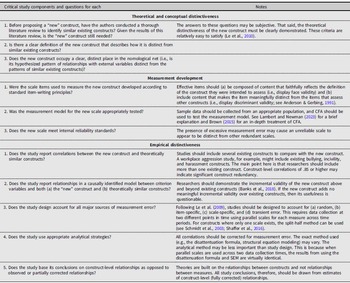
In the current focal article, we consider the effects that construct proliferation has had—and is having—on the field of I-O psychology. We explain that construct proliferation is occasionally “good,” usually “bad,” largely inevitable, and often incentivized (see Gray & Cooper, Reference Gray and Cooper2010). We then discuss what our field should do to address construct proliferation. We recommend that “new” constructs should be subjected to increased scrutiny prior to being introduced, and we provide a checklist that authors, journal editors, and reviewers can use to judge whether a given paper has sufficiently addressed the possibility of construct proliferation (see Table 1). Ultimately, we call for a moratorium on the introduction of new constructs into the I-O psychology literature until steps are taken to greatly reduce the occurrence of construct proliferation.
Checklist for Determining if a New or Existing Paper Has Adequately Addressed Construct Proliferation

Table 1 Long description
The table presents critical study components and questions for evaluating construct proliferation in industrial-organizational (I-O) psychology. It is divided into three main sections: Theoretical and conceptual distinctiveness, Measurement development, and Empirical distinctiveness. Each section lists specific questions to assess the validity and necessity of new constructs. For Theoretical and conceptual distinctiveness, it asks if a thorough literature review was conducted, if the new construct is clearly defined, and if it occupies a distinct place in the nomological net. For Measurement development, it inquires about the development of scale items according to standard principles, the testing of the measurement model, and internal reliability standards. For Empirical distinctiveness, it examines correlations with similar constructs, relationships in a causally identified model, accounting for measurement error, appropriate analytical strategies, and basing conclusions on construct-level relationships. Each question is accompanied by notes providing guidelines and references for further reading.
What are constructs and why are they important?
As a basis for discussing construct proliferation, it is important to first consider the role played by “constructs,” which include psychological events, experiences, and processes. Although most psychological constructs are not “directly observable but… can be inferred from observed or measured data” (American Psychological Association, 2018), one of the primary goals of psychology is the development of theories that accurately describe and predict these constructs. Relationships between constructs constitute “the building blocks of theory” (Schmidt & Hunter, Reference Schmidt and Hunter1999, p. 183). Consider job satisfaction—one of the most widely studied topics in I-O psychology (Spector, Reference Spector2022). Theories of job satisfaction are built upon the relationships between job satisfaction and its hypothesized predictors (e.g., job characteristics, worker personality traits) and consequences (e.g., job performance, turnover intention). In addition, theories of job satisfaction can explain why (mediation) and when (moderation) job satisfaction results in particular outcomes. Each of the components of job satisfaction theory—its predictors, consequences, mediators, and moderators—are “constructs.”
When does construct proliferation occur?
Construct proliferation occurs when a researcher introduces an ostensibly unique construct that is, in fact, redundant with one or more existing constructs (Harter & Schmidt, Reference Harter and Schmidt2008; Le et al., Reference Le, Schmidt, Harter and Lauver2010; Shaffer et al., Reference Shaffer, DeGeest and Li2016). For a given construct to be considered unique, it must satisfy two requirements. First, it must be defined in a way that is conceptually distinct from other existing constructs. Thus, construct proliferation can occur when researchers introduce a “new” construct that shares too much theoretical, conceptual, or definitional overlap with an existing construct. Because I-O researchers typically have high levels of conceptual, rhetorical, and verbal ability, construct proliferation due to conceptual overlap occurs infrequently (Le et al., Reference Le, Schmidt, Harter and Lauver2010).
Second, the construct must be empirically distinct from existing constructs. Thus, construct proliferation can also occur when studies of “new” constructs fail to implement a rigorous research design that can account for all major sources of measurement error (i.e., random, item-specific, scale-specific, and transient error; Le et al., Reference Le, Schmidt and Putka2009). In virtually all situations, measurement error artificially attenuates observed relationships between measures (Hunter & Schmidt, Reference Hunter and Schmidt2004). The presence of measurement error, therefore, can create the illusion that a “new” construct is empirically distinct from an existing construct, when in fact the “new” and existing constructs are indistinguishable. Because the vast majority of studies are not designed to account for all major sources of measurement error, construct proliferation due to empirical overlap between constructs occurs much more frequently than it does due to conceptual overlap.
Why does construct proliferation occur?
As we review in the current section, several forces conspire to produce construct proliferation (see Gray & Cooper, Reference Gray and Cooper2010). And because those forces transcend time, construct proliferation is likely to be a persistent phenomenon. Researchers, therefore, must remain vigilant.
Scientific curiosity
The first potential cause of construct proliferation that we consider is a noble one—one born from scientific curiosity. Many I-O researchers enter the field because they wish to pursue interesting scientific questions, explore new topics, and find novel ways to address work-related challenges and opportunities. At their core, most of us hope to advance the field and make the world a better place. As part of the exploration process, we often strive to examine topics in new ways and discover new phenomena, with the goal of adding to the larger body of scientific knowledge. But in the midst of this enthusiasm, we sometimes “discover” new constructs that already exist under another name. This phenomenon, of course, is not unique to I-O psychology. In the early 2000s, for example, paleontologists unearthed a seemingly new species of dinosaur that, in a playful nod to the bestselling Harry Potter book series, was given the name Dracorex hogwartsia. Later analyses, however, determined that D. hogwartsia was in fact a juvenile Pachycephalosaurus (Goodwin & Evans, Reference Goodwin and Evans2016). The “new” dinosaur species, in the end, was not so new. Situations like these arise when, in good faith, scientists dare to push the boundaries of existing knowledge.
As a part of scientific curiosity, a given scientific discipline may present a new, ostensibly improved construct to coexist with an existing construct it perhaps was supposed to replace. This may occur in part because of historical drift in the conceptualizations of definitions (Ross et al., Reference Ross, Toth, Heggestad and Banks2025) or even cascading adaptation of psychometrically validated scales where items become less and less representative of constructs over time (Heggestad et al., Reference Heggestad, Scheaf, Banks, Hausfeld, Tonidandel and Williams2019). This problem can be further exacerbated when different disciplines that have introduced similar constructs fail to communicate with each other (Heggestad et al., Reference Heggestad, Voss, Ross, Toth, Banks and Canevello2023).
The pursuit of citations
Construct proliferation can also result from the pursuit of a high citation count. As many researchers are aware, an article that introduces a novel construct may be cited hundreds or thousands of times (e.g., Duckworth et al., Reference Duckworth, Peterson, Matthews and Kelly2007; Tepper, Reference Tepper2000; Zhang et al., Reference Zhang, Waldman, Han and Li2015). Knowing this, researchers may be tempted to introduce their own “new” constructs. And it’s hard to fault them, because researchers are often rewarded for achieving high citation counts. Promotion and tenure packets, for instance, often reference a candidate’s citation count, as do nominations for professional distinctions (e.g., SIOP fellowship). Journals are also rewarded for publishing papers that attain high citation counts. A high citation count will increase a journal’s impact factor, thus contributing to its perceived status within the discipline.
Differences in academic and lay perspectives
Construct proliferation may also occur when researchers make distinctions between constructs that most research participants wouldn’t make (Le et al., Reference Le, Schmidt, Harter and Lauver2010; Le & Pan, Reference Le and Pan2021; Shaffer et al., Reference Shaffer, DeGeest and Li2016). When developing scales for a new construct, researchers often rely on subject matter experts (SMEs) such as professors, I-O practitioners, or doctoral students to evaluate item content. Drawing from their formal training in I-O psychology, these SMEs may easily detect minute differences between highly similar items. Consider the following items drawn from measures of transformational leadership, servant leadership, and ethical leadership, respectively: My supervisor considers the moral and ethical consequences of decisions (this item concerns decision making as opposed to treatment of individual employees, and it reflects only the consideration of consequences but not actual behaviors); My supervisor holds employees to high ethical standards (this items involves the expectations placed on employees but not the treatment of those employees or the actual ethical behavior of the supervisor); My supervisor sets an example of how to do things the right way in terms of ethics (this item directly deals with the ethical behaviors exhibited by the supervisor). SMEs with formal I-O training may be able to parse the differences among these very similar leader behavior items; however, it is unlikely that the typical worker would make such fine-grained distinctions. Instead, workers may respond to these items based on their overall, general evaluation of the extent to which their supervisor behaves ethically. As a result, ostensibly distinct constructs may often display empirical redundancy.
This raises an important question: Why would I-O researchers make construct distinctions that members of the lay public wouldn’t make? As we noted earlier, researchers and journals are often both rewarded (in the form of high citation counts) for publishing papers that introduce “new” constructs – including “new” constructs that are very similar to existing ones. This incentive system, therefore, encourages the promulgation of small construct distinctions. And once small construct distinctions appear in the literature, researchers may be primed to notice them. People who are unfamiliar with the I-O psychology literature, in contrast, are unlikely to make small distinctions between similar constructs. They simply haven’t been primed to do so.
Measurement error
When a new construct is proposed, researchers should be most interested in the construct-level relationships between it and other similar, existing constructs. When researchers fail to account for measurement error, they may draw incorrect conclusions about the relationships between constructs and, therefore, incorrect conclusions about the theoretical frameworks that include those constructs. Because measurement error generally attenuates the relationship between observed scores on measures, the presence of measurement error may create the illusion that a construct is empirically distinct from an existing construct, when it is in fact redundant. Measurement error, in fact, may cause researchers to tolerate the prolonged existence of an apparently “unique” construct that is in fact redundant with one or more existing constructs. Other researchers have provided detailed guidelines and examples of how to simultaneously account for all types of measurement error, a topic we revisit in our recommendations section. For methodological details and examples, we refer interested readers to Le et al. (Reference Le, Schmidt and Putka2009, Reference Le, Schmidt, Harter and Lauver2010) and Le and Pan (Reference Le and Pan2021).
The natural arc in the development of a “new” construct
The natural arc in the development of an ostensibly “new” construct may also contribute to construct proliferation. When a construct is first introduced, researchers may have good reason to believe that it is indeed distinct from existing constructs (see Newman et al., Reference Newman, Harrison, Carpenter and Rariden2016). An initial factor analysis, for instance, may suggest that items assessing the new construct load onto one factor, whereas items assessing an existing construct load onto a second factor. Subsequent research, however, may show that the “new” construct is largely redundant with the existing construct. There a several reasons why subsequent research may contradict initial findings. The initial research, for instance, may have omitted an existing construct that subsequent research shows is redundant with the ostensibly “new” construct.
The zeitgeist effect
Construct proliferation may also occur when a general zeitgeist independently inspires different research teams to introduce similar constructs (see Gergen, Reference Gergen1973). The abundance of several conceptually similar workplace aggression constructs, for instance, may be a product of this zeitgeist phenomenon (for reviews of the abundance of similar workplace aggression constructs, see Bowling et al., Reference Bowling, Camus, Blackmore, Perrewé, Halbesleben and Rosen2015; Dhanani & Bogart, Reference Dhanani and Bogartin Press; Hershcovis, Reference Hershcovis2011). Around the year 2000, various research teams introduced several workplace aggression constructs including “abusive supervision” (Tepper, Reference Tepper2000), “workplace incivility” (Cortina et al., Reference Cortina, Magley, Williams and Langhout2001), and “social undermining” (Duffy et al., Reference Duffy, Ganster and Pagon2002). Might there be some larger cultural force that caused different research teams to independently propose similar workplace aggression constructs? And might the same cultural force have made journal reviewers receptive to research examining various forms of workplace aggression? One possibility is that a widespread cultural shift toward increased informality (see Andersson & Pearson, Reference Andersson and Pearson1999) may have caused researchers and reviewers to prioritize the publication of research on workplace aggression constructs. And if different research teams simultaneously initiate research on various aggression constructs, then they are likely to be unfamiliar with each other’s work and may thus unknowingly introduce overlapping constructs.
Different disciplines often introduce smilar constructs
Construct proliferation may also occur when one discipline introduces an ostensibly “new” construct that is essentially identical to a construct that already exists within another discipline. This cause of construct proliferation is most likely to occur when entrenched research silos inhibit communication among researchers from different disciplines (Heggestad et al., Reference Heggestad, Voss, Ross, Toth, Banks and Canevello2023; Loignon & Woehr, Reference Loignon and Woehr2018). Loignon and Woehr’s research on social class provides a possible example of this source of construct proliferation. In their literature review, they identified at least 14 constructs subsumed by the general term “social class.” Many of the constructs they reviewed were at least partially redundant (e.g., “social capital” and “cultural capital” may be partially redundant). The fact that social class is studied by researchers from multiple disciplines, including sociology, political science, and I-O psychology, is a possible reason for the abundance of potentially redundant social class constructs.
Illusory construct redundancy: The effects of common-method variance
Earlier, we discussed how the presence of measurement error could cause two redundant constructs to appear to be empirically distinct (i.e., attenuation effects). Omitted variables, in the form of shared omitted causes, can also make theoretically different constructs appear empirically indistinguishable. One of the most frequently discussed manifestations of this is driven by common-method variance (CMV), which could produce an effect in which two distinct constructs appear to be empirically redundant (i.e., inflation effects; see Podsakoff et al., Reference Podsakoff, MacKenzie, Lee and Podsakoff2003, Reference Podsakoff, Podsakoff, Williams, Huang and Yang2024; Spector, Reference Spector2006). CMV reflects variance associated with the measurement method one has used (an omitted variable), as opposed to the underlying constructs one wishes to assess. Among I-O psychology researchers, CMV is most often a concern when one examines the relationship between constructs that were all assessed using self-report measures. Researchers have generally assumed that the method variance shared by two or more self-report measures typically produces observed correlations that overestimate the true underlying relationships between those constructs. The reason for a large observed correlation between self-report measures, therefore, is often unclear: Is a large correlation the result of construct redundancy? Or is it the result of CMV? Fortunately, researchers can apply several techniques to help minimize the effects of CMV (e.g., the use of multisource research designs, temporal separation, or a psychological separation intervention; see Podsakoff et al., Reference Podsakoff, MacKenzie, Lee and Podsakoff2003; Rubenstein et al., Reference Rubenstein, Simon, Kammeyer-Mueller, Corwin, Morrison and Whiting2025).
The effects of construct proliferation
Construct proliferation has both positive and negative effects that are evident during different stages in the development of a given research topic. During early developmental stages, proliferation may be beneficial (Whetten, Reference Whetten1989). In fact, when researchers first examine new phenomena, construct proliferation is largely inevitable as multiple “new” constructs are introduced as part of that examination. With time, however, the field will ideally winnow down the number of “new” constructs as theories addressing a given phenomenon become more developed. The accumulation of similar constructs without effort to integrate or empirically test the distinctiveness of those constructs is problematic. Construct proliferation, therefore, most often has negative effects on scientific progress. Before discussing these negative effects, we first consider the limited number of situations in which construct proliferation has positive effects.
The positive effects of construct proliferation
First, as we noted above, construct proliferation is likely to occur when researchers initially describe the content space of “new” phenomena (i.e., it is part of the natural arc of construct development). During this early phase, researchers may have only preliminary ideas of what is and what is not part of the construct in question. These preliminary ideas are often refined over time. The five-factor model (FFM) of personality, for instance, came only after decades of work in which multiple researchers introduced many similar personality constructs. Digman (Reference Digman1990) recounted how the initial proliferation of personality constructs was later synthesized into the FFM. He noted how the related constructs “will to achieve,” “dependability,” “task interest,” “superego strength,” “thinking introversion,” “prudence,” “work,” “impulsivity,” “constraint,” and “self-control” were later subsumed by the FFM trait “conscientiousness,” the inclusive FFM label that was adopted by Norman (Reference Norman1963) and McCrae and Costa (Reference McCrae and Costa1987). Subsequent research documented the importance of conscientiousness within work settings. Barrick and Mount (Reference Barrick and Mount1991), for instance, found that conscientiousness was positively related to task performance across all jobs, helping to cement the acceptance of the FFM taxonomy among I-O psychologists. In short, the history of the FFM illustrates how the exploration of personality traits initially produced numerous redundant constructs that helped researchers triangulate distinct constructs that gradually coalesced into the FFM personality factors. The FFM is now one of the most influential and widely accepted models of personality, with the redundant constructs becoming obsolete.
Second, the introduction of ostensibly new constructs can cause researchers to reconsider the content space of an existing construct. It can, in other words, help researchers clarify what is—and what is not—part of a given construct, thus leading to refinement of the definition and assessment of that construct (i.e., improvements in content validity). In some cases, the introduction of a new construct may cause researchers to expand an existing construct’s conceptual space. In other cases, the introduction of a new construct may cause researchers to contract an existing construct’s conceptual space. The introduction of the counterproductive work behavior (CWB) construct, for instance, had a contraction effect on the (existing) organizational citizenship behavior (OCB) construct: Although early conceptualizations of OCB included content reflecting the avoidance of bad behavior (e.g., not taking an excessively long lunch break), researchers have since migrated this content from the OCB construct to the newer CWB construct (see Dalal, Reference Dalal2005).
Furthermore, the introduction of a new construct is sometimes needed to address emerging opportunities and challenges that are relevant within the modern workplace. In many cases, the new construct is an adapted version of an existing construct. The increased prevalence of gig work, for instance, has led to the introduction of new constructs reflecting the perceived fairness of various aspects of algorithmic management systems (see Jabagi et al., Reference Jabagi, Croteau, Audebrand and Marsan2025). These new fairness constructs are adapted from existing organizational justice constructs. Likewise, the growing use of robots, artificial intelligence, and automation has led to the introduction of new constructs that reflect workers’ perceptions that such technology threatens to replace human workers (see Shoss & Ciarlante, Reference Shoss and Ciarlante2022). In this case, these new constructs are based on existing conceptualizations of job insecurity.
Finally, the introduction of ostensibly “new” constructs can generate healthy conflict among researchers. Conflict may occur, for instance, when researchers disagree about whether a new construct is distinct from existing constructs. Researchers should resolve such a conflict by conducting studies that examine the distinctiveness of the new construct. Such research can provide important insights into the nature of both the new and existing constructs. It may, for instance, show that the new construct is either unique or redundant, and it may lead to either the expansion or contraction of the existing construct’s content space. Our field, therefore, should encourage disagreement over constructs because such conflict acts as a catalyst for scientific progress (see Kuhn, Reference Kuhn1962).
The negative effects of construct proliferation
As we briefly mentioned above, the most basic goal of science is to predict and explain phenomena, with those predictions and explanations guiding the development of theoretical propositions that make sense of the world around us. Ideally, scientific theories should be as parsimonious as possible, with more complicated theories and nomological networks used only when necessary. Construct proliferation introduces unnecessary complexity to our theoretical models. If “simple theories are superior to complex ones” (Shaffer et al., Reference Shaffer, DeGeest and Li2016, p. 81), then the net result of construct proliferation is to reduce the quality, validity, and applicability of the predictions and explanations that our field offers. Construct proliferation makes it more difficult for I-O researchers to work together, to build off the work of others, and to accumulate knowledge across studies. Although the problem of construct proliferation affects all disciplines within psychology, some of those negative effects appear to be especially common within I-O psychology. As we mentioned above, the number of constructs included in I-O psychology has more than doubled since 2013 (Anvari et al., 2024). In addition, the field of I-O psychology has been the most fragmented of five psychology subdisciplines (including cognitive, educational and developmental, health and clinical, and personality and social psychology) for over 20 years. It thus appears that despite the attention that I-O researchers have given to construct proliferation, the field continues to move away from parsimony, not toward it.
Beyond the basic goals of science, perhaps the most important purpose of I-O psychology is to develop interventions that improve the well-being and productivity of individual employees and the success of their employers. The presence of construct proliferation, unfortunately, makes it difficult for practitioners to interpret and implement the recommendations provided by I-O researchers, thus causing stakeholders to look elsewhere for solutions to the challenges that their organizations face. Often, these stakeholders will look to solutions that are clearly communicated but are not necessarily supported by theory or empirical evidence. As Rousseau (Reference Rousseau2007) noted, “Organizational science competes in the marketplace for ideas against consultants whose job it is to sell solutions. Can science compete effectively? My answer is, yes, but…Yes, but only when the quality of our research evidence is made more evident to practitioners” (p. 1041). Burgess et al. (Reference Burgess, Brough, Biggs and Hawkes2020) wrote in reference to organizational health psychology (OHP) interventions that “it is evident that published OHP interventions have to date, been largely unsuccessful in demonstrating their long-term effectiveness in reducing the growing costs of occupational stress and well-being” (p. 195). The authors name construct proliferation as one contributing factor to the inability of research to demonstrate convincing effects of OHP interventions. Overall, the presence of construct proliferation reduces the quality of I-O research and the subsequent solutions that we bring to organizations.
Finally, construct proliferation diminishes the overall credibility of I-O psychology. The credibility of psychological science more generally has been disputed for at least 100 years. As early as Reference Stewart1876, Stewart concluded that psychology was not a science but a method, writing that the psychologist “is painfully conscious that mental phenomena are not definite enough to be the objects of a science” (p. 445). Contemporary critics of psychology draw similar conclusions: “That’s right. Psychology isn’t science” (Berezow, Reference Berezow2012). Berezow similarly suggests that, as a field, psychology lacks “clearly defined terminology” and “quantifiability.” The presence of construct proliferation, unfortunately, gives critics further reason to question psychology’s ability to precisely define and measure key constructs. Furthermore, a lack of clear construct definitions and measurement contributes to the current “replication crisis” (Maxwell et al., Reference Maxwell, Lau and Howard2015; Shrout & Rodgers, Reference Shrout and Rodgers2018), which affects not just I-O psychology but all areas of psychology.
Workplace aggression: A case example of the effects of construct proliferation
The developmental arc of the workplace aggressionFootnote 1 construct provides a noteworthy example of both the positive and negative effects of construct proliferation. Beginning in the 1980s, Spector and his colleagues (see Chen & Spector, Reference Chen and Spector1991; Spector, Reference Spector1987; Spector et al., Reference Spector, Dwyer and Jex1988) introduced an early conceptualization of workplace aggression from the target’s perspective, which they referred to as “interpersonal conflict”—a behavior that reflects “how often people experience disagreements or are treated poorly at work” (Spector et al., 1998, p. 358). Interpersonal conflict remained the primary conceptualization of workplace aggression until the late 1990s, when researchers began to introduce a series of ostensibly “new” workplace aggression constructs. These new constructs include “incivility” (Andersson & Pearson, Reference Andersson and Pearson1999), “abusive supervision” (Tepper, Reference Tepper2000), “social undermining” (Duffy et al., Reference Duffy, Ganster and Pagon2002), and “workplace ostracism” (Ferris et al., Reference Ferris, Brown, Berry and Lian2008). As we argue below, the proliferation of these workplace aggression constructs has produced both beneficial and harmful effects.
Beneficial effects of the proliferation of workplace aggression constructs
The introduction of new constructs has provided researchers with a broader understanding of workplace aggression’s content space, thus leading to novel insights that may have otherwise been omitted from the workplace aggression literature. The addition of abusive supervision, for instance, has led researchers to consider the distinct effects of aggression from different sources (supervisors vs. peers; see Hershcovis & Barling, Reference Hershcovis and Barling2010). Similarly, the addition of workplace ostracism has caused researchers to more fully consider the importance of passive, low-intensity forms of aggression (e.g., the perpetrator ignoring the target employee; see Howard et al., Reference Howard, Cogswell and Smith2020). Without the expansion of the workplace aggression literature beyond the confines of the interpersonal conflict construct, these examples of scientific progress may have never occurred.
Harmful effects of the proliferation of workplace aggression constructs
Although the addition of new constructs has provided researchers with broader insights into the workplace aggression construct’s content space, it has also produced one undesirable effect: the introduction of construct redundancy (see Bowling et al., Reference Bowling, Camus, Blackmore, Perrewé, Halbesleben and Rosen2015; Hershcovis, Reference Hershcovis2011). There is, in fact, extensive evidence that construct redundancy is a serious problem within the workplace aggression literature. First, measures designed to assess ostensibly distinct workplace aggression constructs often share considerable similarity in item content. Items reflecting social isolation, for example, are included in measures corresponding to various forms of workplace aggression, including abusive supervision, bullying, incivility, ostracism, and social undermining (see Bowling et al., Reference Bowling, Camus, Blackmore, Perrewé, Halbesleben and Rosen2015). Furthermore, ostensibly distinct forms of workplace aggression appear to reside within largely the same nomological network. Workplace bullying, incivility, and interpersonal conflict, for instance, are each similarly correlated with a common set of criterion variables (e.g., each aggression construct yields similar-sized negative correlations with job satisfaction, psychological well-being, and physical well-being; see Hershcovis, Reference Hershcovis2011). It appears, therefore, that the workplace aggression literature has needlessly distinguished between largely indistinguishable constructs.
Workplace aggression: A literature in limbo
As we have noted in the previous sections, the proliferation of workplace aggression constructs has produced both beneficial and harmful effects. Workplace aggression researchers, however, have yet to fully capitalize on the opportunities—or resolve the limitations—created by construct proliferation. Fortunately, the path toward progress is clear: Researchers must simply use a set of well-established tools (e.g., item sort tasks, factor analysis) to examine the structure of the workplace aggression construct. Such studies would help researchers identify which construct distinctions they should and should not continue to make. In the absence of such studies, the field will continue to tolerate the presence of redundant workplace aggression constructs.
The fact that researchers have taken few steps toward resolving construct proliferation within the workplace aggression literature is itself noteworthy. As we have already discussed, the existence of construct proliferation within the workplace aggression literature was documented over a decade ago (see Bowling et al., Reference Bowling, Camus, Blackmore, Perrewé, Halbesleben and Rosen2015; Hershcovis, Reference Hershcovis2011), and the tools needed to address this problem are readily available (e.g., factor analysis). Given these facts, why haven’t workplace aggression researchers done more to address construct proliferation? One plausible explanation is that researchers have concluded that attempts to address construct proliferation provide too few rewards while posing too many risks. Our discipline, after all, rewards researchers—often handsomely—for introducing “unique” ideas (Gray & Cooper, Reference Gray and Cooper2010). As a result, researchers may generally focus their collective attention on introducing new constructs. That attention, as a result, is diverted from the synthesis and refinement of existing constructs. Furthermore, those who conduct research examining the redundancy of previously enshrined constructs face professional risks. Such research, after all, could lead to the demise of one or more existing constructs. Researchers, therefore, may often be hesitant to address construct proliferation because they wish to avoid insulting colleagues who are wedded to a given workplace aggression construct.
A call to action
In the prior sections, we described what construct proliferation is, why and how it occurs, and we considered both its positive and negative effects. Given the extent to which the I-O field is fragmented, and given the numerous overlapping constructs extant in the field, we would argue that the negative effects of construct proliferation are more pervasive than the positive ones. In addition, given the advanced maturity of the I-O field, the limited potential benefits of construct proliferation are far outweighed by its costs. To make meaningful progress toward reducing the number of redundant constructs in the I-O psychology literature, however, requires more than just awareness of the presence of construct proliferation; instead, it requires sustained effort from individual researchers and from scientific institutions, including our peer-reviewed journals. We acknowledge that the nature of work and I-O research is evolving—generational differences between work orientations are becoming more apparent, the use of AI and subsequent displacement of workers is growing, and the understanding of human psychology continues to advance. New constructs may be needed to address emerging issues in I-O psychology. However, until our field implements systematic efforts to address construct proliferation, we call for a moratorium on the introduction of new constructs into the I-O psychology literature. These efforts, as we describe below, should include several initiatives: (a) the development and implementation of specific guidance for papers that propose “new” constructs, (b) the publication of special issues on construct proliferation (c), the willingness of journals to publish replications of papers that presented “new” constructs, and (d) the integration of construct proliferation topics into graduate training. Registered reports are a particularly useful tool here as researchers can propose a meaningful set of research questions related to redundancy, receive a priori feedback, and the findings can be published regardless of the outcome (for a review of this method, see Briker & Gerpott, Reference Briker and Gerpott2023).
Specific criteria for papers that propose “new” constructs
Before lifting a moratorium on the introduction of new constructs, journals should create specific criteria that address how prospective authors should examine whether a given focal construct is sufficiently distinct from existing constructs. In keeping with our previous recommendations, such criteria should require researchers to include an inclusive set of competing constructs, include outcome measures, collect data at least two different points in time, use multiple measures for each construct whenever possible (or the split-half method for constructs with only one valid scale as demonstrated in Schmidt et al., Reference Schmidt, Le and Ilies2003), correct fully for measurement error, and replicate their findings across multiple datasets.
Such criteria would serve two primary purposes. First, they would provide authors with guidance in conducting research. Authors could use these criteria to guide their attempts to demonstrate that an ostensibly “new” construct is, in fact, distinct from existing constructs. They could also use these criteria to guide their efforts to challenge the distinctiveness of a “new” construct advanced by other researchers. Second, the criteria could provide reviewers and editors with guidance on judging whether a given submission has effectively tested the distinctiveness of a new construct.
As a starting point, Table 1 provides a list of criteria that we recommend authors use to judge whether they have adequately assessed the uniqueness of an ostensibly new construct they have introduced. (Table 1 can also be used to evaluate whether previously published papers have adequately assessed the uniqueness of a new construct.) We recommend that journals in our field adopt such a checklist and make it open and available to authors, editors, reviewers, and practitioners. Prior to submitting an article that proposes a new construct, authors could indicate whether their paper conforms to the checklist. During the review process, editors and reviewers would also compare the checklist to the paper to confirm alignment. If such a checklist were universally adopted by our journals, then construct proliferation would decrease, and researchers and practitioners could be confident that new constructs had been subjected to adequate scrutiny.
Special issues
We also encourage journals to publish special issues on construct proliferation. Articles included in special issues are often highly cited (Brooks & Della Sala, Reference Brooks and Della Sala2010), so the publication of one or more special issues on construct proliferation may help to further increase our field’s collective awareness of this issue. Furthermore, the publication of special issues would serve as a clear signal that I-O psychologists consider the resolution of instances of construct proliferation to be an institutional priority. Special issues on construct proliferation could take various forms. A journal that publishes papers on substantive I-O topics, for instance, could publish a special issue that examines construct proliferation within one or more topical areas. Depending on the breadth of the journal’s scope, such an issue could include research addressing construct proliferation within a single area (e.g., an occupational health psychology journal could publish a special issue on construct proliferation within the occupational stress literature) or research addressing construct proliferation across various areas (e.g., an I-O journal with an inclusive scope could publish a special issue on construct proliferation across the discipline as a whole).
The editors of a special issue on construct proliferation could encourage the submission of papers resulting from adversarial collaborations (Ceci et al., Reference Ceci, Clark, Jussim and Williamsin Press; Clark & Tetlock, Reference Clark, Tetlock, Frisby, Redding, O’Donohue and Lilienfeld2023). A paper that uses this collaborative approach would include authors who initially have conflicting opinions about the uniqueness of the construct in question (i.e., one or more members of the author team would hypothesize that the construct is unique, whereas other members of the author team would hypothesize that the construct is redundant with existing constructs). In some cases, the editorial team could first identify possible cases of construct redundancy and then recruit specific authors who have expertise in the construct(s) of interest. In other cases, the editorial team could publish a general call for papers asking prospective authors to create adversarial teams. To encourage submissions from adversarial collaborations, the editorial team could offer an in-principal acceptance of any paper resulting from such a collaboration, provided that it satisfies various predetermined criteria, such as the examination of a meaningful instance of possible construct redundancy, the application of multiple tools to test for the presence of construct proliferation, and the inclusion of multiple datasets, causally identified nomological networks, and the preregistration of their study.
Publishing replications
To help identify and eliminate unnecessary constructs, our journals must adjust their standards for evaluating replication studies. When a given journal publishes a paper that introduces a new construct, that journal should be open to publishing subsequent challenges to the distinctiveness of that construct. Unfortunately, replications are rarely published in our most prestigious journals (for an exception, see the award-winning paper by Obenauer et al., Reference Obenauer, Sieweke, Bastardoz, Arvate, Gazdag and Hentschel2024, as well as an entire special issue on replications, see Carsten et al., Reference Carsten, Clapp-Smith, Haslam, Bastardoz, Gooty, Connelly and Spain2023). If a journal publishes an article that introduces a “new” construct, it is unlikely that the same journal would later publish an article showing that the “new” construct is redundant with a previously existing one. As a result, the introduction of an unnecessary construct can be difficult to correct.
Journals currently demand that replication studies provide a meaningful theoretical contribution. Contributing to theory is important, but not when it comes at the expense of comprehensive replication, self-correction, and parsimony—all of which hallmarks of good science. In the context of construct proliferation, methodologically sound empirical testing may be even more important than novel theoretical contributions. Practitioners are interested in solutions, and the consultants with which I-O researchers compete do so based on practical results and not theory. If a strong theoretical contribution is imposed as a prerequisite to the self-correction processes, then we risk placing ourselves at a significant disadvantage within the marketplace of ideas.
Graduate program curricula initiatives
Graduate training can provide novice I-O researchers with the knowledge, skills, and professional values needed to address the construct proliferation dilemma. Formal coursework should play an important role. Research methods and statistics courses should demonstrate how various tools that are generally familiar to I-O psychologists, such as content validation tasks (see Woznyj et al., Reference Woznyj, Banks, Whelpley, Batchelor and Bosco2022, Studies 1 and 2), can be used to develop construct measures that are unique from others. Graduate programs should also provide a holistic understanding of the impact of measurement error on construct relationships – including approaches to address measurement error, such as the disattenuation formula and factor analysis. Likewise, instructors of content courses should assign research articles that discuss construct proliferation broadly (e.g., Harter & Schmidt, Reference Harter and Schmidt2008) and within specific topical areas (e.g., Banks et al., Reference Banks, Gooty, Ross, Williams and Harrington2018; Hershcovis, Reference Hershcovis2011; Woznyj et al., Reference Woznyj, Banks, Whelpley, Batchelor and Bosco2022). Reading these and other papers that examine construct proliferation within a particular topical area could inspire students to consider possible instances of construct redundancy within other research areas, and these articles could serve as models for students to draw from if they later decide to pursue research on construct proliferation.
Formal coursework, however, is not the only possible means through which students could learn about construct proliferation. They could, for example, also learn about it via their program’s recurring speaker series, while studying for their comprehensive exams, or while working on research projects with faculty or other graduate students. Ideally, a graduate program would use repetition to inculcate within its students an appreciation for the challenges and opportunities posed by construct proliferation. This may require that a graduate program address construct proliferation by covering it within multiple venues. In our view, graduate students should be taught to be vigilant about construct proliferation in much the same way they are taught to be vigilant about common-method bias or about the limitations of drawing causal inferences from nonexperimental data. The Advancement of Replications Initiative in Management (ARIM; www.arimweb.org) provides one opportunity to help promote such efforts.
Recommendations for practitioners
Until there exists convincing evidence that a purportedly new construct adds meaningful explanatory, predictive, and economic value above and beyond existing constructs, we recommend that practitioners adopt a healthy amount of skepticism regarding “new” constructs. Practitioners may, for example, believe it valuable to learn about and assess employee engagement, with efforts focused on older concepts like job satisfaction being outdated. The empirical similarity between job satisfaction and employee engagement, however, “suggests that little new is being brought to the table by engagement researchers” and that focusing on the term “is unlikely to lead to new conceptualizations or understanding of employees’ reactions to the many characteristics of their work organizations” (Newman et al., Reference Newman, Joseph, Hulin and Albrecht2010, p. 43). If an organization already assesses employee satisfaction, beyond becoming familiar with the concept of employee engagement, the organization may find little utility or economic value in investing in assessments of employee engagement when their current assessment programs are equally as valuable. Relatedly, consider an organization that invests resources in developing new interventions that focus on employee engagement, as opposed to using existing interventions that focus on job satisfaction. It would likely be expensive to create, pilot, and implement such an intervention. If job satisfaction and employee engagement are redundant constructs, then the organization may not realize a return on that investment.
We can draw a parallel in the physical sciences: Einstein’s theory of gravity is more accurate than Newton’s, especially for predicting how celestial bodies behave across great distances; however, calculations based on Newtonian mechanics are accurate enough to send humans to the moon and return them safely to earth. For an astrophysicist, calculations based on Einstein’s theory of gravity may be the most useful. But for a NASA engineer, calculations based on Newtonian theory produce the desired results. Similarly, for all practical purposes, how would an intervention designed around employee engagement look any different from one designed around job satisfaction? Does the construct of employee engagement represent a meaningful advancement for the field of I-O psychology? For an I-O scholar, that may be the case. For an I-O practitioner, however, existing interventions built around the construct of job satisfaction are likely to produce the same results without requiring additional developmental resources. In this case, there may be no need to reinvent the wheel.
Summary
Our hope is that this paper will increase awareness of the challenges and opportunities posed by construct proliferation. Although construct proliferation can have positive effects within emerging scientific fields, its long-term effects are largely negative. I-O psychology, however, is a mature field that has reached a point at which construct proliferation must be addressed. If construct proliferation remains largely ignored, then the field will continue to grow more complicated, fragmented, and arcane. As Pfeffer (Reference Pfeffer1993) wrote, “consensus is a critical precondition to scientific advancement” (p. 600). We recognize that the process of addressing construct proliferation and achieving higher levels of consensus about various constructs will be difficult; however, doing so will advance the scientific contributions and credibility of I-O psychology.

 Open access

