


There has been a great improvement in higher specialist training in child and adolescent psychiatry in recent years, based on the Child and Adolescent Psychiatry Specialist Advisory Sub-committee advisory papers. 1 One of the key areas identified by the Royal College of Psychiatrists, 2 the Postgraduate Medical Education and Training Board, Reference Bhugra3 and recommendations from the Children Act and the Mental Health Act in Children and Adolescents in Psychiatric Settings (CAMHA-CAPS), Reference Mears and Worrall4 is understanding of legislation (i.e. the Children Act 1989, Mental Health Act 1983, consent, parental responsibility and restriction of liberty).
Most of the deaneries have comprehensive academic programmes and regional courses tailored to the needs of the trainees; however, that does not mean that we should stop making efforts to improve the level of specialist training currently being provided. In March 2003, the training programme director in North Western Deanery decided to evaluate training needs, following which this survey was conducted in November 2005.
The survey was conducted as part of a baseline assessment of trainees’ needs following discussions in the specialist training sub-committee. The aims were to examine the knowledge of the basic legal framework in a group of specialist registrars in child and adolescent psychiatry in the North Western Deanery, understand the training needs in this specific area and their implications for the regional academic programme. The survey will be repeated once all the relevant training provisions are in place.
Method
A questionnaire-based survey was completed by a group of specialist registrars in child and adolescent psychiatry in the North Western Deanery covering the legal aspect of child care. An anonymous questionnaire was designed which included 12 questions on experience in forensic psychiatry, the Mental Health Act 1983, the Human Rights Act 1998, the Children Act 1989, capacity to consent, confidentiality, parental responsibility and views on court report writing and being an expert witness. A total of 15 out of 21 specialist registrars in the rotation participated. Most of the specialist registrars were within 15 months of starting their training. The questionnaires from the two specialist registrars conducting the audit were not included in the final analysis and results.
Results
The content analysis of the questionnaire was carried out by two of the authors separately who had originally been in the specialist registrar group: any results that were controversial were considered by them both.
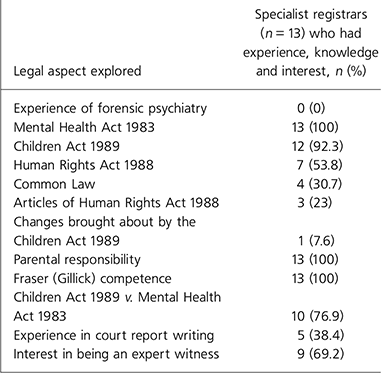
None of the specialist registrars had experience in forensic child and adolescent psychiatry (Table 1). With regard to the legislation having an impact on us as child and adolescent mental health professionals, 13 out of 13 (100%) mentioned the Mental Health Act; 12 (92.3%) specialist registrars mentioned the Children Act; 7 (53.8%) mentioned the Human Rights Act; and only 4 (30.7%) mentioned Common Law. Five (38.4%) didn't know the articles of the Human Rights Act; five (38.4%) said all the articles were relevant, and only three (23%) were familiar with the articles, but were not sure about them. Regarding the changes made in legislation by the Children Act, only two (15.3%) specialist registrars answered the question and only one (7.6%) of them answered correctly.
Results of the questionnaire
| Legal aspect explored | Specialist registrars (n = 13) who had experience, knowledge and interest, n (%) |
|---|---|
| Experience of forensic psychiatry | 0 (0) |
| Mental Health Act 1983 | 13 (100) |
| Children Act 1989 | 12 (92.3) |
| Human Rights Act 1988 | 7 (53.8) |
| Common Law | 4 (30.7) |
| Articles of Human Rights Act 1988 | 3 (23) |
| Changes brought about by the Children Act 1989 | 1 (7.6) |
| Parental responsibility | 13 (100) |
| Fraser (Gillick) competence | 13 (100) |
| Children Act 1989 v. Mental Health Act 1983 | 10 (76.9) |
| Experience in court report writing | 5 (38.4) |
| Interest in being an expert witness | 9 (69.2) |
All of the specialist registrars (100%) were aware of parental responsibility. With regard to Gillick competence, only 1 (7.6%) specialist registrar knew that the name had changed, but 13 (100%) had an understanding of it. Ten (76.9%) specialist registrars correctly answered about the Children Act being less stigmatising than the Mental Health Act and two (15.3%) specialist registrars did not answer the question. Five (38.4%) had written court reports, five (38.4%) did not feel confident about writing the reports; eight (61.5%) felt fairly confident after the 1-day training course arranged by the Deanery. Regarding the overall interest in becoming an expert witness in a Court of Law, nine (69.2%) answered yes.
Discussion
Given pending change in legislation, it has been identified that training in knowledge of legal frameworks is required of specialist registrars, which predominantly consists of junior trainees. This was also reflected by their lack of interest in taking up a role of an expert witness. These findings led to an audit of legal experience available in all the placements, which indicated that most of the placements had some provision; however, specialist registrars were not aware of them.
In March 2006, a child and adolescent psychiatry legal aspect training report was presented to the specialist training sub-committee. 5 This report recommended a programme of training in clinical placements, an academic programme and extra training over a 3-year period that included 3 days extra training and a mini-pupillage scheme which is currently underway. This survey will be repeated once the current group of specialist registrars have finished their rotation.
Declaration of interest
None.


 Open access


eLetters
No eLetters have been published for this article.