




Introduction
American journalist Poultney Bigelow (1855–1954) visited Taipei under Japanese colonial rule prior to the Second World War, describing the city as having developed into a tourist destination comparable to some cities in the United States.Footnote 1 During this period, the Japanese colonial government in Taiwan utilized tourism infrastructure and narratives as symbols to express Japan’s colonial modernity and governance.Footnote 2 After 1945, when the Guomindang (國民黨, GMD) began to govern Taiwan, they too recognized tourism’s potential role in ideological propaganda and national image representation, prompting Taiwan’s tourism agencies to place greater emphasis on promotional activities that would distinguish the island internationally.
Following its retreat to Taiwan in 1949, the GMD continued to claim to be the sole legitimate government of China—the Republic of China (ROC) or ‘Free China’—despite the establishment of the People’s Republic of China (PRC) on the mainland. This claim remained central to Taiwan’s diplomatic identity throughout the early era of the Cold War. As such, any attempt by international bodies to refer to the ROC as merely ‘Taiwan’ was perceived as a denial of its legitimacy and a symbolic victory for the PRC.
This strategic approach to image-making drew upon earlier GMD publicity frameworks. As Jespersen shows, the 1942 ‘China Week’ in New York used themed events and public spectacles to present GMD-led China as a legitimate and modernizing partner on the world stage. During these events, American business leaders emphasized the postwar promise of a ‘Free China’,Footnote 3 while Fortune magazine urged US alignment with a ‘strong, free China closely and equally allied with the U.S.’. casting China’s future as vital to America’s own geopolitical interests.Footnote 4 Although these campaigns were not directly related to tourism, they helped establish ‘Free China’ as a powerful symbolic identity—one that the ROC government would later adapt to shape international perceptions of Taiwan during the Cold War.
Tourism is inherently linked to the projection of a nation’s unique attributes, encompassing its culture, history, and values. While not always explicitly political, tourism often serves as a subtle yet potent means of conveying national identity and shaping collective perceptions, sometimes functioning as informal propaganda. The construction of a destination’s tourist image (TDI) is therefore deeply intertwined with the prevailing political landscape. In postwar Taiwan, the need to distinguish itself from ‘Red China’ became a significant factor in shaping its tourism discourse,Footnote 5 especially during the Cold War when tourism became a tool for different political entities to showcase their image and ideology.Footnote 6 This ideological dimension was complemented by practical institutional developments in Taiwan’s tourism sector.
Following the Second World War, tourism emerged as a vital mechanism for economic reconstruction across Asia. The GMD government in Taiwan quickly implemented various tourism promotion initiatives after relocating to the island. The establishment of the Taiwan Provincial Tourism Commission (臺灣省觀光事業委員會) in November 1956 and the Taiwan Provincial Government’s promulgation of the ‘Taiwan Provincial Tourism Commission Organization Regulations’ in 1957 symbolized the formal institutionalization of Taiwan’s postwar tourism industry.Footnote 7 Complementing these developments, the 1955 ‘Overseas Chinese Investment Regulations’ provided legal protection for foreign investments, further encouraging capital inflow. These institutional foundations facilitated investment from abroad, particularly overseas Chinese participation in hotel infrastructure, simultaneously stimulating economic growth and generating crucial foreign exchange. These foundational economic initiatives were strategically aligned with Taiwan’s broader geopolitical positioning.
During the early postwar period (1945–1955), Taiwan’s geopolitical position was defined by the Cold War context, necessitating careful navigation between China and the United States. To maintain its presence in the international arena, Taiwan’s government cultivated strategic tourism connections with the overseas Chinese community (including Hong Kong and Macau), the United States, and Japan. Notably, the U.S. military rest and recreation programmes (1965–1972) and overseas Chinese perception of Taiwan as a destination for experiencing traditional Chinese culture had significant implications for Taiwan’s tourism infrastructure and related industries during this period.
The international tourism landscape was further shaped by broader diplomatic developments. Cold War studies focused on Eastern Europe have noted that the 1967 International Tourism Year symbolized a mild relaxation in international relations under the slogan ‘Tourism, Passport to Peace’. The rhetoric of ‘peace through tourism’, first popularized in the interwar years and later adopted by the United Nations, promoted tourism as a means to foster international understanding.Footnote 8 However, in East Asia, this UN initiative produced somewhat contrary results, with tourism becoming a competitive arena for political representation. Within this competitive context, Taiwan’s approach to tourism was deeply intertwined with its cultural policies.
When the GMD government took control of Taiwan in 1945, it established ‘cultural reconstruction’ as a primary objective, employing ‘de-Japanization’ and ‘re-Sinicization’ strategies to instil a ‘Chinese national consciousness’ among the populace.Footnote 9 Furthermore, when mainland China launched the Cultural Revolution in 1966, the GMD government strategically initiated the ‘Chinese Cultural Renaissance Movement’, positioning itself as the true heir and guardian of traditional Chinese culture.Footnote 10 As mainland China underwent social reforms in the 1950s and the 1960s Cultural Revolution—characterized by campaigns to destroy ‘old customs, old culture, old habits, and old ideas’—Taiwan deliberately developed tourist attractions and narratives that highlighted ‘Traditional and Cultural China’ as Taiwan’s distinctive feature to attract visitors, particularly overseas Chinese from Hong Kong and Southeast Asia, as well as Japanese and American tourists. This cultural positioning reflected fundamental tensions in Taiwan’s nation-building process.
Allen Chun argues that the core issue in Taiwan’s early postwar nation-building was a fundamental dilemma: invoking ‘traditional’ Chinese culture to construct a ‘modern’ national identity.Footnote 11 With American support, the Republic of China secured legitimacy as the ‘official representative of China’ in international forums, allowing it to focus on internal ‘nationalization’ projects. This process involved using curated elements of Chinese culture—such as Confucian rituals or moral education—as symbolic anchors in educational, ceremonial, and visual public discourses to consolidate a shared sense of national identity.Footnote 12 Importantly, this nationalized Chinese cultural imagination extended beyond domestic audiences through tourism as a vehicle for international projection.
This competition for representing ‘Cultural China’ created a stark contrast between different Chinese societies. While the Hong Kong Tourism Association (established in 1957) marketed itself under the banner ‘The Orient is Hong Kong’, incorporating Chinese cultural elements such as architecture, art, crafts, and folk traditions within an Orientalist framework to attract Western tourists,Footnote 13 Taiwan targeted not only Western visitors but significantly focused on overseas Chinese communities. Taiwan’s tourism promotion deliberately presented the island as a preservation site for Chinese culture, attempting to legitimize the GMD/Republic of China’s claim to represent China proper.
Examination of newspapers from Hong Kong and Southeast Asia reveals Taiwan’s dual strategy: attracting international tourists interested in discovering ‘mysterious China’ while simultaneously appealing to overseas Chinese through tourism activities that showcased ‘Free China’ or ‘Cultural China’. This approach sought to demonstrate Taiwan’s cultural legitimacy to the Chinese diaspora through direct tourism experiences. This strategic deployment of tourism marked a significant departure from Taiwan’s colonial tourism legacy.
It is worth noting that Taiwan’s postwar tourism discourse represented a significant shift from the colonial period. Scholars have identified colonial-era tourism in Taiwan as the origin of modern tourism on the island. Lü Shao-li notes the transformation from exploratory travel to institutionalized tourism as a significant transition in Taiwan’s tourism development. Su Shuo-bin, drawing on sociological perspectives, examines how tourism activities developed under colonialism, exploring how Taiwan simultaneously formed modern tourism social structures—evidenced by tourism discourse and facilities emerging in the 1920s—while also developing distinctly Taiwanese agricultural and festival-based tourism activities. Research on colonial-era tourism in Taiwan has been enriched by diverse perspectives from scholars such as Tsai Long-bao,Footnote 14 Lü Shao-li,Footnote 15 Saito Keisuke,Footnote 16 Zeng Shan-yi,Footnote 17 and Usui Shin,Footnote 18 who have comprehensively examined pre-Second World War Taiwanese tourism through new cultural history and everyday life history frameworks, utilizing previously overlooked materials such as travel guides and railway manuals to document Taiwan’s transition to modern tourism.
While these scholars have thoroughly examined colonial-era tourism development, Wu Mi-shu’s doctoral dissertation provides a valuable longitudinal analysis bridging both colonial and postwar periods.Footnote 19 Wu explicitly connects tourism policies across these historically distinct eras, identifying both continuities and ruptures in Taiwan’s tourism development. Her research demonstrates how the pre-war Japanese colonial government primarily developed tourism infrastructure to facilitate resource extraction and showcase colonial achievements, while the postwar GMD regime adapted some existing structures but fundamentally reoriented tourism. Wu’s work is particularly significant for its comprehensive timeline spanning half a century, filling important historiographical gaps in the critical transition period immediately following the Second World War when tourism institutions were being reconstituted under new political imperatives.
Kate McDonald’s monograph Placing Empire offers a complementary analytical framework for understanding the spatial politics underlying this transformation. McDonald demonstrates how colonial authorities used tourism to advance what she terms ‘spatial politics’—the deployment of place concepts to naturalize uneven structures of rule.Footnote 20 In Taiwan specifically, Japanese colonial tourism had promoted ‘local colour’ attractions, marketing indigenous culture and regional customs as exotic experiences for metropolitan Japanese travellers while positioning Taiwan as a culturally distinct region within a multiethnic Japanese Empire. McDonald’s analysis of how imperial travellers were encouraged to see colonized lands as ‘places within the space of the nation’ while marking colonized subjects as ‘out of place’ provides crucial insight into the mechanisms through which tourism served territorial legitimation during the colonial period.Footnote 21
Building on these historical foundations, Cheng’s analysis reveals how the GMD government strategically abandoned colonial tourism paradigms to construct an entirely new ‘Cultural China’ image. Rather than promoting Taiwan’s regional distinctiveness, as Japanese authorities had done, the GMD positioned the island as the authentic repository of universal Chinese civilization. Cheng’s research shows this strategy intensified particularly after Taiwan’s withdrawal from the United Nations in 1971, when tourism discourse increasingly emphasized Taiwan’s role as custodian of ‘inherent culture’ and ‘national art’.Footnote 22 This deliberate reconstruction of Taiwan’s tourism identity raises important questions about the relationship between tourism, cultural representation, and political legitimacy in contested geopolitical contexts.Footnote 23
Existing literature suggests that tourism plays a crucial role in shaping national image, political propaganda, and cultural identity construction. Taiwan’s postwar tourism development was profoundly influenced by Cold War ideology. However, analyses of how postwar Taiwan specifically utilized tourism to represent and interpret ‘Cultural China’ in competition with different regions in Asia remain insufficient. Through examination of various tourism archives, travel development news reports and promotional materials from Taiwan, this paper will reveal how tourism under GMD rule functioned as an informal political tool, transforming Chinese traditions and famous landmarks into symbols for interpreting and representing ‘Ilha Formosa’. The objective was to position Taiwan under GMD/Republic of China governance as the legitimate representative of China. This strategy served both as a means to continuously attract international tourists interested in discovering the mysteries of China and as a clear attempt to gain support from overseas Chinese communities by encouraging them to experience the attractions of ‘Free China’ or ‘Cultural China’ through direct travel to the ‘Beautiful Island’. This approach not only promoted tourism but also established a more distinct image of ‘Cultural China’ through tourist discourse. More importantly, it will address a significant gap in existing research on Taiwan’s tourism history.
The long-term significance of these early GMD tourism strategies becomes evident when examined against their ultimate fate. Ian Rowen’s analysis of cross-strait tourism from 2008–2016 reveals how the same foundational approach—positioning Taiwan as the authentic repository of Chinese culture—was scaled up dramatically during the Ma Ying-jeou administration, only to provoke a massive backlash that contributed to the GMD’s electoral collapse.Footnote 24 Rowen’s concept of tourism as ‘a technology of state territorialization’ that created ‘two Taiwans’ provides a theoretical framework for understanding how the informal propaganda strategies documented in this study operated not merely as cultural performance, but as active territorial practice with profound geopolitical consequences.
Taiwan’s postwar tourism strategy and development needs (1950s–1960s)
Following the Second World War, tourism emerged as a vital mechanism for economic reconstruction worldwide. Asia was no exception, and Taiwan, under its new Guomindang leadership, quickly recognized tourism’s potential. As early as 1951, members of the Taiwan Provincial Council proposed developing tourism initiatives specifically to attract foreign visitors and generate precious foreign exchange.Footnote 25 These early proposals would soon gain significant momentum with direct endorsement from the highest levels of government.
The turning point came on 31 March 1956, when Chiang Kai-shek (蔣介石, 1887–1975) himself, during the 36th meeting of the Anti-Communist and Anti-Russian General Mobilization Movement, explicitly instructed the Taiwan Provincial Government to emulate successful tourism models from Europe, America, and Japan. His directive was clear: develop Taiwan’s tourism industry comprehensively to attract foreign investment.Footnote 26 This high-level mandate catalysed immediate action across multiple government departments.
Responding to this directive, in June 1956, a landmark joint meeting brought together Taiwan’s economic, transportation, and interior departments to collectively discuss tourism development strategies. These discussions highlighted tourism’s advantages for earning foreign exchange while acknowledging significant infrastructure challenges. Hotel facilities remained inadequate, and cumbersome entry-exit procedures deterred potential visitors.Footnote 27 Despite these obstacles, officials recognized that tourism offered dual benefits: economic improvement and an opportunity to showcase Taiwan’s industrial achievements to international visitors.
The government moved swiftly from planning to implementation. In November 1956, the establishment of the Taiwan Provincial Tourism Commission represented a significant institutional commitment to tourism development. This was formalized in 1957 when the Taiwan Provincial Government promulgated the ‘Taiwan Provincial Tourism Commission Organization Regulations’, marking the official birth of Taiwan’s postwar tourism industry. Complementing this governmental body, December 1957 saw the creation of the non-governmental Taiwan Tourism Association, structurally similar to the Hong Kong Tourism Association established that same year, though operating as a purely non-governmental entity. Practical reforms followed quickly, with entry procedures significantly simplified by February 1957, allowing overseas Chinese to enter Taiwan without documentation requirements—a policy clearly designed to encourage diaspora tourism.Footnote 28
These institutional foundations reflected a clear strategic vision focused primarily on economic benefits. A 1959 cross-departmental joint meeting of the Taiwan Provincial Tourism Commission explicitly characterized tourism as ‘invisible export trade’, noting that countries worldwide had successfully employed tourism for postwar recovery. The document highlighted impressive early results: ‘In less than three years since the government began promoting tourism in autumn 1956, tourism foreign exchange earnings, based on verifiable Taiwan Bank statistics alone, have reached over US$5.3 million.’ Particularly appealing was tourism’s efficiency as an economic sector: ‘The development of tourism requires neither significant national foreign exchange nor massive industrial raw material investments. With our current beautiful scenery, cultural relics, and existing tourism facilities, we can attract a steady stream of tourists to Taiwan to earn foreign exchange.’ This emphasis on tourism made particular sense in Taiwan’s context—lacking industrial resources to drive economic development, tourism represented an achievable path to economic growth. This approach aligned with Taiwan’s key international relationships, particularly with the United States. A 1959 Executive Yuan Council for United States Aid meeting record revealed American concerns about Taiwan’s slow tourism development pace, with U.S. officials emphasizing tourism’s potential to strengthen mutual interests.Footnote 29
Despite these institutional efforts and American encouragement, Taiwan’s tourism performance remained disappointing when compared with regional competitors. An article titled ‘The Promising Future of Taiwan’s Tourism Industry’ revealed stark disparities: Taiwan’s visitor numbers in 1960 amounted to merely 1/9 of Japan’s and 1/5 of Hong Kong’s totals. By 1966, while showing improvement to 2/5 of Japan’s and 1/3 of Hong Kong’s figures, Taiwan clearly remained a secondary destination in the region. These statistics, while presented as evidence of progress, more accurately illustrated Taiwan’s substantial tourism development gap compared with its neighbours.
Numbers of visitors to Taiwan between 1956 and 1961
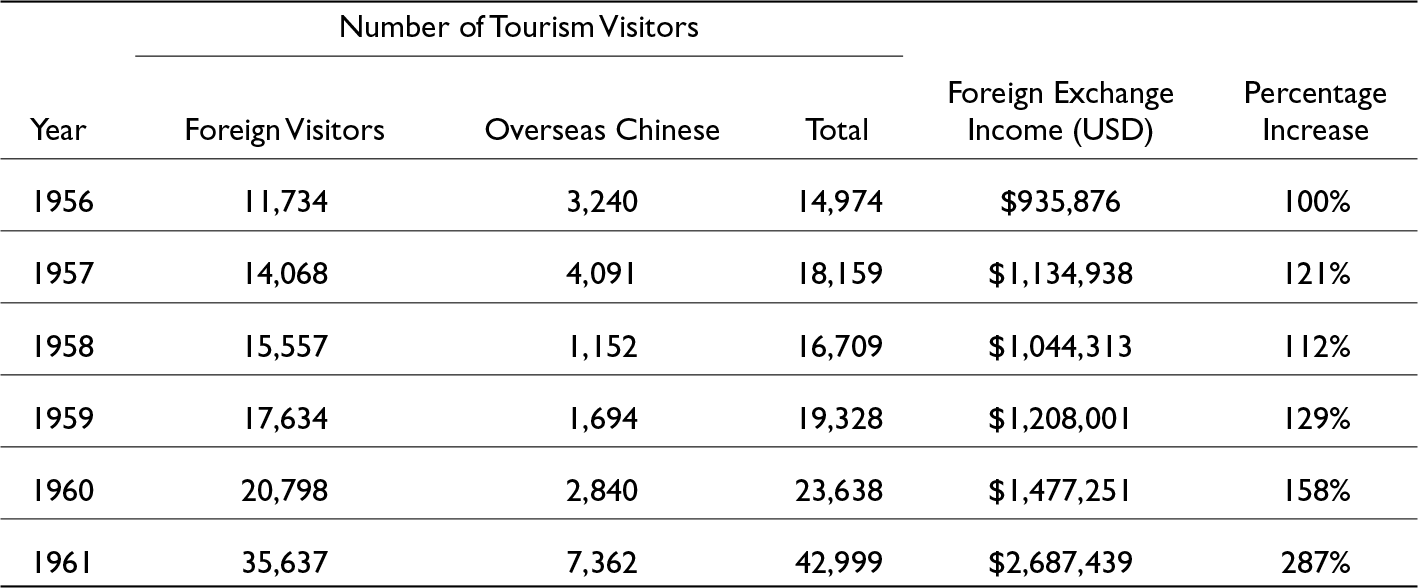
Table 1 Long description
The table measures the number of visitors to Taiwan from 1956 to 1961, including foreign visitors and overseas Chinese, along with foreign exchange income and percentage increase. In 1956, the total number of visitors was 14,974, which grew to 42,999 by 1961. Foreign exchange income also increased significantly from $935,876 in 1956 to $2,687,439 in 1961. The percentage increase in visitors was highest in 1961 at 287%. Notably, the number of overseas Chinese visitors fluctuated, peaking in 1961. These figures exclude American visitors and their dependents, which may affect the overall interpretation of tourism growth.
Notes:1. Foreign exchange income is calculated based on each person staying in Taiwan for 2.5 days at $25 per day, including accommodation, transportation, etc. 2. These figures do not include Americans and their dependents visiting Taiwan, nor their consumption expenses.
This underperformance stemmed from specific image problems, as the Taiwan Provincial Tourism Commission’s work report candidly acknowledged: ‘According to psychological surveys, many international travellers mistakenly consider Taiwan to be the most unsafe and remote country among 19 countries and regions in the Pacific and Far East.’Footnote 30 This perception challenge required targeted strategic responses.
To address these image problems, the Tourism Commission developed comprehensive promotion plans with two distinct strategic priorities. First, they emphasized strengthening international publicity, particularly targeting the lucrative American market. The commission’s work report outlined specific actions: ‘We should establish tourism promotion agencies in American cities with concentrated tourist populations, such as New York and San Francisco, to directly contact local travel agencies, airlines or shipping companies, and tourists.’ Second, they carefully crafted Taiwan’s destination image: ‘The focus of external promotion should be introducing Taiwan’s beautiful scenery, stability and prosperity, Oriental lifestyle, and travel convenience and comfort, thereby eliminating foreign misconceptions about Taiwan’s current safety situation.’Footnote 31
This dual approach—targeting American tourists as primary revenue sources while emphasizing Taiwan’s Oriental cultural identity—aligned with broader regional tourism trends. The American military market was particularly significant. Beginning with the Korean War in the early 1950s and continuing through the Vietnam War period starting in 1966, the US military implemented Rest and Recreation (R and R) programmes across Asia. Hong Kong, Singapore, and the Philippines all developed cooperation programmes with the United States, with Hong Kong emerging as the preeminent destination. During the Vietnam War, Hong Kong became a crucial R and R centre, particularly for the US Seventh Fleet. The British colony’s popularity peaked in 1966 when 390 US naval vessels visited, bringing approximately 185,000 American servicemen who contributed an estimated HK$316.9 million to the local economy.Footnote 32
These R and R programmes were carefully managed bilateral arrangements. In Hong Kong, the colonial administration and US officials collaborated closely, with the US Navy Shore Patrol working alongside British Military Police to maintain order.Footnote 33 American servicemen were attracted by Hong Kong’s combination of deep-water harbour facilities, extensive shopping opportunities, and vibrant nightlife districts like Wanchai, which had gained international fame through the 1960 film ‘The World of Suzie Wong’. Despite Communist China’s repeated diplomatic protests between 1965 and 1968—claiming Hong Kong was being used as ‘a base of US aggression’—the British government maintained these visits were purely recreational in nature.Footnote 34 Notably, while other Asian locations occasionally witnessed anti-American sentiment, Hong Kong residents generally welcomed US servicemen as economically valuable visitors rather than symbols of American imperialism.Footnote 35 Taiwan’s approach to this market differed significantly, generating considerable public debate rather than the enthusiastic embrace seen in Hong Kong.
In November 1965, a US–ROC military collaborative organization established a US military short-term service centre at Yuanshan in Taipei. The centre provided a service handbook that, besides introducing food, accommodation, transportation, and designated red-light entertainment district Beitou北投, also highlighted opportunities to appreciate Taiwan’s beautiful island scenery. Most importantly, the handbook prominently featured the National Palace Museum.Footnote 36 Taiwan’s reports at the time emphasized ‘reminding US military personnel that the symbols of ancient Chinese culture—national treasures—which are rarely seen, are now collected in the National Palace Museum for US military personnel to freely visit’.Footnote 37 This example illustrates how Taiwan strategically deployed Chinese cultural elements as a key method to attract US troops stationed in Vietnam, representing a deliberate attempt to differentiate Taiwan’s tourism approach from Hong Kong’s entertainment-focused strategy.
While the economic benefits of military tourism were evident, questions remained about whether R and R servicemen genuinely engaged with authentic Chinese culture—an aspect Taiwan hoped to emphasize. Reports suggested more immediate concerns about tourism development quality. Hong Kong’s The Kung Sheung Daily News reporter Xie Xiongxuan謝雄玄 published a critical series on southern Taiwan tourism in December 1967, observing: ‘Tourism authorities cannot grasp central policy and lack correct measures and plans, mistakenly guiding tourism toward entertainment rather than encouraging the development of natural scenic spots.’Footnote 38 This critique highlighted tensions between economic opportunism and cultural authenticity in Taiwan’s tourism development.
Taiwan’s strategic positioning amid regional competition required careful differentiation. While Hong Kong promoted itself under the slogan ‘The Orient is Hong Kong’ to European and American tourists, Taiwan sought its own distinctive identity. Following a 1959 inspection by the US Aid Mission, the Taiwan Provincial Tourism Commission developed a ‘Tourism Guide Training Program Draft’ focused entirely on traditional Chinese culture and customs. Training courses encompassed Chinese history and geography, cultural arts, folk customs, drama, and religions—clearly positioning Taiwan as an authentic representation of cultural China.Footnote 39 This approach reflected regional competitive dynamics, with contemporary reports noting that Japanese tourism dominated East Asian markets by leveraging its long history and positioning itself as ‘representing the Orient’. Taiwan’s competition with Hong Kong and Japan for cultural authenticity was therefore an inevitable regional dynamic. Crucially, however, Taiwan’s representation of ‘cultural China’ carried additional symbolic significance beyond economics—it embodied claims of cultural orthodoxy and political sovereignty.
This political dimension of tourism became evident during the 11th Pacific Area Travel Association Conference in Hong Kong in 1962, when a diplomatic incident underscored tourism’s role in Taiwan’s international recognition struggles. The Taiwan Tourism Commission reported: ‘During registration, we discovered that while all countries’ delegate seat nameplates displayed their country names, only our nameplate used just the two characters “Taiwan”. We raised a serious protest and used all connections to negotiate multiple times. As a result, the nameplates for country representatives were removed, the agenda item for introducing representatives from each country was deleted, and fixed seating assignments were eliminated.’Footnote 40 As representatives of the Republic of China (ROC), the Commission delegates regarded the use of ‘Taiwan’ as a denial of their state’s legitimacy and international standing. Since the GMD government continued to assert its claim as the sole representative of all China despite its retreat to Taiwan, the nameplate’s wording implied a sub-national or provincial status—an affront to the ROC’s diplomatic identity and Cold War positioning. This incident vividly illustrated how international tourism platforms had become contested arenas in the broader struggle over Taiwan’s sovereignty and recognition.
Taiwan achieved a significant tourism milestone in 1968 when it secured the right to host the 17th Pacific Area Travel Association annual meeting, held in Taipei from 8–10 February.Footnote 41 These annual conferences served as important platforms for promoting host destinations, as evidenced by Hong Kong’s experience hosting the event in 1962. In anticipation of this opportunity, Ministry of Transportation official Fei Hua (費驊, 1912–1984) wrote ‘Prospects for Taiwan’s Tourism Industry’ in 1967, emphasizing that 1967 had been designated International Tourism Year.Footnote 42 He outlined how Taipei intended to use two tourism initiatives to showcase Free China’s political stability and social order, aligning these efforts with the Chinese Cultural Renaissance Movement.Footnote 43 These initiatives were strategically designed to enhance international travel representatives’ understanding of China through Taiwan’s representation.
Tourism in Taiwan thus evolved beyond purely economic considerations to serve as a crucial platform for international self-representation. For Taiwan’s authorities, tourism provided an informal propaganda channel to express Taiwan’s voice on the international stage—a vital consideration in its contested geopolitical position. The following sections will explore Taiwan’s specific tourism promotion strategies, examining both target audiences and representational methods in greater detail.
‘Returning home tourism’ propaganda and its functions
A crucial perspective on Taiwan’s cultural tourism strategy comes from Tan Chang-kai (譚常愷), an overseas Chinese representative who returned to Taiwan from Canada. In an article titled ‘Chinese Culture and the Tourism Industry’ published on New Year’s Day of 1962 following the Republic of China Tourism Year (1961), Tan articulated two key insights about international tourism to Taiwan. First, he observed that tourists ‘are not experts in land reform, nor are they military or education specialists; they simply want to see China. They are interested in anything that represents Chinese culture or art (including customs and habits), though this doesn’t necessarily mean they admire or respect these elements.’ Second, he emphasized that tourists aren’t coming to China for spiritual cultivation, and natural scenery alone is insufficient to attract them.Footnote 44
Drawing comparisons with other iconic cultural attractions worldwide—Spain’s bullfighting, Egypt’s pyramids, and Italy’s Roman ruins—Tan argued that tourist demand fundamentally revolves around distinctive national culture. While acknowledging that tourists might visit Japan or France for entertainment and pleasure, he cautioned readers not to overlook how ‘Japan’s tourism industry is built upon Eastern aesthetics, with tea houses providing the most respectful servant-like hospitality’. Consequently, he concluded that the most compelling attraction for international visitors would be ‘the preservation and concentration of cultural artifacts representing our nation’s five-thousand-year historical culture’. Elaborating on this point, he explained: ‘I’m not saying international travellers have an obsession with antiquity; I’m saying that anyone with a decent education knows there is an ancient civilization in the East with rich and elegant culture. Since they’ve already gone to Japan and Hong Kong, they won’t hesitate to spend a little more money to visit Taiwan.’Footnote 45
Tan’s analysis directly challenged the infrastructure-focused approach to tourism development. He argued that merely providing modern facilities alongside natural landscapes was insufficient to attract visitors. Instead, he strongly advocated building Taiwan’s tourism activities around Eastern cultural elements, expressing scepticism about the appeal of visiting engineering projects such as the Cross-Island Highway, cement factories, or sugar mills. Instead, he emphasized experiencing the treasures of the National Palace Museum, which, though not yet housed in a completed facility, had already impressed him during his two years since ‘returning to the country’. His conclusion was unequivocal: ‘International visitors come to Taiwan to see China. Only Chinese aesthetics are what international travelers need; everything else is secondary.’Footnote 46
Tan’s emphasis on cultural authenticity as Taiwan’s primary tourism asset became particularly relevant in the government’s strategy to attract overseas Chinese communities. While his analysis addressed international tourism broadly, the GMD recognized that overseas Chinese represented a uniquely receptive audience for Taiwan’s ‘Cultural China’ positioning. Unlike Western tourists seeking exotic Oriental experiences, overseas Chinese could be appealed to through narratives of cultural preservation and homeland connection. This cultural strategy became the foundation for what would become known as ‘returning home tourism’.
Reports of overseas Chinese returning to their homeland for tourism already appeared in the 1930s, though without political connotations at that time. By the 1950s, both the GMD and Communist parties viewed overseas Chinese homeland tourism groups as a critical means of supporting their claims to legitimate sovereignty. Chiang Kai-shek had already implemented various overseas Chinese affairs policies to gain support from the diaspora, considering overseas compatriots as a key force for victory in the anti-communist war.Footnote 47 While foreign exchange considerations were important in the development of ‘returning home tourism’, with many hotels relying on overseas Chinese financial support, the political imperatives appeared to far outweigh purely economic motivations. Records from Taiwan’s Academia Historica show that as early as late 1950, Chiang Kai-shek was already documented in numerous photographs receiving ‘Overseas Chinese Returning Home Tourism Groups’ from Indonesia and Thailand,Footnote 48 followed by similar groups from Malaysia, Burma, Vietnam, Japan, Fiji, Hong Kong, and Macau. These touring groups received exceptionally high-level reception, with almost every group granted an audience with Chiang Kai-shek himself.
A phenomenon worthy of extended analysis is the contested meaning of ‘returning home’ in Taiwan’s postwar tourism discourse. This linguistic framing reveals an implicit construction of legitimacy, one that positioned the island of Taiwan as the embodiment of the Republic of China. These overseas Chinese and ethnic Chinese abroad were ‘returning’ to an island nation many had never previously visited, which through political circumstances had been transformed into the ‘new homeland’ for tens of millions in the Chinese diaspora. As Powers (2011) argues in her study of homeland tourism, such journeys function as transformative experiences where ‘individuals believing to be “expatriate minority communities” dispersed from their land of origin yet maintaining a memory, vision or myth about their original homeland’ engage with places representing their heritage.Footnote 49
Beyond the official ‘homeland observation tours’回國觀光團 that began in the late 1940s, the 1960s witnessed the emergence of unofficial tourism initiatives explicitly framed around ‘reconnecting with ancestral culture’ (認識祖國文化). This parallels Powers’ findings of how Jewish Americans visiting Israel and African Americans traveling to Ghana used tourism as vehicles for what she terms ‘reimaging the imagined community’ through direct engagement with symbolic places. Just as Birthright Israel participants described profound connections when touching the Western Wall, overseas Chinese visiting Taiwan were encouraged to experience emotional connections at carefully curated sites representing ‘Cultural China’. The GMD effectively transformed Taiwan from an island with its own complex colonial history into a symbolic representation of ‘Cultural China’—a place where overseas Chinese could ‘return’ to experience heritage that many had never physically touched, thereby reinforcing the government’s claims to be the legitimate guardian of Chinese civilization and sovereign representative of China itself.
This strategic deployment of tourism as a legitimation tool is further evidenced in official government documents from the period. The Executive Yuan’s 1965 Administrative Policy Guidelines explicitly codified ‘returning home tourism’ as a mechanism for strengthening ties not only with overseas Chinese communities but also with Mongolian and Tibetan people abroad. The document specifically outlined plans for ‘guiding overseas Mongolian and Tibetan people to return to the country for sightseeing to deepen their understanding of the motherland’Footnote 50 and ‘strengthening services for overseas Chinese who return to the country for inspection and observation’ (加強對回國觀光考察僑胞之服務).Footnote 51 These policy directives reveal how Taiwan’s government systematically incorporated tourism into its broader strategy of asserting legitimacy, deliberately extending the concept of ‘returning home’ to ethnic minorities whose ancestral homelands were geographically distant from Taiwan itself. By including Mongolian and Tibetan diasporic communities in this framework, the GMD further reinforced its claim to represent the entirety of China’s diverse territories and peoples, not merely Han Chinese culture, establishing Taiwan as the authentic homeland for all ethnic groups historically associated with the Chinese state.Footnote 52
This reconfiguration of Taiwan as the authentic ‘homeland’ for ethnic Chinese extended beyond official government discourse to influence perceptions throughout Chinese communities in East Asia, particularly in Hong Kong and Macau. In a 1962 interview, Gao Dajing高大經, the official in charge of tourism development, stated: ‘Although the majority of current tourists visiting Taiwan are foreigners, government authorities equally welcome overseas Chinese from Hong Kong and Macau who return to their homeland for tourism.’Footnote 53 Correspondingly, Hong Kong travel agencies aligned with the Taiwan government’s messaging by 1966, offering ‘homeland return tours’. For instance, An Le Travel Agency安樂運旅社 advertised: ‘To introduce Taiwan’s scenic landscapes and guide business and industrial professionals in returning to their homeland for investigation, family visits, and travel, we are organizing special spring observation tours.’Footnote 54 Their promotional material for that year’s Easter tour further emphasized: ‘An Le Travel Agency regularly organizes Taiwan tourism groups to enhance patriotic individuals’ interest in returning to their homeland for tourism.’Footnote 55
A revealing case study of this phenomenon can be found in a 1962 incident reported in The Kung Sheung Daily News. A female student from Po Kok Girls Vocational Secondary School, identified as Ms. Man, won a ten-day tour of Taiwan in a dental health essay competition that February. The newspaper specifically framed her experience as ‘touring the motherland’ (祖國觀光), noting that she expressed happiness at being able to ‘return to the motherland’ and described gaining profound impressions from the journey.Footnote 56 Significantly, this ‘motherland tour’ encompassed various attractions across Taiwan rather than Guangdong province or other regions of mainland China that might have represented ancestral homelands for most Hong Kong residents. As a pro-Taiwan publication, The Kung Sheung Daily News’s coverage functioned as an extension of Taiwan’s ‘returning home’ tourism discourse, leveraging its influence to redefine conceptualizations of ‘motherland’ among overseas Chinese communities in Hong Kong and Macau. This example illustrates how tourism narratives functioned as vehicles for political legitimation beyond Taiwan’s borders, reshaping diasporic identities through carefully choreographed experiences of ‘homecoming’.
The political dimensions of Taiwan’s tourism strategy were noticed by neighbouring governments as early as 1957. Malaysia’s pro-Communist Nanyang Siang Pao reported: ‘The Taiwan government has recently repeatedly encouraged Chinese school teachers and students from this country to organize visiting groups to Taiwan for tourism, promising to cover all transportation costs and accommodation expenses during their stay in Taiwan.’Footnote 57 This observation highlights how Taiwan’s tourism outreach to overseas Chinese communities, particularly educational groups, was perceived as having explicit political motivations by those sympathetic to mainland China. The willingness to fully subsidize such visits underscores the strategic importance Taiwan placed on cultivating relationships with Chinese diaspora communities through direct tourism experiences.
A particularly revealing case study of returning home tourism’s political dimensions can be found in the 1964 ‘Returning Home Travel’ initiative organized by the National Cheng Kung University Alumni Association. This programme received high-level attention from Taiwan’s Ministry of Foreign Affairs, as indicated in official documents: ‘This association’s organization of the returning home travel group is purely for service purposes, aiming to comfort overseas nationals’ nostalgia for their motherland, while promoting mutual understanding and friendship between Chinese and American people, thereby increasing foreign visitors’ interest in Taiwan tourism.’ Significantly, participants were not limited to university alumni but included anyone interested in ‘returning to the motherland for sightseeing and visiting relatives’. The programme explicitly aimed to facilitate this at ‘low prices, simplified procedures, and the best service’. allowing overseas Chinese to fulfil their ‘long-cherished wish to return to their homeland’.
The political calculations behind these initiatives become evident in internal communications. Initially, the programme planned to separate participants into two distinct groups: students originally from Taiwan and those with non-Taiwan origins. However, the Ministry of Foreign Affairs specifically noted that operating under two different group names might generate problematic public discourse. Consequently, they recommended unifying the groups under the single designation ‘Visiting Group of Overseas Students Returning to Their Homeland’, thereby reinforcing the narrative that Taiwan represented the authentic homeland for all ethnic Chinese regardless of their specific place of origin.
To strengthen administrative management, the Taiwan Provincial Tourism Commission was reorganized as the Taiwan Provincial Tourism Administration, with Chiang Lien-ju (蔣廉儒, 1917–), often considered Chiang Kai-shek’s trusted wordsmith, serving as its first director. On 10 October 1967, during the Double Ten National Day celebrations, he articulated five maxims that expressed his aspirations for the tourism industry:
Tourism is an industry without chimneys,
Tourism is education without classrooms,
Tourism is propaganda without words,
Tourism is diplomacy without meetings,
Tourism is politics without slogans.Footnote 58
This special publication was released in Hong Kong, clearly intended as propaganda material aimed at Hong Kong audiences and potentially for circulation overseas or to mainland China. As the official in charge of tourism affairs at the time, Chiang Lien-ju explicitly articulated the connection between tourism and anti-communist political expression. He stated: ‘The progress of Taiwan’s tourism industry is one of the most politically significant indicators among all our advancements, and precisely represents a stark contrast and division with the iron curtain mainland—a powerful political challenge to the mainland’s communist slave society!’Footnote 59 He further described the cultural significance of Taiwan’s tourism development: ‘The tourism activity itself is a living education, a cultural activity. From an internal perspective, allowing ordinary citizens to receive education about their nation and homeland through tourism activities, drawing inspiration from the deeds of ancestors and being nurtured by the beautiful mountains and rivers, thereby stimulating citizens’ initiative and pride. From an external perspective, allowing millions of international travellers to discover through their tourism experiences in Taiwan that this is the revival base of a great ancient Eastern cultural nation, and that it harbours the essence of Eastern artifacts and arts representing the entire East; presenting China’s five-thousand-year culture together with the nationwide anti-communist fighting spirit as a complete and magnificent display before international friends, giving them the feeling that “seeing is believing”, thereby gaining a more accurate understanding, a more intimate familiarity, and a deeper impression of Taiwan.’ The special issue specifically mentioned that ‘since the shameless riots instigated by Hong Kong’s Maoist communist elements in May this year, overseas Chinese compatriots from Hong Kong returning to their homeland for tourism have significantly increased’.Footnote 60 This account was confirmed by contemporaneous newspapers, which reported that the number of people entering Taiwan in May 1967 increased by several thousand compared with the same period the previous year, coinciding with periods of unrest in Hong Kong.Footnote 61
An interesting contrast emerged in the research findings regarding promotional materials targeting different regions. Taiwan Tourism Commission’s promotional materials in Malaysia and Singapore notably lacked the explicit political positioning evident in Hong Kong publications. For example, newspapers such as Nanyang Siang Pao and Sin Chew Jit Poh in Singapore and Malaysia differed significantly from Hong Kong’s Overseas Chinese Daily News and The Kung Sheung Daily News in their framing of ‘homeland’. In Southeast Asian publications, references to ‘homeland’ or ‘motherland’ often still indicated mainland China rather than Taiwan, reflecting different political sensitivities in these markets.
A 1968 article in the pro-China Nanyang Siang Pao offered a pointed critique of the narrative around ‘recovering the mainland’, stating: ‘After painful deliberation, they finally came up with a method close to “self-consolation”, which is that the government wants to build Taiwan into the most progressive and prosperous model province of the “Republic of China”, as the cornerstone for future “counter-attack on the mainland”. Under the implementation of this new approach, sure enough, within a few years, Taiwan’s development endeavours have advanced rapidly, with considerable achievements in various aspects … In addition to significant progress in agriculture and industry, Taiwan’s tourism industry has made considerable gains in recent years, with many first-class hotels already established or being established, bringing a substantial amount of foreign exchange to the Taiwan government.’Footnote 62 This analysis from a pro-mainland Chinese publication acknowledges Taiwan’s economic and tourism success while framing it as a consolation for the unrealistic goal of ‘recovering the mainland’. Nevertheless, the Taiwan government persistently and systematically cultivated a Chinese national image through tourism contexts throughout the 1960s and 1970s, strategically deploying traditional cultural discourse to construct and legitimize the concept of ‘Free China’ despite these regional variations in reception and interpretation.
Chinese culture and tradition in tourism representation
Taiwan’s strategic approach to overseas Chinese tourism was underpinned by specific cultural representations that positioned the island as the authentic guardian of Chinese civilization. The government’s efforts went beyond simply marketing cultural sites; officials systematically curated tourism experiences that would demonstrate Taiwan’s role as the legitimate inheritor of Chinese culture. These representations served dual purposes: attracting international visitors seeking to experience ‘traditional China’ while reinforcing Taiwan’s political claims through direct cultural encounters.
In his speech at the 8th Annual Meeting of the Pacific Area Travel Association in Singapore in 1959, Gao Dajing stated that ‘the tourism industry is a symbol of freedom in democratic countries and the significance of developing the tourism industry is to deepen the impression of Free China among representatives from various countries’.Footnote 63 This explicit connection between tourism development and political legitimation reflected Taiwan’s strategic objectives in the international arena.
From 1960, the US Aid Mission allocated an additional NT$2 million to support Taiwan’s tourism institutions while simultaneously supporting the relocation of the National Palace Museum and the reconstruction of the Lin Family Garden in Banqiao.Footnote 64 This dual investment in tourism infrastructure and cultural heritage preservation highlighted the intertwined nature of tourism development and cultural legitimacy in Taiwan’s postwar strategy.
Tourism officials clearly articulated Taiwan’s unique positioning in the competitive regional tourism landscape: ‘Taiwan has two major tourism advantages. First, Taiwan is situated at a strategic junction in the Southwest Pacific, positioned between Japan and Hong Kong, making it a necessary route for travellers between these two locations, creating superior conditions for attracting tourists. Second, Taiwan possesses traditional Chinese culture, with customs, traditions, and daily life that can arouse tourists’ interest, making it more appealing than the beautiful island scenery and year-round warm climate.’Footnote 65
The 1960s tourism literature from Taiwan reveals a deliberate strategy by authorities to position the island as the legitimate custodian of authentic Chinese cultural traditions through handicraft promotion. As evidenced in the 1961 Taiwan Guide, the official English tourist guidebook, it emphasized a direct lineage between contemporary Taiwanese handicraft production and China’s most revered historical artistic traditions. The text explicitly connects Taiwan’s handicraft sector to ‘China’s long been known … distinguished culture’, establishing cultural continuity from ancient Shang and Zhou dynasty bronzes through Han and Tang earthenware to contemporary production.
Particularly noteworthy is how tourism authorities framed the ‘influx of artisans from the mainland’ as reinforcing Taiwan’s claim to cultural authenticity. This narrative served dual purposes: positioning Taiwan as the genuine inheritor of Chinese cultural traditions during a period of geopolitical contestation, while simultaneously promoting handicraft centres as essential destinations for international tourists seeking ‘something unique, exotic and utilitarian’. The Taiwan Handicraft Promotion Centre was marketed as a ‘must’ visit, demonstrating how cultural heritage was commodified for tourism consumption.
The text’s emphasis on how ‘new designs and forms derived from the ancient artistic patterns’ emerged after 1950s reveals a carefully constructed narrative of cultural preservation and evolution. This representation of handicrafts illustrates how tourism authorities cultivated an image of Taiwan as both preserving traditional Chinese craftsmanship and adapting it through innovation—a dynamic authenticity that appealed to Western tourists’ desire for both cultural traditionalism and modernization.
Even Taiwan-based national transportation companies reinforced this narrative of cultural authenticity. China Airlines advertised itself as ‘an airline operated entirely by Chinese people’,Footnote 66 explicitly emphasizing its Chinese cultural identity rather than specifically Taiwanese characteristics. This branding strategy reinforced Taiwan’s positioning as the legitimate representative of Chinese culture and tradition on the international stage.
The emphasis on Chinese cultural identification received high-level political endorsement. In his speech at the tenth anniversary celebration of the Taiwan Tourism Association, Vice President of Republic of China Yen Chia-kan explicitly stated: ‘Our tourism industry is still in its infancy, and how to strengthen promotion to attract foreign visitors is an extremely important issue. In my view, while we should certainly pay attention to utilizing advertising and following established practices in other tourism regions, the most important thing is to use our brains to research new approaches, ensuring that all our tourism facilities can fully express our own cultural advantages and national characteristics, so that international travellers will enter a new atmosphere and style once they arrive in Taiwan, feeling refreshed and different from elsewhere; and then further discovering the profound and extensive cultural qualities of our Chinese nation, and the warm human relationships. Additionally, we should naturally display our various efforts and achievements in “building Taiwan and recovering the mainland”, so that international people unconsciously form deep impressions of our anti-communist national policy, which is certainly more appropriate.’Footnote 67
Even when promoting southern Taiwan, which had only been under Koxinga’s administration and Qing ruling for approximately 300 years, contemporary travel accounts strategically portrayed Tainan as an ‘ancient cultural capital’. Hong Kong news correspondent Xie Xiongxuan, reporting from Taiwan, characterized the city as possessing ‘one hundred historical and scenic spots’, specifically highlighting the Tainan Prefectural School臺南府學 to emphasize its profound cultural heritage for Hong Kong audiences.Footnote 68 Although southern Taiwan preserved numerous Japanese colonial and indigenous historical sites, Xie’s comprehensive ten-part travelogue predominantly focused on landmarks associated with Chinese dynastic narratives, including Anping Fort安平古堡, Fort Provintia赤嵌樓,Footnote 69 Koxinga Shrine延平郡王祠, Tainan Confucian Temple臺南孔廟,Footnote 70 and Kaohsiung’s Spring and Autumn Pavilions高雄春秋閣—the latter purposefully constructed to commemorate Guan Yu (關羽, ?-220), a significant cultural icon representing Confucian ethical ideals.Footnote 71
When documenting Kaohsiung (formerly Takao打狗), a port city substantially developed under both British and Japanese influences, Xie deliberately reconstructed its historical narrative, asserting that ‘for hundreds of years, Kaohsiung harbour has been silently struggling for its life’s development; however, it was not until it completely returned to the embrace of the motherland that it emerged and embarked on the path of modernization’.Footnote 72 His account further highlighted Kaohsiung’s Daibei Lake (大貝湖, later renamed Chengqing Lake 澄清湖), specifically emphasizing the Zhongxing Pagoda中興塔, a structure embodying aspirations for ‘recovering the mainland’.Footnote 73
Notably, Xie’s travelogues contained numerous critiques of Taiwan’s tourism sites, particularly regarding environmental management issues. His accounts frequently criticized inadequate restroom facilities, deteriorating scenic spots, and prevalent litter problems. These observations represent constructive criticism from a journalist evidently concerned about Taiwan’s tourism development trajectory. Significantly, however, his critical perspective simultaneously reflected an underlying identification with and commitment to the cultivation of Taiwan’s image as ‘Cultural China’—a tacit endorsement of the GMD’s broader cultural legitimation project.
The cultural positioning of tourism attractions extended beyond museums to encompass physical spaces and their symbolic naming. The East-West Cross-Island Highway, Taiwan’s first route connecting the eastern and western regions, was constructed between 1956 and 1960 with American aid funding, finally opening in May 1960. This engineering achievement traversed multiple mountain ranges from Dongshi in Taichung to reach Taroko太魯閣 in Hualien. Within this development, Tpdu塔比多 became a focal point for recreational facilities along the highway. In 1958, to complement Taiwan’s tourism development, the local China Travel Service decided to construct a Chinese palace-style building as a guest house, alongside a Buddhist temple called Xiangde Temple祥德寺.Footnote 74
The symbolic reconfiguration of Taiwan’s geography through strategic naming practices is particularly evident in the case of Tianxiang 天祥, currently a prominent recreation area within Taroko National Park. The site was deliberately named to symbolize national integrity and virtue, commemorating Wen Tianxiang (文天祥, 1236–1283), the revered Song dynasty official who chose execution rather than submission to Mongol invaders—thus embodying the highest ideals of Chinese cultural loyalty. In August 1957, during the Cross-Island Highway’s development, the government proposed establishing an international park in the Taroko area specifically designated for foreign visitors and recreational tourism, with initial plans to situate this development in an area then known as Da Beitou (大北投, correlating to the indigenous place name Tpdu). By November 1957, as the road section from Taroko to this location neared completion, Da Beitou had already been officially renamed Tianxiang.Footnote 75
In a comprehensive cultural renaming initiative, a neighbouring location was redesignated Guanyu, invoking another classical Chinese cultural hero. Simultaneously, the Da Beitou hot spring was renamed Wenshan Hot Spring (文山溫泉), with Wenshan representing Wen Tianxiang’s literary name—further reinforcing the symbolic connection to Chinese historical narratives of patriotic sacrifice and unwavering integrity. The June 1967 unveiling of a commemorative monument and statue of Wen Tianxiang significantly enhanced the Tianxiang scenic area’s cultural significance, explicitly binding this natural landscape to symbols of Chinese historical patriotism and providing international tourists with a tangible manifestation of the cultural narrative Taiwan’s authorities sought to project.
This deliberate cultural reimagining extended beyond landscape features to encompass the architectural design of tourist accommodations, creating a comprehensive experiential environment for visitors. Tourism promotional materials from the period highlighted structures ‘designed after ancient Chinese palace styles, incorporating the advantages of Thai architecture … with room furnishings that are magnificently luxurious, and palace suites rich in ancient Chinese Eastern ambiance’. These descriptions emphasized the distinctive cultural experience awaiting visitors, particularly in new hotel developments catering to international tourists. The Mandarin Hotel 中泰賓館 exemplified this approach, having been financed through overseas Chinese investment specifically to support the ‘returning home tourism’ initiative. Its promotional materials strategically synthesized elements of both Chinese and Thai cultural aesthetics, reflecting the cosmopolitan sensibilities of its target audience while simultaneously reinforcing its fundamental identity as a Chinese cultural space.
Taiwan Tourism Commission surveys from this period provided empirical validation for this cultural emphasis. According to their findings, the elements of Taiwan most interesting to foreign visitors were, in order of preference: natural scenery, the ‘Sun Yat-sen Museum’ (an alternative name for the National Palace Museum used in some Southeast Asian publications), Chinese cuisine, Chinese handicrafts, and the unique lifestyle of Chinese people.Footnote 76
Official discourse consistently reinforced the National Palace Museum as Taiwan’s pivotal exemplar of Chinese cultural legitimacy. In 1965, Vice President of ROC Yen Chia-kan, speaking at a National Palace Museum Management Committee meeting, emphasized: ‘from these precious materials, one can glimpse the splendor of China’s five-thousand-year culture, making it truly the most valuable collection in the world, and therefore foreign visitors to Taiwan invariably make a special trip to see it.’Footnote 77 With support from US aid, the government established the National Palace Museum at its current location in Waishuangxi, Taipei, creating a centrepiece for Taiwan’s cultural tourism strategy and a material embodiment of its claim to Chinese cultural orthodoxy.
The effectiveness of this cultural positioning extended beyond official discourse to influence international visitors’ perceptions. When Japanese publishing industry representatives visited Taiwan, their reactions, as reported in the Central Daily News, validated the museum’s symbolic significance: ‘This morning when they visited the National Palace Museum and saw the priceless Chinese historical artifacts and artworks, it made their blood—having been nurtured by Chinese culture—boil within them with excitement, because Japanese culture originates from Chinese culture, and Chinese cultural influence runs deep in the blood of every Japanese person. Today, the Chinese government led by President Chiang can perfectly preserve the historical and cultural heritage of the Chinese nation, which is also preserving the historical and cultural heritage of the East. President Chiang’s great achievements will be immortal in the history of world culture, truly worthy of the admiration of humanity worldwide.’Footnote 78 Such reports, while certainly curated to advance particular political narratives, nevertheless indicate the museum’s effectiveness as a tourism attraction that simultaneously functioned as a powerful vehicle for cultural legitimation.
Taiwan’s tourism marketing materials from this period consistently emphasized Chinese cultural elements. A 1969 Taiwan Tourism Association advertisement in the Straits Times employed numerous Chinese cultural references in its packaging. The itinerary featured a Chinese dinner banquet and Chinese drama performance on the first day, encouraging travellers to visit ancient temples in Taipei during their free time. Naturally, the itinerary included a mandatory visit to the National Palace Museum, described as the world’s largest collection of Chinese art. The tour then continued to Hualien, with lunch at the newly completed Tianxiang Guest House, shopping for souvenirs at the Marble Plant Showroom, and travelling along the East-West Cross-Island Highway. The itinerary also included visits to the postwar-developed Kaohsiung Port and Tainan’s Koxinga Shrine and Chihkan Tower, all showcasing traditional Chinese cultural elements.Footnote 79
As Taiwan Tourism Bureau Director Chiang Lien-ju articulated, Taiwan’s tourism positioning centred on its role as custodian of Chinese cultural heritage: ‘Especially the rich heritage of China’s five-thousand-year history and culture enjoys extremely high attraction and evaluation in the minds of people worldwide. Westerners generally have feelings of appreciation, admiration, and longing for China’s brilliant culture and art. Therefore, cultural resources constitute our uniquely superior condition.’Footnote 80 Chiang’s ambitious vision extended further, predicting that Taiwan, as the preservation site of Chinese culture, would eventually emerge as ‘the Tourism Centre of the East’ and ‘the Tourism Holy Land of the East’ to which travellers worldwide would aspire to visit. This aspirational message was deliberately crafted for international audiences, as evidenced by its publication in a Hong Kong special edition, obviously intended for circulation beyond Taiwan to Hong Kong and potentially overseas Chinese communities or even mainland China itself.
By the early 1970s, despite Taiwan’s deteriorating international diplomatic position, tourism continued to serve as a vital channel for projecting Chinese cultural identity. In 1972, precisely when PRC was entering the international stage following Nixon’s visit, Taiwan’s tourism authorities persisted in competing for the China narrative within tourism contexts. That year, the Taiwan Tourism Bureau collaborated with Philippine Airlines to host an event titled ‘Chinese Fantasy’, showcasing traditional Chinese aspects of art, fashion, dance, and music, while offering prize drawings for trips to Taiwan.Footnote 81 This initiative exemplifies how Taiwan employed tourism promotions to maintain its claim as the authentic representative of Chinese culture even as its formal diplomatic recognition was declining.
Despite Taiwan’s diplomatic setbacks throughout the 1970s, including its withdrawal from the United Nations in 1971, its tourism sector demonstrated remarkable resilience. As one report noted in 1974: ‘Taiwan may be losing its friends in the diplomatic field, but it seems to be making up for this in the field of tourism. Last year a total of 824,293 tourists called on the island, an increase of 42.1 percent over 1972.’Footnote 82 This growth suggests that while formal international recognition diminished, Taiwan’s cultural soft power, projected through tourism, continued to attract international visitors—a testament to the effectiveness of its strategy positioning the island as the authentic representative of ‘Cultural China’.
Conclusion
The examination of Taiwan’s postwar tourism development reveals how the GMD government systematically deployed tourism as a mechanism for informal political propaganda. By positioning Taiwan as the guardian of authentic Chinese culture, the government achieved multiple strategic objectives: generating vital foreign exchange, building international goodwill, reinforcing its legitimacy claims among overseas Chinese communities, and establishing a distinctive identity in contrast to Communist China. The case of ‘Cultural China’ as represented through Taiwan’s tourism discourse demonstrates how tourism can function as a powerful vehicle for national image-building and political legitimation, particularly in contested geopolitical contexts.
In 1961, Taiwan’s tourism promotion for ‘Visit the Orient: See Taiwan of the Republic of China Year’ explicitly declared: ‘Whereas the Chinese people are steeped in the tradition of hospitality to visitors from afar’ and ‘Whereas this Island offers a panorama of natural scenic beauties and a richness of Chinese culture represented in the renowned collection of art treasures of the former National Palace Museum and in the various festivals, ceremonies, culinary arts, and Chinese opera …’Footnote 83 These official proclamations encapsulated the core strategy of Taiwan’s postwar tourism development—positioning the island as the authentic repository of Chinese cultural traditions and, by extension, the legitimate representative of China itself in the international arena.
This research has examined how postwar Taiwan utilized tourism as an informal political and diplomatic tool, transforming Chinese traditions and famous landmarks into symbols for interpreting and representing ‘Formosa’. This approach contrasted with Hong Kong’s tourism promotion strategies during the same period. While the Hong Kong Tourism Association marketed itself under the banner ‘The Orient is Hong Kong’ by incorporating Chinese cultural elements within an Orientalist framework primarily targeting Western tourists, Taiwan’s strategy distinctively targeted not only Western visitors but significantly focused on overseas Chinese communities, positioning itself as the preservation site for authentic Chinese culture.
Taiwan’s strategic use of tourism as informal political propaganda in the 1950s–1970s established patterns that persisted decades later. J. J. Zhang’s research on contemporary cross-strait tourism demonstrates how tourism continued to function as a vehicle for political legitimation and identity performance well into the 2000s.Footnote 84 His analysis of how material objects from conflict become ‘bridging objects’ in tourism diplomacy shows how Taiwan’s tourism strategy of transforming political symbols into cultural attractions remained relevant in later periods, validating the long-term significance of the GMD’s tourism policies documented in this study.Footnote 85
Taiwan’s deliberate construction of itself as ‘Cultural China’ through tourism development represented a sophisticated form of soft power projection during a period of intense geopolitical competition. By transforming tourism from a purely economic activity into a vehicle for cultural legitimation, the GMD government created a distinctive national brand that simultaneously addressed economic needs and political imperatives. The case of Taiwan thus offers valuable insights into the complex interrelationship between tourism, cultural representation, and political legitimacy in contested national contexts.
Acknowledgements
This article was first presented at the 5th World Congress of Taiwan Studies in 2024. Although the original panel featuring Professor Michael Ng, Dr Tak Wai Hung, and Dr Kuan Fei Chen could not convene as planned due to the organizer’s restructuring, the authors fortunately received valuable and constructive feedback from participants in the reassigned panel. We would like to thank all participants for their insights, with special gratitude to Professor Lutgard Lams, who shared her memories that corroborated the authors’ observations. We also extend our sincere thanks to the anonymous referees, whose constructive comments significantly improved this manuscript. All remaining errors are the authors’ responsibility. This work was supported by the Research Grants Council, University Grants Committee, HKSAR [Grant Number UGC/FDS16/H08/23].
Competing interests
The authors declare none.

 Open access

