

[La versión de en español del artículo se encuentra disponible en el Supplemental Text 1; the Spanish version of this article is available in the Supplemental Text 1.]
The year 2020 was another inflection point in Western society's reckoning with racism and social justice. Police brutality, well-publicized racially motivated violence, and the COVID-19 pandemic were a moment of realization for some, galvanizing many individuals to support and participate in social justice movements. For others—particularly those with marginalized identities—these events were further reminders of persistent social injustice in the United States. The growing consciousness surrounding racial injustice in majority-white societies compelled individuals and organizations to examine their participation in the marginalization of Black, Indigenous, and other people of color.
For archaeologists, these events unfolded in the wake of #MeToo, during which high-profile incidents involving prominent archaeologists accused of sexual misconduct (e.g., Bikales Reference Bikales2020a, Reference Bikales2020b; Riggall Reference Riggall2019; Wade Reference Wade2019a, Reference Wade2019b) exposed the prevalence of sexual harassment, assault, and gatekeeping within our discipline. Other forms of academic abuse, particularly abuse of power and bullying, are also deeply embedded and ongoing (Abbott Reference Abbott2019; Curry Reference Curry2021; Leighton Reference Leighton2020). Controversies related to inequity and social justice continue to embroil the field, with recent resurgence in discussions concerning the ethical treatment of human remains. Continued activism regarding the treatment and repatriation of archaeologically recovered or looted human remains and artifacts pressures museums and other collection-holding institutions to redress their colonial legacies (Lans Reference Lans2021; Schroeder and Nayapiltzin Reference Schroeder and Nayapiltzin2022; Smiles Reference Smiles2021; Watkins Reference Watkins2020; Wheeler et al. Reference Wheeler, Arsenault and Taylor2022). Meanwhile, there is increasing recognition that the remains of different communities are offered different levels of protection. For example, Dunnavant and colleagues (Reference Dunnavant, Justinvil and Colwell2021) and Justinvil (Reference Justinvil2022) address persisting disparities in the treatment of remains from Afro-descendant communities.
From January to May 2021, 30 individuals—students, professors, cultural resource managers, museum staff, editors, and archaeology enthusiasts—came together for a semester-long seminar exploring inequity in archaeological practice (Leclerc et al. Reference Leclerc, Blackwood, Hamley, Landázuri, Landrum, Rivera Prince and Barnes2022a [English], Reference Leclerc, Blackwood, Hamley, Landázuri, Landrum, Rivera Prince and Barnes2022b [Spanish]), with motivations as diverse as their backgrounds. The seminar's discussions made it clear that inequity and social injustices have always been deeply embedded within the discipline. Issues of inequity in archaeology are often ignored or treated narrowly as discrete, if loosely bound, problems (e.g., rare engagement with race/racism in archaeology [Park et al. Reference Park, Wang and Marwick2022]). However, approaching these issues as a community composed of individuals with diverse experiences and perspectives, the seminar's participants found that inequities in archaeological practice are intersectional, with compounding effects. We (a subset of the seminar's participants) further believe that community-building—by providing mutual support and fostering alliances—provides a pathway for realizing equity in our discipline.
In this article, we use our seminar experience to identify issues of inequity across multiple domains of archaeology. Despite many studies of inequity in specific areas of archaeological practice (see Critical Assessment), here we view inequity broadly across the discipline. Such an expanded perspective reveals the intersectionality (Crenshaw Reference Crenshaw1989, but see below) of these issues. We identify four overarching themes—individual, community, theory, and practice—and we consider their roles in archaeology. Finally, we focus on creating a road map for understanding the intersectionality of issues of inequity and on suggesting avenues for continued education and direct engagement.
CASE STUDY, SELECTED TOPICS, AND THE FOUR THEMES
Case Study: A Seminar on Equity in Archaeology
Before the start of the semester, many participants in the seminar met to plan its structure while navigating participation from four time zones in multiple countries during a global pandemic. From this initial meeting, the group strategized concrete ways to approach the seminar nonhierarchically. Participants recognized that power imbalances and inequities, such as childcare and reliable internet access, are often embedded in academic and professional structures and that targeted actions would be needed to democratize the space. These strategies included carefully selecting meeting times, using a virtual meeting platform (Zoom), inviting participants to write their pronouns after their name, requiring all participants to use the “raise hand” function to speak, and collectively managing shared online resources. The group worked collaboratively to flatten power structures, actively listen, and allow participants to share their experiences and insights.
Our first two sessions of the semester focused on how to discuss sensitive topics, and we tested our collectively defined guidelines for intentional and respectful engagement. Throughout the semester, we built a trusting community with one another iteratively and continuously by changing and shifting the nature of “leaders'' and “learners.” Not every discussion leader was a faculty member, held a PhD, or was a trained archaeologist. Often, after presenting, leaders “stepped down” from their roles, and the whole group discussed the topic. By reversing roles, leaders became active learners, listening to and engaging with the group. Many discussion leaders participated as learners in multiple other sessions, which further flattened the distinction between “experts” and “students.” Discussion topics were curated by the seminar's participants (Table 1).
Weekly Equity in Archaeology Seminar Topics (in Order).

Note: These topics were informed by the professional networks and regional interests of seminar participants.
Several students volunteered to lead or co-lead a discussion, and students also proposed two rotating roles each week, stack-taker and notetaker. The stack-taker monitored “raised hands” for live dialogue, as well as comments and conversations held in the chat, so that everyone could contribute to the conversation at their individual comfort levels; they could also shift the speaking platform to other participants. The notetakers were trusted to document discussions and conversations that took place during each meeting with care, and they later posted their notes to a shared Google Drive folder.
Although the seminar operated within a university system, many of the participants were not part of the host university and were treated in the same way as enrolled participants. The group made many decisions that departed from a traditional lecture format, and this was possible by using Zoom. For example, cameras were not required, participants spoke out loud after “raising a hand,” and they could write in the chat messenger. There was no assumed dress code. Many participants had children who were often “in attendance,” whether at their parent's side or somewhere in the home. The University of Maine required a grade for enrolled students, who received an A as long as they were engaged for a majority of the seminar. On Zoom, every video feed has identical dimensions in a randomly ordered matrix, which effectively gives every individual equal spatial representation regardless of hierarchical status.Footnote 1 Given that our names were displayed beside our video, we could pick up each other's names (and pronouns) and attribute contributions more easily. Every session was recorded with the consent of all participants, and consent could be withdrawn retroactively (e.g., if a sensitive topic was discussed), in which case the recording would be edited or deleted. By accessing a shared drive, we could watch or rewatch the discussion. Only participants had access to the drive that housed the recordings. (For further information on the development and execution of the course, see Leclerc et al. Reference Leclerc, Blackwood, Hamley, Landázuri, Landrum, Rivera Prince and Barnes2022a, Reference Leclerc, Blackwood, Hamley, Landázuri, Landrum, Rivera Prince and Barnes2022b.)
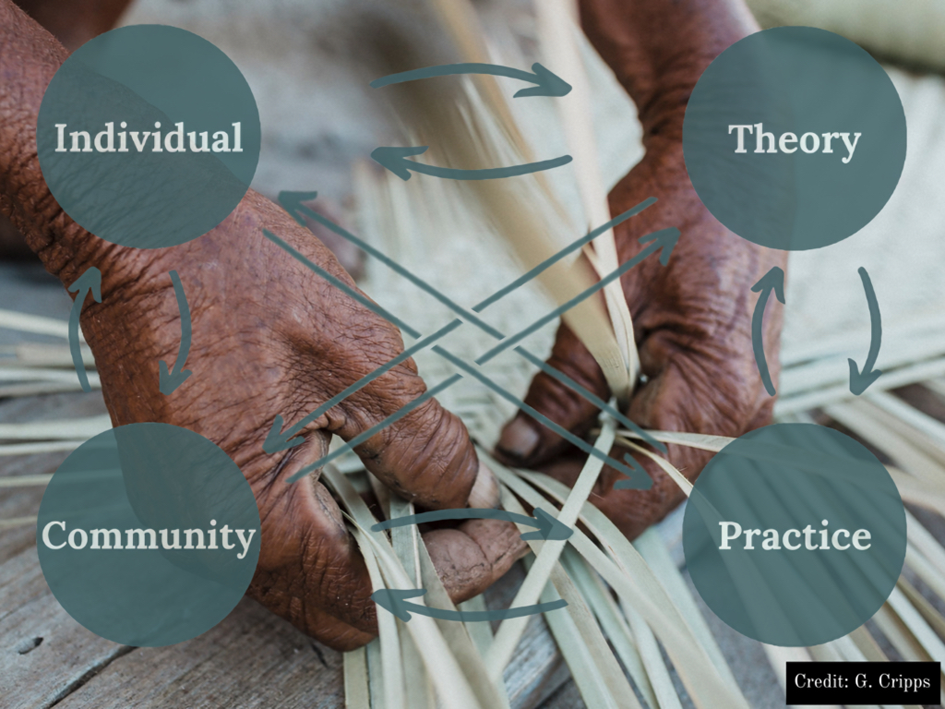
We (the authors) found that four clear themes emerged from our collective discussions throughout the semester (Figure 1). These four themes—individual, community, theory, and practice—are interwoven and provide a pathway for realizing equity in our discipline.
Summary of the core message of our article. There are the four themes guiding issues of equity and inequity in archaeology—individual, community, theory, and practice. Each theme is in a dialectical relationship with the others. No one theme is independent. Instead, they are mutually constitutive. The foundation of this figure is a Mikea elder demonstrating the weaving of palm fronds into a mat, Mikea Forest, SW Madagascar. Addressing issues of inequity and oppression in archaeological practice can begin by listening to what Indigenous and/or descendant communities want. It is through individual, community, theory, and practice that we can make change. (Photo by Garth Cripps, Morombe Archaeological Project.)
Individual
We take a Western perspective of the individual: a bounded entity with autonomy to make decisions and act on them (Gillespie Reference Gillespie2001:81–84). However, for the individual, we emphasize how one navigates the world and how past experiences and relationships with others have shaped this process. Privilege and predisposition to minoritization based on an individual's identity is situationally dependent, and certain groups of people hold privilege in archaeology—for example, white cis-men and cis-women are dominant in the field (Strategies 360 2020) and particularly in tenure-track employment (Cramb et al. Reference Cramb, Ritchison, Hadden, Zhang, Alarcón-Tinajero, Chen and Jones2022). The experiences of people with privileged identities are integrated into the discipline in covert and overt ways. Covert ways could be exemplified by a tendency to assume objectivity and not reflect on and disclose one's positionality, because identities may be understood as a “given” (Guess Reference Guess2006). An overt example would be making fieldwork inaccessible for disabled archaeologists. Individuals with privileged identities may internalize community or cultural ideas without critical consideration. However, people with marginalized identities experience the world in a distinctly different way, through identities in race, sexuality, gender, class, language, nationality, profession, et cetera. An individual's alignment in these aspects of identity and related experiences informs their approaches, perspectives, interpretations, and interactions with others—in the present, as practicing archaeologists, but also as interpreters of the past.
Community
Communities are mosaics of the individuals who compose them. A community is a group of individuals with configurations and alliances based on shared attributes (e.g., intersections of identity, kinship, interests, goals, experiences). In a broader community, people can share solidarity due to the common attribute, contributing perspectives and experiences arising from unique elements of their individual identity. Through their shared ideals, communities can normalize certain identities, ideas, perspectives, and practices. Their practices can transmit and perpetuate the marginalization of other communities or be a powerful vehicle for solidarity and impactful change.
Theory
Conceptualized here, archaeological theory is the formalization of normalized ideas and perspectives into analytical frameworks for understanding the world, both past and present. Theory also guides what is appropriate or acceptable for study (the subject). The researcher's (or researchers’) positionality, whether individual- and/or community-based, and their theoretical framework have a direct impact on the questions asked, who or what is researched, power sharing, the (dis)establishment of hierarchies, and more (e.g., Tuhiwai Smith Reference Tuhiwai Smith2012; Wylie Reference Wylie1992, Reference Wylie2000). Researchers’ epistemological and ontological standpoints directly influence how they understand and interpret their worlds. Theory can also be a means of decentering white, Western, and androcentric theoretical norms that dominate the discipline.
Practice
Whereas theory guides how we interpret our world, practice enacts theory, moving theory from abstract to concrete. It creates a space in which we can either perpetuate social inequities or actively contest and change them. It is important to recognize that good intentions guided by theory do not always equate to good praxis. An individual can act with good intentions while still directly or indirectly causing harm. When speaking as (or acting from) a dominant identity, we must check how our own biases about such categories as race, gender, and class may affect our practices. Individual or community practices may start with shared foundational principles but be enacted differently. It is through collective practice that we create and reify new norms.
CRITICAL ASSESSMENT
Each weekly discussion focused on a single topic (Table 1), and as the semester progressed, many participants started to connect topics. Specifically, we recognized the same mechanisms and groups of people that actively create or reify inequity in our discipline—intentionally or unintentionally—across domains of archaeological practice. Furthermore, the intersection of multiple identities across multiple domains of practice often compounds how people experience inequities.
Below, we briefly consider Intersectionality Theory and how we use it as a departure point for our analysis of inequity in archaeology. We then examine how the topics explored in our seminar intersect under our four themes. The interests, expertise, and professional network of the seminar participants, which broadly aligned with Latin American, North American, and Malagasy archaeological practice, shaped our discussion. We draw from literature shared in the seminar, research by the authors, and conversations that arose in our weekly writing meetings. We give specific examples but relate them to archaeology broadly to illustrate how inequity can pervade multiple professional contexts. We recognize that our treatment of inequity here is not exhaustive in terms of the issues, scholarship, and range of oppressed groups, and we encourage readers to seek out other scholarship and resources (e.g., Cite Black Women Collective, SAA database including list of other databases) and continue this dialogue.
Intersectionality
Intersectionality Theory, as popularized by Crenshaw (Reference Crenshaw1989, Reference Crenshaw1991), was focused on the experience of Black women in the United States. Crenshaw demonstrated in legal studies how the multiple aspects of one's social identity overlap with one another, and that their intersection can create, preserve, and compound social inequities and discrimination.
The magnitude and interactions of oppression's effects on life circumstances have been subject to theoretical debate for decades. From an international perspective, activists Lélia Gonzalez and Beatriz Nascimento—both Afro-Brazilian—wrote about the compounding oppression poor Black women in Brazil faced due to poverty, racism, and sexism (Bairros Reference Bairros1999; Gonzalez Reference Gonzalez1984, Reference Gonzalez2020; Nascimento Reference Nascimento1979, Reference Nascimento1982, Reference Nascimento1985; Smith Reference Smith2016; Smith et al. Reference Smith, Davies and Gomes2021). Victoria Santa Cruz Gamarra, regarded as the mother of Afro-Peruvian music, similarly commented on racism and racial prejudice in Peru in many of her works, including her 1961 play Malató (Francisco de Jesus and de Lima Silva Reference Francisco de Jesus and Lima Silva2022) and her 1978 poem “Me gritaron negra” [They shouted “Black woman” at me], which is about embracing her identity as Black woman in Peru (Thomas and Lewis Reference Thomas and Lewis2021). In the United States, Pauli Murray (Reference Murray and Thompson1970) introduced Jane Crow—the idea that women are “doubly victimized” due to racism and sexism in the United States, and the discrimination that a person experiences based on various aspects of their identity is compounded. Deborah K. King (Reference King1988) challenged this framework with Multiple Jeopardy, illustrating how the effects of oppression experienced by being poor, Black, and a woman multiply and result in an experience of oppression that is greater than adding the oppression of being poor person, a Black person, or a woman to describe this experience.
Intersectionality has a long intellectual history, which we do not detail here. However, we acknowledge the foundation built by many activists and scholars to speak to the multiple, compounding axes of oppression in society. In this article, we broadly apply the term “intersectionality” to encompass various identities—such as those of Latine, queer, and/or disabled people—that may not have been at the heart of these original foundational texts. Intersectionality Theory's applicability across multiple systems of inequity in archaeology proves its enduring relevance and strengths in explaining the social and economic experiences of individuals with multiple marginalized, oppressed identities. For that reason, we center intersectionality in our discussions, providing context through which archaeologists can recognize and combat the axes of oppression compounding colleagues’ and students’ multiple identities.
Who We Are: Individuals and Communities
Individuals learn, train, practice, and research within a global archaeological community. The positionality of an archaeologist within the context of their own communities can create exclusion from archaeological practice and mainstream academia (Valenzuela-Toro and Viglino Reference Valenzuela-Toro and Viglino2021a, Reference Valenzuela-Toro and Viglino2021b) through various mechanisms. These dynamics are different between academic and professional archaeological practitioners. The norms dictating who is marginalized are dynamic and culturally and temporally specific (Fleming Reference Fleming2020). For example, the SAA Members Needs Assessment reports roughly equal responses from men and women (Strategies 360 2020) and is composed predominantly of US-based archaeologists.Footnote 2 But in many Latin American countries, women and nonbinary individuals are a minority in archaeology, and they face inequities in job placement, salary, and barriers to career advancement (see Alcázar and Balarin Reference Alcázar and Balarin2018 [Peru]; Anales de Arqueología y Etnología Reference de Arqueología and Etnología2022 [Argentina]; Brinck et al. Reference Brinck, Dávila, Fuenzalida and Moya2021 [Chile]; Chaparro et al. Reference Chaparro, Bellelli, Scheinson and Berón2019 [Argentina]; Cordero Reference Cordero2018 [Ecuador]; Santana Quispe and Tavera Medina Reference Santana Quispe, Medina, Medina and Quispe2022 [Peru]). Women are also underrepresented in certain Latin American journals (Tavera Medina and Santana Quispe Reference Tavera Medina and Santana Quispe2021). Countering sexism takes a toll on practicing archaeologists, and marginalization on multiple fronts is compounded for women of color (Berhe et al. Reference Berhe, Barnes, Hastings, Mattheis, Schneider, Williams and Marín-Spiotta2021). In the United States, the dimension of race highlights an overwhelming underrepresentation of women and nonbinary archaeologists of color.
Researchers in wealthy, largely white countries have access to significantly more funding and government support for scientific research. Such endorsements regularly allow these researchers to decide what is researched, where that research is conducted, who is involved, which questions are asked, and what constitutes “high-quality” research. These scholars' advantages accumulate over time and do not correlate with merit (Shott Reference Shott2022). Additionally, they often have access to better facilities and the ability to carry out more intensive/long-term projects due to financial security. Looking beyond their country of origin, they are encouraged to conduct research globally and build their careers in foreign countries that suit their interests. These countries are often home to people of color with long histories of colonialism, and these locations frequently map onto the regions where their home countries were the colonizers (Moro-Abadía Reference Moro-Abadía2006; Ruiz Martínez Reference Ruiz Martínez2014). Power differentials and hierarchies, rooted in colonialism, are often introduced and perpetuated by wealthy, foreign researchers in their country of research, regardless of discipline (Cisneros et al. Reference Cisneros, Raja, Ghilardi, Dunne, Pinheiro, Regalado Fernández and Sales2022; Fernández-Osco Reference Fernández-Osco, Gnecco and Rocabado2010 [cited in Leighton Reference Leighton2020]). For example, although it may be legally required to work with local licensed professional archaeologists, not all local archaeologists are treated as equals in grants, presentations, and publications (i.e., coauthorship).
In academia, publishing and citations are highly valued and used as primary metrics for hiring, tenure, and promotion decisions. Archaeologists who do not publish in English often get less readership and overall engagement with their work, even when published in open-access journals. This can lead to unfortunate experiences where bodies of work (often representing peoples’ whole careers) are not cited or incorporated by monolingual English-speaking archaeologists. Some archaeologists in the Global South—for example, Argentina—are government funded, and they are expected to publish in international journals. However, for researchers in non-English-speaking countries, publishing their work in English renders it inaccessible to many people in their home country and often subjects them to harsh language critique during review. Additionally, publishing is expensive, and translation costs time and money, furthering inequity by reducing the ability to progress their research and, potentially, their careers (Kwon Reference Kwon2022). For example, for an archaeologist in Peru to publish an open-access article in Latin American Antiquity as a member of the SAA, it costs US$1,000, equivalent to over 3.5 months of minimum wage salary in Peru (Braswell and Gutiérrez Reference Braswell and Gutiérrez2020). Furthermore, many archaeologists of the Global South (and cultural resource management [CRM] archaeologists in the United States) work for institutions that are unable to afford costly journal subscriptions, leading some to resort to work-arounds, such as file sharing among colleagues.
Lack of resources is also evident when recognizing the role of class for those in wealthy, largely white countries. Discourse surrounding low-income students and the barriers that restrict or challenge their ability to attend and complete university has been ongoing (Jack Reference Jack2019). With such immense and growing financial barriers to higher education, it is more difficult for people from low-income backgrounds to obtain advanced degrees in archaeology than it is for their wealthier peers. Field schools for undergraduates are often required or expected for admission to graduate school. The average Institute of Field Research field school costs US$4,322.26; may require international travel, which has its own set of expenses (e.g., passports, transportation, travelers’ insurance, vaccinations, etc.); and may not include room and board (Flewellen et al. Reference Flewellen, Dunnavant, Odewale, Jones, Wolde-Michael, Crossland and Franklin2021:162, 164–165). Furthermore, while they are in the field, students lose earned income for the duration of the field school (Heath-Stout and Hannigan Reference Heath-Stout and Hannigan2020). Therefore, “free” field schools are not free. For archaeologists pursuing work outside academia, becoming a registered professional archaeologist (RPA) or holding an archaeological permit requires a bachelor's degree and demonstrated field experience, or an advanced degree. Participation in many organizations requires annual fees, representing potential financial barriers. In the United States, class is almost always coexistent with race: Black, Indigenous, and Latine people in the United States are more likely to come from a low-income background than white people (Derenoncourt et al. Reference Derenoncourt, Kim, Kuhn and Schularick2022; Shrider et al. Reference Shrider, Kollar, Chen and Semega2021). From a more global perspective, colorism is also associated with class, with additional impacts on education levels and career advancement (Hall and Crutchfield Reference Hall and Crutchfield2018; Hunter Reference Hunter2007; Ortega-Williams et al. Reference Ortega-Williams, Crutchfield and Camille Hall2021). For Black, Indigenous, and other people of colorFootnote 3 from low-income backgrounds, navigating the financial barriers of training intersects with experiencing racism and historical exclusion from higher education (Barker Reference Barker2016; Irizarry Reference Irizarry2012; McCoy Reference McCoy2014; Strayhorn Reference Strayhorn2009).
There are other less visible aspects of one's identity potentially leading to marginalization or exclusion. This was evident in our seminar's discussion concerning LGBTQIA2S+ archaeologists. Although sexuality and gender identification or expression are intimate and important aspects of identity, they are not always immediately obvious based on one's appearance. Archaeology has broadly centered cisgender, heterosexual white men. This legacy has resulted in an androcentric, heteronormative discipline, evidenced by who is represented in archaeology and the value placed on masculinity, strength, and power. This patriarchal mentality can be internalized as well as expressed by those within and outside cis-white-heteronormativity. For LGBTQIA2S+ archaeologists, it can be difficult to navigate a space in which they feel against the “norm”; they may feel unable to conduct research in countries that are dangerous for LGBTQIA2S+ individuals, within conservative communities in their own country, or in male-dominated crews (Blackmore et al. Reference Blackmore, Drane, Baldwin and Ellis2016; Radde Reference Radde2018). LGBTQIA2S+ perspectives can enrich archaeological research (Dowson Reference Dowson2000; Schmitt Reference Schmitt2020; Voss Reference Voss2000), although the contribution of these perspectives may not always be recognized.
Accessibility is also central to an individual's experience in archaeological practice. Some disabilities are invisible, whereas others are outwardly visible, though both have an impact on archaeological practice (Heath-Stout Reference Heath-Stout2022). For those who are unable to do “traditional” fieldwork without support and accommodations, there are alternative techniques that contribute valuable knowledge, including rapidly developing digital methods, work with legacy collections, and meta-analyses. Academic campus buildings can also act as prohibitory structures. Viewing accessibility as a cost burden to the able-bodied rather than as prohibitive (in its absence) to people with disabilities further perpetuates exclusion from archaeology.
Despite these challenges, archaeologists continue to find meaningful ways to build community. The SAA formally recognizes a handful of interest groups and committees for specific communities, including the Queer Archaeology Interest Group, Women in Archaeology Interest Group, Committee on the Americas, Committee on Native American Relations, and others. Informally, various social media platforms allow archaeologists to find community: the Disabled Archaeologists Network that started on Twitter, the Libreta Negra Mx network on Twitter, and private Facebook groups for women doing fieldwork. There are also Discord servers and other online platforms facilitating virtual community spaces. Informal spaces can lead to more formalized networks, with examples including the Society of Black Archaeologists (SBA) and the Red de Mujeres en Arqueología, the latter funded by the United States Embassy in Peru. Collective organization and grassroots efforts by the SBA have resulted in formalized perspectives in published articles (Flewellen et al. Reference Flewellen, Dunnavant, Odewale, Jones, Wolde-Michael, Crossland and Franklin2021; Franklin et al. Reference Franklin, Dunnavant, Flewellen and Odewale2020), seminars (Dunnavant et al. Reference Dunnavant, Flewellen, Franklin, Jones, Odewale, Wolde-Michael and panelists2020), and shared perspectives on more public-facing forums (Dunnavant et al. Reference Dunnavant, Justinvil and Colwell2021; collaboration with Into the Depths podcast). The SBA has also worked on creating more inclusive training for archaeology, and its members work across languages that may have historically been severed. These efforts and concrete actions by the SBA have led to government involvement: a notable example is the proposal of legislation in Congress that would require institutions with collections to conduct a survey of and produce a report on the remains of Black individuals in their possession. The tangible actions and collective work by the SBA serve as a model for community advocacy for equity and have rippling effects beyond archaeology. However, non-Black archaeologists need to understand that historically excluded communities are shouldering the burden of enacting necessary systemic changes, and the responsibility should not lie with them alone.
Communities such as the aforementioned groups include archaeologists who do not hold those identities—which can be both harmful and helpful. Challenging existing norms requires collective action and buy-in beyond the community advocating for change. Historically, collective action and advocacy make concrete political and social change. For this reason, we recognize that people from marginalized backgrounds need a broader community to make positive changes in the discipline. However, allies must act collaboratively with care, fighting for marginalized groups on their terms and trusting those groups’ ability to identify the support they need. True solidarity often requires discomfort and sacrifice.
Here, we have touched on only a few, but very important aspects of people's identity and community impacting inequity in archaeological practice. Although these issues can appear loosely bound, they are intersectional. A queer, dark-skinned woman of color with disabilities from a low-income background in the Global South will experience racism/colorism, classism, sexism, and discrimination based on sexuality, ableism, and the power dynamics evident in North–South relations. These various mechanisms of oppression do not have discrete impacts on this person. Rather, they are all synergistic and part of this individual's entire lived experience. As people overcome compounding effects of inequity—through activism, advocacy, and oftentimes in just surviving through oppressive systems—they find community. As much as negativity compounds to oppress, it also gives the oppressed an opportunity to overcome together. We are not only professional archaeologists. We are social beings who work with other people, and in community, we can advocate for the marginalized (within and outside of the discipline), challenge oppressive norms, and work toward a more equitable discipline (e.g., Rizvi Reference Rizvi, Supernant, Baxter, Lyons and Atalay2020).
Theory
Since its inception, North American archaeological (and anthropological) thought has been designed and controlled through the perspective of an overwhelmingly wealthy, white, male, and patriarchal lens (Blakey Reference Blakey2020; Hernando Reference Hernando and González-Ruibal2016; Trigger Reference Trigger2006a; Watkins Reference Watkins2020). This biased narrative of the past informs the discipline's foundational theories, many still in use (Trigger Reference Trigger2006b). These widely accepted theories ignore Indigenous knowledge, feminine knowledge, and any knowledge or perspective that stray from the cis-hetero norm. For instance, of the few women recognized for their foundational contributions, none are women of color. Although some may argue that this was a “product of the time,” that position does not hold up to present-day standards and expectations of equity (e.g., Wylie Reference Wylie2012). For example, introductory archaeology courses may address new theoretical perspectives in archaeology, but they still begin with uncritical narratives citing the “founders” of anthropology and archaeology despite the decades of pushback from nonwhite practitioners (Dwyer et al. [Reference Dwyer, Lowen, Clemmons, Turner-Byfield, Goliath, Nesbitt, Clinton and Isabel2022] and Quave et al. [Reference Quave, Fie, Greiff and Agnew2020] are notable exceptions).
Anthropology and archaeology have heavily utilized theory borrowed from other disciplines. In some cases, this tendency can bias and marginalize based on the work's origins, purpose, audience, et cetera. However, other bodies of established theory are more inclusive and equally relevant for developing hypotheses and better understanding the world. These include Queer theor(ies), Indigenous theor(ies), critiques of colonialism/colonization, and critiques rooted in race histories (e.g., Black studies, Latine studies). These categories are not mutually exclusive, and viewing the past through these lenses offers new perspectives and allows us to be restorative when investigating human history. For example, Queer Theory questions and challenges the (normative) androcentric, cisgender, heterosexual, and Western framings embedded within the discipline.
There is a long history of Indigenous peoples worldwide challenging conventional archaeological practice, outcomes of which include “othering” and denying sovereignty to Indigenous groups, legitimizing settler-colonialism, treating people's bodies as objects, and asserting and controlling Indigenous histories, as well as stealing and restricting access to Indigenous ancestors—whether that be their bodies, nonhuman beings, voice recordings, or documented knowledge (Atalay Reference Atalay2006; Brewster Reference Brewster2003; Campbell et al. Reference Campbell, Thompson and Begay2021; Colwell-Chanthaphonh et al. Reference Colwell-Chanthaphonh, Ferguson, Lippert, McGuire, Nicholas, Watkins and Zimmerman2010; Lippert Reference Lippert2006; O'Regan Reference O'Regan2006; Rika-Heke Reference Rika-Heke, Phillips and Allen2010; Schneider and Hayes Reference Schneider and Hayes2020; Watkins Reference Watkins2000; and many others, including those who have not formally published). Devaluation of Indigenous knowledge and objectification of Indigenous peoples creates an unequal power dynamic specifically designed to reduce Indigenous control over their own culture (Newsom et al. [Reference Newsom, Lolar and St. John2021] is an example of how Indigenous knowledge counters Eurocentric narratives of the past). Such devaluation stems from racist beliefs and white saviorism and can actively strip agency from Indigenous peoples.
Black Feminism is distinct from Black Studies and Feminist Studies. It recognizes the intersection of race, gender, and class, and the way these are compounded to oppress Black women, while also critiquing whiteness, patriarchy, capitalism, and how they intersect as oppressive forces (Collins Reference Collins1991; hooks 1981; Hull et al. Reference Hull, Bell-Scott and Smith1982; Lorde Reference Lorde1984; see also Franklin Reference Franklin2001:110–112). These theoretical perspectives not only call on generations of thought but also draw in and articulate perspectives of the past not otherwise found in archaeology (e.g., Battle-Baptiste Reference Battle-Baptiste2011; Franklin Reference Franklin2001; Spencer-Wood et al. Reference Spencer-Wood, Cantu Trunzo and Woehlke2022; Sterling Reference Sterling2015).
This (very) brief discussion of some contemporary theoretical perspectives is nonexhaustive, but it illustrates how theories can draw on ontologies and epistemologies other than those upheld and disproportionately valued by Western science. As described by Guba (Reference Guba and Guba1990), ontology can be understood as the nature of what is knowable, or the nature of reality. Epistemology is the nature of the relationship between the knower and the known. Methodology is how the knower should go about finding out knowledge—how to discover the nature of reality, influenced by the nature of the relationship between the knower and the known.
Although other theoretical approaches have been drawn into archaeological practice, New/Processual Archaeology—archaeology as “science”—still has a grip on the field (Beck et al. Reference Beck, Gjesfjeld and Chrisomalis2021), especially in CRM. However, a growing number of archaeologists in academia now follow more postpositivist paradigms. These approaches (following Guba Reference Guba and Guba1990) adopt a critical realist ontology, acknowledging a reality exists that follows a series of natural laws, but we may never fully comprehend this reality. However, these paradigms are just one way of knowing, and one does not need to be an academically trained archaeologist to create and understand empirical knowledge. In other words, place-based knowing and observation are ongoing as individuals and communities engage with the world. The value placed on this knowledge is influenced by norms dictating what is considered empirical knowledge. It is active gatekeeping. Archaeology, as a community, can move forward by using and valuing more theoretical perspectives and holistic epistemologies (e.g., Atalay Reference Atalay, Supernant, Baxter, Lyons and Atalay2020; Sunseri and Gonzalez Reference Sunseri and Gonzalez2020). Approaches centering relational ontologies recognize that the connectivity between people, objects, and beings around them can move archaeology beyond linear relationships and causality.
Practice
Archaeological theory informs and influences how archaeology is practiced. Moreover, following an intersectionality framework requires an actor (here, an archaeologist) to reflect on power differentials when taking action (Cho et al. Reference Cho, Crenshaw and McCall2013; Mant et al. Reference Mant, de la Cova and Brickley2021:584). Currently, the discipline comprises a broader scope of practicing individuals than its earlier history, including white women and people of lower socioeconomic backgrounds, who are producing and publishing academic archaeological literature (Heath-Stout Reference Heath-Stout2019, Reference Heath-Stout2020). Leadership by, and the inclusion and acceptance of, historically marginalized groups are slowly growing (Douglass et al. Reference Douglass, Morales, Manahira, Fenomanana, Samba, Lahiniriko and Chrisostome2019; Rutecki and Blackmore Reference Rutecki and Blackmore2016), but white male dominance is still profusely embedded. However, the norm of coauthorship versus single authorship is gaining traction as is the proper crediting of all individuals who worked on a project. These small changes create a space and opportunity for more equitable career advancement.
Service to Local, Indigenous, and Descendant Communities. Talking about change is easier than taking tangible actions against prevailing norms. Collective action and acts of resistance, however, can bring about more rapid changes to norms of practice (Simpson Reference Simpson2017). Archaeological practice is most just and effective when guided by the communities whom it is intended to serve (Funari et al. Reference Funari, Manzato, Alfonso and Wassilowsky2013; Uribe Rodríguez and Alfaro Reference Uribe Rodríguez and Adán Alfaro2003) and enacted with the intention and motivation of helping those who are oppressed (Agbe-Davies Reference Agbe-Davies2010; Atalay Reference Atalay2012; Pabón Cadavid Reference Cadavid and Antonio2021). For other communities, such as Indigenous communities, archaeology may be considered a relational ceremony (Tuhiwai Smith Reference Tuhiwai Smith2012; Wilson Reference Wilson2008). Decolonization, in practice, challenges the material systems perpetuating colonialism (e.g., Fúnez-Flores Reference Fúnez-Flores2022). For example, land acknowledgments are increasingly made, for example, at conferences and universities, and in email signatures, but whom do they serve—the Native communities they acknowledge or the non-Native communities who present them? Land acknowledgments can potentially be a form of performative allyship, or “settler colonial moves to innocence” (Tuck and Yang Reference Tuck and Yang2012:10), that allow non-Native communities or individuals to assert solidarity without giving up such things as authority, power, money, or land (Necefer Reference Necefer2021; Sobo et al. Reference Sobo, Lambert and Lambert2021). This causes further harm to Native communities who have been subjected to marginalization since colonization. These harmful practices are not only isolated to archaeological excavations. Instead, they are practices that all individuals of colonial legacies or those subscribing to citizenship to colonial governments are beneficiaries, including archaeologists.
Words alone will not decolonize archaeological practices. Tuck and Yang (Reference Tuck and Yang2012) argue that decolonization requires repatriating Indigenous lands and cessation of colonial land claims. For archaeologists, this requires more than mere consultation with or invitations to Tribes and First Nations to participate. Community building necessitates addressing archaeology's role in perpetuating colonialism and requires archaeologists to share authority with Tribes and First Nations in frameworks that augment the requirements of federal, state, and provincial laws.Footnote 4 CRM professionals should acknowledge their part in colonial structures of dispossession and devaluation, and they should see Indigenous peoples as partners rather than obstacles to energy independence and national security (Estes Reference Estes2019). Accountability and healing are not comfortable but more akin to running into a brick wall. Healing requires time and effort that communities can provide. Archaeology is a privilege, not a right. For those from colonial origins, it should be practiced first as a service to the local, Indigenous, and descendant communities, and second as a service to the archaeological and broader scientific communities.
Archaeologists can be proactive with equitable practice in every facet of their research and profession: the places they work, the people with whom they work, how they teach in the classroom, and the artifacts they deem “worthy of study.” Practicing archaeologists tend to hold immense power and privilege: institutional support, access to funding, and usually a larger platform than the average person. We should be conscious of these privileges at every turn. For example, Douglass (Reference Douglass2020) shares her experience co-creating archaeological research based in community. Research questions as well as how and when research was done were collectively determined. As Douglass notes, intentional community building and reciprocity were integral in creating a community of care—one that has remained resilient through the COVID-19 pandemic (Scudellari Reference Scudellari2021).
Field Work and Field Schools. Archaeological training in field schools can become more equitable by decreasing financial barriers, fostering an inclusive community, considering field safety, and practicing ethical fieldwork. By finding ways to decrease and, preferably, eliminate field school costs, low-income and/or international students will not face as many financial barriers in receiving foundational archaeological training. Ideally, students would also receive stipends. The University of Maine Department of Anthropology offers funding for a summer field school (Principle Investigators [PIs] Drs. Brian Robinson† and Lisa Neuman; Field Director Dr. Bonnie Newsom) that covers student course expenses: three credits of in-state tuition (out-of-state students must cover the difference), room and board, and transportation to the field site. The field school is in early summer, freeing time for students to work full time after its completion. Also included in the budget are stipends for graduate student instructors. Other programs apply for supplemental grant funding (e.g., NSF Research Experiences for Undergraduates [REU] programs such as the Archaeological Investigations of Colonial Maryland, PIs Drs. Liza Gijanto and Randolph K. Larsen), or fundraise to cover all student costs (e.g., St Croix Archaeological Field School, PI Dr. Justin Dunnavant).
In addition to financial assistance, field directors should work to eliminate instances of racial profiling and harassment. To help deter racial profiling, field directors can provide clearly identifiable team apparel and not leave crew members of color to fend for themselves (Demery and Pipkin Reference Demery and Pipkin2021). Disclosures should be clear to the team beforehand if a field site is in a location unsafe for LGBTQIA2S+ people and/or people of color, and measures should be taken to ensure their safety. Field directors can also provide a clearly outlined code-of-conduct contract defining unacceptable behavior, how and to whom to report, and subsequent processes (e.g., Nelson et al. Reference Nelson, Rutherford, Hinde and Clancy2017; Perry Reference Perry2018).
Approximately 50%–68% of archaeologists and anthropologists report fieldwork sexual harassment; marginalized individuals may feel discouraged from reporting, and perpetrators have a lower risk of suffering consequences (Bradford and Crema Reference Bradford and Crema2022; Coto-Sarmiento et al. Reference Coto-Sarmiento, Anés, Martínez, Alonso, Pérez, Martínez and Gómez2020; Hodgetts et al. Reference Hodgetts, Supernant, Lyons and Welch2020). Field directors should have a clear sexual harassment policy, with expectations communicated to team members before the field season (Bradford and Crema Reference Bradford and Crema2022). Colaninno and colleagues (Reference Colaninno, Lambert, Beahm and Drexler2020, Reference Colaninno, Beahm, Drexler, Lambert and Sturdevant2021) provide guidance for creating a harassment- and assault-free field school environment. As part of creating a safe and welcoming environment, field directors can provide restrooms or otherwise private, sanitary environments for crew members who may be menstruating during fieldwork, and they can include a range of menstruation hygiene products as a standard part of their field supplies (Becker Reference Becker2016; Talbot and Nash Reference Talbot and Nash2022). These actions ensure that field team members do not compromise their health in the field.
Archaeological fieldwork should be made accessible to disabled archaeologists. Field directors should have open conversations about accommodations with crew members before going into the field (Powell Reference Powell2021). Disabled archaeologists should be given the agency to make known what accommodations they need, and they should know they will be supported by their supervisor(s) (Heath-Stout Reference Heath-Stout2022:12–13). O'Mahony (Reference O'Mahony2015) provides guidance for creating accessible archaeological field excavations. Importantly, field directors should practice patience and flexibility, understanding that their prior expectations about how fieldwork should be carried out may stem from an ableist perspective. Beyond supporting disabled archaeologists in the field, the discipline can value various forms of archaeological research as equal to excavations. For example, projects with heritage collections or conducting network analyses provide important archaeological knowledge without excavation. Normalizing multiple approaches to archaeological practice can make archaeology more accessible.
No concrete rule states that fieldwork and archaeological training must employ block unit excavations and/or survey. By reimagining the archaeological fieldwork process, we can find new ways to investigate the past that forego destructive techniques. We highlight the Grande Ronde Field School directed by Dr. Sara Gonzalez as an example. This field school contributes to a community-based project that works in collaboration with the Grande Ronde Tribal Historic Preservation Office (THPO). Students practice “Catch and Release Archaeology'' (Gonzalez Reference Gonzalez2016), which was developed and first practiced in the Kashaya Pomo Interpretive Trail Project at Fort Ross State Historic Park in conjunction with the Kashia Band of Pomo Indians and the Kashia THPO.
Mentorship. We highlight the roles of opportunity, intentional inclusion, and increasing visibility as ways to achieve equity in archaeology. Although our research examines peoples of the past, we must not lose sight of the people around us in the present. As archaeologists, we always work with people, and our work impacts individuals beyond the academy, CRM, and other institutions. Equity work is rarely included in job descriptions, and job advancement is often individually centered. Instead, archaeological practice should advance the community as well as the individual. Working in community means engaging in practices that have meaningful impacts but may not always have direct personal benefits, challenging the incentivization structure of archaeological practice (e.g., Supernant et al. Reference Supernant, Baxter, Lyons and Atalay2020).
Mentorship is one example. Whether in academia or industry, archaeologists mentor students and other colleagues. However, there is rarely training for how to be a “mentor” (although see the EMPOWER program led by Dr. Etta Ward); it is an assumed responsibility, and poorly informed mentorship can lead to damaging results, particularly for people from minoritized backgrounds (Dodson et al. Reference Dodson, Montgomery and Brown2009; Gay Reference Gay2004; Martinez-Cola Reference Martinez-Cola2020; Patton Reference Patton2009). Even a good mentor is not necessarily equipped to provide guidance in every situation, and mentees should be encouraged to create a community of mentorship. Although this may seem intuitive, due to power differentials, it can be a daunting task for mentees to expand their community and ask for help. Learning about and centering issues of equity is an ongoing and iterative process. Mentors have a responsibility to educate themselves continuously on inequity to best help their mentees (e.g., understanding the experience of first-generation, low-income students—or racism in the academy). Furthermore, mentors should create a safe environment in such a way that their mentees can trust that their mentor will be open to constructive criticism if they require changes in certain aspects of their mentoring relationship.
Mentoring also includes providing opportunities to individuals from minoritized backgrounds. In terms of graduate school mentorship, better recruitment of diverse students is needed. Although excellent candidates will come from Historically Black Colleges and Universities, Tribal Colleges and Universities, and Hispanic-Serving Institutions, diverse students can also be found in institutions serving working-class students (e.g., community colleges) or local city populations (e.g., Temple University and Philadelphia). When students from minoritized backgrounds are recruited for training, mentors should provide those students with the same opportunities given to those from privileged backgrounds. If minoritized students lack “expected” experience, it is important to recognize that systematic and institutionalized oppression and insufficient access to resources and opportunity are significant barriers to gaining such experience. Practicing archaeologists can provide opportunities and resources for minoritized students to achieve the necessary training and experience to be successful.
Mentors should facilitate equal opportunities for individuals from minoritized backgrounds to have impactful platforms for their research while taking care not to tokenize them. Mentors should also protect their mentees from others in the institution or elsewhere who do want to tokenize them. Examples of tokenizing include asking a Latine student of color to be present at department recruitment events to “showcase diversity” in a predominantly white department, or inviting a Black archaeologist to give a talk about “Diversity, Equity, and Inclusion” (DEI) instead of one about that individual's research focus and expertise, and not offering an honorarium for such a presentation. Often, “DEI talks” are given to a predominantly white audience, which essentially asks archaeologists of color to provide free education and emotional labor, contributing to the “cultural taxation” on people of color at the expense of research time (Cleveland et al. Reference Cleveland, Sailes, Gilliam and Watts2018).
Publishing. Archaeologists should be intentional about giving others credit where credit is due. Crediting can range from acknowledgment to coauthorship in articles or presentations but should also be implemented in citation practice, syllabus construction, fieldwork, analysis, and funding proposals (e.g., Williams Reference Williams2022). Our papers and projects are not completed by a single PI. Coauthorship may be extended to undergraduate research assistants, codirectors, and other collaborators who will benefit from that cultural currency. This includes recognizing the intellectual contributions of local laborers (Mickel Reference Mickel2021; Shepherd Reference Shepherd2003). Participation in fieldwork and even the subsequent analysis is often uncredited and unacknowledged in publications. This act of exclusion inhibits the opportunity to gain cultural currency and can limit career growth.
The more archaeologists publish with longer author lists, the sooner norms on authorship will be challenged and changed. Citations are an active choice. As a discipline, we can be more intentional with thinking about citation as creating a scholarly community of care (D'Ignazio and Klein Reference D'Ignazio and Klein2020:215–224; Palmer et al. Reference Palmer, Washington, Silberstein, Saxena and Bose2022; Thieme and Saunders Reference Thieme and Saunders2018). Not using a reference or not including a research area because it is not published in English is unacceptable but commonly practiced. Throughout the process of writing this article, we roughly tracked the demographics of whom we cited. Recognizing our own inequitable citation practices (both in demographics and language), we returned to the literature to diversify our bibliography.
Furthermore, PIs with robust CVs padded with “credited experience” have more opportunities to receive funding than those without, thereby setting up a potential power differential where “less credited” individuals are reliant on their “more experienced” colleagues to receive grant funding by listing themselves as Co-PI as opposed to PI. Collaboration should strive to be equally beneficial to all parties involved and uplift those who have been historically oppressed and marginalized.
Summary
We call on practicing archaeologists to recognize the social influence and capital they have gained through their identity, positionality, and credentials. Those in positions of power can use influence to motivate others to critically examine equity in their own practice and join others in community to push for positive change within the discipline. Leading by example can influence others to challenge inequitable mentalities embedded in theory and practice.
The different measures we have described are a few examples out of many possibilities. We encourage archaeologists to actively listen, research, then implement concrete actions to make training, fieldwork, and research more equitable.
CONCLUSION
Inequity in archaeology is pervasive, and although some of the mechanisms that allow inequities to persist in the field are external to the discipline, it affects practicing archaeologists all the same. Deconstructing barriers to achieve a more equitable discipline—whether structurally embedded or individually enacted—may feel overwhelming and uncomfortable to archaeologists whose positionality aligns with dominant demographics. Other archaeologists in majority demographics may avoid addressing inequity entirely because they are aware that it requires them to relinquish their privileges. Minoritized archaeologists often suffer consequences or even retaliation for voicing how their colleagues and superiors contribute to inequity in the discipline. Even if the retaliation is not overt, many minoritized archaeologists—particularly Black women and Indigenous people—can face “know-your-place aggression[s]” (Mitchell Reference Mitchell2018) and/or be iced out of academic communities for speaking out (Anonymous Contributors 2019). These consequences have a direct impact on their ability to continue in the discipline. Complacency on the part of dominant groups retains the status quo.
Throughout this article, we have attempted to speak to various dimensions of how inequity broadly affects archaeologists and the discipline. We cannot fully discuss the complexities of these dimensions within the confined space of an article, nor can we cover all the ways that inequity exists and is upheld within the discipline due to our own implicit biases, but we are making an active effort. Throughout our time together in the seminar, and now as collaborative authors, we are always cognizant that each of us is on a spectrum regarding our understanding of inequity in the discipline. Some of us are intimately familiar with this inequity, living through and navigating oppression in the discipline as people whose identities intersect with many of the dimensions of identity we have mentioned. Others were aware of these issues, but perhaps not of their intersections. We all recognize that we do not have (and have not provided) solutions to all of the issues addressed, but we cannot work to repair the damage without first being aware.
Our ongoing learning is possible because we came together with open minds; a willingness to listen, accept, and absorb testimony; and the desire to have honest discussions in an intentionally constructed safe environment. Our continued growth is possible because we created a community. The seminar that inspired this article ended in May 2021, but various groups (often overlapping) have continued to meet weekly to write (Leclerc et al. Reference Leclerc, Blackwood, Hamley, Landázuri, Landrum, Rivera Prince and Barnes2022a, Reference Leclerc, Blackwood, Hamley, Landázuri, Landrum, Rivera Prince and Barnes2022b; and this article) and create a shared resource (SAA Database) collaboratively as a community. Writing and working this way has highlighted the benefits of slow archaeology (Caraher Reference Caraher2015) with respect to writing versus fieldwork. From across the country and continents, we brainstormed, read, and edited these articles and resources in real time on Zoom. Although this process lengthened the time to complete this manuscript, our collaborative authorship provided a sustained avenue to continue discussing issues of inequity. Our meetings were not just a time to work but also a continued dialogue about the topics we discussed above. Learning continues, just as our collaborative community continues.
As archaeologists work toward equitable practice in the discipline, it is important to recognize that people are imperfect and will make mistakes. If someone “calls out” or “calls in” an action or statement, it is important not to act defensively or feel embarrassed. Instead, one should appreciate the education and opportunity to do better. We had many such situations in our seminar and collaborative writing sessions. Achieving equity in the discipline is not simply elevating minoritized archaeologists; it requires sacrifice by the majority. Examples include intentionally removing oneself from a majority-white panel at a conference and recommending archaeologists of color, removing oneself from a professional opportunity in order to elevate the voice of a minoritized scholar, or intentionally collaborating with a capable and skilled archaeologist who would greatly benefit from experience as a codirector on one's next project. It means being the person in one's workplace who pushes for change, regardless of how one's colleagues may feel about it. It means embracing the discomfort.
We have offered a broad overview of many issues of inequity that pervade our discipline. We intended to articulate a new, broad synthesis of inequity in archaeology that highlights multiple ways in which inequity pervades the discipline, drawing attention to their intersections and, subsequently, their compounding effects (although see similar efforts: Flewellen et al. Reference Flewellen, Dunnavant, Odewale, Jones, Wolde-Michael, Crossland and Franklin2021; Fong et al. Reference Fong, Ng, Lee, Peterson and Voss2022; Franklin et al. Reference Franklin, Dunnavant, Flewellen and Odewale2020; Heath-Stout Reference Heath-Stout2019; Jalbert Reference Jalbert2019; Reyman Reference Reyman1994; Voss Reference Voss2021).Footnote 5 Archaeology has a long, complex history rooted in colonialism (Colwell-Chanthaphonh et al. Reference Colwell-Chanthaphonh, Ferguson, Lippert, McGuire, Nicholas, Watkins and Zimmerman2010; Langford Reference Langford1983; Trigger Reference Trigger2006a; Watkins Reference Watkins2020), with an enduring legacy that requires sustained and committed action to dismantle.
We invite our readers to identify how they may actively contribute to inequity in the discipline—through their beliefs about the way archaeology should be done and their actions within their workplace, their research programs, and with the many other communities who have experienced oppression in practice. We are just one community that has come together; and in the future, new communities can expand on and continue this dialogue.
For solutions, we recommend education followed by action. In other words, actively seeking out resources and reading materials that speak to these dimensions of inequity. Minoritized individuals and archaeologists from minoritized backgrounds have long been talking and writing about their experiences while advocating for change. There is no simple guide to solving inequity in archaeology, nor do we try to provide one. Rather, we advocate for archaeologists to find the calls to action in the voices of archaeologists from minoritized backgrounds, to understand why groups are advocating for particular actions, and to respect their goals. In this way, individuals can critically self-reflect and take action in a way that has a foundational intent and meaning. We suggest enacting the recommendations, over and over again, as long as the barriers to equity continue to stand. Finally, we encourage finding or creating those communities that provide mutual support and amplify marginalized voices. Archaeologists need to be active within their communities and do the work required to realize equity in the discipline.
Acknowledgments
In memory of Dr. Deborah Nichols, a valued member of our community of the seminar that led to this article. Her contributions are a testament to her thoughtfulness and care for not only us but all archaeologists.
We all thank everyone who participated in the 2021 seminar titled Equity and Archaeological Practice. We also thank our four anonymous reviewers for their helpful feedback and suggestions that strengthened this article. JARP thanks the comunidad de Huanchaco, her colleagues in Peru, and all who have taken the time to teach and guide her. She also thanks María José Figuerero Torres and Sam Holley-Kline for sharing literature on inequity in Latin American archaeology, and Daniel B. Turner for manuscript feedback. JAB acknowledges the support of the Maine EPSCoR and the University of Maine Wabanaki Center. He also thanks his Indigenous Elders and ancestors who made every effort to ensure that he could be here to offer his perspective, which is informed by their counsel, sacrifices, and experiences. Mahavelo bevata (thank you) to the Elders of Namonte, SW Madagascar, for sharing their knowledge and Mikea traditions and for welcoming KD into their community.
This material is based on work supported by the National Science Foundation Graduate Research Fellowship program under Award #1842473 (JARP) and Award #1840992 (ELL), and the Ford Foundation Predoctoral Fellowship (JARP). Any opinions, findings, and conclusions or recommendations expressed in this material are those of the authors and do not necessarily reflect the views of the National Science Foundation or the Ford Foundation.
Data Availability Statement
Original data were not used in the preparation of this article.
Competing Interests
Sarah Herr is an editor for Advances in Archaeological Practice.
Supplemental Material
For supplemental material accompanying this article, visit https://doi.org/10.1017/aap.2022.26.
Supplemental Text 1. La versión de en español del artículo.


 Open access

