




Tafamidis (sold under the brand names Vyndaqel and Vyndamax) is used to treat patients with heart disease by slowing nerve damage in adults diagnosed with polyneuropathy or cardiomyopathy. The systematic name (CAS Registry No. 594839-88-0) is 2-(3,5-dichlorophenyl)-1,3-benzoxazole-6-carboxylic acid. The crystal structures of Forms 1 and 4 of tafamidis have been reported just before this pattern was collected (Masciocchi et al., Reference Masciocchi, Abbinate, Zambra and Barreca2022). This work was carried out as part of a project (Kaduk et al., Reference Kaduk, Crowder, Zhong, Fawcett and Suchomel2014) to determine the crystal structures of large-volume commercial pharmaceuticals and include high-quality room-temperature powder diffraction data for them in the Powder Diffraction File (Gates-Rector and Blanton, Reference Gates-Rector and Blanton2019).
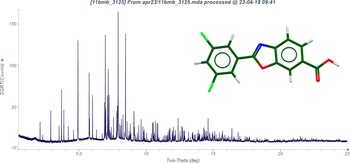
Tafamidis was a commercial reagent, purchased from TargetMol (Batch #130404), and was used as received. The white powder was packed into a 1.5-mm-diameter Kapton capillary and rotated during the measurement at ~50 Hz. The powder pattern was measured at 295 K at beam line 11-BM (Antao et al., Reference Antao, Hassan, Wang, Lee and Toby2008; Lee et al., Reference Lee, Shu, Ramanathan, Preissner, Wang, Beno and Von Dreele2008; Wang et al., Reference Wang, Toby, Lee, Ribaud, Antao, Kurtz, Ramanathan, Von Dreele and Beno2008) of the Advanced Photon Source at the Argonne National Laboratory using a wavelength of 0.459744(2) Å from 0.5 to 40° 2θ with a step size of 0.001° and a counting time of 0.1 sec/step (Figure 1). The high-resolution powder diffraction data were collected using 12 silicon crystal analyzers that allow for high angular resolution, high precision, and accurate peak positions. A mixture of silicon (NIST SRM 640c) and alumina (NIST SRM 676a) standards (ratio Al2O3:Si = 2:1 by weight) was used to calibrate the instrument and refine the monochromatic wavelength used in the experiment. The pattern was indexed using N-TREOR (Altomare et al., Reference Altomare, Cuocci, Giacovazzo, Moliterni, Rizzi, Corriero and Falcicchio2013) and solved using direct methods in EXPO2014. A reduced cell search in the Cambridge Structural Database (Groom et al., Reference Groom, Bruno, Lightfoot and Ward2016) yielded the Refcode CEQDOV for tafamidis Form 1 (Masciocchi et al., Reference Masciocchi, Abbinate, Zambra and Barreca2022). The structure was refined using GSAS-II (Toby and Von Dreele, Reference Toby and Von Dreele2013) and optimized using VASP (Kresse and Furthmüller, Reference Kresse and Furthmüller1996). A single-point density functional calculation (fixed experimental cell) and population analysis were carried out using CRYSTAL23 (Erba et al., Reference Erba, Desmaris, Casassa, Civalleri, Donà, Bush and Searle2022).
The synchrotron powder pattern of tafamidis (λ = 0.459744 Å), along with the molecular structure.

The crystal structure consists of stacks of molecules along the a-axis. The molecules are inclined to this axis; the mean plane is (−4, 2, 11). Strong centrosymmetric O–H⋅⋅⋅O hydrogen bonds (Table I) exist between carboxylic acid groups. The population analysis enabled the quantification of the strength of the O–H⋅⋅⋅O hydrogen bond using the correlation of Rammohan and Kaduk (Reference Rammohan and Kaduk2018). As noted by Masciocchi et al. (Reference Masciocchi, Abbinate, Zambra and Barreca2022), the molecules are linked along the b-axis by C–H⋅⋅⋅N hydrogen bonds. Two C–H⋅⋅⋅Cl hydrogen bonds also contribute to the lattice energy. The overlap populations provide relative measures of the strengths of these C-donor hydrogen bonds.
Hydrogen bonds (CRYSTAL23) in tafamidis Form 1

The volume/non-H atom is smaller than usual, at 16.3 Å/atom, despite the presence of the two Cl atoms in the molecule. The Bravais–Friedel–Donnay–Harker (Bravais, Reference Bravais1866; Friedel, Reference Friedel1907; Donnay and Harker, Reference Donnay and Harker1937) algorithm suggests that we might expect needle morphology for tafamidis, with [100] as the long axis. A second-order spherical harmonic model was included in the refinement. The texture index was 1.017, indicating that the preferred orientation was slight in this rotated capillary specimen.
DEPOSITED DATA
The powder pattern of tafamidis Form 1 from this synchrotron dataset has been submitted to the International Centre for Diffraction Data (ICDD) for inclusion in the Powder Diffraction File. The Crystallographic Information Framework files containing the results of the Rietveld refinement (including the raw data) and the DFT geometry optimization were deposited with the ICDD. The data can be requested at pdj@icdd.com.
ACKNOWLEDGEMENTS
We thank Saul Lapidus for his assistance in the data collection.
FUNDING STATEMENT
The use of the Advanced Photon Source at the Argonne National Laboratory was supported by the U.S. Department of Energy, Office of Science, Office of Basic Energy Sciences, under Contract No. DE-AC02-06CH11357. This work was partially supported by the International Centre for Diffraction Data.
CONFLICTS OF INTEREST
The authors have no conflicts of interest to declare.


 Open access

