


The focus of this chapter is to help you understand specialty board certification in psychology. Just as medicine and many other professions embrace the recognition of specialty skills, psychology does as well. Indeed, although relatively few psychologists are board certified as compared to physicians, the recognition of the need for specialization and board certification has grown significantly in recent years (Reference Robiner, Dixon, Miner and HongRobiner et al., 2012). Within psychology, board certification through the American Board of Professional Psychology (ABPP) is recognized as the “gold standard” and is virtually synonymous with what is being referred to when board certification is referenced in the profession (Reference Nezu, Finch and SimonNezu et al., 2009). Unlike licensure, which is required to practice and is general in scope, board certification is generally a voluntary process that is completed after earning a doctorate, completing internship and a license to practice (Reference Cox and GrusCox & Grus, 2019). It is a means of demonstrating competency in a specialty area of psychology by which the public and profession alike can know that one is competent to practice in one of the many specialties in psychology (Reference CoxCox, 2010; Reference Cox and GrusCox & Grus, 2019).
Within this context, this chapter will (1) cover a brief history of specialization and board certification in the field of psychology, (2) describe some of the benefits and advantages of becoming board certified, (3) describe the board certification process, and (4) debunk some myths regarding board certification. Hopefully, this all helps to provide some information about how and why to pursue board certification in your chosen specialty area.
If you are a graduate student (or perhaps an undergraduate student) who knows you want to become a psychologist, yet may not know what specialty area you wish to pursue, becoming familiar with the concept of specialties and related requirements is advisable as early as is feasible in your professional development. Don’t think, “That is years away, I don’t need to learn it now.” On the contrary, knowing about the specialty areas and requirements will help you plan and, more importantly, avoid missteps as you develop professionally. Little can be more disappointing than to spend years preparing to practice in a specialty area yet discover all too late that you failed to meet a particular requirement. Becoming familiar with the process and applying as early as during graduate school (this will be described later) can facilitate successful completion of the process. Early engagement includes not only learning about board certification and what is required, but also why it is important to you, potential employers, the profession, and the public that we serve. Many psychologists that have gone through the process describe it as having been a growth experience and a means of assuring themselves and others that they are engaged in practice that is focused on competent, high-quality work.
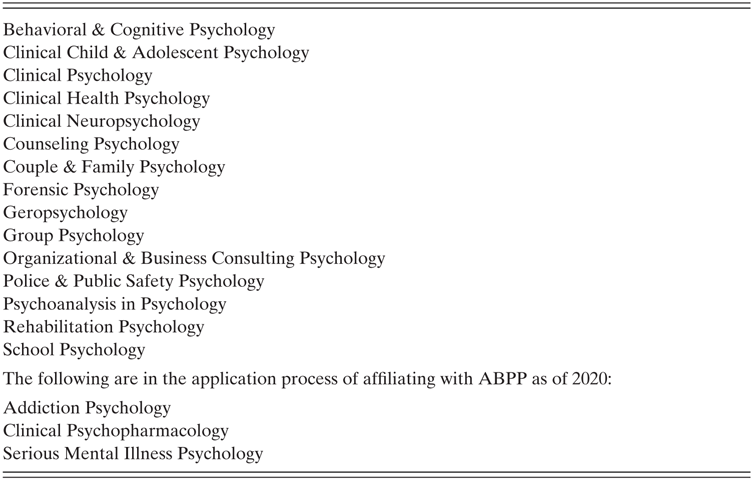
No doubt at various places within this book you will read about the increasing number of people entering psychology, increased interest in providing specialized services, the vast amount of information to learn in the field, and emerging areas of practice that have been developing in recent years. Much of this is directly reflected in the growth of specialties in psychology and the member boards of ABPP. Having started with 3 specialty boards, ABPP includes (at the time of this writing) 15 specialty boards, one subspecialty board, and has two additional specialties and another subspecialty in the process of affiliating as new member boards. Applications to ABPP have doubled in the last decade and now approach 1000 per year.
By way of background to provide you this information, my experience with ABPP is a long one. I was asked, as an active member of the Division of Rehabilitation Psychology of the American Psychological Association, to volunteer to serve on a committee exploring the need and demand for board certification in Rehabilitation Psychology. That ultimately led to establishing the examination process. That work began in 1993; the American Board of Professional Psychology (ABRP) came to fruition and formally affiliated with ABPP in 1997. At that time, I had worked in academic medical centers and hospital-based practices as well as private practice. In 2006, I was hired as the Executive Officer of ABPP. I continue to serve as the organization’s first full-time Executive Officer to this date. So, I have been associated with ABPP in some capacity for 27 years. Through all of this I have become quite familiar with each of the specialty areas, the specialty examining boards and a multitude of boards, committees, and organizations with psychology.
Work in the profession regarding specialization is ongoing and has seen strong support in recent years with several “summits” held to address specialty. A highlight for me of this continuing work has been co-facilitating the Interorganizational Summit on Specialty, Specialization, and Board Certification along with leaders of the Council of Specialties in Professional Psychology (CoS) and the Association of State & Provincial Psychology Boards (ASPPB). The four summits that we have held to date (the fifth is in the planning stages) have brought together roughly 30 of the most important boards and organizations within psychology with virtual unanimous agreement that the profession needs to emphasize the importance of specialty education, training and practice within which board certification is a natural, if not expected, step in professional development. These recent developments speak to the growing importance of specialty, board certification, and ABPP in the evolution of professional psychology.
ABPP is increasingly representative of the standards of competence for specialty practice, beyond that required of the generic licensing process. ABPP board certification is to psychology as specialty certification is within medicine, dentistry, law, and other professions. Moreover, you can initiate your application and begin familiarizing yourself with the requirements while early on in your career; I strongly encourage you to do so!
1. A Brief History of Specialization and Board Certification
Board certification of psychologists has a long history that continues to develop. ABPP began in 1947 when there was a desire to establish a means whereby the profession could identify those psychologists that were competent to provide clinical treatment (as opposed to conduct research, for example). Initially, 3 specialty areas were established; that has grown to the current 15 and growing. Comprehensive descriptions of the evolution of specialty and ABPP can be found elsewhere (Reference Baker, Cox, Johnson and KaslowBaker & Cox, 2014; Reference Bent, Packard and GoldbergBent et al., 1999).
In short, the profession evolved to the point of licensure. However, licensing of psychologists addresses education, training, and experience, and one’s ability to pass a knowledge-based test; it does not examine actual competence through review of one’s work as does the board certification process (Reference Cox and GrusCox & Grus, 2019). Psychologists that provide health care services to the public are expected be licensed by the state or jurisdiction in which they practice (with a relatively few exceptions for those working in “exempt agencies”). Licensing of psychologists is based on the broad and general aspects of applied psychology and is generic. Licensed psychologists are to ethically practice only in those areas that are within the scope of their education, training, and experience (APA, 2017). This leaves a fair amount of potential uncertainty in determining those psychologists that are competent to practice in a specialty. Consumers may be confused when trying to find an appropriate specialty provider if relying solely on licensed, non-board-certified individuals.
Specialization has become increasingly important as knowledge and information in the field increases. What you need to know in a specialty area may well double every 7–8 years (Reference Neimeyer, Taylor and RozenskyNeimeyer et al., 2012, Reference Neimeyer, Taylor, Rozensky and Cox2014). Most health care professions provide a peer-review process for the credentialing and board certification of individuals that provide health care services to the general public.
Specialty areas in psychology (Table 19.1) have a formal means whereby they are recognized (APA, 2011b). Representatives of the CoS, Commission on Accreditation (CoA), Commission for the Recognition of Specialties and Subspecialties in Professional Psychology (CRSSPP; formerly the Commission for the Recognition of Specialties and Proficiencies in Professional Psychology – CRSPPP), and the American Board of Professional Psychology (ABPP) agreed upon and adopted a definition of “specialty” that was acceptable to each of the groups (APA, 2020, p. 23):
A specialty is a defined area of professional psychology practice characterized by a distinctive configuration of competent services for specified problems and populations. Practice in a specialty requires advanced knowledge and skills acquired through an organized sequence of education and training in addition to the broad and general education and core scientific and professional foundations acquired through an APA or CPA accredited doctoral program.* Specialty training may be acquired either at the doctoral or postdoctoral level as defined by the specialty.
*Except where APA or CPA program accreditation does not exist for that area of professional psychology.
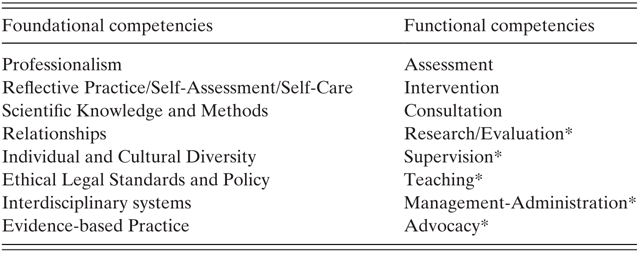
Board certification within a specialty area is not a requirement of licensing boards in psychology; in fact, most licensing boards do not recognize specialty practice at all. As with so many other professions, our field has grown in size, scope, and amount of information needed to competently practice. Reference RobertsRoberts (2006) wrote about the “essential tension” between specialization and “broad and general training” as has typically been referenced in psychology. Is psychology a singular field or a profession made up of a variety of specialty areas? Specialization is an “inevitable and necessary product of developmental processes in a discipline and a profession” (Reference RobertsRoberts, 2006, p. 863). Specialty board certification of psychologists is not required but is a voluntary process within the profession of psychology, overseen by the American Board of Professional Psychology (ABPP). Board certification through ABPP is considered by most psychologists as an advanced recognition of skills, knowledge and competencies (Table 19.2) and continues to be the expected credential for those that hold themselves out as a specialist.
* May not be applicable to all practitioners
At this point, there is general consensus within the profession that while broad and general training remains an essential aspect of psychology education and training, specialty is where we are headed (witness the Interorganizational Summit information above and other descriptors at www.cosppp.org for more information). Clinical neuropsychology is an example of a specialty within psychology that has done a terrific job of enculturating those interested in the area, embracing board certification (Reference CoxCox, 2010). Success in such enculturation is likely associated with the clear articulation of training and education requirements within a specialty via such means as using what has become referred to colloquially as the “Psychology Taxonomy” (APA, 2012).
Most of us are aware of board certification of physicians in various specialties, yet specialty certification in psychology has grown more slowly. The American Board of Medical Specialties (ABMS) was founded in 1933, the American Board of Professional Psychology (ABPP) in 1947. Probably due to the significant reliance on board certification as a means for qualifying for medical staff privileges in medicine, that profession’s certification process has grown more widespread and become enculturated into the medical profession’s education and training process. Psychology, with less presence in hospital and medical settings, has done so more slowly. However, a recent series of profession-wide meetings – the Interorganizational Summits on Specialty, Specialization, and Board Certification among them – has resulted in a consensus that the field of psychology needs to integrate specialization and board certification much more into our education and training process than has been the case historically (Reference Silberbogen, Aosved, Cross, Cox and FellemanSilberbogen et al., 2018). That work continues and planning for “Summit 5.0” (the fifth such summit) is underway as of this writing.
2. Requirements for Becoming Board Certified
It used to be that in order to even apply for ABPP board certification one must have been five years out from receiving one’s doctoral degree. An increased focus on standardization and competency-based education and training led to earlier adoption of specialization of practice for many psychologists; this has also included an increase in number of specialty postdoctoral training programs (Reference Rodolfa, Bent, Eisman, Nelson, Rehm and RitchieRodolfa et al., 2005; Reference Silberbogen, Aosved, Cross, Cox and FellemanSilberbogen et al., 2018). Board certification is a natural next step after specialized post-doctoral training. There seems to be increasing momentum regarding competency-based education, training, and board certification (Reference Kaslow, Graves and SmithKaslow et al., 2012). Recognizing board certification as one of the goals of professional training and development, ABPP started the Early Entry Program in 2007 in an effort to reach students early in training and facilitate understanding and acceptance of board certification within psychology.
The Early Entry Program (or Early Entry Option) has been extraordinarily successful and nearly 60 percent of ABPP applicants now come through that program (Reference Edgar, Holder, Cox and SurisEdgar et al., 2019). Many education and training programs are encouraging and/or sponsoring students, interns, and post-doctoral residents to participate. Becoming familiar with the process and expectations of board certification early permits one to potentially join discussion groups, identify a mentor for the process and start integrating an identity as a specialist-in-training. Basic in its design, the program allows students, interns and post-doctoral residents to apply to ABPP, file credentials and documents as they complete each step of education and training, and eventually be ready for the formal board certification process. The program does not create any exception to the standard credentials review or examination process, but does provide for a discounted application. All other requirements for ABPP board certification remain the same; the Early Entry Program is not an “easier” path, unless one accepts familiarity with the process as making it “easier.”
Becoming board-certified through ABPP includes multiple steps: credentials review, submission of practice samples, and oral examination. The process is similar for every ABPP specialty board. A written (e.g., multiple-choice) examination is also included in the process for two specialty boards: Forensic Psychology and Clinical Neuropsychology.
ABPP has what are called Generic Requirements that are the same for each specialty board. Beyond that, each specialty has its own specialty-specific requirements. The generic and specialty-specific requirements are available online at www.abpp.org. The generic requirements (for those individuals trained in the USA and graduating from a doctoral program in 2018 or later) include a doctorate in psychology from an APA-accredited program, completion of an APA-accredited internship (if the internship is completed in 2020 or later), and licensure in at least one state at the doctoral level for the independent practice of psychology. There are slight variations of these requirements for those trained earlier and/or outside of the USA.
An application that meets the requirements of the generic review is passed on to the specialty board to review the specialty-specific requirements. Specialty-specific requirements are in addition to the ABPP generic requirements; meeting the generic requirements for ABPP is a pre-requisite for review by a specialty board. An example of specialty-specific requirements might be completion of post-doctoral training in the specialty and/or completion of coursework or training in that area of practice. Completion of a formal residency program and/or supervised experience may satisfy some or all of the specialty-specific requirements; it is always best to review the specialty board’s information on the ABPP website for up-to-date information.
Once one’s credentials have been approved by the ABPP Central Office at the generic level and also by the specialty board, most applicants will be requested to submit practice samples; the two exceptions to this are for those applying in Clinical Neuropsychology and Forensic Psychology, each of which require a multiple-choice written examination first. Practice samples are often video recordings of working with a client and/or providing supervision, or written descriptions of one’s work. The specifics vary somewhat from board to board and should be accessed via the ABPP website. Two case presentations or other samples of one’s work along with a personal professional statement are common types of written practice samples. It is understood that different clinical or employment settings or roles might affect the types of cases or materials. An overview of the practice sample submission process (Reference Davidson, Nezu, Finch and SimonDavidson, 2009) and other stages of the process can be found in Reference Nezu, Finch and SimonNezu et al. (2009).
Each specialty board requires an oral examination of approximately 3 hours. The process is expected to be collegial throughout; it is not uncommon to hear that the process was engaging and challenging, yet friendly. The format or model of the oral examination is different across boards, with some being conducted with the examinee meeting with three examiners at once, and others having the examinee spend portions of the time with different examiners. Whatever model is used, the goal is always to assess the competency of the candidate.
The oral examination is most often based in part on the practice sample(s) submitted, and may also include responding to vignettes, fact-finding about cases, or other methods of inquiry. Every specialty board oral examination must also cover legal and ethical issues. That may be examined using the submitted practice sample, or the use of vignettes provided in the examination. The oral examination is an opportunity for a candidate to “think on one’s feet” and demonstrate an ability to conceptualize a case and demonstrate competence in the ability to diagnose and/or discuss a treatment plan. Candidates will need to be prepared to discuss the practice samples in detail, present a solid rationale for what was done in the case as well as how it was done. The candidate should be prepared to demonstrate that one is up to date with relevant literature (Reference Kaslow, Nezu, Finch and SimonKaslow, 2009).
The entirety of the ABPP board certification process is based largely on the concept of professional competency (Reference Rodolfa, Bent, Eisman, Nelson, Rehm and RitchieRodolfa et al., 2005) and the Foundational and Functional Competencies recognized in professional psychology (American Psychological Association, 2011a; Reference Fouad, Grus, Hatcher, Kaslow, Hutchings, Madson, Collins and CrossmanFouad et al., 2009; Reference KaslowKaslow, 2004, Reference Kaslow, Nezu, Finch and Simon2009). These are widely integrated into graduate study and used throughout the education and training experiences in the profession.
3. Myth-Busting
Over the years, some misinformation, misunderstanding, and myths circulated and developed that I would like to debunk. I recall hearing of some of these many years ago when I was entering the field, and some have persisted.
First, ABPP board certification is not just for the “best of the best” or the “cream of the crop” of the “top 2 percent” of psychologists. This myth may have spread and persisted because only a small percentage of psychologists have historically become board-certified. However, with the advent of the Early Entry Program and dissemination of information clarifying that ABPP expects that most appropriately trained psychologists should expect that they can pass the board certification examination. Indeed, we tend to say that psychologists that are 2–3 years post-doctoral degree are likely to be able to pass and psychologists with 10 or fewer years of experience pass at a rate like those who have been practicing longer (Reference Edgar, Holder, Cox and SurisEdgar et al., 2019). That time frame permits for an appropriate, yet not overly lengthy, period of post-doctoral supervised experience; of course, that experience would need to be in the specialty area in which one is anticipating becoming board-certified.
Another myth that persists, and one that is directly related to the above, is that the examination process is grueling and really for academics. The truth is that although the examination is not a “walk in the park” it is based on the very training that one has been undertaking in the years prior to examination. The process is collegial and not adversarial. Many, perhaps even most, board-certified psychologists focus on clinical care and a good percentage are in independent practice. Indeed, the examination process is about clinical practice, not academic psychology.
Finally, some feel that nothing beyond licensure is necessary. Certainly, one must (with very few exceptions) be licensed to practice in the field, and board certification is voluntary. As has been described earlier in this chapter, the notion that one need not demonstrate competence beyond licensure is becoming increasingly unacceptable in the profession as well as with the public (Reference Cox and GrusCox & Grus, 2019). The ABPP board certification examination is the single best way of demonstrating to the public, profession, and yourself that you practice at the expected level of a specialist in a particular area.
The ABPP certification process requires extensive but manageable requirements. Preparation for the board certification process from ABPP includes:
The chance to articulate your own views and perspectives in a more advanced and sophisticated way as part of the preparation and oral exam
A structure to facilitate self-assessment where the individual gets to set his or her own pace in developing their case study, which facilitates better self-understanding and case conceptualization
An important continuing professional education opportunity (fulfills, in some states, the continuing education (CE) requirements for the biennium in which board certification occurs; those successful receive CE credits from ABPP, an APA approved CE provider)
More mobility opportunities as many state licensure boards recognize the ABPP and have a facilitated licensing process
Highest credential for a psychologist and denotes an advanced level of competence (knowledge, skills, attitudes, and competencies)
“Final examination” that gives legitimacy to the profession, along with public confidence one gets when being referred to as a board-certified specialist
Assurance to the public you are a specialist that has successfully completed the educational, training, and experience requirements of the specialty, including an examination designed to assess the competencies required to provide quality services in that specialty
A credential that is understood by other professionals and the public
(The above points were taken from a presentation at the APPIC 2007 Conference in Reference Baker and KaslowBaker, J. and Kaslow, N. (2007), “Board Certification for Internship Training Directors”.)
4. In Closing
Specialization in psychology is increasingly becoming important in the profession and gaining more widespread acceptance. In some segments of the profession, it is expected that you will be, or will soon become, board certified. This is particularly true for those of us who work in, or with, hospitals and medical centers, yet it is certainly not limited to those arenas. The public is becoming more aware of the need for expertise and look for board certification. You would likely seek a board-certified neurosurgeon if you needed brain surgery. Similarly, it follows that a specialist in psychology would be expected to be board certified. Rozensky predicts that psychology as a profession is needing specialization and that to be accepted in health care arenas, psychologists as individual professionals will want board certification.
I hope that the “take-away” from this chapter is that board certification is growing and important in our profession. Starting early is well-advised, and you can be successful in achieving board certification in the specialty for which you train. Good luck as you progress!


 Open access