


Without a consistent international system of rules for processing asylum claims and providing protection, asylum seekers are increasingly dependent on the willingness of national governments, and their voters, to accept them. The number of new asylum applications in the EU more than tripled from 2010 to 2019 (Eurostat 2020a),Footnote 1 making the question of how democratic governments respond to the issue increasingly important. When new applications peaked in 2015–16, those seeking asylum were approximately twice as likely to be granted protection in Germany (64% of all initial decisions) or Sweden (69%) as in France (31%) or the UK (34%) (Eurostat 2020b). What explains this divergence?
In this paper, I argue that the importance of an issue to the public, or its salience, is key to understanding the divergent outcomes generated by asylum systems in Germany and the UK. The rate at which their bureaucracies grant protection to asylum seekers varies depending on the level of salience and its interaction with prevailing immigration preferences in both countries. Previous research has shown that governments are responsive to public preferences on immigration (Lahav Reference Lahav2004; Jennings Reference Jennings2009), and that bureaucratic procedures for dealing with asylum applications can be fallible because of practical difficulties (Toshkov Reference Toshkov2014; Schittenhelm and Schneider Reference Schittenhelm and Schneider2017; Gundacker et al. Reference Gundacker, Kosyakova and Schneider2021), or during periods of heightened public or political pressure (Ellermann Reference Ellermann2006; Jennings Reference Jennings2009; Souter Reference Souter2011). However, work on immigration responsiveness has largely overlooked the role of salience in conditioning asylum policy response at the national level,Footnote 2 despite evidence of increased salience generating greater responsiveness on a range of other issues (Jones Reference Jones1994; Bromley-Trujillo and Poe Reference Bromley-Trujillo and Poe2020). Failing to account for salience may create an inaccurate impression of responsiveness or give the appearance of a policy ‘gap’, where governments adopt more liberal immigration policies than the public would otherwise prefer (Freeman Reference Freeman1995). A lack of response to restrictive preferences may simply be the result of the low salience of immigration leading governments to prioritise other issues. By accounting for the role of salience, my research therefore also looks for credible evidence of a policy gap between the public and asylum outcomes.
Germany and the UK have comparable immigration policies (Huddleston et al. Reference Huddleston, Bilgili, Joki and Vankova2015), large migrant populations relative to the EU28 (the EU27 and the UK) average (Eurostat 2020c), and similar bureaucratic processes for dealing with asylum applications (Schittenhelm and Schneider Reference Schittenhelm and Schneider2017; Schuster Reference Schuster2020). Despite these similarities, the rates at which German and UK caseworkers grant refugee status and other forms of protection, or the asylum recognition rates, have diverged in recent years (Eurostat 2020b).Footnote 3 Using autoregressive time series models, I evaluate changes in both countries’ asylum recognition rates as a product of lagged preference and salience variables, including lagged asylum recognition rates to control for autocorrelation. This approach enables me to test the dynamic relationship between the public opinion variables and asylum decisions, and the factors which influence that linkage. I find that increases in salience at times when public preferences are for more restrictive immigration policies are negatively associated with subsequent asylum recognition rates in the UK. This reduction in grants of protected status is later followed by a rise in the rate of successful appeals at first-tier tribunals, suggesting that the decisions of caseworkers in the UK’s asylum bureaucracy are driven by public opinion rather than the merits of each application. In Germany, increased salience at times when the public favours more open immigration policies precedes a significant rise in asylum recognition rates, while appeal recognition rates remain lower than those in the UK. These findings are robust to controls for variations in applicant characteristics such as country of origin and age. Though high salience accompanies open preferences in Germany and more restrictive preferences in the UK, the results point to asylum outcomes at the initial decision stage responding to a combination of these factors in both countries, therefore demonstrating that the asylum bureaucracies of both countries are influenced by public opinion. While it remains unclear whether this influence is the result of interference from elected officials or the opinions of caseworkers themselves, my findings raise important questions about the lack of a consistent, rules-based system for processing asylum applications governed by international law.
Understanding the relationship between public opinion and policy
The literature includes substantial evidence that governments respond to public preferences on a number of issues (Burstein Reference Burstein2003), including asylum and immigration (Lahav Reference Lahav2004; Jennings Reference Jennings2009; Morales et al. Reference Morales, Pilet and Ruedin2015). Stimson et al. (Reference Stimson, MacKuen and Erikson1995) identify two causes for this responsiveness, which they describe as “dynamic representation”: electoral turnover, where a new government turns electoral pledges into policies, and rational anticipation, where governments respond to public preferences to gain favour with voters and avoid electoral defeat. Bureaucratic actors may also respond to public preferences, either because of pressure to do so from elected officials (Ellermann Reference Ellermann2006) or because resource constraints leave them prone to influence by the same preferences held by the wider public (Schittenhelm and Schneider Reference Schittenhelm and Schneider2017; Gundacker et al. Reference Gundacker, Kosyakova and Schneider2021). Other factors can affect the degree to which policy responds to public preferences. For example, a majoritarian system of government and strong executive enables greater policy responsiveness than a consensual, federal system (Soroka and Wlezien Reference Soroka and Wlezien2010), although others also find a strong link between public preferences and policy in decentralised governments (Tarrow Reference Tarrow2011). The salience of an issue is also likely to influence how governments respond.
Salience is typically described as being the importance of an issue to the general public, though as Wlezien notes (Reference Wlezien2005) it is a relative rather than absolute value and varies depending on measurement and the importance of other issues. However, studies generally indicate that government responsiveness to preferences is better predicted by whether the issue is salient or not than by preferences alone (Jones Reference Jones1994; Soroka and Wlezien Reference Soroka and Wlezien2010), suggesting standard definitions of salience remain relevant for measuring policy response (Soroka and Wlezien Reference Soroka and Wlezien2010, p.102). Though the theory of interaction between preferences and salience has been used to explain changes in defence spending (Jones Reference Jones1994), environmental policies (Bromley-Trujillo and Poe Reference Bromley-Trujillo and Poe2020), and others, analysis of their combined influence on asylum or immigration policy is lacking. If studies only account for public preferences and exclude salience, they are likely to miscalculate the level of responsiveness. Studying the effects of preferences regardless of fluctuations in salience over time could lead to overestimations of, for example, policy responsiveness to restrictive immigration preferences among the general public, which may instead be driven by other factors.Footnote 4 The obverse conditions, where more liberal immigration and asylum policies than the public would prefer lead to a policy ‘gap’ (Freeman Reference Freeman1995), could also potentially be explained by accounting for the salience of immigration with the public. Interest groups often favour ‘quiet politics’, using non-institutional channels to influence government decision-making when salience is low (Culpepper Reference Culpepper2010). This practice extends to humanitarian groups lobbying for asylum rights and has previously been cited as the cause of policy gaps in several European countries (Freeman Reference Freeman1995). However, when the salience of asylum and immigration is low, public preferences for a more restrictive approach are also easier for policymakers to ignore, potentially creating less downward pressure on recognition rates and allowing them to more accurately reflect the number of merit-based asylum applications. A lack of responsiveness to restrictive immigration preferences may therefore be more simply explained as the result of the interaction between preferences and salience. By including salience in my analysis, I contribute to a better understanding of its role in conditioning asylum policy response at the national level, and I determine the existence or otherwise of a gap between public opinion and asylum outcomes.
How does salience interact with preferences? Does it amplify or alter underlying preferences? Some preferences vary depending on recently salient events (Zaller Reference Zaller1992), contributing to a so-called thermostatic response where public opinion and policy change in response to each other (Wlezien Reference Wlezien1995), a relationship Jennings (Reference Jennings2009) finds to influence the UK asylum system.Footnote 5 However, some preferences are less mutable and more deeply held, particularly when they involve consequential future choices such as voting (Krosnick and Brannon Reference Krosnick and Brannon1993). With more stable preferences, higher salience amplifies rather than changes the underlying preference (Soroka and Wlezien Reference Soroka and Wlezien2010), a process referred to as “preference activation” (Jones Reference Jones1994, p.127). In practice, this means that policymakers are more likely to respond to public preferences on immigration and asylum when the issue is more salient, as greater attention from the public increases the political incentives for doing so, but that the underlying preferences are likely to change more slowly if at all. High salience has typically accompanied restrictive immigration preferences in the UK (Jennings Reference Jennings2009), though preferences for open immigration policies could potentially interact with high levels of salience and lead to a more liberal policy response (Hatton Reference Hatton2021).
Public opinion on immigration is not necessarily the same as public opinion on asylum, as preferences depend on certain characteristics of migrant groups. Three sets of characteristics are particularly influential: culture, skills, and legal status. The public tends to favour migrants who are culturally similar to them or to the locally dominant group (Ford Reference Ford2011; De Coninck Reference De Coninck2020), meaning that, for example, non-white or Muslim migrants are viewed less favourably in many Western democracies. The public holds more positive views about skilled migrants compared to less skilled migrants (Ford and Mellon Reference Ford and Mellon2020), as well as preferring those from richer rather than poorer countries (De Coninck Reference De Coninck2020), though different societal groups can perceive and be influenced by cultural or skills-based characteristics to different degrees (Ben-Nun Bloom et al. Reference Ben-Nun Bloom, Arikan and Lahav2015). Preferences related to asylum seekers have been shown to be consistent with these broader views (Bansak et al. Reference Bansak, Hainmueller and Hangartner2016), but they have recently grown more positive in many countries, including Germany and the UK (Rasmussen and Poushter Reference Rasmussen and Poushter2019). This trend is not always reflected in general immigration preferences (Glorius Reference Glorius2018), indicating that asylum seekers and other migrants can prompt different reactions from the public and that asylum seekers will not always benefit from public preferences for liberal immigration policies or be affected by preferences for more restrictive policies. The potential for immigration and asylum preferences to diverge, and the extent to which policymakers in the asylum system are aware of this divergence, must be considered when analysing the relationship between public opinion and asylum outcomes.
European asylum policy 2014–16: Constraints and control mechanisms
How responsive to public opinion should we expect asylum outcomes to be? During the peak years of 2015 and 2016, when they received a total of 2.5 million asylum applications (Eurostat 2020b), the then 28 members of the EU operated under the same external legal constraints. This includes the UK for the period of study, which remains an example of a Western democratic country and which has received an increasing number of new asylum claims, from 22,000 in 2010 to 44,000 in 2019. All EU28 countries (the EU27 and the UK) are party to the 1945 United Nations Charter, the 1948 Universal Declaration of Human Rights (UDHR), and the 1952 European Convention on Human Rights (ECHR) (Bauböck Reference Bauböck2006), which oblige them to abide by an international order of equal rights for all. They are also signatories to the 1951 UN Convention Relating to the Status of Refugees (UNCRSR) and the 1967 UN Protocol Relating to the Status of Refugees (UNPRSR), which establish a duty to protect those fleeing a “well-founded fear of persecution” in their country of origin and uphold the principle of non-refoulement, or not forcing them to return (UNPRSR 1967).Footnote 6 Nevertheless, as Figure 1 demonstrates, outcomes produced by national asylum systems varied greatly during 2015 and 2016. Of the 10 EU28 countries which received the most asylum applications, caseworkers were approximately twice as likely to award some form of protection in Germany (64%) or Sweden (69%) as in France (31%) or the UK (34%) (Eurostat 2020b).
Asylum Recognition Rates for the top 10 EU28 asylum receiving countries, 2015–2016.
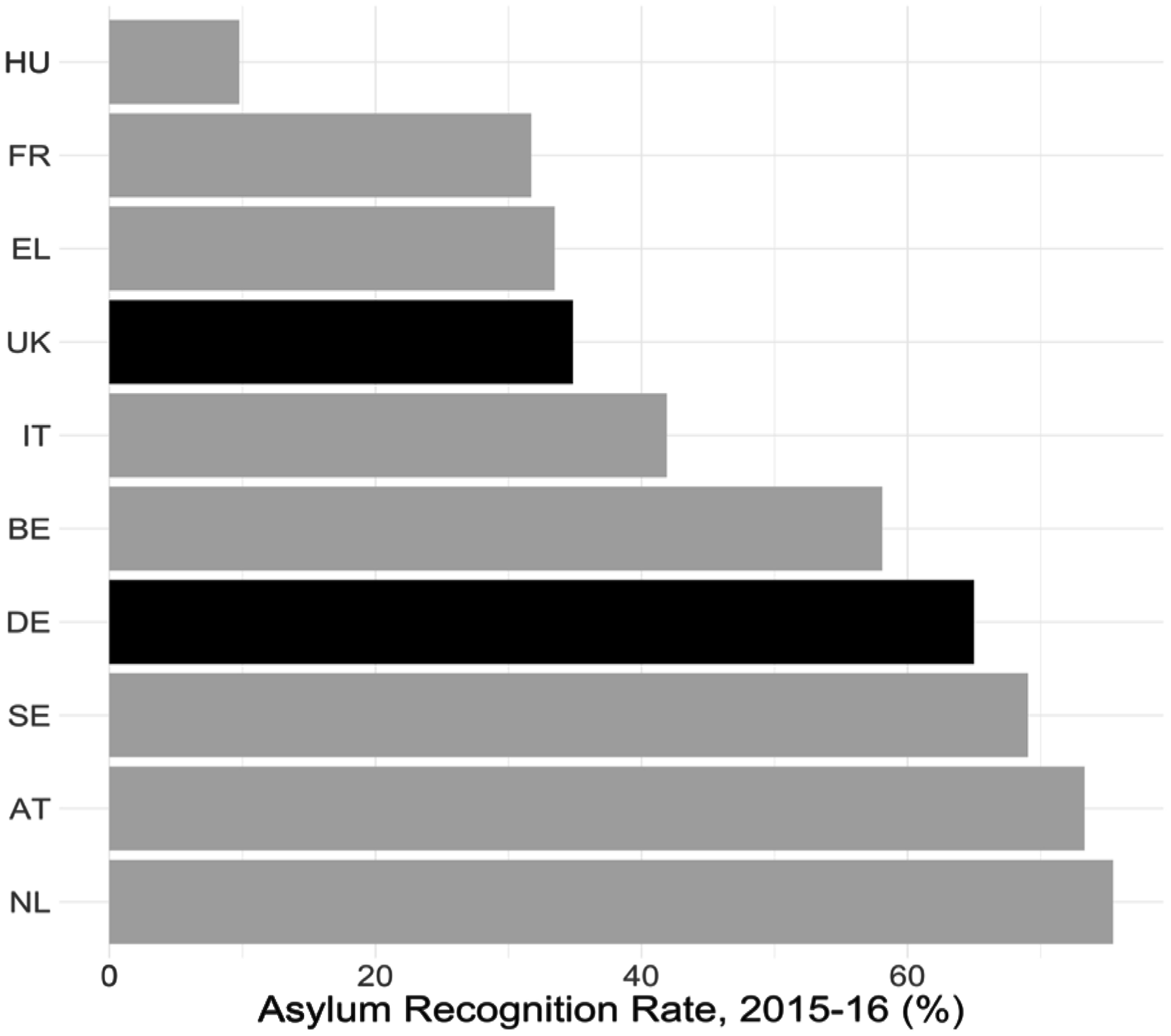
Such wide disparities in asylum recognition rates across Europe may be a sign that initial asylum decisions are not based on the merits of each application alone but are potentially influenced by policy responsiveness operating through bureaucratic channels. The divergence between Germany and the UK thus presents an interesting case study for the influence of policy responsiveness on asylum outcomes.
A two-country comparative case study allows for analysis of the mechanisms behind divergent asylum outcomes. Not every two-country pairing provides the exact matches necessary for a most similar case comparison (Seawright and Gerring Reference Seawright and Gerring2008), but Germany and the UK are among the best matches available, and both provide extensive and reliable salience, preference, and asylum data as well as several qualitative studies of their bureaucratic asylum procedures. They share practical similarities, being European countries of comparable population size, with larger migrant populations than the EU28 average (Eurostat 2020c) and similar immigration policies (Huddleston et al. Reference Huddleston, Bilgili, Joki and Vankova2015). Changes to Article 16 of the German constitution in 1993 mean their asylum laws were in line with UK laws for the period of study (Klusmeyer and Papademetriou Reference Klusmeyer and Papademetriou2009). Germany’s membership of the Schengen Area, temporary suspension of the Dublin Regulation for returning asylum seekers to their first country of entry into the EU, and the high number of asylum applications in 2015 and 2016 are potentially consequential differences from the UK case. Variations in claimant countries of origin are another important factor, with more claimants from Syria in Germany likely to have increased asylum recognition rates compared to the UK, among other such differences. Higher numbers of total applications can also reduce the number of grants of refugee status and other forms of protection, independent of public opinion (Toshkov Reference Toshkov2014). While these differences are, to some extent, a result of political decisions and thus potentially also part of a response to public opinion, I nevertheless control for levels of applications and different claimant characteristics where possible in my analysis.
The systems for processing asylum claims in both countries also share several similarities. Between 2008 and 2013, applications in the UK were processed by the UK Borders Agency (UKBA) and since then by UK Visas and Immigration (UKVI), a division of the Home Office (Schuster Reference Schuster2020). Germany’s federal system of government means that asylum claims are processed at the state level, whereas the advent of the UKVI department centralised the process after 2013. My analysis adds controls for this change. The Federal Ministry for Migration and Refugees (Bundesamt für Migration und Flüchtlinge, or BAMF), overseen by the German Federal Ministry of the Interior (Bundesministerium des Innern, or BMI), has performed the same role in Germany since 1953 (BAMF, 2014). As both systems are overseen by elected officials, they may be subject to the influence of public opinion through the dynamic representation mechanisms described earlier (Stimson et al. Reference Stimson, MacKuen and Erikson1995), for example through changes to asylum policy guidance used to assess claims.
Elected officials are not the only relevant decision-makers in the asylum process, however. Bureaucrats as well as politicians have a role in determining asylum outcomes. Applications in both countries are assigned to individual caseworkers who are responsible for their assessment (UNHCR, 2006; Schittenhelm and Schneider Reference Schittenhelm and Schneider2017). Previous research has shown the ways in which “street-level bureaucrats” respond to public opinion and influence policy outcomes (Ellermann Reference Ellermann2006; Lipsky Reference Lipsky2010). Advocates in the UK also describe a “culture of disbelief” (Souter Reference Souter2011) in which UKVI caseworkers treat asylum claims as false unless evidence conclusively proves otherwise, though accounts differ as to whether this culture stems from top-down political pressure or the biases of the caseworkers themselves (UNHCR, 2006; IAC 2008; Souter Reference Souter2011). Applications rejected at the initial decision stage can be appealed before a judge at the Immigration and Asylum Chamber First Tier Tribunal, commonly referred to as the tribunal, and human rights organisations point to the increasing rate of successful appeals as evidence of discrimination by UKVI (Schuster Reference Schuster2020). While the Home Office rejects the suggestion of a culture of disbelief, they nevertheless write “we must reduce the number of cases which we avoidably got wrong through misapplication of the law or facts or inadequate procedures” (UK Home Office 2013).Footnote 7 Critics of the German asylum system focus on other inconsistencies in how applications are processed. Insufficient funding has contributed to at times inexpert translation services and a lack of formal legal advice for applicants (Schittenhelm and Schneider Reference Schittenhelm and Schneider2017). In contrast to requirements such as those in Sweden, where applications must be overseen by at least one lawyer, German asylum caseworkers were not obliged to undertake formal training until recently (Schittenhelm Reference Schittenhelm2019). A lack of funding and professionalisation, combined with heavy workloads (Gundacker et al. Reference Gundacker, Kosyakova and Schneider2021), may undermine the accuracy of bureaucratic asylum processes, particularly when application numbers increased significantly in 2015 and 2016.
The culture of disbelief identified in the UK implies that there is a constant downward pressure on asylum recognition rates at the initial decision stage. This would potentially lead recognition rates to remain low, independent of public opinion. Alternatively, it may mean greater responsiveness to negative shifts in public opinion and a lack of responsiveness to preferences for open immigration policies. In Germany, a lack of consistency and professionalism in processing claims may leave outcomes dependent on the actions and biases of individual caseworkers, who could themselves be representative of broader public opinion. If preferences are more positive, this dependency would be far less likely to subsequently show up in the German appeals process than in the UK, as there is no incentive for an applicant to appeal a grant of refugee status. In either country, the underlying implication is the same, in that asylum recognition rates will be prone to influence by dynamic changes in public preferences and salience.
Hypotheses
In sum, the theories described above give rise to the expected typology in Figure 2.
A typology of public opinion dynamics, hypothetical mechanisms, and expected asylum recognition rates.

As the typology shows, according to preference activation theory (Jones Reference Jones1994) higher levels of salience will interact with preferences for more open immigration policies and lead to increases in asylum recognition rates, or interact with restrictive preferences and lead to decreases in asylum recognition rates. When salience falls, the influence of preferences is effectively removed. Alternatively, according to the theory of a policy gap (Freeman Reference Freeman1995; Culpepper Reference Culpepper2010), lobbying by organised interests will force recognition rates higher, or a culture of disbelief (Souter Reference Souter2011) will force rates to remain low regardless of public opinion.
I use the following hypotheses to test the expectations described in the typology:
H1. Preference activation: Bureaucratic decision-makers in the German and UK asylum systems will be influenced by public opinion either directly, through changes in their own attitudes, or indirectly, through institutional pressures. As a result, asylum recognition rates will rise after immigration becomes more salient and preferences for more open immigration policies increase, and rates will fall after immigration becomes more salient and preferences for more restrictive immigration policies increase.
H2. Policy gap: Asylum recognition rates will increase despite public preferences for more restrictive immigration policies and rising salience because of lobbying for more open immigration policies by organised interests such as humanitarian groups.
H3. A culture of disbelief: The UK asylum system’s practice of treating asylum claims as false unless conclusively proven otherwise will influence asylum recognition rates. As a result, more open immigration preferences and high salience will not lead to an increase in the UK asylum recognition rate, while the same conditions will lead to an increase in the German recognition rate. More restrictive immigration preferences will also lead to a larger decrease in the UK asylum recognition rate than the same conditions in Germany.
Data and methods
Asylum data
The UK Home Office and German BMI provide numbers of positive decisions and total decisions per quarter from 2002 to 2019. The asylum recognition rate is the total number of all positive decisions as a percentage of total decisions on asylum applications at the first decision stage. Positive decisions include grants of refugee status and forms of subsidiary protection, including humanitarian protection and leave to remain. Applications typically peak in the summer months covered by quarters 2 and 3, while the number of decisions more often peak in either the first or the final quarter of the year. To avoid potential effects of seasonality and to allow for a cumulative effect of longer than a single quarter, I therefore use 6-monthly rolling averages for the data from 2002 to 2019. Data for both countries can be disaggregated according to applicant characteristics, including age, sex, and country of origin. I use this aspect of the data to control for the effects of applicant characteristics on recognition rates where possible.
Figure 3. (left) shows annual aggregated data for the German and UK asylum recognition rates between 2012 and 2019, with a widening gap from 2014 to 2017 between the two countries as German rates rose and UK rates fell.
Asylum Recognition Rates (left), and Appeal Recognition Rates (right), Germany and the UK, 2012–2019.
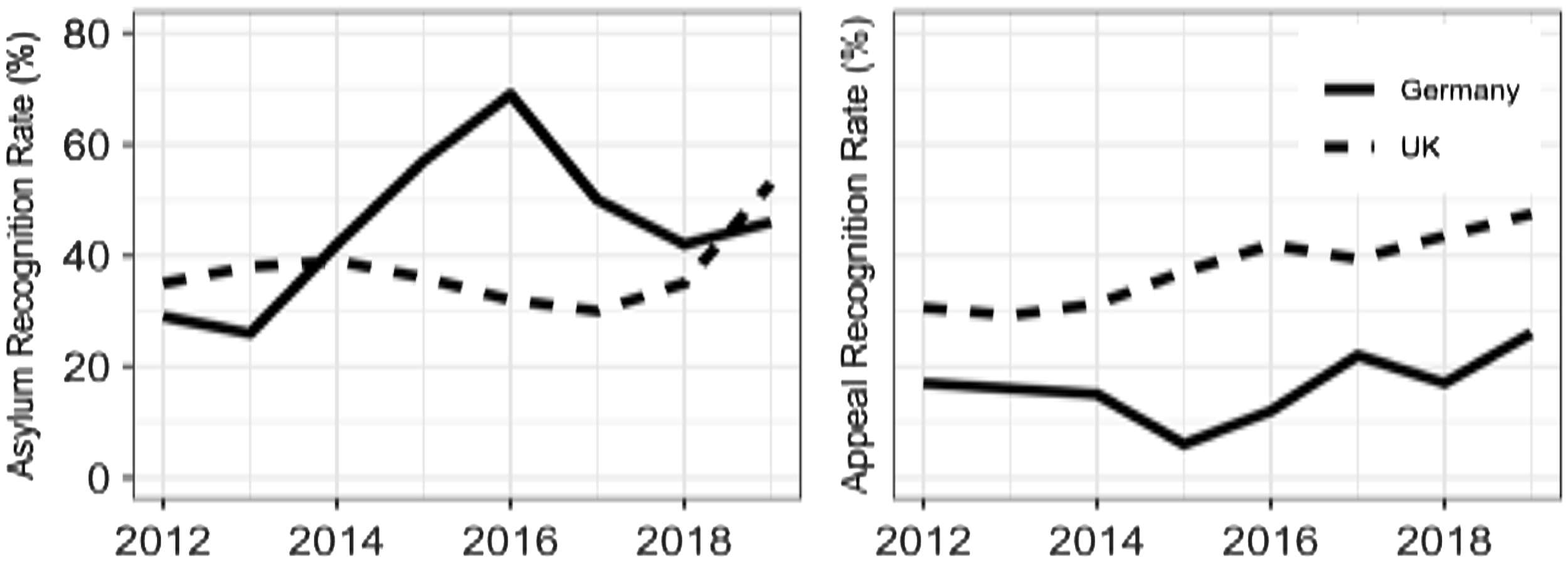
The German appeals data is only available as an annual aggregate from 2012 onwards, while the UK data is available for each quarter from 2010 onwards. Figure 3 (right) shows both German and UK first-tier appeal recognition rates as slightly higher in more recent years, and UK rates as consistently higher than German rates between 2012 and 2019. For example, of the approximately 12,000 appeal rulings made by judges at the first-tier tribunal (Asylum and Immigration Chamber) in the UK in 2016, 5,000 (40%) were to overturn initial decisions. While the aggregated annual German appeals data is not sufficient for more detailed analysis, I use quarterly data available from the UK Ministry of Justice to analyse first-tier tribunal appeals of asylum applications rejected at the initial decision stage and appeals to convert initial grants of subsidiary protection into grants of refugee status and include further analysis of both types of decision in my robustness checks.
Immigration policy preferences
Each biennial wave of the European Social Survey (ESS) includes questions about the perceived benefits of immigration to the economy, culture, and the country in general, and preferences related to immigrants from poor, non-European, and ethnically different countries. Combining these questions creates a measure of immigration policy preferences (Meuleman et al. Reference Meuleman, Davidov and Billiet2009). The 2002 and 2014 waves add a module on immigration, including a question on national governments’ treatment of asylum seekers. Germany and the UK were surveyed in all nine ESS waves from 2002–3 to 2018–9.
I classify respondents from both countries according to their immigration policy preferences, based on the concept of three classes of immigration preferences developed by Heath and Richards (Reference Heath and Richards2020). The three classes are 1. Open: those who favour a liberal immigration policy irrespective of racial, ethnic, or other characteristics, 2. Selective: those who express a preference for certain racial, ethnic, or economic characteristics over others, and 3. Restrictive: those who favour a strict immigration policy irrespective of racial, ethnic, or other characteristics.Footnote 8 These classes are also predictive of preferences for more generous asylum policies (see Appendix 1).
Table 1 shows the classification of respondents over time in Germany and the UK based on the core immigration questions.
Percentage expressing ‘open’, ‘selective’, and ‘restrictive’ immigration preferences, ESS 2002–2019
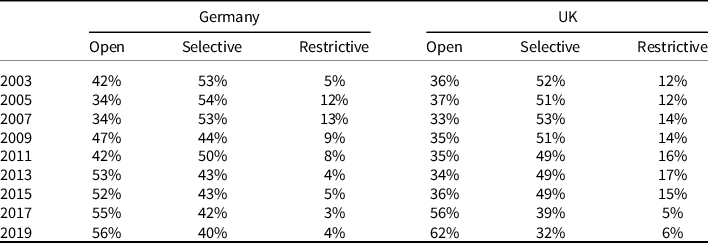
Both countries share similarities in the size and change over time of the open group relative to the other two groups. In 2002, this group was in the minority compared to those who favoured at least some form of control on immigration, but had become the majority by 2013 in Germany and 2017 in the UK. It is plausible to conclude that by these points in time, the median voter in both countries was generally in favour of more liberal immigration policies and, by extension, a more generous approach to applications for refugee status.
Salience
I use different data to measure issue salience. For the UK, I measure issue salience as the proportion of respondents saying that ‘immigration’ was the most important issue facing the country, taken from the ongoing Ipsos Mori ‘Most Important Issues’ (MIP) survey. For Germany, I use the Politbarometer survey. Respondents are asked ‘What in your opinion is the most important problem in Germany at the moment?’Footnote 9 and are free to respond with their own ideas. To produce a manageable list of results, Politbarometer groups together answers on related themes. I use the percentage of people responding on the theme of immigration, which includes all responses of ‘immigration’, ‘asylum’, ‘refugees’, and ‘integration’, and is not further disaggregated in the dataset. As both countries survey salience every month, my analysis takes quarterly averages for 2002 to 2019 to match the quarterly asylum data. Wlezien (Reference Wlezien2005) has questioned the use of MIP surveys as a measure of salience, and others use media or Google Trends analysis or other definitions instead (Helbling and Tresch Reference Helbling and Tresch2011; Mellon Reference Mellon2013; Paul and Fitzgerald Reference Paul and Fitzgerald2021). However, MIP surveys remain an accurate predictor of which issues attract the attention of policymakers (Jones Reference Jones1994; Soroka and Wlezien Reference Soroka and Wlezien2010), as well as providing an extensive and reliable dataset for valid comparative analysis.
The time series data for salience and asylum recognition rates are shown for Germany (left) and the UK (right) in Figure 4. The shaded area indicates the period in which the ‘open’ immigration group was in the minority.
Minority with ‘open’ immigration preference (shaded area), salience (dashed line), and asylum recognition rate (solid line), Germany (left) and UK (right) 2002–2019.
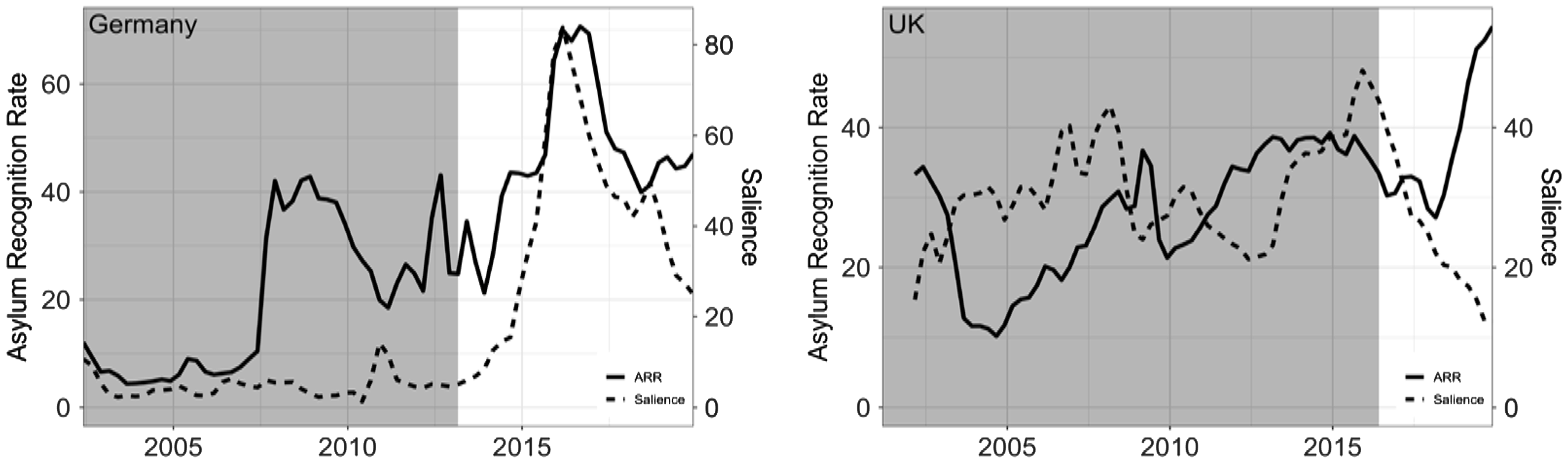
In Germany, salience and asylum recognition rates rose between 2013 and 2016, a period variously referred to as the migration crisis, refugee crisis, or asylum crisis. From early 2015, increases in salience precede increases in recognition rates by one quarter, while this lag appears to increase to two quarters when salience begins to fall in 2016. Between 2007 and 2010, the two series appear largely unrelated as recognition rates rise while salience remains low.
In the UK, an increase in salience in the early to mid 2000s coincides with a fall in the asylum recognition rate. A larger increase in salience between 2012 and 2016 also coincides with a smaller decrease in the recognition rate. This is followed by a consistent, prolonged fall in salience, majority positive public preferences about immigration, and a rise in the asylum recognition rate. However, the link is not constant as there are short periods where both time series appear to rise or fall together. Time series models should provide a clearer estimation of the overall relationship between salience, preference, and asylum recognition rates.
Time series models
It is possible to compare trends in the opinion and asylum data and avoid problems associated with autocorrelation through time series modelling. Each observation in a time series is likely to be somewhat dependent on one or more of its previous observations. This quality can give rise to spurious correlations between variables (Granger and Newbold Reference Granger and Newbold1974). Time series models include lagged values of dependent and explanatory variables, thus accounting for the influence of both autocorrelated dependent variables and lagged explanatory variables.
My analysis uses Auto Regressive Distributed Lag (ARDL) models, which estimate the following values:
 $${y_t} = \alpha + {\beta _1}{y_{t - 1}} \ldots {\beta _p}*{y_{t - p}} + {\gamma _1}{x_{t - 1}} + \ldots {\gamma _r}*{x_{t - r}} + {\varepsilon _t}$$
where the dependent variable y at time t is a product of the intercept, α, the slope, β, and a total of p lags of y, plus the slope γ and the explanatory variable x up to r number of lags, plus an error term, ϵ. Thus, asylum recognition rate at time t is the product of a certain number of lagged asylum recognition rate values and lagged public opinion values. Coefficient properties are estimated using ordinary least squares.
Results of Augmented Dickey Fuller tests for each variable show that the asylum recognition rates and the public opinion variables lack stationarity. That is, the variables lack a consistent mean and variance that would enable accurate modelling over time. Similarly, Engle-Granger two-step tests show that the asylum and public opinion variables are not cointegrated, meaning that they do not share a consistent trend which would also enable accurate modelling over time. To produce stationary variables which can be accurately modelled, I instead take the first differences of each variable, properly transcribed as Δy and Δx. Applying the Augmented Dickey Fuller test, these differenced variables all appear stationary, thus enabling their use in ARDL models for both countries. The appropriate number of lags for the asylum variable is calculated using Akaike Information Criteria (AIC) tests, meaning that the number of lags included in each model varies. I also limit the number of lags to a maximum of five, equivalent to a lag of up to 15 months. In order to study the effects of public opinion on subsequent asylum rates, I include only one lag of salience and preference in each model.
Results
Preference, salience, and Asylum recognition rates
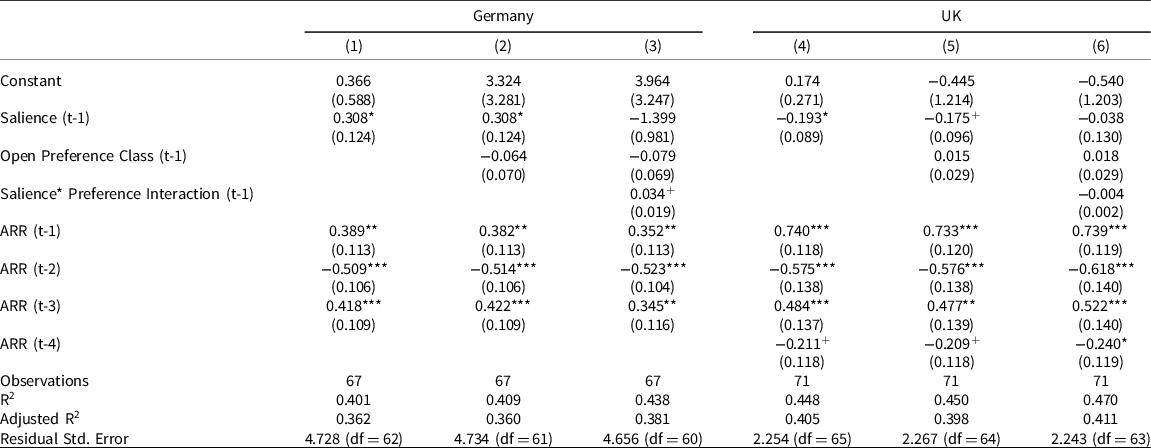
The ARDL models in Table 2 measure the effects of lagged public opinion variables on asylum recognition rates. The results for the German data are shown in Models 1 to 3, and for the UK in Models 4 to 6. Models 1 and 4 regress asylum recognition rates on lagged salience and lagged asylum recognition rates (’ARR’) for Germany and the UK. Models 2 and 5 include both lagged salience and the lagged percentage size of the public who express a preference for ‘open’ immigration policies. Finally, Models 3 and 6 include an interaction variable for salience and the open immigration preference group size. The number of lagged asylum recognition rate variables included in the models are those with the lowest AIC test score. For the German data, the lowest AIC score is achieved by including three lags, while the lowest score for the UK data comes from four lags.
ARDL models for public preference, salience, and asylum recognition rates, Germany and UK 2002–2019
+p < 0.1; *p < 0.05; **p < 0.01; ***p < 0.001.
For the German data, the salience coefficient value in Model 1 represents the effect of a one unit increase at time t-1, i.e. a 1% rise in salience, on asylum recognition rates at time t, controlling for asylum recognition rates at times t-1 to t-3. A 1% increase in salience in Q1 is estimated to be followed by a significant increase in the asylum recognition rate of approximately 0.3% in Q2. Across the period of study, the average number of decisions in Germany per quarter was 34,743. A 0.3% rise in the recognition rate would therefore equate to approximately 116 more grants of protection per quarter. The estimated values of Model 1 reflect the tendency seen in Figure 4 for increases in salience to precede increases in recognition rates, particularly from 2013 onwards. Model 2 shows an approximately equal effect from salience when controlling for the size of the population with open immigration preferences, again estimating a 0.3% rise in recognition rates in Q2 following a 1% increase in salience in Q1.
The size of the open preference group shows no significant effect on recognition rates in Model 2, meaning overall recognition rates do not significantly change when the size of this group increases. Model 3 includes an interaction term for the effects of salience and the open preference group, which estimates a positive effect when salience and open immigration preferences both increase together, albeit this effect is only significant at the 90% confidence interval. A one unit increase in the interaction variable is equivalent to a 1% increase in both salience and the size of the open preference group, or a 2% increase in one variable and 0.5% increase in the other variable, and so on. This suggests that when salience and open immigration preferences increase together, subsequent asylum recognition rates also rise, albeit the effect is relatively small.
In contrast to the German models, the estimated values in Model 4 show a 1% increase in salience preceding an approximate 0.19% reduction in the UK asylum recognition rate in the following quarter. With an average number of decisions per quarter of 9,962, a 0.19% reduction is approximately equal to 19 fewer grants of protected status per quarter. Again, the model controls for lagged values of the asylum recognition rate to avoid the distortive effects of autocorrelation. The values in Model 4 are consistent with the largely inverse relationship between salience and recognition rates apparent on the right-hand panel of Figure 4. When salience rises, the asylum recognition rate falls, and when salience falls, the recognition rate rises. As Model 5 indicates, an increase in the number of people with open immigration preferences does not have a significant effect on asylum recognition rates. However, the salience variable in this model continues to have a negative effect at the 90% confidence interval.
It may seem puzzling that, while the effects of the salience variables in Models 4 and 5 are negative, the effect of the interaction between salience and immigration preference in Model 6 is not significantly different from zero. This is because of the dichotomous effects of salience on asylum recognition rates. Rising salience is associated with falling asylum recognition rates from 2002 to 2016, when immigration preferences were more restrictive. Equally, falling salience and increasingly open immigration preferences are associated with rising asylum recognition rates after 2016. The two effects, of rising salience with restrictive preferences and of falling salience with open preferences, essentially cancel each other out, meaning the effect of the interaction between salience and immigration preference is not significantly different from zero. Taken together with Figure 4, the UK models therefore provide strong evidence of an inverse relationship between the public opinion variables and subsequent asylum recognition rates.
Appeal recognition rates in the UK
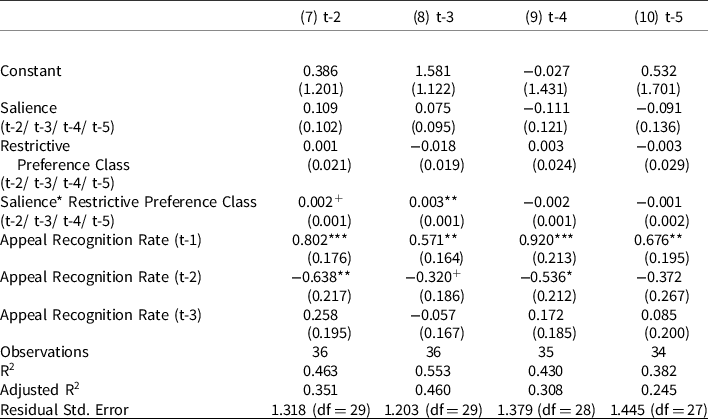
Models 7 to 10 test the theory that increasing salience and preferences for more restrictive immigration policies in the UK indirectly contribute to an increase in the appeal recognition rate by way of a preceding reduction in the asylum recognition rate at the initial decision stage. If public demand leads to the unmerited rejection of asylum applications at the initial decision stage, one would expect this to be reflected in subsequent increases in the appeal recognition rate as these unfounded decisions are reviewed and overturned. The Ministry of Justice provides quarterly data for relevant first-tier tribunal appeals of rejected asylum applications and appeals to convert grants of subsidiary-protected status into grants of refugee status. Data are not published at the level of individual asylum cases, meaning it is only possible to estimate the lag between aggregated initial decisions and tribunal decisions. The estimate should include the 3 months assumed in Table 2 for initial decisions, plus the 28 days allowed for asylum seekers to appeal a rejection. The majority of appeals are decided in less than 6 months, with the majority of the remainder decided up to 6 months later. I therefore test for an effect of lags of salience and public preference for some form of immigration restriction between time t-2 and t-5, equivalent to between 6 and 15 months. The results of the ARDL models for the relationship of these variables with the subsequent appeal recognition rates are shown in Table 3.
ARDL Models for salience, public preference for restrictive immigration policies, and first-tier tribunal appeal recognition rates, UK 2010–2019
+p < 0.1; *p < 0.05; **p < 0.01; ***p < 0.001.
Model 8 estimates a significant effect for the interaction of salience and restrictive preferences on appeal recognition rates. A positive value here means that an increase in salience and restrictive preferences at Q1 is followed by an increase in the appeal recognition rate at Q4, equivalent to nine months later, theoretically by way of an intervening reduction in the asylum recognition rate at the initial decision stage in Q2. The coefficient value estimates that a one unit increase in the interaction variable is followed by a 0.005% increase in successful appeals at the tribunal stage 9 months later, or approximately 6 months after the application has been processed by the UKVI. Though the effect is small, this finding supports the theory that the rate at which applications are rejected at the initial decision stage is related to subsequent reversals by the tribunal, and that this sequence is in turn related to changes in public opinion on the subject of immigration. However, as shown in Figure 3, appeal recognition rates have remained high since 2017 despite more positive public opinion, suggesting there may still be some negative bias in the processing of asylum claims at the initial decision stage.
It should be added that the aggregated appeals data used here is imperfect. Analysing only appeals of rejected applications would potentially be more informative than the available data, which also includes appeals of subsidiary-protected status decisions. However, modelling initial decision recognition rates including only grants of refugee status and excluding subsidiary protection decisions still returns a significant effect for salience, while modelling only grants of subsidiary protection shows no significant effect for salience (see Appendix 2, Table A2). These results are consistent with the idea that applicants and caseworkers consider subsidiary status to be less desirable than a grant of refugee status. That rejected applications and subsidiary decisions are both consistently overturned at the appeals stage therefore provides further evidence of negative bias in the UK asylum system.
Successful appeals at time t will also include a small proportion of appeals processed more than nine months later, which have previously been rejected at the first decisions stage under the theoretical influence of salience at times t-4 or t-5. Analysis at the individual case level is needed to more confidently confirm or refute the significant effect apparent in Model 8.
Robustness checks
A number of confounding factors could explain the significant results. The effects of an increased influx of applicants from oppressive or war-afflicted countries of origin may distort my findings. Public opinion could respond to changes in the number of applications or the recognition rate, introducing a distortionary circularity. Despite the inclusion of lags of the asylum recognition rates and appeal recognition rates, the models may still be prone to autocorrelation.
I control for the effects of different countries of origin on German and UK asylum recognition rates by running separate ARDL models which exclude each of the 10 most common claimant countries of origin. The results, shown in Appendix 2 Tables A3 and A4, do not differ substantially from the main effects and interaction effects shown in Table 2, strengthening the claim that the dynamic relationship between public opinion and asylum outcomes in both countries is not driven by any particular country. Further controls for age and sex (see Appendix 3, Tables A5 and A6) are also consistent with the previous results. Note that data for these characteristics are only available for applications from 2008 onwards.
Despite the increase in asylum applications in 2015, separate models for the German data before and after this point do not meaningfully change the estimated effects of public opinion on recognition rates (see Appendix 3, Table A7). Similar analysis for the UK, splitting the data to account for the centralisation of asylum administration in 2013, returns similar effects to the main models, albeit with a smaller sample and larger standard errors reducing the significance of the results (see Appendix 3, Table A7).
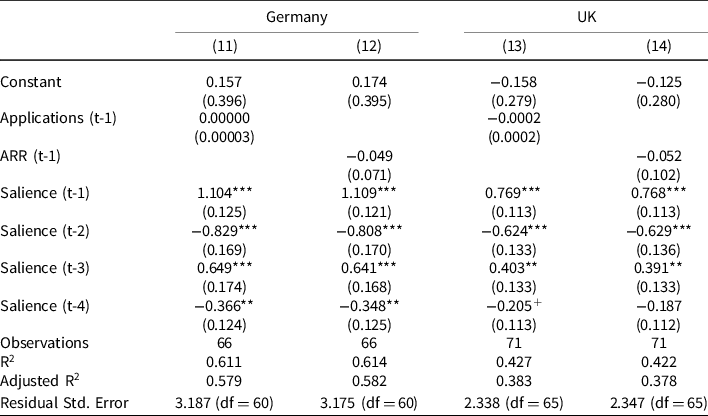
I next test for endogeneity between public opinion and asylum data through further ARDL models, this time using salience as the dependent variable and applications and asylum recognition rates as the explanatory variables.Footnote 10 The results of these models are shown in Table 4.
Robustness Checks of ARDL Models for number of asylum applications, asylum recognition rates, salience and preferences, Germany and UK 2002–2019
+p < 0.1; *p < 0.05; **p < 0.01; ***p < 0.001.
The models estimate no direct relationship between levels of salience and preceding changes in the number of asylum applications or the asylum recognition rate. The variables return small coefficient values for both countries, neither of which is significantly different from zero. While it is likely that higher numbers of asylum applications in particular helped to perpetuate high levels of salience in both countries, this relationship does not explain the effects shown in previous models.
The results of further robustness tests on the modelled relationship between the various public opinion variables and asylum recognition rates are included in Appendix 4. The autocorrelation function tests show autocorrelation values remain small. Further tests suggest that the relevant model residuals are not autocorrelated, and that the residuals from the models for both countries are not normally distributed (Jarque and Bera Reference Jarque and Bera1987) but may be somewhat skewed (D’agostino et al. Reference D’agostino, Belanger and D’Agostino1990). In sum, these findings suggest the significant model coefficient estimates are not the result of autocorrelation, but that the models may exclude other explanatory variables.
Discussion
The results provide evidence in support of H1, that public opinion contributes to divergences in asylum recognition rates between countries and over time. Both Germany and the UK experienced increasingly high levels of salience as asylum applications increased from 2013 onwards. In Germany, this came at a time when the majority favoured more liberal immigration policies. For the general public, particularly high levels of importance given to asylum and immigration between 2013 and 2016 thus appear to have been an expression of an increasingly welcoming culture, or even of pressure for the government to do more to help asylum seekers. The positive interaction between salience and open immigration preferences in model 3 of Table 2 and similar results when controlling for various applicant characteristics suggests that higher salience amplified more open public preferences. That recognition rates rose in the quarter immediately following this is a sign that German policymakers, caseworkers or both were more willing to grant protection to applicants, as H1 predicts. More restrictive immigration preferences held by the median voter until 2013 did not affect asylum outcomes, though as this came at a time when immigration was not a priority for most of the public, the role of salience cannot be determined for this period. Rather, the combination of high salience and open immigration preferences encouraged a more liberal response to the increasing number of applicants between 2013 and 2016 than may have otherwise been the case. For the UK, on the other hand, rising salience occurred when a majority were in favour of more restrictive immigration policies, which led to a fall in rates of protection. This dynamic also led to an increasing number of successful appeals approximately nine months after the initial application. Taken together, these results are consistent with the idea of the UK asylum bureaucracy responding to public demand for lower levels of immigration, again supporting the idea of Preference Activation described in H1. As Preference Activation theory has predicted in other policy domains, a rise in salience means governments are more likely to be responsive to the prevalent public mood.
H2 anticipates rising asylum recognition rates driven by interest group lobbying despite negative public preferences. On the basis of the evidence presented here, high asylum recognition rates in Germany cannot be said to be an example of an interest group-led policy gap, but are instead linked to positive public attitudes. Equally, asylum recognition rates in the UK fall with rising salience and restrictive immigration preferences. Though rates do increase when salience falls, this comes at a time when prevailing preferences are for more open immigration policies. These results therefore do not support H2’s idea of a policy gap in either the German or the UK case.
Finally, H3 predicts consistently lower asylum recognition rates in the UK compared to Germany, even at times of more open public preferences, as a result of a culture of disbelief within the UK asylum system. However, from 2017 onwards, preferences for more open policies grew in the UK and the issue of immigration became substantially less salient. This turn in the public mood also brought a significant increase in asylum recognition rates, exceeding the German rates by 2019. This period in the UK time trends means the results are not consistent with the idea of a culture of disbelief, as asylum recognition rates are not consistently low but instead vary with public opinion. These results therefore do not support the idea of a culture of disbelief influencing asylum recognition rates described in H3.
Despite adding controls for various applicant characteristics (see Appendix 3), the effects of the different German and UK asylum seeker populations on recognition rates cannot be wholly mitigated in my analysis, particularly with regard to countries of origin. For example, the 2015 recognition rates for asylum seekers from Syria were 87% in the UK and 97% in Germany, but these applications accounted for 6% of all decisions in the UK that year and almost 40% in Germany (Eurostat 2020a, 2020b). In other words, higher numbers of asylum seekers from Syria contributed to higher aggregate recognition rates in Germany compared to the UK. Though the effects of public opinion variables remain when removing Syria and other prominent countries from the ARDL models, the potential role of different countries of origin, other applicant characteristics or other omitted variables in driving recognition rates in either country should not be overlooked when assessing the results.
Conclusion
These results highlight the contrast in the relationship between salience and preferences for immigration in Germany and the UK. Where in the UK, high levels of salience tend to indicate pressure to control immigration, this does not appear to be the case in Germany during the same period, where higher salience combined with preferences for more open immigration policies and the recognition of asylum applications subsequently increased. As Freeman (Reference Freeman1994) previously noted, the UK system is responsive to public opinion, though I argue that it is not unique in this. My findings therefore strengthen the case for including asylum policy together with immigration more broadly (Lahav Reference Lahav2004), defence spending (Wlezien Reference Wlezien1995), environmental protection (Bromley-Trujillo and Poe Reference Bromley-Trujillo and Poe2020), and others (Burstein Reference Burstein2003) as policies which are responsive to public opinion, particularly when accounting for salience as well as preferences. Evidence of policy responding to public opinion, and a lack of evidence for Freeman’s ‘policy gap’ (1995), suggests that democratic policymaking is at least somewhat attentive to the demands of the electorate. The mechanism for this responsiveness remains unclear, however. Though my findings do not contradict Stimson et al.’s rational anticipation model (1995), the analysis of successful appeals in the UK also highlights the potential for ‘street-level bureaucrats’ (Lipsky Reference Lipsky2010) to condition responsiveness to public opinion.
The lack of availability of individual asylum case data remains a hurdle to more conclusive results. Being able to trace cases at the individual level is crucial to clarify the relationships and mechanisms between public opinion and recognition rates implied here. Further comparisons would require other countries that experience sustained open immigration preferences and high salience, a rarity outside of Germany. The UK data does not allow for a direct comparison of these conditions, but other countries may do so in future. A further test of these findings would involve running the same analysis, either in other EU countries or in one country after changes to the asylum system are made. Sweden, where initial asylum decisions are overseen by immigration lawyers, would provide an interesting comparison with the UK or German systems of the 2000s and 2010s. Changes in national laws for processing asylum cases or appeals, improvements in training for asylum caseworkers, or different levels of legal aid can also provide points of comparison within countries. If such changes are also connected to changes in public opinion, this would further support decisions at the ministerial level as the main driver of the responsiveness seen here. Though qualitative research has provided details about the working culture of the German and UK asylum systems, interviews with caseworkers and the organisations which work with them are also needed to locate the source of the responsiveness more accurately.
Supplementary material
To view supplementary material for this article, please visit https://doi.org/10.1017/S0143814X22000344
Data availability
Replication materials are available at: https://doi.org/10.7910/DVN/FSRPMX
Acknowledgements
Early versions of this paper were presented at the annual University of Manchester Democracy & Elections/Comparative Politics Conference (2020), the University of Tallinn MirNet Conference (2021), and the European Political Science Association Annual Conference (2021). I am extremely grateful for the feedback and advice of my supervisors, Rob Ford and Nicole Martin, the conference attendees including Chris Butler, Rosalind Shorrocks, Mechthild Roos, Leif Kalev, Adam Scharpf, and Gerald Schneider, and the three anonymous reviewers.
Competing interests
The author declares none.
Funding
Funded by the School of Social Sciences, University of Manchester, UK.


 Open access

