


1 Introduction
According to the magical law of contagion, when objects make physical contact, there may be a passage of basic properties from one to the other (Reference TylorTylor, 1871/1974); Frazer, 1890/1959; Mauss, 1902/1972). Characteristically, at least one of the objects is a living thing, and, most frequently, it is valence or some distinctive property of one entity that is passed to another (Reference Nemeroff and RozinNemeroff & Rozin, 1994; Reference Rozin, Nemeroff, Gilovitch, Griffin and KahnemanRozin & Nemeroff, 2002). Only minimal contact is necessary for the passage of properties (the principle of dose insensitivity), and the effects are typically permanent (“once in contact, always in contact”) (Mauss, 1902/1972; Reference Rozin, Millman and NemeroffRozin, Millman & Nemeroff, 1986; Rozin & Nemeroff, 1990). When contagion beliefs were identified by anthropologists over one hundred years ago, they were thought to be widely held among members of “primitive” cultures. More recent psychological investigations suggested that these beliefs are widely held by educated individuals from Western cultures. For example, most people are reluctant to wear Adolph Hitler’s sweater, even after it is thoroughly cleaned, or eat a food that has been touched by a disgusting object, even after that food has been sterilized (Reference Nemeroff and RozinNemeroff & Rozin, 1994; Reference Rozin, Millman and NemeroffRozin, Millman & Nemeroff, 1986; Reference Rozin, Nemeroff, Wane and SherrodRozin et al., 1989; Rozin & Nemeroff, 1990). The examples we have referred to, and those demonstrated in Westerners, are instances of forward contagion: a past history of contact affects the contacted entity in the present. The forward direction of contagion beliefs maps onto an important causal sequence in the real world: even brief physical contact with objects containing harmful microbes can lead to major negative consequences for the contacted party. Tiny amounts can have large effects. However, unlike in the real world of germs, magical forward contagion effects sometimes survive sterilization and thorough washing, and behave as if what is transmitted is something non-physical, which can be described as a “spiritual essence” (Reference Nemeroff and RozinNemeroff and Rozin, 1994).
Some of the most prominent examples of magical contagion offered by the original anthropologists who studied this were of a different type (Reference TylorTylor, 1871/1974; Frazer, 1890/1959; Mauss, 1902/1972). For example, in tribal regions of Burundi in Southern Africa, designated tribal shamans are known to appropriate pieces of a person’s body, particularly hair and fingernails, in order to exert magical control over a person’s health and welfare (Reference MeyerMeyer, 1916). The practice stems from a belief that physical actions performed on the object, such as burning or desecration, result in spiritual harm, usually instantiated as bad luck to the original owner of the object. This model of magical contagion is distinguished from most forms of magical contagion in that the flow of cause and effect runs backward: negative actions on an object formerly owned by an individual influence that individual in the present. Backward magical contagion effects describe how a “residue” or “essence” of an entity is believed to operate on the original entity through a connection between all entities sharing the same essence. Thus, an enemy shaman burning a lock of your hair is operating on your personal essence thereby inviting bad luck upon you.
While tribal magical rituals provide a vivid depiction of backward magical contagion, the same mental model of contagion may exist in the minds of modern, adult Americans (Reference Rozin, Millman and NemeroffRozin et al., 1986; Reference Rozin, Nemeroff, Wane and SherrodRozin et al., 1989; Rozin & Nemeroff, 1990). Though limited, there is evidence for the presence of backward contagion effects in Americans (Reference Rozin, Nemeroff, Wane and SherrodRozin, Nemeroff, Wane & Sherrod, 1989). In questionnaires, about 30% of college students showed some discomfort in response to a hypothetical situation in which their hair or hairbrush fell into the hands of someone they did not like or a public figure they despised (Reference Rozin, Nemeroff, Wane and SherrodRozin et al., 1989). In these cases, it was made clear that the respondent would never again encounter the object in question, so forward contagion effects were eliminated. Backward contagion seems to be present in some adults, and is particularly interesting because it involves, in some sense, a reversal of the normal causal structure of the world.
Backward contagion may express itself in the Western, developed world. For example, some people may be reluctant to donate their used clothes to organizations that will sell or give them to poor people. Some may be reluctant to give blood because of discomfort of the thought of their blood in someone else, usually an unspecified person. Some may be reluctant to have their (used) car sold to another person, though in this case, the financial cost of indulging this discomfort may be high enough to affect a decision. The situation where backward contagion may operate most strongly is organ donation. Many people have a sense of self in their organs, and the idea of, for example, their kidney living in another (unknown) body may be upsetting. We already know that organ recipients sometimes feel that properties of the donor are expressed in them via the donated organ (Reference SannerSanner, 2001; Reference Inspector, Kutz and DavidInspector, Kutz & David, 2004; Reference Hood, Gjersoe, Donnelly, Byers and ItajkuraHood et al., 2011).
For clarity in our presentation of the following studies, we adopt the following vocabulary: the person who is the focus of backward contagion, whose object falls into the hands of others, is called the source. The object is called the medium, and the person who comes to possess it is called the recipient. What happens to the medium after it comes into the possession of the recipient is called its fate. The studies described here attempt to illuminate backward magical contagion with respect to its prevalence and its properties: what promotes it, and what reduces it? In two studies, we explore the range of media that can operate between source and recipient, the importance of the relation between source and recipient, whether the recipient is aware of the relation between the medium and the source, and the importance of the fate of the medium once it has been transferred. We limit ourselves to consideration of negative backward contagion, because it constitutes most examples from the anthropological literature, and because negative forward contagion is much more robust than positive forward contagion (Reference Rozin, Nemeroff, Wane and SherrodRozin et al., 1989; Reference Rozin, Nemeroff, Gilovitch, Griffin and KahnemanRozin & Nemeroff, 2002; Fedotova, Rozin & Brunwasser, 2014).
2 Study 1
This study serves to assess the degree of belief in backward contagion in an adult American sample, and also explores the importance of whether the recipient knows that the medium comes from its source.
2.1 Methods
2.1.1 Subjects
Two hundred and six adults (81 male, 123 female, 2 did not provide gender) from the United States participated in this study. Their mean age was 33.04 years (s.d.=11.75), ranging from 18 to 64. All subjects were drawn from an internet sample conducted through Amazon’s MTurk service, which compensates subjects with small monetary credits to their Amazon.com account. The majority of subjects identified as White (77.0%), with the remainder identifying as 7.4% African American, 6.4% Asian & Pacific Islander, 5.4% Hispanic and a smaller percentage from other groups. Overall, 30.4% of respondents indicated having attained a Bachelor’s Degree. The study was done in 2013.
2.1.2 Materials
We created 20 short scenarios divided into five groups, based on the medium which might elicit backward contagion effects: blood, hair, an original signature, a photocopy of a signature, or a travel journal. The first two media represent physical connections to the source, while the latter three media represent a psychological connection to the source. The scenarios described the objects as originally belonging to the source (the respondent) before falling into the possession of a recipient. Two recipients were possible: either a convicted rapist, or a personally known enemy, provided by the subject’s own answer to a question posed at the beginning of the survey. In some cases, the recipient was described as keeping the medium and in others as burning it. Finally, we varied whether the recipient (negative figure) knew that the medium came from the source (respondent). This knowledge, when provided, was limited to the name of the source. Table 1 lists all 20 permutations of these factors.
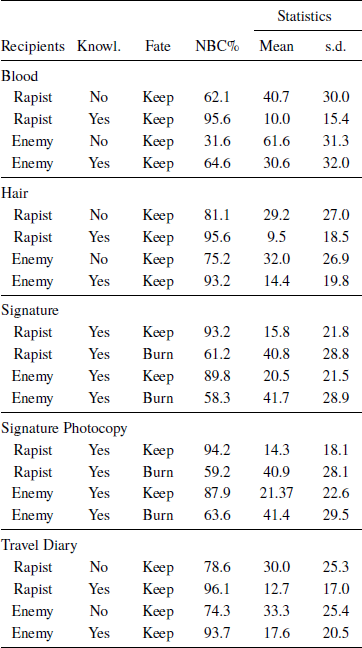
Note. Neutral point was 50, with lower scores indicating a greater backward contagion response.
The on-line survey was carried out using Qualtrics. Subjects viewed a description of each of the 20 scenarios followed immediately by a scale requesting their level of discomfort with the specific scenario. Subjects moved an indicator on a sliding scale from 0 “Extremely Uncomfortable” to 100 “Very Comfortable.” The point of 50 was labeled as “Neutral.” Thus, responses below 50 on the scale indicate discomfort with the event described in the scenario, which we interpret as a negative backward contagion effect. With the exception of the control questions used to calibrate the scale, the order of all scenarios was randomized for each subject.
Subjects responded initially to several control questions. The first two control questions explained the scale by asking about an uncomfortable event (“sit in the waiting room for three hours at the doctor’s office”) and a comfortable event (“drink a glass of purified water”). Subjects were also asked to provide the initials of someone they personally knew whom they would consider an enemy. The survey software automatically inserted the subject’s answer to this question as the initials in the “enemy” scenarios. For example, the software could display “A.H. finds and keeps clippings of your hair.” A follow-up question asked whether this enemy would want the subject to “do poorly” in life.
A categorization of the questions follows. Each question was asked about your personal enemy and a convicted multiple rapist. There were four questions for each of five media. For blood, hair and diary, discomfort was rated for the rapist and the personal enemy, each for a case in which the source identity (name) was known or not. For the two signature media, it is obvious that one could not disguise the name, so instead of the unknown identity pair of items, we had the recipient burn the media (signatures).
Blood: “You donate blood to a blood bank, which gives your blood to a (rapist/enemy) The (rapist/enemy) has no information about your identity.” (for the knowledge condition, the last sentence was replaced by “The (rapist/enemy) receives your name in an informational packet from the blood bank.”
Hair: “A (rapist/enemy) finds and keeps clippings of your hair. The (rapist/enemy) does (not) know that the hair was yours.”
Diary: “A (rapist/enemy) finds and keeps your travel diary from a trip you took in the past. The travel diary contains no compromising or identifying information, but includes your written thoughts and comments about the trip. The (rapist/enemy) does not know that the diary belongs to you.” (Alternative last sentence: “Your name is written on the diary.”
Signature: “A (rapist/enemy) finds your signature on a piece of paper. The (rapist/enemy) keeps your signature” Alternative second sentence: “The (rapist/enemy) decides to burn your signature.”
Signature copy: The same as Signature, except instead of saying “signature” it says “a printed copy of your signature.”
Each subject responded to every scenario in a different randomized order. At the end of the survey, subjects provided standard demographic information as well as levels of religiosity ranging from “not at all” to “extremely religious” (5 point scale) and political leanings along a “very conservative” to “very liberal” (7 point scale).
2.2 Results
To examine the prevalence of backward contagion effects, each subject’s responses were averaged across the 20 scenarios to create a composite backward contagion score. Values at or above 50 were classified as not showing backward contagion, as these values represented neutrality or comfort with the backward contagion scenarios. Values below 50, however, showed a mean discomfort with the scenarios and therefore represented a backward contagion effect. Note that by this criterion a person who showed discomfort for only a few of the 20 scenarios would probably not score with a mean below 50, and would not be classified as believing in backward contagion. From the sample of 206 subjects, 91% (188 subjects) showed an overall effect of backward contagion, but only 9% (18 subjects) indicated no effects of backward contagion for any of the 20 scenarios. Backward contagion sensitivity appears to be consistent across scenarios: Cronbach’s alpha for this scale was α = .90. Backward contagion scale scores did not correlate significantly with gender, religiosity, or political leanings.
Table 1 shows mean responses and standard deviations for each scenario. All scenarios differed significantly from the neutral point of 50, with lower numbers corresponding to a greater discomfort with the scenario. The most uncomfortable scenarios involved a rapist coming into contact with and keeping an object for which he knew the name of the source (range of mean discomfort from 9.5 to 40.8).
The only scenario that did not show significant discomfort was blood given to the enemy when the enemy did not know the name of the source (Table 1; mean 61.6; 18% scored 100!). Note that in this case, the subject may have saved the life of or at least helped the enemy. The corresponding rapist score was 40.7.
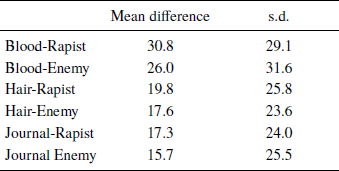
Knowledge of the name of the source of the media (for rapist/enemy across blood, hair, and diary) produced a mean drop of 21.2 (range 15.7 to 30.8) comfort points; all of the six comparisons are significant at p<.001 by paired t-test (Table 2).
Fate.
There are four pairs of cases which are identical except for whether the recipient kept or burned the medium (Table 1). An analysis identical to that done for knowledge of source reveals a mean difference (burn minus keep: 23.2) for all four cases, with the scenario specific difference ranging from −20.2 to −26.6 (Table 1), with each of the four paired sample t-tests significant at p<.001. Discomfort after burning is much less than discomfort after keeping.
A one way repeated measures ANOVA across the five media was carried out separately for rapist and enemy for the one question that was the same for each medium (keep, known source. There is an overall significant effect of media, for rapist (F(4,820) = 9.283 p<.001). Pairwise significant effects (p<.01) show a stronger discomfort for hair and blood than for the two signature items.
3 Study 2
This study was designed to explore the influence of type of medium, nature of recipients, and fate of the medium in the hands of the recipient. Study 2 explores media effects further with a wider set of media. Study 2 also sought to examine an unexpected finding from Study 1. Study 1 suggested that backward contagion was reduced more when the recipient burned as opposed to simply kept the medium. This finding runs counter to the anthropological literature, which suggests that harming the medium produces the most negative effect on the source. For this reason, Study 2 provides a wider range of fates, to confirm and clarify the surprising finding from Study 1.
3.1 Methods
3.1.1 Subjects
One hundred and seventy seven adults (89 male, 88 female) from the United States participated in this study, recruited from Amazon MTurk. Their mean age was 35.13 years (s.d.=12.14), ranging from 18 to 66. The majority of subjects identified as White (84.7%), with the largest second group represented by African-Americans (5.1%). A plurality (39.5%) of subjects indicated having attained a Bachelor’s Degree.
3.1.2 Materials
We created 108 short scenarios which systematically varied the medium, the identity of the recipient, and the fate of the medium. The scenarios were divided first into three groups based on the recipient: a personal enemy, a convicted murderer, and a 30-year-old male stranger. Subjects saw questions about one recipient only.
Multiple media were described as falling into the possession of these recipients. Media were: the source’s fingernail clippings, vial of blood, signature, travel journal, photo album, and shirt (“finds your old shirt”). “Vial of blood previously used in a blood test” replaced donated blood, because Study 1 indicated a charity component for donated blood. These media represented a mix of biologically (fingernails, blood) and psychologically (signature, journal, photo album) connected objects, with shirt as a possible mixture of the two. All media were included for all possible recipients. Six fates were explored, including four in which the recipient no longer had possession of the objects (burning, throwing in a septic tank, giving away, and losing track of the object) and two cases in which the recipient remained in possession of the objects (displaying on a shelf, and storing in an attic). All media were described as belonging to the subject before falling into the possession of a recipient.
Recipients were always described as being unaware of the source, just as in the No Knowledge scenarios of Study 1. All fates were included for all objects and for all possible recipients, but subjects were randomly assigned to one of the recipients: stranger, convicted murderer or enemy. Thus, the permutations of six media with six fates resulted in 36 scenarios per subject. Responses to these backward contagion scenarios used the same scale as Study 1. Subjects viewed one scenario followed immediately by the 0 “Extremely Uncomfortable” to 100 “Very Comfortable” sliding scale. Subjects identified their discomfort or comfort level by dragging the indicator from the neutral point of 50 to their chosen position.
Subjects answered two questions at the beginning of the survey to help calibrate the scale. The first presented an uncomfortable event (“attend a three-hour concert of music you dislike”), while the second presented a comfortable event (“drink a glass of purified water”). The personal enemy was handled in the same way as in Study 1. A control question sought to assure that the personal enemy actually wished the subject would “do poorly” in life. After completing these initial questions, subjects were randomly assigned to complete a set of scenarios corresponding to one particular recipient. This was done to limit the total number of scenarios, so that each subject completed 36, with the intention of improving data quality. Thus, recipient was a between subject variable, and media and fate were within-subject variables. Once assigned, the 36 items were presented in a random order determined for each subject.
At the end of the survey, subjects provided standard demographic information as well as levels of religiosity ranging from “not at all” to “extremely religious” 1–7 scale and political leanings along a “very conservative” to “very liberal” 1–7 scale. Subjects also provided their highest attained level of education.
3.2 Results
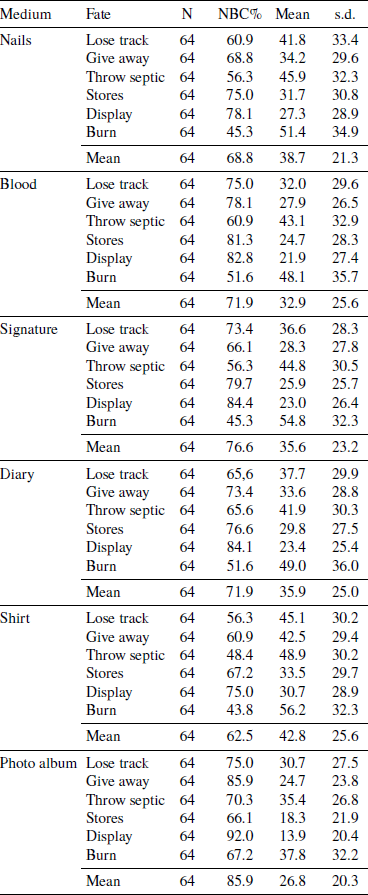
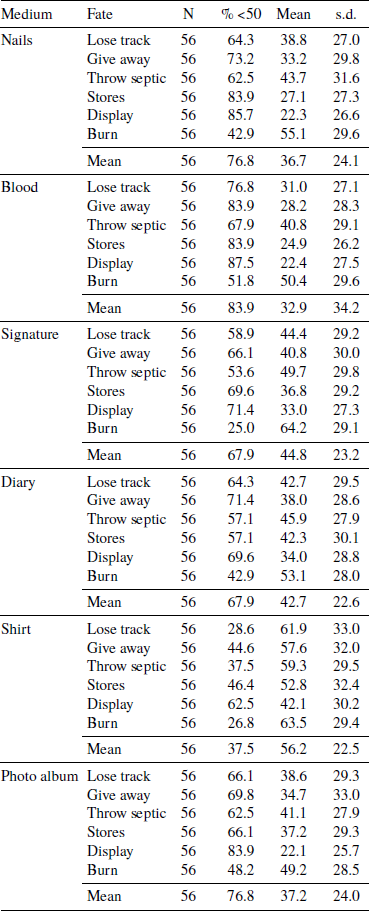
Mean backward contagion effects, averaged over the 36 exemplars, combining all three targets, showed no significant correlations with gender, political identification, level of education, or level of religiosity. With this sample size, a correlation of .15 or more would be significant at p<.05, two tailed. The effect, in terms of means and percent showing backward contagion (<50) for each of the 36 conditions across three types of recipients are displayed in Tables 3 A-C.

Overall effects of the three variables.
A three-way mixed ANOVA was performed. Recipient (3) served as the between-subject factor, while fate (6) and medium (6) served as within-subject factors. To assure a conservative test, significance level was taken to be .01 (two-tailed) or lower.
Results of the ANOVA indicated no significant main effect of recipient, F(2,174) = 3.093, p=.048. The summed backward contagion effect (across all media and fates) was almost significant (p=.05, but we are using a p<.01 standard) and in the predicted direction: mean comfort was 41.7 for stranger, 35.5 for murderer, and 32.6 for enemy. The stranger effect was more comfortable than the enemy effect (p<.05). Tests of within-subjects effects showed a significant main effect of fates (F(5,880) = 79.006, p=.000) and media (F(5,880) = 54.331. p=.000). Interactions within the ANOVA occurred for Fate x Recipient, F(10,880) = 2.736, p=.003, for Media x Recipient, F(10,880) = 5.141, p<.001, as well as for Fate x Media F(25,4400) = 6.831, p<.001. The three-way interaction of Action x Object x Recipient, however, was not significant.The interactions suggest a role for recipients, even though there is no substantial main effect. There is no consistent pattern in the significant interactions of recipient with fate or media.
Media.
A medium score was created for each subject by calculating the mean backward contagion effect for each medium across the six fates that a medium could undergo (Table 4).

Note. Neutral point was 50, with lower scores indicating a greater backward contagion response.
Results indicated that five of the six media showed significant backward contagion effects (p<=.001); only shirt failed to show overall backward contagion. The largest backward contagion effects appeared for blood and photo album, which indicated strong effects for both biologically-connected and psychologically-connected objects, but all five of the effective media scored about the same.
Fate.
Table 5 displays results for the mean scores of the six possible fates across all subjects and compared to the neutral point of 50. All fates except burn showed significant (p<.001) backward contagion effects. Displaying on a shelf resulted in the largest effect, while the second was for store; these are the only two fates in which the medium remained in the possession of the recipient. Most notable was the lack of backward contagion effect for the act of burning. Counter to the traditional culture reports, but consistent with study 1, burning mitigated the backward contagion effect, to the point where the effect (mean difference from neutral 50 of only −1.2) was not significant at all. There were 18 arrays in which the 6 fates were comparable (6 fates by 3 recipients). Burn showed the least discomfort in 17 of the 18. Furthermore, the other objectively unpleasant fate was throwing in a septic tank, and this showed the second smallest backward contagion effect.

Note. Neutral point was 50, with lower scores indicating a greater backward contagion response.
4 General Discussion
The data collected from the two studies suggest the existence of a substantial negative backward contagion (NBC) effect that appears in the great majority of the Americans studied. The results demonstrate that: 1. NBC is enhanced when the recipient knows the name of the source 2. Both biologically (physical contact) and psychologically connected media can lead to NBC, with some evidence that biological origin is more potent. 3. The fate of the medium in the hands of the recipient is an important factor in determining NBC. Possession seems most important in promoting NBC, while destruction of the medium reduces NBC the most. 4. The possession of a personally tied medium seems more important than the nature of the recipient. A recipient’s inclination to harm the source seems less important than one might have imagined, and less important than the ethnographic literature suggests.
In general, once one accepts the idea that, at some level, Americans believe in backward contagion effects, the properties of backward contagion, as demonstrated in this paper, follow a consistent internal logic.
One issue that the findings raise is the level of cognition at which backward contagion ideations exist. Surely, almost all of our subjects believe in exclusively forward causation. The sense of discomfort that our respondents feel runs contrary to their own understanding of the world. It is like a deep intuition, as is also supported by our prior demonstrations that people are disinclined to consume good chocolate made to look like feces, or to refuse to drink juice contacted by a sterilized cockroach (Reference Rozin, Millman and NemeroffRozin et al., 1986). We have demonstrated that such feelings or intuitions or reactions fly in the face of deeply held principles about how the world works. Although individuals are willing to confess to these feelings, they recognize their irrationality, and when asked to put money behind their feelings, they usually refuse (Reference Rozin, Grant, Weinberg and ParkerRozin, Grant, Weinberg & Parker, 2007). That is, most individuals who are, for example, reluctant to consume a chocolate dogdoo, say they will not pay anything to avoid doing this. Further work must be done on the way acknowledged irrational feelings or beliefs function in determining real world behavior.
The presence of magical beliefs that co-occur with scientific/rational beliefs has been noted by Reference Legare, Evans, Rosengren and HarrisLegare et al. (2012), who point out that this is very common in both traditional and modern-developed cultures, with respect to thinking about and explaining human origins, contagious illness, or death. They note that this co-existence is common in both children and adults. They nicely integrate this co-existence with normal human cognitive functioning, and note ways in which people live with the coexistence of magical and “rational” feelings or responses to the same events. One can adopt a framework of multi causation, parallel causation, or different types of causation (e.g., proximal versus distal).
Two of our findings surprise us and violate our general position that, given a belief in backward contagion, the system then proceeds logically. First is the effect that burning the medium substantially reduces NBC. This is in sharp contrast with the ethnographic literature, which focuses on the idea (and evidence) that it is harm to the medium that causes harm to the source. Our data suggest that it is possession, not harm, which is critical. In a way, the ethnographic data make more sense. If some essence of the self is present in the medium, then harming the medium should harm the self. Possession is only dangerous insofar as it predicts potential harm to the medium. That is clearly not the case in our results. Of course, possession leaves open the possibility of future harm, but present certain harm should be more negative than future possible harm. We discuss the possibility of future harm below. The second “anomaly” in our results (leaving aside the fact that NBC is itself anomalous!) is that the nature of the recipient is not that important. If harm to the source via harm to its medium is at the core of NBC, then the worst person to possess a medium is a personal enemy, yet this is not the case in our results. And a stranger is only slightly less negative than an evil person or a personal enemy. Once one enters into the domain of NBC, it seems that some other rational principles are also suspended.
The “standard” anthropological account of NBC is based around the idea that the medium contains the essence of the source, and acting on the essence can affect, backward in time, the source itself. There are three other possible accounts of the NBC we report here. One uninteresting account is demand characteristics. Demand is a highly unlikely account for the results we present. First, individuals are not inclined to admit rather weird things about themselves. Second, demand would not explain the systematic influences that we report (such as effects of the recipients knowledge of the source, or that burning has the strongest influence in reducing NBC). Third, the lack of a strong recipient effect would not be anticipated by respondents trying to conform to experimenter expectations. Fourth, we would think that people would be more upset about the possession by others of personal information (travel notes, photo album), which would be much more threatening than mere personal residues, but this is not the case.
A second, more difficult account refers to associations. By this account, people’s discomfort in NBC situations results from negative associations between something that has to do with themselves (the medium) and negative persons. These negative associations then produce discomfort. The same issue arises with forward contagion. We have shown (Reference Fedotova and RozinFedotova & Rozin, 2014) that association cannot be the principal account for forward contagion, using a number of procedures, including showing that physical contact, the signature of contagion, does not enhance associations. In addition, in the present study, surely there would be much more negative associations with a murderer than a stranger, but as we show in Study 2, the difference in NBC in these two situations is minimal. Also, burning should produce stronger negative associations than possession, with perhaps throwing in a septic tank even more so. Finally, one’s travel diary by most accounts would be more associated with the self than one’s fingernail parings.
Demand and association accounts would not explain NBC in the contexts studied by ethnographers, where considerable effort is devoted to avoiding situations where backward contagion might occur, such as burying one’s nail clippings.
A third account is that there is the possibility that real harm (consistent with forward causation) could come to the source from the recipient. This would, of course, account for the discomfort reported. In support of this view, burning, which in a modern physics framework could not harm the source, is the least effective fate. Furthermore, active possession of the medium seems to produce more NBC. In these cases, the recipient could potentially cause harm by blackmail, or by planting blood, a shirt, or fingernails at a crime scene. These seem like weak accounts. Furthermore, the presence of only a minimal recipient effect argues against this. Only the enemy would be motivated to harm. The murderer might wish to cover himself for a future crime, but the stranger would have no motive, and shows almost as large an NBC effect. Also, losing the medium should also (along with burning) prevent the medium from either being used to harm the source, or to implicate the source in a crime, but it shows a substantial NBC effect. Finally, although knowing the name (from Study 1) enhances NBC, this would explain only discomfort at the enemy possession; it should have no effect on harm for the rapist. Overall, we do not think the actual harm effect is very viable, given our pattern of results, but, along with association, it is a possible partial account.
It is not the case that direct contact is necessary to produce forward contagion (Reference Kim and KimKim & Kim, 2011; Huang, Ackerman & Newman, 2016; Reference Newman, Diesendruck and BloomNewman, Diesendruck & Bloom, 2011; Reference Morales, Dahl and ArgoMorales, Dahl & Argo, 2018), and probably not backward contagion either. It makes intuitive sense that one would be upset that a hated person would have one’s art work in his or her house. In fact, the discomfort we report at a copy of one’s signature in the possession of another, could be another example of this. In general, it is reasonable to assume that one’s extended self, including possessions and creations, contains essence. Along these lines, it is an open question as to whether one would experience positive backward contagion if an admired other possessed part of one’s extended self. This would be “self out of place”, but it would be in a good place.
We do not entirely understand NBC, but we are convinced that it is a real phenomenon. Perhaps there is something unsettling to people that a part of their extended self is no longer a part of them, and is in the public domain. This may be why possession is so important in fostering NBC.
We have documented large individual differences in the degree of adherence to backward contagion, even within Americans. The cause of these differences should be addressed. We have completed some studies (Fedotova, Rozin & Brunwasser, 2014), with the explicit aim of creating and validating an individual difference measure of belief in forward contagion, that also includes a 6 item measure of NBC. Results indicate that this measure correlates most highly with the new forward negative contagion measure (r = .60), but also highly with disgust sensitivity (r = .49) (Reference Haidt, McCauley and RozinHaidt, McCauley & Rozin, 1994; Reference Olatunji, Williams, Tolin, Sawchuck, Abramowitz, Lohr and ElwoodOlatunji et al., 2007).
Our study has a number of limitations. Focusing on negatively-valenced scenarios limits the conclusions of these studies to negative backward contagion. Previous research has suggested that negative forward contagion is much more potent than positive forward contagion, which may hold true for backward contagion as well (Reference Rozin, Nemeroff, Wane and SherrodRozin et al., 1989; Reference Fedotova and RozinFedotova et al., 2014). If this pattern remains consistent for a backward contagion effect, only weak effects would be expected for positive backward contagion in Americans. Nevertheless, exploration of positive backward contagion, such as with personal objects falling into the hands of heroes or loved ones, could help to further elaborate backward magical contagion. Our results come only from an American sample; further work must be done to explore the generality of NBC. Hindu India would be of special interest because of the importance of contagion in Hindu thought and practice.
Backward contagion effects may play a role in daily life in the United States. Backward contagion may manifest during any instance of an individual showing hesitance before allowing his or her possessions to pass to other individuals. For example, backward contagion sensitivity could underlie hesitance of an individual to donate clothing to a second-hand store. Blood donation may provide a more serious example of the same sort. A potentially even more powerful backward contagion effect may be involved in resistance to organ donation.
Backward magical contagion effects represent a deviation from pure rationality. In showing backward contagion, individuals express discomfort with an event which can have no causal link to their present state. While individuals typically like to think of themselves as rational creatures, results from this sample indicate that backward magical contagion effects occur with regularity in America subjects. Nevertheless, these effects occur in a predictable manner, as detailed above. Individuals can follow an illogical premise — that physically unconnected things can have backwards causal links — to at least some logical ends.


 Open access

