

Fear is an instinctive response to threat, danger, and risk. U.S. President Roosevelt (Reference Roosevelt1941) declared that “freedom from fear” is a fundamental freedom for mankind. Terrorism is a source of fear to many. The Global Terrorism Index has found that the number of those killed and the number of countries affected by terrorism are increasing annually. The number of countries with at least one death from terrorism was 22% higher in 2016 than in 2015 (Institute for Economics and Peace, 2016, 2017).
China was ranked the 31st most terrorism-affected country in 2017 (Institute for Economics and Peace, 2017). In China, the Xinjiang Uyghur Autonomous Region, which is located in the north-western part of the country and shares borders with several Central Asian countries, is considered a high-risk area for terrorist activities (Mei & Zhang, Reference Mei and Zhang2015). Since 2014, Xinjiang has taken down 1588 violent and terrorist gangs, arrested 12,995 terrorists, and seized 2052 explosive devices (State Council Information Office of the People’s Republic of China, 2019). Terrorism and the threat of terrorism in this region have had negative effects on almost all aspects of the lives of its residents. Among these effects is the reduced attractiveness and influence of the China-Eurasia Expo, which is held in Ürümqi, the capital city of Xinjiang, and is an important commercial event for the region. The subjective fear induced by the objective risk of terrorism is a matter of life or death, one that has likely led to concerns over the security and safety of the China-Eurasia Expo.
Does everyone experience the same degree of fear? Slovic (Reference Slovic1999) argued that “human beings have invented the concept risk to help them understand and cope with the dangers and uncertainties of life. Although these dangers are real, there is no such thing as ‘real risk’ or ‘objective risk’” (p. 690).
Slovic’s (Reference Slovic1999) argument explains why people living closer to the center of an unfortunate event are less concerned with the event’s negative consequences. For example, a catastrophic earthquake measuring 8.0 on the Richter scale struck China’s Sichuan Province on May 12, 2008. From June 4 to July 15, 2008, Li et al. (Li, Liu et al., Reference Li, Liu, Zheng, Bai, Ren, Li and Wang2009; Li, Rao et al., Reference Li, Rao, Bai, Ren, Zheng, Li and Liu2009) surveyed 2262 adults, including residents in both the devastated and the nondevastated areas, on their post-earthquake concerns for their safety and health. It was found that in general, those who live in the most devastated areas had the least post-earthquake concerns, and the farther away people were from the earthquake area, the greater their concerns (see Figure 1). These concerns related to the estimated probability of an epidemic outbreak, the estimated need for safety measures, and the estimated numbers of psychological and medical workers needed.
Residents’ post-earthquake concerns about safety and health issues in areas with varied devastation levels (Li, Rao et al., Reference Li, Rao, Bai, Ren, Zheng, Li and Liu2009).

Li et al. (Reference Li, Rao, Bai, Ren, Zheng, Li and Liu2009) defined the finding, described as the “psychological typhoon eye” (PTE) effect, as the closer a person is to the center of a disaster area, the less concerned that person is with safety and health after that disaster. Li et al. conducted two subsequent surveys of 5216 residents in September and October 2008 and in April and May 2009. The results of these three waves led them to conclude that the PTE effect was robust through the passage of an entire year. During that time, the level of post-earthquake concerns remained the lowest for the greatest level of the devastated area. The PTE effects reported above (see also Wei, Tao, Liu, & Li, Reference Wei, Tao, Liu and Li2017), the comments they received (e.g., Bartels & Van Rooyen, Reference Bartels and VanRooyen2012; Bonanno, Brewin, Kaniasty, & Greca, Reference Bonanno, Brewin, Kaniasty and Greca2010; Liu, Reference Liu2012; Liu, Wu, & Wang, Reference Liu, Wu and Wang2011; Liu, Wu, & Zhang, Reference Liu, Wu and Zhang2011), and a journal editorial on the effects (Harada, Reference Harada2011) all suggest the relation between the objective environment and the subjective mental state may not be as straightforward as a linear positive correlation. The psychological mechanism governing how people respond to environmental change and strive for freedom from fear may be quite complex.
Therefore, a question that remains of interest is: What is the relation between the objective danger and the subjective fear in the context of terrorist attacks in Xinjiang?
To answer this question, we note that the subjective fear induced by the threat of terrorism in Xinjiang differs from that caused by the Wenchuan earthquake in 2008 in several ways.
First, in the catastrophic 2008 earthquake in Wenchuan, the epicenter was the unique center of the risk source. However, risk source varies with time and space in the face of the threat of terrorism in Xinjiang. The threat of terrorism in Xinjiang has lasted for several years, with terrorist attacks not only in Ürümqi but also in other provincial capital cities, such as Kunming and Beijing. Even when people are away from Xinjiang, the threat of Xinjiang terrorism still exists among them. Under such a threat, the subjective fear induced by the objective risk of terrorism likely decreases gradually with time and distance (Slovic, Reference Slovic1987).
Second, the Wenchuan earthquake was a natural hazard, whereas the terrorist attacks in Xinjiang are man-made hazards. The concern is that man-made and natural hazards do not necessarily induce equivalent subjective fear. In the late 1950s, the Chinese people were decimated by a catastrophic famine caused by drought and weather conditions. During the catastrophe, our state of mind (subjective fear) went from want to freedom. Keeping hunger away is the reason that underlies our motivation to strive for freedom from want. By contrast, during the terrorist attacks in Xinjiang, our state of mind went from fear to freedom. The right to freedom from fear deals with threats in the environment. This right seeks to ensure human security and protect individuals from threats such as wars, terrorism and crimes (for a detailed discussion see Wei et al., Reference Wei, Tao, Liu and Li2017). A notable difference is that the right to freedom works for people to surrender in wars, terrorism and crimes (man-made hazard), but it does not work when people surrender to natural hazards such as AIDS or COVID-19. No ways of surrendering can make people frightened or helpless.
Finally, in the PTE effect detected in the Wenchuan earthquake, the independent variable, distance, is not strictly the spatial distance from the epicenter but self-reported devastation levels. It was assumed that the more devastated the area, the closer it is to the epicenter. For example, an extremely devastated area in the quake was Longnan, which is located in Gansu province and further from the epicenter (Wenchuan) than some moderately or slightly devastated areas located within Sichuan province. By contrast, in a similar study that strictly measured the spatial distance from the epicenter, there were fewer posttraumatic stress disorder (PTSD) cases in a village that was closer to the epicenter (0.5 km) than in a village much further away (10 kms; Wang et al., Reference Wang, Gao, Shinfuku, Zhang, Zhao and Shen2000). That is, the dependent variable that Wang et al. (Reference Wang, Gao, Shinfuku, Zhang, Zhao and Shen2000) measured was not the safety and security concerns but PTSD.
Taking the above-mentioned differences into account, we are not certain whether the subjective fear induced by the objective risk of terrorism will be expressed in the same way as that induced by natural hazards, such as a catastrophic earthquake (Li, Liu et al., Reference Li, Liu, Zheng, Bai, Ren, Li and Wang2009; Li, Rao et al., Reference Li, Rao, Bai, Ren, Zheng, Li and Liu2009; Li et al., Reference Li, Rao, Bai, Zheng, Ren, Li and Zhang2010).
To better understand and analyze the terrorism risk in Xinjiang and other risks under investigation in a framework of risk classification, we can form a 3 × 2 table of risk source. Previous research has analyzed risk according to the source of harm or hazard, including social/man-made technological and natural hazards (Schneiderbauer & Ehrlich, Reference Schneiderbauer and Ehrlich2004; Xie, Wang, Zhang, Li, & Yu, Reference Xie, Wang, Zhang, Li and Yu2011). Social/human-made hazards are threats to communities that include human intent, negligence or error, and may involve the failure of a man-made system (Novelo-Casanova & Suárez, Reference Novelo-Casanova and Suárez2010); technological hazards are caused by misuse or accident in man-made technologies (Xie, Wang et al., Reference Xie, Stone, Zheng and Zhang2011), whereas natural hazards are typically triggered by environmental changes (Schneiderbauer & Ehrlich, Reference Schneiderbauer and Ehrlich2004). Risks are also categorized as acute versus chronic, according to their diffusion rate. Acute risks are nonroutine accidental hazards, whereas chronic risks cause harm gradually (Chakraborty, Reference Chakraborty2001; Chakraborty, Collins, Grineski, Montgomery, & Hernandez, Reference Chakraborty, Collins, Grineski, Montgomery and Hernandez2014). Table 1 shows the six risk categories that result from crossing the aforementioned two factors: a source of harm and rate of diffusion.
Classification of risk and for cases where evidence of the psychological typhoon eye effect have been reported in the media or in research
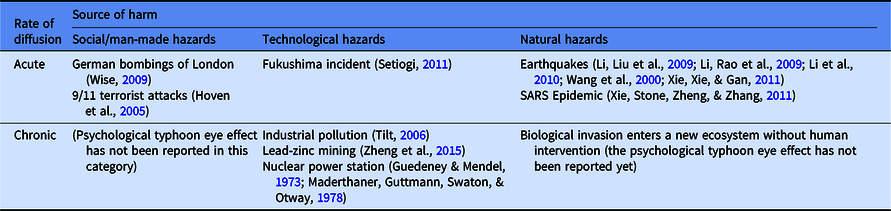
Considering the persistency and transmissibility of the ever-present threat in Xinjiang terrorism, the PTE effect to be investigated in the present study can be categorized as a chronic, social/manmade risk, as shown in the bottom-left cell of Table 1.
Therefore, the present study aims to investigate whether the PTE effect, which was first observed in the context of acute and natural hazards, can be detected and replicated in the context of Xinjiang terrorism (chronic and man-made hazards). The survey findings are anticipated to provide clues for whether the loss of visitors to China-Eurasia Expo (specifically the loss of distant visitors) is in line with the phenomenon reported by this effect, that the further a person is to the center of a disaster area, the more concerned that person is with the safety and security of the area (Wei et al., Reference Wei, Tao, Liu and Li2017).
We therefore propose our working hypothesis: the spatial distance to a respondents’ city of residence from Ürümqi and their levels of concern for safety and security concerning China–Eurasia Expo is positively related. That is, the closer the respondents live to Ürümqi, the less concerned they are with the safety and security of the expo. To test this hypothesis, we surveyed over 2000 residents from 31 provinces and municipalities of China about their concern for safety and security regarding the China-Eurasia Expo. We also measured the spatial distance from their residences to Ürümqi, the site of the Expo. We hope that the resulting findings could lead to a better understanding of the relationship between the objective danger and the subjective fear caused by terrorist threats.
Materials and methods
Data collection and sample
The sampling was limited to those who may have business with the China–Eurasia Expo, such as exhibitors, vendors, professional visitors, guests, staff, and ordinary audience, among others.
The sampling inside Xinjiang was coordinated by the Xinjiang Bureau of International Expo Affairs. A total of 100 anonymous questionnaires was distributed to individuals or organizations and enterprises associated with the China-Eurasia Expo by staff from local commerce authorities in 14 prefectures and cities in Xinjiang and the Commerce Bureau of Xinjiang Production and Construction Corps. Finally, 88 valid questionnaires were collected, representing a response rate of 88%. These questionnaires were returned to the Secretariat of China–Eurasia Expo by express mail.
The sampling outside Xinjiang was coordinated by the Xinjiang Uyghur Autonomous Region Merchants. A total of 2050 anonymous questionnaires was distributed to individuals or organizations and enterprises (about 30 questionnaires each) associated with the China-Eurasia Expo by staff from Xinjiang-stationed offices, chambers of commerce or associations from 28 provinces or municipalities, and staff from the local commerce department of Tibet and Hainan. Finally, 1946 valid questionnaires were collected, representing a response rate of 94.9%. These questionnaires were sent back to the Secretariat of the China-Eurasia Expo by express mail.
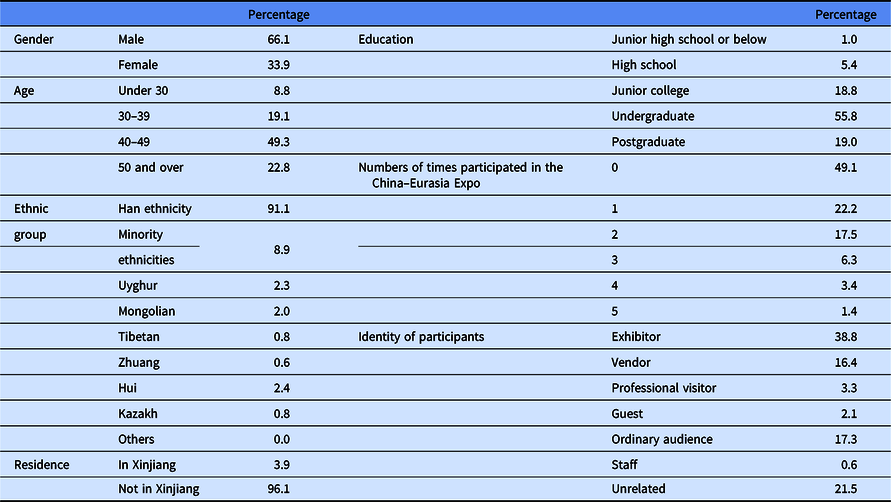
The nationwide survey was conducted from April 20 to June 20, 2018. Our final sample included 2034 individuals, residents of 31 of 34 provinces or municipalities of China, except for Hong Kong, Macao and Taiwan. Oral informed consent was obtained from all study respondents. The respondents were presented with a small gift, a toy memorializing the China-Eurasia Expo in the shape of its mascot, for completing the survey. Detailed demographic information about the respondents is presented in Table 2.
Survey respondents’ demographic data (N = 2034)
Measures
Concerns for the safety and security of the China–Eurasia Expo
Following the basic principle “the greater the risk, the greater the premium” in the insurance industry, and from the commonly used index Willing to Pay (WTP) from the area of economic behavior, the item “the cost of personal accident insurance that they would be willing to pay before attending the Expo” was developed to assess respondents’ concerns about safety of the China-Eurasia Expo. Similarly, according to the principle “the greater the risk, the more security guards needed”, the other item “estimated number of security guards needed per 10,000 attendees at the Expo” was developed to assess respondents’ concerns about security of the Expo. The greater the number of guards or the cost of insurance, the higher a respondent’s concerns about safety and security of the expo. These two items were interspersed among other questions about the preference of “halal food and the traditional Chinese Eight Cuisines” in a lengthy questionnaire. The wording of these two items is shown as follows:
How many security guards are needed for every 10,000 participants in the China-Eurasia Expo? _____ security guards.
How much would you spend on personal accident insurance to attend the China-Eurasia Expo? (0–1000 CNY) _____ CNY.
Distance to respondents’ city of residence from Ürümqi
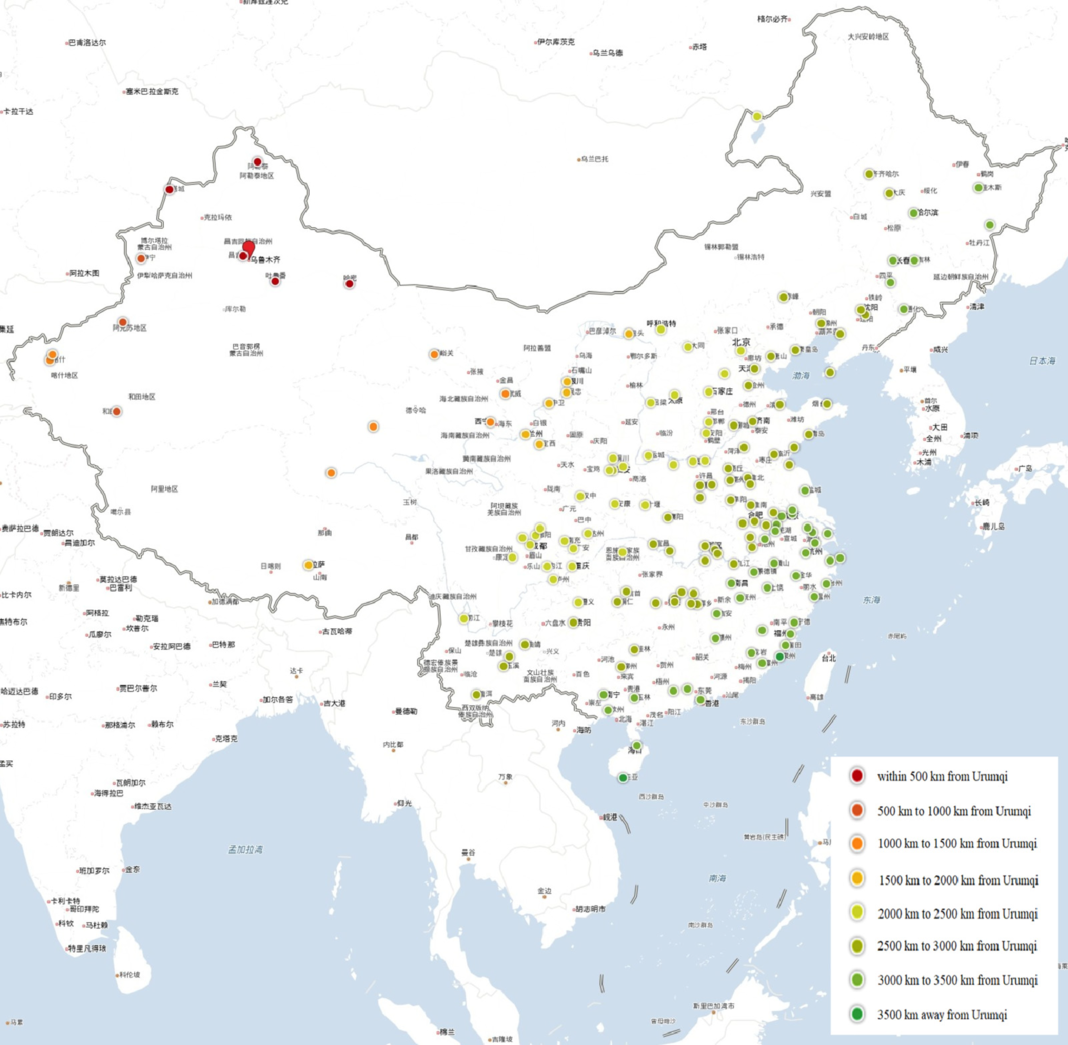
To measure the distance between a respondent’s residential location and Ürümqi, we asked respondents to indicate the cities they lived in, and we calculated the distances using longitudes and latitudes.1 The distribution of distance between respondents’ residential geographical locations and Ürümqi are shown in Figure 2.
Distances between respondents’ residences and Ürümqi, the site of the China–Eurasia Expo.
We also gathered demographic information, including each respondent’s sex, age, education, ethnic group, number of times participated in the China-Eurasia Expo, identity of participants, and whether the respondent resided in Xinjiang or not.
Analyses
The data were analyzed on a personal computer using the R statistical software package (version 3.4.4 for Windows). Correlation coefficients were computed for all variables, including spatial distances and demographic variables. Hierarchical multiple regression analyses were conducted to evaluate the effects of spatial distance on the two items measuring concern for the safety and security of the expo. No missing values were found. All p values reported were two-sided, and p values < .05 were considered statistically significant.
Results
Table 3 shows the means and standard deviations for each measure, as well as the bivariate Pearson correlations for each pair of measures. Spatial distance was positively and significantly correlated with estimated number of security guards needed (r = .45, 95% CI [.42, .49], p < .001) and with the cost of personal accident insurance the respondent would be willing to pay (r = .54, 95% CI: [.50, .57], p < .001). These results provide initial support for our hypothesis that concern for the safety and security of the Expo did not attenuate over distance.
Means, standard deviations, and pair-wise correlations of the measures
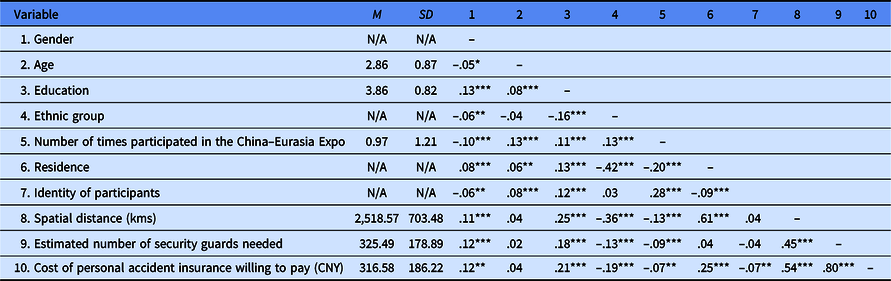
Note: M, mean; SD, standard deviation. Variables were coded as follows: gender: 0 = male, 1 = female; age: 1 = Under 30, 2 = 30–39, 3 = 40–49, 4 = 50 and over; education: 1 = Junior high school or below, 2 = high school, 3 = Junior college, 4 = Undergraduate, 5 = Postgraduate; ethnic group: 0 = Han ethnicity, 1 = minority ethnicities; residence: 0 = in Xinjiang, 1 = not in Xinjiang; identity of participants: 0 = unrelated person, 1 = related person.
N = 2034; *p < .05; **p < .01; ***p < .001.
To determine how well spatial distances can explain respondents’ concerns for the safety and security of the Expo, we conducted a hierarchical multiple regression analysis for each of the two safety and security measures. For each analysis, demographic variables were entered as predictors for the first step of a regression model; at the next step, spatial distance was entered together with demographic variables to determine the effects on the measure in addition to the controls.
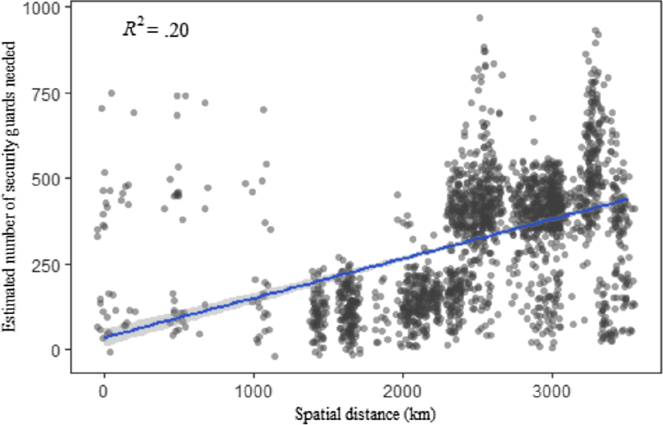
We first analyzed respondents’ estimated number of security guards needed, and the results of this process are shown in Table 4. Step 1 of the analysis used only demographic variables for predictors, which resulted in multiple R 2 of .06, F(7, 2026) = 19.52, p < .001. The next step included spatial distance as an additional predictor, resulting in multiple R 2 of .32, F(8, 2025) = 118.02, p < .001. A comparison of the two models indicated that the 25% increase in R 2 was statistically significant, F(1, 2025) = 756.58, p < .001. Moreover, spatial distance was positively related to the estimated number of security guards needed, β = .66 (95% CI [.62, .71]), t (2025) = 27.51, p < .001; thus, the closer were people to the area of potential terrorist threats, the less they were concerned for security (see also the scatterplot in Figure 3).
Summary of regression analysis results for estimated number of security guards needed
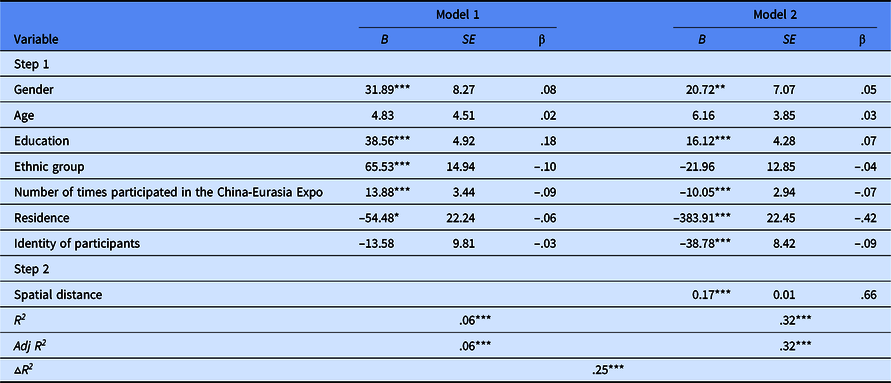
Note: N = 2034; *p < .05; **p < .01; ***p < .001.
Scatterplot of spatial distance against estimated number of security guards needed, with the best-fitting regression line in the middle.
We conducted the same regression analysis, using the cost of personal accident insurance that the respondents would be willing to pay as the predicted variable, and the results are shown in Table 5. Again, step 1 included only the demographic variables as predictors, and the regression had multiple R 2 of .11, F(7, 2026) = 34.99, p < .001. The next step included spatial distance as an additional predictor and resulted in multiple R 2 of .30, F(8, 2025) = 118.14, p < .001. A comparison of the two models indicated that the 21% change in R 2 was statistically significant, F(1, 2025) = 624.76, p < .001. Furthermore, spatial distance was also positively related to the cost of personal accident insurance willing to purchase, β = .60 (95% CI [0.55, 0.65]), t(2025) = 25.00, p < .001; thus, the closer people were to the area of potential terrorist threats, the less willing they were to pay for personal accident insurance (see also the scatterplot in Figure 4). It should be noted that the two dependent measures, estimated security guards needed and the cost of personal accident insurance willing to pay, were highly correlated (r = .80; see Table 3), which may explain the similar results from the two analyses.
Summary of regression analysis results for amount of personal accident insurance the participants are willing to pay
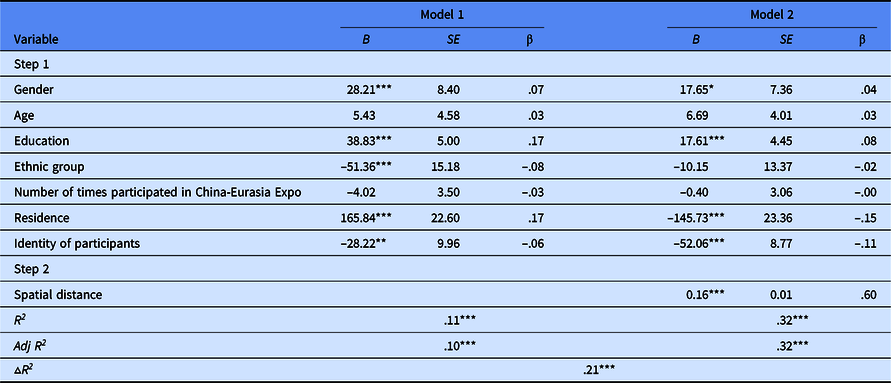
Note: N = 2034; *p < .05; **p < .01; ***p < .001.
Scatterplot of spatial distance against cost of personal accident insurance willing to pay, with the best-fitting regression line in the middle.
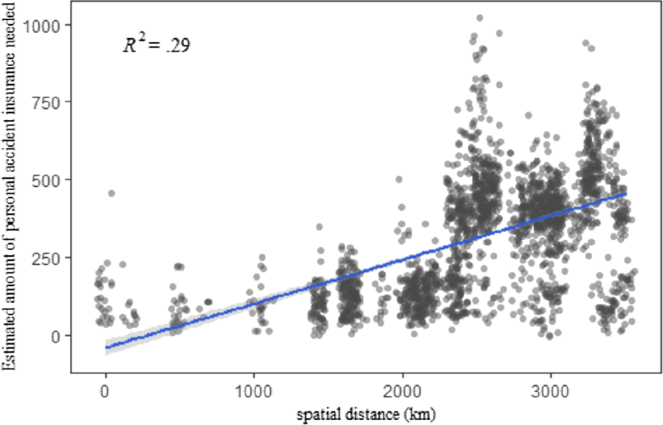
Thus, our analyses have shown that concern for safety and security at the China-Eurasia Expo is positively related to spatial distance between the respondent’s residential geographical location and the site of the Expo. These findings should be interpreted in the light of the PTE effect relative to the impact of terrorism: the closer people are to a center of potential terrorist threat, the less concerned they are with it.
Discussion
In the context of terrorist attacks in Xinjiang, the PTE effect appears to hold for an under-investigated risk – chronic social/man-made hazards (bottom-left cell in Table 1). That is, the closer respondents lived to Ürümqi, a center of a potential terrorist threat in China and the site of the China-Eurasia Expo, the greater their estimated number of security guards needed at the Expo and the cost of personal accident insurance that they would be willing to pay before attending the Expo. Notably, the variable “closeness” measured in the present study is an objective physical distance, rather than a subjective “devastation level” reported in the finding of the Wenchuan earthquake (Li, Liu et al., Reference Li, Liu, Zheng, Bai, Ren, Li and Wang2009; Li, Rao et al., Reference Li, Rao, Bai, Ren, Zheng, Li and Liu2009). We note these findings of the PTE effect in response to terrorism: the closer the respondents lived to a high-incidence area of terrorism, the less concerned they were with the safety and security induced by the threat of terrorism.
In general, relative to other types of risk, terrorism risk has increased its prevalence in human societies and is affecting more people. However, it remains relatively under-investigated and needs to be researched regarding the mechanisms underlying the human response to the impact of such risks. The disparity between practice and research motivated us to investigate the mechanisms of the occurrence and development of risk perception in response to the threat of terrorist attacks.
In the context of terrorism, this study may be the first to report a discrepancy between residents’ risk perception and real risk, although similar discrepancies have been reported for other risk types. For example, after the Fukushima incident following the Tohoku Earthquake on March 11, 2011, not the Japanese but the Chinese engaged in panic buying of salt, causing a shortage of salt in supermarkets in some major cities (Setiogi, Reference Setiogi2011). The German government (but not the Japanese government) was compelled to re-evaluate nuclear power and decided to terminate the use of nuclear power in Germany by 2022 (Batsford, Reference Batsford2013).
In the context of terrorism risk, the duplication of the PTE effect means that those most concerned by terrorism are generally not those whose lives are most at risk. People can overreact and behave irrationally when they overestimate the impact of terrorist attacks (e.g., Gaissmaier & Gigerenzer, Reference Gaissmaier and Gigerenzer2012). This finding may explain why the loss of visitors to the China-Eurasia Expo were mostly from distant visitors. Thus, we should be cautious about interpreting results of risk perceptions and fully recognize the “mismatch” or “bias” between the risk perception assessed by the people who live closer to a given hazard site and the risk perception assessed by those living further away. Therefore, how to reduce the risk perception for people living far away and who have a low risk of being subjected to the negative consequences of terrorist attacks is key to managing the collective psychology of terrorism, and in the specific case of the China-Eurasia Expo, to regain its attractiveness to people outside the Xinjiang region.
Our research may also contribute to the tourism industry. Xinjiang is not only a high-incidence area of terrorism2 but also rich in tourism resources. In particular, the implications we propose can be easily understood by considering the construal-level theory of psychological distance (CLT; Trope & Liberman, Reference Trope and Liberman2010). A simple but effective guide provided by CLT is that the choices people make in response to distant events (e.g., considering a Xinjiang vacation in Beijing) are guided by abstract, higher level thinking, involving their general opinions of and attitudes toward a location (e.g., the safety of traveling in Xinjiang). However, when an individual is close to the situation (e.g., planning what to do while in Xinjiang), the choices made are guided more by concrete, lower level thinking, taking into account detailed aspects of the state of affairs (e.g., which restaurant to eat and which sight to visit). A corresponding guide for encouraging people to participate in the China-Eurasia Expo can be comparably proposed. For those who reside far away from (cf. psychologically distant situations) the site of the China-Eurasia Expo, soothing the invisible safety concern over the Expo by offering appropriate promotion (cf. general descriptions) may be a more effective way. For those who reside near (cf. are psychologically closer to the situation) the site of the China-Eurasia Expo, engaging or nudging people into seeing true signs about the interesting and exciting experiences they could have there, while correcting their (mis)perceptions of safety issues, may be a more effective way. Enabling people to think more concretely of Xinjiang (through various media channels) while presenting more concrete, safety-related numbers should help.
One of the problems that follows is the underlying mechanism of the PTE effect. This problem is also the limitation of the present study. Will the PTE effect detected in the context of man-made hazards share a domain-general mechanism with the PTE effect detected in the context of natural hazards? Or is the underlying mechanism for these two effects domain-specific, as suggested by Wang, Zheng, Xuan, Chen, and Li (Reference Wang, Zheng, Xuan, Chen and Li2016)?
The potential explanations proposed for the PTE effect found in the Wenchuan earthquake, such as Festinger’s (Reference Festinger1962) theory of cognitive dissonance and “psychological immunization” (Henderson, Montgomery, & Williams, Reference Henderson, Montgomery and Williams1972), have certain limitations. In the Wenchuan earthquake, we attempted to examine whether the psychological immunization theory (Henderson et al., Reference Henderson, Montgomery and Williams1972) could account for the PTE (Li et al., Reference Li, Rao, Bai, Zheng, Ren, Li and Zhang2010), but the resulting finding revealed that the theory did not provide a satisfactory explanation for these intriguing results. As for cognitive dissonance, no attempt has been made to test the applicability of Festinger’s theory because manipulating the levels of cognitive dissonance in situations such as earthquake is difficult (Li et al., Reference Li, Rao, Bai, Zheng, Ren, Li and Zhang2010).
Another possible limitation of this study is that we did not ask participants to directly rate their levels of concern for safety and security concerning the China-Eurasia Expo. The purpose of not measuring the participants’ risk perception directly was to avoid the effects of “social desirability” and “political correctness”. In future research, measuring the participants’ risk perception directly and indirectly would be useful.
Detecting the PTE effect in the context of terrorism risk is very encouraging. The next task, exploring the underlying mechanism behind the effect, will be more arduous and challenging. It is also encouraging to note that a promising mechanism of the PTE effect, a “risk information proportion” account, was proposed as a post-hoc hypothesis in a recent study of investigating extended overseas PTE effect in response to COVID-19 (Yang et al., Reference Yang, Xu, Kuang, Ding, Zheng, Rao and Li2020). We hope such a challenging mission will attract increasing research attention in the near future.
Acknowledgments
This work was supported by the National Natural Science Foundation of China under Grant No. 71761167001; the Major Project of National Social Science Foundation of China under Grant 18ZDA332 and 17ZDA325; and the Key Projects of National Social Science Foundation of China under Grant 16AZD058. We wish to thank Xiao-Hong Cai and Ming-Xing Xu for their helpful discussion and comments on this manuscript and Xinjiang Uyghur Autonomous Region Merchants and the Departments of Commerce of China’s 31 provinces (municipalities and autonomous regions) for their assistance with the data collection. The funders played no role in the study design, data collection and analysis, the decision to publish, or the preparation of the manuscript. We are indebted to the respondents for their participation in the survey.
Endnotes
1 We used a computer program, which was provided by GPSSPG (http://www.gpsspg.com/distance.htm), to calculate distances.
2 Incomplete statistics show that from 1990 to the end of 2016, separatist, terrorist and extremist forces launched thousands of terrorist attacks in Xinjiang, killing large numbers of innocent people and hundreds of police officers, and causing immeasurable damage to property (State Council Information Office of the People’s Republic of China, 2019).


 Open access

