

INTRODUCTION
In the July (2018) issue of Management and Organization Review, I analyzed four new technological paradigms affecting the auto industry. I did so by applying the dynamic capabilities framework, particularly the sensing and sensemaking capabilities needed to help firms manage under deep uncertainty (Teece, Reference Teece2018a). This follow-up article details and contextualizes some of the burgeoning Chinese activity summarized by Jiang and Lu (Reference Jiang and Lu2018) and Perkins and Murmann (Reference Perkins and Murmann2018), and uses elements of the dynamic capabilities framework to analyze the possible impact of China on global auto incumbents.
Foreign auto firms have been engaged with China since the 1980s, following its opening to foreign investment. Over time, as the government permitted, a number of foreign assemblers entered joint ventures in which they were limited to 50% ownership. Many of these joint ventures have been quite successful. In most cases, the dynamic capabilities of the Chinese state-owned partners with respect to acquiring and exploiting knowledge have so far proved to be too weak to upgrade their know-how to a globally competitive level.
In the market for internal combustion engine (ICE) autos, multinational enterprises (MNEs) have generally benefited from controlled access to China's rapidly expanding auto market, despite the fact that they have yielded technology and capabilities to their Chinese partners. The favorable position of auto MNEs in China may now be changing because of the four paradigms discussed in the previous article plus the maturity of the China market itself. As vehicles become electric, autonomous, and intelligent, established MNEs and Chinese entrants are on a far more level playing field than ever before. This heightened competition is occurring just as the market itself seems to be entering a period of slower growth.
Table 1 reproduces the table from the earlier article showing the capability gaps facing a typical non-Chinese automotive MNE for each of the paradigms. The farther the global company is from the desired level of capability, the more open the window of opportunity for a Chinese auto or IT firm to catch up and surpass. Thus, for Chinese firms the biggest technology opportunity is in autonomous vehicles, while the biggest business model (and market) opportunity is in the personal mobility space. Unlike the case for ICE autos, they have no legacy disadvantage in those segments.
Distances to new capabilities from traditional non-Chinese car manufacturer capabilities
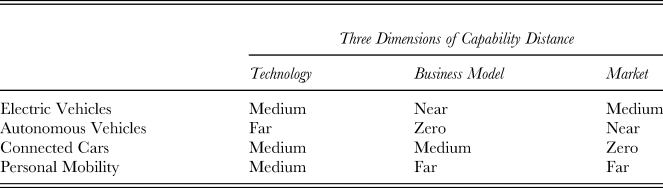
Notes: ‘Zero’ indicates that the capability for the new technology does not represent a significant change for incumbent car makers.
Source: Teece (2018a)
In this paper, I consider two inter-related questions. The first is whether the paradigm shifts create new openings for Chinese auto firms to compete overseas. The second is how well multinationals are likely to perform in the Chinese auto market in light of the ongoing paradigm shifts. To address these questions, I provide an overview of the burgeoning Chinese activity with respect to the four paradigms, each of which is at a different stage in its evolutionary cycle.
Electric vehicles are already a large niche in the Chinese auto market, and multinationals have largely stayed on the sidelines until now. Chinese firms also dominate their home market for auto-related digital services: shared mobility and in-vehicle connectivity. In the development of autonomous vehicles, however, Chinese firms are generally considered to be in the middle of the pack. To analyze these four, overlapping segments, I apply the dynamic capabilities framework.
Chinese firms have been building their basis for domestic success – steadily developing their ordinary capabilities and, often with help from their MNE partners, strengthening their domestic ecosystem. Success in China, however, is not necessarily a good predictor of success globally. The prospects for success of Chinese firms outside China hinge on the strength of their dynamic capabilities as they adapt to – and try to shape – overseas markets.
Inside China, MNEs are not guaranteed continued success, either. They must conduct frequent updates of the sensing process (discussed in the earlier article) to enhance their value proposition to customers and keep their strategic narrative aligned with regulatory changes. To succeed, especially in China's crowded electric vehicle market, they will need to engage meaningfully with the opportunities presented by the country's rich network of assemblers, suppliers, and IT firms.
CHINA'S AUTO MARKET[Footnote 1]
As China's auto sector gradually opens to multinationals, the government has made sure that Chinese state-owned firms are not disadvantaged. The government has also allowed competitive space for entrepreneurial start-ups to enter.
China's state-owned auto sector, which dates only to the 1950s, was stagnant for decades, during which it was decentralized and inefficient (Noble, Ravenhill, & Doner, Reference Noble, Ravenhill and Doner2005). In 1986, the Chinese government declared the auto sector a ‘pillar industry’, and a handful of joint ventures with foreign firms were approved. The early MNE entrants were able to get by with outdated designs that were nevertheless far more advanced than what state-owned firms had been producing (Thun, Reference Thun2004). After a decade, the government let in more multinationals to increase competition and augment the transfer of technology and skills into China's automotive sector.
Following China's 2001 entry to the World Trade Organization, tariff reductions brought lower prices, which expanded the market. Rules that had kept domestic firms from entering the auto industry also crumbled. China's gradual opening of its auto market allowed time for domestic firms to improve their capabilities through technology transfer and learning. The market research firm J.D.Power, which has conducted an annual quality survey on new cars in China since 2000, notes that the gap in problems per 100 vehicles between domestic and international brands has narrowed from 396 in 2000 to just 13 in 2017.[Footnote 2]
WTO entry was accompanied by a Chinese government commitment to end technology transfer as a mandated quid pro quo. However, Chinese governmental authorities caused many foreign firms to come to understand that it was in their best interest to transfer some technology ‘voluntarily’. In essence, market access for MNEs was still conditioned on the MNEs yielding technology and capabilities to their Chinese partners. However, due to China's continued poor reputation for equal treatment of foreign-owned intellectual property rights, some multinationals have tried to avoid transferring their most advanced technologies to their Chinese partners (Prud'homme, von Zedtwitz, Thraen, & Bader, Reference Prud'homme, von Zedtwitz, Thraen and Bader2018).
China's protected market has proved very profitable for some foreign manufacturers. The full extent is unknown, because revenue and profit streams from parts sales and royalty fees are not reported by country, but, according to one estimate, more than 40% of BMW's worldwide profits in 2017 came from China.[Footnote 3]
In 2018, China announced that, by 2022, it would phase out the requirement that multinational auto companies producing cars in China do so through a joint venture, and the requirement was ended immediately for electric vehicle production. Some of the major auto companies, however, indicated they were happy with their existing joint venture arrangements.[Footnote 4]
Although official policy favors state-owned enterprises (Garnaut et al., Reference Garnaut, Song, Yao and Wang2012), private domestic firms have also entered China's auto industry with varying degrees of success. Chinese private firms such as Chery (founded in 1999) and BYD Auto (founded in 2003) have grown to dominate the passenger car market at the low end, while foreign brands lead the higher tiers (Thun, Reference Thun2018). In recent years, foreign brands have also made gains at the low end by localizing their supply sources and initiating or expanding local R&D.
In 2017, German (20%), Japanese (17%), and US (12%) brands (mostly manufactured in joint venture plants) accounted for about half of China's passenger car market (Buxbaum, Reference Buxbaum2018). Only three of the top ten brands in 2017 (Geely, Changan, & Haval) were wholly Chinese.[Footnote 5]
Particularly where China is concerned, the past is not a reliable predictor of the future. The escalating trade tension between the US and China (and the renegotiated agreement in the North American trade zone) will have unpredictable effects on bilateral auto trade. There are also signs that 2018 may see the first yearly decline in China's auto market in nearly three decades as the overall economy gives signs of slowing.[Footnote 6] And, last but not least, the new paradigms roiling the auto industry are also driving investment and innovation by China's auto and IT firms.
Paradigm Shift One: Electric Vehicles in China
Electric vehicle (EV) technology is well into its early growth stage, with numerous old and new companies competing to stand out from the crowd. China has targeted EV technology in part because it is a ‘window of opportunity’ less dependent on legacy capabilities. China has become the world's largest market for EVs, and the market is dominated almost entirely by Chinese companies. MNEs are now preparing to enter because of a new Chinese government mandate coming into force next year.
China's evolving regulations
China has built a successful ICE-based auto industry, bypassing the US in the number of vehicles sold starting in 2009. However, success has brought problems, including an increased dependence on imported oil and the further deterioration of urban air quality. Moreover, Chinese vehicle manufacturers still depend, to a large extent, on technology from foreign partners (Howell, Reference Howell2018).
EVs offer a path toward reducing some of these burdens. Particularly appealing to policymakers is the possibility that this paradigm shift allows Chinese firms to compete with the major global car companies on a more even technological footing. Environmental benefits are more limited because, while large-scale uptake of electric vehicles would improve air in cities, the dependence of more than half of China's electricity generation on coal means that any net pollution improvement at the national level may not be very great.[Footnote 7]
The first national policies specific to launching a new energy vehicles (NEV) industry appeared in 2009, and the regulatory environment for EVs has evolved quite a bit in the meantime (Zhang & Bai, Reference Zhang and Bai2017). In 2010, NEVs – including all-electric vehicles, plug-in hybrids, and fuel cell vehicles – were designated as one of seven ‘strategic emerging industries’ (Prud'homme, Reference Prud'homme2016).[Footnote 8] In the years that followed, dozens of policies supporting the industry were promulgated by the central government, and even more were added at the provincial and municipal levels (Zhang & Qin, Reference Zhang and Qin2018). Promotion was through both subsidies and non-monetary incentives such as preferential access for EV owners to license plates in large cities such as Beijing, where plate issuance is limited (Wang, Sperling, Tal, & Fang, Reference Wang, Sperling, Tal and Fang2017). An important policy tool was government procurement of EVs for official uses and for taxis and other commercial applications (Ou et al., Reference Ou, Lin, Wu, Zheng, Lyu, Przesmitzki and He2017). Government support was broadened in 2013 when large subsidies were made available to consumers nationwide (rather than only in a few cities), with the value dependent on the driving range of the vehicle. The central government's subsidies were very generous, and local governments often added matching subsidies of their own. The combined total subsidy of about $16,000 amounted to half or more of the price of the average plug-in electric vehicle (Ou et al., Reference Ou, Lin, Wu, Zheng, Lyu, Przesmitzki and He2017). Foreign automakers could only qualify with cars manufactured in a Chinese joint-venture plant. They would also be required to share their technological expertise and their intellectual property for one or more key technologies, such as the battery or power management (Helveston, Wang, Karplus, & Fuchs, Reference Helveston, Wang, Karplus and Fuchs2019). Most MNEs proved reluctant to bring EV designs in on these terms.
Not surprisingly, the heavily subsidized consumer market for EVs boomed, with China becoming the largest market for plug-only and plug-in hybrid electric vehicles in 2015, bypassing the US (Du & Ouyang, Reference Du and Ouyang2017). The subsidies proved very expensive for the central government. One estimate placed the cost in 2015 for subsidies to consumer and commercial vehicles at $8.4 billion (Wang et al., Reference Wang, Sperling, Tal and Fang2017). Moreover, the most popular models were cheap sub-compacts with limited range. In 2015, to improve subsidy effectiveness, the minimum specifications for cars that would qualify were raised and the amount of the subsidy began to be scaled back (Ou et al., Reference Ou, Lin, Wu, Zheng, Lyu, Przesmitzki and He2017).
The government also refocused on the supply side by introducing policies to speed the rollout of charging infrastructure (Ji & Huang, Reference Ji and Huang2018). In 2017, China installed about 70,000 public charging stations to reach a nationwide total of 214,000, with plans to reach 500,000 by 2020.[Footnote 9]
In 2018, a new ‘credit’ system was launched that assigns points to car manufacturers based on fleet-average fuel efficiency and the number of new energy vehicles that are produced (Ou et al., Reference Ou, Lin, Qi, Li, He and Przesmitzki2018). Failure to reach assigned targets, which will increase annually, will lead to penalties. At least 10% of sales for each large-scale manufacturer must be plug-in vehicles starting in 2019, rising to 12% in 2020. Companies falling short will be required to buy credits from companies that exceed the target.[Footnote 10]
China's EV market
To compete in the electric vehicles segment, which is relatively mature in terms of vehicle design, multinationals and Chinese firms alike will need strong dynamic capabilities. Deep uncertainties remain. Accordingly, sensing and sensemaking skills are needed to identify which opportunities to pursue. Management must then ensure that the requisite ordinary capabilities and alliances are in place and that the cost structures are is in line with expected revenue, at least in the long-run.
The early leaders in China's EV market were not state enterprises. The largest of the private entrants, BYD, had a background in battery technology and became the third largest battery manufacturer worldwide as of the first quarter of 2018.[Footnote 11] It remains the largest brand in China's rapidly growing EV market and also makes (and exports) electric buses for the smaller commercial vehicle market.[Footnote 12] Private companies Kandi, Zotye, and Chery were also early market leaders, offering relatively inexpensive subcompacts with low range and, in many cases, incapable of highway speeds. State-owned firms have fared better in the past few years, claiming spots 2, 4, and 5 in the 2017 sales ranking: Beijing Auto (BAIC), Shanghai Auto (SAIC), and Jiangling Motors (JMC).[Footnote 13]
Tesla has also found success in the China market. Its imports into China have been growing steadily prior to the current trade dispute, reaching more than $2 billion in 2017 despite the 25% tariff.[Footnote 14] In January 2019, Tesla broke ground in Shanghai for a large-scale plant that will produce the more affordable range of its EVs for the China market, with start-up projected by the end of the year.[Footnote 15]
A handful of global start-ups are combining Chinese capital with U.S. and Chinese engineering to produce high-end vehicles that can potentially rival Tesla. These include US-based start-ups like Lucid Motors and Faraday Future and China-based ventures like Future Mobility Corp. (Byton), Xiaopeng Motors, and Nio. The first of these to actually deliver vehicles to consumers is Nio, which listed its shares on the New York Stock Exchange in September 2018. Its electric SUV began shipping in June 2018 and sells in China for less than half the price of the imported version of the Tesla X. It's manufactured in a factory owned by a state-owned auto company known as JAC Motors (which also produces a low-cost EV under its own brand). Like Tesla, Nio is starting out in a luxury niche with plans to target the mass market with a future model. Also like Tesla, Nio is not currently profitable and faces the significant financial and managerial challenge of building its own factory in Shanghai. As MacDuffie (2018) pointed out, if any of China's EV start-ups is to be more than a press-release phenomenon, it will need to build its system integration capabilities and a brand reputation for quality (MacDuffie, Reference MacDuffie2018). Both of these processes require strong managerial capabilities and require several years of effort.
Nevertheless, MNEs are part of a crowded field in China. Table 2 lists the announcements that the top foreign sellers of conventional autos in China for 2017 have made about EV manufacturing in China. How this will play out is uncertain. They have well-established brands, but some of them are choosing to create new sub-brands with local partners to produce small, city-friendly EVs that Chinese consumers might not look for in one of the well-known American or European brands.
Announced plans for electric vehicle manufacturing in China by leading foreign brands

Source: News reports; details available on request.
Looking back at Table 1, the MNEs faced a ‘medium’ or mid-sized gap in EV technology, which many will have filled by the time they enter the Chinese EV market. The gap for market capabilities is slightly bigger, though, because China's EV market is dominated by inexpensive cars with limited range. MNEs probably can't achieve the newly mandated volume of EV sales if they only target their existing high-end customers. There is, for example, a large underserved market in Western China that requires cheaper vehicles. The profitability of each multinational's China strategy depends on reading (‘sensing’) the EV market correctly. Among the decisions they must make are which market segment(s) to target and whether to create China-specific designs to better accommodate the sometimes inferior Chinese batteries they are required to use.
Paradigm Shift Two: Shared Vehicles
Like the electrical vehicle market, Chinese firms currently dominate the commercial space for ride-hailing and car-sharing services in China. Because of network effects, the first-movers, who are often start-ups rather than car companies, may become difficult to dislodge.
China already has a well-developed market for shared mobility, particularly ride-hailing services. China's ride-hailing leader, Didi Chuxing, with the help of the Chinese government, famously squeezed the world leader, Uber, out of the China market and has begun expanding globally in Mexico, Australia, and Japan. The second- and third-largest ride-hailing companies in China, DiDa Chuxing and Ucar, are also (private) domestic companies. Didi appears to be the most dynamically capable, but its continued expansion may be hampered by a government investigation for lax security practices following two murders of passengers earlier in 2018.[Footnote 16] The company is also under antitrust investigation in China over its merger with Uber's China operations.[Footnote 17]
As discussed in the earlier article, shared-vehicle business models such as ride-hailing have the potential to drain away some of the auto industry's profitability. MNEs in China are experimenting with car sharing services as a means of potentially owning and controlling more of the value chain. As shown in Table 1, the business model and market requirements for personal mobility are quite a stretch for most car companies. Partnerships with established service providers are the quickest route. Examples include Volkswagen, which invested in Shouqi Zhixing, the car sharing subsidiary of a state-owned car-rental firm, and the Renault-Nissan-Mitsubishi alliance, which is among the initial dozen partners for Didi Chuxing's proposed car-sharing platform.[Footnote 18]
Paradigm Shift Three: Connected Vehicles
Chinese firms have also taken the lead in the ‘smart vehicle’ paradigm for accessing local and remote services while driving. It's not Chinese car companies that are in control but rather the big internet companies that already provide smartphone services. Foreign rivals have catching up to do. Apple's CarPlay app for using an iPhone to control a vehicle is available in China, but Google's Android equivalent remains banned along with the company's search engine.
Baidu, China's search engine giant, took an early lead with the January 2015 roll-out of CarLife, a system similar to Apple's CarPlay. Compatible with most brands of smartphone, it enables remote control of infotainment, although the initial apps that were covered were limited to navigation and music. Baidu's first partners were Audi, Hyundai, and GM, and the list has gradually expanded to include other multinational and Chinese car companies. In 2016, Baidu began demonstrating a voice assistant technology, DuerOS. Both CarLife and DuerOS (under the name IOV OS) are now both part of Baidu's open-source Apollo platform, which is Baidu's bid to develop an ecosystem for autonomous vehicles, the subject of the next section.
Meanwhile, Alibaba, China's major e-commerce company, has developed an embedded control system called AliOS in a joint venture (‘Banma’) with state-owned car manufacturer SAIC. SAIC's first ‘internet car’ was launched in September 2017. Ford and BMW are both working with Alibaba to integrate AliOS-based services in their vehicles. Alibaba also has a smart assistant called Tmall Genie that enables voice commands to monitor fuel level or battery status and to control car doors and other functions. Volvo has committed to adopting it in China, while Daimler and Audi have expressed interest.[Footnote 19]
China's third tech titan, Tencent, the leader in messaging and videogames, launched an alliance with another state-owned car company, GAC, offering a system called ‘AI in Car’.[Footnote 20] Its other announced partners are also Chinese car firms, including Geely and BYD.
The relationships between car companies and IT firms are not necessarily exclusive. For example, Audi, in 2016, agreed to get traffic data from Alibaba, use Baidu's CarLife for infotainment, and Tencent's WeChat app for messaging.[Footnote 21] It is too soon to know if any particular system will grow to dominate China's in-vehicle services, much less if any of the technology will prove to be exportable.
Table 1 showed that connected car activities were a capability stretch for conventional auto firms in terms of technologies and business models. Even when companies have invested in relevant systems in their home countries, they may not be applicable in China without significant re-engineering or rethinking.
A notable early success is GM's OnStar service, which was introduced in China in 2009 for Cadillacs and is gradually being added to more models produced by the SAIC-GM joint venture. GM was able to apply capabilities that had first been built up in the US, where OnStar has been offered since 1996.
It seems likely that most other multinationals have little choice but to work with China's internet companies for in-car services, much as they have with Apple and Google outside China. An open question is whether Chinese IT companies will treat Chinese and multinational firms equally. It may depend in part on how willing a particular auto firm is to accept the terms an IT firm wants and also on what the auto firm brings to the partnership in terms of technology or prestige.
Paradigm Shift Four: Autonomous Vehicles
Whereas the first three paradigms are already having market impacts, autonomous vehicles are a work in progress. As with EVs, China hopes it can use this technology to compete with the MNEs. In 2017, it released a number of policy guidelines for ‘intelligent connected vehicles’ setting development and standardization goals.[Footnote 22] The Ministry of Science and Technology named Baidu as the national champion for autonomous driving.[Footnote 23]
China's activity in this area is of course just one facet of a global race to deliver a safe, reliable autonomous vehicle (AV) system. By now, many companies have already placed their bets on whether to approach the autonomous vehicle opportunity through in-house development or a strategic alliance.
According to a widely cited ranking, the world leaders in the field are Waymo (owned by Google parent Alphabet) and General Motors (which acquired a self-driving technology start-up in 2016). All major car companies, either alone or with allies, expect to have Level-4 (out of a possible 5) vehicles available between 2020 and 2022, meaning that the cars can be completely self-driving within carefully defined conditions such as a limited geographic area.[Footnote 24] Because of the cost of autonomous driving hardware, the initial deployments are likely to be in taxi and other intensive-use mobility services, which will also serve a demonstration purpose.
China's most advanced developer of self-driving technology, Baidu, isn't considered to be among the top ten globally. In California, Baidu's vehicles required human intervention every 41 miles driven, compared with every 5,596 miles driven by Waymo's vehicles.[Footnote 25] However, Navigant, the company that performs the annual ranking, notes that the annual ranking can change suddenly because of the ability of firms to strike new strategic alliances.[Footnote 26]
Baidu has taken a novel approach to the development of self-driving technology. It began development in 2015 and was testing vehicles on the road in China and California by 2017.[Footnote 27] In mid-2017, it announced that it would contribute its autonomous driving technology and high-definition maps into a partially open-source platform that it would develop further with partner firms specializing in hardware and autos. Baidu's Apollo alliance now has more than 100 member firms, including Ford and Daimler along with several major Tier 1 suppliers.[Footnote 28] The goal of the Apollo platform is to speed development of autonomous vehicles and components by member firms by offering reference designs.
Baidu can generate revenue from Apollo in the short-run by selling simulation systems, vehicle test data, and detailed map data.[Footnote 29] In the longer term, Baidu expects to license and sell services for autonomous vehicles much the way that Google's open-source Android software allows it to do for smartphones.
Baidu (and its primary auto partner, state-owned BAIC) will likely be in a privileged position in the Chinese market. Waymo, the global autonomous driving leader, opened an office in Shanghai this year, but its plans in China are not yet clear.[Footnote 30] Waymo has also been shunned by most auto manufacturers because it was reportedly interested in them only as providers of interchangeable commodity vehicles rather than as partners.[Footnote 31]
But Baidu will see competition not only from foreign auto firms but also from its domestic tech rivals Tencent, Alibaba and Didi Chuxing, each of which has reportedly been testing autonomous vehicles.[Footnote 32] Baidu, Alibaba, and Tencent also stand to benefit from the advent of autonomous driving no matter what dominant design emerges because they are the only companies authorized to provide the high-definition maps that autonomous vehicles require.
The Chinese auto industry is sometimes said to still be reliant on western technology.[Footnote 33] But Chinese companies are working to develop key technologies such as specialized processors and LiDAR sensors so that China will be able to field a self-driving system in the near future that uses entirely China-made hardware and software. Some are likely to succeed.
Chinese companies have tapped into the experienced engineering labor pool in Silicon Valley, following the path of many major car makers. Baidu opened a facility there in 2014 to develop software for artificial intelligence and autonomous driving.[Footnote 34] When two of Baidu's Beijing-based engineers left to found an autonomous driving start-up in 2016, they set up in California even though they plan to commercialize their technology first in China. Their company, Pony.ai, has raised over $200 million from investors.
Various levels of the Chinese government have also been able to access western technology by assuming the role of venture capital investors, gathering useful information in the process.[Footnote 35] The technologies included autonomous driving and smart vehicles.
China is of course also regularly accused of industrial espionage, which occurs both under state guidance and through private initiative (Hannas, Mulvenon, & Puglisi, Reference Hannas, Mulvenon and Puglisi2013). There appears to be a strong basis for such allegations.[Footnote 36]
The Capabilities Framework
The primary questions on which I endeavor to shed light are (1) how likely is China to produce one or more global auto brands? and (2) how should the MNEs compete in China's auto market? A key constraint is that the Chinese market is protected and tilted in favor of domestic firms. This makes it easier for Chinese companies to win at home; but it may leave them weaker for competing overseas.
As noted above, success for any particular company will require strength in the full range of dynamic capabilities. These include foundational dynamic capabilities for alliance formation, business model design, mergers and acquisition, product development, price setting, and organizational design. Success will also require strong entrepreneurial capabilities.
In my earlier article on Tesla and the four paradigm shifts, I described how sensing and sensemaking capabilities could be used by car firms to navigate the uncertainty surrounding the evolution of the auto industry. Strong sensing and sensemaking capabilities allow firms to perceive where the industry is heading, enabling management to identify critical capabilities and bottleneck assets that need to be acquired or enhanced (Teece, Reference Teece1986).
At this point, it's useful to once again distinguish between ordinary and dynamic capabilities. Ordinary capabilities are processes that deploy people, facilities, and equipment to carry out the current business of the firm. Strong ordinary capabilities allow a firm to achieve best-practice levels of efficiency, without regard to the current or future competitive viability of the output plan. The decreasing quality gap cited earlier shows that Chinese manufacturers have successfully strengthened their ordinary capabilities. However, ordinary capabilities lend themselves to being measured and benchmarked, which also makes them easier to replicate. For this reason, they are an unreliable basis for long-term advantage.
In the auto industry, high-volume manufacturing, procurement, and distribution are ordinary capabilities (Teece, Reference Teece2014a). In a competitive environment, performing these operations efficiently is a minimum entry requirement. They by no means guarantee success.
Dynamic capabilities manifest themselves in activities and assessments that channel ordinary capabilities and other resources so as to maintain fitness with the external business environment (Teece, 2007). Strong dynamic capabilities don't ensure that every strategic decision proves to be the ‘correct’ one, but they allow an organization to respond effectively in the wake of mistakes or unpredictable developments. In addition to the sensing and sensemaking activities discussed in the earlier article, two other important categories of dynamic capabilities are seizing, and transforming.
Seizing activities include the actual filling of capability gaps, the generation of new products, and the innovation (or updating) and implementing of business models for various products and services (Teece, Reference Teece2018c). Profiting from new capabilities depends very much on the ability of firms to offer their customers unique, or at least differentiated, value, then capturing enough of that value to fund future innovation and investment. When seizing capabilities are strong, the firm can respond rapidly to opportunities and threats once they have been identified and deemed important.
Transforming capabilities include the orchestration of all the lower-level elements while ensuring their mutual alignment and overall coherence (Augier & Teece, Reference Augier and Teece2009; Teece, Reference Teece2012, Reference Teece2018b). They also include processes for the design of organizational structures and effective governance mechanisms. Transforming capabilities are most critical when a new business model requires a significant organizational change or conflicts with an existing business model. Minor transformations must also be made periodically to keep the organization aligned internally and with its environment. Fostering an organizational culture that favors flexibility and experimentation, while challenging to effectuate, can provide a solid foundation for quicker and easier transformations and, therefore, for future advantage.
With the capability framework in mind, I now turn to the competitive prospects of Chinese and multinational auto firms.
How successful will Chinese companies be in global markets?
Overview
In their home market, Chinese firms currently dominate the exploitation of the emerging paradigms. In terms of the three types of capability gaps, Chinese auto and IT companies still face a (shrinking) technology gap with their multinational peers, but there is no business model gap, and they have an advantage in terms of home market knowledge.
But it is not clear how well Chinese auto and IT firms can extend their success outside China. As they venture into other countries, their advantage in market capabilities suddenly becomes a deficit. And multinationals turn from willing partners to fierce competitors.
The best Chinese firms have steadily enhanced their capabilities with an eye toward global competition. Chinese-branded vehicles are far less likely today to be simple copies of foreign designs.[Footnote 37] To augment their design capabilities, a number of companies recruited foreign experts to run their design divisions. BYD hired the former chief designer of Audi; Geely brought in the head of Volvo design to lead designs for its own-branded cars; Changan hired from BMW, BAIC from Mercedes-Benz, and Chery from Porsche.[Footnote 38] Unsurprisingly, these four firms were part of the eight wholly Chinese brands in the top twenty for 2017.[Footnote 39]
To date, however, only a few Chinese companies in any non-commodity industries have shown themselves adept at international sales and marketing, so that type of knowledge remains in scarce supply. Some Chinese auto companies are globalizing by acquisition, most notably Geely with its $1.8 billion acquisition of Volvo Cars in 2010, which included a global factory network.
Two leading state-owned auto firms are also venturing overseas. Shanghai Auto (SAIC) has some of its R&D in Europe and the US, marketing offices in Europe, the Middle East, South America, and Australia, and manufacturing bases in Thailand, Indonesia, and India.[Footnote 40] Beijing Auto (BAIC) is building a major joint-venture factory in South Africa to export continent-wide.[Footnote 41]
The need for entrepreneurial leadership: Hyundai as a model
It remains to be seen whether the best Chinese firms can follow the path blazed by Hyundai Motor.[Footnote 42] Over decades, Hyundai methodically built up from ordinary capabilities through lower-level dynamic capabilities such as product development to high-level, entrepreneurial dynamic capabilities that have placed it among the world's top-five car makers.
In 1967, the Hyundai business group, under its dynamic founder Chung Ju-Yung, launched an auto company with government support. Hyundai Motor began as a contractor, assembling a Ford model from ‘kits’ of parts that were imported by Ford. Hyundai learned the basics of running auto assembly from Ford's engineers, but parted ways with Ford in 1973 to pursue its grander ambitions.
Over the next two years, Hyundai consciously pursued a strategy of closing capability gaps. It licensed technologies for all aspects of car design and manufacture from an array of international firms who also helped train Hyundai's engineers. For the design of its first own-brand car, the Pony, it worked with an Italian contractor, again ensuring that its own engineers received training as part of the process.
In 1974, Hyundai hired the former head of British Leyland to oversee its operations. A team of six European engineers under three-year contracts were put in charge of design, production, and test. Production of the Pony began in 1976, and the car proved successful in Korea. As it improved from year to year, it was also exported on a small scale.
Hyundai's next design, the Excel, was another subcompact. Hyundai again licensed much of the technology and design, but took a bigger role in the engineering. The Excel began production in 1985, and the company, having sensed a niche opportunity at the bottom rung of the US market, launched a US distribution and marketing operation. The Excel sold well there and in other export markets, but later received damaging negative publicity over quality issues.
In 1984, Hyundai launched a large-scale R&D program to design its own engine, tripling its annual R&D outlay. After eight years of efforts and failed prototypes, the company finally perfected an engine that outperformed Japanese engines in the same class. Hyundai had gone from imitation to innovation.
Meanwhile, the company had set up R&D offices in the US and in Europe for the purposes of sensing and absorbing new technologies. Its worldwide R&D staff more than quadrupled from 1982 to 1992. Hyundai succeeded in designing its next car, including a new higher-performance engine, without further licensing. The Hyundai Accent launched in 1994 and its successors are still in production.
A key lesson from Hyundai Motor's rise is the need for progressing up the capability hierarchy step by step. Hyundai mastered production before it concerned itself with design or marketing capabilities, and each stage consumed roughly a decade.
Furthermore, entrepreneurial leadership was essential for success. From 1967 to 1996 the company was run by Chung Se Yung, the younger brother of the Hyundai group's founder. With the benefit of the business group's patient capital, he was able to realize the goal of building a global competitor. He drove progress by establishing ambitious ‘stretch’ goals in each phase of development, and the company eventually achieved each one.
China's leading contenders
The key questions about China's auto companies are the quality of their ordinary capabilities, the strength of their dynamic capabilities, and the skill of their leadership. In other industries, a few Chinese companies have proved quite adept at building globally competitive organizations. Haier, an appliance maker, is a leading example (Frynas, Mol, & Mellahi, Reference Frynas, Mol and Mellahi2018). Its Rendanheyi management practices, introduced in 2005, became the basis for developing strong dynamic capabilities. In autos, however, the chairman of Beijing Auto, commenting on the government's plans to further open the market to foreign companies, sounded a pessimistic note: ‘Apparently, time is running out, and everybody is aware what a challenging position domestic automakers will be in, in terms of quality, branding, technology accumulation and other factors’.[Footnote 43]
The Chinese auto company that has demonstrated the strongest dynamic capabilities is Geely. Its founder and current chairman, Li Shufu, started the company as a manufacturer of refrigerators in 1986 with family backing. In the 1990s, it took over a state-owned motorcycle firm, then diversified into small vans. It produced its first passenger cars in 2002. In recent years, with a fully redesigned model line-up, the company has vaulted up the sales rank and was China's third-largest passenger car brand in 2017.
Geely is also a standout in terms of its global reach due to its acquisition of Volvo, an established global car company. Acquisitions are only worth pursuing if the acquiring company has the requisite capabilities and financial resources to select and execute successful combinations of activities. There was considerable skepticism around the Volvo acquisition. So far, though, it appears that Geely has gotten the balance right, allowing autonomy to the Swedish management while providing a much-needed capital infusion. The Volvo brand has now made a solid recovery from the low point at which its previous owner, Ford, sold it to Geely. Geely went on to acquire British taxi maker London Electric Vehicle Company in 2013 and a majority stake in British sports car maker Lotus Cars in 2017. And in 2018, Li Shufu, now a billionaire, directly acquired a nearly 10% interest, valued at about $9 billion, in Daimler AG.[Footnote 44]
The company is also moving ahead in the four new paradigms. Volvo has announced that all its car models starting in 2019 would offer only hybrid or all-electric powertrains. Volvo also has a large engineering team working on self-driving technology and formed a joint venture in 2016 with Autoliv, a large supplier of auto safety technology, to develop autonomy software that can be sold to other auto firms. In 2017, Geely launched a new mid-priced brand, ‘Lynk & Co’, whose ‘permanently connected’ cars feature built-in mobile internet apps. Geely also has links to car-sharing and ride-hailing services.
Among state-owned auto firms, Changan appears to be one of the most sophisticated. In 2017, it announced plans to end the production of internal combustion engines in 2025.[Footnote 45] Changan is a member of Baidu's alliance for autonomous vehicle technology and has obtained a license to test AVs in California.[Footnote 46] It also formed a joint venture with Tencent to create a platform for smart and connected vehicles.[Footnote 47] In terms of dynamic capabilities, it has demonstrated global asset orchestration, having located its main design center in Italy in 2006.
So far, there is insufficient evidence to be sure about the entrepreneurial skills of other Chinese auto firms. The press releases that constitute much of the English-language coverage of China's auto industry are unreliable. Demonstrable results outside the protected China market are scant. Companies such as BYD still seem to still be developing their ordinary capabilities.
The four paradigms reviewed
It remains an open question whether one or more Chinese companies will be able to leverage the four paradigms to leapfrog onto the world stage. The emergence of electric vehicles as an important segment may put the best Chinese producers on a more level playing field; but the scope of that field is limited to countries where investments have already been made in the necessary charging infrastructure. Parts of Europe are therefore very attractive, especially as smaller cars are generally more acceptable in crowded European cities than in the United States. As of 2017, however, China is importing nearly $1.5 billion more of electric vehicles than it's exporting to world markets.[Footnote 48]
The recent crop of high-profile EV start-ups like Nio are attempting an ambitious shortcut by duplicating the Tesla approach of jumping into design and marketing without first building ordinary capabilities. The logic is that leapfrogging past ordinary capabilities is possible if operations can be outsourced. This approach puts stress on the asset orchestration and other capabilities of management. It is far from clear that the Tesla formula can be replicated by a Chinese enterprise without an entrepreneur as gifted and effective as Elon Musk.
As for shared and connected vehicles, these mostly implicate non-auto companies like Baidu and Didi Chuxing. Didi appears to be successfully globalizing in the market for shared vehicle services. It's harder to see a pathway for smart vehicle technology honed for the China market to make its way in any non-Chinese setting.
In autonomous vehicles, companies around the world are still in the phases of sensing and seizing. It is probable that China will support a standard that favors one of its domestic firms (most likely its national champion, Baidu). Aside from Geely, none of China's car makers has a significant self-driving technology program. The exportability of self-driving technology will depend in part on what business model becomes dominant globally, and how fragmented regulations and standards turn out to be. If the rules elsewhere are quite different from China's, overseas success will be difficult for Chinese firms to attain.
In summary, it's not obvious that any of the four paradigms provides an opening for one of China's car companies to go global. At best, it may allow an IT giant like Baidu to do so in a vehicle-related field.
How successful will MNEs be in China going forward?
As discussed earlier, foreign car firms have already achieved considerable success in the Chinese auto market. In each of the new paradigms, MNEs in China will be able to draw on their years of experience with partnerships. Solid partnerships can allow the MNE to maintain some degree of flexibility in a capital-intensive industry through outsourcing and cost-sharing. Chinese partners can also be of help in dealing with local governments backing locally-based firms or with sensitivities attached to politically salient areas like autonomous vehicles.
The choice of partners will be contingent on each MNE's capabilities. For instance, companies that are weaker in autonomous driving technology or ride-sharing algorithms have stronger incentives to enter (and less to lose from) co-development alliances with Chinese companies, while being wary of the risk that an IT partner will extract most of the added value from the relationship (Perkins & Murmann, Reference Perkins and Murmann2018).
The progress of some foreign firms in China could be limited if they are reluctant to expose their best technology for fear that it will be appropriated. However, such an approach will likely serve MNEs better in the longer run. That said, nimble MNEs will be able to seize niche opportunities by creating new brands targeting lower-cost segments with which MNEs are not usually associated. Companies that succeed in China with lower-cost versions of their EVs will also be positioning themselves well for other emerging markets that may embrace EVs in the future.
Chinese partnerships will be particularly important in the areas of shared and connected vehicles. Car companies will be keen to supply vehicles to Didi Chuxing and others if the prices are acceptable. Similarly, multinational car companies have limited incentive to fight the smart-vehicle platforms on offer by Chinese companies like Alibaba and Baidu if they are preferred by Chinese consumers and the terms of use are acceptable. However, car companies are well aware that software, of which there are multiple kinds in a car (user interface, assisted driving, hardware operating system, etc.), is a growing share of a vehicle's cost and can be a key differentiator (Burkacky et al., Reference Burkacky, Deichmann, Doll and Knochenhauer2018). The multinationals are wary of allowing any software platform to become a choke point, as warned by Perkins and Murmann (Reference Perkins and Murmann2018) and others. Since 2003, for instance, major auto firms, including GM, Toyota, and BMW, and their suppliers have collaborated in an organization called AUTOSAR to develop an open-source flexible software layer standard for the electronic control of a vehicle's hardware.
The agility and entrepreneurial foresight that go with strong dynamic capabilities will be needed to respond to the emergence of new ‘species’ of IT-enabled EV business models, as suggested by Lu Feng (Jiang & Lu, Reference Jiang and Lu2018). Agility and foresight are also critical for responding to unpredictable political and regulatory changes. In 2018, for example, foreign investors were warned publicly that trade tensions with the US could lead to new scrutiny, only to see the government launch a charm offensive toward multinationals soon after.[Footnote 49] And multinationals are of course subject to whatever consequences attach to the foreign policy shifts of their home governments. An ongoing political sensing and sensemaking exercise is required both at home and in China. The sensing and sensemaking apparatus discussed in my earlier article (Teece, Reference Teece2018a) is therefore still highly relevant. As events unfold, companies must reevaluate their scenarios and narratives with respect to China, recalibrating as necessary opportunities and risks.
Timing is also a concern. The MNEs are entering China's electric vehicle market after it has reached oversupply and Chinese demand for cars is soft in general.[Footnote 50] But they can't afford to miss the government's deadline for introducing EVs into their product line-up.
In short, multinationals will require strong dynamic capabilities to respond effectively to the twists and turns of China's market as it seeks dominance abroad and prosperity at home.
CONCLUSION
In this paper, I have looked at the four paradigm shifts I discussed in my earlier article (Teece, Reference Teece2018a), here focusing solely on China. The modern Chinese auto industry is now about 30 years old. During that time the country has built up its technical and managerial base. Apart from Geely, however, Chinese auto firms have not yet established significant share in other major auto markets. To do so will require building strong dynamic capabilities to orchestrate a multinational footprint across regions with differing consumer profiles and regulatory constraints (Teece, Reference Teece2014b).
The four paradigms also provide potentially valuable new entry points into the auto industry. For example, Baidu and Didi Chuxing have demonstrated strong orchestration capabilities in autonomous and shared vehicles, respectively.
As personal transportation evolves, Chinese manufacturers may be able to exploit openings for self-driving ‘cars’ without pedals or steering wheels that will put them ahead of the established multinationals. At that point it will be a matter of finding a business model that makes it an attractive business to be in. This is the same challenge faced by the multinationals.
There has been considerable exuberance in some reports about China's prospects in the auto industry as it is transformed by the four paradigms.[Footnote 51] But as the earlier sections make clear, each of the paradigm shifts will be playing out for years to come. Even in electric vehicles, where Chinese companies appear to have a clear lead thanks to the government's forward-looking policies, the progress to date should be relativized. In 2017, electric vehicles accounted for less than 3% of new vehicles sold in China.[Footnote 52] While this is higher than the U.S. or Europe, which are between 1% and 2%, it still means that there's a long way to go before the history of China's electric vehicle market, much less the world's, is written.
Global car manufacturers have already learned to live with the risks in China as they have profited from its remarkable opportunities. China presents unique characteristics because the size and growth of its market is coupled with a relatively unusual and non-transparent form of state capitalism. President Xi has been moving to erase the distinction between the party and the state, and party operatives are already required to be embedded in the Chinese operations of foreign firms – ostensibly to advise company managers on government policies, help businesses cultivate talent, and resolve friction with workers.[Footnote 53]
The government is not shy about tilting the playing field to disadvantage foreign competitors and may prove to be more dynamic and globally influential than any of its companies. For example, when the government declared that electric vehicle subsidies could go only to cars using batteries from an approved list of manufacturers, the list included only Chinese suppliers – even though Chinese-made batteries are more expensive and offer lower energy density than their foreign rivals.[Footnote 54] The Chinese government seems to view the dominance of the battery industry as a potential means of controlling the electric vehicle sector. Chinese firms have invested heavily in scarce raw materials needed for battery production, including lithium and cobalt, dominating the markets for these potential bottleneck assets.[Footnote 55]
While auto companies navigate current challenges, they are also looking far ahead, using their sensing capabilities to search out new opportunities beyond those at the nexus of the four paradigms. For example, Volkswagen and Ford have both publicly discussed their work with leaders in quantum computing research to optimize mobility services, improve battery design, and train autonomous vehicles.[Footnote 56] As Ford's Chief Technology Officer Ken Washington put it: ‘Our mission is to be early enough in the game so that when it's evolved to the point of maturity and applications that matter to the business, we'll have an advantage’.[Footnote 57]



