


Introduction
With a history of over 200 years, birdwatching is one of the most popular outdoor activities in western countries. In the USA, more than 20% of adults annually participate in birdwatching (Cordell and Herbert Reference Cordell and Herbert2002, Carver Reference Carver2009). In the UK, adults made an estimated 372 million visits to natural environments in 2009, and most of the visits involved birdwatching (Natural England 2010). It is estimated that birdwatchers in the UK spend 1.5 million person-hours per year in systematic bird surveys (Greenwood and Carter Reference Greenwood and Carter2003). Birdwatching represents a sustainable use of birds. It not only generates economic revenue and increases job opportunities at local and national levels (Carver Reference Carver2009, Molloy et al. Reference Molloy, Thomas and Morling2010), but also greatly promotes bird study and conservation. This is especially true for long-term and large-scale projects like the Christmas Bird Count and Breeding Bird Survey in the USA (Link et al. Reference Link, Sauer and Niven2008) and the Breeding Bird Survey in the UK (Newson et al. Reference Newson, Woodburn, Noble, Baillie and Gregory2005). These surveys would not be feasible without the participation of numerous birdwatchers (Greenwood Reference Greenwood2007).
With more than 1,300 bird species, China has substantial bird diversity (Zheng Reference Zheng2011). The Chinese people have a long history of a close relationship with birds. More than 200 species of birds have been raised in cages as pets, such as Hwamei Garrulax canorus, Japanese White-eye Zosterops japonicus, and Crested Myna Acridotheres cristatellus. In North China, “bird walking”, or the act of strolling in a park with a caged bird, was a symbol of status and prestige during the Qing dynasty. Across the country, birds occupy an important position in traditional culture and art. For example, many birds have been endowed with different symbols: the Red-crowned Crane Grus japonensis symbolises elegance and longevity, the Mandarin Duck Aix galericulata love, and the Common Magpie Pica pica fortuitous events (Dong et al. Reference Dong, Pei, Yuan and Du2007). There is a substantial literature recording birds and their relationship with people in ancient China (Dong et al. Reference Dong, Pei, Yuan and Du2007). Over the past half century, the Chinese government has promoted various aspects of biodiversity conservation including bird conservation. By 2008, more than 2,500 protected areas had been established, covering an area of 1.43 million km2 or approximately 15.1% of the country’s land surface (MEP 2009). The Wild Animal Protection Law and the Checklists of National Key Protected Wild Animals were issued in 1989 by the Department of Forestry and Department of Agriculture. A total of 236 bird species were designated as national key protected wild animals. The government of China has signed bilateral agreements with Japan and Australia to protect migratory birds. China is also one of the signatory countries to the Convention on Biological Diversity, the Ramsar Convention on Wetlands, and the Convention on International Trade in Endangered Species of Wild Fauna and Flora (Xu et al. Reference Xu, Wang and Xue1999, Liu et al. Reference Liu, Ouyang, Pimm, Raven, Wang, Miao and Han2003). Moreover, a nationwide “week of loving birds” was initiated by the central government thirty years ago. According to the instruction of the central government, each local government designated one week in spring as “week of loving birds”, where bird conservation would be widely publicised (Dong et al. Reference Dong, Pei, Yuan and Du2007, China Wildlife Conservation Association 2011). These activities have greatly raised public awareness of bird conservation throughout China.
All of these measures reflect a characteristically top-down approach. Although government regulations have produced some systematic barriers in China, they have resulted in some remarkable achievements in bird conservation. For example, the Crested Ibis Nipponia nippon, which is a “Critically Endangered” species, was saved from extinction by more than 20 years of government-led conservation (BirdLife International 2008, Ding Reference Ding2010). Conservation and the sustainable use of resources, however, have not been well integrated into all levels of society and government in China (Liu et al. Reference Liu, Ouyang, Pimm, Raven, Wang, Miao and Han2003). Although both central and local authorities have advocated conservation policies, the fate of birds and other wildlife in mainland China is far from secure. Bird poaching still occurs in the countryside. Constant pursuit of short-term economic development by local authorities has caused conservation to be more or less neglected. Especially over the past two decades, economic activities have precipitated dramatic habitat loss and degradation, which threaten biological diversity including avian diversity (Fang et al. Reference Fang, Wang, Li, Tang, Yu, Ni, Liu, Xie, Da, Li and Zheng2006, An et al. Reference An, Li, Guan, Zhou, Wang, Deng, Zhi, Liu, Xu, Fang, Jiang and Li2007).
With the development of market capitalism in mainland China in the 1980s, foreign birdwatchers visited the country and raised the profile of birdwatching in China. By the late 1990s, local birdwatchers were becoming more prominent in China (Han Reference Han2008) and over the past decade, birdwatching has developed rapidly (Ma Reference Ma2011). Here, we report the development of birdwatching in mainland China, its contribution to bird study and conservation, and challenges faced by Chinese birders. We also discuss the potential effects of birdwatching on China’s conservation policy and further ways to develop birdwatching.
Methods
We collected birdwatching data from 2000 to 2010 by submitting a standard questionnaire to birdwatching societies and by interviewing their members and birdwatchers from February to May 2011. The questionnaire included detailed questions in the following four categories: 1) basic information about the local birdwatching societies, 2) management of these birdwatching societies, 3) activities in the birdwatching societies, and 4) development of birdwatching societies (Appendix S1 in the online Supplementary Materials). The questions were developed over a two-month period (December 2010 to February 2011) and informed by a range of preparatory surveys. The World Wide Fund for Nature (WWF) Beijing Office and Hong Kong Birdwatching Society (HKBWS) conducted preliminary surveys on birdwatching activities in mainland China (Ma Reference Ma2011) which we used as a reference. We also invited two birdwatching societies and more than ten birdwatchers to review the preparatory questionnaires. The questionnaires were developed in Chinese and were completed by all 36 of the local birdwatching societies in mainland China. Moreover, we tried to contact birdwatchers in regions without birdwatching societies and distributed personal questionnaires (Appendix S2) by publicising our survey on birdwatching websites and with the help of China Bird Watch, a quarterly journal published by and for birdwatchers.
All the questionnaires were distributed by the team leader (ZJ Ma) through emails and post. A letter was attached to the questionnaire to introduce the aim of the survey and provide a guideline for filling it in. In the letter we also promised to keep more detailed, specific data private unless we obtained the consent of the participants in question. We contacted local birdwatching societies by telephone if we did not receive their feedback within one week. After receiving completed questionnaires, we checked for completeness and consistency of answers to the questions. We communicated with these individuals in person or by telephone, e-mail, and online chats to clarify any uncertain information on the questionnaire. If birdwatching societies and birdwatchers could not provide the quantitative data requested, we asked them to make a conservative estimate. Because we undoubtedly did not contact all the birdwatchers in regions that do not have formal societies, our study provides a conservative estimate of the development of birdwatching activities in mainland China.
All the data in the received questionnaires were put into spreadsheets by two team members (YX Cheng and JY Wang). We compared the data in the spreadsheets and returned questionnaires to avoid data entry errors. We quantified the number of birdwatching societies and birdwatchers annually from 2000 to 2010. We searched for papers about new records concerning bird distribution published in Chinese academic journals in the 1980s, 1990s, and 2000s using the keywords “bird” and “new record” in the Chinese Knowledge Integrated Database (http://dlib.edu.cnki.net), which is the largest database of Chinese academic journals. We also used the keywords “birdwatching society” to obtain papers published by birdwatchers. Comparing these two results, we evaluated the contribution of birdwatchers to the development of new records concerning bird distribution in China. We compared the checklists of birds included in the first (Zheng Reference Zheng2005) and second editions (Zheng Reference Zheng2011) of the reference book A checklist on the classification and distribution of the birds of China to quantify the new records of bird distribution in China in recent years. We also determined the proportions of these new records that were based on observations of birdwatchers vs. professional ornithologists.
We obtained data on the regional gross domestic product (GDP) of 373 prefectures in China in 2009 from the statistical yearbook (National Bureau of Statistics of China 2010). To examine the relationship between the development of birdwatching and the development of local economies, we used a Mann-Whitney U test to compare the regional GDP between the prefectures with and without birdwatching societies. We also regressed the number of birdwatchers in the local birdwatching societies against the local GDP using the least-squares linear method. To meet the assumptions of normality and equal variance, data were logarithmically transformed (log base 10) before regression analysis (Zar Reference Zar1999). Analyses were performed using SPSS 12.0 (SPSS 2003).
Results
Development of birdwatching societies and number of birdwatchers
During the first 10 years of this century, birdwatching developed rapidly in mainland China, especially in the major cities. Though there were only four birdwatching societies in 2000, by 2010, there were already 36. The total number of birdwatchers increased by 40% annually, from about 600 in 2000 to more than 20,000 in 2010 (Figure 1). More than 5,000 birdwatchers have registered with local birdwatching societies. Most birdwatching societies (81%; 29 of 36) have websites that provide information on birdwatching activities or web forums that facilitate communication among birdwatchers. Special websites have also been established that invite birdwatchers to list their birdwatching records (e.g. http://www.birdtalker.net) and to post their bird photographs (e.g. http://www.wwfchina.org/birdgallery). A total of 17 birdwatching societies have compiled newsletters or bulletins to publicise their birdwatching activities. China Bird Watch, which as noted earlier is a quarterly journal published by and for birdwatchers, began publication in 2001 and had more than 1,000 subscribers by 2010. Although volunteers perform most routine work in most birdwatching societies, some societies (14%; 5 of 36) employed full-time staff.
Number of birdwatchers and birdwatching societies in mainland China in 2000–2010.

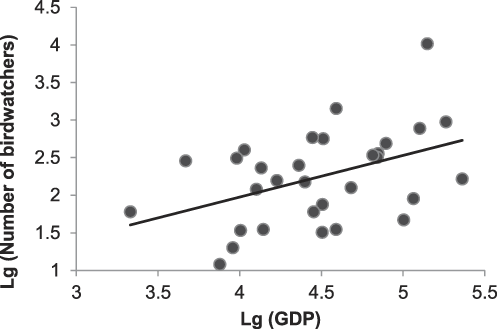
In mainland China, the median regional GDP was significantly higher in the 31 prefectures with birdwatching societies (332 billion US$, interquartile range = 599) than in the 306 prefectures without birdwatching societies (94 billion US$, interquartile range = 113) (Mann-Whitney U test, Z = 5.5, P < 0.001; Figure 2). Moreover, in the prefectures where birdwatching societies have been established, the number of birdwatchers was positively correlated with local GDP (Figure 3).
Regional gross domestic product (GDP; 2009 data) in prefectures with (n = 31) and without (n= 306) birdwatching societies (BWS).

Relationship between regional gross domestic product (GDP; million US$, 2009 data) and number of birdwatchers in local birdwatching societies in 2010. The data were logarithmically transformed. The regression equation is: Lg (Number of birdwatchers) = 0.55 × Lg (GDP) – 0.24, R 2 = 0.19. F = 6.94, P= 0.01. Lg is logarithms with base 10.
Contribution of birdwatching to bird study and conservation
We found a total of 128, 149, and 241 papers concerning new records of bird distribution in the 1980s, 1990s, and 2000s, respectively. During the same periods, there were 0, 1, and 12 papers in which the authors’ address included the term “birdwatching society”. In the new edition of the national checklist (Zheng Reference Zheng2011) 21 bird species were recorded for the first time in China, of which eight (38%) were reported by Chinese birdwatchers and the others by professional ornithologists and foreign birdwatchers.
Birdwatchers were actively involved in bird surveys and monitoring. In the winter of 2004 and 2005, more than 30 birdwatchers worked with professional ornithologists on the simultaneous waterbird surveys in the middle and lower Yangtze River floodplain organised by WWF. This was the first simultaneous bird survey covering a large area (extending 1,850 km along the Yangtze River) in mainland China. Since 2005, birdwatchers in coastal regions have conducted monthly synchronised waterbird surveys along the east coast of China. The surveys are still underway and will be helpful for understanding the long-term population trends of waterbirds in the region.
Birdwatchers were also active in educating the public about birds and their conservation. More than 100,000 local people received on-the-spot conservation and environmental education each year from 2008 to 2010. “Wednesday Class”, a session organised by the Beijing Birdwatching Society, was first held in 1996 to introduce and communicate information about birds and biological conservation. In 2006, the session began providing live webcasts to birdwatchers and the public in other places.
In December 2002, the first “birdwatching contest” in mainland China was conducted near Dongting Lake in Hunan Province. A total of 12 birdwatching teams from mainland China attended the contest, comparing birdwatching records within a specified time and region among teams. From then on and in cooperation with local governments and other conservation NGOs, birdwatching societies organised birdwatching festivals or birdwatching contests in more than 30 cities. Television, newspapers, magazines, and other print media frequently have reported on birdwatchers and birdwatching activities. Currently, birdwatching societies are among the most active conservation NGOs in mainland China.
Birdwatchers have also contributed directly to bird conservation. In addition to rescuing birds from poachers, nearly 70% (25 of 36) of the birdwatching societies have submitted bird conservation proposals to local governments. Three-quarters of these proposals have been accepted or partly accepted. For example, in response to a proposal submitted by the Shanghai Birdwatching Society concerning poaching regulations, a game refuge was established in Nanhui area of Shanghai in 2007, leading to an obvious decline in poaching in the region. Moreover, some birdwatchers volunteered to patrol nurseries and farmlands to inspect and remove illegal mist nets set by poachers in remote rural areas. In recent years, birdwatchers have begun to guide and attend bird conservation programmes supported by local governments and conservation NGOs. For example, a programme to conserving the “Critically Endangered” Spoon-billed Sandpiper Eurynorhynchus pygmeus was jointly undertaken by birdwatchers from the Shanghai Birdwatching Society and the Jiangsu Birdwatching Society.
Challenges to the development of birdwatching societies
Birdwatching societies in mainland China face a range of challenges. About three-quarters (72%) of birdwatching societies indicated that shortage of funds was a major problem. Most birdwatching societies can obtain funds by undertaking financially supported projects, from personal or business donations and membership fees, etc., but they still need more funds to support birdwatching-related activities. However, only one-third of the birdwatching societies considered that a shortage of funds was the most important challenge to their future development. About two-thirds (69%) of birdwatching societies stated that difficulties in being formally registered and accepted by the authorities was a major challenge. Less than half of the societies (42%) have been registered; other birdwatching societies are either unregistered (36%) or attached to government departments (22%). Three other important challenges were staff shortage, inadequate management systems within the society, and shortage of experienced birdwatchers (indicated by 50%, 33%, and 25% of the birdwatching societies, respectively).
Discussion
Birdwatching has rapidly developed and is becoming increasingly prominent in mainland China. With a history of only about 10 years, however, birdwatching in mainland China is still in its infancy phase of development, compared to western countries where tens of millions already participate (see Introduction). The development of birdwatching appears to be related to economic conditions; our results indicated that birdwatchers in China are more numerous in regions with higher GDP, while in the USA birdwatchers tend to be relatively affluent (Cordell and Herbert Reference Cordell and Herbert2002, Carver Reference Carver2009). Over the past two decades, China’s economy has grown rapidly, and economic development is likely to continue in the foreseeable future (Grumbine and Xu Reference Grumbine and Xu2011). With the further growth of China’s economy, we suspect that birdwatching in China has enormous potential for further development and more people will participate in birdwatching and join birdwatching societies.
The development of birdwatching was also spurred by foreign birdwatchers and birdwatching organisations. The Oriental Bird Club (OBC), established in the early 1980s, has helped organise birdwatching tours to East Asia including mainland China since the mainland country opened up to the outside world in the 1980s (P. Jepson and M. Crosby pers. comm.). OBC has also set up a fund to encourage bird study and conservation in Asia. Some birdwatchers and birdwatching societies in mainland China have obtained financial support from OBC to launch birdwatching-related activities. HKBWS has played an important role in promoting the development of birdwatching in mainland China. HKBWS has organized birdwatching trips into mainland China since the 1980s. On such trips birdwatchers contacted local people and raised interest in birdwatching at those localities they visited. Although most members of HKBWS were English in the early 1980s, the spread of birdwatching amongst local Chinese meant that more and more Chinese in Hong Kong joined the HKBWS (Lam Reference Lam2008). These Chinese members can communicate with local communities in mainland China without language barriers. In 1999, HKBWS established the China Conservation Fund to encourage and spread birdwatching in mainland China, to spur individuals to publish birdwatching records, and to support bird conservation studies. Most of these projects were undertaken by local birdwatching societies in mainland China. In 2005, HKBWS set up the China Programme to organise communication and training workshops among birdwatchers in mainland China as well as publish birdwatching, bird surveys, and bird conservation publications (Hong Kong Bird Watching Society 2003, 2006). All these activities have greatly accelerated the development of birdwatching in mainland China.
WWF has also been active in promoting birdwatching in mainland China. In the 1980s, WWF Hong Kong started to invite staff from wetland reserves in China and trained them in bird identification for monitoring purposes. After the establishment of the WWF Beijing Office in the 1990s, WWF played an increasing role in nurturing the growth of birding in mainland China. Perhaps most important was the publication of a comprehensive field guide to the birds of China (MacKinnon and Phillipps Reference MacKinnon and Phillipps2000), which WWF jointly prepared with IUCN and the World Bank. This is the most popular field guide for Chinese birdwatchers and has greatly facilitated the development of birdwatching in mainland China (Chen Reference Chen2007). It is estimated that about 20,000 English copies have been released and the number of Chinese copies must be much greater (J. MacKinnon pers. comm.). In 2001, WWF established the first Chinese birdwatching internet forum (www.wwfchina.org/bbs), attracting the attention of many birdwatchers. Since then many birdwatching societies have established local birdwatching websites and internet forums (Ma Reference Ma2011). We believe that the rapid development of the internet in mainland China has facilitated communication among birdwatchers.
Many studies have indicated that birdwatching has brought substantial market value to local economies (Carver Reference Carver2009, Molloy et al. Reference Molloy, Thomas and Morling2010, Wenny et al. Reference Wenny, Devault, Johnson, Kelly, Sekercioglu, Tomback and Whelan2011). The economic value should encourage policy makers to pay more attention to conservation and ensure that suitable habitats are protected rather than indiscriminately sacrificed to economic or real estate development. Moreover, birdwatching has a high potential to improve the environmental well-being of local communities (Sekercioglu Reference Sekercioglu2002), which meets the targets of sustainable development that have been strongly advocated worldwide over the past two decades (e.g. Folke et al. Reference Folke, Carpenter, Elmqvist, Gunderson, Holling and Walker2002, Robinson Reference Robinson2004). Relative to birdwatching in western countries, birdwatching in mainland China involves few people and has a very limited ability to improve economic development and to provide jobs. From the perspective of local governments, birdwatching is presently valued because of its positive associations with environmental protection and natural beauty, i.e. it is valued for its contribution to public relations. However, with the development of birdwatching and an increasing number of birdwatchers, economic benefits from birdwatching will become more evident. This should cause policy makers to consider conservation of birds and their habitats and make decisions that are consistent with the objective of sustainable development.
Birdwatching takes many forms in western countries, from sitting in gardens to watch birds fly to feeders, to making records of birds seen in the countryside (Fisher Reference Fisher1966). Currently, most Chinese birdwatchers are interested in taking birdwatching tours to rural areas where they can find abundant bird species including some endemics. This might reflect the popular birdwatching tours of foreign birdwatchers in mainland China. Moreover, many birdwatching societies organise birdwatching activities with an explicit conservation purpose. The spread of diverse birdwatching forms, especially recreational birdwatching, might attract more people and prompt the further development of birdwatching in mainland China. In addition, working with local communities will be helpful to preserve indigenous knowledge and culture about the native birds (e.g. cormorant fishing; Dong et al. Reference Dong, Pei, Yuan and Du2007).
As important indicators of biodiversity and environmental quality, birds have been widely useful for Ecological Impact Assessments and monitoring environmental changes (Bibby et al. Reference Bibby, Burgess, Hill and Mustoe2000, Gregory et al. Reference Gregory, van Strien, Vorisek, Meyling, Noble, Foppen and Gibbons2005). Many bird surveys and monitoring programmes have been implemented over the past century, providing basic data for understanding the distribution, phenology and population dynamics of birds and for making conservation plans (Greenwood Reference Greenwood2007 and references therein, Both et al. Reference Both, van Turnhout, Bijlsma, Siepel, van Strien and Foppen2010). Large-scale and long-term programmes rely on the participation of numerous volunteer birders (Li and Mundkur Reference Li and Mundkur2004, Greenwood Reference Greenwood2007). Our results indicated that the number of papers containing new records of bird distribution has increased rapidly over recent decades, suggesting a great increase in field observations. This is consistent with the rapid development of birdwatching in China in the 2000s. Although only 5% of these papers included the addresses of birdwatching societies in the 2000s, the actual number of papers contributed by birdwatchers could be much higher, because 60% of birdwatching societies have no fixed address (Ma Reference Ma2011) and because some birdwatchers provided the address of their work rather than of their birdwatching society. Moreover, most birdwatchers were unfamiliar with publishing their records in academic journals; they just listed their records on birdwatching websites (Ma Reference Ma2011). Nevertheless, professional ornithologists in China have paid close attention to the contribution of birdwatching to avian studies. The China Ornithological Society (COS) has collected birdwatching records and used them in compiling the China Birdwatching Annals since 2003 (China Ornithological Society 2004). In 2005, the COS established the Birdwatching Specialist Group, with the goals of guiding birdwatching activities and combining amateur birdwatching with academic ornithological studies (Ma Reference Ma2011). In fact, birdwatching records have provided basic data for elucidating avian population trends (Barter et al. Reference Barter, Chen, Cao and Lei2004, China Coastal Waterbird Census Group 2011), for designating Important Bird Areas (Chan et al. Reference Chan, Crosby, So, Wang, Cheung and Hua2009) and for detecting distributional changes of birds including the potential effects of environmental changes in mainland China (e.g. Du et al. Reference Du, Zhou, Shu and Li2009, Cai et al. Reference Cai, Tang, Yuan, Wang and Ma2011). Systematic bird monitoring frameworks involving volunteer birdwatchers will be helpful for understanding bird population dynamics on the current background of global changes, something that is still absent in mainland China (Si and Ding Reference Si and Ding2011, Wu et al. Reference Wu, Xu, Wu and Cao2012).
Our results indicate that opinions differed somewhat about the challenges faced by birdwatching societies. These opinions might be related to differences in their developmental stages and differences in the attitudes of local governments toward birdwatching. Moreover, our results indicated that fewer than half of birdwatching societies have been registered, and difficulty in being registered and accepted by the authorities was one of the major challenges. This is because there are some restrictions and complex procedures for legal registration of social organisations in mainland China (Hildebrandt Reference Hildebrandt2011). The inability to register puts birdwatching societies in an awkward position with respect to the government, reduces their visibility to the public, and slows their long-term development. In July 2011, the Chinese Ministry of Civil Affairs announced that restrictions on registering social organisations will be relaxed (Ma Reference Ma2011). This will help birdwatching societies obtain legal status and will promote further development of birdwatching.
In western countries, birdwatching means watching birds in their natural environments, and the birdwatchers know the species status, distribution, and habitats of birds (Jepson Reference Jepson, Tidemann and Gosler2010). Because bird-keeping has a long history, “birdwatching” has tended to focus on caged birds in China in the past. People have obtained much knowledge about birds through bird-keeping; there are many publications on appreciating, keeping, acquiring, and breeding birds; bird-keepers are familiar with the song, behaviour, and husbandry of birds (Dong et al. Reference Dong, Pei, Yuan and Du2007). The difference between the two birdwatching forms reflects the culturally distinct relationships between humans and birds (Jepson Reference Jepson, Tidemann and Gosler2010). However, bird-keeping is potentially detrimental to wild populations. Now, Chinese birdwatching has shifted to viewing birds in their natural environments. It is crucial that we engage this vast audience of people who keep caged birds and inform them about the natural ecosystems that are the source of their beloved birds. The synergy between these two activities, accompanied by robust and stringent wildlife protection, particularly against poaching for the cage trade, will be helpful to avian conservation.
China has a top-down political system, and conservation policy is developed and implemented through government-driven policy and regulation without substantial public input (Grumbine and Xu Reference Grumbine and Xu2011). The widespread acceptance by local governments of conservation proposals from birdwatching societies indicates that conservation is also being driven from the local level. Although the influence of birdwatchers on conservation policy at the local level is still weak relative to that of the central government, the increased activity at local level reflects an improved understanding of conservation by the public and could have far-reaching, long-term implications for conservation in mainland China.
Birdwatching is still at an early stage in mainland China. As the economy continues to grow and as international communications increase, birdwatching in China is likely to continue its rapid growth. Birdwatchers will play an increasingly important role in bird study and conservation and also in the development of China’s conservation policies and practices. The contribution of birdwatchers should help integrate the concerns and activities of local communities, local and central governments, conservation NGOs, and scientists and thereby help society achieve the objectives of conservation and sustainable development (Berkes Reference Berkes2007). Because China is a large country with a wide range of habitats that contain diverse wildlife (Xu et al. Reference Xu, Wang and Xue1999), the improvement of conservation in China will also represent a major contribution to global conservation.
Supplementary Material
The supplementary materials for this article can be found atjournals.cambridge.org/bci
Acknowledgements
This study was financially supported by the World Wide Fund for Nature (WWF) Beijing Office. We thank Simba Chan, Vivian Fu, Yingxin Qiao, Shuihua Chen, Jinyu Lei, Li Yao, and Lu Dong for their comments and suggestions on the questionnaire and their help in contacting birdwatching societies and birdwatchers. We also thank Mingze Lu, Qin Huang, Meng Li, Zigeng Chen, and Changkun Xie for their help with data collection. We appreciate local birdwatching societies and birdwatchers for providing information about local birdwatching activities. We are grateful to John MacKinnon and Mike Crosby for providing information about birdwatching in China in the early stage, and Paul Jepson, Jeremy Greenwood, Barrie Cooper, Charlotte Chang, and Bruce Jaffee for their suggestions on an earlier version of this manuscript.



