

Introduction
In the first Lord Lugard Lecture, held in Lagos in 1955, Saburi Biobaku, one of the pioneers of modern African historiography, observed that
the historian in his craft examines all the evidence available to him and reconstructs the past in the light of the various sources within his reach. If another historian were to come across fresh documents, a new light is thrown on the subject and much of what the first historian has written may be modified or even invalidated. (Biobaku Reference Biobaku1955: 6).
A historian of a younger generation, Olutayo Adesina, argued that ‘historical production’ involves
the exploration of formerly neglected topics … the need to uncover the unknown, answer questions, seek implications or relationships – of events from the past and their connection with the present, assess past activities and accomplishments of individuals, agencies, or institutions, and to aid generally an understanding of human cultures and societies. (Adesina Reference Adesina2017: 3)
In view of the literature available to the researcher, there has been no in-depth study of the subject of global cooperation and collaboration of J. F. Ade Ajayi, which involved a discussion of how and why he chose the pursuit of African history and the path of global cooperation and collaboration in the promotion of African history. Indeed, it is noted that his perception of African historiography as a global enterprise, involving cooperation and collaboration, has received scant attention (Adeboye Reference Adeboye2015: 741–4).
For Ade Ajayi, collaboration was partnership building; it was neither collusion nor compromise nor the abandonment of the right to take decisions on issues, based on equity and mutual respect. It was not a surrender of sovereignty. For him, collaboration was working with anyone from any part of the world for the realization of his purpose of having an acceptable African history, which was a productive venture.
The study of history inevitably carries the global touch. This is because of the nature of the search for materials, written and unwritten, sometimes with the injection of interviews and discussion as to the methodology of collecting sources. This study, however, focuses attention on the intentional and deliberate effort of Ade Ajayi to cultivate a broad base of access to materials, ideas, and peoples in his work as a historian of Africa. Furthermore, global collaboration involves building partnership by peoples and institutions across the world. Related to global cooperation would be the contribution of what has been described as Afrocentric intervention in the writing of the history of Africa, by which historians have sought to address the perceived marginalization of African thought, African history and African feelings and dispositions.
This article, therefore, seeks to fill the gap in the understanding of the contribution of J. F. Ade Ajayi to historiography as an African historian. The personal papers of Jacob Ade Ajayi, kept at the Jacob Ade Ajayi Trust Library and Archives in Ibadan,Footnote 1 offer information on this important subject. The papers are supplemented by materials available in various libraries and depositories especially in the United Kingdom and Nigeria. This article will be a contribution to the study of historiography. It involves an investigation of the background of the historian, the possible influences, interests, and pressures that lead the historian to produce historical work.
Early preparation and training
Ade Ajayi valued global collaboration and cooperation in the pursuit of acquisition of knowledge in History. His interest in African History was an unintended outcome of his training in History in the formal school systems in Nigeria and in Britain where most of his teachers were non-Africans. The objective of his early education in History at both primary and secondary schools was determined by the expectations of colonial rule, to glamourize the conquerors of Africa, and demonstrate the evolution of European states and empires. Ade Ajayi began his learning of History at Igbobi College, where students were prepared for the Cambridge School Certificate examinations, following his invitation to Cambridge Local Examinations Syndicate by the colonial administration in Nigeria in 1909 (Omolewa Reference Omolewa1977: 111–30). The teacher had little choice other than to follow the curriculum, which prescribed the teaching of the lives of Europeans such as Sir Walter Raleigh, Sir Francis Drake, and conflicts such as the Wars of the Roses and the English Civil Wars of 1642 to 1647 (Omolewa Reference Omolewa1980a: 42–56).
In later years, the colonial officials expected the teaching of History to demonstrate the benefits of the conquest of the African countries and the frustrations to development posed by the barbaric peoples in the region before the European conquest. The expectation was to secure the loyalty of the subjects (Ogunlade Reference Ogunlade, Omolewa and Osuntokun2014: 57–100).
What was taught in the school did not take advantage of the local pioneer works, often by amateur historians, that captured the history of the major towns, cities and communities in Southwest Nigeria during the colonial period. Among these writings, listed by Biobaku (Reference Biobaku1973: 251–4), were the history of Ilesa, Iwe Itan Ilesa, by J. D. E. Abiola, printed in 1932; the history of Ore, Otun and Moba, Iwe Itan Ore, Otun ati Moba, by D. Adelagbe at an unspecified date. Other writings include the history of old and new Oyo, Iwe Itan Oyo-Ile ati Oyo Isisiyi, by M. C. Adeyemi, printed in Ibadan in 1914; the history of Abeokuta, by A. K. Ajisafe, printed in Bungay in 1924; the history of Ibadan and of Iwo, Ikirun and Osogbo, Iwe Itan Ibadan ati Iwo, Ikirun ati Osogbo, by I. B. Akinyele, printed in Ibadan in 1911; and J. B. O. Losi’s History of Lagos, 1914. It also included The History of the Yorubas: from the earliest times to the beginning of the British Protectorate, by Samuel Johnson in 1921; A Short History of Badagry, by T. O. Avoseh, published in Lagos in 1938; and A Short History of Benin, by J. U. Egbrevba, printed in Ibadan in 1934. Finally, the list included Iwe Itan Ajase, by A. Akindele, published in Porto Novo in 1914; and, much later, The Outlines of Ibadan History, by I. B. Akinyele printed in Lagos in 1946.
It is interesting to note that it was in 1899 that Samuel Johnson, of the Church Missionary Society, wrote the manuscript which he sent to an English publisher through one of the Missionary Societies. The manuscript was said to have been misplaced and the publisher offered to pay for it. This seemed to Obadiah Johnson, brother of the author and to ‘all his friends who heard of it so strange that one could not help thinking that there was more in it than appeared on the surface’ (Johnson Reference Johnson1921: ix). Apart from ignoring local publications, the colonial officials who prepared the History curriculum paid no attention to the works of the Nigerian educated elite. These included John Augustus Payne’s Table of Principal Events in Yoruba History, published in 1893, and Oritshetukeh Faduma’s The Religious Beliefs of the Yoruba People, which Faduma presented at the Congress on Africa held in Atlanta, Georgia in 1895 (Coleman Reference Coleman1958: 186–7).
At Yaba Higher College, which Ade Ajayi attended from 14 February to 16 December 1947, there was no serious study of history because the institution at its inception began with courses to train professionals in Medicine, Agriculture, Engineering, Forestry and Survey. Critics of the College curriculum made suggestions for its reform to accommodate courses in the humanities; for example, Henry Carr, the Nigerian graduate of Fourah Bay College in Sierra Leone, and the first African Inspector of Education for the colony of Lagos ‘was apprehensive of scientific education without the mellowing influence of the humanities’ (Taiwo Reference Taiwo1975: 131). Yaba Higher College introduced courses in the humanities and education, which include English Literature, History, and Geography (Taiwo Reference Taiwo1975: 133–5). Thus, by the time Ade Ajayi was admitted to the College there were some courses in History. However, the content of the History of Nigeria taught would be better described as History for Nigeria rather than the History of Nigeria, as it was about how Nigeria responded to external influences, rather than the evolution of Nigeria over the period being studied. Nevertheless, his experience at Yaba Higher College in the days of the rise of Nigerian nationalism drew his attention to the emergence of a new elite eager to ‘create a new political society’ (Ogunlade Reference Ogunlade, Omolewa and Osuntokun2014: 59), which he later explored.
The History syllabus of the University College, which Ade Ajayi attended from January 1948 to June 1951 was designed by the University of London for colonial students who attempted the examinations as external students. Therefore, it was not intended to produce Africans who would be specialists in the History of Africa. In his first year as a student of the Department of History, Ade Ajayi opted for History, Latin and English. The History courses were Medieval European History from 1395 to 1500 and Modern European History from 1500 to 1914. At the University of London Intermediate Degree in Arts examination in July 1948, he was asked the following questions, among others:
1. “The real turning-point in English history is not the accession of Henry VIII, but the fall of Wolsey.” Discuss this opinion.
2. Account for the failure of the threats to the integrity of the Austrian Empire in 1848 and 1849.
3. What success was achieved by Bismarck in his handling of the internal problems of Germany after 1870? (University of London, Senate 1948)
As he moved to the University College in Leicester, where he studied from September 1952 to September 1955, Ade Ajayi came under the influence of Jack Simmons, an English transport historian but versatile in the broad field of history. Ade Ajayi later testified that Jack Simmons ‘made a historian out of me. His view of history in its local, national and international dimensions, as one that I cherished as I also cherish our continuing friendship’ (Ogunlade Reference Ogunlade, Omolewa and Osuntokun2014: 86). At Leicester, Ade Ajayi took courses in English History, European History and Commonwealth History. As he later observed, during his undergraduate days the only book which discussed Africa was Harry Johnston’s The Colonization of Africa by Alien Races. Otherwise, there was nothing on Africa:
Hardly anything was offered about African History, which did not exist in those days as an academic discipline. It was later about 1954 or 1955 that the University of London made history when it appointed the first lecturer in African History, Dr Roland Oliver, who had done some pioneering work on the Christian Missions in East Africa.Footnote 2
The entire three-year duration of his programme in Leicester was covered by the scholarship awarded by the Director of Colonial Scholars. As J. L. Keith, the Director of Colonial Scholars, made it clear to Ade Ajayi in his letter of 27 November 1952, ‘Your scholarship is tenable up to a maximum period of three years and, unless my permission is given for any necessary extension, will normally terminate at the end of the summer term, 1955’.Footnote 3 The scholarship guidelines also indicated that the candidate would be required to return home by the first passage offered to him on the termination of the award.
Ade Ajayi later explained that the African student had little option but to follow the prescribed courses under the watch of colonial officials:
Once a people lose their sovereignty, and they are exposed to another culture, they lose at least a little of their self-confidence and self-respect; they lose their right of self-steering, their freedom of choice as to what to change in their own culture or what to copy or reject from the other culture (Ajayi Reference Ajayi and Ranger1968: 196–7)
The control exercised by the colonial officials both in the rural areas and in the metropolis included the determination of the content of learning in approved curriculum and the examination bodies (Omolewa Reference Omolewa1980b: 651–71).
Cooperation and collaboration at the level of maturity as a historian
After his undergraduate days, Ade Ajayi began to develop a new orientation in his relationship with teachers and colleagues in the world of history, but not once did he attempt to jettison his contact with them. It should be noted that he grew up at the time when the African educated elite began to question assumptions about African history. Ade Ajayi was disappointed that the African was always the object of history and never the subject; he was disappointed about how Africans always reacted to issues raised by Europeans and to the decisions made for them. He was frustrated by the absence of encouragement for the study of the history of Africa.
Having taken a First Class in his degree examinations at the University of Leicester, Ade Ajayi became confident in his ability to pursue research in History. He also demonstrated his capacity for sustained academic work. For example, at Leicester, where he served as an Archivist, he received a letter from the President of the University College, acknowledging ‘the conscientious and efficient manner’ in which he had performed his assigned duties, particularly commendably.Footnote 4 The Registrar of the University College, Leicester, also wrote to him on 21 October 1955 to convey news of the award to him by the West End Association War Memorial Prize in History for the session, 1954–55. Ajayi now believed that he could pursue his interest in history. For the postgraduate scholarship required, he was awarded the Derby Fellowship of the Institute of Historical Research of the University of London. He became interested in study related to the development of his country, Nigeria.
Ade Ajayi mastered the art of writing history. As he later explained, for him, the word ‘history’ must be understood in its two-fold meaning. History is both the past and the study of the past. Its meaning covers both the reality of past events and the effort of historians to capture or retrieve and to interpret something of that reality (Ajayi Reference Ajayi1990: 3). He had an interest in exploring the role played by Africans in the development of Africa as well as by those with whom they came in contact. He believed that the African was not merely a passive observer. For him, the colonial period was of considerable interest but he believed that much transpired before as well as during colonial rule.
At the beginning of his postgraduate work in 1955, Ajayi was fortunate to have as his supervisor Prof. Gerald S. Graham, Rhodes Professor of Imperial History at King’s College, University of London. Graham was an academic who was sympathetic to the study of the history of Africa, which he considered desirable. He was willing to encourage students in the pursuit of their interest in the study of African history. Graham had already supervised the doctoral thesis of the trail-blazing historian of Africa, Kenneth Onwuka Dike. Ajayi described Graham, a Canadian, as ‘an excellent human being with a never-failing sense of humour. He befriended you if he thought you were a good historian whether or not he shared your view’.Footnote 5
Graham was also appreciated for his ‘commitment to the scientific use of evidence about the past and appreciation of researchers’ ability to identify sources relevant to the arguments they sought to develop’ (Ogunlade Reference Ogunlade, Omolewa and Osuntokun2014: 89). This was another phase of the work, which demanded collaboration with other historians. As was the practice with supervision, a student arrived at the subject of study after consultation with the supervisor. On most occasions, supervisors suggested a theme for consideration and adoption. Sometimes, a student would come up with a topic for approval by the student’s supervisor after a careful literature survey. For example, it was L. C. Gwam, the archivist at the National Archives at the University of Ibadan, who suggested to Adewumi Fajana the development of education in Nigeria as a research topic, and also drew to his attention some valuable sources (Fajana Reference Fajana1978: v). Furthermore, C. O. Taiwo stated that it was the appreciation of the qualities of Henry Carr in his obituary by Prof. L. J. Lewis of the Institute of Education, University of London, that inspired his own research on Carr (Taiwo Reference Taiwo1975: vii).
One of the early exposures of Ade Ajayi to the global dimension in historiography was around the choice of topic for his thesis. He began his postgraduate research in history at the time when it was fashionable for Europeans to study the educated elite. For a long time, the Europeans who teased them for uncritically accepting the cultural transfer introduced by the Europeans had vilified the educated elite. Those of them who were trained abroad were critically followed and there were reports of the progress they made in the distant land of their studies. Since it was known that the educated elite would replace the colonial administrators in governance and professional services, Europeans were eager to have a clearer understanding of how this set of people had emerged, what they were capable of doing and what their orientations and leanings were. In the United States, James Coleman had pioneered such study in his Nigeria: background to Nigerian nationalism (Reference Coleman1958) where he drew attention to the role of Western education and other influences that shaped the thoughts and practices of the educated elite.
It was left for the supervisor of Ade Ajayi to suggest the topic of the missionaries. After considerable reflection, Ade Ajayi accepted the suggestion and that was how his thesis topic emerged. He agreed to explore the subject of ‘The Christian Missions and the Making of Nigeria, 1840–1900 (a study of missionary activity as a factor in imperial expansion)’ and submitted the title during his registration for the PhD programme in September 1955 at the University of London. The dates, 1840 and 1900, were important in global history: 1840 marked the beginning of a vigorous European expansion in China, India and Southeast Asia while 1900 was the beginning of technological breakthrough in Europe and the passing of the Gold Standard Act by the United States Congress. The dates were, however, less relevant to Nigeria in particular and required a further reflection by the young postgraduate student.
Ajayi, however, immediately took ownership of his field of study. He proposed one month after the initial registration of the title of his study to change the title of the proposed thesis to ‘The Missionary Factor in Nigeria in the 19th Century’, perhaps influenced by The Missionary Factor in East Africa (1952), the title chosen by Roland Oliver, the first British lecturer in African history. In a letter from the Deputy Academic Secretary of the University on 24 October 1955 Ajayi was informed of the approval of his new title: ‘The Scholarship Committee considered your proposal to study “The Missionary Factor in Nigeria in the 19th Century” during your tenure of your Derby Studentship in History. I am pleased to say that the Committee approved your proposal’.Footnote 6
Having identified the broad area for his work, Ade Ajayi set out to search for sources (raw materials in public and private archives), carry out reliability and validation tests and, if further necessary, conduct interviews. The second phase was the identification of where to locate the evidence, involving the primary and secondary sources, the collection and collation of evidence. Ajayi did not develop an interest in the study of the impact of colonial rule. Rather, he expressed a desire to study ‘the period before the general European scramble when European influence was penetrating the country gradually without, except at Lagos, official British rule’.Footnote 7
He began to search for relevant materials. Early in 1956, he wrote a letter dated 16 February 1956 to the editor of Joyful News in Yorkshire, asking about the role the Joyful News agents of the Methodist Church played in opening up the Ijebu:
I am doing a thesis for the PhD of London University on the Christian missions and the making of Nigeria, 1840–1900. The idea is to make a study of missionaries as pioneers and to assess their contributions to the spread of European culture and influence in the years before the establishment of British administration in Nigeria. I wonder if you have the letters, journals etc. of these pioneers and if you could allow me to see them.Footnote 8
He wrote a similar letter to the Foreign Mission Committee of the Church of Scotland asking for letters, both outgoing and incoming, and committee minutes. He further approached the Baptist Mission in Richmond, Virginia. In the response of 20 February 1956 to his letter, the General Secretary of the Methodist Mission added: ‘I’m afraid you may be disappointed with what you find here in our office.’ The Baptist Mission in Richmond, Virginia, sent Ade Ajayi a book written on missionary work by Dr George Sadler and explained that ‘Here in the States, people who wish to use our facilities come to the office’.Footnote 9
Having secured the approval of the relevant authorities to consult the various archives, Ade Ajayi began to travel widely in order to locate sources for the subject. He was in Scotland for the records of the Presbyterians, and he exhaustively used the Church Missionary Society (CMS) records in London. Having just got married, that determination to search for sources as evidence for his writing proved uncomfortable for his young wife who complained about his long and sustained absences from home. Ade Ajayi agreed with his wife and lamented about how glued he was to the production of a good thesis.
Furthermore, C. A. Mizen of the University of London conveyed the Senate approval of the amended title of the proposed PhD thesis on 3 March 1958.Footnote 10 Ade Ajayi submitted the thesis on 1 July 1958 and the oral examination of the thesis was held on 24 July, with Prof. W. L. Burn of the University of Durham as his external examiner.
It is important to note that his passion to tell a fuller history than he did for his PhD thesis propelled Ade Ajayi to collect additional evidence in order to expand his earlier work. Rather than publish his thesis in an abridged form, Ade Ajayi proceeded to broaden it by adding new materials. He obtained a grant as a Lecturer in History in Ibadan to travel to the United States to explore the archives of the Baptist Mission and to expand his thesis for publication. The publication became the first in the Longman series for the Ibadan School of History. This act further demonstrated his drive for the pursuit of excellence and intellectual perfection. Reviewing the book for the journal, Books Abroad, in January 1967, Franklin Parker of the University of Oklahoma described it as ‘a scholarly book and a basic book on which later historians will lean and from which popularizers will borrow’.Footnote 11
Parker also called it ‘an essential book careful in scholarship and wary of interpretations’.Footnote 12 He was impressed that the author wrote about ‘his own country’s history and treats objectively both the white missionaries and the Africans in whose vineyards they labored’.Footnote 13 Ian Espie, with whom he edited one of the standard textbooks on African History once informed him:
I have been reading and enjoying chapters of your thesis and must congratulate you on a most happily readable style. I have seldom read a thesis which I could honestly say I had enjoyed – this one I can.Footnote 14
In his PhD thesis Ade Ajayi had opted to make Bishop Ajayi Crowther the hero of his findings. The dates of his thesis, 1841–1891, reflect the beginning of Crowther’s mission to Nigeria with the Niger Mission of 1841 and the Bishop’s death at the closing hours of 31 December 1891 (Ajayi Reference Ajayi1992; Reference Ajayi and Crowder2001). He lamented the denial to Africans of making choices, an argument that he pursued in his October 1999 Henry Martyn Lecture at Cambridge.Footnote 15
In his later choice of studies, including the work on Yoruba warfare and the biography of Justice Kayode Esho, his focus remained on the contributions of Africans to development. For example, he made the point that the Yoruba wars brought about the rise of a new class of warriors, distorting the old constitutional arrangements and demanding new powers, and that sometimes the warriors established new settlements, which affected constitutional development. It was within the context of establishing the importance of an African playing a decisive role in historical development that he chose to reduce the importance of the colonial period, which he considered as merely a phase. For him, many of the stories of the activities of the colonial officials were mythical, involving much imagination by those who considered themselves as ‘little gods communing with mortal men’ (Ajayi Reference Ajayi and Ranger1968: 190). It was also within the context of the centrality of the African in history that he built the foundation of his relationship and partnership with the outside world.
Historical practice at Ibadan
As soon as he had defended his thesis, Ade Ajayi left the UK on 12 September 1958 by the S. S. Calabar and arrived in Lagos on 27 September 1958.Footnote 16 It was perhaps at the University College, Ibadan, that his choice of global collaboration in academic development became most evident. He received a letter dated 18 September 1958 from James Henderson, the Academic Registrar of the University of London informing him that the Vice-Chancellor, acting on behalf of the Senate, had conferred upon him on 15 September 1958 the Degree of PhD in the Faculty of Arts (Modern West African History) as an Internal Student.Footnote 17 Henderson concluded: ‘I have the honour to inform you that I am also to inform you that the Examiners have reported that your thesis is suitable for publication in an abridged form’.Footnote 18
At this stage of his professional career as a historian, the main contact for Ade Ajayi was Kenneth Dike, then Head of the Department of History at the University College, Ibadan. He had a close working relationship with Dike, his predecessor as graduate student at King’s College of the University of London. Dike was a trailblazer in modern African historiography having concentrated his attention on the study of Africans in Africa. For that purpose, his hero was Jaja of Opobo, an African merchant. Dike was fascinated with the research focus of Ajayi and admired the thrust of the work. As Head of Department of History at the University College, Ibadan, Dike offered Ajayi an appointment as a Lecturer II on 30 July 1958, one week after the successful defence of his doctoral thesis. Earlier, on 17 September 1957, Dike had asked Ajayi for help:
I have been asked to read during the celebration of the Centenary of the Niger Mission … Can you tell me why Crowther, after he has been consecrated Bishop of the Niger Mission, chose to plant his Headquarters in Lagos rather than in the Niger itself? What are your views for Bishop Crowther’s alleged failure in administering the Niger Mission during his lifetime? For instance, why did the leadership of the Mission pass onto Europeans after his death? Would you consider the Bishop deficient in judging character?Footnote 19
Ajayi provided the evidence and explanations required by Dike who later wrote to Ajayi on 21 January 1958, barely six months before the completion of his thesis, to thank him. Dike added that ‘my talk was so general and so slight that whatever is said can never impair any contribution you are likely to make on the subject’.Footnote 20 Ajayi served Dike faithfully. Later as Head of the Department of History, when Dike was the Vice-Chancellor, Ajayi joined him in contributing an entry on African historiography to the Encyclopedia of the Social Science (Dike and Ajayi Reference Dike, Ajayi and Sills1968: 394–400).
On his arrival at Ibadan as a lecturer, Ade Ajayi was requested to teach European History. He felt uncomfortable with this, having specialized in Modern West African History in his PhD thesis but, although disappointed, he began to prepare for the course. He informed his students at the Department that for those taking European History that term ‘I shall deliver one extra lecture weekly at 1–2 on Mondays in the Arts Lecture Theatre. The first lecture in this series will be given on Monday, the 9th of February’.Footnote 21 He later jumped at the opportunity given him to teach the History of Africa and to be involved with the preparation of the new curriculum, working with H. F. C. Smith and the West African Examinations Council, itself a collaborative venture with the Cambridge University Local Examinations Syndicate (Omolewa and Osuntokun Reference Omolewa and Osuntokun2014: 146).
Ade Ajayi worked with colleagues, mostly expatriate staff, and notably Charles (later Abdullahi) Smith, a Briton who enthusiastically championed the cause of the teaching of African History at University College, Ibadan, in the design of new courses for an independent degree programme of the University of Ibadan, a large portion of which dealt with African History. Working through the Historical Society of Nigeria, and together with the West African Examinations Council, Ajayi organized a workshop to develop the curriculum and material for examinations in African History. In the process, Ade Ajayi became a co-author with Ian Espie of one of the two books produced by the workshop, entitled A Thousand Years of West African History (Reference Ajayi and Espie1965), one of the twin publications on the History of Africa, produced as a collaborative venture between the Faculties of Arts and Education at the University of Ibadan.
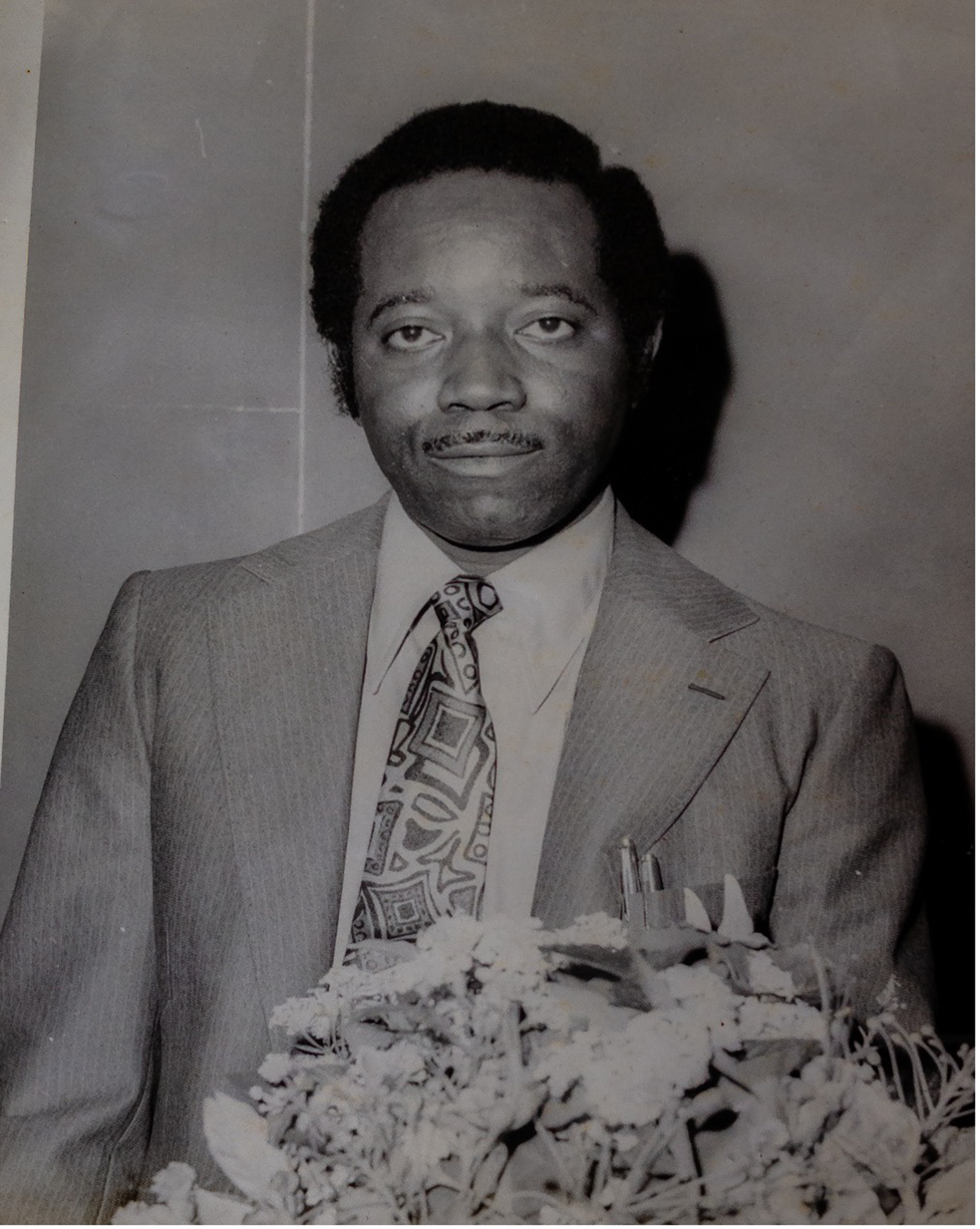
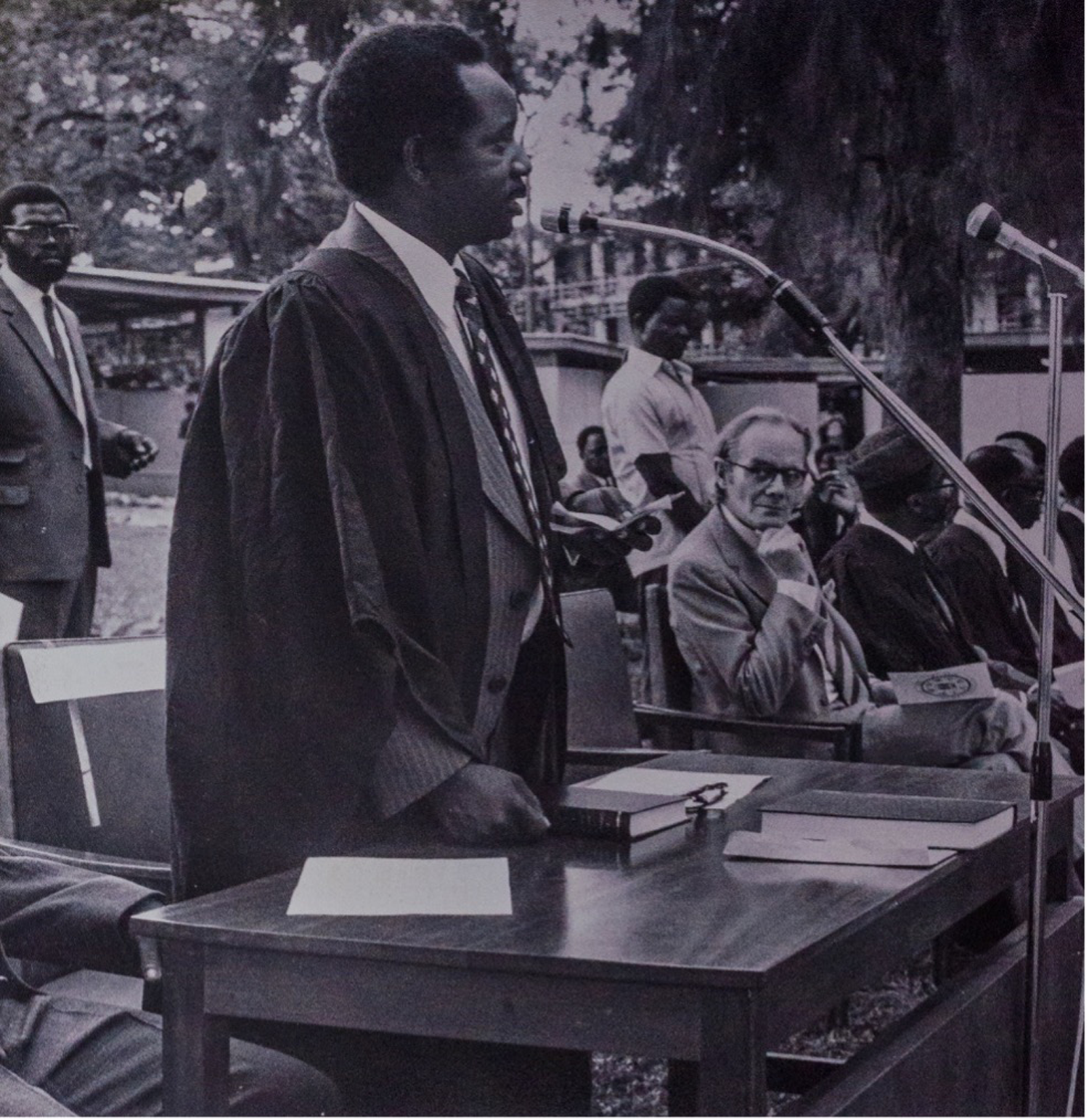
As Dean of the Faculty (Figure 1) and Head of the Department of History, Professor Ajayi was part of the decision to establish a partnership between students from the North and their colleagues from the South, through student exchange programmes. To this end, he sent second year undergraduate students from the Department of History at the University of Ibadan to the School of Oriental and African Studies (SOAS) and Queen Mary College, both of the University of London. The students spent one term away from their base and returned to complete the undergraduate programme. Among the early set of exchange students were successively Festus Ogunlade, Akinjide Osuntokun, Michael Omolewa and Bunmi Peters. For Ade Ajayi, the study of history was of global interest and could not be done in Africa in isolation from the world, because learning and teaching of History was part of the universal movements in historiography. As President of the Historical Society of Nigeria from 1972 to 1981 (Figure 2), he often promoted his ideas of global partnership building with confidence and satisfaction.
J. F. Ade Ajayi as Dean of Arts, University of Ibadan, in 1964. Courtesy of Jadeas Trust Library and Archives.

Prof. J. F. Ade Ajayi delivering a lecture at the University of Ibadan in 1972. Courtesy of Jadeas Trust Library and Archives.

Global cooperation and collaboration factor
J. F. Ade Ajayi was particularly noted for his dedication to the practice and promotion of global collaboration in his study and writing of African History. Ade Ajayi would only accept that there was an African historiography for as long as there was also a European, American or Asian historiography. He was not favourably disposed to the idea of ‘ghettoing’ anything that he considered universal. He was interested in the African who was familiar with global issues and histories other than African. His partners in scholarship were global; so were his search for materials, his travels and even his themes of research.
It is remarkable that in spite of the fact that Ade Ajayi’s focus was consistently on West Africa, rarely bringing in other parts of Africa, he addressed the subject of historiography in a wider dimension. Furthermore, while his attention was on the African Bishop Ajayi Crowther, Ade Ajayi was also mindful of the non-Africans who had faith in Africa and the ability of the African; hence the attention he paid to the contribution of Henry Venn, then Secretary of the Church Missionary Society. Ade Ajayi considered Venn a firm believer in the potential of the African for leadership, who had to be trained to be able to receive the competence and efficiency required to excel.
Ade Ajayi was visibly a global player in the field of historiography as in many of the other aspects of life. His major work was collaborative. His study on the Yoruba wars in Nigeria was written in partnership with a British historian, Robert Smith (Ajayi and Smith Reference Ajayi and Smith1964). He occupied the chair of the International African Institute that was once held in 1926 by Lord Lugard. He was the spokesperson for the emerging Ibadan History School but the work of the school was a joint venture with Longman publishers in the UK.
One may ask the question about why Ade Ajayi chose to be a global player. It could be argued that, to some extent, it was part of his nature to reach out beyond the locality of his birth and upbringing. One may indeed note that in his early years he had chosen to leave Christ’s School Ado-Ekiti, where he was admitted for his secondary education, to continue his secondary education in Igbobi College, Lagos, far away from his hometown of Ikole-Ekiti. As the first son of his family, one would have expected him to stay close to his roots and assist the parents in bringing up the younger ones. Later, he was to develop close relations with non-Yorubas, among whom were J. B. Webster, a Canadian; Michael Crowder, an Englishman; and James Coleman, an American. It was with Michael Crowder that he published extensively on the history of West Africa (Ajayi and Crowder Reference Ajayi and Crowder1972–Reference Ajayi and Crowder1974). He also edited a historical atlas of Africa with Crowder (Ajayi and Crowder Reference Ajayi and Crowder1985). It is possible that the young Ade Ajayi also acquired some knowledge of the outside world through some informal education settings of personal reading, listening to discussions and taking advantage of other forms of available communication during the period.
However, it seems perhaps more plausible to submit that his early education generated the awareness that the learning and teaching of History cut across the narrow limits of borders posed by geographical space. It will be remembered that Ade Ajayi belonged to the early generation of students who were exposed to the curriculum designed by colonial officials for Nigerian schools. This generation appreciated the value of Western education with its exposure to European literature, language and reward systems for learning and excelling in packaged programmes.
Irresistibly committed to the pursuit of the study and writing of African History, Ade Ajayi remained convinced that the global approach was the wisest and most appropriate approach to the promotion of the subject. He was not bigoted. He believed that humanity would thrive better in harmony and respect for differences. His concern was for the rise of African historiography, which he desired to make rich, credible and respectable, meeting the ‘universal gold standard’ of historiography.
He collaborated with the American, James Coleman, and as stated above with the English historian, Michael Crowder. Yet his choice of collaborators and partners was never an accident. It is within the context of global collaboration that he worked as a member of the UNESCO International Scientific Committee for the Drafting and Preparation of a General History of Africa.
One of Ajayi’s closest collaborators in his writings on African history was Michael Crowder. However, Ajayi was not always looking for just any collaborator. His target was to identify those who shared his vision and respected his people in Africa. For this reason, he was attracted to Michael Crowder, an Englishman who supported reform in his own country and decolonization abroad. Crowder belonged to the generation ‘inspired by all the hopes and aspirations symbolised in Nkrumah’s Ghana and the projected “development decade” in Africa’ (Ajayi Reference Ajayi1992: xv–xvi). Crowder later explained that he had written The Story of Nigeria in 1962 ‘to dispel the assumption of which I was guilty, and which is still often made, that before the colonial period, Africans had very little history’ (Ajayi and Peel Reference Ajayi1990: xvi). Ade Ajayi’s support for studies generated by archaeology was intended to dispel the myth that there was no African history before the coming of the Europeans; notably his authoritative work, jointly with Crowder, on A History of West African History (Ajayi and Crowder Reference Ajayi and Crowder1972–Reference Ajayi and Crowder1974). He was at home with Africanist and African historians.
Global cooperation and collaboration have proved most profitable for the advancement of historiography in Africa. For example, three of the resolutions adopted at the International Congress of African Historians in Tanzania in 1965 were those dealing with African historiography, namely that historical study imposes on the historian the discipline of the facts, that in Africa the study of African history must be continental rather than parochial. Nevertheless, a study of smaller units is a means to this end, that historical study requires assent to the universality of human nature; moreover, the description and explanation of human activity in Africa is of value to universal understanding. Ade Ajayi deliberately ‘sold’ African history globally. For example, at the Inaugural Seminar of the Centre of African Studies held in 1963 at the University of Edinburgh he presented a paper on ‘Political organisation of West African towns in the nineteenth century: the Lagos example’. He remained persistent and focused, contributing to scholarship with a focus on the African, African initiatives, experimentations, efforts, frustrations, and strengths.
Furthermore, Ade Ajayi, through the adoption of the principle of global cooperation and collaboration, was able to engage non-Africans in the task of decolonizing the history of Africa. Thus, Ade Ajayi proved, beyond reasonable doubt, that
the activities of Europeans could not be a substitute for the history of Africa in which Africans must be the central dramatis personae; that Africans were the subjects whose initiatives determined, for most of their history, the direction of change; and that they were not perpetual objects of the initiatives of others. (Ajayi Reference Ajayi1990: 59)
At the International Congress of African Historians held at University College in Dar es Salaam, Tanzania, from 26 September to 2 October 1965, a Standing Committee was appointed consisting of Professors J. F. Ade Ajayi, R. Cornevin, B. Kamian, P. E. Mveng, T. O. Ranger and Dr B. A. Ogot. Later, as noted above, Ade Ajayi served as Chairman of the International African Institute. He was appointed a member of the thirty-member International Scientific Committee for the Drafting and Preparation of a General History of Africa in 1971, two-thirds African, established by the Executive Board of UNESCO in 1970 following the instruction of the 16th session of the General Conference of UNESCO. He was the Editor of Volume 6 of the series. He was the Chairman of the Governing Council of the United Nations University in Japan. He was a Member and later the Chairman of the Governing Council of the United Nations University, and Fellow of the Center for Advanced Study in the Behavioral Sciences, Stanford University, 1970–71.
Ade Ajayi’s mindset was that there was value in cooperation and collaboration. He faced criticism of his global attitude. However, it seems plausible to argue that the global approach and his collaboration with the Europeans who respected his academic excellence led to his election as first African Dean of the Faculty of Arts at the University of Ibadan. In explaining his acceptance by the wider community of scholars, one should note that Ade Ajayi was a master when it came to the stage of the interpretation of findings and discussion of historical evidence. His mastery of the English language was excellent and impressive. His character as a cool, calm and sensitive person came to the fore. As J. D. Y. Peel, his colleague and associate of many years, testified:
Ajayi was one of the best committee chairmen I have known. His conduct of business was masterly: he always kept a strong grip of the essential issues without seeming to dominate the discussion… The foundation of all his work whether as a scholar or an academic administrator was the rectitude of his judgement. As a historian this showed in the calm, exact and authoritative way he analysed the complex situations and mixed motives of his subjects. (Peel Reference Peel2015: 745–6)
He maintained a cordial relationship with the eminent Prof. James S. Coleman of the University of California because of the confidence expressed by Coleman in his work and his constant encouragement and support. For example, in a letter to Ajayi of 5 December 1955, Coleman had noted ‘I think your research is important and involves you in virgin material’.Footnote 22 Coleman continued to keep in touch with Ajayi whom he informed about his epochal publication on the background to Nigerian nationalism. Ade Ajayi always had a solid reason for his choice of academic partners, associates and others with whom he related.
One of his former students, Obaro Ikime, once observed that Ade Ajayi was a subject of criticism by his contemporaries: that he consistently preferred the global to the local choices. As Ikime put it, ‘there was the view held by quite a number of his fellow Yoruba that Ajayi preferred to make friends with the oyinbos (the white men) and the kobokobos (those perceived by the Yoruba as the non-Yoruba indigenes)’ (Ikime Reference Ikime2014: 53). As a global player, Ajayi was never discriminatory in cultivating professional partnership or indeed in his performance as an academic and administrator. Rather, he made sure that he related to everyone of all races, ideologies, colour, gender and age. For example, he chose to serve as chair of the Public Lecture entitled ‘Our struggle in the context of the African Liberation Movement’ on 8 May 1964 at the Trenchard Hall of the University of Ibadan, delivered by Malcolm X, the controversial visiting African American, a ‘leader of the Black Muslim Movement in the United States and an associate of Cassius Clay’ (Sherwood Reference Sherwood1965: 16). Ajayi performed the role in his capacity as Dean of the Faculty of Arts but was also fully aware of the implications of accepting the invitation. In a confidential report sent to the United States Department by the American consulate in Ibadan, which was interested in the visit of Malcolm X to Africa, it was noted that the students were ‘highly responsive and apparently sympathetic’ to his presentation; it was observed that the ‘speaker induced large number of those present to agree with his anti-white racist approach’ (Sherwood Reference Sherwood1965: 16). Those who share the view that Ade Ajayi was always leaning to the side of the white might not have been aware of the fact that Ajayi often took the risk of sticking out his neck on the side of justice, fair-play and the pursuit of truth, standing out as a strong voice in sympathy for the weak and oppressed. It might also not have been noticed that at the time when he was chair of the Malcolm X Lecture, the secret services in some Western nations were hunting down those considered enemies of the West. It therefore took courage and conviction by Ajayi to have accepted to serve as chairman of the lecture. As it turned out, Malcolm X was assassinated in the United States the year following his visit to Nigeria.
The Nigerian historian, Obaro Ikime, complained that in 1977, as the Convener of the meeting of the Association of African Universities in Accra on African History, Prof. Ajayi did not invite anyone from Nigeria, including the Head of the Department of History at the University of Ibadan, to present the keynote address. Rather, Prof. Bethwell Ogot – a Kenyan – was invited to give the keynote address, which caused anger and frustration among the Nigerian historians (Ikime Reference Ikime2014: 54). The truth is that Ade Ajayi did not invite the Head of the Department of History of his own University in Ibadan to make a presentation because he was eager to give the deserved honour to Ogot. Ogot was at the time the Chairman of the UNESCO International Scientific Committee for the Drafting and Preparation of the History of Africa on which Ajayi served as a member. One would note that Ade Ajayi was responsible for the nomination of several Nigerian specialists who contributed chapters to the eight volumes of the UNESCO General History of Africa (1981–1993): Tunji Oloruntimehin, Tony Asiwaju, and Adiele Afigbo. Ade Ajayi also designated Michael Omolewa of the University of Ibadan as his Editorial Assistant for Volume 6 of the General History of Africa series.
Conclusion
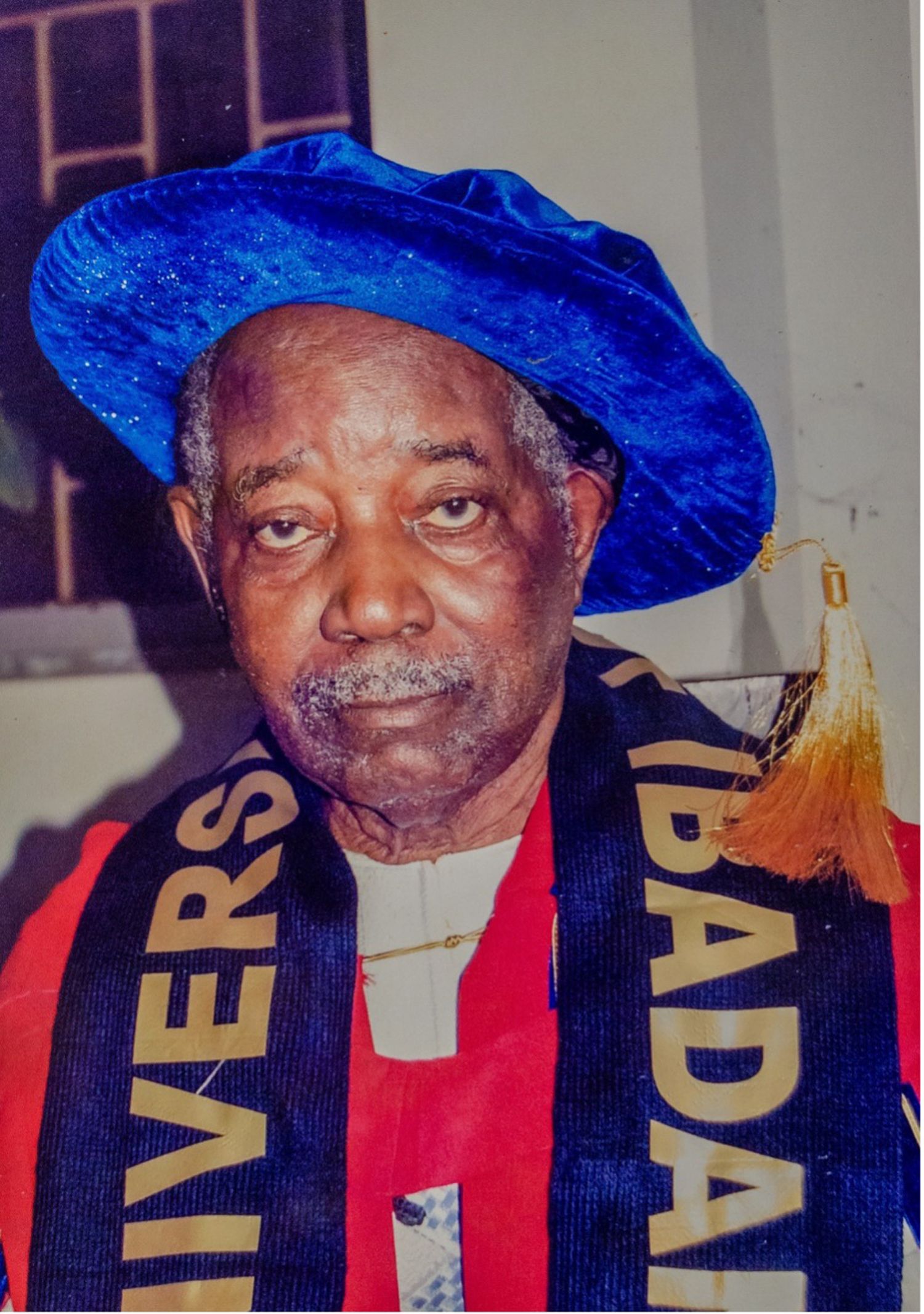
The story of the journey of Ade Ajayi as a student of African history demonstrates the role which the historian plays in the determination of the choice of area of study, the collection and collation of evidence and the interpretation of sources. Ade Ajayi proved that while the historian may emerge as ‘the king’ of his field of study, the king is subject to forces and considerations that influence the choices made as a historian. The story shows that in the tortuous journey as historian, which he began during his formative years and training, Ade Ajayi was compelled to submit to the teachers and policy makers of colonial Nigeria and the British Empire. He later chose to depend on global cooperation and collaboration for his research while taking the driver’s seat in advanced research and publishing. He remained passionately committed to the global approach as he built partnerships and cooperation with the wider world to further his interest in the development of African history (Figure 3).
Emeritus Professor J. F. Ade Ajayi at the award of his Honorary degree of D. Litt. at the University of Ibadan on 17 November 2012. Courtesy the Jadeas Trust Library and Archive.

Ade Ajayi chose the pursuit of African history at the time of decolonization during which doctoral theses were prepared on African history by young students at various universities in Europe. For Nigeria, it was the period when Kenneth Dike, Saburi Biobaku and others produced theses. These pioneers of African historiography were not insular. They appreciated the cooperation and collaboration with European teachers. The first Minister of Foreign Affairs in Nigeria, Jaja Wachuku, captured this point on the relationship between Africa and Europe in his contribution to the debate on the establishment of the Federation of Nigeria as an independent sovereign state at the House of Representatives on Saturday, 16 January 1960:
I try to see the dawn of independence of Nigeria as a student who has graduated through a university, gone through all his examinations and then a proud professor is quite prepared to present him on graduation day, and then when he has his cap and gown and his hood on his shoulders he looks back to him and says proudly ‘Yes, I was his tutor’. Such a student never forgets his tutor (Nigeria, House of Representatives Debates 1960: 152).
The pioneer historians depended much on the training received at the hands of their foreign teachers. Ade Ajayi was one of those who continued to appreciate the role played by the teachers and the value of his peers and associates across geographical, social and racial boundaries.
Ajayi decided to continue to work with those African, European, and American historians, such as Adu Boahen, Bethwell Ogot, Roland Oliver, Michael Crowder and James Coleman, who shared his vision of African history. His work with Crowder in particular has remained a substantial contribution to African historiography (Ajayi Reference Ajayi and Crowder1985). These were Africans and non-Africans who rejected the myth that Africa had no history or civilization and accepted the view that there was always something new out of Africa: ‘Ex Africa semper aliquid novi.’ His work at the Institute of Historical Research, University of London, and his supervision and contact with historians from different parts of the world may have persuaded him of the value of global cooperation and collaboration in the production of historical work. It seems clear, however, that the motive for his global approach was part of his desire to make African history respectable and to meet the international gold standard for scholarship. For him, the goal was to have a history of Africa that remained true to the international tenets of writing, the pursuit of truth, and adherence to historiographical rules and traditions. Incidental issues of race, geographical location, nationalities, gender, and race were secondary.
Acknowledgements
An earlier version of this paper was presented at the International Conference on ‘African history and historiography: illumining the pathway and understanding the challenges’, held in memory of Emeritus Professor J. F. Ade Ajayi at the University of Ibadan, Nigeria, in August 2019. I appreciate the kind invitation from the organizers of the Conference to make the presentation.
Emeritus Prof. J. F. Ade Ajayi suggested to me the unusual subject of Historiographical and Bibliographical Studies of Europe for my postgraduate work. He made sure that his experiment in making a European Historian of an African scholar did not face a Waterloo. I commend his meticulous attention and sensitivity to keeping records and his ability to discover the passion of Festus Bamgbelu, his secretary of many years, for record keeping and preservation. I am grateful to the librarians at the Jadeas Trust Library and Archive in Ojobadan, Bodija, Ibadan, the University of Ibadan and the British Library in London, for their kind assistance to me during my years of research.
It is imperative that I appreciate my History teachers and those who have helped to sustain my interest in historiographical studies: Remi Adeleye, G. A. Akinola, Paul Mbaeyi, Roland Oliver, J. D. Ojo, Douglas Johnson, Tunji Oloruntimehin, Tekena Tamuno, S. O. Awokoya, S. H. O. Tomori, J. A. Akinpelu, Kenneth Charlton, Roger Boshier, Tunde Adeniran, Ayo Bamgbose, Ayo Banjo, A. B. O. O. Oyediran and J. A. Kayode Makinde.
Michael Omolewa is Emeritus Professor of the History of Education and a member of the Council of the International African Institute.

 Open access

