




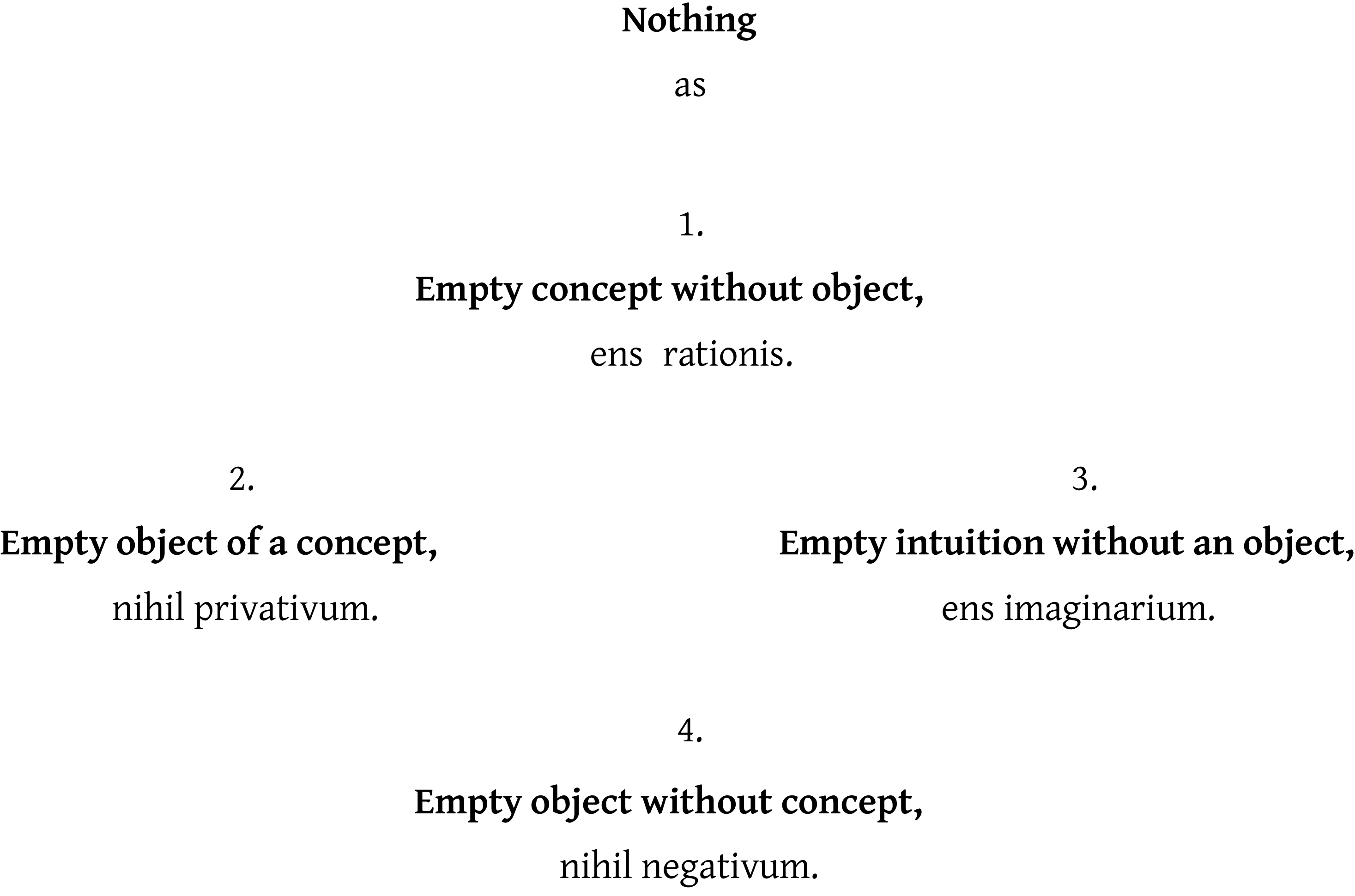
The ‘table of th[e] division of the concept of nothing’ (A291/B348)Footnote 1 is to be found at the very end of the Transcendental Analytic in the Critique of Pure Reason. According to Kant, the table is ‘… not in itself especially indispensable’ and may just ‘… seem requisite for the completion of the system’ (A290/B346). Hence, it is perhaps no wonder that the relevant passage (A290-2/B346-9) has attracted the interest of Kant research to a very small extent.Footnote 2 This is, however, regrettable. The Table of Nothing might indeed not be ‘especially indispensable’ for the purposes of the critique of pure reason and might only be important with respect to the future system of pure reason. It might even be the case that the Table of Nothing does not add anything original to Kant’s teachings in the Critique of Pure Reason that could not be inferred from the work’s other sections. Nevertheless, the table could shed some significant light on Kant’s teachings, since it gives grounds to examine some fundamental questions, such as the ontological status of noumena or of pure space and pure time (see sections 2 and 7 below). In any case, the Table of Nothing in itself poses some challenging questions of interpretation. Specifically, there is a manifest inconsistency in Kant’s presentation of the nihil negativum, i.e. the fourth type of nothing on the table, that needs to be resolved in one or the other way (see section 4 below).
The paper has the following structure. Sections 1 and 2 take a first look at the way Kant introduces and presents the Table of Nothing and pose the two questions the paper aims to answer: (1) on the relation of the table to rationalist metaphysics and (2) on the relation between the different sub-concepts of nothing on the table. Section 3 discusses the interpretation of Nicholas Stang, which reads off the table a hierarchy of the concepts of nothing, an order of logical precedence, and which serves as a counterfoil against which the interpretation proposed in the paper is developed. Section 4 argues, contra Stang and other scholars, that Kant’s nihil negativum cannot be identified with the logically impossible of the rationalist tradition. Section 5 argues further that the only relevant concept of possibility for the table is that of real possibility, the possibility of objects. Hence, section 6 presents an interpretation of the Table of Nothing, which relates the table closely to the tables of the categories and the principles of the pure understanding. Section 7 proceeds to answer question (2) in a way opposed to Stang’s hierarchy of nothings. Finally, section 8 proceeds to answer question (1) by ascertaining a radical break between Kant and his rationalist predecessors with regard to the question of nothing.
1. Transcendental philosophy and ontology
Kant introduces the Table of Nothing in opposition to the way ‘…with which one is accustomed to begin a transcendental philosophy’ (A290/B346). The usual starting point is namely ‘the division between the possible and the impossible’ (A290/B346). Kant obviously has in mind the rationalist school metaphysics in the style of Wolff or Baumgarten. In that tradition, the impossible coincides with the self-contradictory, and it is nothing. On the contrary, whatever contains no contradiction in its concept is possible or something (Etwas, aliquid) or a thing (Ding, ens) (see Wolff Reference Wolff and École1977: §§57, 59, 79, 85, 101–3; Reference Wolff and Corr2003: §§12, 16; Baumgarten Reference Baumgarten1757: §§7, 8, 61 (17: 24, 40)). But why does Kant use the term ‘transcendental philosophy’? Does he really apply the term to the philosophy of Wolff and Baumgarten, and why? In order to describe his own innovative transcendental philosophy, Kant sometimes holds on to the old term ‘ontology’ (cf. A845-6/B873-4; PM, 20: 260-61). Here, reversely, he refers to the ontology of his predecessors as ‘transcendental philosophy’. The use of the term makes sense insofar as that discipline also had to do with our general concepts a priori of objects (cf. A11-12). Apart from terminology, the crucial question would be:
-
(1) To what extent is there a substantial continuity or rather a break between the Critical Kant and his rationalist predecessors with regard to the question of possibility, i.e. with regard to the distinction between something and nothing?
The question will be addressed in the course of the paper. In any case, Kant states at this point that ‘[t]he highest concept’ (A290/B346) cannot be the division between the possible and the impossible, as in Wolff and Baumgarten. A still higher concept is missing. That generic term has to be ‘the concept of an object in general [Gegenstand überhaupt] (…leaving undecided whether it is something or nothing)’. The concept of an object in general has to be handled ‘…in accordance with the order and guidance of the categories’ (A290/B346). Then, with respect to the question of possibility, we get a different picture than the one given by rationalist metaphysics. We do not get the impossible as the self-contradictory, on the one hand, and a vast multitude of possible beings, the subject matter of ontology, on the other. We rather get a table of the division of the concept of nothing, which Kant presents (see Figure 1), and a corresponding table of the division of the concept of a possible something, which Kant leaves out (cf. A291/B348).
The Table of Nothing.
Source: Kant, Critique of Pure Reason, A292/B348.

2. The four types of nothing
Kant declares that the Table of Nothing is arranged according to the order of the categories. However, the four sub-concepts of nothing can be grouped together in different ways. First of all, it catches the eye that only two of those sub-concepts, namely nr. 2 and nr. 4, are designated on the table by the term ‘nothing’ (nihil). On the one hand, a concept that contains a contradiction cancels itself out, and its object is nothing, a nihil negativum (negative nothing, nr. 4) (see A291/B348). On the other hand, sub-concept nr. 2 is a concept of nothing as the lack of an object, a privation, a nihil privativum (privative nothing). Kant seems to think of privation not as pure absence, but in a dynamical fashion.Footnote 3 His examples are the ‘shadow’ and the ‘cold’ (A291/B347), which are always relative. A rock, e.g., more or less cancels the sunlight out, or, more precisely, it cancels out the effect of the sunlight on the area on which it throws its shadow.Footnote 4 These two sub-concepts refer to empty objects. Either the concept is so composed that the object is impossible, ‘[e]mpty object without concept’ (nr. 4), or it is the concept of a privation, of a cancelation in an interplay of forces, ‘[e]mpty object of a concept’ (nr. 2) (A292/B348).
On the contrary, in the other two cases (nr. 1 and nr. 3), the object is in no way cancelled out or annulled. Instead, something is missing. That is, a further condition of the possibility of the object is yet missing. That condition is either the reference to intuition (Anschauung) in general (nr. 1) or the reference to a possible existence (Dasein) in sensation (Empfindung) (nr. 3). Hence, the sub-concept nr. 1 is described as ‘[e]mpty concept without object’; the sub-concept nr. 3 as ‘[e]mpty intuition without an object’ (A292/B348). We have either an empty form of thought or an empty form of intuition; in either case, the object is missing.
These two sub-concepts of nothing (nr. 1 and nr. 3) seem to be, in some sense, concepts of something, of an ens (ens rationis, i.e. being of reason; ens imaginarium, i.e. imaginary being). Moreover, as is well known, both the forms of intuition, ‘pure space and pure time’ (A291/B347), which are entia imaginaria, and noumena, which are entia rationis (cf. A290/B347), have an indispensable, necessary function according to Kant. They are necessary in the course of grounding our possible cognition and in the course of drawing its limits. Nevertheless, both the forms of intuition and the noumena appear on the table as instances of nothing. Hence, the following question suggests itself with regard to the Table of Nothing:
-
(2) Are those entities (entia rationis, entia imaginaria) actually non-entities? Or are they to some extent possible entities and, hence, instances of nothing only to a lesser extent in comparison with the other two types of nothing listed on the table (nihil privativum, nihil negativum)?
So far, I have combined the four sub-concepts of nothing in two groups: nr. 2 with nr. 4 and nr. 1 with nr. 3. However, Kant himself points at a different grouping, namely nr. 1 with nr. 4 and nr. 2 with nr. 3. On the one hand, the nihil privativum and the ens imaginarium (nr. 2 and nr. 3) are ‘empty data for concepts’ (A292/B349). The matter of intuition, sensation, is either missing entirely (in the case of nr. 3, of the form of intuition as ens imaginarium) or is of degree zero (in the case of nr. 2, of the nihil privativum). On the other hand, the ens rationis and the nihil negativum (nr. 1 and nr. 4) are ‘empty concepts’ (A292/B349). The concept is free of contradiction, yet merely invented in the case of nr. 1; the concept cancels itself out and the object is impossible in the case of nr. 4. That last case seems to correspond to the understanding of nothing, of the impossible, in the rationalist tradition: impossible is that which contradicts itself. On the whole, these two cases, the ‘empty concepts’, seem to have in common that one does not even get to intuition: already the concept indicates that no reference to an object is possible.Footnote 5
3. Stang’s reading: a hierarchy of nothings
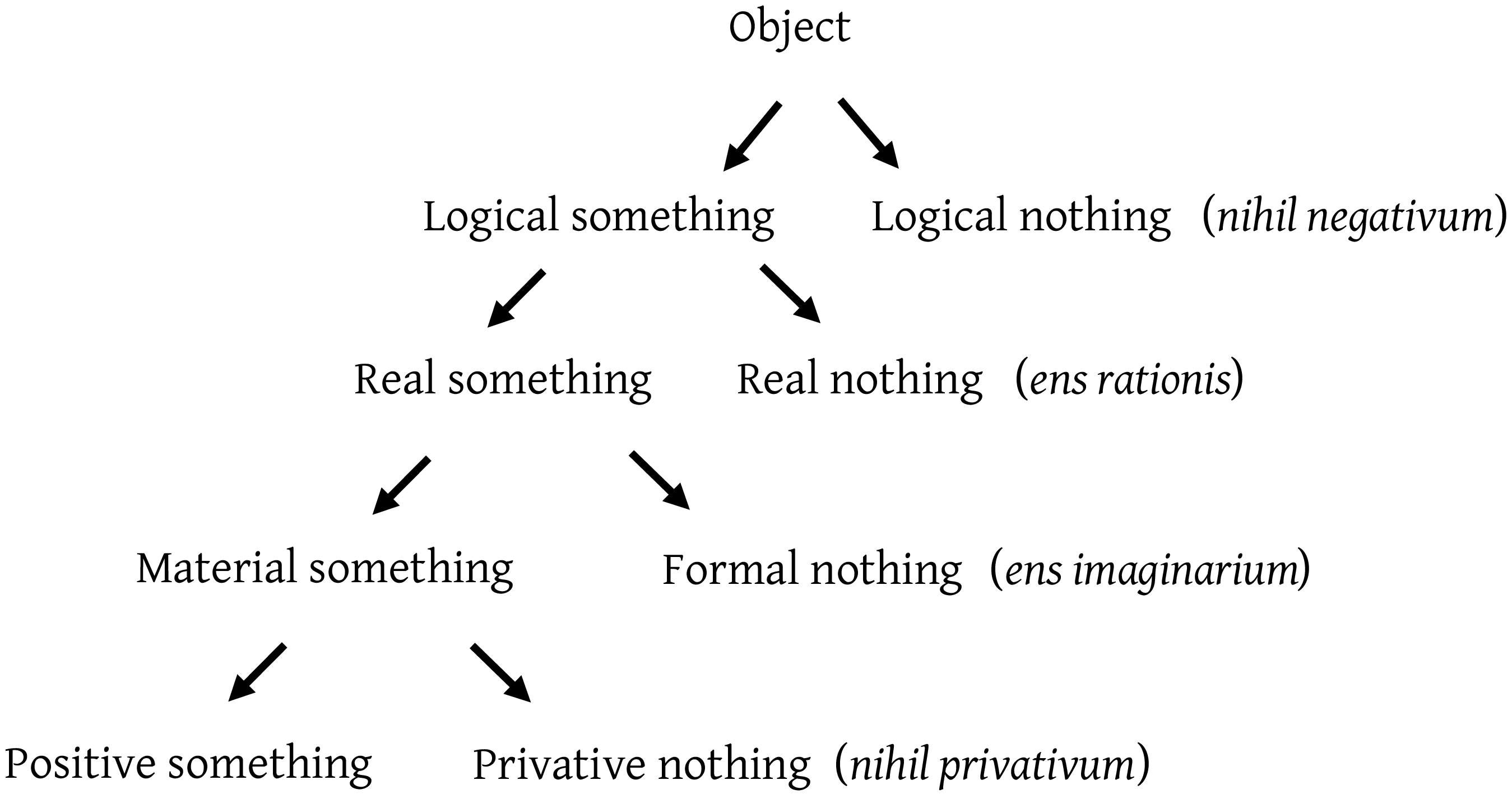
Nicholas Stang’s important book Kant’s Modal Metaphysics is one of the few exceptions in the literature on Kant that discuss the Table of Nothing (see Stang Reference Stang2016: 166–71).Footnote 6 Kant’s distinction between ‘empty concepts’ – which apparently are divorced from intuition – and ‘empty data for concepts’ seems to prompt Stang to endorse the view that the order of the categories is not essential and that a different principle of organization can apply to the table. Stang places the ‘empty concepts’ ahead of the ‘empty data for concepts’. Specifically, he proposes the following order: 1. nihil negativum, 2. ens rationis, 3. ens imaginarium, 4. nihil privativum. That order is actually a sequence of distinctions or oppositions (see Figure 2): 1. The logical nothing (nihil negativum) is opposed to the logical something. A logical nothing is self-contradictory, i.e. logically impossible. A logical something is anything that is not self-contradictory, i.e. logically possible. 2. The real nothing (ens rationis) is opposed to the real something. A real something is not just logically possible, but also has a reference to intuition, unlike a real nothing. 3. The formal nothing (ens imaginarium) is opposed to the material something. A material something has a reference to some matter of sensation and not just to the form of intuition, unlike a formal nothing. 4. Finally, the privative nothing (nihil privativum) is opposed to the positive something. In the former case, sensation has a degree equal to zero, unlike in the latter case.
The Table of Nothing (organized by logical precedence).
Source: Nicholas F. Stang, Kant’s Modal Metaphysics, Oxford UP 2016, 168.

Hence, the table is transformed into a scale of ‘logical precedence’ (Stang Reference Stang2016: 168), a scale of prior and subsequent distinctions: ‘the different distinctions between possible and impossible objects are logically subordinate to one another’ (167). As a consequence, we get a hierarchical tree of concepts of possible objects. The concept of a logical something is the minimal and, hence, maximally general concept of a possible object. In the concept of a real something, a further requirement of possibility, the reference to intuition, has been added to the minimal requirement that is the absence of contradiction. At the end, the concept of a positive something has maximal intension: that concept denotes an entirely possible object, an object possible in all respects.
Correspondingly, we get a scale of different degrees or grades or shades of nothingness. The nihil negativum is absolutely nothing; the ens rationis, as a logical something, is already something more than nothing, at least the shadow of a thing; the ens imaginarium is already a real something, but not yet a material something; the nihil privativum is a material something, but not yet a positive something. Down the scale, successively, more and more content is added on. From black we get to grey, then to light grey, and finally to off-white. At the end, a last little step is needed in order to arrive at the full white of a positive something.
Stang’s reading is prima facie plausible. Moreover, it also provides an answer to our question (2) above. We get in fact a hierarchy of the concepts of nothing, a hierarchical order from nothing at all to almost something. Nevertheless, on that reading, contrary to our initial presumption, the nihil privativum would be nothing to a lesser degree than the ens rationis and the ens imaginarium; it would indeed stand a bit closer to being.
However, if Stang’s organization of the Table of Nothing should be accepted, then Kant’s deviation from rationalist metaphysics at that point would not be quite a break with that tradition (cf. our question (1) above). The highest division would still be the one between the possible and the impossible in the sense of the self-contradictory, i.e. the distinction between the logical something and the logical nothing. It would just be the case that further sub-divisions would be subordinated under that highest division; subsequent differentiations of the concept of possibility would be introduced and subordinated under the highest concept of logical possibility. Certainly, that picture does not fit well with the way Kant announces the Table of Nothing. His declaration that the highest concept in a transcendental philosophy cannot be the division between the possible and the impossible would amount, on Stang’s reading, to the demand that one should just find a name – ‘object in general’ – for the concept that is thus divided.
This is not just a technical issue about the arrangement of a table of concepts. It can have substantial implications. For instance, we may ask: Does Kant indeed think both phenomena and noumena under a concept of possibility in general, under the concept of a possible something, be it a logical something? On Stang’s account, a logical something is a minimally possible object. The concept of a logical something is the maximally general concept in the tree of concepts of possible objects; it includes noumena as well as any other thinkable entia rationis.
Stang is in fact a scholar who ascribes to Kant rather strong positions with respect to noumena or to things in themselves.Footnote 7 His reorganization of the Table of Nothing can be considered to underpin such an interpretation, a metaphysical interpretation of Kant, as one might want to term it. Yet, is such a reading of the table truly compelling? Or may we take Kant’s claim seriously that ‘the distinction of whether an object is something or nothing must proceed in accordance with the order and guidance of the categories’ (A290/B346)?
4. Against Stang’s reading: the logical and the geometrical nothing
The metaphysical distinction between something and nothing in the rationalist tradition was actually a logical distinction: the distinction between the logically possible and the logically impossible. The position of Wolff and Baumgarten on the question of possibility is duly termed by Stang (Reference Stang2016: 13) as ‘logicism’. Now, we may ask: Does sub-concept nr. 4 on Kant’s table really coincide with the logically impossible of that rationalist distinction? Does the nihil negativum have to be identified with the logical nothing?
Kant does in fact describe the nihil negativum as ‘[t]he object of a concept that contradicts itself’ (A291/B348). In that case, the concept is so composed that even the thought of an object fails.Footnote 8 However, the example Kant mentions is ‘the rectilinear figure of two sides’ (A291/B348), which, according to his teaching, entails no contradiction. For Kant, such a figure is impossible not on logical, but on geometrical grounds: the figure can be thought, but it cannot be constructed in the pure intuition of space.Footnote 9
Kant brings up the very same example, ‘the concept of a figure that is enclosed between two straight lines’ (A220/B268), just a few pages before the Table of Nothing, in the chapter on the Postulates of Empirical Thinking. At that point, the figure serves precisely as the example of an object which is impossible although ‘no contradiction’ (A220/B268) is involved; ‘the impossibility rests not on the concept in itself but on its construction in space’ (A221/B268). Kant needs that example in order to argue that the absence of contradiction in a concept ‘is, to be sure, a necessary logical condition’, yet ‘far from sufficient for the objective reality of the concept, i.e. for the possibility of such an object as is thought through the concept’ (A220/B268).
What should we make of the obvious inconsistency in Kant’s account of the nihil negativum, i.e. with the obvious discrepancy between the description and the example meant to illustrate that description? I think, it would not be very convincing to simply disregard Kant’s example: to claim that Kant was just a little bit careless in choosing that particular example, or that, out of inertia, he just took over Wolff’s example despite its dependence on the latter’s logicism.Footnote 10 That would not be very convincing since Kant uses the exact same example just a few pages earlier, precisely in order to make the point that the impossibility of an object need not rest on the presence of a contradiction in its concept, i.e. on the logical impossibility of that concept. Moreover, even if we chose to ignore Kant’s example, the difficulty would not disappear. The difficulty lies rather in the matter. Namely: Where else on the table, if not under nr. 4, could such a figure, ‘a rectilinear figure of two sides’, be accommodated? Where on the Table of Nothing does the geometrical nothing belong?
Obviously, (a) the geometrical nothing does not have anything to do with the nihil privativum (nr. 2), i.e. with an object such as a ‘shadow’, which is perfectly possible, but actually the absence of an object. (b) To be sure, neither can the geometrical nothing be a case of an ens imaginarium (nr. 3). That type of nothing designates ‘[t]he mere form of intuition, without substance’, hence ‘the merely formal condition of … [an object] (as appearance)’ (A291/B347). Besides pure space, geometrical figures certainly also belong here. That is, proper geometrical figures in pure space, such as a triangle. Any geometrical object is, according to Kant, ‘only the form of an object’ and is – apart from conforming appearances – ‘only a product of the imagination’ (A223/B271): an ens imaginarium. Now, a digon or biangle, i.e. a ‘rectilinear figure of two sides’, can definitely not be a case of nothing in just the same sense as a geometrical triangle is. The latter satisfies the formal condition for being a determination of a possible object in space; the former violates precisely that condition, i.e. constructibility in the pure intuition of space.
Then, (c) is the geometrical nothing perhaps an ens rationis, a ‘thought-entity’ (Gedankending) (A292/B348) (nr. 1)? One could contend that to be the case. One could even point out that a biangle can be a possible figure in a non-Euclidean geometry. For Kant, nevertheless, the biangle is indeed impossible, since it cannot be constructed on a Euclidean plane. Furthermore, the difference between the thought-entity (Gedankending) (nr. 1) and the ‘non-entity’ (Unding) (nr. 4) is precisely the fact that the former is not impossible, that it is not ‘opposed to possibility’ (der Möglichkeit entgegengesetzt, A292/B348). The thought-entity is in fact not possible, it ‘may not be counted among the possibilities’ (A292/B348), yet only because no intuition can be given that corresponds to the concept (cf. A290/B347). Either no such intuition can be given in principle, in the case of noumena, or there is just a total lack of empirical evidence, in the other example cited by Kant, the example of ‘certain new fundamental forces’ (gewisse neue Grundkräfte) in physics or powers in psychology (A290/B347).Footnote 11 On the contrary, the biangle is impossible because its construction in intuition fails. That is, the concept of a biangle is so composed that the construction is bound to fail. The concept of a biangle is opposed to the principles of such a construction. By contrast with the idea of noumenal freedom or the concept of some fundamental cohesive force of matter, the concept of a biangle is indeed ‘opposed to possibility’ (A292/B348).
Consequently, I think, the most consistent reading of Kant’s Table of Nothing in a systematic regard, the reading that coheres with Kant’s overall teaching, is the following. We should not assume that Kant’s example for the nihil negativum − the ‘rectilinear figure of two sides’ − is wrong, and actually belongs to some other sub-division of nothing, but rather conclude that Kant’s explanation, which refers to contradiction, is too narrow.Footnote 12 The non-entity (Unding), the nihil negativum irrepraesentabile (NM, 2: 171; cf. Baumgarten Reference Baumgarten1757: §7 (17: 24)), the type of nothing that designates what is impossible or ‘opposed to possibility’, cannot be restricted to the logical nothing; it must definitely comprise also the geometrical nothing, i.e. the figure that is not constructible.Footnote 13
I would suggest that a further case also belongs under nr. 4 on the Table of Nothing. That is the case of something which is impossible because it is opposed to the ‘formal conditions of experience’ (A218/B265). A ghostly figure (spectre, Gespenst), e.g., that would allegedly be suddenly perceived, yet as a perception would certainly not stand in a necessary connection to other perceptions, would, for Kant, be nothing and not something.Footnote 14 But in which sense would that be nothing? I think such a ghostly figure should be counted among the impossible objects, among the non-entities (Undinge), under nr. 4. Where else on the Table of Nothing could such a type of nothing, the empirical nothing, be accommodated? One could perhaps contend that it should be viewed as an ens imaginarium, as an ‘empty intuition without an object’ (nr. 3). However, such an allegedly perceived object would be an instance of nothing precisely because it would violate the constitutive rules of experience, specifically the analogies of experience (cf. A188/B231). The perception of a ghost violates the rules that permit a perception to be related to an object. On the other hand, the mere form of intuition cannot be taken as an object (ens imaginarium), since it is always only perceived as the form of some certain matter; the rules for the connection of perceptions do not even apply to it. According to Kant’s theory of experience, a ghostly figure that suddenly appears out of the blue is not a possible object of experience because it is indeed ‘opposed to possibility’. The problem with such a figure is not that it might lack flesh and blood and have merely the shape of a real corporeal object.
Kant’s description of the nihil negativum as an ‘empty object without concept’ certainly fits best with the logical nothing: a contradiction cancels out the concept, it renders the concept impossible. However, also in the cases of the geometrical nothing, e.g. the biangle, and the empirical nothing, e.g. the ghostly figure, it is true that the determinations of the concept render the object impossible. By contrast with the case of the nihil privativum, the ‘empty object of a (perfectly possible) concept’, in all these cases, the determinations of the concept are ‘opposed to possibility’: the concept is so composed that the object thought in it is a non-entity (Unding). In the case of the logical nothing, nothing is even thought in the impossible, contradictory concept. In the case of the geometrical nothing, something is thought in the concept, but it is impossible to represent it in intuition. In the case of the empirical nothing, something is thought and allegedly perceived, but it is an impossible object of experience.
5. Logical and real possibility
The outcome of the foregoing discussion is that sub-concept nr. 4 on Kant’s table should not be identified with the impossible of the rationalist tradition, i.e. with the logical nothing. Thus, Stang’s ‘logical’ organization of the Table of Nothing has to be rejected. We cannot accept that the highest division of the concept of an object in general is the division between the logical something and the logical nothing. Hence, neither can we accept that the table results in a hierarchy of nothings and a corresponding hierarchy of possible objects, with logical possibility being the highest concept, the maximum genus, on that scale.
Kant does, in fact, distinguish between logical possibility and real possibility. However, he is always careful to oppose the ‘logical possibility of the concept’ to the ‘real’ or ‘transcendental possibility of things’ (A244/B302; cf. A596/B624, A610/B638).Footnote 15 The absence of contradiction in a concept entails that the concept as such is possible, but it does not entail that it is the concept of a possible object.
According to Kant’s understanding of pure general logic, or formal logic, that discipline abstains from any reference to objects: ‘General logic abstracts … from all content of cognition, i.e. from any relation of it to the object, and considers only the logical form in the relation of cognitions to one another’ (A53/B79). Formal logic only has to do with the logical relations that obtain between concepts and between judgements. The possible relation of concepts to objects − the possible instantiation of concepts − is the subject matter of another pure discipline, namely transcendental logic. The conception of logic as a purely formal discipline − in traditional terms, the separation of logic from ontology − is fundamental for Kant’s Critical position.Footnote 16
How should we then understand the relation between the logical demand for non-contradiction, on the one hand, and the possibility of objects, on the other? That a concept does not contradict itself is, to be sure, a necessary condition for its possible instantiation, i.e. for the possibility of the object. A contradiction cancels the concept and annuls any possible reference to an object. However, that necessary condition should not be understood as also a sufficient condition for the possibility of objects, not even for some class of halfway possible objects or shadow-like objects. In other words, the logical possibility of a concept is indeed a precondition for a corresponding object to be itself possible, but logical possibility is not one kind – the maximum genus – of the possibility of objects.Footnote 17
One could ask: Does formal logic not have, according to Kant, a broader domain of validity than the material principles of pure understanding, which are ‘immanent’ (A296/B353) to the realm of phenomena? Is logic, specifically the law of non-contradiction, not also valid in the realm of noumena? The logical law of non-contradiction is indeed, for Kant, universally valid, yet precisely because it holds of concepts and judgements ‘without regard to their content’ (A151/B190), i.e. without any regard to their reference to objects.Footnote 18 Hence, the validity of the law is not restricted to the realm of phenomena, yet only because that validity is not restrained by the condition of any (possible or actual) reference to an object. The law is universally valid, but only as a negative demand of any concept or idea of reason, and says nothing about the possibility of an object being given that corresponds to that concept or idea.
For Kant, ‘the problematic thought, which leaves a place open for [noumena], only serves, like an empty space, to limit’ the domain of phenomena and of possible cognition (A259/B315). Theoretical reason cannot determine anything with respect to the possibility of noumena; it can only profess that they are not impossible. That is, it can only assert that, in so far as a concept is not self-contradictory, a corresponding object is not for that reason impossible. In his 1792–1793 lectures on metaphysics, Kant attributes to rationalist metaphysics the mistake of reversing the correct inference ‘what contradicts itself, is impossible’ into the inference ‘what does not contradict itself, is possible’. The result, according to Kant, is that every chimera is upgraded into a possible object (see Met-Dohna, 28: 623).
Kant’s strict distinction between the logical possibility of the concept and the real possibility of a corresponding object can help clarify the division of the concepts ‘object in general’, ‘something’, and ‘nothing’. The highest concept preceding the tables of nothing and something is ‘the concept of an object in general (taken problematically, leaving undecided whether it is something or nothing)’ (A290/B246). An object in that sense, i.e. ‘taken problematically’, is, of course, whatever is thought in a concept: the intentional object of the concept, as one might be inclined to term it. Yet, to decide whether the object is something or nothing means to decide whether it is a possible object or not: whether an object can be possibly given that corresponds to the concept. Hence, the relevant concept of possibility for the tables is that of real possibility, the possibility of objects. Logical possibility as a criterium for division − in fact, for the highest division − is out of place at that point.Footnote 19 Thus, it makes perfect sense that the arrangement of the tables of nothing and something ‘must proceed in accordance with the order and guidance of the categories’ (A290/B246) and the synthetic principles of the pure understanding. These are namely the conditions under which an object in general can be given: the conditions of possibility of the objects of experience. The categories ‘are concepts of an object in general’ (A95/B128); the principles of the pure understanding are the rules that make comprehensible ‘the possibility of things in accordance with the categories’ (B291).
6. The Table of Nothing and the order of the categories
How should, then, the Table of Nothing − and the corresponding table of a possible something − be read, in accordance with the order of the categories and principles of the understanding? I propose the following reading that takes Kant’s declaration seriously and matches nr.1 on Kant’s Table of Nothing with the categories of quantity and axioms of intuition, nr. 2 with the categories of quality and anticipations of perception, nr. 3 with the categories of relation and analogies of experience and, finally, nr. 4 with the categories of modality and postulates of empirical thinking.Footnote 20
Ad nr. 1: Something, as an intuition in space or time, is an extensive magnitude; a thought-entity (Gedankending, ens rationis), on the contrary, cannot be given in any intuition (cf. B202-3). Ad nr. 2: Something, as an object of perception, has a degree of influence on the senses; that degree begins from the absence of sensation, from nothing = 0, which absence corresponds to the category of negation (cf. B207-10). Ad nr. 3: In order for perception to be indeed related to an object, perceptions must stand in a thoroughgoing necessary connection. The object is then determined as a substance that stands in causal interaction with other substances; only thereby can objective relations be determined in time (persistence, succession, and simultaneity) (cf. B218-19, 224-5, 232-4, 256-8). In empty time, no objective relations prevail. ‘The mere [bloße; i.e. naked, empty] form of intuition, without substance’ (A291/B347) represented as an object, is but a phantasma, an ens imaginarium. Ad nr. 4: The categories of modality and the corresponding postulates have the peculiarity that they do not add any further determination to the object (cf. A219/B266). Thus, the object is determined as a possible something in so far as its determinations comply with the conditions of possibility laid out under the previous three headings (cf. A218/B265). On the other hand, the object is judged to be nothing in so far as it is impossible, i.e. in so far as it collides with those conditions of possibility, in so far as it is ‘opposed to possibility’ (A292/B348).
The fourth and last type of nothing on Kant’s table stands out from the other three types, precisely because it signifies that which is impossible, which runs counter to the conditions of possibility. In accordance with the line of thought developed in section 4 above, an object is nothing and not something, in the sense of sub-concept nr. 4, thus a non-entity (Unding), either (a) because its determinations contradict one another, hence it is the object of a logically impossible concept, or (b) because its determinations are opposed to the conditions of intuition, like the ‘rectilinear figure of two sides’ (cf. section 4 above), or (c) because its determinations are opposed to the conditions of the real in perception, i.e. the gradual increase and decrease of influence on the senses, or (d) because its determinations are opposed to the conditions of the unity of experience, like the ghost that appears suddenly out of nowhere (cf. section 4 above).
By contrast, the first three types of nothing on Kant’s table do not denote that which is impossible. They either denote that some component of possibility is entirely missing (nr. 1 and nr. 3; cf. section 2 above) or denote the absence of something, which is perfectly possible (nr. 2). Thus, it is fair to conclude that the fourth case of nothing is indeed nothing at all, a sheer non-entity, whereas each of the first three sub-concepts of nothing on the table refers to some instance that is not a truly possible object, but nevertheless is not quite nothing: e.g. the noumenal object of a necessary idea of reason (nr. 1), a shadow (nr. 2), or pure space (nr. 3).
Yet, apart from that distinction, the Table of Nothing does not appear to establish a hierarchical order of the concepts of nothing, a scale from sheer non-being to almost being. If we do not accept Stang’s reading and, hence, do not impose on the table an order of ‘logical precedence’, then that scale can no longer be derived from the division of the concept of nothing. Accordingly, the table of the division of the concept of a possible something would not result in a hierarchical order of possible and of less possible objects. Instead, we would get a cartography of the concept of possibility, i.e. a systematic mapping of the different, yet complementary, conditions of possibility, in accordance with the system of the categories and the transcendental principles of pure understanding. The corresponding Table of Nothing offers a mapping of the different, yet systematically interconnected, meanings of the concept of nothing.
7. Thought-entities and imaginary entities
We proceed now to answer our question (2) above, on the ontological status of entia rationis, specifically of noumena, and entia imaginaria. On Stang’s account, an ens imaginarium is nonetheless a ‘real something’; an ens rationis is at least a ‘logical something’. What can be said about these two sub-concepts of nothing on our account, which does not accept a hierarchy of nothings?
The nihil negativum (nr. 4) is clearly a non-entity, an impossible object, utter nothingness. The nihil privativum (nr. 2) is also clearly a case of nothing, although not a non-entity, not an impossible object, but the absence of an object, which is a perfectly possible state of affairs. In any case, the nihil negativum and the nihil privativum appear on the table as ‘empty objects’. As was explained above (see section 2), in both cases, the object is cancelled out or annulled: Either the object is rendered impossible, hence simply nothing (nihil negativum), or the effect of some cause is cancelled out by some opposite cause and the result is nothing in the sense of a privation, e.g. a shadow or rest as a zero point of movement (nihil privativum).
By contrast, the ens rationis (nr. 1) and the ens imaginarium (nr. 3) do not refer to ‘empty objects’; in each of these cases, the object of the concept is not annulled. Yet, the object of the concept is nevertheless absent. Sub-concept nr. 1 is an ‘empty concept without object’; sub-concept nr. 3 an ‘empty intuition without an object’. In the first case, something is thought in the concept; in the second case, something is intuited. Yet, in both cases, that something is actually – metaphysically or ontologically – nothing.
Ad nr. 3: ‘[P]ure space and pure time’ (A291/B347), the pure forms of intuition, are certainly the grounds of the objects of possible experience (cf. A23-4/B38-9; A30-31/B46), but apart from the objects they ground, apart from appearances that are intuited as outside one another and as succeeding one another, apart from the matter of sensation, pure space and pure time are indeed nothing.Footnote 21 To be sure, space and time are not just the forms of intuition, but are themselves originally given as a priori intuitions (cf. A 24-5/B39-40; A31-2/B47-8; B160-61).Footnote 22 Yet, in the passage on the Table of Nothing, Kant makes clear once more that ‘pure space and pure time … are not in themselves objects that are intuited’ (A291/B347). ‘Space is represented as an infinite given magnitude’ (A25/B39); equally, the representation of time is originally ‘given as unlimited’ (A32/B48). Yet, no infinite objects are thereby intuited. ‘Space, represented as object (as is really required in geometry), contains more than the mere form of intuition’ (B160 n.), namely it contains a pure synthesis, but it is in so far, as a pure representation, not unlike the geometrical figures drawn in space (cf. B154-5), only a product of the power of imagination.Footnote 23
Ad nr. 1: The ‘problematic thought’ (A259/B315) of noumena is, for Kant, certainly indispensable for the limitation of the sphere of phenomena, i.e. the objects of our possible cognition. Yet, noumena have their place on the Table of Nothing. In the concept of a noumenon, an object is certainly thought, but only ‘problematically, leaving undecided whether it is something or nothing’ (A290/B346). When one advances from the concept of an object in general to the actual tables of something and nothing, then it is decided that a noumenal object is in fact nothing and not something, i.e. nothing for us, a mere thought-entity (Gedankending, ens rationis). In so far as no intuition can be given that corresponds to a concept, nothing can be determined as to the possibility of the object thought in that concept. The concept is, thus, empty. An object is thought in the concept only problematically, even if such concepts as the transcendental ideas of pure reason make up ‘necessary problems’ of reason (Refl. 5553, 18: 224).Footnote 24
Thus, thought-entities (entia rationis) and imaginary entities (entia imaginaria) are neither possible entities nor to some extent possible entities. They are but instances of nothing. A truly possible object is, for Kant, only an object of possible experience, one that conforms to the system of conditions that is the system of principles of the pure understanding. In what sense are cases nr. 1 and nr. 3 on the Table of Nothing entia, unlike nr. 2 (nihil privativum) and nr. 4 (nihil negativum)? Only in the sense that they are objects of reason (entia rationis) or objects of imagination (entia imaginaria). Reason can and ultimately has to think of noumenal objects in its transcendental ideas; the power of imagination has to represent pure space as an object as well as represent geometrical objects in pure space.Footnote 25
8. Kant’s break with rationalist metaphysics
We are now also in a position to answer our question (1) above: Kant’s deviation from rationalist metaphysics − or from the older ‘transcendental philosophy’ (cf. A290/B346; see section 1 above) − with regard to the question of nothing, was nothing less than a radical break. In the previous sections, we have examined that break with reference to sub-concepts nr. 1 (ens rationis) and nr. 4 (nihil negativum) on Kant’s table: Kant does not divide ‘objects in general’ into logically possible and logically impossible objects, into logical somethings and logical nothings, in so far following the rationalist tradition, only to deviate from that tradition in introducing further sub-divisions of the concept of a possible something.Footnote 26 Kant’s transcendental philosophy does not have to do directly with objects (cf. B25), hence with possible, halfway possible and impossible objects. It rather has to do with the a priori conditions under which our thought can relate to objects.Footnote 27 Thus, the table of the division of the concept of nothing follows the order of the system of such conditions, i.e. the order of the categories and transcendental principles. The same goes for the corresponding table of the division of the concept of a possible something, which Kant leaves out since it ‘follows of itself’ (A291/B348). On the reading spelt out above (see section 6), the fourfold division of the concept of something does indeed follow directly from the system of principles of the pure understanding.
In this last section, I will attempt to explicate Kant’s break with the way of thinking typical of rationalist metaphysics, also with reference to sub-concepts nr. 2 (nihil privativum) and nr. 3 (ens imaginarium) on the Table of Nothing. I will resort to a beautiful Reflexion of the late 1770’s. Kant becomes almost lyrical in that note:
If I represent the intellect that thinks reality, as light, and when it negates [aufhebt] reality, as darkness, then complete determination can be thought either as the introduction of light every now and again into darkness [als ein hinein tragen des Lichts hin und wieder in die Finsternis], or darkness can be thought as a mere limitation of universal light [als bloße Einschrankung des allgemeinen Lichts], so that things are distinguished only by shadows, and reality is the ground, in fact only a single universal reality [die realitaet liegt zum Grunde und zwar nur eine eintzige allgemeine]. In the opposite case, all things are distinguished only by their light, as if they were originally elevated out of darkness [als ob sie ursprünglich aus der Finsternis gehoben wären]. Now I can indeed think a negation when I have a reality, but not when no reality is given. Reality is therefore logically first, and from this, one concludes that it is also metaphysically and objectively first. But because the objects of the senses are not given by the understanding (and are not given a priori at all), negation, and the darkness from which the light of experience draws up its figures, are what is first [so ist hier die negation das erste und die Finsternis, aus der das Licht der Erfahrung Gestalten ausarbeitet]. (Refl 5270, 18: 139)Footnote 28
If a real determination is represented as ‘light’, and the negation of such a determination is represented as ‘darkness’, then ‘complete determination’ can be thought of in two different manners. Either one conceives determination ‘as an introduction of light every now and again into darkness’ – according to the new, Critical way of thinking – or one thinks of ‘darkness … as a mere limitation of universal light’ – according to the way of thinking typical for rationalist metaphysics. In this tradition, all reality, i.e. the set of all possible determinations of things, was represented as contained in a given ground, in an ens realissimum. Hence, the complete determination of each and every thing comes about via negations: every particular thing is deprived of some of those realities, of some of the determinations of the ground. ‘[T]hings are distinguished only by shadows, and reality is the ground’. In other words, the reality of any finite thing is but a shadow, and the infinite reality of the ground is universal light.
What led people to think of determination in that manner? The reason is that in thought, among concepts, negation cannot be represented unless some real determinations have been posited first. Negation presupposes some real determinations to be negated. ‘Reality is … logically first’, hence the rationalist thinkers concluded ‘that it is also metaphysically and objectively first’. They concluded that reality has not only logical but also ontological priority over negation.
However, in our cognition, we do not have to do with objects of pure thought, but with the products of a synthesis of empirical perceptions. The ground of such a synthesis is not ‘universal light’, but ‘darkness’. The ground is namely the a priori form of intuition, pure space and pure time, i.e. the third case of nothing on the table, as well as the degree zero of sensation as the starting point for the empirical synthesis, i.e. the second case of nothing on the table. ‘[N]egation, and the darkness from which the light of experience draws up its figures, are what is first.’ In other words, the ground is darkness – it is nothing apart from what it grounds; infinite space and unlimited time are in themselves nothing – and the finite reality of empirical things is light.
Thus, ‘logically’, i.e. in the process of determination through concepts, something, i.e. some real determination, always goes first. Yet, ‘metaphysically and objectively’, i.e. in the synthesis of objects, nothing goes first, being the underlying ground. ‘[A]ll things are distinguished only by their light, as if they were originally elevated out of darkness.’Footnote 29

 Open access

