

Introduction
The diversity of social practices involving the manipulation and deposition of human remains is one of the main features of the Late Neolithic and Chalcolithic societies of southern Iberia. Alongside traditional burials in megalithic tombs and hypogea, in the last few decades archaeologists have begun to describe the frequent appearance of human bones in features such as pits and ditches, a novel form of mortuary treatment that reveals a previously underappreciated ritual complexity (Zafra de la Torre et al., Reference Zafra de la Torre, Castro López and Hornos Mata2003, Reference Zafra de la Torre, Castro López, Hornos Mata, Gonçalves and Sous2010; Blasco et al., Reference Blasco Bosqued, Liesau and Ríos Mendoza2011; Márquez-Romero & Jiménez-Jáimez, Reference Márquez-Romero and Jiménez-Jáimez2013; García Sanjuán et al., Reference García Sanjuán, Díaz-Zorita Bonilla, García Sanjuán, Vargas Jiménez, Hurtado Pérez, Ruiz Moreno and Cruz Auñón2013, Reference García Sanjuán, Vargas Jiménez, Cáceres Puro, Costa Caramé, Díaz-Guardamino Uribe and Díaz-Zorita Bonilla2018; Valera et al., Reference Valera, Silva, Cunha, Evangelista and Valera2014; Valera, Reference Valera2019). One of the most remarkable patterns identified has been the discovery of human remains that do not fit the ‘traditional’ funerary practices for the period, which consist of the primary burial of individuals, usually accompanied by grave goods, in structures specially built for mortuary purposes.
Many pits and ditches housing human bones were apparently not conceived of as funerary spaces, at least in the classical meaning of the term. Though not all these features contain human remains, when human remains do appear in these contexts, they are typically fragmented, scattered, and mixed with other kinds of materials such as pottery sherds, animal bones, flint tools, stone artefacts, and so on. These human bones appear to have been treated in the same way as other categories of material culture, showing the same degree of dispersal, fragmentation, and lack of clear deposition patterns. Pits and ditches can thus be considered intricate palimpsests in which human remains were occasionally deposited without any differential treatment relative to other materials.
This variability in human bone manipulation has prompted alternative interpretations that go beyond the traditional consideration of depositions of human remains as being necessarily related to funerary ritual. For example, these types of ‘non-funerary’ depositions have been explained as forming part of rubbish dumps, or as discard activities that resulted in jumbled assemblages of a wide variety of archaeological materials (Hurtado Pérez, Reference Hurtado Pérez, Maicas, Cacho, Galán and Martos2010; Ríos et al., Reference Ríos, Liesau, Blasco and Valera2014). An alternative perspective interprets such human remains as ritualized depositions resulting from social practices that took place after the primary burial depositions (Valera and Godinho, Reference Valera and Godinho2010; Márquez-Romero & Jiménez-Jáimez, Reference Márquez-Romero, Jiménez-Jáimez and Valera2014; Valera, Reference Valera2019).
This kind of manipulation and deposition of human remains occurs quite frequently among the prehistoric ditched enclosures of southern Iberia but it is quite difficult to recognize in the archaeological record. This is the case of the ditched enclosures in the Guadiana basin such as Perdigões (Valera & Godinho, Reference Valera and Godinho2010), Porto Torrão (Rodrigues, Reference Rodrigues and Valera2014), La Pijotilla, and San Blas (Hurtado Pérez, Reference Hurtado Pérez, Maicas, Cacho, Galán and Martos2010). Human remains have also been documented in enclosure ditches in the Guadalquivir basin at sites such as Valencina-Castilleja (García Sanjuán et al., Reference García Sanjuán, Díaz-Zorita Bonilla, García Sanjuán, Vargas Jiménez, Hurtado Pérez, Ruiz Moreno and Cruz Auñón2013, Reference García Sanjuán, Vargas Jiménez, Cáceres Puro, Costa Caramé, Díaz-Guardamino Uribe and Díaz-Zorita Bonilla2018) and Marroquíes (Sánchez Vizcaíno et al., Reference Sánchez Vizcaíno, Bellón Ruíz and Rueda Galán2005; Aranda Jiménez et al., Reference Aranda Jiménez, Lozano Medina, Escudero Carrillo, Sánchez Romero, Alarcón García and Fernández Martín2016), and in the Madrid region at the enclosure of Camino de las Yeseras (Ríos et al., Reference Ríos, Liesau, Blasco and Valera2014). In many cases, it is difficult to characterize these deposits because only general descriptions of the finds have been published. Nevertheless, with a few exceptions, human remains are usually fragmentary and scattered, occurring either as isolated finds throughout the stratigraphic sequence of the ditches, or clustered in specific depositional events.
Archaeological interest in the variability of funerary practices in late prehistoric Iberia has grown markedly over the past several years. Social, ritual, and chronological considerations have guided these new approaches, which are focused on the analysis of human remains from a variety of contexts, including pits, ditches, megalithic tombs, and hypogea (Ríos et al., Reference Ríos, Liesau, Blasco and Valera2014; Rodrigues, Reference Rodrigues and Valera2014; Valera et al., Reference Valera, Silva, Cunha, Evangelista and Valera2014; Beck, Reference Beck and Osterholtz2016, Reference Beck2017; García Sanjuán et al., Reference García Sanjuán, Vargas Jiménez, Cáceres Puro, Costa Caramé, Díaz-Guardamino Uribe and Díaz-Zorita Bonilla2018; Valera, Reference Valera2019). However, many of the issues discussed in these studies remain unresolved. How do we explain this diversity of body manipulation practices? Should the deposition of human remains in non-funerary contexts be characterized as a form of mortuary practice? What social and ritual practices were associated with these depositions? Does the placement of human bones in enclosure ditches follow a specific pattern? What are the ideological implications of this form of human body manipulation within the framework of Iberian Chalcolithic societies?
An analysis of the human remains from Ditch 5 at the site of Marroquíes offers an excellent opportunity to answer some of these questions. This article presents the analysis of the deposition of human remains using a multi-proxy approach characterized by: i) the bioarchaeological analysis of human remains, including their anatomical representation, degree of fragmentation, and taphonomy; ii) the analysis of the mobility patterns of individuals buried in the ditch using evidence from strontium and oxygen isotope ratios (87Sr/86Sr, δ 18O); and iii) the radiocarbon dating of human remains to explore their degree of chronological variability.
Archaeological Background: The Marroquíes Site
Over the last two decades, Marroquíes has become one of the most important archaeological sites in Iberian late prehistory. Discovered over the course of salvage excavations related to the development and expansion of the city of Jaén, in southern-central Spain, numerous rescue excavations have revealed this site to be one of the largest and most complex settlements known for the Iberian Copper Age (Zafra de la Torre et al., Reference Zafra de la Torre, Hornos Mata and Castro López1999, Reference Zafra de la Torre, Castro López and Hornos Mata2003, Reference Zafra de la Torre, Castro López, Hornos Mata, Gonçalves and Sous2010).
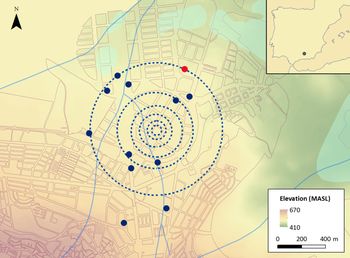
The defining components of Marroquíes consist of at least six ditches that follow a concentric layout expanding outwards from the centre of the site. The ditches extend over an area of 113 hectares; the innermost 34 hectares have been interpreted as a settlement area, while the remaining 79 hectares, located between Ditches 4 and 5, have been interpreted as storage facilities and fields (Figure 1) (Zafra de la Torre et al., Reference Zafra de la Torre, Hornos Mata and Castro López1999, Reference Zafra de la Torre, Castro López and Hornos Mata2003, Reference Zafra de la Torre, Castro López, Hornos Mata, Gonçalves and Sous2010). The ditches are U- or V-shaped in profile and range from 1 to 5 m in depth and 1.5 to 20 m in width. Other architectural features, including bastions, palisades, and stone walls, have been understood as being associated with some of the ditches, providing support for the traditional interpretation that views these monumental constructions as defensive in nature. Alternatively, the ditches have also been interpreted as a complex irrigation and water supply system (Zafra de la Torre et al., Reference Zafra de la Torre, Castro López, Hornos Mata, Gonçalves and Sous2010).
Map of Marroquíes. Distribution of mortuary areas (blue dots) and layout of possible ditches. Excavated area of Ditch 5 is marked by a red dot (modified from Díaz-Zorita Bonilla et al., Reference Díaz-Zorita Bonilla, Beck, Bocherens and Díaz del Rio2018).

The areas between the ditches are characterized by palimpsests of features such as intercutting pits, circular huts, irregularly shaped features, postholes, hypogea, and artificial caves, which are negative structures excavated into the bedrock. Like other Iberian ditched enclosures, Marroquíes is noteworthy for the presence of human bones, predominantly within the enclosure system, although there is some evidence that these kinds of practices were also present outside the enclosed area (Figure 1). At Marroquíes, human bones have largely been found in three types of features: i) circular and oval pits of varying shape and size, typically associated with other kinds of material culture, especially faunal remains (Serrano Peña et al., Reference Serrano Peña, Portero Fernández and Cano Carrillo2011; Cámara Serrano et al., Reference Cámara Serrano, Sánchez Susi, Laffranchi, Martín Florez, Riquelme Cantal and Spanedda2012; Beck, Reference Beck and Osterholtz2016, Reference Beck2017; Díaz-Zorita Bonilla et al., Reference Díaz-Zorita Bonilla, Beck, Bocherens and Díaz del Rio2018); ii) different sections of Ditches 4 and 5 (Sánchez Vizcaíno et al., Reference Sánchez Vizcaíno, Bellón Ruíz and Rueda Galán2005; Aranda Jiménez et al., Reference Aranda Jiménez, Lozano Medina, Escudero Carrillo, Sánchez Romero, Alarcón García and Fernández Martín2016; Beck, Reference Beck2017); and iii) hypogea located outside the enclosure area (Espantaleón & Jubes Reference Espantaleón and Jubes1957, Reference Espantaleón and Jubes1960; Serrano Peña et al., Reference Serrano Peña, Portero Fernández and Cano Carrillo2011; Beck, Reference Beck2017; Díaz-Zorita Bonilla et al., Reference Díaz-Zorita Bonilla, Beck, Bocherens and Díaz del Rio2018).
Ditch 5
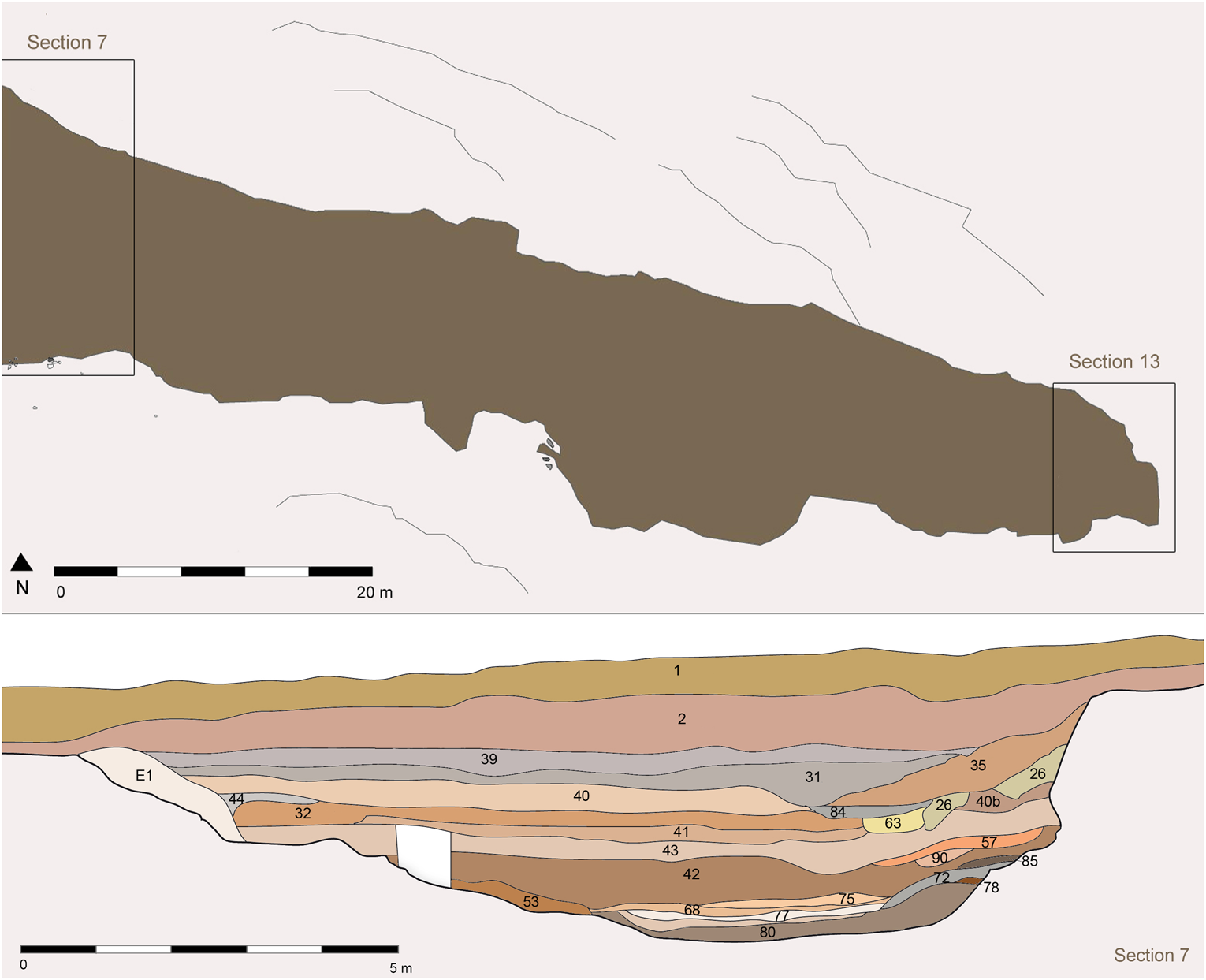
Ditch 5 is the outermost ditch enclosing the site. Various sections have been excavated, revealing an irregular layout that varies in shape and size (Burgos et al., Reference Burgos Juárez, Lizcano Prestel and Pérez Bareas2001; Sánchez Vizcaíno et al., Reference Sánchez Vizcaíno, Bellón Ruíz and Rueda Galán2005; Sánchez & Gutiérrez, Reference Sánchez and Gutiérrez2009). The ditch is between 2 and 3 m deep and between 10 and 20 m wide, making it the largest and most monumental enclosure at Marroquíes. Its size suggests a huge investment of communal labour in its construction. The section of Ditch 5 referred to in this article was excavated in 2001–2002 on a plot of land where a new secondary school was to be built. The excavation of an area of 19,482 m2 led to the discovery of many features, most prominently a ditch 70 m in length running east-west. This section of Ditch 5 is fairly irregular in both size and shape, ranging from 13 to 20 m in width and reaching a depth of 3 m at its western end. From this point, the depth of the ditch progressively decreased until its eastern end, where the trajectory of the ditched was interrupted (Sánchez Vizcaíno et al., Reference Sánchez Vizcaíno, Bellón Ruíz and Rueda Galán2005).
The ditch was excavated in different trenches that revealed its U-shaped profile. The greatest depth was recorded in the western section of the ditch in Trench 7. In this area, Ditch 5 had a complex stratigraphic sequence characterized by successive and intercalated depositional events of both anthropogenic and natural origin (Figure 2). As a result of different processes associated with water circulation, several sedimentary deposits were formed, characterized by a matrix of silt and clays with few or no inclusions. In addition, deliberate deposits of human remains represent events of a different nature. These anthropogenic stratigraphic units were more variable in shape and size and incorporated different kinds of material culture including human remains. Pottery sherds and animal bones were the most common finds, while lithics, charcoal, and seashells were less common (Sánchez Vizcaíno et al., Reference Sánchez Vizcaíno, Bellón Ruíz, Rueda Galán, Portero Fernández and Díaz García2004).
Western section of Ditch 5 in Trench 7 (top) with stratigraphic units (bottom) (modified from Sánchez Vizcaíno et al., Reference Sánchez Vizcaíno, Bellón Ruíz, Rueda Galán, Portero Fernández and Díaz García2004).
Materials and Methods
In 2003, a sample of human skeletal remains (311 fragments, 102 identified bones) found in Ditch 5 was analysed using bioarchaeological and biochemical techniques (Trancho & Robledo, Reference Trancho and Robledo2003). This analysis produced a minimum number of individuals (MNI) estimate of four adults and one subadult (Sánchez Vizcaíno et al., Reference Sánchez Vizcaíno, Bellón Ruíz and Rueda Galán2005). The more recent analyses described in this article include all the human bones found in Ditch 5. This new analysis comprised a total of 1801 human bone fragments, leading to the identification of at least 338 individual elements (MNE) representing a minimum of ten individuals (MNI), including the sample previously studied in 2003 (Table 1). Nearly all the fragments were found in Trench 7, with only seventy-seven recorded in Trench 13. In Trench 7, human remains appeared in the lower half of the ditch, mainly concentrated in stratigraphic unit 75 (SU 75) (68 per cent of identified bones), a stratum located close to the bottom of the ditch (Figure 2). The human bones were found fragmented, scattered, and mixed with other materials, particularly faunal remains, without any evidence of anatomical connection.
Average completeness of element and bone count by stratigraphic unit.

*Average completeness was scored with reference to the system used in Buikstra & Ubelaker (Reference Buikstra and Ubelaker1994), where 1 = > 75 per cent complete; 2 = 25–75 per cent complete, and 3 = < 25 per cent complete. Average completeness was then calculated for all identifiable bones in each unit.
The identification and classification of each fragment followed standard bioarchaeological methods. This included discriminating between human and non-human remains, adult and subadult bones, identifying the skeletal element or tooth, the fraction present, and the degree of completeness of the element. Taphonomic changes were recorded following Buikstra & Ubelaker (Reference Buikstra and Ubelaker1994), Fernández-Jalvo & Andrews (Reference Fernández-Jalvo and Andrews2016), and Lyman (Reference Lyman1994). Sex was estimated following Buikstra and Ubelaker (Reference Buikstra and Ubelaker1994). Adult age was assessed in relation to changes at the auricular surface of the pelvis (Lovejoy et al., Reference Lovejoy, Meindl, Pryzbeck and Mensforth1985), and subadult age was assessed using skeletal development and epiphyseal fusion (Buikstra & Ubelaker, Reference Buikstra and Ubelaker1994; Scheuer & Black, Reference Scheuer, Black, Cox and Mays2000), as well as dental development (AlQahtani et al., Reference AlQahtani, Hector and Liversidge2010). Inter-observer error was calculated using the guidelines outlined in Buikstra & Ubelaker (Reference Buikstra and Ubelaker1994). Statistical analyses were carried out using Past software, version 3.10 (Hammer et al., Reference Hammer, Harper and Ryan2001), JMP®, version 14, and R statistical package (R Core Team, 2017).
Mobility patterns were analysed with reference to 87Sr/86Sr and δ 18O isotope ratios in dental enamel. In a recent study of human remains from Marroquíes, the local ratio for 87Sr/86Sr was estimated to range from 0.70675 to 0.71020 at 2σ, and for δ 18Odw (drinking water) from -10.91‰ to -8.04‰ (Díaz-Zorita Bonilla et al., Reference Díaz-Zorita Bonilla, Beck, Bocherens and Díaz del Rio2018). The sampling strategy was based on the MNI estimate: of the ten individuals identified, eight were associated with mandibles, five of which had preserved teeth. Tooth 36 (lower left molar 1) was sampled as it was present in all five individuals. In addition, tooth 37 (lower left molar 2) was preserved in four cases and selected to assess intra-individual mobility. Therefore, the total sample included nine human and five animal teeth (drawn from one specimen each of Bos taurus, caprine, and Sus domesticus, and two specimens of Canis familiaris). Samples of ~12 mg of tooth enamel were extracted using a Dremel© device. Organic material was removed using a two per cent NaOCl solution for twenty-four hours, after which samples were placed in a 0.1M Ca-acetate acetic acid buffer solution for another twenty-four hours, then rinsed and dried (Bocherens et al., Reference Bocherens, Billiou, Patou-Mathis, Bonjean, Otte and Mariotti1997). Samples were analysed at 70°C using a ThermoFinnigan Gasbench II on a Finnigan Delta Plus XL CFIRMS at the University of Tübingen for δ 13C and δ 18O values of the carbonate fraction of bioapatite. Isotopic abundances are expressed as δ (delta) values in parts per mil (‰), as follows: δ 13C = (13C/12Csample/13C/12Cstandard - 1) × 1000 and δ 18O = (18O/16Osample/18O/16Ostandard - 1) × 1000. The standards used are the marine carbonate V-PDB for carbon and oxygen and V-SMOW for oxygen. For fossil samples, the analytical error is 0.1–0.2‰ for δ 13C and δ 18O, based on multiple isotopic analysis of modern tooth enamel of camel and hippopotamus prepared and analysed at the same time.
Strontium separation and analysis of aliquots of the pretreated samples was conducted at the Curt Engelhorn Center for Archaeometry, Mannheim, Germany. ~5 mg of enamel were dissolved in 250 μl of HNO3 under clean-lab conditions. Teflon columns with Eichrome Sr-Spec resin were preconditioned with 500 μl of 3 N HNO3, the samples loaded, and washed in with 3 × 400 μl of 3 N HNO3. The Sr was eluted with 1.5 ml of 0.4 N HNO3 (0.5 ml + 1 ml steps). Sr concentrations were determined by Quadrupole Inductively Coupled Plasma Mass Spectrometry (Q-ICP-MS), and the solutions diluted for strontium isotope analysis by High-Resolution Multi Collector-ICP-MS (Neptune). Raw data were corrected according to the exponential mass fractionation law to 88Sr/86Sr = 8.375209. Blank values were lower than 10 pg Sr during the whole clean-lab procedure. The NBS 987 and Eimer & Amend (E & A) standards run along with the samples yielded 87Sr/86Sr ratios of 0.71026 ± 0.00003, 2σ; n = 19 and 0.70804 ± 0.00002, 2σ; n = 26, respectively. The certified 87Sr/86Sr ratio of NBS-987 is 0.71034 ± 0.00026 [95 per cent confidence interval]. The inter-laboratory comparative value for AMES (Eimer & Amend) is 0.708027 ± 0.000035 (1 SD) (Müller-Sohnius, Reference Müller-Sohnius2007). The isotope ratios of the standards run with the samples were within the expected ranges.
The MNI was also the criterion used to select samples for palaeodietary analysis and for radiocarbon dating, as this strategy ensured no individuals would be double-counted. The combination of δ 13C and δ 15N was used to investigate the consumption of proteins (Whelan et al., Reference Whelan, Sackett and Benedict1970; Schoeninger & DeNiro, Reference Schoeninger and DeNiro1984). Analysis of δ 13C and δ 15N were conducted for nine individuals, with ~500 mg of bone used for collagen extraction for each individual. This analysis was conducted at the Department of Geosciences at the University of Tübingen following standard methods (DeNiro & Epstein, Reference DeNiro and Epstein1981; Bocherens et al., Reference Bocherens, Billiou, Patou-Mathis, Bonjean, Otte and Mariotti1997). An NC2500 CHN elemental analyser coupled to a Thermo Quest Delta + XL mass spectrometer was used to measure stable isotopes. Values of δ 13C and δ 15N are reported according to the international V-PDB standards, atmospheric air (AIR), respectively. The reproducibility for elemental composition of carbon and nitrogen was 0.1 per cent and 0.3 per cent. The reproducibility for δ 13C and δ 15N measurements was ± 0.1‰ and ± 0.2‰. In-house tests with modern camel and elk collagen standards showed that elemental contents of carbon and nitrogen were reproducible to 0.2 per cent for both isotopes.
In addition, the carbon (δ 13Cap) of the carbonate fraction of enamel was also analysed in order to assess dietary practices. This form of analysis allows for the investigation of all components of diet, rather than only proteins as in δ 13C bone collagen (Ambrose & Norr, Reference Ambrose, Norr, Lambert and Grupe1993; Howland et al., Reference Howland, Corr, Young, Jones, Jim and van der Merwe2003).
Radiocarbon dating was conducted in two laboratories: the Centre for Isotope Research, University of Groningen (GrM) and the Swiss Federal Institute of Technology (ETH). All samples were measured using Accelerator Mass Spectrometry (AMS). Radiocarbon dates were calibrated using the internationally agreed atmospheric curve, IntCal13 (Reimer et al., Reference Reimer, Bard, Bayliss, Beck, Blackwell and Bronk Ramsey2013), and the OxCal v4.3 program. The new radiocarbon series was modelled in a Bayesian statistical framework (Bronk Ramsey, Reference Bronk Ramsey2001, Reference Bronk Ramsey2009).
Results
Bioarchaeological analysis
MNI and palaeopathology
The results of the new bioarchaeological analysis produced an MNI estimate of at least ten individuals, including seven adults and three subadults. For the adults, assessment of sex depended on the anatomical region analysed, with different sex ratios produced when referencing different fragments. Analyses of pelvic and cranial fragments produced a ratio of three females to four males, while analyses limited to the mandible identified only males (n = 7). The three subadults are classified in the following age categories: Infant I (birth–6.9 years old), Infant II (7–12.9 years old), and Juvenile (13–17.9 years old).
Only fourteen bones were affected by pathologies. Osteoarthritis (n = 5) was the most commonly observed, followed by abnormal bone loss (n = 4), abnormal bone formation (n = 3), cribra orbitalia (n = 1), and exostosis (n = 1). Most of these are generalized lesions caused by infection, rather than specific indicators of a particular condition. There is also little evidence of dental disease, a result that is particularly striking when compared to data from other mortuary areas at Marroquíes such as Necropolis 1 (N1), Necropolis 2 (N2), and Necropolis 4 (N4) (Beck, Reference Beck and Osterholtz2016; Beck et al., Reference Beck, Díaz-Zorita Bonilla, Bocherens and Díaz del Río2018). Three out of seventy-nine (4 per cent) observable teeth have caries (a LM2, a RP4, and a LM1), which is lower than the frequencies reported for N1 (8 per cent), N2 (9 per cent), and N4 (7 per cent). Nine out of seventy-six (12 per cent) show calculus, a frequency also lower than the frequencies reported for N1 (32 per cent), N2 (23 per cent), and N4 (46 per cent). Perhaps the most striking finding is that none of the ninety-seven teeth recovered have hypoplasias, in contrast to the frequencies reported for N1 (4 per cent), N2 (14 per cent), and N4 (4 per cent).
Degree of skeletal completeness
Adult remains are represented by a wide variety of anatomical regions. The highest MNE derives from the left temporal (n = 7), a number that is matched by the posterior mandibular dentition, including the LM2 (n = 7), the LM1 (n = 7), and the RM1 (n = 7). There are eighty-two fully identifiable adult teeth and five additional teeth that can be identified as probably adult (e.g. teeth are not sided or positions are unknown). For seven adults with all their teeth present at death, we would anticipate an initial deposition of 224 teeth. There was no evidence of alveolar resorption within the sample, so teeth observed/expected are simply factored out of a count based on thirty-two teeth per adult individual. The degree of adult dental completeness for Ditch 5 is thus 82/224 (37 per cent), a figure comparable to other mortuary areas at Marroquíes, where the ratio of observed/expected adult teeth ranges from seventy per cent (3034/4346) in N4, to fifty per cent (447/902) in N1, and thirty-three per cent (188/574) in N2 (Beck, Reference Beck2017). In Ditch 5, lower molars (67 per cent) and upper molars (50 per cent) show the highest ratios of dental completeness, while lower incisors (7 per cent) and lower premolars (29 per cent) show the lowest levels.
If bone identified only as ‘fragments’ is excluded from the analysis, the majority of identifiable bones are from SU 75 (n = 230), followed by SU 76 (n = 30), SU 42 (n = 28), SU 68 (n = 15), SU 80 (n = 15), and SU 62 (n = 13) (Table 1). If the analysis is restricted to these stratigraphic units, a broad preservation pattern emerges: the bulk of each assemblage is made up of the bones of the skull, followed by those of the spine, feet, legs, and thorax, though preservation patterns differ between stratigraphic units (Figure 3). Using this metric, the bones of the pelvis are most poorly preserved, followed by those of the hand and arm.
Percentage assemblage by anatomical region and stratigraphic units (SU).

When element completion is compared between stratigraphic units, most show a value of approximately 2.00, which signifies bones are between twenty-five per cent and seventy-five per cent complete (Table 1).
Quantitative comparisons of observed versus expected bones by anatomical region show evidence of the deliberate selection of particular categories of bones. Mandibles represent the highest proportion of the MNI (70 per cent), followed by the left temporal (60 per cent), second cervical vertebra (axis) (50 per cent), left ulna (50 per cent), and left clavicle (50 per cent). The remaining skeletal elements occur at less than fifty per cent of the MNI (Table 2).
Skeletal element representation in adults. R = right, L = left, P = proximal, M = medial.

The results of the calculation of the average inter-observer error was 0.31 mm for bones and 0.14 mm for teeth.
Taphonomic features
A total of 123 recorded fragments showed taphonomic changes, meaning that only 6.8 per cent of the total number of fragments were affected by any changes. In brief, weathering affected up to 113 fragments representing sixty-two per cent of all stratigraphic units, predominantly SU 75 (n = 65), SU 42 (n = 21), and SU 80 (n = 16). Another common feature was breakage resulting from archaeological excavation, which represented thirty-two per cent of all fragments with taphonomic changes. There were additional taphonomic factors observed, including roots, insects, fire, and cutmarks, but these affected a very small number of bones (≤ five fragments).
Mobility patterns
The 87Sr/86Sr results for five individuals from Ditch 5 showed a range of 0.7081–0.7106 with an estimated range of 0.7075–0.7103 at 2σ from the mean (Table 3). This means that all samples fell within the local range established in Díaz-Zorita Bonilla et al. (Reference Díaz-Zorita Bonilla, Beck, Bocherens and Díaz del Rio2018) except for one that could be considered an outlier. The individuals with first and second molars that could be compared all showed very small inter-tooth differences, reflecting constant habitats during early childhood, except for individual MBS-603. These results are consistent with the previous results from Marroquíes, in which only six individuals (5 per cent) were identified as non-local in a total sample of 115 individuals (Díaz-Zorita Bonilla et al., Reference Díaz-Zorita Bonilla, Beck, Bocherens and Díaz del Rio2018).
Stable isotope results (87Sr/86Sr, δ18O and δ13Cap).

Samples were also analysed for oxygen (δ 18O) and carbon (δ 13C). In the case of oxygen, and considering fractionation, values were converted to phosphate and then to drinking water following Daux and colleagues (Reference Daux, Lécuyer, Héran, Amiot, Simon and Fourel2008) but also compared to modern precipitation values to establish a range of local water sources using nearby locations with similar environmental conditions (available at: http://waterisotopes.org). The human samples show a mean δ 18O of -7.59dw‰ (VSMOW ± 1.70 1σ) and values range from -9.05‰ to -6.01‰. Results appear to be homogenous at the intra-individual level. Likewise, if we consider the previous research at Marroquíes where results suggested a local δ 18Odw range of -10.91‰ to -8.04‰ (Díaz-Zorita Bonilla et al., Reference Díaz-Zorita Bonilla, Beck, Bocherens and Díaz del Rio2018), all human individuals from Ditch 5 appear to share these same water sources although there are some differences between the signals preserved in the first and second molars, which could be due to the continued presence of a nursing signal. The only non-local values from the Ditch 5 study come from two faunal specimens (MBS-610 and MBS-613), which showed values of δ 18Odw that fell outside the previously established local range (Figure 4).
Results of 87Sr/86Sr vs δ18OSMOW isotope analysis for mobility. The area between the dotted lines indicates the local bioavailable strontium shown at 2σ for 87Sr/86Sr; and the area between dashed lines indicates the local signal for δ18OSMOW at 1σ.

Finally, the δ 13Cap average for the Ditch 5 sample is -12.30‰ ± 1.9 (1σ). Human values ranged from -15.19‰ to -12.23‰, showing a difference of ~3‰ between individuals (Table 3). While some individuals have carbon isotope values compatible with a C3 terrestrial environment, one bovid has a δ 13C value of -8.13‰, which probably reflects a mixed diet that includes some C4 plants (Figure 5).
Results of δ13CVPDBap vs δ18OSMOW isotope analysis for the same individuals based on tooth 36 and 37. Dashed lines indicate teeth from the same individual.

Palaeodietary analysis and radiocarbon chronology
The MNI was also the criterion used to select samples for radiocarbon dating, as this strategy has previously been successful in the study of funerary contexts characterized by disarticulated and commingled human remains (Aranda Jiménez et al., Reference Aranda Jiménez, Lozano Medina, Díaz-Zorita Bonilla, Sánchez Romero and Escudero Carrillo2018a, Reference Aranda Jiménez, Lozano Medina, Sánchez Romero, Díaz-Zorita Bonilla and Bocherens2018b; Lozano Medina & Aranda Jiménez, Reference Lozano Medina and Aranda Jiménez2018). Of the ten individuals identified, nine have been successfully dated (Table 4). This radiocarbon series also draws on two additional dates from human remains from the initial excavation of Ditch 5 (Sánchez Vizcaíno et al., Reference Sánchez Vizcaíno, Bellón Ruíz and Rueda Galán2005).
Radiocarbon dates from Ditch 5 at Marroquíes.
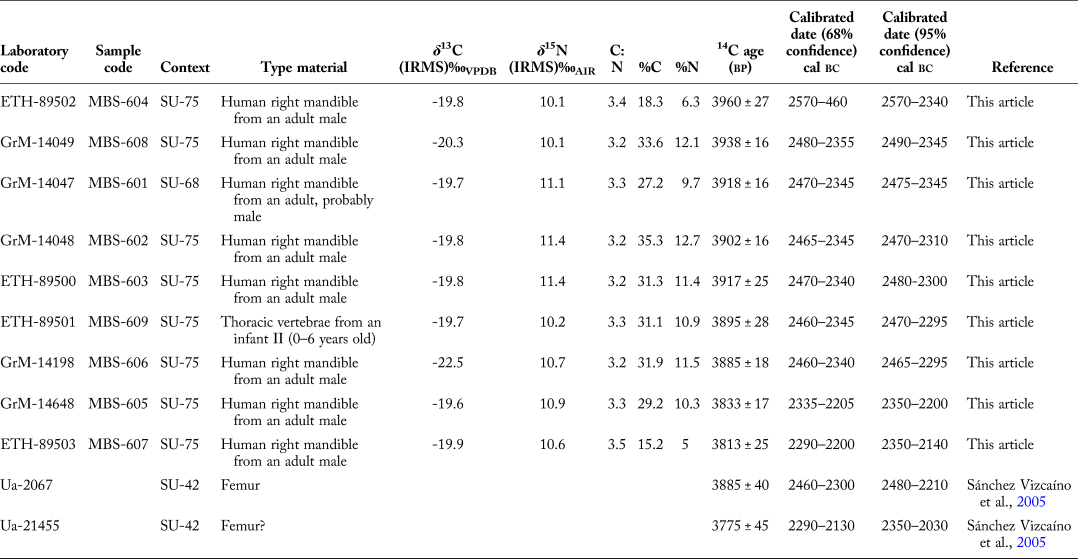
In total, the radiocarbon series for Ditch 5 consists of eleven dates. All the dated samples belong to individuals that show no significant influence of an aquatic reservoir affect according to their δ 13C and δ 15N stable isotope ratios. These isotopic values indicate that diet was based on C3 plants and terrestrial animals with no evidence of marine protein consumption. This is consistent with the previous results obtained for Marroquíes (Beck et al., Reference Beck, Díaz-Zorita Bonilla, Bocherens and Díaz del Río2018) but also for contemporaneous populations recently studied at sites such Panoría and El Barranquete (Díaz-Zorita Bonilla et al., Reference Díaz-Zorita Bonilla, Aranda Jiménez, Bocherens, Escudero Carrillo, Sánchez Romero and Lozano Medina2019). Given the carbon and nitrogen stable isotope ratios, radiocarbon measurements of Ditch 5 can therefore be considered accurate estimates.
The eleven dates were not uniformly distributed through the stratigraphic sequence. Most of the dates (n = 8) belong to SU 75, which contains sixty-eight per cent of the human remains. The remaining three dates belong to SU 42 (n = 2) and SU 68 (n = 1). Bayesian models were built to analyse this new radiocarbon series using the OxCal program v4.3 (Bronk Ramsey, Reference Bronk Ramsey1995, Reference Bronk Ramsey2001, Reference Bronk Ramsey2009). A first Bayesian model was built which considered all the dates in just one phase of continuous activity; these present a good index of agreement (Amodel = 78 per cent), i.e. all the dates were internally consistent. According to this model, the dates fall in the second half of the third millennium, between 2560 and 2360 cal bc (95 per cent of probability, Boundary Start) and 2410–2120 cal bc (95 per cent of probability, Boundary End), representing a period of between 130 and 230 years (68 per cent probability span). Therefore, the individuals deposited in Ditch 5 would have died at very different times in the past.
In a second model, the stratigraphic relationship between samples was used as prior information. As stated above, although the dated human samples are largely concentrated in SU 75, they were also found in SU 42 and SU 68. The Bayesian model that incorporated this information shows a poor agreement between the calibrated radiocarbon dates and the stratigraphy (Amodel = 13) (Figure 6). Four measurements also have poor individual agreements, all belonging to SU 75. This second model would indicate that the radiocarbon dates and the stratigraphic sequence are not in agreement.
Probability distribution of dates from Ditch 5 at Marroquíes according to the stratigraphic sequence. Each date shows two distributions: light grey represents the 14C calibration, and dark grey indicates the result of the Bayesian model (posterior density estimates). Distributions other than those relating to particular dates correspond to aspects of the model. The square brackets down the left-hand side and the OxCal keywords define the overall model exactly.

To properly evaluate this information, we must take into account the fact that none of the dated human bone was found in an articulated or even semi-articulated position, which means that the contemporaneity between the date obtained and the act of deposition cannot be guaranteed; indeed, it may even be unlikely. In other words, the length of time that passed between the moment in which these individuals died and their final deposition in Ditch 5 is unknown. This pattern explains why bones from different points in time are found clustered in specific depositional events such as SU 75. The seemingly anomalous ‘young’ and ‘old’ dates found in the previous Bayesian model provide evidence that human remains with very different chronologies were mixed in the same act of deposition. This situation is also consistent with the radiocarbon series based mostly on faunal remains obtained from Ditch 4 at Marroquíes (Aranda Jiménez et al., Reference Aranda Jiménez, Lozano Medina, Escudero Carrillo, Sánchez Romero, Alarcón García and Fernández Martín2016) and Ditch 1 at Perdigões (Márquez-Romero et al., Reference Márquez-Romero, Mata Vivar, Jiménez-Jáimez and Suárez Padilla2013).
Three main conclusions can be drawn from these radiocarbon results. First, human remains belonging to people who died at different times appear to have been mixed in the same stratigraphic units. Second, individuals deposited in Ditch 5 all seem to have died in the second half of the third millennium over a period of 130 to 230 years (68 per cent probability span). Third, the samples ETH-89503 (2290–2200 cal bc at 68 per cent probability), and Ua-21455 (2290–2130 cal bc at 68 per cent probability) provide a terminus post quem for the infilling of Ditch 5.
Discussion
During Iberian late prehistory, the deposition of human remains inside ditched enclosures is a frequent ocurrence (Valera & Godhino, Reference Valera and Godinho2010; Rodrigues, Reference Rodrigues and Valera2014; Ríos et al., Reference Ríos, Liesau, Blasco and Valera2014; Aranda Jiménez et al., Reference Aranda Jiménez, Lozano Medina, Escudero Carrillo, Sánchez Romero, Alarcón García and Fernández Martín2016; García Sanjuán et al., Reference García Sanjuán, Vargas Jiménez, Cáceres Puro, Costa Caramé, Díaz-Guardamino Uribe and Díaz-Zorita Bonilla2018). Marroquíes is no exception, and results from this study suggest that the deposition of human bones in Ditch 5 was a deliberate social act rather than a form of refuse disposal, as has been traditionally considered. As John Chapman (Reference Chapman2000: 145) has argued convincingly, ‘it is highly improbable that great-grandfather's skull would be dumped in a rubbish pit along with the remains of a hearty meal!’
The anatomical patterning of the human skeletal remains from Ditch 5 indicates that body parts appear to have been carefully selected, handled, and deposited according to particular cultural rules. The analyses of the degree of skeletal completeness relative to age and MNI show deliberate selection of particular categories of bones, predominantly the skull, thorax, and upper limbs. These skeletal remains were found fragmented and mixed with other kinds of material in different depositional events. The radiocarbon dates reveal that these episodes were characterized by the inclusion of the remains of people who died at different points in time during the second half of the third millennium bc. Furthermore, the bones show evidence of different taphonomic environments, as elements with indications of weathering appear together with other bones that lack such indicators. The presence of skeletal remains with different biographies in the same act of deposition is a relevant feature of this archaeological context. Taken together, multiple lines of evidence, from bioarchaeological analysis, to radiocarbon dating, to taphonomy, suggest that human remains were deposited in the ditch after skeletonization.
Keeping the post-mortem nature of the deposit in mind, a second question relates to the origin of the human remains in Ditch 5. Strontium and oxygen isotope analyses indicate that all individuals, with one possible exception, were local. Thus, it is most likely that the skeletal remains were collected from initial burials at the Marroquíes site itself, where funerary contexts with articulated human bones have been found (Cámara Serrano et al., Reference Cámara Serrano, Sánchez Susi, Laffranchi, Martín Florez, Riquelme Cantal and Spanedda2012; Beck, Reference Beck2017). Nevertheless, other possible scenarios, such as the collection of parts from partially or fully skeletonized bodies after exposure to the elements, cannot be ruled out.
The likely movement of human remains between different mortuary areas at Marroquíes introduces another relevant question. Were human bones collected from tombs and immediately deposited in the ditch, or were they kept as a part of different ritual practices before their final deposition? If this were the case, human bones could have acted as relics, gifts, or magical substances in different commemorative practices. Based on the principle of synecdoche, the dead could have continued to be key social actors through the materiality of their bones, which formed part of different processes of transformation and construction of the human self (Brück, Reference Brück1995, Reference Brück2004, Reference Brück2006, Reference Brück2009). In any case, it is difficult to consider this kind of ritual context as explicitly funerary. Ditch 5, along with other features at Marroquíes that contained similar depositions of human remains, seems to have been the final resting place for human skeletal remains that came from other kinds of mortuary areas. As Evangelista and Valera have recently suggested (Reference Evangelista, Valera and Valera2019), the deposition of bones in the bottom of backfilled ditches removes them from circulation. The evidence presented here suggests that human skeletal remains at Marroquíes, which occur in almost every kind of context across the site, formed part of a complex sequence of ritual behaviour.
Conclusions: Making Sense of Body Manipulation
Death is the most critical and irreversible event in the human lifespan. Nevertheless, in many societies, death is not conceived of as the final stage of life, as has traditionally been interpreted by archaeologists. Instead, people continue to be dynamic social actors after biological death, acting as ancestors, life-forces, substances, reincarnations, or performing other roles. The body, thus, could maintain its agency in a variety of states, whether alive or dead, whole or fragmented. From this perspective, the social life of the body does not end with death but acquires a new ontological status, transforming the deceased individual into a new kind of being who retains both agency and a capacity for action (Thomas, Reference Thomas, Hamilakis, Pluciennik and Tarlow2002; Fowler, Reference Fowler, Stutz and Tarlow2013; Robb, Reference Robb, Stutz and Tarlow2013).
This transformation is not instantaneous since the circulation of human skeletal remains suggests a prolonged interaction between the living and the physical remains of the dead. This seems to have been the case for the Chalcolithic societies of southern Iberia, in which human skeletal remains were handled, processed, and subjected to many different kinds of mortuary treatment (Kunst et al., Reference Kunst, Cardoso, Waterman and Valera2014; Valera, Reference Valera, Ard and Pillot2016, Reference Valera2019). In ditched enclosures such as Marroquíes (Beck, Reference Beck and Osterholtz2016, Reference Beck2017; Aranda Jiménez et al., Reference Aranda Jiménez, Lozano Medina, Escudero Carrillo, Sánchez Romero, Alarcón García and Fernández Martín2016; Díaz-Zorita Bonilla et al., Reference Díaz-Zorita Bonilla, Beck, Bocherens and Díaz del Rio2018), Perdigões (Valera & Godinho, Reference Valera and Godinho2010), Camino de las Yeseras (Rios et al., Reference Ríos, Liesau, Blasco and Valera2014), and Valencina-Castilleja (García Sanjuán & Díaz-Zorita Bonilla, Reference García Sanjuán, Díaz-Zorita Bonilla, García Sanjuán, Vargas Jiménez, Hurtado Pérez, Ruiz Moreno and Cruz Auñón2013), human bones are found not only in ‘traditional’ funerary deposits, but also in a wide range of ‘non-funerary’ contexts that suggest the existence of a great variety of post-mortem ritual practices. The co-existence of diverse mortuary practices and multiple forms of human bone manipulation appears to have been a key aspect of these societies, to the point that human remains are often ubiquitous at such sites (Márquez-Romero, Reference Márquez-Romero2004).
We must nevertheless still ask why human skeletal remains appear almost everywhere, given that the ubiquity of human remains is a unique feature associated mainly with the largest enclosures. While the frequency of Chalcolithic human bones may have served many different purposes, we argue that their powerful presence could have acted as permanent reminder of collective values and kinship in a changing environment characterized by increasing social complexity, population growth, the appearance of copper metallurgy, and the expansion of supra-regional exchange networks (Cruz Berrocal et al., Reference Cruz Berrocal, García Sanjuán and Gilman2013; Lillios et al., Reference Lillios, Blanco-González, Lee Drake and López Sáez2016). In this perspective, the ubiquity of human remains makes sense as a ritual strategy employed by dynamic communities navigating new social and scalar challenges, such as those observed during the Bronze Age in Britain (Brück, Reference Brück2006, Reference Brück2009). The frequency of human bone depositions would thus create a symbolic landscape characterized by the continuous interaction between the living and the dead, past memories and present social relationships, and the ancestors and their living relatives.
When considering the mortuary deposits in Ditch 5, another aspect of human bone treatment emerges. A parallel between humans and animals and between humans and objects can be drawn, as all these elements share the same degree of admixture and fragmentation inside the ditch. This deliberately similar treatment suggests the creation of symbolic parallels between humans, animals, and objects, giving them the same ontological status, without any distinction in their power for action. Their association would serve to underlie a world-view based on the construction of the self in a more fluid way, in which the person is recognized as composite and multiple-authored (Chapman, Reference Chapman2000; Hernando Gonzalo, Reference Hernando Gonzalo2002; Brück, Reference Brück2004; Fowler, Reference Fowler2004; Budja, Reference Budja2010; for discussions related to southern Iberian ditched enclosures, see Márquez-Romero, Reference Márquez-Romero2004; Valera, Reference Valera, Ard and Pillot2016; Evangelista & Valera, Reference Evangelista, Valera and Valera2019).
In order to understand the presence of human remains in ‘non-funerary’ contexts during the Iberian Chalcolithic, it is necessary to critically consider modern Western ideas concerning the moral superiority of humans in relation to animals and other non-human actors. From this perspective, it is surprising, perhaps even unsettling, to find human bones treated as a form of ‘refuse’ mixed in with other kinds of ‘waste’. Yet it is precisely the combination of human skeletal remains with other materials that highlights the possibility of alternative epistemologies in which agency is not restricted to humans (Appadurai, Reference Appadurai1986); instead animals, objects, and places all have the capacity to act meaningfully. The selected deposition of human bones in Ditch 5 at Marroquíes can, therefore, be considered the final act of a complex sequence of ritual behaviours that accorded human remains the same ontological status as other kinds of material culture.
Acknowledgements
This article was written as part of the research project ‘Innovation, hybridisation and cultural resistance. The third and second millennia cal bc societies in the southern Iberian Peninsula’ (HAR2017-82932-P), funded by the Spanish Ministry of Economy and Competitiveness, and the research project ‘Mobility of humans, animals and objects during the Late Neolithic-Early Bronze Age (fourth–second millennia cal bc) in Europe’, funded by the Institutional Strategy of the University of Tübingen (Deutsche Forschungsgemeinschaft, ZUK 63) and the MWK Research Seed Capital RiSC Programme from the Baden-Württemberg Ministry of Science, Research and Arts. J. Beck’s participation was supported by the European Union’s Horizon 2020 research and innovation programme under the Marie Skłodowska-Curie grant agreement No 746216. Strontium isotope samples were processed and measured by Sandra Kraus, Sigrid Klaus, and Bernd Höppner (Curt Engelhorn Center for Archaeometry, Mannheim, Germany). We are indebted to the team of archaeologists from the University of Jaén for granting access to the original excavation records and to Gonzalo Trancho, who studied part of the human bone collection included in this article. We would also like to thank the staff at the Jaén Museum for their assistance. We would like to thank the two editors C. Frieman & M. Hummler and the anonymous reviewers whose suggestions helped to improve this paper.


 Open access

