


For people to effectively share an environment, they usually also must effectively share knowledge about that environment. While seemingly obvious and intuitive, this insight is often overlooked in literature about governing resources as commons.Footnote 1 Focusing on the knowledge commons associated with an environmental commons helps to illuminate a host of complex governance dilemmas. This chapter examines the interrelationship between environmental and knowledge commons, weaving together different strands of commons research and practice.
Every environmental commons has a corresponding knowledge commons that provides an essential foundation for managing the shared environmental resources.Footnote 2 We can improve our understanding of an environmental commons by investigating its associated knowledge commons.Footnote 3 In addition, our prescriptions for environmental commons governance should account for the relationship between an environmental commons and its associated knowledge commons and for the challenges of creating and maintaining an associated knowledge commons.
The knowledge commons associated with an environmental commons includes a diversity of knowledge relevant to the environmental commons. At a minimum, the knowledge commons includes the knowledge necessary for a relevant community to delineate and understand the shared environmental resources, their collective relationships with those resources, and the social demand for institutionalized governance. In addition to this descriptive baseline knowledge, the knowledge commons includes managerial knowledge – that is, descriptive knowledge about the community’s relationship to the shared resources that enables the community to make ongoing decisions about how to manage the resources. This may include, for example, knowledge about how one use of the shared environmental resources affects other uses. It also may include knowledge about how to operationalize rules-in-use. At a minimum, the knowledge commons provides the type of descriptive account of the environmental commons that community members might provide first hand or that one might encounter in a conventional Ostrom-inspired case study of a commons.
Effective management requires more than just descriptive knowledge of the environmental commons. In addition, the community must make certain normative judgments about the environmental commons that are in some sense constitutive of the community itself. The community must, for example, define whose interests in the environmental commons count and who will have a voice in managing the environmental commons. And the community will have to determine other normative judgments that will guide its management decisions, such as whether the community will adhere to an egalitarian ethic or give some uses or users of the environmental commons priority over others. An understanding of these normative judgments among the community will be crucial to the ability of the community to manage the environmental commons. Indeed, to the extent that the community lacks a shared understanding of the environmental commons or of its normative priorities, this is likely to significantly impede the community’s ability to effectively manage the environmental commons. Normative disagreements about the environmental commons are likely to induce disagreements about even the descriptive knowledge in the knowledge commons. The knowledge commons thus plays an important role as a venue for communicating, contesting, and negotiating normative judgments and governance decisions about the environmental commons. Because the knowledge commons is crucial to managing the environmental commons, conflicts about managing the environmental commons will often manifest themselves in conflicts in the knowledge commons.
As Figure 2.1 illustrates, the relationship between an environmental commons and its associated knowledge commons is bidirectional. The physical, social, and political characteristics of the environmental commons generate the knowledge that constitutes the associated knowledge commons. In this sense, the knowledge commons depends deeply on the environmental commons. But humans understand the environmental commons through the lens of the knowledge commons, and governance of the environmental commons therefore requires the knowledge commons to inform decision making about the environmental commons. The bidirectional relationship creates an interdependency between environmental commons governance and knowledge commons governance. Controversies in environmental commons governance are likely to cause controversy over the knowledge commons, and vice versa.Footnote 4
The knowledge commons–environmental commons relationship.
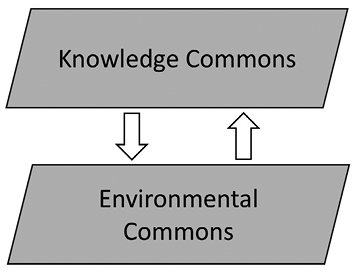
Figure 2.1 Long description
Diagram has two slanted rectangular blocks, the upper one labeled Knowledge Commons and the lower one labeled Environmental Commons. Between them are two arrows: one pointing downward from the upper block to the lower block, and one pointing upward from the lower block to the upper block. The layout illustrates a reciprocal relationship between the Knowledge Commons and the Environmental Commons.
Recognizing the existence of knowledge commons associated with environmental commons, and the role of knowledge commons in managing environmental commons, yields at least three important insights. First, to understand environmental commons, we often will have to study their associated knowledge commons.Footnote 5 Second, because normative judgments are embedded in the knowledge commons, understanding the relevance of knowledge commons to environmental commons also highlights the role of normative judgments in what otherwise may be assumed to be objective information about the environmental commons. Understanding knowledge commons as commons means recognizing that the knowledge in a knowledge commons is itself a socially determined product of governance decisions, not merely “the facts.” Third, as shared resources and potential loci of stakeholder conflict, knowledge commons present distinct social dilemmas that demand governance institutions. Ostrom’s design principles for commons, as well as the Governing Knowledge Commons (GKC), Institutional Analysis and Development (IAD), and Social-Ecological Systems frameworks, can be useful for understanding and managing knowledge commons associated with environmental commons.Footnote 6
Section 2.1 illustrates our basic points about the environmental commons–knowledge commons relationship with a simple example, the well-trodden allegory of a pasture shared by a community of herders. We extend the descriptive account of the environmental commons to show the necessary existence of a corresponding knowledge commons. Then, we illustrate the additional functions of the knowledge commons.
Section 2.2 takes the shared grazing pasture example and expands it in three deliberate steps, by adding stylized variations in the types of grazing animals and corresponding effects. Each step complicates the scenario in ways that present different governance challenges and depend upon different knowledge. The final two extensions present distinct types of normative complications that present additional demands on knowledge institutions. One involves interaction effects that force a normative choice about priorities among uses of the shared resource, and the second involves external effects that extend beyond the community and shared resource system itself; these are like an extraterritorial effect. Whether or not, and to what extent, a community cares about such effects is a sociopolitical consideration about priorities.
The highly stylized examples in Section 2.1 and Section 2.2 are merely illustrative. In lieu of a pasture, we could present similar stylized examples and variations using a different shared natural resource, such as a lake or woodland, or even a built environment, such as a road system, computer server, or living room. By illustrating different types of social dilemmas and governance challenges, we hope to provide a bridge between the environmental commons and knowledge commons. Essentially, we show how governance of the environmental commons depends upon the knowledge commons, and how, as the scale, scope, and heterogeneity of the environmental commons increase, the complexity of the knowledge commons increases as well.
Section 2.3 applies the insights developed in Sections 2.1 and 2.2 to a series of examples. We open with an example of a natural environment (forest management) and then turn to two examples of built environments (road systems and living rooms).
Section 2.4 builds on the insights from these examples to begin to address questions of how attributes of environmental resource commons affect their associated knowledge commons, and how to govern knowledge commons so that they can support better governance of environmental commons.
In conclusion, we propose additional research both to retrospectively mine past case studies of environmental commons to highlight the often-hidden knowledge commons at work and additional case studies of more complex commons that may raise more complicated and nuanced issues with respect to the environmental commons–knowledge commons relationship. Overall, this is an area rich with opportunity for additional theoretical and empirical inquiry.
2.1 A Stylized Exploration of a Classic Environmental Commons and Corresponding Knowledge Commons: Herding Sheep on a Shared Pasture
Assume an environmental resource, such as a meadow (natural) or highway (built), that is shared freely without restriction. That is, assume the resource is presumptively open to all-comers and there is no mechanism for coordinating the actions of resource users. Consumption may initially be nonrivalrous, if, for example, the population is small relative to the capacity of the resource, but it may turn rivalrous over time.Footnote 7 The resource may be depleted and even destroyed entirely, as individuals rationally decide to use the resource at a rate and in a manner that maximizes private gains but disregards the effects that such use has on other users or more generally on the sustainability of the resource. Here is how Hardin (Reference Hardin1968, 1244) famously explained it:
Picture a pasture open to all. It is to be expected that each herdsman will try to keep as many cattle as possible on the commons…
As a rational being, each herdsman seeks to maximize his gain. Explicitly or implicitly, more or less consciously, he asks, “What is the utility to me of adding one more animal to my herd?” This utility has one negative and one positive component.
1) The positive component is a function of the increment of one animal. Since the herdsman receives all the proceeds from the sale of the additional animal, the positive utility is nearly +1.
2) The negative component is a function of the additional overgrazing created by one more animal. Since, however, the effects of overgrazing are shared by all the herdsmen, the negative utility for any particular decision-making herdsman is only a fraction of −1.
Adding together the component partial utilities, the rational herdsman concludes that the only sensible course for him to pursue is to add another animal to his herd. And another; and another…. But this is the conclusion reached by each and every rational herdsman sharing a commons. Therein is the tragedy. Each man is locked into a system that compels him to increase his herd without limit – in a world that is limited. Ruin is the destination toward which all men rush, each pursuing his own best interest in a society that believes in the freedom of the commons. Freedom in a commons brings ruin to all.
Hardin recognized two potential solutions to this type of social dilemma: government regulation and privatization. Both rely on collective action through governmental institutions to introduce constraints on resource consumption. Government can constrain consumption by directly managing or regulating use of the shared resource, limiting consumption to sustainable levels. Alternatively, government can create a system of private property rights delineating ownership of the resource, which supports incentives for conservation by internalizing the externalities of resource use. The approaches differ substantially in terms of the manner in which ongoing (month-to-month, day-to-day) resource allocation decisions are made. Both effectively eliminate the commons and replace it with a different governance regime.Footnote 8 Notably, although not explicitly described in most accounts of commons, including Hardin’s, both governance approaches require a body of knowledge about the resource that is accessible to those managing the resource, whether government officials or private owners.Footnote 9 This knowledge includes an understanding of the resource itself, but also an understanding of the relationships between users and the resource and of the normative judgments underlying management of the resource.
Elinor Ostrom challenged Hardin’s frame by asking two foundational sets of questions: First, how well does the tragedy of the commons allegory describe reality? Does the allegory accurately predict real-world behavior of individuals sharing common-pool resources? Second, does the allegory provide a useful basis for choosing or designing management solutions? Are the governance options limited to government command-and-control regulation and private property-enabled markets? (Frischmann Reference Frischmann2013).
As to the first set of questions, Ostrom posited that reality is much more complicated and nuanced than Hardin’s simple allegory suggests, in ways that are important to managing resources. Ostrom (Reference Ghosh, Hess and Ostrom2007; 1990) identified many ways in which Hardin’s allegory was overly reductionist and distorting, so much so that it could “lead the analyst to miss what is most important and focus on what is least relevant” (Frischmann Reference Frischmann2013, 390). In other words, Hardin’s allegory itself presented a knowledge dilemma.
Hardin conflated resource and governance by referring to the shared pasture that was openly accessible to all-comers as the commons, which then, on certain strict assumptions, was doomed to tragedy. But the resource (e.g., pasture) is distinct from the governance regime (e.g., open access, commons, government regulation, private property enabled market) that manages it. The term “commons” describes a form of governance, not a type of resource. Furthermore, a resource managed as a commons is not necessarily subject to open access. Commons involve “institutionalized sharing of resources among members of a community,” but not necessarily with nonmembers or the general public (Madison et al. Reference Madison, Frischmann and Strandburg2010, 841).
As to the second set of questions, Ostrom argued that effective cooperative management is theoretically and practically feasible. Natural resource commons can be effectively managed as commons and therefore are not doomed to suffer tragedy and need not be eliminated. Community management, social norms, and other related institutions can and often do outperform government regulation and privatized market arrangements.Footnote 10
How to effectively govern shared resources as commons has been a core interdisciplinary research question for decades. The provisional answer is that effective commons governance depends on the context and community. It also depends, we argue, on shared knowledge.Footnote 11 Based on extensive fieldwork, Ostrom proposed the following design principles:
1. Define clear boundaries for the community and shared resources.
2. Tailor appropriation and provision rules to local needs and conditions.
3. Enable those affected by operational rules to participate in modifying the rules.
4. Ensure monitors are accountable to (or are) the appropriators.
5. Use graduated sanctions for rule violators.
6. Provide accessible, low-cost means for resolving conflicts.
7. Make sure external authorities recognize and respect the rule-making authority of community members.
8. When part of larger resource systems, build responsibility for governing the common resource in nested tiers.
These offer useful, albeit broad, guidance. Notably for our purposes, each principle relies substantially on shared knowledge – for example, how different rules would affect use of a resource, or whether different possible sanctions might deter potential rule violators. The design principles promote effective governance because they help individuals understand their capacity to cooperate in self-governance, which in turn depends on a shared base of knowledge about the resource and the community. Ostrom recognized this, albeit sometimes only implicitly and indirectly. Ostrom explained how the credibility of the design principles as an explanation of persistent, and thus effective, commons governance depended on showing that the design principles affected incentives of community members and perpetuated across generations. Both of these impacts – incentivization and perpetuation – require internalization and transmission of knowledge.Footnote 12
To illustrate how environmental commons are inexorably linked to knowledge commons, let us return to Hardin’s stylized allegory of a pasture shared by a group of sheepherders. For the herders to manage the pasture as a commons, they need to share some knowledge about the pasture and about themselves as a community. For our sheepherders, that knowledge may be as simple as understanding that other sheepherders are using the pasture to graze their sheep and that the pasture’s capacity to sustainably support grazing is limited. Conceivably that knowledge alone could be enough to lead the herders to limit their use of the pasture for their common benefit.
More sophisticated management of the pasture may require more knowledge. The herders would benefit from recognizing themselves as the group of individuals that is mutually dependent on the pasture. It also would be helpful if they have a technical understanding of the pasture and the effects of grazing on the pasture. Beyond such technical knowledge, the herders have certain normative understandings of themselves as a community – for example, whether their access to the pasture is presumptively equal or whether some herders have priority over others, or whether the pasture should be managed for short-term benefit or long-term benefit, and whether anyone else other than the herders should have a say in managing the pasture. If there are any rules governing use of the pasture, the herders need to know them. Perhaps the herders should consider whether the pasture should be used for grazing or instead for other uses, such as cropland, hunting, or natural preserve. It is also helpful, albeit not necessarily essential, if the herders communicate with each other about these areas of knowledge and share a common understanding.Footnote 13 In short, to relate this discussion to the IAD and GKC frameworks, the herders must have some shared understanding about the action arena within which they operate, and this requires shared knowledge about the biophysical characteristics, attributes of the community, and rules-in-use.
To be clear, this common knowledge need not be perfect, in the sense of being comprehensive, fully accurate, or universally agreed upon. The herders may disagree about the carrying capacity of the pasture, about whether grazing rights should be allocated equally among herders, or about who has the right to graze on the pasture. Differences of opinion regarding management of the pasture may well manifest in differences of opinion as to the relevant knowledge about the pasture. The more accurate and agreed upon the knowledge is, however, the better the knowledge can motivate and support cooperation via community governance. Given an opportunity to communicate (and not artificially forced into a one-shot prisoner’s dilemma), the herders may be able to develop, share, and act upon such common knowledge.Footnote 14
Despite the centrality of knowledge to commons governance, we, as analysts or storytellers about environmental commons, tend to presume that a knowledge commons functions effectively in the background but generally do not focus on the knowledge commons as a subject of our analysis or story.
Suppose our group of sheepherders agrees about the collective need to constrain use of the pasture according to a set of agreed-upon rules. The pasture, they realize, can become overcrowded with sheep, causing deterioration. Assume each sheepherder uses the pasture similarly and that the sheep graze similarly. The social dilemma they face is thus what economists call an “anonymous crowding” (congestion) problem because using the pasture in this scenario entails homogeneous uses (Cornes and Sandler Reference Cornes and Sandler1996, 355). The attributes of individual users (herders, sheep) do not matter for the purpose of making the rules for the pasture. What matters is the overall capacity of the pasture, the overall number of sheep grazing in the pasture, and the rate (intensity) at which the sheep are consuming the pasture grass. It follows that effective governance in this situation requires some knowledge about each of these parameters. Such knowledge informs the primary governance decision about allocation rules for the pasture, which may boil down to simple rationing – that is, how many sheep can each herder graze, and for how long.Footnote 15
Game theory models and common knowledge. The tragedy of the commons has been modeled in game theory as a prisoner’s dilemma. While the model predictably leads to defection and tragedy, Ostrom emphasized how real-world scenarios rarely fit the model (Frischmann Reference Frischmann2013, 390–392; Ostrom Reference Ghosh, Hess and Ostrom2007, 15183). Once communication among players and/or repeated interactions among players is allowed (rather than assumed away), cooperation is much more likely. Notably, to talk meaningfully about available moves, strategies, and consequences – i.e., the “payoff structure” in game theoretic terms – requires some base level of shared understanding, which in turn implies the existence of knowledge commons.
If the sheepherders are committed to governing their shared pasture as a commons, rather than resorting to other governance regimes such as government command-and-control or privatization, then a corresponding knowledge commons dilemma also arises.Footnote 16 Essentially, the community of herders must generate and share the knowledge needed to govern its environmental commons. The herders may need, for example, to develop an understanding of consumption patterns and long-term impacts. Understanding the need for such information, the herders may create the knowledge commons intentionally through planning and study. Alternatively, the knowledge commons may arise informally and unintentionally as individual herders debating governance options share their experiences with the pasture and what they have observed about the effects of grazing.
The relevant information in the knowledge commons may develop through consensus, or it may be hotly contested among stakeholders. Conflicts may arise over how to frame risks, resolve uncertainty, or deal with contested knowledge. Heuristics, biases, and other psychological and sociological phenomena may challenge the commonality of the knowledge commons. Or, by contrast, the herders may govern the knowledge commons in ways that reduce conflict and build consensus about how to manage the pasture. They may, for example, agree to defer to the judgment of an appointed person – someone known and trusted by the community, or an outside expert – as to the carrying capacity of the pasture.
Regardless, our point is simply that even the most basic environmental commons requires joint effort toward the generation, curation, and sharing of knowledge about the environmental commons. This is implicit in Ostrom’s first three design principles, which focus on defining the resource and the community, finding rules that reflect local needs and conditions, and enabling participation to change rules.
Ostrom’s other design principles also depend upon developing and communicating shared knowledge – among community members, with outsiders, and as integral parts of governance institutions (e.g., sanctions, dispute resolution). Suppose, for example, that our community of sheepherders agrees on a system for allocating grazing rights among themselves. Effective governance will require monitoring and tracking compliance with these rules-in-use.Footnote 17
The quality of an environmental commons – its value to the community – depends on the effectiveness of the community’s governance. Like an environmental commons, a knowledge commons also may need active management to serve its function of informing decisions about the environmental commons. Left unmanaged, problems of inaccurate knowledge and lack of access to knowledge may dominate the knowledge commons. The absence of definitive information about transmission of the COVID-19 virus, for example, deprived public health experts of a consensus of information on which to build norms of mutual protection. Because effective environmental commons governance requires a well-functioning knowledge commons, effective environmental commons governance therefore will require an effective strategy for governing the associated knowledge commons.
So far, we have described the environmental resource as if it only generates outputs – here, grazing areas for the herders’ sheep. This view implicitly presumes the pasture is natural.Footnote 18 Of course, it is not. The pasture itself is a social construction, involving a reshaping of the natural environment through particular human activities. Rather than a pasture, it could be many other things.Footnote 19 Further, consider how the community contributes inputs that affect the environmental resource as well as complementary goods that affect how community members interact with the resource and each other. Herders may, for example, create trails in the pasture, construct a fence around the pasture, or build a place to sit while the sheep graze. The benefits of these inputs and complementary goods inure to the herders who invest in them, but also to all other herders as well. This creates a potential problem. Users of shared resources may be disinclined to invest in contributions that would add value to the resource system without any confidence that they, as opposed to other users, will be able to enjoy the fruits of their efforts. A herder may not bother to build a place to sit, for example, even though other herders would also enjoy sitting there and benefit from the first herder’s efforts.
Similar issues arise for knowledge resources, which often function as inputs and complementary goods and face incentive issues rooted in concerns about free riding. Take, for example, information about areas of the pasture that are especially good for grazing. A herder with knowledge of the best grazing areas may be disinclined to share that information with other herders because sharing the information will not benefit, and may in fact disadvantage, the first herder. Similarly, a user may be disinclined to invest in contributing potentially valuable information to the knowledge base because other users will take advantage of the information, without benefit (and potentially with detriment) to the first user. For example, a herder may be disinclined to invest the time to survey the precise boundaries of the pasture because the cost of surveying the pasture outweighs the benefits to the herder, not taking account that the survey would be valuable to other users as well.
Yet in some cases, unlike a conventional environmental resource, information will be more advantageous to the user if other users have access to it. For example, if the pasture is generally believed to support only grazing by 200 sheep, but one herder who would like to have more sheep has information (or an innovation) supporting the idea that the pasture actually can sustainably support grazing by 300 sheep, it is in that herder’s interest first to invest in contributing that information to the communal knowledge base and second to make that information accessible to the other herders. Thus, here the incentives have reversed. The presence of other herders gives the herder more, rather than less, incentive to invest in contributing the information to the communal knowledge base and to make the information accessible to others. Managing a knowledge commons effectively requires taking into consideration the different incentives that members of the community will have to contribute to, or hinder, the accumulation and distribution of information about the environmental commons.
2.2 Extending the Stylized Exploration of Classic Environmental Commons and Corresponding Knowledge Commons: Herding Sheep and Other Animals on a Shared Pasture
We now build from the sheepherding example and expand it in three deliberate steps, by adding stylized variations in the types of grazing animals and corresponding effects. At each stage, varying the facts has implications both for the environmental commons and the associated knowledge commons.Footnote 20
Even prior to undertaking the challenge of managing the pasture as a commons, the community must make certain foundational decisions. The herders and perhaps others must decide, either individually or collectively, that they want to use the land as a pasture rather than for other purposes, such as homesites, a forest for harvesting timber, cropland, or recreational uses. This decision presents a governance dilemma, which requires both descriptive and normative knowledge for the community to address. Descriptively, the community must understand the land in question as a potential pasture site. Ideally but not necessarily, the community also will have some knowledge about other potential uses for the land, and the relative advantages and disadvantages of each alternative use. Normatively, the community must define who may participate in the decision about how to use the land and the process for making that decision, as well as the criteria the community will apply in deciding among alternatives. Like the use of the land itself, contributions of information to the knowledge commons are likely to occur strategically. A proponent of using the land as cropland, for example, may publicize the benefits of cropland and the disadvantages of other potential uses. How the community creates and manages the knowledge commons may effectively decide how it decides to use the land, such as if the community envisions land use as a matter of tradition and the land has traditionally been used as a pasture. Or the knowledge commons may play a supporting but not defining role in managing the environmental commons. The ability of the community to decide the best use of the land will depend in significant part on whether it is able to generate a robust and diverse knowledge commons on which to base its decisions about the land.
Turning to management of the land as a pasture, in the first scenario, described in Section 2.1, a community of sheepherders shared a pasture and governed it (and themselves) as a commons. Grazing sheep on the pasture gave rise to a potential social dilemma that can be framed as an anonymous crowding congestion problem. Managing congestion and avoiding tragedy required the community to determine rules-in-use regarding grazing and to monitor compliance with and to enforce the rules. The management decisions that created and implemented the rules depended on the existence of a shared body of knowledge, with both descriptive and normative components, about the pasture and the herders’ relationship to the pasture and to each other. Thus, this natural resource commons is accompanied by an associated knowledge commons. We also highlighted potential social dilemmas concerning incentives to invest in public goods (whether inputs or complementary goods) that contribute to the environmental and knowledge commons.
2.2.1 Herding Sheep and Goats on a Shared Pasture: Knowledge Concerning Heterogeneous Uses
Now suppose our community of herders share the same pasture but some fraction herd sheep and the rest herd goats. Thus, we are shifting from homogeneous use to heterogeneous uses, albeit still within a rather narrow scope (herding livestock). Assume that the only relevant difference between sheep and goats for purposes of managing the shared pasture is the rate at which the grazing animals consume the resource.Footnote 21 On these stylized facts, the addition of goats presents a complication for rules-in-use concerning allocation and tracking.Footnote 22 The herders will have to decide whether and how to factor the differences between sheep and goats into the rules-in-use.
The additional complication for rules-in-use for grazing creates complications for the associated knowledge commons as well. The herders will have to understand the different rates of consumption and will have to track sheep and goats separately. They also will have to communicate with each other about whether and how the differences between sheep and goats should influence the allocation rules. Yet the move from the base scenario in Section 2.1 to this variation does not necessarily present a substantial challenge, either for governing the pasture or for developing the underlying requisite knowledge commons, so long as the only difference between sheep and goats is in the rates of consumption.
There could be complications, and even conflict, in distinguishing animal types and measuring consumption rates, and dealing with such complications could put pressure on the knowledge commons institutions. Herders may engage in strategic behavior to game rules-in-use by, for example, selectively highlighting information favorable to their interests in discussions over management of the pasture. Nonetheless, if the only difference between sheep and goats is their rate of consumption, the information challenges for the shift from sheep to sheep and goats primarily concern descriptive and managerial knowledge similar to the initial sheep-only scenario.Footnote 23
We can extend this scenario along similar lines, for example, from 2 → 3 → … → n different types of animals, which would complicate matters mostly in terms of accounting. Creating and maintaining a knowledge commons is costly to the community. As the number of types of grazing animals increases, the cost of creating and maintaining a knowledge commons sufficient to support management of the pasture increases as well. If these costs (a form of transaction costs for governing the pasture) increase enough, then they may constrain governance choices.Footnote 24 If, for example, ten different breeds of goats graze on the pasture, each with a somewhat different rate of consumption, the cost of understanding the differences between the breeds at some point may exceed the benefits of differentiating among the breeds, leading the herders to treat all goats alike even if they are not.
2.2.2 Herding Sheep, Goats, and Donkeys on a Shared Pasture: Knowledge Concerning Interaction Effects
Heterogeneity also can introduce potential interdependencies among uses, referred to as interaction effects. Some interaction effects can be positive, as when uses are complementary (mutually beneficial). Some can be negative, as in the case of interuse congestion, also referred to as cross-crowding. Various uses may interact with each other in a manner that goes beyond competition for scarce capacity. Rivalrousness may arise because a certain use raises the marginal costs for another use, reducing consumption opportunities for that use, even if the capacity of the underlying resource is not scarce. To illustrate, consider once more our shared pasture.
Suppose our community of herders share the same pasture, and they herd sheep, goats, and donkeys. Again, assume the only relevant difference in resource consumption between sheep, goats, and donkeys is quantitative (rate, intensity). This presents the same issues raised in Section 2.2.1. Now assume the following stylized fact: Donkeys and sheep don’t get along and tend to fight with each other.Footnote 25 Herding both types of animals on a common pasture would then give rise to negative interaction effects and rivalry, even if the capacity of the pasture is more than enough to support both flocks.
Interaction effects can give rise to another type of externality; individuals choosing which and how many animals to add to their flock may not account for the interaction effects and consequential impacts on other herders in the community. Again, as with the previous scenarios, this presents a social dilemma, and thus creates demand for governance, in both the natural resource commons and corresponding knowledge commons. The community must be able to describe, understand, and address the challenge of interaction effects.
Cross-crowding complicates conventional approaches to managing congestion. A sizable capacity cushion does not necessarily eliminate cross-crowding; nor does restricting total membership size of the user community; nor does congestion pricing. Interaction effects arise because of interdependencies among uses that are unrelated to scarce capacity. As a result, where interaction effects are significant, some other manner of coordination may be necessary. In particular, managing cross-crowding may entail managing the membership size of subsets of users based on the identity of their use. In the context of our stylized scenario, this would mean the community might choose to restrict (or even prohibit) sheep or donkeys.
Heterogeneity thus introduces another choice in governance, which is the scope of uses – whether to allow all types of animals or limit the range. In other words, the community may decide to (de)prioritize some uses. Importantly, this type of decision can push beyond managerial in the descriptive and technical sense and have a sociopolitical, normative dimension, much like the constitutive community decision to designate the shared natural resource a pasture rather than a recreational field, wildlife preserve, or something else.
Where two uses are interdependent in a fashion that gives rise to interuse congestion, both uses cause the congestion (Coase Reference Coase1960).Footnote 26 Cross-crowding is not attributable exclusively to one use or the other. Interuse congestion would not arise unless both uses were present. For example, interaction effects between industrial pollution and swimming in a lake are attributable to both uses, and not, as is often assumed, to the industrial use alone. Eliminating interaction effects between these uses can be accomplished by eliminating either of the two uses, or in some cases, by restricting the intensity, timing, or some other characteristic of one use or the other.
Deciding how to coordinate interdependent uses, and which use(s) to restrict, are difficult questions that must be evaluated in context. This contextual evaluation depends heavily on shared knowledge. Some of this knowledge is descriptive and similar to the type of knowledge necessary to manage the pasture for its carrying capacity, as in the first scenario. For example, it may be that sheep and donkeys only bother each other when they are in close proximity, and that problems can be avoided if they are kept apart. But other knowledge necessary for managing a pasture with sheep, goats, and donkeys is more constitutive. For example, do some grazing animals have normative priority over others? Perhaps sheep have long-standing cultural resonance in the community, and therefore the community, in managing the pasture, will give sheep preference over donkeys. This type of knowledge may be subject to debate within the community. There may be questions, for example, regarding who may speak to the community’s normative preferences.
The basic point of this subsection is to show how interaction effects can force (de)prioritization and thus trigger (additional) normative, even constitutive, decisions. In prior scenarios without interaction effects, the community did not need to choose among types of grazing animals. Of course, choosing to designate the land as a pasture for grazing animals is itself a normative decision, constitutive of the community. It is worth noting that such a decision also deals with potential interaction effects, not among types of grazing animals (uses of the pasture) but rather among land uses (pasture, cropland, recreational park, etc.).
2.2.3 Herding Sheep, Goats, and Cows on a Shared Pasture: Knowledge Concerning External Effects to Outsiders
Now suppose our herders share the same pasture, and they herd sheep, goats, and cows; let’s leave the antagonistic donkeys aside. Again, assume the only relevant difference in resource consumption between the animals is quantitative (rate, intensity). This presents the same issues raised in Section 2.1. However, now assume that grazing sheep, goats, and cows causes soil erosion that deposits sediment in the river that runs by the pasture. The sediment pollutes the river, which downstream communities use for drinking water. The sediment in the river is thus a byproduct of grazing animals in the pasture.
Some byproducts of grazing animals, such as wool and milk, are private goods that yield benefits captured by the herders, whether directly through their own use of those goods or through market transactions in which they sell those goods. The sediment byproduct of grazing animals, however, is a public bad – bad because the water pollution is harmful rather than beneficial, and public in the sense that the water pollution it causes is nonexcludable and nonrivalrous. This is a type of negative externality, yet it is a different type of negative externality than the one posited by Hardin. Hardin described a negative externality among community members, where each herder made a decision that generated unaccounted-for harm to other herders sharing the pasture. In this stylized scenario, each herder’s animals may generate both the Hardin-style externality associated with overconsumption of the shared pasture and a productive-use-style externality involving unaccounted-for harm to outsiders, meaning people who are not community members.Footnote 27
The sediment (productive use externality) scenario raises three distinct knowledge dilemmas for which knowledge commons could play a critical role. First, the community must be able to understand the new environmental problem. The harms associated with the sediment byproduct are quite different and more complex than what we have encountered so far. It can be difficult to know that the downstream effects exist, to appreciate how the harms come about, and to attribute them to individual decisions about herding animals on the pasture.Footnote 28 This additional knowledge may implicate new sources of information and new expertise.
Second, the community must recognize (or choose to ignore) the need for community governance regarding the sediment byproduct, and this entails deciding whether and to what degree the consequences to outsiders matter to the community. The political economy of such a decision depends on shared knowledge, for example, about who the outsiders are and where and when they may suffer the harms. It also depends on existing relations with other communities and whether there are intercommunity norms and governance institutions that mediate these types of relationships. A community may decide wholly on its own that it cares about the impacts on outsiders, or it may be pressured (forced) to internalize the externalities by outsiders.
Third, community governance of sediment production (river pollution) presents a different environmental commons dilemma in the sense that rationing pasture use based on resource consumption does not address the productive use externality problem. Other governance mechanisms are needed. A tax on animals, for example, could reflect the marginal external cost and lead herders to internalize the external effects of their decisions. We leave aside a more detailed comparative analysis of options, and instead note that these will generate the same types of demands for ongoing descriptive and managerial knowledge described previously.
The first and third types of knowledge dilemmas are similar to those raised in Sections 2.1 and 2.2, with the added difficulties of generating and sharing descriptive and managerial knowledge about more complex and attenuated phenomena. But the second dilemma implicates specific normative values of the community – namely, whether, to what degree, and how to care about outsiders. This dilemma is constitutive of the community’s identity – what type of community it is and wants to be, how the community regards outsiders, and so on. Of course, all normative considerations are to some extent constitutive of community identity. For example, how community members treat each other is similarly constitutive. Even treating the land as a pasture rather than a nature preserve is constitutive of community identity.Footnote 29 Our point is to highlight how knowledge commons support the social processes communities undertake to deal with these types of issues.
The stylized scenarios in this section illustrate how governance of an environmental commons depends on the associated knowledge commons, and vice versa. Moreover, as the scale, scope, and heterogeneity of the knowledge commons increase, its dynamic, constitutive functions in the associated environmental commons become both more important and more challenging. Conscious consideration of the environmental commons–knowledge commons relationship therefore can facilitate more effective governance of the environmental commons and the knowledge commons. The same combined environmental commons–knowledge commons analysis can apply to many other shared resource settings, such as traffic on roads involving cars, trucks, bicyclists, and pedestrians; uses of the internet involving streaming video, gaming apps, and social media; or even the atmosphere, involving numerous uses including aesthetics, air travel, supply of life-sustaining gases, water vapor storage and transport, pollution dumping, and heat traps.
2.2.4 Summary
In the preceding scenarios, we have shown how each governance dilemma in the environmental commons is associated with a corresponding body of information in the knowledge commons. The ability of the community to address a governance dilemma in the environmental commons will thus depend in part on the community’s ability to manage the associated knowledge commons effectively, and how the community manages the knowledge commons will influence how it governs the environmental commons. In Table 2.1, we summarize the types of knowledge necessary for effective resource governance in each scenario.Footnote 30 As the resource governance dilemmas increase in complexity, the requisite knowledge that must be available to the community increases in complexity as well. At every stage, the requisite knowledge includes both descriptive components and normative components and includes the knowledge required for prior scenarios. Thus, for example, when the herders confront the problem of congestion among sheep, they must reach a common understanding of who participates, what criteria to apply, and what process by which to decide how to limit sheep on the pasture.
| Scenario | EC Dilemma | Requisite Knowledge Descriptive | Requisite Knowledge Normative |
|---|---|---|---|
| 0 | Choice of land use (e.g., pasture, preserve, recreation) | Possible uses Consequences of uses | Who participates What criteria What process |
| 1 | Homogeneous congestion (potential externalities among community members) | Capacity of pasture Number of sheep grazing Rate of consumption Rules-in-use Monitoring/tracking use | Same as for Scenario 0 How to govern (e.g., government, market, or community) |
| 2 | Heterogeneous congestion (potential externalities among community members) | Same as for Scenario 1, but more complex | Same as for Scenario 1, but more complex |
| 3 | Interaction effects (potential externalities among community members) | Interdependency effects among uses (e.g., conflict between different species) Rules-in-use Monitoring/tracking use | (De)prioritization of uses Same as for Scenario 1 |
| 4 | Productive use externalities (potential external effects on noncommunity members) | External effects, who is impacted, to what extent, and how Mechanisms can be complex | Who matters and how much Same as for Scenario 1, but complicated by external governance structures and relations |
Although the different scenarios outlined in the table are analytically discrete, in practice the classification of a commons may be fluid and depend on judgments made within the community. For example, before the pasture can be managed for homogeneous congestion in Scenario 1, the community must decide – perhaps explicitly, perhaps implicitly – that all sheep are to be treated equally. This decision requires both descriptive knowledge about the sheep (how different are they, and in what ways) and normative knowledge about the community’s priorities (whether it wants to overlook any differences). As another example, the community may decide for normative reasons or for ease of administration to treat sheep and goats as if they were the same, even though they are not – essentially, to treat a Scenario 2 situation as a Scenario 1 situation. Similarly, if the community chooses to ignore effects outside the community, it might treat a Scenario 4 situation as if it were another type of scenario, but such a community decision is normative and could, and we suggest should, be based upon knowledge about external effects. Of course, in reality, incomplete knowledge about external effects is a persistent governance challenge.
To some extent, the interrelated environmental commons and knowledge commons resemble the interrelated governance functions that Michael McGinnis has described in his work on networks of adjacent actions (McGinnis 2011, 52). McGinnis argued that, whereas scholarship under the IAD framework often focuses on a single regulatory function, in reality, commons governance entails multiple interrelated functions, each of which “constitutes an action situation in its own right.” Complex policy settings, especially those characterized by polycentric governance, can thus be framed as networks of mutually dependent adjacent action situations, with each governance function entailing its own action situation.
Interdependent environmental commons–knowledge commons relationships, like McGinnis’s networks of adjacent action situations, highlight related commons. In some sense, environmental commons–knowledge commons relationships could be viewed as a specific type of networks of adjacent action situations. But environmental commons–knowledge commons relationships also have their own distinctive attributes. First, using the GKC framework incorporates insights from the knowledge commons literature. The GKC framework builds from the IAD framework but with substantial adaptations that account for many differences in the underlying resources, governance dilemmas, and dynamic and often constitutive relationships among resources and communities. Second, the environmental commons–knowledge commons relationship generally operates at a broader level than the network of interdependent governance functions that McGinnis describes. The information, knowledge, and beliefs that comprise the knowledge commons underlie every governance decision for the knowledge commons, and the knowledge commons itself includes numerous governance decisions and functions. The environmental commons and the knowledge commons thus each encompass their own networks of adjacent governance functions, and the environmental commons–knowledge commons relationship involves a web of relationships among specific environmental commons functions and knowledge commons functions.
2.3 Additional Examples
The stylized pasture hypothetical described in Section 2.2 offers just one example of the environmental commons–knowledge commons relationship. This section describes additional examples drawn from both natural and built physical environments.
2.3.1 Natural Environmental Example: Forest Management
Forests are a well-known example of an environmental commons subject to potential management issues of congestion, conflicts among uses, and externalities (e.g., Arnold Reference Arnold1993). Managing a forest effectively as a commons depends on an associated knowledge commons with information ranging from data about use of forests, scientific information about impacts, and shared or disputed values about forests. Government agencies such as the US Forest Service are often charged with managing forests on public lands, guided by statutes and regulations such as the National Forest Management Act that provide a general management framework.
For managing forests on public lands, the governing statute, regulations, guidance documents, and other legal decisions designate lands as a unit of the national forest system and assign certain goals and values to guide management of the lands. These decisions provide the foundation for judgments that delineate the baseline Scenario 0. Some of these decisions are made by Congress or the Forest Service at the national level, while others are made more locally. At all levels, deciding what lands to designate as a national forest and what uses and values to prioritize for the forest requires information about the range of potential uses and benefits that can be derived from the forest and the values implicated by those uses and benefits. Thus, for example, historically, the Forest Service managed its lands primarily for the purpose of timber harvesting, but eventually received a mandate to manage forests for multiple uses, including recreation and environmental benefits in addition to resource extraction.
When the Forest Service’s mission focused on timber harvesting, its management decisions focused on Scenario 1 and 2 issues of congestion and, in particular, determining how much timber harvesting was sustainable for a forest. If there was only one type of timber harvesting, this would raise issues of homogeneous congestion under Scenario 1. If multiple types of timber harvesting were in play – say, clearcutting and selective cutting – then Scenario 2 issues arise. In either scenario, the Forest Service needs descriptive information about the impacts of timber harvesting on forest productivity for future timber harvesting. Different stakeholder groups, including scientists, the timber industry, and environmental groups, are likely to have information to contribute to the understanding of how much timber harvesting a forest can sustain. Agencies sometimes employ formal mechanisms such as public comment and public meetings to elicit information relevant to their decisions. The information that stakeholders contribute is often not impartial, but instead reflects the normative priorities of the stakeholder that produces it. Thus, contestation over knowledge in the knowledge commons reflects disputes over physical resource use in the environmental commons. Having mechanisms that facilitate broad participation from all stakeholders and clear rules for how the agency treats the information it obtains through those mechanisms can increase stakeholders’ perceptions of the legitimacy of the agency’s decisions, potentially reducing conflict in the environmental commons.
Now that the Forest Service has a mission to manage forests for multiple uses, managing interactive effects among uses is an important part of its role. Some uses may conflict – for example, off-road vehicles may annoy hikers, and timber harvesting may at least temporarily displace wildlife. Other uses may benefit each other, such as when off-road vehicles use logging roads. Again, stakeholders are likely to contribute information that advances their agenda for the forest – for example, hikers complaining about the aesthetic impacts of logging.
When the Forest Service considers the positive and negative externalities of forest management, it is in Scenario 4. Logging may cause sedimentation of rivers and streams, impairing downstream water quality. Logging and recreation may contribute to the local economy, helping to sustain rural communities. To represent the broad public interest, the Forest Service needs descriptive information about these external impacts and also needs to reach an understanding of what value to attach to these different effects. Different stakeholder groups will generate relevant information consistent with their interests in uses of the forest.
In considering forests and other public lands management, we often think of the agency as a land manager, a label that indicates its responsibility for stewarding the environmental commons of the forest (or rangeland or wildlife refuge or state or national park). But these public lands managers also play an important role as managers of the knowledge relevant to stewarding the environmental commons. Debates about public land management draw on a wide variety of knowledge from various stakeholder groups. Because of the environmental commons–knowledge commons relationship, public lands managers must manage their knowledge commons well if they hope to manage their environmental commons effectively.
Public agencies often have rules and practices – some as formal laws or principles, some as informal norms – for what information and knowledge to consider in making decisions. These rules and practices should depend on the type of decision the agency is making, as indicated by our different governance scenarios. For example, if the Forest Service is deciding how much timber harvesting in an area would be sustainable (Scenario 1), this is primarily a scientific question and so scientific knowledge should be most relevant to the agency. Stakeholders will know this and attempt to cast the information they produce in scientific terms. The agency will have to evaluate the scientific merit of the potentially relevant information in the knowledge commons – for example, by assessing the methodology of the work that produced the information. By contrast, if the agency is deciding whether how to manage conflicts between off-road vehicle users and hikers (Scenario 3), it needs both descriptive information about how much off-road vehicles bother hikers and vice versa, but also normative information about how much value to place on off-road vehicle use versus hiking. For normative information, the agency has to undertake a different kind of evaluation – for example, determining the extent to which a comment represents the views of a broader group of stakeholders. The clearer and more transparent the agency can be about how it will treat different types of information, the more effectively stakeholders can structure their contributions to the knowledge commons.
Under administrative law principles, agencies often formally designate a body of knowledge and information as the administrative record on which they base their decisions. At least in theory, the agency’s decisions must consider all knowledge and only knowledge in the administrative record. Stakeholders hoping to influence agency processes accordingly vie to get their positions supported by information in the administrative record. Agency processes such as comment periods and public meetings can reduce obstacles to stakeholder contributions to the administrative record, thereby enriching the quality of the knowledge commons. Whether the agency is able to leverage a robust knowledge commons into better governance of the environmental commons is a different issue.
This brief summary conveys only the tip of the iceberg regarding the interactions of environmental resource governance and knowledge commons governance in the context of public lands and administrative agency decision-making. Further research should examine the relationship between public lands and their associated knowledge commons, and in particular how agency practices for managing public lands and agency practices for managing associated knowledge commons can mutually support each other.
2.3.2 Built Environment Examples
We now provide an abbreviated look at how the insights from the previous section would apply to some familiar examples of built environments: roads and the living room.
2.3.2.1 Roads
Roads are an important infrastructure generally managed as commons (Frischmann Reference Frischmann2012).Footnote 31 Governance of roads involves both the physical resource of the road infrastructure itself and an associated knowledge commons. The interaction of the two commons raises issues similar to the pasture example discussed in Section 2.
The baseline Scenario 0 presents the normative question of what roads to build and where to build them. Addressing this question requires considering information about the present and future transportation needs of the community, possible transportation options (which may include alternatives to roads, such as mass transit), and normative judgments about transportation as a fiscal priority compared with other pressing concerns.
Scenario 1 involves homogeneous traffic (e.g., similar-sized cars), which presents a basic congestion problem. Roads are not inevitably or always congested, but they can be, depending on capacity (supply) and demand patterns. Tolerating some congestion, especially at low levels, may be preferable or even necessary. Like the pasture, an individual vehicle’s use of a road can impose externalities on other users – once there is some congestion, each additional vehicle on the roads increases travel times for other vehicles as well. When congestion reaches certain levels, for example, for certain routes during rush hour, sustaining the roads as useful commons may depend upon rationing or congestion pricing as mechanisms for dealing with anonymous crowding. The knowledge required for a community to choose among possible policy options for managing congestion and then to implement the chosen policy tracks the analysis described earlier for the pasture. Decision-makers will need to know information about resource capacity, number of users, the rate of consumption, pattern of consumption, rules-in-use, and monitoring.
Scenario 2 introduces heterogeneous traffic, such as different types of vehicles – say, cars and trucks. This complicates the descriptive details (e.g., different consumption rates, potentially different rules-in-use) but does not alter the basic analysis.
Scenario 3 involves interaction effects, for example, among vehicles (cars, trucks, and bicycles) and among use types (vehicles and pedestrians). Rules governing access to highways generally exclude bicycles and pedestrians to avoid interaction effects; communities deploy speed bumps and other traffic calming measures on residential streets for similar reasons. In addition to the knowledge requirements of other scenarios, new challenges arise: understanding how the interaction effects work, what the types of risks are for different users and types of roads (highways versus residential), and how to (de)prioritize across contexts. Managing this additional information may require new forms of expertise and the additional exercise of political (community) judgment. Further, strategic behavior in the generation and sharing of knowledge also becomes a more prevalent concern. As may be familiar to many readers, the politics associated with deployment of speed bumps highlights how the knowledge dilemmas for knowledge commons are not simply scientific or technocratic.
Finally, Scenario 4 surfaces the many positive and negative externalities associated with roads, beyond mere congestion effects among road users. Beyond their direct benefits and costs to road users, roads enable economically and socially productive activities (among different communities) that generate positive externalities (social surplus). These positive externalities provide a potentially important justification for managing road systems as commons rather than, for example, relying on toll roads. Roads also create negative externalities such as noise and pollution that impact neighboring communities. Information about these positive and negative externalities, and normative judgments about the consequences of their impacts, are potentially important to managing the road system for the benefit of the community.
As with the pasture example, the relevant decision-makers must determine which distinctions among road users matter and which do not matter and what this means for managing road congestion. These decisions may implicate different types of knowledge. For example, whether different types of vehicles contribute differently to congestion will determine whether traffic congestion is treated as homogeneous (Scenario 1) or heterogeneous (Scenario 2). This decision primarily depends on descriptive knowledge about vehicle use and its effects on congestion.Footnote 32 Other management decisions will depend on both descriptive and normative knowledge. For example, whether to apply preferential rules-in-use to electric vehicles may depend on the number of such vehicles on the roads, but also how much the public cares about pollution from gasoline-powered and diesel vehicles.
Despite the many differences between pastures and roads, each step in the analysis for roads triggers the same types of knowledge dilemmas and challenges summarized in Table 2.1. Our analysis of roads is admittedly cursory; we could write an entire chapter on this example alone. Still, the point is to reveal the shared features and spark interest in further exploration in the future.
2.3.2.2 Living Rooms
The living room of a home provides an overlooked everyday example of an environmental commons. Living rooms raise governance issues similar to pastures and roads.
The baseline Scenario 0 presents the question of how to use a particular room in a house – for example, as an office, dining room, or living room. The baseline decision reflects a commitment to shared space, shapes the set of complementary goods and inputs (e.g., furniture, design, decoration, and lighting), and also shapes expectations and social norms regarding the range of acceptable uses of the room.
Scenario 1 conflicts over the living room would involve issues of homogeneous congestion – for example, when a large group gathers to watch television. Managing congestion requires knowing how many people want to watch television, potentially including people from outside the home; the carrying capacity of the room, which in turn depends on people’s aversion to (or preference for) crowding and seating preferences; and possible rules-in-use for managing the congestion.
Scenario 2 conflicts over the living room would involve issues of heterogeneous congestion – for example, children who take up less room on the couch than adults, or people who insist on sitting together. This requires additional information, but does not differ significantly from problems of homogeneous congestion.
Scenario 3 issues arise when different people want to use the living room for different purposes that conflict with each other – for example, when some people want to watch television and some want to read. Managing these conflicts requires additional descriptive information about the relationship between the conflicting activities – for example, how much television watching bothers readers – and also normative information about the relative weight of the activities.
Scenario 4 considers the broader impacts of how the living room is used. Perhaps noise from the television disturbs the sleep of other members of the household, or perhaps the living room can be used as a place for neighborhood children to socialize. If these externalities are important to the residents of the home, then making best use of the living room will require both descriptive and normative information about these external impacts of living room use.
Although the living room example may seem trivial (or even silly), it highlights the pervasiveness of commons governance in our everyday lives and the significance of knowledge and information to that governance. Accepted social norms and strong knowledge flows can make the living room a well-functioning environmental commons, and lack of communication can cause squabbles and divisions within the household.
2.4 Building Robust Commons Governance
So far, the discussion of the pasture, woodlands, roads, and living room examples have highlighted the commonalities among them. In particular, each type of environmental commons potentially raises different governance challenges, and each governance challenge for the environmental commons in turn has implications for associated knowledge commons. But there are important differences across commons resources as well, and these differences potentially have significant implications for the knowledge commons.
Compare, for example, a road system with a living room. Road systems are geographically dispersed, governed polycentrically by government agencies, and used by a very large number of people, often in the millions. Congestion and other interpersonal effects are highly complex and difficult to discern. Most users are relatively anonymous to each other and have only limited contact with the various public officials making governance decisions about the roads. Because they involve government agencies, decision-making processes for roads tend to be formal and bureaucratic.
The knowledge institutions that effectively manage the information needed to govern a road system reflect these features. Because of the complexity of the issues, expert professionals are hired to analyze traffic effects, environmental impacts, and economic costs and benefits of different options. Because road users are numerous, dispersed, and anonymous, rules-in-use are communicated through centralized and formal means such as highway signs. Because bureaucratic processes are involved, information is developed through formal mechanisms such as traffic studies.
Living rooms, by contrast, are a single space, governed informally, and used by the same small number of people for an extended time. Interactive effects are relatively easy for users to discern. The small number of users are socially cohesive, bonded as a couple, a family, or roommates. A small number of adults, often related, may exercise total control of living room use. Decisions tend to be made through social norms and custom rather than formal processes, and these customs are either well known to the users or easily communicated.
The knowledge institutions that manage living rooms reflect the features of a living room and contrast with those for road systems. Because of the informality of the decision-making and communication processes about use of the living room, the knowledge institutions are informal as well. Users come to their own understandings of living room use and communicate those understandings and their preferences directly to others in the home. Rules-in-use arise through social norms rather than formal process. Little communication about the rules is necessary.
If the living room example is modified slightly to the lobby of an apartment building or a common room in a college dormitory, then the features of both the environmental commons and the knowledge commons change as well. Residents in an apartment building are more anonymous to each other than people who live together in a home, requiring more formal processes of communication such as sending emails and posting signs. Residents may have only a limited understanding of how uses affect each other – for example, whether sitting with their dog in the lobby will bother anyone.
In theory, a well-functioning knowledge commons would contain all information and knowledge relevant to governing and using the associated environmental commons, and this information and knowledge would be easily accessible to all stakeholders in the environmental commons. Economists often assume perfect information as a precondition of a perfectly functioning market. In reality, however, information is costly to produce and to consume, and so a knowledge commons contains only some potentially relevant information, and the information in a knowledge commons is not perfectly available to all stakeholders in the environmental commons. A variety of barriers may impede access to a knowledge commons, including both access to produce knowledge that becomes part of the knowledge commons and access to consume knowledge that is part of the knowledge commons. Effective governance of a knowledge commons, which itself is important to governance of the associated environmental commons, thus requires attention to issues of access.
Some access issues arise because the cost of generating knowledge varies; some knowledge is easier to generate than other knowledge. In the hypothetical pasture, for example, it will be easier for sheepherders to understand the effects of congestion from their sheep than it will be to understand the effects of congestion from goats, and even more difficult for them to understand the effects that grazing has on downstream water quality. Without concerted efforts to find out about knowledge that is more difficult to acquire, decisions about the environmental commons – here, the pasture – will tend to depend on more readily available knowledge.
As observed in Section 2.3, as the complexity of an environmental commons increases, this increases the complexity of the associated knowledge commons. In Scenario 1, involving only homogeneous congestion, the associated knowledge commons can focus on sheep. As more interactions are introduced into the environmental commons – sheep, goats, donkeys, cows, and downstream water quality – the knowledge commons associated with the environmental commons becomes more complicated. Because generating, curating, and accessing information is costly, the costs of maintaining an effective knowledge commons increase as the complexity of the environmental commons increases. The relative costs of maintaining an effective knowledge commons should be factored into decisions about managing the environmental commons – in other words, one reason to confine use of the pasture to sheep, in our stylized hypothetical, is to avoid the cost of learning about sheep–goat–donkey interactions.
Knowledge commons are also unlikely to be neutral as to the interests in the environmental commons. Because existing uses of the environmental commons generate information naturally as a byproduct of the use, a knowledge commons will tend to include more information and knowledge about existing uses than about potential other uses. Because generating information, especially in accessible form, is costly, the information and knowledge in the knowledge commons also will tend to reflect the financial interests of stakeholders who have invested in creating and disseminating information favorable to their interests. Effective governance of the environmental commons may therefore benefit from institutional buffers that insulate the knowledge commons from conflicts in the environmental commons. Institutional buffers could take the form of, for example, publicly funded research to generate knowledge that would be underproduced by stakeholders in the environmental commons.
A well-functioning environmental commons–knowledge commons relationship supports effective governance of both commons. When knowledge commons and environmental commons are out of sync, this may pose a significant obstacle to effective governance. Ostrom (Reference Ostrom1990, 68–69) offers the example, described by McKean (1986, 565) of a situation in which Japanese villagers thought that their village leader had set a gathering season for forest products too late, thereby endangering their ability to obtain a type of pole they gathered from the forest and then used to support their gardens. The discrepancy between the villagers’ understanding of the facts and the rules-in-use imposed by their leader led them to violate the rules despite the risk of severe sanction in the form of fines and forfeiture of what they had gathered. It is unclear from Ostrom’s description whether the leader was correct or the villagers were correct, and in some sense it does not matter; conflicts in the knowledge commons led to a breakdown in the system used to govern the environmental resource.
Changing conditions also may have implications for governing both the environmental commons and the knowledge commons. Ostrom (Reference Ostrom1990, 88) noted that the stability of the system – for example, a consistent population of users – can contribute to effective governance. She pointed to the incentives that stability creates to act consistently with developed norms. A farmer who cares about his reputation in the community is more likely to comply with norms about water use for irrigation. But stability also supports effective governance of an environmental commons because stability allows the existing knowledge commons to support decision making and communication about the environmental commons. Changing conditions in the environmental commons, by contrast, may render knowledge obsolete, requiring updating of information (posing a challenge for managing the knowledge commons) or making decisions about the environmental commons with less information (posing a challenge for managing the environmental commons). Resilience in commons governance thus may require building an ability to respond to changing conditions in both the environmental commons and the associated knowledge commons.
2.5 Conclusion: Future Directions
Every environmental commons has an associated knowledge commons, and the interdependence of the environmental and knowledge commons means that neither one can be fully understood without the other. Effective governance of one also depends on the other, and conflict in one commons increases the risk of conflict in the other.
Future research should investigate these complex environmental commons–knowledge commons relationships. What are the implications of specific features of environmental commons for effective governance of the associated knowledge commons, and vice versa? For example, can some strategies prevent controversies in the environmental commons from infecting the associated knowledge commons, allowing for commonly accepted knowledge from which the community can draw in governing the environmental commons? Case studies exploring environmental commons–knowledge commons relationships can shed light on this question and point to governance strategies that productively manage the relationship between associated environmental commons and knowledge commons.
We also propose a retrospective empirical project that revisits and entails a meta-analysis of prior environmental commons studies. The aim would be to map the understudied and underappreciated knowledge commons implicit in many past studies of environmental commons.
There are also ample opportunities for additional case studies. In writing this chapter, we discussed and even drafted descriptions of many different examples, drawn from many different domains. Yet the GKC book of which this chapter is a part is its own entangled environmental commons–knowledge commons. There are many authors contributing shared knowledge, and there is only so much space in a book. And so, for brevity’s sake, we held much in reserve. In closing, however, consider two examples that we hope inspire further research.
Digital networked environments on the internet are amalgams of knowledge resources (data, software, images, design, and so on) running on physical resources (hardware, connectivity infrastructure). A website, for example, can include text, images, video, design, and other content (knowledge resources) accessible on a screen (physical resources) as well as software code (knowledge resources) running on a computer (physical resources). To be a virtual environment that users visit, whether to obtain access to content or to interact with others, a website also depends on shared infrastructures for connectivity. Simply put, virtual spaces involve many shared resources, both tangible and intangible, often governed as commons. A social media platform, an email or Discord server, or even just a chat room presents many of the governance scenarios we have described. Communities that manage shared digital environments as commons often depend upon shared knowledge to deal with homogeneous congestion (e.g., too much information or too many users), interaction effects (e.g., bullying), and externalities (e.g., viral misinformation). Content moderation on digital tech platforms, such as social media, for example, must distinguish between interaction effects among platform users and productive use externalities associated with off-platform speech effects, even if sometimes both occur simultaneously. Of course, the extraordinary scale, scope, and speed of digital networked communications makes the governance challenges even more difficult, and this puts more pressure on the knowledge commons. As community members, users may play a limited role in platform governance; for example, flagging content that violates platform policies. Not surprisingly, tech platforms rely heavily on algorithmic systems to automate content moderation. These systems typically are highly opaque and often seem to displace potential knowledge commons. At the heart of many complex social dilemmas arising in digital networked environments are interdependent and evolving environmental commons–knowledge commons. We have only scratched the surface of this rich topic for future policy-relevant research.
Another area rich with environmental commons–knowledge commons interactions worthy of sustained study is public health. Consider, for example, the emerging global crisis of antimicrobial resistance (AMR), which impacts health, economic welfare, food security, and the global environment. In the twentieth century, penicillin and other antibacterials added years to life expectancy by preventing many infectious diseases (the major cause of death pre-antibiotics) and by enabling treatment of infections associated with surgery and other medical procedures. The global spread of AMR threatens to upend these incredible gains. AMR already hits hardest in low- and middle-income countries, where its effects are aggravated by inequity, but it also threatens high-income countries. Like climate change, AMR is a global-scale wicked problem that entails many interdependent environmental commons–knowledge commons. Antimicrobial effectiveness (AME), for example, is an essential public infrastructure for advancing public health and human flourishing. And AME implicates a body of knowledge about antimicrobial effectiveness, ranging from medical and public health studies to social norms of hygiene. Considering the challenge of AME in terms of infrastructure highlights the complex interactions between natural and built environments, knowledge commons, and public health, and it emphasizes how sustainability depends upon developing knowledge commons for sharing various knowledge resources globally to describe and diagnose shared resource dilemmas, devise potential solutions to manage collective action among diverse stakeholders, and engage different communities in a global conversation about normative priorities and values. A possible response to AMR would be to create a global institution of experts charged with compiling and disseminating consensus scientific information about AMR, similar to the Intergovernmental Panel on Climate Change (IPCC). Whether an IPCC-like institution would be effective for AMR/AME depends on a variety of factors regarding the technical, social, and political context of AMR. Like digital networked communications, the question of how knowledge institutions can contribute to addressing AMR warrants more examination and research.
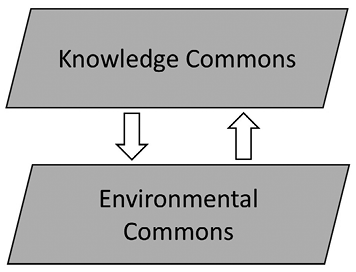

 Open access