


1. Introduction
The rapid development of generative AI systems, which gained widespread recognition with the advent of voice assistants and the significant advancements by OpenAI, is presenting companies with new opportunities (Reference MoriuchiFloridi & Chiriatti, 2020; Reference Floridi and ChiriattiMoriuchi, 2019). A prime example is Bosch's announcement that by 2025, all of its products will either be equipped with AI or developed and manufactured with the help of AI (Reference EbbergEbberg, 2020). The current transformation of the workplace goes beyond the adoption of AI and encompasses a variety of other trends that are profoundly affecting the role of engineers (Reference Dumitrescu, Albers, Riedel, Stark and GausemeierDumitrescu et al., 2021). In addition to the increasing use of AI and digitalization, the demands for sustainability, global connectivity or the focus on more meaningful work are reshaping how products are developed. These changes create opportunities to optimize product development and support engineers in their work by the help of a well aligned work environment but also pose challenges in engaging with the trends (Reference Krause and GebhardtKrause & Gebhardt, 2023). In this context, the concept of “New Work” has gained prominence (Reference Teichert, Pospisil, Brugger and LödigeTeichert et al., 2023). It promises to design work environments that cater to the individual needs of engineers and foster the realization of their potential to eventually enable them to thrive. In this study, we define ‘thriving’ as engineers being able to work productively, feel secure in their roles, and engage in meaningful and innovative work (Reference Spreitzer, Sutcliffe, Dutton, Sonenshein and Grantcf. Spreitzer et al., 2005). But are human-centered concepts like New Work truly the solution to the challenges posed by current and future trends in product development? This paper thoroughly examines the impact of current trends including the resulting challenges and potentials by taking a snapshot of the actual impact of trends on engineers that need to be considered when designing an environment where engineers can thrive.
2. State of the art
2.1. Developing advanced systems: ASE - Advanced Systems Engineering
In addition to the evolution of mechanical products into cyber-physical systems, modular product architectures and lightweight design developments (Reference Krause and GebhardtKrause & Gebhardt, 2023), the trend radar by Dumitrescu et al. (2021) demonstrates that a multitude of disparate trends, predominantly classified as megatrends encompassing digitalization, globalization and sustainability, exert a profound influence on engineering. In response to the ongoing changes in engineering, the guiding principle of Advanced Systems Engineering (ASE) was formulated (Reference Dumitrescu, Albers, Riedel, Stark and GausemeierDumitrescu et al., 2021). This principle is constituted by a triad comprising Advanced Systems (AS), Systems Engineering (SE), and Advanced Engineering (AE), thereby providing a comprehensive framework for modern product development. ASE integrates systematic methods, digitalization, and interdisciplinary collaboration to enable engineers to develop advanced systems efficiently. ASE recognizes that engineers face increasing complexity in cyber-physical systems and must continuously adapt. However, existing research within ASE primarily focuses on technical solutions rather than the work environments engineers need to thrive in (Reference Dumitrescu, Albers, Riedel, Stark and GausemeierDumitrescu et al., 2021).
2.2. The engineer at the center of product development
Recent literature has increasingly focused on the role of engineers as central figures in product development. This shift is exemplified by the system triple of product engineering, which positions engineers at the core of the process, emphasizing their crucial role in transforming goals into tangible outcomes through their unique contributions (Reference Albers, Heimicke, Spadinger, Degner and DuehrAlbers et al., 2019). The system triple of product engineering, comprising the system of objectives, the system of objects, and the operation system, offers a socio-technical perspective on product development, highlighting the critical influence of individual engineers in the success of the operation system (Reference Albers, Lohmeyer and HorváthAlbers & Lohmeyer, 2012). The significance of placing people at the heart of product development has been long recognized. Allen (Reference Allen1966) noted that understanding product development inherently requires an examination of human behavior, while Hales and Gooch (Reference Hales and Gooch2004) underscored the essential role of human responsibility in ensuring successful development processes. Creativity, a key driver of innovation, is deeply rooted in human cognitive processes, which involve memory, knowledge, and both intuitive and analytical thinking (Reference Bender and GerickeBender & Gericke, 2021). Effective problem solvers rely on intelligence, creativity, decision-making, and flexibility, attributes that are uniquely human and essential to navigating the complexities of product development (Reference DörnerDörner, 1984). Prior research has also identified several interdependent factors that influence engineers, which can be grouped into macroeconomic, microeconomic, organizational, project-related, and personnel categories (Reference Gericke, Meißner, Paetzold, Lindemann, Venkataraman, Kim, Lee, Cantamessa and YannouAlbers et al., 2019; Reference Albers, Heimicke, Spadinger, Degner and DuehrGericke et al., 2013). These factors present both opportunities and challenges throughout the product development lifecycle, impacting engineers in various ways. Successfully integrating these human factors into the development process is crucial for fostering innovation and overcoming obstacles, ultimately leading to more adaptive and innovative outcomes. Recognizing the importance of the engineer's role sets the stage for exploring how human-centered approaches can further enhance the environment in which engineers operate, to eventually ensure a successful development of Advanced Systems (Reference Reich and SubrahmanianReich & Subrahmanian, 2020).
This results in our understanding that an engineering environment is a socio-technical system in which engineering teams perform analysis and synthesis activities to develop innovative solutions. It includes all contextual factors that an organization can influence, structured within the dimensions of people, organization, and technology. These dimensions provide the foundation for enabling engineers to thrive:
-
People: e.g. competencies, collaboration structures, decision-making autonomy, and motivation.
-
Organization: e.g. project management approaches, leadership styles, corporate strategies, and stakeholder engagement.
-
Technology: e.g. digital tools, software systems, physical workspace design, and automation systems.
Understanding how these dimensions interact is critical for developing work environments that foster creativity, problem-solving, and productivity while addressing challenges such as growing product complexity, interdisciplinary collaboration, and increased external demands.
2.3. New Work in engineering
A key factor in designing enabling development environments is the consideration of human-centered approaches that address both professional and personal requirements. By aligning the workplace with engineers’ needs, organizations can create conditions that promote innovation and productivity (Reference Zoltowski, Oakes and CardellaZoltowski et al., 2012). A concept called New Work, rooted in the ideas of Frithjof Bergmann from the 1980s, has gained significant relevance in modern engineering as it aligns with the evolving demands for human-centered approaches. New Work emphasizes autonomy, flexibility, and meaningful work, offering a framework that addresses the changing expectations of engineers and the complexities of modern product development (Reference Hofmann, Piele and PieleHofmann et al., 2019). In the context of Advanced Systems Engineering (ASE), where interdisciplinary collaboration and continuous adaptation are crucial, New Work provides a human-centered approach that empowers engineers to thrive. The principles of New Work directly respond to the challenges engineers face in today’s rapidly evolving technological landscape. By promoting flexible work environments, decentralized decision-making, and personal development, New Work enhances engineers' engagement and creativity. This approach could support in ASE, where the integration of digital tools and agile methods requires engineers to be adaptive and innovative (Grote et al., 2020). The flexibility promoted by New Work practices, such as remote working and self-organized teams, not only improves job satisfaction but also increases productivity by allowing engineers to work in ways that best suit their individual needs and project demands (Reference SavicSavic, 2020).
The essence of concepts like New Work lies in creating environments where engineers can excel by aligning work structures with individual strengths and motivations. New Work suggests that these environments must be flexible, supportive of continuous learning, and focused on human-centric values, emphasizing work-life balance and fostering a culture of innovation (Reference Teichert, Pospisil, Brugger and LödigeTeichert et al., 2023). This ensures that engineers can adapt to and lead within the dynamic context of ASE (Reference Impertro, Duehr, Rust, Albers and BursacImpertro et al., 2023). While New Work offers significant benefits, its successful implementation in development environments requires overcoming cultural resistance and ensuring that the necessary digital infrastructure is in place. Leaders must adopt management styles that support autonomy and flexibility while maintaining productivity and innovation (Reference Von Au, Harwardt, Niermann, Schmutte and SteuernagelImpertro et al., 2023; Reference Impertro, Duehr, Rust, Albers and BursacVon Au, 2020). New Work provides a framework that directly addresses the essential characteristics of development environments needed for engineers to thrive. By aligning work practices with the evolving demands of ASE and the individual needs of engineers, New Work represents a critical pathway to creating more adaptive, innovative, and human-centered development environments.
3. Research objective and research methodology
The overarching objective of this study is to identify the essential characteristics of a development environment that enables engineers to thrive. Considering the evolving trends in the engineering sector, this research aims to determine what specific demands such environments must meet to place engineers at the center of product development, ensuring their well-being and productivity. Therefore, the goal of this paper is to thoroughly examine the current trends in engineering, including the challenges and potentials these trends introduce. By taking a snapshot of the evolving work environment, this paper seeks to understand how the trends impact engineers and their individual needs in a work environment that enables engineers to thrive.
The main research question guiding this investigation is:
-
What are the essential impacts of trends on engineers that need to be considered when designing an environment where engineers can thrive?
To address this research question, a mixed-method approach is employed following Tashakkori and Creswell (Reference Tashakkori and Creswell2007). Our approach is divided into four stages, each linked to specific methods and objectives (cf. Figure 1).
Mixed method research approach

The first stage involves clarifying the research context by establishing a general understanding of the study's focus. This is achieved through an extensive literature review, which helps to clarify the study's objectives.
The second stage includes an exploratory data collection process. This stage is based on semi-structured interviews with eight industry professionals to gather qualitative insights. This includes various job profiles and hierarchy levels. For example, a Principal Scientist from the glass industry or a Solution Manager from the automotive industry. Semi-structured interviews, widely used in qualitative research (Reference Kallio, Pietilä, Johnson and KangasniemiKallio et al., 2016), allow for structured questioning while exploring unknown areas, thereby uncovering new aspects within partially known research fields (Reference Wilson and WilsonWilson, 2014). These interviews are conducted following the methodology suggested by Buber and Holzmüller (Reference Buber and Holzmüller2007). Following the interviews, a systematic text analysis of the transcribed interview data using MAXQDA software is conducted. The analysis is based on inductive and deductive coding (Reference Mayring, Bikner-Ahsbahs, Knipping and PresmegKuckartz, 2010; Reference KuckartzMayring, 2015), offering insights into the qualitative and quantitative content of the engineers' statements.
The third stage involves the formulation of impact hypotheses based on the previous findings again using MAXQDA software. To this end, a new coding guide was created based on the general trends and their challenges and potential. This made it possible to derive thematic impacts. These impact hypotheses represent the current and future impacts of trends on engineers in the context of product development.
The hypotheses are ultimately evaluated in a fourth stage through a quantitative, cross-industry survey. To recruit participants for the study, engineers were contacted via several digital platforms, including LinkedIn, internet forums, Prolific, SurveyCircle and email, over a period of 50 days. The survey data of 122 engineers, analyzed using SPSS software, assesses the relevance of the impact hypotheses, giving answers about the impacts of trends that need to be considered when designing development environments that enable engineers to thrive. For each hypothesis of impact, agreement was gauged using two items: one for the general agreement with the described hypothesis (occurrence) and the estimated positive and/or negative impact strength of the impact hypothesis (impact), each representing a dimension of relevance. The respondents were asked to rate each of the aforementioned items on a five-point Likert-like scale (ranging from 1 - strongly disagree to 5 - strongly agree), or alternatively, they could choose to refrain from answering (Reference Sullivan and ArtinoLikert, 1932; Reference LikertSullivan & Artino, 2013). Furthermore, data pertaining to the respondents' demographic characteristics were collected for subsequent analysis to identify potential differences between age groups and company sizes. To ensure the representativeness of the sample, respondents were also asked to provide information regarding their occupation and industry. Additionally, an attention check question was integrated into the questionnaire to assess the respondents' engagement with the material. Trends on engineering from the perspective of engineers
Based on the inductive and deductive approach, a total of 25 trends were identified in the semi-structured interviews, which were deemed to exert an influence on the work of engineers. An overview of the frequency and distribution of mentions per interview (column) and trend (row) is shown in Figure 2. The size of the squares is indicative of the quantity of mentions, thereby elucidating the comparative disparities in mentions. In addition to identifying the trends themselves, the analysis also identified challenges and potential opportunities associated with each trend. For instance, the agility trend was found to present several challenges, as well as offering several opportunities. Similarly, some trends could be assigned to a higher-level trend if this was evident from the context. To illustrate, the observed trend towards the utilization of patents (Patents) was found to align with the trend towards overarching competition (Market competition). The trends of artificial intelligence (AI), agile working methods, sustainability and open innovation were highlighted particularly frequently in the interviews. However, the number of overall mentions varied between the interviews.
Overview matrix of the naming distribution of all codes identified in the interviews by interview (column) and code (row), in relation to all cells

4. Impacts of trends on engineers in product development
Based on the interview data, impact hypotheses were formulated to examine the influence of trends and their associated challenges and potentials for engineers (cf. Table 1). The objective of this analysis is to illustrate the impact of the trends on the individuals at the center of product development and to establish a causal relationship between them. For a more detailed understanding, the 14 impact hypotheses were divided into 24 individual, distinct items that represent the separated main contents of each hypothesis.
Impacts of trends on engineers in product development

5. Evaluation of impact hypotheses
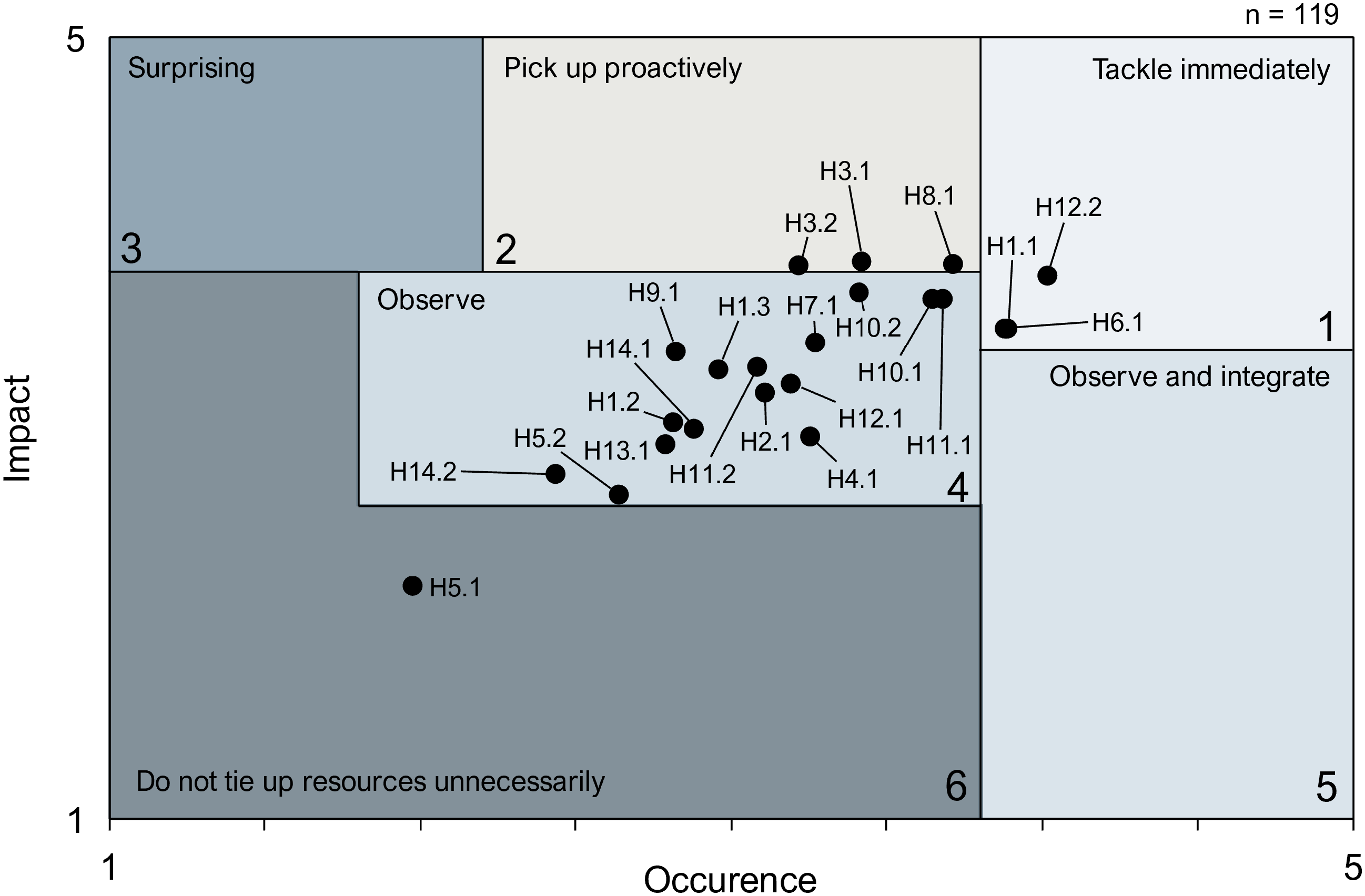
Eventually, the impact hypotheses were evaluated through a quantitative, cross-industry survey with 122 participants. The three most common age groups were 25-29 (22 %), 30-34 (25 %), 35-39 (13 %) and 50-64 (14 %). In terms of company size, the majority of respondents were from organizations with more than 250 employees (70 %). However, organizations with fewer than 10 (4 %), 10 to 50 (11 %) and 51 to 250 (13 %) employees were also included in the survey. It should be noted that a small proportion of respondents did not provide any information about the organizations (2 %). The impact hypotheses were allocated to the adapted trend portfolio by Fink and Siebe (Reference Fink and Siebe2011) based on the mean values by item (cf. Figure 3). The trends in area 1 of the trend portfolio (tackle immediately) are of particular significance due to the high rating of both dimensions (occurrence and impact) within the portfolio.
Adapted trend portfolio according to Fink & Siebe (Reference Fink and Siebe2011) for the relevance assessment of the evaluated impact hypotheses with a scale of 1 (do not agree at all) to 5 (completely agree)

It is therefore evident that there is a significant degree of relevance in the increase in responsibility for work results (H12.2), working in diverse teams (H1.1) and taking account of trends in the workplace (H6.1). In contrast, trends in area 2 (pick up proactively) as the growing importance of autonomy (H8.1) as well as the high number of meetings (H3.1) and their inefficiency (H3.2) need to be considered to foster environments where engineers can thrive. The majority of trends are situated in the midfield of the portfolio (observe), and thus should be considered in the context of future working environments, using resources and capacity. (cf. Figure 3). Moreover, the results indicate that engineers are apprehensive about the prospect of losing their employment (H5.1) as displayed in are 6 (do not tie up resources unnecessarily). However, the respondents stated that the potential impact on their work was minimal. It is therefore not essential to address this trend.
6. Discussion and outlook
This study investigated how current trends in engineering impact engineers in the center of product development. While prior research has identified general trends and their implications for product requirements or societal shifts, it often fails to consider their specific effects on the individuals driving innovation - engineers. Additionally, these studies tend to focus on isolated trends without examining their combined effects or the mechanisms underlying their impact. On the one hand, the results of the study demonstrate that trends such as digitalization, sustainability, and global collaboration persist in their significance, as would be anticipated. On the other hand, these trends influence not only product requirements but also the working conditions and demands placed on engineers. For instance, sustainability efforts necessitate balancing resource constraints with the pressure to innovate (e.g.: “[...] however, this also means that if sustainable solutions cannot at least be reconciled with the cost requirements.” Interview F). These findings extend existing knowledge by emphasizing how trends collectively shape the experiences, expectations, and challenges faced by engineers, an aspect previously underexplored in literature. However, it does not aim to redefine or reinterpret these trends but rather to provide empirical evidence of their multifaceted impact, particularly regarding challenges like maintaining creativity under increasing time and resource pressures.
The insights gained from this study contribute to the overarching goal of designing development environments that enable engineers to thrive by aligning their work conditions with their individual needs. One limitation is the subjectivity of the results, for example in the categorisation of the hypotheses in the portfolio, which is why further studies based on structured design methods are being carried out. Future work will focus on developing methods, processes, and tools that support engineers based on their individual needs, aligning with the principles of New Work. For example, the identified need for structured collaboration despite increasing flexibility (H3, H10) highlights the importance of balancing autonomy with organizational structure, a core element of New Work (Reference Teichert, Pospisil, Brugger and LödigeTeichert et al., 2023). Additionally, findings such as the challenge of increased stakeholder involvement (H2) emphasize the need for transparent decision-making structures, another key aspect of New Work. One other direction is the development of a modular organization system tailored for engineering teams based on applying structured design methodologies (Reference Kolberg, Reich and Levine.g. Kolberg et al., 2014). In our approach, we will draw from the principles of modular product development to combine standardized structures with flexible options to accommodate diverse needs. For example, modules could include tailored collaboration frameworks, flexible scheduling models, or tools for remote work, allowing teams to adapt their workflows while maintaining consistency. This approach aims to balance efficiency with individuality, fostering collaboration and reducing internal complexity. Beyond organizational improvements, the overarching goal of this research is to enhance the resilience of both engineers and organizations. By fostering environments that prioritize engineers' well-being, creativity, and productivity, the research aims to strengthen their capacity to navigate emerging trends and challenges, ultimately driving sustainable innovation in product development.
Acknowledgements
This work is based on the unpublished master thesis by co-author Fabian Dernbach (Reference DernbachDernbach, 2024).



 Open access

