


Early intervention services (EIS) for young people experiencing first-episode psychosis (FEP) were introduced in England from the 1990s and operate across the country. Motivating an EIS model of care in psychosis was growing recognition of the relationship between a longer duration of untreated psychosis and poorer outcome, Reference Marshall, Lewis, Lockwood, Drake, Jones and Croudace1 alongside patient and carer dissatisfaction with existing services. 2 EIS are intended to be low-stigma, high-intensity and youth-friendly, focusing on young people aged between 14 and 35 years.
A sustained engagement, where possible, of EIS with the young person's family is a key tenet of the UK Mental Health Policy Implementation Guide, 3 which suggests that family members should be involved in the assessment and treatment process as early as possible. Receiving the support of family members has also been identified by service users as important to recovery, Reference Lester, Marshall, Jones, Fowler, Amos, Khan and Birchwood4 and research suggests that relatives can be pivotal to instigating and sustaining individuals' engagements with mental health services. Reference Chung, Jung, Kim, Lee, Shin and Shin5 In terms of supporting informal caregivers themselves, the Policy Implementation Guide suggests that ‘care must be taken to engage and support all those important to the service user’, and that EIS should offer ‘psycho-education, family therapy and support’. 6
Carers' experiences of a relative's mental illness have been most explored in terms of expressed emotion Reference Scazufca and Kuipers7 and coping strategies Reference Gerson, Wong, Davidson, Malaspina, McGlashan and Corcoran8 with research also highlighting wider difficulties in daily life. Reference Karp9 The necessity of recognising and validating these difficulties has been emphasised, Reference Noble and Douglas10 as has the need for greater attention to caregiving experiences. Reference Kenny, Sarma and Egan11 These are both calls that qualitative analysis is ideally placed to answer to ensure that existing explorations of meaning and experience with service users Reference Corin, Good, Fischer, Willen and DelVecchio Good12,Reference Larsen13 are complemented by those with carers. The importance of identifying gaps in service provision, and thereby providing the evidence base to improve practice, is underscored by a recent suggestion by the UK Royal College of General Practitioners that up to 40% of the UK's informal carers experience psychological distress or depression. 14 Previous research also found that up to a third of those caring for a relative with psychosis met criteria for post-traumatic stress disorder. Reference Barton and Jackson15
However, whilst recognising both the ‘distress’ Reference Addington, Coldham, Jones, Ko and Addington16 engendered by a relative's illness and the potential ‘burden’ Reference Knock, Kline, Schiffman, Maynard and Reeves17 of caregiving practices, it is also necessary to ask what impact on carers might be wrought by the healthcare services treating their relatives. Carers' advocates warn that it may take years before the effects of the recent changes to commissioning in the NHS become apparent. Reference Blog18 This warrants an investigation not only of the relationships between the NHS and its patients but also of how it engages with the families of those service users, who are estimated to save the UK economy £119 billion a year in care costs. 19
In this paper we analyse intersections between the experiences of carers of young people with FEP and EIS's practices of engaging with families. Although the findings derive from a focus on one type of service they offer insights that may be useful across mental health services.
Method
The data presented in this paper were collected using in-depth longitudinal interviews between 2011 and 2014 for the qualitative component of the ongoing Super EDEN (Sustaining Positive Engagement and Recovery) study (2010–2015). Super EDEN aims to evaluate EIS for young people with FEP using mixed methods. It is funded by the National Institute for Health Research, obtained ethical approval from the NHS and adheres to Good Clinical Practice. Reference Verma20 Super EDEN runs at five sites across England: Birmingham, Cornwall, Cambridgeshire, Norfolk and Lancashire.
Participants
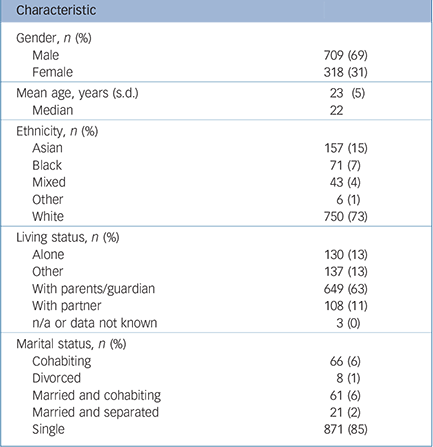
Super EDEN is following up participants to the National EDEN study (2005–2010). Reference Birchwood, Lester, McCarthy, Jones, Fowler and Amos21 A total of 1027 service users consented to participate in National EDEN on their inception into EIS across the five sites (Table 1).
Demographic characteristics of the National EDEN sample (n = 1027) on their inception into EIS
| Characteristic | |
|---|---|
| Gender, n (%) | |
| Male | 709 (69) |
| Female | 318 (31) |
| Mean age, years (s.d.) | 23 (5) |
| Median | 22 |
| Ethnicity, n (%) | |
| Asian | 157 (15) |
| Black | 71 (7) |
| Mixed | 43 (4) |
| Other | 6(1) |
| White | 750 (73) |
| Living status, n (%) | |
| Alone | 130 (13) |
| Other | 137 (13) |
| With parents/guardian | 649 (63) |
| With partner | 108 (11) |
| n/a or data not known | 3 (0) |
| Marital status, n (%) | |
| Cohabiting | 66 (6) |
| Divorced | 8(1) |
| Married and cohabiting | 61 (6) |
| Married and separated | 21 (2) |
| Single | 871 (85) |
All participants to National EDEN (2005–2010) were invited to take part in Super EDEN (2010–2015). A total of 518 service users consented to participate in Super EDEN, with 207 of those taking part in qualitative interviews. A total of 98 carers also consented to participate in qualitative interviews. This paper presents the data of 80 carers who had completed at least one interview by the end of 2013.
To maximise variation in socio-demographic characteristics, a purposive sample of service users in each site was approached. They were asked if ‘someone who had supported [them] through the illness might like to take part in a carer interview about their experiences'. Carers were thereby nominated for participation in the study by service users. Individuals identified by service users were approached by the team and invited to participate in an interview.
The term carer is contested, with definitions varying across research and policy, and it is recognised that family carers may not self-identify as ‘carers’. Reference Henderson and Forbat22 Our recruitment approach allowed young people's own definitions of ‘carer’ to emerge. It aimed to avoid assumptions on the part of the research team regarding who counts as a carer and what this might comprise. This enabled us to take account of people who were not necessarily primary caregivers in terms of a task-based definition, but who had been impacted by the service user's FEP and had also come into contact with EIS. Throughout the paper ‘carer’ and ‘caregiver’ are used interchangeably for ease of reading.
Demographics
The mean age of the 80 carers whose data are presented in this paper was 49.9 years at first time-point (range = 23–80). The median was 51, and s.d. was 10.8 (Table 2). At first time-point, six of the service users were still with EIS and 74 had been discharged. Most carers were interviewed individually. However, seven interviews took place with a partner, other family members or the service user present for at least some of the interview, at the choice of interviewees themselves.
Ethnicity and gender of carers

| White British | White Irish | White Other | Mixed White/Asian | Asian Pakistani | Asian Indian | Dual Heritage | |
|---|---|---|---|---|---|---|---|
| Female (n = 56) | |||||||
| Mother | 42 | 1 | 1 | 1 | 1 | 1 | 2 |
| Partner | 4 | 1 | |||||
| Grandparent | 1 | ||||||
| Sister-in-law | 1 | ||||||
| Male (n = 24) | |||||||
| Father | 13 | 1 | 1 | ||||
| Stepfather | 1 | ||||||
| Partner | 5 | ||||||
| Grandparent | 1 | ||||||
| Sibling | 2 | ||||||
Data collection and analysis
Interviews were conducted by researchers trained in qualitative methods, taking informed consent and ethical research practice. Interviews were designed to last for approximately an hour but were often longer at the direction of participants. All participants provided written consent.
Topic guides were written with the valuable input of a Lived Experiences Advisory Panel (LEAP) of young people who had undergone psychosis and received treatment from EIS, and a carers' reference group. Underpinned by the interpretive qualitative framework of medical anthropology, Reference Lambert and McKevitt23,Reference Russell Bernard24 which emphasises the social, cultural and structural dimensions of individuals' experiences, topic guides were flexible; although semi-structured, they offered participants a choice regarding the topics they would like to discuss. Interviewees were also invited to talk about any other aspects of experience they felt it important to highlight to the researcher. Fitting with the epistemological framework of the study, this aimed to maintain an openness to participants' concerns throughout data collection. Interviews engendered a reflexive process of co-examination between participant and researcher of the meanings that carers attributed to their experiences as well as of relationships between these and wider cultural processes and healthcare structures.
Interviews were transcribed verbatim by a professional transcriber. Quality checks were performed by comparing a random sample of recordings to transcripts. Transcripts were analysed using iterative thematic analysis. Reference Corbin and Strauss25 No software was used during the analysis. Coding drew out key themes, words and phrases. It comprised constant comparison, with the relationships between codes explored alongside an analysis of each code across the transcripts. ‘Deviant cases’ were sought to challenge emerging interpretations. Conducting the analysis concurrent with data collection ensured iterative interaction between data and analysis to enhance reliability. Reference Morse, Barrett, Mayan, Olson and Spiers26 Overall reliability was established by probing the relationship between each individual transcript and the themes across the interviews as well as through discussions within the research team to forge shared interpretations. Emerging results were also explored at meetings with the LEAP and carers' reference group.
This analysis was done in tandem with that of data from seven focus groups with EIS staff and interviews with 209 service users. This simultaneity allowed a triangulation of analysis to take place where prevalent themes in carers' interviews could be tracked across these other transcripts. Being careful not to unethically impute similarities, this allowed us to map out relationships between informal caregiving and mental health services. This paper does not present data from the focus groups or service user interviews, but the former are referred to in the discussion to contextualise key findings from carers' interviews.
Results
Results are presented in three sections; the first explores the concept of caregiving (Carers' Accounts of What They Do) with the second focusing on affective challenges (Carers' Accounts of How They Feel). The third section (Talking and Listening) examines how the preceding two sections illustrate intersections between carers' experiences and EIS's ways of engaging with families.
Carers' accounts of what they do: ‘producing normality’, vigilance and medication management
Although data were not explicitly collected on the living status of carers in Super EDEN, and therefore whether their caregiving could be quantified as ‘full-time’, interview transcripts evince a fluidity to service users' living status. Many carers described the service user moving in with them at the onset of psychosis or during subsequent times of crisis and others recounted days, and even nights, spent at the service user's residence. Such accounts demonstrate that common to carers living apart from their relative and to those cohabiting is the undertaking of a wide range of supportive practical tasks. Those frequently listed by carers include:
‘Trying to remember her appointments, trying to help her cope with some of the everyday problems that she has to deal with, e.g. laundry and housework and just being at certain appointments at certain times’. (mother of Leila, 24)
Many interviewees framed such tasks as helping to produce and maintain a sense of mundane familial continuity, of what some carers termed ‘normality’, for the service user. Two parents interviewed together described going to their son's house to do his tidying, laundry and shopping to offer him ‘structure’ and thereby prevent him from ‘slipping into’ what they termed ‘that floppy little world of his’. Likewise, one participant described how he helped his partner:
‘It was intense straight from the start, so I've had to find out how to help with it and calm her down. It's just become a day-to-day routine with her, because it's been something I've done since we've been together’. (male partner of Yvonne, 27)
Yet, this emphasis on producing and maintaining calm continuity for the service user was juxtaposed in many carers' accounts with flux, hurry and rupture that had come to be part of their own lives. These ensued from the pressure of finding time to perform practical tasks and also from the anticipation of being needed at any moment. This latter was described as forging a continual preoccupation with the service user. This can lead caregiving to feel ‘full-time’ even if living apart from the service user, as caregivers' daily lives may be reconfigured by the anticipated needs of their relative. Such accounts demonstrate how caregivers can find themselves continually reacting to situations:
‘Wherever you are at the weekend – two o'clock in the morning, whatever I'm doing, it doesn't matter – if I'm needed I have to go. And sometimes that's difficult for people to understand if it's not their daughter. He'll [partner] just turn over and say “good-bye” as the phone rings before I've answered the phone, “I'll see you in a week then”’. (mother of Leila, 24)
‘Because she was on a heavy dose of anti-psychotics she was sleeping most of the morning; I mean she slept very, very heavily thirteen hours a night. And you know I always used to dread her waking up because, you know, there was a kind of sense of, I mean I just felt that her personality completely disintegrated and I don't know, it was such a huge level of stress’. (mother of Abigail, 29)
As shown by this second quotation, interviewees described the register of daily life changing quickly from calm to flux or even crisis. This can be precipitated by something as small as the service user waking up and may leave the carer needing to ‘catch up’. However, this same quotation also highlights how caregiving can be intangible; it may involve simply ‘being there’, which is echoed throughout our data:
‘Caring for him really it's not like having to care for somebody that's physically handicapped, you don't really have to do anything for him it's just a matter of knowing that he's, he's actually okay you know’. (mother of Tony, 32)
This ‘being there’ was described by participants as solidifying into a task in and of itself. Many recounted the perpetual embodied vigilance of watching over their relative and being continually ‘on alert’ to small changes; alterations to how a relative sat or ate were highlighted as indicative of shifts in their well-being.
Interviewees described this vigilance as underpinned by a growing knowledge of psychosis symptomatology and medications. They widely attributed these to encounters with EIS staff in which the illness, symptoms and strategies to deal with potential relapse had often been explained. Our data also elucidate how this knowledge is absorbed into existing familial contexts. One grandmother knew that her grandson was not taking his medications because he had begun to use the front door of the house rather than the back; this was unusual for the family and therefore a significant sign of relapse. As such, knowledge transfer on the part of EIS was described as central to carers' understandings, and sometimes also management, of service users' medications. The partner of a young woman with FEP, for example, echoed other carers when recounting how she took charge of her girl-friend's medications, keeping them locked in a drawer. Likewise, one mother described administering medications to her daughter, saying:
‘I find it difficult, you know, to … asking somebody of 25 to take tablets in front of you feels bad, but on the other hand it's a lot worse if she doesn't take them … if we get a bit relaxed about it, which after a few months of her doing it regularly we sort of think oh, it's fine, she's got into the habit now, and then she starts behaving a little bit erratically, and we say, “are you taking your tablets?” ’. (mother of Eva, 25)
Carers' accounts of how they feel: reward, distress and reconfigured lives
Carers' interviews were intimate and emotional and many described not having talked about their experiences before meeting the researcher. A palpable distress resonates through our transcripts:
‘I felt myself almost going over the edge too. I felt I could really not keep us both together. I felt I could lose it and get terribly depressed and, you know, I felt I was just having to hold on to all my sense of normality myself’. (mother of Aziz, 27)
‘Sometimes I can start getting angry and I feel tired in myself and things like that and I can't cope with even the littler things that shouldn't bug people really; they start getting on me nerves and I think, I need a break from it, you know. 'Cause the, the, littler things bug me bigger than the big things 'cause the big things I seem to handle’. (mother of Jacob, 22)
Transcripts elucidate the many ways in which the well-being of carers comes to depend on that of the service user; the parameters of caregivers' happiness may narrow and be continually re-sited in line with the young person's state of health:
‘We know he's still alive and that keeps us happy to a certain level of happiness, in a sense, that we know he's not hurt himself or anything like that’. (mother of Andrew, 28)
The depth of this intertwining is highlighted by carers' drawing of parallels between their own experiences and those of the service user:
‘The thing was with carers or parents or whoever, you're going through the same situation as [Tony] is. [Tony's] in a world of his own so to him nothing's happening, he's okay you know. It's us around that aren't okay … it wasn't a traumatic experience for him; it were for everybody else’. (father of Tony, 32)
There is a link between these parallels and interviewees' articulations above of being ‘on alert’ – constantly preoccupied with, and watching over, their relative. This is illustrated by the presence of uncertainty in our transcripts, which elucidates continual alterations to caregivers' lives and sense of self. Many recounted ‘taking each day as it comes’, coping day-by-day and not looking towards the future or making any plans, particularly during the most acute phase of a relative's episode:
‘I used to worry about going out and, you know, what you'd find when you get back’. (mother of Lynne, 31)
Carers described undergoing a continual process of adjustment. Yet, within this, shock, anger, loss and uncertainty were not only engendered by a relative's illness onset or diagnosis. Rather, our data suggest that distress can solidify and settle, seeping into many areas of daily life that go beyond the service user's well-being. It can remain even after their recovery, both because embodied vigilance can be hard to let go and because carers may find that bit-by-bit their lives and selves have been cumulatively, but hugely, reshaped.
Although distress was, therefore, very evident in our interviews, it must also be noted that the rewards of caregiving were described as well. These rewards are intimate and heterogeneous; they include a renewed closeness to, and joy at spending time with, the service user, as well learning about one's own character and sense of self. Closer attention to the personal, social and structural factors that tilt the balance between distress and reward in individual caregiving experiences warrant further exploration. In our study, parents were most likely to explicitly articulate reward within their interviews. Some described how the service user's needs had reinvigorated an active parenting that had, as children reached adulthood, shifted into the background. ‘It's/it was like having a baby again’ is a reoccurring phrase, and one that expresses an ambivalent mix of loss, entrapment, closeness and continuity.
Beyond this significant trope in parents' interviews, the sociodemographics of carers themselves do not correlate with a greater or lesser amount of distress or reward articulated. Rather, a high level of distress expressed in interviews most clearly intersected with caregivers' descriptions of how they had not felt able to talk about their experiences in any other setting, such as with mental health services.
Talking and listening: services and carers
Supporting caregiving
The majority of our interviewees were positive about EIS. The value placed on this service by carers is twofold; it lies in EIS's support of the service user her/himself, and also in how EIS provide caregivers with support to care for their relative.
Participants positively described EIS's care of the service user as allowing them to share responsibility for the young person. This was a responsibility that many carers had felt they carried alone between the onset of symptoms and the service user's inception into EIS:
‘I think they're unbelievable, they're unbeatable, I'd recommend them to anybody. I'd recommend them to anybody because they are – they're there and when they say they're there to help, they literally mean they're there to help’. (mother of Joe, 21)
Given the intertwining of service users' well-being with that of carers, noted above, this sharing was described as alleviating carers' distress:
‘Well, the thing that I felt was the most important thing [about EIS] was actually [Leila] should go somewhere and she was safe, so I could sleep’. (mother of Leila, 24)
EIS were also praised for supporting participants' caregiving of the service user. Particularly highlighted was the provision of information about psychosis and antipsychotics, which we saw to underpin the vigilance and medication management, above:
‘I thought they were very good. I mean, they did, like I said, they did give me a bit of support, you know, when they came they had a chat with me. They did, erm, explain everything, what was wrong with [Lisa], that it was psychosis and what that was’. (mother of Lisa, 21)
One father described himself as ‘stunned’ by the ‘plain language’ used to make medical complexities clear.
As well as offering information, many carers felt that EIS team members listened to their worries about the service user, taking on board their observations and expertise regarding medications or a worsening in symptoms, for example. This allowed them to feel recognised by EIS team members as playing a key role in keeping the service user safe:
[EIS] made us feel part of the team in a sense. They'd ask us, like, almost in the same vein as you'd ask at the end of a shift in a hospital. (father of Patricia, 30)
A minority of carers, however, recounted difficulties arising in their interactions with EIS. These were particularly related to confidentiality, data protection and, given the age range of EIS's clients (14–35 years at the time of interviews), a desire on the part of some service users not to have family involvement. Some carers also felt their observations not to be taken note of sufficiently quickly or explicitly by EIS:
‘I think they should listen to you a little bit sooner especially you know being his parents – you, we know him, we know when he's doing things that aren't the norm and they should have taken notice of that’. (father of Tom, 32)
This sense of not being listened to clearly leads to self-censoring on the part of some carers who described difficulty or unwillingness in articulating their concerns. There is also a lack of confidence in their own observations, with some caregivers feeling that the alterations to a young person that may signal relapse are too intangible or small report.
Our data do not evince any significant correlations between socio-demographic characteristics of carers themselves and a positive or negative engagement with EIS. Importantly, the opinion of individual carers is seen to alter between time-points and within the space of one interview when describing differing past experiences, different teams or team members within EIS, or their opinions of wider funding cuts to mental health services. Overall, frustration at not being listened to as ‘part of the team’ emerged as a cause of distress, with a positive engagement being described as ‘empowering’ and ‘reassuring’. However, from our data emerges a further key finding: although being ‘part of the team’ may lead to carers being listened to, this listening may only be partial. In describing how EIS supported them with what they do, carers clearly expressed how they did not receive the same input with how they feel.
Supporting carers themselves
Many interviewees reported never having been asked by service professionals how they themselves were feeling. To the researcher's question regarding whether she had been offered any support for herself by EIS, one participant replied in the negative, explaining:
‘I've always been asked to support [Zoe]’. (female partner of Zoe, 27)
There are, thus, layers of listening in which EIS listen to carers for information about the service user but not so much to carers' own experiences. This was felt by many interviewees to leave the often-substantial affective impact of both a relative's illness and of caregiving unacknowledged. In her interview, a mother who had initiated her son's contact with EIS and who felt ‘relieved’ after feeling ‘so alone’ with him also said of his FEP:
‘It was a terrible experience really in so many ways and I really would have benefitted from talking to somebody … I needed somebody dispassionate to be able to help me with him and help me manage myself really’. (mother of Aiden, 27)
Later in the interview, she continued:
‘I think [Aiden] got a very good service really. I don't think I did but I didn't really … I kind of didn't really expect it either and I probably should have expected it and I probably didn't think that I wanted it so much as now when I look back I think God, I could have really done with that. So I think I suppose what would be helpful is if somebody said in all cases where you're a carer for somebody with psychosis you can have somebody to talk to just for yourself and they're there at any time. If that had been said to me I think I would have probably taken it up’. (mother of Aiden, 27)
Interviewees articulated a lack of knowledge regarding possible avenues of support open to them, being unsure of where they might go both within EIS and beyond:
‘I don't really know what Early Intervention have got at their disposal 'cause I've never – they've never actually sat down and told me what is actually available for me to ask for or, you know, I've had to find it all out myself. You know, I mean, if they could explain to people actually what they can do and what they can't do, then, you know, people would have a clearer picture’. (father of Nancy, 23)
Moreover, our data demonstrate a lack of expectation of support for themselves on the part of carers. Two parents interviewed together regarded EIS as having provided:
‘Absolute support both for [Eva] and for us, really good’. (father of Eva, 25)
Yet, when telling the researchers that they were ‘the first people to ask us how we feel’, Eva's parents described only having identified the need to talk through their feelings after their daughter had recovered; they felt themselves to have been too concerned about her well-being during the episode to notice their own needs:
‘It was extremely traumatic and I think it's only when you get to start being probed on it, you actually think that was really … the 2009 episode was deeply traumatic’. (father of Eva, 25)
In line with the more frequent explicit articulation of caregiving rewards amongst parents and descriptions of the return to more active parenting, it is notably also parents who expressed a greater lack of expectation of support, and who were less likely to identify themselves as ‘carers’:
‘It's more than caring’
‘It's loving and caring’. (mother and father of Ben, 25)
However, parents in particular also described feeling that EIS and mental health services more widely had certain expectations of them because they were parents without taking into account the complexities of family life or their own needs. This was especially noted in relation to acute crisis moments such as a service user's discharge from hospital to the parental home being conducted without sufficient discussion. Such expectations arguably compound a lack of help-seeking by normalising the absorption of caregiving into parenting.
As such, our data suggest that the prevalent lack of expectation of support across our interview narratives can partly be attributed to how existing kinship relations expand to absorb a new care role. Yet, it is also clear that it cannot easily be disentangled from the ways in which that role is both depended on and shaped by EIS; the discussion section will explore this.
Discussion
In line with previous research, carers in this study value the help offered to them by EIS to support their relative. In particular, EIS's provision of clinical information was praised for aiding a process of ‘expertification’ Reference Epstein27 around psychosis and medications, which underpins informal caregiving. As it has been suggested that it can be difficult to meet carers' needs for information about a relative's psychosis because of diagnostic ambiguities, Reference Sin, Moone and Wellman28 such knowledge transfer must be recognised as a success of EIS.
Moreover, whilst previous discussions of carers of individuals with psychosis have suggested that many feel ‘undervalued’ Reference Jones29 and ‘marginalised by services’, Reference Shiers30 overall our participants recounted feeling that their insights into the service user's treatment and well-being are listened to by EIS. It is however important to acknowledge the minority of less-positive voices; some carers described not feeling listened to, with both the speed at which EIS take account of observations and legal issues around confidentiality criticised. There is also some self-censoring on the part of carers, which suggests that relatives may lack certainty regarding how much their voices matter; this perhaps needs explicitly addressing by EIS teams and as part of early warning signs materials.
Overall, though, the majority of carers interviewed felt EIS to recognise the value of their caregiving within the home. This is supported by triangulating these data with those from the focus groups conducted with EIS staff. A team member was not alone when he stated that carers ‘do our work when we are not there’. Yet, there is an important paradox to this role too, with the listening that accompanies it being partial: whilst EIS are widely praised by carers for listening to them in relation to the service user's needs, many feel their own needs and emotions not to be recognised.
Whilst it is important to acknowledge articulations of caregiving rewards as well as distress, Reference Bauer, Koepke, Sterzinger and Spiess31 a prevalent feature of our participants' narratives is distress. As this distress is, to a certain extent, intertwined with the well-being of the service user, an indirect consequence of EIS's care for the service user is clearly the alleviation of carer distress. Yet, intersecting with previous discussions of caregiving, Reference Barnes32 the data in this study also evince the wider personal and social impacts of caregiving. The affective alterations described by carers extend beyond a correlation with their relative's well-being. Many recounted undergoing a series of small but cumulative changes to their everyday conditions of possibility, which presented huge biographical challenges Reference Chamberlayne and King33 lasting beyond the service user's illness.
Many participants, however, stated that they had never been asked how they were feeling by EIS staff, and recounted not having had any opportunities to talk about their emotions. Thus, an emphasis on knowledge transfer and on carers being ‘part of the team’ without a concomitant attention to how both caregiving and the young person's illness may both cause distress risks leaving central aspects of carers' lived experiences unacknowledged. This may also have further ramification for carers' well-being.
Super EDEN's data demonstrate that carers both receive and ask for little help with their affective challenges; there is a prevalent lack of help-seeking amongst our participants. Arguably, the frequent intangibility of caregiving contributes to this lack, as does the ways in which the practical tasks and emotion work of caregiving can be absorbed into existing familial relationships such as that between parents and children; ‘taking care of' expands to accommodate a more intensive ‘caregiving’. Reference Barnes34
Yet it is also apparent that carers who would like to talk about their experiences do not currently know where to go for help. We therefore cannot simplistically assume a linear relationship between an individual's lack of well-being and help-seeking. Many participants also only explicitly identified this need for help with their emotions in retrospect. This highlights a wider finding from these data: carers may postpone their own emotional needs to prioritise those of the service user and this postponement is framed by them as a central part of caregiving. Many interviewees described their role as creating calm and continuity for their relative. It is in relation to this production of calm that a particular relationship between carers' experiences and EIS's engagements with carers emerges.
In the focus groups with EIS teams, staff members placed emphasis on stress reduction for carers in order that they might better support service users, not for themselves. Although this does echo the Policy Implementation Guide's suggestion that the ‘engagement of family/friends […] can alleviate stress within the family’, 6 it also serves to frame carers' emotions as not part of, or even as interfering with, caregiving. This suggests that EIS may come to rely on a specific informal ‘care role’ that has no space within it for carers' own emotions to be heard or spoken.
Our data further indicate that this reliance on the part of EIS is productive; it shapes carers' expectations of themselves ‘as carers’. It serves to legitimise, and thereby solidify, an existing lack of expectation of help on the part of carers. Contextualising this in relation to EIS's emphasis on knowledge transfer elucidates that, although this latter is highly valued by carers, it cannot be disentangled from this interactional process.
All these engagements with carers on the part of EIS transfer particular expectations of, and templates for, caregiving. This template – of postponing emotion and watching vigilantly for relapse – demonstrates that EIS's engagements with carers may not only shape what they do with their emotions, but also how and when they might feel these. If, as anthropological analysis has shown us, ‘experience is not an existential given but rather a historical possibility predicated on a certain way of being in the world’ Reference Desjarlais, Good, Fischer, Willen and DelVecchio Good35 it is clear why many interviewees described only feeling the full force of their affective challenges long after their relative's illness episode.
Overall, thus, interactions between carers' experiences and EIS highlight how becoming a ‘carer’ is not automatic at the moment of a relative's diagnosis but is a complex configuration of social processes, some of which are embedded in existing healthcare structures; as Charmaz suggests, ‘the structure of medical care extends its reach into the depths of private life’. Reference Charmaz36 Likewise, both caregiving practices and healthcare structures are embedded in cultural and political contexts. As this wider landscape continues to shift, there is a pressing need to acknowledge and engage with the lives, emotions and experiences of caregivers.
Limitations
Our study has a number of limitations: we cannot be sure that our participants are representative of carers. Yet, both the gender distribution of our sample and the high proportion of parents, in particular of mothers, do echo previous research into caregiving in FEP. Reference Patterson, Birchwood and Cochrane37 The high proportion of white British carers is broadly reflective of the demographic make-up of the study sites and of the service users participating in the study (73% of the overall cohort of service users consented into National EDEN are white British). However, it is also clear that it is a white British female viewpoint that is most represented, which is a potential limitation.
Carers' accounts may contain some post hoc reconstruction. This is always a feature of qualitative research that asks participants to look back at a particular time in their life. However, it arguably does not detract from the value of the research as individuals' processes of meaning-making take place at many different moments during and after their relative's FEP and the interviews. It would be unethical and unscholarly for us to categorise particular moments or reflections as more ‘authentic’ or ‘valuable’ than others.
A further limitation may ensue from the fact that carers participating in the study were nominated by their service user relatives. As such, this paper tells the story of families in which service users have benefitted from informal support. Although it therefore does not portray the experiences of service users without this type of support or families not able or willing to provide this, the discussion does highlight the needs of families/partners/friends who undertake caregiving roles. These findings have a number of implications for practice.
Implications for practice
In highlighting how supporting and empowering carers to be ‘part of the team’ can be so valued by carers whilst simultaneously having paradoxical ramifications for their well-being, these data point to wider issues in how families are currently supported by mental health services. EIS's emphasis on providing information about psychosis, medications and illness management strategies informally echoes the suggested provision of psycho-education in the guidelines, noted earlier. As such, EIS's approach replicates a wider growing emphasis on psycho-education initiatives for carers and evaluations of these have also suggested that few target distress or difficulties. Reference Kuipers, Onwumere and Bebbington38 Our data demonstrate that such an emphasis on knowledge transfer without a concomitant attention to carers' affective challenges risks leaving fundamental aspects of their lives unacknowledged and compounding an existing lack of help-seeking.
Strong relationships between EIS team members and service users have been highlighted as key to service user satisfaction. Reference Lester, Marshall, Jones, Fowler, Amos and Khan39 This was also recognised as a central aspect of their care role by EIS staff in our focus groups. That carers sometimes related their diverging experiences of EIS's listening to staff, team and funding changes suggests that a greater emphasis on continuous individual relationships between EIS staff and carers may be of benefit to carers.
These data suggest that mental health professionals may feel more comfortable giving information and guidance rather than listening to and working with carers' complex emotions; developing their confidence to support families and friends through their own journey while giving them hope and a clear role in recovery, particularly in the early phase of the psychosis, should perhaps be a part of core skills training for staff.
However, it is also arguable that, by engaging with carers in the ways that they currently do, EIS offer as much support as is ethically possible without losing focus on, or moving resources away from, service users or causing complexities in those relationships. EIS are commissioned to care for those with FEP and a greater attention to carers' well-being may give rise to difficulties around confidentiality, divided priorities and increasingly stretched funds.
It is clear that carers' needs are many and varied and our data show that some may not want or expect to talk about their experiences or emotions within formalised services, particularly during their relative's illness. Even should they wish to do so, this desire will arise at varying temporal moments. Yet it is also clear that a lack of help-seeking cannot be assumed to indicate the absence of need. Such a lack is compounded by caregivers' encounters with existing healthcare structures. That the lack of an expectation of support for themselves on the part of carers is legitimised by their experiences of not being offered help or asked how they are suggests that there is a need for clearer signposting; carers may need help more actively offered so that their experiences are not both unheard and unspoken.
Whilst arguing that mental health services need to be careful not to depend too heavily on the unseen emotional and practical work of informal caregiving without paying greater attention to carers' own needs, these data also invite primary care into this ongoing discussion. It may be long after an episode, after the service user's contact with EIS or a community mental health team ceases, that carers look back and feel the need to talk through their emotions. More ‘hands on’ crisis support to deal with acute episodes perhaps needs to be followed later by support addressing distress and personal challenges. As such, further research into carers' personal coping strategies and the ways and moments in which they would like to talk, and to whom, is warranted. This would offer insights into the best positioning of interventions and support. Our data suggest that a phased intervention across services involving collaboration between EIS and primary care might be key. Primary care is arguably well-positioned to step in at the moment when a need for help is felt and articulated and it offers the opportunity for a continuous therapeutic relationship.
Furthermore, from the duration and content of our interviews, it appears that what may be welcomed by carers are open unhurried alternative spaces in which they are taken seriously as individuals with valuable experiences and expertise. As such, peer support may also have a key role to play. This type of support is already being offered by voluntary sector organisations, such as Rethink Mental Illness. It may be of benefit to families for EIS staff to familiarise themselves with relevant local and online support provision; these could be mentioned to caregivers and accessed by them when needed.
Overall, our findings indicate that engaging with the multidimensional and urgent needs of carers of individuals with mental illness may need to be made a priority of the currently evolving NHS. Further research is therefore necessary to guarantee that carers are supported alongside, as well as through, service users, and to ensure that they are listened to as well as for.
Funding
This article presents independent research funded by the National Institute for Health Research (NIHR) under the Programme Grants for Applied Research programme (RP-PG-0109-10074). Professor Max Birchwood, Chief Investigator of Super EDEN, is part-funded by NIHR CLAHRC West Midlands.
Acknowledgements
We thank the carers who shared their experiences with us; the researchers who conducted the interviews; members of the MHRN Heart of England Hub Carers' Reference Group; and members of the Super EDEN Lived Experiences Advisory Panel. This report presents independent research commissioned by the National Institute for Health Research. The views expressed are those of the authors and not necessarily those of the NHS, the NIHR of the Department of Health.
Professor Helen Lester, our colleague, friend and co-author, sadly passed away before the publication of this manuscript. Helen worked tirelessly throughout her career as a general practitioner and academic to address health inequalities, particularly in relation to severe mental illness. It was our privilege to work with Helen on the Super EDEN programme and she is very much missed.




eLetters
No eLetters have been published for this article.