





Introduction
Do authoritarian regimes impact civil society in the long run? If so, how long do these effects endure, and do they vary across generations? While some comparative research concludes that authoritarianism undermines civil society (e.g., Bernhard and Karakoç Reference Bernhard and Karakoç2007; Howard Reference Howard2012; Tucker and Pop-Eleches Reference Tucker and Pop-Eleches2017), other work contends that repression may foster prosocial behavior in both the short and long run (Voors, Nillesen, Verwimp et al. Reference Voors, Nillesen, Verwimp, Bulte, Lensink and Van Soest2012; Bauer, Blattman, Chytilová et al. Reference Bauer, Blattman, Chytilová, Henrich, Miguel and Mitts2016; Barceló Reference Barceló2021). Many studies focus on intense forms of repression, such as mass killings, deportations, or executions, but authoritarianism also exerts control through low-intensity, daily acts of repression. For instance, authoritarian governance may rely on preemptive detentions, targeted employment bans, or restrictions on education, shaping lives and behavior without resorting to physical violence.Footnote 1
Research has tended to overlook the enduring influence of these ‘everyday’ authoritarian practices even though they are pervasive. While some recent works examine surveillance or covert repression (Gläßel and Paula Reference Gläßel and Paula2020; Gohdes Reference Gohdes2020; Hager and Krakowski Reference Hager and Krakowski2022; Nalepa and Pop-Eleches Reference Nalepa and Pop-Eleches2022), the broader and long-term consequences of authoritarian ‘everyday politics’ for civil society remain unclear. Living under such regimes typically involves both fear and frequent encounters with non-fatal repression, which may have lasting impacts on civic engagement. These legacies are important because civic engagement underpins democratic accountability, representation, and collective action (Putnam Reference Putnam2000). Amid global democratic backsliding, strong civic organizations help safeguard democracy; indeed, this is why they are often targeted by would-be authoritarians (Bermeo Reference Bermeo2016).
In this study, we aim to shed some light on the legacies of authoritarian politics on civic participation. Specifically, we ask, do these legacies exist, and if so, do they vary by generation? Research on the legacies of authoritarian repression has burgeoned in recent years (Ruggeri et al. Reference Ruggeri, Balcells and Justino2025). While some studies have started to examine how the effects of repression shift over time (e.g., Rozenas and Zhukov Reference Rozenas and Zhukov2019; Dinas and Northmore-Ball Reference Dinas and Northmore-Ball2020; Pop-Eleches and Tucker Reference Pop-Eleches and Tucker2020), evidence on generational variation remains limited – with a few notable exceptions (Tucker and Pop-Eleches Reference Tucker and Pop-Eleches2017; Neundorf and Northmore-Ball Reference Neundorf and Northmore-Ball2025). Recent insights suggest that while the effects of authoritarian repression can be transmitted across generations (Balcells Reference Balcells2012; Lupu and Peisakhin Reference Lupu and Peisakhin2017), not all cohorts behave in the same way. For example, Neundorf and Northmore-Ball (Reference Neundorf and Northmore-Ball2025) report long-term differences in voting behavior across cohorts socialized under different regimes.
This study extends the focus beyond voting behavior to broader civic engagement. We ask whether impacts differ across age groups and whether they persist as cohorts age. By estimating time-varying effects of repression, we aim to reconcile conflicting results reported in prior work. We focus on the case of Spain, pooling data from around 140,000 individual surveys conducted by the Centro de Investigaciones Sociológicas (CIS) between 1989 and 2017. We assess civic engagement among cohorts who were socialized during the Francoist regime, when repression was pervasive, compared to those who were socialized in democratic periods, when state repression was no longer the norm. We document that those who lived their ‘impressionable years’ (Krosnick and Alwin Reference Krosnick and Alwin1989; Neundorf and Smets Reference Neundorf and Smets2017) under Francoism exhibit consistently lower civic engagement than later generations. This is particularly the case for involvement with political associations. These findings hold even when controlling for age; that is, earlier generations show lower participation levels compared to later cohorts at equivalent ages. In the Online Appendix, we present complementary analyses showing suggestive evidence that areas more exposed to authoritarian repression witnessed increased civic participation under democracy, but only once post-Franco cohorts reached adulthood.
Our findings indicate that authoritarian legacies affect cohorts in different ways. We contribute to the literature on the legacies of authoritarian politics and repression in two ways. First, we extend the focus beyond violent repression to everyday, low-intensity mechanisms of control. Second, we show that incorporating generational differences helps reconcile conflicting findings about the effects of repression on civic engagement.
How authoritarianism affects long-term civic life
Authoritarian regimes deploy a range of repressive tools to demobilize the opposition, from covert targeted surveillance and psychological intimidation to overt physical harm (Davenport Reference Davenport2005). These forms of repression shape perceptions of group belonging and the social environment for mobilization, thereby weakening opposition structures (Nugent Reference Nugent2020). While repression typically depresses organizational life under authoritarianism (Davenport Reference Davenport2005; Young Reference Young2019), an important question remains: does it leave a lasting impact on civil society after the regime ends?
An extensive body of research has explored the long-term effects of authoritarian repression on political behavior (Bernhard and Karakoç Reference Bernhard and Karakoç2007; Bauer, Blattman, Chytilová et al. Reference Bauer, Blattman, Chytilová, Henrich, Miguel and Mitts2016; Osorio et al. Reference Osorio, Schubiger and Weintraub2018; Zhukov and Talibova Reference Zhukov and Talibova2018; Rozenas and Zhukov Reference Rozenas and Zhukov2019; El Kurd Reference El Kurd2020; Neundorf and Pop-Eleches Reference Neundorf and Pop-Eleches2020; Nugent Reference Nugent2020; Nalepa Reference Nalepa2022; Bautista, González, Martínez et al. Reference Bautista, González, Martínez, Muñoz and Prem2023), though findings are mixed. While repression can backfire, strengthening the opposition, it can also demobilize societies and weaken social movements over time. One explanation for the diverse consequences of repression highlights victimization patterns: effects differ depending on whether violence is indiscriminate or targets specific individuals (Kalyvas Reference Kalyvas2006; Finkel Reference Finkel2015). Other work highlights how effects vary over time. For instance, Rozenas and Zhukov (Reference Rozenas and Zhukov2019) argue that repression intensifies opposition behavior, but only when the regime’s capacity to coerce diminishes, underscoring the importance of shifting political opportunities.
Most studies, however, focus on violent repression, whereas understanding the legacies of authoritarian politics also requires paying attention to low-intensity forms of repression. In addition, previous explanations have underspecified the mechanisms that cause repression’s effects to vary over time. We contend that the age at exposure shapes authoritarian legacies, which implies that identical repressive tactics need not affect cohorts uniformly. Recent work shows that the effects of authoritarian socialization vary across cohorts and depend on the presence of countervailing socializing agents – families, schools, religious organizations, and media (Tucker and Pop-Eleches Reference Tucker and Pop-Eleches2017; Neundorf and Pop-Eleches Reference Neundorf and Pop-Eleches2020). Historical legacies research has also emphasized the importance of socialization during key moments in life. While some research points to the importance of family- or school-based socialization at young ages (Alesina and Fuchs-Schündeln Reference Alesina and Fuchs-Schündeln2007; Cantoni, Chen, Yang et al. Reference Cantoni, Chen, Yang, Yuchtman and Zhang2017; Yan and Li Reference Yan and Li2025), we suggest that it is not so much during childhood but when individuals become young adults that living under authoritarianism can affect lifelong patterns of civic participation. Indeed, the impressionable years hypothesis holds that attitudes are especially malleable in late adolescence and early adulthood and then stabilize, making exposure during these years particularly consequential (Searing, Wright, and Rabinowitz Reference Searing, Wright and Rabinowitz1976; Krosnick and Alwin Reference Krosnick and Alwin1989; Sears and Levy Reference Sears, Levy, Sears, Huddy and Jervis2003; Neundorf and Smets Reference Neundorf and Smets2017). Our key expectation is that long-term civic participation is affected when individuals are exposed to authoritarian politics at the time when they are socialized into civic life.
In countries emerging from authoritarianism, we propose that the effects of repression vary across generations. In Spain, we hypothesize that repression depresses civic participation most among individuals who experienced adolescence and early adulthood under authoritarian rule – the ‘Franco cohorts’ – whereas its influence on ‘post-Franco cohorts,’ who reached adulthood after democratization, is weaker and may even reverse. This cohort pattern reflects political socialization and exposure timing: authoritarian regimes inculcate beliefs and behaviors, and those socialized during the regime are less likely to replace these norms after democratization, while those socialized in a democratic context more readily adopt democratic norms, attenuating authoritarian legacies (Neundorf and Pop-Eleches Reference Neundorf and Pop-Eleches2020).
Beyond the lack of democratic socialization in their formative years, Franco cohorts may exhibit lower civic participation due to lingering effects of authoritarian politics – fear, social distrust, and the societal divisions repression fosters – which inhibit collective action and sustain low engagement, especially with prolonged exposure (Nugent Reference Nugent2020). In such contexts, individuals often have incentives to misrepresent their true preferences.Footnote 2 More broadly, exposure to authoritarian rule is best seen as a bundled treatment. While repression is central, complementary features, such as fewer institutional avenues for participation and a reduced supply of civic associations, also depress participation among cohorts socialized under authoritarianism.
For post-Franco cohorts, democratic socialization is critical – it likely outweighs potential legacies of past repression – and fear becomes less pervasive. Repression may even have a countervailing effect on civic engagement in subsequent generations. Although not directly tested here, previous research finds that repression can foster anti-regime attitudes among descendants (Balcells Reference Balcells2012; Lupu and Peisakhin Reference Lupu and Peisakhin2017; Rozenas, Schutte, and Zhukov Reference Rozenas, Schutte and Zhukov2017; Villamil Reference Villamil2021; Fontana, Nannicini, and Tabellini Reference Fontana, Nannicini and Tabellini2023) and may increase their political and civic engagement (Barceló Reference Barceló2021). This suggests that even if Franco-era cohorts participate less, they may transmit values or experiences that encourage engagement among their descendants.
In summary, in the case of Spain, we expect authoritarian repression to have persistent negative effects on civic participation, but only among Franco cohorts. Our main hypothesis is as follows:
H1: Individuals socialized under an authoritarian regime exhibit persistently lower levels of civic participation compared to those socialized under democracy.
Dictatorship and democracy in Spain
The Francoist dictatorship, which began in 1939 after the Spanish Civil War ended, was marked by intense repression, especially during the 1940s (Juliá Reference Juliá1999; Solé i Sabaté Reference Solé i Sabaté2000; González Duro Reference González Duro2003; Balcells Reference Balcells2017). The regime systematically suppressed opposition, purged state institutions, and banned independent associations, making any collective action or organization – including labor unions or political parties – illegal and risky (Balcells and Villamil Reference Balcells and Villamil2020).
Through the early 1950s, nearly all forms of civic engagement outside of state-sanctioned bodies or the Catholic Church were clandestine and faced harsh penalties. From the mid-1950s onward, repression gradually decreased, and limited forms of dissent began to emerge, particularly among students and workers (García Piñeiro Reference García Piñeiro1990; Hernández Sandoica, Ruiz Carnicer, and Baldó Lacomba Reference Hernández Sandoica, Ruiz Carnicer and Baldó Lacomba2007).Footnote 3 However, civil society remained tightly controlled, with independent organizations still illegal and political or labor opposition often prosecuted by special courts such as the Tribunal de Orden Público (TOP) (1963–1977), which targeted not only violent dissent but also peaceful association and protest (Del Aguila Reference Del Aguila2001).Footnote 4
A decisive change occurred after Franco’s death in November of 1975, with the legalization of political parties, the restoration of civil liberties, and free elections by 1977. Despite initial instability, Spain emerged as a stable democracy, though the influence of former regime elites remained strong in the early years (Sánchez-Cuenca Reference Sánchez-Cuenca, Muro and Lago2020). Collective action and civic participation surged during the democratic transition, especially among the cohorts who came of age in the 1970s, but declined afterwards (Torcal and Montero Reference Torcal and Montero2000; Pérez-Díaz Reference Pérez-Díaz and Putnam2002; Morales Reference Morales2005). Right after democratization in the late 1970s, no transitional justice or accountability for past repression was pursued (Aguilar Reference Aguilar2002; Sikkink and Kim Reference Sikkink and Kim2013). Decades later, in the 2000s, demands for transitional justice rose and national policies addressing the past were adopted, increasing the salience of Franco-era crimes (Aguilar, Balcells, and Cebolla-Boado Reference Aguilar, Balcells and Cebolla-Boado2011).Footnote 5 While such periods of reckoning may influence attitudes, we see them as unlikely to undo civic participation habits formed during late adolescence under the dictatorship. Our interpretation, therefore, emphasizes the timing of socialization over later-period reframing.Footnote 6
Empirics
Our central expectation is that individuals who were socialized (in their late adolescence/early adulthood) under the Francoist regime will show consistently lower levels of civic participation than later generations. To test this, we rely on survey data to analyze cohort-based effects of the Francoist regime on individual-level participation in associations. We combine data from numerous surveys fielded by CIS, the primary state-funded public opinion institution in Spain. We selected all surveys where the CIS included items querying whether respondents were or had been part of various types of voluntary associations. These types span from parents’ associations or cultural groups to labor unions and political parties. Our dataset includes around 140,000 respondents from 43 surveys between 1989 and 2017.Footnote 7
Variables
We code two binary dependent variables which indicate that the respondent is or has been part of a) any type of association or b) a political association. The general category includes associations such as religious organizations, charities, cultural associations, sports associations, unions, political parties, or environmental associations, among others. When there is no explicit ‘political associations’ category, we code unions and political parties as such.
To analyze cohort and age effects over time, we code our main independent variables using both birth and survey years, that is, the year the respondent was born and the year the survey was fielded. First, we create a categorical variable indicating the decade in which the respondent was born, ranging from the 1910s to the 1990s.Footnote 8
Second, we explore how cohort effects evolve, testing whether generational effects persist over time. To do so, we compare cohorts on a subset of surveys fielded during a particular time period. Because we have fewer observations in these subsets, we include a simpler coding of cohort: we compare individuals who were born before 1958 with those who were born in that year or after. We choose 1958 as a cutoff because those who were born before this year turned 18 during Francoism (in 1975 at the latest) and thus had at least some exposure to the regime as young adults.Footnote 9 The years between Franco’s death in 1975 and the end of the transitional period in 1982 were marked by substantial political uncertainty (Sánchez-Cuenca and Aguilar Reference Sánchez-Cuenca and Aguilar2009). The 1958 birth year differentiates older cohorts from those who came of age after the transition, which is commonly dated to the first transfer of power from UCD to the PSOE.
Third, we explore age effects at different points in time. Put differently, we assess whether age-related differences in participation are constant over time or, consistent with our expectations, they vary due to cohort effects. We estimate another set of models in which we include respondents’ age and its quadratic term as the main explanatory variablesFootnote 10 and run these models on subsets of the surveys grouped by fieldwork year.
All models include various individual-level control variables: gender, self-reported ideology (on a 0–10 scale, from left to right), level of education, whether the individual lives in a rural area, and whether they voted in the last election. The models that focus on cohort effects also include logged age as a control variable. In order to account for changes in question wordings or other survey design details, we include survey fixed effects in all models. While we would ideally include additional controls, their availability varies across surveys, thereby including them would substantially reduce the number of observations.
Results
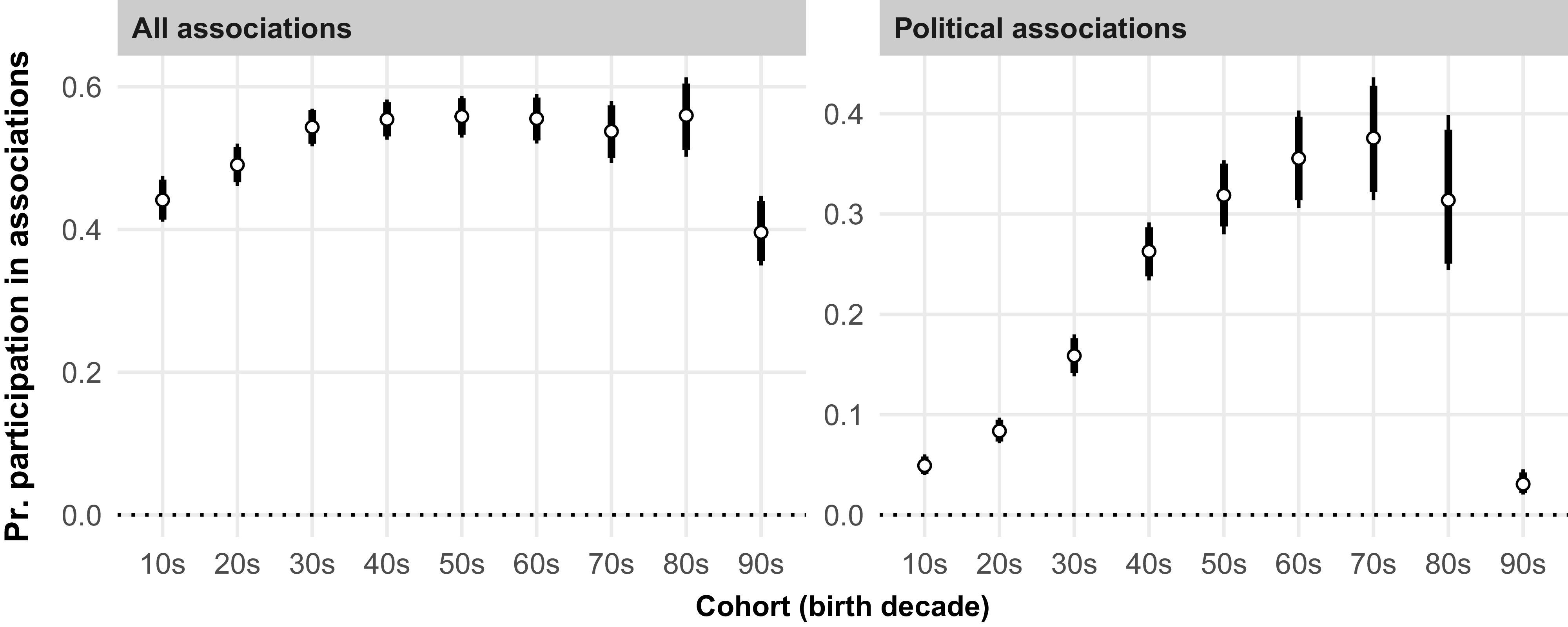
Figure 1 shows the results of the first set of individual-level logistic models where we analyze the relationship between cohort, coded as the decade when the individual was born, and the probability of being a member of 1) any association or 2) political associations.Footnote 11 Controlling for age at the time of the survey, these models show whether individuals from different birth cohorts are more or less likely to participate in voluntary organizations.
Cohort effects on participation in associations.

Looking at the entire sample, drawing data from surveys between 1989 and 2017, we observe minor cohort effects when looking at the probability of participation in any type of association, but much larger ones when focusing on political associations. Compared to younger cohorts, individuals born in the 1910s, 1920s, or 1930s exhibit a significantly lower likelihood of participation in political associations. The probability of participation reaches its peak among those born in the 1970s, who were children when Spain was transitioning into a democracy. Results show evidence in favor of our hypothesis, suggesting that the dictatorship left a persistent negative legacy in participation among the generations that lived through it.Footnote 12
These cohort effects could mask changes in political behavior driven by compositional effects. Specifically, members of older generations may be more likely to participate when interviewed in later survey waves; however, because their share of the sample declines over time, this increase may not be reflected in the aggregate results. We dig into this by analyzing cohort effects over time, namely, whether individuals born in the same period display different political behavior depending on when they are interviewed. We present these results in Figure 2.Footnote 13 In this case, we use a binary cohort measure – being born in 1958 or later – and include an interaction between this variable and the year in which the survey was fielded.
Cohort (binary) effects across survey years.
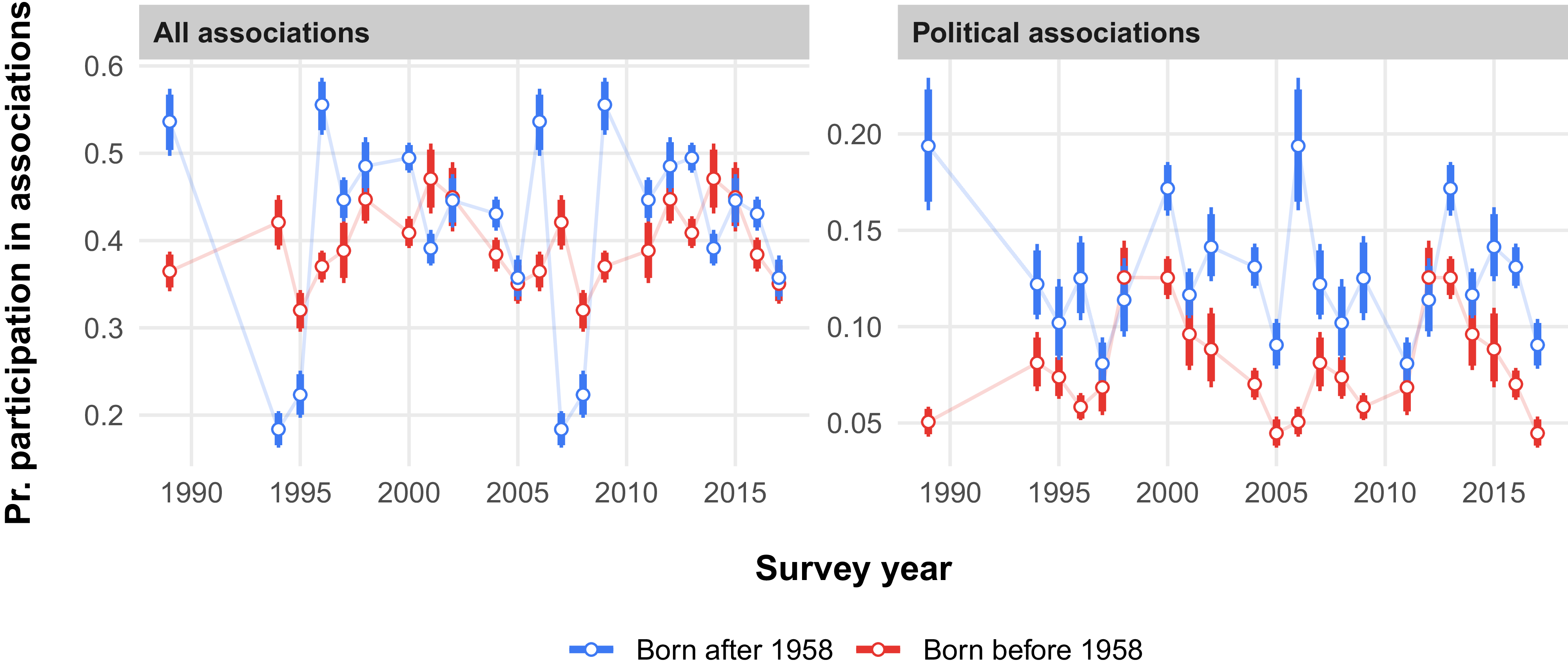
The results show mixed patterns for participation in any association (left panel). During most survey years, younger cohorts are more likely to participate, but this relationship does not consistently hold across the full period – at some points, older cohorts are more likely to participate. By contrast, when we look at the models on political associations (right panel), we observe that individuals born in 1958 or after are significantly more likely to participate than individuals born before 1958, across virtually all survey years. These differences disappear when we change the threshold to 1965 (results shown in Appendix C), which suggests that this result is not a mere artifact of age but that there was a significant change between those who were socialized under the regime and younger generations, who were not.
An additional caveat to these analyses is that we only observe earlier generations when these individuals are already older. Hence, the observed patterns could be picking up life-cycle effects. Put differently, the results reported above could be due to the fact that we only observe people born in, say, the 1920s when they are at least 60 years old, and not when they were younger. To address this, we examine how the age effect varies over time to explore whether earlier generations were indeed less likely to participate due to the period they lived through rather than life-cycle effects. We include age in quadratic form as our primary independent variable and run a different model for each five-year period, including all responses from surveys fielded during these years. Figure 3 shows the results graphically, comparing the effect of age on the probability of participation between the earliest surveys, fielded between 1989 and 1994, and the latest ones for which we have data, between 2015 and 2017 (full tables shown in Appendix B).
Age effects across survey years.

The results indicate that individuals above fifty years old interviewed by the CIS in the early 1990s were less likely to participate in political associations than individuals of the same age interviewed in the late 2010s. Put differently, holding age constant, participation is higher in later survey waves. For example, individuals born around 1930 and interviewed in 1990 (that is, at age 60) were significantly less likely to participate than individuals born in 1955 and interviewed in 2015 (also at age 60). Notably, this pattern appears only among older respondents, which suggests that the differences are unlikely to be driven by changes in survey design over time. Instead, the pattern is consistent with cohort differences: those who lived through the dictatorship behave differently from those who did not. Consistent with this interpretation, we do not observe comparable differences among younger respondents – for instance, those who were 30 in 1990 (born around 1960) and those who were 30 in 2015 (born around 1985). Following recent research on cohort effects (Rohrer Reference Rohrer2025), we include more analyses in Appendix E exploring cohort-age trajectories. These analyses also indicate that, keeping age constant, older cohorts were less likely to participate in associations than younger cohorts.
Overall, these results provide evidence confirming our expectation that generations who were socialized in their late adolescence and early adulthood under Francoism (and therefore experienced authoritarianism first-hand) exhibit less long-term participation, even after the regime was no longer present, at least compared to individuals who were not socialized under the Francoist regime. In Appendix F, we use survey data from the European Social Survey to show how these generational patterns are present in Spain but not in other major European countries. These findings thus offer insights into whether living through the dictatorship, an experience encompassing various facets beyond repression, left a lasting impact on specific generations.
Complementary analyses
A key limitation of the analyses above is that it is difficult to link individuals to the experiences they had under the authoritarian regime. Birth year is a proxy for the broader political context in which an individual was socialized, but it leaves many factors out. We argue that authoritarian socialization is a bundled treatment, encompassing depressed civic life, fewer options for political participation, and, of course, repression, among other elements. Yet, authoritarian experiences are likely to vary across individuals, particularly with regard to repression, which may be the main factor driving civic participation down.
In Appendix G we show complementary analyses that address this issue, exploring whether there is a link between experiences of authoritarian repression at the local level and civic participation. While individual data on having experienced repression is not available, we build a local-level dataset using data on repression from the archives of the TOP, the political court discussed above,Footnote 14 and analyze its correlation with a local measure of the formation of voluntary associations during the democratic period.Footnote 15 In order to track differences across generations, we explore the formation of associations in 5-year periods between 1976 and 2020 as our dependent variable. If our argument about the generational legacies of authoritarianism is correct, we should find that any initially negative correlation between local repression and associationism weakens over time and may even turn positive as post-Franco cohorts come of age. The results depicted in Figure A11 show that Francoist repression was indeed linked to increased associationism – not immediately after democratization, but only later on, from the mid-1990s onward.Footnote 16
Conclusion
While research on the effects of violence is expanding, the broader impact of less intense, everyday forms of repression remains underexplored, especially in terms of their longevity and variation across generations. This paper investigates the long-term legacies of authoritarian repression on civic participation, with a particular focus on how these effects vary across generations and change over time. We argue that living under an authoritarian regime depresses civic engagement among cohorts that experience the regime as teenagers and young adults, but that this effect does not necessarily extend to cohorts that are not socialized under authoritarianism.
Using a dataset of approximately 140,000 survey responses collected over nearly three decades in Spain, we analyze cohort and age effects on civic participation, finding that those who come of age during the Franco dictatorship exhibit persistently lower levels of participation. Our findings reveal evidence of a long-term negative impact of authoritarian rule on civic engagement but do not support the notion of intergenerational transmission of these effects. This differs from research on the more specific impact of violent repression or victimization on political identities or political behavior, where such intergenerational transmission has been documented (e.g., Balcells Reference Balcells2012; Lupu and Peisakhin Reference Lupu and Peisakhin2017; Rozenas, Schutte, and Zhukov Reference Rozenas, Schutte and Zhukov2017).
The effect of authoritarian politics sets apart countries like Spain from others that have not had periods of authoritarian rule (as indicated by the evidence from the European Social Survey, see Appendix F). Our argument states that cohorts socialized under these conditions display long-lasting, lower levels of civic participation due to their exposure to the threat of repression, lower trust, and reduced organizational supply channels. While differences across generations can also be due to secular trends in participation common to all Western countries, we suggest that lower levels of participation among cohorts socialized during the Francoist regime are due to the effects of authoritarian politics. Furthermore, while research points to a participation decline among younger generations in Western Europe (Grasso Reference Grasso2016), we document systematically lower levels of participation among older generations in Spain.
At the same time, Spain – and its democratization process – is not representative of the universe of former autocracies. Several authors have highlighted that the Spanish transition from authoritarianism is a quite paradigmatic example of a negotiated, elite-led transition (see, among others, O’Donnell and Schmitter Reference O’Donnell and Schmitter1986; Linz and Stepan Reference Linz and Stepan1996), which occurred in a context of relative economic development. We would argue that the large gap in participation between older and younger generations is more likely to be observed in transitional contexts where mobilization was severely curtailed during the regime but opened quickly after democratization. This was the case of Spain. As such, people who socialized under the regime faced fewer opportunities for association and harsher repression, while those that came of age during democracy could participate much more openly and were exposed to a wave of mobilization – even if short-lived (Sánchez-Cuenca and Aguilar Reference Sánchez-Cuenca and Aguilar2009; Sánchez-Cuenca Reference Sánchez-Cuenca, Muro and Lago2020). We would argue that these conditions were broadly similar in other transitions in Southern Europe (i.e., Portugal and Greece) and the Southern Cone (i.e., Chile and Uruguay), even though each of them had their idiosyncrasies (Sanchez Reference Sanchez2003). The findings here might not travel to other cases where either strong popular mobilization was present during the authoritarian regime and likely caused its downfall (as in Tunisia) or where participation is limited after democratization. Revolutionary processes thus fall outside of the scope of this study, and so do post-civil war democratization processes. Finally, the findings here do not apply to authoritarian regimes that do not regulate associational life.
Overall, this study contributes to the literature on the legacies of repression and authoritarianism, political socialization, and political participation. It emphasizes the importance of generational context in shaping the lasting impact of political history on civic life. Future research should continue to disentangle the complex relationship between political legacies and generational shifts in civic engagement.
Supplementary material
The supplementary material for this article can be found at https://doi.org/10.1017/S1475676526101042.
Data availability statement
Replication files and code for this article can be found at Harvard Dataverse: https://doi.org/10.7910/DVN/KUWPQQ.
Acknowledgements
The authors are grateful for comments and suggestions from Joan Barceló, Chantal Berman, Patricia Justino, Stephen Kaplan, Krzysztof Krakowski, Harris Mylonas, Andrea Ruggeri, Michael Weintraub, and three anonymous reviewers. Earlier versions of this paper were presented at the UNU-WIDER workshop in Helsinki (May 2022), the Comparative Politics workshop at George Washington University (October 2022), and the APSA 2023 Annual Meeting. The authors thank participants for helpful feedback. They also thank Simón Ballesteros, Ana Paula Pellegrino, and Kaitlyn Hladik for helpful research assistance.
Funding statement
This project has received funding from UNU-WIDER as part of the project ‘Institutional Legacies of Violent Conflict.’
Competing interests
The authors declare no competing interests.
Ethical standards
This study did not involve research on human subjects.
AI use
The authors acknowledge the use of OpenAI’s GPT-4, GPT-5, and GPT-5.2 (accessed from openai.com/) for assistance with grammar and language editing. In the pre-publication phase, they used Perplexity Pro (accessed from perplexity.ai/) to review the accuracy of the bibliography. Like with RA work, all AI outputs were checked and edited by the authors, who remain responsible for the content.


 Open access

