


1. Introduction
In the analysis of the effects of longitudinal stress gradients on glacier flow, as in the previous papers of the present series, it is necessary to have a longitudinal equilibrium equation by means of which the longitudinal flow interactions are mediated. Such equations have been considered by a number of authors (Reference RobinRobin, 1967; Reference CollinsCollins, 1968; Reference BuddBudd, 1968, Reference Budd1970, Reference Budd1971; Reference NyeNye, 1969; Reference PatersonPaterson, 1981; Reference HutterHutter, [c1983], p. 260-64). In carrying out the present work, it became evident that the existing equations had certain limitations or uncertainties, and it was found that in overcoming these, one could obtain an exact longitudinal equilibrium equation that revealed explicitly, succinctly, and exactly the various ways in which longitudinal slopes, longitudinal stress deviators, stress gradients, and longitudinal curvature of the ice surface affect the basal shear stress as calculated from the equilibrium equation for an ice mass flowing over a bed of longitudinally varying slope. This result is presented here, for application in the other papers of the series. From it, two new terms in the longitudinal equilibrium relationship between basal shear stress and its causative factors are recognized and evaluated.
2. Exact Equilibrium Equation of Budd
We consider an infinitely wide ice sheet in two-dimensional flow (plane strain) down an inclined basal surface where the inclination β(x) is a function of distance x in the flow direction. We choose a Cartesian coordinate system with x-axis directed down-stream in the flow plane and inclined downward at an arbitrary angle γ to the horizontal, as shown in Figure 1. The y-axis is in the flow plane, normal to x, and directed generally upward. Choice of origin is arbitrary. The local down-stream inclination of the bed with respect to the x-axis is θ, positive when the basal slope exceeds the inclination of the x-axis, and the local down-stream slope of the ice surface with respect to the x-axis is δ. The upper surface of the ice sheet is described by у = y s(x), and the basal surface by у = y B(x), so that tan δ = - dy s/dx and tanθ = –dy B/dx. The local ice thickness, measured parallel to the y-axis, is h(x) = y s – y B.
Coordinate systems used in development of the exact. “vertically” integrated longitudinal equilibrium equation. Around each surface point a local ξ, η system is defined, the ξ -axis being tangent to the surface at this point, and inclined by an angle δ relative to the x-axis. The basal shear stress τ b is shown with shear arrows indicating the sense of shear for positive τ b .

Our point of departure is the exact, “vertically” integrated longitudinal equilibrium equation derived by Reference BuddBudd (1970, equation (13)) for the geometry of Figure 1. Noting that our angles γ, δ, and θ in Figure 1 correspond to Reference BuddBudd’s (1970, fig. 1) angles x, –θ, and –ϕ, respectively, and that our basal shear stress τB with the positive sense indicated by the shear arrows in Figure 1 is minus Reference BuddBudd’s τb (1970, p. 21) and correcting an error of sign in the fourth term on the right side of his equation (13), we can write this equation in our notation as

where

and

and

The notation ∣B and ∣S in Equation (1) means the value of the indicated quantity at the bed or surface, respectively. The T ij are the stress-tensor components.
We emphasize that, as demonstrated by Reference BuddBudd (1970, p. 20–22), this equation is an exact statement of “vertically” integrated longitudinal equilibrium, without approximations of any kind, other than the assumption that the ice density ρ is a constant, which can easily be relaxed, as follows: by carrying through Budd’s procedure in deriving Equation (1), but admitting spatially variable ρ(x, y), it is readily shown that in this case the term -pghsinγ in Equation (1) is replaced by

where

and

3. Further Development of the Exact Equilibrium Equation
In developing Equation (1) further, we will express all boundary quantities in terms of the shear stress τB at the bed and the longitudinal stress deviators at the bed and surface, which we will call σ’B and σ’S. Based on a local coordinate system (ξ,η) with ξ-axis parallel to the surface and η-axis perpendicular to it (Fig. 1), we define

where (as in Equation (4))

and where τ ηη ∣S = 0 (ignoring atmospheric pressure). In the usual way, we can calculate the stress components in the (x, y) system in terms of those in the (ξ, η) system:


In taking the second step in Equation (8), we eliminate τξξ by using Equation (6). At the surface, where τξη = 0, Equation (7) becomes

Similarly, at the bed,

where σ’B, analogously to σ’S , is the longitudinal stress deviator corresponding to a local longitudinal axis tangent to the bed. In case of no basal sliding, σ’B = 0 if the basal ice is isotropic, and possibly even if it is not (Reference NyeNye, 1969, p. 210).
Besides substituting Equations (9) and (10) directly into Equation (1), we want to express the derivative ∂τ yy /∂x∣s in Equation (1) in terms of σ’S. Although Reference BuddBudd (1970, p. 22) undertakes an evaluation of this derivative, his result (his equation (16)) goes only part way to our objective. There is a more straightforward approach, as follows. If we evaluate the desired derivative in the (ξ, η) coordinate system previously defined (Fig. 1), we have

The derivative ∂τ
yy
/∂ξ∣
S at the local origin (ξ, η) = (0,0), which is the point of tangency of the ξ-axis with the ice surface, can be readily calculated from Equation (8) if we carry out the differentiation by following the ice surface. To do this, we specify local curvilinear coordinates  for which
  is arc length measured along the surface and
  = 0 on the surface. In terms of this curvilinear system, in which
  = 0, we obtain from Equation (8)

in which δ is a function of  . Differentiating,

We write this and similar expressions to follow as an ordinary derivative because the quantity differentiated is a function only of longitudinal position, represented in terms of coordinate ξ,  , or x. An alternative calculation of ∂τ
yy
/∂ξ∣s can be made by differentiating Equation (8) in a Cartesian (ξ,η) system fixed in orientation at the tangency point (0,0). In this case, δ in Equation (8) is a constant, δ0, and the stress components τ
ηη
and τξη
may vary with ξ because the ice surface departs from the ξ-axis away from the tangency point:
, or x. An alternative calculation of ∂τ
yy
/∂ξ∣s can be made by differentiating Equation (8) in a Cartesian (ξ,η) system fixed in orientation at the tangency point (0,0). In this case, δ in Equation (8) is a constant, δ0, and the stress components τ
ηη
and τξη
may vary with ξ because the ice surface departs from the ξ-axis away from the tangency point:

In the Appendix it is shown that ∂τ ηη /∂ξ∣S = 0, ∂τ’ξ ξ /∂ ∣S = dσ’S/dξ, and, perhaps unexpectedly,

On this basis. Equations (13) and (14) combine to give again Equation (12), but with  replaced by dξ. Since dξ =
  at the origin (tangency point), we thus drop the distinction between differentiation with respect to ξ or
  in Equation (12).
Similarly, differentiating Equation (8) with respect to η,

Two of the derivatives in Equation (15) can be evaluated with the help of the equilibrium equations in the (ξ,η) coordinate system:


The second step in Equations (16) and (17) follows from the considerations in the Appendix and in particular from Equations (14) and (5).
We can now drop the distinction between δ and δ0, which is needed only in carrying out the differentiation in Equation (13); δ and δ0 are the same function of x, since they both describe the orientation of the ξ,η coordinate system as a function of x,as Figure 1 indicates.
Putting Equations (12) and (15)–(17) into Equation (11), we then get

Since we can regard the surface quantities as functions of x, in place of ξ, the ξ differentiation in Equation (18) can be replaced by x differentiation according to d/d ξ = cosδ • d/dx. Expanding the derivative in the next-to-last term in Equation (18) and combining terms gives

An alternative route to Equation (19) is via the evaluation of ∂τ ηη /∂x∣s’ given by Reference BuddBudd (1970, p. 22), with further evaluation of ∂τ xx /∂x ∣ s, which Budd left unevaluated in his equation (16). If we write, analogously to Equation (11),

and introduce this into Budd’s equation (16) (after correcting a sign error in two terms on the right-hand side), then with the use of Equations (12)–(17) and after considerable labor we arrive again exactly at Equation (19). This helps to show that Equation (19) is an exact result, since the second derivation, which is rather long and complex, is quite independent of the first, though both of course are based on Equations (12)–(17).
We can now put Equations (9), (10), and (19) into Equation (1) to obtain the desired form of the longitudinal equilibrium equation, Combination of the various trigonometric terms, with use of α = γ + δ and dδ/dx = dα/dx (γ being constant), leads to

This equation is exact, containing no approximations or assumptions except that ρ is a constant, an approximation easily relaxed, as noted in section 2. By carrying the modification to Equation (1) there stated through the derivation given above, it follows that allowing ρ to be a function ρ(x, y) will result in replacing ρ in Equation (21) with ρS = ρ(y S) and in adding to the right side of Equation (21) the following terms:

where 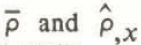 , are the averages of density and density gradient stated in section 2.
4. Examination of the Result
As an expression of the effects of longitudinal stress gradients and of longitudinal curvature of the glacier surface (dα/dx) on the basal shear stress, Equation (21) is usefully re-organized as follows. Let μ
S and μ
B be factors ∼l that relate σ’S and to  Then, re-arranging Equation (21),

In Equation (22), the contributions to τB are arranged in a particular order, for clarity. In the first line is the direct body-force contribution (“down-slope stress” of Reference BuddBudd (1971, p. 179)), plus the special “T term” given by the “integrated stress-curvature” in Equation (3). The main body-force effect goes as sinα, with no approximations, modified by a δ-dependent factor, and also a θ-dependent factor (on the left side of Equation (22)), both near unity. The “T term”, or “variational stress” term of Reference BuddBudd (1971, p. 179), whose magnitude is the least apparent among the terms of Equation (22), is further considered in Part IV by Reference KambKamb and Echelmeyer (1986[a]).
The second line of Equation (22) contains the stress-gradient terms. The well-known main longitudinal stress-deviator gradient term 2G is at the far left. The middle term is a correction term of order δ2 relative to G. The term on the right involves the “vertical” gradient of the longitudinal stress deviator at the surface, which is probably small in most glacier-flow situations, and moreover occurs in a term that is third order in the (often small) angle δ.
In the third line of Equation (22) are contributions stemming from the longitudinal deviatoric stress. The last of these involves also the longitudinal curvature of the ice surface.
It is useful to note a few points as to how Equation (22) compares with the corresponding equations of other authors. The result of Reference BuddBudd (1970, equation (17)) is in principle similar, but not developed to the point where the various contributions from the body forces, stress deviators, and gradients can be compactly grouped and isolated as they are in Equation (22). Because of one of the sign errors noted, the higher-order contribution to the body-force term has the wrong sign in Budd’s equation (17), and its form is in detail somewhat different because of omission of other contributions that come from the term ∂τ xx /∂x∣ s that is left unevaluated. Collins’ exact equation (1968, equation (5)), which is similar in form to Equation (1), is not developed to the point where it can be compared closely with Equation (22). Equation (45) of Reference PatersonPaterson (1981, p. 99), which follows equation (10) of Reference NyeNye (1969, p. 211), generally resembles Equation (22) in form, but with most of the smaller terms not present and with a factor (1 - 2sin2 θ) multiplying τB on the left, rather than (1 + 2sin2θ) as in Equation (22). (Paterson’s equation (45) is obtained in a coordinate system with δ = 0 and therefore θ = α - β.) However, a comparison is difficult to make, because, as Reference NyeNye (1969, p. 209) pointed out, the main longitudinal stress-gradient term in his equation (10) involves a stress-deviator average that is different in general from our in Equation (2) above.
The discussion by Reference PatersonPaterson (1981, p. 99–100) leaves some confusion as to whether the h in the main stress-gradient term 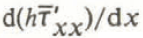 should be considered variable with x, as it appears to be in his Equation (48), or should instead be treated as constant as far as the differentiation is concerned, as in his equation (44) and in equation (10) of Reference NyeNye (1969). Confusion on this point might also stem from the fact that Reference BuddBudd (1970, p. 22) gave two “exact” equilibrium equations (his equations (13) and (20)), one of which involves, in effect, the inclusion of h within the differentiated bracket, and the other the exclusion of it. The issue can be settled decisively by considering the magnitudes of the terms in Equation (22), as is done in section 8 below.
5. Simplification for Small δ
The importance of the various contributions in Equations (21) or (22) can be judged in terms of their order in the angles δ and θ. If the undulations in the surface are rather smooth compared to those in the underlying bed, as can in general be expected, then the longitudinal variations in δ will be smaller than those of θ and may be small enough that when the x-axis is chosen to lie along the mean slope of the glacier surface, δ will be everywhere small compared to unity. In this case the higher-order terms in δ can be dropped out of Equation (22), which will become, to first order in δ,

6. The K Term
To first order, δ enters Equation (23) only in the surface-curvature term, which we call the “K term”. In view of dα/dx = dδ/dx, the K term may be rewritten

It seems likely that in most flow situations the variation in surface slope over a longitudinal interval of one ice thickness h will be of order δ or less, so that we may assume h∣dδ2/dx∣ ∼ δ2. In this case the K term is actually second order in δ, and could probably be dropped along with the other terms in Equation (22) that are neglected in Equation (23), except in flow situations like ice falls.
In the K term, the longitudinal curvature, stress devia-tor, and relative surface slope δ enter in such a way as to cause an accentuation in the basal shear stress within an ice fall in zones near the head and foot where δ ˃ 0, and a relaxation in τB just outside these zones, where δ ˂ 0. Put another way, in flow with “staircase” surface topography, the K term tends to cause a decrease of τB in the peripheral parts of the “treads” and an increase in the peripheral parts of the “risers”. We can estimate the magnitude of the effect for a sinusoidal staircase with ∣ δmax ∣ = 15°, ∣σ’S ∣ = 1.2 bar (based on η S = 3 bar year and ∣du/dx∣ = 0.2 a-1 at the surface), and λ/h ≈ 4 where λ is the wavelength of the staircase. From Equation (24) the maximum value of ∣k∣ is then 0.12 bar, not large but appreciable in relation to a basal shear stress of 1 bar. For these same (fairly extreme) conditions, the “S” term in Equation (22),

has maximum value 0.04 bar, so its neglect in Equation (23) while the K term was retained there has a measure of justification. The secondary stress-gradient term

in Equations (21) or (22), is, at maximum, about 20% of the main stress-gradient term 2G under the above conditions. For the more typical glacier situations to which we apply Equation (23) in Parts I (Reference Kamb and EchelmeyerKamb and Echelmeyer 1986[b], and II (Reference Echelmeyer and KambEchelmeyer and Kamb, 1986) with α ≈ 6° and δ  3°, the K and G
2
terms are reduced by a factor 0.04 relative to the values estimated in the rather extreme case evaluated above, and they therefore become negligible, as does of course S also.
3°, the K and G
2
terms are reduced by a factor 0.04 relative to the values estimated in the rather extreme case evaluated above, and they therefore become negligible, as does of course S also.
7. The B Term
If there is no basal sliding, then σ’ B = 0 (see again Reference NyeNye, 1969, p. 210) and the σ’B term in Equation (23) drops out. We label this term “B”,

It is a kind of “basal drag” term, which contributes a resistance to sliding flow over basal hills (or, more precisely, ridges oriented crosswise to the flow). This is seen as follows. If the surface topography reflects only gently the underlying ridges, so that ∣δ∣ « ∣θ∣, then on the stoss side of a hill there must be convergent, extending flow such that ūh = constant (ignoring accumulation/ ablation), hence

where θ < 0 on the stoss side. On the lee side, Equation (28) remains valid and describes the diverging, compressing flow there (θ > 0). If we designate by η B the effective viscosity of the basal ice, and suppose that the longitudinal strain-rate parallel to the basal surface is approximately equal to dū/dx, then

Thus the B term in Equation (27) is

From the form of Equation (30), it follows that the B term gives a basal drag resistance that is independent of the sign of θ. It constitutes a resistance to the flow because it subtracts from the basal shear stress τb, which is linked to the flow velocity via the mechanics of basal sliding and of shear deformation of the basal ice, as in Equations (I-1) or (I-3).
We can estimate the drag resistance due to B in a near-maximal practical case for, say, θ = 30°, by taking η B ≈ 1 bar year (appropriate to τB = 1 bar), ū = 50 m a-1, h = 200 m. These give B = -0.1 bar, which is an appreciable but not large fraction of the basal shear stress. It might have detectable effects.
For flow over a roughly sinusoidal topography of transverse ridges, the B term will tend to cause the appearance in the surface topography of a wave that is the second harmonic of the bedrock sinusoid, because it will tend to require a compensating variation in surface slope a in Equation (23) at twice the bedrock wave number on account of the tan2θsin2θ variation in Equation (30).
The overall drag resistance arising from the B term goes as the longitudinal average of tan2θsin2θ, which is approximately 3θ4 max/8 for sinusoidal topography with maximum slope angle θmax. This overall drag resistance is somewhat akin to the sliding resistance due to short-wavelength roughness in the basal topography, but the two cannot be equated. It might be thought that the short-wavelength drag could be described by a modification of Equation (30) in which h is replaced by ∼λ/π, where λ is the roughness wavelength, but this is not correct. The drag calculated in this way from B in Equation (30) contains an extra factor of sin2θ by comparison with the ordinary basal sliding drag for a roughness wave of wavelength λ:

Equation (31) is obtained from Reference HutterKamb (1970), equations (40), (30), (26), and (21), with ∂z 0/∂x = -tanθ. The reason why Equations (31) and (30) give different results here is that the stoss- and lee-side pressure distribution responsible for the drag in Equation (31), at roughness wavelengths λ ∼ 1 m important in basal sliding, is generated via its coupling through the x-equilibrium equation to ∂T xy /∂x, and is thus in effect contained in the T term in Equation (23)s, rather than in the B term. If Equations (23) or (22) were used to treat the short-wavelength drag, τB on the left side of these equations would be zero (shear stress across the ice–rock interface), and the basal drag would appear mainly as a negative value of T = -τ B, where the value of τB would correspond to the value given by Equation (31). On the other hand, in the use of Equation (23) in longitudinal coupling theory (Parts I, II, and IV) we treat the motions and stresses at distance scales ∼ h and larger, smoothing out the short-wavelength effects responsible for the basal drag in Equation (31). (The smoothing is suggested by the way Figure 1 is drawn.) In this case, the short-wavelength drag given by Equation (31) is equated to τB on the left side of Equations (22) and (23), and the terms on the right describe in effect the source of the basal shear stress, including some reduction in τB due to the long-wavelength basal drag term B in Equation (30). Moreover, in this case the T term is generally small, as discussed in Part IV.
8. Differentiation of h in the G Term
If in Equation (23) the longitudinal stress-gradient term G is expanded,

then there will appear in Equation (23) an extra term that is first order in δ and θ and therefore in general much larger than all of the terms second- or higher-order in δ that were neglected in going from Equation (22) to Equation (23). Thus, there is no question that at the level of accuracy of Equation (21) it is necessary to retain the h within the differentiated bracket in Equation (32), or else to include the corresponding τ’ xx (tanδ - tanθ) term from Equation (32). This settles the point raised in section 5.
9. Further Simplified Equilibrium Equation
If α and θ are also assumed small, then Equation (21) reduces to

which is a simplified longitudinal equilibrium equation often quoted (e.g. Reference BuddBudd, 1971, equation (5); Reference PatersonPaterson, 1981, p. 100, equation (46)), and which, with neglect of the T term, is used in Part I (Reference KambKamb and Echelmeyer, 1986[b]) of this series.
Acknowledgement
I thank K. Echelmeyer for comments and criticisms, and for careful, laborious checking of the mathematical relations in this paper, as well as for providing the initial stimulation for the work.
Appendix Calculation of Longitudinal Derivatives at the Ice Surface
A detailed but significant and slightly subtle point in developing the longitudinal equilibrium equation is the way in which partial derivatives of stress components with respect to ξ in the (ξ,η) coordinate system locally tangent to the ice surface, can be represented in terms of longitudinal derivatives of σ’, the surface-parallel longitudinal stress-deviator component at the surface. The geometrical situation in the vicinity of the tangency point, taken as the origin (ξ,η) = (0,0), is shown in Figure 2. Position along the surface is given by coordinate ξ, and the shape of the surface is represented by the function η S(ξ), which to lowest order in ξ can be written

because of the tangency condition. The local orientation of the surface is specified by local axes μ and ν, respectively tangent and perpendicular to it. The angle between the local μ-axis and the ξ-axis is €(ξ). The μ and ν axes correspond to the  and ῆ coordinates introduced in obtaining Equation (12); μ and ν are used to make the distinction from ξ and η better visible.
Detail in the vicinity of a surface point 0 at which a local ξ, η coordinate system is defined. At an adjacent point P, whose coordinates in the ξ,η system are (ξ, η S )the local surface tangent and normal vectors are defined as axes μ and ν, the )μ -axis being tilled by the angle ε relative to the ξ-axis. Surface curvature is greatly exaggerated for clarity.

Any stress component τ ij can be expressed as a function of ξ and η by a Taylor series expansion about the point (ξ,η S) on the surface:

to lowest order in (n – n S ). The stress components τij at the surface can be obtained in terms of τ’ μμ , τ μν , τ νν at by the standard transformation formulae for plane strain, similar to Equation (8):


In these formulae we put τ μμ = σ’ S, by definition, and, because the surface is stress-free, τ μν = τ νν = 0 (ignoring atmospheric pressure). The calculation of any desired derivative ∂τij /∂ξ∣ 0 at the origin consists in introducing T ij from the appropriate Equations (A-3)–(A-6) into Equation (A-2), setting η = 0, taking nS from Equation (A-1), differentiating with respect to ξ, and evaluating at ξ = 0, where € = 0. Thus, for τξη from Equation (A-6),

assuming ∂τξη /∂η and its ξ derivative are bounded. The last step in Equation (A-7) follows from the fact that

where δ(0) is the value at the local origin. Equation (A-7) is the basis for Equation (14), in which the evaluation symbol ∣0 is replaced by ∣S.
By the same type of procedure, it is shown that

and

which are utilized in Equations (13) and (16).
The only one of the above results that departs from what might be expected from simple intuition is Equation (A-7). This departure has a definite effect on the development of the longitudinal equilibrium equation. With Equation (A-7), the two independent evaluations of ∂τ xx / ∂x∣S discussed in the main text lead to exactly the same result, Equation (19), whereas if instead one takes ∂τξη /∂ξ ∣0 = 0, as might be thought from simple intuition, then these two independent evaluations give different results.



