











1. Introduction and main results
Denote by $K^r_n$
the complete
$K^r_n$
the complete $r$
-uniform hypergraph on
$r$
-uniform hypergraph on $n$
vertices, that is, the hypergraph whose vertex set is
$n$
vertices, that is, the hypergraph whose vertex set is $[n] \, :\! = \{1,2,\ldots ,n\}$
and whose edge set is
$[n] \, :\! = \{1,2,\ldots ,n\}$
and whose edge set is $\binom {[n]}{r}$
. For fixed
$\binom {[n]}{r}$
. For fixed $r$
-uniform hypergraphs
$r$
-uniform hypergraphs $F$
and
$F$
and $G$
, we say that a hypergraph
$G$
, we say that a hypergraph $H\subseteq G$
is (strongly)
$H\subseteq G$
is (strongly) $F$
-saturated in
$F$
-saturated in $G$
, if
$G$
, if $H$
does not contain any copy of
$H$
does not contain any copy of $F$
, but adding any edge
$F$
, but adding any edge $e\in E(G)\setminus E(H)$
to
$e\in E(G)\setminus E(H)$
to $H$
creates a copy of
$H$
creates a copy of $F$
. We let
$F$
. We let ${\textit {sat}}(G, F)$
denote the minimum number of edges in an
${\textit {sat}}(G, F)$
denote the minimum number of edges in an $F$
-saturated hypergraph in
$F$
-saturated hypergraph in $G$
. The problem of determining
$G$
. The problem of determining ${\textit {sat}}(K^2_n, K^2_s)$
was raised by Zykov [Reference Zykov19] in 1949, and independently by Erdős, Hajnal, and Moon [Reference Erdős, Hajnal and Moon9] in 1964. They showed that
${\textit {sat}}(K^2_n, K^2_s)$
was raised by Zykov [Reference Zykov19] in 1949, and independently by Erdős, Hajnal, and Moon [Reference Erdős, Hajnal and Moon9] in 1964. They showed that ${\textit {sat}}(K^2_n, K^2_s)=\binom {n}{2}-\binom {n-s+2}{2}$
. Their result was later generalised by Bollobás [Reference Bollobás3] who showed that
${\textit {sat}}(K^2_n, K^2_s)=\binom {n}{2}-\binom {n-s+2}{2}$
. Their result was later generalised by Bollobás [Reference Bollobás3] who showed that ${\textit {sat}}(K^r_n, K^r_s)=\binom {n}{r}-\binom {n-s+r}{r}$
.
${\textit {sat}}(K^r_n, K^r_s)=\binom {n}{r}-\binom {n-s+r}{r}$
.
We say that an $r$
-uniform hypergraph
$r$
-uniform hypergraph $H\subseteq G$
is weakly
$H\subseteq G$
is weakly $F$
-saturated in
$F$
-saturated in $G$
if
$G$
if $H$
does not contain any copy of
$H$
does not contain any copy of $F$
, but the edges of
$F$
, but the edges of $E(G)\setminus E(H)$
admit an ordering
$E(G)\setminus E(H)$
admit an ordering $e_1, \ldots , e_k$
such that for each
$e_1, \ldots , e_k$
such that for each $i\in [k]$
, the hypergraph
$i\in [k]$
, the hypergraph $H_i=H\cup \{e_1,\ldots , e_i\}$
contains a copy of
$H_i=H\cup \{e_1,\ldots , e_i\}$
contains a copy of $F$
containing the edge
$F$
containing the edge $e_i$
. We define
$e_i$
. We define $\mathop {\mbox{$w$-${sat}$}}\! (G, F)$
to be the minimum number of edges in a weakly
$\mathop {\mbox{$w$-${sat}$}}\! (G, F)$
to be the minimum number of edges in a weakly $F$
-saturated subhypergraph in
$F$
-saturated subhypergraph in $G$
. Note that the saturation is in fact a restriction of the weak saturation, where one is allowed only to add all the edges at once (simultaneously). Hence, any
$G$
. Note that the saturation is in fact a restriction of the weak saturation, where one is allowed only to add all the edges at once (simultaneously). Hence, any $H$
which is
$H$
which is $F$
-saturated in
$F$
-saturated in $G$
is also weakly
$G$
is also weakly $F$
-saturated in
$F$
-saturated in $G$
, and thus
$G$
, and thus $\mathop {\mbox{$w$-${sat}$}}\! (G,F)\le {\textit {sat}}(G,F)$
. As such, the weak saturation can be viewed as a natural extension of the saturation. The problem of determining
$\mathop {\mbox{$w$-${sat}$}}\! (G,F)\le {\textit {sat}}(G,F)$
. As such, the weak saturation can be viewed as a natural extension of the saturation. The problem of determining $\mathop {\mbox{$w$-${sat}$}}\! (K^r_n, K^r_s)$
was first raised by Bollobás [Reference Bollobás4], who conjectured that
$\mathop {\mbox{$w$-${sat}$}}\! (K^r_n, K^r_s)$
was first raised by Bollobás [Reference Bollobás4], who conjectured that $\mathop {\mbox{$w$-${sat}$}}\! (K^r_n, K^r_s)=sat(K^r_n, K^r_s)$
. Using ingenious algebraic methods, this conjecture was verified by Alon [Reference Alon1], Frankl [Reference Frankl10], Kalai [Reference Kalai11, Reference Kalai12], and Lovász [Reference Lovász17]:
$\mathop {\mbox{$w$-${sat}$}}\! (K^r_n, K^r_s)=sat(K^r_n, K^r_s)$
. Using ingenious algebraic methods, this conjecture was verified by Alon [Reference Alon1], Frankl [Reference Frankl10], Kalai [Reference Kalai11, Reference Kalai12], and Lovász [Reference Lovász17]:
Theorem 1.1 [Reference Alon1, Reference Frankl10–Reference Kalai12, Reference Lovász17].
 \begin{align*} \mathop {\mbox{$w$-${sat}$}}\! (K^r_n, K^r_s)={\textit {sat}}(K^r_n, K^r_s)=\binom {n}{r}-\binom {n-s+r}{r}. \end{align*}
The binomial random graph $G(n,p)$
is obtained by retaining every edge of
$G(n,p)$
is obtained by retaining every edge of $K_n$
independently with probability
$K_n$
independently with probability $p$
. Similarly, the binomial random
$p$
. Similarly, the binomial random $r$
-uniform hypergraph
$r$
-uniform hypergraph $G^r(n,p)$
is obtained by retaining every edge of
$G^r(n,p)$
is obtained by retaining every edge of $K^r_n$
independently with probability
$K^r_n$
independently with probability $p$
. In 2017, Korándi and Sudakov [Reference Korándi and Sudakov15] initiated the study of the saturation and the weak saturation in random graphs.
$p$
. In 2017, Korándi and Sudakov [Reference Korándi and Sudakov15] initiated the study of the saturation and the weak saturation in random graphs.
Theorem 1.2 [Reference Korándi and Sudakov15]. Let $p\in (0,1)$
and let
$p\in (0,1)$
and let $s$
be a constant. Then,
whp
,
$s$
be a constant. Then,
whp
,
-
(a) ${\textit {sat}}(G(n,p),K^2_s)=(1+o(1))n\log _{\frac {1}{1-p}}n$
.
${\textit {sat}}(G(n,p),K^2_s)=(1+o(1))n\log _{\frac {1}{1-p}}n$
. -
(b)
$\mathop {\mbox{$w$-${sat}$}}\! (G(n,p), K^2_s)=\mathop {\mbox{$w$-${sat}$}}\! (K^2_n, K^2_s)$
.


Note that there is quite a stark difference between the (strong) $K_s$
-saturation number and the weak
$K_s$
-saturation number and the weak $K_s$
-saturation number in
$K_s$
-saturation number in $G(n,p)$
. For the weak
$G(n,p)$
. For the weak $K_s$
-saturation, whp the answer is the same as in
$K_s$
-saturation, whp the answer is the same as in $K_n$
, whereas for the
$K_n$
, whereas for the $K_s$
-saturation whp there is an additional
$K_s$
-saturation whp there is an additional $\log n$
factor compared with
$\log n$
factor compared with $K_s$
-saturation in
$K_s$
-saturation in $K_n$
.
$K_n$
.
Since the work of Korándi and Sudakov, there have been several papers devoted to the study of ${\textit {sat}}(G(n,p),F)$
and
${\textit {sat}}(G(n,p),F)$
and $\mathop {\mbox{$w$-${sat}$}}\! (G(n,p),F)$
for graphs
$\mathop {\mbox{$w$-${sat}$}}\! (G(n,p),F)$
for graphs $F$
which are not cliques, in particular when
$F$
which are not cliques, in particular when $p$
is constant. Mohammadian and Tayfeh-Rezaie [Reference Mohammadian and Tayfeh-Rezaie18] and Demyanov and Zhukovskii [Reference Demyanov and Zhukovskii6] proved tight asymptotics for stars,
$p$
is constant. Mohammadian and Tayfeh-Rezaie [Reference Mohammadian and Tayfeh-Rezaie18] and Demyanov and Zhukovskii [Reference Demyanov and Zhukovskii6] proved tight asymptotics for stars, $F=K_{1,s}$
. Considering cycles, Demidovich, Skorkin, and Zhukovskii [Reference Demidovich, Skorkin and Zhukovskii5] showed that whp
$F=K_{1,s}$
. Considering cycles, Demidovich, Skorkin, and Zhukovskii [Reference Demidovich, Skorkin and Zhukovskii5] showed that whp ${\textit {sat}}(G(n,p),C_m)=n+\Theta \left (\frac {n}{\log n}\right )$
for
${\textit {sat}}(G(n,p),C_m)=n+\Theta \left (\frac {n}{\log n}\right )$
for $m\ge 5$
, and whp
$m\ge 5$
, and whp ${\textit {sat}}(G(n,p),C_4)=\Theta (n)$
. Considering a more general setting, Diskin, Hoshen, and Zhukovskii [Reference Diskin, Hoshen and Zhukovskii8] showed that for every graph
${\textit {sat}}(G(n,p),C_4)=\Theta (n)$
. Considering a more general setting, Diskin, Hoshen, and Zhukovskii [Reference Diskin, Hoshen and Zhukovskii8] showed that for every graph $F$
, whp
$F$
, whp ${\textit {sat}}(G(n,p),F)=O(n\log n)$
, and gave sufficient conditions for graphs
${\textit {sat}}(G(n,p),F)=O(n\log n)$
, and gave sufficient conditions for graphs $F$
for which whp
$F$
for which whp ${\textit {sat}}(G(n,p),F)=\Theta (n)$
. As for the weak saturation, Kalinichenko and Zhukovskii [Reference Kalinichenko and Zhukovskii14] gave sufficient conditions on
${\textit {sat}}(G(n,p),F)=\Theta (n)$
. As for the weak saturation, Kalinichenko and Zhukovskii [Reference Kalinichenko and Zhukovskii14] gave sufficient conditions on $F$
for which whp
$F$
for which whp $\mathop {\mbox{$w$-${sat}$}}\! (G(n,p),F)=\mathop {\mbox{$w$-${sat}$}}\! (K_n,F)$
, and Kalinichenko, Miralaei, Mohammadian, and Tayfeh-Rezaie [Reference Kalinichenko, Miralaei, Mohammadian and Tayfeh-Rezaie13] showed that, for any graph
$\mathop {\mbox{$w$-${sat}$}}\! (G(n,p),F)=\mathop {\mbox{$w$-${sat}$}}\! (K_n,F)$
, and Kalinichenko, Miralaei, Mohammadian, and Tayfeh-Rezaie [Reference Kalinichenko, Miralaei, Mohammadian and Tayfeh-Rezaie13] showed that, for any graph $F$
, whp
$F$
, whp $\mathop {\mbox{$w$-${sat}$}}\! (G(n,p),F)=(1+o(1))\mathop {\mbox{$w$-${sat}$}}\! (K_n,F)$
.
$\mathop {\mbox{$w$-${sat}$}}\! (G(n,p),F)=(1+o(1))\mathop {\mbox{$w$-${sat}$}}\! (K_n,F)$
.
Another natural and challenging direction is to extend the results of Korándi and Sudakov to hypergraphs. Indeed, in their paper from 2017, they asked whether their results could be extended to $r$
-uniform hypergraphs. In this paper, we answer that question in the affirmative:
$r$
-uniform hypergraphs. In this paper, we answer that question in the affirmative:
Theorem 1.
Let $p\in (0,1)$
, and let
$p\in (0,1)$
, and let $2\le r\lt s$
be constants. Then,
whp
,
$2\le r\lt s$
be constants. Then,
whp
,
-
(a)
$\mathop {\mbox{$w$-${sat}$}}\! (G^r(n,p), K^r_s)=\mathop {\mbox{$w$-${sat}$}}\! (K^r_n, K^r_s)$
. -
(b)
${\textit {sat}}(G^r(n,p), K^r_s)=(1+o(1))\binom {n}{r-1}\log _{\frac {1}{1-p^{r-1}}}n$
.


Similarly to the case of $r=2$
, for the weak saturation whp the answer is the same as in the complete
$r=2$
, for the weak saturation whp the answer is the same as in the complete $r$
-uniform hypergraph, whereas for the saturation, there is whp an additional
$r$
-uniform hypergraph, whereas for the saturation, there is whp an additional $\log n$
factor compared with the complete
$\log n$
factor compared with the complete $r$
-uniform hypergraph. Furthermore, the proof of Theorem1(a) can be extended to
$r$
-uniform hypergraph. Furthermore, the proof of Theorem1(a) can be extended to $p\ge n^{-\alpha }$
, for some appropriately chosen constant
$p\ge n^{-\alpha }$
, for some appropriately chosen constant $\alpha \gt 0$
. In fact, we believe there exists a threshold for the property of the weak saturation stability, that is, for when
$\alpha \gt 0$
. In fact, we believe there exists a threshold for the property of the weak saturation stability, that is, for when $\mathop {\mbox{$w$-${sat}$}}\! (G^r(n,p),K^r_s)=\mathop {\mbox{$w$-${sat}$}}\! (K^r_n, K^r_s)$
– for graphs, the respective result was obtained by Bidgoli, Mohammadian, Tayfeh-Rezaie, and Zhukovskii [Reference Bidgoli, Mohammadian, Tayfeh-Rezaie and Zhukovskii2] – though the problem of finding the threshold itself looks very challenging.
$\mathop {\mbox{$w$-${sat}$}}\! (G^r(n,p),K^r_s)=\mathop {\mbox{$w$-${sat}$}}\! (K^r_n, K^r_s)$
– for graphs, the respective result was obtained by Bidgoli, Mohammadian, Tayfeh-Rezaie, and Zhukovskii [Reference Bidgoli, Mohammadian, Tayfeh-Rezaie and Zhukovskii2] – though the problem of finding the threshold itself looks very challenging.
The proof of Theorem1(b) follows the ideas appearing in [Reference Korándi and Sudakov15], with some adaptations and more careful treatment. Since the key ideas generalise from the graph setting to the hypergraph setting, we present only an outline of the proof in Section 4. The full proof is presented in the Appendix of the ArXiv version of the paper [Reference Diskin, Hoshen, Korándi, Sudakov and Zhukovskii7].
The weak saturation problem for random hypergraphs turns out to be much harder and requires several new ideas. Indeed, for the upper bound of Theorem1(a), a novel and delicate construction is needed, see Section 2 for an outline of the proof.
The paper is structured as follows. In Section 2 we demonstrate the key ideas of the proof of Theorem1(a) by giving a detailed sketch for the case where $r=3$
. In Section 3, we prove Theorem1(a). In Section 4, we provide a detailed sketch of the proof for Theorem1(b), with the complete proof appearing in the Appendix of the ArXiv version of the paper [Reference Diskin, Hoshen, Korándi, Sudakov and Zhukovskii7]. Throughout the paper, we will use the shorthand
$r=3$
. In Section 3, we prove Theorem1(a). In Section 4, we provide a detailed sketch of the proof for Theorem1(b), with the complete proof appearing in the Appendix of the ArXiv version of the paper [Reference Diskin, Hoshen, Korándi, Sudakov and Zhukovskii7]. Throughout the paper, we will use the shorthand $G \, :\! = G^r(n,p)$
and abbreviate
$G \, :\! = G^r(n,p)$
and abbreviate $r$
-uniform hypergraph to
$r$
-uniform hypergraph to $r$
-graph.
$r$
-graph.
2. A detailed sketch of the proof of Theorem1(a) for
$r=3$

Let us begin with the lower bound. To that end, note that whp all the edges of $\binom {[n]}{r}\setminus E(G)$
can be activated from the edges of
$\binom {[n]}{r}\setminus E(G)$
can be activated from the edges of $G$
. Thus, a weakly
$G$
. Thus, a weakly $K^r_s$
-saturated subgraph of
$K^r_s$
-saturated subgraph of $G$
is whp also a weakly
$G$
is whp also a weakly $K^r_s$
-saturated of
$K^r_s$
-saturated of $K^r_n$
, and therefore whp
$K^r_n$
, and therefore whp $\mathop {\mbox{$w$-${sat}$}}\! (G,K^r_s)\ge \mathop {\mbox{$w$-${sat}$}}\! (K_n^r,K^r_s)$
.
$\mathop {\mbox{$w$-${sat}$}}\! (G,K^r_s)\ge \mathop {\mbox{$w$-${sat}$}}\! (K_n^r,K^r_s)$
.
The proof of the upper bound follows from a delicate construction. For the sake of clarity of presentation, and since it already illustrates all the main issues one needs to overcome, we consider the case when $r=3$
in this sketch.
$r=3$
in this sketch.
The natural first step for finding a weakly $K_s^r$
-saturated subhypergraph in
$K_s^r$
-saturated subhypergraph in $G$
, similar in spirit to the approach taken in the case when the host graph is a complete hypergraph, is to choose a core
$G$
, similar in spirit to the approach taken in the case when the host graph is a complete hypergraph, is to choose a core $C_0\subseteq [n]$
of size
$C_0\subseteq [n]$
of size $s-3$
, such that
$s-3$
, such that $G[C_0]\cong K^3_{s-3}$
. Observe that, in the case of the complete hypergraph, for every edge
$G[C_0]\cong K^3_{s-3}$
. Observe that, in the case of the complete hypergraph, for every edge $e \subseteq [n] \setminus C_0$
and for every
$e \subseteq [n] \setminus C_0$
and for every $S\subsetneq e$
, we have that
$S\subsetneq e$
, we have that $K_n^3[C_0 \cup S]\cong K_{|C_0\cup S|}^3$
. In this case, we can then set
$K_n^3[C_0 \cup S]\cong K_{|C_0\cup S|}^3$
. In this case, we can then set $H$
to be the graph whose edges are of the form
$H$
to be the graph whose edges are of the form $f\subseteq [n]$
with
$f\subseteq [n]$
with $f\cap C_0\neq \varnothing$
. Then, we may activate all the remaining edges
$f\cap C_0\neq \varnothing$
. Then, we may activate all the remaining edges $e\subseteq [n]\setminus C_0$
, since in
$e\subseteq [n]\setminus C_0$
, since in $K_n^3$
we have that
$K_n^3$
we have that $K_n^3[C_0\cup e]\cong K_s^3$
, and all the edges induced by
$K_n^3[C_0\cup e]\cong K_s^3$
, and all the edges induced by $C_0\cup e$
, except
$C_0\cup e$
, except $e$
, are in
$e$
, are in $H$
. This immediately gives the desired upper bound of
$H$
. This immediately gives the desired upper bound of $\mathop {\mbox{$w$-${sat}$}}\! (K_n^3,K_s^3)\le \binom {n}{3}-\binom {n-s+3}{3}$
.
$\mathop {\mbox{$w$-${sat}$}}\! (K_n^3,K_s^3)\le \binom {n}{3}-\binom {n-s+3}{3}$
.
However, when the host graph is the random graph $G$
, we may have edges
$G$
, we may have edges $e \subseteq [n] \setminus C_0$
and sets
$e \subseteq [n] \setminus C_0$
and sets $S \subsetneq e$
such that
$S \subsetneq e$
such that $G[C_0 \cup S]$
is not a clique. Thus, in what follows, for every such problematic set
$G[C_0 \cup S]$
is not a clique. Thus, in what follows, for every such problematic set $S$
, we will choose an additional core (that is, a special
$S$
, we will choose an additional core (that is, a special $(s-3)$
-subset of
$(s-3)$
-subset of $[n]$
).
$[n]$
).
The proof is divided into four main stages. In the first stage, we define appropriate cores for all relevant subsets of vertices $S\subset [n]\setminus C_0$
of size at most two. The second stage describes the construction of a weakly
$S\subset [n]\setminus C_0$
of size at most two. The second stage describes the construction of a weakly $K_s^3$
-saturated subhypergraph
$K_s^3$
-saturated subhypergraph $H$
of
$H$
of $G$
, making use of the properties of the cores established in the first stage. In the third stage, we count the number of edges of
$G$
, making use of the properties of the cores established in the first stage. In the third stage, we count the number of edges of $H$
. The fourth and final stage proves that
$H$
. The fourth and final stage proves that $H$
is indeed a weakly
$H$
is indeed a weakly $K_s^3$
-saturated subhypergraph
$K_s^3$
-saturated subhypergraph $G$
.
$G$
.
Defining cores
Our cores will be disjoint subsets of size $s-3$
. Let us try to give a rough intuition for the purpose of our cores. For every edge
$s-3$
. Let us try to give a rough intuition for the purpose of our cores. For every edge $e$
, we aim to find a set
$e$
, we aim to find a set $C$
of size
$C$
of size $s-3$
such that
$s-3$
such that $G[e\cup C]\cong K_s^3$
. Further, we want that either
$G[e\cup C]\cong K_s^3$
. Further, we want that either $H[e\cup C]$
will form a clique without
$H[e\cup C]$
will form a clique without $e$
, and then
$e$
, and then $e$
can be immediately activated, or that after several steps of activation of other edges,
$e$
can be immediately activated, or that after several steps of activation of other edges, $H[e\cup C]$
together with the previously activated edges will form a clique without
$H[e\cup C]$
together with the previously activated edges will form a clique without $e$
. To allow for this activation process, we will not choose cores for the edges themselves (as this will be inefficient and require too many edges in
$e$
. To allow for this activation process, we will not choose cores for the edges themselves (as this will be inefficient and require too many edges in $H$
), but rather assign cores to sets of vertices
$H$
), but rather assign cores to sets of vertices $S$
of size at most two. Each such core allows us to either activate immediately edges containing
$S$
of size at most two. Each such core allows us to either activate immediately edges containing $S$
, or to do so through some ‘chain’ of activation. As each core will contribute additional edges to
$S$
, or to do so through some ‘chain’ of activation. As each core will contribute additional edges to $H$
, we aim to minimise the number of cores. We now turn to choosing the cores.
$H$
, we aim to minimise the number of cores. We now turn to choosing the cores.
We begin by choosing $C_0$
, where the only requirement on the set
$C_0$
, where the only requirement on the set $C_0$
is that
$C_0$
is that $G[C_0]\cong K_{s-3}^3$
(whp such a set exists in
$G[C_0]\cong K_{s-3}^3$
(whp such a set exists in $G$
). We remark that we will use
$G$
). We remark that we will use $C_0$
to activate edges
$C_0$
to activate edges $e\subseteq [n]\setminus C_0$
satisfying that
$e\subseteq [n]\setminus C_0$
satisfying that $G[e\cup C_0]=K_s^3$
.
$G[e\cup C_0]=K_s^3$
.
We now turn to define a core for every singleton $v\in [n]\setminus C_0$
(noting that cores for different vertices may coincide). For every
$v\in [n]\setminus C_0$
(noting that cores for different vertices may coincide). For every $v\in [n]\setminus C_0$
, if
$v\in [n]\setminus C_0$
, if $G[C_0\cup \{v\}]\cong K_{s-2}^3$
, we choose the core
$G[C_0\cup \{v\}]\cong K_{s-2}^3$
, we choose the core $C_v \, :\! = C_0$
. Otherwise, if
$C_v \, :\! = C_0$
. Otherwise, if $G[C_0\cup \{v\}]\ncong K_{s-2}^3$
, we choose a core
$G[C_0\cup \{v\}]\ncong K_{s-2}^3$
, we choose a core $C_v$
, disjoint from
$C_v$
, disjoint from $v$
, with the following property.
$v$
, with the following property.
 \begin{align} \text{Every edge $f\subseteq C_v\cup \{v\}\cup C_0$ with $f\cap C_v\neq \varnothing $ is in $G$.} \end{align}
Indeed, whp this is possible for every such $v\in [n]\setminus C_0$
.
$v\in [n]\setminus C_0$
.
Let us mention two observations.
-
(O1) We have that
$G[C_0\cup C_v]\cong K^3_{|C_0\cup C_v|}$
, and
$|C_0\cup C_v|=s-3$
when
$C_v=C_0$
, and
$|C_0\cup C_v|=2(s-3)$
otherwise. Indeed, every
$e\subseteq C_0$
is in
$G$
since
$G[C_0]\cong K^3_{s-3}$
, and every remaining edge
$e\subseteq C_0\cup C_v$
with
$e\cap C_v\neq \varnothing$
is in
$G$
by Property (1). -
(O2) If
$u\in C_v$
for some
$v$
, we have that
$G[C_0\cup \{u\}]\cong K_{s-2}^3$
, and therefore
$C_u=C_0$
.






We remark that in the final activation step of the argument, for every $v\in [n]$
, using the edges activated through
$v\in [n]$
, using the edges activated through $C_0$
, we will be able to activate edges of the form
$C_0$
, we will be able to activate edges of the form $e=\{v, x,y\}\subseteq [n]\setminus C_v$
where
$e=\{v, x,y\}\subseteq [n]\setminus C_v$
where $G[e\cup C_v]\cong K_s^3$
. Crucially, note that for such edges
$G[e\cup C_v]\cong K_s^3$
. Crucially, note that for such edges $e$
(when
$e$
(when $C_v\neq C_0$
), we have
$C_v\neq C_0$
), we have $G[e\cup C_0]\ncong K_s^3$
, and thus choosing an additional core was indeed necessary.
$G[e\cup C_0]\ncong K_s^3$
, and thus choosing an additional core was indeed necessary.
Still, there will be edges $e=\{v_1,v_2,v_3\}$
, where for every
$e=\{v_1,v_2,v_3\}$
, where for every $i\in [3]$
,
$i\in [3]$
, $G[e\cup C_{v_i}]\ncong K_s^3$
. We thus turn to defining cores for pairs of vertices. We will define cores for all pairs of vertices
$G[e\cup C_{v_i}]\ncong K_s^3$
. We thus turn to defining cores for pairs of vertices. We will define cores for all pairs of vertices $S=\{v_1,v_2\}$
which satisfy that
$S=\{v_1,v_2\}$
which satisfy that $v_1\notin C_{v_2}$
and
$v_1\notin C_{v_2}$
and $v_2\notin C_{v_1}$
(the reason for defining cores for such vertices will become clearer in the last two steps of the argument: when counting the number of edges in
$v_2\notin C_{v_1}$
(the reason for defining cores for such vertices will become clearer in the last two steps of the argument: when counting the number of edges in $H$
and when considering the activation of edges). We will ensure that
$H$
and when considering the activation of edges). We will ensure that $C_S$
satisfies the following property.
$C_S$
satisfies the following property.
 \begin{align} \text{Every edge $f \subseteq S \cup C_0 \cup C_{v_i} \cup C_S$ with $f \cap C_S \neq \varnothing $ is in $G$, for every $i \in \{1, 2\}$.} \end{align}
In all the cases when one of the sets $C_0,C_{v_1},C_{v_2}$
can be chosen for the role of
$C_0,C_{v_1},C_{v_2}$
can be chosen for the role of $C_S$
so that Property (2) is satisfied, we will indeed set
$C_S$
so that Property (2) is satisfied, we will indeed set $C_S$
to be equal to such a core. However, in other cases, we will have to assign a new core for
$C_S$
to be equal to such a core. However, in other cases, we will have to assign a new core for $S$
. Let us now describe in detail how we define the core
$S$
. Let us now describe in detail how we define the core $C_S$
.
$C_S$
.
If $G[C_0 \cup \{v_1, v_2\}] \cong K^3_{|C_0\cup \{v_1,v_2\}|}$
, then we set
$G[C_0 \cup \{v_1, v_2\}] \cong K^3_{|C_0\cup \{v_1,v_2\}|}$
, then we set $C_{S} = C_0$
. Assume now that it is not the case. If for some
$C_{S} = C_0$
. Assume now that it is not the case. If for some $i\in \{1,2\}$
, every edge
$i\in \{1,2\}$
, every edge $f\subseteq C_{v_i}\cup S\cup C_0$
with
$f\subseteq C_{v_i}\cup S\cup C_0$
with $f\cap C_{v_i}\neq \varnothing$
is in
$f\cap C_{v_i}\neq \varnothing$
is in $G$
, then we set
$G$
, then we set $C_S=C_{v_i}$
(since verifying that (2) holds for such a choice of
$C_S=C_{v_i}$
(since verifying that (2) holds for such a choice of $C_S$
is somewhat technical, we omit the explanation here, and refer to the complete proof in Section 3). Otherwise, a new choice for the core
$C_S$
is somewhat technical, we omit the explanation here, and refer to the complete proof in Section 3). Otherwise, a new choice for the core $C_S$
should be made to later activate edges containing
$C_S$
should be made to later activate edges containing $S$
. Whp for any such
$S$
. Whp for any such $S$
we may find a core
$S$
we may find a core $C_S$
, disjoint from
$C_S$
, disjoint from $S$
, which satisfies Property (2).
$S$
, which satisfies Property (2).
Let us mention a few observations. Below, we fix $S=\{v_1,v_2\}$
.
$S=\{v_1,v_2\}$
.
-
(O3) For every
$i\in \{1,2\}$
and
$c\in C_S$
, we have that
$C_{\{v_i,c\}}=C_{v_i}$
. Indeed, we need to show that every edge
$f\subseteq C_{v_i}\cup \{v_i,c\}\cup C_0$
with
$f\cap C_{v_i}\neq \varnothing$
is in
$G$
. Now, if
$c\in f$
, then
$f\cap C_S\neq \varnothing$
and thus, by Property (2), we have that
$f$
is in
$G$
. Otherwise,
$f\subseteq C_{v_i}\cup \{v_i\}\cup C_0$
(and intersects with
$C_{v_i}$
), and thus, by Property (1), we have that
$f$
is in
$G$
. -
(O4) For every
$i\in \{1,2\}$
, we have that
$G[C_0\cup C_{v_i}\cup C_{S}]\cong K^3_{|C_0\cup C_{v_i}\cup C_S|}$
. Indeed, by Observation (O1) we have that
$G[C_0\cup C_{v_i}]\cong K^3_{|C_0\cup C_{v_i}|}$
, and by Property (2), every edge
$f\subseteq C_0\cup C_{v_i}\cup C_S$
with
$f\cap C_S\neq \varnothing$
is in
$G$
. -
(O5) If
$X\subseteq [n]\setminus C_0$
satisfies that
$G[C_0\cup X]\cong K^3_{|C_0\cup X|}$
, then
$C_S=C_0$
for every
$S\subseteq X$
of size at most two. In particular, if
$Y\subseteq C_{v_i}\cup C_S$
with
$|Y|\le 2$
, by (O4) we have that
$G[C_0\cup Y]\cong K^3_{|C_0\cup Y|}$
and therefore
$C_{Y}=C_0$
.










Constructing
$H$

Let $H\subseteq G$
be a subhypergraph on
$H\subseteq G$
be a subhypergraph on $V(G)=[n]$
, consisting of the following edges:
$V(G)=[n]$
, consisting of the following edges:
-
(1) Every edge
$e\subseteq C_0$
is in
$H$
. -
(2) For every
$v\in [n]\setminus C_0$
, we add to
$H$
all edges of the form
$\{v\}\cup C'$
for every
$C'\subseteq C_v$
of size two. These edges are in
$G$
by Property (1). -
(3) For every
$v\in [n]\setminus C_0$
, we add to
$H$
all edges of the form
$\{v,c_0,c\}$
for every
$c_0\in C_0$
and
$c\in C_v$
. These edges are in
$G$
by Property (1). -
(4) For every
$S=\{v_1, v_2\}\subseteq [n]$
for which
$C_S$
is defined, we add to
$H$
all edges of the form
$S\cup \{c\}$
for every
$c\in C_S$
. These edges are in
$G$
by Property (2).


While Steps (1) and (2) are rather transparent, we refer to Figure 1 for an illustration of edges added to $H$
at Steps (3) and (4).
$H$
at Steps (3) and (4).
Illustration of a chain of cores, $C_0$
,
$C_0$
, $C_{v_2}$
, and
$C_{v_2}$
, and $C_{\{v_1,v_2\}}$
, together with edges that were added to
$C_{\{v_1,v_2\}}$
, together with edges that were added to $H$
. The edge
$H$
. The edge $\{v_1, v_2, c_1\}$
is added to
$\{v_1, v_2, c_1\}$
is added to $H$
by (4). The edge
$H$
by (4). The edge $\{v_2, c_1, c_2\}$
is added to
$\{v_2, c_1, c_2\}$
is added to $H$
by (4), noting that
$H$
by (4), noting that $C_{\{v_2, c_1\}}=C_{v_2}$
by (O3). The edge
$C_{\{v_2, c_1\}}=C_{v_2}$
by (O3). The edge $\{c_1, c_2, c_3\}$
is added to
$\{c_1, c_2, c_3\}$
is added to $H$
by (4) since
$H$
by (4) since $C_{\{c_1, c_2\}}=C_0$
by (O5). Finally, the edge
$C_{\{c_1, c_2\}}=C_0$
by (O5). Finally, the edge $\{v_2, c_2, c_3\}$
is added to
$\{v_2, c_2, c_3\}$
is added to $H$
by (3).
$H$
by (3).

Number of edges in
$H$

The number of edges we have added to $H$
is at most
$H$
is at most
 \begin{equation*}\binom {s-3}{3}+\binom {n-s+3}{1}\binom {s-3}{2}+\binom {n-s+3}{2}\binom {s-3}{1}=\binom {n}{3}-\binom {n-s+3}{3}.\end{equation*}
Indeed, the first term comes from the edges induced by $C_0$
, which we have added to
$C_0$
, which we have added to $H$
at Step (1).
$H$
at Step (1).
The second term comes from the edges which were added at Step (2). For every $v\in [n]\setminus C_0$
, we have chosen
$v\in [n]\setminus C_0$
, we have chosen $C_v$
(possibly
$C_v$
(possibly $C_v=C_0$
),
$C_v=C_0$
), $|C_v|=s-3$
, and added all edges of the form
$|C_v|=s-3$
, and added all edges of the form $\{v\}\cup C'$
where
$\{v\}\cup C'$
where $C'\subseteq C_v$
with
$C'\subseteq C_v$
with $|C'|=2$
. Thus, we have
$|C'|=2$
. Thus, we have $\binom {n-s+3}{1}$
choices for
$\binom {n-s+3}{1}$
choices for $v \in [n] \setminus C_0$
and
$v \in [n] \setminus C_0$
and $\binom {s-3}{2}$
choices for
$\binom {s-3}{2}$
choices for $C' \subseteq C_v$
of size two.
$C' \subseteq C_v$
of size two.
Finally, the third term comes from the edges which were added at Step (3) and at Step (4). To see this, consider a pair of vertices $S = \{u, v\} \subseteq [n] \setminus C_0$
. Recall that we define
$S = \{u, v\} \subseteq [n] \setminus C_0$
. Recall that we define $C_S$
only if
$C_S$
only if $v\notin C_{u}$
and
$v\notin C_{u}$
and $u\notin C_{v}$
. Thus, if
$u\notin C_{v}$
. Thus, if $C_S$
is not defined, then WLOG
$C_S$
is not defined, then WLOG $v \in C_{u}$
. In this case, since
$v \in C_{u}$
. In this case, since $v \notin C_0$
, we must have
$v \notin C_0$
, we must have $C_u \cap C_0 = \varnothing$
(recall that the cores are either identical or vertex-disjoint). In Step (3), we add all the edges
$C_u \cap C_0 = \varnothing$
(recall that the cores are either identical or vertex-disjoint). In Step (3), we add all the edges $\{v, u, c_0\}$
for each of the
$\{v, u, c_0\}$
for each of the $\binom {s-3}{1}$
possibilities for
$\binom {s-3}{1}$
possibilities for $c_0 \in C_0$
(note here, that when considering all pairs
$c_0 \in C_0$
(note here, that when considering all pairs $\{u,v\}$
in this manner, we in fact cover all edges added at Step (3)). Otherwise,
$\{u,v\}$
in this manner, we in fact cover all edges added at Step (3)). Otherwise, $C_S$
is defined, and at Step (4) we add all edges
$C_S$
is defined, and at Step (4) we add all edges $\{u, v, c\}$
for each of the
$\{u, v, c\}$
for each of the $\binom {s-3}{1}$
possibilities for
$\binom {s-3}{1}$
possibilities for $c \in C_S$
.
$c \in C_S$
.
Activating the edges in
$E(G)\setminus E(H)$

First, note that we can activate all edges $e\subseteq [n]\setminus C_0$
, such that
$e\subseteq [n]\setminus C_0$
, such that $G[C_0\cup e]\cong K_s^3$
. Indeed, by Observation (O5), for every non-empty
$G[C_0\cup e]\cong K_s^3$
. Indeed, by Observation (O5), for every non-empty $S \subsetneq e$
we have
$S \subsetneq e$
we have $C_S = C_0$
. Thus, by Steps (1), (2), and (4), all edges induced by
$C_S = C_0$
. Thus, by Steps (1), (2), and (4), all edges induced by $C_0\cup \{e\}$
, except
$C_0\cup \{e\}$
, except $e$
, are in
$e$
, are in $H$
. We can thus activate
$H$
. We can thus activate $e$
, which closes a copy of
$e$
, which closes a copy of $K_s^3$
with
$K_s^3$
with $C_0$
. See Figure 2 for illustration.
$C_0$
. See Figure 2 for illustration.
The edge $e$
closes a copy with
$e$
closes a copy with $C_0$
and can thus be activated. The three types of edges that are in
$C_0$
and can thus be activated. The three types of edges that are in $H$
appear in shaded colours. The edges induced by
$H$
appear in shaded colours. The edges induced by $C_0$
appear in blue, and were added to
$C_0$
appear in blue, and were added to $H$
at Step (1). The edges that contain one vertex from
$H$
at Step (1). The edges that contain one vertex from $e$
and two vertices from
$e$
and two vertices from $C_0$
appear in red, and were added to
$C_0$
appear in red, and were added to $H$
at Step (2). The edges that contain two vertices from
$H$
at Step (2). The edges that contain two vertices from $e$
and one vertex from
$e$
and one vertex from $C_0$
appear in green, and were added to
$C_0$
appear in green, and were added to $H$
at Step (4).
$H$
at Step (4).

We can now activate the remaining edges $e=\{v_1, v_2, v_3\}\subseteq [n]\setminus C_0$
. To that end, whp we can choose an auxiliary clique
$e=\{v_1, v_2, v_3\}\subseteq [n]\setminus C_0$
. To that end, whp we can choose an auxiliary clique $\tilde {C} \, :\! = \tilde {C}(e)$
disjoint with
$\tilde {C} \, :\! = \tilde {C}(e)$
disjoint with $e\cup \bigcup _{i,j\in [3]}(C_{v_i}\cup C_{\{v_i,v_j\}})$
(in fact, the union is over
$e\cup \bigcup _{i,j\in [3]}(C_{v_i}\cup C_{\{v_i,v_j\}})$
(in fact, the union is over $i,j\in [3]$
for which such cores are defined), such that
$i,j\in [3]$
for which such cores are defined), such that $G[\tilde {C}\cup e]\cong K^3_s$
and for every
$G[\tilde {C}\cup e]\cong K^3_s$
and for every $i\neq j \in \{1,2,3\}$
, every edge
$i\neq j \in \{1,2,3\}$
, every edge $f\subseteq \tilde {C} \cup \{v_i, v_j\}\cup C_{\{v_i, v_j\}}\cup C_{v_i}\cup C_0$
with
$f\subseteq \tilde {C} \cup \{v_i, v_j\}\cup C_{\{v_i, v_j\}}\cup C_{v_i}\cup C_0$
with $f\cap \tilde {C}\neq \varnothing$
is in
$f\cap \tilde {C}\neq \varnothing$
is in $G$
. We will utilise the following observation.
$G$
. We will utilise the following observation.
-
(O6) For every
$c\in \tilde {C}$
and every
$i\in [3]$
, we have that
$c\notin C_{v_i}$
and thus
$C_{\{v_i,c\}}$
is defined. Further,
$C_{\{v_i,c\}}=C_{v_i}$
. To show that, we need to argue that every edge
$f\subseteq C_{v_i}\cup \{v_i,c\}\cup C_0$
which intersects with
$C_{v_i}$
is in
$G$
. Indeed, if
$c\in f$
, then this follows from our choice of
$\tilde {C}$
, and otherwise, this follows from (1).


Our goal is to show that all edges induced by $e\cup \tilde {C}$
, except for
$e\cup \tilde {C}$
, except for $e$
, are either in
$e$
, are either in $H$
or can be activated. We will then have that
$H$
or can be activated. We will then have that $e$
closes a copy of
$e$
closes a copy of $K^3_s$
with
$K^3_s$
with $\tilde {C}$
, and can thus be activated as well. We do so in several activation steps, where some activation steps may depend on previous activation steps (see also Figure 3 for illustration). In what follows, we always assume
$\tilde {C}$
, and can thus be activated as well. We do so in several activation steps, where some activation steps may depend on previous activation steps (see also Figure 3 for illustration). In what follows, we always assume $i,j\in [3], i\neq j$
.
$i,j\in [3], i\neq j$
.
-
(A1) Edges
$f$
induced by
$\tilde {C}\cup C_{\{v_i, v_j\}}\cup C_{v_i}$
.
We claim that such
$f$
closes a copy of
$K^3_s$
with
$C_0$
and can thus be activated. By the choice of
$\tilde {C}$
and Observation (O4),Now, consider an edge
\begin{equation*}G\left [C_0\cup \left (\tilde {C}\cup C_{\{v_i, v_j\}}\cup C_{v_i}\right )\right ]\cong K^3_{\left |C_0\cup \left (\tilde {C}\cup C_{\{v_i, v_j\}}\cup C_{v_i}\right )\right |}.\end{equation*}
$f'=\{c_0,x,y\}\subseteq C_0\cup \left (\tilde {C}\cup C_{\{v_i, v_j\}}\cup C_{v_i}\right )$
with
$c_0\in C_0$
and
$f'\nsubseteq C_0$
. We have that, in particular,
$G[\{x,y\}\cup C_0]\cong K_{|\{x,y\}\cup C_0|}^3$
, and thus
$C_{\{x,y\}}=C_0$
by (O5). Hence, we added
$f'$
to
$H$
at Step (4) (where
$\{x,y\}$
play the role of
$S$
). Therefore, we can now activate any edge
$f\subseteq \tilde {C}\cup C_{\{v_i, v_j\}}\cup C_{v_i}$
since it closes a copy of
$K^3_s$
with
$C_0$
(together with the edges in
$H$
).
-
(A2) Edges of the form
$f=\{v, c_1, c_2\}$
where
$v\in \{v_i,v_j\}, c_1,c_2\in C_S\cup \tilde {C}$
.
We claim that
$f$
closes a copy of
$K^3_s$
with
$C_v$
and can thus be activated. Set
$S=\{v_i,v_j\}$
. We have already activated edges induced by
$C_S\cup C_{v}\cup \tilde {C}$
during (A1). In Step (2), we added to
$H$
all edges of the form
$\{v, x_1,x_2\}$
where
$x_1,x_2\in C_v$
. As for edges
$\{v, c, x\}$
where
$c\in \{c_1,c_2\}$
and
$x\in C_v$
, note that by (O3) and (O6),
$C_{\{v,c\}}=C_v$
. Thus,
$\{v,c,x\}$
is in
$H$
by Step (4). Thus,
$f$
closes a copy of
$K_s^3$
with
$C_v$
(together with edges of
$H$
and edges activated during (A1)) and may thus be activated. See the left-hand side of Figure 3 for illustration. -
(A3) Edges of the form
$f=\{v_i,v_j,c\}$
where
$c\in \tilde {C}$
. Set
$S=\{v_i,v_j\}$
. We claim that
$f$
closes a copy of
$K^3_s$
with
$C_S$
and can thus be activated. Edges of the form
$\{v_i,v_j,x\}$
where
$x\in C_S$
have been added to
$H$
at Step (4). Edges induced by
$\{c\}\cup C_S$
were activated in (A1). Edges of the form
$\{v, x_1,x_2\}$
where
$v\in S$
and
$x_1,x_2\in C_S$
were activated in (A2). Furthermore, edges of the form
$\{v, c, x\}$
where
$v\in S$
and
$x\in C_S$
were activated in (A2). Thus,
$f$
closes a copy of
$K_s^3$
with
$C_S$
(together with edges of
$H$
and edges activated during (A1) and (A2)), and may thus be activated. See the right-hand side of Figure 3 for illustration.











Illustration of a chain of activation, with the complexity of the construction evident already when $r=3$
. Towards activating an edge
$r=3$
. Towards activating an edge $\{v_1, v_2, v_3\}$
with
$\{v_1, v_2, v_3\}$
with $\tilde {C}$
, we need to activate edges of the form
$\tilde {C}$
, we need to activate edges of the form $\{v_1, v_2, c\}$
where
$\{v_1, v_2, c\}$
where $c\in \tilde {C}$
. To that end, we first activate all edges that form a clique with
$c\in \tilde {C}$
. To that end, we first activate all edges that form a clique with $C_0$
, and in particular, all edges induced by
$C_0$
, and in particular, all edges induced by $C_{v_1}\cup C_{\{v_1,v_2\}}\cup \tilde C$
. Then, as the left side illustrates, we can activate the edges of the form
$C_{v_1}\cup C_{\{v_1,v_2\}}\cup \tilde C$
. Then, as the left side illustrates, we can activate the edges of the form $\{v_1, c_1, c_2\}$
as they form a clique with
$\{v_1, c_1, c_2\}$
as they form a clique with $C_{v_1}$
. Indeed, the edge
$C_{v_1}$
. Indeed, the edge $\{c_1, c_2, c_3\}$
forms a clique with
$\{c_1, c_2, c_3\}$
forms a clique with $C_0$
, and the edge
$C_0$
, and the edge $\{v_1, c_2, c_3\}$
is in
$\{v_1, c_2, c_3\}$
is in $H$
since
$H$
since $C_{\{v_1, c_2\}}=C_{v_1}$
(and was added at Step (4)). We can then, as the right side illustrates, turn our attention to edges of the form
$C_{\{v_1, c_2\}}=C_{v_1}$
(and was added at Step (4)). We can then, as the right side illustrates, turn our attention to edges of the form $\{v_1, v_2, c\}$
, which will close a clique with
$\{v_1, v_2, c\}$
, which will close a clique with $C_{\{v_1, v_2\}}$
. Here, the edge
$C_{\{v_1, v_2\}}$
. Here, the edge $\{c, c_1, c_2\}$
closes a clique with
$\{c, c_1, c_2\}$
closes a clique with $C_0$
and thus has already been activated, and the edge
$C_0$
and thus has already been activated, and the edge $\{v_1, v_2, c_2\}$
is in
$\{v_1, v_2, c_2\}$
is in $H$
by Step (4).
$H$
by Step (4).

Thus, $e$
closes a copy of
$e$
closes a copy of $K^3_s$
together with
$K^3_s$
together with $\tilde {C}$
(with the edges of
$\tilde {C}$
(with the edges of $H$
and edges activated during (A1)–(A3)).
$H$
and edges activated during (A1)–(A3)).
Finally, we are left with edges $e=\{v_1,v_2,v_3\}$
which intersect with
$e=\{v_1,v_2,v_3\}$
which intersect with $C_0$
. The argument for these edges is similar to before, and we omit the details here, referring to the complete proof present in Section 3.
$C_0$
. The argument for these edges is similar to before, and we omit the details here, referring to the complete proof present in Section 3.
3. Weak saturation
Let $r \ge 3$
and
$r \ge 3$
and $s \ge r + 1$
be integers. Let
$s \ge r + 1$
be integers. Let $p \in (0, 1]$
be a constant. Recall that
$p \in (0, 1]$
be a constant. Recall that $G \, :\! = G^r(n,p)$
. Set
$G \, :\! = G^r(n,p)$
. Set $\ell \, :\! = s-r$
.
$\ell \, :\! = s-r$
.
We start we the lower bound, which is the easiest part of the paper, and follows from the fact that whp $G$
is weakly saturated in
$G$
is weakly saturated in $K_n$
$K_n$
Claim 3.1.
Whp $\mathop {\mbox{$w$-${sat}$}}\! \left (G, K_s^r\right ) \ge \mathop {\mbox{$w$-${sat}$}}\! (K_n^r,K_s^r)$
.
$\mathop {\mbox{$w$-${sat}$}}\! \left (G, K_s^r\right ) \ge \mathop {\mbox{$w$-${sat}$}}\! (K_n^r,K_s^r)$
.
Proof. Let us first show that whp $G$
is weakly saturated in
$G$
is weakly saturated in $K^r_n$
. To that end, fix some edge
$K^r_n$
. To that end, fix some edge $e\in K^r_n \setminus G$
. The probability that for a fixed set
$e\in K^r_n \setminus G$
. The probability that for a fixed set $S$
of size
$S$
of size $\ell$
we have that
$\ell$
we have that $e\cup G[S\cup e]\not \cong K_s^r$
is
$e\cup G[S\cup e]\not \cong K_s^r$
is $1-p^{\binom {s}{r}-1}$
. This event is independent for every two disjoint sets of size
$1-p^{\binom {s}{r}-1}$
. This event is independent for every two disjoint sets of size $\ell$
, and thus the probability that
$\ell$
, and thus the probability that $e$
does not form a copy of
$e$
does not form a copy of $K^r_s$
in
$K^r_s$
in $G\cup e$
is at most
$G\cup e$
is at most $\left (1-p^{\binom {s}{r}-1}\right )^{\lfloor \frac {n}{\ell }\rfloor }={\text{exp}}\left (-\Theta (n)\right )$
. The union bound over
$\left (1-p^{\binom {s}{r}-1}\right )^{\lfloor \frac {n}{\ell }\rfloor }={\text{exp}}\left (-\Theta (n)\right )$
. The union bound over $\binom {n}{r}\le n^r$
edges
$\binom {n}{r}\le n^r$
edges $e\in K^r_n$
shows that whp every edge
$e\in K^r_n$
shows that whp every edge $e\in K^r_n$
belongs to a copy of
$e\in K^r_n$
belongs to a copy of $K^r_s$
in
$K^r_s$
in $G\cup e$
, and therefore whp
$G\cup e$
, and therefore whp $G$
is weakly saturated in
$G$
is weakly saturated in $K^r_n$
.
$K^r_n$
.
Now, if $H$
is weakly saturated in
$H$
is weakly saturated in $G$
, then we can add to
$G$
, then we can add to $H$
edges one-by-one until we obtain
$H$
edges one-by-one until we obtain $G$
, and then keep adding edges until we reach
$G$
, and then keep adding edges until we reach $K^r_n$
. Thus, whp any such
$K^r_n$
. Thus, whp any such $H$
is weakly saturated in
$H$
is weakly saturated in $K_n^r$
as well. But then,
$K_n^r$
as well. But then, $\mathop {\mbox{$w$-${sat}$}}\! \left (G, K_s^r\right ) \ge \mathop {\mbox{$w$-${sat}$}}\! (K_n^r,K_s^r)$
.
$\mathop {\mbox{$w$-${sat}$}}\! \left (G, K_s^r\right ) \ge \mathop {\mbox{$w$-${sat}$}}\! (K_n^r,K_s^r)$
.
The rest of this section is devoted to the proof of the upper bound. In Section 3.1, we lay the groundwork for our proof: define the cores, construct the weakly saturated subhypergraph $H$
, and count its edges. In Section 3.2, we show that there exists an ordering of the edges under which we can activate all edges of
$H$
, and count its edges. In Section 3.2, we show that there exists an ordering of the edges under which we can activate all edges of $G$
that are not in
$G$
that are not in $H$
.
$H$
.
3.1 Laying the groundwork
Before we delve into the fine details, we note that what follows will be a natural extension of the construction in Section 2 to general $r$
(together with their formalisation). We will once again define a core
$r$
(together with their formalisation). We will once again define a core $C_0$
, and inductively define cores for sets
$C_0$
, and inductively define cores for sets $S\subseteq V(G)\setminus C_0$
with size
$S\subseteq V(G)\setminus C_0$
with size $1\le |S| \le r-1$
. The construction of the cores will naturally have a chain property, that is, the core of
$1\le |S| \le r-1$
. The construction of the cores will naturally have a chain property, that is, the core of $S$
may (and will) depend on the cores of
$S$
may (and will) depend on the cores of $S'\subsetneq S$
. Once again, there will be several sets
$S'\subsetneq S$
. Once again, there will be several sets $S$
for which we will not define a core, and instead draw relevant edges with vertices from
$S$
for which we will not define a core, and instead draw relevant edges with vertices from $C_0$
.
$C_0$
.
We begin by partitioning $V(G)$
into
$V(G)$
into $\lfloor \frac {n}{\ell }\rfloor$
sets of size
$\lfloor \frac {n}{\ell }\rfloor$
sets of size $\ell$
, denoted by
$\ell$
, denoted by $Q_1, \ldots , Q_{\lfloor \frac {n}{\ell }\rfloor }$
. Let us further write
$Q_1, \ldots , Q_{\lfloor \frac {n}{\ell }\rfloor }$
. Let us further write $\mathcal{Q} \, :\! =\{Q_1, \ldots , Q_{\lfloor \frac {n}{\ell }\rfloor }\}$
. Throughout the proof, we will use the following probabilistic lemma.
$\mathcal{Q} \, :\! =\{Q_1, \ldots , Q_{\lfloor \frac {n}{\ell }\rfloor }\}$
. Throughout the proof, we will use the following probabilistic lemma.
Lemma 3.2.
Let $k\ge 0$
be a constant. Then,
whp
, for every
$k\ge 0$
be a constant. Then,
whp
, for every $S\subseteq V(G)$
with
$S\subseteq V(G)$
with $|S|=k$
, there exists
$|S|=k$
, there exists $Q_i$
, with
$Q_i$
, with $1\le i \le \lfloor \frac {n}{\ell }\rfloor$
, such that
$1\le i \le \lfloor \frac {n}{\ell }\rfloor$
, such that $S\cap Q_i=\varnothing$
and every edge
$S\cap Q_i=\varnothing$
and every edge $e\subseteq Q_i\cup S$
with
$e\subseteq Q_i\cup S$
with $e\cap Q_i\neq \varnothing$
is in
$e\cap Q_i\neq \varnothing$
is in $G$
.
$G$
.
Proof. Fix $S$
and fix
$S$
and fix $i$
such that
$i$
such that $Q_i\cap S=\varnothing$
. The probability that every edge
$Q_i\cap S=\varnothing$
. The probability that every edge $e\subseteq Q_i\cup S$
with
$e\subseteq Q_i\cup S$
with $e\cap Q_i\neq \varnothing$
is in
$e\cap Q_i\neq \varnothing$
is in $G$
is at least
$G$
is at least $p^{\binom {\ell +k}{r}}$
. There are at least
$p^{\binom {\ell +k}{r}}$
. There are at least $\lfloor \frac {n}{\ell }\rfloor -k$
different
$\lfloor \frac {n}{\ell }\rfloor -k$
different $i$
such that
$i$
such that $Q_i\cap S=\varnothing$
. Therefore, the probability there doesn’t exist such a
$Q_i\cap S=\varnothing$
. Therefore, the probability there doesn’t exist such a $Q_i$
is at most
$Q_i$
is at most
 \begin{align*} \left (1-p^{\binom {\ell +k}{r}}\right )^{\lfloor \frac {n}{\ell }\rfloor -k}={\text{exp}}\left (-\Theta (n)\right ), \end{align*}
where we used our assumptions that $k, r, \ell$
, and
$k, r, \ell$
, and $p$
are constants. There are
$p$
are constants. There are $\binom {n}{k}$
ways to choose
$\binom {n}{k}$
ways to choose $S$
, and thus by the union bound, the probability of violating the statement of the lemma is at most
$S$
, and thus by the union bound, the probability of violating the statement of the lemma is at most
 \begin{align*} \binom {n}{k}{\text{exp}}\left (-\Theta (n)\right )=o(1), \end{align*}
as required.
Defining the cores
Let $i_0$
be the first index in
$i_0$
be the first index in $\left [\lfloor \frac {n}{\ell }\rfloor \right ]$
such that
$\left [\lfloor \frac {n}{\ell }\rfloor \right ]$
such that $G[Q_{i_0}]\cong K^r_{\ell }$
, and let us set
$G[Q_{i_0}]\cong K^r_{\ell }$
, and let us set $C_0 \, :\! = Q_{i_0}$
(note that by Lemma 3.2 whp such an
$C_0 \, :\! = Q_{i_0}$
(note that by Lemma 3.2 whp such an $i_0$
exists). For every
$i_0$
exists). For every $j\gt 0$
, let
$j\gt 0$
, let $i_j$
be the
$i_j$
be the $j$
-th index in
$j$
-th index in $\left [\lfloor \frac {n}{\ell }\rfloor \right ]$
for which we have that
$\left [\lfloor \frac {n}{\ell }\rfloor \right ]$
for which we have that $G[C_0\cup Q_{i_j}]\cong K^r_{2\ell }$
(that is, the
$G[C_0\cup Q_{i_j}]\cong K^r_{2\ell }$
(that is, the $j$
-th occurrence of some
$j$
-th occurrence of some $Q\in \mathcal{Q}$
for which it holds). We then set
$Q\in \mathcal{Q}$
for which it holds). We then set $C_j \, :\! = Q_{i_j}$
(once again, note that since
$C_j \, :\! = Q_{i_j}$
(once again, note that since $G[C_0]\cong K^r_{\ell }$
, by Lemma 3.2 whp such a
$G[C_0]\cong K^r_{\ell }$
, by Lemma 3.2 whp such a $C_j$
exists). We call these sets cores, and we enumerate them
$C_j$
exists). We call these sets cores, and we enumerate them $C_0, C_1,\ldots , C_m$
. Note that for every
$C_0, C_1,\ldots , C_m$
. Note that for every $i\neq j\in [m]$
,
$i\neq j\in [m]$
, $C_i\neq C_j$
, as they are two different
$C_i\neq C_j$
, as they are two different $Q\neq Q'\in \mathcal{Q}$
. We continue assuming these cores have been defined deterministically.
$Q\neq Q'\in \mathcal{Q}$
. We continue assuming these cores have been defined deterministically.
Assigning cores to sets
Set $C_{\varnothing }=C_0$
. For every vertex
$C_{\varnothing }=C_0$
. For every vertex $v \in V \setminus C_0$
, let
$v \in V \setminus C_0$
, let $i(v)$
be the first index such that the following holds.
$i(v)$
be the first index such that the following holds.
-
1. Every edge
$e \subseteq \{v\} \cup C_0 \cup C_{i(v)}$
with
$e \cap C_{i(v)} \neq \varnothing$
is in
$G$
. -
2.
$\{v\} \cap C_{i(v)} = \varnothing$
.



We then set $C_{\{v\}} = C_{i(v)}$
. Note that by the properties of the cores and by Lemma 3.2, whp such a
$C_{\{v\}} = C_{i(v)}$
. Note that by the properties of the cores and by Lemma 3.2, whp such a $C_{\{v\}}$
exists for every
$C_{\{v\}}$
exists for every $v\in V(G)\setminus C_0$
. Furthermore, observe that the properties of
$v\in V(G)\setminus C_0$
. Furthermore, observe that the properties of $C_{\{v\}}$
imply that
$C_{\{v\}}$
imply that $G[\{v\}\cup C_{\{v\}}]\cong K^r_{\ell +1}$
.
$G[\{v\}\cup C_{\{v\}}]\cong K^r_{\ell +1}$
.
Now, we define cores for suitable subsets outside of $C_0$
by induction on their size. For every
$C_0$
by induction on their size. For every $j\in [2, r-1]$
and for every
$j\in [2, r-1]$
and for every $S \subseteq V(G) \setminus C_0$
of size
$S \subseteq V(G) \setminus C_0$
of size $j$
, if
$j$
, if
 $$\textrm {there is no } S'\subsetneq S, \text{ such that } C_{S'} \text{ is defined and } S\setminus S'\subseteq C_{S'}, \quad S\,\textrm{is core-definable}$$
we define $C_S$
in the following way. Let
$C_S$
in the following way. Let $i(S)$
be the first index in
$i(S)$
be the first index in $[m]$
such that the following holds for every integer
$[m]$
such that the following holds for every integer $t\in [j-1]$
and a sequence
$t\in [j-1]$
and a sequence $\varnothing =S_0 \subsetneq \ldots \subsetneq S_t \subsetneq S$
for which
$\varnothing =S_0 \subsetneq \ldots \subsetneq S_t \subsetneq S$
for which $C_{S_0}, \ldots , C_{S_t}$
are defined.
$C_{S_0}, \ldots , C_{S_t}$
are defined.
-
(P1) Every edge
$e \subseteq S \cup C_{i(S)} \cup C_{S_0} \cup \ldots \cup C_{S_t}$
with
$e \cap C_{i(S)} \neq \varnothing$
is in
$G$
. -
(P2)
$G\left [C_{i(S)} \cup C_{S_0} \cup \ldots \cup C_{S_t} \right ]\cong K^r_{|C_{i(S)} \cup C_{S_0} \cup \ldots \cup C_{S_t}|}$
. -
(P3)
$S \cap C_{i(S)} = \varnothing$
.




We then set $C_S = C_{i(S)}$
. Note that we allow
$C_S = C_{i(S)}$
. Note that we allow $S_0=\varnothing$
in order to include edges intersecting with
$S_0=\varnothing$
in order to include edges intersecting with $C_{\varnothing }=C_0$
.
$C_{\varnothing }=C_0$
.
Note that the condition in Property (P1) applies only to edges intersecting with $C_{i(S)}$
. Furthermore, by induction, we have that
$C_{i(S)}$
. Furthermore, by induction, we have that $G\left [S_0 \cup C_{S_0} \cup \ldots \cup C_{S_t} \right ]\cong K^r_{|S_0 \cup C_{S_0} \cup \ldots \cup C_{S_t}|}$
, and thus the condition in Property (P2) also concerns only edges intersecting with
$G\left [S_0 \cup C_{S_0} \cup \ldots \cup C_{S_t} \right ]\cong K^r_{|S_0 \cup C_{S_0} \cup \ldots \cup C_{S_t}|}$
, and thus the condition in Property (P2) also concerns only edges intersecting with $C_{i(S)}$
. Thus, by these properties and by Lemma 3.2, whp for every
$C_{i(S)}$
. Thus, by these properties and by Lemma 3.2, whp for every $S\subseteq V(G)\setminus C_0$
of size
$S\subseteq V(G)\setminus C_0$
of size $j$
such that there is no
$j$
such that there is no $S'\subsetneq S$
with
$S'\subsetneq S$
with $C_{S'}$
defined and
$C_{S'}$
defined and $S\setminus S'\subseteq C_{S'}$
, we can find such a
$S\setminus S'\subseteq C_{S'}$
, we can find such a $C_S$
. In what follows, we assume this holds deterministically.
$C_S$
. In what follows, we assume this holds deterministically.
Note that we have defined a core $C_{S}$
for every set
$C_{S}$
for every set $S\subseteq V(G)\setminus C_0$
of size at most
$S\subseteq V(G)\setminus C_0$
of size at most $r-1$
which is core-definable. Furthermore, if
$r-1$
which is core-definable. Furthermore, if $C_{S}$
is not defined, then there exists
$C_{S}$
is not defined, then there exists $S'\subseteq S$
for which
$S'\subseteq S$
for which $C_{S'}$
is defined and
$C_{S'}$
is defined and $S\setminus S'\subseteq C_{S'}$
. Finally, note that
$S\setminus S'\subseteq C_{S'}$
. Finally, note that
 \begin{align} i(S') \le i(S) \quad \text{for every $S' \subseteq S$ such that $C_{S'}$ and $C_S$ are defined.} \end{align}
Indeed, the Properties (P1) through (P3) are closed under inclusion, and thus any index satisfying the properties for $S$
must already satisfy the properties for
$S$
must already satisfy the properties for $S'$
.
$S'$
.
Constructing
$H$

Let $H \subseteq G$
be a subhypergraph consisting of the following edges:
$H \subseteq G$
be a subhypergraph consisting of the following edges:
-
(E1) Every edge
$e \subseteq C_0$
is in
$H$
. -
(E2) For every
$\varnothing \neq S \subseteq V(G) \setminus C_0$
for which
$C_S$
is defined, we add to
$H$
all edges of the form
$S \cup C'$
for every
$C' \subseteq C_S$
of size
$r - |S|$
. -
(E3) For every
$\varnothing \neq S \subseteq V(G) \setminus C_0$
for which
$C_S$
is defined, we add to
$H$
all edges of the form
$S \cup C' \cup C'_0$
for every
$\varnothing \neq C' \subseteq C_S$
and
$\varnothing \neq C'_0 \subseteq C_0$
satisfying
$|C' \cup C'_0| = r - |S|$
.


Note that edges of type (E1) are in $G$
by the definition of the cores, and edges of type (E2) and type (E3) are in
$G$
by the definition of the cores, and edges of type (E2) and type (E3) are in $G$
by Property (P1) (and the first property when defining cores for singletons).
$G$
by Property (P1) (and the first property when defining cores for singletons).
Number of edges in
$H$

Let us bound from above the number of edges added in each step of the construction.
First, at Step (E1), we add $\binom {\ell }{r}$
edges to
$\binom {\ell }{r}$
edges to $H$
induced by
$H$
induced by $C_0$
. We now turn to Steps (E2) and (E3). Let us set
$C_0$
. We now turn to Steps (E2) and (E3). Let us set
 \begin{align*} A &= \left \{S \colon \varnothing \neq S \subseteq V(G) \setminus C_0 \wedge C_S \textit { is defined}\right \} \quad \text{and} \\ B &= \left \{S \cup C' \colon \varnothing \neq S \subseteq V(G) \setminus C_0 \wedge C_S \textit { is defined} \wedge C' \subseteq C_S\right \}. \end{align*}
We have the following.
-
• In Step (E2), we add the edges
$S \cup C'$
for every
$S \in A$
and
$C' \subseteq C_S$
of size
$r - |S|$
. -
• In Step (E3), we add the edges
$X \cup C'_0$
for every
$X \in B$
and
$C'_0 \subseteq C_0$
of size
$r - |X|$
.


Thus, the number of edges considered at Step (E3) is at most
 \begin{equation*} \sum _{S \in A} \binom {\ell }{r-|S|} = \sum _{\substack {S\subseteq V(G)\setminus C_0\\ C_S\text{ is defined}}}\binom {\ell }{r-|S|}. \end{equation*}
Note that, for every $S \subseteq V(G) \setminus C_0$
such that
$S \subseteq V(G) \setminus C_0$
such that $C_S$
is defined and for every
$C_S$
is defined and for every $\varnothing \neq C' \subseteq C_S$
, we have that
$\varnothing \neq C' \subseteq C_S$
, we have that $C_{S \cup C'}$
is not defined. Indeed, in that case, we have that
$C_{S \cup C'}$
is not defined. Indeed, in that case, we have that $S \subseteq S \cup C'$
,
$S \subseteq S \cup C'$
, $C_{S}$
is defined, and
$C_{S}$
is defined, and $(S \cup C') \setminus S \subseteq C_S$
. Thus, by definition,
$(S \cup C') \setminus S \subseteq C_S$
. Thus, by definition, $S \cup C'$
is not core-definable. Hence, we have that
$S \cup C'$
is not core-definable. Hence, we have that
 \begin{equation*} B \subseteq \{X\subseteq V(G)\setminus C_0 \colon C_X\text{ is not defined}\}. \end{equation*}
Moreover, the number of added edges at Step (E3) is at most
 \begin{equation*} \sum _{\substack {X\subseteq V(G)\setminus C_0\\ C_X\text{ is not defined}}}\binom {\ell }{r-|X|}. \end{equation*}
Therefore, the number of edges in $H$
is at most
$H$
is at most
 \begin{align*} \binom {\ell }{r}+\sum _{i=1}^{r-1}\left (\sum _{\substack {S\subseteq V(G)\setminus C_0, \quad |S|=i\\ C_S\text{ is defined}}}\binom {\ell }{r-i}+\sum _{\substack {X\subseteq V(G)\setminus C_0, \quad |X|=i\\ C_X\text{ is not defined}}}\binom {\ell }{r-i}\right )\\ =\binom {\ell }{r}+\sum _{i=1}^{r-1}\binom {n-\ell }{i}\binom {\ell }{r-i}=\binom {n}{r}-\binom {n-\ell }{r}. \end{align*}
3.2 Activating the remaining edges
The argument for activating the remaining edges will be a natural extension of the argument given for the case $r=3$
in Section 2, together with its formalisation.
$r=3$
in Section 2, together with its formalisation.
Assigning an auxiliary core to every edge
Let us fix an edge $e\in E(G)$
. Note that we only assign cores to sets of size at most
$e\in E(G)$
. Note that we only assign cores to sets of size at most $r-1$
, that is, there is no
$r-1$
, that is, there is no $C_e$
defined. By Lemma 3.2 applied with
$C_e$
defined. By Lemma 3.2 applied with

we can choose an auxiliary core $\tilde {C} \, :\! = \tilde {C}(e)$
from
$\tilde {C} \, :\! = \tilde {C}(e)$
from $Q_1,\ldots , Q_{\lfloor \frac {n}{\ell }\rfloor }$
, such that the following holds. For every
$Q_1,\ldots , Q_{\lfloor \frac {n}{\ell }\rfloor }$
, such that the following holds. For every $S\subsetneq e$
, every
$S\subsetneq e$
, every $t\in [0,|S|-1]$
, and every
$t\in [0,|S|-1]$
, and every $S_0\subsetneq \cdots \subsetneq S_t\subsetneq S$
such that
$S_0\subsetneq \cdots \subsetneq S_t\subsetneq S$
such that $C_S$
is defined and
$C_S$
is defined and $C_{S_i}$
is defined for every
$C_{S_i}$
is defined for every $i\in [0,t]$
:
$i\in [0,t]$
:
-
(
$\overline {P}1$
) Every edge
$f \subseteq S \cup C_S \cup C_{S_0} \cup \cdots \cup C_{S_t}\cup \tilde {C}$
with
$f \cap \tilde {C} \neq \varnothing$
is in
$G$
. -
(
$\overline {P}2$
)
$G\left [S_0\cup C_{S} \cup \tilde {C}\cup C_{S_0} \cup \cdots \cup C_{S_t} \right ]\cong K^r_{|S_0\cup C_{S} \cup \tilde {C}\cup C_{S_0} \cup \cdots \cup C_{S_t}|}$
. -
(
$\overline {P}3$
)
$(S \cup C_{S}\cup C_{S_0}\cup \cdots \cup C_{S_t})\cap \tilde {C} = \varnothing$
.





Lemma 3.2 guarantees the (typical) existence of edges intersecting with $\tilde {C}$
. Indeed, the above properties concern only edges intersecting with
$\tilde {C}$
. Indeed, the above properties concern only edges intersecting with $\tilde {C}$
. To see that in Property (
$\tilde {C}$
. To see that in Property ( $\overline {P}2$
), note that
$\overline {P}2$
), note that $G\left [S_0\cup C_{S} \cup C_{S_0} \cup \cdots \cup C_{S_t} \right ]\cong K^r_{|S_0\cup C_{S} \cup \tilde {C}\cup C_{S_0} \cup \cdots \cup C_{S_t}|}$
by Property (P2) and thus Property (
$G\left [S_0\cup C_{S} \cup C_{S_0} \cup \cdots \cup C_{S_t} \right ]\cong K^r_{|S_0\cup C_{S} \cup \tilde {C}\cup C_{S_0} \cup \cdots \cup C_{S_t}|}$
by Property (P2) and thus Property ( $\overline {P}2$
) indeed concern only edges intersecting with
$\overline {P}2$
) indeed concern only edges intersecting with $\tilde {C}$
. Lemma 3.2 further guarantees the non-intersection of
$\tilde {C}$
. Lemma 3.2 further guarantees the non-intersection of $\tilde {C}$
with
$\tilde {C}$
with $S$
, which yields Property (
$S$
, which yields Property ( $\overline {P}3$
).
$\overline {P}3$
).
Core extension property
Recall that, by (3), given $S\subseteq S\cup U\subseteq V(G)$
such that
$S\subseteq S\cup U\subseteq V(G)$
such that $C_S$
and
$C_S$
and $C_{S\cup U}$
are defined, then
$C_{S\cup U}$
are defined, then $i(S)\le i(S\cup U)$
. If
$i(S)\le i(S\cup U)$
. If $U$
satisfies
$U$
satisfies $i(S\cup U)=i(S)$
, then
$i(S\cup U)=i(S)$
, then $C_{S\cup U}=C_S$
. In the following claim, we show that for a given
$C_{S\cup U}=C_S$
. In the following claim, we show that for a given $S$
for which
$S$
for which $C_S$
is defined, we have that
$C_S$
is defined, we have that $U$
is satisfies
$U$
is satisfies $i(S\cup U)=i(S)$
whenever
$i(S\cup U)=i(S)$
whenever $U\subseteq C_{S_0}\cup \cdots \cup C_{S_t}$
, for some
$U\subseteq C_{S_0}\cup \cdots \cup C_{S_t}$
, for some $S\subsetneq S_0\subsetneq \ldots \subsetneq S_t$
. This ‘extension’ property of the cores will be important for us throughout the activation process, and in fact, we required Properties (P1) and (P2) when choosing our cores so that this extension property will hold.
$S\subsetneq S_0\subsetneq \ldots \subsetneq S_t$
. This ‘extension’ property of the cores will be important for us throughout the activation process, and in fact, we required Properties (P1) and (P2) when choosing our cores so that this extension property will hold.
Claim 3.3.
Let $e_0$
be an edge in
$e_0$
be an edge in $G$
. Let
$G$
. Let $S \subseteq V(G) \setminus C_0$
be such that
$S \subseteq V(G) \setminus C_0$
be such that $C_S$
is defined. For every set
$C_S$
is defined. For every set $U$
and
$U$
and $t\in [r-1]$
such that
$t\in [r-1]$
such that $|S\cup U|\le r-1$
and
$|S\cup U|\le r-1$
and $U \subseteq C_{S_0} \cup \cdots \cup C_{S_t}\cup \tilde {C}(e_0)$
for some
$U \subseteq C_{S_0} \cup \cdots \cup C_{S_t}\cup \tilde {C}(e_0)$
for some $S \subsetneq S_0 \subsetneq \ldots \subsetneq S_t\subsetneq e$
for which
$S \subsetneq S_0 \subsetneq \ldots \subsetneq S_t\subsetneq e$
for which $C_{S_0}, \ldots , C_{S_t}$
are defined and different than
$C_{S_0}, \ldots , C_{S_t}$
are defined and different than $C_{S}$
, we have that
$C_{S}$
, we have that
 \begin{equation*} C_{S \cup U} = C_{S}. \end{equation*}
Proof. We prove by induction on $|S\cup U|$
, where the case when
$|S\cup U|$
, where the case when $|S\cup U|=0$
follows trivially.
$|S\cup U|=0$
follows trivially.
Let $S'\cup U'\subsetneq S\cup U$
with
$S'\cup U'\subsetneq S\cup U$
with $S'\subseteq S$
and
$S'\subseteq S$
and $U'\subseteq U$
such that
$U'\subseteq U$
such that $C_{S'\cup U'}$
is defined. Suppose towards contradiction that
$C_{S'\cup U'}$
is defined. Suppose towards contradiction that $S'$
is not core-definable. Then, there exists
$S'$
is not core-definable. Then, there exists $S''\subsetneq S'$
such that
$S''\subsetneq S'$
such that $C_{S''}$
is defined and
$C_{S''}$
is defined and $S'\setminus S''\subseteq C_{S''}$
. But then, by the induction hypothesis,
$S'\setminus S''\subseteq C_{S''}$
. But then, by the induction hypothesis, $C_{S''\cup U'}=C_{S''}$
, and by our assumption
$C_{S''\cup U'}=C_{S''}$
, and by our assumption $(S'\cup U')\setminus (S''\cup U')\subseteq C_{S''}=C_{S''\cup U'}$
. Therefore,
$(S'\cup U')\setminus (S''\cup U')\subseteq C_{S''}=C_{S''\cup U'}$
. Therefore, $C_{S'\cup U'}$
is not defined – contradiction. Therefore,
$C_{S'\cup U'}$
is not defined – contradiction. Therefore, $C_{S'}$
is defined, and by the induction hypothesis, we have that
$C_{S'}$
is defined, and by the induction hypothesis, we have that $C_{S'\cup U'}=C_{S'}$
.
$C_{S'\cup U'}=C_{S'}$
.
Let us verify that $C_{S\cup U}$
is defined. Suppose towards contradiction that
$C_{S\cup U}$
is defined. Suppose towards contradiction that $S\cup U$
is not core-
definable. Then, there exists
$S\cup U$
is not core-
definable. Then, there exists $S'\cup U'\subsetneq S\cup U$
such that
$S'\cup U'\subsetneq S\cup U$
such that $S'\subseteq S$
,
$S'\subseteq S$
, $U'\subseteq U$
,
$U'\subseteq U$
, $C_{S'\cup U'}$
is defined, and
$C_{S'\cup U'}$
is defined, and $(S\cup U)\setminus (S'\cup U')\subseteq C_{S'\cup U'}$
. We then have by the above that
$(S\cup U)\setminus (S'\cup U')\subseteq C_{S'\cup U'}$
. We then have by the above that $C_{S'\cup U'}=C_{S'}$
. Suppose first that
$C_{S'\cup U'}=C_{S'}$
. Suppose first that $U'=U$
. Then
$U'=U$
. Then $(S\cup U)\setminus (S'\cup U')=S\setminus S'\subseteq C_{S'}$
, contradicting the fact that
$(S\cup U)\setminus (S'\cup U')=S\setminus S'\subseteq C_{S'}$
, contradicting the fact that $C_{S}$
is defined. Otherwise,
$C_{S}$
is defined. Otherwise, $U'\subsetneq U$
. Then, by the induction hypothesis,
$U'\subsetneq U$
. Then, by the induction hypothesis, $C_{S\cup U'}=C_S$
. By our assumption,
$C_{S\cup U'}=C_S$
. By our assumption, $(S\cup U')\setminus (S'\cup U')\subseteq C_{S'\cup U'}$
, contradicting the fact that
$(S\cup U')\setminus (S'\cup U')\subseteq C_{S'\cup U'}$
, contradicting the fact that $C_{S\cup U'}$
is defined. Therefore, we conclude that
$C_{S\cup U'}$
is defined. Therefore, we conclude that $C_{S\cup U}$
is defined.
$C_{S\cup U}$
is defined.
Therefore, it suffices to verify that $S\cup U$
satisfies Properties (P1) through (P3) with respect to
$S\cup U$
satisfies Properties (P1) through (P3) with respect to $C_S$
. Let
$C_S$
. Let $k\ge 1$
be an integer and let
$k\ge 1$
be an integer and let $A_1\subsetneq A_2\subsetneq \cdots \subsetneq A_k\subsetneq S\cup U$
be such that
$A_1\subsetneq A_2\subsetneq \cdots \subsetneq A_k\subsetneq S\cup U$
be such that $C_{A_i}$
is defined for every
$C_{A_i}$
is defined for every $i\in [k]$
. We can then write
$i\in [k]$
. We can then write $A_i=(A_i\cap S)\cup (A_i\cap U)$
. Noting that
$A_i=(A_i\cap S)\cup (A_i\cap U)$
. Noting that $|A_i|\lt |S\cup U|$
, by the above and by the hypothesis, we then have that
$|A_i|\lt |S\cup U|$
, by the above and by the hypothesis, we then have that $C_{A_i}=C_{S\cap A_i}$
, and therefore when we consider
$C_{A_i}=C_{S\cap A_i}$
, and therefore when we consider $C_{A_i}$
, we may assume that
$C_{A_i}$
, we may assume that $A_i\subseteq S$
.
$A_i\subseteq S$
.
-
1. First, let us show that every edge
$e\subseteq (S\cup U)\cup C_S\cup C_{A_1}\cup \cdots \cup C_{A_k}$
with
$e\cap C_S\neq \varnothing$
is in
$G$
, that is, let us verify Property (P1). Note that, by the above, there is some sequence of
$S_1'\subsetneq \cdots \subsetneq S_k'\subsetneq S$
such that
$C_{A_j}=C_{S_j'}$
for every
$j\in [k]$
. Since
$S\subsetneq S_0$
, we have that
$B_1\subsetneq \cdots \subsetneq B_m$
where
$m=k+t+2$
and
$B_1=S_1', \ldots , B_k=S_k', B_{k+1}=S, B_{k+1}=S_0, \ldots , B_m=S_t$
. Thus, if
$e\cap \tilde {C}\neq \varnothing$
, then by Property (
$\overline {P}1$
) with
$B_m$
we have that
$e$
is in
$G$
. Otherwise, let
$\tau \in [t]$
be the maximal index such that
$e\cap C_{S_{\tau }}\neq \varnothing$
. We may assume that
$\tau \ge 1$
, otherwise
$e\subseteq S\cup C_S\cup C_{A_1}\cup \ldots \cup C_{A_k}$
and then the above follows from Property (P1) with respect to
$S$
and
$C_S$
. Then, choosing
$B_1=A_1, \ldots , B_k=A_k, B_{k+2}=S, B_{k+3}=S_{1},\ldots , B_m=S_{\tau }$
, since
$e\cap C_{S_{\tau }}\neq \varnothing$
, we have that
$e$
is in
$G$
by Property (P1). Therefore,
$S\cup U$
satisfies property (P1) with respect to
$C_S$
. -
2. We now turn to show that
$G[A_1\cup C_{S}\cup C_{A_1}\cup \cdots \cup C_{A_k}]\cong K^r_{|A_1\cup C_{S}\cup C_{A_1}\cup \cdots \cup C_{A_k}|}$
. It suffices to show that
$G[(A_1\cup U)\cup C_{S}\cup C_{A_1}\cup \cdots \cup C_{A_k}]\cong K^r_{|(A_1\cup U)\cup C_{S}\cup C_{A_1}\cup \cdots \cup C_{A_k}|}$
, where we may assume, as discussed above, that
$A_i\subseteq S$
for all
$i\in [k]$
.To that end, note that by Property (P2) (or by Property (
$\overline {P}2$
) if
$U$
intersects with
$\tilde {C}$
) with respect to
$S_t$
and
$C_{S_t}$
, we have that for every
$B_1\subsetneq B_2\subsetneq \cdots \subsetneq B_m\subseteq S_t$
such that
$C_{B_i}$
is defined for every
$i\in [m]$
,
$G[B_1\cup C_{S_t}\cup C_{B_1}\cup \cdots \cup C_{B_m}\cup \tilde {C}]\cong K^r_{|B_1\cup C_{S_t}\cup C_{B_1}\cup \cdots \cup C_{B_m}\cup \tilde {C}|}$
. We may thus choose
$B_1=A_1, \ldots , B_k=A_k, B_{k+1}=S, B_{k+2}=S_0,\ldots , B_m=S_t$
, and since
$U\subseteq C_{S_0}\cup \cdots \cup C_{S_t}\cup \tilde {C}$
, we conclude that
$S\cup U$
satisfies Property (P2). -
3. Finally, let us show that
$(S\cup U)\cap C_S=\varnothing$
. Indeed, since
$C_S$
is defined, we have that
$S\cap C_S=\varnothing$
, and by our assumption,
$C_{S_0},\ldots , C_{S_t}$
are different from
$C_{S}$
(and in particular disjoint, due to the definition of the sequence
$Q_i$
,
$i\in \left [\lfloor \frac {n}{\ell }\rfloor \right ]$
), and by property (
$\overline {P}3$
),
$\tilde {C}$
is disjoint from
$C_S$
. Therefore,
$U\cap C_S=\varnothing$
and
$(S\cup U)\cap C_S=\varnothing$
.
















Activating the edges
With this at hand, we are ready to prove that we can activate all the edges of $G$
outside of
$G$
outside of $H$
. The argument here will be a natural extension, and formalisation, of the argument for
$H$
. The argument here will be a natural extension, and formalisation, of the argument for $r=3$
detailed in Section 2. We consider separately edges that intersect with
$r=3$
detailed in Section 2. We consider separately edges that intersect with $C_0$
and edges that do not.
$C_0$
and edges that do not.
Claim 3.4.
One can activate all edges $e \in V(G) \setminus C_0$
.
$e \in V(G) \setminus C_0$
.
Proof. Let $e \subseteq V(G) \setminus C_0$
be of size
$e \subseteq V(G) \setminus C_0$
be of size $r$
. We will show that
$r$
. We will show that $e$
closes a copy of
$e$
closes a copy of $K^r_s$
with
$K^r_s$
with $\tilde {C}=\tilde {C}(e)$
.
$\tilde {C}=\tilde {C}(e)$
.
Let us prove by induction on $|S|$
that for every set
$|S|$
that for every set $S \subsetneq e$
, one can activate all edges (that are not in
$S \subsetneq e$
, one can activate all edges (that are not in $H$
) of the form
$H$
) of the form $S \cup U$
, where
$S \cup U$
, where $U \subseteq \tilde {C} \cup C_{S_0} \cup \ldots \cup C_{S_t}$
for
$U \subseteq \tilde {C} \cup C_{S_0} \cup \ldots \cup C_{S_t}$
for $S \subsetneq S_0 \subsetneq S_1 \subsetneq \ldots \subsetneq S_t \subsetneq e$
for which
$S \subsetneq S_0 \subsetneq S_1 \subsetneq \ldots \subsetneq S_t \subsetneq e$
for which $C_{S_i}$
is defined for all
$C_{S_i}$
is defined for all $i\in [t]$
. Note that we need the above only for
$i\in [t]$
. Note that we need the above only for $U\subseteq \tilde {C}$
, however, for the induction argument it will be easier to prove the aforementioned stronger statement.
$U\subseteq \tilde {C}$
, however, for the induction argument it will be easier to prove the aforementioned stronger statement.
For the base case of the induction, we consider $S = \varnothing$
. Let
$S = \varnothing$
. Let $f \subseteq \tilde {C} \cup C_{S_0} \cup \ldots \cup C_{S_t}$
be an edge for some
$f \subseteq \tilde {C} \cup C_{S_0} \cup \ldots \cup C_{S_t}$
be an edge for some $\varnothing \subsetneq S_0 \subsetneq S_1 \subsetneq \ldots \subsetneq S_t \subsetneq e$
. Note that by Property (P2),
$\varnothing \subsetneq S_0 \subsetneq S_1 \subsetneq \ldots \subsetneq S_t \subsetneq e$
. Note that by Property (P2), $G[f\cup C_0]\cong K^r_{|f\cup C_0|}$
, and thus if
$G[f\cup C_0]\cong K^r_{|f\cup C_0|}$
, and thus if $f\cap C_0\neq \varnothing$
, we have that
$f\cap C_0\neq \varnothing$
, we have that $f$
is in
$f$
is in $H$
. Let us thus suppose that
$H$
. Let us thus suppose that $f\cap C_0=\varnothing$
. By (E1), all the edges induced by
$f\cap C_0=\varnothing$
. By (E1), all the edges induced by $C_0$
are in
$C_0$
are in $H$
. Moreover, for every
$H$
. Moreover, for every $S' \subsetneq f$
, since
$S' \subsetneq f$
, since $G[f\cup C_0]\cong K^r_{|f\cup C_0|}$
, we have that
$G[f\cup C_0]\cong K^r_{|f\cup C_0|}$
, we have that $C_{S'} = C_0$
. Thus, by (E2), every edge of the form
$C_{S'} = C_0$
. Thus, by (E2), every edge of the form $S' \cup C'_0$
, for every
$S' \cup C'_0$
, for every $C'_0 \subseteq C_0$
of size
$C'_0 \subseteq C_0$
of size $r - |S'|$
, is in
$r - |S'|$
, is in $H$
. Hence,
$H$
. Hence, $f\cup C_0$
is a clique in
$f\cup C_0$
is a clique in $G$
, and all its edges but
$G$
, and all its edges but $f$
are in
$f$
are in $H$
. Thus, we can activate
$H$
. Thus, we can activate $f$
.
$f$
.
For the induction step, let $i \in [r-1]$
. Suppose that for every
$i \in [r-1]$
. Suppose that for every $S'\subsetneq e$
,
$S'\subsetneq e$
, $|S'|\lt i$
, and
$|S'|\lt i$
, and $S'\subsetneq A_1\subsetneq A_2\subsetneq \ldots \subsetneq A_k\subsetneq e$
such that
$S'\subsetneq A_1\subsetneq A_2\subsetneq \ldots \subsetneq A_k\subsetneq e$
such that $C_{A_i}$
exists for all
$C_{A_i}$
exists for all $i\in [k]$
, we have activated (or added to
$i\in [k]$
, we have activated (or added to $H$
) all edges of the form
$H$
) all edges of the form $S'\cup U'$
where
$S'\cup U'$
where $U'\subseteq \tilde {C}\cup C_{A_1}\cup \ldots \cup C_{A_k}$
. Let
$U'\subseteq \tilde {C}\cup C_{A_1}\cup \ldots \cup C_{A_k}$
. Let $S \subsetneq e$
of size
$S \subsetneq e$
of size $i$
. Let
$i$
. Let $f$
be an edge of the form
$f$
be an edge of the form $S \cup U$
where
$S \cup U$
where $U \subseteq \tilde {C} \cup C_{S_0} \cup \ldots \cup C_{S_t}$
for some
$U \subseteq \tilde {C} \cup C_{S_0} \cup \ldots \cup C_{S_t}$
for some $S \subsetneq S_0 \subsetneq S_1 \subsetneq \ldots \subsetneq S_t \subsetneq e$
for which
$S \subsetneq S_0 \subsetneq S_1 \subsetneq \ldots \subsetneq S_t \subsetneq e$
for which $C_{S_0}, \ldots , C_{S_t}$
are defined. We will consider two separate cases, determined by whether
$C_{S_0}, \ldots , C_{S_t}$
are defined. We will consider two separate cases, determined by whether $C_{S}$
is defined or not.
$C_{S}$
is defined or not.
Assume first that $C_{S}$
is defined. We will show that we can activate
$C_{S}$
is defined. We will show that we can activate $f$
by closing a copy of
$f$
by closing a copy of $K^r_s$
induced by
$K^r_s$
induced by $f \cup C_{S}$
. Indeed, note if
$f \cup C_{S}$
. Indeed, note if $f\cap C_S\neq \varnothing$
then
$f\cap C_S\neq \varnothing$
then $f$
is in
$f$
is in $H$
(indeed, by Claim 3.3,
$H$
(indeed, by Claim 3.3, $C_{f\setminus C_{S}}=C_S$
). We may thus suppose
$C_{f\setminus C_{S}}=C_S$
). We may thus suppose $f\cap C_S=\varnothing$
. By Claim 3.3, we have that
$f\cap C_S=\varnothing$
. By Claim 3.3, we have that $C_{S \cup U'} = C_{S}$
for every
$C_{S \cup U'} = C_{S}$
for every $U' \subseteq U$
. Thus, we added to
$U' \subseteq U$
. Thus, we added to $H$
all edges of the form
$H$
all edges of the form $S \cup U' \cup C'$
for every
$S \cup U' \cup C'$
for every $U' \subsetneq U$
and
$U' \subsetneq U$
and $C' \subseteq C_S$
. By the induction hypothesis, we have already activated (or have in
$C' \subseteq C_S$
. By the induction hypothesis, we have already activated (or have in $H$
) all edges of the form
$H$
) all edges of the form $S' \cup U'$
for every
$S' \cup U'$
for every $S' \subsetneq S$
,
$S' \subsetneq S$
, $U' \subseteq U \cup C_S$
. Hence, we can activate
$U' \subseteq U \cup C_S$
. Hence, we can activate $f$
by closing a copy of
$f$
by closing a copy of $K^r_s$
induced by
$K^r_s$
induced by $f\cup C_S$
.
$f\cup C_S$
.
Assume now that $C_{S}$
is not defined. Then, there exists
$C_{S}$
is not defined. Then, there exists $S' \subsetneq S$
such that
$S' \subsetneq S$
such that $C_{S'}$
is defined and
$C_{S'}$
is defined and $S \setminus S' \subseteq C_{S'}$
. By Claim 3.3, we have that
$S \setminus S' \subseteq C_{S'}$
. By Claim 3.3, we have that $C_{S' \cup U'} = C_{S'}$
for every
$C_{S' \cup U'} = C_{S'}$
for every $U' \subseteq U$
. Hence, we have already added to
$U' \subseteq U$
. Hence, we have already added to $H$
all edges of the form
$H$
all edges of the form $S' \cup U' \cup C'$
for every
$S' \cup U' \cup C'$
for every $U' \subseteq U$
and
$U' \subseteq U$
and $\varnothing \neq C' \subseteq C_{S'}$
. In particular, letting
$\varnothing \neq C' \subseteq C_{S'}$
. In particular, letting $C' = S \setminus S'$
, we get that the edge
$C' = S \setminus S'$
, we get that the edge $f = S \cup U$
is already in
$f = S \cup U$
is already in $H$
.
$H$
.
Altogether, all edges induced by $e\cup \tilde {C}$
, other than
$e\cup \tilde {C}$
, other than $e$
, are either in
$e$
, are either in $H$
or have been activated, and thus
$H$
or have been activated, and thus $e$
can be activated by closing a copy of
$e$
can be activated by closing a copy of $K^r_s$
with
$K^r_s$
with $\tilde {C}$
.
$\tilde {C}$
.
Claim 3.5.
One can activate all the edges intersecting with $C_0$
.
$C_0$
.
Proof. Let $e$
be an edge such that
$e$
be an edge such that $e \cap C_0 \neq \varnothing$
. Once again, we will show that
$e \cap C_0 \neq \varnothing$
. Once again, we will show that $e$
closes a copy of
$e$
closes a copy of $K^r_s$
with
$K^r_s$
with $\tilde {C}=\tilde {C}(e)$
in
$\tilde {C}=\tilde {C}(e)$
in $H$
.
$H$
.
Let us prove by induction on $|S|$
that for every set
$|S|$
that for every set $S \subsetneq e \setminus C_0$
, one can activate (if not already in
$S \subsetneq e \setminus C_0$
, one can activate (if not already in $H$
) all edges of the form
$H$
) all edges of the form $S \cup U$
where
$S \cup U$
where $U \subseteq C_0 \cup \tilde {C} \cup C_{S_0} \cup \ldots \cup C_{S_t}$
for some
$U \subseteq C_0 \cup \tilde {C} \cup C_{S_0} \cup \ldots \cup C_{S_t}$
for some $S \subsetneq S_0 \subsetneq S_1 \subsetneq \cdots \subsetneq S_t \subsetneq e \setminus C_0$
for which
$S \subsetneq S_0 \subsetneq S_1 \subsetneq \cdots \subsetneq S_t \subsetneq e \setminus C_0$
for which $C_{S_0},\ldots , C_{S_t}$
were defined. We can then activate
$C_{S_0},\ldots , C_{S_t}$
were defined. We can then activate $e$
as it closes a copy of
$e$
as it closes a copy of $K^r_S$
with
$K^r_S$
with $\tilde {C}$
.
$\tilde {C}$
.
For the base case of the induction, we consider $S = \varnothing$
. Let
$S = \varnothing$
. Let $f \subseteq C_0 \cup \tilde {C} \cup C_{S_0} \cup \ldots \cup C_{S_t}$
be an edge for some
$f \subseteq C_0 \cup \tilde {C} \cup C_{S_0} \cup \ldots \cup C_{S_t}$
be an edge for some $S \subsetneq S_0 \subsetneq S_1 \subsetneq \cdots \subsetneq S_t \subsetneq e \setminus C_0$
for which
$S \subsetneq S_0 \subsetneq S_1 \subsetneq \cdots \subsetneq S_t \subsetneq e \setminus C_0$
for which $C_{S_0},\ldots , C_{S_t}$
were defined. By Claim 3.4, we may assume that
$C_{S_0},\ldots , C_{S_t}$
were defined. By Claim 3.4, we may assume that $f \cap C_0 \neq \varnothing$
. By Claim 3.3, we have that
$f \cap C_0 \neq \varnothing$
. By Claim 3.3, we have that $C_{f\setminus C_0}=C_{S}=C_0$
since
$C_{f\setminus C_0}=C_{S}=C_0$
since $S=\varnothing$
. Therefore, by (E2),
$S=\varnothing$
. Therefore, by (E2), $f$
is in
$f$
is in $H$
.
$H$
.
For the induction step, let $i \in [r-1]$
and take
$i \in [r-1]$
and take $S \subsetneq e \setminus C_0$
of size
$S \subsetneq e \setminus C_0$
of size $i$
. Let
$i$
. Let $f$
be an edge of the form
$f$
be an edge of the form $S \cup U$
, where
$S \cup U$
, where $U \subseteq C_0 \cup \tilde {C} \cup C_{S_0} \cup \ldots \cup C_{S_t}$
for some
$U \subseteq C_0 \cup \tilde {C} \cup C_{S_0} \cup \ldots \cup C_{S_t}$
for some $S \subsetneq S_0 \subsetneq S_1 \subsetneq \cdots \subsetneq S_t \subsetneq e \setminus C_0$
for which
$S \subsetneq S_0 \subsetneq S_1 \subsetneq \cdots \subsetneq S_t \subsetneq e \setminus C_0$
for which $C_{S_0},\ldots , C_{S_t}$
were defined. We will consider two separate cases, determined by whether
$C_{S_0},\ldots , C_{S_t}$
were defined. We will consider two separate cases, determined by whether $C_{S}$
is defined or not.
$C_{S}$
is defined or not.
Assume first that $C_{S}$
is defined. If
$C_{S}$
is defined. If $U \cap C_0 = \varnothing$
, then we can activate
$U \cap C_0 = \varnothing$
, then we can activate $S \cup U$
by Claim 3.4. If
$S \cup U$
by Claim 3.4. If $U \cap C_0 \neq \varnothing$
, note that by Claim 3.3,
$U \cap C_0 \neq \varnothing$
, note that by Claim 3.3, $C_{S \cup (U \setminus C_0)} = C_S$
. We thus have that
$C_{S \cup (U \setminus C_0)} = C_S$
. We thus have that $f$
closes a copy of
$f$
closes a copy of $K^r_s$
with
$K^r_s$
with $C_S$
. Indeed, let
$C_S$
. Indeed, let $h \subseteq f \cup C_S$
be an edge with
$h \subseteq f \cup C_S$
be an edge with $h\neq f$
. If
$h\neq f$
. If $S \cap h \neq S$
, then
$S \cap h \neq S$
, then $|S\cap h|\le i-1$
. Writing
$|S\cap h|\le i-1$
. Writing $S'=S\cap h$
and
$S'=S\cap h$
and $U'=h\setminus S$
, we want to apply the induction hypothesis with
$U'=h\setminus S$
, we want to apply the induction hypothesis with $S'\cup U'$
. Indeed, note that
$S'\cup U'$
. Indeed, note that $U'\subseteq C_0 \cup \tilde {C} \cup C_S \cup C_{S_0} \cup \ldots \cup C_{S_t}$
, and in particular where
$U'\subseteq C_0 \cup \tilde {C} \cup C_S \cup C_{S_0} \cup \ldots \cup C_{S_t}$
, and in particular where $S'\subsetneq S \subsetneq S_0\subsetneq \cdots \subsetneq S_t\subsetneq e$
. Thus, by the induction hypothesis, we have already activated (or added to
$S'\subsetneq S \subsetneq S_0\subsetneq \cdots \subsetneq S_t\subsetneq e$
. Thus, by the induction hypothesis, we have already activated (or added to $H$
) the edge
$H$
) the edge $h$
. Otherwise, we have
$h$
. Otherwise, we have $S \subseteq h$
. Noting that by Claim 3.3,
$S \subseteq h$
. Noting that by Claim 3.3, $C_{h \setminus C_0} = C_S$
, by (E3) we have already added the edge
$C_{h \setminus C_0} = C_S$
, by (E3) we have already added the edge $h$
to
$h$
to $H$
.
$H$
.
Assume now that $C_{S}$
is not defined. Then, there exists
$C_{S}$
is not defined. Then, there exists $S' \subseteq S$
such that
$S' \subseteq S$
such that $C_{S'}$
is defined and
$C_{S'}$
is defined and $S \setminus S' \subseteq C_{S'}$
. By Claim 3.3,
$S \setminus S' \subseteq C_{S'}$
. By Claim 3.3, $C_{S' \cup (U \setminus C_0)} = C_{S'}$
. Thus, by (E3), we added to
$C_{S' \cup (U \setminus C_0)} = C_{S'}$
. Thus, by (E3), we added to $H$
all edges of the form
$H$
all edges of the form $S' \cup (U \setminus C_0) \cup C' \cup C'_0$
for every
$S' \cup (U \setminus C_0) \cup C' \cup C'_0$
for every $\varnothing \neq C' \subseteq C_{S'}$
and
$\varnothing \neq C' \subseteq C_{S'}$
and $C'_0 \subseteq C_0$
. In particular, letting
$C'_0 \subseteq C_0$
. In particular, letting $C' = S \setminus S' \subseteq C_{S'}$
and
$C' = S \setminus S' \subseteq C_{S'}$
and $C'_0 = U \cap C_0$
, we get that the edge
$C'_0 = U \cap C_0$
, we get that the edge $f = S' \cup (U \setminus C_0) \cup (S \setminus S') \cup (U \cap C_0)=S\cup U$
was added to
$f = S' \cup (U \setminus C_0) \cup (S \setminus S') \cup (U \cap C_0)=S\cup U$
was added to $H$
.
$H$
.
4. Strong saturation
We begin with the proof of the lower bound of Theorem1(b), which sheds some light as to why typically ${\textit {sat}}(G^r(n,p),K^r_s)=(1+o(1))\binom {n}{r-1}\log _{\frac {1}{1-p^{r-1}}}(n)$
.
${\textit {sat}}(G^r(n,p),K^r_s)=(1+o(1))\binom {n}{r-1}\log _{\frac {1}{1-p^{r-1}}}(n)$
.
Proof of the lower bound of Theorem 1(b)
. Let us show that if $H$
is
$H$
is $K_s^r$
-saturated in
$K_s^r$
-saturated in $G$
, then
$G$
, then $e(H)\ge (1+o(1))\binom {n}{r-1}\log _{\frac {1}{1-p^{r-1}}}n$
. Note that if
$e(H)\ge (1+o(1))\binom {n}{r-1}\log _{\frac {1}{1-p^{r-1}}}n$
. Note that if $H$
is
$H$
is $K_s^r$
-saturated in
$K_s^r$
-saturated in $G$
, then adding any
$G$
, then adding any $e\in E(G)\setminus E(H)$
creates a new copy of
$e\in E(G)\setminus E(H)$
creates a new copy of $K_s^r$
, and in particular, a new copy of
$K_s^r$
, and in particular, a new copy of $K_{r+1}^r$
. Let
$K_{r+1}^r$
. Let $\alpha =\frac {1}{1-p^{r-1}}$
.
$\alpha =\frac {1}{1-p^{r-1}}$
.
Given an $(r-1)$
-subset
$(r-1)$
-subset $S\subseteq V(G)$
, let
$S\subseteq V(G)$
, let $N_H(S)=\{v\in V(G)\colon \{v\}\cup S\in E(H)\}$
. Let
$N_H(S)=\{v\in V(G)\colon \{v\}\cup S\in E(H)\}$
. Let
 \begin{align*} A \, :\! = \{S\subseteq V(G)\colon |S|=r-1 \text{ and } |N_H(S)|\ge \log _{\alpha }^2n\}, \end{align*}
and set $B=\binom {V(G)}{r-1}\setminus A$
. Note that if
$B=\binom {V(G)}{r-1}\setminus A$
. Note that if $|A|=\Omega \left (n^{r-1}\right )$
, then
$|A|=\Omega \left (n^{r-1}\right )$
, then $|E(H)|=\Omega \left (n^{r-1}\log _{\alpha }^2n\right )$
, and we are done. We may thus assume that
$|E(H)|=\Omega \left (n^{r-1}\log _{\alpha }^2n\right )$
, and we are done. We may thus assume that $|A|=o\left (n^{r-1}\right )$
, and thus
$|A|=o\left (n^{r-1}\right )$
, and thus $|B|=(1+o(1))\binom {n}{r-1}$
.
$|B|=(1+o(1))\binom {n}{r-1}$
.
Let $S\in B$
. We claim that there are at least
$S\in B$
. We claim that there are at least $(1+o(1))\log _{\alpha }n$
edges
$(1+o(1))\log _{\alpha }n$
edges $e\in E(H)$
, such that
$e\in E(H)$
, such that $S$
is the only
$S$
is the only $(r-1)$
-subset of
$(r-1)$
-subset of $e$
which is in
$e$
which is in $B$
. This will imply that the number of edges in
$B$
. This will imply that the number of edges in $H$
is at least
$H$
is at least $|B|\log _{\alpha }n=(1+o(1))\binom {n}{r-1}\log _{\alpha }n$
, as required. Let
$|B|\log _{\alpha }n=(1+o(1))\binom {n}{r-1}\log _{\alpha }n$
, as required. Let $u\in V(G)$
be such that
$u\in V(G)$
be such that $e=\{u\}\cup S\in E(G)\setminus E(H)$
. Then
$e=\{u\}\cup S\in E(G)\setminus E(H)$
. Then $\{u\}\cup S$
closes a copy of
$\{u\}\cup S$
closes a copy of $K_{r+1}^r$
together with
$K_{r+1}^r$
together with $H$
, in particular, there is some
$H$
, in particular, there is some $w\in V(G)$
such that
$w\in V(G)$
such that $e\cup H[S\cup \{u\}\cup \{w\}]\cong K_{r+1}^r$
. Note that for all but at most
$e\cup H[S\cup \{u\}\cup \{w\}]\cong K_{r+1}^r$
. Note that for all but at most $\log _{\alpha }^4n$
choices of
$\log _{\alpha }^4n$
choices of $u$
, we have that the only
$u$
, we have that the only $(r-1)$
-subset of
$(r-1)$
-subset of $S\cup \{w\}$
that is in
$S\cup \{w\}$
that is in $B$
is
$B$
is $S$
. Indeed,
$S$
. Indeed, $S\in B$
, so there are at most
$S\in B$
, so there are at most $\log _{\alpha }^2n$
choices of
$\log _{\alpha }^2n$
choices of $w$
such that
$w$
such that $\{w\}\cup S\in E(H)$
. Then, if at least one other
$\{w\}\cup S\in E(H)$
. Then, if at least one other $(r-1)$
-subset
$(r-1)$
-subset $S\neq S'\subseteq S\cup \{w\}$
is such that
$S\neq S'\subseteq S\cup \{w\}$
is such that $S'\in B$
, then we have at most
$S'\in B$
, then we have at most $\log _{\alpha }^2n$
choices for this
$\log _{\alpha }^2n$
choices for this $u$
as well, since
$u$
as well, since $S'\cup \{u\}\in E(H)$
.
$S'\cup \{u\}\in E(H)$
.
Thus, we have a set $U$
of at least
$U$
of at least $|N_G(S)|-\log _{\alpha }^4-O(1)$
vertices
$|N_G(S)|-\log _{\alpha }^4-O(1)$
vertices $u$
such that there exists
$u$
such that there exists $w=w(u)$
forming an edge with
$w=w(u)$
forming an edge with $S$
and with every
$S$
and with every $\{u\}\cup S'$
, where
$\{u\}\cup S'$
, where $S'\subset S$
,
$S'\subset S$
, $|S'|=r-2$
, and such that
$|S'|=r-2$
, and such that $S$
is the only
$S$
is the only $(r-1)$
-subset of
$(r-1)$
-subset of $S\cup \{w\}$
that is in
$S\cup \{w\}$
that is in $B$
. Let us prove that
$B$
. Let us prove that $|\{w(u)\colon u\in U\}|\geq (1+o(1))\log _{\alpha }n$
. This will immediately imply the desired upper bound.
$|\{w(u)\colon u\in U\}|\geq (1+o(1))\log _{\alpha }n$
. This will immediately imply the desired upper bound.
To that end, it suffices to show that whp for any $(r-1)$
-set
$(r-1)$
-set $S$
, and
$S$
, and $W$
of size at most
$W$
of size at most $\log _{\alpha } n-5\log _{\alpha }\log _{\alpha }n$
, there are at least
$\log _{\alpha } n-5\log _{\alpha }\log _{\alpha }n$
, there are at least $2\log _{\alpha }^4n$
vertices
$2\log _{\alpha }^4n$
vertices $u\in V(G)\setminus (S\cup W)$
such that
$u\in V(G)\setminus (S\cup W)$
such that $S\cup \{u\}\in E(G)$
, and for every
$S\cup \{u\}\in E(G)$
, and for every $w\in W$
there is some
$w\in W$
there is some $X\subset S\cup \{u\}$
with
$X\subset S\cup \{u\}$
with $|X|=r-1, X\neq S$
, such that
$|X|=r-1, X\neq S$
, such that $X\cup \{w\}\notin E(G)$
. Fix
$X\cup \{w\}\notin E(G)$
. Fix $S$
and
$S$
and $W$
. The probability that
$W$
. The probability that $u$
satisfies the above is
$u$
satisfies the above is $p'=p(1-p^{r-1})^{|W|}\ge p\cdot \frac {\ln ^5n}{n}$
. These events are independent for different
$p'=p(1-p^{r-1})^{|W|}\ge p\cdot \frac {\ln ^5n}{n}$
. These events are independent for different $u$
, so the number of vertices satisfying this property is distributed as
$u$
, so the number of vertices satisfying this property is distributed as $Bin(n-(r-1)-|W|,p')$
. Thus, by a standard Chernoff’s bound, the probability that there are less than
$Bin(n-(r-1)-|W|,p')$
. Thus, by a standard Chernoff’s bound, the probability that there are less than $2\log ^4_{\alpha }n$
such vertices is at most
$2\log ^4_{\alpha }n$
such vertices is at most ${\text{exp}}\left (-\Omega (\ln ^5n)\right )$
. There are
${\text{exp}}\left (-\Omega (\ln ^5n)\right )$
. There are $\binom {n}{r-1}$
ways to choose
$\binom {n}{r-1}$
ways to choose $S$
and
$S$
and $\sum _{i=1}^{\log _{\alpha }n}\binom {n}{i}\le n^{\log _{\alpha }n}$
ways to choose
$\sum _{i=1}^{\log _{\alpha }n}\binom {n}{i}\le n^{\log _{\alpha }n}$
ways to choose $W$
, and thus by the union bound there are whp at least
$W$
, and thus by the union bound there are whp at least $2\log _{\alpha }^4n$
such vertices.
$2\log _{\alpha }^4n$
such vertices.
We now turn to the upper bound of Theorem1(b). As we follow here the proof strategy from [Reference Korándi and Sudakov15] with minor adjustments, in the next section we give an outline of the proof. For the full proof, see the Appendix of the ArXiv version [Reference Diskin, Hoshen, Korándi, Sudakov and Zhukovskii7].
4.1 Outline of the upper bound of Theorem1(b)
We will utilise two lemmas. The first one generalises a result of Krivelevich [Reference Krivelevich16] to the case of hypergraphs:
Lemma 4.1.
Let $r \ge 3$
and
$r \ge 3$
and $t \ge r$
be integers. There exist positive constants
$t \ge r$
be integers. There exist positive constants $c_0$
and
$c_0$
and $c_1$
such that if
$c_1$
such that if
 \begin{equation*} \rho \ge c_1 n^{-\frac {t + 1 - r}{\binom {t + 1}{r} - 1}}\quad \text{and}\quad k \geq c_0 n^{\frac {\binom {t}{r}(t + 1 - r)}{\left (\binom {t+1}{r} - 1\right )(t-1)}} \log ^{\frac {1}{t-1}} n, \end{equation*}
then
whp $G^{r}(n,\rho )$
contains a subhypergraph
$G^{r}(n,\rho )$
contains a subhypergraph $H$
on
$H$
on $[n]$
such that
$[n]$
such that
-
•
$H$
is
$K^r_{t+1}$
-free,
-
• every induced
$k$
-subhypergraph of
$H$
contains a copy of
$K^r_t$
.


The proof of Lemma 4.1 follows, in general, ideas present in [Reference Krivelevich16], utilising Janson’s inequality.
We also require the following lemma, which shows that for $\rho$
chosen as in that in Lemma 4.1, typically every two vertices
$\rho$
chosen as in that in Lemma 4.1, typically every two vertices $u$
and
$u$
and $v$
are not both contained in ‘many’ copies of
$v$
are not both contained in ‘many’ copies of $K_t^r$
in
$K_t^r$
in $G^r(n,\rho )$
. This lemma is a new ingredient in the proof – this was not needed in the graph setting of [Reference Korándi and Sudakov15], but is necessary in the hypergraph setting.
$G^r(n,\rho )$
. This lemma is a new ingredient in the proof – this was not needed in the graph setting of [Reference Korándi and Sudakov15], but is necessary in the hypergraph setting.
Lemma 4.2.
Let $r \ge 3$
and
$r \ge 3$
and $t \ge 4$
satisfying
$t \ge 4$
satisfying $t\geq r$
be integers. Let
$t\geq r$
be integers. Let $c \gt 0$
be a constant and let
$c \gt 0$
be a constant and let $p = c n^{-(t + 1 - r)/ \left(\binom {t + 1}{r} - 1\right )}$
. Then,
whp
, for every two vertices
$p = c n^{-(t + 1 - r)/ \left(\binom {t + 1}{r} - 1\right )}$
. Then,
whp
, for every two vertices $u$
and
$u$
and $v$
, the number of copies of
$v$
, the number of copies of $K^r_t$
in
$K^r_t$
in $G^{r}(n,\rho )$
, which contains
$G^{r}(n,\rho )$
, which contains $u$
and
$u$
and $v$
, is at most
$v$
, is at most $2\binom {n}{t - 2} \rho ^{\binom {t}{r}}$
.
$2\binom {n}{t - 2} \rho ^{\binom {t}{r}}$
.
Proof. Fix two vertices $u$
and
$u$
and $v$
. Denote by
$v$
. Denote by $X$
the number of copies of
$X$
the number of copies of $K_t^r$
in
$K_t^r$
in $G \sim G^{r}(n,\rho )$
which contain
$G \sim G^{r}(n,\rho )$
which contain $u$
and
$u$
and $v$
. By the union bound over all the choices of
$v$
. By the union bound over all the choices of $u$
and
$u$
and $v$
, it suffices to prove that
$v$
, it suffices to prove that
 \begin{equation*} \mathbb{P}\left (X \gt 2\binom {n}{t-2} p^{\binom {t}{r}}\right ) \ll n^{-2}. \end{equation*}
Set $L = K \log n$
where
$L = K \log n$
where $K$
is a sufficiently large constant. For every subset
$K$
is a sufficiently large constant. For every subset $T \subset V(G)$
of size
$T \subset V(G)$
of size $t$
, denote by
$t$
, denote by $Y_T$
the indicator random variable of the event
$Y_T$
the indicator random variable of the event $G[T] \cong K_t^r$
. Below, we consider only those
$G[T] \cong K_t^r$
. Below, we consider only those $t$
-subsets of
$t$
-subsets of $V(G)$
that contain
$V(G)$
that contain $u$
and
$u$
and $v$
(in particular, sum up over such sets in the computation of the
$v$
(in particular, sum up over such sets in the computation of the $L$
-th moment of
$L$
-th moment of $X$
below). We have
$X$
below). We have
 \begin{align} \mathbb{E}[X^L] &= \sum _{\substack {T_1, \ldots , T_{L} \subset V(G) \\ |T_1| = \cdots = |T_{L}| = t}} \mathbb{E}[Y_{T_1} \cdot \cdots \cdot Y_{T_{L}}]\notag \\ &= \sum _{\substack {T_1, \ldots , T_{L-1} \subset V(G) \\ |T_1| = \cdots = |T_{L-1}| = t}} \mathbb{E}[Y_{T_1} \cdot \cdots \cdot Y_{T_{L-1}}] \sum _{T_L \subset V(G), |T_L| = t} \mathbb{E}[Y_{T_L} \mid Y_{T_1} = \cdots = Y_{T_{L-1}} = 1]\notag \\ &= \sum _{\substack {T_1, \ldots , T_{L-1} \subset V(G) \\ |T_1| = \ldots = |T_{L-1}| = t}} \mathbb{E}[Y_{T_1} \cdot \ldots \cdot Y_{T_{L-1}}] \cdot \mathbb{E}[X \mid Y_{T_1} = \ldots = Y_{T_{L-1}} = 1]. \end{align}
Let $H$
be a hypergraph with
$H$
be a hypergraph with $e(H) \le L \cdot t$
. By FKG inequality,
$e(H) \le L \cdot t$
. By FKG inequality, $\mathbb{E}[X \mid H \subset G]\geq \mathbb{E}X$
. On the other hand,
$\mathbb{E}[X \mid H \subset G]\geq \mathbb{E}X$
. On the other hand,
 \begin{align*} \mathbb{E}[X \mid H \subset G] \le \binom {n}{t-2} \rho ^{\binom {t}{r}} + \sum _{j = r}^{t} e(H)^{\binom {j}{r}} n^{t - j} \rho ^{\binom {t}{r} - \binom {j}{r}}. \end{align*}
The first summand in the right-hand side above is an upper bound to the expectation of the number of copies of $K_t^r$
which does not share any edges with
$K_t^r$
which does not share any edges with $H$
while the second summand is an upper bound to the expectation of the number of copies of
$H$
while the second summand is an upper bound to the expectation of the number of copies of $K_t^r$
which does share at least one edge with
$K_t^r$
which does share at least one edge with $H$
. The index
$H$
. The index $j$
indicates how many vertices in the copy of
$j$
indicates how many vertices in the copy of $K_t^r$
belongs to
$K_t^r$
belongs to $H$
. So we have at most
$H$
. So we have at most $\binom {j}{r}$
edges which are already in
$\binom {j}{r}$
edges which are already in $H$
. The term
$H$
. The term $e(H)^{\binom {j}{r}}$
is an upper bound to the number of choices of the common
$e(H)^{\binom {j}{r}}$
is an upper bound to the number of choices of the common $j$
vertices,
$j$
vertices, $n^{t-j}$
is an upper bound to the number of choices of the remaining
$n^{t-j}$
is an upper bound to the number of choices of the remaining $t - j$
vertices and
$t - j$
vertices and $p^{\binom {t}{r} - \binom {j}{r}}$
is an upper bound to the probability that this copy appears in
$p^{\binom {t}{r} - \binom {j}{r}}$
is an upper bound to the probability that this copy appears in $G$
conditioned on
$G$
conditioned on $H \subseteq G$
. We will show that the second summand on the right-hand side of the inequality is asymptotically smaller than
$H \subseteq G$
. We will show that the second summand on the right-hand side of the inequality is asymptotically smaller than
 \begin{equation} \mathbb{E}[X]=(1+o(1))\binom {n}{t-2}\rho ^{\binom {t}{r}}, \end{equation}
implying $\mathbb{E}[X\mid H\subset G]\leq (1+o(1))\mathbb{E}[X]$
. Note that, for every
$\mathbb{E}[X\mid H\subset G]\leq (1+o(1))\mathbb{E}[X]$
. Note that, for every $j = r, r+1, \ldots , t$
, we have
$j = r, r+1, \ldots , t$
, we have
 \begin{align*} \frac {n^{t - j} \rho ^{\binom {t}{r} - \binom {j}{r}}}{n^{t-2} \rho ^{\binom {t}{r}}} = n^{2 - j} \rho ^{-\binom {j}{r}} = \Theta \left (n^{2 - j + \frac {\binom {j}{r}(t+1-r)}{\binom {t+1}{r}-1}}\right ). \end{align*}
Thus, it is sufficient to show that the last expression tends to 0 as $n\to \infty$
, which is true if
$n\to \infty$
, which is true if
 \begin{equation*} \frac {\binom {j}{r}(t+1-r)}{\binom {t+1}{r}-1} \lt j - 2. \end{equation*}
To show the latter, we will use the following claim.
Claim 4.3. $\frac {\binom {t}{r} (t + 1 - r)}{ \left(\binom {t+1}{r} - 1 \right)(t-1)} \lt 1 - \frac {r - 1}{t}$
.
$\frac {\binom {t}{r} (t + 1 - r)}{ \left(\binom {t+1}{r} - 1 \right)(t-1)} \lt 1 - \frac {r - 1}{t}$
.
Proof. We have
 \begin{align*} \frac {\binom {t}{r} (t + 1 - r)}{ \left(\binom {t+1}{r} - 1\right )(t-1)} &\lt \frac {\binom {t}{r}}{\binom {t+1}{r} - 1} = \frac {\binom {t}{r}}{\binom {t}{r} + \binom {t}{r - 1} - 1} \\ &= \frac {\binom {t}{r}}{\binom {t}{r} + \binom {t}{r} \cdot \frac {r}{t-r+1} - 1} = \frac {1}{1 + \frac {r}{t-r+1} - \frac {1}{\binom {t}{r}}}\\ &\le 1 - \frac {r}{t-r+1} + \frac {1}{\binom {t}{r}} \leq 1 - \frac {r}{t - r + 1} + \frac {1}{t - r + 1} \\ &=1-\frac {r-1}{t-r+1}\lt 1 - \frac {r - 1}{t}. \end{align*}
By Claim 4.3,
 \begin{align*} \frac {\binom {j}{r}(t+1-r)}{\binom {t+1}{r}-1} &\lt \frac {\binom {j}{r}}{\binom {t}{r}} \left (1 - \frac {r - 1}{t}\right )(t-1) \le \frac {\binom {j}{r}}{\binom {t}{r}} (t-2)= \frac {j(j-1)\ldots (j-r+1)}{t(t-1)\ldots (t-r+1)}(t-2) \\&\stackrel {r\geq 3} \leq j-2, \end{align*}
as needed.
Thus, we conclude that $\mathbb{E}[X\mid H\subset G]=(1+o(1))\mathbb{E}[X]$
uniformly over all
$\mathbb{E}[X\mid H\subset G]=(1+o(1))\mathbb{E}[X]$
uniformly over all $H$
with
$H$
with $e(H)\leq L\cdot t$
. By induction, from (4), we have
$e(H)\leq L\cdot t$
. By induction, from (4), we have
 \begin{equation*} \mathbb{E}[X^L] = \biggl ((1 + o(1))\mathbb{E}[X]\biggr )^L. \end{equation*}
From (5), by Markov’s inequality, we get
 \begin{align*} \mathbb{P}\left (X \gt 2\binom {n}{t-2} \rho ^{\binom {t}{r}}\right ) \le \frac {\mathbb{E}[X^L]}{((2+o(1))\mathbb{E}[X])^L} = \left (\frac {(1 + o(1))\mathbb{E}[X]}{2\mathbb{E}[X]}\right )^L = (1/2+o(1))^L \ll n^{-2}, \end{align*}
where the last asymptotical inequality is true if $K$
is sufficiently large.
$K$
is sufficiently large.
With these two lemmas at hand, we can now describe our construction. We say that an edge $e\in E(G)\setminus E(H)$
can be completed if it closes a copy of
$e\in E(G)\setminus E(H)$
can be completed if it closes a copy of $K_s^r$
in
$K_s^r$
in $H\cup \{e\}$
. Recall that we aim to construct a
$H\cup \{e\}$
. Recall that we aim to construct a $K_s^r$
-free subhypergraph
$K_s^r$
-free subhypergraph $H\subseteq G$
with
$H\subseteq G$
with $(1+o(1))\binom {n}{r-1}\log _{\frac {1}{1-p^{r-1}}}n$
edges, such that every edge
$(1+o(1))\binom {n}{r-1}\log _{\frac {1}{1-p^{r-1}}}n$
edges, such that every edge $e\in E(G)\setminus E(H)$
can be completed. Throughout the proof, we make use of the following observation, already appearing in [Reference Korándi and Sudakov15].
$e\in E(G)\setminus E(H)$
can be completed. Throughout the proof, we make use of the following observation, already appearing in [Reference Korándi and Sudakov15].
Observation 4.4.
It suffices to construct a $K_s^r$
-free graph that completes all but
$K_s^r$
-free graph that completes all but $o(n^{r-1}\log n)$
edges. Indeed, by adding each of the uncompleted edges to
$o(n^{r-1}\log n)$
edges. Indeed, by adding each of the uncompleted edges to $H$
, if necessary, we obtain a
$H$
, if necessary, we obtain a $K_s^r$
-saturated graph with an asymptotically equal number of edges.
$K_s^r$
-saturated graph with an asymptotically equal number of edges.
We set $\alpha =(1-p^{r-1})^{-1}$
and
$\alpha =(1-p^{r-1})^{-1}$
and $\beta =(1-p^{\binom {s}{r}-\binom {s-r}{r}-1})^{-1}$
. Throughout the rest of this section, unless explicitly stated otherwise, the base of the logarithms is
$\beta =(1-p^{\binom {s}{r}-\binom {s-r}{r}-1})^{-1}$
. Throughout the rest of this section, unless explicitly stated otherwise, the base of the logarithms is $\alpha$
. We then set aside three disjoint subsets of
$\alpha$
. We then set aside three disjoint subsets of $[n]$
,
$[n]$
, $A_1$
,
$A_1$
, $A_2$
, and
$A_2$
, and $A_3$
, of sizes
$A_3$
, of sizes $a_1 \, :\! = \frac {1}{p}\log n\left (1+\frac {3}{\log \log n}\right )$
,
$a_1 \, :\! = \frac {1}{p}\log n\left (1+\frac {3}{\log \log n}\right )$
, $a_2 \, :\! = sr\log _{\beta }n$
, and
$a_2 \, :\! = sr\log _{\beta }n$
, and $a_3=\frac {a_2}{\log ^{1/r}a_2}$
, respectively. We let
$a_3=\frac {a_2}{\log ^{1/r}a_2}$
, respectively. We let $B=[n]\setminus (A_1\cup A_2\cup A_3)$
, shorthand
$B=[n]\setminus (A_1\cup A_2\cup A_3)$
, shorthand $t=s-r$
, and recall that
$t=s-r$
, and recall that $G\sim G^r(n,p)$
.
$G\sim G^r(n,p)$
.
We now define $H$
to be a subhypergraph of
$H$
to be a subhypergraph of $G$
with the following edges:
$G$
with the following edges:
-
• all edges of
$G$
intersecting both
$A_1$
and
$B$
with at most
$t$
vertices from
$A_1$
; and, -
• if
$t\ge r$
, we take
$H[A_1]\subsetneq G[A_1]$
to be
$K_{t+1}^r$
-free, such that there exists a copy of
$K_t^r$
in every induced subhypergraph of
$H[A_1]$
of size at least
$c_0a_1^{\frac {\binom {t}{r}(t+1-r)}{\left (\binom {t+1}{r}-1\right )(t-1)}}\log ^{1/(t-1)}a_1$
. Moreover, every two vertices in
$A_1$
are contained in at most
$2\binom {a_1}{t-2}\left (c_1a_1\right )^{-\frac {t+1-r}{\binom {t+1}{r}-1}}$
copies of
$K_t^r$
in
$H[A_1]$
. Otherwise, if
$t\lt r$
, we take
$H[A_1]$
to be the empty hypergraph.


Note that, whp, by Lemmas 4.1 and 4.2 the subhypergraph described in the second bullet exists. Furthermore, the number of edges we have in $H$
now is indeed
$H$
now is indeed $(1+o(1))\binom {n}{r-1}\log _{\frac {1}{1-p^{r-1}}}n$
. Moreover, since
$(1+o(1))\binom {n}{r-1}\log _{\frac {1}{1-p^{r-1}}}n$
. Moreover, since $H[A_1]$
is
$H[A_1]$
is $K_{t+1}^r$
-free, if
$K_{t+1}^r$
-free, if $t+1\ge r$
we see that
$t+1\ge r$
we see that $H$
is
$H$
is $K_s^r$
-free. If
$K_s^r$
-free. If $t+1\le r-1$
, we note that we do not have edges intersecting both
$t+1\le r-1$
, we note that we do not have edges intersecting both $A_1$
and
$A_1$
and $B$
with at least
$B$
with at least $t+1$
vertices in
$t+1$
vertices in $A_1$
, and thus
$A_1$
, and thus $H$
is
$H$
is $K_s^r$
-free.
$K_s^r$
-free.
Given an $(r-1)$
-set of vertices
$(r-1)$
-set of vertices $S\subseteq [n]$
, the neighbourhood of
$S\subseteq [n]$
, the neighbourhood of $S$
in
$S$
in $X\subseteq [n]$
is given by
$X\subseteq [n]$
is given by $N_X(S) \, :\! = \left \{v\in X\colon \{v\}\cup S\in E(G)\right \}$
. Given an
$N_X(S) \, :\! = \left \{v\in X\colon \{v\}\cup S\in E(G)\right \}$
. Given an $(r-1)$
-set of vertices
$(r-1)$
-set of vertices $S\subseteq B$
, we say that
$S\subseteq B$
, we say that $S$
is good if
$S$
is good if $|N_{A_1}(S)|\ge pa_1-\frac {\log n}{\log \log n}$
, and otherwise we say that
$|N_{A_1}(S)|\ge pa_1-\frac {\log n}{\log \log n}$
, and otherwise we say that $S$
is bad. Finally, we say that an edge
$S$
is bad. Finally, we say that an edge $e\in G[B]$
is good if there exists at least one good
$e\in G[B]$
is good if there exists at least one good $(r-1)$
-subset
$(r-1)$
-subset $S\subseteq e$
, and otherwise say that the edge
$S\subseteq e$
, and otherwise say that the edge $e$
is bad.
$e$
is bad.
We first utilise the subhypergraph in $H[A_1]$
in order to activate almost all the good edges
$H[A_1]$
in order to activate almost all the good edges $e\in E(G[B])$
. Observe that good edges
$e\in E(G[B])$
. Observe that good edges $e$
have some
$e$
have some $S\subseteq e$
, with
$S\subseteq e$
, with $|S|=r-1$
and such that
$|S|=r-1$
and such that $S$
has a large neighbourhood in
$S$
has a large neighbourhood in $A_1$
. Fix an
$A_1$
. Fix an $r$
-subset
$r$
-subset $e\subseteq B$
. Note that given
$e\subseteq B$
. Note that given $S\subseteq e$
with
$S\subseteq e$
with $|S|=r-1$
and its neighbourhood in
$|S|=r-1$
and its neighbourhood in $A_1$
, we have that
$A_1$
, we have that
 \begin{align*} N_{S,e} \, :\! = \left |\left \{v\in N_{A_1}(S)\colon \{v\}\cup S'\in E(G)\text{ for all }S'\subseteq e, |S'|=r-1\right \}\right |\sim Bin(|N_{A_1}(S)|,p^{r-1}). \end{align*}
By the choice of $H[A_1]$
, we can then expose the edges of the form
$H[A_1]$
, we can then expose the edges of the form $S'\cup \{v\}$
in
$S'\cup \{v\}$
in $G$
, where
$G$
, where $S'\subseteq e$
and
$S'\subseteq e$
and $v\in N_{A_1}(S)$
, and then using Chernoff’s bound find in
$v\in N_{A_1}(S)$
, and then using Chernoff’s bound find in $N_{S,e}$
many copies of
$N_{S,e}$
many copies of $K_t^r$
. Now, note that given two copies of
$K_t^r$
. Now, note that given two copies of $K_t^r$
in
$K_t^r$
in $H[N_{S,e}]$
the events that each of them closes a copy of
$H[N_{S,e}]$
the events that each of them closes a copy of $K_s^r$
with
$K_s^r$
with $e$
are dependent only if these copies intersect in two vertices. To bound these dependencies, we utilise the fact that in
$e$
are dependent only if these copies intersect in two vertices. To bound these dependencies, we utilise the fact that in $H[A_1]$
every two vertices do not have many copies of
$H[A_1]$
every two vertices do not have many copies of $K_t^r$
sharing them. This, together with Janson’s inequality, allows us to show that whp, for all but
$K_t^r$
sharing them. This, together with Janson’s inequality, allows us to show that whp, for all but $o(n^{r-1}\log n)$
good edges in
$o(n^{r-1}\log n)$
good edges in $e\in E(G[B])$
, there is at least one copy of
$e\in E(G[B])$
, there is at least one copy of $K_t^r$
that closes a copy of
$K_t^r$
that closes a copy of $K_s^r$
with
$K_s^r$
with $e$
. Note that by Observation 4.4, this in fact completes our treatment for all the good edges in
$e$
. Note that by Observation 4.4, this in fact completes our treatment for all the good edges in $G[B]$
.
$G[B]$
.
Before turning to bad edges in $G[B]$
, let us discuss the difference in the treatment of good edges above from the setting of graphs in [Reference Korándi and Sudakov15]. Indeed, in the case of graphs, a key part of the argument for the upper bound is to consider vertices
$G[B]$
, let us discuss the difference in the treatment of good edges above from the setting of graphs in [Reference Korándi and Sudakov15]. Indeed, in the case of graphs, a key part of the argument for the upper bound is to consider vertices $v$
with a large neighbourhood in
$v$
with a large neighbourhood in $A_1$
. Then, fixing
$A_1$
. Then, fixing $v$
and considering edges
$v$
and considering edges $uv\in E(G[B]))$
, it suffices to find a copy of
$uv\in E(G[B]))$
, it suffices to find a copy of $K_{s-2}^2$
in
$K_{s-2}^2$
in $N_v \cap N_u$
– whose size is distributed according to
$N_v \cap N_u$
– whose size is distributed according to $Bin(|N_v|,p)$
. On the other hand, when considering hypergraphs, we consider instead an
$Bin(|N_v|,p)$
. On the other hand, when considering hypergraphs, we consider instead an $(r-1)$
-set
$(r-1)$
-set $S\subseteq e$
with a substantial neighbourhood in
$S\subseteq e$
with a substantial neighbourhood in $A_1$
,
$A_1$
, $N_{S,e}$
. Then, when considering edges
$N_{S,e}$
. Then, when considering edges $\{u\}\cup S\in E(G[B])$
, it no longer suffices to find a copy of
$\{u\}\cup S\in E(G[B])$
, it no longer suffices to find a copy of $K_{s-r}^r$
in
$K_{s-r}^r$
in $\tilde {N}_{S, u} = \bigcap _{S' \subset S \cup \{u\}, |S'| = r - 1} N_{S',e}$
. Indeed, one needs to further consider edges with
$\tilde {N}_{S, u} = \bigcap _{S' \subset S \cup \{u\}, |S'| = r - 1} N_{S',e}$
. Indeed, one needs to further consider edges with $1\le \ell \lt r-1$
vertices from
$1\le \ell \lt r-1$
vertices from $S \cup \{u\}$
, and
$S \cup \{u\}$
, and $r-\ell$
vertices from
$r-\ell$
vertices from $\tilde {N}_{S, u}$
. As noted above, this further creates possible dependencies which do not appear in the case of graphs, and, in particular, this is why Lemma 4.2 is important to us in the hypergraph setting.
$\tilde {N}_{S, u}$
. As noted above, this further creates possible dependencies which do not appear in the case of graphs, and, in particular, this is why Lemma 4.2 is important to us in the hypergraph setting.
We now turn to bad edges in $G[B]$
. As there is a non-negligible portion of them, we require the set
$G[B]$
. As there is a non-negligible portion of them, we require the set $A_2$
to complete them. By Lemma 4.1 there exists a subhypergraph
$A_2$
to complete them. By Lemma 4.1 there exists a subhypergraph $H_2\subseteq G[A_2]$
which is
$H_2\subseteq G[A_2]$
which is $K_{t+1}^r$
-free and every large enough subset in it induces a copy of
$K_{t+1}^r$
-free and every large enough subset in it induces a copy of $K_t^r$
, when
$K_t^r$
, when $t\ge r$
. Moreover, there are at least
$t\ge r$
. Moreover, there are at least $r\log _{\beta }n$
vertex-disjoint copies of
$r\log _{\beta }n$
vertex-disjoint copies of $K_t^r$
in
$K_t^r$
in $H_2[A_2]$
. We can thus add to
$H_2[A_2]$
. We can thus add to $H$
the edges of
$H$
the edges of $H_2[A_2]$
, edges intersecting both
$H_2[A_2]$
, edges intersecting both $A_2$
and
$A_2$
and $B$
in
$B$
in $G$
with at least two and at most
$G$
with at least two and at most $t$
vertices from
$t$
vertices from $A_2$
, and edges of the form
$A_2$
, and edges of the form $S\cup \{v\}$
where
$S\cup \{v\}$
where $S\subseteq B$
is bad and
$S\subseteq B$
is bad and $v\in A_2$
. The first two are of order
$v\in A_2$
. The first two are of order $o(n^{r-1}\log n)$
, and using Chernoff’s bound, one can show that there are at most
$o(n^{r-1}\log n)$
, and using Chernoff’s bound, one can show that there are at most $\frac {n^{r-1}}{\log n}$
bad
$\frac {n^{r-1}}{\log n}$
bad $(r-1)$
-subsets
$(r-1)$
-subsets $S\subseteq B$
, and thus the last set of edges is also of order
$S\subseteq B$
, and thus the last set of edges is also of order $o(n^{r-1}\log n)$
. Similarly to before,
$o(n^{r-1}\log n)$
. Similarly to before, $H$
is still
$H$
is still $K_s^r$
-free. Using Markov’s inequality, whp we can now close all bad edges in
$K_s^r$
-free. Using Markov’s inequality, whp we can now close all bad edges in $G[B]$
(recall that a bad edge has that all its
$G[B]$
(recall that a bad edge has that all its $(r-1)$
-subsets are bad).
$(r-1)$
-subsets are bad).
Note that we have not added any edge to $H$
intersecting both
$H$
intersecting both $B$
and
$B$
and $A_2$
, whose intersection with
$A_2$
, whose intersection with $B$
is a good
$B$
is a good $(r-1)$
-subset. As there are
$(r-1)$
-subset. As there are $\Omega (n^{r-1})$
good
$\Omega (n^{r-1})$
good $(r-1)$
-subsets in
$(r-1)$
-subsets in $B$
, and
$B$
, and $\Omega (\log n)$
vertices in
$\Omega (\log n)$
vertices in $A_2$
, we cannot ignore these edges, and this is the reason for setting aside the set
$A_2$
, we cannot ignore these edges, and this is the reason for setting aside the set $A_3$
. Once again, we find in
$A_3$
. Once again, we find in $G[A_3]$
a subhypergraph
$G[A_3]$
a subhypergraph $H_3$
which is
$H_3$
which is $K_{t+1}^r$
-free, and every large enough subset in it induces a copy of
$K_{t+1}^r$
-free, and every large enough subset in it induces a copy of $K_t^r$
, when
$K_t^r$
, when $t\ge r$
.
$t\ge r$
.
The choice of edges which we add to $H$
now is slightly more delicate. We add to
$H$
now is slightly more delicate. We add to $H$
the edges of
$H$
the edges of $H_3$
, all edges intersecting both
$H_3$
, all edges intersecting both $B$
and
$B$
and $A_3$
with at least two and at most
$A_3$
with at least two and at most $t$
vertices from
$t$
vertices from $A_3$
, edges of the form
$A_3$
, edges of the form $S\cup \{v\}$
where
$S\cup \{v\}$
where $S\subseteq B$
is good and
$S\subseteq B$
is good and $v\in A_3$
, and edges intersecting both
$v\in A_3$
, and edges intersecting both $B\cup A_2$
and
$B\cup A_2$
and $A_3$
with one vertex from
$A_3$
with one vertex from $A_2$
and at least one and at most
$A_2$
and at least one and at most $t$
vertices from
$t$
vertices from $A_3$
. This careful choice of edges allows us to show that the hypergraph
$A_3$
. This careful choice of edges allows us to show that the hypergraph $H$
is still
$H$
is still $K_s^r$
-free. As the argument here is slightly more delicate, let us state it explicitly. Since there are no edges intersecting both
$K_s^r$
-free. As the argument here is slightly more delicate, let us state it explicitly. Since there are no edges intersecting both $A_1$
and
$A_1$
and $A_2\cup A_3$
, it suffices to consider
$A_2\cup A_3$
, it suffices to consider $X\subseteq B\cup A_{2}\cup A_{3}$
of size
$X\subseteq B\cup A_{2}\cup A_{3}$
of size $s$
, and suppose towards contradiction that
$s$
, and suppose towards contradiction that $X$
induces a clique in
$X$
induces a clique in $H$
. Since
$H$
. Since $H[B]$
is an empty hypergraph, we must have that
$H[B]$
is an empty hypergraph, we must have that $|X\cap B|\le r-1$
. Since we only added edges intersecting
$|X\cap B|\le r-1$
. Since we only added edges intersecting $A_3$
, we may assume that
$A_3$
, we may assume that $X$
contains vertices from
$X$
contains vertices from $A_3$
. If
$A_3$
. If $|X\cap A_3|\ge t+1$
, we are done by similar arguments to before. Furthermore, if there are at least two vertices in
$|X\cap A_3|\ge t+1$
, we are done by similar arguments to before. Furthermore, if there are at least two vertices in $A_2\cap X$
, note that there are no edges in
$A_2\cap X$
, note that there are no edges in $H$
containing two vertices from
$H$
containing two vertices from $A_2$
and at least one vertex from
$A_2$
and at least one vertex from $A_3$
, leading to a contradiction. Thus, we are left with the case where
$A_3$
, leading to a contradiction. Thus, we are left with the case where $|X\cap A_{2}|=1, |X\cap A_{3}|=t, |X\cap B|=r-1$
. Now, if
$|X\cap A_{2}|=1, |X\cap A_{3}|=t, |X\cap B|=r-1$
. Now, if $X\cap B$
is bad, there are no edges of the form
$X\cap B$
is bad, there are no edges of the form $(X\cap B)\cup \{v\}$
,
$(X\cap B)\cup \{v\}$
, $\{v\}\in A_3$
, in
$\{v\}\in A_3$
, in $H$
, and if it is good, then there are no edges of the form
$H$
, and if it is good, then there are no edges of the form $(X\cap B)\cup \{v\}$
,
$(X\cap B)\cup \{v\}$
, $\{v\}\in A_2$
, in
$\{v\}\in A_2$
, in $H$
– either way, we get that
$H$
– either way, we get that $X$
cannot induce a clique. Let us note that this last part of the argument is also quite different from the argument in the setting of graphs. Indeed, in [Reference Korándi and Sudakov15], to ensure that
$X$
cannot induce a clique. Let us note that this last part of the argument is also quite different from the argument in the setting of graphs. Indeed, in [Reference Korándi and Sudakov15], to ensure that $H$
remains
$H$
remains $K_s^2$
-free, one needs to consider a partition of
$K_s^2$
-free, one needs to consider a partition of $A_2$
into independent sets, and partition
$A_2$
into independent sets, and partition $A_3$
accordingly. Here, adding edges intersecting both
$A_3$
accordingly. Here, adding edges intersecting both $B\cup A_2$
and
$B\cup A_2$
and $A_3$
which intersect
$A_3$
which intersect $A_2$
in at most one vertex suffices to show that
$A_2$
in at most one vertex suffices to show that $H$
remains
$H$
remains $K_s^r$
-free.
$K_s^r$
-free.
Furthermore, due to the size of $A_3$
, the number of edges we added at this stage is of order
$A_3$
, the number of edges we added at this stage is of order $o(n^{r-1}\log n)$
. Using similar arguments to before, we can show that we can activate all but
$o(n^{r-1}\log n)$
. Using similar arguments to before, we can show that we can activate all but $o(n^{r-1}\log n)$
of the edges of the form
$o(n^{r-1}\log n)$
of the edges of the form $S\cup \{v\}$
where
$S\cup \{v\}$
where $S\subseteq B$
is good and
$S\subseteq B$
is good and $v\in A_2$
. Again, by Observation 4.4, this completes our treatment for all edges of the form
$v\in A_2$
. Again, by Observation 4.4, this completes our treatment for all edges of the form $S\cup \{v\}$
where
$S\cup \{v\}$
where $S\subseteq B$
is good and
$S\subseteq B$
is good and $v\in A_2$
.
$v\in A_2$
.
Finally, note that we have not completed all the edges: we did not complete edges of the form $S\cup \{v\}$
where
$S\cup \{v\}$
where $S\subseteq B$
is bad and
$S\subseteq B$
is bad and $v\in A_3$
as well as some of the edges induced by
$v\in A_3$
as well as some of the edges induced by $A_1\cup A_2\cup A_3$
. Furthermore, if
$A_1\cup A_2\cup A_3$
. Furthermore, if $t\lt r$
, we have not completed edges instersecting both
$t\lt r$
, we have not completed edges instersecting both $B$
and
$B$
and $A_1\cup A_2\cup A_3$
with more than
$A_1\cup A_2\cup A_3$
with more than $t$
vertices in either
$t$
vertices in either $A_1$
,
$A_1$
, $A_2$
, or
$A_2$
, or $A_3$
. However, there are at most
$A_3$
. However, there are at most $o(n^{r-1}\log n)$
edges of these types, and we are thus done by Observation 4.4.
$o(n^{r-1}\log n)$
edges of these types, and we are thus done by Observation 4.4.
Funding statement
B. Sudakov is research supported in part by SNSF grant 200021\-228014.
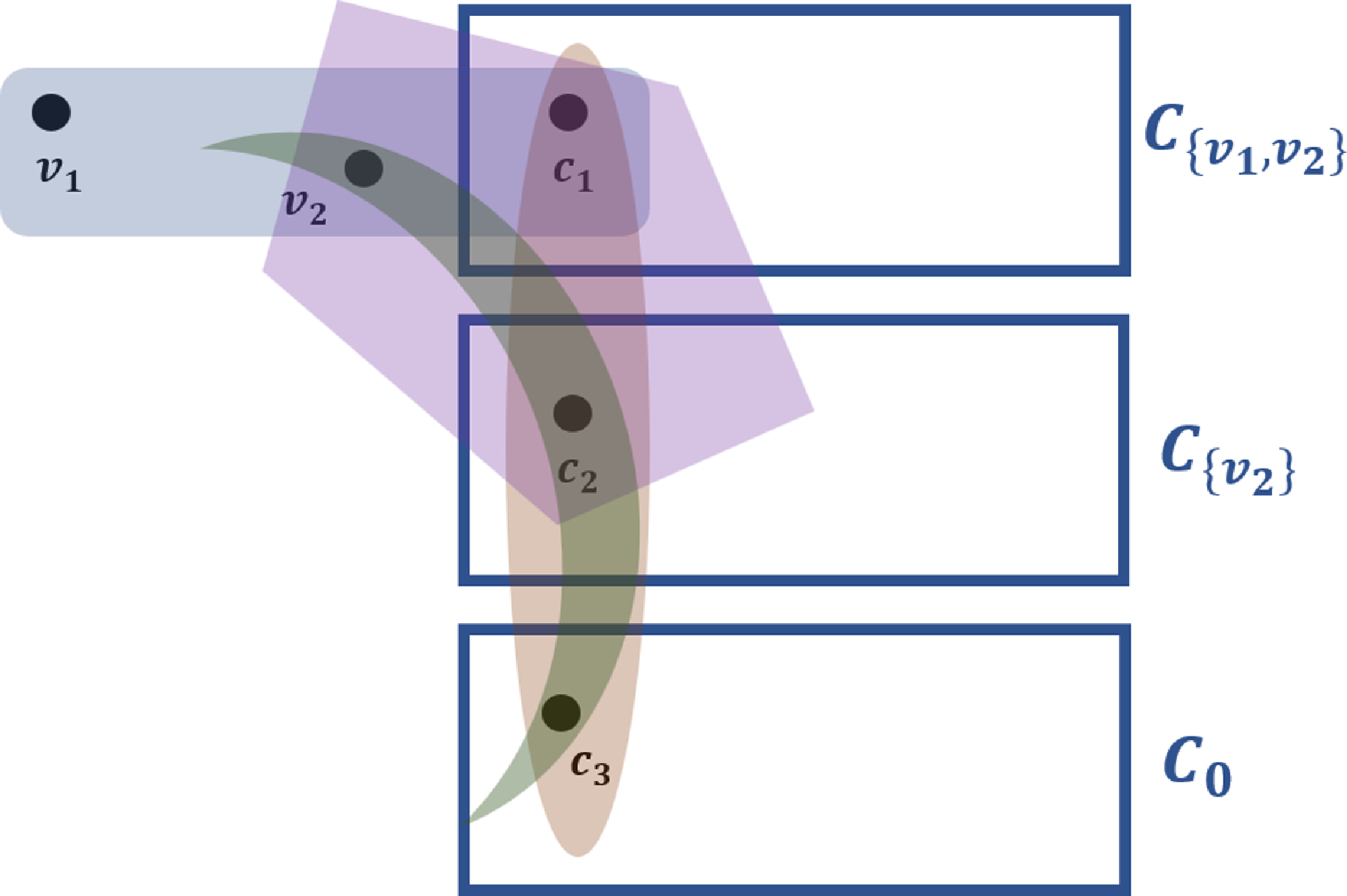


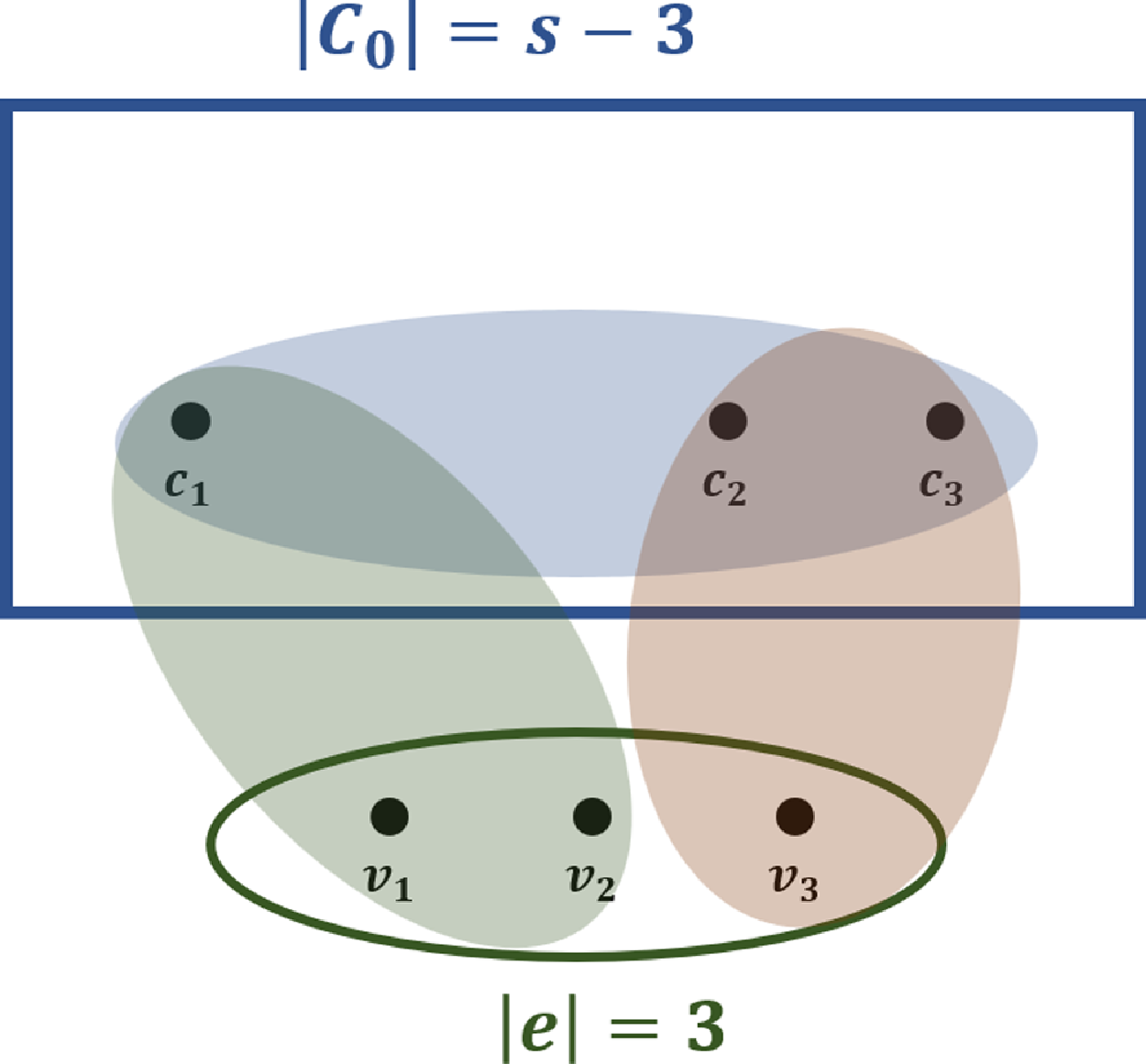


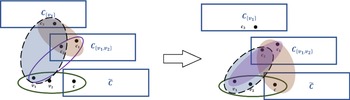


 Open access

