




Introduction
Climate variability and change are generating uncertainty regarding the future resilience of species and ecosystems, placing increasing demands on conservation management to make decisions built not only on evidence, but also on approaches to managing incomplete or ambiguous information. As a result, uncertainty can have crucial impacts on the timeliness and effectiveness of conservation outcomes.
In the Southern Ocean, the Commission for the Conservation of Antarctic Marine Living Resources (CCAMLR) plays a central role in responding to environmental change. Established as a precautionary, ecosystem-based, conservation-focused management organization, CCAMLR has been recognized in the past as a leader in marine conservation (Constable Reference Constable2011, Brooks et al. Reference Brooks, Crowder, Curran, Dunbar, Ainley and Dodds2016, Nilsson et al. Reference Nielsen, Fulton, Haward and Johnson2016). CCAMLR’s management approach is underpinned by a commitment to precautionary, science-based decision-making and international cooperation, reinforcing its links to the Antarctic Treaty and as a part of the broader Antarctic Treaty System regime (Haward Reference Haward2021). It is this commitment that has guided the adoption of Conservation Measures (CMs) - legally binding agreements that often govern anthropogenic activities and are adopted through consensus. The magnitude of climate change is testing the resilience of Antarctic ecosystems, challenging the anthropogenic pressures that it can withstand. As a result, CCAMLR’s decisions could be pivotal in shaping the future of the Antarctic ecosystem.
Adélie penguins (Pygoscelis adeliae) on the Antarctic Peninsula offer valuable insights into CCAMLR’s response to climate change. The Antarctic Peninsula is experiencing the greatest magnitude of warming in the Southern Hemisphere (Vaughan et al. Reference Vaughan, Marshall, Connolley, Parkinson, Mulvaney and Hodgson2003, Siegert et al. Reference Siegert, Trusel, Brigham-Grette, van Wessem, Rignot and Lenaerts2019). In 2006, CCAMLR’s Scientific Committee (SC-CAMLR) noted the first possible observations of the impacts of climate change on Adélie penguin populations around the South Shetland Islands (Goldsworthy & Brennan Reference Goldsworthy and Brennan2021). Consistent with this, Adélie penguin declines have been identified at several colonies on the Antarctic Peninsula, with links between years of novel climate and declines suggested (Cimino et al. Reference Cimino, Lynch, Saba and Oliver2016). However, despite scientific evidence of climate-driven population declines, climate change has tested CCAMLR’s ability to balance science-based decision-making with international cooperation. As a result, the adoption of climate change CMs has been repeatedly postponed, raising concerns regarding the future resilience of species and the ecosystem (Nilsson et al. Reference Nielsen, Fulton, Haward and Johnson2016, Rayfuse Reference Rayfuse2018, Brooks et al. Reference Brooks, Crowder, Österblom and Strong2020, Wendebourg Reference Wendebourg2020, Goldsworthy & Brennan Reference Goldsworthy and Brennan2021, Krüger et al. Reference Krüger, Nicol, Trathan, Flores and Thorpe2021, Goldsworthy Reference Goldsworthy2022, Hughes et al. Reference Hughes, Cavanagh and Convey2022).
While drivers of climate change remain outside the control of CCAMLR, Marine Protected Area (MPA) proposals have become one of CCAMLR’s most visible efforts to build ecosystem resilience in a changing climate, although most remain under negotiation (Goldsworthy Reference Goldsworthy2022). Collectively, the scientific evidence suggests that an extension of CCAMLR’s proposed Weddell Sea MPA (WSMPA) to its south or by way of an MPA in the Antarctic Peninsula would be beneficial for protecting Adélie penguins. This is supported by the identification of Marine Important Bird and Biodiversity Areas related to Adélie penguins within the proposed Domain 1 MPA (D1MPA; Handley et al. Reference Handley, Lynch, Trathan, Wienecke, Southwell, Ainley and van Franeker2021), dynamic ecosystem model projections that the D1MPA would reduce population declines of Adélie penguins under long-term climate change scenarios (Dahood et al. Reference Dahood, Klein and Watters2020a,Reference Ducklow, Baker, Martinson, Quetin, Ross and Smithb) and identification of the Weddell Sea as an Adélie penguin hotspot of significant conservation value (Borowicz et al. Reference Borowicz, Lynch, Wethington, Flynn, Trivelpiece and Fraser2018). MPAs are further supported by evidence that current catch limits may no longer be precautionary for conserving Adélie penguins under climate change (Watters et al. Reference Watters, Hinke and Reiss2020, Krüger et al. Reference Krüger, Nicol, Trathan, Flores and Thorpe2021). This highlights the risks that the ongoing delays in the adoption of the D1MPA and WSMPA pose for Adélie penguins and demonstrates the importance of investigating what is contributing to the delays in reaching consensus for MPA adoption to support the future resilience of Adélie penguins.
This paper explores the contribution that uncertainty associated with climate change has to the pace and direction of MPA establishment and the associated impacts on the resilience of Adélie penguins on the Antarctic Peninsula. It will focus on investigating how uncertainty appears within CCAMLR’s foundations of science-based decision-making and international cooperation. This will include looking at knowledge gaps within CCAMLR’s scientific process, including the CCAMLR Ecosystem Monitoring Program (CEMP) and other sources of science formally presented in working groups and Commission documents. Additionally, the paper will consider how increasing unknowns are challenging CCAMLR’s commitment to international cooperation, including an exploration of how uncertainty is addressed and negotiated in political discussions and how this contributes to the pace of current outcomes. Overall, we identify key opportunities for addressing uncertainty more directly and constructively within CCAMLR and to enhance its capacity to improve conservation outcomes for Adélie penguins.
Adélie penguins on the Antarctic Peninsula: climate pressures, uncertainty and population trends
An investigation of what is known about the pressures that Adélie penguins face in this region under climate change reveals the scientific evidence available to decision-makers, as well as providing a foundation regarding what uncertainty remains.
As highly abundant meso-predators, Adélie penguins play a critical role in the structure, functioning and resilience of the Southern Ocean ecosystem (Baum & Worm Reference Baum and Worm2009). Adélie penguins have a circum-Antarctic distribution, forming breeding colonies on ice-free land around the continent. This paper focuses on Adélie penguins located on the Antarctic Peninsula, using the boundaries of CCAMLR Subarea 48.1. For this paper, Adélie penguin colonies are represented by sites retrieved from the Mapping Application for Penguin Populations and Projected Dynamics (MAPPPD), which was specifically designed to complement efforts from CEMP in meeting the management objectives set forth by CCAMLR (Humphries et al. Reference Humphries, Naveen, Schwaller, Che-Castaldo, McDowall, Schrimpf and Lynch2017). In MAPPPD, a site is defined as a biologically relevant population that is largely separated from others, with only occasional migration between them; in some cases, several small islands have been combined into a single site (Humphries et al. Reference Humphries, Naveen, Schwaller, Che-Castaldo, McDowall, Schrimpf and Lynch2017). The distribution of Adélie penguin colonies in this area is divided into two main geographical groups, separated by a ~400 km stretch of coastline found on the western Antarctic Peninsula, known as the ‘Adélie Gap’, where there are no known colonies (Wethington et al. Reference Wethington, Flynn, Borowicz and Lynch2023). The first group are those found north of the Gap, where ~52 colonies are situated. The second group are colonies south of the Gap, where ~47 colonies are located (Fig. 1). Areas of significance include the Weddell Sea (located off the east of the Peninsula and bounded by the Scotia Arc in the north where the Scotia Sea begins), the Bellingshausen Sea (located off the west of the Peninsula) and the Bransfield Strait (which runs between the South Shetland Islands and the Peninsula, connecting the Weddell Sea to the east and Bellingshausen Sea to the west; Fig. 1).
Adélie penguin colonies and Commission for the Conservation of Antarctic Marine Living Resources (CCAMLR) Ecosystem Monitoring Program (CEMP) sites on the Antarctic Peninsula. The map shows the Antarctic Peninsula. Orange points represent Adélie penguin colonies, blue points represent CEMP sites that specifically monitor Adélie penguins and green points represent other CEMP sites in the region (CEMP site information retrieved from https://www.ccamlr.org/en/science/cempsites, accessed 24 July 2023). Yellow boxes distinguish between colonies north of the Adélie Gap and south of the Adélie Gap. Upper right: CCAMLR Subarea 48.1 (blue) in the context of the entire Antarctic continent. Map sourced from https://maps.apps.pgc.umn.edu/id/2364 (The Reference Elevation Model of Antarctica (hillshade)).

During the breeding season, breeding Adélie penguins along the entire Antarctic Peninsula are known to forage near their colonies. Foraging for breeding penguins is spatially restricted by the need to provision their chicks, with foraging range varying from within 5 km of their colony to over 170 km, depending on the colony size, location, stage of breeding, presence of competitors and environmental conditions (Wienecke et al. Reference Wienecke, Robertson and Scolaro2000, Lynnes et al. Reference Lynnes, Reid, Croxall and Trathan2002, Clarke et al. Reference Clarke, Emmerson and Otahal2006, Ballance et al. Reference Ballance, Ainley, Ballard and Barton2009, Ford et al. Reference Ford, Wilson, Bevan, Wienecke, Barton, Giardino and Kooyman2015).
Non-breeding birds are less restricted in foraging range; however, they have been shown to still have ties to their colony during the breeding season (Ainley Reference Ainley1978). During the breeding season, both breeding and non-breeding Adélie penguin colonies in the northern region are known to rely on the Weddell Sea and Bransfield Strait (Borowicz et al. Reference Borowicz, Lynch, Wethington, Flynn, Trivelpiece and Fraser2018, Oosthuizen et al. Reference Oosthuizen, Barbraud, Lyver, Ainley, Trathan and Southwell2022). For Adélie penguin colonies north of the Gap, the Weddell Sea has been identified as providing a suitable foraging habitat with relatively stable sea-ice conditions compared to the western side of the Antarctic Peninsula (Parkinson & Cavalieri Reference Parkinson and Cavalieri2012, Borowicz et al. Reference Borowicz, Lynch, Wethington, Flynn, Trivelpiece and Fraser2018, Perchivalé et al. Reference Perchivalé, Trathan, Lynch, Wilson and Southwell2022). Colonies south of the Gap have been known to rely on the Bellingshausen Sea during this time (Trivelpiece & Fraser Reference Trivelpiece and Fraser1996).
During winter, Adélie penguins on the Antarctic Peninsula migrate variable distances. Adélie penguins have been documented to require a balance of sea-ice habitat and light during this time for both foraging and navigation (Trivelpiece & Fraser Reference Trivelpiece and Fraser1996, Ballard et al. Reference Ballard, Toniolo, Ainley, Parkinson, Arrigo and Trathan2010, Erdmann et al. Reference Erdmann, Ribic, Patterson-Fraser and Fraser2011). Adélie penguins north of the Gap have been known to use the Weddell Sea and southern Scotia Sea during winter (Polito et al. Reference Polito, Lynch, Naveen and Emslie2011, Hinke et al. Reference Hinke, Goebel, Trivelpiece, Polito, Reiss and Trathan2015, Reference Hinke, Goebel, Trivelpiece, Polito, Reiss and Trathan2020), with Adélie penguin colonies found south of the Gap known to distribute into the Bellingshausen Sea (Erdmann et al. Reference Erdmann, Ribic, Patterson-Fraser and Fraser2011, Polito et al. Reference Polito, Lynch, Naveen and Emslie2011). Adélie penguins found south of the Gap have also been identified at their colonies during winter (Black et al. Reference Black, Southwell, Emmerson, Lunn and Hart2018, Cimino et al. Reference Cimino, Stammerjohn, Fraser, Lynch, Patterson-Fraser and Trathan2023).
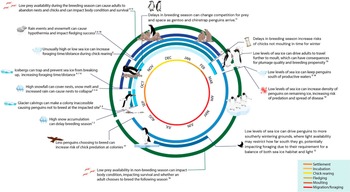
Key stages in the annual Adélie penguin cycle include winter foraging and migration, colony settlement, incubation, chick rearing, fledging, moulting and summer foraging for non-breeding adults (Fig. 2). Within these stages, four key physical environmental factors have been identified as impacting Adélie penguin population dynamics under climate change: 1) increased precipitation (Ainley et al. Reference Ainley, Russell, Jenouvrier, Woehler, Lyver, Fraser and Kooyman2010, Hinke et al. Reference Hinke, Goebel, Reiss, Trivelpiece, Polito and Trathan2012, Juáres et al. Reference Juáres, Lynch, Trathan, Wienecke, Southwell and van Franeker2015, Ropert-Coudert et al. Reference Ropert-Coudert, Kato, Wilson, Charrassin, Le Maho and Bost2015, Cimino et al. Reference Cimino, Patterson-Fraser, Stammerjohn and Fraser2019, McLatchie et al. Reference McLatchie, Jones, Smith, Brown, Wilson, Thompson and Green2024), 2) changes in sea-ice conditions including sea-ice extent, timing of sea-ice recession and availability of polynyas (Ainley et al. Reference Ainley, Russell, Jenouvrier, Woehler, Lyver, Fraser and Kooyman2010, Emmerson & Southwell Reference Emmerson and Southwell2011, Ninnes et al. Reference Ninnes, Trathan, Forster, Croxall, Murphy and van Franeker2011, Gorman Reference Gorman2015, Cimino et al. Reference Cimino, Lynch, Saba and Oliver2016, Ropert-Coudert et al. Reference Ropert-Coudert, Charrassin, Kato, Wilson, Le Maho and Bost2018, Schmidt et al. Reference Schmidt, Trivelpiece, Emslie, Polito, Lynch and Naveen2023), 3) increased glacier calving (Ninnes et al. Reference Ninnes, Trathan, Forster, Croxall, Murphy and van Franeker2011, Dugger et al. Reference Dugger, Ballard, Ainley, Lyver and Schine2014, Lescroël et al. Reference Lescroël, Ballard, Dugger, Jennings, Pollard and Porzig2014, Wilson et al. Reference Wilson, Lynch, Trathan and Woehler2016) and 4) increased terrestrial availability from glacial retreat (LaRue et al. Reference LaRue, Lynch, Jones, Fagan, Polito, Trathan and Southwell2013, Cimino et al. Reference Cimino, Lynch, Saba and Oliver2016). In addition to these physical factors, changes in food web dynamics, including changes to prey availability and changes in predator-prey relationships, were identified as crucial considerations for Adélie penguins under climate change (Fraser & Hofmann Reference Fraser and Hofmann2003, Forcada et al. Reference Forcada, Trathan, Reid, Murphy and Croxall2006, Trivelpiece et al. Reference Trivelpiece, Hinke, Miller, Reiss, Trivelpiece and Watters2011). Together, these impacts have been documented to influence decisions for adults to breed, breeding success, brood success, chick survival, successful juvenile recruitment, winter migration and summer and winter foraging success and dispersal (Fig. 2; LaRue et al. Reference LaRue, Lynch, Jones, Fagan, Polito, Trathan and Southwell2013, Cimino et al. Reference Cimino, Lynch, Saba and Oliver2016).
Annual life stages and potential impacts of climate change for Adélie penguins. The innermost circle shows the different life stages of the Adélie penguin throughout a year. The outer circles show climate change’s potential impacts on Adélie penguin populations at different times of the year. Superscript reference citations: 1 = McLatchie et al. (Reference McLatchie, Jones, Smith, Brown, Wilson, Thompson and Green2024); 2 = Cimino et al. (Reference Cimino, Patterson-Fraser, Stammerjohn and Fraser2019); 3 = Dugger et al. (Reference Dugger, Ballard, Ainley, Lyver and Schine2014); 4 = Wilson et al. (Reference Wilson, Lynch, Trathan and Woehler2016); 5 = Juáres et al. (Reference Juáres, Lynch, Trathan, Wienecke, Southwell and van Franeker2015); 6 = Ropert-Coudert et al. (Reference Ropert-Coudert, Kato, Wilson, Charrassin, Le Maho and Bost2015); 7 = Ropert-Coudert et al. (Reference Ropert-Coudert, Charrassin, Kato, Wilson, Le Maho and Bost2018); 8 = Ninnes et al. (Reference Ninnes, Trathan, Forster, Croxall, Murphy and van Franeker2011); 9 = Emmerson & Southwell (Reference Emmerson and Southwell2011); 10 = Chapman et al. (Reference Chapman, Lynch, Ballard, Fraser, Patterson-Fraser and Trathan2011); 11 = Trivelpiece et al. (Reference Trivelpiece, Hinke, Miller, Reiss, Trivelpiece and Watters2011); 12 = Ainley et al. (Reference Ainley, Russell, Jenouvrier, Woehler, Lyver, Fraser and Kooyman2010); 13 = Schmidt et al. (Reference Schmidt, Trivelpiece, Emslie, Polito, Lynch and Naveen2023); 14 = Ballerini et al. (Reference Ballerini, Tavecchia, Olmastroni, Pezzo and Focardi2009); 15 = Ballard et al. (Reference Ballard, Toniolo, Ainley, Parkinson, Arrigo and Trathan2010); 16 Hinke et al. (Reference Hinke, Goebel, Trivelpiece, Reiss, Polito and Trathan2007); 17 = Schmidt et al. (Reference Schmidt, Lynch, Naveen, Emslie, Polito and Trivelpiece2021).

Population shifts have been observed for Adélie penguins on the Antarctic Peninsula, occurring alongside environmental change since the late twentieth century (Ducklow Reference Ducklow, Fraser, Meredith, Stammerjohn, Doney and Martinson2013, Cimino et al. Reference Cimino, Lynch, Saba and Oliver2016). The first published evidence linking Adélie penguin decline and sea-ice extent on the Peninsula was published by Croxall et al. (Reference Croxall, Trathan and Murphy2002). Cimino et al. (Reference Cimino, Lynch, Saba and Oliver2016) found a link between years of novel climate and Adélie penguin declines on the Peninsula, suggesting recent warming effects could be detrimental to Adélie penguin populations. Population declines have also been identified around the South Shetland Islands (Trivelpiece et al. Reference Trivelpiece, Hinke, Miller, Reiss, Trivelpiece and Watters2011, Juáres et al. Reference Juáres, Lynch, Trathan, Wienecke, Southwell and van Franeker2015, Hinke et al. Reference Hinke, Trivelpiece and Trivelpiece2017), as well as south of the Danger Islands on the western side of the Peninsula, particularly for colonies south of the Gap (Ducklow et al. Reference Ducklow, Baker, Martinson, Quetin, Ross and Smith2007, Lynch et al. Reference Lynch, Fagan and Naveen2010, Reference Lynch, Naveen, Trathan and Fagan2012, Lynch & LaRue Reference Lynch and LaRue2014, Wethington et al. Reference Wethington, Flynn, Borowicz and Lynch2023). Some stable and increasing trends of Adélie penguin colonies have been identified around the north-east and north-west ends of the Antarctic Peninsula (Borowicz et al. Reference Borowicz, Lynch, Wethington, Flynn, Trivelpiece and Fraser2018, Perchivalé et al. Reference Perchivalé, Trathan, Lynch, Wilson and Southwell2022, Wethington et al. Reference Wethington, Flynn, Borowicz and Lynch2023), including around the Danger Islands, which are identified as an Adélie penguin hotspot accounting for 55% of the Antarctic Peninsula population (Borowicz et al. Reference Borowicz, Lynch, Wethington, Flynn, Trivelpiece and Fraser2018). Marguerite Bay has been identified as a biological hotspot, which divides areas of Adélie penguin decline occurring to the north of this point from the increasing and stable trends occurring from Marguerite Bay to the south (Casanovas et al. Reference Casanovas, Naveen, Forrest, Poncet and Lynch2015).
Methods and approach
A multiple-method qualitative social science research design was adopted, which utilized primary and secondary data, including governance and science documents and key informant interviews.
A literature review was undertaken in which the focus was on CCAMLR, with other key search terms including ecosystem-based management, climate change, CEMP, ecosystem monitoring, Marine Protected Area, Ross Sea, international cooperation, regional fisheries management organizations, Southern Ocean management, high seas management, management under uncertainty, penguins, transboundary principle, Adélie penguins, krill and future management.
A document analysis was carried out, which included relevant CCAMLR meeting documents from 2009 onwards. The year 2009 was chosen as this was when CCAMLR urged increased consideration of climate change’s impacts to better inform management decisions (CCAMLR 2009). Additional information on CCAMLR was collected from CCAMLR’s website (https://www.ccamlr.org/). Due to CCAMLR’s processes, requests for papers were not always approved.
The document analysis also included an investigation into the science visible in CCAMLR’s processes. This included analysis of CEMP and other science presented in working group documents, due to the visibility and relevance of these data within decision-making. Documents included CCAMLR, SC-CAMLR and the Working Group on Ecosystem Monitoring and Management (WG-EMM) meeting documents, relevant documents mentioned within these papers and CEMP standard methods documents. Information on CEMP monitoring sites was obtained from CCAMLR’s website (https://www.ccamlr.org/en/science/cemp-sites).
NVIVO® version 12 software was used to facilitate the analysis of qualitative data from the CCAMLR, SC-CAMLR and WG-EMM reports. A key to this analysis was the development of appropriate codes around which key themes were drawn. Initial code groups included: Penguin Mentions, Adélie Mentions, Ecosystem Relationships, Climate Change, Conservation Measures and List of Documents. Penguin codes were separated by species; any unspecified mention of a penguin was coded separately as penguin. An analysis of Uncertainty was grouped into discussions around fisheries, illegal, unreported and unregulated (IUU) fishing, climate change, protected areas and monitoring. The analysis of Uncertainty also incorporated synonyms and similar phrases, including doubt, lack of science, lack of certainty, concerns on the certainty, paucity of information, little evidence, insufficient scientific evidence, requires more evidence, not provided sufficient evidence and insufficient evidence.
A comprehensive review on the scientific literature of Adélie penguins was conducted. The key focus was on Adélie penguins, with other search terms including climate change, ocean acidification, sea ice, precipitation, krill, fish, Domain 1 MPA, Antarctic Peninsula, diet, foraging, winter trends, summer trends, population trends, distribution, chick survival, fledging success, life history, management, CCAMLR and ecosystem monitoring. To attain a more holistic background, the literature review was coupled with a review of climate change on the Antarctica Peninsula, with key search terms including Pygoscelis penguins, krill, sea ice, rain, precipitation, glacier calvings and fishing in the Southern Ocean.
Key informant interviews were used to support other forms of data gathered, including CCAMLR reports and documents. Interviews were approved by the University of Tasmania Human Research Ethics Committee (Project ID 28278). Identification of potential informants involved selecting individuals with familiarity and knowledge of the issue and who held appropriate positions and roles. Interviews conducted included a deliberate and focused choice of a small number of experts with relevant expertise. In support of this approach, it is argued that a small number of experts can provide deeper insights and can contextualize information (Marshall Reference Marshall1996). There is some debate over the optimal number of key informants, with variation across studies from 4–6 to 12–17, with the concept of data saturation stated as occurring when ‘no new information arises from subsequent data’ (Muellmann et al. Reference Muellmann, Brand, Jürgens, Gansefort and Zeeb2021). This approach provides an efficient process under time constraints. Interviews were limited to experts within Australia and the UK. Because of this, the perspectives represented in the study may be skewed towards the priorities and positions of these countries. Fifteen participants were initially contacted with an invitation to participate in the study. Seven individuals agreed to take part and were provided with a project description and consent form to participate in a recorded, 1 h, semi-structured interview over Zoom. Participants included those with expertise or experience with CCAMLR, CEMP and/or Adélie penguins.
Interviews were conducted between April and May 2023. The following five interview questions were prepared for all interviews:
-
1) What do you consider to be the fundamental role(s) of CCAMLR, particularly regarding climate change?
-
2) What are the benefits and limitations in CCAMLR’s current management framework regarding its ability to respond to climate change?
-
3) How would you describe the adequacy of the science that guides CCAMLR’s ecosystem approach? If possible, answer with reference to CEMP and Adélie penguins.
-
4) How would you say international cooperation is influencing CCAMLR’s commitment to adopt CMs based on the best scientific evidence available?
-
5) What does the future of the Antarctic Peninsula look like under current management? If possible, answer with reference to Adélie penguins.
Following the interviews, transcripts were provided to the interviewees for an opportunity to review; after this, interviews were deidentified and analysed for key themes and quotes.
Results
Of the 15 total CEMP sites on the Antarctic Peninsula listed on CCAMLR’s website, 8 sites monitor Adélie penguins (Fig. 1), 11 sites monitor gentoo penguins (Pygoscelis papua), 4 sites monitor chinstrap penguins (Pygoscelis antarcticus) and 1 site is identified as monitoring Antarctic fur seals (Arctocephalus gazella). No sites were identified as monitoring the remaining CEMP species that could be found in the region, which includes Antarctic petrels (Thalassoica antarctica), Cape petrels (Daption capense) and macaroni penguins (Eudyptes chrysolophus). Black-browed albatross (Thalassarche melanophrys) are also a listed CEMP species; however, they do not breed on the Antarctic Peninsula. Some 50% of CEMP sites that monitor Adélie penguins are found on the South Shetland Islands, which is north of the Adélie Gap, where ~10% of known colonies are located. A further two Adélie penguin CEMP sites are north of the Gap, where ~42% of the colonies are found, and two Adélie CEMP sites are located south of the Gap, where ~47% of colonies are found. The most southerly Antarctic Peninsula CEMP site is located at Yalour Island (-65.23, -64.16), with a further 31 Adélie penguin colonies occurring on the Antarctic Peninsula located south of this (Fig. 1).
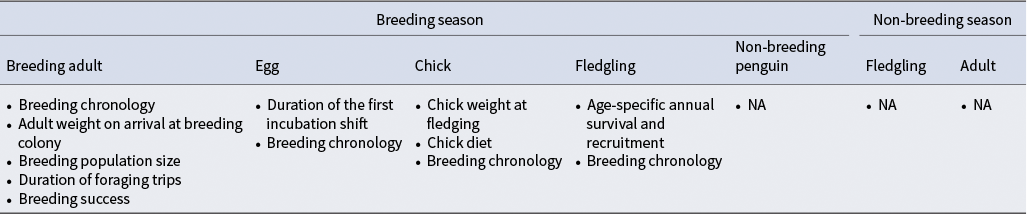
CEMP standard methods currently focus on parameters that can be measured from land, and as a result these exclusively focusing on the breeding season. The parameters do not include information on non-breeding penguins and winter parameters (Table I).
Commission for the Conservation of Antarctic Marine Living Resources (CCAMLR) Ecosystem Monitoring Program (CEMP) monitoring parameters for penguins. Parameters of penguins monitored with the CEMP standard methods are shown. The table is divided into different stages of the breeding and non-breeding seasons for Adélie penguins.

Source: CEMP standard methods (https://www.ccamlr.org/en/system/files/CEMP20Standard20Methods20Jun202014.pdf, accessed 24 July 2023). NA = not applicable.
The most common limitation within CEMP described by Interviewees 1, 3, 5, 6 and 7 was the absolute amount of research being done. Specific limitations included no climate reference zones and the inability to disentangle drivers. One interviewee described CEMP as ‘simply not enough’. The majority of interviewees (Interviewees 1, 2, 3, 5, 6 and 7) mentioned that addressing gaps in CEMP data will become increasingly necessary under new environmental conditions.
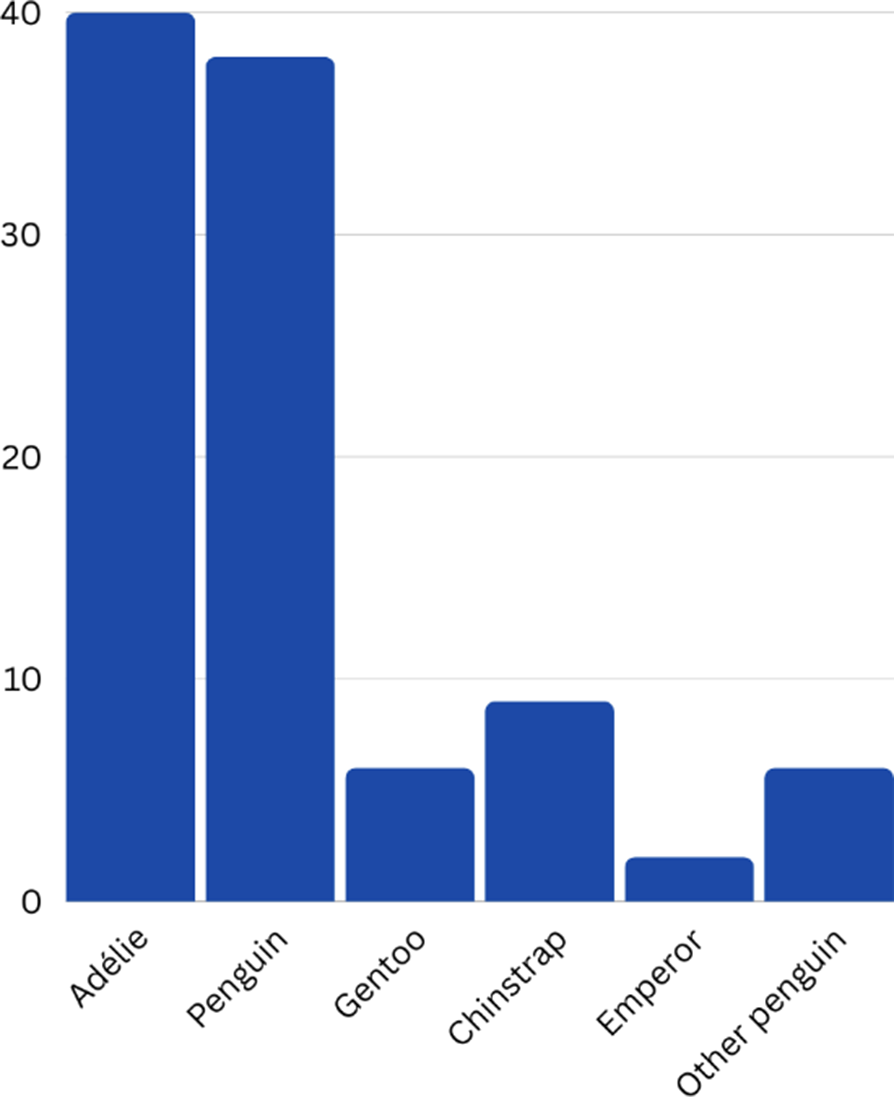
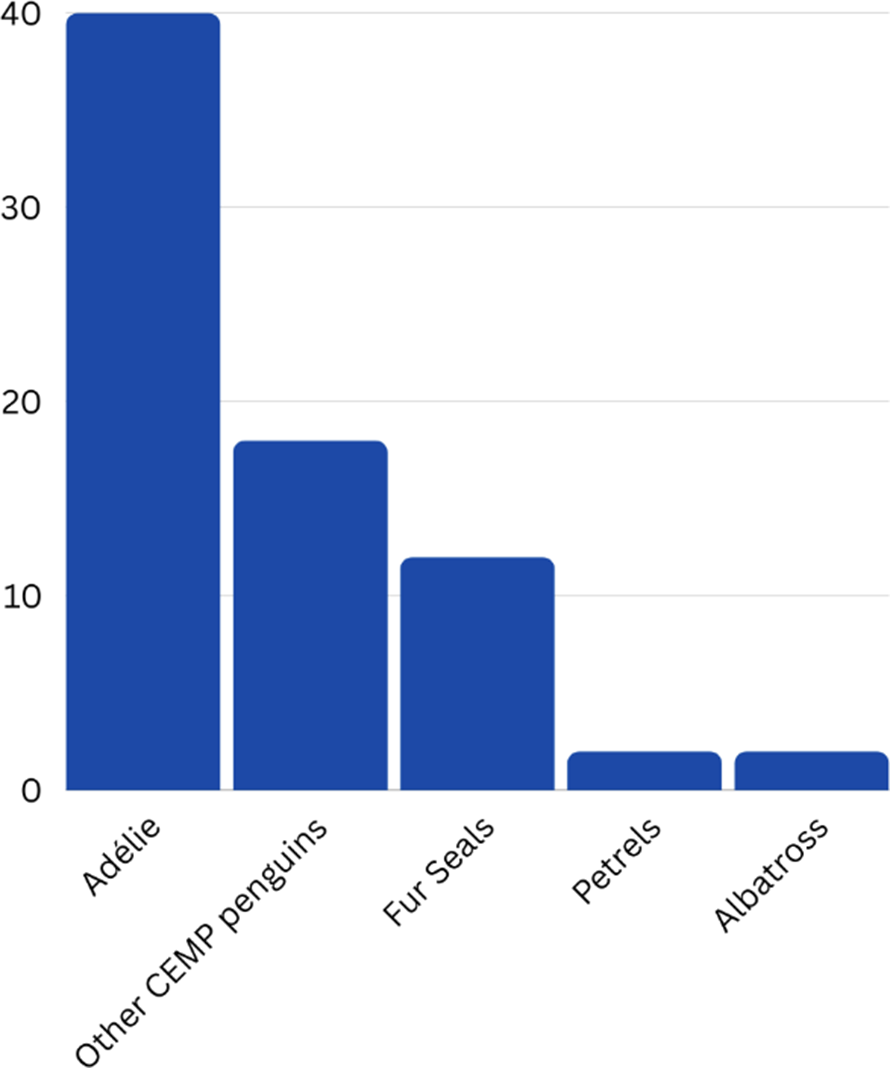
Of the documents submitted to the WG-EMM on penguins from 2009 to 2022, 101 documents directly mention penguins within their title; 40 of these papers were directly related to Adélie penguins, which was the most mentioned of any penguin species. There were a further 39 unspecified penguin mentions. Chinstrap penguins were the second most mentioned, being mentioned in nine documents (Fig. 3). Additionally, documents on Adélie penguins accounted for over 50% of the documents submitted on any CEMP species (Fig. 4).
Number of Working Group on Ecosystem Monitoring and Management (WG-EMM) documents submitted on penguins. A breakdown of documents listed under the List of Documents section of the WG-EMM meetings between 2009 and 2022 that mentioned penguin in the title is shown. Penguins are grouped by the species specified. Documents in which no specific species was identified are categorized as ‘Penguin’. The ‘Other penguin’ section includes mentions of rockhopper, Magellanic and African penguins.

Number of Working Group on Ecosystem Monitoring and Management (WG-EMM) documents submitted on Commission for the Conservation of Antarctic Marine Living Resources (CCAMLR) Ecosystem Monitoring Program (CEMP) species. A breakdown of documents listed under the List of Documents section of the WG-EMM meetings between 2009 and 2022 that mentioned a CEMP species within their title is shown.

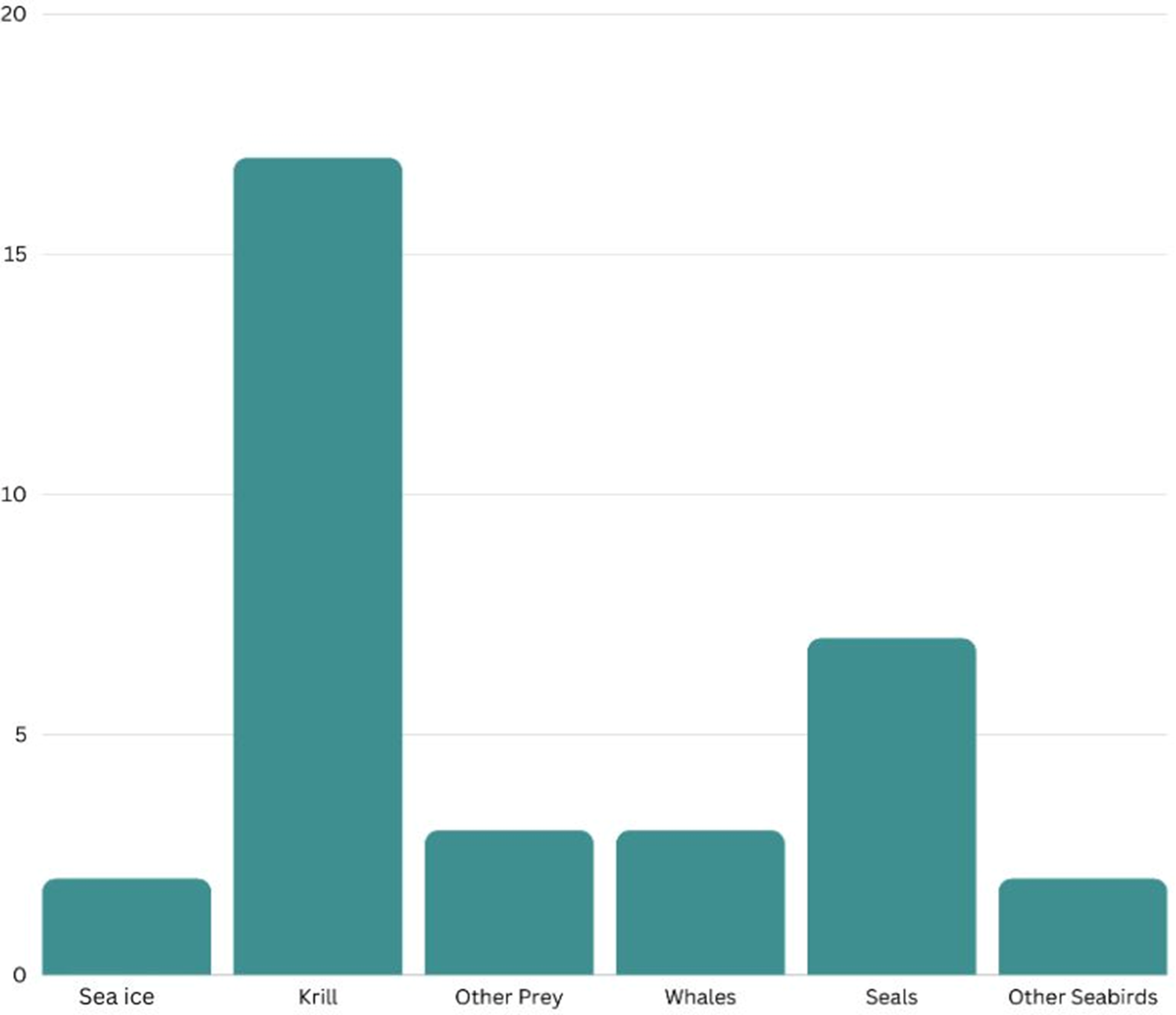
Of the Adélie penguin relationships discussed in SC-CAMLR meetings between 2009 and 2022, the Adélie/krill relationship was the most frequently mentioned relationship compared to discussions on the relationships of Adélie penguins with other prey species, with whales, with seals or with other seabirds (Fig. 5).
The Scientific Committee for the Commission for the Conservation of Antarctic Marine Living Resources (SC-CAMLR) discussions of ecosystem relationships. A count of the relationships mentioned between penguins and other biological and physical components of the Southern Ocean between 2009 and 2022 in the SC-CAMLR meetings is shown.

The discussions analysed in the WG-EMM, SC-CAMLR and CCAMLR meetings between 2009 and 2022 included data from both CEMP and other sources however it was not always distinguishable.
Between 2009 and 2022, Adélie penguins were discussed regularly within the WG-EMM, SC-CAMLR and CCAMLR meetingsMentions were most frequent in WG-EMM, but both SC-CAMLR and CCAMLR also directly discussed Adélie penguins in several years. Penguin declines on the Antarctic Peninsula were noted on at least eight occasions between the WG-EMM, SC-CAMLR and CCAMLR meetings. In addition to this, there were also mentions of changes and vulnerability linked to climate change, the need for spatial protection and extinction risk (Fig. 6). Other discussions not included in Fig. 6 included other updates on monitoring and discussions on Adélie penguins in other regions of Antarctica.
Discussions of Adélie penguins between 2009 and 2002 in the Working Group on Ecosystem Monitoring and Management (WG-EMM), the Scientific Committee for the Commission for the Conservation of Antarctic Marine Living Resources (SC-CAMLR) and Commission for the Conservation of Antarctic Marine Living Resources (CCAMLR) meetings. The bar graph on the right shows the count discussions concerning Adélie penguins between 2009 and 2022 in the WG-EMM, SC-CAMLR and CCAMLR meetings. Mentions in tables were excluded. The two SC-CAMLR meetings in 2013 were combined into one count. The left of the figure describes the notable mentions of Adélie penguins or penguins that are associated with declines generally or specifically in the Antarctic Peninsula region, as well as mentions associated with climate change and protection.

It is important to note that due to COVID-19 the 2020 WG-EMM meeting was postponed, SC-CAMLR 2020 and 2021 were held as virtual meetings, and CCAMLR 2021 had a limited agenda. As such, discussion opportunities may have been more limited in these years.
Two climate change resolutions were adopted in 2009 and 2022, both of which recognizing that ‘climate change is one of the greatest challenges’ (CCAMLR 2009, 2022b) facing Antarctica and the ocean surrounding it. Within the 12 years between these resolutions, two CMs were approved that prioritize the protection of ecosystems through restricting anthropogenic pressures in the CCAMLR region, including the Ross Sea Region MPA and the Larsen C Ice Shelf Special Area for Scientific Study (SASS). A further six proposals have not achieved consensus, including three MPA proposals, one additional SASS and two proposals that integrate climate change into decision-making (Fig. 7).
Timeline of climate change action in the Commission for the Conservation of Antarctic Marine Living Resources (CCAMLR). A timeline of actions within CCAMLR that are associated with climate change and Adélie penguins is shown. Green text represents proposals that have been adopted that could provide protection for Adélie penguins. Red text represents proposals that have not yet reached consensus but could provide protection for Adélie penguins. D1MPA = Domain 1 Marine Protected Area; ICG = Intersessional Correspondence Group; MPA = Marine Protected Area; SASS = Special Area for Scientific Study.

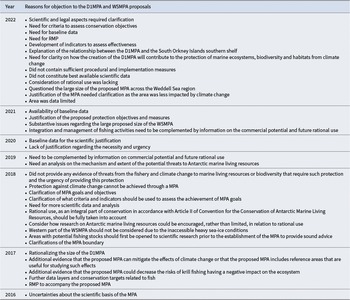
Uncertainty appeared as a key theme used to object to protected area proposals by a minority of members consistently between 2012 and 2022, excluding 2021 (Fig. 8). This is evident in the D1MPA and WSMPA proposals, in which objections were based on a lack of data, science, evidence, clarity and certainty (Table II). Objections to the proposals are occurring despite the majority of members agreeing that the best available science has been used and that the proposal is ready for adoption.
The role of uncertainty in increasing and decreasing human activities. This figure shows the years when discussions of uncertainty played a role in an outcome between 2009 and 2022 in Commission for the Conservation of Antarctic Marine Living Resources (CCAMLR) discussions. Red circles indicate when uncertainty was used to oppose a protection measure that was perceived as having an impact on reducing human activities. Blue circles represent when uncertainty resulted in a decrease in human activities.

When uncertainty has been discussed, there is consistency in its use as a reason to allow continued human activity in comparison to its minimal use in restricting human activities. Of the total of 84 mentions of uncertainty recorded between 2009 and 2022, protected areas had 36 mentions of uncertainty and fisheries had 33, making up the majority of discussions on uncertainty compared to discussions on fisheries, IUU fishing and climate change and monitoring, which had 6, 4 and 5 mentions, respectively (Fig. 9). During this time, uncertainty was used as a reason to object to a protected area proposal in every year excluding 2021. In contrast, uncertainty was found to limit human activities through the closure of a fishery once in 2011, to restrict the increase of a catch limit in 2020 and to object to a proposal on an exploratory fishery in 2021 (Fig. 8). It is important to note that 2021 is an exception to the trend because the meeting took place during the COVID-19 pandemic and had a limited agenda. In addition, the exploratory fishery that did not receive consensus in 2021 was quoted as having ‘consistently received very good reviews’ and was blocked by one member (CCAMLR 2021).
Uncertainty and climate change mention comparison and breakdown. The bar graph shows changes in discussions of uncertainty between 2009 and 2022 within the topics of fisheries, IUU fishing, climate change, protected areas and monitoring. The orange line graph shows all mentions of climate change within Commission for the Conservation of Antarctic Marine Living Resources (CCAMLR) meeting documents between 2009 and 2022. IUU = illegal, unreported and unregulated.

From 2009 to 2018, CCAMLR explicitly acknowledged uncertainty in its decision-making, with mentions appearing in both the agenda and the abstracts (Fig. 10). Uncertainty last appeared as an agenda item in 2010 and was removed from the abstracts in 2018. Overall, mentions of uncertainty declined gradually from 2009 to 2022 (Fig. 10). In contrast, climate change remained an agenda item throughout, and, from 2020, it was also included in the abstracts (Fig. 11).
Mentions of uncertainty in Commission for the Conservation of Antarctic Marine Living Resources (CCAMLR) meetings. The bar graph shows mentions of uncertainty between 2009 and 2022 within discussions of fisheries, illegal, unreported and unregulated fishing, climate change, protected areas and monitoring. The green line is a linear trend line of all mentions. The top horizontal bar shows when uncertainty was mentioned under the abstract as one of the major topics discussed in CCAMLR meeting documents. The bottom horizontal bar shows the years when uncertainty appeared as an agenda item in CCAMLR meetings.

Mentions of climate change in Commission for the Conservation of Antarctic Marine Living Resources (CCAMLR) meetings. The bar graph shows mentions of climate change between 2009 and 2022. The orange line is a linear trend line. The top horizontal bar highlights the years when climate change was mentioned under the abstract as one of the major topics discussed in CCAMLR meeting documents. The bottom horizontal bar highlights the years when climate change appeared as an agenda item in CCAMLR meetings.

Discussion
Uncertainty has played a key role in postponing the adoption of MPAs, creating tension with CCAMLR’s precautionary, science-based approach. The case of Adélie penguins, whose declines and vulnerability have been documented and discussed within meetings (Fig. 6), reveals how the positions of a small number of members can shape conservation outcomes under CCAMLR’s consensus system, illustrating the risk that this dynamic presents. A pragmatic path forward is to balance calls for greater certainty while also recognizing that demands for higher certainty may undermine CCAMLR’s commitment to precautionary decision-making based on the best available science. This paper finds opportunities to address uncertainty by 1) reducing key scientific uncertainties through targeted monitoring and research and 2) systematically integrating residual uncertainty into decision-making.
Reducing uncertainty: science
Of the science visible within CCAMLR, there is a mix of internal sources, specifically CEMP, and external sources presented and discussed in working group and commission documents that supplement these data.
CEMP is an important programme that represents a long-term effort by CCAMLR to detect and interpret changes in the environment. CEMP’s strengths are in its aims to deliver consistent, structured, long-term, standardized data at key sites of ecological significance. A study presented in WG-EMM 2022 that tracked Adélie penguins from the Ardley Island CEMP site documented the importance of CEMP data for conservation proposals such as the D1MPA and WSMPA. However, CEMP’s limited data coverage means that its data alone are typically unable to support the adoption of CCAMLR CMs (Constable Reference Constable2011, Miller Reference Miller, Berkman, Lang, Walton and Young2011). CEMP’s limitations are exacerbated by climate change, increasing ecosystem risks and highlighting opportunities to identify key areas for improvement within CCAMLR’s science programme.
CCAMLR processes and discussions also integrate engagement with science beyond CEMP, such as those listed in its meeting documents and mentioned in discussions of the WG-EMM, SC-CAMLR and CCAMLR. These sources present valuable contributions that can play an important role in filling knowledge gaps. External sources, however, vary in the consistency of their inclusion in meetings and discussions. Consequently, current attempts to fill knowledge gaps from outside of CEMP also have not been able to support consensus. This highlights the potential of identifying where uncertainty can be reduced both in CEMP and in other sources of science that CCAMLR draws upon.
Due to CEMP’s design as an important, long-term, standardized monitoring programme and its potential to provide a structured foundation within CCAMLR, it offers useful insights into opportunities to reduce uncertainty. It also offers a basis that can help pinpoint where a more coordinated integration of external sources of science could be effective.
Spatial range of monitoring
The information that CEMP can provide on Adélie penguins could be improved by expanding the spatial range of the programme on the Antarctic Peninsula. There is currently a high concentration of CEMP sites north of the Adélie Gap, with sparse monitoring of southern colonies (Fig. 1). Adélie penguins in the north and south display differing dynamics and responses to climate change (Wethington et al. Reference Wethington, Flynn, Borowicz and Lynch2023), suggesting that increasing the number of CEMP sites in the south would give a more holistic view of Adélie penguin population dynamics on the Antarctic Peninsula.
The limitations of the spatial distribution of CEMP sites are exacerbated by the localized information that the programme provides. Adélie penguins have demonstrated spatially variable responses to climate change along the Antarctic Peninsula (Ainley et al. Reference Ainley, Russell, Jenouvrier, Woehler, Lyver, Fraser and Kooyman2010, Casanovas et al. Reference Casanovas, Naveen, Forrest, Poncet and Lynch2015, Cimino et al. Reference Cimino, Lynch, Saba and Oliver2016, Borowicz et al. Reference Borowicz, Lynch, Wethington, Flynn, Trivelpiece and Fraser2018). Many climate change impacts on the physical environment are spatially localized, including changes in precipitation, iceberg calving events and changes in sea-ice conditions, all of which can cause local declines in Adélie penguin populations (Clarke et al. Reference Clarke, Kerry, Irvine and Phillips2002, Emmerson & Southwell Reference Emmerson and Southwell2011, Dugger et al. Reference Dugger, Ballard, Ainley, Lyver and Schine2014, Ropert-Coudert et al. Reference Ropert-Coudert, Kato, Wilson, Charrassin, Le Maho and Bost2015, McLatchie et al. Reference McLatchie, Jones, Smith, Brown, Wilson, Thompson and Green2024). Given the potential for localized ecological change, the current spatial distribution of CEMP could lead to significant population declines being overlooked. Furthermore, there are no CEMP sites at the Adélie penguin hotspot on the Danger Islands (Borowicz et al. Reference Borowicz, Lynch, Wethington, Flynn, Trivelpiece and Fraser2018) or at identified biological hotspots in Marguerite Bay (Casanovas et al. Reference Casanovas, Naveen, Forrest, Poncet and Lynch2015). The limited spatial distribution of Adélie penguin CEMP sites supports claims that CEMP is highly site-specific (Rayfuse Reference Rayfuse2018). Consequently, expanding the limited spatial distribution of CEMP sites could enhance CCAMLR’s ability to implement management that better considers the Adélie penguin species on the Antarctic Peninsula.
Monitoring parameters
There is an opportunity to improve CEMP by including additional Adélie penguin life stages, particularly stages that could be increasingly significant under new environmental conditions (Table I). For example, climate change presents conditions that could increase the number of Adélie penguins that choose not to breed or experience nest failure (McClintock et al. Reference McClintock, Ducklow and Fraser2008, Lynch et al. Reference Lynch, Fagan and Naveen2010). Non-breeding penguins include juvenile penguins and penguins that choose not to breed, fail to pair or experience early nest failure.
Non-breeding penguins have been shown to exhibit different movement behaviours compared to penguins that choose to breed (Oosthuizen et al. Reference Oosthuizen, Barbraud, Lyver, Ainley, Trathan and Southwell2022), underscoring the importance of information on non-breeding penguins under conditions of climate change. In addition, the non-breeding season is a substantial portion of an Adélie penguin’s year and has been identified as a significant timeframe that could be contributing to Adélie penguin declines on the Antarctic Peninsula (Trathan et al. Reference Trathan, Croxall and Murphy1996, Hinke et al. Reference Hinke, Goebel, Trivelpiece, Reiss, Polito and Trathan2007, Juáres et al. Reference Juáres, Lynch, Trathan, Wienecke, Southwell and van Franeker2015, Wethington et al. Reference Wethington, Flynn, Borowicz and Lynch2023). This highlights the importance of expanding CEMP parameters to encompass the distribution and behaviour of non-breeding adults as well as winter dynamics to reduce the uncertainty surrounding Adélie penguin environmental interactions.
CEMP’s understanding of Adélie penguin populations on the Antarctic Peninsula could further benefit from distinguishing between juvenile Adélie penguins and more experienced adult penguins. Due to their inexperience, juveniles are particularly vulnerable to predation and starvation, particularly during the first few weeks after fledgling (Hinke et al. Reference Hinke, Goebel, Trivelpiece, Polito, Reiss and Trathan2020). Age and experience strongly influence foraging efficiency and survival, with older, more experienced breeders exhibiting more effective foraging strategies compared to juveniles and less experienced individuals (Lescroël et al. Reference Lescroël, Ballard, Massaro, Dugger, Jennings and Pollard2019). This vulnerability may be further exacerbated by climate change due to additional pressures associated with changes in sea-ice conditions and food web dynamics (Hinke et al. Reference Hinke, Goebel, Trivelpiece, Reiss, Polito and Trathan2007, Trivelpiece et al. Reference Trivelpiece, Hinke, Miller, Reiss, Trivelpiece and Watters2011, Juáres et al. Reference Juáres, Lynch, Trathan, Wienecke, Southwell and van Franeker2015). As the future stability of Adélie penguin populations is dependent on juvenile survival and successful recruitment, there is a need to better understand behaviour and dispersal patterns among juvenile penguins under shifting environmental conditions. The inclusion of juvenile Adélie penguins in CEMP tracking represents an opportunity to improve CEMP’s ability to determine the environmental drivers of the changes detected. Furthermore, of the parameters currently included in CEMP, there are discrepancies in the parameters that are being measured and reported at CEMP sites (Trathan & Agnew Reference Trathan and Agnew2010). There is therefore an opportunity to improve CEMP to better represent the overall dynamics, environmental interactions and population stability of Adélie penguin populations.
Consideration of trophic interactions
Article II of the CAMLR Convention text outlines the objective ‘maintenance of the ecological relationships between harvested, dependent and related populations of Antarctic marine living resources’ (CCAMLR 1980). As a mesopredator, Adélie penguins have direct trophic links with prey, including krill and fish, as well as top predators, including leopard seals (Hydrurga leptonyx), orcas (Orcinus orca), giant petrels (Macronectes spp.) and skuas (Stercorariidae spp.). There is a discrepancy in data collected for CEMP-listed species, which increases species biases in CCAMLR discussions and limits CCAMLR’s ability to understand the ecological relationships within the CCAMLR region. Additionally, climate change will probably impact many of these relationships. For example, declines in krill availability are expected to lead to an increase in predation of Adélie penguins by leopard seals, as seals turn to penguins as an alternative food source (Wilson et al. Reference Wilson, Denny, Moller, Ratz and Walker2001). This increased predation threat could be exacerbated by decreasing sea-ice cover, which Adélie penguins have been known to use as a place to rest and protect themselves from predators (Emmerson & Southwell Reference Emmerson and Southwell2011). As another example of shifting predation, a decline in the number of Adélie penguin individuals that choose to breed in a given year is predicted to result in higher relative nest predation by skuas and giant petrels, leading to further population declines (Schmidt et al. Reference Schmidt, Lynch, Naveen, Emslie, Polito and Trivelpiece2021). In addition, papers have suggested the importance of fish in the survival of Adélie penguins (Chapman Reference Chapman, Lynch, Ballard, Fraser, Patterson-Fraser and Trathan2011, Gorman Reference Gorman2015, Swadling et al. Reference Swadling, Constable, Fraser, Massom, Borup and Ghigliotti2023). The inconsistencies in the data on these key Adélie penguin relationships raise concerns regarding the accuracy and effectiveness of CCAMLR’s current ability to guide management decisions so as to achieve its objectives (Fig. 5).
Adélie penguins also have competitive relationships that are largely disregarded in CCAMLR monitoring and discussions, with many other krill consumers or higher-order predators largely being overlooked. For example, whales are substantial competitors for krill, yet they are excluded from CEMP monitoring. The changing dynamics of krill under climate change (Piñones & Fedorov Reference Piñones and Fedorov2016, Atkinson et al. Reference Atkinson, Siegel, Pakhomov and Rothery2019) and the high competition for krill between Adélie penguins and other taxa, such as whales, highlight that there are gaps in monitoring that represent key opportunities to improve the information that CEMP provides. With key ecological relationships being overlooked, CCAMLR cannot assess the true causes and effects of changing prey availability, its influence on competition within the food web and the risks they present to Adélie penguins. There is a clear need and opportunity to reduce scientific uncertainty regarding Adélie penguin population trends by broadening the taxonomic scope of CCAMLR monitoring and discussions.
Reasons for objection to the Domain 1 Marine Protected Area (D1MPA) and Weddell Sea Marine Protected Area (WSMPA) proposals. Reasons for the objection or any concerns raised for the D1MPA and WSMPA proposals that were documented in Commission for the Conservation of Antarctic Marine Living Resources (CCAMLR) meeting documents from 2016 to 2022 are shown, including any concerns regarding preliminary proposals.

MPA = Marine Protected Area; RMP = research and monitoring plan.
Climate reference zones
The limitations of the data that CEMP collects impedes the programme’s ability to attribute any changes detected (Trathan & Agnew Reference Trathan and Agnew2010, Flores et al. Reference Flores, Atkinson, Kawaguchi, Krafft, Nicol, Siegel, Steinberg and Tarling2012, Stokke Reference Stokke, Stokke, Østhagen and Raspotnik2022). Central to this is a lack of baseline data. Comparing data with historical baselines is likely to be misleading due uncertainties regarding the pre-exploited state of Antarctica (Trathan & Agnew Reference Trathan and Agnew2010), which has been complicated by the impacts of whaling and sealing. Furthermore, the observed past is not a reliable guide for CCAMLR due to the novel conditions occurring presently and projected for the future. As a result, CCAMLR may need to consider how to account for shifting baselines under climate change (Trathan & Agnew Reference Trathan and Agnew2010). This could be achieved via the implementation of climate reference zones where human impacts are excluded, allowing the observation of contemporary baselines. To be effective, these zones would need to represent very similar ecosystem properties and population dynamics to areas where fishing is allowed (Trathan & Agnew Reference Trathan and Agnew2010, Stokke Reference Stokke, Stokke, Østhagen and Raspotnik2022). Effective monitoring within these climate reference zones would allow for a more efficient comparison to fishing areas, which could help to determine whether CCAMLR is meeting its objectives under climate change.
Monitoring and climate change
Although CEMP is an important programme, CCAMLR’s ability to translate CEMP data into effective CMs is becoming increasingly limited under climate change (Trathan & Agnew Reference Trathan and Agnew2010, Constable Reference Constable2011, Flores et al. Reference Flores, Atkinson, Kawaguchi, Krafft, Nicol, Siegel, Steinberg and Tarling2012, Stokke Reference Stokke, Stokke, Østhagen and Raspotnik2022). The significant gaps in data in crucial areas of monitoring, including the spatial range, monitoring parameters and consideration of trophic interactions, in addition to the lack of reference zones could cause bias in identifying and estimating overlap with threats. These limitations impair the effectiveness of decision-making and correspond to an associated risk to CCAMLR’s ability to achieve its conservation objectives under climate change. Additionally, the responses of CEMP may be delayed by the time lag between emissions, climate change impacts and the time needed to detect a trend, exacerbated by year-to-year natural fluctuations in both predator and prey dynamics. As a result, CEMP is likely to underestimate the urgency of climate change impacts. The already-detected impacts of climate change highlight the growing importance and urgency of addressing key monitoring and knowledge gaps in order to effectively implement CMs so as to achieve CCAMLR’s goals (Trathan & Agnew Reference Trathan and Agnew2010, Goldsworthy & Brennan Reference Goldsworthy and Brennan2021).
The limitations of CEMP also point to the potential value of other sources of science for filling these knowledge gaps. These could include further consideration of long-term programmes such as the Palmer Long-Term Ecological Research (LTER) project, which provides extensive data on ecosystem processes, penguin population dynamics and environmental drivers in the western Antarctic Peninsula, as well as additional shorter-term or targeted projects that could fill knowledge gaps. While CCAMLR does consider research outputs from Palmer LTER and other initiatives, a more systematic integration of these data could also be beneficial for improving the detection of the environmental drivers affecting Adélie penguins and help reduce levels of certainty in critical areas. Expanding research efforts to enhance the integration of external science into CCAMLR assessments could therefore be highly beneficial.
CCAMLR’s commitment to precautionary management based on the best available science means that, although reducing uncertainty is important, strategies are also needed for decision-making under uncertainty. Residual uncertainty will always remain, especially given climate complexity. The significant additional monitoring that is required, the cost and logistical difficulties associated with monitoring in Antarctica and the growing uncertainty associated with climate change emphasize the urgency for CCAMLR to address how it can best manage residual uncertainty, given the known responses of Adélie penguins to climate-related changes in their environment. Consequently, for CCAMLR to uphold its commitments, decision-making must effectively incorporate and address this residual uncertainty.
Integrating uncertainty
There is an intrinsic link between climate change and uncertainty. The decreased communication of uncertainty in CCAMLR meetings (Fig. 10) is concurrent with the increased communication of climate change (Fig. 11), emphasizing a key gap within CCAMLR’s approach to incorporating climate change into management. Discussions about uncertainty associated with climate change are also infrequent and insignificant compared to discussions of uncertainty in other topics (Fig. 9). The case of Adélie penguins on the Antarctic Peninsula demonstrates that the current pace and direction of climate change response underscores an opportunity for integrating uncertainty more constructively to support CCAMLR’s commitments to make decisions based on the best available science.
There is a consistent use of uncertainty to object to protection measures and consequently allow for continued anthropogenic pressure. This is supported by a disparity in the levels of certainty required for fishing and for an ecosystem protection measure, demonstrated by the following statements made 10 years apart in CCAMLR meetings:
Some of you have demanded a level of scientific certainty to support MPA designations, which, if applied equally to fishing activities, would result in little, if any, fishing. (CCAMLR 2012, paragraph 7.104)
… The disparity between the amount of information that is requested for conservation initiatives to be adopted versus the minimum scientific and monitoring requirements for fishing activities to proceed … (CCAMLR 2022a, paragraph 5.19)
These mirroring statements highlight a long-standing, fundamental issue whereby different standards of certainty are applied to different activities and initiatives in CCAMLR. While uncertainty was mentioned with similar frequency in fishing and protected areas (Figs 8 & 9), the outcomes diverged sharply. This reveals that in the absence of consistent definitions or thresholds, the weight given to scientific evidence can shift depending on the CM, allowing for the positions of a small number of members to shape conservation outcomes under CCAMLR’s consensus system.
The use of uncertainty to oppose protection measures creates a contradiction to CCAMLR’s ability to solve problems, resulting in a reasonable expectation that there will be a delay in progress. Fishing-free areas have been identified as an important tool in reducing uncertainty on the state of the environment under climate change, highlighted in meetings by nations who stated:
… closing areas to fishing [is] necessary to differentiate between the effects of fishing and climate change and to reduce uncertainty. (CCAMLR 2015, paragraph 9.10)
Using uncertainty as a key objection to proposals that could restrict fishing creates a paradoxical challenge for CCAMLR, as it impedes efforts to ultimately reduce that uncertainty. As a result, uncertainty has become a central tool that enables national priorities to undermine CCAMLR’s precautionary, science-based approach to conservation. This current approach to uncertainty is limiting CCAMLR’s capacity to address the added risks posed by anthropogenic pressures alongside climate change.
The magnitude of this uncertainty paradox is further underscored by CCAMLR’s focus on Adélie penguins within WG-EMM and CEMP sites. Between 2009 and 2022, documents on Adélie penguins outnumbered those submitted on all other CEMP species (Fig. 3) and on other penguin species (Fig. 4) in WG-EMM meetings. Additionally, Adélie penguin CEMP sites make up a significant number of the CEMP sites on the Antarctic Peninsula compared with sites for other species (Fig. 1). Despite CCAMLR’s clear focus on Adélie penguins, there remains insufficient certainty regarding their need for protection. This suggests that the level of certainty required for species protection has not yet been met for any species. Therefore, this highlights that a consistent and standardized approach to addressing uncertainty within CCAMLR may advance management efforts.
Adélie penguin declines on the Peninsula underscore how inconsistent certainty requirements and prolonged negotiations can carry significant ecological risks, potentially undermining precautionary management. Impacts on Adélie penguins associated with climate change were first noted in CCAMLR in 2006 (Goldsworthy & Brennan Reference Goldsworthy and Brennan2021). From 2009 onwards, Adélie penguins have been consistently discussed in CCAMLR forums, with meetings noting declines, their particular vulnerability to climate change and the importance of protection (Fig. 6). Concurrently, substantial quantities of time and resources have been dedicated to MPA proposals compared with other CMs (Brooks et al. Reference Brooks, Crowder, Österblom and Strong2020, Goldsworthy Reference Goldsworthy2022), supported by special meetings for MPAs, two climate change resolutions and several members affirming that the best available science underpins these proposals. In the case of Adélie penguins, the level of certainty that appears to be required before action can proceed is especially counterproductive given that their decline and vulnerability to climate change have been documented and considered. These dynamics highlight the need for approaches that integrate uncertainty in such a way that supports timely, robust decisions for species and ecosystems under pressure.
To effectively integrate uncertainty in management requires an understanding of what is known and what is not known. CCAMLR is well suited to do this as its best available science framework implies an acceptance of the inherent limitations of knowledge. An improvement of CCAMLR’s handling of uncertainty could take the form of an uncertainty language framework to better assess and communicate uncertainty. This framework could be designed to encourage the consistent characterization and communication of the probability of outcomes across proposals. The goal of an uncertainty language framework is to frame, support and empower decisions on complex, contested issues with persistent uncertainties (Mach et al. Reference Mach, Mastrandrea, Freeman and Field2017). Such a framework would allow CCAMLR to better understand and respond to the risks of climate change.
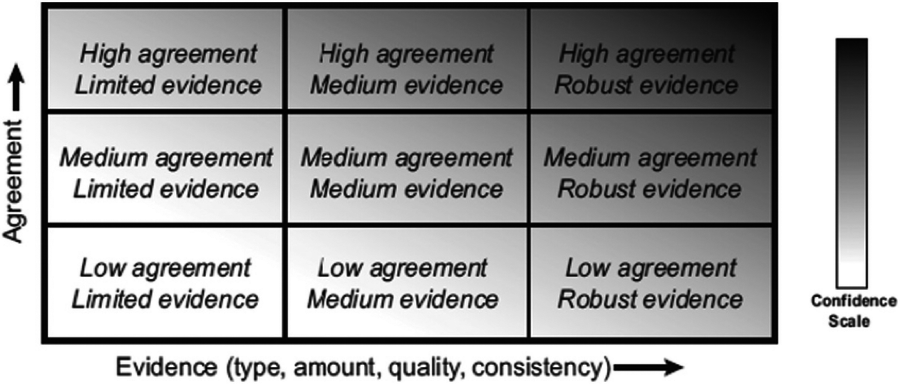
The Intergovernmental Panel on Climate Change (IPCC) presents an uncertainty language framework that has been used to effectively communicate uncertainty on a complex topic in an international forum. There are two dimensions of probability to consider when communicating uncertainty. The first is the statistical frequency with which an event is expected to occur, and the second is the degree of belief warranted by evidence (Burgman Reference Burgman2005). The IPCC framework incorporates both dimensions of probability through confidence and likelihood statements. Confidence statements represent a qualitative measure that expresses the degree of understanding and consensus among experts (Fig. 12; Mastrandrea et al. Reference Mastrandrea, Field, Stocker, Edenhofer, Ebi and Frame2010). Likelihood statements represent a quantitative measure that expresses the chance of a defined outcome (Fig. 13). These two measurements can then be strengthened by an impact statement, which is a measure of the significance of the potential impact on the ecosystem (Gergis Reference Gergis2023). The IPCC’s uncertainty communication framework therefore provides a practical and consistent structure that could be adapted and incorporated within CCAMLR.
The Intergovernmental Panel on Climate Change’s confidence scale, which depicts summary statements for evidence and agreement and their relationship with confidence. There is flexibility in this relationship; for a given evidence and agreement statement, different confidence levels could be assigned, but increasing levels of evidence and degrees of agreement are correlated with increasing confidence. Retrieved from https://www.ipcc.ch/site/assets/uploads/2017/08/AR5_Uncertainty_Guidance_Note (accessed 1 September 2023).

The Intergovernmental Panel on Climate Change’s (IPCC) likelihood scale, which provides calibrated language for describing quantified uncertainty. It can be used to express a probabilistic estimate of the occurrence of a single event or of an outcome (e.g. a climate parameter, observed trend or projected change lying within a given range). Likelihood may be based on statistical or modelling analyses, elicitation of expert views or other quantitative analyses. Retrieved from https://www.ipcc.ch/site/assets/uploads/2017/08/AR5_Uncertainty_Guidance_Note (accessed 1 September 2023). AR4 = IPCC’s Fourth Assessment Report; AR5 = IPCC’s Fifth Assessment Report.

Implementing a standardized approach to addressing uncertainty within CCAMLR would enable a more comprehensive evaluation of risk to the ecosystem. It would allow for the inevitable uncertainties in the science used by CCAMLR and could bolster communication, trust and transparency to support cooperation and consensus. Considering the growing uncertainties that climate change presents, the adoption of an uncertainty framework provides an opportunity to address one of the obstacles that is leading to deadlock within CCAMLR. Consequently, addressing and integrating uncertainty could help safeguard Antarctic ecosystem functioning and underpin more supportive conditions for Adélie penguins on the Antarctic Peninsula.
Conclusion
With ecosystems undergoing unprecedented transformation, uncertainty is an unavoidable and increasingly complex factor for conservation decision-makers to navigate. CCAMLR’s proven ability to lead in ocean governance through innovative management emphasizes the potential for the organization to overcome current obstacles and guide effective management into the future. The changing population dynamics of Adélie penguins occurring simultaneously with CCAMLR’s deadlock and delay in management has demonstrated the unfavourable conditions facing Adélie penguins and the associated urgency of a response. In recent years, uncertainty has become an increasingly prominent force, repeatedly being used as a reason to oppose ecosystem CMs. This highlights an opportunity for CCAMLR to achieve its objectives by addressing and integrating uncertainty in order to mirror current environmental standards. This could be achieved by incorporating a framework for the standardized communication of uncertainty, as has been successfully demonstrated by the IPCC, while simultaneously reducing uncertainty by improving CCAMLR’s science programme. Addressing uncertainty could contribute to minimizing the risk of negative outcomes for Adélie penguins and the Antarctic ecosystem more broadly by re-establishing a balance between scientific guidance and international cooperation. Addressing uncertainty therefore presents a key opportunity for CCAMLR to adapt its management to new environmental conditions.
Acknowledgements
We would like to thank all interviewees for their time in contributing to this paper; their knowledge and experience were invaluable. We would also like to thank the reviewers for their insightful feedback, which strengthened this paper.
Author contributions
All authors contributed ideas to the paper’s development. NL conducted data curation and visualization. MH and JLY supervised all work. All authors contributed to original draft preparation, revisions and edited the final manuscript.
Competing interests
The authors declare none.








 Open access

