


Introduction
Drug overdose death rates have increased dramatically from 2018 to 2022 [Reference Spencer, Garnett and Minino1]. Therefore, it is imperative to engage people with living experience (PWLE; current experience with drug use) with drug use meaningfully in the research process. PWLE implemented what we now consider mainstay evidence-based harm reduction strategies (e.g., peer-distributed naloxone and syringe exchange) prior to public health recognition or legal protections around the practices [Reference Salazar, Vincent, Figgatt, Gilbert and Dasgupta2,Reference Zibbell, Peiper and Duhart Clarke3]. Further, the illicit drug market in the United States is evolving and highly variable, necessitating rapid responses to prevent related harms. PWLE are uniquely positioned to offer relevant expertise.
To incorporate community feedback, researchers often form community advisory boards (CABs) for studies. CABs provide both a platform for members to give feedback on the study and for researchers to build trust with the community [Reference Bosak, Drainoni and Christopher4]. These CABs frequently offer valuable feedback on survey questions, data collection methods, and interpretation of results [Reference Aronson, Bennett, Ardouin-Guerrier, Rivera-Castellar, Gibson and Vargas-Estrella5,Reference Shaw, Lazarus and Pantalone6]. However, there are often several challenges that limit their effectiveness. Crucially, study-specific CABs are typically established after funding, meaning the research agenda has already been established. This greatly reduces the possibility of any input on major decisions related to agenda setting, study direction, and study design, which could risk turning CAB members into merely “ethical approvers” [Reference Sanchez-Youngman, Boursaw and Oetzel7]. While there is growing support for including input early in the process [Reference Pratt8], researchers are often challenged to form and compensate board members prior to their projects receiving funding. In ideal situations, a board comprised of PWLE could be consulted outside of a specific study to advise researchers across all phases of research, including idea generation and study design [Reference Salazar, Vincent, Figgatt, Gilbert and Dasgupta2].
Additionally, due to the inherent power imbalance between researchers and community members during academic collaboration, study-specific CABs may also perpetuate tokenism in which the involvement of PWLE appears positive at face value, with little power given to members, perpetuating representation without influence [Reference Salazar, Vincent, Figgatt, Gilbert and Dasgupta2,Reference Pratt8]. Further, additional power imbalances may exist within CABs that include both individuals with and without experience with drug use [Reference Aronson, Bennett, Ardouin-Guerrier, Rivera-Castellar, Gibson and Vargas-Estrella5,Reference Shaw, Lazarus and Pantalone6,Reference Lazarus, Shaw and LeBlanc9]. Therefore, researchers must be aware of these dynamics, as PWLE may then not feel comfortable providing honest feedback [Reference Travers, Pyne and Bauer10]. Finally, some CABs may include only people with lived experience (past experience with drugs use), rather than PWLE. In some cases, researchers report choosing to exclude potential board members who actively use drugs to avoid perceived challenges (e.g., may not meet participation expectations), which could lead to researchers missing crucial perspectives [Reference Souleymanov, Kuzmanović and Marshall11].
As a result, few CABs are led by PWLE and are independent of specific research projects. To address these gaps, University of Kentucky (UK) researchers partnered with Voices of Hope, a local recovery community center (RCC), to establish the Survivors Union of the Bluegrass (SUB). The SUB is a CAB which provides a forum for PWLE to consider ethical and practical issues of proposed, ongoing, and future research. Any researcher at UK can consult the SUB during any stage of their research process, thus involving PWLE in the development, design, and dissemination of research. The aims of this paper are to (1) describe the development and operations of the SUB; (2) summarize board membership, attendance, and activities to date; and (3) describe members’ perceptions of the impacts of their participation in the SUB.
Methods
SUB development
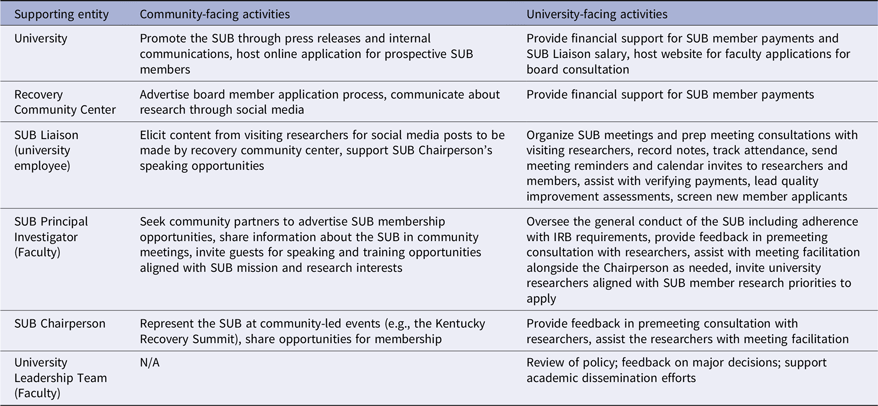
The SUB was established as a partnership between the University of Kentucky Substance Use Research Priority Area (SUPRA; a defined research organizational unit that includes substance use researchers across the university and receives recurring fiscal support from the Office of the Vice President for Research), the Center for Clinical and Translational Science (CCTS; a research unit funded within the university by the National Center for Advancing Translational Sciences [NCATS, see below]) and Voices of Hope (Table 1).
Survivors Union of the Bluegrass structure: community-facing and university-facing activities

Legend: IRB = Institutional Review Board; N/A = Not Applicable; SUB = Survivors Union of the Bluegrass.
This partnership is aligned with the goals of all three entities. Research funders and academic journals [Reference Sheikhan, Kuluski and Hiebert12,Reference Davis, Pinfold, Catchpole, Lovelock, Senthi and Kenny13] are increasingly emphasizing the importance of the involvement of people with lived experience [Reference Selby, Beal and Frank14,15], including the NCATS, which recognizes the importance of including patients and communities in the research process to accelerate translation [16]. To that end, NCATS supports the adoption of community-and patient-engaged research strategies. As an RCC, Voices of Hope is a non-profit that is led and governed by people in recovery, with a mission to promote lifelong recovery through recovery support services, advocacy, research, and education. VOH has extensive experience partnering with researchers and has demonstrated a commitment to following ethical research practices (e.g., all VOH staff complete training on protections of human subjects in research). Partnering with the SUB allows VOH to contribute to a platform for PWLE to provide direct feedback to researchers on projects, elevating their voices and the VOH core value that people are the experts in their own lives and the needs of their community. Additionally, RCCs traditionally aim to reduce substance use-related stigma [Reference Hoeppner, Simpson and Weerts17]. Toward this aim, the SUB provides an opportunity for UK researchers at all levels (students, trainees, faculty) to interact directly with PWLE in a setting where they can have in-depth discussion that enhances their understanding of substance use disorder, treatment, recovery, and harm reduction, and thus, likely reduces stigma around drug use.
Building initial SUB membership started with the identification of a SUB Chair. An individual identifying as a PWLE with experience working with university researchers and Voices of Hope was contacted by SUB leadership (the UK Leadership Team) and agreed to serve as the first SUB chair. The local RCC and the SUB chair assisted with the community-facing language that described “people with living experience” by recommending using terms with which people self-identify versus overly academic terms. “People who use drugs” and “people in non-abstinence-based recovery” were suggested. It was also important to VOH to include “people in non-abstinence-based recovery” to clarify that the SUB was open to individuals with this often-marginalized pathway of recovery. Therefore, all recruitment materials and the language used during meetings specifies that the SUB is made up of “people who use drugs and people in non-abstinence-based recovery.” Additionally, the UK Leadership Team and VOH agreed on compensating members $50 per meeting in order to compensate members for their expertise as generously as possible within budgetary constraints.
The initial members were recruited through word-of-mouth and distribution of flyers by VOH, the initial SUB Chair, and UK researchers with existing partnerships with harm reduction organizations and study-specific advisory boards. At an initial SUB meeting, the members brainstormed and voted on the name (the SUB), to be in line with other organizations that they perceived to be similar [Reference Brothers, Simon and Vincent18–20].
SUB structure (Table 1)
The SUB meetings are led by a Chair, who is a PWLE. In addition to being a SUB member and providing their feedback and experiences to visiting researchers, the Chair is expected to help facilitate the conversation, including opening and closing each meeting. The SUB chair is compensated with a $100 gift card monthly because of the extra work associated with their role; in addition to attending all SUB meetings, they spend roughly two additional hours per month (i.e., double that of SUB members). These extra duties include meeting with the SUB leadership team once per month, facilitating the visiting researcher discussions, contributing to dissemination efforts, and collaborating on agenda setting for SUB meetings, such as trainings and guest speakers. The Chair also disseminates information about the SUB within the community and assists with recruitment when a SUB member slot becomes vacant.
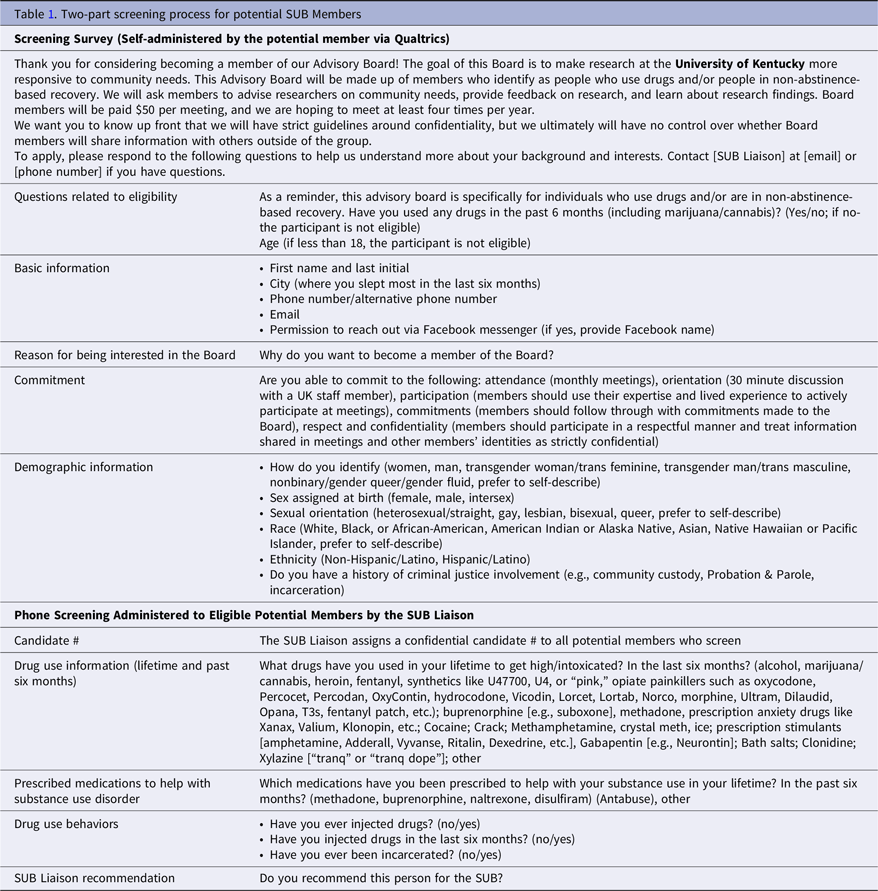
A SUB liaison position was also created for a UK employee to support the SUB’s operations. The SUB liaison provides logistical assistance to the SUB by sending calendar invitations and reminders for SUB members and visiting researchers, scheduling preparation meetings with visiting researchers prior to the SUB meeting, and providing tracking data to funding bodies (e.g., number of visiting research teams attended in the past year). The SUB liaison screens all interested members via phone (see Table 2), sends text reminders about meetings, answers any member questions that arise outside of the scheduled meeting time, and takes detailed notes provided to researcher post-meeting. After each meeting, the liaison coordinates with VOH to provide an attendance log for payments. Finally, the liaison collaborates with the SUB principal investigator (PI) for general oversight and to create annual reports which outline the SUB’s activities and dissemination efforts from the past year.
Screening questions for potential survivors union of the bluegrass members
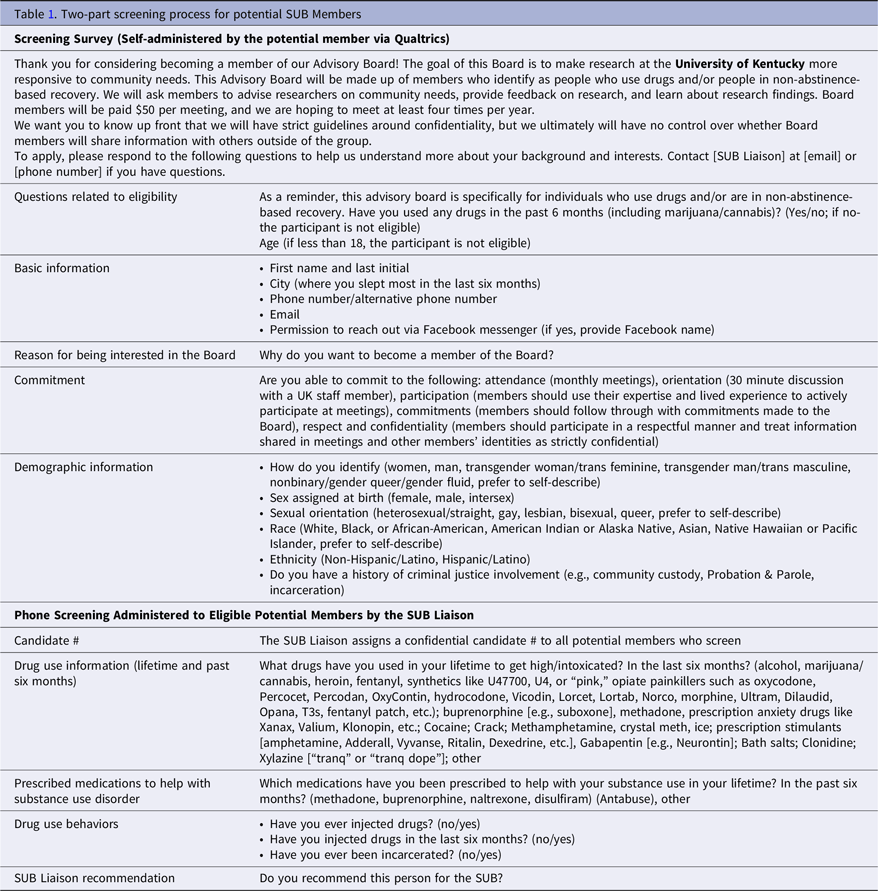
Legend: SUB = Survivors Union of the Bluegrass; UK = University of Kentucky.
SUB operations
A draft of the initial charter was originally created by the UK Leadership Team as the proposal for the SUB, drawing on best practices from available examples [Reference Lazarus, Shaw and LeBlanc9,21–Reference Greer, Amlani, Pauly, Burmeister and Buxton24]. In the initial SUB meetings, different components of the charter were discussed with SUB members for feedback and voting on changes. For example, the initial SUB charter outlined quarterly meetings as a conservative estimate, but allowed members to vote on the frequency of meetings up to every other month. During the initial meeting in August 2022, members unanimously voted to meet every other month and chose a standing meeting time and day of the month. By the end of 2022, UK researchers requested to increase the frequency to monthly to meet demand. Since January 2023, the SUB has met monthly for two hours over Zoom on the last Tuesday of each month. It should be noted that meeting virtually rather than in person was decided in the initial charter due to ongoing COVID restrictions. However, the group mutually agreed once restrictions were lifted that the virtual format removed multiple barriers that disproportionately affect PWLE including transportation challenges, stigma concerns, geographic limitations, and safety fears tied to criminalization.
The 2-hour meetings are split into two 45-minute blocks, allowing 15 minutes to open and close each meeting. Each block is typically filled by a visiting research team who is given the full 45-minute block to discuss their work and ask questions of the board. Researchers are encouraged to bring 2–3 discussion questions to provide enough time for engaged conversation and must attend a brief preparation meeting with SUB leadership (see Visiting Researchers). Quarterly, there is an option for the SUB to opt to use one 45-minute block to host a guest speaker (typically from outside UK) or training discussion on a topic relevant to the members.
SUB members have expectations they must meet to be compensated, all of which were co-created between the UK SUB Leadership team, the SUB Chair, and SUB members across multiple meetings. These expectations have evolved over time, as new potential issues for consideration arose. Once guidelines are established and agreed upon by the SUB members, they are then reviewed with all new members during screening by the SUB Liaison. Members must have appear on camera, be in a private space or use headphones (to respect the privacy of other SUB members who may be overheard), be an active participant in the conversation and/or Zoom chat, and not be engaging in activities that may jeopardize their safety (e.g., driving a car). Members who are driving are removed from the meeting by the SUB liaison. Members earn $25 for each 45-minute block they actively attend (up to $50/meeting) and are compensated with Amazon gift cards or a physical check. Payment is sent promptly by VOH, which then submits to UK for reimbursement. Board members expressed that prompt delivery of payment was important, particularly for those who may have urgent needs. Some members also appreciate not having to submit paperwork for payment to the university due to concerns related to privacy. Therefore, the university’s partnership with VOH is critical as the RCC is well-positioned to disburse compensation efficiently, ensuring members are paid quickly (typically within 1–2 days).
Visiting researchers
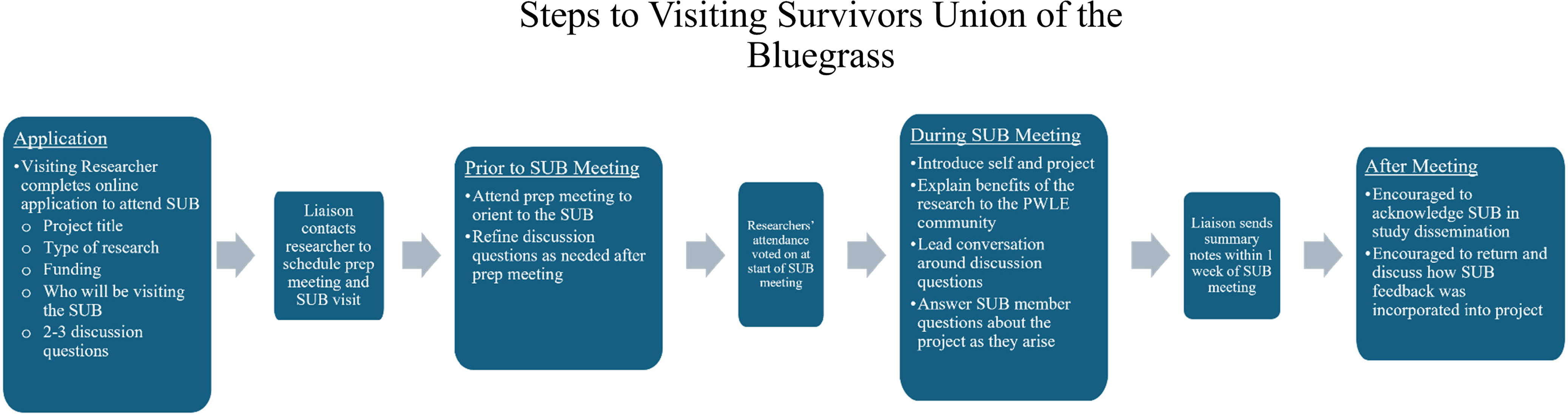
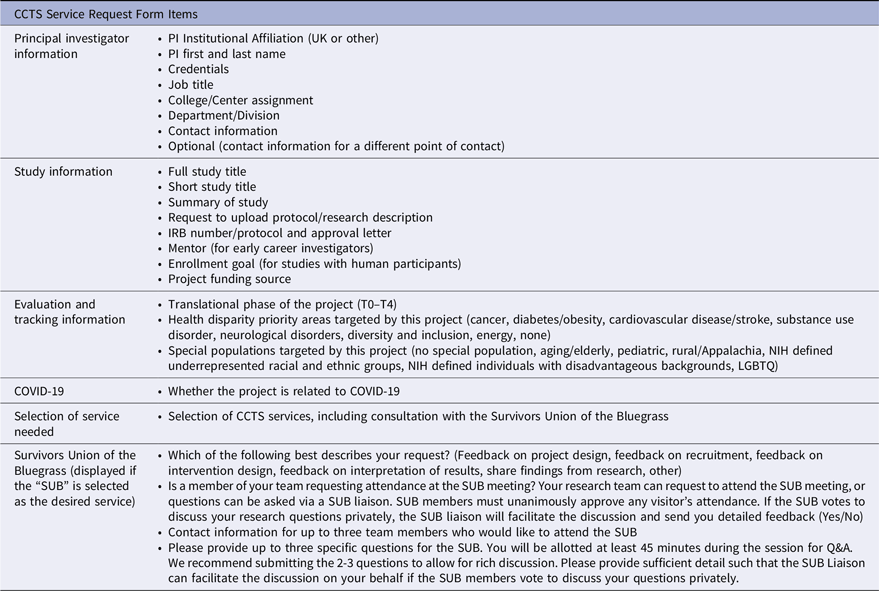
University researchers (see Fig. 1 for process) apply to visit the SUB through a REDCap service request form hosted by the UK CCTS (https://www.ccts.uky.edu/). The form (see Table 3) collects basic information about the study (e.g., funding source, grant mechanism, project name) and three proposed discussion questions. Each researcher that would like to attend the meeting (up to three) must be unanimously voted in to the Zoom meeting by the SUB members in attendance. SUB members can vote against the researcher’s admittance for any reason (e.g., researcher may be a member’s healthcare provider, neighbor, etc.). This ensures that members are comfortable with interacting with and potential recognition by the researcher(s). We also emphasize to visiting researchers the importance of maintaining confidentiality from SUB meetings to keep membership private, a crucial component of building trust with members. Researchers are encouraged to order their discussion questions based on importance in case the discussion runs long. However, the chair also helps guide and redirect conversations back to discussion questions in hopes that all questions will be sufficiently addressed.
Process for interested researchers to visit the SUB. Legend: PWLE = people with living experience of substance use, SUB = survivors union of the bluegrass.

Service request form items for researchers
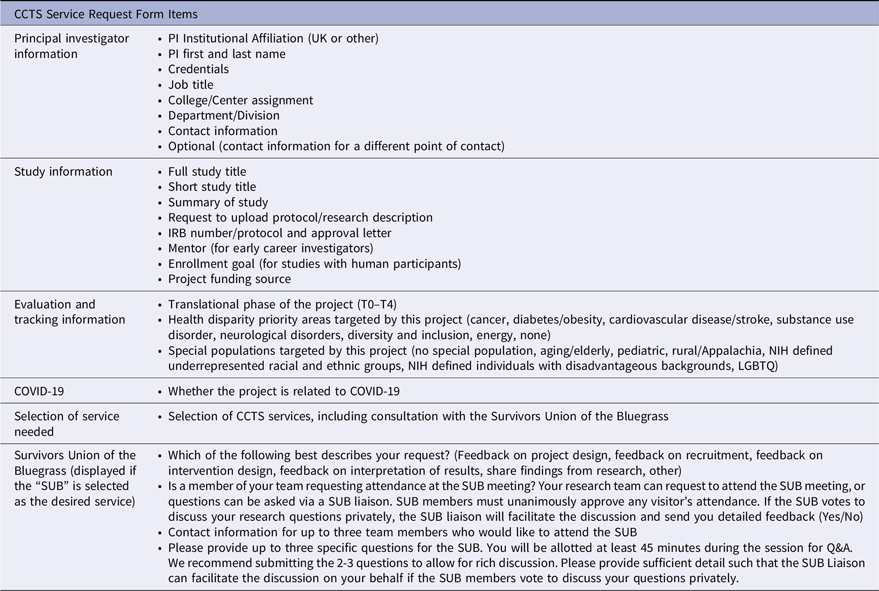
Legend: CCTS = Center for Clinical and Translational Science; IRB = Institutional Review Board; LGBTQ = Lesbian, Gay, Bisexual, Transgender, and/or Queer; Q&A = Question and Answer; SUB = Survivors Union of the Bluegrass; UK = University of Kentucky.
After the visiting researchers have applied, but before they attend a SUB meeting, the research team must attend a “SUB Researcher Prep Meeting” with the chair, liaison, and PI. During this meeting, the researchers are given an overview of the SUB, including meeting logistics (e.g., logging into the meeting, presentation, and facilitation tips). Researchers are encouraged to refrain from academic-style presentations or slideshows other than when necessary and instead present their work in a conversational manner, as with an interested family member. Researchers are also given feedback on the wording of discussion questions to be received and understood by members. During the prep meeting, it is critical that the SUB chair, liaison, and PI become familiar with the discussion questions, because if the researchers are not voted in by SUB members, then they would present the researchers’ work and discussion questions.
Visiting researchers are given latitude on how to spend the 45-minute block. Typically, researchers briefly introduce themselves and their project or, if earlier in the process, present an idea, and then transition to discussion. Researchers are encouraged to ask follow-up questions and probes throughout the conversation and can facilitate the conversation with as much assistance from the SUB chair as desired. To allow visiting researchers to stay focused during the conversation, the SUB PI monitors the chat log and will share comments throughout the meeting. The SUB liaison also copies, deidentifies, and forwards the chat log to all visiting researchers in addition to detailed summary notes from the conversation. Researchers are provided with these materials within one-week post-visit and encouraged to make future visits updating the SUB on how their feedback, if at all, was incorporated into the study.
Focus group
Twice per year, the SUB Liaison leads a Quality Improvement focus group during one of the monthly meeting blocks to elicit feedback on member experiences. Example questions include “What has been the most memorable experience during your time on the SUB?,” “Are there topics we have not talked about that you would like to discuss?,” and “How could SUB leadership improve your experience as a SUB member?” Prior to beginning each focus group, members are asked for permission to keep an audio recording and transcript for quality improvement purposes that may be used for future research. As with visiting researchers, the SUB must unanimously approve before the focus group proceeds. Disseminating findings from the quality improvement focus groups, along with the general operation of the SUB, was approved by the University of Kentucky Institutional Review Board.
This manuscript presents findings from a brief qualitative analysis of member experiences described in quality improvement focus groups conducted with the SUB in October 2023 and April 2024. Because the focus group was part of our regular quality improvement activities, no demographic data was collected. However, a table of demographic data from current SUB members at the time of their screening is presented in the results section. Each focus group audio recording was transcribed for analysis with permission from all attending SUB members. After reviewing the transcripts for familiarity, a codebook was created collaboratively between the SUB PI (AFB), the SUB Liaison (TM), the SUB Chair, and two SUB interns (BH, JC). Once the codebook was created and agreed upon, transcripts were coded separately by three UK SUB team members (TM, BH, JC). The group then met to discuss disagreements and code to consensus using best practice methods from thematic analysis [Reference Braun and Clarke25]. The team reviewed the codes and discussed themes to be created by combining codes across the two focus groups, utilizing the flexibility thematic analysis provides [Reference Clarke and Braun26]. Reflexivity among coders was managed by having the SUB interns be included in the codebook creation and coding process, thus including perspectives of people who did not hold leadership positions or similar power differentials with the SUB as the PI and Liaison [Reference Olmos-Vega, Stalmeijer and Varpio27]. All coding was performed on deidentified transcripts in Microsoft Word.
Results
Membership, attendance, and activities to date
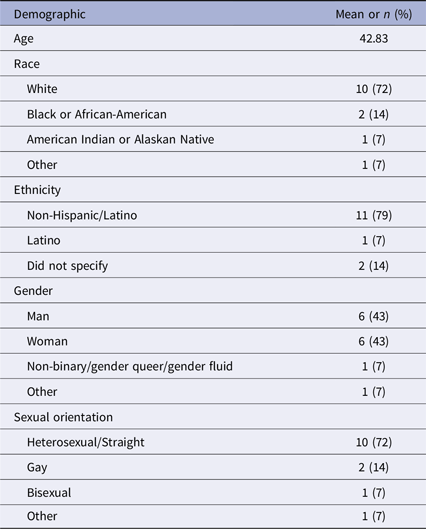
From August 2022 through June 2025, the SUB held 33 meetings with an average attendance of 11 members (average 74% attendance). The SUB currently has 14 members (see Table 4), 9 of whom have been members since December 2022. Across all meetings, 30 people have attended at least one meeting. To date, 52 teams have visited the SUB to discuss their work. This includes five doctoral students who discussed their dissertation work at varying points of their project, with one student visiting twice in one year. Ten researchers have returned at least once and were encouraged to provide updates on how their work was impacted by the SUB’s feedback. The SUB had four trainings on topics of interest to the members, including measuring recovery in research, activities, and goals of survivor’s unions, the power of language around substance use, and current research on medication therapy for stimulant use disorder. Additionally, four guest speakers have attended the SUB and shared their work on advocacy for PWLE, drug checking, and drug trend surveillance. Ten members attended the October 2023 focus group, and 11 members attended the April 2024 focus groups. Results from both focus groups are presented below.
Survivors Union of the Bluegrass member demographics
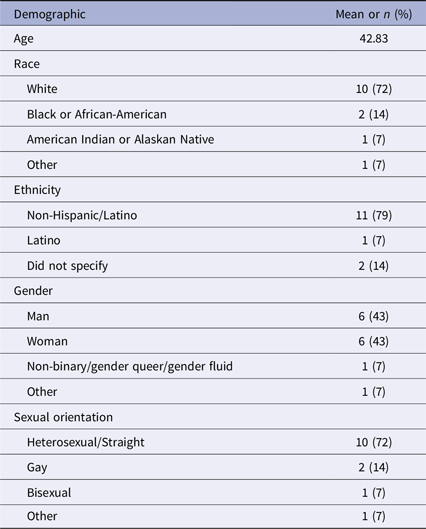
Note: all demographic data is from the time of screening.
Perceived impacts of participation in the SUB
Contributions to research
Members shared that they believed SUB feedback helped researchers understand the subject matter (e.g., drug use, addiction, etc.). One member shared that, “our expertise has allowed them to refine their understanding of addiction.” Others agreed that researcher understanding of drug use could only go so far without talking to someone with lived experience (“…you can’t read it out of the book and get it. You got to really feel our experience wholeheartedly.”). Members assumed that without the SUB, researchers would have no one else to provide the lived experience perspective (“…if it really wasn’t for us, who would they have to talk to? They wouldn’t be able to have that information”). Additionally, members believed SUB feedback “can help [researchers] eliminate some challenges or barriers to their research project” like advising what kind of compensation should be expected or where to recruit participants.
A chance to help other PWLE
Several described a perceived positive impact of the SUB on other PWLE and their community. In some instances, this impact was described as functioning through SUB members sharing what they have learned: “I had a couple of girls who were pregnant at the same time, and instead of using, they went down to the Needle Exchange and got test strips… they actually got clean… they wouldn’t have known how to do that, I wouldn’t have known how to do that, without coming through the Survivors Union.” Another member mentioned they could use what they learned through the SUB to inform other PWLE about treatment options and other health services interventions to help change lives. Members also said they had been able to share information regarding rallies, movements, and events with each other and other PWLE to involve them in the harm reduction movement. Additionally, members described the SUB’s impact as functioning through influence on the research. One member characterized their sharing during SUB meetings as potential for “[change] for our future generations and maybe save some people from addiction, or maybe even prevent [overdose death].” Another member shared that influencing the visiting researcher’s work was an opportunity to have a broad impact: “and you know, what they’re writing for grants is only going to, you know, help other people as well as it’s helping us.”
Being treated as the expert
Throughout both focus groups, members shared a sense of being treated as the expert by visiting researchers and characterized the sense in positive terms (“It feels good to be looked at as an expert”). The idea of being treated as experts was contrasted with how members feel they are typically treated (along with PWLE at large). One member shared that this experience, “feels good to… have an extensive experience in a subject matter and not be thought of as a POS, or a convict, or a drug addict, or a junkie… the bubble gum on the bottom of your shoe.” Unlike other spaces in members’ lives, within the SUB they, “have a voice that makes people not think of us like the unwanted or the undesirables.” Members perceived the researchers’ interest in their expertise as genuine (“they actually wanna talk to us”) and believed their expertise “refined [visiting researchers’] way of investigating.” This relationship with visiting researchers is also contrary to what one member described as the typical experience with researchers: “a lot of times… [PWLE] are studied in… a demeaning type manner, but everybody that’s come here has been very respectful and has honest interest in what we have to say.”
Feeling empowered
Members mentioned their SUB participation made them feel empowered and specifically mentioned becoming more confident in sharing their thoughts and experiences. One member shared, “[The SUB has] really given me a lot of confidence to speak up about my understanding of addiction.” Another member mentioned that being a part of the SUB and research had made them feel their experiences were not, “for nothing.” One member explained that being part of the SUB made them feel valued saying, “I think [sharing expertise with researchers], to me, gives me a sense of being valued in our community.”
Hope and belonging
Members described the SUB as a place where they belong and are understood. One member summarized a conversation stating, “you found a place where you can be you and you can be honest, and you can be a person who is in recovery that uses drugs and not-you’re accepted rather than pushed out like some of the other spaces we’ve navigated.” Members had also mentioned that the SUB made them feel hopeful: “Like that hope or whatever. I think you guys add a lot of motivation and fuel to my cup. I do not feel alone in this battle all the time.” There had been a mention of hope regarding future treatment options. Members mentioned that some modalities of treatment (e.g., “rehab”), “don’t work for the majority.” Members went on to mention that being a part of the SUB had given them hope that there will be a change in treatment options with one member stating, “I think a big part of it for me has just been how much hope it’s given me that maybe drug addiction will finally be treated in a way that like works.”
Support for expanding the model
Members also voiced encouragement of other institutions to pursue a similar structure for representation of PWLE (“It’s an awesome idea”; “they could really benefit from having a group like this”). Members shared that having a SUB would be beneficial to both PWLE and researchers at other institutions. If a university is “able to start something like [the SUB], it will be beneficial for the people who are part of the group… [which will] benefit all the people around them, too. So, it’s a wave that goes outward.” For researchers, the SUB can serve as a way for researchers “to know that [their work] is meaningful, it was important… we actually help validate [visiting researchers], too.” Members also had specific recommendations for other institutions. One member recommended that institutions prioritize diversity among their group members, similar to the SUB’s diversity in lived experiences (“they really could benefit from having a group like this that is very diverse”). Another member encouraged future groups to, like the SUB, not be “attached to any particular research study” which helps the SUB “to have a wider net, if you will, or a much bigger on-ramp.”
Conclusions
The SUB, to our knowledge, is one of the first CABs comprised of PWLE housed at a university that is not tied to a specific study or project. Since its inception in August 2022, the SUB has met regularly to inform visiting researchers, welcome guest speakers, and participate in training. The SUB’s high rate of retention (at the end of 2024, 92% of the current members had attended meetings for at least one year) commitment to the SUB’s goals and impact. Further, members characterized their involvement in the SUB as an opportunity to share their expertise and affect change for other PWLE. These characterizations and members’ commitment to participate all point to the SUB being a meaningful model for PWLE to participate in the research process.
The SUB model is an ongoing commitment by both the university and the local RCC to bringing PWLE into the research process. Creating an advisory board that exists outside of a single study or project enabled the SUB to involve PWLE more meaningfully in the research process, an essential collaboration for all substance use researchers [Reference Salazar, Vincent, Figgatt, Gilbert and Dasgupta2]. SUB members advised researchers across the research process, from idea creation to interpretation of results, and, in doing so, may have been involved differently than some other community boards where members may serve as token voices or mere ethical approvers [Reference Pratt8]. Further, SUB members themselves characterized this involvement as meaningful for both researchers (“our expertise has allowed [researchers] to refine their understanding of addiction”) and themselves (“I like the idea that I can help girls who were like me growing up”). Thus, the SUB serves as both a service for researchers and a way for the university to collaborate with and support the community of PWLE.
The structure of the SUB, which is supported by the local RCC and two units from the university (SUPRA and the CCTS), could serve as a model for expansion in other states. Currently, the NIH’s NCAT (2025) funds a network of 60 medical institutions with Clinical and Translational Science Awards, and many universities have centers or institutes focused on substance use research. Further, there are approximately 250 RCCs located around the country that are led by the recovery community and embrace all pathways of recovery, including non-abstinence-based recovery [Reference Hoeppner, Simpson and Weerts17].
Through experience with SUB development and operation, we have identified areas in need of additional consideration related to longstanding CABs comprised of PWLE. For example, while our screening criteria (drug use in the past 6 months) does well to screen out individuals in long-term, abstinence-based recovery from all substances, it does not account for individuals who may enter abstinence-based recovery during their SUB membership. We have had some current members of the SUB who have shared during meetings that they have stopped using substances. Based on consultation with the members and our own desire to treat SUB members as partners and advisors (rather than research participants), we made the decision to forgo periodic screening of members for substance use. We do, however, regularly review the overall purpose of the SUB, including that members should self-identify as a person who uses drugs and/or a person in non-abstinence-based recovery. Future organizers of similar CABs should consider whether ongoing screening or rotating membership would be beneficial to the group’s dynamic.
Limitations
First, we acknowledge challenges inherent in power differential between researchers and community members. The SUB is an imperfect effort to address this differential by including PWLE across several phases of research and different studies. Still, universities should find ways to promote a shared leadership model between researchers and PWLE. We agree with Salazar, Vincent, Figgatt, Gilbert, and Dasgupta [Reference Salazar, Vincent, Figgatt, Gilbert and Dasgupta2] that institutions and researchers should work for systemic changes that would enable PWLE to participate as equals in research, such as eliminating requirements for drug testing for university employment. Further, it is also important for researchers to address societal issues that are barriers for PWLE to access higher education, such as the War on Drugs, which criminalizes drug use. Academia should recognize the value of lived experience as at least equal to learned experience; an expertise our members felt is rarely valued by the academic community, outside of their experience on the SUB.
Several additional limitations apply to our work. The focus group facilitator was the organizer of SUB meetings, which could have resulted in more positive feedback than would have been obtained from an outside facilitator. Similarly, one of the three data analysts was on the SUB leadership team, which could have resulted in a more positive interpretation of findings. However, this limitation was mitigated through a coding process that involved discussion of themes and coding to consensus. We are considering anonymous feedback through surveys in the future so members do not feel pressure to provide overly positive feedback. While there are many advantages of having a sustained, stand-alone board independent of specific research projects, there are also limitations. Members may not have as direct experience with the research topic or geographic area of interest as they would in a board formed for a specific project and time for consultation may be more limited. It is also unclear the extent to which the SUB is impacting visiting researchers’ work. While visiting researchers are encouraged to return to the SUB to share how they incorporated SUB members’ feedback, not all researchers have been able to make additional visits. To address this, SUB leadership team plans to collect qualitative data from past visitors to describe the impact of SUB input on research. Finally, although the SUB is designed to be a statewide initiative, we currently lack membership from communities in Western and Northern Kentucky, and there may be regional differences in substance use patterns [Reference Luu, Slavova, Freeman, Lofwall, Browning and Bush28]. We plan to continue providing SUB application materials to partner with harm reduction organizations in underrepresented regions.
Reflections and recommendations
To conclude, we believe the SUB is making a significant translational impact on the university’s research portfolio. Feedback from our members informs work from preclinical and animal studies (e.g., managing opioid withdrawal symptoms in mice) to clinical practice (e.g., Hepatitis C screening in the emergency department) to population health (e.g., designing and testing a harm reduction vending machine). The SUB also reduces stigma by positioning PWLE as experts based on their own experiences. We offer several recommendations for those interested in establishing an advisory board of PWLE. First and foremost, a strong, authentic relationship between university partners and local RCCs is essential. RCCs are typically well-integrated into their communities and serve as trusted resources. Establishing a mutually beneficial partnership with RCCs can facilitate meaningful connections with PWLE and create a foundation of trust. Relationship-building is not trivial – it requires time, consistency, and a genuine commitment to showing up – but the investment is critical to the success of building trust and buy-in with the community.
Second, timely and appropriate compensation is vital. University systems often pose logistical challenges, such as significant delays between participation and payment. Moreover, requirements like bank accounts may exclude some PWLE. To address these barriers, we partnered with our local RCC to issue payments, enabling CAB members to receive compensation within 1–2 days rather than waiting several weeks. Additionally, compensation must be adequate in both form and amount. For instance, checks may be impractical for members without bank access, so offering flexible payment options is important.
Third, we found that monthly meetings worked well for our CAB. Although we originally planned a bimonthly schedule, we shifted to monthly meetings based on member interest and the number of requests for input from presenting researchers. Holding the meeting at the same time each month seems to have helped members with planning and attendance. While many lessons were learned through this process, we hope that these core reflections provide a useful starting point for others seeking to establish a CAB of PWLE.
Author contributions
Trevor Moffitt: Conceptualization, Formal analysis, Methodology, Visualization, Writing-original draft, Writing-review and editing, Bryson Henson: Formal analysis, Project administration, Writing-original draft, Writing-review and editing, April Young: Conceptualization, Supervision, Writing-original draft, Writing-review and editing, Sharon L. Walsh: Conceptualization, Supervision, Writing-original draft, Writing-review and editing, Rachel Vickers-Smith: Conceptualization, Supervision, Writing-original draft, Writing-review and editing, Junior Cruz: Formal analysis, Writing-original draft, Writing-review and editing, Jeremy Byard: Project administration, Writing-review and editing, Brook West: Project administration, Writing-original draft, Writing-review and editing, Amanda Fallin-Bennett: Conceptualization, Formal analysis, Investigation, Methodology, Project administration, Supervision, Writing-original draft, Writing-review and editing.
Funding statement
The Survivors Union of the Bluegrass is funded by the University of Kentucky Substance Use Priority Research Area (SUPRA), National Center for Advancing Translational Sciences through grant number UL1TR001998, and Voices of Hope.
Competing interests
Amanda Fallin-Bennett, PhD, RN is a co-founder of Voices of Hope.

 Open access

