


1. Introduction
The contribution of land-based CO2 emissions to climate change has renewed political interest in solving deforestation. Forests offer a low-cost, natural climate solution to meet near-term emissions reduction targets until energy systems are decarbonized (Griscom et al., Reference Griscom, Adams, Ellis, Houghton, Lomax, Miteva, Schlesinger, Shoch, Siikamäki, Smith, Woodbury, Zganjar, Blackman, Campari, Conant, Delgado, Elias, Gopalakrishna, Hamsik and Fargione2017; Houghton et al., Reference Houghton, Byers and Nassikas2015). In tropical forest countries, land use activities represent more than half of national emissions (CAIT, 2020). Agricultural commodity production remains the largest driver of deforestation globally, with social and political conditions that differ across regions. Controlling deforestation requires locally adapted policies that are tailored to the evolving constraints facing forest managers in each setting (Börner et al., Reference Börner, Schulz, Wunder and Pfaff2020; Seymour & Harris, Reference Seymour and Harris2019). As a result, the issue has not been met with deep international cooperation but rather polycentric networks of governance among state and non-state actors.
Interventions addressing deforestation span three domains: domestic public policies, international REDD+ financial mechanisms, and sustainable supply chain initiatives (Furumo & Lambin, Reference Furumo and Lambin2020; Nepstad et al., Reference Nepstad, Irawan and Bezerra2013). Tropical nations are advancing public policies to reduce deforestation-related emissions under the Paris climate agreement, leveraging international REDD+ finance and policy mechanisms (Hein et al., Reference Hein, Guarin, Frommé and Pauw2018). Companies that produce and source commodities in these countries seek to enhance their reputations and market access by committing to eliminate deforestation from their supply chains (Lambin et al., Reference Lambin, Gibbs, Heilmayr, Carlson, Fleck, Garrett, le Polain de Waroux, McDermott, McLaughlin, Newton, Nolte, Pacheco, Rausch, Streck, Thorlakson and Walker2018). Transnational actor networks such as the New York Declaration on Forests (NYDF) and Tropical Forest Alliance (TFA) support these commitments. Yet, global forest loss was greater in the last decade than in the previous one, despite broad actor engagement. There is a pressing need to accelerate the zero-deforestation transition.
Supply chain initiatives have limited effectiveness without complementary public policies (Lambin et al., Reference Lambin, Gibbs, Heilmayr, Carlson, Fleck, Garrett, le Polain de Waroux, McDermott, McLaughlin, Newton, Nolte, Pacheco, Rausch, Streck, Thorlakson and Walker2018; Taylor & Streck, Reference Taylor and Streck2018). Governments create enabling conditions that support supply chain initiatives by threatening with regulations, formalizing land rights, legitimizing novel governance arrangements, orchestrating actors, and monitoring compliance. Voluntary supply chain initiatives are still embraced by a small portion of industry leaders, while laggards are unlikely to adopt better practices without a regulatory push from governments (Lambin et al., Reference Lambin, Kim, Leape and Lee2020). A mix of command-and-control and market-based approaches is thus required. The order in which these interventions are introduced into a policy mix may matter, as governance systems navigate different forest cover change dynamics through time that influence the political feasibility of strategies.
The concept of policy sequencing has recently been elaborated in the literature on renewable energy transitions as a mechanism for incrementally ratcheting up policy stringency (Meckling et al., Reference Meckling, Kelsey, Biber and Zysman2015, Reference Meckling, Sterner and Wagner2017; Pahle et al., Reference Pahle, Burtraw, Flachsland, Kelsey, Biber, Meckling, Edenhofer and Zysman2018). It has not yet been applied to land use. Zero deforestation as a policy objective is distinct from energy decarbonization in several ways. While decarbonization is formulated as a technical problem – designing and deploying renewable energy technologies – the complexity of solving deforestation makes it a ‘wicked’ problem. Targets depend on geographic context and progress is influenced by multiple stakeholders with different interests. The many pathways to reducing deforestation reflect diverse land uses and values. Stakeholder motivations influence their strategies – for example, indigenous communities favor area-based reserves whereas industry actors privilege market-based approaches. The opportunity for zero deforestation thus lies in increasing convergence among actor groups and agendas, including reduced carbon emissions, biodiversity conservation, sustainable rural development, geopolitical control, and preventing zoonotic diseases (Dobson et al., Reference Dobson, Pimm, Hannah, Kaufman, Ahumada, Ando, Bernstein, Busch, Daszak, Engelmann, Kinnaird, Li, Loch-Temzelides, Lovejoy, Nowak, Roehrdanz and Vale2020). We hypothesize that policy sequencing has the potential to enhance instrument and actor coordination toward zero deforestation.
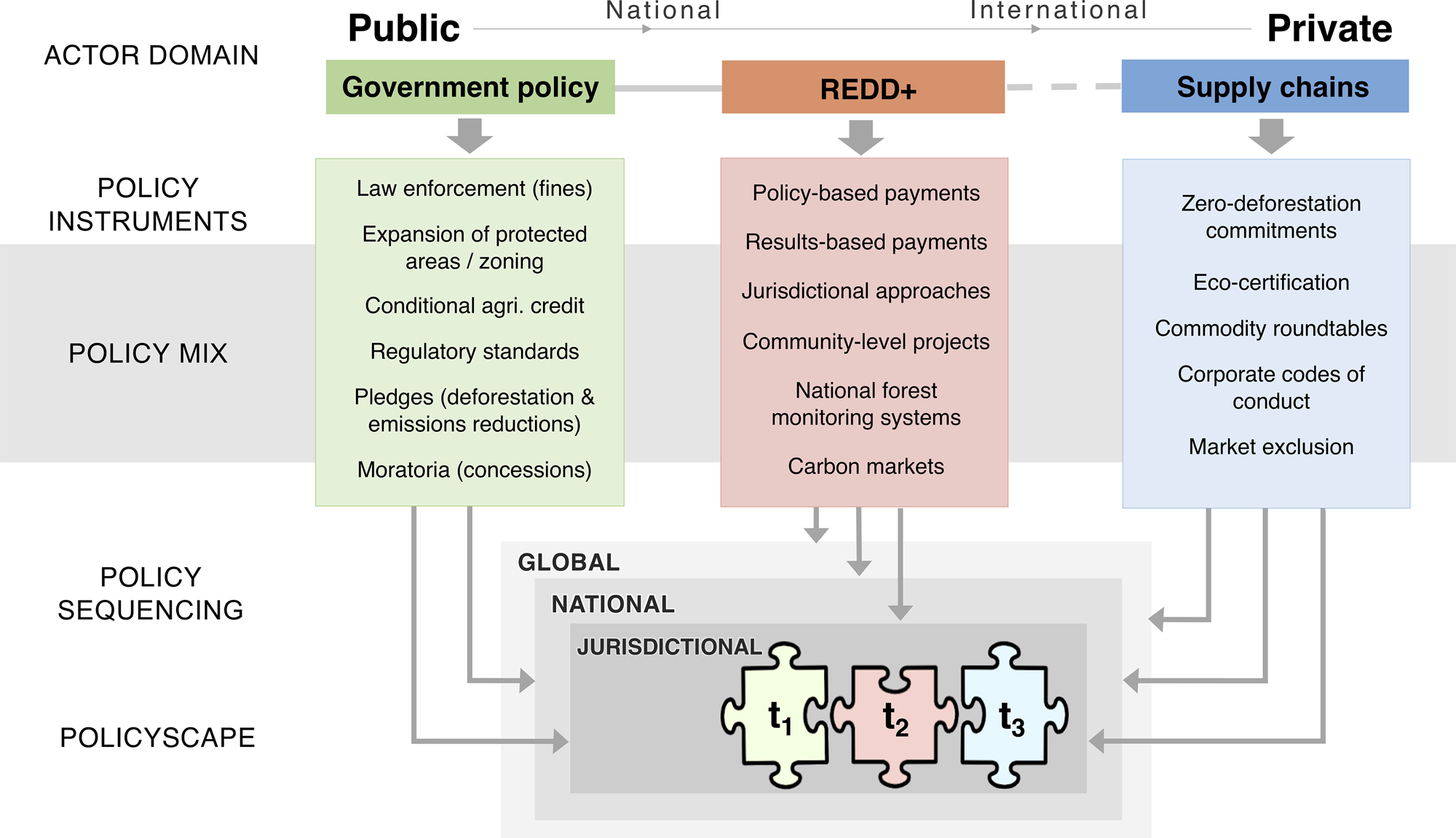
In this study, we analyze the patterns of sequencing in the evolution of public–private policy mixes in three Latin American countries that have committed to reduce deforestation: Costa Rica, Brazil, and Colombia. These countries feature different levels of institutional maturity and policy success toward controlling deforestation. We first provide a theoretical background on policy mixes, with special attention to how policy sequencing – the temporal component of a policy mix – bridges instrument options with the territorial demands of a policyscape – the spatial component of a policy mix (Figure 1). We then compare findings from our case studies, discuss mechanisms of policy sequencing, and offer insights on how iterative learning can deliver smarter policy mixes.
Conceptual framework of a policy mix perspective on zero-deforestation governance. Policy instruments to reduce deforestation are designed by groups of public and private actors in three general domains: domestic public policies, REDD+, and sustainable supply chain initiatives. The resulting policy mix is implemented through a temporal process of policy sequencing at different spatial scales in the policyscape.
2. Theoretical framework
2.1 Policy mix
The spatial and temporal heterogeneity of deforestation drivers has precluded a first-best approach to controlling deforestation as a negative externality of commodity production and rural development. In this second-best setting, instrument mixes are justified by the variable opportunity costs of conservation, imperfect property rights, political constraints, and regulatory interactions across jurisdictions (Bennear & Stavins, Reference Bennear and Stavins2007; Goulder & Parry, Reference Goulder and Parry2008; Pfaff & Robalino, Reference Pfaff and Robalino2012). The rationale of an instrument mix is further supported by innovation and policy studies (Flanagan et al., Reference Flanagan, Uyarra and Laranja2011; Howlett & Rayner, Reference Howlett and Rayner2007; Rogge & Reichardt, Reference Rogge and Reichardt2016). Different policy instruments are needed to destabilize incumbent actor regimes that rely on deforestation, and fortify niche actors advancing more sustainable alternative models like agroforestry and silvopastoral practices (Kivimaa & Kern, Reference Kivimaa and Kern2016). This entails innovations in the production and distribution of commodities, including sustainable land management practices, improved supply chain monitoring and traceability, and new markets for deforestation-free products. Civil society is supporting companies with new tools to standardize these efforts (e.g. TRASE, Accountability Framework initiative). However, the implementation costs fall largely on producers who perceive risks, bottlenecks, and insufficient incentives to decouple commodity production from deforestation, barriers that no single instrument can address (Jaffe et al., Reference Jaffe, Newell and Stavins2005; Rogge & Reichardt, Reference Rogge and Reichardt2016; Waissbein et al., Reference Waissbein, Glemarec, Bayraktar and Schmidt2013).
2.2 Policy sequence
Early use of policy sequencing was to understand historical institutional changes and shifts in public policy. Institutional theorists have long recognized the importance of policy feedback, or how existing policies shape key aspects of politics and subsequent policymaking (Béland & Schlager, Reference Béland and Schlager2019; Pierson, Reference Pierson1993; Schattschneider, Reference Schattschneider1935; Skocpol, Reference Skocpol1992). The concept of ‘path dependency’ describes the temporal sequence of events in this causal chain and emphasizes policy change as the outcome of a policy sequence. Path-dependent sequences can be self-reinforcing or reactive (Mahoney, Reference Mahoney2000). Self-reinforcing sequences are defined by positive feedbacks in which present policy choices constrain future policy options through mechanisms of differential increasing returns and high costs of reversion (Levin et al., Reference Levin, Cashore, Bernstein and Auld2012; Pierson, Reference Pierson2000). This leads to long-term reproduction of institutional patterns, or ‘lock-in’ of prevailing status quo conditions that repel change to more efficient policy alternatives (Mahoney, Reference Mahoney2000). Reactive sequences, by contrast, are defined by negative feedbacks in which policy choices trigger a chain of reactions through mechanisms of learning and increased competitiveness, which leads to institutional change. In the energy sector, policymakers have learned how to adjust price support mechanisms (e.g. feed-in-tariffs) to spur deployment and bring down costs of renewable technologies (Pahle et al., Reference Pahle, Burtraw, Flachsland, Kelsey, Biber, Meckling, Edenhofer and Zysman2018). Yet decarbonization remains hampered by sunk costs in current technologies (e.g. stranded assets), accumulation of experience in institutions, and entrenched special interests despite the growing affordability of renewable technologies (Jordan & Matt, Reference Jordan and Matt2014; Rosenbloom et al., Reference Rosenbloom, Meadowcroft and Cashore2019).
Policymakers seldom have an opportunity for wholesale replacement of existing policies. Instead, new policy instruments are commonly patched onto existing arrangements through a process of ‘layering’ (Howlett & Rayner, Reference Howlett and Rayner2013; Streeck & Thelen, Reference Streeck, Thelen, Streeck and Thelen2005; van der Heijden, Reference van der Heijden2011). Adding new instruments without dismantling old ones can create antagonisms in the policy mix – for example, tension between new conservation priorities and old government incentives that facilitate industry access to forested lands through preferential zoning, subsidies, and infrastructure development. Scholarly attention has thus shifted from policy sequencing as an unintentional process of institutional change (or continuity) to sequencing as an intentional policy design tool for smarter regulation (Gunningham & Sinclair, Reference Gunningham and Sinclair1998; Howlett, Reference Howlett2019). Smarter policy mixes require policymakers to consider how instruments might facilitate or form synergies with other instruments and actors in the mix (Lambin et al., Reference Lambin, Meyfroidt, Rueda, Blackman, Börner, Cerutti, Dietsch, Jungmann, Lamarque, Lister, Walker and Wunder2014; Taeihagh et al., Reference Taeihagh, Givoni and Bañares-Alcántara2013). Strategic policy sequencing can help overcome barriers that uphold lock-ins (Pahle et al., Reference Pahle, Burtraw, Flachsland, Kelsey, Biber, Meckling, Edenhofer and Zysman2018). For example, deployment of incentives for the adoption of renewable technologies was a prerequisite to build coalitions of private sector support before more coercive carbon pricing policies could be introduced (Li & Taeihagh, Reference Li and Taeihagh2020; Meckling et al., Reference Meckling, Kelsey, Biber and Zysman2015, Reference Meckling, Sterner and Wagner2017).
In the land use sector, state regulation can prompt eco-innovation among firms. Long-term government targets (e.g. emissions or deforestation reductions) support private sector innovation by reducing the risk of policy reversal. Pursuit of targets through engagement with transnational networks and issue linkages with other agendas helps set standardized regulations across jurisdictions that reduce free-riding by non-compliant actors. Once commodity producers comply with a voluntary sustainability standard (VSS), new operating procedures – for example, crop planting protocols, segregated supply chains – represent a technology push toward more sustainable practices (Jordan & Matt, Reference Jordan and Matt2014; Schmidt & Sewerin, Reference Schmidt and Sewerin2017). New lock-in is reinforced by market demand for sustainably produced commodities, including investments to reconfigure supply chains, ensure responsible procurement, and reach new clients. In sum, intentional policy sequencing seeks to spur coordinated multi-stakeholder action through push and pull measures that are mediated by regulation, technology, and market forces (Constantini et al., Reference Constantini, Crespi and Palma2017; Horbach et al., Reference Horbach, Rammer and Rennings2012). Coordination in the policy mix is enhanced through iterative experimentation and learning among stakeholders (Pahl-Wostl, Reference Pahl-Wostl2009).
2.3 Policyscape
The spatial configuration of a policy mix is the policyscape. In theory, the spatial distribution of instruments reflects the spatial heterogeneity of deforestation risks and is thus endogenous to landscape characteristics (Pfaff & Robalino, Reference Pfaff and Robalino2012). A policyscape perspective considers how to maximize the cost-effectiveness of the policy mix through improved spatial targeting (Barton et al., Reference Barton, Blumentrath and Rusch2013). This depends on instrument complementarity and additionality – for example, optimal spatial allocation of command-and-control and incentive-based instruments – as well as how individual instruments are calibrated – for example, which lands are eligible under a PES program. Under polycentric governance, different actor groups design interventions independently at different scales. Spatial overlap can provide a degree of reinforcement and resiliency, but without coordination, it can also lead to reduced additionality, increased transaction costs, and wasted resources (Ostrom, Reference Ostrom2010). For instance, government pledges bring donor funding and NGO activity with limited coordination among actors. There may be too many instruments targeting one place, or competing instruments (e.g. eco-certification schemes) that raise transaction costs of compliance. Conversely, neglected regions may have insufficient interventions, creating gaps in the policyscape. Selection biases in voluntary incentives often fail to target the most at-risk lands (Börner et al., Reference Börner, Schulz, Wunder and Pfaff2020; Ezzine-de-Blas et al., Reference Ezzine-de-Blas, Dutilly, Lara-Pulido, Le Velly and Guevara-Sanginés2016; Robalino & Pfaff, Reference Robalino and Pfaff2013). The question therefore becomes how a well-designed sequence of interventions can deliver conservation goals at lower cost across entire at-risk regions.
3. Methods
We compiled recent deforestation interventions in each country from policy references (see Supplementary Material), and classified policies as disincentives, incentives, or enabling measures (Börner & Vosti, Reference Börner, Vosti, Muradian and Rival2013). We extracted the patterns of instrument and actor sequencing in relation to national forest cover dynamics to understand how the policy mix changes at different stages of the forest transition. Originally proposed by Mather (Reference Mather1992), the forest transition is an empirical regularity that describes how countries undergo forest loss and subsequent recovery. Intact or core forests experience frontier conditions marked by accelerated land clearing until forest cover stabilizes and begins to recover in forest-agriculture mosaics, or production landscapes (Angelsen & Rudel, Reference Angelsen and Rudel2013). Forest transition is not deterministic: countries may undergo forest transitions differently, at varying rates, and with reversals of forest recovery. Forest transition provides a framework for understanding how certain policies become more relevant and politically feasible at different stages, and how the right policy mix can shorten periods of forest loss and accelerate periods of forest stabilization (Angelsen & Rudel, Reference Angelsen and Rudel2013; Mather, Reference Mather2007).
4. Results
While public policies included a balance among disincentives, incentives, and enabling measures, supply chain and REDD+ initiatives had a greater focus on incentives. Examples of deforestation interventions from case studies are presented in Table 1. Below, we summarize the policy sequences observed in the case studies. For in-depth analysis on zero-deforestation agendas and governance in each country, refer to the Supplementary Material.
Key interventions to reduce deforestation in the national case studies
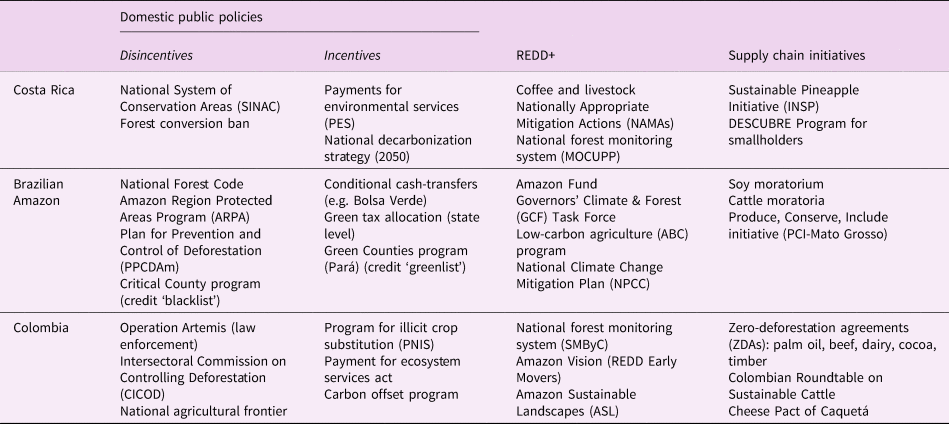
Acronyms reflect language of origin. For complete lists of interventions refer to the Supplementary Material.
4.1 Stages of actor and instrument sequencing
4.1.1 Domestic public policies
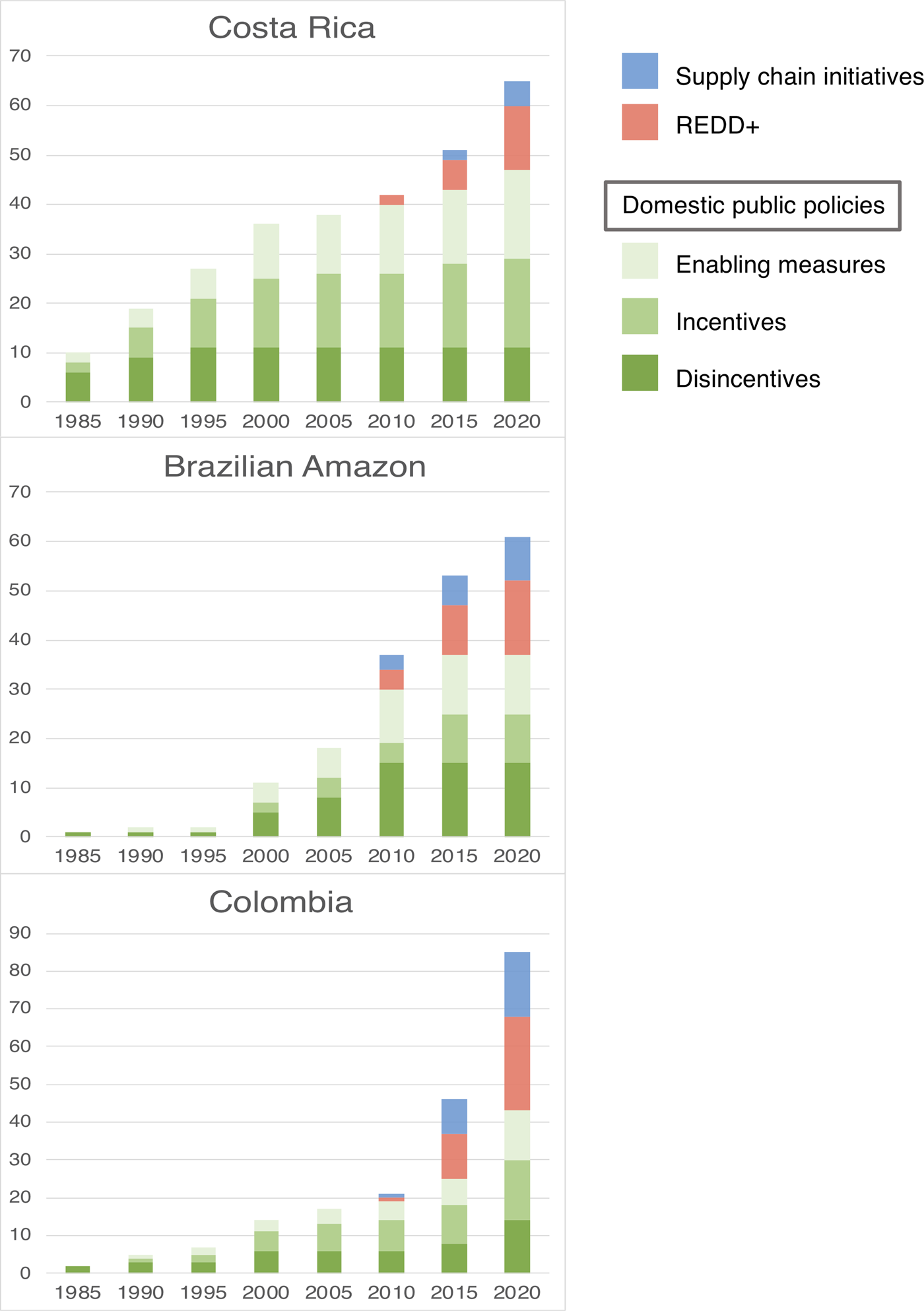
The pattern of sequencing observed was that of early government intervention, followed by REDD+ and sustainable supply chain initiatives (Figure 2). At early stages of the forest transition, the state played a critical role in agenda setting following periods of rampant forest loss. Government interventions first included command-and-control measures like increased land use regulations, law enforcement, fines, and area-based interventions. The goal was to establish a legal basis for forest protection and the institutional capacity to enforce it. Coercive policy instruments helped slow land clearing by consolidating the agricultural frontier and deterring land speculation. Protected areas were significantly expanded at this early stage of intervention in all three countries. Costa Rica stiffened consequences for illegal deforesters from fines to jail sentences in the 1990s. In the Brazilian Amazon, a stringent national forest code had long been in place making most deforestation illegal, but there was little political will to enforce it. Creation of a national satellite-based forest monitoring system (PRODES) in the late 1980s allowed the government to step up field raids, equipment confiscations, and fines. Colombia also increased field operations in the late 2010s to stop illegal deforestation after the peace agreement, and established the country's first national agricultural frontier to assist conservation efforts outside of protected areas. These regulations act as deterrents – a first response to ‘stop the bleeding’ of forest loss. They reduce extensive agricultural rent by increasing the costs of expansion into forests (Angelsen, Reference Angelsen2010; Nepstad et al., Reference Nepstad, McGrath, Stickler, Alencar, Azevedo, Swette, Bezerra, DiGiano, Shimada and da Motta2014).
The evolving policy mix to reduce deforestation in three national case studies from Latin America. Domestic public policies like area-based disincentives and command-and-control measures developed early in the policy sequence, followed by financial incentives to increase compliance. Enabling measures to support (dis)incentives increased at later stages to enhance coordination in the policy mix. REDD+ and supply chain initiatives consist primarily of incentives and enabling measures. Graph values represent cumulative interventions in the policy mix prior to, but not including, the year displayed in each column.
A subsequent set of government policies added regulatory incentives into the policy mix to reinforce legal compliance. These supporting instruments make compliance more attractive by increasing forest rent and its capture (Angelsen, Reference Angelsen2010). Costa Rica's national PES program was introduced after the strengthening of the protected areas system. Between 1997 and 2012, conditional payments supported the protection of 860,000 hectares of forest on private lands, nearly one-fifth of the territory (Porras et al., Reference Porras, Barton, Miranda and Chacón-Cascante2013). Previous government experience with distributing subsidies and forest certificates in Costa Rica provided institutional capacity as well as industry and smallholder support for a successful rollout of the PES program (Pagiola, Reference Pagiola2008; Watson et al., Reference Watson, Cervantes, Castro, Mora, Solis, Porras and Comejo1998). Incentives can also be leveraged to make non-compliance more costly, such as the Critical Counties program in Brazil that froze agricultural credit in the counties with the highest rates of deforestation.
As incentive-based policies rely on clearly defined property rights, additional enabling measures were needed. The PES program in Costa Rica has helped formalize land tenure as a pre-condition for participation (Porras et al., Reference Porras, Barton, Miranda and Chacón-Cascante2013). In Colombia, the armed conflict has resulted in longstanding land titling issues that have inhibited large-scale deployment of incentives for landowners, despite a national PES program in place. In Brazil, the rural land registry (CAR) was set up to enforce the Forest Code by committing landowners to register their properties and legal forest reserves. The tool sidesteps the challenges of land titling in large frontier areas by focusing on self-reported land occupation that can facilitate satellite-based monitoring (Nepstad et al., Reference Nepstad, McGrath, Stickler, Alencar, Azevedo, Swette, Bezerra, DiGiano, Shimada and da Motta2014). The institutional capacity to link deforestation with properties opens up further incentive-based policy options.
4.1.2 REDD+
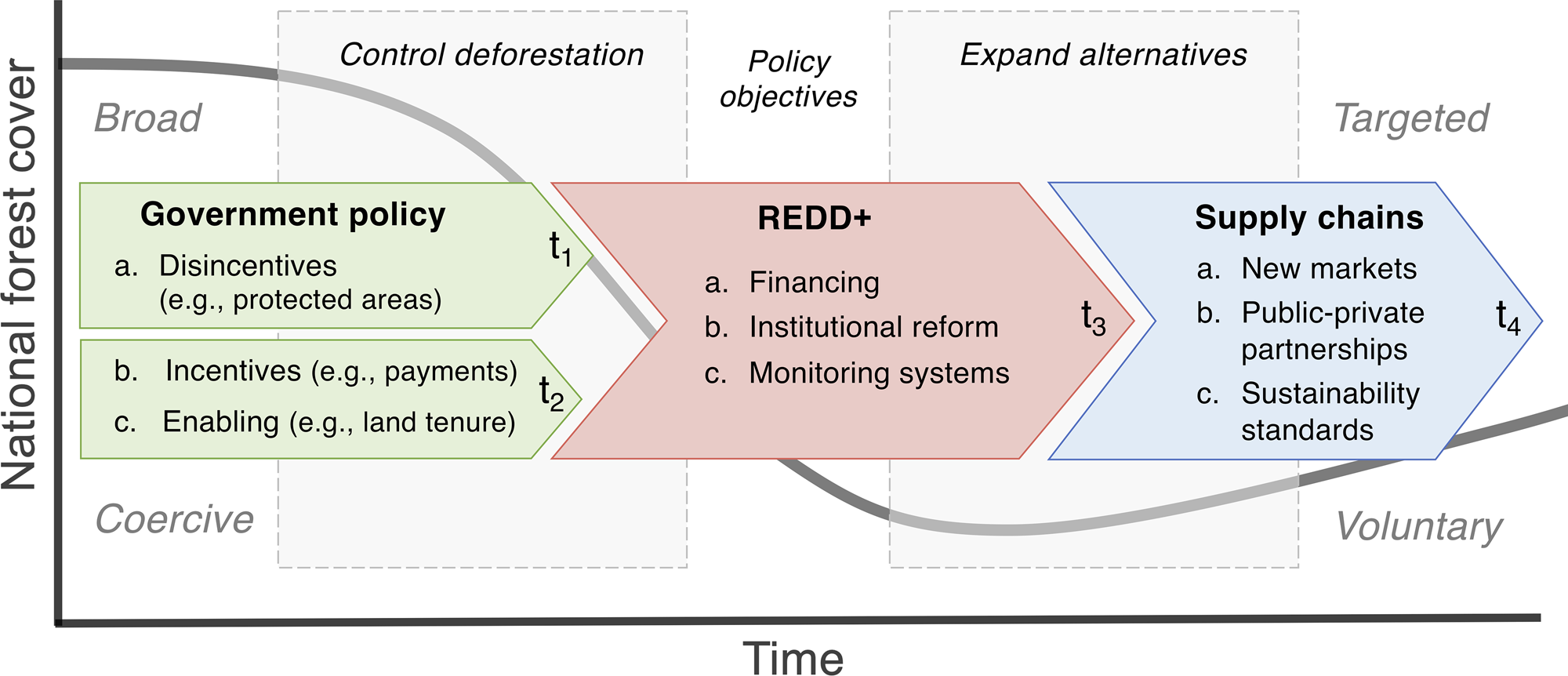
In the following stage, incentives were expanded through voluntary initiatives. External policy networks like REDD+ were sought to scale up financing. Engaging the REDD+ framework expands stakeholder coalition support for zero deforestation through issue linkage with climate change. This resulted in an ‘internationalization’ of domestic forest agendas, bringing new streams of finance for low-emissions rural development, restoration of degraded lands, and a strengthening of indigenous land rights (Duchelle et al., Reference Duchelle, Seymour, Brockhaus, Angelsen, Larson, Moeliono, Wong, Pham and Martius2019). Funding followed strong commitments made by receiving countries. Brazil's 2009 pledge for an 80% reduction of deforestation in the Brazilian Amazon by 2020 was supported by the creation of the Amazon Fund, seeded with one billion dollars in results-based payments from Norway. Commitments by subnational governments also played an important role in Brazil, leading to state-level REDD+ programs supported by transnational actor networks like the Governors' Climate and Forest Task Force (GCF) that advances jurisdictional approaches to zero deforestation (https://www.gcftf.org/). Similarly, the 2009 pledge for zero deforestation in the Colombian Amazon by 2020 led to the Joint Declaration of Intent, to which Norway, Germany, and the United Kingdom have committed over half a billion dollars in policy and results-based payments. Colombian policymakers effectively leveraged climate funding for emissions reductions from deforestation to help finance peacebuilding through low-emissions rural development projects (Furumo & Lambin, Reference Furumo and Lambin2020). Accessing performance-based funding through the REDD+ mechanism requires demonstrated progress. This becomes more relevant at intermediate stages of the forest transition after deforestation has been slowed and forest cover begins to stabilize (Figure 3). The government pledges in Brazil and Colombia both followed periods of reduced deforestation.
Stages of policy sequencing along the forest transition curve. Earlier in the forest transition, coercive instruments are designed to control deforestation and disrupt lock-in of existing production models. Instruments become more targeted with the deployment of incentives. Later in the forest transition, voluntary instruments expand alternative models of sustainable production that lead to forest recovery. The policy sequence (t n) represents the addition of (not transition to) new actor domains as interventions are layered into the policy mix.
4.1.3 Supply chain initiatives
With a legal basis for reducing deforestation, institutional capacity for enforcement, and monitoring capabilities in place, countries are primed for further performance-based initiatives from private sector actors. At this stage, supply chain initiatives entered the policy mix to scale up zero-deforestation efforts through more specific targeting of commodity sectors and actor groups. Early sustainability efforts along commodity supply chains largely focused on market-based eco-certifications (e.g. Forest Stewardship Council) and multi-stakeholder commodity roundtables (e.g. Roundtable on Sustainable Palm Oil). These VSS have a long history in the case studies, but most standards have only recently adopted zero-deforestation criteria. Early VSS have raised awareness among firms and farmers, pioneered mechanisms for supply chain traceability, and created new markets for sustainable products. Many corporate zero-deforestation commitments also rely on certifications to demonstrate compliance (Lambin et al., Reference Lambin, Gibbs, Heilmayr, Carlson, Fleck, Garrett, le Polain de Waroux, McDermott, McLaughlin, Newton, Nolte, Pacheco, Rausch, Streck, Thorlakson and Walker2018). Contemporary supply chain initiatives have morphed from private sector commitments into multi-stakeholder implementation strategies – for example, the soy and cattle moratoria in Brazil and the national zero-deforestation agreements for palm oil, beef, dairy, cocoa, and timber sectors in Colombia.
Environmental NGOs played an important role in pressuring industry actors through naming-and-shaming campaigns that led to the creation of the soy moratorium in the Brazilian Amazon. The moratorium began in 2006 as a working group between NGOs, soy traders, and producer associations. The Brazilian government joined in 2008 and helped develop a system to monitor compliance using PRODES. To pre-empt civil society backlash and government regulation, moratoria were also organized in the cattle sector that rely on the government's CAR to monitor compliance. In Colombia, ambitious private sector zero-deforestation agreements were initiated by the government through REDD+ funding. The Joint Declaration required Colombia to establish zero-deforestation agreements in national commodity sectors. Companies committed to deforestation-free production along their supply chains, civil society organizations supported implementation, and the Colombian government assumed responsibility for monitoring compliance through their national forest monitoring system. In 2020, Costa Rica began pursuing similar zero-deforestation initiatives with commodity sectors through a national monitoring system that tracks land use changes in pineapple, oil palm, banana, sugar cane, and cattle landscapes. Supply chain initiatives also include partnerships to support smallholders in the production, transformation, and marketing of sustainable products (Furumo & Lambin, Reference Furumo and Lambin2020). Supply chain initiatives are relevant at intermediate and late stages of the forest transition to limit further encroachment into forest frontiers and conserve tree cover for regeneration in production landscapes (Figure 3). Market-based instruments require infrastructure that mostly exists in forest-agriculture mosaic landscapes.
4.2 National variations in policy sequences
Variations in policy sequences exist between countries given unique national settings. These variations can be understood as the context-appropriate policy sequence needed to overcome institutional, financial, distributional, and free-riding barriers faced by each country (Pahle et al., Reference Pahle, Burtraw, Flachsland, Kelsey, Biber, Meckling, Edenhofer and Zysman2018). Below, we identify the main factors that account for these variations.
4.2.1 Political will and baseline institutional capacity
Countries begin their pursuit of controlling deforestation with different levels of institutional and financial capacity. Much of Brazil and Costa Rica's successes in reducing deforestation can be attributed to proactive political leadership that removed institutional barriers early in the policy sequence. REDD+ financing was later sought to scale up existing government strategies. Brazil eventually pursued REDD+ to receive compensation for its early successes in reducing deforestation. Costa Rica was also interested in pursuing compensation for national forest recovery, particularly in its large protected area system, but was less beholden to REDD+ payments as it already had mechanisms to finance its national PES program through a tax on fossil fuels and a national carbon market (Barbier et al., Reference Barbier, Lozano, Rodríguez and Troëng2020; Wallbott et al., Reference Wallbott, Siciliano and Lederer2019). Colombia has introduced similar financial mechanisms to support its system of protected areas and REDD+ projects, but with weaker baseline-level institutional and enforcement capacity, it has been more reliant on international REDD+ support to advance its zero-deforestation agenda.
4.2.2 Commodity-driven deforestation and links to international markets
When a commodity sector is responsible for significant deforestation, and impacts are highly visible, supply chain initiatives will likely be sought earlier in the policy sequence. In Brazil, major supply chain initiatives slightly preceded engagement with REDD+. Forest clearing for soy fields in the Brazilian Amazon had captured international attention when the soy moratorium was introduced. With much of the soy being exported, Brazilian soy traders were susceptible to consumer pressure and thus needed to demonstrate commitments to sustainability or risked losing market access. The pre-competitive, market-exclusion mechanism of the moratorium surmounted distributional barriers by building an industry coalition. County-level monitoring and conditioning of credit access to individual farmers based on jurisdictional performance helped overcome free-riding and scale up compliance.
The Colombian commodity sectors with zero-deforestation agreements are mostly geared toward the domestic markets; roughly 60% of palm oil, 85% of beef, and 95% of cocoa production are consumed internally (Furumo & Lambin, Reference Furumo and Lambin2020). Supply chain initiatives can thus gain traction even in sectors that are relatively decoupled from international markets. Participating Colombian producers expect these agreements to distinguish their products and create opportunities to expand exports. In Costa Rica, the livestock industry contributed significant forest loss leading up to the forest transition in the 1980s. The reversal of forest decline was largely due to stagnating beef exports. No single commodity sector has dominated deforestation since, and thus supply chain initiatives have not been as pressing – although a multi-stakeholder group has recently formed over growing concern about deforestation from export-oriented pineapple production.
5. Discussion
5.1 Mechanistic sequencing to address proximate drivers
The role of sequencing in the design of smart policy mixes for zero-deforestation commodity production and rural development takes both mechanistic and transformative forms. The mechanistic view focuses on deploying the right instrument at the right time, in response to evolving circumstances along the forest transition curve (Figure 3). At early forest transition stages, channeling infrastructure projects (e.g. roads, mining, settlements) away from intact core forests yields the greatest benefit to control deforestation (Angelsen & Rudel, Reference Angelsen and Rudel2013). Once these projects are in place, it is very difficult to prevent the positive feedback of land clearing from auxiliary roads that expand accessibility. Preventative measures through improved spatial planning are needed to achieve this (Vilela et al., Reference Vilela, Harb, Bruner, da Silva-Arruda, Ribeiro, Costa-Alencar, Escobedo-Grandez, Rojas, Laina and Botero2020), including area-based regulations like protected areas and indigenous reserves. In a posterior stage, slowing land clearing in frontier forests requires state interventions that increase the risk of illegally cutting forests (e.g. law enforcement, fines) and incentivize legal compliance by reducing opportunity costs (e.g. subsidies, cash payments) (Nepstad et al., Reference Nepstad, McGrath, Stickler, Alencar, Azevedo, Swette, Bezerra, DiGiano, Shimada and da Motta2014). Defining clear property rights can enable adoption. REDD+ as a strategy to mitigate GHG emissions by preventing deforestation enters the policy mix at this stage, facilitating government action.
In later stages of forest transition, the focus of policies becomes accelerating forest recovery through adaptive strategies. Most gains in forest cover occur in production landscapes outside of protected areas, thus calling for sustainable agricultural policies. These include targeted market-based strategies that expand alternative models of production and create more value for farmers. Enabling measures include technical assistance and green credit for farmers, partnerships with well-capitalized processors, and the creation of new markets. Supply chain initiatives gain the most traction at this stage, opening opportunities for blended finance and other public–private partnerships. In reality, these policy stages occur simultaneously in different regions across a country, particularly when a gradient of forest cover dynamics exists between agricultural areas and core forests. Further research is needed to understand whether the pattern of policy sequencing observed in our case studies holds up in other countries and geographical regions with different political, institutional, and cultural settings.
5.2 Transformative sequencing to address underlying drivers
A transformative view of sequencing considers how deliberate ordering of interventions can unlock system-wide changes in governance regimes. A transition to zero-deforestation commodity production requires overcoming political economy-related resistance, by weakening existing vested interests and building up new political and institutional support for sustainable land use. In the case studies, this transition began with a domestic enabling environment that supported private sector initiatives and advanced multi-stakeholder engagement. This enabling environment includes a strong legal framework for de jure forest protection, institutional capacity for de facto law enforcement, and a rearrangement of incentives to support new models of sustainable production. We observed different mechanisms in the creation of the domestic enabling environment, beginning with government commitment and reinforced through incentives for coalition-building and new technologies.
5.2.1 Government commitment sets the national forest agenda
The enabling environment can only be set by governments, yet domestic public policy remains the biggest wildcard among the three governance domains. As most tropical forests are state-owned, it is also the most critical. Even with de jure forest protection in place – which is relatively strong in Latin America – law enforcement requires sustained political will and resources. A first step to disrupting perverse institutional lock-ins is thus commitment by the state. These commitments tend to follow a focusing event, such as the 1997 forest fires in the Brazilian Amazon, or the signing of the peace deal in Colombia. Forest resources also become increasingly scarce along the forest transition curve, increasing their value and opportunities for their conservation. In countries with weak political and institutional capacity for land use governance, transnational networks like REDD+ have expanded incentives to pursue national commitments and institutional reform. Nonetheless, a national forest transition requires sustained political support. In Brazil, the rollback of environmental regulations and law enforcement under the Bolsonaro administration is threatening years of progress on reducing deforestation. There is a risk of intermediate lock-in of REDD+ as an ineffective strategy if carbon markets do not mature and payments fail to materialize on a large scale. Brazil was compensated for less than 5% of its emission reductions between 2006 and 2015 (https://redd.unfccc.int/info-hub.html), and the lack of incentives has contributed to the current backlash. There are further challenges integrating proper project-level carbon offsets into national accounting systems under the Paris agreement (West et al., Reference West, Börner, Sills and Kontoleon2020), even though most tropical countries are relying on REDD+ to meet their nationally determined contributions (Hein et al., Reference Hein, Guarin, Frommé and Pauw2018).
5.2.2 Incentives build coalitions of support
Once governments have set an agenda to reduce deforestation, incentives build coalitions that reinforce regulatory compliance and increase the political feasibility of more stringent policy. In Costa Rica, the evolution from fiscal incentives for plantation-based reforestation in the 1980s to direct payments for forest conservation in the 1990s helped build a coalition of conservation-minded industry actors. This softened opposition to a forest conversion ban that was extended during this period from lands with forestry aptitude to all private lands (Navarro & Thiel, Reference Navarro and Thiel2007). In the Brazilian Amazon, incentives were leveraged at the county level to spur collective action on reducing deforestation (Nepstad et al., Reference Nepstad, McGrath, Stickler, Alencar, Azevedo, Swette, Bezerra, DiGiano, Shimada and da Motta2014). This began by withholding agricultural credit for non-compliant deforesters (e.g. Critical Counties program). Positive reinforcement with credit was later introduced to reward groups of good actors instead of penalizing bad ones (e.g. Green Counties program). Without perceived legal risk and assured enforcement, incentives are less effective (Börner et al., Reference Börner, Marinho and Wunder2015) – especially for illegal deforestation like land grabbing in which criminal actors are unlikely to respond to regulatory or market-based incentives. However, law enforcement is costly in remote frontier and core forests (Börner et al., Reference Börner, Marinho and Wunder2015).
Governments can also dismantle or rearrange old incentives in the policy mix that reward forest clearing. In Costa Rica, the provision of livestock credit fueled the beef export boom and rapid forest decline of the 1960s and 1970s (Watson et al., Reference Watson, Cervantes, Castro, Mora, Solis, Porras and Comejo1998), peaking at 58% of national agricultural credit in 1974 (Kaimowitz, Reference Kaimowitz1996). Removal of the credit reduced demand for deforestation just as incentives for reforestation were kicking in. The recent proliferation of zero-deforestation initiatives in Colombia has not yet been successful in reducing deforestation on a large scale, partially because of policies that still favor agro-industrial interests and land clearing. Alternative forest-based models of production like agroforestry, silvopastoralism, and non-timber forest products are still perceived as high-risk ventures with limited credit opportunities from governments. In countries that produce two-thirds of the world's agricultural output, only 5% of agricultural financial incentives provided by governments support conservation (Searchinger et al., Reference Searchinger, Malins, Dumas, Baldock, Glauber, Jayne, Huang and Marenya2020). Farm credit and subsidies could gradually be made conditional on zero deforestation. Fiscal incentives can also be leveraged by making tax revenue distribution from national to local governments conditional on reducing deforestation, as pioneered by India (Busch & Mukherjee, Reference Busch and Mukherjee2017).
5.2.3 New technologies expand policy options
Advancements in technology expand the menu of policy options for reducing deforestation. Chiefly, satellite-based forest monitoring systems underpin interventions in all three policy domains: government law enforcement over landholders, results-based REDD+ payments for national and subnational governments, and producers' compliance with supply chain commitments for companies. Forest monitoring capabilities are a key development in the domestic enabling environment that allows for ambitious supply chain initiatives. The zero-deforestation agreements in commodity sectors in Colombia and Costa Rica rely on governments to monitor compliance, and REDD+ was key to building their monitoring systems. National landholder registries were a momentous innovation in Brazil and Costa Rica that supported the spatial targeting of instruments to the property level. Linking properties with high-resolution monitoring enabled policy experimentation with PES programs and market exclusion. The early detection of deforestation events also enhances government capacity to respond to violations in real-time. In countries that lack a national forest monitoring system, global databases are filling the gap. For example, GLAD alerts from Global Forest Watch (Hansen et al., Reference Hansen, Krylov, Tyukavina, Potapov, Turubanova, Zutta, Ifo, Margono, Stolle and Moore2016) have helped the Peruvian government's Project Mercury crack down on illegal gold mining in the Amazon (Finer & Mamani, Reference Finer and Mamani2020). Improved alerts have the potential to turn real-time monitoring into real-time law enforcement.
5.3 Policy sequencing as a learning process
Learning mechanisms help explain how new ideas gain prominence in policy discussions and become adopted as mainstream strategies. Following Pahl-Wostl (Reference Pahl-Wostl2009), the concept of triple-loop learning captures how policy mixes evolve over time and transform the context of resource governance (Figure 4). Single-loop learning refers to refining existing strategies to improve performance– that is, tinkering around the edges of strategies. Similar actions or instruments are re-calibrated or scaled up to broaden their scope of impact. Double-loop learning questions the underlying assumptions of a strategy and reframes governance solutions. This is accompanied by experimentation with new instruments and the inclusion of new actor groups. Triple-loop learning entails a paradigm shift in which power structures are redefined and the boundaries of actor networks are expanded far beyond the established governance regime (Pahl-Wostl, Reference Pahl-Wostl2009). These learning loops are evident in the evolving governance strategies for controlling deforestation, which we refer to below as forest governance 1.0 to 3.0.
Forest governance as a sequence of policy strategies that are refined, reframed, and transformed through learning loops (derived from Pahl-Wostl, Reference Pahl-Wostl2009). Each loop confers an increasingly higher level of learning in a process that leads to more efficient governance defined by enhanced coordination and synergies among actor groups.
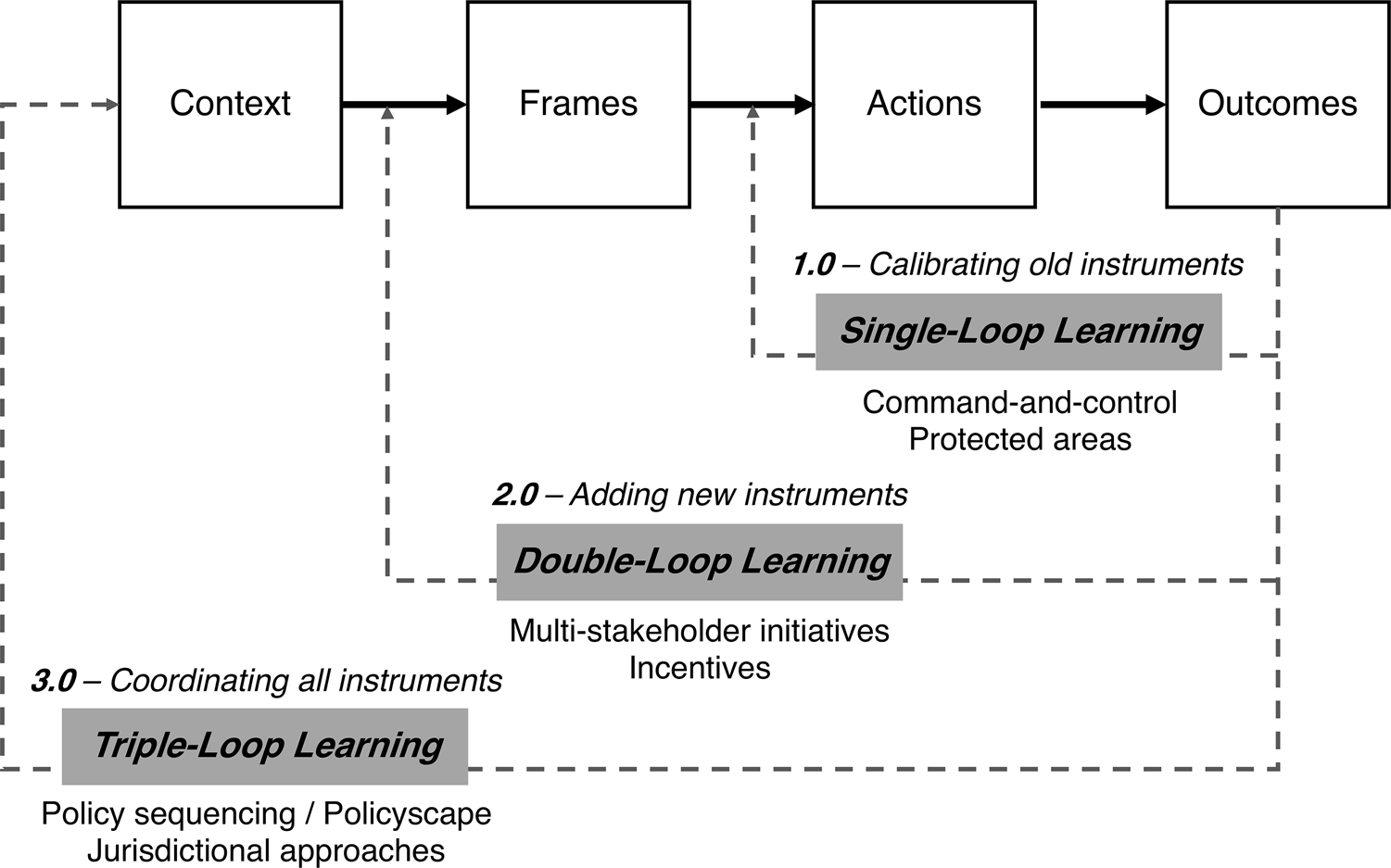
Forest governance 1.0 was rooted in a ‘fortress conservation’ paradigm that sought to exclude humans from nature. This strategy utilized incremental area-based instruments and sanctions to target proximate deforestation drivers. Interventions were largely pursued by state environmental ministries and shared minimal linkages, or outright antagonisms, with other policy domains (e.g. agriculture) and actor groups (e.g. indigenous). In recent decades, policymakers have come to recognize the limitations of relying solely on disincentives to control deforestation. Forest governance 2.0 shifted focus to offering incentives to influence behavior. This reframing recognizes the absence of silver bullet solutions, and embraces policy mixes that combine area-based and supply chain initiatives, and incentives with threats of sanctions. Policymaking is advanced through transnational networks of subnational and non-state actors at multiple levels. This polycentric experimentation has led to a proliferation of public and private initiatives that are layered with minimal coordination.
In the face of looming tipping points for reducing global emissions and preserving tropical forest ecosystems (Nobre et al., Reference Nobre, Sampaio, Borma, Castilla-Rubio, Silva and Cardoso2016), there is a renewed sense of urgency in solving deforestation. The need to make polycentric governance more efficient has led to new governance strategies that account for policy interactions. Forest governance 3.0 seeks to design a coordinated and coherent approach that integrates multiple types of interventions articulated in a purposeful way to maximize synergies. Integrated landscape and jurisdictional approaches are a first attempt in this paradigm shift. They seek to enhance actor coordination, manage scale mismatch and leakage, and lower costs of compliance and verification (Arts et al., Reference Arts, Buizer, Horlings, Ingram, van Oosten and Opdam2017; Cash et al., Reference Cash, Adger, Berkes, Garden, Lebel, Olsson, Pritchard and Young2006; von Essen & Lambin, Reference von Essen and Lambin2020).
A deliberate and coordinated polycentric forest governance can use policy sequencing and policyscape concepts to design more cost-effective approaches. Purposeful policy sequencing – that is, undoing perverse lock-ins and establishing an enabling environment – can enhance complementarities among diverse initiatives. Governance through the policyscape would pool information, technology, and even resources across a broader coalition of actors, such that new initiatives are spatially targeted to maximize cost-effectiveness. This would ensure resources are not wasted on similar instruments in the same location and help avoid gaps elsewhere in the policyscape with underdeveloped policy mixes. Nonetheless, competition among governments, NGOs, and other conservation practitioners for limited resources undermines a deliberate and coordinated polycentrism. The current lack of communication among actors with similar goals is evident in the Colombian Amazon, where even government-led initiatives are not in dialogue. Comprehensive and publicly available spatial data of where policies are implemented in practice would permit more rigorous impact evaluation, guide new investments, reduce transaction costs, and allow for smarter design of policy mixes with greater synergies.
Advanced stages of triple-loop learning must be accompanied by a broader transformation of societal norms and values, and demand-side measures in consuming countries. This includes addressing underlying drivers of deforestation, like reducing red-meat consumption and incorporating natural capital accounting into policymaking. Policy linkages between individual domains are transformed into policy integration across society, which is already beginning around carbon neutrality goals. Actor network boundaries are expanded to include global financial and trade systems that bridge supply and demand side measures. In sum, the domestic enabling environment becomes a global one.
6. Conclusion
Reducing tropical deforestation is possible through improved governance. No single strategy will solve deforestation and governments cannot simply copy-paste successful interventions from one country without tailoring them to domestic conditions like deforestation drivers, political will, and institutional capacity. Analyzing this governance puzzle through a policy mix perspective reveals the importance of sequencing interventions to improve the implementation of existing commitments and expand the adoption of new ones. Smart policy mixes avoid antagonisms by rearranging incentives to reverse the lock-in of land clearing activities and expand alternative models of production.
States play a critical role in initiating the national zero-deforestation agenda and creating an enabling environment of command-and-control policies and incentives that support private sector commitments. Strong subnational governments can also fill this role, just as self-regulation by the private sector can pre-empt it. Success, however, depends on a minimum level of institutional capacity from central governments. Once launched, the zero-deforestation agenda is kept in motion and scaled up by a collection of transnational initiatives, nonstate actors, and public–private partnerships. Transnational governance alone is not capable of achieving zero deforestation, but it can help states build the necessary institutional capacity to implement stronger commitments. Success depends not only on the establishment but also maintenance of the domestic enabling environment. Transnational actors provide a bulwark against changes in political winds that may temporarily debilitate government action.
In the face of growing urgency to reduce deforestation, we identify a new paradigm that is based on more deliberate and coordinated polycentric forest governance. Enhanced effectiveness of forest conservation interventions will result from a purposeful sequencing of public and private interventions, and a policyscape of complementary initiatives that generate a system-wide transformation of forest governance.
Supplementary material
The supplementary material for this article can be found at https://doi.org/10.1017/sus.2021.21.
Acknowledgements
None.
Author contributions
PRF and EFL conceived and designed the study. PRF gathered and analyzed the data. PRF and EFL wrote the article.
Financial support
This research received no specific grant from any funding agency, commercial or not-for-profit sectors.
Conflict of interest
None.
Research transparency and reproducibility
All datasets compiled and used for analysis in this study are available in the Supplementary File.


 Open access

