

1. Introduction
Cigarette smoking remains the leading cause of preventable disease, disability, and death in the United States [1]. According to the 2020 Surgeon General’s Report, smoking cessation reduces the risk of premature death and can add as much as a decade to life expectancy [1]. More than two-thirds of U.S. adults who smoke cigarettes report interest in quitting cigarette smoking [Reference Babb, Malarcher, Schauer, Asman and Jamal2]. Sustained efforts to increase access to and use of evidence-based cessation treatments among adults who smoke, in coordination with population-based interventions, are important to effectively address the continuum of tobacco use including initiation, cessation, and relapse [1].
Population-based interventions to address tobacco use include evidence-based mass-reach health communication campaigns, which have been shown to increase cigarette smoking cessation, use of cessation resources such as quitlines, and change tobacco-related social norms [3–Reference Davis, Patel and Shafer5]. The Centers for Disease Control and Prevention’s (CDC’s) national Tips from Former Smokers® (Tips®) campaign is the first federally funded national mass media campaign in the U.S. to encourage adults who smoke to quit and make free help available. Tips® shares real life stories of people who are living with serious long-term health effects due to smoking cigarettes and secondhand smoke exposure on a variety of media channels including television, radio, print, and digital media [6]. Tips® has been associated with quit attempts and smoking cessation among adults who currently smoke [Reference Davis, Duke, Shafer, Patel, Rodes and Beistle7–Reference Neff, Patel, Davis, Ridgeway, Shafer and Cox10]. From 2012 to 2018, the Tips® campaign was associated with an estimated 16.4 million quit attempts and over one million sustained quits among adults who smoked cigarettes [Reference Murphy-Hoefer, Davis, King, Beistle, Rodes and Graffunder9].
Although extensive research has been conducted on relationship between Tips® campaign exposure and cigarette smoking cessation among current smokers, no study has examined its potential preventative effects on cigarette relapse among former smokers. Existing studies from Australia [Reference Wakefield, Bowe and Durkin11] and England [Reference McVey and Stapleton12] have reported that, in addition to helping people quit smoking, exposure to mass media campaigns has been associated with a lower likelihood of relapse among people who had recently quit smoking. However, no study has assessed the impact of a national campaign on reducing relapse in the United States. To address this gap, this study examined the relationship between Tips campaign exposure and the odds of relapse to cigarette smoking among people who formerly smoked.
2. Materials and Methods
2.1. Data and Sample
This study’s sample and recruitment methods are based on those of previous studies examining the effectiveness of the Tips campaign [Reference Davis, Patel and Shafer5, Reference McAfee, Davis, Alexander, Pechacek and Bunnell8, Reference Neff, Patel, Davis, Ridgeway, Shafer and Cox10, Reference Murphy-Hoefer, Davis and Beistle13]. In brief, we used data from a longitudinal online panel of adult cigarette smokers in the U.S. Adult cigarette smokers were identified as individuals who reported currently smoking cigarettes either “some days” or “every day” at the time of initial recruitment. Respondents were recruited from a combination of the nationally representative Ipsos KnowledgePanel® (KP) and a custom Ipsos panel recruited using the same methods as KP. Both samples are drawn from an address-based random sample (ABS) of U.S. households covering approximately 95% of the U.S. adult population (18 years and older). Respondents received invitation packets containing study information and unique links to join the study. Respondents to the initial survey (Spring 2014) were followed longitudinally and invited to participate in subsequent surveys, with new sample periodically recruited via ABS to replenish respondents lost to follow-up. The combined sample was weighted to reflect age, sex, race/ethnicity, and educational distributions among adult cigarette smokers from the National Health Interview Survey.
Data collection was timed to coincide with the Tips campaign each year. Approximately three surveys were conducted per year in 2014, 2015, 2016, and 2018, with one survey wave being conducted in 2019. No data were collected in 2017. Survey waves were conducted approximately 3-6 months apart and, each year, were timed to occur before campaign launches, during the campaigns, and after the campaigns ended. In total, 12 waves of survey data were collected between 2014 and 2019.
Because this study examines cigarette relapse as the primary outcome, we further limited the cigarette smoker panel data to the subset of respondents who transitioned to nonsmoker status during the study period (i.e., recent former smokers). Recent former smokers were defined as current cigarette smokers who reported smoking “not at all” in at least one subsequent survey over the course of their tenure in the panel. This subset of recent former smokers was then further limited to respondents who recorded their cigarette smoking status for all remaining survey waves after first reporting former smoking. We excluded participants from the analytic sample who missed all survey waves after transitioning to former smoking, since we could not determine whether they relapsed after the transition to former smoking (20.1% of the initial former smoking sample). All formerly smoking respondents in the analytic sample completed a minimum of 3 survey waves and up to a maximum of 12, averaging approximately 9 completed waves per respondent (SD = 2.1). Including all repeated measurements on individual participants, the final analytic data consisted of 3,464 total observations on 1,409 unique former smokers.
2.2. Outcome Variable: Cigarette Smoking Relapse
The outcome variable was cigarette relapse, measured for the analytic sample of recent former smokers. Respondents who remained former smokers at their first follow-up survey were assigned a value of relapse = 0 for that wave and all applicable waves thereafter. Former smokers who indicated relapsing to current cigarette smoking at a given wave were assigned a value of relapse = 1 for that wave and then given missing values for relapse for all waves thereafter. Former smokers who continued to report former smoker status in all remaining follow-up survey waves were assigned a value of relapse = 0.
Assignment of missing values for all survey waves after cigarette relapse simulates survival analysis by censoring the outcome [Reference George, Seals and Aban14]. That is, the analytic sample is restricted to only those participants who are “at risk” of cigarette relapse, while still applying logistic regression to the dataset [Reference Zhong and Tibshirani15]. This approach allows us to present odd ratios for campaign effects on cigarette relapse, which are more easily interpreted than the hazard ratios generated by standard survival analyses.
2.3. Exposure Variable: Tips Campaign Gross Rating Points
Respondent exposure to the Tips campaign was measured as past-quarter cumulative Tips Gross Rating Points (GRPs), a measure of media campaign dose that varies by respondents’ designated market area (DMA) and time. Past-quarter GRPs were merged to the survey data based on respondents’ DMA of residence and survey completion date. Following the methods used in previous studies, GRPs were transformed into curvilinear form (by taking the square root) to capture expected diminishing marginal effects of GRPs over the range of observed GRPs [Reference Davis, Patel and Shafer5].
2.4. Covariates
Covariates included in the analysis were as follows: sex (male or female); age in years; race/ethnicity (non-Hispanic white, non-Hispanic Black, Hispanic, or non-Hispanic other race/multiracial); education (less than high school, high school degree or General Education Diploma (GED), some college but no degree or an associate’s degree, and a college education (a Bachelor’s degree or greater); most or all of the respondent’s family members or friends smoke (versus most of them are not smoking or none of them are smoking); annual household income (in tens of thousands of U.S. dollars); living with one or more persons who smoke cigarettes; having one or more children in the household; having one or more physical health conditions (endorsing being diagnosed with one or more of 19 listed medical conditions, which ranged from acid reflux disease to stroke); and having one or more mental health conditions (reporting prior diagnosis of ADHD or ADD, anxiety disorder, depression, and/or “mental health condition”). Covariates were measured at each survey wave, allowing for covariate variation over time. The covariates we chose are based on those used in a broader literature that examines the impact of the Tips campaign and has found many of these covariates to be significantly associated with cigarette cessation-related outcomes [Reference Davis, Patel and Shafer5, Reference McAfee, Davis, Alexander, Pechacek and Bunnell8, Reference Murphy-Hoefer, Davis, King, Beistle, Rodes and Graffunder9, Reference Neff, Patel, Davis, Ridgeway, Shafer and Cox10, Reference Murphy-Hoefer, Davis and Beistle13, Reference Davis, Murphy-Hoefer, Levine, King, Hu and Rodes16]. For regression models, we included all covariates that significantly improved model fit (as measured by R 2). Any missing values on covariates at a given wave were replaced with values from the most recent wave they were measured for each individual respondent. Lastly, we created separate indicator variables for each state to account for time-invariant state characteristics (i.e., state fixed effects).
2.5. Statistical Analysis
We used descriptive statistics to characterize the sample at the first wave of data included in this analysis. Logistic regression was used to model relapse as a function of Tips GRPs. To adjust the standard errors for clustered values within each individual, we used Stata’s (Stata Version 17) “svy” survey data suite of commands to specify the unique respondent ID as the clustered ID variable for the logistic regression. In addition, we applied survey weights, also using the “svyset” statement in Stata and then performed the logistic regression using the “svy: logistic” command, which generates weighted, adjusted odds ratios for GRPs that account for correlated data within unique individual respondents.
GRPs were scaled so that odds ratios reflected the difference in odds of relapse for a 1,000 quarterly GRP increase in Tips exposure. This GRP increment was chosen because it reflects the typical quarterly Tips campaign ad buy and the CDC’s best practice recommendations for effective tobacco prevention campaigns [3]. All models were weighted and included all covariates described previously.
To visually illustrate the relationship between GRPs and relapse, we also used the regression model results to calculate the predicted probability of relapse associated with past-quarter GRPs, averaged across markets and time, for all GRP values observed during the study period (0 to 4,072). Because no surveys were conducted in 2017, we conducted a sensitivity analysis to determine the potential impact of missingness on our results. To do this, we reran the regression analysis on 2014-2016 data alone, excluding the 2018 and 2019 survey waves, to assess whether the pre-2017 data yielded different results from the complete 2014–2019 data. This analysis helped establish whether the lack of survey data in 2017 introduced significant bias in analysis of the overall 2014–2019 time period.
3. Results
3.1. Sample Characteristics
Weighted sample characteristics are summarized in Table 1. The sample was 53.5% male and 46.5% female with a mean overall age of 43.8 years. Participants who reported being non-Hispanic white comprised 64.4% of the sample, and participants who reported being non-Hispanic Black comprised 14.5% of the weighted sample. Participants who reported being Hispanic and non-Hispanic other race/multiracial participants made up the remaining 15.2% and 6.0% of the sample, respectively. Respondents with less than a high school degree comprised 13.0% of the sample, and those with a high school degree or a GED comprised 42.5% of the sample. Participants with some college education comprised 31.1% of respondents and those with a bachelor’s degree or higher comprised the remaining 13.4% of the sample. Approximately 54.5% of respondents reported that most or all of their family or friends smoked.
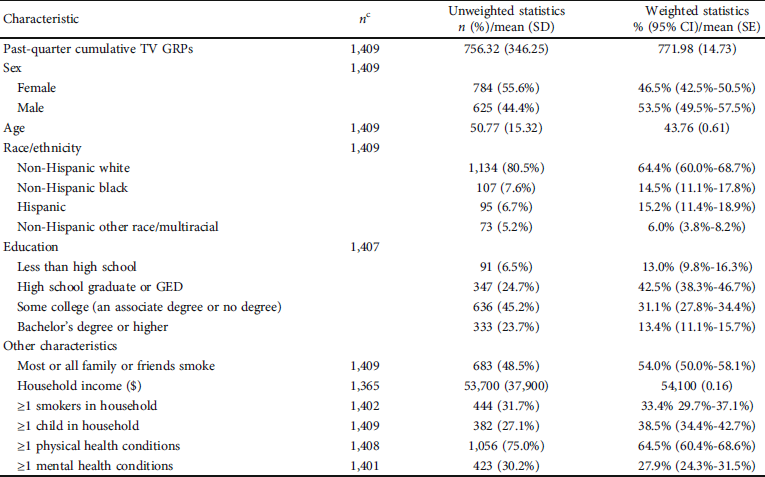
Abbreviations: TV: television; GRPs: gross rating points; SD: standard deviation; CI: confidence interval; SE: standard error; GED: general education degree.
a Weighted to reflect age, sex, race/ethnicity, and education benchmark distributions among adult cigarette smokers from the National Health Interview Survey.
b To be included in the analytic sample, participants had to report smoking “every day” or “some days” (current smoking) in the initial survey wave, subsequently report smoking “not at all” for at least one wave thereafter.
c The sample size represents the number of unique participants with nonmissing values at the initial survey wave.
Approximately half (50.5%) of the analytic sample reported relapsing to current smoking during the follow-up period. Once participants transitioned to former smoking, for those who reported relapse, the average time to reporting first relapse was approximately 9.5 months (mean = 288.69 days, SD = 281.73). Among respondents reporting former smoking who did not report relapse during the follow-up period, the average length of time spent as a former smoker before the end of data collection (2019) was approximately 2.6 years (mean = 958.42 days, SD = 495.16). Past-quarter cumulative Tips GRPs averaged 772 and ranged from 0 to 4,072 among survey respondents across the study timeframe.
3.2. Association between Tips GRPs and Cigarette Relapse
Adjusting for covariates, higher levels of Tips GRPs were associated with lower odds of cigarette relapse (adjusted odds ratio (aOR) = 0.63, 95% CI: 0.50-0.78; Table 2). Specifically, each 1,000 GRP increase was associated with a 37% decrease in the odds of relapse. Other significant covariates included reporting that most or all family or friends smoke, which was associated with higher odds of relapse (aOR = 2.40, 95% CI: 1.75-3.30). Except for several state fixed effects, the remaining covariates in the model were not significant.
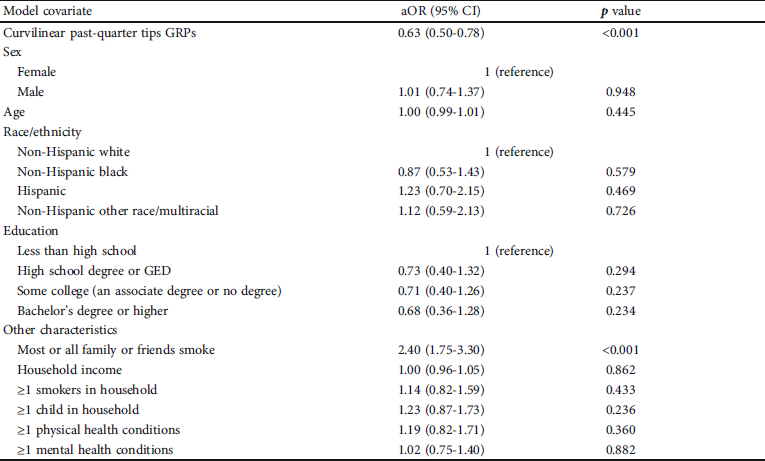
Abbreviations: aOR: adjusted odds ratio; CI: confidence interval; GRPs: gross rating points; GED: general education degree.
a Former smokers were participants who reported smoking “every day” or “some days” (current smoking) in Spring 2014 and subsequently reported smoking “not at all” for at least one wave thereafter.
b The analysis was weighted to reflect age, sex, race/ethnicity, and education benchmark distributions among adult cigarette smokers from the National Health Interview Survey.
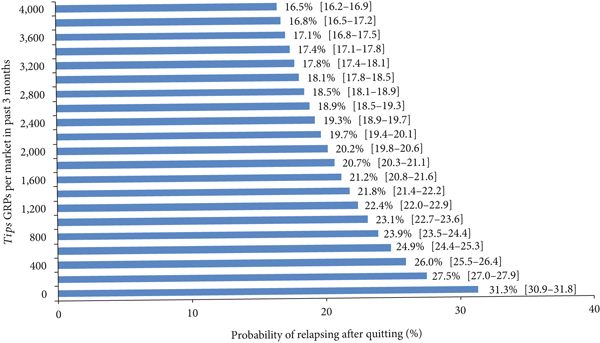
Figure 1 illustrates the dose-response relationship between GRPs and relapse using the model-predicted probabilities of relapse across the range of mean past-quarter Tips GRPs (averaged across markets and time) observed during the study period. The predicted probabilities of relapse ranged from 16.5% (95% CI: 16.2%-16.9%) at 4,000 GRPs to 31.3% (95% CI: 30.9%-31.8%) at 0 Tips GRPs (i.e., no campaign). The predicted probability of relapse at an average Tips dose of 1,000 quarterly GRPs was 23.1% (95% CI: 22.7%-23.6%).
Model-predicteda cigarette smoking relapse by mean observed past-quarter Tips campaign GRPs (95% CI) among former smokingb adults. aThe analytic model adjusted for weights and the following covariates: sex, race/ethnicity, education, having family or friends who smoke, household income, whether one or more smokers live in the household, whether one or more children live in the household, whether participants have physical health conditions, and whether participants have mental health conditions. bFormer smokers were participants who reported smoking “every day” or “some days” (current smoking) in Spring 2014 and subsequently reported smoking “not at all” for at least one wave thereafter.
3.3. Sensitivity Analysis Results
Restricting the dataset to pre-2017 data reduced the model sample size from 3,464 to 2,776 observations. The covariate-adjusted odds of relapse resembled the full model results (aOR = 0.62, 95% CI: 0.48-0.80). The directionality and significance of all covariates remained the same.
4. Discussion
Our study found that higher levels of Tips GRPs were associated with lower odds of relapse to cigarette smoking among U.S. adults who formerly smoked cigarettes. Although the Tips campaign primarily is aimed at increasing quit attempts among individuals who currently smoke, the results of our analysis suggest Tips may be protective against cigarette smoking relapse among those who have quit. In addition to existing evidence documenting the impact of mass-reach health communication campaigns on smoking cessation in the U.S., these findings indicate an additional function of the campaign in potentially reducing cigarette smoking relapse.
In addition to our U.S.-focused analysis, several other studies have examined the impact of mass media campaigns on maintaining abstinence from cigarette smoking or preventing relapse [Reference Wakefield, Bowe and Durkin11, Reference McVey and Stapleton12, Reference Biener, Reimer, Wakefield, Szczypka, Rigotti and Connolly17]. Biener et al. [Reference Biener, Reimer, Wakefield, Szczypka, Rigotti and Connolly17] found that, in Massachusetts, among individuals who reported quitting smoking in the past 2 years, participants who reported remaining abstinent for more than 6 months were more likely to report that TV advertisements had helped them quit smoking compared to participants who reported remaining abstinent for 6 months or less. Consistent with our findings, a national prospective study in Australia found that greater exposure to mass media campaigns was associated with lower odds of relapse among those who recently quit and that “keeping the reasons for quitting salient can help ex-smokers resist temptations to smoke, resist urges to smoke, and reinforce the value of quitting” [Reference Wakefield, Bowe and Durkin11]. Similarly, in England, researchers found that, among adults who reported former smoking, a significantly greater percentage of adults exposed to a national antismoking TV campaign (featuring tips on preventing relapse) remained abstinent at 18 months follow-up compared to those not exposed to the campaign [Reference McVey and Stapleton12]. Secondary outcome studies in New York [Reference Nonnemaker, Hersey and Homsi18] and Florida [Reference Nonnemaker, Dench, Homsi, MacMonegle and Duke19] suggested that exposure to cessation media messages may also influence smoking relapse, but these studies did not find a statistically significant relationship between campaign exposure and relapse. Possible explanations for the difference between our findings and theirs are the lack of measurement of advertising exposure between baseline and follow-up in the New York study [Reference Wakefield, Bowe and Durkin11, Reference Nonnemaker, Hersey and Homsi18] and the lower than recommended campaign target rating points in the Florida study [Reference Nonnemaker, Dench, Homsi, MacMonegle and Duke19].
One possible explanation for our significant findings on cigarette smoking relapse is Tips’ use of emotive messaging focused on the negative health consequences of cigarette smoking [Reference Wakefield, Bowe and Durkin11, Reference McVey and Stapleton12, Reference Biener, Reimer, Wakefield, Szczypka, Rigotti and Connolly17, Reference Sly, Heald and Ray20, Reference Duke, Mann, Davis, MacMonegle, Allen and Porter21]. Other campaign ads with similar themes as Tips have been found to reduce smoking relapse [Reference Murphy-Hoefer, Davis, King, Beistle, Rodes and Graffunder9, Reference Wakefield, Bowe and Durkin11, Reference Donovan, Boulter, Borland, Jalleh and Carter22]. In Massachusetts, researchers found that ads focused on the health consequences of cigarette smoking or “inspirational quit tips” were most helpful for preventing relapse [Reference Biener, Reimer, Wakefield, Szczypka, Rigotti and Connolly17]. Similarly, in Australia, ads focused on the negative health consequences of smoking cigarettes helped persons who recently quit to maintain their nonsmoking status [Reference Wakefield, Bowe and Durkin11].
In the context of existing studies, our findings have important implications for considering individuals who formerly smoked as part of the core target audience, in addition to those who currently smoke, when developing messages for tobacco control mass media campaigns. Most people who attempt to quit smoking relapse [Reference Babb, Malarcher, Schauer, Asman and Jamal2] take as many as 30 attempts to quit successfully [1]. Accordingly, cessation maintenance has been identified as an important step in staying quit [Reference Borland, Partos, Yong, Cummings and Hyland23]. Our study also draws attention to the benefit of combining individual-level interventions, which are well-documented [1, Reference Stead, Perera and Lancaster24], with mass media campaigns as part of relapse prevention initiatives. Our findings support existing evidence for a comprehensive approach that uses effective message themes and executional styles, campaigns with sufficient reach and duration, and maintaining social norm influences to reduce smoking relapse [3, Reference Durkin, Brennan and Wakefield25]. These interventions have the potential to support smoking abstinence for the estimated 55 million adults in the U.S. who have quit smoking [Reference Creamer, Wang and Babb26].
In addition, our findings add to an already substantial body of evidence that the Tips campaign is effective, including its association with over one million sustained quits [Reference Murphy-Hoefer, Davis, King, Beistle, Rodes and Graffunder9], economic savings and gains in life quality [Reference Xu, Alexander and Simpson27, Reference Shrestha, Davis and Mann28], increased calls to quitlines and visits to cessation-related websites [Reference Duke, Mann, Davis, MacMonegle, Allen and Porter21, Reference Davis, Alexander, Shafer, Mann, Malarcher and Zhang29], and knowledge of tobacco-related health risks [Reference Duke, Davis and Alexander30, Reference Huang, Thrasher and Abad31]. Previous research has focused on the economic savings associated with smoking cessation that has been attributed to Tips [Reference Xu, Alexander and Simpson27, Reference Shrestha, Davis and Mann28]. Our findings suggest that a reduction in relapse may be associated with Tips. Future research could quantify the health-related economic benefits associated with this reduction in relapse to current smoking attributable to Tips.
4.1. Limitations
This analysis has several limitations that should be considered. The primary limitation is that there were no surveys collected in 2017. Because of this gap in the data, participants who relapsed to current cigarette smoking in 2017, then returned to former smoking during the 2018 evaluation, could be misclassified as formerly smoking in our analysis. However, our sensitivity analysis that reexamined the relapse model using pre-2017 data produced similar results to the overall model. This finding suggests that the 2017 data gap was unlikely to be a major source of bias resulting from misclassifications of relapse patterns. Another limitation of this analysis is that we did not capture additional quit attempts after the first relapse; it is likely that some of the respondents who relapsed to smoking during the study period later quit. In addition, the analysis did not include information about respondent behavior after the end of the study period; as a result, we were not able to capture smoking relapses that occurred after the final survey wave. Another limitation is our use of self-reported data, which can be prone to misreporting of smoking status and relapses that have occurred. However, the short time periods between waves of data collection for Tips (except for 2017) and the literature establishing self-reported smoking status as a reliable measure [Reference Patrick, Cheadle, Thompson, Diehr, Koepsell and Kinne32] make the possibility of uncaptured relapses less likely. Lastly, this analysis only accounts for Tips GRPs, which capture Tips exposure via TV, and does not include other possible sources of exposure to Tips, such as digital media; however, TV is the largest component of the campaign’s media buy and thus the primary source of Tips exposure.
5. Conclusions
Higher levels of exposure to the Tips campaign were associated with lower odds of relapse to cigarette smoking. The finding of a dose-response relationship between Tips exposure and relapse supports the role of tobacco cessation mass media campaigns in reducing the risk of cigarette smoking relapse and identifies an additional beneficial outcome of the Tips campaign. Evidence-based mass-reach health communication campaigns that promote cessation and prevent relapse are an important part of a comprehensive approach to increase and maintain cigarette smoking cessation.
Data Availability
Readers can access the data supporting the conclusions of the study by sending an inquiry to tobaccomediacampaign@cdc.gov.
Disclosure
The findings and conclusions in this report are those of the authors and do not necessarily represent the views of the Centers for Disease Control and Prevention or the Agency for Toxic Substances and Disease Registry.
Conflicts of Interest
The authors declare that they have no conflicts of interest.
Acknowledgments
The research and publication of this article were funded by the Office of Smoking and Health, Centers for Disease Control and Prevention.


 Open access

