





Introduction
As contemporary competitive pressure and the pace of technological advancement increase, organizations encounter the challenges of increasing cost-efficiency, preempting competitors, and creating breakthroughs (Meyer and Utterback, Reference Meyer and Utterback1995; Kessler and Bierly, Reference Kessler and Bierly2002). In this context, New Product Development (NPD) is claimed as the principal determinant of competitive advantage (Clark and Fujimoto, Reference Clark and Fujimoto1991; Kleinschmidt and Cooper, Reference Kleinschmidt and Cooper1991; Brown and Eisenhardt, Reference Brown and Eisenhardt1995; Crawford, Reference Crawford1997; Alam, Reference Alam2006) as well as the engine of renewal and survival (Andrews, Reference Andrews1975; Bowen et al., Reference Bowen, Clark, Holloway and Wheelwright1994; Fairlie-Clarke and Muller, Reference Fairlie-Clarke and Muller2003) for many corporations. Accordingly, NPD has enjoyed remarkable attention in a diverse variety of fields for the past decades, including product development and innovation (Durisin et al., Reference Durisin, Calabretta and Parmeggiani2010), business research and service innovation (Johne and Storey, Reference Johne and Storey1998; Froehle et al., Reference Froehle, Roth, Chase and Voss2000; Menor et al., Reference Menor, Tatikonda and Sampson2002; Blazevic and Lievens, Reference Blazevic and Lievens2004), and software engineering (Royce, Reference Royce1970; MacConell, Reference MacConell1996). With the growing interest, the processes and methods of a physical product, service, and software development have evolved significantly over the late 20th century.
While the current literature adequately addresses valuable insights on different varieties of subject development, a new type of product has emerged associated with the Internet of Things (IoT). There have been vital opportunities for innovation by amalgamating sensors, actuators, and cloud computing with non-digital products and services (Xu, Reference Xu2012; Yoo, Reference Yoo2013; Lasi et al., Reference Lasi, Fettke, Kemper and Feld2014; Radziwon et al., Reference Radziwon, Bilberg, Bogers and Madsen2014). However, it has been revealed that nearly three-quarters of IoT developments are failing (Cisco, 2017) due to the lack of experience and understanding of IoT development (Reichert, Reference Reichert2017). There are extra layers of development complexity because IoT exists in larger network ecologies, bridging both the digital and physical worlds. IoT design is not simply the integration of IoT hardware-related features into software-based development. However, it requires creators to consider the complex ecologies and eternal data process holistically. If the complexity is effectively managed accordingly through the development process, in this case, IoT design may fully unlock value by selling physical products, providing customized services, and harnessing data arising from the product in use. The economic value of IoT is estimated to generate anywhere from $2.7 to $ 14.4 trillion in value by 2025 (Manyika et al., Reference Manyika, Chui, Bughin and Dobbs2013).
Nevertheless, the growing number of studies focused on IoT, and researchers from marketing and design argue that current NPD models are obsolete to be applied to IoT development (Speed and Maxwell, Reference Speed and Maxwell2015; Ng and Wakenshaw, Reference Ng and Wakenshaw2017). To move the field forward, an integrative understanding is required from the broader product development discourse. With this research, we aim to develop a conceptual process for IoT design that reconciles characteristics of NPD in current literature and the key attributes differentiating existing NPD to IoT design process and provide an integrative understanding of the field. This paper contributes to a body of existing knowledge on development processes. The first primary contribution of the research is to outline a comprehensive IoT design model to enable both practitioners and scholars to comprehend IoT development better. On the researcher side, access to a novel process model will allow researchers in different fields to develop a critical exploration in the subject area. On the other hand, practitioners would be able to create greater value by applying primary elements of the development model to their IoT design and development process.
To develop a conceptual model, a literature review was conducted in three stages. First, a structured literature review on the existing IoT NPD process was conducted to identify gaps in the literature. Then a comprehensive review of existing NPD, Systems Development Life Cycle or Software Development Life Cycle (SDLC), New Service Development (NSD), and integrated models was conducted as developing an integrative view of NPD models requires organizing the disparate literature into groups, and distinguishing, parsing, classifying, or categorizing an entity (Maclnnis, Reference Maclnnis2011). Finally, the relevant factors on the IoT NPD process were identified to be synthesized in the conceptual model.
As the first step of the review process, a structured literature review was conducted to explore existing NPD models for IoT systems. For the searching process, the following databases were used: Web of Science, ProQuest, ACM Digital Library, IEEE Xplore Digital Library, and Scopus. We included peer-reviewed studies that employed any type of research design but exceptionally included gray literature in the form of PhD theses. Studies that contain the model related to IoT development were included. We limited searches to papers published in English and between 2011 and 2021. The search terms used were as follows:
• “IoT” OR “Internet of Things” OR “internet-connected” OR “connected device*” OR “digitised product*” OR “connected product*” OR “digitised device*”
AND
• “NPD” OR “new product development” OR “design process” OR “development process” OR “NSD” OR “SDLC”
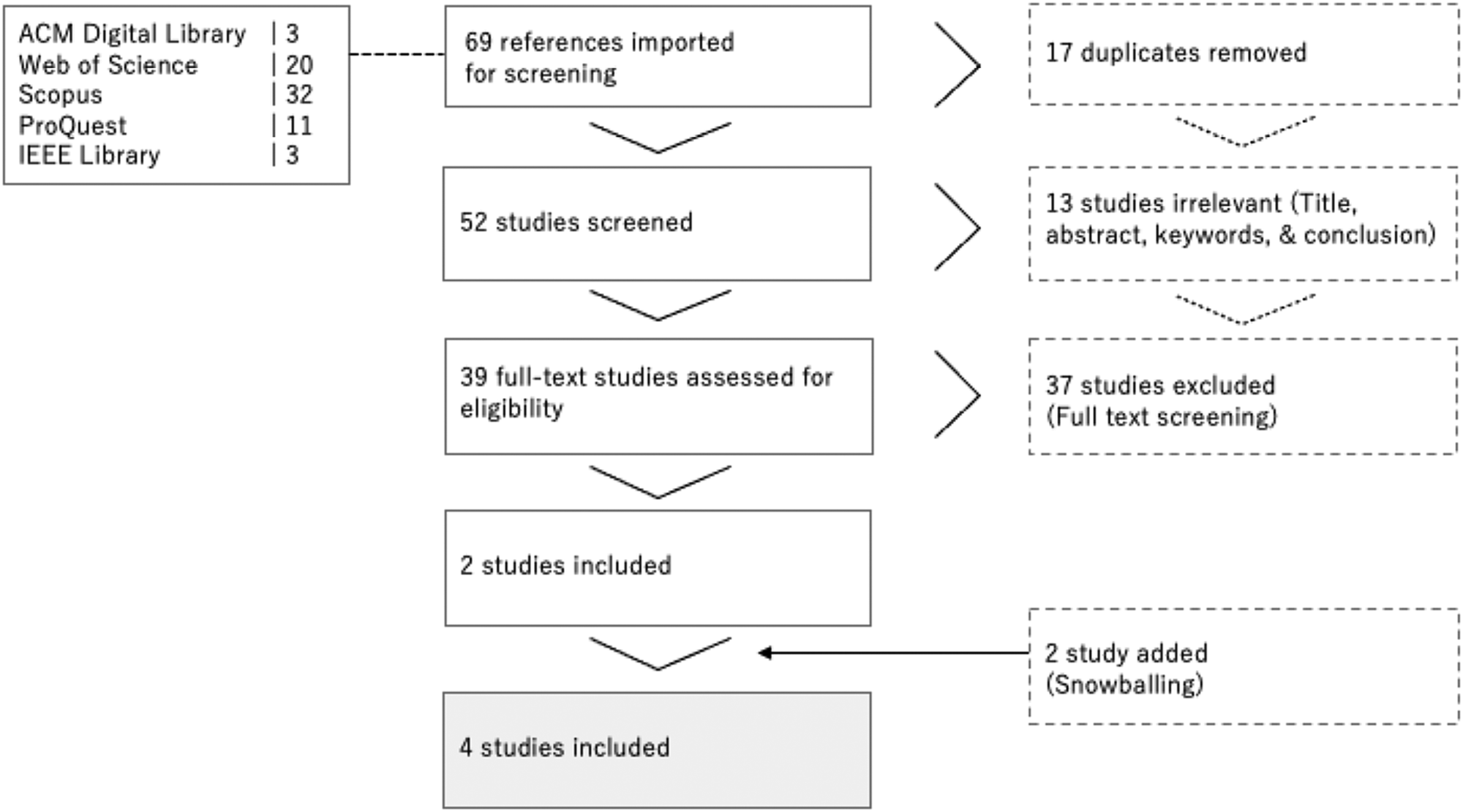
Keywords were searched for in the titles, abstracts, and indexed subject headings of articles. The initial electronic database search yielded a total of 69 published articles. Figure 1 shows a PRISMA chart that details how many studies were excluded at each stage of the review. After removing 17 duplicates, 52 were screened for eligibility, of which 39 met the inclusion criteria for the full-text review. Following the full-text review, two studies were included and using snowballing techniques, that is, a study of “references to references” (Wohlin, Reference Wohlin2014), and two articles were added which ended up to the total number of four articles in the review.
Result from the structured review and the selection process.
Our review of existing literature on NPD began with an initial selection of critical review papers on innovation and development processes (Saren, Reference Saren1984; Rothwell, Reference Rothwell1994; Howard et al., Reference Howard, Culley and Dekoninck2008; Durisin et al., Reference Durisin, Calabretta and Parmeggiani2010; Eveleens, Reference Eveleens2010; Matkovic and Tumbas, Reference Matkovic and Tumbas2010; Gericke and Blessing, Reference Gericke and Blessing2012; Papastathopoulou and Hultink, Reference Papastathopoulou and Hultink2012). A comprehensive understanding of the existing NPD models was then supported by a manual investigation of abstracts and articles published in the selected journals: Journal of Product Innovation Management, Research Technology Management, Strategic Management Journal, Journal of Service Marketing, and International Journal of Service Industry Management. These are the leading journals in NPD publications in innovation management, management, service marketing, and service research (Page and Schirr, Reference Page and Schirr2008; Papastathopoulou and Hultink, Reference Papastathopoulou and Hultink2012). In order to encompass NPD models in the software and design domains, the relevant journals covering SDLC and design processes were also selected, such as the Journal of Engineering Design and Journal of Software: Evolution and Process.
The review of articles in the selected journals led to an additional search for a deeper understanding of mainstream NPD models. Thus, an additional literature search was conducted using the specific model names including “waterfall,” “v-model,” “agile,” “lean,” “concurrent,” “spiral,” “stage-gate,” and “PSS.” Primarily based on the critical review papers on the existing NPD models and the systematic reviews on the emergent NPD processes, the selected 36 models were identified (Table 1).
List of the development processes across disciplines

To extend our review, literature on relevant fields was more broadly searched by using another set of terms, including “digital innovation,” “big data,” “data science process,” “affordance,” and “material properties.” Using the key words as a starting point, the authors applied the snowball methods approach to critically examine relevant literatures. We refined our search to include journals, conference articles, academic texts, books, and white papers through electronic databases such as ProQuest Business Premium, Springer Journals Archive, and Wiley Online Library Journals. In terms of quality and relevance, a set of 135 articles were selected for analysis. Selected papers were grouped into two fields: (a) current theories, frameworks, and models on NPD processes (n = 110) and (b) the state of the art in the literature of data science processes and key factors of IoT development (n = 25). The first set of articles are employed to differentiate and integrate current theories and models of NPD across disciplines, and the rest is used to frame key factors and generic data science processes related to IoT design. Each text was thoroughly reviewed to contextualize NPD processes in IoT by drawing from the fields it intersects with.
We organized the paper as follows. First, the authors critically examined the established literature on the development processes across disciplines, discussing the commonalities and differences between the different development approaches, and the generic phases of the development process. Second, we identify the key factors and the generic data science practices that affect the IoT development process. Third, we link the relevance of the existing NPD to the theories of data science and digital innovation and propose the conceptual IoT development process. Finally, in the conclusion, we summarize the insights and the contributions of this study, as well as its limitations.
Established NPD processes
Definitions of different development models
Product is perceived distinctively depending on the fields. For instance, a product is regarded as a bundle of utilities, including intangible attributes in marketing theory (Kotler, Reference Kotler2000; Kahn, Reference Kahn, Kay, Slotegraaf and Uban2005; International Organisation for Standardization, 2015). In software engineering, Meyer (Reference Meyer2001) proposed software as a product and a service. Sidi et al. (Reference Sidi, Panahy, Affendey, Jabar, Ibrahim and Mustapha2012) and Huang et al. (Reference Huang, He, Chi and Zhou2015) viewed data as a product, whereas Psomakelis et al. (Reference Psomakelis, Nikolakopoulos, Marinakis, Psychas, Moulos, Varvarigou and Christou2020) viewed data as a service. Whether they are a product or a service, in this paper, a product is defined as a broader concept, including physical and digital products/services/data regardless of their attributes.
Accordingly, the definitions of various development processes are compared and debated.
In innovation and product management theories, no single agreed definition of NPD exists. Krishan and Ulrich (Reference Krishnan and Ulrich2001) identify NPD as the transformation of a market opportunity and a set of assumptions about product technology into a product available for sale. Similarly, Ulrich and Eppinger (Reference Ulrich and Eppinger2011) define product development as a set of activities beginning with the perception of a market opportunity and ending in the production, sales, and delivery of a product. The definition of NPD by Bruce and Cooper (Reference Bruce and Cooper2001) is more inclusive, describing it to capture a range of disparate kinds of innovative activities leading to the production of a new service or product from radical innovations to simple modification and adaptations to existing products. NSD is defined as “the overall process of developing new service offerings” (Johnson et al., Reference Johnson, Menor, Roth, Chase, Fitzsimmmons and Fitzsimmons2000). This viewpoint is shared and extended by Edvardsson et al. (Reference Edvardsson, Johnson, Gustafsson and Strandvik2000) to the extent that embraces strategy, culture, and service policy deployment and implementation.
In software engineering, NPD is referred to as SDLC. Matkovic and Tumbas (Reference Matkovic and Tumbas2010) define SDLC as a process of creating and adapting software products, as well as a basis for creating methodologies and models in software engineering. Similarly, the Department of Defense in the USA (1988) perceives it as the software development process for managing the development of the deliverable software including major activities, but with a focus on concurrent, recursive, and iterative development activities. Ruparelia (Reference Ruparelia2010) identifies it as a conceptual framework or process that involves the development of an application from its initial feasibility study through to its deployment in the field and maintenance. This definition is distinguished from others by reflecting the recurring theme of software development within the process.
While examining definitions of New Product, Service, and Software Development, the commonality and difference of the definitions are identified. They are likely to be considered as a conceptual process encompassing required activities, but the extent of the activities seems to be different between the processes. Particularly, NPD and NSD are likely to involve the complete set of business activities from ideation to launch. Meanwhile, SDLC primarily focuses on software development activities from a technical perspective. Since IoT development is the hybrid of a physical product and software development, comprehending and comparing different terminology of different development processes enable us to revisit the definition of the development process of IoT. Subsequently, the next section explores current theories, frameworks, and models of development processes in order to identify the phases of the generic development process, and similarities and differences of different development approaches in relation to the IoT development.
Different approaches of NPD, NSD, SDLC, and integrated development
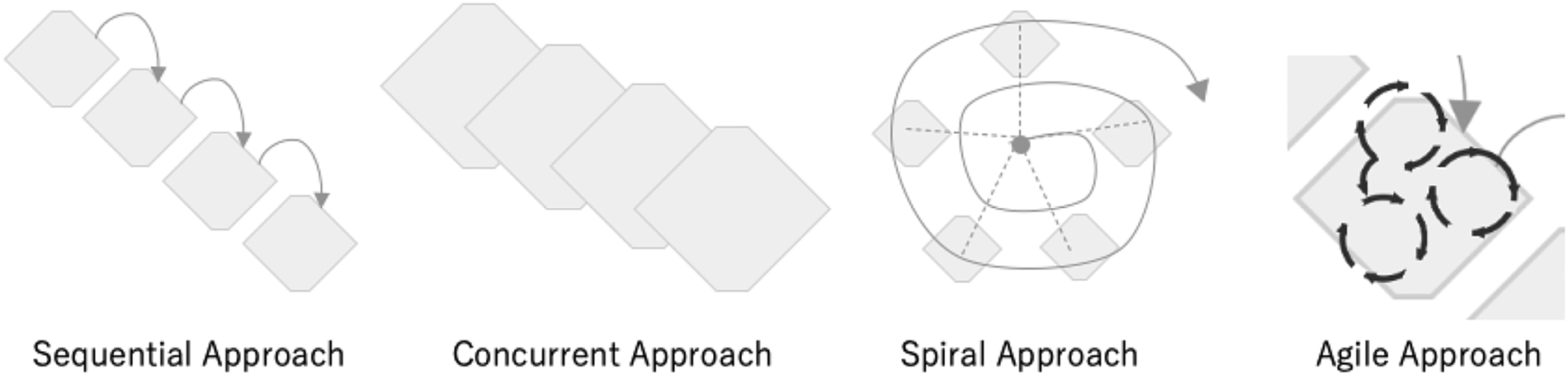
The waterfall model was highly influential (Boehm, Reference Boehm1995) until the traditional linear models were seriously being challenged in the 1980s (Berkhout et al., Reference Berkhout, Hartmann and Trott2010), and alternative approaches have emerged, including spiral, concurrent, and agile approaches (Fig. 2). Established NPD approaches are continuously evolving, supported by emergent trends of the increasing significance of NPD activities. The key attributes of different approaches are discussed in order to comprehend the emergent trend of NPD and value creation.
Different approaches of development processes.
Sequential approach
Among the various types of product development models, the sequential approach is the most commonly used and conventional often referred to as “BAH model (Booz et al., Reference Booz, Allen and Hamilton1982),” “a stage-gate system (Cooper, Reference Cooper1990),” “over the wall process (Walsh et al., Reference Walsh, Roy, Bruce and Potter1992; Trott, Reference Trott2012),” “program production process (Benington, Reference Benington1956),” “the waterfall process (Royce, Reference Royce1970),” “the V-shape life cycle (Forsberg and Mooz, Reference Forsberg and Mooz1991),” and “the service design and management model (Ramaswamy, Reference Ramaswamy1996).” The attributes of the traditional sequential models are (a) the linear continuation of the process to the next stage is resolved by a review and approval in order to minimize investment risks and (b) fully developed requirement documents work as completion criteria for early phases. Accordingly, the sequential approaches are regarded as a lengthy process, high costs, difficulty in adaptation to uncertainty, inflexibility between phases, and inability to react to changes.
Concurrent approach
The concurrent approach stems from several factors observed in industries such as faster innovation, increasing inter-company networking, and the appearance of new technologies (Rothwell, Reference Rothwell1993). “Parallel processing models (Takeuchi and Nonaka, Reference Takeuchi and Nonaka1986),” “Concurrent Engineering (Pennell et al., Reference Pennell, Winner, Bertrand and Slusarszuk1989),” “Activity-stage models (Crawford, Reference Crawford1997),” “Sashimi model (Mcconnel, Reference Mcconnel1996),” “Unger and Eppinger's spiral model (Reference Unger and Eppinger2009),” and “NSD model (Johnson et al., Reference Johnson, Menor, Roth, Chase, Fitzsimmmons and Fitzsimmons2000)” are categorized in this approach. With the emphasis on the iterative feedback loops and overlaps of the phases, it is enabled to increase the speed of the development process, and the flexibility to react to changes or errors. More importantly, new philosophies of design are emerging to respond to the flow of new information on customer needs and preferences, allowing offerings to be more tailored, adaptable, and desirable to the market. In the marketing and innovation theories, the emerging trends of having new strategic partners (international joint ventures) and establishing comprehensive networks are explained with the value constellation model (Normann and Ramírez, Reference Normann and Ramírez1994), open innovation (Chesbrough, Reference Chesbrough2004), and co-creation with the customer (Royce, Reference Royce1970).
Spiral approach
The representative spiral approaches include “Boehm's spiral life-cycle model (Boehm, Reference Boehm1986),” “Microsoft Solutions Framework (Microsoft Team, 2003),” and “Unger and Eppinger's Spiral model (Reference Unger and Eppinger2009).” The key aspects of these approaches are that (a) risks should be assessed and monitored at each milestone and (b) complex communication and workflow are enabled. With strong approval, control, and flexibility in the process, the approach enhances the opportunities for avoiding development risks. However, the development process potentially becomes increasingly costly, as this approach requires a highly specific risk analysis to be undertaken.
Agile approach
Stability and predictability have long been highlighted as the core elements of successful development within the traditional NPD process. However, irrespective of the development subject, the shift to more rapid and lightweight processes becomes a dominant trend and consistent theme over time that is called the agile approach. Specifically, in software development, due to the fact that the continuous changes in system requirements occur over and during the process, this approach becomes popular. Overlaid on a traditional NPD process, they encompass the Agile development method (Martin, Reference Martin2002), Lean Development (Poppendieck and Poppendieck, Reference Poppendieck and Poppendieck2003), and the Scrum software development process (Schwaber and Beedle, Reference Schwaber and Beedle2002). These approaches (a) emphasize the small incremental releases for ongoing changes to the product/system specification and (b) de-emphasize on documentation and a formalized process-driven step. Although these approaches lack formal management, they enhance close communication and coordination activities, speed to market, and faster responses to changing customer requirements.
Integrated development approach
In an era of service-dominant logic (Vargo and Lusch, Reference Vargo and Lusch2004a), the classical distinction between products and services is challenged (Lovelock and Gummesson, Reference Lovelock and Gummesson2004; Vargo and Lusch, Reference Vargo and Lusch2004b), and the boundary of digital and physical products are blurred. Consequently, the development approach for integrated offerings of product, software, and service has been an interesting subject among researchers. PSS methodologies, one of the widely recognized integrated development approaches, are proposed by Aurich et al. (Reference Aurich, Fuchs and Wagenknecht2006) and Maussang et al. (Reference Maussang, Zwolinski and Brissaud2009), illustrating the systematic development of integrated product and service design. However, PSS methodologies are criticized as insufficient to describe the development details (Komoto and Tomiyama, Reference Komoto and Tomiyama2009; Vasantha et al., Reference Vasantha, Roy, Lelah and Brissaud2012) and not reflecting an entire life-cycle perspective (Mont, Reference Mont2000; Welp et al., Reference Welp, Meier, Sadek and Sadek2008).
Although Jacobs and Cooper's new approach to IoT development (Reference Jacobs and Cooper2018) and the eight-shaped model (Janne and Bogers, Reference Janne and Bogers2019) depict a continuous and never-ending IoT design process which reflects one of the main attributes of IoT development, they are limited in not integrating the whole NPD process nor fully reflecting the attributes of IoT design. The digitally-driven NPD model proposed by Yerpude and Rautela (Reference Yerpude and Rautela2020) depicts the co-creation perspective of IoT NPD but it is not activity-based NPD model. The big data analysis model for market analysis (Yu and Yang, Reference Yu and Yang2016) integrates big data analysis activities into the NPD process but does not illustrate the continuous feedback cycles.
Relevant differences between the approaches
Having compared the attributes of the different approaches, the relevant differences are thus identified: flexibility, a cross-functional approach, meaningful customer involvement, and rapid and lightweight processes. For example, the NPD processes with the agile approach are more lightweight than those adopting a waterfall approach. The Spiral approach combines the iterative characteristics with the waterfall model, in essence, allowing more flexibility and customer interactions. Although aspects of the models are distinctive, they are composed of a series of phases that must be followed and completed (Alshamrani and Bahattab, Reference Alshamrani and Bahattab2015). In the next section, the phases of different models are reviewed to identify the generic phases.
Generic phases of NPD processes
Over several decades, more than 600 diverse NPD models including all the variations of models have been developed by researchers with the aim of improving established NPD practices (Nijssen and Lieshout, Reference Nijssen and Lieshout1995; Best, Reference Best2006). Several different development processes for physical products and engineering have been dominant within manufacturing economies, and then they started to be modified and developed specifically for service and software development. Through comprehensive interrogation of existing and emerging development processes for hardware, service, software, and combination of product and software (Table 2), the generic phases of the NPD process for this study are identified.
Phases, stages, or main activities of the NPD, NSD, SDLC, and PSS processes
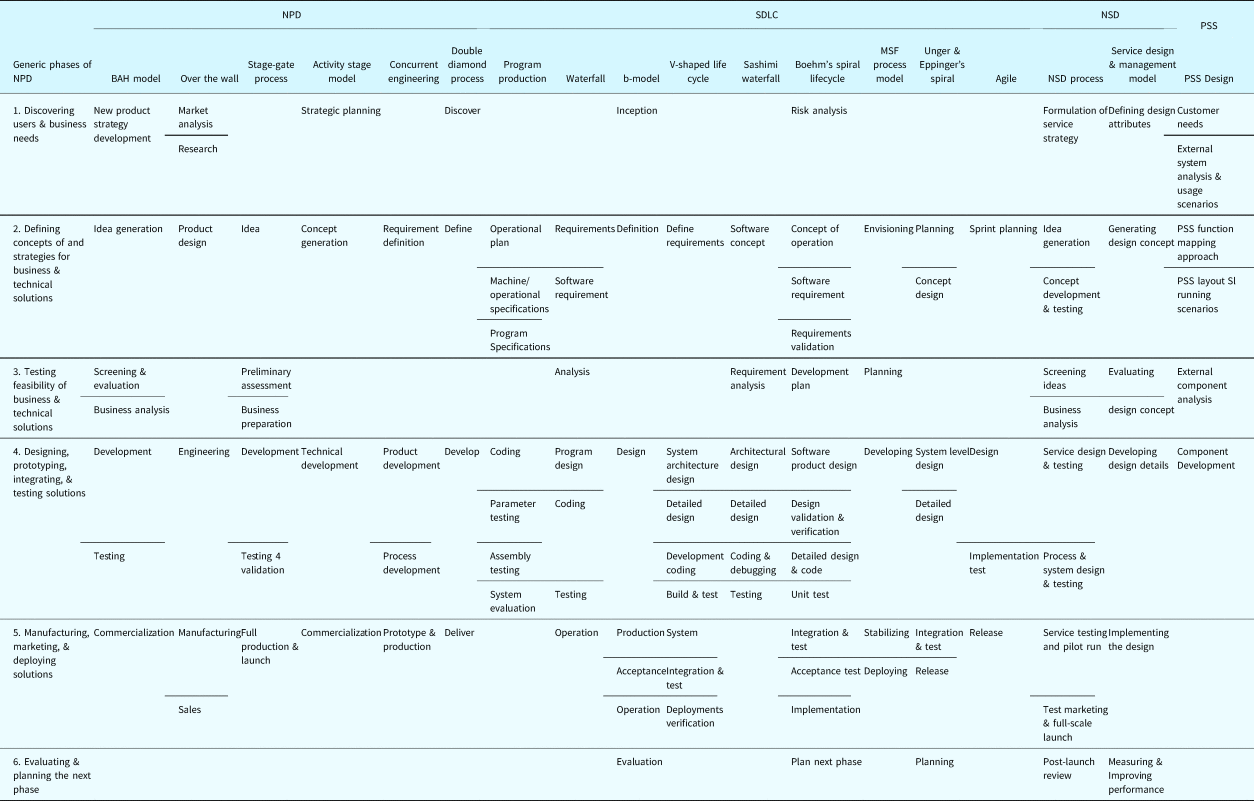
Interrogating the phases and activities of different processes, the generic phases of the development process are identified, which consists of six distinct phases. The brackets in each phase describe detailed activities of a physical product, service, and software development.
(1) Discovering users and business needs (Market research and analysis).
(2) Defining concepts of and strategies for business and technical solutions (System and Software requirements, Business model, and Concepts of software, product, and service).
(3) Testing feasibility of business and technical solutions (System and business analysis, Screening, and Evaluating the solution ideas).
(4) Designing, Prototyping, Integrating, and Testing solutions (Developing prototyping, Integrating and Testing plan, Coding, Debugging, and Casting),
(5) Manufacturing, Marketing, and Deploying solutions (Process development, Resetting organization, and Modifying product design for mass production).
(6) Maintaining, Evaluating, and Planning the next phase (Maintaining and customer support).
The generic phases of the development process are intended to cover the entire set of business activities from the transformation of market needs into a set of offerings to create organizational value, which is coherent with definitions of NPD and NSD. The last phase of the process, “Evaluating and planning the next phase,” is additionally included reflecting the recurring theme of NSD and SDLC, since the term “products” in this research is not restricted to physical products but comprehensive of software, service, and data or the combination of all. This not only broadens the extent of the NPD process for IoT but also considers significant design aspects of the combination of physical and nonphysical products. The six generic phases will be used as a foundation for developing our conceptual IoT design process.
Commonalities and differences between development processes
Balancing between flexible iterations and structured review is one of the significant commonalities between development processes. Although all of the NPD, NSD, SDLC, and integrated development processes have managerial control and allow flexibility, the manner of reviews and iterations varies. Another determined commonality identified is that whether it is physical products, software, service, or integrated development processes, the initial stage of the process is characterized as fuzzy. These stages are often called the fuzzy front end (FFE) of an innovation process (Smith and Reinertsen, Reference Smith and Reinertsen1992) in which the corporations decide to build on an idea or not. Generally, including idea generation, opportunity validation, and concept development (Dewulf, Reference Dewulf2013), FFE is widely recognized as critical, providing the foundations on which the overall development project is built (Stevens and Burley, Reference Stevens and Burley2003). Even though the SDLC is likely to cover technical aspects of activities, it still has fuzziness in the early stage of the processes, involving defining software requirements and software concepts. Accordingly, growing scholarly works indicate that the FFE shall be proactively managed and optimized to encourage successful innovations (Khurana and Rosenthal, Reference Khurana and Rosenthal1997; Reinertsen, Reference Reinertsen1999; Kim and Wilemon, Reference Kim and Wilemon2002).
Contrary to the commonality identified in the front end of the process, one of the differences between the processes is identified in the back end of the development. The NPD processes tend to have a beginning and an end of product development, as their final phases are commercialization, sales, or delivering the products. Meanwhile, the final phases of SDLC and NSD processes are evaluation, post-launch review, and planning next, which imply the continuous following loop of the next development process. A recurring theme of NSD and SDLC is attributed to the simultaneous provision and consumption of software and services, unlike traditional tangible products. This distinction stems from the characteristics of service, namely their intangibility, inseparability, heterogeneity, and perishability (Zeithaml et al., Reference Zeithaml, Parasuraman and Berry1985), and the characteristics of software, the ability to constantly being revised and improved while being provided to customers.
The different characteristics of physical products, software, and service have a significant influence on each development process, and they have been subject to the research of diverse scholars. Griffin (Reference Griffin1997) argued that NSD and SDLC processes tend to be less formal than NPD processes. A conventional linear process is originated from designing physical artifacts underlining the hierarchy of design in which requirements of physical components are gradually broken down (Royce, Reference Royce1970; Boehm, Reference Boehm1976). Thus, development risks over the NPD processes are managed and controlled through the decomposition of requirements. However, without physical constraints, software as a reusable unit of business-complete work (Papazoglou et al., Reference Papazoglou, Van Den Heuvel, Papazoglou and Van Den Heuvel2007) can easily be reassembled to deliver new features and user value. In this respect, development risks are controlled by agility with sense-and-respond capability over the software development process (Svahn et al., Reference Svahn, Henfridsson, Yoo and Threesome Dance2009). Due to the different emphasis on the development between hardware and software, in information systems literature, Svahn et al. (Reference Svahn, Henfridsson, Yoo and Threesome Dance2009) argued that there are tensions over the development process of networked artifacts.
Scholarly work on the existing development process adequately addresses valuable insights related to the IoT development process, including (a) the generic phases of NPD processes; (b) various attributes of different development approaches; and (c) commonalities and differences of tangible products, services, software, and integrated development processes. However, it has been identified that only a few existing processes “partially” reflect vital characteristics of networked products or integrate data science within the development model. As the data science process and the factors that influence IoT development are the key attributes of the IoT design process, the attention of this discussion focuses upon literature on the factors that affect the IoT development process.
Factors to be considered for IoT design
Different factors that affect IoT development
As the development process is affected by the attributes of the subject, it is required how a digitalized artifact differs from traditional products, which have a fixed, discrete set of boundaries and features. Researchers in information systems (Yoo et al., Reference Yoo, Lyytinen, Boland and Berente2010b, Reference Yoo, Boland, Lyytinen and Majchrzak2012; McAfee and Brynjolfsson, Reference McAfee and Brynjolfsson2012; Henfridsson et al., Reference Henfridsson, Mathiassen and Svahn2014; Johnson et al., Reference Johnson, Friend and Lee2017) identified several factors that differentiate NPD processes of the 20th century from its counterpart within the digital economy (Table 3).
Factors affect the NPD process for IoT

The material properties of digitalized artefacts can be matched to each layer of IoT architecture, as shown in Figure 2. Sense-ability, Memorability, and Traceability of digitalized artifacts linked to the layer of device hardware are closely related to Homogenization of data and the dimensions of big data. Embedded software leads to the Programmability of smart products interrelated to reprogrammability, digital materiality, and the prevalence of combinatorial innovation. Addressability, Communicability, and associability are enabled by the layer of communications and processing, which would then make IoT development more heterogeneous with the significance of the digital platform. There are no material properties matched to the application layer, as it is more about delivering value to the users. As illustrated in Figure 3, these material properties provide new ways of IoT development that can be explained with critical factors, including the dimensions of big data, the characteristics of digital technologies, the six dimensions of digital innovation, and the traits of innovations associated with pervasive digital technology.
Mapping the interconnectivities between the IoT architecture layers, material properties of digitalized artifacts, and three key factor groups of networked artifacts.
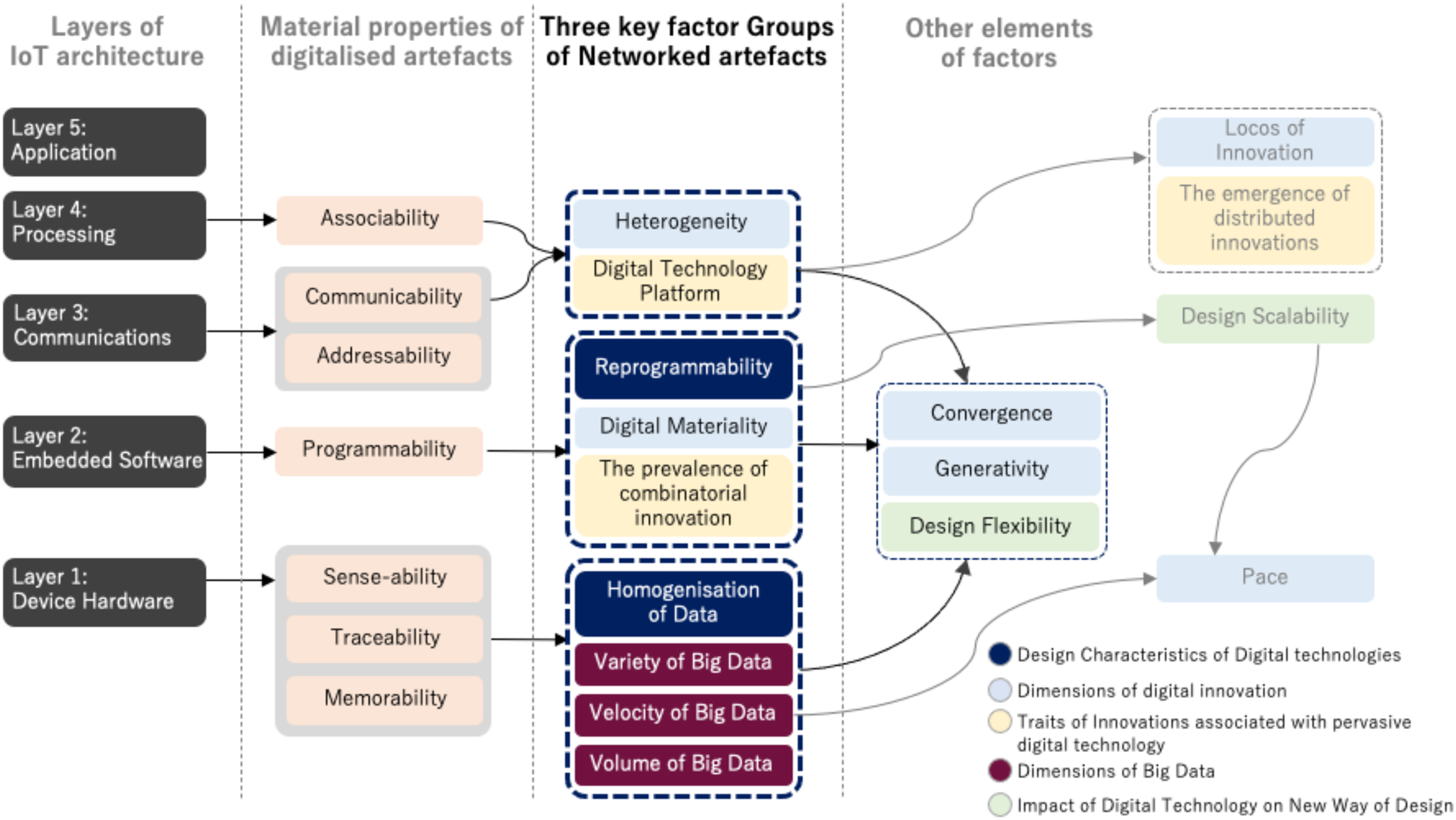
Among the different factors, Yoo et al. (Reference Yoo, Lyytinen, Boland and Berente2010b) identified data homogenization and reprogrammability as the fundamental and unique design characteristics of digital technology. The homogenization of data means that a discrete representation of data in bits of 0 and 1 enables the homogenization of all data accessible by digital devices, whereas analogue data has a tight coupling between data and special devices (e.g., pictures and camera) (Yoo et al., Reference Yoo, Henfridsson and Lyytinen2010a). Data homogenization empowers all different types of digital data collected from different sources that can be efficiently combined with other digital data (Yoo et al., Reference Yoo, Henfridsson and Lyytinen2010a). With the homogenization of data, the dimensions of big data, volume, velocity, and variety (McAfee and Brynjolfsson, Reference McAfee and Brynjolfsson2012; Johnson et al., Reference Johnson, Friend and Lee2017) enables to create a diverse variety of services and dissolves product and industry boundaries.
Another critical aspect of a networked artefact is reprogrammability. In the digital realm, features of a product become malleable and flexible with digital materiality which is “what the software incorporated into an artefact can do by manipulating digital representations" (Yoo et al., Reference Yoo, Boland, Lyytinen and Majchrzak2012). The affordances of pervasive digital technology lead to the convergence of multiple affordances with a single smart device (Yoo et al., Reference Yoo, Boland, Lyytinen and Majchrzak2012). Due to reprogrammability, the development of digital artifacts has the aspects of generativity which empowers the continual reinterpretations, expansions, and refinements of products, contents, services, or processes (Yoo et al., Reference Yoo, Lyytinen, Boland and Berente2010b). The convergence of media and products increases the competition among heterogeneous markets and industries. The network and communication capabilities of IoT products are also a key attribute in IoT development. It results in IoT design not only Heterogeneous in which diverse forms of data, information, knowledge, and tools are integrated (Yoo et al., Reference Yoo, Lyytinen, Boland and Berente2010b), but also a platform-centered (Yoo et al., Reference Yoo, Boland, Lyytinen and Majchrzak2012). Moreover, the heterogeneity of digitalized artifacts increasingly distributes the development activities, moving toward the periphery of organizations.
Along with the complex architecture and material properties of IoT, the unique properties and traits of digital technology and big data enable a new approach of design and development that are evidently distinctive from the development processes in the mid to late 20th century. The different elements of factors are independent and interdependent under the umbrella of IoT design. However, with a focus on IoT as networked artifacts, we identified three fundamental attributes of designing networked artifacts: 3Vs of big data, reprogrammability, and heterogeneity. These three key attributes will be revisited for discussing the conceptual IoT design process. In the next section, data science processes, which is another significant factor to be considered and reflected within the IoT NPD process, will be further discussed.
Data science processes and practices
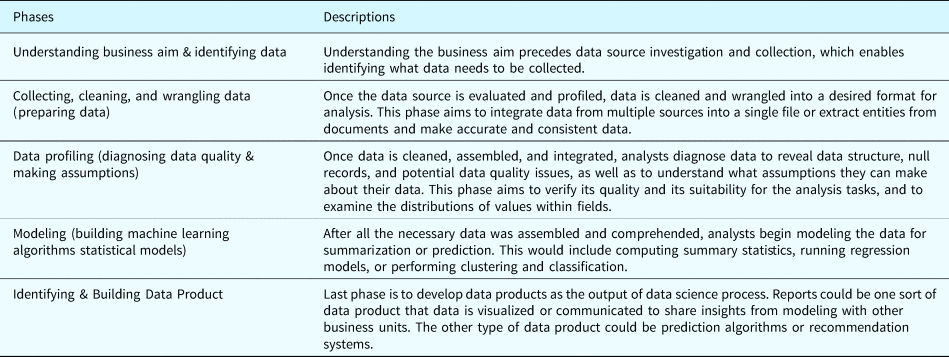
Several recent studies have explored how modern data, often live, large, complicated, and/or messy, is analyzed. There are several different processes identified concerning different emphasis on the process, for example, exploratory approach or holistic approach. The study of Kandel et al. (Reference Kandel, Paepcke, Hellerstein and Heer2012) identified the data analysis process based on the interview of enterprise analysts in the context of the larger organization. The study focused on the comprehensive data science process containing five major phases: Discover data; Wrangle data; Profile data; Model data; and Report procedures and insights. Furthermore, based on Kandel et al.'s five phases of process, Alspaugh et al. (Reference Alspaugh, Zokaei, Liu, Jin and Hearst2018) devised a data science process that emphasizes the exploratory aspects of the data practice, which encompasses an additional phase, EXPLORE. The data science process proposed by O'Neil and Schutt (Reference O'Neil, Schutt, Loukides and Nash2013) and Baumer (Reference Baumer2015) aims to teach data science to students. O'Neil and Schutt (Reference O'Neil, Schutt, Loukides and Nash2013) defined and developed the data science process which includes the phase of Exploratory Data Analysis. Baumer (Reference Baumer2015) presents a holistic approach to teaching data science processes, from framing a question to obtaining an answer through a variety of data practices. The pivot of the process is to form questions through data acquisition, processing, and exploring computational methods to discover answers in the form of inferences and presentations.
Even though each of the processes presents slightly different phases, similar to design and development processes, different data science processes share resembling phases of the process, which are further described in Table 4. Despite the appearance of their linear processes, they are described as a nonlinear and iterative process (Kandel et al., Reference Kandel, Paepcke, Hellerstein and Heer2012; Sands, Reference Sands2018). In the next section, the theories, frameworks, and models are examined and analyzed, which will be used to establish the conceptual model of IoT design processes.
Generic phases of data science process
Conceptual model of IoT design processes
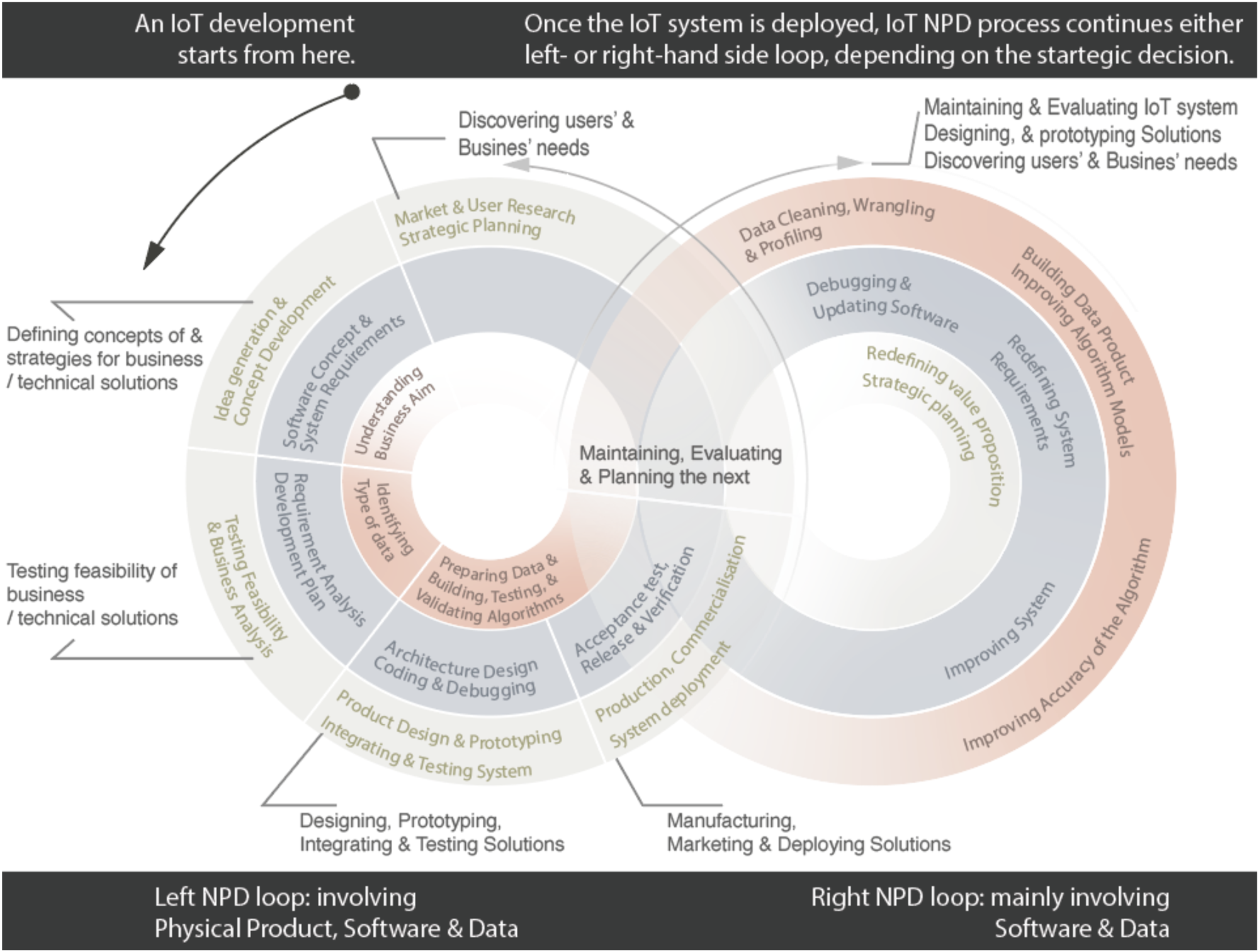
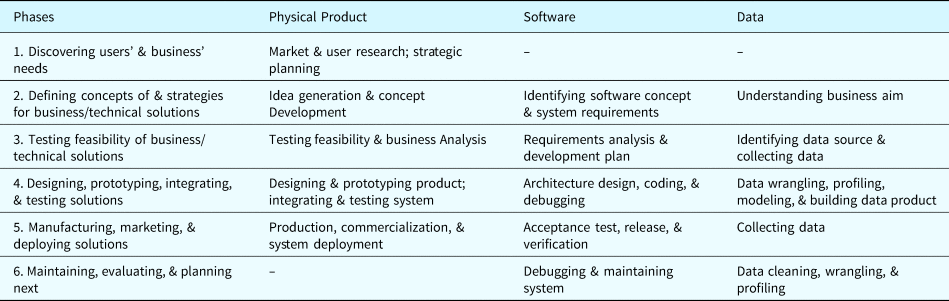
Our conceptual IoT design process consists of three layers of eight-shaped cycles (Fig. 4). Each layer represents physical product development, software development, and data practice process. Although the development activities for data represent the generic data science process identified through literature, the tasks can be done selectively depending on the smartness of IoT device, for example, monitoring, control, optimization, and autonomy (Porter and Heppelmann, Reference Porter and Heppelmann2014). We named this novel approach as the Mobius strip model of IoT development, as it implies an infinite loop. The IoT development process begins from the top of the left-hand cycle, consisting of six generic phases of NPD, which are identified through a literature review. IoT development involves three different types of subject matter; each phase has specific development activities depending on a physical product, software, and data (Table 5). Once the physical products and software are developed and deployed through the first cycle on the left hand, the process enters into the Maintaining, Evaluating, and Planning next phase.
Mobius strip model of IoT development processes.
Development activities for physical product, software, and data in the first cycle IoT development
At this point, the organization needs to devise a strategic decision to maintain and improve the existing value proposition or expand its value constellation, connecting new smart products to its system. If the organization decides to deliver a new service through more interconnected devices, they may revert to the left-hand cycle while analyzing data and maintaining new software. If they adopt the former strategy, they may enter the right NPD loop. Over this loop, the main NPD activities are related to software development and data process. The new users’ and business needs identified in the right loop could trigger a new IoT development process and start other left-hand loops whilemaintaining the existing system.
The first phase of the first development cycle is “Discovering Users’ & Business’ needs” in which an organization conducts market & user research as well as strategic planning. The development activities for software and data are likely to be technically orientated that involves the second phase “defining concepts of & strategies for business/technical solutions.” Once the concept and system requirements are identified, the organization tests feasibility of the business and technical solutions in which the data science process begins in earnest, identifying data source. The fourth phase “Designing, Prototyping, Integrating, & Testing Solutions’ is the most condensed, incorporating many design activities and development risks. As one of the risks, Svahn et al. (Reference Svahn, Henfridsson, Yoo and Threesome Dance2009) argued that different speeds and approaches of physical products and software development might occur tensions. On top of that, even greater tensions would be generated between data process, physical, and digital development if the IoT system encompasses AI elements. Because building annotated data sets and testing the algorithm are tedious, time-consuming (Kandel et al., Reference Kandel, Paepcke, Hellerstein and Heer2012; Deutsch, Reference Deutsch2015), and costly, adding more complexity to the IoT design process. Alternatively, if a company decides to use annotated data sets, their design process would be simpler, but they might be challenged to differentiate their business from that of the competitors.
Developing physical and digital products challenges the designer with a continual pressure of never being able to finish design and integrate system due to reprogrammability (Yoo et al., Reference Yoo, Henfridsson and Lyytinen2010a) and the pace of digital innovation (Yoo et al., Reference Yoo, Lyytinen, Boland and Berente2010b). Once the IoT system is manufactured and deployed, data starts to be collected and an organization enters the phase of “maintaining, evaluating, and planning next” in which the existing IoT system is monitored and maintained. Shifting from the left cycle to the right cycle is where the critical distinction between our conceptual design process and existing development processes is stressed. Over the right-hand side development, the organization endeavors to redefine the value proposition of IoT offerings based on real-time data on customers’ experience. The redefined value could be provided through having new features released, connecting other IoT devices and services to the existing IoT system (Yoo et al., Reference Yoo, Boland, Lyytinen and Majchrzak2012), or providing data to manage the customer relationship. While supporting customers and maintaining up-to-date software, if novel users and business needs can be met with new IoT development, it triggers the other left NPD loops. This point within the design process is where the true value of the IoT is thoroughly realized having more things connected and communicated with each other seamlessly (Lee et al., Reference Lee, Cooper, Hands and Coulton2019b). In this way, the IoT development process is continually re-designing IoT products and services in an iterative way.
Our conceptual IoT NPD process with two infinite loops is different from existing processes, as the two cycles need a distinctive strategy and approach to development and value creation. This is primarily caused by key considerations within each cycle. The left-hand side development loop heavily involves physical product development, whereas the right-hand side development loop mainly focuses on data process and software development. Consequently, the left loop is more influenced by physical product development, which requires more robust approval and control. In contrast, the development activities on the right-hand side are more flexible and faster, affected by software development and data analysis. Having stress on software and data practice results in the phase of manufacturing being omitted in the development cycle on the right-hand side. The separation between the phases of the left cycle represents stricter review gates, while over the cycle on the right-hand side occurred concurrently and more flexibly alongside IoT system consumption.
Unlike existing development processes that include FFE with the stages of idea generation, opportunity validation, and concept development, we argue that the fuzziness is no longer the characteristics of the initial stage but of the whole process. It is supported by the theories of the reprogrammability of the IoT system and big data. Once an IoT device is deployed, data is continuously collected and analyzed, which enables organizations to generate business opportunities and develop new product and service concepts. Due to a little time constraint in software development, ideas can be effectively and efficiently generated, and the speed of development is faster than the cycle on the left-hand side of the process. Each development cycle requires the organization to take a different business strategy and model. When involving physical product development, the organization's business model may be close to the manufacturer. However, once the IoT system is launched and implemented, the organization becomes more of a service provider maintaining, refining current offerings, and delivering new services.
Although the Mobius strip model of IoT development is conceptual in nature, the proposed model is based on bridging existing theories and linking works across disciplines, the constructs behind the conceptual model are drawn from the case studies of the IoT development. It is beyond the scope of this paper to discuss the case studies in detail. However, the individual IoT NPD processes can be found in the publications (Lee et al., Reference Lee, Cooper, Hands and Coulton2020, Reference Lee, Cooper, Hands and Coulton2019a), which discuss how our case studies are related to conceptualizing the Mobius strip model.
Conclusions
As novel and challenging as today's IoT is, IoT offers fertile opportunities for organizations’ long-term sustainable growth. Given its nascent status, there is still a lack of scholarly works on the development process of IoT products and services, which is arguably one of the most critical marketing planning and implementation process activities. In exploring this theme, the paper draws an extensive review of current theories, frameworks, and models connected to the research study area, critically interrogating extant accounts of NPD processes (in its broadest sense). Through contextualizing established literature, this paper provides attention to the core research questions at large: (1) What are the commonalities and differences between the development process for a physical product, software, service, and integrated product? (2) How do the factors and data science processes affect the IoT development process? (3) What is the conceptual process for IoT development?
Through the descriptive analysis, the paper identified: generic phases of the development process for an IoT design process; that process balance between strict reviews, controls, flexibility, and iteration; the FFE of an innovation process; a different backend between the development processes; and a distinctive development approach depending on the subject matter. Reflecting on the unique characteristics of IoT products, alongside insights from existing NPD and data science processes, the Mobius strip model of the IoT development process is proposed which has three layers of eight-shaped loops. Each cycle of the model needs different development approaches and strategies and enables the scope, feature, and value proposition of IoT systems to unceasingly evolve even after being launched and while in use.
Although this study has explored the fields that intersect with the design process for IoT, there are a couple of limitations that could be addressed in future studies. Given that there is no established body of literature for IoT design, our conceptual process is only based on related literature, and the model needs to be tested in the field to validate it. Moreover, a little reflection of the data-enabled design approach toward the Mobius strip model suggests that further work on the use of IoT data and the nuances of using data within the NPD, specifically within the design process, is necessary to ensure the validity of the model. Notwithstanding these limitations, however, the authors argue that the finding has some crucial contributions to ground our knowledge of the IoT NPD process. This research will enable industry practitioners to understand better, how the IoT system should be developed through a conceptual NPD process. For academics, this paper contributes to augmenting the body of literature regarding emergent innovation processes for IoT and serves as a starting point for future in-depth research on IoT NPD processes.
Acknowledgements
The research presented in this paper has been possible through the PETRAS IoT Hub, funded by the UK Engineering and Physical Sciences Research Council (EPSRC), and the Research and Development Management Association (RADMA) Doctoral Funding.
Boyeun Lee is a fifth-year PETRAS PhD candidate as well as a Post-Doctoral Research Associate in Prosperity at Imagination, Lancaster University. With a wide range of public and commercial experience across sectors as a service design researcher, her core research interests focus on IoT design process, data-enabled design, and design strategies in developing emerging technologies.
Professor Rachel Cooper is a Distinguished Professor of Design Management and Policy at Lancaster University. Her research interests cover design thinking; design management; design policy; and across all sectors of industry, a specific interest in design for well-being and socially responsible design.
Dr. David Hands is an Associate Director of Teaching, Imagination, Lancaster University. David has also written and published extensively on design management and design as a strategic resource for both profit and non-profit organizations alike.
Professor Paul Coulton is the Chair of Speculative and Game Design in the open and exploratory design-led research studio Imagination Lancaster. He uses research through a design approach to create fictional representations of future worlds in which emerging technologies have become mundane.


 Open access

