Introduction: Conversion and Literary Genesis
Christianization is the spark that set Georgian literature alight.
When King Mirian embraced the Christian God, he and his noble allies ignited the public conversion of a polity born at the collapse of the once-mighty Achaemenid Empire. Clustered in the vicinity of the Kura (Mtkvari) River, the inhabitants of eastern Georgia were not alone. Across southern tier of the isthmus named for the Caucasus Mountains, polytheistic religions of the Georgians, Armenians, and Caucasian AlbaniansFootnote 1 gave way to Christianity in the fourth century. Christianity also made inroads among the highland communities of northern Caucasia, though its penetration was irregular and spread across a millennium.Footnote 2
Later generations of Christian Georgians looked back upon Mirian’s baptism with a sense of wonder and determination. In the anxiety-laden transition from late antiquityFootnote 3 to the medieval age, Georgians fortified themselves with culturally centered stories of divine intervention, protection, and purpose; of rapid and decisive conversion following the king’s baptism; of the equally swift and total annihilation of a tightly structured “paganism”; and of close religious ties to Jerusalem and the Christianizing Roman Empire. Christian Armenians and Albanians created their own such tales.
But an interrogation of available sources across cultural and linguistic traditions reveals these images to be insulated and distorted. As received, Caucasia’s conversion stories compress the long-term process of Christianization into culturally focused moments that were sudden, triumphant, and revolutionary. While the transformation of belief, ritual, and religious organization had been considerable, what had come before was not instantly and completely swept away. What’s more, Christianization was a pan-regional phenomenon, not a tidy patchwork of culturally and politically circumscribed conversions. This isthmus-spanning Christianization was enmeshed in the Iranic world,Footnote 4 a polycentric cross-cultural venture stretching from Central Asia to Anatolia inhabited by Persians, Parthians, and other Iranic peoples including Georgians, Armenians, and Caucasian Albanians. Eurasia’s wider Iranic society adapted to, and thrived across, two seismic monotheistic transformations rooted in late antiquity: Christianity and Islam, whose long Iranic phase is called Persianate.
Contra to the notion of civilizations whose imperial cores unilaterally thrust their cultural wares upon “backward” neighbors, the Iranic enterprise is characterized by the agency and adaptability of its diverse peoples. While the Iranic world aggregated around an imperial nucleus, as is typical of such ventures, Iran’sFootnote 5 influence over the Iranic cross-cultural matrix varied significantly – as did the agency of its inhabitants. Some Iranic cultural traits were fundamentally local; some developed in parallel with Persia/Parthia and each other; and some were adaptations and, less commonly, direct borrowings or imperial impositions.
These qualities commingled, as exhibited by the polytheisms practiced by Caucasia’s elites. Encompassing a mixture of local and regional spiritual traditions, these polytheisms revolved around staple Zoroastrian ideas but were not mere imitations of Iran’s Zoroastrianisms.Footnote 6 Caucasia’s “paganisms” – a Christian pejorative often masking the region’s syncretic Zoroastrianisms – had not been immediately and forever extinguished with the royal conversions of the fourth century. Strands of these faiths survived for centuries, especially in the overlapping spheres of social structure and political culture. Broadly, the prevailing Iranic social fabric remained in place but evolved in fresh directions (see Figure 1). Caucasia’s Christianization was less a revolution than the long-term adaptation of a monotheistic faith to an enduring Iranic society stretching from the Caspian to the Black Seas. Meanwhile, this metamorphosis brought new opportunities, including the honing of collective identities around the twin pillars of church and king as well as the prospect of closer relations with the coreligionist Roman Empire.Footnote 7
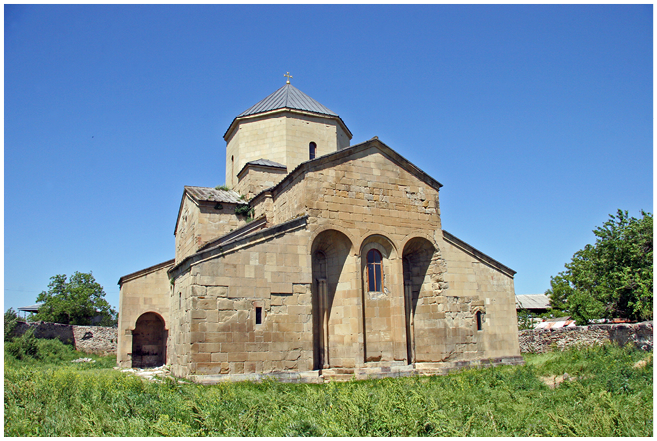
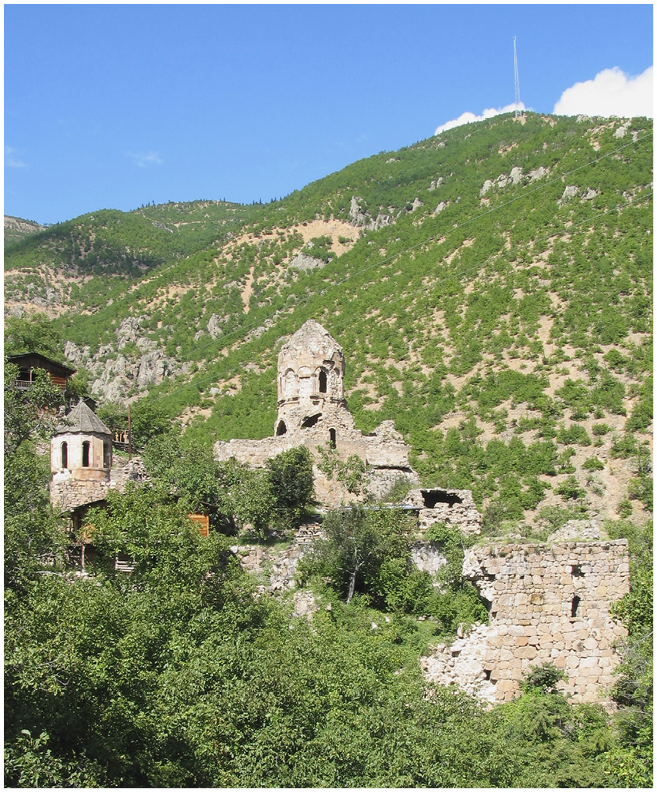
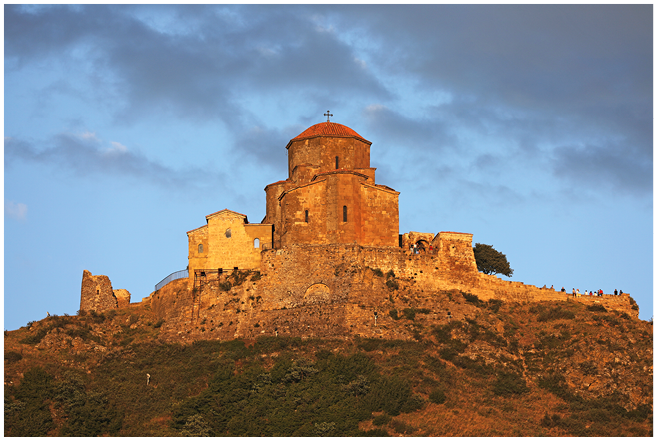
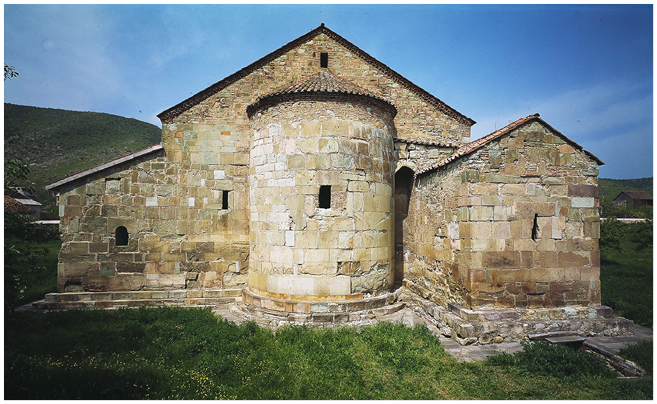
The synthesis of Iranic culture and Christianity is evident in Caucasia’s early churches, including this seventh-century edifice at Tsromi.
Kingship is a conspicuous index of the Iranic framework of Caucasia’s Christianization. As conversion became a public matter,Footnote 8 Armenia, Albania, and Georgia were helmed by hereditary autocrats having Parthian bloodlines. Trdat IV (r. 298/299–ca. 330) and Urnayr (r. ca. 350–ca. 375) were Armenian and Albanian Arsacids, respectively; Mirian III (r. 284–361) was likely an acculturating Parthian Mihranid ensconced in the eastern Georgian land of Kartli.Footnote 9 Back in Iran, Arsacids had governed the Parthian Empire from 247 BC until their ouster by the Sasanians in AD 224, whose own authority collapsed during the Islamic conquest in the mid-seventh century. Mihranids, by contrast, had no royal precedent in Iran or elsewhere. In late antiquity, Caucasia’s kings governed Iranic realms organized around dynastic noble families, many with Parthian pedigrees.Footnote 10 Both before and after Christianization, these elites understood their status in Iranic terms.
Precisely how and why the three Partho-Caucasian monarchies and their aristocracies came to repudiate Zoroastrianism and champion Christianity remain murky. One thing is clear: competing Sasanian and Roman interventions prompted Caucasia’s autonomy-minded elites to play rival empires off one another.Footnote 11 Christianity shaped to Caucasia’s Iranic society was an efficacious instrument toward this end. In Caucasia, Christianity drew together and diversified the Iranic and Christian worlds while facilitating engagement with the larger Afro-Eurasian ecumene.
Caucasia’s received Christianization tales gravitate around two fourth-century figures plunged into the role of proselytizers: Gregory Lusaworich, “the Illuminator,” and Nino. The former is the protagonist of the Gregory Cycle, a medley of texts celebrating the conversion of the Armenian king Trdat. In a measured way, Gregory also is feted in passages about Albania’s royal conversion woven into the only surviving history of that realm. A separate textual cycle eulogizes the holy woman Nino and her conversion of King Mirian of eastern Georgia in the 320s or 330s.
Though their confident narratives may seem straightforward, as was their authors’ intent, our conversion narratives pose complex hermeneutic challenges. Autograph and early manuscripts, names of original authors, and initial versions are lost. Nevertheless, internal criteria demonstrate their construction around old oral and written traditions. Comprising multiple layers of hagiographical tropes and legendary images, the received tales advocate for politically and culturally centered Christianities. Though mostly unconfirmed by independent contemporaneous evidence, underlying features of these accounts are historically tenable. Internal criteria situate the cycles’ earliest written survivals about a century after the conversions of Trdat and Mirian. Nevertheless, extant manuscripts are relatively late, a quality typical of Caucasia’s early literatures.
Time and time again, Caucasia’s received conversion stories have been heralded as more-or-less accurate, objective, and culturally isolated accounts – precisely as their premodern architects intended. But intrusive analysis reveals traditions to have relied heavily on symbolism and allegory. Moreover, they were in steady flux at given moments and across time. Successive generations repackaged and created new memories of conversion, impregnating them with subtlety and spectacle as they endeavored to wrest organizational and communal legitimacy from Christian beginnings. The received tales are multilayered expressions of evolving religious authority privileging particular Christian identities across several centuries. These “living” traditions are not dispassionate multiview windows looking directly and exclusively onto the fourth century. Nor were they intended to be.
The flexibility of Caucasia’s conversion stories is readily apparent in the composite History of Albania attributed to Movses Daskhurantsi (or Kalankatuatsi). Writing in Armenian and not the withering Albanian language,Footnote 12 the tenth-century author-editor redresses the dearth of Albanian sources by exploiting the extensive corpus of Armenian historiography, including The Epic Histories, Elishe (Eghishe), and Movses Khorenatsi. Pursuant to his Armenian sources, Daskhurantsi salutes the guiding hands of Gregory the Illuminator and his grandson Grigoris in the Albanians’ conversion – even though the Albanian King Urnayr ruled a few decades later in the mid-300s. This temporal transposition seems to be a calculated harnessing of Gregory’s pan-regional prestige by Daskhurantsi or his source(s).
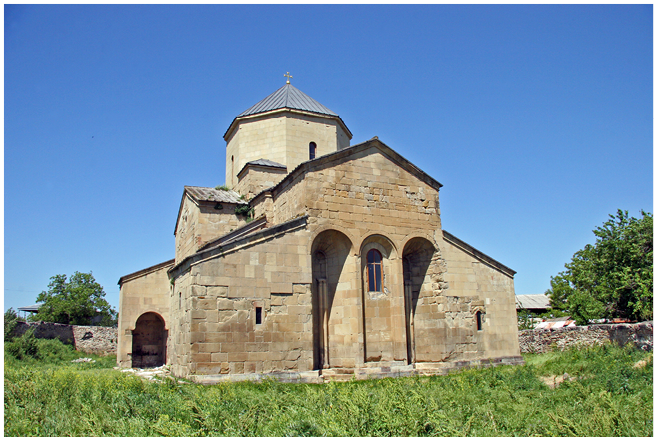
The deployment of Armenian traditions about Gregory triggered undesirable repercussions: Armenians asserted ecclesiastical dominance – even after its erosion in the sixth and seventh centuries – through Gregory’s real and supposed actions. Cognizant of the dilemma, Daskhurantsi creatively casts Gregory’s labors as the second albeit decisive step in Albania’s conversion. The Albanians’ earliest encounter with Christianity, Daskhurantsi insists, pivoted on Elishay (Eliseus), a missionary ordained by St. James in Jerusalem.Footnote 13 Daskhurantsi thus ties Albanian Christian beginnings and self-sufficiency to apostolic-era Jerusalem, three centuries before the initial royal conversions in Caucasia, not to mention the Roman Empire! By no means is this strategy unique to Daskhurantsi. Like Christians elsewhere, Armenians and Georgians flaunted apostolic connections to magnify proclamations of ecclesiastical autonomy and autocephaly. Armenians latched on to Bartholomew and Thaddaeus while Georgians embraced Andrew “the First-Called”(see Figure 2).Footnote 14 Apostolic claims proliferated across Christendom, including connections to Andrew forged in Byzantium to answer papal primacy.Footnote 15
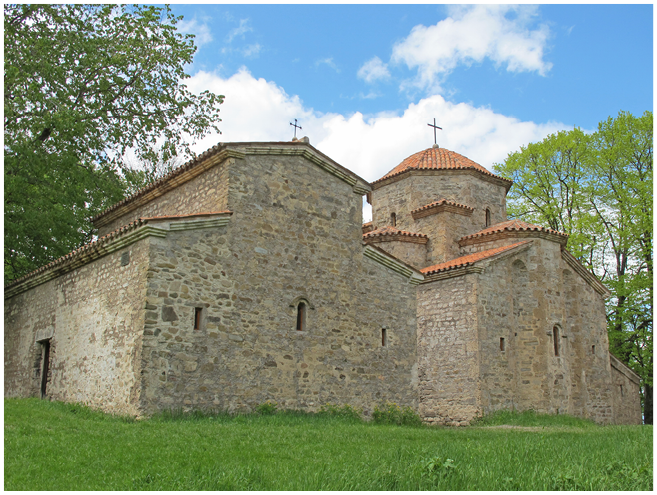
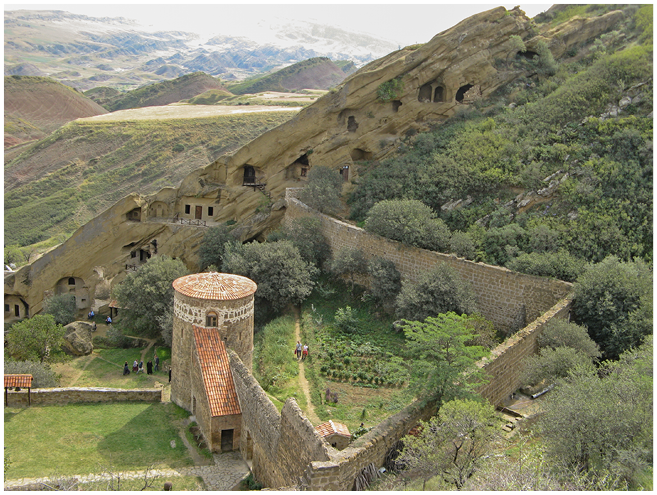
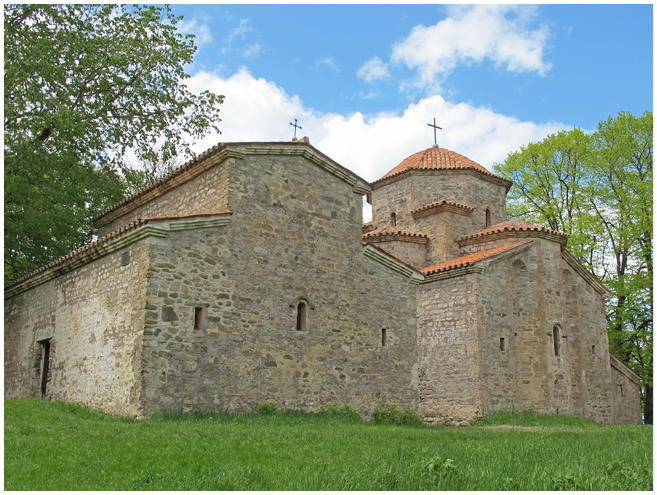
Evidence of early church construction is found across southern Caucasia. In this figure, the Dzveli Shuamta complex, Kakheti, featuring a fifth-century basilica and seventh-century cruciform domed church (both heavily restored).
So far as we can discern, Armenians and Georgians sculpted distinctive written traditions of royal conversion in a more systematic way than the dwindling Albanians. The principal components of the Gregory Cycle are associated with the shadowy “Agathangelos,” whose Greek name means “good messenger.” Abundant interlinked Gregory traditions circulated among early Christian Armenians and their neighbors. The extant Armenian-language recension, designated “A,” crystalized in the fifth century.Footnote 16 A related yet distinctive “V” recension, whose Armenian is lost, roughly belongs to the same time. The considerable variation among the Gregory Cycle’s texts reflects the kaleidoscopic Armenian experience and contested ecclesiastical power across wide geographical and cultural expanses. Alongside Armenian exists Greek, Syriac, Arabic, Geʽez, Georgian,Footnote 17 and other versions. For its part, the extant Nino Cycle is built around two related anonymous Georgian-language texts about King Mirian’s conversion: the seventh-century Conversion of Georgia and the expanded Life of Nino of the ninth/tenth century. The latter survives in multiple medieval recensions.Footnote 18 Yet other variants of the Nino tale were composed in Georgian starting in the eleventh century, including a metaphrastic vita. Like those of the Gregory Cycle, received components of the Nino Cycle are based on older traditions.
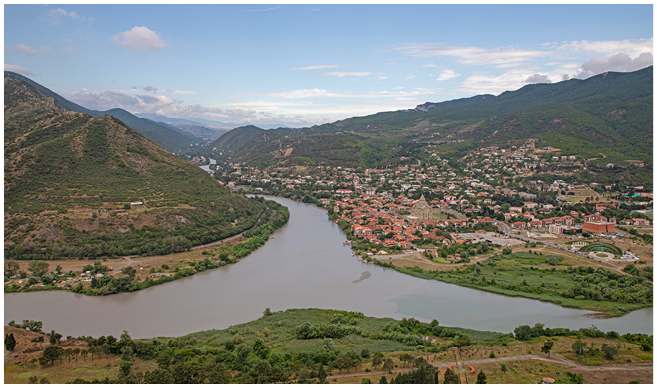
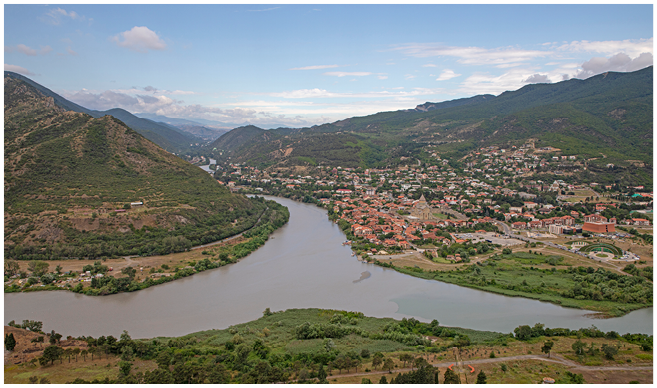
Despite apparent divergences across cycles, Caucasia’s surviving conversion stories share underlying features. They assert prompt and decisive “top-down” conversions of their respective realms. They also prioritize particular dynastic monarchs and their subjects while emphasizing elites of dominant cultural-linguistic groups. Accordingly, the Nino Cycle elevates the rulers and dominant culture of Kartli and its royal seat Mtskheta, located just across the Kura River from its ancient predecessor Armazi (see Figure 3, left side). Though individual texts highlight specific polities and cultures, a critical and collective reading of Caucasia’s conversion tales divulges an isthmus-spanning Christianization of Iranic peoples – a dynamic process not always grasped at the time and obscured as “living” traditions evolved. The received conversion texts exhibit robust intraregional competitiveness yet were in conversation with each another, a circumstance resulting from common, polycentric, and inter-realm Christianization.
Modern Mtskheta and Armazi at the confluence of the Kura and Aragvi Rivers.
Over time, Caucasia’s church organizations adjusted, embellished, and comprehensively rewrote stories of their genesis. What have come down to us are multilayered tales advertising culturally centered autonomy earned from unique origins and curbing encroaching claims of neighboring churches. Particulars of a given tradition were simultaneously contested from within: internal constituencies, sometimes open rivals, put their own spin on communal conversion. As stories of Christianization evolved, older texts lost their full efficacy and were often neglected or discarded. Surviving tales are multilayered “living” commemorations of Caucasia’s royal conversions composed across several centuries. They are mindfully structured declarations of advantaged religious, cultural, and political power snugly cloistered within specific kingdoms. Their curated memories of Christian genesis evoke the past but also justify the present and stake desired futures. Needless to say, we lack the sources to determine precisely what happened in the early fourth century, during the time of Nino.
Though built from numerous layers of selective memory, exaggeration, and jurisdictional claims, these are not stories of mere make-believe: their narrative crux consists of genuine personae and events. The earliest extant versions, in Armenian and Georgian, derive from the fifth (Agathangelos), seventh (Conversion of Georgia), and tenth (Daskhurantsi) centuries. One of the oldest witnesses to Caucasia’s royal conversions was written ca. 400 in the Roman Empire. The compact tradition preserved in Rufinus’ Latin-language History of the Church (I.10)Footnote 19 presents the royal conversion of the “Iberians” – the Graeco-Latin designation for Kartvelians and other inland Georgians – as coinciding with the realm of the unnamed king, who seems to be Mirian. Rufinus relied upon a well-placed Georgian informant, whom he names. Hailing from the Armeno-Georgian marchlands, Bacurius (Bakur) served the Romans as dux Palaestinae and comes domesticorum. Received Georgian-language conversion stories accord with the rudiments of Rufinus account,Footnote 20 which might be counted as an independent component of the Nino Cycle.Footnote 21 Significantly, Rufinus assigns Iberians and others he adjudged peripheral to a Christian commonwealth forming under the Roman aegis. His Christianizing Iberians were inherently subordinate to Romans and lived “under the Pontic sky.” Later, medieval Georgians – especially in Islamic times – embraced a vision of conversion within the Romano-Byzantine sphere that was hitched directly to Constantinople though adjusted it to maintain their distinctiveness and autonomy.
Until the sixth century, Caucasia’s conversion tales would have openly reflected the plurality of the region’s Christianities, as we see in Syria and elsewhere.Footnote 22 Afterward, the Armenian, Georgian, and Albanian “national”Footnote 23 churches injected such texts with a hardy dose of cultural and jurisdictional privilege. Arising by the seventh century, Caucasia’s “national” churches are among the first such institutions in the emergent Eastern Christendom. Each initially germinated within a sovereign polity. Each favored a dominant cultural-linguistic community. And each maintained intrinsic autonomy and autocephaly.Footnote 24
In this atmosphere, later generations downplayed and rejected early Christian Caucasia’s cross-cultural condition – though in particular instances it might be evoked. Consider Gregory the Illuminator and the “Roman” holy woman Hripsime (Georgian Ripsime), whose martyrdom preceded Gregory’s unfettered public proselytization. Both were venerated as saints across early Christian Caucasia. Patterns and accurate memories of actual conversion were jumbled from the start. Received Georgian and some later Armenian texts – including Khorenatsi’s history – thus place Nino (Armenian Nune) in the company of Hripsime, Gayane, and other Christian women who fled to Armenia because of (Diocletian’s?) persecution in the Roman Empire. The extant Gregory Cycle does not explicitly count Nino among these women. However, according to the Nino Cycle (but not Rufinus), Nino’s companions were martyred in Armenia by the still-“pagan” King Trdat. Shepherded by the divine, Nino alone escaped to eastern Georgia, where she secured the baptisms of Queen Nana and then King Mirian. By not making Christian martyrs before his conversion, Mirian, in a sense, is made to eclipse Trdat; their respective treatment of holy women stands in stark contrast.
The ostensible Hripsime-Nino linkage echoes late antique Caucasia’s authentic cross-cultural condition. However, from the seventh century the association was animated by the exploitation of Hripsime’s memory by autonomy-minded Armenian, Georgian, and Albanian clerics. Georgian suppression of memories of Gregory – who by then epitomized Armenian ecclesiastical primacy – is not coincidental. This having been said, Caucasia’s cultural and linguistic diversity posed practical hurdles to the fourth-century engineers of conversion. A shared Iranic social structure and cross-cultural interplay need not entail cordial relations or ease of communication.
An inconvenient but evaporating truth haunted later generations: Caucasia’s actual conversion had been heterogeneous and set within a pan-regional, southward-oriented Iranic society. Contrary to received assertions, the region’s early Christianization was not confined to sharply delimited linguistic, cultural, and political constituencies. Early on, rigid demarcations of orthodoxy and heresy were atypical; the Georgian “national” church inculcated the Nino Cycle with such ideas only from the 600s. Early, what mattered most was a general adherence to Christianity and allegiance to the Christian king and local bishops – as we would expect in a newly Christianizing environment caught in the vise of competing empires. In this plural and cosmopolitan setting, Caucasia’s early Christians lived side-by-side and frequently interacted not only with each other but with Zoroastrians, Jews,Footnote 25 Manichaeans, and polytheists too – a microcosm of the situation across western Asia.Footnote 26
Received Christian accounts paint Caucasia’s “paganisms” as monolithic and menacing. In fact, on the eve of mass Christianization, a panoply of loosely organized, syncretic Zoroastrianisms and other religious beliefs prevailed across Caucasia’s Iranic society.Footnote 27 Christian Armenian and Georgian sources sometimes distinguish Caucasia’s Zoroastrianisms from those of Persians and Parthians. Zoroastrianism’s pervasiveness and its adaptation is only one aspect of the isthmus’ long-term belonging to the Iranic enterprise. The cultures, languages, social organizations, political machineries, and economies of Caucasia’s kingdoms were firmly rooted in – and creatively contributed to – the diverse, cross-cultural, and polycentric Iranic world. Caucasia’s Iranic society spilled northward into pastoralist highland communities, such as the Alans and the Ovsis (cf. modern Ossetians) of Georgian sources.Footnote 28 The isthmus’ active membership in the Iranic venture is attested already in the Achaemenid age, encompasses the Arsacid and Sasanian Empires, and extends into Islamic times.Footnote 29 Caucasia’s Iranic condition did not go unnoticed in Iran. For example, elites in the Sasanian Empire sometimes acknowledged Caucasia’s political and social integration within “Eranshahr” – “the land of the Iranians” – as evidenced by the Naqsh-e Rostam inscription of Shahanshah Shapur I (r. 240–270).Footnote 30
Caucasia’s sedentary society, like Iran’s, gravitated around a constellation of aristocratic houses and their estates. This structure facilitated and was put into the service of the region’s Christianization. Christianity was fit to existing Iranic society at least as much as the other way around. As they had with Zoroastrianism, Caucasia’s peoples fashioned distinctive forms of Christianity within their pan-regional Iranic society, not in opposition to it or as a foreign tradition imported wholesale. Caucasia’s social organization thus remained intact. Bishoprics – including a short-lived episcopal dynastyFootnote 31 established by Gregory the Illuminator – were sculpted to it. Christianization was a culturally transcendent dynamic, not a one-way monocultural path leading straight into the arms of the Roman Empire or a feat masterminded by Constantinople through a harbinger of the ninth-century Cyril-Methodian mission to the Slavs. All the while, Caucasia’s Iranic status did not entail a blind or necessary association with, or allegiance to, imperial institutions in Iran. Thus, Georgia’s direct encounters with the Church of the East, established at Ctesiphon under Sasanian surveillance in the early 400s, were muted.
Dangers and opportunities actuated by rival empires spawned a volatile political and religious situation in Caucasia. With Mesopotamia, the isthmus was a prime Romano-Iranian battleground.Footnote 32 This is the context in which Caucasia’s three principal churches became embroiled in theological, Christological, and jurisdictional disputes as they pursued amicable relations with – or distance from – Constantinople. Tensions flared as the Georgian Church flexed its autonomy and repudiated the regional religious protectorateFootnote 33 asserted by its Armenian counterpart. Armenians pronounced formal schism at their Third Council of Duin (Dvin) in 607. During the last Romano-Sasanian war, many Georgian elites aligned politically and theologically with the Christian Roman Empire.Footnote 34 The stance hardened with the growth of Islam in Caucasia. As their Constantinopolitan orientation solidified, Georgian prelates rejected the prevailing miaphysitism of the Armenian Church. At first, many were ambivalent or endorsed compromise positions like Zeno’s Henotikon. But in the early seventh century, the Georgian religious establishment led by Katholikos Kwrion (Kyrion) embraced the dyophysite Christology of the Fourth Ecumenical Council held at Chalcedon back in 451. In Caucasia, rival Christological positions expedited the formation of “national” churches, and this sparked a fresh round of adjustments to conversion tales.
Among the most visible and utilitarian products of Caucasia’s Christianization are the dedicated Armenian, Georgian, and Albanian scripts crafted toward the end of the fourth century. The later cultural-linguistic privileging of “national” churches is transposed on memories about the invention of these scripts. Yet our sources’ reliance on older traditions has sustained aspects of the cross-cultural past. Received Armenian-language sources – including Daskhurantsi’s History of Albania – attribute the invention of Caucasia’s scripts to the Armenian ascetic Mashtots (Mesrop, d. 440). New scripts were indispensable tools for cultivating Christianity. Fittingly, Mashtots’ hagiographical saga is one of the oldest specimens of Armenian literature.
The author of Mashtots’ vita does not afford exclusive credit to his master for the creation of scripts. Koriwn signals an earlier Armenian script created by a Syrian bishop named Daniel and makes Mashtots’ success contingent upon Albanian and Georgian linguistic experts. In Georgia, Mashtots reportedly secured the consent of the local king and chief bishop before collaborating with a translator named Jalay.Footnote 35 Koriwn gestures a practical impediment. The principal tongues of late antique Caucasia were quite dissimilar and not mutually intelligible: Armenian is Indo-European; Georgian anchors its own linguistic family; and the now-extinct Caucasian Albanian language, to which modern Udi is related, belongs to the Northeast Caucasian family.Footnote 36 Perhaps inspired by al-Masudi, other Muslim writers fittingly dubbed the polyglot isthmus “the Mountain of Languages.” The linguistic hodgepodge could be navigated and managed, as shown by the shared basic design of characters of the three Caucasian scripts.Footnote 37 While the precise relationship of these scripts remains a matter of passionate debate, all three resulted from the cross-cultural Christianization sweeping the isthmus.
No surviving Georgian source names Mashtots or concedes non-Georgian involvement in the invention of asomtavruli, the first known Georgian script. An early Georgian historiographical work, The Life of the Kings, spuriously credits the script’s invention to its first king of the eastern Georgians, Parnavaz (r. 299–234 BC).Footnote 38 This ca. 800 text is based on older oral tales and perhaps a lost written source. The total silence enshrouding Mashtots is a maximal extension of the diminution of Gregory the Illuminator in received Georgian texts. Georgians may have deliberately circumvented the Mashtots tradition with the Parnavaz legend. By the same token, the tethering of Mashtots to the Georgian script may be an Armenian heralding of their avowed dominance.
Parnavaz’s fanciful association with a Georgian script is not a perfunctory effort to proclaim primacy. Rather, it conforms to the Iranic epic, the chief modality through which Caucasia’s late antique peoples envisioned their past.Footnote 39 The Life of the Kings intentionally paints Parnavaz as a foundational Iranic king who engineered the social-cultural machinery of his realm, including a network of nobles (eristavis);Footnote 40 a distinctive polytheistic religion featuring a local formulation of Ahura-Mazda (Armaz); and a Georgian script. The anonymous historian asserts: “In this fashion did Parnavaz order everything, imitating the kingdom of the Iranians.”Footnote 41
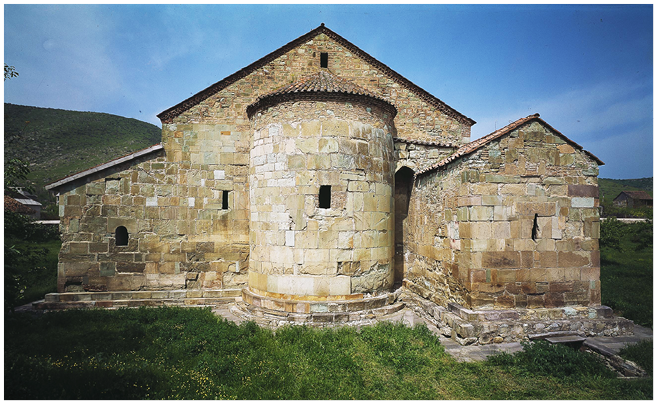
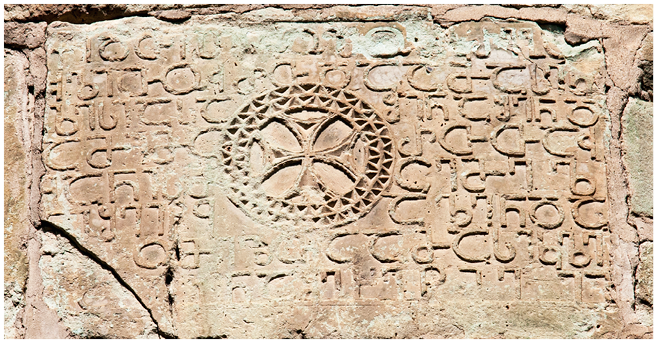
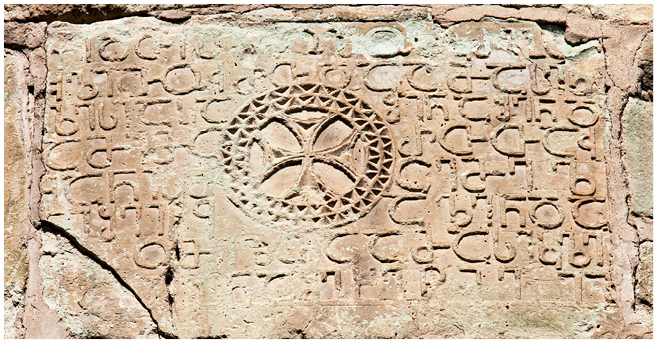
Modern efforts to exhume a pre-Christian origin for the Georgian script are fascinating and speculative.Footnote 42 One of the most erudite is Levan Chilashvili’s examination of early inscriptions from Nekresi in Kakheti. Also noteworthy is Vakhtang Licheli’s creative identification of moldings/carvings found at Kartli’s Grakliani Hill as vestiges of a “proto-Georgian” script from the seventh century BC. Notwithstanding, the oldest reliably dated examples of Georgian are fifth-century AD inscriptions from greater Jerusalem and on the exterior of the Bolnisi Sioni (Zion) basilica in southern Georgia (see Figures 4–5).Footnote 43 On their basis, Tamaz Gamqrelidze established the creation of the uncial asomtavruli script by a Christian impulse, which was embedded within regional and pan-Christian frameworks.Footnote 44 The invention of one or more of Caucasia’s scripts may involve the Holy Land, where Christians from Caucasia were present by the fifth century. So, while specific passages of the received Armenian Life of Mashtots may be hyperbole meant to amplify Armenian ecclesiastical hegemony over Caucasia, the vita embodies an authentic contemporaneous pattern: the isthmus’ cross-cultural Christianization.
Bolnisi Sioni.
Bolnisi Sioni, Bishop Davit’s memorial text in asomtavruli. The exterior also features a late fifth-century foundational inscription.
The fashioning of the Armenian, Albanian, and Georgian scripts did not occur ex nihilo. Some peoples in Caucasia had been acquainted with, and were proficient in, other scripts and written languages for centuries before Christianization.Footnote 45 Evidence of Greek is relatively plentiful in Caucasia, thanks to ancient Greek colonies on the Black Sea littoral as well as connections (e.g.) to the Seleucids and Roman Empire.Footnote 46 Georgian and Armenian knowledge of Greek continued across premodern times, especially in ecclesiastical settings. Latin, by contrast, is rarely attested in Caucasia. The easternmost example is an inscription carved by troops of Emperor Domitian (r. 81–96) near the Caspian coast, south of Baku. The earliest known writings generated by a Caucasus-based polity are Urartian cuneiform inscriptions from the mid-first millennium BC. Urartu disappeared in the sixth century BC and probably did not spill into what would become Georgia.
A local Aramaic language and script, attested toward the start of late antiquity, are another indication of Caucasia’s integration within the Iranic world. Its modern appellation Armazic honors the royal citadel of Armazi (named for the aforementioned deity Armaz) overlooking Mtskheta, where early specimens were discovered.Footnote 47 Prior to the Georgian script, written Armazic was employed by some elites in Mtskheta and elsewhere in eastern Georgia and Armenia. Armazic’s remnants include the ca. 150 BC bilingual epitaph of a young aristocratic woman named Serapit. Found near Mtskheta, its Greek text is arranged first while the longer Armazic is composed from Serapit’s perspective.Footnote 48 As it happens, Armazic belongs to a wider phenomenon: in late antiquity, new scripts were created for other Aramaic languages in northern Iran.Footnote 49 Yet other written languages are attested among Georgians and their immediate neighbors before and around the time of the royal conversions. Examples include Middle Iranian, Palestinian Aramaic, and Hebrew.
Late antique perceptions of Caucasia’s multilingual knot are woven into The Life of the Kings. Its eponymous Georgian forefather, Kartlos (reverse-engineered from the toponym Kartli), was imagined to have assembled a heterogeneous community: “… the language of the descendants of Kartlos in which they had conversed had been Armenian. But when these innumerable peoples had come together in Kartli, then the Georgians abandoned the Armenian tongue. From all these peoples was created the Georgian language.”Footnote 50 Predictably, the text positions the foundational Parnavaz as “the first king in Kartli from among the descendants of Kartlos. He extended the Georgian [kartuli] language, and no more was a different language spoken in Kartli except Georgian.”Footnote 51 While Greek and Armazic inscriptions are tangible proof of the usage of scripts and languages other than Georgian, Parnavaz’s tale demonstrates the late antique and medieval Georgian understanding of their culture and polity to have been multi- and cross-cultural from the very beginning.
Overview
This Element surveys the history of Georgian literature to the establishment of the influential Georgian monastery of Iveron on Mt. Athos in the 980s. The birth of Georgian literature was sparked by a dedicated script, whose ca. 400 creation was a product of the Christianization of Caucasia’s Iranic society. Initial Georgian-language texts rendered fundamental Christian religious sources, especially biblical and liturgical materials, the subject of Section 1. Other religious works, including patristic, homiletic, and hagiographical texts, were soon adapted and translated into Georgian, as examined in Sections 2 and 3. Some early Georgian texts were “living” traditions, prone to adjustment, reediting, and even comprehensive rewriting. Original Georgian literature in the guise of hagiography arose in the late fifth century. Investigated in Section 4, passions and vitae were intended to grow and consolidate Christianity by confirming divine intervention and extolling pious deeds in post-apostolic Caucasia. Original hagiographical texts also fine-tuned the definition of the Christian Georgian community and its emergent “national” church. Section 5 probes the creation of original historiography elaborating a distinctive Georgian communal past centered on dynastic kings and aristocrats. Merging hagiographical modes with Iranic epic-history, early Georgian historians constructed the past within the context of Persia/Parthia and the Iranic world. The last section contemplates modes of Christian Georgian identity as expressed in literary sources.
Georgian Language and Script
Georgian anchors the non-Indo-European Kartvelian (kartveluri), or South Caucasian, linguistic family, which consists of four main languages: Georgian proper (kartuli, “Kartvelian”); Megrelian and Laz/Chan in western areas; and Svan in the northwestern highlands. These splintered from a conjectured “proto-Kartvelian” progenitor by the third millennium BC. Kartuli is the only member of this family to have regularly been written in late antiquity.
Premodern Georgian was written in three kindred scripts. The earliest, asomtavruli or mrglovani (“rounded”), was invented toward the end of the fourth century AD. Some five hundred years later appeared nuskhuri, whose angular style is reminiscent of Armenian. The quickly written mkhedruli is attested especially from the tenth century; it is still used for modern Georgian. None of these scripts formally distinguishes between majuscules and minuscules.
A simplified system of Georgian transliteration has been adopted for this Element. Common scholarly variants are given in brackets (Table 1).
| Georgian | Transliteration | Georgian | Transliteration |
|---|---|---|---|
| ა | a | ს | s |
| ბ | b | ტ | t |
| გ | g | უ | u |
| დ | d | ჳ | w |
| ე | e | ფ | p [p‘] |
| ვ | v | ქ | k |
| ზ | z | ღ | gh [ġ,ɣ] |
| ჱ | e [ē] | ყ | q |
| თ | t [t‘] | შ | sh [š] |
| ი | i | ჩ | ch [č‘] |
| კ | k | ც | ts [c‘] |
| ლ | l | ძ | dz [ż,ʒ] |
| მ | m | წ | ts [c] |
| ნ | n | ჭ | ch [č] |
| ჲ | y | ხ | kh [x] |
| ო | o | ჴ | q [q‘] |
| პ | p | ჯ | j |
| ჟ | zh [ž] | ჰ | h |
| რ | r | ჵ | ho [ō] |
The seeming replication of sounds arises from separate glottal and aspirate forms. This Element’s Georgian spellings maintain focus on contemporaneous Georgian culture. The chief exceptions are names well known beyond Kartvelology (Georgian Studies), for example, Peter the Iberian.
Georgia, Georgians, and Caucasia
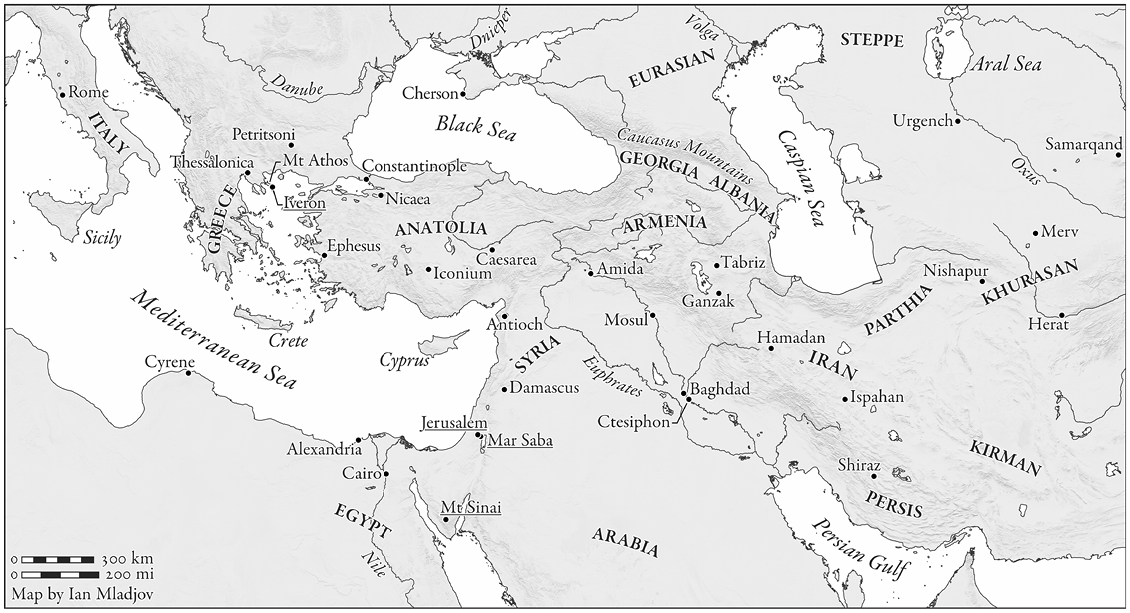
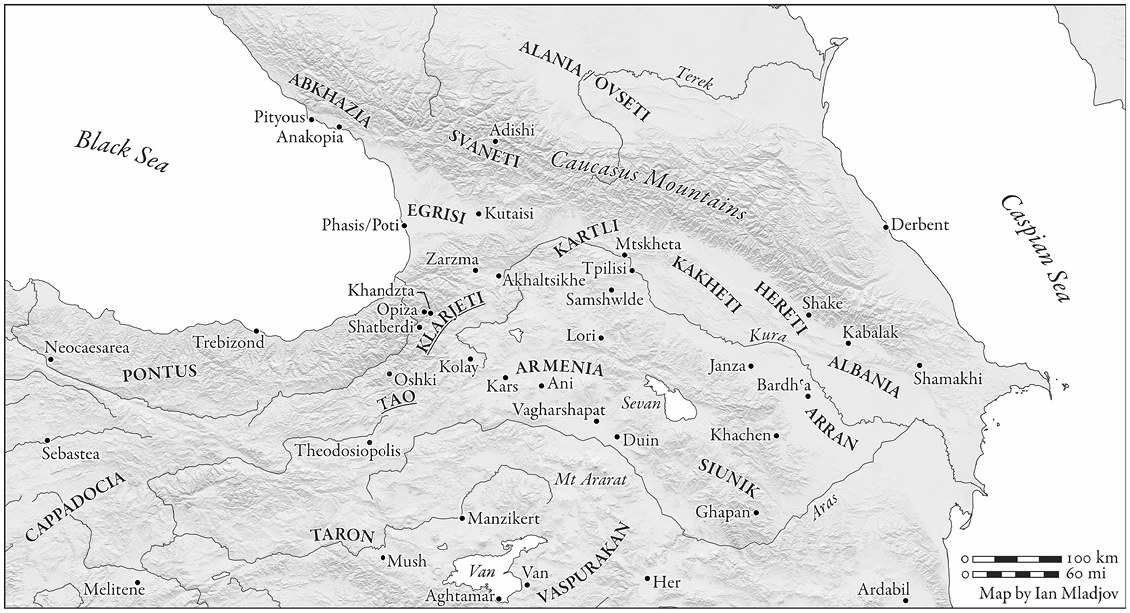
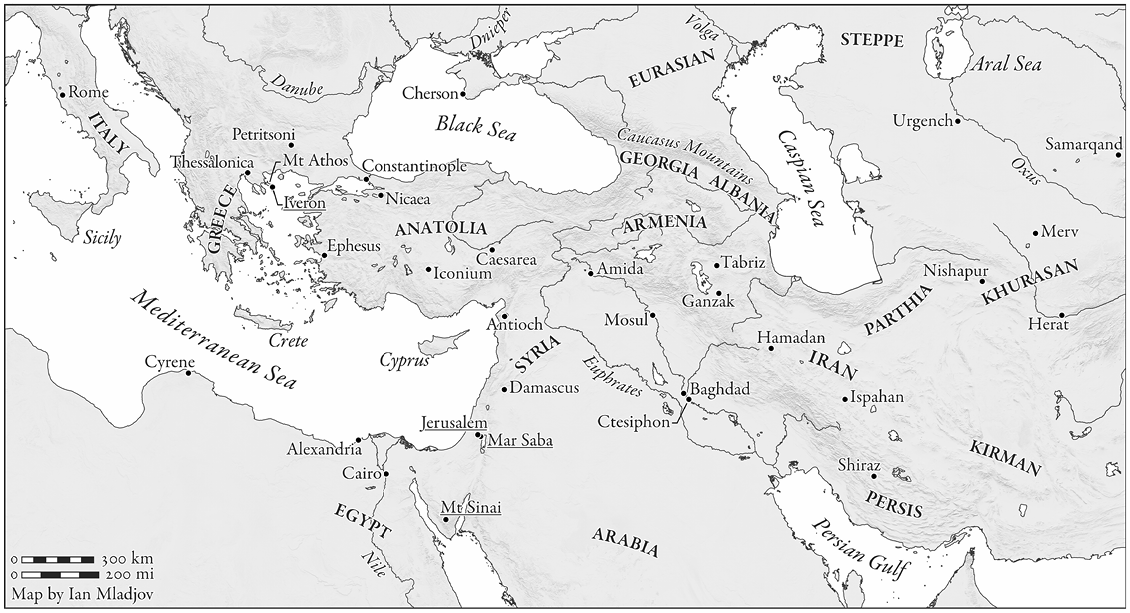
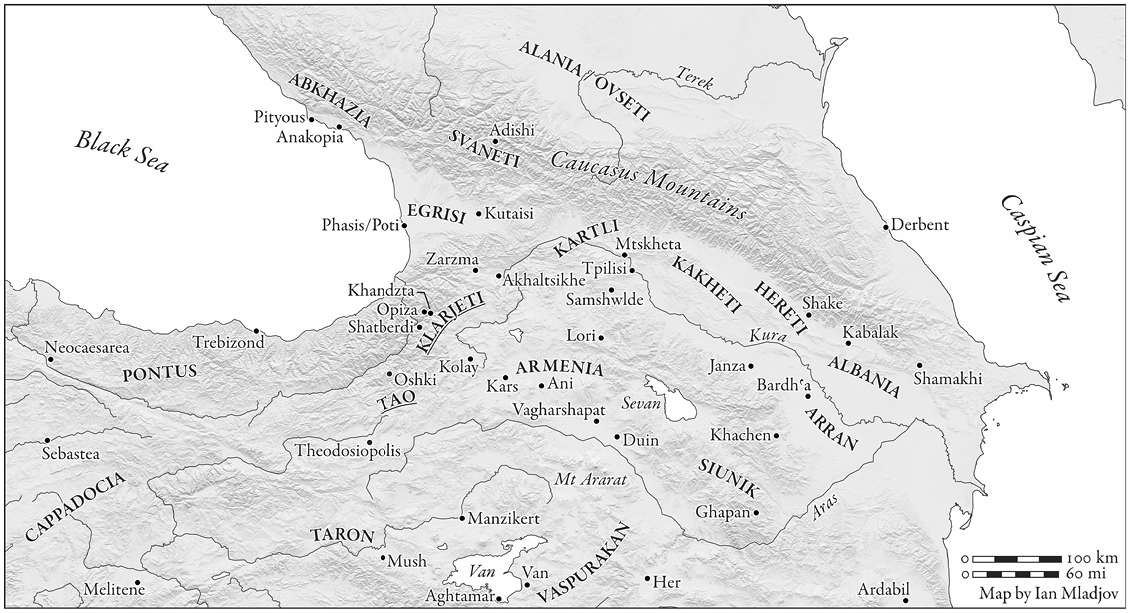
“Georgia” and “Georgians” are exonyms. In early Christian times, Georgian speakers and writers referred to specific regions and their inhabitants. Kartli was the cultural, political, religious, and economic nucleus of eastern Georgia, home to the monarchy based at Armazi/Mtskheta and, after the early sixth century, Tbilisi (Tpilisi in Old/Middle Georgian) (see Maps 1 and 2). Kartli’s dominant community called itself kartveli, that is, Kartvelian/Kartlian. The various Georgians, including Kakhetians, spoke substantively the same language, kartuli – the inanimate form of kartveli. Surviving Georgian-language sources, especially from the medieval Bagratid era, can designate all “Georgian” subjects of Kartli’s king as Kartvelians. Early medieval Georgian sources began to deploy the toponym Sakartvelo, “where the Kartvelians reside,” for Kartli proper as well as other “Georgian” lands and subjects of the Bagratid polity. Today, Sakartvelo is the name of the nation-state of Georgia.
For the sake of accessibility, this Element regularly uses Georgian for Kartvelian. Graeco-Latin Iberia refers to Kartli but can encompass adjacent inland regions. Classical Armenian Virk often refers to what Greek and Roman authorities call Iberia. The Armenian root Vir- echoes Middle Iranian Wirchan/Wirzhan/Wrwchan.
In contemporaneous sources, “Caucasia,” usually intends the Caucasus Mountains and its highlands. But in this Element, Caucasia is shorthand for the southern tier of the isthmus. Caucasian is the adjectival form of Caucasia and is never used in a racial sense. Transcaucasia, “across the Caucasus Mountains,” imparts a later Russian perspective and is anachronistic for late antiquity.
1 Biblical and Liturgical Texts
An estimated 75,000 manuscript leaves in Georgian populate repositories across the globe.Footnote 52 The largest concentration of late antique and medieval Georgian manuscripts is housed at the Georgian National Centre of Manuscripts (NCM) in Tbilisi. Other major collections include those of the National Archives of Georgia, Svaneti’s Museum of History and Ethnography, the Kutaisi State Historical Museum, the Oriental Institute in St. Petersburg, Bibliothèque nationale de France, and Oxford University.Footnote 53
Some Georgian collections descend from medieval monastic libraries, including St. Catherine’s on Mt. Sinai, Iveron on Mt. Athos in Greece, and the Monastery of the Holy Cross in Jerusalem, whose holdings now belong to the Greek Patriarchate of Jerusalem. These monastic milieux are not fortuitous. Extant manuscripts in Old and Middle Georgian, whose collective use stretches to the thirteenth century, overwhelmingly convey religious texts. Monastic scriptoria were the chief nodes of premodern manuscript production.Footnote 54 Whether whole or incomplete, extant manuscripts antedating the ninth century are relatively rare. Precious few were copied in the fifth and sixth centuries, soon after the invention of a dedicated Georgian script. Only a fraction of Georgian manuscripts once existing are known. We must therefore weigh the endurance of specific genres and their relative numbers. Ecclesiastical works generally had a better chance of survival, thanks to the durability of the Georgian Church and the diffusion of manuscripts across its repositories within and beyond Caucasia. Longevity also hinged on assertions of power, including theological stances.Footnote 55
Three main hubs nurtured the manufacture, transmission, and preservation of early Georgian religious literature: the Holy Land including Sinai, Mt. Athos, and Tao-Klarjeti in the Caucasian-Anatolian marchlands (see above, Map 1, underlined). This triad fueled a tricontinental Georgian monastic network across which people, manuscripts, objects, and ideas moved with remarkable frequency. At its height in the eleventh to thirteenth centuries, the network comprehended other nodes such as the Black Mountain in Syria, Petritsoni (Bachkovo) in Bulgaria, and Constantinople.Footnote 56
Caucasia and the Wider World
Late Antique and Early Medieval Caucasia
From today’s vantage, one literary center towers above the others. Iveron (Iviron), the monastery “of the Iberians,” was established in the 980s on Mt. Athos in northeastern Greece.Footnote 57 Its Greek name is emblematic of deep Byzantine entanglements. Iveron’s foundation was sanctioned by Emperor Basil II (r. 976–1025), to whom Georgians had lent critical assistance in quashing the rebellion of Bardas Phocas. The abundant texts and manuscripts generated at Iveron by industrious ascetics such as Eptwme (955–1024) and Giorgi MtatsmideliFootnote 58 (1009–1065) – Euthymius and George “of the Holy Mountain” – disseminated across the Georgian web. So great was Iveron’s literary impact that scholars classify Georgian biblical, liturgical, and other ecclesiastical texts in discrete “Athonite” and “pre-Athonite” phases.
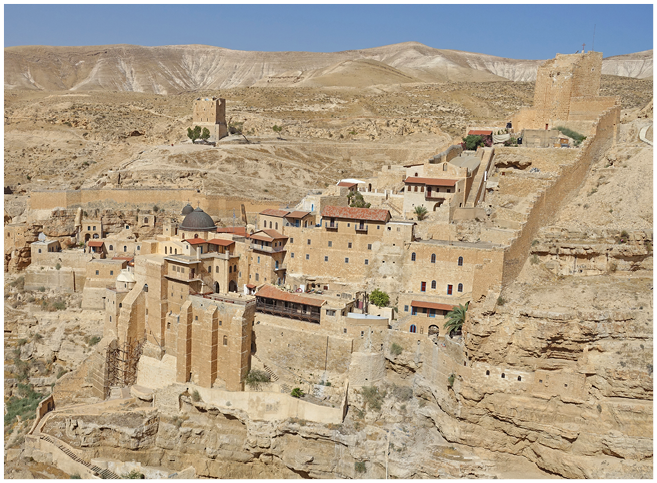
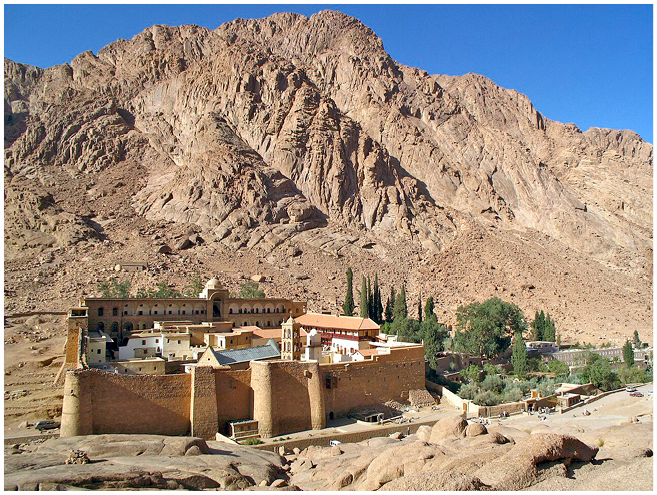
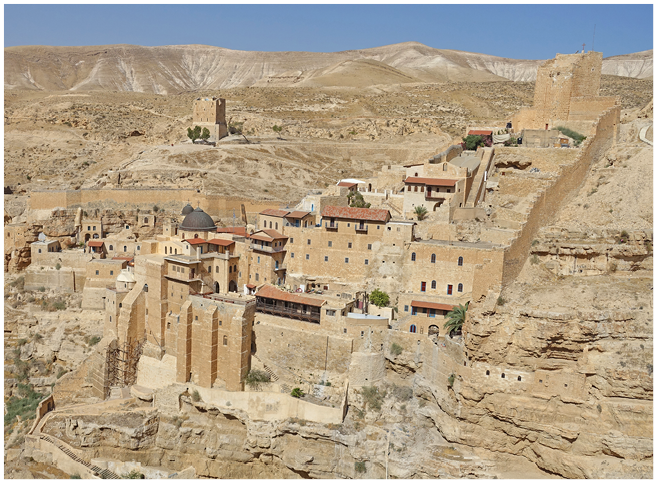
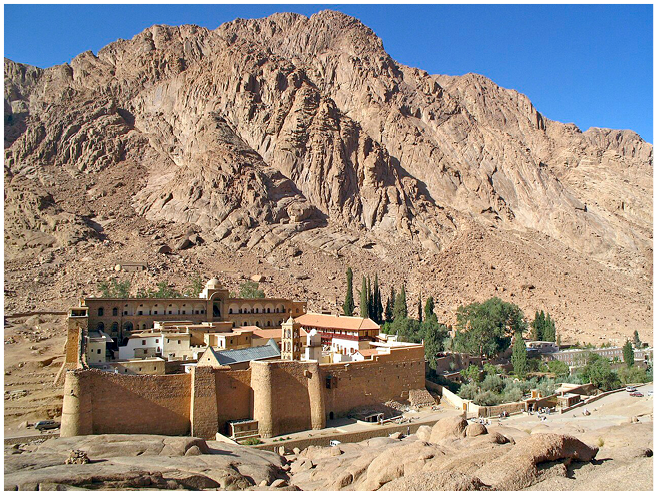
But for the preceding half-millennium, the epicenter of Georgian religious literature was Jerusalem and its environs.Footnote 59 Christian ascetics from Caucasia established a presence in the Holy Land by the early 400s. In terms of texts and manuscripts, Georgians resident at the monastery of Mar Saba in the Judean Desert were especially productive (see Figure 6).Footnote 60 In the late tenth century, intra-Muslim rivalry compelled the relocation of a band of Sabaite monks to the monastery on Mt. Sinai (see Figure 7).Footnote 61 Later honoring St. Catherine, this foundation eclipsed Mar Saba where, by the twelfth century, manuscript production all but ceased.Footnote 62 In the eleventh century, another Georgian from Mar Saba, Prokhore (Prochorus), established a library and scriptorium at his new monastery of the Holy Cross in Jerusalem. Purportedly built atop Adam’s buried head (and on the site of an earlier [Georgian?] church), Holy Cross became the focus of the long-lived Georgian community in Palestine. Back in Caucasia, a monastic archipelago prospered from the ninth century across the region known as Tao-Klarjeti.Footnote 63 Its scriptoria constitute the most productive Georgian literary hub within the isthmus. Tao-Klarjetians, including Prokhore, and their manuscripts propagated across the Georgian monastic diaspora.
Mar Saba.
St. Catherine’s monastery, Mt. Sinai. Credit: Joonas Plaan, Creative Commons CC BY 2.0.
There were no comparable centers of Georgian secular literature. The royal cities Mtskheta and Tbilisi, noble estates, and other concentrations of political authority were prime invasion targets. Literary centralization and manuscript preservation were also hindered by the mobility of the royal court and mutable aristocratic landscape. Still, political elites produced, exchanged, and accumulated documents. For example, Bagratid-era royal charters survive starting in the late ninth century.Footnote 64 Many affirm privileges and gifts granted to monasteries and bishoprics by the monarchy and are preserved in ecclesiastical settings.
Investigations of early Georgian literature must come to terms with a sweeping ideological vision arising in the tenth century. Within and beyond Caucasia, medieval Georgian monasteries, including Iveron, spearheaded an effort by which religious and political elites gravitated toward Constantinople and adapted Romano-Byzantine modes and symbols as never before.Footnote 65 The political dimension of this Byzantine turn was especially built up by the Bagratid dynasty, resuscitators of Georgian kingship in 888. Resultant textual and material sources represent Bagratid Georgia and its church as an intrinsic, albeit distinctive, part of the Christian Roman world. Today we strain to see beyond the Byzantine-tinted imagery suffusing these sources, which dominate the surviving late antique and medieval material, visual, and literary records.Footnote 66 Since the tenth century, Georgia’s links with Byzantium have been retrojected back to King Mirian’s fourth-century conversion. Accordingly, Christian Georgia has been depicted from its inception as an extension of Christian Rome/Byzantium. In some respects, this Romano-Byzantine timbre is a mirage. Though based on certain realities, its exaggerations sideline local distinctiveness, adaptability, and agency. Also obscured are early Georgian Christianity’s bonds with Mesopotamia, Syria, and the Holy Land, and closer to home, Armenia, Cappadocia, and Pontus. Nevertheless, connections between Caucasia and the Roman Empire existed in late antiquity, even before Christianization.Footnote 67 And Christianity could encourage Caucasia’s closer relations with the Christian Roman Empire and its entry into a new and expanding world. The fact remains, however, that Caucasia’s venerable nexus with the Iranic world survived Christianization, contributed to it, and was the social framework to which Christianity was configured.
Caucasia’s public conversion heightened engagement with fundamental Christian religious traditions. With the advent of the Georgian script ca. 400, translations of Christian biblical excerpts and books were prioritized.Footnote 68 Little if anything survives directly of this incipient literary heritage. Though original manuscripts of the earliest biblical translations into Georgian have vanished, old fragments establish their existence by the fifth century. For example, the Gospel underwriting split between palimpsests NCM A-89 and A-844 derives from the late fifth/early sixth century.Footnote 69 Graz MS 2058/1,Footnote 70 a Lectionary copied perhaps in the 500s, is one of the oldest nearly complete Georgian manuscripts.
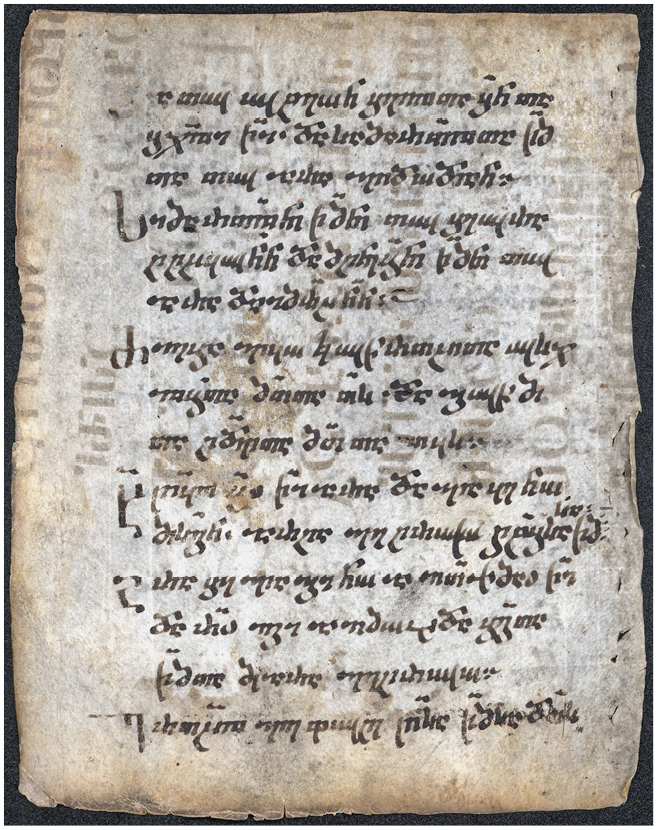
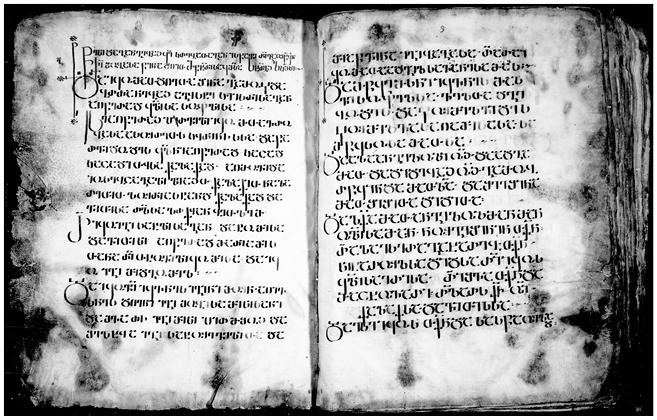
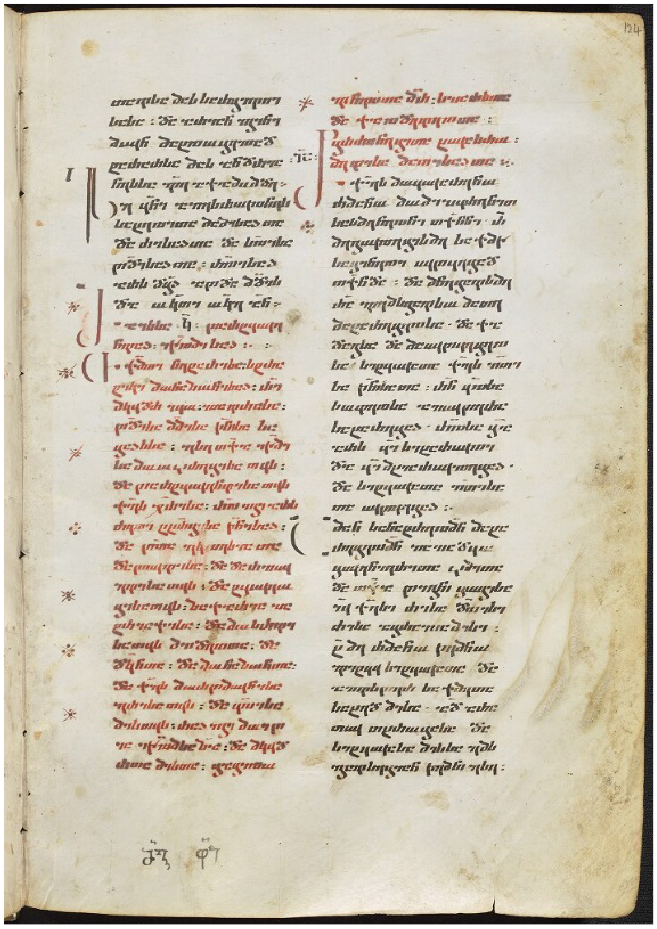
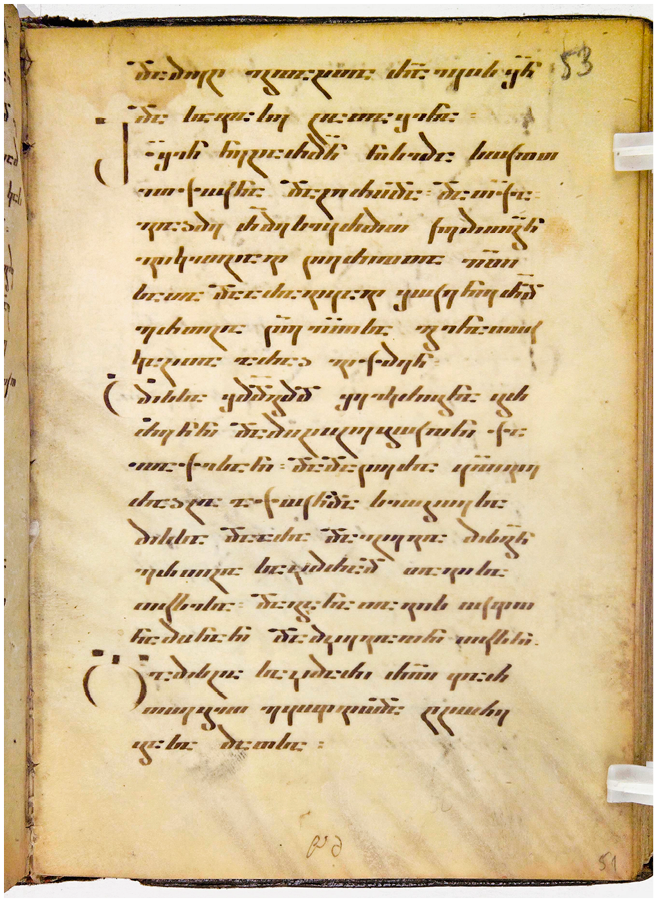
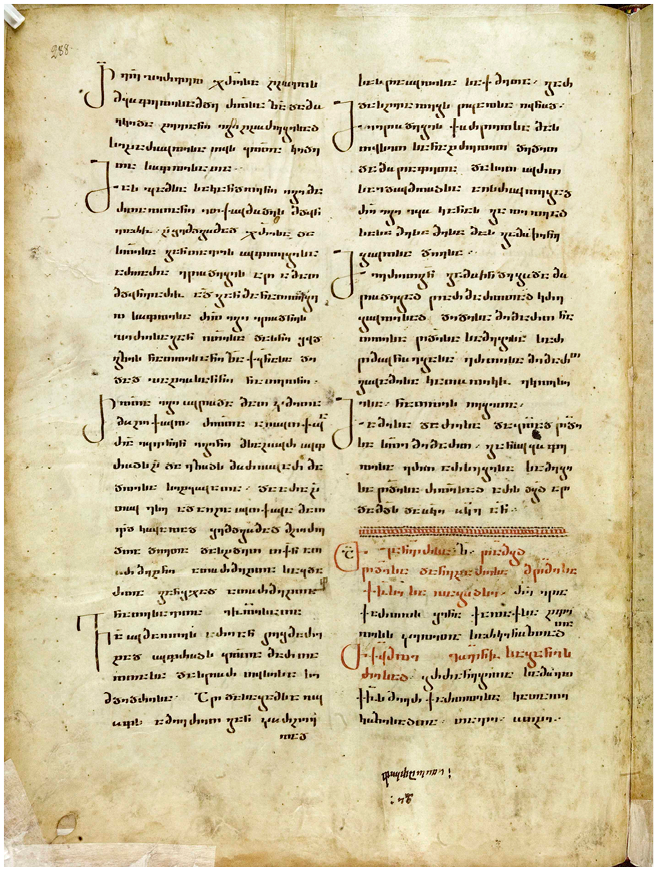
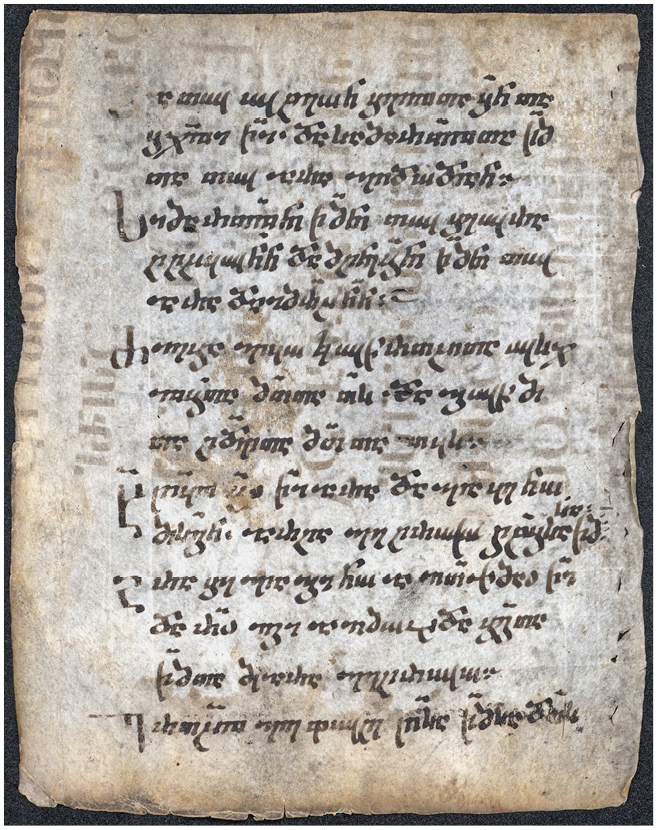
The earliest Georgian manuscripts are devoid of dates, and resolving their age is challenging.Footnote 71 Ongoing C14 and other scientific analyses are beginning to clarify the situation.Footnote 72 Traditionally, dating has rested upon contextualization, comparison, and internal criteria, the last of which includes the archaic prefix kh- marking second-person subjects and third-person objects. Such ancient sources are called khanmeti (see Figure 8). Their study was pioneered by Akaki Shanidze.Footnote 73 By the seventh/eighth century, h- became the favored prefix. Its texts are called haemeti. With few exceptions, the distinctive prefix vanished thereafter.
Jerusalem Lectionary palimpsest. Sixth-/seventh-century khanmeti underwriting in faint asomtavruli script; Psalter overtext in nuskhuri. NCM H-999, 86v (contrast exaggerated).
At first, specific New Testament passages and books were put into Georgian. These translations featured the four Gospels and Pauline letters and may have been extracts – pericopes – for liturgical usage. Canonical books in Georgian circulated in two early compendiaFootnote 74: otkhtavi, “four chapters” (a calque on Greek tetraeuangelion), transmitted the four Gospels; and samotsikulo, “apostolic,” comprised Acts and catholic letters. Remnants of the most ancient Georgian biblical texts – the start of the “pre-Athonite” phase identified by Kekelidze – exhibit significant internal variation. Direct witnesses of the “pre-Athonite” biblical tradition heavily favor the stage’s twilight, which is characterized by an outburst of revising/copying the Georgian Gospels and other books of the New and Old Testaments. Previous versions fell from usage and often were lost. Only a modicum of this ancient legacy survives directly, often as the underwriting of palimpsests.Footnote 75
This activity is confirmed by the incorporation of biblical materials and/or allusions to the Gospels in the oldest original Georgian texts. For instance, the late fifth-century Passion of Shushanik mentions passages in Matthew, Mark, John, Galatians, Psalms, among others.Footnote 76 The holy woman Shushanik possessed the Gospels (evangele), probably equivalent to otkhtavi or even a Gospel lectionary, as well as the “holy books of the martyrs” (tsmidani igi tsignni motsametani).Footnote 77 She also read Psalms (psalmunni) and “[Songs] of David” (davitni) (the distinction of which is unclear), indicating the circulation of particular translated Old Testament books in early Christian Caucasia. Because the fifth-century Shushanik was an Armenian Mamikonean princess residing in the bicultural Armeno-Georgian marchlands, these texts may have been in Armenian. However, Georgian cannot be ruled out since some of its inhabitants were bilingual. Other early original works containing biblical/Gospel allusions include The Life of the Kings and The Life of Vakhtang, two ca. 800 historiographical sources.Footnote 78
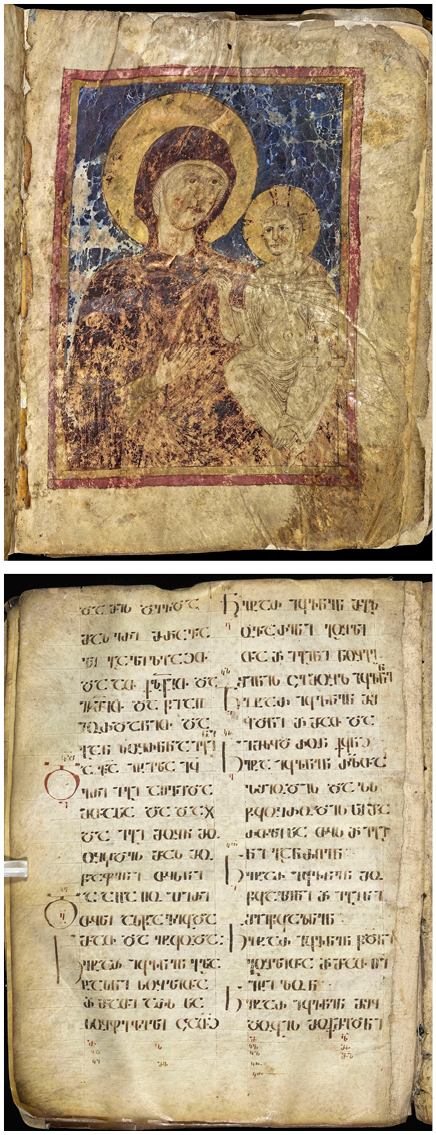
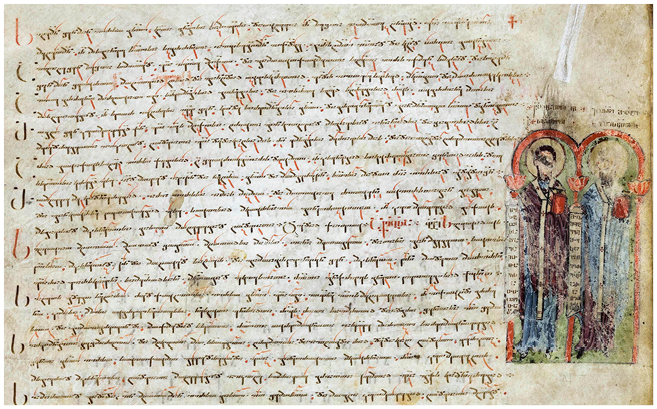
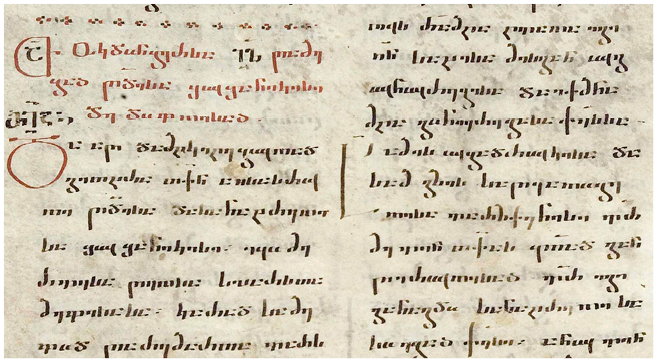
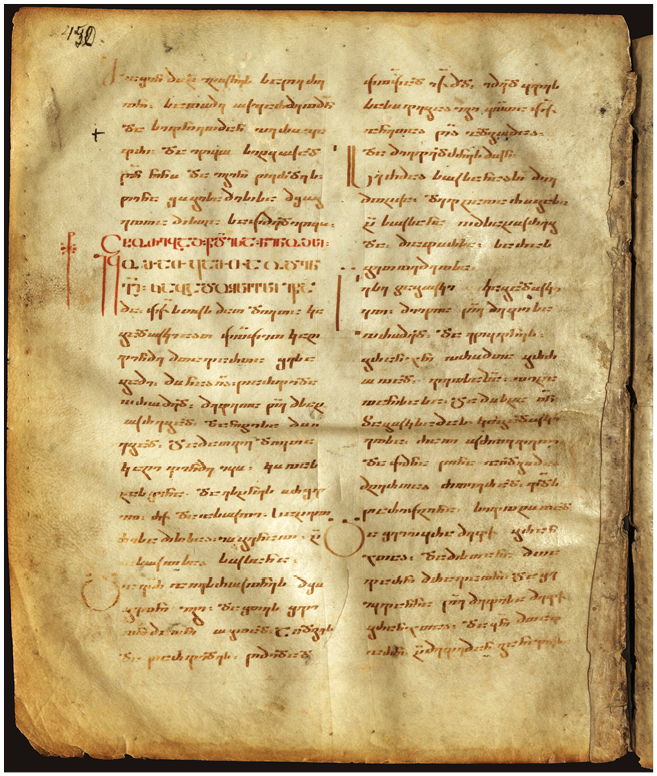
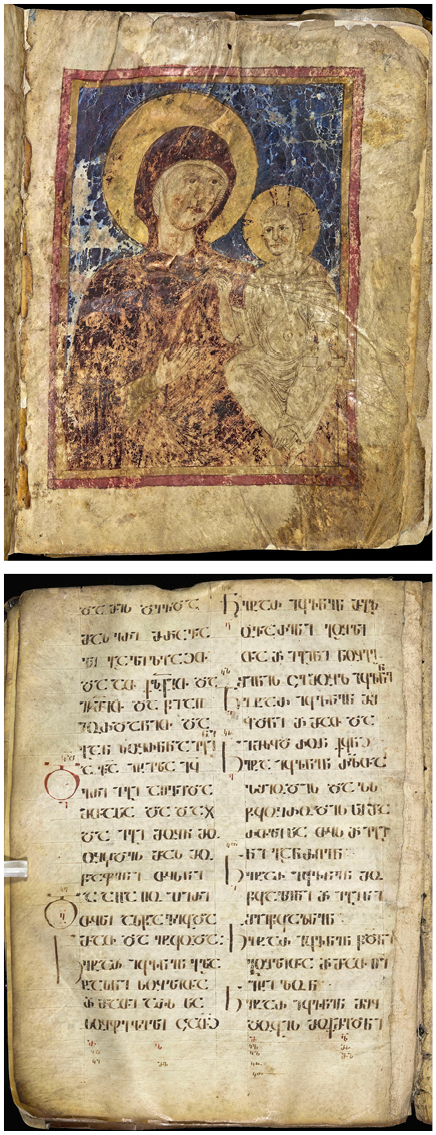
Starting in the late ninth century, a torrent of biblical and other religious manuscripts burst from the monasteries of Tao-Klarjeti, just beyond Islamic-controlled Caucasia and not far from the Byzantine heartland. The manuscript of the earliest dated Georgian Bible, but containing only the four Gospels, was copied in 897 at Shatberdi in Tao-Klarjeti. It was eventually conveyed to Adishi, its namesake village in the northern region of Svaneti.Footnote 79 Surviving Georgian Gospels from the tenth century include the Opiza (913), Jruchi I (936; see Figure 9), Parkhali (970), Sinai (978), Tbeti (995), Bertay (late 900s), and perhaps Tsqarostavi redactions. The oldest substantively complete Georgian manuscript of the Old Testament was copied in 978–979 at Oshki in Tao-Klarjeti. Created for the recently founded Iveron monastery, it is damaged and lacks Numbers and Deuteronomy.Footnote 80 Some books, such as Chronicles and Psalms, were never included. A critical edition of the Georgian Old Testament based on these and other manuscripts appeared in 2017.Footnote 81 By contrast, a critical edition of the entire Georgian New Testament has not been published.Footnote 82
Jruchi I Gospels. NCM H-1660, 7r, 15v.
Variations in early pre-Athonite biblical texts evince assorted methods of translation and a geographical horizon beyond the foremost literary hubs.Footnote 83 Building upon pioneering studies by Shanidze, Robert Blake, and others, experts usually classify pre-Athonite Gospels – the oldest Georgian biblical sources – into two subgroups, which overlapped: “khanmeti” or “Adishi” (Gg1 or geo1), likely produced at Mar Saba; and “proto-vulgate” (Gg2 or geo2).Footnote 84 While the proto-vulgate Gg2 is sometimes understood as a revision of an earlier Gg1, the two may constitute parallel recensions. Bernard Outtier traces both traditions to the fifth century.Footnote 85
Some scholars, especially non-Georgians, profess Gg1’s dependence on Armenian-language originals. Notwithstanding, Jeff Childers contends that “many of the perceived Armenian affinities are linguistic rather than textual – that is, loanwords and occurrences of Armenian syntax and idioms – and may be due partly to the development of a somewhat Armenianized form of Georgian idiom rather than direct textual dependence … [t]he most primitive [Georgian ecclesiastical] literary strata display the influence of Syriac roots, mediated mainly through Armenian channels.”Footnote 86 In particular instances, Armenian versions informed revisions to the Georgian.Footnote 87 At the very least, Georgian Gg1 and the early Armenian and Albanian Gospels share a common ancestor.Footnote 88 The still-unresolved question is the precise relationship of Gg1 to the Armenian.
While early Georgian biblical texts display occasional affinities with Armenian as well as Syriac versions, precise relationships are elusive. For the Georgian Acts, Childers discerns a “Syro-Armenian legacy.”Footnote 89 Paul’s canonical letters may have a similar pedigree. An Armenian and/or Syriac heritage has been proposed, though J. Neville Birdsall finds a chief reliance upon Greek.Footnote 90 Early on, Armenian and Syriac versions seem to have affected Georgian biblical translations even when concrete relationships cannot be ascertained. Greek texts undergird known Georgian biblical translations – including Old Testament books – with “tantalizing frequency.”Footnote 91 Yet there were other influences.
Across Christendom, religious literature is characterized by adjustment, editing, and retranslation, thus giving rise to new recensions. Early Christian Georgian texts adhere to the pattern.Footnote 92 Catalysts for “living” Georgian ecclesiastical traditions include evolving self-identities; different modes of translation; the organizational maturation and standardization of Christianity; vacillating relations with neighboring church hierarchies; changing theological and Christological stances; and shifting attitudes toward the Christian Romano-Byzantine Empire, including efforts by early medieval Georgian elites to “Byzantinize.” Such factors undergird the comprehensive retranslation of biblical books into Georgian, based on then-current Greek versions, executed by Georgians on Mt. Athos. The “Athonite” or “reform” recension has dominated ever since.
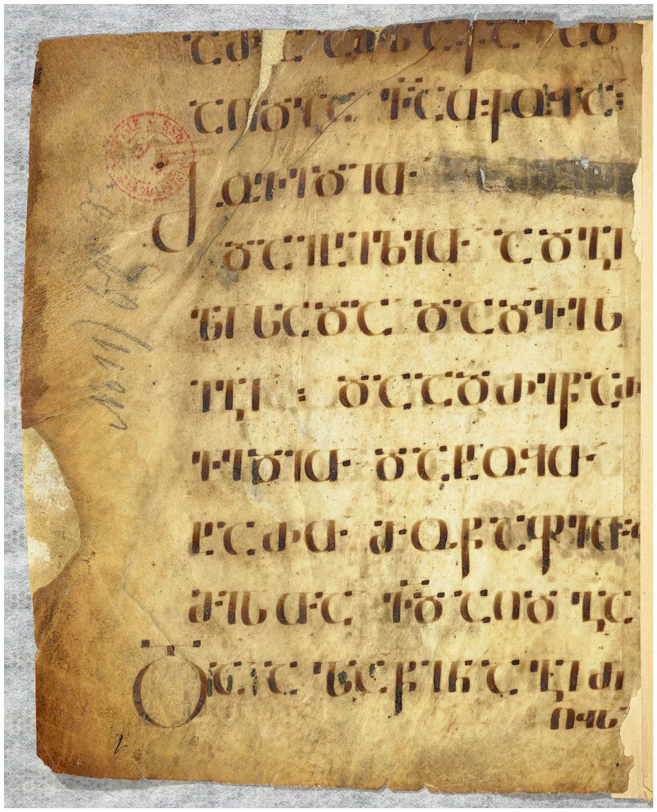
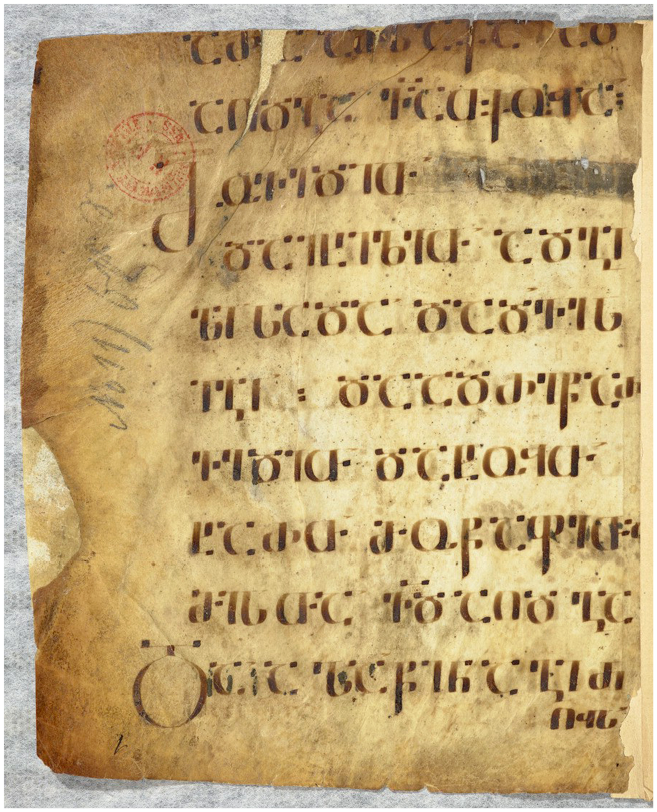
The articulation of culturally distinctive liturgical traditions demonstrates that the rendering of fundamental Christian texts into local languages need not acts of slavish duplication. Priests and monks in the Holy Land elaborated a medley of interrelated yet idiosyncratic liturgies that influenced the whole of Christendom. Usually directed by a bishop or presbyter, the liturgy commemorates God’s salvation through Christ while stressing the imperative of the Eucharist and other sacraments. It comprises fixed elements, such as vespers, alongside variable ones for specific dates, feasts, or seasons.Footnote 93 Among Georgians, Armenians, and Albanians, early liturgical engagement boosted interest in the New and Old Testaments and vice versa (see Figure 10).
Fifth-/sixth-century khanmeti fragment of the Lectionary. BnF Géorgien 30. See Outtier, “Reconstruction.”
Caucasia’s Christians followed the lead of their Levantine brethren by utilizing Jerusalem’s liturgy of St. James. Charles Renoux stresses the Caucasian churches’ adoption of “the Jerusalemite model as the basis for their services throughout the liturgical year, and it is clear that in doing so, they must have closely communicated with each other.”Footnote 94 Owing to their antiquity and state of preservation, Georgian and Armenian texts are the most comprehensive sources for the liturgical life of early Christian Jerusalem and wider Palestinian liturgy. Stig Simeon R. Frøyshov characterizes Georgian sources as “an essential, often unique, witness to the first millennium liturgy of Jerusalem.”Footnote 95 Daniel Galadza further categorizes Georgian manuscripts as “the most faithful witnesses” to Jerusalem’s stational liturgy. Georgian adherence to the Jerusalemite liturgy prevailed until the tenth/eleventh century, when the liturgy was harmonized with that of Constantinople – as happened in the Holy City itself. The late Georgian shift to the imperial liturgy belongs to the selective “Byzantinization” shepherded by the Georgian Church and crown.
Because most original Greek versions have vanished, Georgian and Armenian renditions of the Lectionary and related sources hold special importance.Footnote 96 In particular, ninth- and tenth-century manuscripts created by Georgian monks in the Holy Land and Sinai preserve much of Jerusalem’s ancient liturgical tradition. A particularly rich concentration of such manuscripts exists at St. Catherine’s monastery on Mt. Sinai. Its Georgian materials were microfilmed in the 1950s by the Library of Congress (USA). A fire in 1975 brought to light an unknown cache of religious manuscripts, many of which are Georgian.Footnote 97 This “new” Sinai collection includes numerous liturgical manuscripts. It is worth noting that Georgian witnesses of Jerusalem’s ancient liturgy have been known to scholars since the early 1900s, when they were publicized by Kekelidze.Footnote 98 Recent investigations by Lili Khevsuriani, Tinatin Chronz, Anna Kharanauli, and others are especially reliant on Sinaitic materials.Footnote 99 Robust engagements of the early Georgian liturgy by non-Georgians include studies by Renoux, Frøyshov, Outtier, Galadza, Stephen Shoemaker, and Jost Gippert. Such studies confirm the elaboration of the Jerusalemite liturgy in distinctive Georgian-language “pre-Athonite” versions, thus paralleling the evolution of biblical texts in Georgian.
Like early Georgian-language biblical translations, Georgian liturgical works attest the perseverance and evolution of Jerusalem’s – and Palestine’s – traditions across late antiquity. Specialists have identified three interlinked “pre-Athonite” liturgical subgroups in Georgian: kartuli (“Georgian”), principally from the fifth and sixth centuries; sabatsmiduri (“St. Saba”) associated especially with Mar Saba; and ierusalimuri (“Jerusalemite”), designating the Roman/Byzantine liturgy from the seventh/eighth century.Footnote 100 While much of the structure and content of liturgical services was unalterable, certain aspects could be added or manipulated. Some variations probably originated with Jerusalem’s ecclesiastical elite but are attested in Georgian for the first time. Georgian liturgical sources also contain distinctly Georgian features and, perhaps occasionally, those of other traditions including the East Syrian.
Related to Jerusalem’s ancient liturgy are others from Palestine, elaborated at places like Mar Saba, whose liturgy dates to the sixth century. At Mar Saba, Georgian (“Iberian”), “Bessian” (possibly Abasgis of western Georgia), Armenian, and Syrian brethren performed the daily liturgy in their own languages and assembled in common with others to celebrate the Eucharist in Greek.Footnote 101 This liturgy was designed for use within and beyond monastic milieux, as marriage services and prayers for pregnant women certify.Footnote 102
Four Georgian books impart the ancient Jerusalemite liturgy of St. James: the Euchologion; the Horologion; the Lectionary; and the Tropologion. They are not always attested for the same periods. The unchangeable or “ordinary” liturgy features in the Euchologion (kurtkhevani, “blessings”) and the fixed daily office – in the Horologion or Book of Hours (zhamni). Both fixed and moveable elements appear in the Lectionary (kanoni) as well as the Tropologion, Jerusalem’s hymnal known in Georgian as the iadgari.Footnote 103 Let us examine each of these liturgical books.
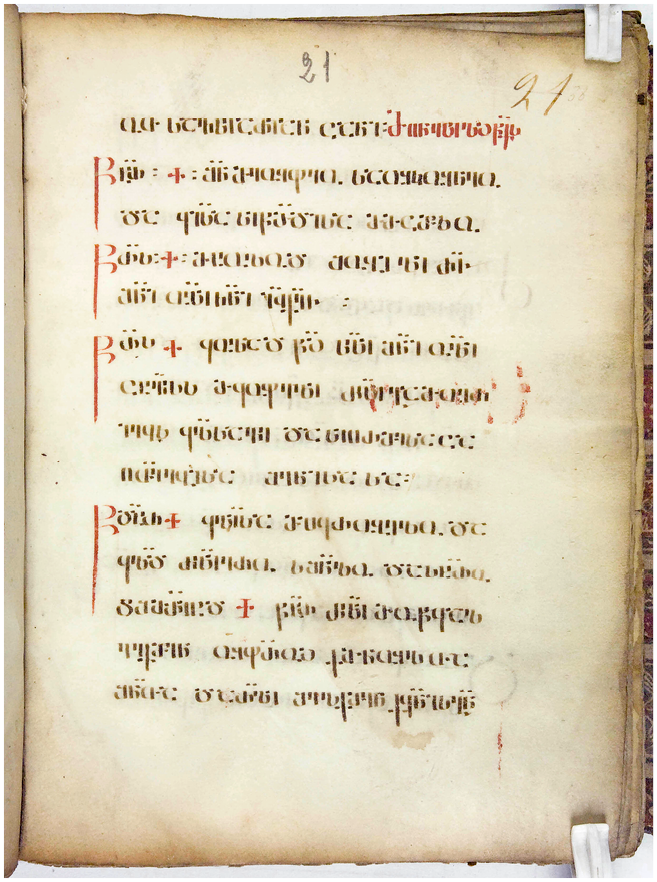
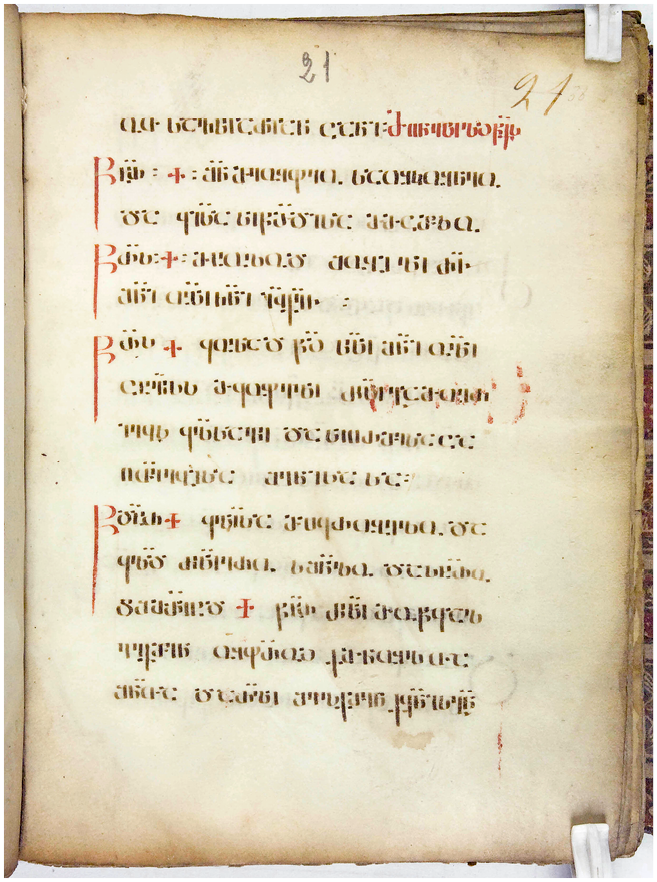
The Euchologion contains liturgical prayers conducted by bishops, priests, and deacons; it was used both in parish and monastic services (see Figure 11). It features the Eucharist and other sacraments, including rites for baptism, marriage, burial, ordination, and tonsure.Footnote 104 Greek and Syro-Palestinian witnesses survive, but the Georgian tradition is the most extensive. In 1912, Kekelidze published the only extant variant of Jerusalem’s pontifical Euchologion, containing services celebrated specifically by a bishop or archbishop.Footnote 105 It is preserved, for example, in NCM A-86, a manuscript copied for Katholikos Swmon (r. 1001–1011).
Euchologion. NCM A-86, 21r.
Early Georgian witnesses of the so-called Great Euchologion, which includes divine liturgies and other mysteries, date to the ninth to tenth centuries. These are found within compendia scholars call liturgical krebulni, “collections.” Though displaying variability in content, all but one of Sinai’s krebulni have a common structure: first, the Euchologion, with the Presanctified Gifts of St. James, litanies, dismissal prayers arranged in the annual liturgical cycle, other sacraments, and additional prayers; and second, the Lectionary.Footnote 106 A critical edition and translation of the Georgian Euchologion’s liturgy was published by Khevsuriani, Tseradze, Mzekala Shanidze, and Michael Kavtaria.Footnote 107 Articulated in short and long versions, the former is probably of greater antiquity. One did not replace the other: they were used side-by-side in the tenth and eleventh centuries.Footnote 108
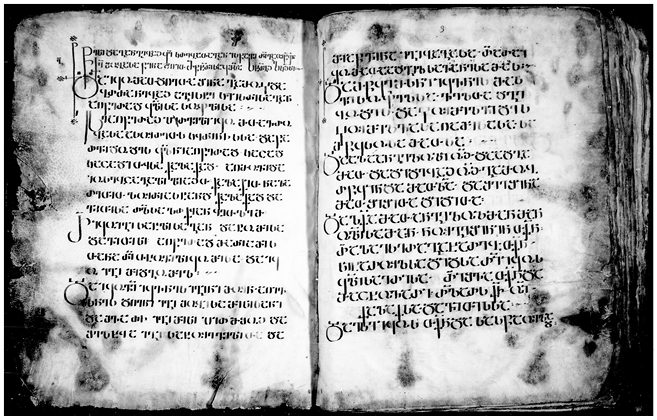
The Jerusalemite Lectionary is “perhaps the best known pre-Athonite Georgian liturgical book” and is characterized by greater plasticity than its later Constantinopolitan analogue (see Figure 12).Footnote 109 Kekelidze again pioneered the publication of its Georgian version. Since the 1960s, Michael Tarchnishvili’s edition and translation have been favored outside the former USSR.Footnote 110 However, Tarchnishvili’s masterwork predates the 1975 discovery of Sinai’s “new” collection, including nine (mostly fragmentary) copies of the Georgian Lectionary from the ninth to tenth century.
Tenth-century Georgian Lectionary, Sin.Geo.O.63.
The Georgian Lectionary is broadcast in “several chronologically succeeding redactions.”Footnote 111 The oldest specimens, the “khanmeti” group, consist of four fragments from the 600s. Together with archaic features in subsequent manuscripts, these early survivals place the origin of the Georgian Lectionary post-450Footnote 112; in comparison, the extant Armenian Lectionary echoes the mid-fifth century. In its surviving condition, the Georgian Lectionary conveys the Jerusalemite tradition as it developed from the fifth through eighth century.Footnote 113 Culturally specific features include allusions to saints specially venerated by Georgians: Nino, Shushanik, Evstati, Razhden, Habo, and Prince Archil.
The Georgian and ArmenianFootnote 114 Lectionaries comprehend all Old and New Testament readings for the liturgical year and “contain readings and psalms for the eucharistic synaxis that include references to the location of liturgical stations.”Footnote 115 However, the Georgian diverges from the Armenian in its attestation of liturgical services for every day of the year and its incorporation of hymns – the iadgari, called Tropologion in Greek – into the Liturgy of Hours and Eucharistic services. The Georgian Lectionary further integrates chants and psalms performed at the outset of the liturgical office, preceding the proclamation of the lections leading to the celebration, both before and after the reading of the evangelical pericope.Footnote 116
Emblematic of Caucasia’s Iranic condition, the word iadgari is neither a transcription of a Greek term nor a calque on Greek tropologion (> troparion, “hymn”). Old Georgian iadgari, reflecting Middle Iranian ayad, “memory” with the actor suffix -gar,Footnote 117 denotes veneration of the sacred by chant/song.Footnote 118 Some Christian Greek terms were adapted into Georgian early on, including eklesia (church), episkoposi (bishop), and katalikosi (katholikos/catholicus). But Christian terminology also paralleled and was adapted from Middle Iranian, sometimes via intermediaries like Armenian. Examples include iadgari, zhami (hour, hence liturgy), and eshmaki (devil). Other words, such as ghmerti (God) and tsmida (holy, saint; also tsminda), are local. Given the entanglements of Middle Iranian and the languages of southern Caucasia, it is not surprising that numerous Georgian and Armenian terms – religious and otherwise – are connected to Parthian, Middle Persian, and other Iranian languages.Footnote 119
Standing “at the apex of [Georgia’s] cultural heritage,”Footnote 120 the iadgari is the only direct vestige of the early Jerusalemite hymnal and confirms information about the liturgy divulged by the fourth-century pilgrim Egeria. It is often understood as a hymnographical supplement to the Lectionary and other liturgical books, including the Horologion.Footnote 121 As a liturgical book, the iadgari presents hymns in the same sequence as the Lectionary, but the latter’s hymns consist only of their opening notes (incipit). The musicological significance of the iadgari is considerable. It alone preserves the full cycle of hymns for each of the eight modes (“tones”) or melodies of Jerusalem’s Oktoechos. Indeed, Georgian sources suggest the existence of the full-fledged Oktoechos by the sixth century. An outstanding aspect of the eight-mode system attested by older versions of the iadgari is the Sunday Resurrection hymns for the vespers, matins, divine liturgy, and perhaps nocturns.Footnote 122
According to Shoemaker, the iadgari offers “a unique and almost entirely unknown resource for advancing our knowledge of early Christian liturgy and hymnography.”Footnote 123 Frøyshov adds: “[a]ncient stage hymnography is known in the form of a complete hymnal only in its Georgian translation. However, [some] Greek models … of the Ancient Iadgari have been identified within the preserved Greek hymnographical corpus.”Footnote 124 The iadgari sheds light on the Liturgy of Hours, the non-eucharistic services at fixed times each day. And it attests the development of Jerusalem’s ordinary Sunday worship, including the stational liturgy and the early theological definition of the laity.
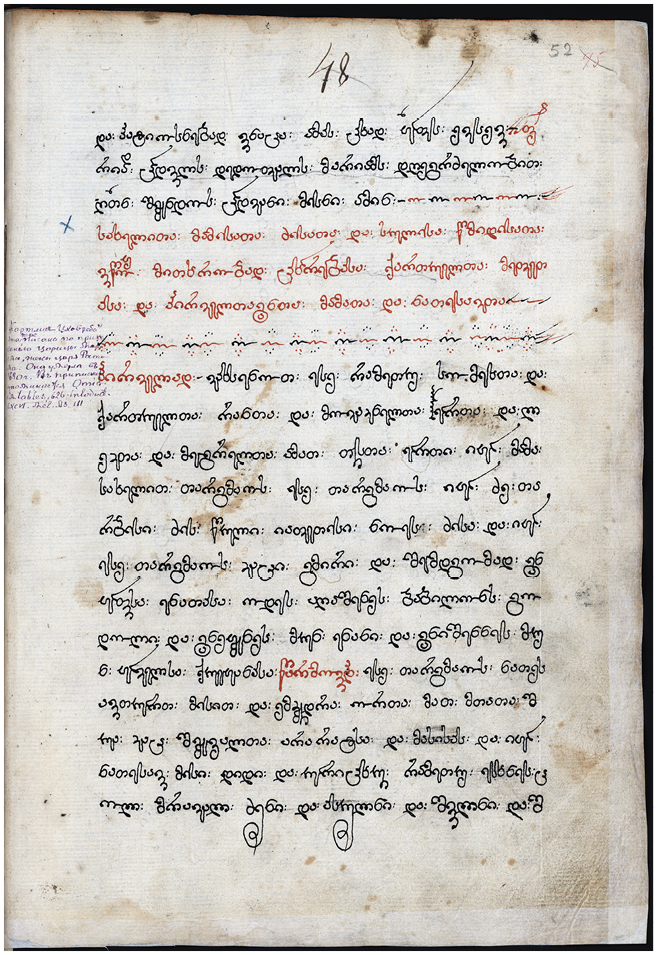
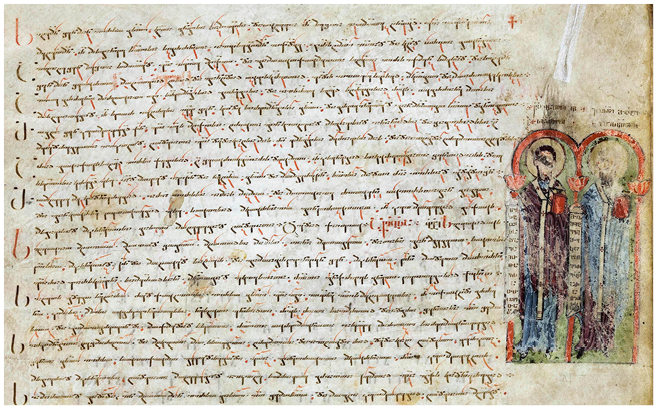
Like other ecclesiastical traditions, the iadgari evolved. By the tenth century, Georgians distinguished “new” (akhali) and “old(est)” (udzvelesi) iadgari. The former exhibits a reform of Georgian chant commencing ca. 600 and incorporates material from the Jerusalemite patriarch Sophronius, John of Damascus, and Cosmas the Melodist. Similar changes characterize Syriac and Greek survivals. Adhering to the “new” iadgari are the renowned tenth-century Georgian hymnographers Ioane Minchkhi, resident on Sinai, and Mikael Modrekili, who toiled at Shatberdi (see Figure 13).
Modrekili’s iadgari, copied at Shatberdi, 978–988. NCM S-425, 60r.
The “old” iadgari preserves ancient, pre-reform hymns and chants of Jerusalem. The oldest known iadgari text been traced to the turn of the fourth and fifth centuries.Footnote 125 It was expertly edited by Elene Metreveli, Tsiala Chankievi, and Khevsuriani.Footnote 126 Today, translations and studies of the iadgari in European languages continue to multiply. Renoux published a French translation of several hymns, including those devoted to the ResurrectionFootnote 127; Shoemaker – an English translation with parallel Georgian text of the oldest sections of Jerusalem’s hymnal; and Hans-Michael Schneider – a German translation of the commemoration of the Incarnation.Footnote 128 These are augmented by other studies of the “old” iadgari,Footnote 129 including articles by Peter Jeffery and Frøyshov and monographs by Galadza and Shoemaker.Footnote 130
Shoemaker’s interrogation of the oldest iadgari hymns, based on Sin.Geo.O.16 and Sin.Geo.O.40, necessitates a reappraisal of how early Christians perceived Mary. Many “old” Marian hymns predate the Third Ecumenical Council of Ephesus in 431, which profoundly reshaped Mary’s veneration. These early Georgian chants laud the pure and holy Mother of God, ghmrtismshobeli – a calque on Greek Theotokos.Footnote 131 Such traditions hold tremendous importance for Georgian Christianity, whose adoration of the Virgin Mary may be coterminous with its genesis. Other evidence for early Georgian devotion to Mary includes the Nino Cycle as well as Maximus the Confessor, to whom is attributed the Georgian rendition of the Greek Life of the Virgin. It was probably created at Mar Saba.Footnote 132
Georgian witnesses are crucial for the text of Jerusalem’s Book of Hours. The Horologion had long been known through secondhand sources like Egeria’s travelogue, Caucasian Lectionaries, and the Georgian iadgari. But Sin.Geo.O.34, Sin.Geo.N.23, and other tenth-century Georgian manuscripts transmit the Horologion directly. Though the opening and other parts are missing, the most important daily offices endure. Copied at Mar Saba and adjusted there and at Sinai, Sin.Geo.O.34 contains two versions of the Horologion. Zosime calls them “Sabaite” and “Georgian,”Footnote 133 the latter enshrining ancient Jerusalem practice. Zosime himself was one of the manuscript’s creators. It “seems to have been originally composed for a great church housing both a parish and a cenobitic community of ascetics or monks.” This must be the Holy Sepulchre.Footnote 134 Because its twenty-four offices were meant to be celebrated in common by monks, the Georgian Horologion developed, in part, within a monastic environment.
Just beyond our temporal purview, Georgian sources shed substantial light on the “Byzantinization” of Jerusalem’s liturgy in the eleventh century – a topic thoroughly examined by Galadza.Footnote 135 Despite the change, the earlier Jerusalemite tradition was not entirely snuffed out, as Georgian texts demonstrate. Thus, the oldest Horologion transmitted in Georgian manuscripts “is doubtless the predecessor of the Sabaite and Byzantine Horologia.”Footnote 136
2 Other Translated and Adapted Texts
Extant Georgian ecclesiastical texts are overwhelmingly beholden to Greek originals. Georgian biblical, liturgical, patristic, homiletic, and hagiographical works as well as exegesis, dogmatics, apocrypha, and other genres rest heavily upon Greek foundations. Because early Georgian religious literature, its surviving condition, “is overwhelmingly defined by translations of Greek texts, … it [is] a veritable wellspring for the study of the Byzantine literary tradition.”Footnote 137 But the association has sometimes been pushed too far. A monograph locating Georgian literature’s genesis and growth within a framework of sustained “Georgian-Byzantine literary contacts” stakes Georgian ancestry for Basil of Caesarea and other Cappadocian Fathers.Footnote 138 This ostentatious view has garnered little support.
Much has not survived, especially before Iveron. Some translations/adaptations from Greek have vanished completely. An intriguing candidate is Eusebius’ History of the Church, which Eptwme Mtatsmideli specifies in a list of unsuitable books. But does he have a Georgian-language version in mind?Footnote 139 Georgian translations/adaptations of some Greek texts survive only in fragments, often in palimpsests, or were reworked to the point that archaic features were lost. Significantly, Greek did not command a total monopoly. Greek sources sometimes entered Georgian through intermediaries. And some early Georgian religious texts were influenced by and rendered from traditions in other languages, notably Armenian, Arabic, and Syriac.
Religious texts could be translated/adapted into Georgian more than once and/or elaborated in multiple recensions of substantively the same translation/adaptation. The causes of this apparent duplication of labor include the quality, faithfulness, and comprehensiveness of earlier version(s); the provenance of the original or intermediary; and shifting theological postures. Starting in the late 900s, Iveron’s monks expedited revisions and wholesale retranslations based on Greek archetypes. As Nikoloz Aleksidze stresses, “a large number of texts, particularly those with heavy liturgical usage, even if translated early on, were often re-translated by the Athonites and later by their students and followers.” The oeuvre of Gregory Nazianzenus, for instance, was “translated within virtually all [Georgian] literary schools, both independently and as each other’s continuation.”Footnote 140 Basil of Caesarea’s Hexaemeron – a commentary on the Creation story of Genesis – was set into Georgian in the eighth century and retranslated about 300 years later at Iveron by Giorgi Mtatsmideli.Footnote 141 While Georgian Athonites led the most vigorous retranslation campaign, such efforts existed before, during, and after Iveron’s apogee.
We are again confronted with a relatively small number of fragments and the absence of whole and substantively complete manuscripts from the earliest stage of Georgian literature. Extant fragments include Vienna Codex georgicus 2, a palimpsest analyzed by Jost Gippert.Footnote 142 Its upper layer consists of a twelfth-century Menaion, liturgical materials for the month of May with variable hymns. But underwriting conveys portions of fourteen or more manuscripts deriving from the fifth/sixth to the tenth century. The Vienna Codex’s archaic khanmeti leaves, probably copied in Palestine, preserve remnants of biblical sources (including the earliest Georgian witnesses of Joshua and Judges), the Lectionary, and other texts such as the apocalypse of Zerubbabel, the Protevangelium of James, and hagiographies devoted to Cyprianus and Justina as well as Christina.
As noted, scriptoria and libraries outside Caucasia piloted the development of the earliest Georgian literature. They were perhaps responsible for its creation and conceivably for fashioning the first Georgian script. By the fifth century, Georgians were active in Jerusalem and its environs, near the Sea of Galilee, and in Gaza. Until the 900s, Georgians at Mar Saba in the Judean Desert played a leading literary role. In the Holy Land, ascetics from Caucasia guided the conveyance of religious texts, oftentimes Greek, into their mother tongues. Across Georgian Christianity’s inaugural millennium, Jerusalem and Palestine, and later Sinai, constituted the most prolific Georgian literary hub.
A major Georgian literary node blossomed on Caucasian soil after the displacement of elites from Islamic-controlled eastern Georgia during the Umayyad-Abbasid transition. (The amirate in Tbilisi, Arabic Tiflis, would come to an end only with its conquest by the Bagratid King Davit the Builder [Aghmashenebeli, r. 1089–1125]). In the eighth century, this Caucasus-based Georgian literary center incubated within the constellation of monasteries strewn across the Caucasian-Anatolian marchlands, including lands Georgians call Tao-Klarjeti and Shavsheti. The dissemination of Tao-Klarjetian manuscripts and ascetics across the Georgian monastic web is manifested by the contemporaneous surge of Tao-Klarjetian Bible manuscripts.
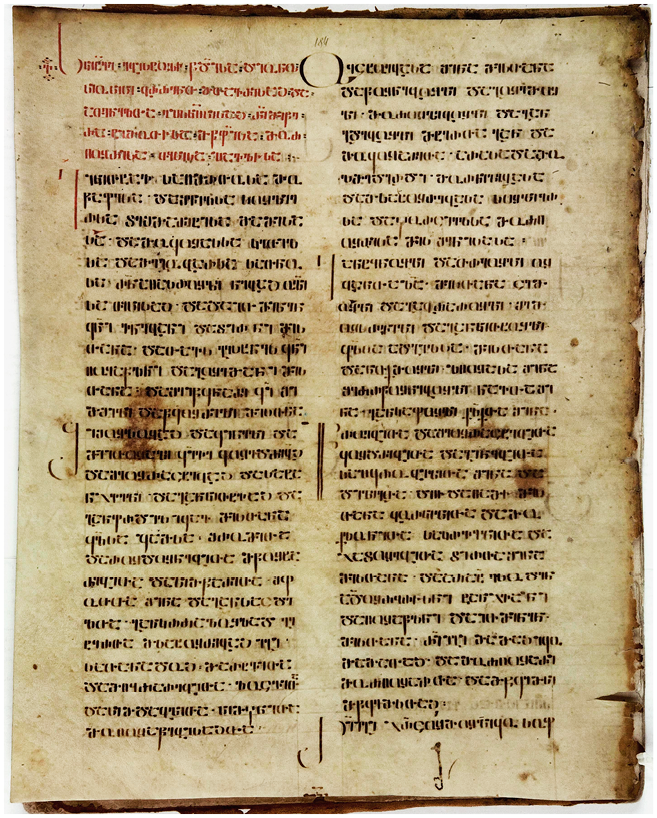
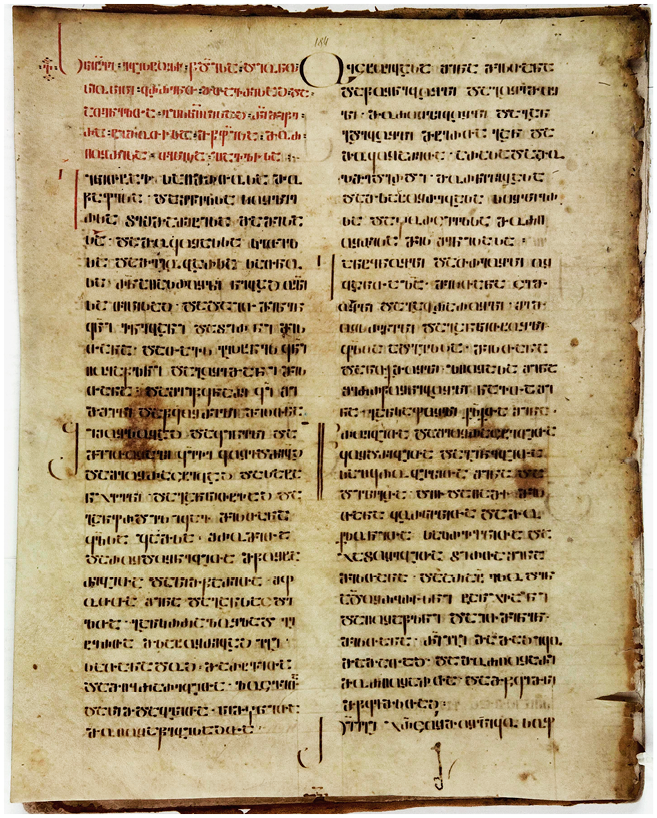
Among the prodigious output of Shatberdi, Khandzta, and companion scriptoria in Tao-Klarjeti are mravaltavis. Perhaps a calque on Greek polykephalos (though disputed by Gippert),Footnote 143 mravaltavis are compendia for liturgical purposes featuring homilies credited to Church Fathers, sermons, and some hagiographical matter.Footnote 144 Their content is variable. Fragments of an eighth-century mravaltavi, for instance, encompass works by John Chrysostom, Hesychius of Jerusalem, Severian of Gabala, and Antipater of Bostra. The Sinai mravaltavi of 864 is the oldest dated Georgian manuscript of any kind. Other important mravaltavis of the ninth to eleventh centuries are named after Athos, Udabno, Tbeti (see Figure 14), and Parkhali.
Tbeti mravaltavi. NCM A-19, 93v.
Edited and extensively investigated by Tamila Mgaloblishvili, lections of the tenth-century Klarjetian mravaltavi cover the second half of the liturgical year and are drawn from the Jerusalem tradition, as is characteristic of the genre.Footnote 145 All but ten of its sixty-three lections are translations from Greek. Embedded within this source are homilies of the Church Fathers, including renowned authorities like John Chrysostom, Ephrem the Syrian, Severian of Gabala, and Cyril of Jerusalem. The Klarjetian mravaltavi also incorporates a few original Georgian works: an excerpt of The Conversion of Georgia and sermons of the tenth-century Ioane Bolneli (John of Bolnisi).Footnote 146
Other kinds of religious manuscripts were produced in Tao-Klarjeti. One of the most renowned is the tenth-century Shatberdi Codex (NCM S-1141),Footnote 147 consisting of two distinctive parts: earlier leaves in the asomtavruli script and others in nuskhuri. Most of its fourteen texts were rendered from Greek by the ninth century. A few are based on Armenian originals. Alongside works by Gregory of Nyssa, Epiphanius of Cyprus, Basil of Caesarea, and Hippolytus of Rome, appears an original Georgian-language narrative: the oldest nearly complete version of Moktsevay kartlisay, the heart of the Nino Cycle. Commemorating the Christianization of King Mirian, this compendium is named after its earliest component, The Conversion of Georgia. The insertion of the story of Georgia’s royal Christianization among works of ecumenical distinction legitimized the Georgian Church and bolstered its claims of autonomy.
Back in Palestine, disruptions from competing Islamic amirates in the tenth century triggered the migration of Ioane Zosime and his companions from the Judean Desert to Mt. Sinai. The Georgian community on Sinai endured until the sixteenth century.Footnote 148 Zosime’s egress, however, did not portend a mass Georgian exodus from Jerusalem and its environs. Remaining hagiopolite Georgians won occasional favor from Muslim overlords. In the mid-eleventh century, the ex-Sabaite Prokhore – originally from Shavsheti – founded the Monastery of the Holy Cross, which thrived until the 1700s.
Of great importance is Sinai’s “new” Georgian collection, some manuscripts of which are directly connected to Zosime. In addition to liturgical materials (with the PsalterFootnote 149), the collection’s texts include, for example, John Chrysostom’s On Fear of God and Repentance; Alexander of Cyprus’ On the Invention of the Cross; and sermons by the Sinai fathers. Sin.Geo.N.48 and Sin.Geo.N.50 of St. Catherine’s “new” Georgian collection, both from the early tenth century, preserve portions of two previously unknown versions of The Conversion of Georgia. Palimpsests are common among Sinai’s Georgian manuscripts. For example, Sin.Geo.O.34 conveys the iadgari and homilies copied on Sinai by Zosime and others (and surviving as the palimpsests’ upper layers).Footnote 150 The underwriting of the parchment reused by Zosime – which he may personally have brought from Palestine – consists of Palestinian Aramaic renderings of Old Testament books, New Testament pericopes for the Jerusalem Lectionary, as well as homiletic and hagiographical texts.
Hagiography is prominent in Sinai’s Georgian holdings. Consider the upper-layer of palimpsest Sin.Geo.N.13, an assemblage of ascetica and hagiographies from the tenth to eleventh century. It launches with Athanasius of Alexandria’s vita of Antony the Great. Remarkably, all three Christian Caucasian languages and their scripts occur in this palimpsest: most underwriting is Caucasian Albanian though some is Armenian.Footnote 151 The tenth-century hagiographical compendium Sin.Geo.N.3 includes translations of the passions of Philotheus, Mamas, and Peter of Alexandria, along with The Commemoration of the Blessed Pelagia. The manuscript begins with the eighth-century Martyrdom of Habo, an original Georgian narrative featuring an Arab convert to Georgian Christianity.Footnote 152 Habo and Archil, martyred in Georgia by Muslim rulers, are often evoked in Georgian texts circulating in the Holy Land. Original hagiographies are rarely transmitted in their own manuscripts and collections exclusively of original Georgian works. An exception among Sinai’s “new” manuscripts is Sin.Geo.N.50 from the first half of the tenth century. Its 105 folios impart Moktsevay kartlisay and original vitae of Iovane Zedazneli (John of Zedazeni) and Abibo Nekreseli (Abibo of Nekresi), two of the Thirteen Syrian Fathers.Footnote 153
Hagiography was a favorite genre of early Christian Georgian translators, scribes, and authors. Liturgical concerns helped to fuel this affection. In the words of Bernadette Martin-Hisard, hagiography at first developed “to supply the liturgy with the texts – readings and hymns – for the celebration of the feasts of the saints in accordance with the liturgical calendar. A Georgian Calendar compiled on Mt. Sinai in the tenth century and the development of Georgian mravaltavi bear further witness to the liturgical needs that soon made translations indispensable.”Footnote 154 Hagiography affirmed God’s existence in post-apostolic times. In addition, original hagiographies were devices for promoting local/regional Christian heroes, defining a distinctive Georgian Christianity, and cementing the legitimacy of the Georgian Church.
The first hagiographies in Georgian were passions commemorating the suffering and martyrdom of holy men and women. In Old Georgian, such narratives are called tsamebay, “witness” (later “torture, torment”) and martwlobay, “martyrdom,” from Greek martys, “martyr.” Soon thereafter, vitae were also translated/adapted and composed in Georgian. Their biographically driven tales were designated tskhorebay (tskhovreba), “life,” mirroring Latin vita and Greek bios.
Though known Georgian translations/adaptations of hagiography and other ecclesiastical texts often proceed from Greek, some reflect originals and traditions in other languages. There was an East Syrian influence upon early Georgian literature, but it tended to be indirect and sometimes filtered through Armenian.Footnote 155 Its medieval impact was greater, when interactions of Georgian and Syriac speakers increased in the Holy Land, Sinai, and, in the tenth to thirteenth centuries, the environs of Antioch.Footnote 156 Georgian manuscripts were produced on the Black Mountain, whose medieval literary school – like Iveron’s – was oriented toward Byzantium and favored Greek texts. Among its renowned translators are Giorgi Mtatsmideli (prior to his residency at Iveron), Eprem Mtsire (Ephrem the Lesser), and his pupil Arsen Iqaltoeli (Arsen of Iqalto). Their Hellenophile translations utilize Greek intermediaries for original Syriac texts,Footnote 157 as is the case for works attributed to Ephrem the Syrian. Rarely, Syriac served as an intermediary for originals in other tongues. The Life of Porphyry of Gaza, initially composed in Greek, entered Georgian through a lost Syriac version.Footnote 158
The rendering of Christian Arabic texts into Georgian is examined by Tamar Pataridze.Footnote 159 Such activity converged on the Judean Desert monasteries of Mar Saba and Mar Chariton in the eighth to tenth century. Many examples entail Greek originals rendered into Arabic and then Georgian. One of the best-known candidates is The Persian Conquest of Jerusalem in 614 composed by a certain Strategius of Mar Saba. The lost Greek archetype endures through Arabic and Georgian versions.Footnote 160 A compelling case for the Georgian Sacking of Jerusalem (Tsartquevnay ierusalemisay) being based directly on Greek is made by Shoemaker and Sean Anthony, though specialists usually regard the Georgian to be dependent upon Arabic.Footnote 161 The Georgian was created no later than the 900s, its oldest manuscript belonging to the next century (see Figure 15). Early Georgian histories (see Section 4) report the Sasanian capture of Jerusalem but exhibit no direct knowledge of Strategius.
Persian Conquest of Jerusalem, in a Menologion copied in 1038–1040 by Prokhore, founder of the Monastery of the Holy Cross. Bodleian MS.Georg.b.1, 124r. Creative Commons CC BY-NC 4.0.
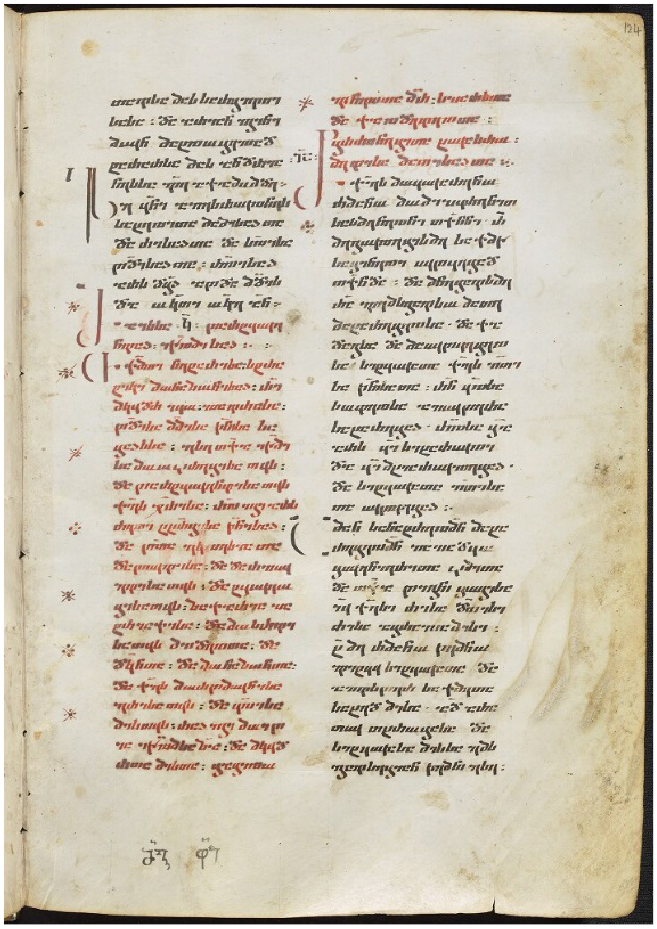
Texts entering Georgian via Arabic are mostly hagiographical. The Killing of the Holy Fathers at Sinai and Raithu pays tribute to the murder of ascetics by nomads in fourth-century Sinai. The vanished Coptic original was rendered into Greek and then Arabic, upon which the Georgian is based.Footnote 162 The Georgian version is transmitted in the Sinai mravaltavi, copied at Mar Saba in the mid-ninth century but named for its current repository. Another Greek text penetrating Georgian via Arabic is The Life of Stephen the Sabaite.Footnote 163 The extant Georgian manuscript dates to 983; the Georgian text was created earlier that century at Mar Saba. Adhering to the same arc of transmission is The Life of Cyriacus by the sixth-century Cyril of Scythopolis. Cyriacus (Kyriakos) was a fifth-century Palestinian ascetic at Mar Chariton, where Georgians also toiled. Gérard Garitte revealed the Georgian vita to contain peculiarities of an Arabic intermediary.Footnote 164
Pataridze discusses two vitae passing from Syriac into Arabic and then Georgian. Both appear in NCM A-249, a tenth-/eleventh-century collection (krebuli) from Palestine. The trajectory of The Life of Nisime (Onesimus) was first resolved by Nani Tsakadze (see Figure 16). Though disputed by Michel van Esbroeck, the path via Syriac and then Arabic was confirmed by Pataridze and Outtier.
Life of Nisime. NCM A-249, 51r.
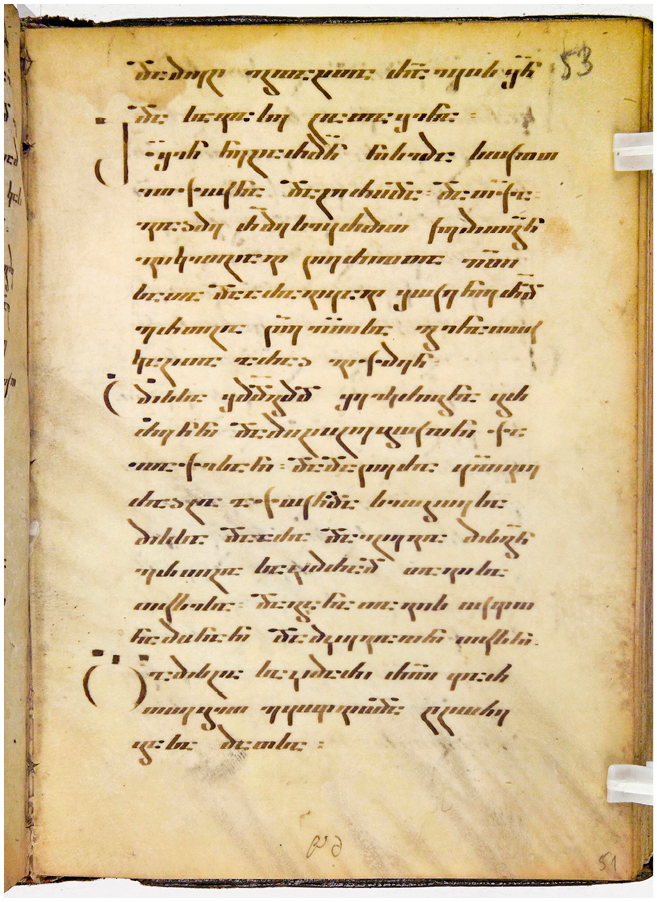
Versions in all three languages are connected to Mar Saba; a Georgian colophon indicates the work’s “translat[ion] at the lavra of Mar Saba.”Footnote 165 Outtier established the transmission from Syriac and then to Arabic and Georgian of the other text, The Life of Ephrem the Syrian.Footnote 166 A-249 also conveys an apocryphal text about Joseph of Arimathea – The Story of the Foundation of the Church of Lydda – that proceeded from Greek to Syriac and on to Arabic and Georgian.Footnote 167
A small number of Christian Arabic originals reached Georgian, sometimes through intermediaries. The vita of John of Damascus, born into a Christian Arab family and renowned for his defense of icons, was written by the Arab monk Michael. Its Arabic archetype passed into Georgian via Greek.Footnote 168 The analogous textual voyage of The Passion of Michael the Sabaite was uncovered by Paul Peeters and corroborated by Sidney Griffith and Monica Blanchard.Footnote 169 The earliest Georgian witness is preserved in the tenth-century manuscript from Iveron (Geo.8). Its title affirms a spurious association with “Abukura,” the Melkite Theodore Abu Qurrah from Edessa who wrote in Syriac and Arabic.Footnote 170 In the preface, the supposed narrator Basil of Emesa claims to have met Abu Qurrah, whose edifying tale launches this work. Perhaps entering Georgian directly from Arabic are separate passions of Peter of Capitolias and Romanus the Neomartyr.Footnote 171 The latter, a monk from Galatia, was martyred by the Arabs in the late eighth century. The Georgian title identifies its author as Stephen of Damascus, a monk at Mar Saba. The original text, probably Arabic, is lost.
Through Arabic was transmitted other kinds of religious literature in Georgian. The Cave of Treasures, an ecumenically popular apocryphon, is named for the site where the banished Adam and Eve supposedly hoarded relics pilfered from Paradise.Footnote 172 Originally composed in Syriac, the narrative was adapted into Georgian, Arabic, Coptic, Geʽez, and other languages. The Georgian “covers the entire text of the Syriac original … [and] incorporates the text of the apocryphal Testament of Adam …”Footnote 173 The Cave of Treasures may have entered Georgian as a stand-alone text; among its extant manuscripts is Kutaisi 128, copied in the fifteenth/sixteenth century. In addition, the Georgian Cave of Treasures was inserted wholesale into a late-medieval recension of Kartlis tskhovreba, the Georgian Royal Annals. Surviving in the Mariamiseuli and Machabliseuli manuscripts of Kartlis tskhovreba, the Georgian Cave of Treasures appears first, before the Life of the Kings’ treatment of Georgian ethnogenesis and state formation. Kekelidze conjectured the Georgian translator of Cave of Treasures to have been the eleventh-century archbishop Leonti Mroveli,Footnote 174 who edited – and perhaps first assembled – Kartlis tskhovreba. But this intriguing identification is no longer accepted.
Also achieving wide popularity is The Tale of Barlaam and Ioasaph, whose literary odyssey began in Arabic (and perhaps even Middle Iranian, Sogdian, etc.) and proceeded into Georgian and thence Greek. Set in India, the fictional narrative centers on the Christianization of Prince Ioasaph by the hermit Barlaam. The Georgian adaptation endures in two versions: the ninth-century Balavariani and the shorter Wisdom of Balahvar.Footnote 175 Considering its Arabic original, Robert Volk’s hypothesis of Mar Saba as the birthplace of the initial Georgian rendering is attractive.Footnote 176 The Georgian Balavariani was translated into Greek on Athos by Eptwme Mtatsmideli at the zenith of Georgian-Byzantine interaction.Footnote 177 The wide appeal of this Christian retelling of the Buddha’s life is affirmed by the survival of some 150 manuscripts of its Greek version.
3 Original Hagiography
Hagiography’s magnetism permeated the whole of late antique Christendom. Among early Georgian translators, the attraction soon morphed into the writing of original narratives, glorifying holy women and men connected to Georgia.Footnote 178 Because autograph manuscripts and initial copies do not survive, approximate dates of composition hinge on internal criteria, comparison, and contextualization. Such methodologies confidently place the advent of original hagiography – and hence original Georgian literature – about 150 years after Mirian.
The Passion of Shushanik was composed in the late fifth century. Its earliest witness, however, is transmitted in the eleventh-century Parkhali mravaltavi (NCM A-95). The lone surviving copy of The Passion of the Nine Children of Kolay, penned sometime between the fifth and seventh century, occurs in a tenth-century hagiographical collection from Mt. Athos (Iveron Geo.8). The Martyrdom of Evstati, written no later than the early 600s, is conveyed in manuscripts starting in the tenth/eleventh century (NCM H-341). This triad of oldest original Georgian texts contains no explicit dates, though synchronisms attuned to Sasanian shahanshahs situate the tales of Shushanik and Evstati. The same convention is deployed in early Georgian and Armenian inscriptions, including the fifth-century foundational inscription of Bolnisi Sioni, Georgia’s oldest extant church edifice.Footnote 179
Explicit indications of authorship are atypical in early original Georgian literature. This may be intentional. Authorial affirmations might detract from the glory of God, Christ, and the saints. Authorship might further betray texts to have been composed or heavily revised well after the purported events they describe. Early hagiographies extolling the martyrdoms of the children of Kolay and Evstati are anonymous. The received Passion of Shushanik is credited to the holy woman’s priest-confessor Iakob Tsurtaveli (Jacob of Tsurtavi), who fleetingly surfaces in the narrative. The attribution is not iron-clad. In a similar vein, places of composition are unspecified. Sites within Georgia are attractive given the tales’ settings in Caucasia. But monastic environments in the Holy Land are feasible.
Consensus positions The Passion of Shushanik as the oldest (known) original Georgian work. However, the distinction may belong to The Passion of the Nine Children of Kolay.Footnote 180 Internal criteria situate the latter’s composition as early as the fifth and before the seventh century. A generic presentation suffuses the tale with universal relevance across time and space. The text is unencumbered by particulars, including names, dates, and toponyms besides its setting in the “large village” of Kolay. Called Kol (Kogh) in Armenian (cf. Turkish Göle), Kolay was located in the Caucasian-Anatolian frontier near Kura River’s source.Footnote 181 According to the anonymous hagiographer, Kolay had a mixed population of “pagans” (tsarmartni, here possibly Zoroastrians) and some Christians. Children of both religious persuasions played together. When the priest rang a bell each evening, Christians young and old flocked to the church for vespers and prayers.Footnote 182 Curious “pagan” playmates followed but were refused entry until they obtained religious instruction. After the ex-“pagans” were baptized on a dark winter’s night in the Kura River, they were forcibly collected and beaten by their parents. Alluring gifts failed to restore the children to “paganism,” so the parents appealed to the local prince (mtavari). He enjoined them to remedy the situation as they wished. Having ousted the priest, the familial mob dug a pit near the baptism site and cast their children into it, crushing their skulls.
Original hagiography from early Christian Caucasia accentuates children and especially women and, as we have seen, counts them among the martyrs.Footnote 183 In the Armenians’ Gregory Cycle, the martyrdom of Hripsime and her female companions, all foreigners, is a crucial step toward King Trdat’s conversion.Footnote 184 Another foreign woman, Nino, is the central character of Georgian conversion tales. Depicted in extant Georgian sources as a survivor of the Hripsimian massacre, she escaped to the Georgian royal seat Mtskheta.Footnote 185 There Nino secured the conversion of Queen Nana and then of her spouse Mirian – the only known case of a late antique royal conversion guided by a holy woman. Pious women are featured in other Georgian literary genres, including original historiography. An example is Sagdukht, daughter of the Sasanian marzban based in Caucasian Albania. The future mother of Vakhtang, Sagdukht, married the Christian Georgian King Mirdat V (r. 435–447), converted from Zoroastrianism, and sponsored the construction of the Samshwlde Sioni (Zion) church.Footnote 186
Another prominent holy woman is Shushanik, daughter of Vardan Mamikonean, the Armenian nakharar (nobleman) who led the ill-fated 450–451 insurrection against the Sasanians. Shushanik’s Armenianness was not a detriment to her commemoration in Georgian hagiographical and historiographical sources. Her husband Varsken (Armenian Vazgen) administered a strategic stretch of the Armeno-Georgian marchlands. Its border-lords were styled pitiakhshi in Georgian and bdeashkh in Armenian, both echoing Middle Iranian bitakhsh. Some pitiakhshis, like Varsken, envisioned themselves as bona fide monarchs independent of the Armenian and Georgian crowns, to whom they were typically subordinated.Footnote 187 Varsken’s identity is ambiguous, yet modern observers habitually describe him as Georgian. The confusion stems partly from the contemporaneous designations of the bicultural Armeno-Georgian frontier. Armenians called it the “[march of] Georgia [Virk]” and Gugark. But to Georgians it was the “[march of] Armenia [Somkhiti].”
Consumed by political ambition, Varksen renounced Christianity, embraced Zoroastrianism, and pledged fidelity to the Sasanian shahanshah. Shushanik resisted her husband’s determined efforts to detach her from Christianity. At first, Varsken confined Shushanik to a cell, where she lived as a hermit. She was occasionally visited by the local archbishop and his priests and deacons, all of whom – pursuant to the Iranic social pattern – were attached to Varsken’s domains. The irritated pitiakhshi resorted to alternate methods, including a futile intervention by relatives and banishment to the castle’s dungeon. Meanwhile, Varsken forced his children into Zoroastrianism. In her seventh year underground, the languishing Shushanik finally succumbed. The Georgian passion was penned soon after her ca. 475 death (see Figure 17).
Passion of Shushanik, Parkhali mravaltavi. NCM A-95, from 353r.
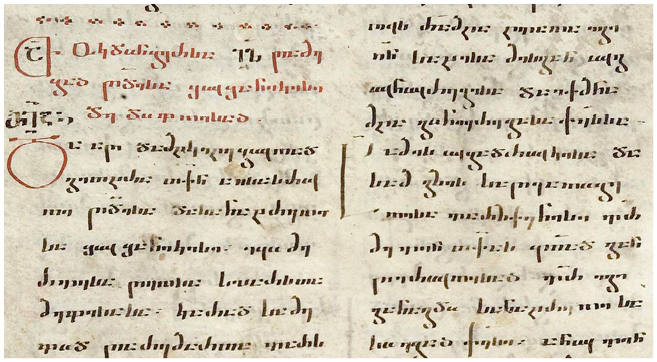
When the embryonic Armenian and Georgian “national” churches permanently broke communion in the early 600s, each voiced competitive devotion to Shushanik’s memory. The Book of Letters (Girk Tltots), an Armenian anthology of ecclesiastical correspondence, evokes Shushanik’s Armenian lineage and connection to Trdat’s conversion to vindicate the transregional primacy avowed by the Armenian Church. Not surprisingly, Shushanik’s travails became celebrated in separate Georgian- and Armenian-language hagiographies. While fundamentally aligned with the Georgian narrative, the Armenian displays noteworthy divergences, including allusions to Hripsime and Nino. Shushanik’s Georgian and Armenian passions are rival but entangled traditions: one is not a direct translation of the other. The textual relationship has attracted some of the brightest luminaries of Caucasiology, including Ilia Abuladze and Paruyr Muradyan.Footnote 188 The latter proposed a lost common source of uncertain language for the extant Georgian and Armenian versions.
An obsession with foreigners punctuates early original Georgian texts, as we have seen with the Armenian Shushanik, the “Roman” Nino, and the Parthian Mirian.Footnote 189 Alongside them was the martyr Razhden, a Christianized Persian or Parthian who served the Georgian King Vakhtang Gorgasali (r. 447–522), Sagdukht’s son.Footnote 190 Another Christianizing Persian/Parthian, Gwrobandak, renamed Evstati (Eustathius) after baptism, was murdered in Georgia soon after 600 – though most scholars place his death a few decades earlier.Footnote 191 Sometime in the sixth century, the Thirteen Syrian Fathers migrated to Georgia and established the area’s first monasteries and lavras or at least were among the first to implant communal monastic practice (see Figure 18).Footnote 192 The Christianized Arab Habo was martyred in Georgia in 786.
Garesja (Gareja) monastic complex, Kakheti, a well-known foundation of the Thirteen Syrian Fathers.
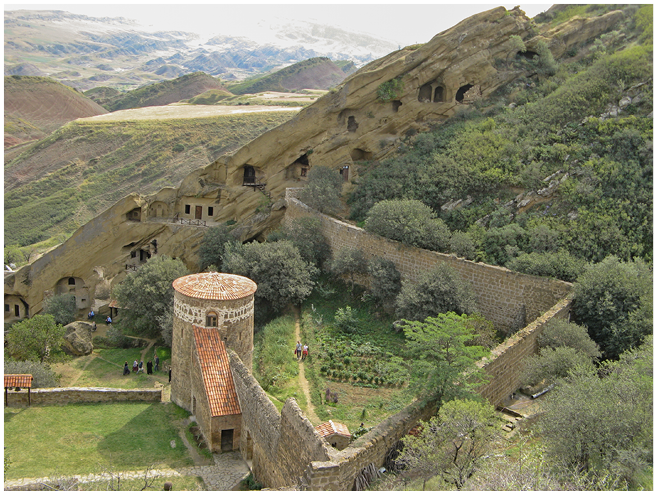
Three patterns stand out. First, early Georgian hagiographies frequently accentuate apostasy and Christianization. Narratives glorifying Evstati and Razhden feature apostasy from the Zoroastrianisms of the Sasanian Empire; the ex-Zoroastrian Evstati may have converted to Christianity directly from an intermediate faith, Manichaeism; and the inverted Varsken apostatized from Christianity and embraced Zoroastrianism. Second, Georgian hagiographical commemorations of outlanders are not confined to martyrs, as evidenced by the Thirteen Syrian Fathers. Finally, admired strangers represent peoples concentrated mostly south of the Georgian heartland, thus mirroring the primary orientation of early Georgian Christianity: Armenians, Persians/Parthians, Syrians, and Arabs. (Possibly) apart from Nino, “Romans” – especially Greeks – are not among them. Significantly, Nino’s categorical identification as a “Roman” from Cappadocia is stressed in texts only from the ninth/tenth century and later. This may be a deliberate Georgian attempt to harness the prestige of the Roman Empire, thus paralleling the early medieval aggrandizement of her Jerusalemite connections. But it also matched Gregory the Illuminator’s Cappadocian ties.
By highlighting religious choice while prioritizing Christianity’s virtue, Georgian hagiographers exalted and avowed the superiority of their faith through the pious acts of Georgians and non-Georgians alike. Some authors make clear that conversion to Georgian Christianity was accompanied by conversion to Georgian culture, as is claimed for the Parthian Mirian and, as we shall see, Habo. As part of their conversion to Georgian Christianity, some foreigners (and locals) took new names as outward signs of their religious and cultural renewal. Gwrobandak became Evstati and Murvan/Nabarnugios – Peter “the Iberian.”
In Georgian, hagiographical acclamations of strangers reach into Islamic times. Iovane Sabanis-dze (John, son of SabanFootnote 193), author of The Passion of Habo, praises an Arab perfumer serving the Georgian prince Nerse (see Figure 19). Habo “learned to read and write and converse freely in Georgian,”Footnote 194 studied the Bible, and was baptized clandestinely. A Muslim Arab from the heart of the Caliphate thus transformed himself into a Christian Georgian, a change meant to epitomize the virtues of Georgian identity and the claimed superiority of Christianity over Islam – generally replicating Evstati’s conversion from Zoroastrianism. Having run afoul of Arab authorities, Nerse and his entourage sought refuge in the Caucasus highlands and subsequently journeyed to Abkhazia (Apkhazeti), whose Christian rulers feted Habo. But the homesick Nerse wished to return to eastern Georgia. Dismissing calls to conceal his conversion, Habo was apprehended by agents of the Muslim amir of Tbilisi and executed in 786.
Passion of Habo, Parkhali mravaltavi. NCM A-95, 145v.
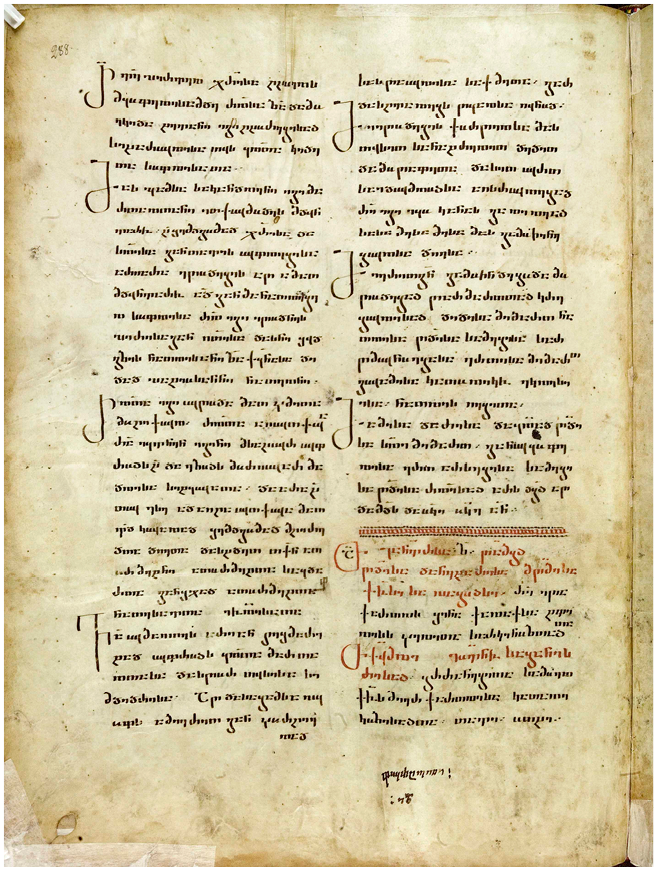
Biblical imagery augmented the fascination with strangers in Christian Caucasia. In Matthew 25.35, Jesus says that “… I was a stranger and you welcomed me …” In Hebrews 13.2, Paul writes: “Do not neglect to show hospitality to strangers, for by doing that some have entertained angels without knowing it.” Analogous ideas punctuate the Hebrew Bible. The divine commandment of Exodus 23.9 proclaims: “You shall not oppress a resident alien; you know the heart of an alien, for you were aliens in the land of Egypt.” Though influential, biblical tropes only partially explain the fixation upon strangers in Christian Caucasia. Of greater importance are the region’s multi- and cross-cultural character, mobility, and connections to Mesopotamia, Iran, Anatolia, and Eurasian Steppe. Face-to-face encounters with outsiders were not uncommon in Caucasia and were not restricted to religious settings.
Strangers are the central heroes of early original Georgian hagiographies. Even in their received forms, which were prone to adjustment, these texts capture the plurality of early Christianity in Caucasia. While they encapsulate the contours of a nascent Georgian Christianity, their primary aim is the validation of Christianity in Georgian settings through the acts of pious women and men, whoever they might be. Georgians emerge as principal characters only in the eighth century,Footnote 195 when much of southern Caucasia was under Islamic hegemony and as the Georgian “national” church was maturing. To this era belongs the vita of Serapion Zarzmeli, credited to the monk’s pupil Basil. Among Serapion’s achievements was the construction of the Zarzma monastery on a hillside in Samtskhe in west-central Georgia. Contemporaneous original hagiographies feature martyrdoms ordered by Muslim officials. The victims are now Georgians. The Passion of Archil thus commemorates the martyrdom of the presiding prince (r. 736–786, during the Georgian interregnum ca. 580–813) by command of the Abbasid governor Khuzayma ibn Khazim.Footnote 196 It is preserved uniquely in Kartlis tskhovreba, the main Georgian compendium of royal historiography.
The Life and Passion of Kostanti-Kakhay, composed in the ninth/tenth century and surviving in manuscripts from the seventeenth/eighteenth century,Footnote 197 celebrates a Georgian nobleman who amassed considerable wealth under Islamic dominion. With these riches Kostanti (Constantine) supported monks, priests, orphans, widows, and the poor. He reportedly made a pilgrimage to Jerusalem. Back in Georgia, the elderly Kostanti was arrested during the reported anti-Christian sweep of 853 – though the narrative accuracy founders since Muslims and other non-Muslims were also victimized. According to the vita, Kostanti’s torture was ordered by Bugha, the Turkish general headquartered in Tbilisi.Footnote 198 Kostanti was hauled before the Caliph Jafar al-Mutawakkil, who demanded the Georgian’s acceptance of Islam. Kostanti refused. Two Muslim converts from the Armeno-Georgian frontier were dispatched to Kostanti’s cell, but their persuasions failed. In 853, al-Mutawakkil ordered Kostanti’s beheading. In the text’s final stanza, the martyr’s family received a condolence letter from Byzantine Emperor Michael III (r. 842–867).
Early modern manuscripts transmitting Kostanti’s vita also contain The Passion of Gobron, composed by Stepanoz Mtbevari (Stephen of Tbeti) in the early tenth century. Mtbevari recounts the murder of Gobron during military operations of Yusuf ibn Abi’l-Saj. These were among the last Abbasid expeditions conducted in Georgian domains. Yusuf’s invasion proceeded from the Sajids’ base in Azerbaijan, through the Tbilisi amirate, and into the southwestern territories of Javakheti and Samtskhe. In their course, the Georgian general Gobron was detained. Pressure mounted for his conversion to Islam, but Gobron resisted despite being forced to watch the execution of 133 comrades. The penalty for impertinence was beheading.
Akin to translated/adapted ecclesiastical works, some original Georgian hagiographies are “living” traditions. Alterations of Shushanik’s passion seem to have been minimal.Footnote 199 By contrast, the beginning of Evstati’s passion must have been thoroughly reworked or appended later. The adjustment constitutes a medieval effort to reconcile Evstati’s unconventional trajectory to Christianity. The young Iranian Gwrobandak – to use his birth name – was expected to follow his father into the Zoroastrian priesthood. First, however, he may have joined a Manichaean congregation in his hometown Ganzak in northwestern Iran.Footnote 200 From there he migrated to Georgia, where he converted to Christianity and took a Christian name and wife. If Evstati actually Christianized for the first time in Iran, as the muddled narrative literally asserts, he likely belonged to the Church of the East. But a second Christian baptism is hard to explain.
Georgian hagiographies could be comprehensively rewritten, as the vitae of the Thirteen Syrian Fathers show. Though these holy men lived in the 500s, their earliest extant vitae date to the tenth century. The presumed originals are lost. What prompted the recasting of the tradition? It is often argued, with good reason, that the Thirteen Syrian Fathers were non-Chaledonians, probably miaphysites, who sought refuge in Caucasia from persecutions in Roman Syria.Footnote 201 Throughout its history Caucasia has been a place of sanctuary, concealment, and imprisonment – an idea evoked in ancient mythology, such as the biblical tales of Gog and Magog and the Greek myth about Prometheus. Early Christian exiles to Caucasia include the ecumenical hero Maximus the Confessor, whose writings became popular among Georgians.Footnote 202
Georgians imagined their past through pulses of remembering and forgetting, a phenomenon contributing to the elaboration of multiple versions of the same text. For religious traditions, some adjustments were animated by theological and Christological evolution. In a splendid monograph, Nikoloz Aleksidze probes memories of the schism Armenians declared with the Georgians in 607.Footnote 203 The realities of the formal break – a convoluted, contested, decades-long process – and its selective remembrance shaped the historical memories of all parties. For Georgians, the schism and all it represents conditioned, to varying degrees, the transmission of existing ecclesiastical literature and the production of new texts. Starting in the early seventh century, the emergent Georgian “national” church deemed itself administratively autonomous, whereas its Armenian counterpart claimed to helm an ongoing ecclesiastical “protectorate” over Christian Caucasia. The incipient Georgian “national” church aligned itself with the Romano-Byzantine Church and the dyophysitism of Chalcedon. If the theorized original Georgian vitae of the Thirteen Syrian Fathers had championed a non-Chalcedonian Christology and/or had laid bare Caucasia’s plural religious environment, we can understand the later impulse to reconfigure them. Significantly, the systematic revision of these vitae was not an imperative until the tenth century and later, well after the start of the schism. At this later time, the rejuvenated Georgian Church emphasized traditions affirming its ancient and staunch commitment to Chalcedonian orthodoxy. Georgian monasteries were flourishing in Caucasia and abroad, and the Bagratids had restored Georgian kingship.
Such is the framework for divergent traditions about Petre kartveli, popularly known as Peter the Iberian.Footnote 204 Born ca. 413/417 with the name MurvanFootnote 205 to the Christian pitiakhshi of the Armeno-Georgian marchlands, Peter was sent to Constantinople in 429 as a hostage of Emperor Theodosius II (r. 408–450). Eight years later, Peter and a companion from Lazika, John the Eunuch, absconded to the Holy Land. Peter initially entered the monastery of Melania the Younger on the Mount of Olives. Around 445, he was ordained as priest by Paul, bishop of Maiuma in Gaza. In 449, Paul attended the Second Council of Ephesus, disparaged by rival dyophysites as “the Robber Council.”
When the bishopric of Maiuma fell vacant, Jerusalem’s anti-Chalcedonian patriarch installed Peter as bishop. Peter’s monastery in Gaza matured into a renowned miaphysite intellectual center. Among its students was Severus of Antioch.Footnote 206 But none of Peter’s expressly miaphysite activities are disclosed in the surviving Georgian-language vita. Instead, it presents him as orthodox, adhering to – or at least not defying – dyophysitism. The received Georgian memory of Peter the Iberian, like that of the Thirteen Syrian Fathers, was scrubbed and repackaged as immaculately Chalcedonian.Footnote 207 Precisely when this occurred is not entirely clear. However, it seems that the Georgian vitae of Peter and the Thirteen Syrian Fathers were all comprehensively revamped around the tenth century.Footnote 208 This was an age of political and religious consolidation as both church and realm engaged Byzantine models to an unprecedented extent.
An alternative image is proffered by Peter’s pupil John Rufus. Originally composed in Greek, The Life of Peter the Iberian survives exclusively in Syriac and was not rendered into Georgian. Rufus anchors Peter’s piety in the Christian devotion of his family back in Caucasia, though the vita does not always get things right about Peter’s boyhood. Peter’s father Bosmarios was not “king” of the IberiansFootnote 209 but pitiakhshi of the Armeno-Georgian frontier – though some border lords imagined themselves as kings. The name of the woman “who raised” Peter, Zuzo, may distort Georgian dedamdzudze (> dzudzu, “breast”), a wetnurse or female tutor – a primary institution of the Iranic world.Footnote 210 According to Rufus, Peter left Caucasia for good when he was dispatched to Theodosius’ court. The young man did not forget his homeland. He brought bones of Iranian martyrs and deposited them in a Constantinopolitan shrine located in the chamber where he practiced asceticism.Footnote 211 The Iranic matrix of early Christian Caucasia shines brightly.
Once in Palestine, Rufus writes, Peter soared within miaphysite ranks. As ascetics at Mar Saba and across the Judean Desert came to favor Chalcedon’s dyophysitism, their counterparts clustered in Gaza mostly opposed it. The Syriac vita structures the adult Peter’s spiritual life around antipathy to Chalcedon. Peter’s deathbed exhortation to his brethren underscores the one true path to salvation: “First, indeed, they should keep the orthodox (i.e. miaphysite) faith accurately and without change until death and reject and curse all heresies, expressly the Council of Chalcedon, and reject and curse the wicked Tome of Leo …”Footnote 212 Peter urged his adherents to seek the sanctity of the soul and body, to maintain restraint in speech, to meditate, and to read Basil the Great’s tract on asceticism, Questions of the Brethren.
Some researchers have credited Peter the Iberian with theological writings ascribed to Dionysius the Aeropagite.Footnote 213 The historical Dionysius was an Athenian citizen converted by the apostle Paul and who served as the city’s first bishop. Texts spuriously hitched to his name, however, belong to the fifth/sixth century. Peter the Iberian is but one of several illustrious figures to have been associated with the so-called Corpus Aeropagiticum. Others include Severus of Antioch and Peter the Fuller. Though roundly discounted in scholarship,Footnote 214 Peter’s purported creation of the influential Aeropagite corpus found a champion in Shalva Nutsubidze. This modern philosopher prescribed a long-term influence of Ps.-Dionysius on Georgian literature, particularly the beloved Knight in the Panther’s Skin (Vepkhistqaosani) attributed to Shota Rustaveli. In Nutsubidze’s view, the cultural efflorescence embodied by this thirteenth-century epic poem was an “Eastern Renaissance,” anticipating that of Western Europe by centuries.Footnote 215 Patriotic yearnings aside, the epics popular across Christian Caucasia merit careful contextualized study. The Knight in the Panther’s Skin was by no means the first expression of Iranic epic literature in Christian Georgia. Its forebears, arising in late antiquity, are entwined with early Georgian conceptions of historiography.
4 Original Historiography
Already in late antiquity, Georgians, Armenians, and probably Caucasian Albanians put distinctive traditions of their dynastic political elites into writing. Yet Georgian historiography tends to languish on the literary sidelines, thanks to scholars’ prioritization of religious sources; their unnecessarily narrow definition of historiography; reputedly late texts and manuscripts; and the strong penchant for Graeco-Roman/Byzantine and Armenian sources among specialists outside the Georgian Republic. The ingrained, oft-repeated ideological dichotomy of Christianity/Rome-Byzantium/Europe/West and Zoroastrianism/Iran/non-Europe/East is another factor.
One of the underrated values of original Georgian historiography is its complication of Caucasia’s persistent image as an extension of Christian Romano-Byzantine “civilization.” While medieval Georgians often saw themselves as part of a Christian ecumene moored to Constantinople, Georgian culture was never a Romano-Byzantine sibling, even under the Byzantine-leaning Bagratids. Earlier, late antique Caucasia belonged first and foremost to the Iranic world, a condition established by Nicholas Adontz, Cyril Toumanoff, Nina Garsoïan, James Russell, and others. Before, during, and after Christianization, Caucasia’s peoples – and not only Georgians – belonged and contributed to the Iranic expanse while articulating their own identities, including distinctive strains of Zoroastrianism and Christianity.
Georgia’s Iranic dimensions tend to be engaged more openly, consistently, and deeply in historiographical than religious sources – a trait shared with Armenian literature. Nevertheless, scholars often ignore, sidestep, or misrepresent early Georgian historiography. Even a cursory examination reveals early Georgian historiography’s deployment of an Iranic onomasticon and vocabulary (a quality transcending literary genres, including ecclesiastical ones); its geographical and historical horizons are Iran and the Iranic world; and its narrative structure is an original formulation of the Iranic epic.Footnote 216 In terms of content, production, and transmission, early Georgian religious texts sometimes impart real and desired connections to the Christian Roman Empire. However, their historiographical counterparts, which accentuate political culture, more clearly divulge Caucasia’s belonging to the dynamic Iranic world, stretching from Central Asia, through Persia/Parthia, Mesopotamia, to Caucasia and Anatolia. Caucasia’s membership in this commonwealth by no means ceased with Christianization. Its distinctive Iranic society and identities remained intact but evolved in new ways as Christianity was molded to the region’s Iranic matrix.
Unlike their Armenian neighbors, early Christian Georgians’ interest in Classical and Romano-Byzantine historiography was subdued. The discrepancy rests partly on western Armenia’s annexation and “Romanization” under Justinian (r. 527–565).Footnote 217 While foundational works like Eusebius’ Chronicle and Socrates of Constantinople’s ecclesiastical historyFootnote 218 were adapted into Armenian, there is no indisputable evidence that any Romano-Byzantine histories, even church histories, were put into Georgian. Similarly, there are no irrefutable instances in which early Georgian historians directly employed Romano-Byzantine historiographical sources. Ostensible citations of concrete texts such as The Conversion of the Greeks are, in fact, vague Georgian acknowledgements of foreign traditions.Footnote 219 Heightening the sense of unfamiliarity with Romans are sparse references to specific emperors in early Georgian historiography. The chief exceptions are Constantine, Jovian (r. 363–364), and Heraclius (r. 610–641), only the last of whom is engaged near-contemporaneously and in any detail. More telling, the basic structure of early Georgian historiographical works was not Romano-Byzantine but Iranic.Footnote 220
Early Georgian hagiography and historiography are enmeshed despite differing purposes, sites of production, and modes of transmission. The former regularly incorporates historiographical features, especially its engagement of the dynastic monarchy. The convergence of genres explains why tskhorebay (tskhovreba) “life,” titles vitae and extant histories alike.Footnote 221 The overlap is further manifest by two hagiographies inserted wholesale into the historiographical compendium Kartlis tskhovreba, The Life of Georgia. (Though none of its component texts are proper chronicles arranged by dates, Kartlis tskhovreba is popularly called the “Georgian Chronicles.”Footnote 222) In extant manuscripts, the corpus’ original account of the Christianization of King Mirian – which must have been intrinsically Iranic in accord with the surviving Life of the Kings – is entirely replaced with the hagiographical Life of Nino. And between the continuation of the history of King Vakhtang Gorgasali and The Book of Georgia (Matiane kartlisay) appears The Passion of Archil. Consistent with Kartlis tskhovreba’s royal(ist) perspective, both hagiographies spotlight political figures.
Unusually, the hagiographical Life of Nino appears in two independent Georgian compendia: the historiographical Kartlis tskhovreba and the ecclesiastical Moktsevay kartlisay, the last of which preserves conversion texts of the Nino Cycle. Kartlis tskhovreba’s oldest Georgian-language witness, the Anaseuli or Queen Anna redaction (NCM Q-795), was copied at the end of the fifteenth century. However, the corpus’ earliest extant manuscript contains its Armenian-language adaptation, Patmutiwn Vrats (History of the Georgians).Footnote 223 Matenadaran 1902 was copied sometime between 1274 and 1311. Without question, Kartlis tskhovreba transmits old traditions. Its earliest texts, as received, took shape around 800. For its part, the oldest nearly complete version of Moktsevay kartlisay appears in the tenth-century Shatberdi Codex. Moktsevay kartlisay’s two-chambered heart is the seventh-century Conversion of Georgia and the dependent Life of Nino of the ninth/tenth century. Both anonymousFootnote 224 texts are predicated upon old oral and perhaps lost written traditions. Their earliest layers echo the fourth century – probably through oral traditions – and generally accord with the brief tradition enshrined by Rufinus (ca. 400).
As the Georgian “national” church coalesced in the early 600s, its leadership yearned for a standard account of their organization’s origin vouchsafing autonomy through ancient beginnings. The succinct Conversion of Georgia staked basic jurisdictional claims, but its limitations were palpable. This stimulated the composition of the narratively rich Life of Nino in the ninth/tenth century (see Figure 20). Appreciably extending The Conversion of Georgia, the vita incorporates old traditions from alternate (lost) sources as well as deliberate innovations, such as an amplified role in Nino’s proselytization efforts by ex-Jews, including Mtskheta’s rabbi and his daughter.Footnote 225 Abiatar is “a new Paul” and his daughter Sidonia with other Jewish women are among Nino’s earliest converts. The text even credits Sidonia with composing part of Nino’s ninth-/tenth-century vita! Further, The Life of Nino inflates genuine bonds to Jerusalem by expounding upon the presence in Mtskheta of two biblical relics bridging Jewish and Christian antiquity: Elijah’s mantle and Jesus’ tunic.Footnote 226 That Moktsevay kartlisay has come down to us in as many as three recensions reflects the ongoing Georgian adjustment of its conversion stories after their initial composition.
Life of Nino, Shatberdi Codex. NCM S-1141, 223v.
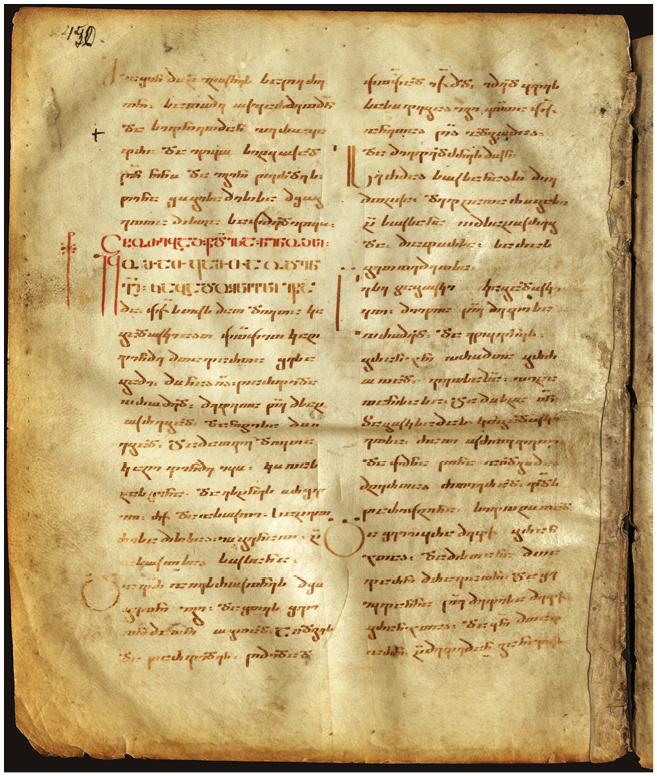
It is striking that the earlier Conversion was not discarded with the appearance of The Life of Nino. Instead, The Conversion was incorporated into Moktsevay kartlisay. Both conversion tales circulated concurrently, a phenomenon also exhibited, for example, by the short and long recensions of the Georgian Euchologion. Soon after the composition of The Life of Nino, four brief historiographical tracts were conjoined to it and the earlier Conversion of Georgia, thus completing Moktsevay kartlisay. The corpus’ non-hagiographical components – The Primary History of Georgia and three Royal Lists, as named by Toumanoff – supply basic historical context for the fourth-century conversion of Georgia’s monarchy.Footnote 227 We again see the intersection of hagiography and historiography. While Moktsevay kartlisay’s succinct historiographical works impart information similar to – and often in harmony with – Kartlis tskhovreba’s early components, the two sets of sources neither are identical nor translations of one another. Instead, they enshrine a common but evolving and multilayered tradition.
Components of Moktsevay kartlisay
1. Primary History of Georgia
2. Royal List I
3. Conversion of Georgia
4. Royal List II
5. Royal List III
6. Life of Nino
The Life of Nino quickly became the textual anthem of Georgia’s Christianization. As Leonti Mroveli comprehensively edited (and perhaps first assembled) Kartlis tskhovreba in the eleventh century, this archbishop-editor may have replaced the original Iranic account of the first Christian king Mirian with the entire Life of Nino. In addition, Mroveli is likely responsible for interjecting biblical waymarks into The Life of the Kings, the only component of Kartlis tskhovreba devoted to pre-Christian times. One announces Jesus’ birth within the reign of King Aderk.Footnote 228
Though they are hagiographical monuments to Nino’s travails, The Conversion of Georgia and The Life of Nino exhibit historiographical features. The Christianization of the eastern Georgian crown, which she guided, is the axis of both narratives. Even for the protracted interregnum ca. 580–888, Kartlis tskhovreba’s component texts champion the notion of dynastic kingship, hence Toumanoff’s designation “Georgian Royal Annals.” The blurring of Georgian historiography and hagiography helps to explain why the vitae of Nino and Archil, with their accent upon political elites, are not jarring departures within the historiographical Kartlis tskhovreba.
Though its composite nature is indisputable, Kartlis tskhovreba is too often treated as a single monolithic source. Assuredly, the corpus’ texts were homogenized through medieval editing. Further narrative and structural smoothing stems from extensive reediting ca. 1700 by order of King Vakhtang VI, hence the later recension’s name, Vakhtangiseuli.Footnote 229 Though somewhat obscured by editorial polishing, the core of Kartlis tskhovreba consists of twelve – and in one pre-Vakhtangiseuli recension, thirteen – late antique and medieval texts extending to the Mongol era. The first five texts of the received corpus are gathered into two suites, a consequence of previous editing. Placed at the start of Kartlis tskhovreba, the tripartite Tskhorebay kartvelta mepeta consists of The Life of the Kings, about Georgian ethnogenesis and pre-Christian history and lending its name to the entire suite; The Life of Nino; and a short treatment of the early Christian Chosroid (Georgianized Mihranid) monarchs. Arranged next is Tskhorebay vakhtang gorgaslisa, containing: The Life of Vakhtang Gorgasali, the suite’s namesake; and an untitled continuation ascribed to Juansher Juansheriani, though this attribution is suspect.
Initial Components of Kartlis tskhovreba
1. Life of the Kings
2. Life of Nino
3. Life of the Successors of Mirian
4. Life of Vakhtang
5. Ps.-Juansher’s continuation
6. Passion of Archil
1 + 2 + 3 = suite Tskhorebay kartvelta mepeta
4 + 5 = suite Tskhorebay vakhtang gorgaslisa
1–4 = dependent upon the lost Hambavi mepeta
Besides the inserted vita of Nino and narrative about early Chosroids kings, the main components of the two suites attained their received states ca. 800 and no later than Ashot’s accession as the first Bagratid presiding prince in 813. Toumanoff and others have persuasively established this chronology, although some experts advocate an eleventh-century date, during the zenith of Bagratid rule.
Elsewhere I have proposed that the received Life of the Kings, Life of Vakhtang, and its continuation are based mostly on a lost Georgian epic-history from the sixth century, which might be called Hambavi mepeta, Tale of the Kings.Footnote 230 Building upon preexisting oral traditions, Hambavi’s author(s) lived in a Christian environment and presumably was/were Christians. His/their understanding of Georgian history – from its mythical inception through the establishment of eastern Georgian kingship in early Hellenistic times and to the Christianization of the local monarchy – is attuned to Iranic epic-history and not Romano-Byzantine models. In fact, Georgians, Armenians, and Caucasian Albanians creatively articulated their history in Iranic terms, creating their own renditions of the Iranic epic interlaced with actual people, places, events, and institutions. As presented, Georgia’s pre-Christian monarchs parallel hero-kings of the Iranian epic, elaborations of which include the lost Khwaday-namag and the later Shahnama of Ferdowsi. Significantly, Hambavi mepeta was an original Georgian text paralleling and not a slavish rehashing of the Khwaday-namag tradition. Georgians were generally aware of the Khwaday-namag, as an allusion to The Life of the Iranians in the Georgian Life of the Kings shows. But as with its reference to The Conversion of the Greeks, this acknowledges a foreign tradition, perhaps in oral form, and does not certify direct familiarity or usage of written source, Persian or otherwise.Footnote 231
That the lost Hambavi mepeta was an original Georgian work is evident in its tale – repeated in the extant Life of the Kings (see Figure 21) – of eastern Georgia’s semi-mythical first monarch Parnavaz. Assuming kingship at the collapse of the Achaemenid Empire, Parnavaz bears an Iranic name announcing his possession of khwarrah (farnah), the sacral luminescence confirming sanction to rule in Zoroastrian milieux. This tradition presents Parnavaz as a foundational Iranic king credited with first organizing eastern Georgian society. Starting with Parnavaz, legitimate pre-Christian monarchs successfully engaged in one-on-one contests and commanded a corps of champion bumberazis. Whether reality, a literary trope, or some combination of the two, Caucasia’s Iranic society manifests itself yet again.
Start of Life of the Kings, Kartlis tskhovreba’s Mariamiseuli redaction. NCM S-30, p. 95(52).
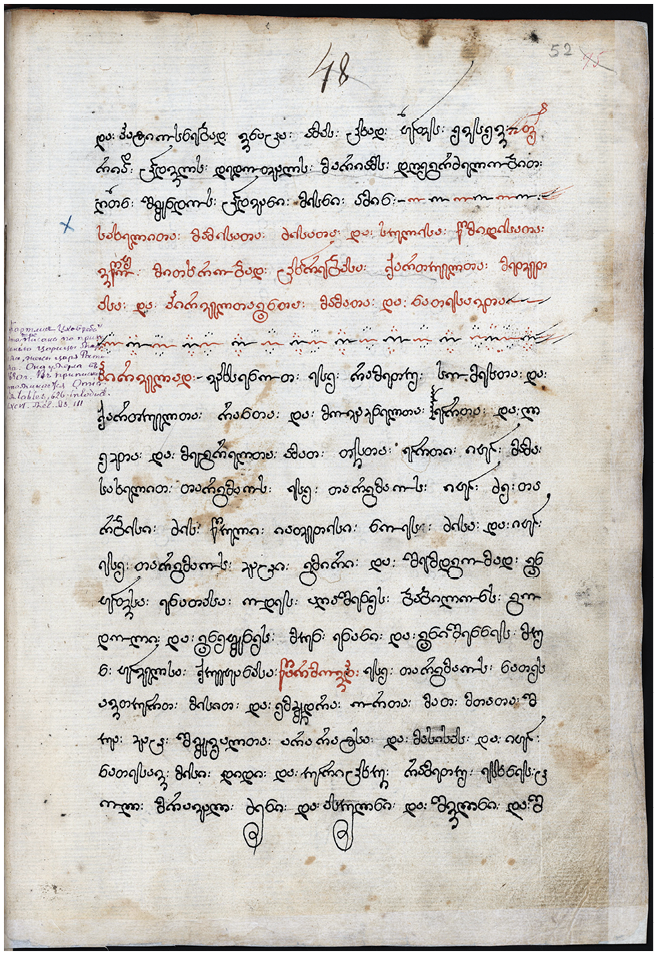
Analogous imagery – with nominal religious adjustment – is applied to the early Christian kings of eastern Georgia. The lost Hambavi mepeta, the main source for Kartlis tskhovreba’s oldest components, must have been replete with such images. The first Christian monarch of the Georgians would have been described in this Iranic manner in the original complete Life of the Kings, which was based heavily upon Hambavi mepeta. But sometime before the thirteenth century, The Life of the Kings’ original Iranic presentation of the Christianizing phase of Mirian’s reign was (r)ejected and entirely replaced with the hagiographical Life of Nino. This substitution may have been carried out by the archbishop-editor Leonti Mroveli. The switch conceivably occurred ca. 800, when extensive sections of Hambavi mepeta were refashioned into the nuclei of the two initial received suites of Kartlis tskhovreba. The same phenomenon surfaces in Armenian historiography, whose Epic Histories commences abruptly with the third book, though with no replacement text. The surviving narrative lacks what was surely an Iranic presentation of Trdat, the first Christian Armenian king.Footnote 232
The most elaborate Iranic depiction of a Christian Georgian king involves Vakhtang Gorgasali (r. 447–522, according to Toumanoff but contested). A mishmash of history and myth typifying Iranic epics and early Georgian historiography, the anonymous Life of Vakhtang is the first Georgian history structured principally around a solitary ruler. Its Vakhtang is an Iranic hero-king without equal, essentially a super-bumberazi eclipsing all other champions.Footnote 233 Faithfully adhering to the lost Hambavi mepeta, the received Life of Vakhtang recounts one-on-one contests pitting its hotshot protagonist against a cavalcade of gigantic opponents, termed goliati (cf. “goliath”) and gmiri (“hero”). Besides a lone Roman logothete, all hailed from the Iranic universe. Like his “pagan” analogues, the Christian Vakhtang was endowed with khwarrah, the Georgian didebay designating “greatness” and, in Christian contexts, “glory.” Vakhtang’s sacral radiance emanated from a Christian, not Zoroastrian, fount. Further, the text avows political and diplomatic alliances between Christian Georgia and the Zoroastrian Sasanians. In one instance, Vakhtang and the Sasanian shahanshah pooled forces and invaded the Roman Empire. Later, when censured by the king of Sind for consorting with Sasanians, Vakhtang retorted that Iranians were his kin.
The Life of the Kings and The Life of Vakhtang together paint Chosroid Georgia as an autonomous mini-Sasanian Empire of the north. Their Chosroids are Georgianized Christian Sasanians – not acculturated Parthians/Mihranids – who unsuccessfully laid claim to the throne of Iran. Georgian Khosroiani denotes “descendant of Khusro,” a generic throne name peoples of Caucasia, Romans, and others applied to Sasanians. But in early Georgian historiography, Chosroid monarchs are endowed with a deeper Iranian/Iranic legitimacy. Addressing his troops, the Christian Vakhtang boasts of his family’s biological descent from the biblical Nimrod, the world’s first great king and founder of Iran’s monarchy.Footnote 234 Vakhtang further proclaims Zoroastrianism an honorable faith because it venerates the same Creator God as Christianity and Judaism. This proposition flows from the “civilizational” and religious chains around which early Christian Georgians conceived their past.
Archaic Iran (established by Nimrod) → Achaemenid Persia → Arsacid Parthia → Sasanian Empire → (after an interruption) Seljuks
Ancient Greek city-states → Alexander/Hellenistic world → Rome/Byzantium
Zoroastrianism → Judaism → Christianity (but not Islam).
In light of the religious continuum and the religious plurality of early Christian Caucasia, it should be noted that early Georgian literature is remarkably devoid of polemical works, whether condemnations of other religions or invectives against heresy.Footnote 235 Early Christian Georgians had no Eznik, the well-known Armenian polemicist of the fifth century.Footnote 236
Vakhtang’s Iranic portrayal neither is accidental nor is it chiefly the product of the (later) Islamic rejuvenation of the Iranic/Iranian epic. Further, received Iranic imagery has not tarnished the devotion Georgians have showered upon Vakhtang ever since. Vakhtang is one of the few pre-Bagratid Georgian kings celebrated by name in medieval Bagratid histories, which insistently paint Georgia in Byzantine and Byzantine-like hues. Today, Vakhtang remains a hero of the brightest magnitude. An imposing Soviet-era statue of Vakhtang on horseback stands vigil beside the Metekhi church across from Tbilisi’s old town.
The long seventh century was an age of transformation, reflection, and historiographical development in Caucasia.Footnote 237 During the last war of antiquity, the Roman Emperor Heraclius (r. 610–641) marched his soldiers through Georgian and Armenian lands into the Sasanian heartland, vanquishing its rulers. Heraclius’ appearance in Caucasia made a deep impression within the region. Romans exploited the situation to expand their hegemony, and this accelerated the Georgian Church’s alignment with its imperial counterpart. For the seventh century, Byzantinists often cite the rich Armenian history ascribed to Sebeos. But three early Georgian historiographical sources also engage this eraFootnote 238: Ps.-Juansher’s continuation of The Life of Vakhtang, Royal List II, and the eleventh-century history of Sumbat Davitis-dze, all of which reflect a common tradition.
A prospective Georgian celebrity of the age is curiously absent from surviving texts. Before Heraclius’ trek through the isthmus, Katholikos Kwrion had spearheaded the Georgian Church’s drive toward autonomy and closer relations with dyophysite Romans. Both brought him into conflict with the miaphysite Armenian Church, which declared schism in 607. In uncertain circumstances, Kwrion vacated or was ejected from the Georgian katholikosate. Thereafter, he was bishop of the Roman-controlled littoral city of Phasis (modern-day Poti?).Footnote 239 Heraclius grasped Kwrion’s talents and elevated him to the esteemed position of patriarch of Alexandria. But Kwrion’s tenure in Egypt permanently stained his legacy: having persecuted miaphysite Copts, he surrendered Roman Egypt to the Arabs.
Despite his high profile, or because of it, the disgraced Kwrion was forgotten. This is remarkable since early original Georgian historiography names many chief prelates of the Georgian Church. At first, these men bore the title of bishop and then archbishop. Most of them, if not all, were foreigners, including Greeks, Armenians, and Iranians. Received texts situate the Georgian Church’s attainment of autonomy within Vakhtang’s reign. Its prelate was upgraded to katholikos (catholicus), a title likewise employed in neighboring Iranic settings, including Armenia and Albania as well as Sasanian Iran by the Church of the East.Footnote 240 Only from the mid-500s were katholikoi drawn from Georgian families.
Late antique Georgian sources attest the attachment of bishops to great noble houses and their estates, the social keystone of Iranic Caucasia. In Shushanik’s Passion, a bishopric coincided with the estate of the pitiakhshi in the Armeno-Georgian marchlands. Mtskheta’s prelates were attached to royal domains. Unlike parts of Roman Anatolia, Caucasia was not intensely urbanized. But as transpired in the Roman Empire and elsewhere, Caucasia’s bishops fit themselves to the existing sociopolitical fabric. In the Georgian interregnum stretching from ca. 580 to 888, some bishoprics began to be associated with great monasteries, such as those in Tao-Klarjeti. Bishops were drawn from monastic ranks. Some were ex-nobles.
From the emergent literary hub of Tao-Klarjeti derives the longest and most elaborate early Georgian vitae. But The Life of Grigol Khandzteli is far more than a hagiographical tract.Footnote 241 Writing from a religious vantage in the mid-tenth century, Giorgi Merchule organically melds hagiography and historiography in his celebration of Grigol Khandzteli (George of Khandzta, 759–861). With Muslims dominating eastern and central Georgia, including Mtskheta and the subsequent royal seat Tbilisi, Khandzteli led a group of pious men from Kartli to Opiza in Tao-Klarjeti. Although he contemplated disappearing into the wilds in imitation of Antony of Egypt, Khandzteli embarked on a cenobitic path and launched an archipelago of monasteries in the Byzantine-Caucasian frontier. Its foundations include Khandzta and Shatberdi (see Figure 22).Footnote 242 Supported by the region’s monks and an allied bishop, Khandzteli became archimandrite over the monasteries of Klarjeti. Some of his pupils were ordained as bishops, including Eprem of Atsqueri in Samtskhe and Katholikos Arsen.
Ruins of Khandzta, today in eastern Turkey.
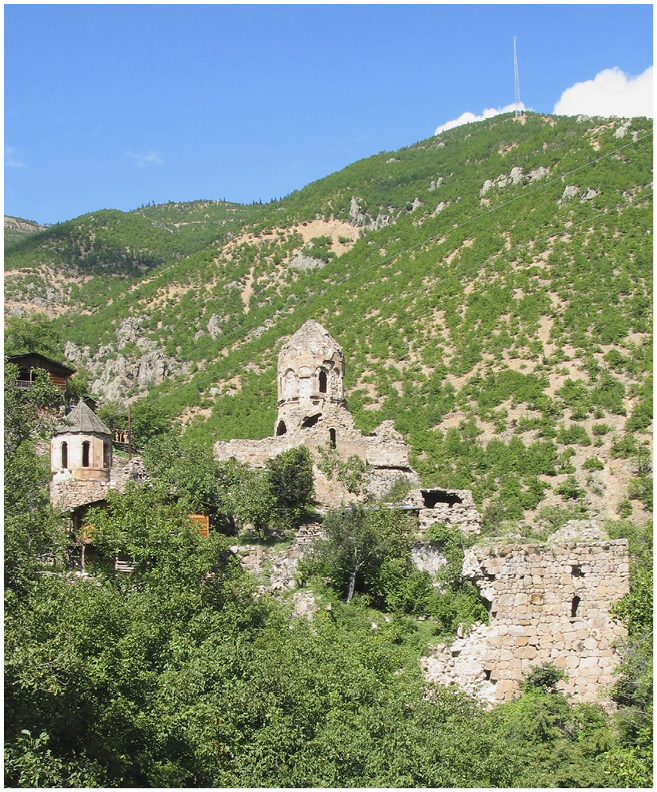
Khandzteli’s vita imparts its hero’s routine interaction with political figures. The monarchy had been in abeyance since the 580s, but from 813 the presiding principate was reenergized by the upstart Georgian Bagratids. While safeguarding their position, Khandzteli and his ecclesiastical partners cooperated with the Bagratids in the (re)building of an autonomous Christian Georgian polity. The burgeoning alliance features in Khandzteli’s audience with the Bagratid Ashot. Khandzteli upheld the Georgian Bagratids’ claim to be biological descendants of the King-Prophet David, advocated for their restoration of the Georgian monarch (a feat accomplished by Adarnase in 888), and expressed hope for the eternal rule of the Davidic Bagratids over the Georgians. This partnership was neither blind nor subservient to political authorities. Khandzteli simultaneously fostered closer, though prudent, relations with the Byzantine government and church while insisting upon Georgia’s autonomy. Khandzteli trekked to Constantinople, where he visited churches and shrines. Yet interactions with the co-religionist empire were fraught with peril: “[s]ome of the things he saw taught him well and others must be avoided because of evil.”Footnote 243
In Khandzteli’s time, Georgia’s ties to the Holy Land were injected with new vigor. Khandzteli tasked a colleague traveling to Jerusalem to acquire a copy of Mar Saba’s typikon, upon which Khandzteli based his rules for Tao-Klarjeti’s monasteries.Footnote 244 More generally, Khandzteli was involved with strengthening of Christian traditions linked to the Holy Land:
[Khandzteli] not only relied on the wisdom of the divine scriptures [tsignta saghmrtota], but he was … also a [religious] teacher through the order of the yearly hymns [galoba] and sermons of the holy catholic church, and he completely knew the order for all the holy days, because he remembered everything he learned … And now in Khandzta there is an annual collection of the iadgari, through the Holy Spirit and written in his own hand, the words of which are very good. He knew the written books of the New Testament by heart and many books of the Old Testament as well. Exceeding our human nature, he would also speak of the innumerable, unprinted, oral teachings of the Holy Fathers, without books …Footnote 245
Some of Khandzteli’s pupils emigrated to Jerusalem.Footnote 246 They were “worthy priests, children of esteemed nobility, and of the family of Bishop Eprem the Great from Atsqueri.” In a letter of introduction written on their behalf, Khandzteli alludes to Mar Saba, where the men apparently intended to settle.
Khandzteli greatly impacted not only the cenobitic communities of Tao-Klarjeti, many of which he established, but also the Georgian Church and Bagratid princes, who were laying the groundwork for a renewed monarchy. While Khandzteli brushed aside intermittent calls for his episcopal ordination, he did not shy from responsibility and leadership. With controversy swirling around Katholikos Mirian’s appointment of his son Arsen as his successor, the Bagratid Guaram invited Georgian bishops and “desert fathers” to an ecclesiastical council to condemn Mirian and Arsen. Khandzteli and the Tao-Klarjetian abbots were divided on the issue and did not attend. As the council progressed, a mysterious man – revealed to be Khandzteli – arose in the distance riding a donkey. Khandzteli’s simple clothes were “garments of light, of a resplendence never experienced. And the cap on his head was like a royal crown, adorned with precious gemstones and priceless diamonds.” Khandzteli voiced support for his former student Arsen. When Guaram rebuked Khandzteli, the holy man retorted: “[a] lay person had no jurisdiction in the canons set forth by the holy apostles and the blessed Fathers of the Church …”Footnote 247
The vita acclaims the saintly deeds of Khandzteli yet accomplishes considerably more. Its rich historiographically driven narrative addresses a crucial juncture in Caucasia’s past: the evolution of the Georgian presiding principate into an autonomous monarchy under the Bagratids with the cautious support of ecclesiastical allies; the consolidation of its “national” church while much of southern Caucasia remained under Islamic rule; the foundation of powerful monasteries in and around Tao-Klarjeti; and the selective adaptation of Byzantine culture by religious and political elites.
At their jurisdictional zenith in the twelfth and early thirteenth centuries, the Bagratid monarchy and Georgian Church projected themselves as piloting an autonomous second Byzantium, thus revamping bygone Chosroid claims of helming a mini-Sasanian Empire. Historiographical texts from the apogee of Bagratid power depict Georgia as an autonomous mini-Byzantium to Constantinople’s east. Original hagiographies celebrating prominent Georgian Athonites are oriented strongly toward Byzantium even as they underscore serious tensions between Georgians and Byzantines.Footnote 248 Adapted Byzantine imagery was engaged as never before. But the fact remains that Georgia and the whole of southern Caucasia constituted a distinctive cross-cultural zone firmly embedded in the Iranic world from the initial waves of Christianization up to the tenth century and beyond. Many of the fundamental aspects of this Iranic status remained intact across the many centuries of Bagratid hegemony.
5 Literary Expressions of Christian Georgian Identity
Christian Georgians might seem to have populated an edge of Romano-Byzantine “civilization,” particularly if our purview is confined to translated and adapted literature. This persistent image is seemingly reinforced by (extant) medieval Georgian art and architecture, whose origins and purpose tend to be religious and are entangled with their Romano-Byzantine and ecumenical analogues. Today, the Christian Roman Empire/Byzantium remains the favored avenue for investigating late antique Georgia. Outside the Georgian Republic, students of premodern Georgia are often trained as Byzantinists. This is perhaps most defensible from a Bagratid-era religious art-history vantage. In fact, Georgians in Caucasia lived beyond the physical margins of Romano-Byzantine culture and politics; they spoke a non-Indo-European language with its own script; and since the Iron Age they belonged to the dynamic Iranic world. But Caucasia’s long-term evolving participation in the Iranic venture did not exclude its membership in other multicultural blocs. For example, Caucasia’s Christians simultaneously integrated themselves into – and helped create – the Eastern Christian world, sometimes termed the Byzantine Commonwealth. Both cross-cultural enterprises were more diverse, dynamic, polycentric, and interconnected than is usually claimed. And we must not forget that Caucasia became enmeshed with the dar al-Islam as well.
Georgian identity was neither restricted to Christianity nor intrinsically aligned with, nor an exotic extension of, Romano-Byzantine identity. The cross-cultural Christianity embraced by contemporaneous Georgians was entangled with the Christianities of the Holy Land, the rest of Caucasia, eastern Anatolia, Mesopotamia, and Iran. The creative engagement of ecumenical Christian symbols, texts, and practices by Georgian clerics and ascetics reveals much about the evolving real and desired integration of Georgia into wider Christendom. By the same token, while actively contributing to the Christian ecumene, Georgians and other Christian peoples safeguarded their distinctive identities. They sculpted their own Christianities, embedding Christian traditions within their cultures, including literature, art, and architecture. With regard to the latter, a pan-Caucasian form of church construction – a domed cruciform structure based on intersecting basilica halls – emerged toward the end of late antiquity (see Figure 23).Footnote 249 This is another reminder of the sustained interface of Caucasia’s Christianities in the formative period.
Cruciform church of Jvari, sixth/seventh century, above Mtskheta.
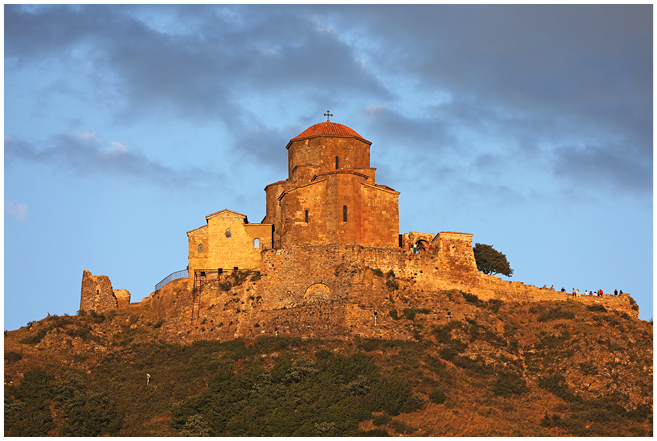
Christianity was converted to Georgian culture as much as, if not more than, the Georgians converted to Christianity. Before and after Christianization, language was a principal ingredient of Georgian self-identity.Footnote 250 The religious significance of Georgian was celebrated in poetry, perhaps by none other than Zosime.Footnote 251 Earlier, Giorgi Merchule, author of Khandzteli’s vita, emphasized the intersection of the distinctive Georgian language and Georgian Christianity: “Kartli consists of those spacious lands where the liturgy [zhami] and all prayers are carried out in the Georgian language. Only ‘Lord have mercy’ is said in Greek, which in Georgian is ‘upalo, tsqaloba qav’ or ‘upalo shegwtsqalen.’”Footnote 252 There were other markers of self-identity, including a remarkably generic affiliation to Christianity in the decades following King Mirian’s baptism. But tethered tightly to this relationship was recognition of the authority of the Christian king and local bishops. Sixth- and seventh-century clerics infused this notion with a robust sense of “orthodoxy” (martlmadidebeli < martali [“true, righteous,” following Greek orthos] + madidebeli, “glorifying”) featuring alignment with Constantinople and Chalcedon’s dyophysite Christology. Meanwhile, the Georgian Church came to affirm its internal autonomy. Georgians consequently repudiated the Armenian Church’s claim of a pan-Caucasian ecclesiastical protectorate. In 607, indignant Armenian prelates formally broke communion with the Georgian Church.
Georgian efforts to align with the Romano-Byzantine Empire quickened with the interventions of Heraclius, the flourishing of monasteries in the Caucasian-Anatolian frontier, and Bagratid ascendancy. Upstart Bagratids sought allies in the reenergized Georgian Church and especially its monasteries, which created and transmitted many of the manuscripts and texts examined in this Element. As a kingdom integrating eastern and western lands, on both sides of the Surami ridge, materialized in the early eleventh century, crown and church embarked on a deliberate effort to selectively “Byzantinize” aspects of their religious and political identity. By the late eleventh century, the Bagratids transformed their expanding kingdom into a pan-Caucasian empire. Bagratid monarchs envisioned themselves as helming another Byzantium and the Georgian katholikoi – an autocephalous church. The Georgian mepe (monarch) was upgraded to basileus and the Georgian katholikos to patriarch. Byzantine-like imagery prevailed even after King Davit the Builder intentionally discarded Byzantine titles, emphasizing a local intitulatio instead. Though Georgia was reduced to a minor kingdom in the mid-thirteenth century (an existing decline having been sealed by the Mongol conquest), fragmented Bagratid sovereignty persevered until imperial Russian expansion in the eighteenth century. Bagratid-era textual and material sources, regularly evoking Romano-Byzantine imagery, endured and have prevailed for a millennium. Precisely as intended, they continue to overwhelm perceptions of premodern Georgia.
Original literature and its language exhibit a shimmering facet of Georgian identity: the isthmus’ enduring Iranic society. While original hagiographies emit flashes of Iranic Georgian culture thanks especially to their language and historiographical attributes, the genre of original historiography proffers the most detailed and sustained evidence. Caucasia’s multifarious and entangled Iranic cultures, which were in constant motion, have deep roots and did not wither and die with Christianization. However, some Christians grappled with Caucasia’s long-standing ties to the Iranic world, which might be understood as Zoroastrian or even Islamic. The Life of the Kings’ original account of the Christianizing Mirian – which must have painted the king in customary Iranic colors – was replaced wholesale in the Bagratid era with the hagiographical Life of Nino, which intentionally suppresses such Iranic imagery.
Across Caucasia’s south, Iranic cultural and political modes thrived before, during, and after Christianization. Both modes are characterized by local distinctiveness, creativity, and agency. The accommodation of Christianity within an existing Iranic society resides at the crux of The Life of Vakhtang. It confidently projects Vakhtang as an Iranic hero-king bearing an Iranic name; he commanded a corps of champions called bumberazis; he possessed a Christianized khwarrah; he sometimes allied militarily with the Sasanians; and he is even made to justify Zoroastrianism’s integrity thanks to its recognition of a transcendent God the Creator and his supposed royal Iranian pedigree from Nimrod. In The Life of the Kings, comparable imagery is deployed for Vakhtang’s pre-Christian predecessors going back to Parnavaz, its first king of eastern Georgia. Armenian sources – including The Epic Histories and Ps.-Sebeos – similarly cloak Christian political elites in Iranic imagery. But Georgian Bagratids deliberately eschewed the traditional Iranic royal image in favor of one more aligned with Constantinople – or at least that dampened features clearly linked to Iran.
Admittedly, there is much we do not know about the Iranic underpinnings of early Christian Georgian self-identity, including its presumed existence among non-elite groups. The most extensive texts, in Kartlis tskhovreba, are staunchly royalist. Information about aristocratic houses – the backbone of premodern Georgian society – is hard to come by. This diverges from neighboring Armenia, where medieval histories often were written on behalf of prominent nakharar houses like the Armenian Arsacids, Mamikoneans, Artsrunis, and Bagratunis. Georgian sources divulge even less about non-elite strata, including peasants and slaves. Fortunately, there is much to be gleaned from material culture about these textually underrepresented groups.
Its limitations and fragmentary state notwithstanding, the received Georgian literary record is remarkable. The genesis and early development of Georgian literature are inseparable from Caucasia’s pan-isthmus and cross-cultural Christianization. At the same time, early Georgian literature is a tangible monument not only to the Christian conversion of the Georgians but also to the “Georgianization” of Christianity. And it is a witness to the isthmus’ enduring Iranic condition long after Christianization.
Epilogue: Future Investigations
Despite complications arising from the incomplete manuscript tradition as well as the intricacies of “living” traditions, there have been many scholarly leaps forward. In late Russian imperial and Soviet times, and throughout both Georgian Republics (1918–1921 and 1991–), Georgian researchers devoted considerable attention to their premodern literature. The preparation of diplomatic and critical editions has been a particular strength. In recent times, improved access has resulted from digital resources like Jost Gippert’s ARMAZI – Kaukasische Sprachen und Kulturen: Grundlagen ihrer elektronischen Dokumentation Alternative Ressourcen, Materialien, Anwendungen und zusätzliche Informationen (titus.uni-frankfurt.de/armazi.htm). Continued efforts at digital preservation, physical reprinting, and updating of the complete Kartul khelnatserta aghtseriloba (Description of Georgian Manuscripts) are vital. This extensive series catalogues the holdings of the Georgian National Centre of Manuscripts.
Accessing scholarly works published in the Georgian Republic, especially from abroad, can range from difficult to well-nigh impossible. Distribution often relies on personal networks. Some books are not readily available at shops in Tbilisi and Kutaisi. The used book market has contracted. Digital files of some recent publications circulate online, but irregularly and not always matching printed versions. The situation is markedly better for publications from Soviet and Russian imperial times. Many of these are available digitally through the Georgian National Library (dspace.nplg.gov.ge/) and the Georgian Open Library Digital Repository (dspace.gela.org.ge/).
Translations of early hagiographies into European languages by David Marshall Lang, Bernadette Martin-Hisard, and others are frequently cited. Updated and new translations, with extensive historical and linguistic commentary, of the critical texts in Dzveli kartuli agiograpiuli literaturis dzeglebi (Monuments of Old Georgian Hagiographical Literature) is a logical step.
Among published critical editions of Kartlis tskhovreba, I continue to favor that of Simon Qaukhchishvili. However, it predates the discovery of the important Mtskheta redaction of 1697 (NCM Q-1219). Of the two scholarly English translations of the corpus’ early texts, I prefer Robert Thomson’s Rewriting Caucasian History, which provides parallel translations of Qaukhchishvili’s critical Georgian text and the medieval Armenian adaptation. The other English translation, based on a new Georgian edition, was published under the auspices of the Georgian Academy of Sciences in 2014. This translation was edited by a modern historian. Detailed commentary of the corpus’ component texts, exploiting both Georgian and non-Georgian research, remains underdeveloped.
Specialists should strive for a better balance of the surgical use of early Georgian texts for well-known subjects (e.g., pre-reform Jerusalemite liturgy and Romano-Byzantine history) as well as patriotic celebrations. In both instances, Georgian agency and connections with the wider world can be diminished if not ignored, thus resulting in a decontextualized and essentialized vision. A wider, more balanced approach will yield an improved understanding of Georgia’s place in the late antiquity and the polycentric nature of that world.
Following in the footsteps of Ilia Abuladze, Zaza Aleksidze, and other Caucasiological bumberazis, specialists should be proficient in both Old/Middle Georgian and Classical Armenian. Resulting studies would benefit from looking beyond cultural and linguistic boundaries, however conceived, and to examine in more detail the dialogues and convergences among early Georgian, Armenian, and, as can be recovered, Caucasian Albanian authors. By the same token, scholars must be aware of the limitations and pitfalls of both national, imperial, and colonial imagery and narratives.Footnote 253
Late antique Caucasia’s entanglements with Syria/Mesopotamia, northern Iran, and Anatolia require finer resolution. This will help clarify, inter alia, the Iranic socio-cultural matrix of early Christian Caucasia and the isthmus’ place in the Afro-Eurasian ecumene. Lingering imaginaries of late antiquity as a Romano-Byzantine endeavor must be quieted once and for all. Within this polycentric and cross-cultural enterprise, the essential place of Persia/Parthia, Iranic world, and Caucasia should be fully embraced.
Acknowledgments
This Element stands on the shoulders of giants, perhaps none as great as Korneli Kekelidze. His groundbreaking works include the essential Kartuli literaturis istoria (History of Georgian Literature). The National Centre of Manuscripts (NCM) in Tbilisi is named in his honor.
Numerous colleagues and friends offered feedback and corrections on draft sections. I am especially grateful to Bernard Outtier, Nikoloz Aleksidze, Stephen Shoemaker, Alison Vacca, Thamar Otkhmezuri, Tinatin Chronz, Kevin Tuite, Mary Whitby, Philip Forness, and Julie Nelson. Thanks are also due to series editor Garrick Allen, Tamar Zhghenti and NCM, Jost Gippert, Giorgi Cheishvili, Zaza Skhirtladze, and Ronald Suny. In the final stages, I benefitted from perceptive comments of two anonymous reviewers. Remaining errors are mine and mine alone.
Ian Mladjov produced the maps, which were funded by the Department of History at Sam Houston State University. Images marked NCM are courtesy of the Georgian National Centre of Manuscripts. Uncredited photographs are by the author.
Garrick V. Allen
University of Glasgow
Garrick V. Allen (PhD St Andrews, 2015) is Professor of Divinity and Biblical Criticism at the University of Glasgow. He is the author of multiple articles and books on the New Testament, early Jewish and Christian literature, and ancient and medieval manuscript traditions, including Manuscripts of the Book of Revelation: New Philology, Paratexts, Reception (Oxford University Press, 2020) and Words Are Not Enough: Paratexts, Manuscripts, and the Real New Testament (Eerdmans, 2024). He is the winner of the Manfred Lautenschlaeger Award for Theological Promise and the Paul J. Achetemeier Award for New Testament Scholarship.
About the Series
This series sets new research agendas for understanding early Christian literature, exploring the diversity of Christian literary practices through the contexts of ancient literary production, the forms of literature composed by early Christians, themes related to particular authors, and the languages in which these works were written.