


13.1 Introduction
The international human rights regime consists of a multifaceted web of regional and global treaties, institutions, and compliance monitoring mechanisms.Footnote 1 While some elements complement each other, others create overlap and redundancy in terms of protected rights and of the institutions and mechanisms created to monitor compliance with them. Many core civil and political rights are covered by general conventions at both the regional and the global levels and are fleshed out further by additional group- or subject-specific treaties. In addition to monitoring mechanisms such as State reporting and inquiry procedures, the three regional human rights regimes in Europe, the Americas, and Africa as well as the nine core UN human rights treaties all provide for individual complaints/communications procedures (ICPs) that enable aggrieved individuals to have the merits of alleged human rights violations decided by independent institutions. One dimension along which these institutions differ is their institutional design. The three main regional human rights conventions feature full-fledged courts (in addition to human rights commissions in the African and inter-American human rights systems) that are staffed with professional judges and whose judgments are legally binding, whereas the committees established by the UN human rights treaties, while taking some design cues from judicial institutions, are composed of part-time experts and issue legally non-binding pronouncements that are called “views,” “opinions,” or “decisions.”
A frequent assumption in the human rights domain (also elsewhere) is that courts and legally binding judgments will yield better rights protection by way of better compliance than non- or quasi-judicial institutions whose output lacks such legal status. Pierre-Henri Teitgen, one of the chief designers of the European Convention on Human Rights (ECHR), put the sentiment thus when arguing against the inclusion in the ECHR’s monitoring machinery of solely a commission with only recommendatory powers: “If … we really wish to have collective protection in Europe of rights and fundamental freedoms, it is necessary to go beyond a simple Recommendation or the mere publication of a Report. We must refer the matter to the only force which, in these countries, has a final authority, that is justice; there must be a Court and Judges.”Footnote 2 Conversely, in the context of the UN human rights treaty bodies, the lack of legally binding status of their pronouncements has been repeatedly adduced as one reason for the compliance problems encountered.Footnote 3 The suggestion is that legally binding court judgments generally have greater purchase with respect to inducing compliance than committee decisions that come without such legal status.
In this chapter I argue that the significance of legally binding or non-binding status for compliance is conditional on a number of contextual political and institutional factors, among them regime type, expected costs of compliance and non-compliance, and whether violations are isolated or occur as a result of State policy.Footnote 4 To explore my expectations empirically, I take advantage of the existence of significant jurisdictional overlap regarding individual complaints between the European Court of Human Rights (ECtHR), the UN Human Rights Committee (HRC), and the UN Committee against Torture (CAT) with respect to many European States. Because State responses to adverse decisionsFootnote 5 can be expected to be affected inter alia by the specific issues and rights involved, I focus on compliance with adverse findings concerning one particular right: the core physical integrity right of freedom from torture and from inhuman or degrading treatment or punishment.Footnote 6 The analysis provides indicative evidence that compliance with so-called conditional violations – violations that have not yet occurred, but might with some probability if a State were to implement its planned course of action – concerning the non-refoulement norm is as high for treaty body decisions as it is for ECtHR judgments. When it comes to remedying actual past or ongoing violations, however, the ECtHR performs better overall, but with significant differences between countries with different democratic credentials. The implication is that the ostensibly institutionally weaker treaty body arrangements perform well when the political and material stakes for the respondent State are comparatively low, but when those stakes increase, a stronger institutional design performs better (if still far from perfectly). If respondent States are insufficiently or only weakly democratic, however, compliance is equally low for both types of institutions. While application numbers reveal a preference among petitioners for a judicial assessment of their grievances, the work of the treaty bodies can be consequential under certain circumstances, especially with respect to preventing violations.
13.2 Right to Freedom from Torture: Institutional Overlap
Few human rights are as widely affirmed in international instruments as the right to be free from torture and from other unduly harsh forms of treatment or punishment. The Universal Declaration of Human Rights (1948) set the precedent when it affirmed that “no one shall be subjected to torture or to cruel, inhuman or degrading treatment or punishment” (Article 5). The three regional human rights conventions in Europe,Footnote 7 the Americas,Footnote 8 and AfricaFootnote 9 followed suit, as did the Arab League,Footnote 10 the Organisation of Islamic Cooperation,Footnote 11 ASEAN,Footnote 12 and the European Union,Footnote 13 with some regions adding further subject-specific treaties.Footnote 14 At the UN level, five of the nine core human rights treaties include provisions outlawing torture: the UN Convention against Torture (UNCAT),Footnote 15 the International Covenant on Civil and Political Rights (ICCPR),Footnote 16 and the conventions on the rights of children,Footnote 17 of persons with disabilities,Footnote 18 and of migrant workers and their families.Footnote 19 The prohibition of torture is recognized as customary international law and widely considered to be ius cogens.Footnote 20 The Statute of the International Criminal Court includes torture as a crime against humanity and a war crime.Footnote 21
As of January 1, 2022, all forty-seven countries then subject to the ECHR/ECtHRFootnote 22 had ratified ICCPR, UNCAT, and the Convention on the Rights of the Child, all but one had ratified the Convention on the Rights of Persons with Disabilities, while only four were party to the Migrant Workers Convention. The first four treaties have active ICPs that could in some instances be used to address the same alleged violations of the prohibition of torture and of related offences.Footnote 24 Twenty-one ECHR parties have accepted all four active ICPs while two countries have accepted only one. All but three have accepted the ICCPR’s ICP and thirty-nine have accepted UNCAT’s.Footnote 25
Figure 13.1 depicts ICP acceptance under the four relevant conventions. While it shows the present state of overlap, it should be noted that there have been (sometimes extended) periods of time during which countries have been subject to only a single individual complaints mechanism. One reason has to do with temporal availability: the ECtHR was set up in 1959, but the HRC’s and CAT’s ICP competences became operational only in 1976 and 1987, respectively, and those of the other two committees later still, in 2008 (Rights of Persons with Disabilities) and 2014 (Rights of the Child). Eastern and Central European countries only began to accept ICPs near the end of the Cold War and until that time were not subject to any of them. Even when available, States differ significantly in terms of the time between accepting the first and second of these ICPs (which are optional in the case of the treaty bodies and were so under the ECHR until 1998), ranging from less than six months for Azerbaijan, Poland, and Bulgaria to over thirty-eight years for Belgium and Germany.
Acceptance of ICPs of relevant UN human rights treaties by ECHR partiesFootnote 23

Only the HRC and CAT have produced quantitatively meaningful output against ECtHR parties so far.Footnote 26 Figure 13.2 shows which States have received adverse decisions related to the prohibition of torture and from which body. Twenty States have received torture-related judgments only from the ECtHR, while two, Norway and Denmark, were until the end of 2019 – the cut-off date of the dataset used for this research – subject to adverse decisions only from the HRC and CAT. Eight countries have been subject to adverse decisions involving the prohibition of torture from all three bodies while six small States (Andorra, Liechtenstein, Monaco, Iceland, Luxembourg, and San Marino) have so far never been found responsible for having violated Article 3 ECHR, Article 7 ICCPR, or any UNCAT provision. In terms of the scope of the relevant treaty provisions, it is to be noted that the first two articles are single-paragraph provisions whereas UNCAT spells out rights and obligations at greater length over several articles. While the provisions and the jurisprudence based on them are not identical, there is considerable substantive overlap in terms of rights and obligations covered as a result of treaty interpretation and reading ECHR/ICCPR provisions in conjunction with other articles.Footnote 27
Adverse torture-related decisions by respondent State and issuing institution

Why applicants turn to the treaty bodies when they also have access to the ECtHR is worth investigating; some reasons that have been suggested in the literature have to do with the narrowing of access to the ECtHR, the (expected) shorter time to a decision, applicant-friendlier rules of evidence and different interpretive takes on certain aspects related to the prohibition of torture.Footnote 28 The question to be explored further in the following, however, is how States respond to the signals received from these two types of institutions in terms of complying, or not complying, with them and what causal factors likely play a role.
13.3 Theoretical Expectations
This section addresses from a theoretical point of view the causal factors that likely affect whether States will comply with ECtHR judgments and treaty body decisions and how such factors may play out differently with respect to the two types of decisions. I discuss the following factors: regime type and rule of law, costs of compliance and non-compliance, and systematic as opposed to isolated infringements.
13.3.1 Regime Type and Rule of Law
It is a fairly consistent finding of research on international human rights law that compliance is strongest among liberal democracies,Footnote 29 that is, States that share the values embodied in human rights and recognize them as legitimate constraints on governmental action. Liberal democracies also typically adhere to the rule of law and as such are well practised in responding to, and abiding by, the decisions of properly established monitoring and dispute settlement institutions. While all members of the Council of Europe, the ECtHR’s parent institution, are nominally rule-of-law countries (a condition of membership)Footnote 30 and committed to “genuine democracy,”Footnote 31 there is variance in the strength of their rule-of-law and democratic credentials that can be expected to affect the extent of their compliance with adverse judgments and decisions. We should generally expect countries with higher scores on democracy indicators to have better compliance rates than those whose scores are lower.
To the extent that sincere commitment to human rights is the driving force behind the effects of (liberal) democracy on compliance with adverse human rights decisions, there should be no systematic difference in terms of its compliance-enhancing role with respect to ECtHR judgments and treaty body views, respectively. That commitment itself is ultimately socio-political (and not legal) in nature and there is nothing in the recognition that State action should be constrained by, and assessed in terms of conformance with, human rights norms and should give rise to remedial action in case of violations that would make it conditional on the legal status of a pronouncement. States frequently take action in the human rights and other domains in response to demands and recommendations that are legally non-binding (but may have non-legally binding quality).Footnote 32 There is no reason to expect that sufficiently well-reasoned decisions from the treaty bodies should be received and treated differently than ECtHR judgments solely because of their different institutional sources and legal status.
Commitment to the rule of law, on the other hand, can cut both ways when it comes to compliance with legally non-binding decisions. On the one hand, the rule of law has been linked, since A. V. Dicey gave currency to the phrase, to the possibility of resolving disputes and to obtaining redress through recourse to the courts in cases involving both civil and public law.Footnote 33 While the theoretical bond between the rule of law and “access to justice” may be weaker than often asserted, it appears that “the assumption that this connection is so obvious as to need no explication” is widespread.Footnote 34 Having a mechanism for the resolution of disputes in place in turn generates legitimate expectations of compliance on the part of its users.Footnote 35 On the other hand, the rule of law privileges the law as a specific institution over other, non-legal norms, standards, and commitments, hence the name. To allow legally non-binding decisions to trump legally binding legislation, judicial decisions or executive determinations would jar with this understanding of law as having higher normative status than non-law.
How decisions with different legal status are treated domestically differs between countries. In some States, the judicial branch in particular has emphasized that treaty body views have a subordinate and suggestive, rather than determinative role to play.Footnote 36 The Supreme Court of Ireland, for example, addressing the consequences of HRC views, stated that “[t]he notion that ‘views’ of a Committee, even of admittedly distinguished experts on international human rights, though not necessarily lawyers, could prevail against the concluded decision of a properly constituted court is patently unacceptable.”Footnote 37 Other high courts have argued similarly, noting that treaty body views are not “judicial decisions” and therefore “cannot constitute the authentic interpretation of the Covenant,”Footnote 38 and do not legally bind the respondent State and its courts.Footnote 39 As a consequence, while, “domestic courts should address the view of such treaty bodies[,] they do not … have to endorse it.”Footnote 40
The difference in comparison to the treatment of ECtHR judgments is, however, not categorical as these judgments are typically not accorded binding effect domestically either, at least not formally, although it appears that courts tend to give greater weight to findings and arguments by the ECtHR in comparison with pronouncements by the treaty bodies.Footnote 41 The German Constitutional Court, for example, has stipulated that the effect of ECtHR judgments within the domestic legal order is not unconditional. While State authorities are under an obligation to “take into account” Strasbourg’s jurisprudence in their decision-making, not only the failure to do so, but also “the ‘enforcement’ of such a decision in a schematic way, in violation of prior-ranking law, may … violate fundamental rights in conjunction with the principle of the rule of law.”Footnote 42 At the same time, while relevant treaty body views “should” be addressed, for ECtHR judgments there is a “duty” to take them into account; they “must” be considered.Footnote 43
Elsewhere, the difference in legal status between judgments and views is diminishing or has not been a major issue to begin with. The Spanish Supreme Court’s 2018 judgment declaring the views of the Committee on the Elimination of Discrimination against Women (CEDAW) to be binding on Spain is a 180-degree turn from the 2002 Spanish Constitutional Court’s decision previously referencedFootnote 44 and aligns the legal status of court judgments and treaty body views.Footnote 45 In Norway, the Supreme Court in 2008 noted that “the UN Human Rights Committee’s interpretation of the International Covenant must be accorded considerable weight as a source of law”Footnote 46 and in a recent decision concerning rights of Sami reindeer herders, the court relied heavily on the “case law” and other statements of the HRC on the scope of ethnic groups’ right to enjoy their own culture as protected by Article 27 ICCPR without making an issue of their legal status.Footnote 47
National positions on the consequences of the different legal status of ECtHR judgments and treaty body views in domestic proceedings are thus not uniform. While domestic courts, qua institutional identity, may be particularly concerned about issues of legal status, the same does not necessarily hold true for other governmental actors that are involved in giving effect to adverse human rights decisions. An expectation that in cases of conflict between legally binding and legally non-binding decisions, relevant actors in rule-of-law countries will, ceteris paribus, accord precedence to the former more often than the other way around, may appear plausible. At the same time, the different institutional actors and issue areas involved, distinct principled approaches to the implications of differences in legal status as well as areas of discretion and choice in political and legal decision-making make this a probabilistic prediction, and not one where we should expect near-consistent behaviour, one way or the other, simply as a function of legal status.
13.3.2 (Expected) Costs of Compliance and Non-Compliance
In addition to normative factors the decision whether, and how, to comply with an adverse decision is also typically affected by the expected material, political, and/or sovereignty costs of compliance and of non-compliance. When the costs of the measures necessary to bring a State into compliance with the requirements of an adverse decision are low, States will be more likely to implement them voluntarily than when they are high, especially when the likely political costs of non-compliance are minor. In an effort to minimize costs, States in some cases also adopt some, but not all of the remedial measures required, resulting in “partial compliance.”Footnote 48 Existing research supports the expectation that States remain rational actors that will seek to maximize the relationship between benefits and costs of their chosen course of action and often deal with different types of remedies differently. In the context of the Inter-American and European human rights systems, States have been found to comply to greater extent with financial reparation obligations than those that require general measures such as legislative actionFootnote 49 and generally appear intent on minimizing the domestic impact of adverse findings.Footnote 50 Similarly, in the case of the Court of Justice of the European Union, a routine response by States is to “contain compliance” by remedying only the violation in the decided case but refraining from drawing more general implications from it.Footnote 51
General measures to remove systemic sources of repeat violations – such as changes in legislation, reform of administrative practices, systematic training of security personnel, or practical measures such as improving prison infrastructure – are typically the costliest, in material terms and/or with respect to their sovereignty costs, whereas the costs of individual measures, limited to the individual applicant, are in most cases lower. Where financial compensation is the only individual measure to be adopted, it is commonly the least costly remedial measure (except in instances of highly politicized cases or where compensation is exceptionally high). Most amounts are relatively small and do not constitute a significant financial burden, at least not for developed countries, and no additional sovereignty costs are implicated through necessary changes of substantive decisions or policies. Conditional non-refoulement violations have been implied to be particularly easy to remedy,Footnote 52 presumably because States primarily simply have to refrain from doing what they had planned to do. Of course, compliance with such cases is not entirely without costs – residence permits need to be issued and subsistence payments made, plus there are sovereignty costs as a result of an international expert body enjoining a State from implementing its national authorities’ decisions in a domain usually viewed as a core part of State sovereignty – but none of these are beyond those that are incurred in the ordinary course of managing a State’s immigration and asylum system. Compliance with decisions finding conditional violations involving the threat of tortureFootnote 53 also avoids the reputational cost of being identified as a violator of a core physical integrity right and instead may generate for the complying State positive reputational capital as a State disposed to prevent grave human rights violations when able to do so.
The impact of the magnitude of the expected costs of adopting effective remedial measures when deciding whether and how to comply with adverse decisions involving the right to freedom from torture should in principle apply to ECtHR judgments and treaty body views alike. These costs arise out of the type of violation and the types of measures necessary to remedy it and their magnitude should not as such differ according to whether they follow from a judgment or a view.
The expected costs of non-compliance, however, can be expected to differ, for two reasons. First, in the case of a treaty body, the monitoring of compliance with its views is undertaken by the same treaty body that issued the decision. During the follow-up procedure the treaty bodies have no additional enforcement capabilities at their disposal other than the pre-existing power of publicizing non-conforming conduct by the respondent State in their annual and follow-up reports. In the case of the ECtHR, by contrast, supervision of the execution of the court’s judgments is done by the Committee of Ministers, a political body composed of State representatives. The Committee also has no material enforcement powers other than the power of publicizing and criticizing non-compliance and the “nuclear” option of ending a country’s membership in the Council of Europe and hence the Convention (which happened in the case of Russia, if for different reasons,Footnote 54 and in general tends to be rather counterproductive from the vantage point of monitoring and protecting human rights). Naming and shaming by one’s peers is, however, likely more consequential than when done by the treaty bodies. Interview evidence from a study on the relative efficacy of the UN Human Rights Council’s Universal Periodic Review (UPR) compared with the treaty bodies’ State reporting procedure suggests that States are more sensitive to criticism from other governments than from experts without governmental authority and powers.Footnote 55 The involvement of political actors in the UPR is seen as being able to generate more political pressure than is the case for the treaty bodies. As a result of such pressure, the UPR “is perceived [by stakeholders] to be more likely to lead to actual compliance with the undertaken commitments.”Footnote 56 The same logic arguably applies, mutatis mutandis, here as well.
Second, audience costs imposed by the larger public are likewise less likely in the case of non-compliance with treaty body decisions than they are with respect to non-compliance with ECtHR judgments, for the simple reason that the treaty bodies and their work are less known to larger publics and receive much less publicity in the media and public discourse compared to the ECtHR. In the majority of cases, knowledge about treaty body decisions is confined to experts and the applicants; as a result, political mobilization around the failure to comply with a given view is theoretically unlikely and empirically rarely seen (with occasional exceptions, e.g., when the view in question addresses an issue that is already politically salient domestically).Footnote 57 More generally, while most enforcement mechanisms available in the human rights domain – agenda setting, naming and shaming, peer pressure, electoral politics, mobilization, and lobbying – are not dependent on a decision’s legal status,Footnote 58 the latter may affect their intensity by being interpreted by relevant audiences as signals of different normative valence and authoritativeness. If Teitgen’s suggestion above is correct, then the normative signals sent by courts and their judgments may be expected to be seen by States as stronger than those of non-judicial monitoring and dispute settlement bodies. Kal Raustiala captures this effect when he notes that “the factors that push states to comply with [legally binding obligations] often apply, albeit more weakly, to [legally non-binding ones] as well.”Footnote 59
13.3.3 Isolated versus Systematic Violations
Occasional violations of physical integrity rights can and do occur even in established and otherwise well-functioning democracies, either inadvertently, through negligence, or because individual actors either intentionally commit such acts or are under the belief that their conduct does not infringe the particular rights at issue. When such violations occur in an isolated fashion, we should expect principally rights-abiding States to be willing and able to address and remedy the violations in question. The situation is different in contexts where there are patterns of recurrent violations that are either condoned or intentionally pursued as State policy. In such systemic cases, both the willingness and/or the ability to effectively end violations, prevent their recurrence, and remedy those that have already occurred, will be missing or be severely compromised. The frequency of substantively related complaints and of adverse decisions over extended periods of time is typically indicative of such systemic problems, and their implementation is impeded by having to take place in the same political and institutional environment that gave rise to the violations in the first place.
The existence of State-condoned or State-authorized systemic or repeat violations militates against the execution of adverse judgments and treaty body views alike. Because it requires changing an existing preference for the status quo, bringing about compliance in such cases typically requires more than just persuasive authority, but also some tweaking of the respondent State’s cost-benefit calculations through the offer of incentives and/or the threat of sanctions. It is in this respect that the above-mentioned differences in the institutional arrangements for supervising the execution of judgments and views can be expected to be consequential, if only to an extent, in that the intergovernmental arrangement for supervising the execution of ECtHR judgments may generate some such incentives and sanctions, for example, through linking compliance to cooperation in other areas in which the respondent State has an interest. The treaty bodies, by contrast, have no such access to political incentives/sanctions that they could wield to enforce compliance against a recalcitrant State.
13.4 State of Compliance with Torture-Related Decisions
This section presents the state of compliance with ECtHR, HRC, and CAT decisions involving violations of the prohibition of torture that have been rendered until the end of 2019. Since I am interested especially in the comparative performance of the institutionally weaker UN human rights treaty bodies, only the twenty-one States that have received at least one relevant adverse HRC or CAT decision are included in the dataset, leaving out for the time being the twenty States subject only to adverse ECtHR judgments. Compliance is coded in accordance with the assessment of the body supervising the implementation of the decisions. In the case of the ECtHR, the Council of Europe’s Committee of Ministers is charged with the supervision of the execution of the ECtHR’s judgments (Article 46(2) ECHR). Monitoring whether States have paid the financial compensation awarded and taken individual and/or general measures to provide reparation in the applicant’s case and prevent a recurrence of the violation,Footnote 60 the Committee adopts a final resolution ending supervision when it is satisfied that all measures necessary for compliance have been adopted.Footnote 61
HRC and CAT themselves conduct second-order compliance monitoring, having created the roles of rapporteur for follow-up of views in 1990Footnote 62 and 2002,Footnote 63 respectively. While the committees do not, for the most part,Footnote 64 use the term “compliance” but refer to “satisfactory implementation” or “satisfactory resolution,” the terms of the CAT rapporteur for follow-up on decisions note the mandate to “monitor” and “encourage compliance” by examining whether respondent States have adopted “measures … pursuant to the Committee’s decision.”Footnote 65 In the case of the HRC the follow-up rapporteur is similarly charged with “ascertaining the measures taken by States parties to give effect to the Committee’s Views.”Footnote 66 The committees’ practice shows that the standard for “satisfactory implementation” is in principle one of substantive compliance so that their assessments can be taken as reasonable indicators for this.
13.4.1 State of Compliance: ECtHR
The ECtHR dataset comprises 1,521 judgments involving Article 3 ECHR that the ECtHR rendered against nineteen countries between 1990 and 2019. Fourteen of these are judgments recognizing friendly settlements or solutions with an award of costs and expenses.Footnote 67 Of those on the merits, fourteen involve conditional violations whereas 1,493 find past or ongoing violations of Article 3 ECHR, alone or together with infringements of other ECHR provisions and, in fourteen instances, jointly with conditional violations.Footnote 68 As of December 31, 2021, the Committee of Ministers had adopted final resolutions indicating sufficient compliance with respect to 71.4 percent of non-refoulement judgments and 100 percent of friendly settlements/solutions (see Table 13.1). Judgments declaring past or ongoing violations, by contrast, have been complied with at a rate of about only 36.4 percent. Since these are the most frequent type of judgment, overall compliance is, at 37.3 percent, equally low.
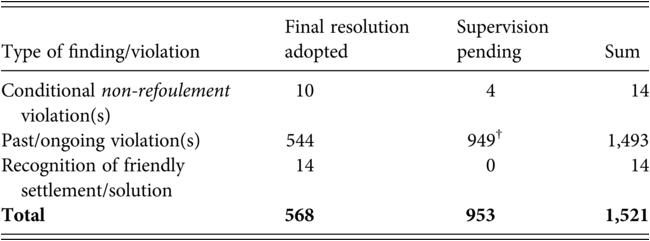
† Includes 14 judgments that find past/ongoing as well as conditional violations.
Judgments related to Article 3 ECHR are unevenly distributed (see Figure 13.3). Russia by far dominates the dataset with 856 observations,Footnote 69 followed by Ukraine (215), Greece (116), and Bulgaria (91); the remaining countries account for considerably fewer judgments. With a high case count and low national compliance rate of 19.2 percent, Russia drives down the overall compliance rate; without Russia, this rate increases to 54.9 percent.
ECtHR judgments involving violations of Article 3 ECHR (–2019), by country

13.4.2 State of Compliance: HRC and CAT
Table 13.2 shows the compliance status for HRC’s and CAT’s torture-related decisions, including data from their latest available follow-up reports of 2020.Footnote 70 Until the end of 2019, the HRC had issued 242 adverse views against 33 different ECHR parties, 75 of which involved violations of Article 7 ICCPR, by itself or in combination with other provisions. Of these, a good third concerned conditional non-refoulement violations while the remaining views addressed actual violations. The rate of (documented) compliance is low, at 18.6 percent, and is better for conditional violations (37 percent) than for actual ones (8.3 percent). CAT has found violations of UNCAT against 18 ECHR partiesFootnote 71 in 92 decisions. CAT has assessed 88.5 percent of the 61 conditional violations as satisfactorily resolved, but only 25.8 percent of the decisions identifying past or ongoing violations. CAT’s overall compliance rate is 67.4 percent. Combined, the compliance rate across the two bodies is 45.5 percent. Unlike supervision in the ECHR/ECtHR system, however, not all treaty body decisions are systematically covered by the follow-up procedures and 30 decisions do not make any appearance in the follow-up reports, their implementation/compliance status thus being unknown.
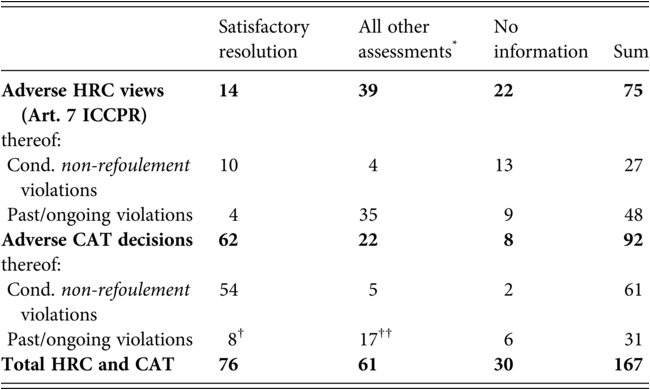
* Includes e.g., findings of “follow-up ongoing,” “lack of implementation” and closed follow-up due to applicants having gone missing.
† Includes five decisions with a follow-up assessment of “partially satisfactory resolution.”
†† Includes one decision that found both a conditional and an actual violation.
As in the case of ECtHR judgments, adverse findings by the treaty bodies are unevenly distributed (see Figure 13.4). The 3 countries that top the list are unusual suspects for violations of physical integrity rights: Denmark (32 decisions), Sweden (28), and Switzerland (26). The reason behind this counterintuitive finding is the fact that all but 6 of their combined 86 adverse decisions concern conditional violations of the non-refoulement norm.Footnote 72
Torture-related HRC views and CAT decisions against ECHR parties (–2019) by country

13.4.3 Discussion
The numbers show that a clear majority of applicants with access to the ECtHR and one or both of the treaty bodies prefer a determination of alleged torture-related violations by the former, rather than the latter. The number of adverse decisions is about nine times higher for the ECtHR than for the treaty bodies (and still about 4.4 times higher when excluding outlier Russia from both datasets). While this imbalance also holds for most States individually, seven States have received more adverse treaty body views than ECtHR judgments and two (Denmark and Norway) have received only adverse views, but no torture-related ECtHR judgments (see Table 13.4 in the appendix for individual country data).
The relationship between democracy and compliance with ECtHR judgments, while not determinative, is suggestive. The four countries with double-digit numbers of judgments against them and the lowest compliance rates also have the lowest average Polity IV regime scores (Azerbaijan, Russia, Ukraine)Footnote 73 or a relatively low liberal democracy score (Hungary)Footnote 74 compared with other countries in the dataset (averaged across the time period covered by the decisions against them). Conversely, respondent States with low judgment counts and high compliance rates comprise many countries with the highest Polity IV regime type score (“10”), which indicates perfect democracy (e.g., Ireland, Finland, Austria, and Switzerland). With respect to compliance with treaty body views, the patterns are not as clear-cut. While Azerbaijan, Russia, and Hungary appear not to have complied with any decision against them, this also holds true for several countries with higher regime type/democracy scores, such as Spain and Germany. That said, with case counts in the single digits, it is not possible to determine any patterns as the reasons for non-compliance may be unique to the individual case and in some cases the coding of non-compliance is due to the absence of follow-up information.
It is notable that the three countries that have complied with the highest numbers of adverse treaty body decisions (Denmark, Sweden, and Switzerland) are all consistently in the highest percentile ranks with respect to the World Bank’s rule of law indicator,Footnote 75 so the expectation that commitment to the rule of law might cut against compliance with non-binding treaty body views cannot be generally confirmed. To the contrary, all three countries accord treaty body views special weight, especially in immigration and expulsion proceedings, even if they do not necessarily share the committees’ ratio decidendi. In Sweden, legislation expressly provides that “[if] an international body that is competent to examine complaints from individuals has found that a refusal-of-entry or expulsion order in a particular case is contrary to a Swedish commitment under a convention, a residence permit shall be granted to the person covered by the order, unless there are exceptional grounds against granting a residence permit.”Footnote 76 The Danish Refugee Appeals Board also regularly reopens asylum cases in light of adverse treaty body decisions while in Switzerland CAT decisions can constitute “new evidence” that may result in a reassessment of an asylum seeker’s application.Footnote 77 So at least in the specific area of non-refoulement-related cases, the lack of legally binding status does not significantly impede the treaty body views’ domestic implementation.
In both institutional contexts, compliance rates differ between conditional and actual violations. With regard to the former, rates are comparably high, at 71.5 percent (ECtHR) and 72.7 percent (HRC/CAT); the rate is highest for CAT alone (88.5 percent). For actual violations, by contrast, compliance rates drop to 36.4 percent and 15.2 percent, respectively (without Russia, rates increase to 56.8 percent and 26.5 percent). In either case, the rate of compliance with ECtHR judgments finding actual past or ongoing violations is more than twice as high as the rate of compliance with comparable treaty body views. This is in line with the argument made above that conditional violations should be more straightforward and cheaper to comply with than actual violations which also carry the added moral and political opprobrium of having to recognize a violation, rather than being able to prevent one. When compliance costs increase, however, the institutionally stronger ECtHR system performs better than the treaty bodies in inducing compliance, suggesting that under these conditions differences in legal status, follow-up arrangements and mobilization are consequential.
That said, a high incidence of non-compliance often goes hand in hand with widespread, systemic patterns of violations that imply at best government indifference to violations committed in particular by the police and military, and at worst deliberate policy, neither of which is conducive to bringing about compliance. Many of the judgments and views against Russia deal with violations of this sort, for example, those concerning violations stemming from the wars in Chechnya and their aftermathsFootnote 78 and with police brutality in different parts of the country.Footnote 79 When, in addition, a State that is being subjected to peer pressure and publicly named and shamed does not care too much about the reputation it has among those using such means, then the institutionally stronger ECtHR supervisory mechanism also reaches the limits of what it can accomplish.
13.5 Conclusion
The existence of jurisdictional overlap in the human rights domain results in a growing body of decisions coming from different institutions that address the same or related rights with respect to the same States. This raises, among other things, the question of their comparative effectiveness in resolving disputes and providing remedies to victims of human rights violations. This chapter has compared rates of compliance with adverse decisions concerning the right to be free from torture and inhuman and degrading treatment or punishment issued by three institutions with ICP jurisdiction over European States as one indicator of such effectiveness.Footnote 80 While a reliable identification of the causal factors affecting compliance and non-compliance and their relative importance in different institutional contexts requires research methods that can deal with sizable numbers of cases and variables, such as multivariate regression analysis or qualitative comparative analysis (QCA), the present text has highlighted select factors expected to be consequential with respect to furthering or inhibiting compliance with ECtHR judgments, treaty body views, or both, and taken a first look at the distribution of compliance and non-compliance across different types of decisions and countries. The empirical evidence tentatively suggests that the UN human rights treaty bodies can induce compliance equally as well as regional courts when their decisions concern conditional violations and are addressed to liberal democracies, but that the ECtHR performs comparatively better when it comes to findings of actual past and/or ongoing violations. However, when a State lacks the aspiration to adhere to the values embodied in human rights norms and in independent monitoring, both institutional settings as they currently exist are incapable of nudging such a State toward compliance with adverse decisions. Further research will need to engage in more fine-grained analysis to assess causal pathways in greater detail, but it seems clear that the presence or absence of a particular legal status of the output of individual complaints procedures is, by itself, determinative neither of compliance nor of non-compliance.


 Open access