




Introduction
Microctonus aethiopoides Loan (Hymenoptera: Braconidae) is a recognised biological control agent, having been introduced from its natural Palearctic distribution into North America, Australia, and New Zealand for the control of invasive weevils in the genera Sitona and Hypera (Coleoptera: Curculionidae) (Coles and Puttler, Reference Coles and Puttler1963; Stufkens and Farrell, Reference Stufkens, Farrell, Cameron, Hill, Bain and Thomas1989; Gerard et al., Reference Gerard, Eden, Hardwick, Mercer, Slay and Wilson2007; Phillips et al., Reference Phillips, Vink, Blanchet and Hoelmer2008). The female lays eggs in adult weevils and the larvae develop within the active host, which dies after the mature larvae emerge to pupate. One common attribute amongst the host genera is that the adult females tend to be larger than the males: e.g. male lucerne weevil S. discoideus Gyllenhal weighs on average 75% that of females (Wightman, Reference Wightman1986). This gives rise to the question: does the sex of the weevil host influence the oviposition and viability of M. aethiopoides?
The introduction and field release of a parthenogenetic pro-ovigenic strain of M. aethiopoides from Ireland into New Zealand in 2006 for control of clover root weevil, Sitona obsoletus Gmelin (Coleoptera: Curculionidae) in pasture (Gerard et al., Reference Gerard, Eden, Hardwick, Mercer, Slay and Wilson2007) provided opportunities to explore this question in both the laboratory and field. A retrospective analysis of the monthly host population data collected from four release sites over the 3 years following the Irish M. aethiopoides release showed that the parasitoid produced broods of one to seven parasitoids per host, and brood size was not influenced by locality, host gender or host weight (Gerard et al., Reference Gerard, Kean and Cameron2024). The latter was unexpected as adult S. obsoletus ranged in weight from 2.4 to 14 mg during the above field study and numerous studies of other gregarious parasitoid species have shown that generally parasitoid females lay more eggs in larger hosts (e.g. Crowley and Saeki, Reference Crowley and Saeki2009; Li et al., Reference Li, Zhu, Meng and Li2017; Kher et al., Reference Kher, Kulkarni, Dosdall and Cárcamo2024). However, oviposition decisions by parasitoids in the field, where hosts are frequently scarce and host-finding ability is paramount, can differ from predictions generated by theoretical models (Phillips et al., Reference Phillips, Vink, Blanchet and Hoelmer2008) or in the laboratory when provided with an excess of hosts, as reported by Bezemer and Mills (Reference Bezemer and Mills2003). The observed brood sizes in the field will be the sum of decisions undertaken by individual females and would be influenced by numerous factors including the time taken to find hosts (which could vary with pasture architecture and composition, temperature, and weather), parasitoid age and egg load (Heimpel et al., Reference Heimpel, Rosenheim and Mangel1996), and competition with other adults (Visser and Rosenheim, Reference Visser and Rosenheim1998).
Therefore, laboratory studies are necessary as it is through elimination of most such variables that a better understanding can be gained of the impact of host size on Irish M. aethiopoides oviposition success. To remove the effects of field conditions and detangle the effects of host size versus sex on parasitism success, a laboratory study was conducted comparing parasitism in the largest and smallest individuals in a S. obsoletus population, and what role host sex may have had in the outcomes. In addition, the previous field analyses using generalised mixed models were on data collected during the establishment phase of Irish M. aethiopoides over multiple sites and seasons. To see if post-establishment single site data provides more nuanced results, previously unpublished host weight and sex data gathered during a field study investigating parasitism levels by Irish M. aethiopoides in S. obsoletus nine years after release is also presented (Gerard et al., Reference Gerard, Wilson and Upsdell2021).
Methods
Laboratory comparison of parasitism success on large and small S. obsoletus
Irish M. aethiopoides adults were reared in a controlled environment room at 20°C in a 16:8 L:D photoperiod in a similar manner that is described by McNeill et al. (Reference McNeill, Proffitt, Gerard and Goldson2006). As parthenogenic, all adults are female. S. obsoletus adults were collected from pasture and placed in cages with bunches of clover (Trifolium repens L.) foliage. In line with previous and concurrent M. aethiopoides mass rearing protocols (Fusco and Hower, Reference Fusco and Hower1974; Cullen and Hopkins, Reference Cullen and Hopkins1982; Gerard et al., Reference Gerard, Wilson and Eden2011), the exposure rate was two parasitoids to 100 weevils and the exposure time 4 days. The weevils were then transferred into a two-tiered parasitoid rearing cage where prepupae emerging from weevils in the upper chamber dropped through mesh to the lower chamber to pupate under and between layers of paper towel. The cocoons were removed after 48 h and placed in Petri dishes on moistened filter paper to prevent desiccation. The Petri dishes were inspected daily for newly emerged adults, which was usually 7–10 days after collection.
Sitona obsoletus adults were collected by suction sampler from pasture at the Ruakura Research Centre (37°46′13.5″ S 175°19′00.2″ E) in autumn 2006, before Irish M. aethiopoides had become established on the research farm. Around 300 weevils were collected and from these the visually 105 largest and 105 smallest weevils were selected in the laboratory. Sex can be determined by close inspection of the ventrite (Bright, Reference Bright1994), but this is very difficult to do by eye with active weevils and accurate sex data was going to be obtained during dissections. Therefore, weevils were not separated by sex. Batches of large or small weevils were put into separate 30 × 25 × 12 cm cages, each with a newly emerged parasitoid. There were 11 replicates of each size, with 9 consisting of 10 weevils and 2 with 7 or 8 weevils. Each cage was supplied with a vial of 10% sucrose solution plugged with a cotton wool wick as a food source for the parasitoid and bunches of white clover (Trifolium repens L.) foliage for the weevils to feed on and provide a habitat. The cages were placed in the controlled environment room and on day four, the parasitoids were removed, and fresh clover foliage added. At day 15, the weevils in each cage were removed, sealed in small plastic bags, frozen then retrieved, weighed and dissected under a binocular microscope. The sex of the weevils and the number and life stages of any parasitoids present were recorded.
Data were analysed by regression analysis using GenStat, 8th edition (GenStat Committee, 2005). Most variables were normally distributed with no transformation needed, and all were combined in a single analysis. The number of parasitoid larvae per weevil were analysed with a Poisson distribution and percent parasitism with a binomial distribution. Unexpectedly, only two of the 105 weevils in the large category were males, so to prevent distortion of statistical analyses, they were omitted as outliers when investigating the interactions between host sex and parasitoid outcomes.
Determining impact of weevil size on parasitism in the field
Raw population data were available from a study by Gerard et al. (Reference Gerard, Wilson and Upsdell2021) on the Ruakura Research Centre farm, Hamilton, New Zealand (37°46′01.5″ S 175°19′09.5″ E). S. obsoletus adults had been collected at monthly intervals from January to April 2015 by taking replicated suction samples of pasture using a modified blower vac. These had been assessed in the laboratory and the sex, weight, and number of parasitoid larvae present recorded for each adult. The pooled data were analysed using one-way analyses of variance (ANOVA) and chi-square tests in Microsoft Excel. Parasitoid developmental data were not analysed as generations overlap in summer.
Results
Laboratory comparison of parasitism success on large and small S. obsoletus
For the field- collected S. obsoletus used in this experiment, the mean weight for the large individuals averaged 9.7 ± 0.1 mg (N = 105, females range 7.2–12.7 mg, males 7.7–9.3 mg) and the small weevils 4.8 ± 0.1 mg (N = 105, females range 3.1–5.8 mg, males 3.6–6.0 mg). Weevil survival was high, with only one mortality from unknown causes. All but two of the large weevils were female while 65% of small weevils were male (Table 1). Parasitism levels exceeded 70% in both the large and small weevil populations, but significantly fewer large weevils were parasitised compared to small weevils (74% vs. 91%, P < 0.001). All parasitoids found in weevil dissection were either first or second instar larvae. Brood size ranged from 1 to 8 larvae, with a single larva (N = 75 broods) or two larvae (N = 62 broods) being the most common. While host weight had no impact on brood size, significantly more parasitoid larvae in the small weevils were still in the first instar compared to those in large weevils (47% vs. 26%, P < 0.01, Table 1).
Effect of host size category on mean (± SE) S. obsoletus sex rate and on mean (± SE) percent parasitism, brood size/parasitised host, and larval development by M. aethiopoides

Table 2 summarises the data when categorised by both host sex and size. The two large males (both parasitised) were omitted from the analysis. Compared to the large females, small females had higher parasitism rates (97% vs. 74%, P < 0.001) and parasitoid larval development was similar (32% vs. 26% first instars, P = 0.55). However, even though small males did not differ statistically from small females in either weight (P = 0.178), percent parasitism (P = 0.057) or larvae/ parasitised host (P = 0.56), parasitoid development was retarded with 56% of larvae still in the first instar compared with 32% in females.
Effect of host size category and sex on mean (± SE) weight, percent parasitism, brood size/parasitised host and larval development by M. aethiopoides

Determining impact of weevil size on parasitism in the field
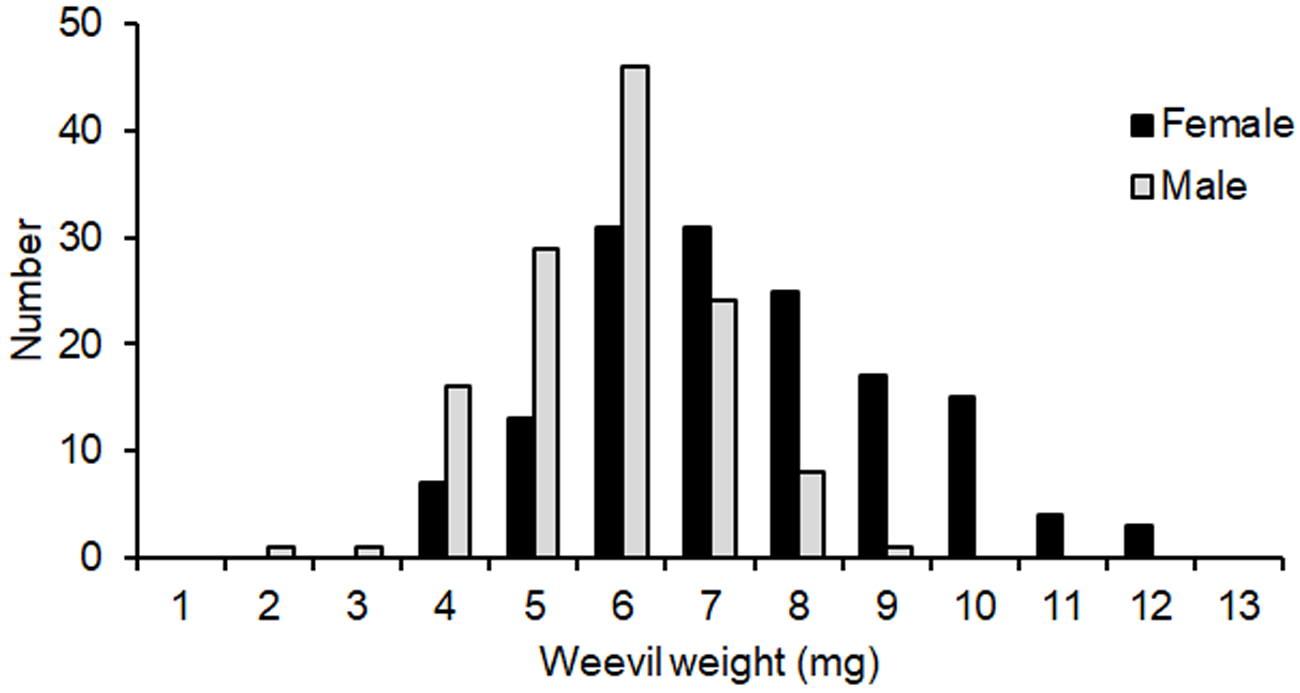
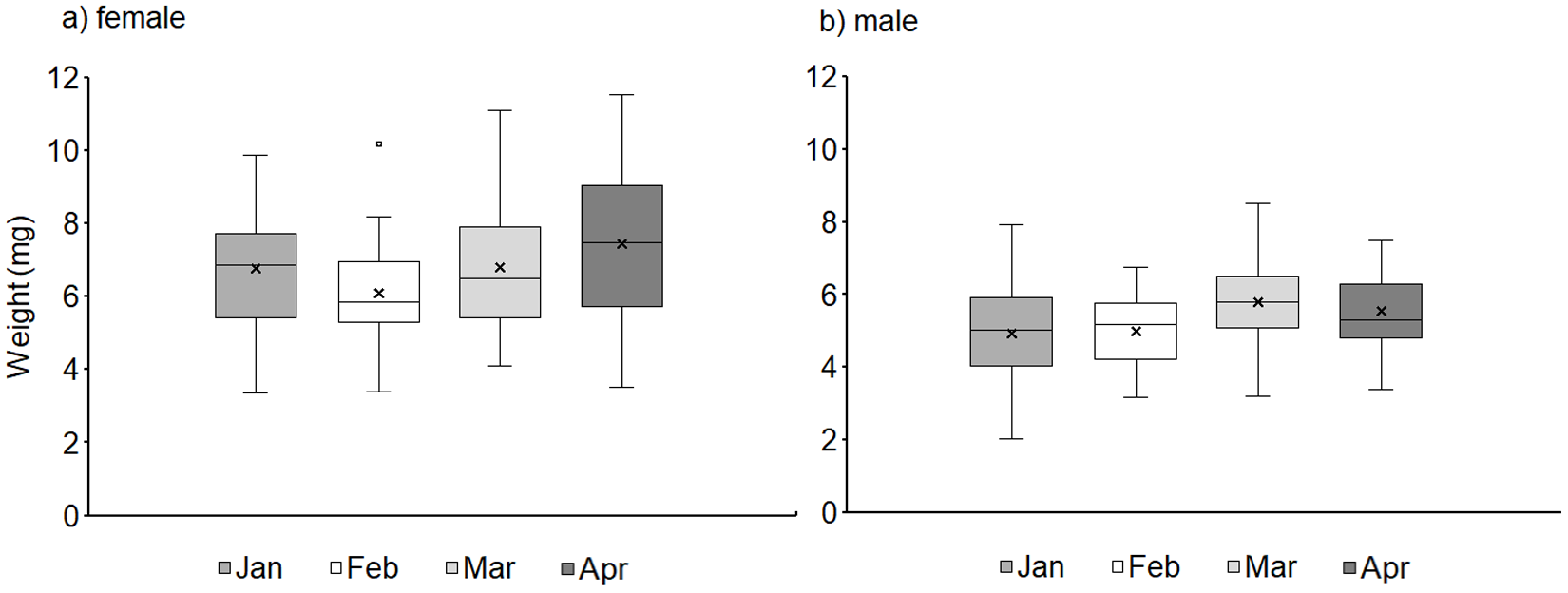
S. obsoletus adults ranged in size with weights from 2 to 12 mg. While there was overlap in adult weights (Fig. 1), female S. obsoletus were heavier (6.97 ± 0.15 mg) than males (5.41 ± 0.10 mg) (P < 0.001). Weevil weight varied with the month collected (Fig. 2a and b): females were heaviest in April (7.4 ± 0.3 mg) and lightest in February (6.1 ± 0.3) (P = 0.036) while males where heaviest in March (5.8 ± 0.2) and lightest in January (5.0 ± 0.2) (P = 0.007). Parasitism levels increased from 5 ± 3% in January to 58 ± 5% in April. No difference in overall percent parasitism by Irish M. aethiopoides was found between the heaviest 20% and the lightest 20% of the S. obsoletus population (33% vs. 35%, P = 0.84), nor between males (41 ± 6%) and females (29 ± 4%) (chi-square test P = 0.075). The average brood size was 1.39 ± 0.09 with 76% of broods consisting of a single larva.
Histogram of weight distribution of male and female S. obsoletus adults collected from Waikato pasture Jan–April 2015.

Monthly mean weights of S. obsoletus male and female adults collected from Waikato pasture Jan–April 2015. Boxes extend from the 25th to 75th percentiles and the whiskers from the smallest to largest values. The solid line shows the median value and the x symbol the mean.

Discussion
The no-choice experiment in this study showed that in the laboratory Irish M. aethiopoides, the biocontrol agent for S. obsoletus in New Zealand, had lower parasitism rates in large weevils compared to small weevils. This was contrary to findings in the field which confirmed earlier work reporting host size has no influence on field parasitism. The stark difference between the laboratory and field observations demonstrates how subtle differences related to host size may be masked in the field where numerous other factors play a more dominant role in determining parasitism success.
Potential influence of host size
Sitona obsoletus adult weight in the field study ranged from 2 to 12 mg (Fig. 1) and males averaged around 78% the weight of females. This variation in adult weight and sex aligns with that of S. discoideus (Wightman, Reference Wightman1986). However, while S. discoideus host size made no difference in laboratory parasitism rates by Moroccan M. aethiopoides (Barratt and Johnstone, Reference Barratt and Johnstone2001) which was introduced into New Zealand in 1982 to control this species (Stufkens et al., Reference Stufkens, Farrell and Goldson1987), the no-choice experiment of this study showed a significant 17% difference in parasitism between large and small S. obsoletus females. This disparity between strains of the same parasitoid species may have occurred because unlike the solitary Moroccan strain, Irish M. aethiopoides produces broods of one to seven parasitoids and adult parasitoid size varies with resources available during development (Gerard et al., Reference Gerard, Kean and Cameron2024). It is possible that small parasitoid females have difficulty piercing the abdominal integument and ovipositing successfully in large weevils. Similar interactions have been found with other parasitoids where both host and parasitoid body sizes vary (Lykouressis et al., Reference Lykouressis, Garantonakis, Perdikis, Fantinou and Mauromoustakos2009; Song et al., Reference Song, Meng and Li2017). Differences in parasitism may also arise if the large S. obsoletus females have more effective immune responses against M. aethiopoides eggs than their smaller counterparts. Encapsulation is the primary defence against endoparasitoids: the host haemocytes form a capsule around parasitoid egg resulting in parasitoid death. For instance, the encapsulation of Microctonus hyperodae Loan eggs and larvae by adult Listronotus maculicollis Dietz preclude the use of this parasitoid as a viable biocontrol agent for this weevil in the USA (McNeill et al., Reference McNeill, Vittum and Baird1999). Unfortunately, the very small size of newly laid M. aethiopoides eggs means detection of encapsulated eggs is extremely difficult and the test developed to determine successful oviposition (McNeill et al., Reference McNeill, Barratt and Evans2000) was not applicable to this study. Lastly, additional activity associated with mating in the mixed-sex replicates of small weevils may have increased their likelihood of parasitoid attack compared to the female-only large weevil replicates. This aligns with findings that these parasitoids attack active hosts and not those in resting positions (Phillips, Reference Phillips2002).
Potential influence of weevil sex
Differences in parasitism in relation to host weevil sex have been reported previously in M. aethiopoides. A survey of autumn S. discoideus field populations from 1996 to 1998 found that although the weevil sex ratio was biased towards females, around twice as many males (39%) were parasitised by Moroccan M. aethiopoides than females (21%) (Kean and Barlow, Reference Kean and Barlow2000). Barratt and Johnstone (Reference Barratt and Johnstone2001) also observed this in cage experiments with the same host: parasitoid combination. Similarly, during investigations on non-target impacts on Rhinocyllus conicus Froelich, a weevil introduced to control thistles, the Moroccan M. aethiopoides parasitised male weevils at higher rates than females both in the laboratory (Barratt and Johnstone, Reference Barratt and Johnstone2001) and field (Murray et al., Reference Murray, Barratt and Ferguson2002). However, host sex had no influence on parasitism in the laboratory by the M. aethiopoides strain introduced into the USA to control Hypera postica (Gylh.) (Fusco and Hower, Reference Fusco and Hower1973).
While the higher rate of percent parasitism in small female (97%) compared to small male hosts (88%) was not statistically significant for Irish M. aethiopoides (P = 0.057), the variation between the Moroccan and Irish strains may relate to host reproductive physiology. In New Zealand, S. obsoletus adults have two generations per year that overlap in early autumn, are active year-round, and provided they have adequate food and are not exposed to drought, most non-parasitised individuals remain reproductive throughout their lifetime (Willoughby and Addison, Reference Willoughby and Addison1997; Addison et al., Reference Addison, Willoughby, Hardwick and Gerard1998; Gerard et al., Reference Gerard, Addison, Hardwick and Willoughby1999). In contrast, S. discoideus is univoltine, the adults emerge in early summer, and the bulk of the population enters aestivation until autumn when they become reproductively mature (Sue et al., Reference Sue, Ferro and Emberson1980; Wood, Reference Wood1980; Goldson et al., Reference Goldson, Frampton, Barratt and Ferguson1984). Weevils were most vulnerable to attack by M. aethiopoides when feeding or grooming and immune when resting (Phillips, Reference Phillips2002). S. obsoletus adults have short episodes of feeding interspersed with long periods away from the leaf surface, with females eating more clover dry matter than males (Gerard and Hackell, Reference Gerard and Hackell2005). Given that highly fecund, fully reproductive female weevils will have higher metabolic demands than males of comparable size, they may be more vulnerable to parasitism due to longer or more frequent feeding episodes. For S. discoideus, the Barratt and Johnstone (Reference Barratt and Johnstone2001) cage study was conducted in early autumn and only 18% of unparasitised females were reproductively mature at time of dissection 15 days after exposure. Therefore, their speculation that the male-dominated parasitism resulted from males searching for receptive females is plausible.
A bias toward fully reproductive S. obsoletus females would help parasitoid females select optimal hosts. Microctonus spp. venom contains numerous proteins (Crawford et al., Reference Crawford, Brauning, Smolenski, Ferguson, Barton, Wheeler and McCulloch2008) that induce female-specific changes in the host haemolymph (Lovallo et al., Reference Lovallo, Barratt, Legge and Cox-Foster2000) and rapid female sterility (Loan and Holdaway, Reference Loan and Holdaway1961). No similar physiological changes in S. obsoletus males have been reported, nor have they been observed by the authors. The resorption of eggs would provide a resource boost for hatching parasitoid larvae and help to explain why larval development was more advanced in females compared to males. Faster Moroccan M. aethiopoides larval development in female S. discoideus adults compared to males was observed by Barratt and Sutherland (Reference Barratt and Sutherland2001), who attributed this to the larger size of females. However, a 23% difference (P = 0.029) in M. aethiopoides larval development existed between similarly sized small female and male S. obsoletus in this study, indicating sex is an important factor in host quality in this host: parasitoid interaction. Irish M. aethiopoides larvae diapause over winter and emerge to pupate in September in the North Island (Gerard et al., Reference Gerard, Wilson and Eden2011). The differential rates of parasitoid larval development would lead to increased overlapping of the successive generations, which should help population resilience in the field: Life stages within the hardy host adults are likely to withstand extreme weather events and localised environmental shocks, even when the more vulnerable parasitoid adults (∼2 mm) and pupae in the soil litter layer are lost.
Determining impact of weevil size on parasitism in the field
As in the instigating study on the early 2006–2009 Irish M. aethiopoides field release data (Gerard et al., Reference Gerard, Kean and Cameron2024), the analysis of the 2015 data confirmed that neither host sex nor weight influenced overall parasitism levels by Irish M. aethiopoides in S. obsoletus field populations. While the 12% difference in parasitism rate between male and female hosts seemed substantial, the data exhibited high variability due to the parasitoid multiplying from a low level through several generations.
The variation in monthly mean weevil weights in the field likely arose from the combination of the emergence of new adults, climate, and the possible greater longevity of larger females. At the study sites, S. obsoletus had two peaks of adult emergence, one in early summer (December/early January) and a second for the overwintering generation peaking in autumn (late March–early April) (Gerard et al., Reference Gerard, Wilson and Upsdell2021). January to March 2015 rainfall was 31–76% below normal and was followed by a very wet April (208% above normal) (NIWA 2024). It is likely that the low weights in February reflect the dry conditions and a decline in food resources, while the pattern difference between S. obsoletus sexes was accentuated by the probable drought-induced resorption of eggs during the drought and resumption of egg production when the rains returned (Addison et al., Reference Addison, Willoughby, Hardwick and Gerard1998; Gerard and Arnold, Reference Gerard and Arnold2002).
Conclusions
This study shows how laboratory studies can be used to identify the possible influences that host size and sex may have on parasitism. By selecting the largest and smallest individuals from a S. obsoletus population, we were able to show that in a no-choice experiment the large weevils were less likely to be parasitised by Irish M. aethiopoides. However, faster parasitoid larval development could offset this disadvantage. Within the small-sized weevil cohort, parasitoid larval development was more rapid in female compared to males. This differential development would not be detected in field or in laboratory studies where host exposure is uncontrolled. By facilitating an increasing overlap of generations through the summer, the differential development times may help Irish M. aethiopoides population resilience to adverse events and thus the species long-term persistence and efficacy as a biocontrol agent.
Acknowledgements
The authors thank Catherine Cameron for data analysis and Tim Hale (AgResearch, Ruakura) for his support for the field work and insect collections undertaken on the research farm. We also like to thank Mark McNeill and Craig Phillips (both Bioeconomy Science Institute-AgResearch) and the journal reviewers for valuable comments on the manuscript. The work presented was funded by the New Zealand Foundation for Research, Science and Technology through LINX0804 Ecosystems Bioprotection and by DairyNZ Project RD1425.



 Open access

