


Introduction
The implications of a warming Arctic for international law will depend, in part, on the magnitude and nature of the threats that emerge over the course of the next few decades. The history of Arctic politics has been characterized by both exemplary international cooperation and intense global competition. On the one hand, the High North has long been seen as a zone of exceptional politics characterized by international cooperation. On the other hand, it has also been a zone of intense strategic competition. Climate change is a threat multiplier on a global scale. It will introduce new Arctic challenges. But it will also exert pressure on key relationships, institutions, and norms globally. Some of these new pressures—and the conflicts they generate—will have ramifications for Arctic geopolitics. In the Arctic, emergent points of conflict include concerns over freedom of navigation, fish and hydrocarbon resource management, Indigenous rights, and environmental regulation. In one possible future these points of contention might be addressed through cooperative legal regimes. In another, strategic competition might come to the fore, potentially eroding fundamental pillars of the international legal order, including norms related to the non-appropriation of international waters, the right of self-determination, nuclear non-proliferation, or even the preservation of territorial integrity. The likely future lies somewhere between these two extremes, with strategic competition returning in greater force to the Arctic, but with legal authorities and norms still serving as guardrails in a new “Great Game.”
Arctic Political-Legal History
The history of Arctic geopolitics can be divided into five time periods, each with its own primary legal challenges. The first period is the Era of Exploration, from the mid-nineteenth century until World War I, when states competed for territorial control and bragging rights. The second era encompassed the two World Wars and saw important innovations in conceptions of territoriality. The onset of the Cold War marked the third period of Arctic geopolitics, with the Arctic becoming one of the front lines of the conflict. The fourth period began with the end of the Cold War and the founding of the Arctic Council, which ushered in a new era characterized more by cooperation than competition. This fourth period, when issues of common interest deepened cooperation among Arctic states, formed the Arctic politics and legal structures with which practitioners today are familiar. Finally, the current era of Arctic geopolitics has seen mounting climate risks, increasing Russian and Chinese ambitions, and breakdowns in circumpolar cooperation in the Arctic Council due to Russia’s invasion of Ukraine.
Exploration Era
The exploration era truly kicked off in the latter half of the nineteenth century when Arctic exploration became an international affair and changes in technology meant Arctic economies could develop in new ways.Footnote 1 The chronometer, steel hulls, internal combustion engines, the exploding harpoon, and screw propellers all contributed to a rapid pace of development in maritime economies and a steep increase in exploration and economic activity.Footnote 2 With this increased activity came the need to adjudicate the most basic question of international law, spatial jurisdiction. Two competing legal theories developed in this period. The United Kingdom and Canada favored basing territorial claims on discovery rights (with Canadian claims inherited from British explorers). The United States and Norway, in contrast, preferred a regime based on effective occupation.Footnote 3 The different interpretations of international law, paired with the cultural phenomenon of exploration as a form of international sport, fueled races for the poles and various feats of Arctic conquest. These races mattered. Russia’s launch of the first modern icebreaker in 1899 allowed it to reach Spitzbergen before Norway-Sweden, which presented a challenge to Norwegian-Swedish claims to the archipelago dating from 1871.Footnote 4 The parallel contestation of law and politics in this era of Arctic geopolitics demonstrates that Arctic politics is capable of stretching and challenging foundational principles of international law.Footnote 5
World Wars
The first half of the twentieth century saw some of the starkest whiplash in Arctic geopolitics. Initially, a largely cooperative footing took hold. Several cooperative methods for adjudicating territorial jurisdiction developed. Bilateral exchanges of mutual recognition were common in this period. The 1920 Svalbard Treaty, Canadian-Russia mutual endorsement of the Sectors Principle, and Norwegian-British exchange of recognition of both Arctic and Antarctic claims demonstrate the momentum behind diplomatic solutions. In addition to bilateral work, it was in this period that states first employed third-party arbitration to resolve Arctic territorial disputes. In the East Greenland case, Norway argued that Norwegian settlements in East Greenland demonstrated effective occupation and prevailed over Denmark’s assertion of sovereignty, since Danish occupation was concentrated in the Western portions of the isle. That the court sided with Denmark functionally lowered the test for effective occupation of sparsely populated or inhospitable environments by allowing a part of the territory to stand in for the whole.Footnote 6 Finally, the first Arctic overflights confirmed that all relevant landmasses had been discovered in the polar regions, ending one of the primary motivators driving competitive expeditions.Footnote 7
World War II brought Arctic competition back. Whereas previously states vied for Arctic positions with provocative sponsorship of expeditions and build-up of military hardware and presence, in the 1940s, actual blood was shed over the control of Arctic territory. Nearly 30 percent of all Allied aid to reach the USSR in World War II passed through the straits over Norway’s North Cape, making these some of the most strategically significant waterways in any modern conflict.Footnote 8 To contest the waterways, both Allied and Axis powers placed military assets on the Svalbard archipelago, in direct contravention of the Svalbard Treaty. Additionally, General Lothar Rendulic’s scorched-earth tactics in the Nazi retreat across Northern Norway presented novel challenges to the law of armed conflict. Rendulic’s Rule—which was adopted in the Hostages case and provides that assessment of a military officer’s perception of military necessity cannot be judged in hindsight—still features as a key component of the law of armed conflict.Footnote 9 Though World War II was not primarily a war over Arctic issues, it demonstrates the potential for broader strategic competition to spill over into the Arctic and, when refracted through Arctic conflict, have a significant effect on international legal regimes.
Cold War
The Cold War is another international confrontation in which the primary issues were not Arctic in nature. However, due to the Arctic’s position directly between the USSR and the United States, it became one of the main theatres of the confrontation. Because the shortest strike paths for bombers and missiles transversed the Arctic and submarines routinely patrolled under the ice, nuclear politics became a major theme in Cold War Arctic politics. Although Denmark—including Greenland—committed to being a nuclear-free zone, the United States repeatedly deployed nuclear weapons and reactors in Greenland without consulting Danish officials. One famous instance was Project Ice Worm—an experimental U.S. Army program testing the deployment of nuclear weapons under the Greenlandic ice cap. The United States also hosted weapons at Thule and periodically flew nuclear bombers over Greenland—which in one case led to the loss of a nuclear weapon off the West coast of Greenland. In essence, the pressures of the Cold War, and the Arctic’s key position between the two superpowers, led the United States to prioritize strategic competition with the Soviet Union over the sovereignty of—and therefore legal obligations to—allied states.
After 1989
Hard as it is to imagine today, at the end of the Cold War, the United States and Russia entered into a period of cooperation on environmental and nuclear safety issues in the Arctic. In the early 1990s, Norway was less concerned about the Russian nuclear submarines slipping past Svalbard and more concerned with the decommissioned ones rotting on the seafloor and contaminating Norwegian waters. When the Cold War ended, many of Russia’s nuclear submarines, with highly radioactive spent fuel, were left to sink at the piers at the Russian Arctic port of Murmansk, just sixty miles from the border with Northern Norway. In 1993, Russia admitted to dumping radioactive waste in the ocean and acknowledged that Soviet submarine accidents had also released toxic material. Norway’s defense minister worried that these sunken subs were a “slow motion Chernobyl” at sea. He asked his American counterpart to engage the Russian military to safely remove these wastes. This request led to the establishment of the Arctic Military Environmental Cooperation program among the United States, Russia, and Norway. U.S. and Russian officials also exchanged formerly classified images of contamination at military bases, delivered lectures at each other’s military academies, and conducted joint Arctic science activities.Footnote 10
Current Emergent Threat Environment
Three security challenges exacerbated by climate change have the potential to upset major pillars of international law: first, navigational rights in exclusive economic zones and international straits; second, nuclear non-proliferation; and third, the territorial integrity norm.
Freedom of Navigation
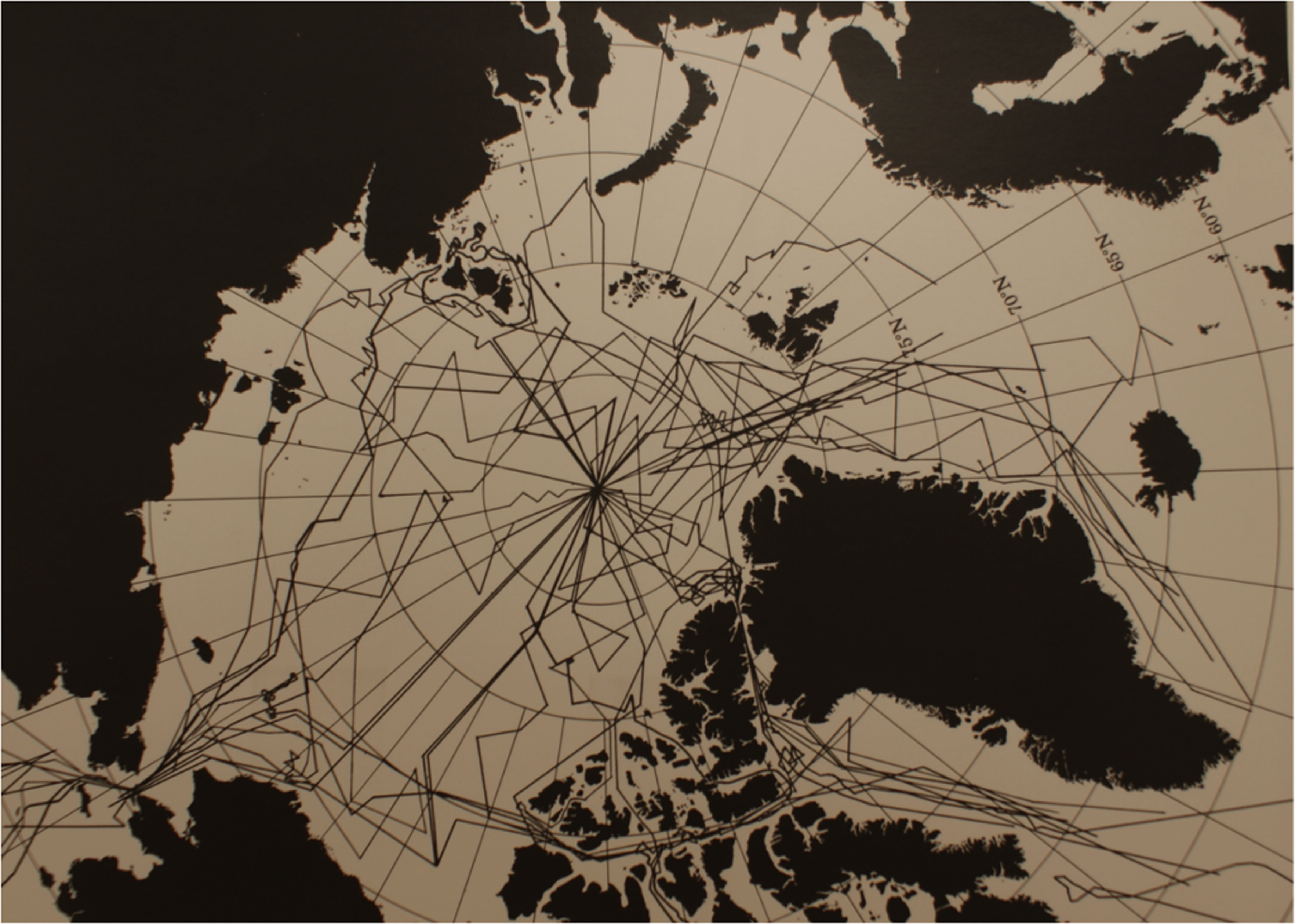
As the melting of Arctic sea ice has opened up Arctic waterways to routine navigation, the territorial treatment and governance of the Northwest Passage (NWP) and Northern Sea Route (NSR) have garnered greater attention. Differing interpretations of the status of various straits in Canadian and Russian internal waters along the NWP and NSR have increased tensions between each of these states and the United States. Since 2022 Russia has explicitly limited the right of free passage for warships along the NSR.Footnote 11 The United States has objected to both countries’ attempts to internalize what the United States views as international straits, but it has been more cautious challenging Russia’s governance practices along the NSR than Canada’s in the NWP. As Figure 1 illustrates, activity is denser in the NWP than the NSR. During the Cold War, the NSR was functionally off limits to American action due to strategic concerns associated with disturbing the USSR’s nuclear fleet. This reluctance to conduct patrols or Freedom of Navigation acts along the NSR persists today. The United States has made its objections known to Russia diplomatically, but the only concrete action the United States has employed recently is the relatively cautious voyage of the USS Healy in 2022.Footnote 12 As sea ice retreat driven by climate change continues and both the NWP and NSR grow in significance for global shipping, there is a chance that the NSR will develop into one of the only major shipping routes not regularly patrolled by the United States. Furthermore, the popularization of more restrictive definitions of “straits used for international navigation” by Canada and Russia could inspire other states to pursue similar internalizations. Of particular concern to the United States would be decisions by Chinese officials to pursue more exclusive practices in the South China Sea among and between the various islands under China’s contested claims.
Arctic Submarine tracks from 1958–1983. Reproduced from the Waldo K. Lyon Papers. Footnote 13 .
Nuclear Non-proliferation
Another major pillar of international law that Arctic states may challenge is the nuclear non-proliferation regime. Because climate change is a global threat multiplier, it will likely exacerbate existing conflict and contribute to regional instability. The Euro-Russian relationship has already been worn threadbare by the war in Ukraine. Furthermore, the Trump administration’s rhetoric has sharpened Europe’s focus on developing a security infrastructure that does not rely on the United States. With climate change added into this incendiary mix, the risk for regional conflict in Europe is only likely to grow in coming years. Whether it is the politics of decarbonization, an increase in the weaponization of climate migrants along the Russia-EU border, or the escalation of maritime disputes as sea ice retreats and fish stocks migrate further north, there are multiple vectors for climate change to add to the risks of continuing post-Ukraine conflict between Russia and Europe. This increased risk profile makes the debate about Europe’s security infrastructure more salient. One of the biggest themes of a more independent security infrastructure is the creation of an independent nuclear deterrent in Europe. Though both Sweden and Finland have signed and ratified the Nuclear Non-Proliferation Treaty,Footnote 14 their recent NATO accession, along with their experience in nuclear and defense industries, places them as instant leaders in talks around the development and hosting of a new European nuclear arsenal.Footnote 15
The Territorial Integrity Norm
Finally, the territorial integrity norm must be mentioned in light of the renewed interest in the acquisition of Greenland from the United States. Tensions escalated to new heights in 2026 with the Trump administration refusing to rule out military action and Denmark alleging the United States was engaged in information operations in Greenland.Footnote 16 Though the motives of the United States are difficult to discern, there is a strong likelihood that commercial opportunities created by a changing climate are a contributor. Opportunities for tourism and mineral extraction in Greenland will increase as the Arctic warms. Additionally, Greenland is positioned on the eastern edge of the NWP and guards passage into the North Atlantic for Russian Arctic naval assets, increasing its strategic salience as those waterways grow in significance. Importantly, the United States has traditionally been seen in the field of International Relations as a supporter of the territorial integrity norm, making its rejection of that norm in the case of Greenland all the more significant.Footnote 17 From the initial drafts of the UN Charter at the San Francisco Conference in 1945, the territorial integrity norm has been foundational to modern international law. If basic rules regarding spatial jurisdiction begin to bend or break under the pressures of climate change, we will be in a very different future than one where the primary concerns are fishing or other extraction rules, Indigenous rights, and environmental regulation.
Conclusion
Recognizing that hard and soft power have always coexisted in international Arctic politics means acknowledging growing strategic competition today while continuing to invest in areas that serve mutual interests, where cooperation is possible—for example, scientific research into the changing Arctic climate, natural resource conservation, search and rescue, and oil spill prevention and cleanup. These areas and others of potential scientific and environmental cooperation—whose significance will likely grow as climate change progresses—should be assessed not only for their intrinsic value, but also for their contribution to mediating conflict.
Russia’s full-scale invasion of Ukraine in 2022 may have been the nail in the coffin of the era of U.S.-Russian Arctic cooperation that characterized the decade after the Cold War and facilitated the creation of the Arctic Council. However, a new era of Arctic engagement is emerging, with Arctic states and actors continuing various forms of non-security cooperation and even looking for ways to reengage with Russia after the Ukraine war. It is most likely that climate change will simultaneously bring both greater competition and greater cooperation to the Arctic. Even as climate change puts added pressures on the legal norms of freedom of navigation, nuclear non-proliferation, and territorial integrity, states should seek confidence building measures and engage on issues of conservation to balance these pressures and prepare for a time when tensions ease and opportunities for multilateral circumpolar cooperation arise again.

 Open access

