

John Harris and the value of life
Everyone’s life is different. We have different abilities, talents, length of life, quality of life, and desires for our lives. The value of life for John Harris is not determined by objective features like its length or quality.
“it does not follow from the fact that some lives are more desirable in virtue of their objective features than others, that those with more desirable lives have more valuable lives [that is, are more worth saving].”Footnote 1
Rather, the value of life is determined by the degree to which a person values their life. A person’s life matters “not because it is a life, but because it is someone’s life, because her life is an enterprise in which she has, and takes an interest.”Footnote 2 Life per se is not of value but of value to the extent that a person values it.Footnote 3
Of course, people value their own lives to different degrees. Some people who experience incurable suffering no longer value continuing to live and desire euthanasia. Their lives have ceased to have value for them. However, to the degree that people value their lives equally (that is, they want to continue to live), their lives should have equal value, and they ought to be treated equally, according to John Harris.
A problem: limitation of resources
In 2001, I wrote an Editorial for the British Medical JournalFootnote 4 on the Independent Inquiries into Pediatric Cardiac Services at the Royal Brompton Hospital and Harefield Hospital alleging that children with Down Syndrome were discriminated against because they were inappropriately “steered away” from surgery for heart defects. The report recommended that: “The Trust’s policies confirm clearly that people with a disability are entitled to, and will be accorded … the same rights of access to services as those without a disability; and that consultants should take the lead in implementing policies and influencing attitudes regarding equality of access…Access to services, and priority for treatment, should be determined only on the basis of clinical need.”
Approximately 50% of children born with Down syndrome have congenital heart defects.Footnote 5 Many of these, such as holes in the heart, can be corrected by surgery. It is discrimination to deny these children surgery based on their disability unless doctors judged their disability to be so severe as to make life not worth living. Some doctors did believe thisFootnote 6 into the 1990s but it is now roundly rejected.
Children with complex cardiac abnormalities, including those with Down Syndrome, sometimes also require cardiac transplantation. However, there is a severe shortage of organs for transplantation, especially pediatric transplantation. Only about 1/3 of children who need heart transplantation receive one. This is rarely performed in Down SyndromeFootnote 7 despite 1/775 live births in the United States being for Down SyndromeFootnote 8. Indeed, a study in 2024 of major pediatric heart transplant centers in the US showed only 26 patients with Down Syndrome [DS] listed for heart transplants between 1992 and 2020.Footnote 9 The authors concluded that in those 26 transplanted, “outcomes in children with DS selected for transplant listing are comparable to pediatric TX recipients overall.”
As these data suggest, children with Down Syndrome are given lower if any priority. A Channel 4 edition of Inside Out reported one case of a child who was denied heart-lung transplantation because of her Down’s syndrome. Her mother believed the medical argument was: “There are so few organs they’re not going to waste one on my child.”Footnote 10
In many countries with legislation preventing discrimination, it is probably unlawful discrimination to fail to give children with Down Syndrome an equal chance of receiving a heart transplant on quality of life grounds. For example, The European Convention on Human Rights 1950 states: “Everyone’s right to life shall be protected by law. No one shall be deprived of his right to life intentionally” and “The enjoyment of the rights and freedoms set forth in this Convention shall be secured without discrimination on any ground such as sex, race, color … or other status.”
According to John Harris’ account of the value of life, children with Down Syndrome have lives of equal value to those without Down Syndrome and ought to have an equal chance of receiving a cardiac transplant. He has been a staunch advocate of equality of access or equal treatment for equal needs. Indeed, he argued that the use of Quality Adjusted Life Years to measure the health and economic outcome of medical treatments is discriminatory against the aged (ageist), the disabled (ablist), and those with rare expensive diseases (economist).Footnote 11
As Harris succinctly puts it, each rational person wants for himself or herself at least three things from health care: (a) the maximum possible life expectancy; (b) the best quality of life; and (c) the best opportunity or chance of getting both.Footnote 12 This is a version of egalitarianism. The good or value of health care is giving each person (c).
There are limits, according to Harris. In The Value of Life, he argues for a “fair innings” approach to the allocation of life-saving resources, such as hearts. That is, each of us would be treated equally until our fair innings had been achieved (an innings is a period of batting in cricket until one is “out” or is no longer allowed to bat and score runs). At the time of his writing, this innings was mooted at 70, but it might now be 80 or 85. This was the first “sufficientarian” approach to distributive justice in health care.
Harris’ egalitarianism speaks in favor of giving children with Down Syndrome an equal chance of receiving a heart transplant. This is not because he believes disability is neutral like hair color (as some disability scholars argueFootnote 13. Harris believes disability is badFootnote 14. But just as a short life can be valued by the individual as much as a longer life is valued by a different individual, so too a disabled life can be valued as much by the individual as the life of an able-bodied individual is valued by that individual.
While Harris’ egalitarianism underpins the law and stated values of the National Health Service, it is not in fact what dictates treatment in the United Kingdom or most other countries. As Harris realizes, treatment is provided on cost-effectiveness grounds, which is in practice the cost/QALY (Quality Adjusted Life Year). QALYs include consideration of probability of benefit, length of benefit, and value of benefit (in terms of quality of life). This approach is essentially utilitarian. According to utilitarianism, the right act is the act that maximizes utility, which in this case is the health benefit of medical treatment (measured in QALYs).
Indeed, even Courts take utilitarian considerations into account. In 1995, Jaymee Bowen (Child B) was denied a second bone marrow transplant for leukemia on grounds of cost and low probability of success. Sir Thomas Bingham, Master of the Rolls, appealed to a principle of maximizing benefit when he rejected the father’s appeal: “Difficult and agonizing judgments have to be made as to how a limited budget is best allocated to the maximum advantage of the maximum number of patients.” Indeed, the General Medical Council has stated that “the clinical team in determining priorities and the utilization of the resources made available to them by the NHS is entitled to take into account the likely success of the treatment proposed.”Footnote 15
Indeed, there are more severe congenital conditions than Down Syndrome. Trisomy 18 is one. It results in more profound intellectual disability, and more complex cardiac abnormalities and children very often do not live beyond childhood. According to egalitarianism, babies born with Trisomy 18 should be given an equal chance of receiving a heart transplant. Indeed, any individual no matter how profound their impairments of cognition or consciousness from brain injury, dementia, or other causes should not only be given consideration but moreover equal consideration for life-saving organs, unless they have had their “fair innings.”
Should children with Down Syndrome or Trisomy 18 have an equal chance of receiving a heart transplant? How should limited resources like hearts be distributed? What is justice?
These are questions I have been struggling with for 30 years. John Harris has outlined a plausible, coherent, and compelling egalitarian account of justice in health care. But it is also inconsistent with much medical practice, including funding of services in the NHS, and it conflicts with other ethical theories. How should we make progress where there appear to be a variety of conflicting approaches to issues like justice in health care?
The COVID-19 pandemic: egalitarianism or utilitarianism?
Such issues came into sharper relief during the pandemic. At times, there were shortages of ventilators, vaccines, masks, and other medical equipment. Italy was initially hard hit and doctors there proposed age limits in the allocation of ventilators—this was an example of Harris’ “fair innings” argument. This proposal received a hostile responseFootnote 16.
The standard medical approach to the allocation of life-sustaining treatment is “first come, first served.” This is egalitarianism with no limits—time becomes the lottery to decide who lives and who dies. It is psychologically more comfortable for doctors—it appears as if “no decision” is made. However, it will mean that people with a very low chance of surviving are treated, and they may live very short lives of very poor quality.
In the UK, it was believed that limiting access to ventilators based on age, even fair innings, would be ageist and in contravention of the Discrimination Act, though this was disputedFootnote 17. Instead, doctors invented the category of “frailty”Footnote 18 which was in fact of proxy for probability of survival, length of survival, and quality of life, that is, utility. Frailty was not mentioned as a “protected category” in UK law and so could be used as a basis for medical decision-making.
Most countries in the West embrace pluralistic values, like both equality and utilityFootnote 19. This can be seen in the ambivalence of British policy, sometimes egalitarian, sometimes utilitarian. Harris’s contributions have been immense—his critique of utilitarianism is sharp, comprehensive, and illuminating. However, society appears to embrace plural values, including both utility and equality, and indeed such inclusion seems justifiable.
A way forward to embracing plural values: collective reflective equilibrium
In recent years, I have begun to explore a pragmatic, practical, and implementable approach to policy formation on contentious issues like organ or ventilator allocation. It is based on John Rawls’1950’s paper, Reflective Equilibrium.Footnote 20 When faced with a difficult issue, such as organ allocation, we should consider a range of relevant cases and our intuitions (or preferences or values) about these cases. We should then apply a broad range (pluralism) of theories, principles, and concepts to these cases. Where theoretical prescriptions diverge from intuitive prescriptions, we should try to bring these into alignment, or make them coherent, sometimes modifying the theories, sometimes modifying the intuitions. It is not exactly clear how we decide which to modify (and that is work to be done) but it will be some form of rational alignment, seeking to identify the weight of reason. Rawls himself set some constraints on who are rational deliberators and how they should deliberate (who were informed of the relevant facts, willing to use logic and engage in rational dialogue, and had empathetic imagination of all those affected by the policy or action).
In the original version of reflective equilibrium, this process occurred at an individual or small group level involving rational deliberators. In Collective Reflective Equilibrium, we seek to identify public values. This can be done by interviews, citizen juries, surveys, machine learning, or the use of novel massive online platforms such as that employed by the Moral Machine experiment which used a novel gamified online platform to obtain over 40 million preferences for the programming of driverless carsFootnote 21.
Saving the greatest number?
One example of collective reflective equilibrium in practice is in deciding whether to save the greatest number. John Taurek in his classic paper “Should the Numbers Count?”Footnote 22 asks us to imagine this kind of example. Imagine you are in charge of a coastguard rescue vessel. A ship has overturned a violent storm is brewing. To the north is a lifeboat with one occupant. To the south is a lifeboat with 5 occupants. You only have time to go north or south before the storm will overturn the boats and drowns the occupants.
Which direction do you go, north or south? Taurek argues treating people equally involves tossing a coin as this gives all six sailors an equal chance (50%) of living. This is also what Harris’ egalitarianism requires. If each person wishes to live as much and values their life equally, then to treat them as equals is to give them an equal chance.
This egalitarian prescription to give everyone an equal chance is inconsistent with public values. In one survey we conducted, the “Intensive Care Life Boat” study, only 2 out 109 members of the public opted to toss a coin to decide whether to save one life or five; the other 107 all opted to save the greater number.Footnote 23 In the Moral Machines experiment, saving the greatest number was the second strongest global preference (after saving humans rather than animals)Footnote 24. Ordinary people believe we should save the greatest number.
Utilitarianism directs us to save the five sailors (the greatest number). What about contractualism, a theory Rawls himself supported? A simplified version of Rawls’ view would say that the morally just course of action is the one we would choose from behind a “veil of ignorance,” that is if we did not know who we would be in the dilemma under consideration, whether it is the one sailor north or one of the five south. A policy of saving the greatest number would be in our rational self-interest. It would give a 5/6 chance of living.
Both utilitarianism and contractualism converge with public values to prescribe saving the greatest number. This diverges from egalitarianism. The convergence of two dominant ethical theories together with coherence with public values makes saving the greatest number a highly plausible policy (at least compared to egalitarianism without public support). Of course, a more complete exercise of collective reflective equilibrium would not limit itself to three theories, but bring a wider range of theories and principles to bear.
Priority for the young?
Harris has been a prolific critic of ageism and discrimination against the elderly, especially through the use of QALYsFootnote 25. However, another public value that we identified which is the third strongest preference identified in the Moral Machines experiment, is a priority for the young over the old. In our work, people strongly preferred to save younger lives than older lives, even when the length of future life was the sameFootnote 26.
This conflicts with Harris’ own fair innings approach—Harris would only give priority to lives below some threshold, and below that threshold (he stipulated 70), they would be given equal priority.
So which principle—priority to the younger or fair innings—should inform public policy?
Utilitarianism would favor saving the young as they will live for longer. It is for this reason Harris has argued that the use of QALYs to allocate resources in health are ageist.
According to contractualism, we should imagine we are behind a veil of ignorance, unaware of whom we will be. For example, if trying to decide whether to provide a ventilator or transplant to a 20-year-old or a 60-year-old, we should imagine whether we will be the 20-year-old or the 60-year-old who needs the limited life-saving resource. Whom would we wish to be saved? It would be rational to prefer to save the 20-year-old because that individual will live roughly another 60 years. The 60-year-old will only live roughly another 20 years. Contractualism again converges with utilitarianism to support the popular view that we should give priority to younger lives, rather than a fair innings.
As we argue in our paper elaborating on Collective EquilibriumFootnote 27, egalitarianism can be given a Kantian defense. And indeed, in some societies, there is no public preference to save younger lives, such as East Asian societiesFootnote 28. Harris may well be able to marshal other defenders than Kant to support his egalitarianism, and there may be public support for his views in some parts of the world (e.g., Germans are typically more influenced by Kant, whereas the English are typically utilitarian, as a vast generalization). I have not given some definitive argument in favor of priority for younger people, rather than a fair innings. What I have tried to do is begin to sketch how progress might be made by appealing to a range of theories as well as public intuitions in something like reflective equilibrium. Where it leads, who knows?
Contractualism and utilitarianism converge on saving younger lives when those younger people will live longer than older people. But what if they live for equal amounts of time? Imagine we could save a 35-year-old for 20 years, or a 50-year-old for 20 years. Whom should we save?
Harris’ fair innings argument would apply that they should be treated equally. But in our survey of the allocation of ventilators, we found the public strongly supportive of saving the younger person, that is, the 35-year-old in the exampleFootnote 29. Utilitarianism would not support priority to the younger person in this example.
However, there is another reason to save the younger person, that would support saving the 35-year-old for 20 years rather than the 50-year-old for 20 years. That is desert. The younger person has had less of a good—life. So, they deserve more. Arguments from the desert might also support giving priority to the younger person.
Variable value of life?
For John Harris, the value of life is determined by the value people place on their own lives.
“The point is this: if we allow that the value of life for each individual consists simply in those reasons, whatever they are, that each person has for finding their own life valuable and for wanting to go on living, then we do not need to know what those reasons are. All we need to know is that particular individuals have their own reasons, or rather, simply, that they value their own lives.”Footnote 30
“But where people do not in fact value their own lives or do not want their lives to continue, then of course it will not be wrong for them to kill themselves, or for others to help them do so, or for others to kill them at their request… for individuals by wishing to die show that they do not value life, or that they value death more. To frustrate the wish to die will on this view be as bad as frustrating the wish to live, for in each case we would be negating the value that individuals themselves put on their lives.”Footnote 31
If we can value life not at all, presumably we also value life to different degrees, and we might value our own lives to different degrees at different ages. This opens up another possibility for why we should give priority to younger lives.
In one of my favorite pieces of bioethics literature, Life’s Uncertain Voyage, Peter Singer argues life is like a voyageFootnote 32. He imagines a person climbing a mountain in the Himalayas. In the first stage, the person has the vague idea of possibly climbing the mountain. As time progresses, the idea crystallizes and the desire becomes stronger until they begin preparations. Then follows the long journey to Nepal, and slowly beginning to climb the mountain. As they get closer and closer to the peak, their excitement and anticipation increase. At the peak, there is exhilaration and a deep sense of achievement. Then follows the long descent and the journey back home.
Singer argues that it is worst if the journey is aborted, or interrupted, right before the peak is ascended. It would be less bad if it were aborted when it was just a vague whim, or when on the journey home. Life’s value, he argues, varies according to how close we are to our most important projects, ambitions, and investments.
Martha Nussbaum gives similar arguments:
“… if one invests a lot of time in plans and hopes for the future, engaging in activities the whole point of which is preparatory (say, professional training), an unexpected death can make those activities vain and futile.”Footnote 33
Ronald Dworkin introduces the related concept of ‘creative investment’ in life by the person themselves and others.
“The death of an adolescent girl is worse than the death of an infant girl because the adolescent’s death frustrates the investments she and others have already made in her life—the ambitions and expectations she constructed, the plans and projects she made, the love and interest and emotional investment she formed for and with others, and they for and with her.” Footnote 34
He argues that death is less bad as one gets older:
“But how bad this is- how great the frustration- depends on the stage of life in which it occurs, because the frustration is greater if it takes place after rather than before the person has made a significant personal investment in his own life, and less if it occurs after any investment has been substantially fulfilled, or as substantially fulfilled as is anyway likely.” Footnote 35
This family of arguments would support giving the greatest value to lives in the 30s or 40s, with life’s value declining gradually on either side of that. That is, “creative investment” arguments might support giving priority to younger individuals, at least those with substantial creative investment.
Indeed, a version of Harris’ own account might support giving priority to younger individuals. If younger individuals value their own lives more, the valuing life account might converge with the creative investment accounts. Harris does not go into what constitutes “valuing” much but if it were construed as “rational preferences” it might be that our strongest rational preferences for living would be as our creative investments reach their peak and are realized, much like reaching the peak in Singer’s voyage.
What I have tried to show is that whether or not we should give some priority to saving younger lives is not settled by merely applying one plausible theoretical account, like the fair innings account, or simply by appealing to public values and intuitions. We require consideration of a broad range of theoretical approaches as well as public values and intuitions and seek to bring these into maximum equilibrium. That is the task of bioethics.
Collective equilibrium and deciding health policy
If we accept the principle that we should save the greatest number of people, this has implications for health policy and the allocation of limited resources. It implied, in the COVID-19 pandemic, that ventilators and vaccines (and other life-saving resources) should have been allocated to those with the highest increment in the chance of survival, and in the case of ventilators, those who would require ventilation for the shortest amount of time.
Consider increment in the chance of survival first. Imagine there are two groups who will die without ventilation. Group A has a 20% chance of surviving and Group B has an 80% chance. For every 10 people treated in each group with the resource, two people from Group A would be saved, and eight people from Group B. We save more people if we direct resources to Group B.
Consider secondly the length of treatment. Imagine there are two groups who will die without ventilation. Group C requires ventilation for 6 weeks and Group D for 2 weeks. Directing resources to Group D rather than C would save 3 times as many people.
On the basis of these considerations, Dominic Wilkinson and I have argued that one mandatory step in allocating ventilators when there is a shortage is to consider the incremental probability of survival and duration of use of the resourceFootnote 36. Such a policy would save the greatest number. We argued that this has the strongest public and theoretical support from a range of different theories, despite some versions of egalitarianism like Taurek’s suggesting equal treatment requires something like a lottery (or the standard medical practice of “first come, first served”).
There are, of course, many other values that are relevant to allocation. For example, for utilitarians, it is not only the number that is important but also the length and quality of life savedFootnote 37. Utilitarians would also consider the maximization of QALYs. (Indeed, pure utilitarians would not consider saving the greatest number of people at all, but saving the greatest number of QALYs. What we described in our algorithm was a utilitarian step after an initial step of triage to save the greatest number—it is only partly utilitarian.)
After triage for the probability of survival and duration of use, egalitarians might employ a lottery if resources are still insufficient for all. Some consideration might be given to responsibility or social value. And some consideration might be accorded to historical injustice or age. There are a range of possible policies.
We incorporated some of these considerations into a decision algorithm that described a mandatory initial triage considering the probability of survival and duration of use of the resource, followed by different subsequent triages based on different value considerations. In principle, Collective Equilibrium could be used to decide among these different optional steps for a relevant population. We chose a mandatory stage of “saving the greatest number” as this was the strongest relevant preference in Edmond Awad et al’s survey of 40 million preferences and we judged it to be the least controversial value preference. See Figure 1.
An ethical algorithm for rationing life-sustaining treatmentFootnote 38.
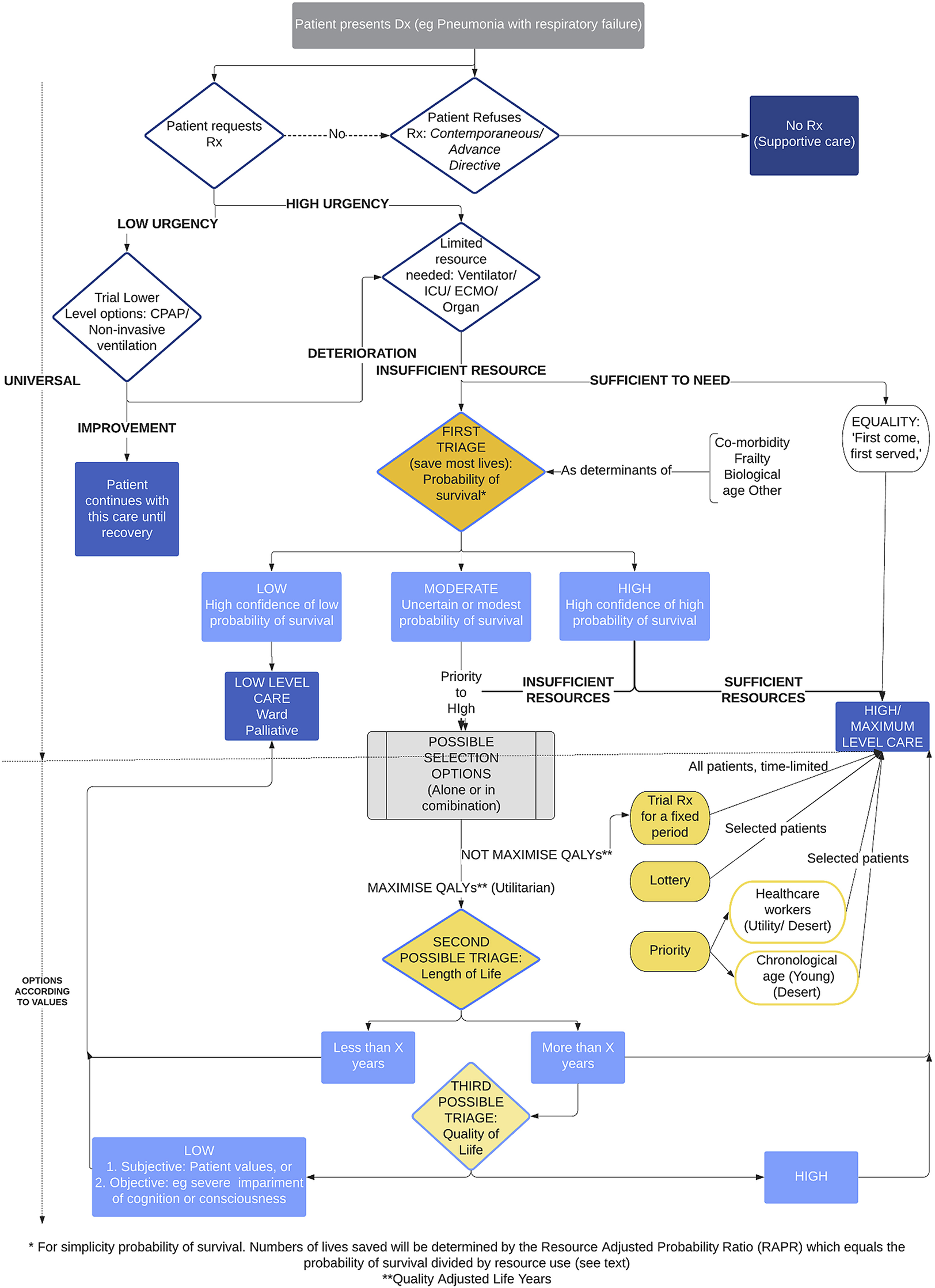
We did not attempt to create coherence between theoretical considerations (theories and principles) and public values, we did extensively survey public opinion pre-pandemic about the allocation of intensive care bedsFootnote 39 and during the pandemic around the allocation of ventilators and vaccines.Footnote 40 , Footnote 41 , Footnote 42 , Footnote 43
Across these studies, ordinary people preferred to save (in stark contrast to John Harris’ own egalitarian views)
-
1. People who had a higher probability of survival.
-
2. People who would live longer after being saved.
-
3. People who were younger.
-
4. People whose diseases were cheaper to treat or would use the resource for a shorter time (under conditions of limited money, equating to saving a greater number).
-
5. People who were abled rather than disabled.
They were prepared to withdraw ventilators from poorer prognosis patients for better prognosis patientsFootnote 44, which is rarely if ever done in medicine.
It was only when factors between different recipients of life-saving interventions were very similar (e.g., 49% chance of survival vs. 51%) did significantly more people became egalitarian, choosing to toss a coin (though even in these situations in many cases a substantial minority were still utilitarian).
Harris would, I suspect, strongly disagree with this approach. He argued the preferences revealed by the Moral Machines study should have no bearing on policy for programming driverless cars. Instead, moral theory alone should inform policy. In characteristically swashbuckling style, he described the work in the Moral Machine experiment as “useless”.Footnote 45 Harris argues that,
“The idea that it might be open to individual citizens or corporations to decide who shall be ‘spared’ and who condemned to death, and that this might be a matter of mere individual ‘preference,’ made on the basis of the sorts of sampling described in [the Moral Machines paper]… is outrageous in the extreme.”Footnote 46
Here I agree with Harris, who writes that a solution to a moral dilemma “has to show how the circumstances which make it a moral dilemma, have been weighed carefully one against another, and morally persuasive reasons, facts and/or justifications found for having a moral preference for one outcome rather than another.” Importantly, however, this does not entail that public preferences have no role to play in the process—especially when its output is meant to be a practicable and implementable policy in a liberal democratic society. We would need not only an ethical underpinning but a converging ethical underpinning for these views, for example by seeking a convergence between utilitarianism and contractualism (as a veil of ignorance).
However, appealing to moral theories alone, as Harris suggests, is also problematic. First, there is no universally accepted moral theory—philosophers deeply disagree about whether to be Kantians or Utilitarians, for example. Although many moral theories embrace certain fundamental moral ideas (such as equality), they interpret these ideas in radically different ways. Hence in Utilitarianism, equal moral consideration is expressed by counting each person’s utility equally; in Kantian ethics, equal standing is understood to relate to our autonomy and dignity; on contractualist views, equal standing may relate to equality of position behind the veil of ignorance, while egalitarians call for equal treatment for equal needFootnote 47.
Most plausibly, all or at least some of these considerations matter. Consider the basic conflict between utility and equality in the initial organ allocation example. It is plausible that both utility and equality matterFootnote 48. This is expressed in the relatively modern conception of justice called “prioritarianism”Footnote 49 where some priority is given to utility benefits to the worst off. “Justice (as pure equality), and let the Heavens fall” would be absurd—it would require directing all resources to the worst off until equality was achieved. And pure Utilitarianism would also be absurd—it would require taking organs from healthy individuals to save the lives of a larger number of people, the Survival Lottery which John Harris famously originally conceived as an objection to UtilitarianismFootnote 50.
Or consider the inclusion of disability as a consideration in the allocation of organs, as in the initial example. People are fiercely divided over whether disability should be considered in organ allocation and whether it constitutes unjust discrimination. Some will object that quality of life considerations or disability should not affect the distribution of resources. Myopia, for example, is not relevant—we should not deny the short-sighted (like me) organs because they need to wear glasses. However, extreme disability clearly should be a relevant consideration. Take the example of total disability: permanent unconsciousnessFootnote 51. No one would reasonably argue that we should give those who are permanently unconscious equal consideration for an organ transplant. Similar arguments apply to a minimally conscious state.
What about more widely discussed disabilities, such as blindness, deafness, and paralysis? Because these individuals have intact mental lives and report equal levels of happiness after adaptation, there is a strong argument for equal consideration.
Ethics is not black and white; it is black, white, and gray. Many disabilities will be in the gray zone.
As soon as plural values are introduced into the moral conversation and dialogue, people are likely to conclude (wrongly), “Ah, ethics is just relative, to culture, place, time, or personal preference.” This is a deep mistake. It means that moral progress is not possible. It means that there is no strong or deep criticism of what the Nazis did—they just had different values. It makes the Universal Declaration of Human Rights baseless, and international codes nearly meaningless.
While moral relativism is false, context dependency is true of moral judgments. Moral judgments supervene the particular facts of situations. Even with the same values being considered, there will be different justified policies, moral judgments, or prescriptions in different factual circumstances. To consider both utility and equality, with more resources, more consideration can be given to equality, and “gray zone” cases.
The best example of the context specificity of applying plural values is seen in consideration of the two values of liberty and public health. In the 1980s, Cyprus was bankrupting its health system and using all its blood supply in treating an “epidemic” of thalassemia. Thalassaemia is a genetic disorder affecting the production of blood cells, resulting in pain, deformity, and premature death. Carriage of the gene for thalassemia is very high in Cypriot populations. If both parents are healthy carriers, they have a 25% chance of having a child with a severe form of the disorder. Prenatal testing of fetuses and termination of affected pregnancies became possible in the 1980s.
One very important value that John Harris has consistently championed is procreative/reproductive autonomy or procreative/reproductive liberty—the freedom to decide whether to have children, how many children to have, when, and what kind of children. This is important in Western liberal societies. However, Cyprus was facing a public health emergency. In response, the Church decided to require people wishing to be married in the Church to have career testing. It did not require that they go to have prenatal testing or termination of pregnancy. However, having witnessed the pain and misery of thalassemia close up, nearly everyone who found they were carriers voluntarily chose prenatal testing and termination of affected pregnancies. The rates of thalassemia plummeted. Problem solved.
This was “mandatory carrier testing.” It was a form of coercion and arguably some infringement of their procreative liberty. People were no longer free to get married in ignorance of their career status. However, the level of coercion used by the Church was an effective and proportionate response to a public health crisis. Although both liberty and public health were important, some restriction of liberty was justified in that circumstance.
Of course, libertarians, whose sole value is liberty, would object. But these monotheistic moral approaches just are not plausible.
Algorithmic bioethics
Early on in the pandemic, before vaccines for COVID-19 were developed, I identified the factors and values that would make mandatory vaccination justifiable (the same factors are relevant to all coercion): the gravity of the problem, safety and effectiveness of vaccines, the incremental utility of coercion over other less coercive measures, and proportionality of the costs of coercion to the incremental utility of coercive policies. I constructed an algorithm using these four factors. See Figure 2. This is an example of algorithmic bioethics.
Algorithm for mandatory vaccinationFootnote 52.
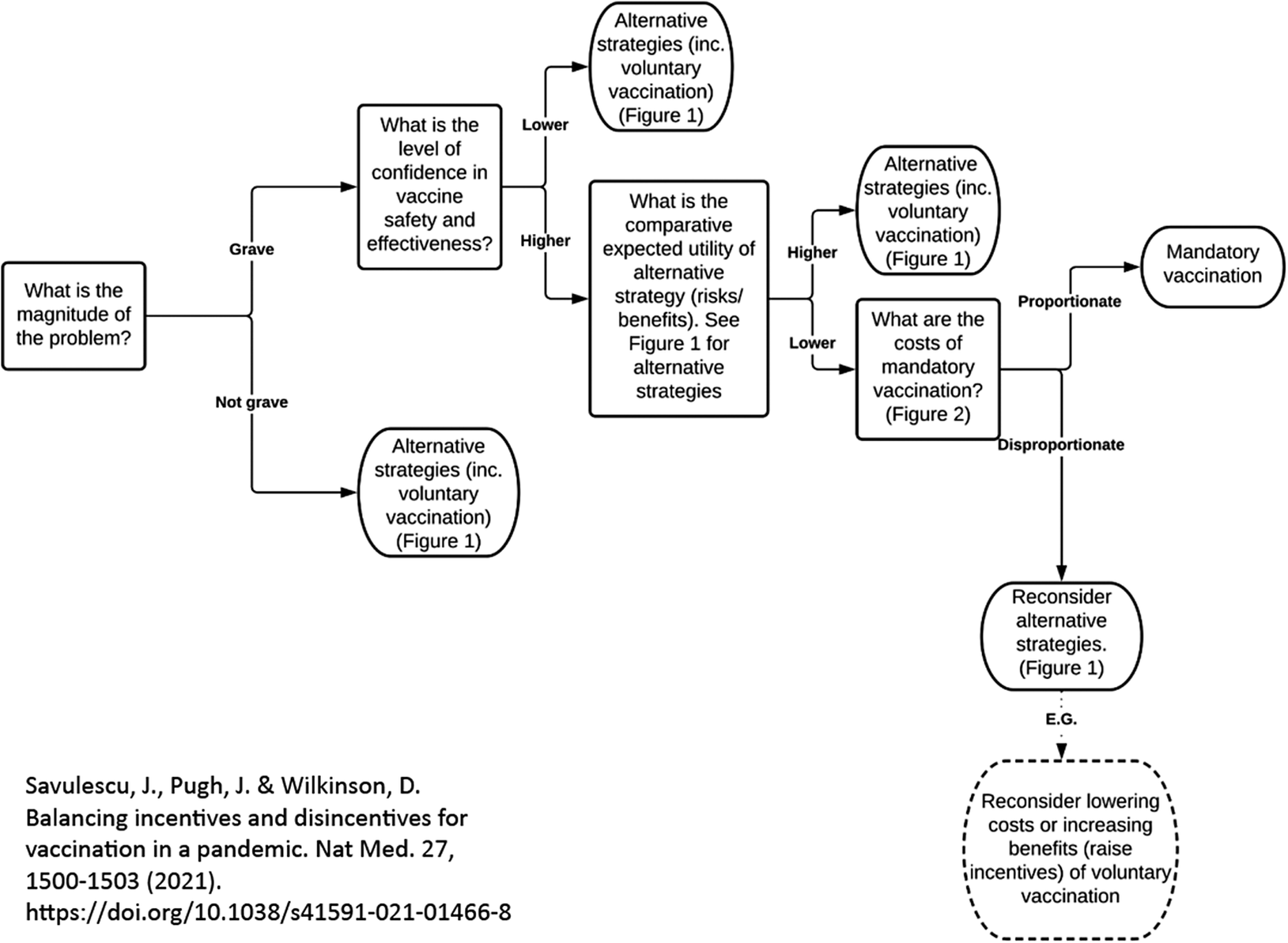
Algorithmic bioethics seeks to lay bare and make clear what the relevant values are to a policy. Further, it seeks to order these logically in a decision tree so they can be applied in practical situations. If someone disagrees with the inclusion or exclusion of a value, or their priority, they can amend the algorithm. The algorithm is clear (transparent) to all.
Importantly, the algorithm can be applied to the facts of a particular situation to yield a determinate prescription. When I applied my algorithm to the facts of COVID-19 (lethal primarily for the elderly, vaccines poor at preventing transmission, etc) I judged that mandatory vaccination was only justifiable for the elderly, over 65Footnote 53. Italy and Greece implemented such a “selective” mandatory vaccination policy by imposing fines on those over a certain age who refused vaccination.
Algorithmic bioethics is no silver bullet for practical ethics but it does enable progress and inclusion of diverse values like utility and equality.
However, for each value point in the algorithm, there will be further inquiry, debate, and dialogue over how to interpret or specify that value. There may even be an algorithm behind that particular value to determine that value. For example, in the case of mandatory vaccination: what is a grave public health emergency? What is safe and effective enough? What is proportionate coercion? We drafted a simple algorithm for how to determine whether coercion is proportionateFootnote 54.
I have applied algorithmic bioethics to many other dilemmas in medical ethics: access to experimental treatment, resolution of conflict between parents and doctorsFootnote 55, determining futilityFootnote 56, when it is ethically justifiable to use biased training data in AIFootnote 57, vaccine passports, employing incentives and disincentivesFootnote 58, innovative care including AI (under consideration), and others.
I do not claim these algorithms are right or perfect. But they are a clear basis for making progress because they can be revised or replaced. Bioethics needs to be clear, practicable, and justifiable. And such algorithms can be polytheistic, instead of monotheistic, embracing plural values, like utility and equality.
Further, these decision tools can be used by policymakers and potentially programmed into AI, moral AI. AI has a vastly superior capacity compared to humans to harness facts about the world and people. This could be coupled with this human-constructed ethical decision procedure to make ethical decisions. For example, pre-AI Dominic Wilkinson and I suggested the cost/QALY threshold could be applied consistently beyond new medicines and devices, to procedures and interventions, such as ventilation or surgery for intensive care patientsFootnote 59. (We did not endorse cost/QALY but rather argued that if it were an acceptable ethical way to distribute resources, it could be consistently applied to procedures). AI could be used to retrieve the relevant data to calculate the cost-effectiveness of many more parts of the clinical pathway. Coupling AI with algorithmic bioethics could be ethically transformative for medicine.
Life extension
Another of John Harris’ pioneering contributions has been to argue for life extension. But how long should we live (if there are sufficient resources)?
Harris argues that we have a moral duty to extend life as long as possible, even to immortality because saving a life and delaying death are equivalent. So if we have an obligation to save lives, we have an equal obligation to extend life indefinitely.Footnote 60 Harris suggests it might be preferable to limit reproduction rather than the length of people’s lives if overpopulation is a problem.
In recent unpublished research, together with Brian Earp and colleagues, we surveyed 198 members of the British public to see how they would choose between different possible future worlds to explore their values relating to the length of life of future persons vs. a number of new lives in existence (what I called the length vs number trade-off). People strongly preferred that there be fewer people with longer lives, rather than more people with shorter lives, even exponentially larger numbers of people. For example, 69% preferred a population of 2 million living 100 years compared to 31% who preferred a population of 64 million living 75 years.
But this preference began to flip at 150 years—that is, after people were living 150 years, they started to prefer there be more people rather than fewer people living even longer. For example, 52% preferred a world with a population of 2 million living 200 years and 48% preferred a world with a population of 64 million living 100 years. However, 36% preferred a population of 2 million living 200 years compared with 64% who preferred a population of 8 million living 150 years.
We asked them explicitly what principle should govern how long people should live. Here are the results:
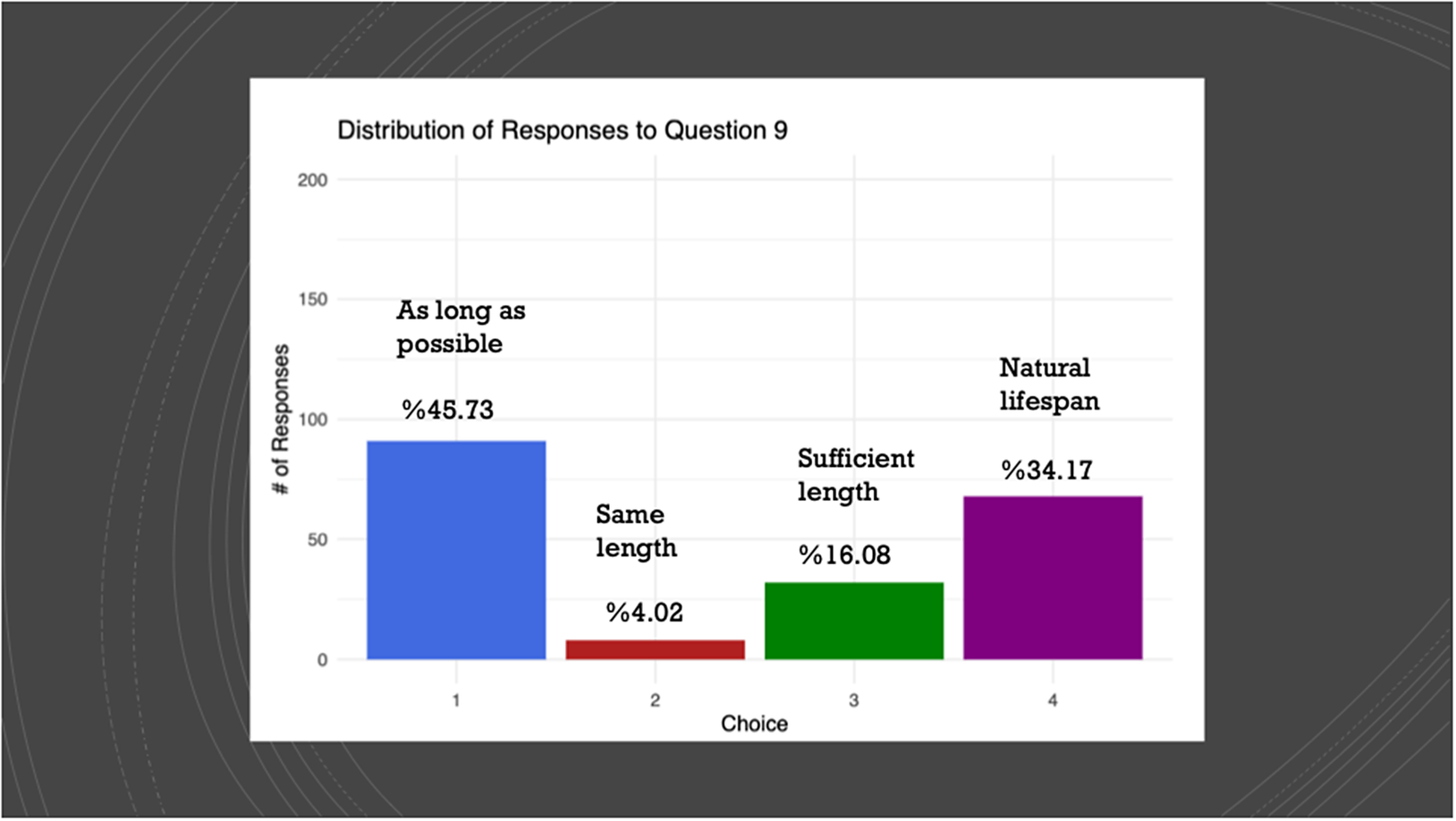
“Sufficient length” was described as “80 years” and “Natural lifespan” was described as 120 years.
HevolutionFootnote 61 is investing billions in developing life extension technologies, or strictly, healthspan extension technologies (but these are likely to also extend life). As life extension technologies mature, we will face profound questions about how long people should live. I do not believe we can apply a simple approach, like egalitarianism and a fair innings. These will be important considerations, among others. But we require a complex pluralistic approach. We require complex ethics.
The speed limit
I began this piece with the dilemma of who to give a heart transplant to when not everyone can receive one. I have considered the allocation of life-saving resources during the pandemic. I will finish on what many will find is a much more mundane issue: the speed limit. (I know driving is another of John’s pleasures—he refuses to buy a driverless car because he enjoys driving so much. I am sure he always keeps to the speed limit).
As I travel the world and live in different places, I am fascinated that the speed limit is different in each country. In the UK, it is 120 kph, in Germany it is unlimited on the autobahn, in France it is 130 kph, in Victoria, Australia it is 100 kph, in New South Wales (a neighboring state of Australia) it is 110 kph, and in Singapore, it is only 90 kph!
Driving a car is a potentially lethal activity. Each year 1.19 million people die on the roads globally (World Health Organization) and speed is a major contributor. So, what is the right speed limit?
As I have argued, ethical judgments are context-specific. The answer will depend in part on many facts: the quality of the roads, how crowded, the safety of the cars, visibility, weather, orientation of the roads and geography, etc.
But importantly which speed limit is right will depend on values. Safety is one value. The lower the limit, the safer. So, on safety grounds, Singapore has picked the right one. Protecting the environment is another important value. A lower limit reduces carbon emissions. So, is the lowest limit—90 kph—the right one?
There are other values. Economic efficiency supports a higher speed limit. The Netherlands recently increased its speed limit to 130 kph to increase economic efficiency. Pleasure supports a higher limit. Freedom supports a higher limit. And so on.
An ethical policy will take account of all the relevant values and facts. But it is not that a complete specification of all the relevant facts will directly dictate a policy. Nor will a single value dictate the correct policy. It is complex. What is required is an ethical process and deliberation about how to weigh the different values and apply them to the facts (and wisdom).
Importantly, not any speed limit goes. Setting a limit of 100 kph in a crowded city center with small roads and school crossings is wrong. While there may be some gray zones, that might be informed by cultural or societal values, there is black and white, there is wrong and right. Some speed limits are wrong.
The task of bioethics is to create rules for such deliberation, to outline the black, white, and gray. Constructing an ethical algorithm is one way of taking account of plural values, including equality, and enabling them to be applied to the facts of the situation.
Vector of reasons
Ethics is one way like physics. In Newtonian physics, forces can be described as vectors. They have a direction and strength. Which direction a ball will roll is predicted by summing the vectors.
In ethics, the issue is which direction should the ball roll. That is determined by reasons. Reasons are like vectors. They have a direction and a strength, depending on the factual circumstances. For example, in the speed limit case, the vector of safety would be a mere point if cars were perfectly safe for users and third parties. What should be done, the right policy, weighs all these vectors, or reasons.
While we know the laws of physics, we have yet to entirely discover or invent the laws of ethical deliberation. That is, how to identify all relevant reasons, and how to weigh and prioritize them. Collective reflective equilibrium and algorithmic bioethics are two minuscule steps forward in the physics of ethics. (Physics began as a discipline within philosophy at the University of Oxford).
Conclusion
The point of bioethics and practical ethics is to inform practical decision-making and policy. Indeed, ethical decisions are inescapable and to choose to do nothing, including not to think about the problem, is to be responsible for the consequences of that course when we have the power to choose to act another way. It is inevitable that policies and laws have to be made, like setting a speed limit. We should aim to improve them and make the best decisions, policies, and laws possible, given the constraints of our situation and relevant opportunity costs (for example, delaying policymaking to gather more information or deliberate more). Just as “first come, first served” is a bad procedure for allocating life-saving resources, so too many of the intuitive, or monotheistic, policies may be mistaken.
John Harris is, in my view, one of the great pioneers in bioethics. He has articulated, defended, and applied highly plausible accounts of egalitarianism and what is now called sufficientarianism. He has given a healthy and piercing critique of utilitarianism and QALYs. However, bioethics is an ongoing project where progress is incremental and slow. What remains to be done—the task of bioethics—is to place these arguments in a broader complex framework looking for coherence with other plausible theories and principles. Indeed, it will be to create new theories and principles. And, I believe at least for the purposes of public policy, to identify points of maximum coherence with public values. (Of course, it is a further question is what should constitute public values and how we should ascertain these).
As someone who has been battling in this field now for 35 years, I have frequently used John’s arguments as a springboard for debate and progress. I would like to thank John Harris for his contribution to the field.
When I wrote that piece on allocation of organs to children which I began with, I received considerable anger and hostility from the clinical genetics community for daring to raise these issues. I was complaining to John McBain (who established Melbourne IVF) about how unfair I felt people’s reactions were. He replied,
“In Scotland, the worst thing you can say about a man is that he died with no enemies.”
In bioethics, the best thing you can say about someone is not that they created a flock of followers like sheep, but that they caused people to think and they enabled progress. John Harris has innervated and energized the field of bioethics with his brand of egalitarianism for over 40 years. That’s about all you can do.
Acknowledgments
This research was funded in whole, or in part, by the Wellcome Trust [Grant number WT203132/Z/16/Z] and [Grant number: 226801] for Discovery Research Platform for Transformative Inclusivity in Ethics and Humanities Research (ANTITHESES). For the purpose of open access, the author has applied a CC BY public copyright license to any Author Accepted Manuscript version arising from this submission.
Funding statement
This research project is supported by the National University of Singapore under the NUS Start-Up grant; NUHSRO/2022/078/Startup/13). This research is supported by the Social Science Research Council (Singapore) and administered by the Ministry of Education, Singapore), under its Social Sciences Research Thematic Grant (SSRC2023-SSRTG-006)
Competing interest
JS is a Bioethics Advisor to the Hevolution Foundation (2022-). JS is a Bioethics Committee consultant for Bayer. JS is a Partner Investigator on an Australian Research Council grant LP190100841 which involves industry partnership from Illumina. He does not personally receive any funds from Illumina.


 Open access

