

Introduction
Location of Hovk within Armenia.

During the Quaternary the Transcaucasus acted as a migration corridor facilitating hominid dispersals between Europe, the Near East and Asia. Accumulated genetic and fossil evidence from the Greater Caucasus and western Transcaucasus suggest that Neanderthal populations were replaced after 35-30 ka BP by anatomically modern humans (Reference HoffeckerHoffecker 1999; Ovechinnikov et al. 2000; Adler et al. 2006). The cultural record is, however, controversial as in Eastern Europe a broad spectrum of transitional Middle/Upper Palaeolithic industries are found (Cohen & Stepanchuk 1999) whereas in the Western Caucasus such industries do not exist. Recent finds from Ortvale Klde, Georgia, suggest that Upper Palaeolithic peoples entered the region approximately 32 ka BP without significant, if any, overlap with Neanderthal populations (Tushabramishvili et al. 2002). These conclusions are, however, based on few sites, while there are huge geographic lacunae for the relevant period. The Palaeolithic sequence in Armenia is, for example, poorly understood. Although Middle, Upper and Late Palaeolithic lithic finds from the Armenian region of Transcaucasus share clear typological affinities with archaeological cultures of the Taurus-Zagros regions (Reference SardarianSardarian 1950), there is no chronological framework. Indeed the Armenian Palaeolithic is entirely known from excavations of Yerevan cave (Reference YeritsianYeritsian 1970) and the rock shelters of Lusakert 1 and Lusakert 2 (Reference YeritsianYeritsian 1975), and a series of open-air sites near the obsidian sources (Arteni, Jraber, Hatis, Gutanasar etc., Reference LiubinLiubin 1984). These 1950-1990s excavations provide only a limited amount of information, and the main results remain unpublished.
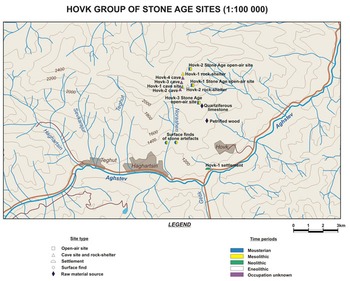
Hovk 1 Cave and other prehistoric sites found during the March-April 2005 survey.

Background
It was with this background that we began work on a series of caves in the Hovk region of northern Armenia (Figure 1). Hovk is a high elevation forested karstic region at the flanks of the Lesser Caucasus Mountain range in north-east Armenia (Figure 2). The team carried out the first ever archaeological survey of the area in March 2005. During this work one of the Armenian team members discovered dense surface concentrations of Mousterian tools at a high elevation (approx. 1800m) plateau above the village of Hovk. A subsequent survey in April 2005 by the Armenian team members led to the discovery of six small-to-medium sized karstic gallery caves, an open-air site, and a rock shelter, all containing Middle and Upper Palaeolithic tool assemblages. In August 2005 UK and Armenian team members carried out a 14-day trial excavation at one of these sites, termed Hovk 1 cave. Objectives Our prime objective is to establish chronometrically dated cultural sequences that spans the Middle Pleistocene to early Holocene by means of excavation and survey. We also intend to obtain detailed palaeoenvironmental data for the region for the same period using multiple proxies. This brief paper outlines the results of our initial excavations in 2005. These are essential steps in understanding of the archaeological and palaeoanthropological relationships between archaic Homo sapiens, Neanderthals, and anatomically modern humans in the Transcaucasus.
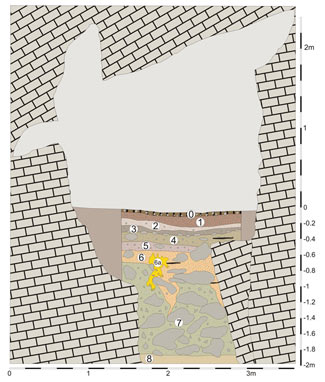
Stratigraphy of the Hovk 1 cave as revealed by the August 2005 excavation. O 10 YR 3/3 Humic and fibrous fine sand/silt (animal dung) 1 10 YR 6/3 Silt/fine sand diamict with sub-angular and sub-rounded limestone granules-course pebbles (cave earth) 210 YR 4/3 Fine diamict of sub-rounded granular and fine pebble limestone clasts in silt/fine sand matrix (cave earth) 3 10 YR 6/3 Medium diamict of coarse pebble to granular limestone in silt/fine sand matrix (cave earth) 4 2.5Y 5/2 Silt/fine sand with occasional fine-pebble to granular sub-angular and sub-rounded limestone clasts (cave earth) 5 10 YR 4/3 Fine diamict of granular and fine pebble-sized limestone clasts in humic silt/clay matrix (cave earth) 6 10 YR 6/4 Well sorted fine sand with very occasional sub-angular limestone granules (aeolian deposit) 6a Stalagmite 7 10 YR 6/4 Coarse gravel of boulder-sized sub-angular limestone clasts in fine sand matrix (roof collapse) 8 2.5 Y 6/4 Moderately sorted medium sand with granular to pebble-sized sub-rounded limestone clasts (cave earth).

Results
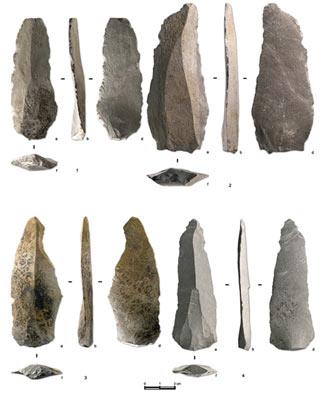
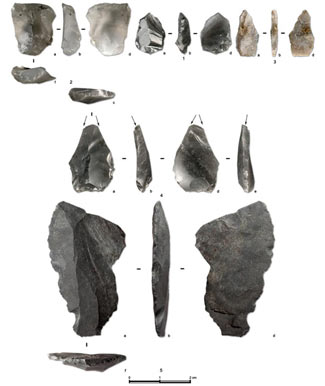
Hovk 1 cave is a double gallery cave 2-3m wide and 14m long. The 3.5 x 2m test excavation revealed a series of poorly sorted cave earths (Units 1-6) derived from erosion of the cave walls, allochthonous aeolian sediments and ash spreads. These overlie re-worked speleotherms (Unit 6a) and thick roof collapse deposits (Unit 7) (Figure 3). Further cave earths (Unit 8), but with moderate sorting, were found below the latter. However, Unit 8 could not be investigated in detail during the 2005 season. Nevertheless two Levallois 'laminar blades' (Figure 4), ash, frequent charcoal fragments and animal bone fragments were recovered from this deposit. The roof collapse deposit (Unit 7) was devoid of archaeological finds except for a notched tool and two 'laminar blades' similar to those previously discussed and all made of limestone, found at the Unit 7-Unit 8 boundary at the front of the cave (Figure 5). These are probably derived from Unit 8. Numerous bones were recovered from Unit 6, including those of non-domesticated wild sheep (Ovis sp.), wild goat (Capra sp.), wild boar (Sus scrofa), bovid and bear (Ursus sp.), and accompanied by a single flint flake. One obsidian and one chalcedony flake were found in Unit 5, while an obsidian double burin, transformed into an end scraper was recovered from the boundary of Units 4 and 5. The vertebrate fauna from Unit 5 was similar to that previously detailed for Unit 6. An AMS 14C date was obtained from an astragalus of a wild goat from Unit 5, yielding an age of 33 800 ± 500 BP (Poz-14674). Unit 4 also contained worked obsidian flakes and a similar fauna to Unit 5. However, there appears to be a hiatus at the Unit 3-4 boundary as the former contains evidence of medieval occupation, including a hearth and a rim sherd of a coarse ware pot. The uppermost cave earth deposits (Units 1 and 2) are also of medieval date on the basis of a few coarse ware sherds recovered.
Discussion While emphasising the Hovk Prehistoric Project is at an early stage our first season of excavations at Hovk 1 cave have already demonstrated significant results of possible regional importance. The Levallois blades in Unit 8 appear to have typological affinities with the 'Tabun D' facies of Bar-Yosef (1994, 1995), thereby indicating that hominids using Middle Palaeolithic lithic technologies occupied higher zones of the (> 2000m asl) Lower Caucasus region prior to 33 kya BP. However, these blades are made of fine-grained Cretaceous limestone of relatively low quality raw material. This demonstrates that the population who made these tools were capable of successfully applying a complex Levallois chaîne operatoire on local materials. Should these artefacts indeed prove to be of the 'Tabun D' facies, this would suggest that Unit 8 formed during or prior to Oxygen Isotope Stage (OIS 5e), based on the dating of this technocomplex in the Levant (Reference Bar-yosefBar-Yosef 1995).
Levallois artefacts recovered from Units 7 and 8.

Tools and flakes from Units 4-7.

The microlithic tools and flakes made from obsidian recovered from Units 4-5 are possibly the earliest example of the use of such technology in the Caucasus given their association with the 33 800 BP AMS 14C date from Unit 5. They are also the first microliths recovered from a cave excavation in Armenia. Should the chronology be confirmed by further chronometric dating planned for 2006-2007, this would imply a much earlier development of composite tool technologies than had previously been supposed.
A key question is who was making the lithic tools recovered from Hovk? In the absence of hominid fossils from the region we can only speculate at present. The AMS 14C date from Unit 5 is on the Middle to Upper Palaeolithic transition, and although the technology suggests production during the Upper Palaeolithic and therefore by modern humans, we cannot at present be certain that this was the case. On the other hand if the typological affinity of the Levallois blades recovered from Unit 8 with 'Tabun D' is accepted this also has implications for the population at Hovk. In the Levant 'Tabun D' is associated with archaic Homo sapiens populations which has been dated by ESR to 110-250 ky BP (Porat et al. 2002). However, archaic Homo sapiens are unknown in the Caucasus. On the other hand Neanderthal fossils have, however, been recovered from Yerevan I dated to c. 48 ka BP (Reference LiubinLiubin 1984), while an undated cranium was found from the shores of Lake Sevan (unpublished data).
Determining which hominid species was present at Hovk at different stages of the Upper Pleistocene is a key question that will be addressed during by the Hovk Prehistoric Project in further seasons of fieldwork. However, it is not the only question that remains to be answered. Clearly stratigraphic layers below Unit 8 (at least 2m of deposits are known to exist on the basis of probing carried out in 2005) need to be investigated to see whether further Palaeolithic activity exists below. The chronology of the cave stratigraphy also needs to be further elucidated, while the basis of Palaeolithic use of the cave also needs to be investigated in detail. We will make a start to these activities during our forthcoming 2006 field season in July 2006.