


Introduction
Understanding the production and change of stylistic attributes in material culture—defined here specifically as their visual qualities, mainly texture, colour, decorative patterns, shape, luminance—has been central for archaeology since its inception, particularly in the study of pottery styles. In central Germany, the prehistoric ceramic record exemplifies this focus and represents one of the most extensively documented sequences in Europe. Stylistic variation in this region is typically analysed within typo-chronological and socio-cultural frameworks, informing broader interpretations of identity, technological change and social boundaries (e.g. Lehmann Reference Lehmann2000; Müller Reference Müller2001; Schwarz Reference Schwarz2021a). Analytical methods often rely on expert descriptions of vessel forms and decorative motifs, occasionally supplemented by statistical modelling (e.g. Einicke Reference Einicke2014; J. Müller Reference Müller2001).
Recent archaeological research has incorporated methods from experimental psychology to interpret stylistic variation through the visual effects of pottery, particularly eye movement patterns observed in modern European populations (Criado-Boado et al. Reference Criado-Boado, Martínez and Blanco2023). When individuals engage with visual stimuli, they make rapid eye movements known as saccades to sample new locations or objects, followed by fixations where visual information is processed (Rayner Reference Rayner2009). This cycle reflects the active focus of visual attention, highlighting how vision is a primary means of acquiring sensory information from material culture.
Eye-tracking studies indicate that object saliency, i.e. how visually conspicuous an object is, has a strong influence on participants’ visual-cognitive response (Criado-Boado et al. Reference Criado-Boado, Martínez and Blanco2023). Thus, these methods provide a refined means of assessing how pottery styles may guide human patterns of attention. Reconstructing these patterns offers an opportunity to evaluate cognitive fluctuations in relation to changes in stylistic designs, and potentially prehistoric socio-cultural dynamics. While it is now widely recognized that caution is required when generalizing cognitive behaviour from a sample of very specific modern populations from the ‘Global North’ (Henrich et al. Reference Henrich, Heine and Norenzayan2010), this is seldom put into practice (Apicella et al. Reference Apicella, Norenzayan and Henrich2020). This means that inferences from eye-tracking studies to all worldwide populations, and consequently to prehistoric populations as well, requires further scrutiny and investigation.
Considering these caveats, this study aims to provide new lines of research for investigating how salient stylistic attributes in prehistoric pottery influence visual attention, offering a cognitive perspective on stylistic variation. It provides a first look into eye-tracking techniques for examining temporal stylistic variation diachronically in archaeological pottery. This diachronic study advances three main arguments: (i) decorative patterns are the primary focus of participants’ attention and elicit varying degrees of cognitive load, reflecting the demand for visual exploration; (ii) by considering the typo-chronological phases of the ceramic vessels, we can determine which styles demand more attention or are considered more ‘captivating’; and (iii) by contextualizing pottery styles, we can link the observed patterns of attention to stylistic changes and establish cognitive explanations for stylistic variation. We conducted a free-viewing experiment using mobile eye-tracking at the State Museum of Prehistory Halle (Saale) (Saxony-Anhalt, Germany), analysing 41 vessels dated between 5500 and 1 bce. Thirty-six participants took part in this study, including archaeologists, people with experience working with clay, and lay observers. The experiment measured fixation duration and pupil diameter as proxies for cognitive load, offering insight into the attentional impact of different pottery styles in modern European populations, which we believe could potentially give some insights about prehistoric societies.
Socio-cultural contexts and pottery stylistic variation in central Germany
In central Germany, i.e. Middle Elbe-Saale region (Fig. 1), the documentation of pottery styles has been a long-held tradition since the nineteenth century (Klopfleisch Reference Klopfleisch1883), with consistent records covering most of the region’s prehistory. This section provides an overview of the main socio-cultural changes, including economic and ritual practices, and typological modifications occurring from c. 5500 to year 1 bce (Table 1).
Distribution of sampled vessels from central Germany.

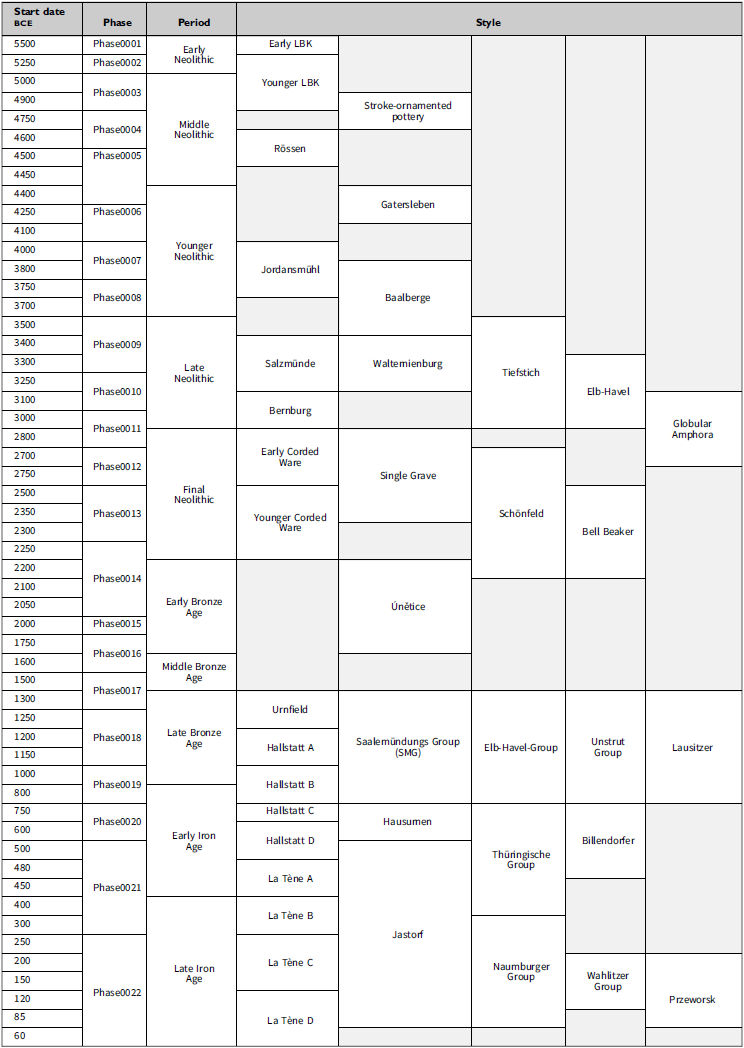
Typo-chronological chart of central Germany with a structured phase division (Buck & Buck Reference Buck and Buck2022; Hermann & Brachmann Reference Hermann and Brachmann1989; J. Müller Reference Müller2001; R. Müller Reference Müller1985; Preuß Reference Preuß1998; Revert Francés Reference Revert Francés2022; Schwarz Reference Schwarz2021a,b).

Neolithic
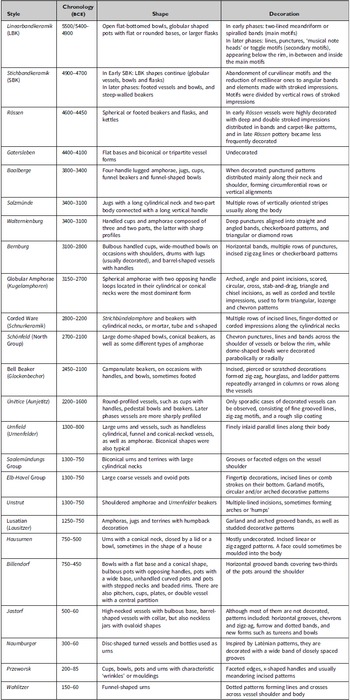
During the Early Neolithic (5500/5400–5000 bce), the introduction of agriculture, more sedentary lifestyles, pottery and other food-processing technologies brought large environmental and demographic changes in central Europe (Bickle & Whittle Reference Bickle and Whittle2013; Lüning Reference Lüning1988). Settlements were organized as single farmsteads or hamlets located on fertile loess soils near fresh water sources. These societies exhibited a heterarchical social organization, structured around segmented households and patrilocal kinship (Alt et al. Reference Alt, Ganslmeier, Münster, Friederich, Alt and Meller2024). Age and gender status were also reflected in the external cemeteries and in the burials within domestic spaces (Schwarz Reference Schwarz and Meller2021c, 225). Extensive supra-regional networks are documented, including the distribution of Mediterranean Spondylus shells (Windler Reference Windler2018) and actinolite adzes originating from the Jizera Mountains (Nowak Reference Nowak2008, 25). Early Linearbandkeramik (LBK) pottery was uniform in shape and decoration, characteristically globular-shaped vessels with curvilinear or spiral bands (Table 2), followed by a marked stylistic regionalization during the Middle and Late phases (Einicke Reference Einicke2014). Produced at household level, it appears in both settlements and graves (Einicke Reference Einicke2014, 287).
Synthesis of main stylistic changes in pottery from central Germany spanning from 5500–1 bce (Behn Reference Behn1924; Behrens Reference Behrens1973; Beier Reference Beier1988; Beran Reference Beran1993; Bergemann Reference Bergemann2018; Brandt Reference Brandt2001; Dąbrowska & Mączyńska Reference Dąbrowska, Mączyńska, Brather, Heizmann and Patzold2010; Einicke Reference Einicke2014; Grenz Reference Grenz, Brather, Heizmann and Patzold2010; Hein Reference Hein1990; Hille Reference Hille2012; Kneisel Reference Kneisel2012; Maraszek et al. Reference Maraszek, Muhl, Schwarz and Zich2015; D. Müller Reference Müller and Meller2021; J. Müller Reference Müller2023; Peschel Reference Peschel1990; Preuß Reference Preuß1998; Revert Francés Reference Revert Francés2022; Schulz Reference Schulz1928; Schwarz Reference Schwarz2021a,b).

The socio-political organization of the Early Neolithic underwent significant changes during its final phase and the onset of the Middle Neolithic (c. 5000–4700 bce). Supra-regional networks shifted (Eisenhauer Reference Eisenhauer1999) and settlement numbers declined (Ostritz Reference Ostritz2000, 12). In comparison to the late LBK enclosure boom, rondels appeared, featuring a designated area for ritual and communal activities, alongside Stroke-ornamented pottery (Stichbandkeramik, SBK; Schier Reference Schier2023). From 4700–4400 bce, extra-mural flat graves persisted, and villages containing Rössen-style pottery were enclosed by ditches (Schunke Reference Schunke, Meller and Friederich2014). SBK and Rössen pottery continued much from LBK traditions, particularly Early SBK shapes (Behrens Reference Behrens1973, 43; Kaufmann Reference Kaufmann1976). Both styles replaced curvilinear motifs with more angular bands and stroked impressions, up until the late Rössen phase, when pottery became mostly undecorated (Kaufmann Reference Kaufmann2017).
At the start of the Younger Neolithic (4400–3500 bce) domestic site evidence declines. While c. 4100–3800 bce social hierarchy is not evident, around 3800–3500 bce, socio-political shifts emerged, characterized by central earthworks and the first appearance of burial mounds for individuals beside flat graves (J. Müller Reference Müller2001), suggesting the increase in social stratification. The earliest causewayed enclosures appeared around 4400/4300 bce (J. Müller et al. Reference Müller, Schmütz, Rinne, Gleser and Hofmann2019) with Schiepzig/Michelsberg, and continued until 3500 bce linked to Baalberge pottery. Mortuary practices diversified, including Baalberge burial mounds for certain individuals and variants of flat graves with or without stone and wooden features. Economic transformations included expanded herding (Bergemann Reference Bergemann2018), the introduction of copper items, and later copper metallurgy (e.g. jewellery and copper flat axes: Strahm and Wiermann Reference Strahm, Wiermann and Meller2021, 202). Younger Neolithic pottery was mostly undecorated, as shown in Gatersleben and Baalberge styles, though innovative shapes emerged. The manifold forms of Baalberge ceramics are found in graves (D. Müller Reference Müller and Meller2021, 99), while additional storage vessels are found in domestic contexts (Schwarz Reference Schwarz2021a, 67).
During the Late Neolithic (3500–2800 bce), causewayed enclosure continued predominantly linked to Salzmünde pottery. Centralized, fortified Bernburg settlements indicate advanced social organization. Mortuary evidence suggests significant labour division, with richly furnished grave mounds implying hereditary status (J. Müller Reference Müller2001, 446). Collective burial practices became more complex, including Walternienburg-Bernburger wall-chambered tombs and, associated with Tiefstich pottery, megalithic tombs (Diers & Fritsch Reference Diers, Fritsch, Müller, Hinz and Wunderlich2019). Around 3200/3100 bce cattle double burials emerged, later appearing with Globular Amphorae styles (Müller Reference Müller2023). Two economic systems coexisted: mixed farming associated with Walternienburg-Bernburg styles; and sedentary pastoralism, linked to Globular Amphorae pottery. Copper metallurgy production also increased.
Continuing the previous regional traditions, there is a diversification of Walternienburg-Bernburg vessel shapes, both in domestic and ritual contexts (Beier Reference Beier1983). In contrast, Globular Amphorae (3150–2700 bce) styles represent a supra-regional phenomenon, widespread across central and eastern Europe (J. Müller Reference Müller2023; Szmyt Reference Szmyt2017). Both Globular Amphorae and Bernburg pottery share decorative patterns (Table 2), indicating interaction and stylistic hybridization (J. Müller Reference Müller2023).
During the Final Neolithic (2800–2200 bce), institutionalized power structures re-emerged through specific lineages, as reflected in Corded Ware (CW) and Bell Beaker (BB) funerary practice (Haak et al. Reference Haak, Furholt, Sikora, Kristiansen, Kroonen and Willerslev2023). Single graves, both flat and under tumuli, were often superimposed on earlier graves. CW and BB grave goods show marked gender differentiation. Communities remained agricultural, organized in single farmsteads and hamlets with cereal processing facilities (Risch et al. Reference Risch, Friederich, Küssner and Meller2022). Copper metallurgy flourished, producing diverse forms such as double axes, tubes, spiral bands, and rings (Strahm & Wiermann Reference Strahm, Wiermann and Meller2021, 203).
The Final Neolithic saw the coexistence of multiple, distinct pottery styles, often within the same contexts. CW (2800–2200 bce), distributed throughout eastern and central Europe, and later BB (2450–2100 bce) in western and central Europe represented two supra-regional networks in central Germany alongside local Schönfeld styles (2700–2100 bce; Großmann Reference Großmann2016; Wetzel Reference Wetzel1978). CW and BB ceramics continued into the early Proto-Únětice phase of the Early Bronze Age. Pottery followed a trajectory from early standardized, partly decorated forms (2800–2600 bce) to highly diverse, elaborately decorated beakers and amphorae until c. 2300 bce, before a decline in shape variety and decoration by 2100 bce (Großmann Reference Großmann2016, 115).
Bronze Age
During the Early Bronze Age (2200–1600 bce), settlement patterns continued to comprise farmsteads, hamlets, and small villages in the loess regions (Risch et al. Reference Risch, Friederich, Küssner and Meller2022). Distinct socio-cultural trajectories emerged: communal social activities marked Early Únĕtice (2200–2000 bce), increasing social differentiation characterized Classical Únĕtice (2000–1800 bce), and instability defined Late Únĕtice (1800–1600 bce). While flat burials in small cemeteries remained dominant, between 1950 and 1800 bce pit graves within domestic sites and large burial mounds appeared. They were seemingly reserved for individuals with distinct diets and, occasionally, golden items (Knipper et al. Reference Knipper, Held and Fecher2015; Meller Reference Meller2019), indicating social stratification (Hubensack Reference Hubensack2018). Tin-bronze metallurgy intensified early on, evidenced by hoards and graves, requiring supra-regional networks and underscoring the growing value of metal artefacts. In contrast, ceramic production developed to certain standardized forms, mostly undecorated but of high quality, suggesting a reduced emphasis on pottery.
In central Germany, Únĕtice style disappearance around 1600 bce created a hiatus at the beginning of the Middle Bronze Age (1600–1300 bce), rendering the period difficult to define. Few Pre-Lusatian settlements are known, with most evidence deriving from burials. Domestic remains indicate smaller, open farmsteads and hamlets. Agro-pastoral Tumuli Bronze groups occupied southern and western regions, while the Nordic Bronze Age influenced the north (Hellmund Reference Hellmund, Feeser, Dörfler and Rosch2024). Now tin–bronze was widely distributed through trade networks. Innovations such as lost-wax casting enabled the production of more complex and decorated metal objects (Jockenhövel Reference Jockenhövel, Fokkens and Harding2013, 730). These were deposited in hoards and in individual tumulus burials. Ceramics were restricted to coarse undecorated wares and are rarely found in graves (Hermann & Brachmann Reference Hermann and Brachmann1989).
During the Late Bronze Age (1300–800 bce), several groups coexisted: from the south to the north Unstrut, Saalemündung, Lusatian, Elb-Havel, among others, shaped by Urnenfelder and Nordic influences (Revert Francés Reference Revert Francés2022, 13; Fig. 2). Settlement patterns varied: farmsteads, hamlets and fortified hilltops in the north; sites with pit houses in the northeast; and large enclosed sites with structured landscape (e.g. pit alignments, walls, and ditches) in the south (Revert Francés Reference Revert Francés2022, 12–14; Schunke Reference Schunke, Meller and Becker2017). Under Urnenfelder influence, cremations became dominant in Europe, with diverse grave forms (stone cists, stone-packed and bell-shaped graves) suggesting social ranking. Intensified bronze tool use increased agricultural productivity and the wide distribution of similarly shaped tools like sickles indicate an ‘industrialization’ and specialization of metallurgical production (Buck & Buck Reference Buck and Buck2022; Hermann & Brachmann Reference Hermann and Brachmann1989, 102; Sommerfeld Reference Sommerfeld1994). Urnenfelder pottery style (1300–800 bce) was widespread across Europe. In central Germany, Elb-Havel ceramics incorporated forms and decorations from neighbouring Saalemündung and Lusatian traditions.
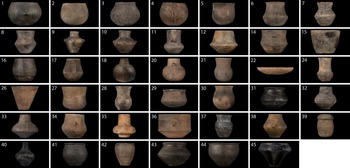
Pottery selection for the experiment (© Anna Sara Jagiolla, State Office for Heritage Management and Archaeology Saxony-Anhalt – State Museum of Prehistory Halle (Saale)). Photographs are numbered according to asset ID (Supplementary material).

Iron Age
The Early Iron Age (800–400 bce), particularly south of the Middle Elbe-Saale region, saw a reorganization of territorial structures with the creation of centralized hilltop sites (R. Müller Reference Müller, Brather, Heizmann and Patzold2010, 628) and rectilinear enclosures, alongside farmsteads, hamlets and villages (Hermann & Brachmann Reference Hermann and Brachmann1989, 123–5). Mortuary practices including tumuli in Hallstatt C, and, in Hallstatt D, large ‘princely tombs’ containing weapons, metal vessels, gold jewellery and chariots (Hermann & Brachmann Reference Hermann and Brachmann1989, 106, 127; Verger & Buchsenschutz Reference Verger, Buchsenschutz and Buchsenschutz2015, 83), had a strong influence in central Germany. This period saw the evolution of new ‘luxury crafts’ and new networks, including Mediterranean imports and Baltic amber or brown coal jewellery (Verger & Buchsenschutz Reference Verger, Buchsenschutz and Buchsenschutz2015). This transition is tied to the emergence of iron and ‘elites’ controlling its production. Iron metallurgy in central Germany began in the eighth century bce with the circulation of standardized objects and jewellery. As bronze became scarce, bone objects proliferated, especially in tools, notably within the Billendorf style, before iron became dominant. Metals such as silver, iron, bronze and gold increasingly served as markers of social distinction. While pottery continued to be produced domestically, specialized workshops emerged for graphite-tempered ceramics imitating metallic vessels (Hermann & Brachmann Reference Hermann and Brachmann1989, 127). Iron Age ceramic styles are primarily defined by funerary contexts, particularly urns deposited at cremation sites, but most of these vessel types also are known from domestic sites.
In the Late Iron Age (400–50 bce), iron became the primary material for tools due to its strength and reparability, but lost its status as a prestige material for jewellery. Its widespread use extended across all levels of society, and iron tools were commonly placed in graves (Maraszek et al. Reference Maraszek, Muhl, Schwarz and Zich2015). Although central Germany lay at the margins of the ‘Celtic world’, exchanges are evident through the ‘latènisation’ of burial practices (individual inhumations with weapons for men) and shared motifs in art and jewellery (fibulas, bracelets and torques). The southwest fell within the La Tène assemblage, while the east was associated with the Jastorf group, characterized by cremations. Nonetheless, La Tène influence reached this zone, evidenced by fortification types, ingot forms and wheel-manufactured pottery (Hermann & Brachmann Reference Hermann and Brachmann1989, 131). From the mid-second century bce, the Przeworsk group from east-central Europe also appeared in the region (Hermann & Brachmann Reference Hermann and Brachmann1989, 138). The introduction of the potter’s wheel and vertical kilns (Faßhauer Reference Faßhauer1959; R. Müller Reference Müller and Hopps2006) marked a technological shift, allowing for more standardized vessel forms and decorative patterns beside handmade pottery. The presence of permanent facilities such as kilns in some Late Iron Age settlements points to increased specialisation in ceramic production. Przeworsk-style ceramics (200–85 bce), influenced by both La Tène and Mediterranean traditions, are mainly found in cemeteries but also appear in settlement contexts (Dąbrowska & Mączyńska Reference Dąbrowska, Mączyńska, Brather, Heizmann and Patzold2010; Peschel Reference Peschel1989).
In sum, over this 5000-year sequence, central Germany witnessed diverse economic changes, technological innovations, social structures, including changes in mortuary practices, that periodically influenced some of the changes in pottery styles. From its inception, pottery was central to social life and produced at the household level. A clear distinction between mortuary and settlement pottery emerges with Baalberge style, but only in respect of coarse wares, which were uniquely present in settlements. By the Late Neolithic, expanding networks and growing social stratification coincided with increased stylistic variation in ceramics. As other crafts developed, however, pottery gradually lost its central role. The development of Bronze Age metallurgy, combined partly with increasing social stratification, ushered in standardized production and specialized techniques, leading to a reduced importance of pottery styles, now seemingly manufactured by more specialized craftspeople (Kneisel Reference Kneisel, Kneisel, Furholt and Hofmann2025, 187). During the Late Bronze Age and Early Iron Age, specialized pottery types for cremated remains, i.e. urns, were created, as exemplified by the Urnenfelder and Hausurnen styles. However, the trajectory of increasing production culminated with the introduction of iron tools, the potter’s wheel, and specialized agglomerated workshops. Consequently, at the end of the Iron Age pottery became largely utilitarian and commercially produced with more uniform designs.
Following these observations, we aim to analyse the visual impact of decorative designs produced in these different contexts, and to assess their connection to some of the major changes in pottery style production outlined so far.
Visual cognition, uncertainty and material culture
Foraging strategies involve actively targeting visually rich areas to gather information (Parr & Friston Reference Parr and Friston2017). Within the ‘active inference’ framework (Clark Reference Clark2013; Parr & Friston Reference Parr and Friston2017), visual exploration, comprising fixations and saccades, serves to resolve ‘uncertainty about states of affairs in the world’ (Parr & Friston Reference Parr, Friston and Hodgson2019, 123). Active vision engages an internal generative model to predict sensory input, driving eye movements according to beliefs about salient or information-rich locations (Parr et al. Reference Parr, Sajid and Da Costa2021). Consequently, visual perception fosters selective attention: focusing on one region inherently excludes others, with our internal generative model ‘filling the gaps’. Thus, attention operates as a zero-sum game (Clark Reference Clark2024).
In visual cognition research, eye-tracking experiments often introduce unexpected items, such as incongruent or abruptly appearing objects, to examine their effects on overt attention (Coco et al. Reference Coco, Nuthmann and Dimigen2020; Matsukura et al. Reference Matsukura, Brockmole and Henderson2009). While some of these changes go unnoticed (Matsukura et al. Reference Matsukura, Brockmole and Henderson2009), others consistently attract attention regardless of task instructions (Brockmole & Henderson Reference Brockmole and Henderson2005, 866). Such cases generate prediction errors, often linked to increased surprise signals and cognitive load. A well-established finding in scene-viewing experiments is that mean gaze duration— the total viewing time upon first encountering an object —is longer for incongruent than for congruent objects (e.g. Coco et al. Reference Coco, Nuthmann and Dimigen2020), likely reflecting the additional mental effort required to resolve violated expectations.
Given generative models are situated in the world, visual responses to uncertainty are shaped not only by the stimulus properties (e.g. objects, see below), but also by an individual’s experience (Nodine et al. Reference Nodine, Locher and Krupinski1993) and the task-related purpose of the visual stimuli (Massaro et al. Reference Massaro, Savazzi and Di Dio2012). The latter two are normally described as top-down factors. Research on visual expertise demonstrates that domain-specific experience influences how attention is allocated and how visual information is perceived and interpreted (Gegenfurtner et al. Reference Gegenfurtner, Lehtinen and Säljö2011). With increasing expertise, eye movements become attuned to task-relevant information and prior knowledge (e.g. Bertram et al. Reference Bertram, Helle, Kaakinen and Svedström2013; Vogt & Magnussen Reference Vogt and Magnussen2007).
Cultural factors also shape attentional patterns. Cross-cultural research has highlighted differences between holistic and analytic viewing: East Asian populations tend to attend more to contextual information in a scene, whereas ‘Western’ populations focus more on salient objects (Boduroglu et al. Reference Boduroglu, Shah and Nisbett2009; Masuda & Nisbett Reference Masuda and Nisbett2006). More recent studies with larger and more diverse samples provide a more nuanced picture (Čeněk et al. Reference Čeněk, Halámková and Caha2025; Lacko et al. Reference Lacko, Čeněk and Arıkan2025), showing, for instance, that German populations also exhibit ‘holistic’ viewing tendencies. Beyond these object–context distinctions, many additional cultural influences on visual processing remain poorly understood (Masuda Reference Masuda2017).
As human practices are embedded within the material world, material culture also plays a key role in tinkering uncertainty. Recent eye-tracking studies using images of replica pottery styles show that decorative patterns are salient, i.e. visually conspicuous, and significantly influence patterns of attention during free-viewing tasks (Criado-Boado et al. Reference Criado-Boado, Martínez and Blanco2023). However, this saliency was not solely attributable to bottom-up factors, like luminance, colour and edge effects. Criado-Boado et al. (Reference Criado-Boado, Martínez and Blanco2023, 3) argued that saliency arises from a broader set of properties than traditionally assumed. This research highlights how saliency contributes to the generation of uncertainty through prediction errors. Since saliency is largely, but not exclusively, materially driven, such processes are especially relevant to archaeology, where past cognition must be inferred from material traces.
We argue that uncertainty, often triggered by stylistic features of material culture, elicits heightened epistemic response. Cognitive load measures from participants viewing a sequence of archaeological pottery styles in central Germany can indicate which styles are most visually captivating or attention-grabbing (see also Clay et al. Reference Clay, Schrumpf and Tessenow2020). This analysis offers insight into how emerging styles may inadvertently have reshaped patterns of visual attention. While our focus lies on the visual impact of stylistic attributes, we acknowledge the role of top-down factors in shaping visual exploration and address this in our methods. Of note are participants’ domain-specific knowledge and, based on limited evidence, differences between holistic and analytic viewing (also known as global or local respectively), which highlight the importance of protocols that address these strategies.
Methods
Our method employs eye-tracking techniques to analyse participants’ visual response, specifically fixation locations and pupil diameter as indicators of cognitive load, towards representative prehistoric pottery styles from central Germany. A free-viewing experiment was conducted using vessels spanning from 5500 to 1 bce, with two objectives: (1) to assess whether stylistic attributes primarily drive visual exploration, and (2) to identify the cognitive load elicited by these attributes.
Experiment protocol
In the experiment we presented 41 complete or reconstructed archaeological pots from the Early Neolithic to the late Iron Age at the State Office for Heritage Management and Archaeology Saxony-Anhalt – State Museum of Prehistory Halle (Saale, Saxony-Anhalt). Participants viewed each vessel freely for 15 seconds from a distance of 80 cm. Vessels were shown in profile within a photography box under consistent LED lighting. Free-viewing conditions were chosen to avoid task-directed biases related to participant expertise, and pots were presented in isolation to help mitigate the cultural biases discussed above. Rather than following chronological order, pots were grouped by size into four sets. Group order varied across participants, and vessels within each group were arbitrarily randomized. To limit mind wandering and attentional lapses (Krimsky et al. Reference Krimsky, Forster, Llabre and Jha2017), pottery assets were presented in two 10–15-minute sessions separated by a 5–10-minute break.
Data were collected using the Pupil Core wearable eye-tracking headset (Pupil Labs GmbH), operating at a maximum sampling rate of 200 Hz, and the Pupil Capture software (v3.5.1). Calibration was performed using natural features choreography at both the beginning and end of each session to allow for potential post-hoc adjustments.
Ceramic vessel sampling
To avoid temporal overrepresentation and typological or subjective selection biases, we conducted a structured sampling strategy using 250-year phases, dividing the 5500-year span into 22 intervals. For each phase, one complete or reconstructed vessel per documented style was selected (see Table 1 and Fig. 2; Supplementary information S1 and S2), based on the regional fine-grained typo-chronologies that incorporate absolute dates (Schwarz & Muhl in Maraszek et al. Reference Maraszek, Muhl, Schwarz and Zich2015; Schwarz Reference Schwarz2021a,b), regardless of whether vessels were decorated. Where possible, the exact vessel used as the fossil directeur was selected. Additionally, each phase was defined with all the objects that may have existed within its time interval; thus, the same object could appear in multiple phases. Despite this structured approach and the size of the museum collection, a sampling gap remains for the Middle Bronze Age (phases 15–17), as the criteria could not be met.
Barring 16 vessels from settlement, ditches or with unknown contexts, all vessels analysed in this study were found in burial contexts (see Supplementary information). However, with the exception of coarse wares, which usually are known only from domestic contexts, in all of the sampling phases there is representation of vessel types that appear both in domestic and ritual contexts, including mortuary practices. In this way, our sample selection is representative of the main ceramic developments in central Germany.
Surface area (size), aspect ratio (shape), and luminance were also measured to assess which visual attributes influenced attention.
Participant population sampling
The study included 36 participants, primarily residents of Saxony-Anhalt, aged between 18 and 65, with balanced gender representation and refractive errors under three dioptres (Supplementary material). Participants were grouped into three categories: archaeologists, individuals with experience working with clay, and naïve participants. Grouping was based on the participants’ familiarity with the visual stimuli: archaeologists were familiar with museological objects and, in some cases, specific styles, whereas clay practitioners possessed knowledge of the sensorial aspects of vessel production. Combined, these two groups capture complementary aspects of domain-specific knowledge relevant to past potters (see discussion below). Written informed consent was obtained, and the study was approved by the CAU Ethics Committee (ZEK-22-2023).
Data processing and analysis
Gaze data were processed using Pupil Player software (v3.5.1), extracting gaze position, fixation (duration: 100–500 milliseconds; dispersion: ≤1.5°), pupil size, and blink phases (filter length: 0.25; onset confidence: 0.50; offset confidence: 0.30). Recordings were excluded if calibration accuracy exceeded 3.0° (Supplementary material).
Data were curated by removing blink phases and timestamps with pupil detection quality below 0.7. Each recording was annotated with the corresponding asset name. As pupil size is sensitive to light fluctuations when new stimuli are introduced (Mathot & Vilotijevic Reference Mathot and Vilotijevic2023), the first 2000 milliseconds of each trial were excluded based on time-course graphs, retaining only the stabilised phase. Aberrant values were removed, keeping pupil sizes between 0-8 mm (Fink et al. Reference Fink, Simola and Tavano2024).
To assess focal areas on the vessels, raw gaze data were adjusted using an area of interest (AOI) defined via ImageJ (v1.54f), corresponding to the photography box. Fixation coordinates from Pupil Player were recalculated relative to the AOI, and head movements were corrected using rotational matrices to ensure accurate spatial alignment.
We measured two indicators of cognitive load, processing difficulty, and surprise: fixation duration (Nuthmann Reference Nuthmann2017) and pupil size (Einhäuser Reference Einhäuser and Zhao2017). Both typically increase with cognitive demands, though fixation duration is considered the more sensitive measure (Meghanathan et al. Reference Meghanathan, van Leeuwen and Nikolaev2015).
Pupil data were first normalized by z-scoring them for each session:
 $$z\_scoredData\; = \;{{x - \mu \left( x \right)} \over {\sigma \left( x \right)}}$$
where x is the raw data, μ is the raw data mean and σ is the raw data standard deviation (Fink et al. Reference Fink, Hurley, Geng and Janata2018, 10). They were then baseline corrected by taking the mean pupil diameter of the 200 milliseconds before the change of each asset and subtracting it from the mean diameter of the stimulus period (Fink et al. Reference Fink, Simola and Tavano2024, 1384):
 $$\small{BaselineCorrectedData \!=\!\mu \left( {z\_scored\;Prestimulus} \right) \!- \!\mu \left( {z\_scored\;Stimulus} \right)}\;$$
Surface area, width and height of vessels were digitally measured using scaled photographs (see Vindrola-Padrós et al. Reference Vindrola-Padrós, Moulding and Astaloș2019). Aspect ratio was then calculated by dividing the width over the height of the vessels.
Epistemological considerations
In experimental psychology it is commonly assumed that human responses to visual stimuli reflect biologically rooted, universal mechanisms shared across individuals, cultures and time, an assumption often left unaddressed (Henrich et al. Reference Henrich, Heine and Norenzayan2010). Our study challenges this presumed universality of attentional mechanisms, as well as the notion that present-day behaviours can be equated with those of the past in two ways. First, we sought to mitigate top-down influences related to participants’ experience and cultural background by adjusting both stimulus presentation and experimental setting. Free-viewing conditions were used to reduce the influence of domain-specific knowledge, as increasing expertise shifts attention from object saliency to task-relevant information (e.g. Bertram et al. Reference Bertram, Helle, Kaakinen and Svedström2013; Koide et al. Reference Koide, Kubo and Nishida2015). Objects were presented in isolation, without background or accompanying items, to limit differences between analytical and holistic attentional patterns. Furthermore, we also emphasized comparative perception over just examining singular objects by presenting them within a sequence. For example, in display #1 (Fig. 3), perception is shaped by participants’ prior experience: those with generative models 2 or 3 are unlikely to be surprised by a familiar object. However, in display #2, the same object appears incongruent within the sequence, drawing attention even from familiar participants. Thus, presenting and analysing the entire sequence of objects and not individual vessels was one way to mitigate some of the top-down biases.
Epistemological considerations of object presentation to participants.

Secondly, we addressed issues of universalism and presentism by diversifying the sampled populations. Following recommendations to define the target population a priori (Simons et al. Reference Simons, Shoda and Lindsay2017), i.e. prehistoric populations that were observing, making, handling and/or using these ceramic vessels, our sampling involved archaeologists familiar with the material, people with experience working with clay, and naïve participants, allowing for comparative insight across different forms of familiarity with the objects. Further studies will extend this approach to populations who handle, use and attribute meaning to such vessels in ways more closely approximating past practices. This is a central aim of our XSCAPE project, namely to reproduce these experiments across diverse populations with differing social organization and lifeways.
While participants’ generative models may shape perception differently, presenting and analysing vessels in sequence and including a more diverse, targeted sample helps mitigate some of these effects. We do not claim that past populations viewed pottery identically to modern observers; rather, we argue that certain styles elicit stronger cognitive responses, making them more visually captivating even for populations that are more familiar with these styles.
Results
Three participants were removed because of low angular accuracy (Supplementary information S3). To investigate whether stylistic attributes were the main driver of participants’ visual exploration in a real-world setting, we created a visualization for each vessel and participant by plotting the fixation positions over the object. Figure 4 shows representative fixation distributions for 12 of the 41 vessels, each based on data from a single participant. In the fixation maps, each dot corresponds to the location of an individual fixation. To capture the temporal evolution of fixation locations, colour coding was applied, with the colour transitioning from yellow (for fixations during early viewing) to orange and red. As shown in Figure 4, fixations were neither randomly distributed nor predominantly biased towards the centre of the object. Instead, participants mostly focused on the decorative patterns. Exceptions to this general trend include: Asset 1, where the attentional focus was higher on the handle; Assets 08 and 31, where the focus was higher on the cracked areas; and Assets 06, 07, 08, 09, 15, 29, 30, 37, 41, 43 and 44, which were undecorated. Therefore, in general participants’ focus was mostly on the pots’ design elements, primarily the decoration, and secondarily the form, and not on visual attributes potentially relating to use-related wear or taphonomic processes.
Fixation distributions example for twelve of the vessels, with data from a single participant shown for each vessel. Each dot represents an individual fixation, with its colour indicating the timing within the 15-second viewing period, ranging from yellow (earlier) to red (later). EET = Elapsed experiment time.

While the locations of eye fixations indicate which regions of the vessel attract viewers’ attention, the durations of these fixations reflect how long attention remains focused on those regions. Similarly, pupil size reflects the cognitive load associated with processing the vessel’s features. Figure 5 shows fixation duration (top) and pupil diameter (bottom) for each chronological phase. For each dependent measure, the bold coloured line connects the mean values for successive phases, highlighting the temporal trends in the data. Coloured points represent the mean values for each asset within a given phase, with assets appearing multiple times if used in more than one phase. Additionally, a LOESS regression fit is displayed to highlight the overall trend.
Mean fixation duration (top) and mean z-scored pupil diameter (bottom; after baseline correction) for all participants (n=33) according to chronological phases. Points display mean values of each asset in their chronological phase.

The data indicate a peak in phases 01–02 (5500–5000 bce) and reaches a lower level in phases 06–07 (4250–3750 bce). From phase 09–16 (3500–1500 bce) a plateau emerges and variation increases substantially. The drop in cognitive load values in phase 12 should be taken with care, as it is generated by a reduced number of types and a single object (Schönfeld parabolic bowl) presented non-canonically. A depression forms in phases 17–19 (1500–750 bce), albeit variation is maintained. In phase 20 (750–500 bce) a short peak appears followed by a progressive decline in values and variation in phases 21–22 (500–1 bce). These results highlight that there are observable differences in the pottery styles from different chronological periods.
There was a high and statistically significant correlation between mean fixation duration and mean normalized baseline-corrected pupil diameter (rPearson=0.75, p<.001; Fig. 6), suggesting that both measures are related. Although both measures change in a qualitatively similar way over chronological phases (Fig. 5), the fixation-duration data show somewhat clearer and more consistent trends.
Pearson correlation between mean fixation duration and mean z-scored pupil diameter (after baseline correction) of all participants (n=33) per object per phase.

While post-hoc grouping reduces the statistical power of the analyses, mean values for archaeologists (n=11), people with experience working with clay (n=9) and naïve participants (n=13; Fig. 7; Supplementary information) follow a similar pattern. Nevertheless, mean fixation durations were generally longest for potters and shortest for archaeologists, perhaps because the former found the pots most engaging, while the latter were most familiar with such objects. These differences suggest that fixation durations vary according to participant knowledge and expertise with the stimuli, and cannot be explained purely by bottom-up factors.
Mean fixations duration (top) and mean z-scored pupil diameter (bottom) of participants with archaeological background, with experience working with clay, and naïve according to the chronological phases of assets. Error bars represent the 95% confidence intervals of the mean for each phase.

To gain insight into the observed changes in fixation duration and pupil size across chronological phases, we examined the correlation between object attributes—specifically luminance, size, and aspect ratio—and each dependent variable (Fig. 8). Interestingly, although vessel size is not a stylistic attribute, it shows a strong negative correlation. Larger objects are associated with shorter fixation durations and smaller pupil diameters. This negative correlation aligns with the findings of Nuthmann et al. (Reference Nuthmann, Schütz and Einhäuser2020), who reported shorter first-fixation durations for larger objects in images of real-world scenes. Importantly, Figure 8, given the relatively even distribution of small and large vessels remains consistent throughout the chronological phases (Supplementary information, S4), the size effect is unlikely to drive the trends observed in Figure 5. Contrastingly, both luminance and aspect ratio exhibit no correlation, indicating that colour and vessel shape were not influential factors.
Correlation between object attributes—luminance, size (surface area) and aspect ratio (<1 for vertically elongated, >1 for horizontally elongated objects) with fixation duration (left) and pupil size (right).

Discussion and interpretations
The results discussed here are based solely on modern observers’ responses to ancient ceramics. We have attempted to address this issue in multiple ways to build an interpretation about the diachronic development of pottery styles in central Germany, by presenting objects in isolation, setting free-viewing conditions, including participants with different domain-specific knowledge, and analysing the comparison between objects rather than individually. Results displayed in Figure 7 suggest that several of these mitigating measures were effective, as the attentional differences between objects are consistent across participants, despite variation in attention to individual objects (see Figure 4). Thus, we interpret the differences between objects as responses to the stylistic attributes of the assemblage itself, rather than as artefacts of unfamiliarity. Additionally, despite the fact that German populations have been characterized as exhibiting holistic viewing patterns, focus was mostly on decorative patterns rather than any other ‘global’ elements of the objects like their shape.
Also, although limited, the selection of 41 pots comprises the most representative vessel types for each pottery style, based on regional typo-chronologies. While certain periods exhibit a clear increase in variation of vessel types per style, such as the Late and Final Neolithic periods, our sampling needed to be systematic and consistent across periods to avoid biases. Nevertheless, our results still reflect this variability (Fig. 5). Therefore, we consider the sample adequate for drawing general inferences about long-term stylistic change.
With these limitations clarified, we turn to our results. This eye-tracking experiment, using prehistoric vessels from central Germany, reveals two main findings: first, fixation location indicate that decorative patterns primarily guide visual attention; second, cognitive load analysis shows chronological variation, in general with a peak in the Early Neolithic, a depression in the Middle and Younger Neolithic, a plateau from the Late Neolithic to Early Iron Age, and a decline in the Late Iron Age. Slight variations are also observed within these four main periods (a more detailed speculative account is also provided in Supplementary file S4, Appendix D, offering an exploratory interpretation). Overall, the data suggest a trend towards less cognitively demanding, and thus less visually engaging, decorative styles over time.
Regarding our objective of assessing whether decorative patterns guide visual attention, the results support this claim, aligning with previous findings (Criado-Boado et al. Reference Criado-Boado, Martínez and Blanco2023). Of the other measured attributes, only vessel size had an influence on visual-cognitive responses, measured through mean fixation duration and z-scored pupil diameter. However, as vessels were presented in size-based groups, this factor was controlled as much as possible. Surface area distribution also remained broadly consistent across chronological phases, except in the Early Neolithic (smaller vessels) and Late Iron Age (larger vessels). Yet this is representative of vessel sizes that existed at the time and not the result of a sampling problem.
There were also other influencing factors. Traces of taphonomic processes were found to affect attention in two vessels from Gatersleben and Únětice styles, and to a lesser degree in two LBK vessels. In the former case, these vessels were undecorated but the crack patterns attracted participants’ attention and increased fixation times. In the case of the two LBK vessels, participants’ main focus were the spiralled decorative patterns, but the cracks seemed to enhance their saliency. Handles were also attention-grabbing, likely because they afford manual interaction (Federico & Brandimonte Reference Federico and Brandimonte2019). Nonetheless, decorative patterns were consistently the primary focus of visual attention.
Linking stylistic changes with observed patterns of attention
Taking the main diachronic trends observed in our results as a baseline, i.e. the Early to Middle Neolithic peak, the Younger Neolithic depression, the Late Neolithic to Early Iron Age ‘plateau’ and the Late Iron Age decline, we relate these patterns to the stylistic changes mentioned above, in order to contribute to an archaeological understanding of the factors that may have shaped vessels’ stylistic attributes. To investigate this, mean fixation duration values per object are displayed according to their typological classification (Fig. 9), which provide a finer temporal resolution.
Integration of important social and economic changes (top) with mean fixation duration of each pottery style type for all participants in chronological order (bottom).

The first peak included vessels from LBK, SBK and Rössen styles, which elicited the highest cognitive load values across the sequence. Among these, the distinctive LBK spiral banded motifs were the most captivating, particularly in the later LBK. This aligns with the increase of ornamented decorative patterns during later phases, where primary motifs like spirals and curvilinear bands were combined with secondary elements including lines, punctures, ‘musical notes’ and toggle motifs. SBK angular stroked patterns also provoked a strong visual response. Although decorated Rössen pottery was not included, it is reasonable to expect a similar effect.
These decorative choices can also be explained from an archaeological perspective. During the Early Neolithic (5500/5400–5000 bce), LBK pottery was mostly locally produced in different households, with decorative patterns likely signalling group affiliation, particularly in the later phases when regionalized decorative patterns emerged. These decorated vessels were deeply integrated into every aspect of social life, serving ritual, economic and cultural functions. They appear in graves, settlement pits and wells, highlighting their multifunctional role (Salque et al. Reference Salque, Radi and Tagliacozzo2012; Tegel et al. Reference Tegel, Elburg and Hakelberg2012). Significant investment was thus made in pottery in both highly symbolic and more mundane contexts partly due to its use as a marker of group identity and distinction. Thus, pots may have been designed to attract attention through decorative patterns that promoted visual exploration, especially during the later LBK period with its regional stylistic diversification.
During the early Middle Neolithic (c. 5000–4700 bce), while there were significant changes in multiple domains of life, the organization of pottery production and its contexts of use remained broadly consistent, though vessels also served communal rather than solely household functions. Rössen and SBK pottery styles also developed from the LBK tradition, with curvilinear motifs replacing angular designs, and stroked impressions becoming more common than incisions. Only in the late Rössen phase did decoration largely disappear (a trend that continued into the Younger Neolithic). Despite these later developments, similar strategies for visual communication were retained.
The aforementioned peak is followed by a depression with vessels from Gatersleben and Baalberge styles, which elicited considerably lower attentional demands. While their shapes were distinctive, the absence of decorative elements resulted in reduced visual engagement, supporting findings that morphology alone has less influence on attention than decorative patterns (Criado-Boado et al. Reference Criado-Boado, Martínez and Blanco2023).
Archaeologically, Gatersleben and Baalberge pottery became more conservative in decoration, with an almost complete absence of ornamental patterns, yet introduced innovative vessel shapes such as biconical and tripartite forms (Gatersleben) and four-handled amphorae and funnel-shaped jugs (Baalberge). While pottery remained locally produced, designs and uses shifted. While more varied shapes were found in settlements and graves, coarse wares were found only in the former. Unlike the Early and early Middle Neolithic styles, there was a reduced investment in decorative designs, which may have been related to the establishment of copper metallurgy in Baalberge and the use of copper items including ornaments to portray social identity and diversification. Consequently, this signals a change in stylistic attributes, which could explain the lower attentional demands recorded.
Our results also revealed a ‘plateau’ extending from the start of the Late Neolithic (3500 bce) to the Early Iron Age (800 bce). This period exhibits the largest number of styles represented per phase and greatest variation in stylistic attributes, particularly in decorative patterns (Supplementary information, S4). This diversity is also reflected in the high variation in cognitive load values (Fig. 9). Starting from the Bronze Age, this variation takes the shape of a clear bimodal distribution, with the majority of vessels reaching low cognitive load values, despite some displayed lavishly burnished surfaces, and a few vessels with incised decorations exhibiting higher values. Thus, burnishing seems to not have a particular effect on visual engagement, at least using the parameters measured here.
The variation of decorative patterns and bimodal distributions can also be explained archaeologically. The Late Neolithic is an innovative period when supra-regional networks of very different ceramic traditions were interlinked. Hybridization of decorative patterns, for instance, can be seen between pottery styles from Bernburg farmers and Globular Amphorae pastoralists around 3200–2700 bce. Similarly, the contemporaneous Corded Ware, Bell Beaker and Schönfelder traditions introduced significant stylistic variation.
However, by around 2200 bce, stylistic attributes of pottery were modified with the appearance of Únětice style: impressed or incised decorative patterns became scarce, most of the investment in decoration of pottery was on their burnishing (Stoll-Tucker Reference Stoll-Tucker, Vučković, Filipović, Stojanović and Risch2021, 42) and ceramic vessels were reduced to just a few standardized types (Breu et al. Reference Breu, Risch and Molina2024), which contrasted with the growing diversity of metal objects. The significance of pottery seemed to be restricted to only certain spheres. For example, Únětice graves occur as flat-graves with mainly ceramics, flat-graves mainly with metal objects, or as large burial mounds with prestigious objects and ceramics, which may be related to the status of the deceased.
This ‘media displacement’ (Roe Reference Roe, Carr and Neitzel1995, 56) towards new objects was also in vogue during the Late Bronze Age (1300–800 bce). The widespread use of bronze, particularly for tools, affected techniques and production rates and standardized material culture, redirecting decorative investment away from pottery toward metalwork. Pottery likely also became more specialized (Kneisel Reference Kneisel, Kneisel, Furholt and Hofmann2025). Decorative patterns were less challenging to produce, although extensive efforts were made towards burnishing fine wares, as seen with Lusatian pottery (Kneisel Reference Kneisel, Kneisel, Furholt and Hofmann2025, 187).
A similar development occurred in the Early Iron Age (800–500 bce), although a short shift in exchange networks isolated the area and prompted a return to earlier materials such as bone for tool-making and possibly a brief revival of pottery production. During the Late Bronze Age and Early Iron Age, the use of urns became widespread in different styles, which is partially reflected in our sample, given our focus on mortuary vessels. This indicates a specialized production of vessels for funerary contexts.
Thus, during this extended period between the Late Neolithic and Early Iron Age, the interplay between local and supra-regional networks and socio-economic changes contributed to decorative diversity and coincidentally also differentiated visual engagement. Furthermore, as pottery was displaced in importance to metalworking during the Bronze Age and Early Iron Age, vessels were more standardized and the craft became more specialized, while lavishly decorated pots were restricted to certain contexts. This development would explain the bimodal distributions reflected in our data.
The last pattern observed in our results was the consistently low cognitive load values for pottery styles from the Late Iron Age. Vessels belonging to these styles displayed more homogeneous textures and standardized shapes, which likely contributed to these results. Bilateral symmetry, in particular, facilitates more efficient visual processing (Wagemans Reference Wagemans1995, 14), contributing to lower attentional demand.
Archaeologically, the diffusion of workshop areas, mass production and technological advances, such as the pottery wheel and vertical kilns for the production of some ceramic types, had a direct effect on pottery design during the Late Iron Age in central Germany. Some vessels became highly standardized in shape, decoration, texture, colour and symmetry. The restricted uses of pottery, combined with production tools that enforced standardized stylistic attributes, might also have resulted in vessels that were not ‘attention-grabbing’. This does not imply the disappearance of creative or investment in decorative patterns on ceramics, but rather that such creative inputs became more restricted to specific contexts or for specific individuals.
Our eye-tracking data suggest that, among contemporary participants in Germany with varying levels of knowledge of archaeological pottery, later prehistoric styles (Younger Neolithic to Late Iron Age) elicited lower levels of visual engagement than earlier styles (Early and Middle Neolithic). Given the revealed importance of decorative patterns over other stylistic attributes, earlier styles evoked stronger responses due to distinctive spiralled and punctured motifs, whereas later styles were less enticing because they are undecorated despite having complex shapes, feature limited incised or impressed decorations, exhibit homogenous burnished surfaces, or standardized symmetrical designs.
From an archaeological diachronic perspective, these patterns correspond with the reduced importance of pottery for visually communicating important socio-cultural cues (e.g. value, social and political distinction, group affiliation, political ideology), which were the product of long-term socio-historical processes including (a) increased standardization and specialization of pottery production and (b) the general displacement of interest towards other crafts. Both of these processes were likely made possible and fuelled by the increase in social ranking and the emergence of large supra-regional networks. Thus, it may be possible to hypothesize the moment that as ceramics became less crucial for visual communication, their designs grew progressively less visually demanding.
One might also argue that the observed changes are congruent with technological innovations that indirectly influenced the use and value of pottery: the introduction of agriculture, copper metallurgy, tin-bronze metallurgy and also the impact of iron technologies and new pottery infrastructure.
Conclusions
This diachronic study is among the first to analyse temporal variation in pottery stylistic attributes in relation to potential visual-cognitive effects on viewers. Two limitations should be noted. First, spanning five millennia, we selected only a small number of representative pots per period. Although systematic and consistent, this selection is insufficient to capture fine-grained stylistic variation, particularly in periods displaying high stylistic diversity (e.g. Late and Final Neolithic periods). Second, while participants varied in socio-economic status, age, gender, and domain-specific expertise, they shared a similar cultural background.
Further work will address these limitations through more focused synchronic studies, including larger selections of pottery from specific periods (e.g. Final Neolithic and Early Iron Age), and by expanding into other European regions, alongside replication of experiments with a ‘targeted’, culturally diverse pool of participants. Thus, the goal is not to establish universality (in the traditional sense), but to identify target populations representing the range of past experiences with pottery. If reproduced, our results could furthermore provide a nuanced understanding of how stylistic changes were shaped both by perceptual effects and diverse socio-historical trajectories.
So far, we have presented a hypothetical archaeological explanation built from a deeper understanding of the context of the material culture studied. That is, throughout the 5000-year temporal sequence in central Germany, substantial changes occurred in pottery design, some linked to specific socio-economic processes, such as new technological innovations, increasing craft specialization and standardization, and media displacement. While the reproduction of our experiments in other contexts is certainly required, our current results support the working hypothesis that an emergent feedback mechanism might have existed between the changing social and symbolic roles of pottery and the visual attention these items attracted. In this sense, given that attention is a ‘zero-sum game’, the investment and specialization in other crafts would have become more important, partly because pottery styles became more inconspicuous or uninspiring.
At a more general level, we have demonstrated how certain decorative patterns of ceramic vessels from central European prehistory elicit distinctive visual effects in human participants, providing empirical support for the long-standing idea that objects can captivate or ‘enchant’ their viewers (Gell Reference Gell, Coote and Shelton1992; Vindrola-Padrós et al. Reference Vindrola-Padrós, Scholtus, Furholt and Müller2025). From a cognitive perspective, the vessels’ visual properties affect our attention patterns by altering our predictions (Parr & Friston Reference Parr, Friston and Hodgson2019), demonstrating how material culture shapes our predictions about the world.
Supplementary material
To view supplementary material for this article, please visit https://doi.org/10.1017/S0959774326100572
Repository for data and analysis: https://doi.org/10.57892/100-108
Acknowledgements
We wish to thank Harald Meller, Veit Dresely, Elizabeth Pawlak, Hannah Heineman and Marie-Louise Tomsche for their support in conducting our experiments at the State Office for Heritage Management and Archaeology Saxony-Anhalt – State Museum of Prehistory Halle (Saale). We are grateful to all the participants who took part in this study. We thank Sebastian Schultrich and Ralf Opitz for their help. Finally, we thank the other members of our project for their ongoing input. This work was supported by the European Research Council under ERC-2020-SyG 951631 Material Minds: Exploring the Interactions between Predictive Brains, Cultural Artefacts, and Embodied Visual Search (XSCAPE; https://cordis.europa.eu/project/id/951631/results). Our ethical procedures were approved by the CAU Ethics Committee at Kiel University (Ref. No. ZEK-22/23).



 Open access

