





1. Introduction
Climate change has adverse impacts on humans and Earth’s ecosystems. With the broad acceptance of human influence on climate change, the 196 Parties at the 2015 United Nations Climate Change Conference in Paris (i.e., COP21) committed to the overarching goal to hold ‘the increase in the global average temperature to well below 2°C above pre-industrial levels’ and pursue efforts ‘to limit the temperature increase to 1.5°C above pre-industrial levels’ (UNFCCC, 2016). The 1.5°C and 2°C thresholds act as markers, compelling parties to address elevated atmospheric greenhouse gas concentrations (contributing to adverse warming). In turn, parties must address the adverse impacts on natural, managed, and human systems as temperatures rise. These impacts were discussed by the United Nations (UN) Intergovernmental Panel on Climate Change (IPCC) in the Special Report on Global Warming of 1.5°C (SR15) (IPCC, Reference Masson-Delmotte, Zhai, Pörtner, Roberts, Skea, Pirani, Shukla, Moufouma-Okia, Péan, Pidcock, Connors, Matthews, Chen, Zhou, Gomis, Lonnoy, Maycock, Tignor and Waterfield2018). They have since been considered in assessments of so-called climate tipping points (Abrams et al., Reference Abrams, Huntingford, Williamson, Armstrong McKay, Boulton, Buxton, Sakschewski, Loriani, Zimm, Winkelmann and Lenton2023; Armstrong McKay et al., Reference Armstrong McKay, Staal, Abrams, Winkelmann, Sakschewski, Loriani, Fetzer, Cornell, Rockström and Lenton2022; Wunderling et al., Reference Wunderling, von der Heydt, Aksenov, Barker, Bastiaansen, Brovkin, Brunetti, Couplet, Kleinen, Lear, Lohmann, Roman-Cuesta, Sinet, Swingedouw, Winkelmann, Anand, Barichivich, Bathiany, Baudena and Willeit2024). These tipping points relate to changes in the state or development of large-scale components of the Earth system (i.e., tipping elements), such as polar ice, low-latitude coral reefs, forests, and hydrodynamic patterns. Climate tipping points have timescales ranging from decades or less (e.g., sea ice collapse and coral reef die-off) to millennia (e.g., ice sheet collapse). Armstrong McKay et al. (Reference Armstrong McKay, Staal, Abrams, Winkelmann, Sakschewski, Loriani, Fetzer, Cornell, Rockström and Lenton2022) suggest that further warming, within and exceeding the Paris Agreement range (1.5 to <2°C), poses a significant likelihood of triggering multiple climate tipping points, leading to abrupt and/or irreversible change to the Earth system.
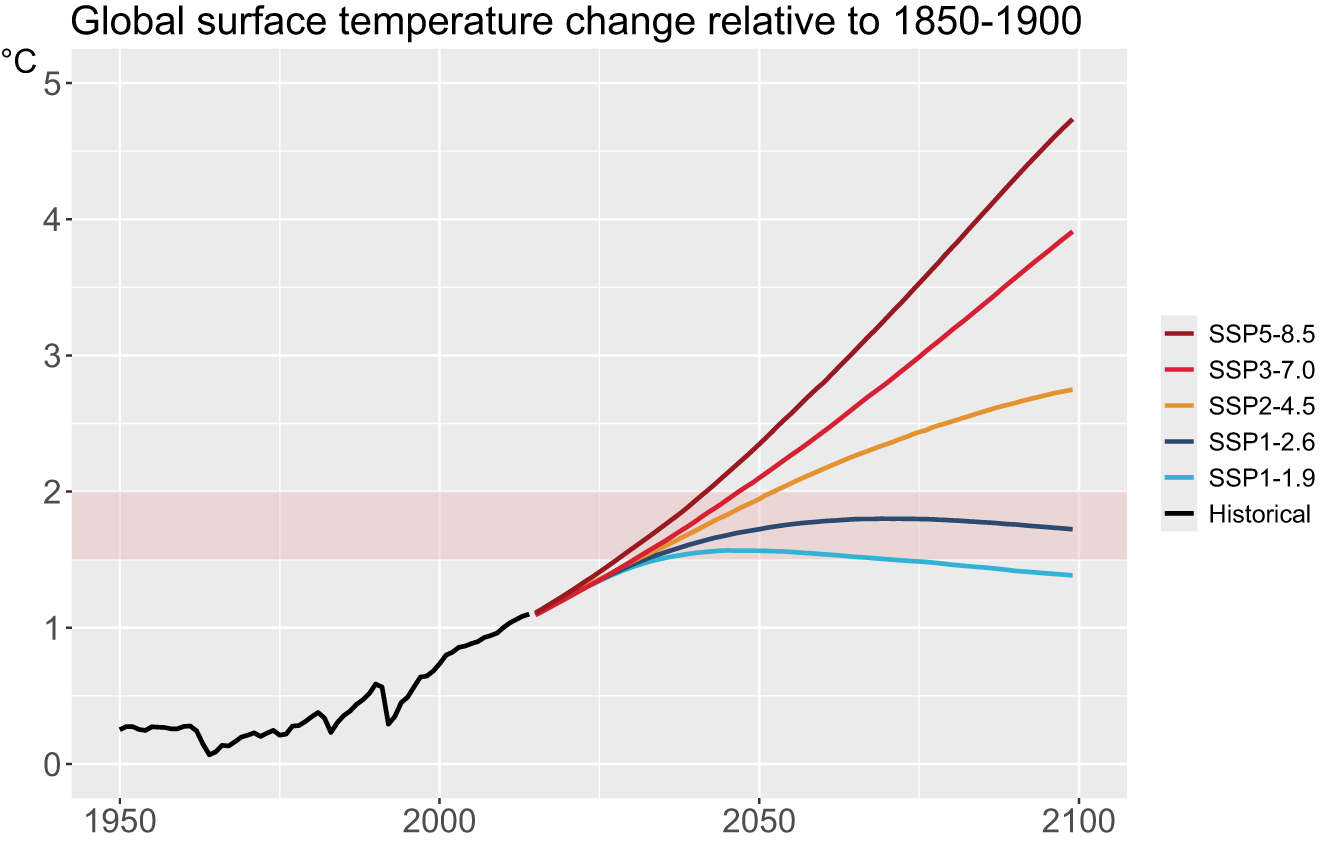
Managing climate change through adaptation, emissions reduction, and greenhouse gas removal (GGR) alone is challenging. The IPCC Sixth Assessment Report (AR6) outlined several scenarios with respect to net warming and net greenhouse gas emissions. These scenarios combine pathways based on global socio-economic trends (IPCC, Reference Shukla, Skea, Slade, Al Khourdajie, van Diemen, McCollum, Some, Vyas, Fradera, Belkacemi, Hasija, Lisboa, Luz and Malley2022; O'Neill et al., Reference O'Neill, Kriegler, Riahi, Ebi, Hallegatte, Carter, Mathur and van Vuuren2014; Riahi et al., Reference Riahi, van Vuuren, Kriegler, Edmonds, O'Neill, Fujimori, Bauer, Calvin, Dellink, Fricko, Lutz, Popp, Cuaresma, Samir, Leimbach, Jiang, Kram, Rao, Emmerling and Tavoni2017) and emissions trajectories as a result of mitigation measures, including emissions reduction and GGR (Box SPM.1, (IPCC, Reference Stocker, Qin, Plattner, Tignor, Allen, Boschung, Nauels, Xia, Bex and Midgley2013)). All five emissions scenarios considered by the IPCC, plotted in Figure 1, involve breaching the 1.5°C threshold (IPCC, Reference Masson-Delmotte, Zhai, Pirani, Connors, Péan, Berger, Caud, Chen, Goldfarb, Gomis, Huang, Leitzell, Lonnoy, Matthews, Maycock, Waterfield, Yelekçi, Yu and Zhou2021b). Only the most ambitious scenario (SSP1-1.9), involving sustainable development and rapid mitigation, leads to temperatures returning to below 1.5°C by 2100. Recent analyses suggest that the 2°C threshold could also be breached (Climate Action Tracker, 2024; Hansen et al., Reference Hansen, Sato, Simons, Nazarenko, Sangha, Kharecha, Zachos, von Schuckmann, Loeb, Osman, Jin, Tselioudis, Jeong, Lacis, Ruedy, Russell, Cao and Li2023). Under current policies, global warming is likely to exceed 1.5°C by 2030 and 2°C by 2050, and could reach 2.7°C warming in 2100.
Global surface temperature change relative to 1850-1900 (°C) under the five emissions scenarios (SSPx-y) used in the IPCC Sixth Assessment Report (AR6). Source: “best estimate” data from Figure SPM.8a in the Working Group I Summary for Policymakers (IPCC, Reference Masson-Delmotte, Zhai, Pirani, Connors, Péan, Berger, Caud, Chen, Goldfarb, Gomis, Huang, Leitzell, Lonnoy, Matthews, Maycock, Waterfield, Yelekçi, Yu and Zhou2021b). ‘SSPx’ refers to the Shared Socio-economic Pathway, and ‘y’ refers to the Representative Concentration Pathway (RCP), defined by the approximate level of radiative forcing by 2100 (in W/m2). The red-shaded band denotes the Paris Agreement range (1.5 to <2°C).
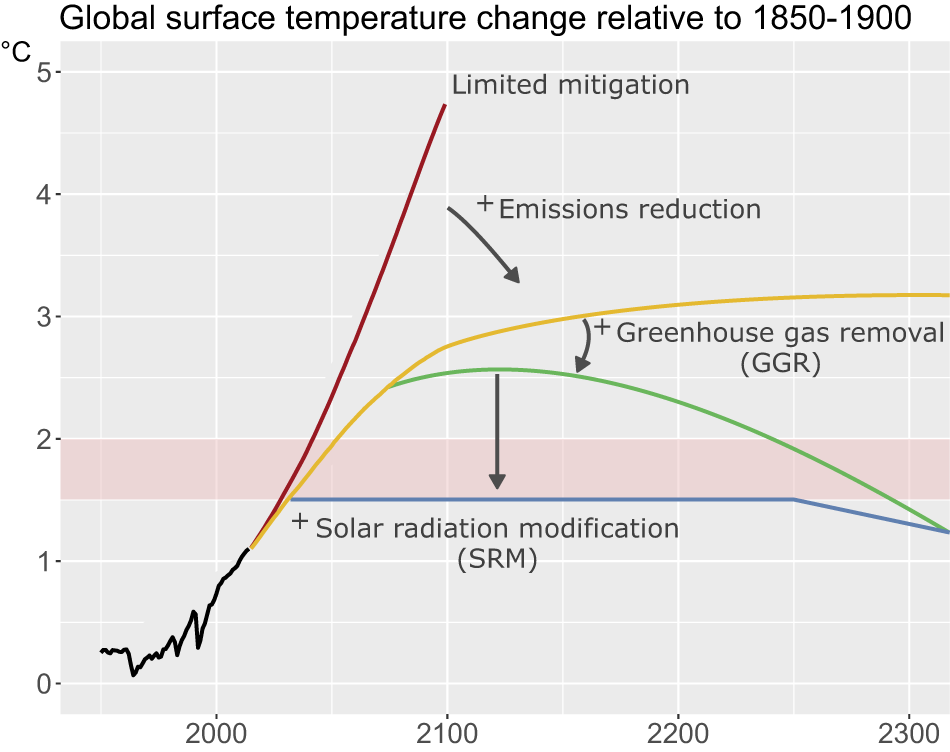
The likelihood of breaching the Paris Agreement thresholds has motivated efforts to explore additional measures to manage climate change. Figure 2 illustrates pathways drawing upon three actions. The first action is emissions reduction: without concerted effort in this area, the other actions are futile. The second action is greenhouse gas removal (GGR). GGR involves actively removing greenhouse gases from the atmosphere to counteract historical and hard-to-abate emissions. Ultimately, the goal is to reduce the concentration of greenhouse gases in the atmosphere to levels consistent with an overall warming of 1.5 to <2°C. Seminal studies have suggested that a level of 350 ppm for carbon dioxide (CO2) concentration should be targeted (Hansen et al., Reference Hansen, Sato, Kharecha, Beerling, Berner, Masson-Delmotte, Pagani, Raymo, Royer and Zachos2008; Rockström et al., Reference Rockström, Steffen, Noone, Persson, Chapin, Lambin, Lenton, Scheffer, Folke, Schellnhuber, Nykvist, de Wit, Hughes, van der Leeuw, Rodhe, Sörlin, Snyder, Costanza, Svedin and Foley2009). The third action is solar radiation modification (SRM). SRM involves increasing Earth’s reflectivity to decrease global average surface temperatures, thereby limiting the impacts of climate change stemming from elevated greenhouse gas concentrations.
The projected influence of emissions reduction and climate intervention (greenhouse gas removal, GGR; and solar radiation modification, SRM) on global surface temperature change relative to 1850-1900 (°C). Adapted from Long & Shepherd (Reference Long, Shepherd and Freedman2014) and MacMartin et al. (Reference MacMartin, Ricke and Keith2018) with historical data (black line) and 2015-2100 scenario modelling projections from IPCC (Reference Masson-Delmotte, Zhai, Pirani, Connors, Péan, Berger, Caud, Chen, Goldfarb, Gomis, Huang, Leitzell, Lonnoy, Matthews, Maycock, Waterfield, Yelekçi, Yu and Zhou2021b). The red line denotes scenario SSP5-8.5 (limited mitigation). The yellow line denotes a scenario adapted from SSP2-RCP4.5 in which emissions continue near to current levels until 2050, then decrease but without sufficient negative emissions to achieve net-zero by 2100. The green line denotes an improved scenario with the addition of long-term GGR (for illustration purposes). The blue line denotes an improved scenario with the addition of long-term GGR and SRM (for illustration purposes). The red-shaded band denotes the Paris Agreement range (1.5 to <2°C).
In this paper, we review some recent advances in emissions reduction and climate intervention, in the form of GGR and SRM. These advances are described from the technological dimension, and relevant ethical, legal, social, and economic implications are cited. We do not seek to provide an exhaustive summary or a systematic review, but rather to provide a narrative review, synthesising insights from the fast-moving field of climate science. For broader overviews, we refer the reader to IPCC reporting. Climate mitigation is assessed by Working Group III in AR6 – see Summary for Policymakers (IPCC, Reference Shukla, Skea, Slade, Al Khourdajie, van Diemen, McCollum, Some, Vyas, Fradera, Belkacemi, Hasija, Lisboa, Luz and Malley2022). Climate intervention is assessed in SR15 – see Sections 4.3.7 and 4.3.8 (IPCC, Reference Masson-Delmotte, Zhai, Pörtner, Roberts, Skea, Pirani, Shukla, Moufouma-Okia, Péan, Pidcock, Connors, Matthews, Chen, Zhou, Gomis, Lonnoy, Maycock, Tignor and Waterfield2018) – and by Working Group I in AR6 – see Section 4.6.3 (IPCC, Reference Masson-Delmotte, Zhai, Pirani, Connors, Péan, Berger, Caud, Chen, Goldfarb, Gomis, Huang, Leitzell, Lonnoy, Matthews, Maycock, Waterfield, Yelekçi, Yu and Zhou2021a). Our aim is to provide a concise review of climate mitigation and intervention efforts to limit global warming and its impacts.
2. Emissions reduction
Approximately three quarters of global greenhouse gas emissions arise from the burning of fossil fuels to supply energy for society (Crippa et al., Reference Crippa, Guizzardi, Pagani, Banja, Muntean, Schaaf, Becker, Monforti- Ferrario, Quadrelli, Risquez Martin, Taghavi-Moharamli, Grassi, Rossi, Melo, Oom, Branco, San-Miguel, Manca, Pisoni and Pekar2024; IEA, 2023; World Resources Institute, 2022), as shown in Figure 3. Therefore, emissions reduction depends heavily on the transition away from fossil fuels as the primary source of energy, as acknowledged by the Parties at COP28 in 2023 (UNFCCC, 2023a). There has been much progress in various non-fossil fuel sources of energy. Advances in wind and solar technologies, in particular, have resulted in significant reductions in cost per kWh. Nevertheless, renewable energy still only accounts for about one sixth of total global primary energy consumption (Energy Institute, 2024). The vast majority – 81.5% in 2023 – is still provided by fossil fuels. The rise in energy demand has caused fossil fuel use to rise. This demand is driven by population growth, emerging markets, and developing regions. Energy security and emissions reduction are key to global sustainable development, yet these two imperatives are held in tension. Although fossil fuel use is still rising annually, the overall rate of growth is slowing and its share in primary energy consumption is falling as renewable energy capacity increases (Energy Institute, 2024; IEA, 2024b). These trends are encouraging to some degree because they imply that new fossil fuel infrastructure projects are deemed less viable as opposed to renewable energy projects. If these trends continue, there is a possibility that global greenhouse gas emissions will reach a peak in the coming years and begin to fall. Below, we highlight the key sectors responsible for greenhouse gas emissions and identify potential measures towards emissions reduction.
Global greenhouse gas emissions by sector in the year 2023. Source: Emissions Database for Global Atmospheric Research (Crippa et al., Reference Crippa, Guizzardi, Pagani, Banja, Muntean, Schaaf, Becker, Monforti- Ferrario, Quadrelli, Risquez Martin, Taghavi-Moharamli, Grassi, Rossi, Melo, Oom, Branco, San-Miguel, Manca, Pisoni and Pekar2024). LULUCF: Land use, land-use change, and forestry.
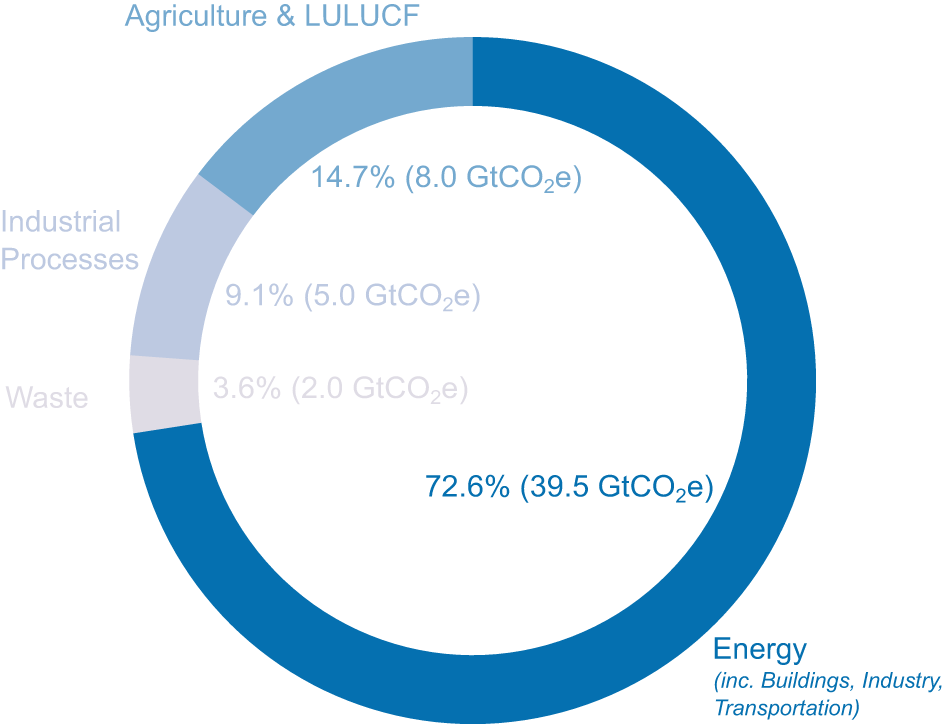
Within the energy sector – the highest-contributing sector to global greenhouse gas emissions – it is important to examine how energy is used in society and to pursue measures to increase efficiency and reduce demand. The use of energy in society includes the following sectors: buildings, industry, and transportation. Based on representative emissions data from the year 2023, these sectors collectively contributed over 50% of global greenhouse gas emissions (Crippa et al., Reference Crippa, Guizzardi, Pagani, Banja, Muntean, Schaaf, Becker, Monforti- Ferrario, Quadrelli, Risquez Martin, Taghavi-Moharamli, Grassi, Rossi, Melo, Oom, Branco, San-Miguel, Manca, Pisoni and Pekar2024). There are significant opportunities to make each of these sectors more efficient overall, which is economically appealing if this leads to reductions in energy costs. However, there are challenges associated with reducing emissions in many of these sectors.
With respect to buildings, there are many opportunities to increase energy efficiency and decrease energy demand. These include improvements in insulation and energy use monitoring, which can also provide significant health benefits (NEPC, 2022). A significant challenge lies ahead, however, with a changing climate, and the increased likelihood of more severe heatwaves (Dunn et al., Reference Dunn, Alexander, Donat, Zhang, Bador, Herold, Lippmann, Allan, Aguilar, Barry, Brunet, Caesar, Chagnaud, Cheng, Cinco, Durre, de Guzman, Htay, Wan Ibadullah and Bin Hj Yussof2020), impacting mortality and morbidity (Arsad et al., Reference Arsad, Hod, Ahmad, Ismail, Mohamed, Baharom, Osman, Radi and Tangang2022). A 2023 analysis estimated that 1.12 billion people in 77 countries are at high risk of poor health and livelihoods due to a lack of access to cooling (Sustainable Energy For All, 2023). This will likely result in higher demand for active cooling systems in both domestic and non-domestic settings; this in turn will result in higher energy use, especially in summer. A 2023 report by the UN Environment Programme (UNEP) found that, based on current energy policies, electricity demand for air-conditioning could more than double between 2023 and 2050, which would correspond to more than 10% of global projected greenhouse gas emissions in 2050 (UNEP, 2023a). The report suggests various efficiency measures and technological development, including passive cooling technology in the form of improved insulation and reflective surfaces. A voluntary pledge was made at COP28 in 2023 between 60 nations to ‘reduce cooling related emissions by 68% […] by 2050, significantly increase access to sustainable cooling by 2030, and increase the global average efficiency of new air conditioners by 50%’ (UNEP & Cool Coalition, 2023). Such developments highlight the growing need to protect lives and livelihoods from the impacts of extreme heat.
With respect to industry, there continue to be significant opportunities to make industrial processes more efficient. Agencies such as the UN Economic Commission for Europe provide industry with support to pursue energy efficiency for the benefit of the climate as well as for business and economic reasons. Ultimately, the measures adopted by a commercial or industrial entity to improve energy efficiency will be guided by the cost of a given investment, the terms associated with the finance required, and the resulting operational cost reductions associated with reduced energy use. These factors, which are considered in the IPCC scenario modelling (IPCC, Reference Lee and Romero2023), are all highly dependent on the context and ultimately will limit the pace of change.
The electrification of transportation represents a significant contribution to emissions reduction. The International Energy Agency (IEA) estimates a 20% reduction in global emissions between 2020 and 2050 if electricity were to become the dominant fuel (IEA, 2021). The reliance on electricity would enable the primary source of energy for transportation to be renewable. The electrification of road freight, shipping, and aviation is limited by the energy density of current batteries; the use of low-carbon fuels, such as biofuels and hydrogen-based fuels, is therefore likely to increase in the coming decades. The electrification of transportation depends largely on electric passenger cars. Electric cars currently account for roughly one-fifth of global car sales (IEA, 2024a), and remain in a state of robust growth due to falling costs, improved battery technology, and government support. However, the shift to batteries is causing the weight of passenger cars to increase and, therefore, for certain types of journeys, the energy use can be greater. Fortunately, this is offset by the benefit of energy storage and the ability to convert kinetic energy to electrical energy with braking, which can improve the efficiency of short journeys. The overall energy efficiency, accounting for life cycle emissions, also depends on the source of electricity. The interested reader may refer to Albatayneh et al. (Reference Albatayneh, Assaf, Alterman and Jaradat2020) and Lee and Kim (Reference Lee and Kim2023) for recent analyses comparing the efficiency of electric vehicles and internal combustion engine vehicles. In general, emissions reduction in transportation depends greatly on widespread electrification and increased renewable energy capacity.
Aside from energy production, the sectors most responsible for emissions beyond energy production are agriculture, and land use, land-use change, and forestry (LULUCF). Collectively, these sectors have contributed roughly 15% of global greenhouse gas emissions per year in the last decade (Crippa et al., Reference Crippa, Guizzardi, Pagani, Banja, Muntean, Schaaf, Becker, Monforti- Ferrario, Quadrelli, Risquez Martin, Taghavi-Moharamli, Grassi, Rossi, Melo, Oom, Branco, San-Miguel, Manca, Pisoni and Pekar2024; World Resources Institute, 2022). The challenges associated with these sectors are inextricably linked to human and planetary health factors, as outlined by the UN Sustainable Development Goals (SDGs; United Nations, 2017). There are many opportunities to reduce emissions with more careful management of land (Lloyd et al., Reference Lloyd, Thomas, Ofoegbu, Bradley, Bullard, D'Acunha, Delaney, Driver, Evans, Faulkner, Fonvielle, Francksen, Friday, Hose, Kaduk, Manning, Morrison, Novo, Page and Balzter2023), including minimising the amount of fertiliser required to maintain crop yields and plant health. However, owing to the need for food security to manage population growth, there is increasing pressure to use land more intensively in farming. Greenhouse gas emissions associated with the global production of food are continuing to rise (FAO, 2021). Progress to improve land management practices, guided by the principles of sustainable development, must therefore intensify.
Emissions reduction is central to climate mitigation efforts under the Paris Agreement. Expressed in Nationally Determined Contributions, climate action plans must include innovations in every sector of society to achieve net-zero emissions. The challenges in avoiding elevated greenhouse gas concentrations are compounded by the effects of environmental changes associated with warmer conditions, such as increased emissions from wetlands and melting permafrost. There is no sustainable future without significant effort in reducing greenhouse gas emissions. But the challenges related to halting the rise and prompting the fall of emissions remain significant.
3. Greenhouse gas removal (GGR)
Greenhouse gases are the principal physical drivers of global warming. The role of greenhouse gas removal (GGR) in strategies for mitigating climate change is now broadly acknowledged. Indeed, the term net-zero implicitly includes GGR as a means to offset hard-to-abate emissions from sectors such as aviation, agriculture, shipping, and industry. Moreover, the term net-negative implies levels of GGR that exceed emissions. The IPCC AR6 Working Group III concluded that ‘the deployment of [carbon dioxide removal] to counterbalance hard-to-abate residual emissions is unavoidable if [net-zero carbon dioxide] or [greenhouse gas] emissions are to be achieved’ (C.11, (IPCC, Reference Shukla, Skea, Slade, Al Khourdajie, van Diemen, McCollum, Some, Vyas, Fradera, Belkacemi, Hasija, Lisboa, Luz and Malley2022)). Based on radiative forcing studies, carbon dioxide (CO2) and methane are the highest contributors to global warming (IPCC, Reference Masson-Delmotte, Zhai, Pirani, Connors, Péan, Berger, Caud, Chen, Goldfarb, Gomis, Huang, Leitzell, Lonnoy, Matthews, Maycock, Waterfield, Yelekçi, Yu and Zhou2021a). Here, we review the status of two categories of so-called negative emissions technologies: carbon dioxide removal (CDR) and methane removal.
CDR is a key tenet of scenarios considered in AR6, the most recent IPCC assessment (IPCC, Reference Masson-Delmotte, Zhai, Pirani, Connors, Péan, Berger, Caud, Chen, Goldfarb, Gomis, Huang, Leitzell, Lonnoy, Matthews, Maycock, Waterfield, Yelekçi, Yu and Zhou2021a). The State of Carbon Dioxide Removal (Smith et al., Reference Smith, Geden, Gidden, Lamb, Nemet, Minx, Buck, Burke, Cox, Edwards, Fuss, Johnstone, Müller-Hansen, Pongratz, Probst, Roe, Schenuit, Schulte and Vaughan2024), a report published in 2024, concluded that, in addition to deep, near-term emissions reduction, 7–9 gigatonnes of CO2 (GtCO2) will need to be removed per year by 2050 to meet the 1.5°C Paris Agreement goal – a roughly fourfold increase from current amounts. This mid-century removal target is predicated on three ‘Paris-consistent 1.5°C scenarios’, which vary with respect to the pace of emissions reduction. As of 2020, CDR is taking place at about 2 GtCO2 per year (Smith et al., Reference Smith, Geden, Gidden, Lamb, Nemet, Minx, Buck, Burke, Cox, Edwards, Fuss, Johnstone, Müller-Hansen, Pongratz, Probst, Roe, Schenuit, Schulte and Vaughan2024). Smith et al. (Reference Smith, Geden, Gidden, Lamb, Nemet, Minx, Buck, Burke, Cox, Edwards, Fuss, Johnstone, Müller-Hansen, Pongratz, Probst, Roe, Schenuit, Schulte and Vaughan2024) identify two broad categories of CDR: conventional and novel. Conventional CDR refers to well-established methods related to LULUCF activities. These include afforestation/reforestation, agroforestry, forest management, soil carbon sequestration in croplands and grasslands, peatland and coastal wetland restoration, and durable wood products.
Although conventional CDR methods account for nearly all current CDR, their ability to increase in scale is limited, and many Paris-consistent scenarios require novel approaches to CDR. Novel CDR can be categorised as land-based or marine-based, and also as engineering-based or nature-based solutions. Land-based novel methods include biochar, enhanced rock weathering, direct air carbon capture and storage (DACCS), and bioenergy with carbon capture and storage. Marine-based novel methods include ocean alkalinity enhancement (OAE), macroalgae cultivation, and microalgae cultivation. As concluded by Smith et al. (Reference Smith, Geden, Gidden, Lamb, Nemet, Minx, Buck, Burke, Cox, Edwards, Fuss, Johnstone, Müller-Hansen, Pongratz, Probst, Roe, Schenuit, Schulte and Vaughan2024), the scaling of conventional CDR must align with globally accepted principles, such as those outlined by the three Rio Conventions (encompassing climate change, desertification, and biodiversity loss) and the SDGs (UNFCCC, 2023b; United Nations, 2017). Scaling efforts will depend on a robust and responsible framework for monitoring, reporting, and verification. Honegger, Michaelowa, & Roy (Reference Honegger, Michaelowa and Roy2021) and Chlela and Selosse (Reference Chlela, Selosse, Filho, Dinis, Moggi, Price and Hope2023) review the implications of CDR on climate action (SDG-13) and the co-benefits and trade-offs on other SDGs. Where novel CDR methods are concerned, key knowledge gaps remain which limit the ability to compare the risks and to inform policy design. Below, we review a selection of novel CDR methods.
Several land-based novel CDR methods are being developed commercially based on the value of carbon credits, with different schemes being introduced to create marketplaces for trade (Balmford et al., Reference Balmford, Keshav, Venmans, Coomes, Groom, Madhavapeddy and Swinfield2023). According to Smith et al. (Reference Smith, Geden, Gidden, Lamb, Nemet, Minx, Buck, Burke, Cox, Edwards, Fuss, Johnstone, Müller-Hansen, Pongratz, Probst, Roe, Schenuit, Schulte and Vaughan2024), novel CDR methods currently account for only 0.0013 GtCO2/year – less than 1% of total CDR. However, novel CDR methods are experiencing rapid growth compared with conventional methods. Technological challenges concerning novel CDR methods include the degree of permanence (i.e., how long removed CO2 is kept out of the atmosphere, which includes the risk of reversal) and the feasibility of scale-up (e.g., energy requirements, compatibility with existing infrastructure, and land use). Below, we review advances in DACCS, the most heavily funded land-based novel CDR method.
Recent DACCS projects illustrate the scale-up challenges of engineering-based CDR. Climeworks, in collaboration with Carbfix, have begun operating a DACCS plant that is designed to capture up to 36,000 tCO2/year (Climeworks, 2022). More than 27,000 similarly sized DACCS facilities would be needed just to sequester 1 GtCO2/year. DACCS plants require significant energy input, and while the Climeworks plant is powered by geothermal energy, the availability of low-emissions energy sources is a limiting factor for DACCS. Economically, there are inherent challenges to the scaling of novel CDR. With respect to carbon credits, the market that drives novel CDR deployment is currently small. The market size adversely affects the costs of novel CDR; carbon offsets from DACCS funding are 1–2 orders of magnitude more expensive than current carbon offset alternatives (e.g., reforestation and renewable energy funding) (Crawford, Reference Crawford2021). Recent projects, such as the Climeworks project, have attracted strong investment however, leading to expectations of a tenfold market increase by 2040 (Mistry et al., Reference Mistry, Carroll, Baker, Ponce De Leon, Dewar and Sims2023). In alignment with the scaling of conventional CDR, the scaling of land-based novel CDR must occur with due respect to ethical, legal, and social principles outlined by the SDGs and the Rio Conventions (UNFCCC, 2023b; United Nations, 2017). Integrating land-based novel CDR into existing CDR policy will thus depend on cross-disciplinary actions, including market growth, strategic deployment, and the development of robust governance frameworks.
Advances in novel CDR methods have been mostly limited to land-based methods. In part, this can be attributed to existing infrastructure and resources, as well as targeted funding opportunities, such as the call in 2020 by the UK government (BEIS & HM Treasury, 2020). However, roughly 70% of Earth’s surface is ocean, and marine-based carbon dioxide removal (mCDR) methods can potentially provide significant CDR capacity. Below, we focus on three novel mCDR methods, shown in Figure 4, that have received growing attention: OAE, macro- and microalgae cultivation.
Three novel methods of marine-based carbon dioxide removal (ocean alkalinity enhancement, macroalgae cultivation, and microalgae cultivation).
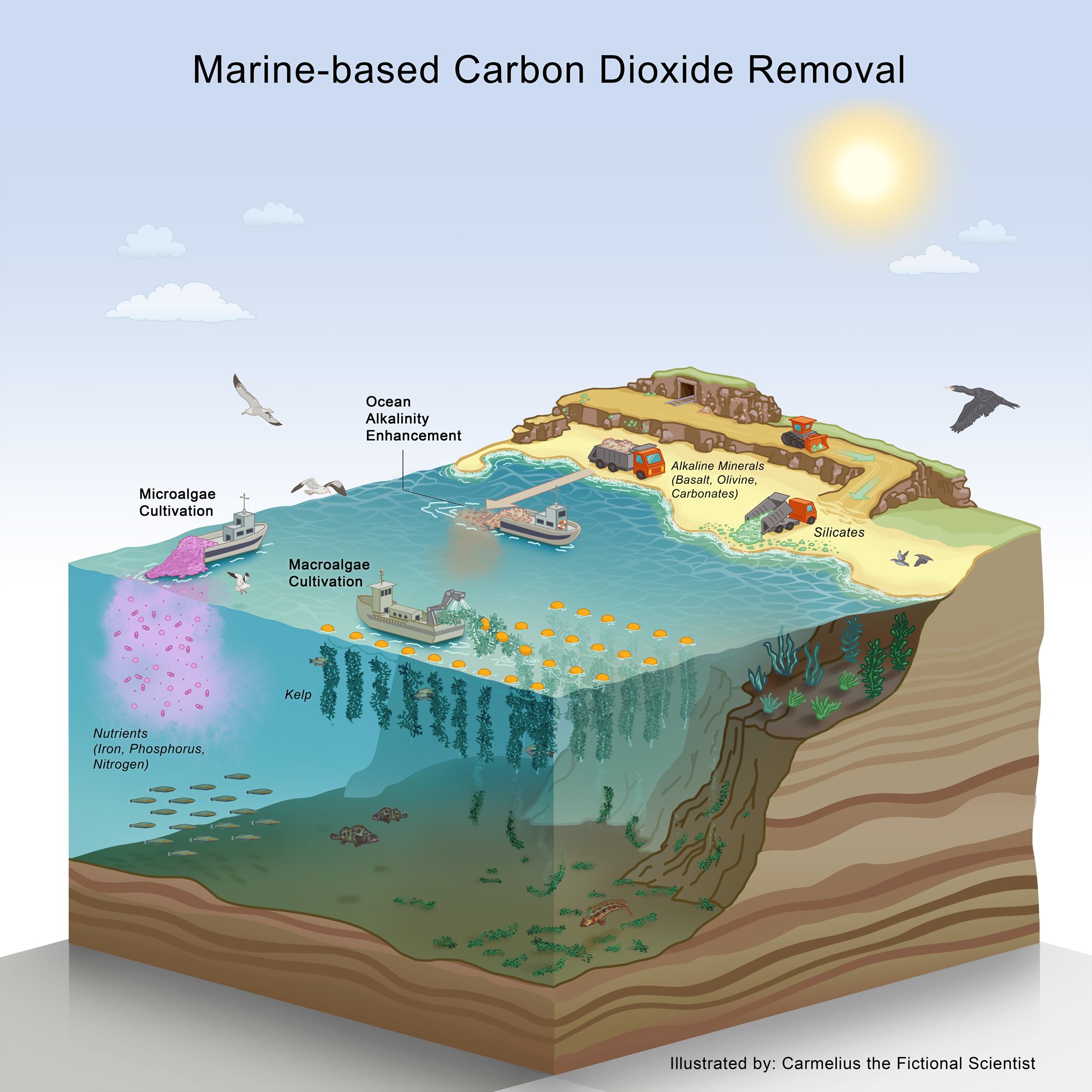
OAE involves altering seawater chemistry to increase the ocean’s capacity to store carbon in a durable chemical form. This method has already attracted significant investment (Planetary Technologies, 2024). OAE processes include spreading alkaline minerals over the open ocean as well as spreading alkaline silicates across beaches. While this method may require less energy input than DACCS (Keith et al., Reference Keith, Holmes, St. Angelo and Heidel2018), it requires extensive material supply. For example, sequestering one tonne of CO2 would require more than 4 tonnes of olivine, a mineral commonly proposed for OAE (National Academies of Sciences, Engineering, and Medicine, 2022). The processing of raw materials for OAE thus poses a major scale-up challenge, which may have adverse environmental impacts.
A novel biological approach for mCDR involves growing macroalgae (or seaweed) in coastal or offshore waters. This includes macroalgae cultivation and harvesting, as well as ocean afforestation (e.g., planting kelp forests), which is analogous to successful land-based CDR methods. Whether there is any CDR potential associated with harvested macroalgae depends on its eventual use. Residual biomass from the farm that remains in the ocean has CDR potential, but this remains highly uncertain. Another approach is to intentionally sink macroalgal biomass grown from coastal farms, floating platforms or buoys, or harvested from the open ocean. The potential for macroalgae harvesting in the open ocean has been identified in the North Atlantic. Strong-Wright and Taylor (Reference Strong-Wright and Taylor2022) identified a high growth potential of sugar kelp (i.e., Saccharina latissma) between 40°N and 50°N. Bach et al. (Reference Bach, Tamsitt, Gower, Hurd, Raven and Boyd2021) analysed formations of the floating seaweed Sargassum in the subtropical North Atlantic, linked to the emergence of the Great Atlantic Sargassum Belt. Such studies offer valuable insights into the efficacy of large-scale ocean afforestation. Intentional sinking provides a more direct pathway for carbon removal, but the economic viability and ecosystem impacts of this approach are less certain. The following aspects of macroalgae cultivation as a CDR strategy warrant further research: (i) quantifying the generation and fate of macroalgal biomass; (ii) the risk of nutrient limitation and other unintended ecosystem impacts; and (iii) quantifying the amount of carbon removed and the degree of permanence.
Microalgae cultivation involves the addition of specific nutrients to parts of the ocean which are limited in these components. The fundamental principle underpinning this concept is derived from observations of the formation of phytoplankton blooms following the addition of nutrients, such as iron, from natural processes. There are many observations of such blooms following dust storms from deserts depositing material on the surface of oceans (Banerjee & Prasanna Kumar, Reference Banerjee and Prasanna Kumar2014; Rijkenberg et al., Reference Rijkenberg, Powell, Dall'Osto, Nielsdottir, Patey, Hill, Baker, Jickells, Harrison and Achterberg2008; Westberry et al., Reference Westberry, Behrenfeld, Shi, Yu, Remer and Bian2023). Volcanic eruptions can also lead to the deposition of nutrient-rich material onto the surface of oceans. The Hunga eruption in 2022, for example, led to the deposition of ash-laden volcanic plumes over a wide area (roughly 2,000 km from the source), and was followed by an increase in chlorophyll-a concentrations in the region (Yoon et al., Reference Yoon, King, Longman and Cronin2023). These observations indicate that volcanic ash deposition can enhance phytoplankton productivity. Observations such as these have prompted some groups, such as the ExOIS consortium, to explore the addition of nutrients such as iron to help promote the growth of phytoplankton and increase both the uptake of carbon dioxide by the ocean and the amount that gets sequestered at depth (Buesseler et al., Reference Buesseler, Chai, Karl, Ramakrishna, Satterfield, Siegel, Smith, Webb, Wells and Yoon2022). However, there are significant questions regarding the ultimate fate of the organic material arising from the addition of nutrients, and also the potential for unintended ecosystem impacts. Earlier work into ocean iron fertilisation was inconclusive on these points (Yoon et al., Reference Yoon, Yoo, MacDonald, Yoon, Park, Yang, Kim, Lee Il, Lee, Jung, Park, Lee, Kim, Kim, Kim and Kim2018) and further research is needed if this method is to meaningfully contribute to the 7−9 GtCO2/year mid-century removal target.
The numerous outstanding questions posed by marine-based novel CDR methods, including those aforementioned, have prompted the development of research frameworks. For instance, Ocean Visions and Monterey Bay Aquarium Research Institute (2022) have provided a representative framework concerning macroalgae sequestration. The need to develop a framework to help compare different mCDR methods is being addressed by the European Union-funded project entitled Strategies for the Evaluation and Assessment of Ocean based Carbon Dioxide Removal (SEAO2-CDR) (SEAO2-CDR, 2024). This 4-year project unites scientific, economic, legal, political, social, and ethical researchers to develop mechanisms, tools and guidelines. Invariably, the project will need to account for recent amendments to the London Convention and the London Protocol, which call for the evaluation of ‘marine geoengineering techniques’ (IMO, 2023). Robust research frameworks, coupled with intergovernmental oversight, would ensure that mCDR methods can be evaluated and implemented in a responsible and transparent manner.
Methane removal has been the subject of growing attention. Although atmospheric concentrations of methane are approximately 200 times more dilute than carbon dioxide (by volume), methane traps more heat in the atmosphere per molecule; over a 20-year timescale, methane is roughly 80 times more potent than carbon dioxide as a greenhouse gas. The need to address atmospheric methane concentrations has recently been discussed by Jackson et al. (Reference Jackson, Abernethy, Canadell, Cargnello, Davis, Féron, Fuss, Heyer, Hong, Jones, Damon Matthews, O'Connor, Pisciotta, Rhoda, De Richter, Solomon, Wilcox and Zickfeld2021). They highlight that the elimination of most anthropogenic methane emissions is unlikely this century. In addition, the risk of a sudden methane release from the Arctic or elsewhere cannot be dismissed. Technologies for negative emissions of methane must therefore be investigated. In light of these circumstances, a voluntary framework known as the Global Methane Pledge was established adjacent to COP26 in 2021, which called for action to reduce methane emissions by 30% from 2020 levels by 2030. This goal is estimated to reduce warming by at least 0.2°C by 2050 (CCAC, 2023).
There are four broad classes of technologies for methane removal: (i) catalysts (e.g., photocatalysts), (ii) metal catalysts (e.g., zeolites or porous polymer networks), (iii) physical (e.g., iron-salt aerosols), and (iv) biological (e.g., soil management, biofilters). With respect to catalysis, the need to balance limiting rates of mass transfer to physical surfaces and the kinetics of reaction poses challenges to methane abatement systems, as discussed by Tsopelakou et al. (Reference Tsopelakou, Stallard, Archibald, Fitzgerald and Boies2024). Furthermore, effective methane removal poses significant scale-up challenges. For example, photocatalytic oxidation would likely require a vast surface area, on the order of 1011 m2, to achieve a removal capacity comparable to the year-on-year increase in atmospheric methane, on the order of 101 Tg (Nisbet-Jones et al., Reference Nisbet-Jones, Fernandez, Fisher, France, Lowry, Waltham, Woolley Maisch and Nisbet2022).
If methane removal proves feasible and deployable at scale, it could be more effective than CDR at slowing the near-term rate of global warming, owing to the greater potency of methane over the timescales of a few decades (Jackson et al., Reference Jackson, Abernethy, Canadell, Cargnello, Davis, Féron, Fuss, Heyer, Hong, Jones, Damon Matthews, O'Connor, Pisciotta, Rhoda, De Richter, Solomon, Wilcox and Zickfeld2021). This statement is critical – the timescale for potential impact on the climate with the adoption and scale-up of certain methane removal methods could be shorter than that of the mitigation scenarios considered by the IPCC (i.e., emissions reduction combined with CDR). Jackson et al. (Reference Jackson, Abernethy, Canadell, Cargnello, Davis, Féron, Fuss, Heyer, Hong, Jones, Damon Matthews, O'Connor, Pisciotta, Rhoda, De Richter, Solomon, Wilcox and Zickfeld2021) recommend a Methane Removal Model Intercomparison Project (MR-MIP) to facilitate Earth system modelling and experiments concerning atmospheric methane. This project, inspired by comparable CDR analyses and intercomparisons (e.g., Jones et al., Reference Jones, Ciais, Davis, Friedlingstein, Gasser, Peters, Rogelj, Van Vuuren, Canadell, Cowie, Jackson, Jonas, Kriegler, Littleton, Lowe, Milne, Shrestha, Smith, Torvanger and Wiltshire2016; Keller et al., Reference Keller, Lenton, Scott, Vaughan, Bauer, Ji, Jones, Kravitz, Muri and Zickfeld2018), may yet provide the robust research framework needed to quantify the expected impacts of methane removal.
In summary, meeting the goals of the Paris Agreement requires a range of negative emissions technologies. A roughly fourfold increase of CDR by the mid-century is required to meet the 1.5°C Paris Agreement goal (Smith et al., Reference Smith, Geden, Gidden, Lamb, Nemet, Minx, Buck, Burke, Cox, Edwards, Fuss, Johnstone, Müller-Hansen, Pongratz, Probst, Roe, Schenuit, Schulte and Vaughan2024). Well-established conventional CDR methods, such as forest management and soil carbon sequestration, must be scaled responsibly, mindful of the principles of sustainable development and the limitations on the degree of permanence. Innovations in novel CDR methods are also needed if they are to contribute to climate goals. Land-based novel methods have technological challenges concerning the degree of permanence and the feasibility of scale-up. DACCS, while attracting strong investor attention, currently has significant energy requirements and economic challenges (Keith et al., Reference Keith, Holmes, St. Angelo and Heidel2018). There are significant opportunities for mCDR due to the potential capacity, but the methods are in the early stages of development. Robust monitoring, reporting, and verification protocols are required and are central to the development and deployment of CDR methods. Finally, research into tackling non-CO2 greenhouse gases such as methane should continue and intensify, given the potential for impact on the climate over shorter timescales than those involving emissions reduction and CDR alone.
4. Solar radiation modification (SRM)
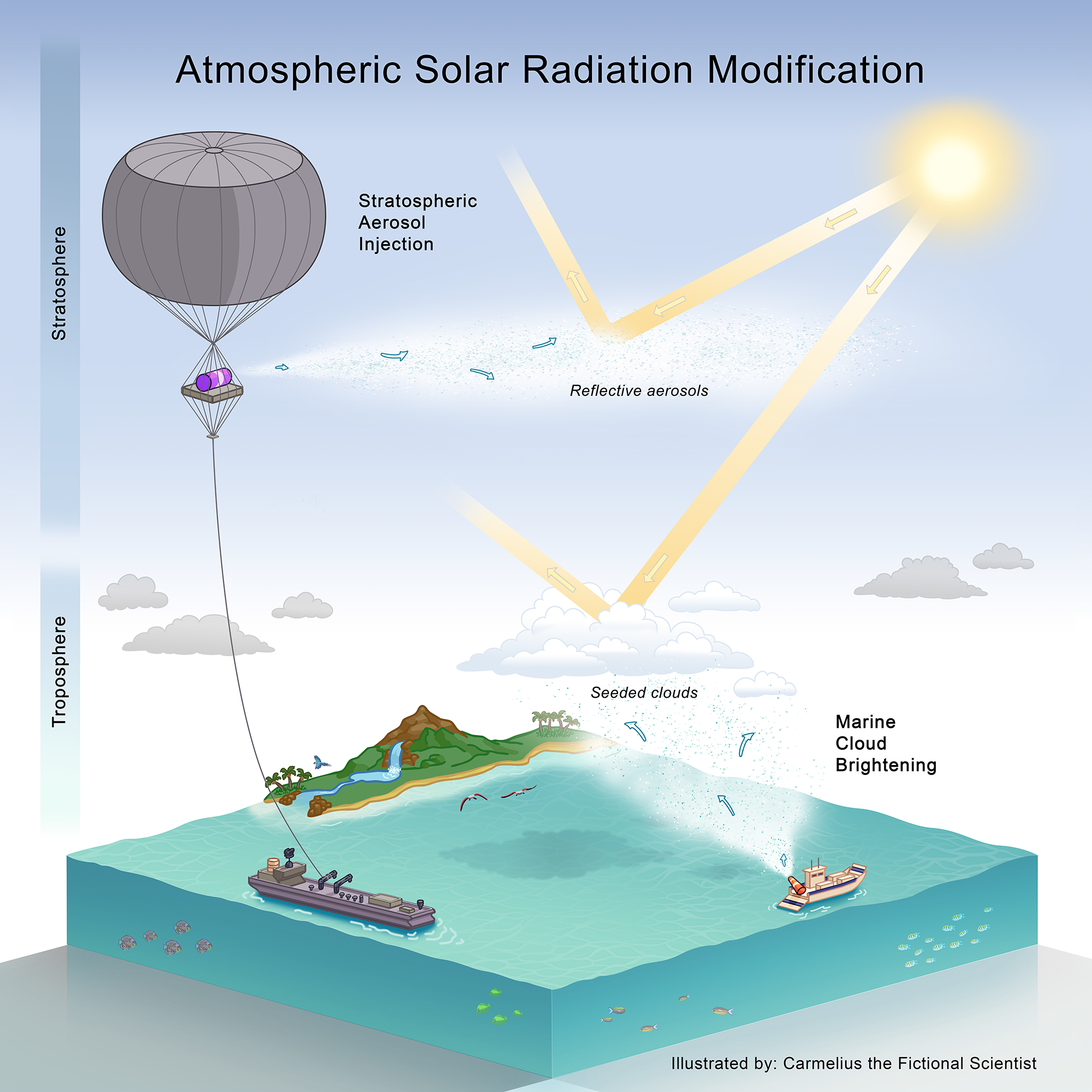
In light of continued global warming and the relatively slow response by national and international bodies, technological approaches to address Earth’s radiation balance have received growing attention. These approaches, collectively termed solar radiation modification (SRM), partly stem from observations of natural and human-induced radiative forcing, a measure related to the Earth-atmosphere energy balance. The volcanic eruption of Mt Pinatubo in 1991 was estimated to have injected roughly 20 million tonnes (20 Tg) of sulphur dioxide into the stratosphere, leading to a 0.5°C reduction in global mean surface temperatures for more than a year (IPCC, Reference Stocker, Qin, Plattner, Tignor, Allen, Boschung, Nauels, Xia, Bex and Midgley2013). In terms of radiative forcing from human activities, an 80% emissions reduction in sulphur dioxide emissions from international shipping – following International Maritime Organization (IMO) regulations – led to a radiative forcing of +0.2 ± 0.11 W/m2, averaged over the ocean (Yuan et al., Reference Yuan, Song, Oreopoulos, Wood, Bian, Breen, Chin, Yu, Barahona, Meyer and Platnick2024). SRM methods seek to increase Earth's reflectivity (or albedo). Below, we review two widely studied atmospheric SRM methods: stratospheric aerosol injection (SAI) – the injection of particles into the stratosphere (roughly 6–50 km above sea level) – and marine cloud brightening (MCB) – the seeding of particles into low-lying marine clouds (roughly 700–1000 m above sea level). Both are illustrated in Figure 5.
Atmospheric methods of solar radiation modification (SRM) – stratospheric aerosol injection (SAI) and marine cloud brightening (MCB).
Knowledge of SAI has largely stemmed from computational studies and empirical evidence from natural analogues (e.g., volcanic eruptions). Various computational studies have simulated SAI at multiple injection locations to meet global mean surface temperature objectives defined by IPCC scenarios. The Geoengineering Model Intercomparison Project (GeoMIP) has contributed to the knowledge base related to the impact of SAI on the climate (Kravitz et al., Reference Kravitz, Robock, Boucher, Schmidt, Taylor, Stenchikov and Schulz2011). These studies have sought to characterise the role of SAI with respect to the drivers of atmospheric circulation using models coupling radiative, dynamical, and chemical processes. Generally, studies suggest that SAI can cause radiative forcing of −2 W/m2 or greater (in magnitude), depending on the injection rate (Kleinschmitt et al., Reference Kleinschmitt, Boucher and Platt2018; Kravitz et al., Reference Kravitz, MacMartin, Tilmes, Richter, Mills, Lamarque, Tribbia and Large2019; Niemeier & Timmreck, Reference Niemeier and Timmreck2015). Studies have also considered the unintended consequences of SAI, including ozone depletion (Bednarz et al., Reference Bednarz, Butler, Visioni, Zhang, Kravitz and MacMartin2023; Eric Klobas et al., Reference Eric Klobas, Wilmouth, Weisenstein, Anderson and Salawitch2017; Tilmes et al., Reference Tilmes, MacMartin, Lenaerts, Van Kampenhout, Muntjewerf, Xia, Harrison, Krumhardt, Mills, Kravitz and Robock2020) and stratospheric heating from sulphur absorption of longwave radiation (Aquila et al., Reference Aquila, Garfinkel, Newman, Oman and Waugh2014; Richter et al., Reference Richter, Tilmes, Glanville, Kravitz, MacMartin, Mills, Simpson, Vitt, Tribbia and Lamarque2018). Kravitz et al. (Reference Kravitz, MacMartin, Mills, Richter, Tilmes, Lamarque, Tribbia and Vitt2017) simulated sulphur dioxide SAI using a coupled atmosphere-ocean general circulation model against a background defined by the RCP8.5 scenario (SSP5-8.5 in Figure 1, red line in Figure 2) over the period 2020–2099. The results of these simulations point to the potential scale of impact of SAI. The objectives were to maintain the 2020 values corresponding to three distinct climate patterns: (i) global warming (i.e., global mean surface temperature); (ii) hemispheric deviations in radiative forcing; and (iii) polar amplification (relative to lower latitudes). These objectives were simultaneously met using a feedback algorithm that adjusted the extent of sulphur dioxide injection at specific latitudes; the total injection rate increased linearly up to 51 Tg/year in 2099. Further computational research is needed to enable meta-analyses of SAI models. Future model development of the climate response to SAI must ensure clear and transparent assumptions, sufficient spatiotemporal resolution, and reliable uncertainty quantification. Invariably, however, model validation is constrained by the paucity of experimental data.
MCB has received growing attention, reflected by numerous computational studies and the ongoing progress of early stage field experimentation. Similar to SAI, the concept of MCB has an observable analogue: aerosol pollution from ship exhausts. The underlying principle of MCB is that, for a fixed amount of water, small cloud droplets occupy more surface area than large cloud droplets, increasing the ability of clouds to reflect solar radiation (Latham, Reference Latham1990; Twomey, Reference Twomey1974). Many studies have investigated the effects of seeding low-lying marine clouds with particles conducive to cloud droplet formation (i.e., cloud condensation nuclei or CCN). These studies typically assume the CCN particles are salt crystals, which can be derived naturally from seawater droplets. The study by Stjern et al. (Reference Stjern, Muri, Ahlm, Boucher, Cole, Ji, Jones, Haywood, Kravitz, Lenton, Moore, Niemeier, Phipps, Schmidt, Watanabe and Kristjánsson2018) considered nine models and showed that a 50% increase in the cloud droplet number concentration of low clouds over the global oceans under the RCP4.5 pathway (SSP2-4.5 in Figure 1) would result in median radiative forcing of −1.9 W/m2 with an inter-model spread of −0.6 to −2.5 W/m2. A study by Wood (Reference Wood2021) used a simple heuristic model to predict changes in cloud droplet concentration and albedo in response to increased particle concentrations below low-lying marine clouds. The study found that a radiative forcing level to offset a doubling of CO2 would require salt emission rates of 50–70 Tg/year over roughly 50% of the global ocean area. Computational studies have also considered the microphysical processes of clouds in response to cloud seeding (e.g., Hoffmann and Feingold (Reference Hoffmann and Feingold2021)), which have identified suitable particle size distributions that optimise cloud droplet formation for albedo enhancement and limit the effects counteracting MCB (e.g., precipitation and cloud evaporation). Insights from computational MCB studies are often constrained by the following limitations: (i) the idealised representation of cloud formation in climate models; and (ii) the inability of current satellite observations to resolve cloud and aerosol microphysics. A detailed overview of MCB (and SAI) research, including limitations and key knowledge gaps, has been provided in Chapter 2 of Reflecting Sunlight, a report by the National Academies of Sciences, Engineering, and Medicine (2021).
In addition to computational studies, a small number of groups are investigating the generation and delivery of seawater droplets for MCB. The technological appraisal of various droplet generation methods has been based on factors such as droplet size (and size distribution), droplet production rate, energy requirements, scale-up potential, and environmental impacts (Cooper et al., Reference Cooper, Foster, Galbraith, Jain, Neukermans and Ormond2014, Reference Cooper, Johnston, Foster, Galbraith, Neukermans, Ormond, Rush and Wang2013; Foster et al., Reference Foster, Cooper, Galbrath, Jain, Ormond and Neukermans2020). Methods under investigation include effervescent atomisation, flash boiling atomisation, electrospraying, and oscillation-induced Rayleigh jet breakup. MCB field trials have been undertaken in Australia on the Great Barrier Reef in recent years, aiming to provide a localised cooling effect on reefwater during heatwave periods to mitigate coral bleaching (Harrison, Reference Harrison2023; Harrison et al., Reference Harrison, Baird, Harrison, Utembe, Schofield, Escobar Correa, Mongin and Rizwi2019; Hernandez-Jaramillo et al., Reference Hernandez-Jaramillo, Harrison, Kelaher, Ristovski and Harrison2023). These trials used arrays of effervescent nozzles to generate seawater sprays and industrial fans to transport the sprays into the lower atmosphere. Early findings suggest that this system is capable of generating optimal salt particles which are carried into low-lying clouds by convection. The trials also established the need for further research and development in droplet generation, focused largely on optimising the droplet size distribution and production rate at minimal energy expense. These experimental efforts contribute valuable insights in a nascent area of research, providing a foundation on which to assess the technological feasibility of MCB at various scales.
The technological development of SRM is intrinsically linked to the ethical, legal, and social implications of its deployment. There have been some notable attempts at field experimentation of SAI. In 2011, the UK-government-funded SPICE project was announced, involving the study of delivery systems and climate impacts of potential aerosols delivered to the stratosphere. Field test plans on a delivery system were halted in 2012 owing to concerns over intellectual property (Cressey, Reference Cressey2012). Davidson et al. (Reference Davidson, Burgoyne, Hunt and Causier2012) provide an analysis of the SPICE project, its objectives, and the potential timescale for implementation. The SCoPEx project was announced in 2017, led by Harvard University researchers. Field test plans at Sweden’s Esrange Space Centre were halted in 2021 owing to opposition from environmentalists and local Indigenous groups (Tollefson, Reference Tollefson2024). The status of projects such as SCoPEx have had knock-on effects on public awareness and attitudes towards SRM. Debnath et al. (Reference Debnath, Reiner, Sovacool, Müller-Hansen, Repke, Alvarez and Fitzgerald2023) found a strong correlation between SRM-related social media activity and climate action or negotiation events. High surges in activity and ‘emotion volatility’ (negative, neutral, positive) were observed to coincide with the announcement of the SCoPEx project. In the political domain, SAI has recently been examined in a report on the progress of the Montreal Protocol (WMO, 2022). The report identified knowledge gaps and uncertainties which limit the evaluation of SAI and its impacts (positive and negative). With respect to MCB, clear regulatory frameworks are also needed. In this regard, amendments to the London Convention and the London Protocol to include and evaluate ‘marine geoengineering techniques’ are concerted efforts to encourage global cooperation and oversight (IMO, 2023). Global bodies such as UNEP have called for more research of SRM and ‘a responsible global conversation on SRM’ (UNEP, 2023b). These calls have been met with resistance, however, evidenced by the withdrawal of an SRM-related proposal at the UN Environment Assembly (UNEP, 2024). Where SRM is concerned, the governance challenges are as worthy of scrutiny as the technological challenges.
The implications of SRM for sustainable development remain highly uncertain. As with the assessment of GGR, the UN SDGs provide a useful framework by which SRM may be assessed. By limiting temperature rise resulting from elevated greenhouse gas concentrations, SRM could support the attainment of multiple SDGs, in terms of both the physical effects of climate action and the co-benefits to living standards and biodiversity. However, the unintended consequences on the complex, highly interrelated components of the Earth system remain unclear. In addition, any form of large-scale climate intervention will be a challenge for global governance, and the potential social consequences cannot be underestimated. These factors pose acute and novel risks to the attainment of SDGs. A detailed review of SRM implications in the context of the SDGs has been provided by Honegger, Michaelowa, & Pan (Reference Honegger, Michaelowa and Pan2021). Further research of SRM is needed to reduce the uncertainties of its implications (positive and negative). As a means of assessing physical and societal outcomes, the SDGs framework aids this consolidation.
In summary, the current state of knowledge regarding SRM is insufficient for robust evaluations. The development and scale-up of SRM methods are non-trivial, requiring timescales on the order of a decade – timescales that regrettably may coincide with those of certain climate tipping points, such as coral reef die-off and Arctic sea ice loss (Armstrong McKay et al., Reference Armstrong McKay, Staal, Abrams, Winkelmann, Sakschewski, Loriani, Fetzer, Cornell, Rockström and Lenton2022). As such, more technological research is urgently needed, in both computational and experimental domains. However, it is also clear that future advances in SRM are contingent on diverse societal engagement and robust governance frameworks.
5. Concluding remarks
The goals of the Paris Agreement encourage society to pursue a sustainable future in a safe and stable climate. However, all scenarios assessed in the IPCC Sixth Assessment Report (AR6) involve breaching the threshold of 1.5°C above pre-industrial levels (IPCC, Reference Masson-Delmotte, Zhai, Pirani, Connors, Péan, Berger, Caud, Chen, Goldfarb, Gomis, Huang, Leitzell, Lonnoy, Matthews, Maycock, Waterfield, Yelekçi, Yu and Zhou2021b). Breaching this threshold may lead to adverse impacts on natural, managed, and human systems. Current socio-economic trends suggest that energy security concerns are limiting the pace of the energy transition, prolonging society’s reliance on fossil fuels (Energy Institute, 2024). In light of these circumstances, additional measures to limit global warming (and address its impacts) are urgently needed. This paper has reviewed three climate actions: emissions reduction, greenhouse gas removal (GGR), and solar radiation modification (SRM).
Emissions reduction depends greatly on progressing the energy transition while the demand for energy continues to grow. Renewable energy sources occupy a growing share of global primary energy consumption, although the phasing out of fossil fuels will likely be prolonged in light of national and international trends. With the energy sector accounting for roughly three quarters of total greenhouse gas emissions globally (Crippa et al., Reference Crippa, Guizzardi, Pagani, Banja, Muntean, Schaaf, Becker, Monforti- Ferrario, Quadrelli, Risquez Martin, Taghavi-Moharamli, Grassi, Rossi, Melo, Oom, Branco, San-Miguel, Manca, Pisoni and Pekar2024; IEA, 2023; World Resources Institute, 2022), efficiency measures must be actively pursued with respect to buildings, industry, and transportation. The emissions from the agriculture sector and the LULUCF sector – roughly 15% of global greenhouse gas emissions (Crippa et al., Reference Crippa, Guizzardi, Pagani, Banja, Muntean, Schaaf, Becker, Monforti- Ferrario, Quadrelli, Risquez Martin, Taghavi-Moharamli, Grassi, Rossi, Melo, Oom, Branco, San-Miguel, Manca, Pisoni and Pekar2024) – are hard to abate and greatly influence standard-of-living factors (e.g., food security, clean water, and sanitation). Improvements in land management practices (e.g., the use of fertilisers) should be pursued with due attention paid to the principles of sustainable development.
Achieving net-zero (or net-negative) emissions, consistent with the goals of the Paris Agreement, requires intense scale-up of GGR technologies (i.e., negative emissions technologies). In addition to deep, near-term emissions reduction, a roughly fourfold increase in annual carbon dioxide removal (CDR) is needed by the mid-century to reach net-zero emissions by that time (Smith et al., Reference Smith, Geden, Gidden, Lamb, Nemet, Minx, Buck, Burke, Cox, Edwards, Fuss, Johnstone, Müller-Hansen, Pongratz, Probst, Roe, Schenuit, Schulte and Vaughan2024). Conventional CDR, involving land use, land-use change, and forestry (LULUCF) activities (e.g., afforestation/reforestation), should continue with the aid of a robust and responsible framework for monitoring, reporting, and verification. It is likely that novel CDR development will need to intensify to sufficiently increase annual CDR levels. Land-based novel CDR methods, such as direct air carbon capture and storage (DACCS), are in a state of growth, although further expansion is currently constrained by energy requirements and economic challenges (e.g., market size and infrastructure costs). Marine-based novel CDR methods, such as ocean alkalinity enhancement (OAE), could have a significant effect at scale, although further research and development is needed to progress the knowledge base and inform potential governance.
The risk of severe climate impacts associated with breaching the Paris Agreement thresholds motivates research into additional intervention measures, including SRM. Widely studied methods of atmospheric SRM include stratospheric aerosol injection and marine cloud brightening. Computational studies and observational studies show that SRM could limit temperature rise resulting from future emissions scenarios within timescales relevant to the goals of the Paris Agreement. However, the implications (positive and negative) for the climate and for sustainable development are yet to be adequately understood. Robust research and governance frameworks must be established to inform potential development and deployment in the future.
In summary, given the threats posed to humans and ecosystems by the likely breach of the 1.5°C Paris Agreement threshold, additional mitigation and intervention measures must be considered in future policies addressing climate change. Emissions reduction is an imperative, one that must be reconciled with the needs of a growing population, such as energy security and food security. Further consideration of GGR and SRM is urgently needed to assess their risks and benefits. Collectively, the progress of climate mitigation and intervention must intensify to secure a safe and stable climate.
Acknowledgements
The authors acknowledge Carmel Cohen for his assistance with figure illustrations.
Author contributions
SF conceived the study. DM and SF designed the study. DM and SF wrote the article. HH and JRT assisted in editing the article.
Funding statement
This research received no specific grant from any funding agency, commercial or not-for-profit sectors.
Competing interests
HH contributed to the UK-government-funded SPICE project.
Research transparency and reproducibility
N/A


 Open access

