


5.1 Introduction
Climate change is moving faster than we are … There is no more time to waste. (Guterres Reference Guterres2018; see also IPCC 2018; UNEP 2022)
On May 21, 2024, the Advisory OpinionFootnote 1 of the International Tribunal for the Law of the Sea (ITLOS) confirmed that climate change, including global warming and sea-level rise, poses an existential threat and raises human rights concerns (IPCC 2019b, 78, 2021a). This international judicial holding relies heavily on the scientific findings of the Intergovernmental Panel on Climate Change (IPCC) and specifically acknowledges the “unequivocal” role of human activities in driving climate change by increasing atmospheric greenhouse gas (GHG)Footnote 2 concentrations in the past two millennia (ITLOS Advisory Opinion, para. 48; IPCC 2023).
Anthropogenic GHG emissions hinder the ability of solar energy to escape the Earth’s atmosphere, trapping heat therein and leading to its reabsorption into the Earth’s surface (UNEP 2022). Also known as the greenhouse effect, this means that increased GHG emissions accelerate global warming, which is one of the key drivers of climate change (IPCC 2019a). The IPCC has warned that human-induced climate change is a global emergency that affects human and environmental health in multiple ways and that global warming is threatening its escalation (IPCC 2021b, 2023, 89). In this context, the Advisory Opinion of ITLOS – an international judicial body established under the United Nations Convention on the Law of the Sea (UNCLOS),Footnote 3 which today has 171 State parties – serves as a major global legal endorsement of these scientific findings by reinforcing the scientific consensus and amplifying the call for decisive action.
The oceans are fundamental climate regulators (ITLOS Advisory Opinion, para. 55). There is no denying that the pressing need for deep reductions in GHG emissions summoned by the IPCC report, which was signed by the World Meteorological Organization and the United Nations Environment Programme (IPCC 2023, v), also warrants urgent sensitization of anthropogenic marine interactions. ITLOS has held that UNCLOS State parties have “specific obligations to take all necessary measures to prevent, reduce and control marine pollution from anthropogenic GHG emissions and to endeavour to harmonize their policies in this connection” (ITLOS Advisory Opinion, para. 441(3)(b)).
Despite such global clarity for the need to specifically address anthropogenic maritime GHG emissions, the case for relevant actions within the international shipping sector (hereinafter “the sector”) is rather complex. The sector has been the backbone of global trade and economy due to its cost- and energy-efficient character in comparison to other modes of transport.Footnote 4 However, increased global maritime trade has resulted in a 62 percent increase in the sector’s share of global anthropogenic GHG emissions over the past two decades, with estimates suggesting a 90–130 percent increase in emissions by 2050 compared to 2008 levels (IMO 2021a). Moreover, the sector’s global nature, with diverse and multiple stakeholders across various jurisdictions, complicates the attribution of its emissions to any particular national economy. Therefore, the contemporary global goal of reducing GHG emissions in the sector requires a customized approach.
Against that backdrop, this chapter examines the existing approach to addressing GHG emissions within the sector and finds certain procedural and legal disparities toward achieving a “just and equitable transition” (JET). This finding is a culmination of components analyzed in Sections 5.2, 5.3, and 5.4 of this chapter. Section 5.2 highlights the multinational and multidimensional character of the sector and explores its interaction with the general international legal framework to address climate change, including the findings of the ITLOS Advisory Opinion. Section 5.3 traces the specialized measures adopted under the auspices of the International Maritime Organization (IMO) for addressing anthropogenic GHG emissions within the sector. Section 5.4 contextualizes the relevant measures in the sector with the consensus-driven goal for JET within the IMO. This exercise has helped identify gaps in the sector’s practical and legal approaches toward JET.
5.2 The International Shipping Sector and the International Legal Framework to Address Climate Change
Ships have facilitated oceanic navigation for thousands of years and have undergone significant technological transformation in their build and operation. The shipping sector has evidenced technological progress through a history of maritime enterprise – from ancient boats, canoes, rafts, kayaks, and floats progressively spanning materials from animal skins and timber to strong metals. Ships, which were once reliant on oceanic winds for navigation, eventually upgraded to steam-powered engines, coal-fired steamships, oil-powered vessels, and diesel engines (De Souza Reference De Souza2002, 7–42; Paine Reference Paine2013, 526). These technological advancements have been instrumental in increased speed, capacity, time, and cost efficiency of the maritime trade (Paine Reference Paine2013, 599). Today, the focus is on addressing the environmental tradeoffs from the sector’s business-as-usual practices.
5.2.1 Decarbonization
Today, maritime transport largely relies on fossil fuels for sustained international shipping operations. Among the six GHGs, carbon dioxide (CO2), emitted from burning fossil fuels in support of human activities, as in the case of maritime transport, has the most significant impact on global warming (IPCC 2005, 53). Hence, the imperative for specifically reducing anthropogenic CO2 emissions has attained critical urgency in the sector. This goal is termed “decarbonization.”Footnote 5 Essentially, it aims for the adoption of energy-efficient and climate-friendly methods to help slow the rate of global warming by stabilizing the Earth’s temperature in line with the ultimate objective of the United Nations Framework Convention on Climate Change (UNFCCC).Footnote 6 It appears that the dominance of CO2 emissions in the sector has led to the usage of “decarbonization” as a proxy term for GHG emissions reduction in the sector. Therefore, unsurprisingly, decarbonization in relation to the sector has been defined as “an overarching term that describes acts, pathways, or processes, by which countries, individuals or other entities aim to reduce and ultimately eliminate GHG emissions from human activities” (BIMCO 2023).
In the past three decades, the world has acknowledged the need for globally coordinated and integrated responses to climate change, including through decarbonization. This global reinforcement comes from the near-universal membership of 198 State parties to the 1992 UNFCCC, which entered into force in 1994 (UNTC n.d.). The ultimate objective of the UNFCCC is to undertake time-frame-sufficient interventions to stabilize GHG concentrations in the atmosphere “at a level that would prevent dangerous anthropogenic interference with the climate system” (Article 2). The goal is to be executed in a manner that naturally enables ecosystems to adapt to climate change without threatening food production and by sustainably enabling economic development (Article 2).
Further, the UNFCCC serves as an umbrella mechanism, with an implementation operationalized through the 1997 Kyoto ProtocolFootnote 7 and the 2015 Paris Agreement.Footnote 8 The Kyoto Protocol binds the developed world to meet emissions reduction and limitation commitments (Article 2). ITLOS has affirmed that the necessary measures to be taken by UNCLOS State parties under Article 194(1) to address marine pollution from anthropogenic GHG emissions must be determined by taking into account the Paris Agreement’s “global temperature goal of limiting the temperature increase to 1.5°C above pre-industrial levels and the timeline for emission pathways to achieve that goal” (ITLOS Advisory opinion, para 441(3)(b)). The Paris Agreement, which has 195 parties and entered into force in 2016, commits all parties to prepare and communicate five-year climate action plans in the form of their nationally determined contributions (Article 4(2) and (9)). It further encourages the formulation of long-term low GHG emissions development strategies (Article 4(19)). These policy measures are expected to serve as the basis for pursuing domestic mitigation measures in line with the objects of the Paris Agreement (Article 4(2) and (19)).
5.2.2 The Principle of Common but Differentiated Responsibilities and Respective Capabilities
The UNFCCC approach is centered on the principles of intergenerational and intragenerational equity (Article 3(1)). It supports taking full account of the legitimate priority needs of developing countries with a view to avoiding adverse impacts on social and economic development (preamble). This approach is influenced by the proclamations of the 1972 Stockholm Declaration on the Human Environment (UN 1972). The UNFCCC recognizes that, historically, the largest share of global GHG emissions originated in developed countries, and that there will be a predictable growth of this share in developing countries to meet their social and development needs (preamble). This recognition is materialized through the formal adoption of the principle of common but differentiated responsibilities and respective capabilities (CBDR-RC) (Articles 3(1) and 4(1)). The CBDR-RC is also reflected in Principle 7 of the 1992 Rio Declaration on Environment and Development (UNGA 1992). Applying this principle, the UNFCCC puts the onus on the developed world to take action specifically for sustainably protecting the climate system (Articles 3(4) and 4(1)).Footnote 9 For implementation purposes, the UNFCCC categorizes the developed country parties in Annexes I and II, while the developing countries are those that are not included in either Annex – that is, non-Annex parties (Article 4(2)). In addition to meeting their own commitments, the developed country parties are also obliged to promote, facilitate, and financially support, including for the transfer of technology, and extend assistance to, the developing country parties toward compliance with the obligations under the UNFCCC (Article 4(3), (4), and (5)).
ITLOS has also been mindful of incorporating this approach in its Advisory Opinion. It has been observed that some elements common to the principle of CBDR-RC are contained in the obligation under Article 194(1) of UNCLOS, which clarifies that the scope of measures to reduce anthropogenic GHG emissions causing marine pollution may differ between developed States and developing States (ITLOS Advisory Opinion, para. 229). While all States must make mitigation efforts in this regard, developed States should “continue taking the lead” (para. 229).
5.2.3 The Obligation of Due Diligence and the Precautionary Approach
Given the high risks of serious and irreversible harm to the marine environment from anthropogenic GHG emissions, ITLOS has held that UNCLOS State parties have an obligation to take necessary measures to prevent, reduce, and control marine pollution from such emissions with a “stringent standard of due diligence” (ITLOS Advisory Opinion, para. 441(3)(c)). Importantly, ITLOS has linked the obligation of due diligence with the precautionary approach (para. 242).
The UNFCCC applies the precautionary principle in cases of threats of serious or irreversible damage and lack of full scientific certainty by expressly requiring parties to “take precautionary measures to anticipate, prevent or minimize the causes of climate change and mitigate its adverse effects” (Article 3(3)). Similarly, Article 196(1) of UNCLOS obliges State parties “to take all measures necessary to prevent, reduce and control pollution of the marine environment resulting from the use of technologies under their jurisdiction or control or the intentional or accidental introduction of species, alien or new, to a particular part of the marine environment, which may cause significant and harmful changes thereto.” In this context, ITLOS has clarified that “scientific certainty” is not required for determining “necessary measures” and, in the absence of such certainty, the precautionary approach must be applied (ITLOS Advisory Opinion, para. 213). ITLOS has taken a progressive and impactful view that the precautionary approach is implicit in UNCLOS, even in the absence of explicit reference (para. 213). For instance, ITLOS interpreted that the use of the word “may” in Article 196(1) implies a precautionary approach and creates an obligation requiring the application of this approach (paras. 434, 441(4)(g)). Further, ITLOS also applied the precautionary approach to limit the margin of discretion of State parties for executing the obligation of environmental impact assessments under Article 206 of UNCLOS (paras. 361, 367).
5.2.4 Polluter-Pays Principle
The implementation of the obligation of due diligence may vary according to the capabilities and available resources of States. In practice, the application of the precautionary approach for undertaking the necessary measures to prevent, reduce, and control marine pollution comes with financial implications or costs. The Rio Declaration made significant progress in embodying a legal mechanism for allocating such costs. Principle 16 states that “national authorities should endeavour to promote the internalization of environmental costs and the use of economic instruments, taking into account the approach that the polluter should, in principle, bear the cost of pollution, with due regard to the public interest and without distorting international trade and investment.” Popularly referred to as the “polluter-pays principle,” it obliges the polluter to bear the cost of pollution.
Although the UNFCCC does not expressly refer to this principle and the ITLOS Advisory Opinion fails to account for it, the principle of CBDR-RC contains some common elements. Given that the principle of CBDR-RC creates differential obligations on parties based on their historical contributions to global GHG emissions and thereby to climate change, it can be suggested that this principle sets the appropriate stage for implementing the tenets of the polluter-pays principle. However, the application of the polluter-pays principle and the UNFCCC regime to the sector is not straightforward. This is because the application of the principle hinges on the identification of the polluter, while the sector continues to ask: Who is the polluter?
5.2.5 Complexities of the International Shipping Sector
The UNFCCC requires all parties – whether developed or developing – to develop, update, publish, and make available national anthropogenic GHG inventories (Article 4(1)(a)). This is intended to help evaluate the effectiveness of measures aimed at limiting emissions and enhancing removals of GHG. However, no explicit reference to the sector has been made in the UNFCCC (Article 4(1)(a)). The IPCC has clarified that emissions based upon fuel sold to ships engaged in international transport are not to be included in national totals but reported separately (IPCC 1996, I.3, 2006, 8.4). The reason for this segregation emerges from the sector’s global nature. The sector witnesses a multitude of interactions by multinational and cross-jurisdictional stakeholders, which complicates the attribution of GHG emissions from international shipping to any national economy.
International shipping operations are not singular in character, where responsibilities are divested among more than one entity based on the type of charterparty or the applicable international commercial terms. For example, consider a ship flying the flag of State A, owned by a national of or a company established in State B, chartered by a national of or a company established in State C, manned by nationals belonging to States D, E, and F, and carrying the cargo from State G bound for States H, I, and J. As part of its operations, the ship is required to navigate not only through the high seas but also through the exclusive economic zones and/or territorial waters of coastal States K and L. In this case, the attribution of the anthropogenic GHG emissions from this ship not only transcends the confines of national or domestic law but also demonstrates the complication in identifying the polluter or responsible party operating across myriad jurisdictions for the emissions in question.
Simplified model illustrating the multinational and multidimensional nature of international commercial shipping operations and the associated GHG emissions from ships.
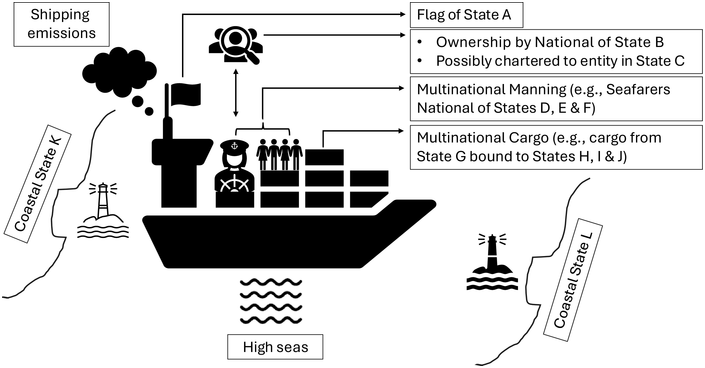
Figure 5.1 Long description
The model illustrates the multinational and multidimensional complexity of international commercial shipping operations using a representative example. A ship flies the flag of State A, is owned by a national of or a company established in State B, is chartered by a national of or a company established in State C, is manned by nationals belonging to States D, E, and F, and carries cargo from State G bound for States H, I, and J. As part of its operations, the ship navigates not only through the high seas but also through the exclusive economic zones and territorial waters of coastal States K and L. In this case, the attribution of anthropogenic G H G emissions from this ship transcends the confines of national or domestic law and demonstrates the complexity of identifying the polluter or responsible party operating across multiple jurisdictions for the emissions in question.
5.3 The Role of the IMO in Reducing GHG Emissions in International Shipping
The multinational nature of the sector, as emphasized in Section 5.2, summons multilateral action. This is also reaffirmed under Part XII of UNCLOS for the protection and preservation of the marine environment from any source, including ship-source GHG emissions. Article 211 of UNCLOS centralizes the role of a “competent international organization or general diplomatic conference” in providing the basis for legislation and enforcement to prevent pollution from vessels. ITLOS has confirmed the understanding that the term “competent international organization” in this context refers to the IMO (ITLOS Advisory Opinion, para. 280). Besides, the Kyoto Protocol had already solidified the intent to separately regulate anthropogenic GHG emissions from the sector, rather than within the UNFCCC. With 192 parties, it expressly affirms that the limitation or reduction of GHG emissions from marine bunker fuels is to be pursued by working through the IMO (Article 2(2)). Therefore, with the urgency to reduce GHG emissions in the sector, the role of the IMO has become nonnegotiable.
The IMO is a specialized agency of the United Nations with a mission to promote safe, secure, environmentally sound, efficient, and sustainable shipping through cooperation (IMO n.d.-a; UNGA 1948). Through intergovernmental cooperation, it has adopted global measures for preventing marine and atmospheric pollution from ships, particularly in the form of the 1973 International Convention for the Prevention of Pollution from Ships, as modified by its 1978 protocol (MARPOL).Footnote 10 MARPOL, which entered into force in 1983, is a result of the IMO’s focused approach toward marine environmental concerns that are specifically addressed by its Marine Environment Protection Committee (MEPC) – one of the five main committees of the IMO. It has 162 contracting States, reflecting approximately 99 percent of the gross tonnage of the world’s merchant fleet (IMO 2024i; ITLOS Advisory Opinion, para. 280). With such strong global participation, the framework of MARPOL sets forth generally accepted rules and standards for the purposes of Article 211 of UNCLOS (IMO 1997, para. 6.1).
MARPOL champions the IMO principle of nondiscrimination and, accordingly, no more favorable treatment (NMFT) to nonparty ships. This is specifically to ensure that ships of parties are not disadvantaged against ships of nonparties, in line with the IMO’s conventional purpose of promoting freedom of shipping and “to encourage removal of discriminatory action and unnecessary restrictions by Governments affecting shipping engaged in international trade so as to promote the availability of shipping services to the commerce of the world without discrimination” (MARPOL, Article 5(4), IMO convention, Article 1(b)).Footnote 11 In practice, the application of these principles may include equivalent surveys or inspections of nonparty ships, as well as relevant sanctions under national law or possible detention of noncompliant ships visiting ports of a party (IMO 2022i).
5.3.1 MARPOL and the Reduction of GHG Emissions from Ships
MARPOL, as an umbrella instrument, regulates six forms of ship-source pollution: (1) pollution by oil (Annex I); (2) pollution by noxious liquid substances in bulk (Annex II); (3) pollution by harmful substances carried by sea in packaged form (Annex III); (4) pollution by sewage (Annex IV); (5) pollution by garbage (Annex V); and (6) pollution by air pollution from ships (Annex VI). However, the originally adopted MARPOL Annexes did not make regulations concerning CO2 or other GHG emissions from ships. It was in 1997 that the MEPC recognized the significance of following those developments, even outside of the scope of IMO, such as in the UNFCCC (IMO 1997, para. 6.79).
The 1997 International Air Pollution Conference, which adopted MARPOL Annex VI, invited the IMO to cooperate with the UNFCCC for a twofold purpose: (1) to exchange information on GHG emissions; and (2) to undertake a study of CO2 emissions from ships for establishing their amount and relative percentages as part of the global inventory of CO2 emissions (MARPOL COP 1997, 96). To meet the first purpose, the IMO provides verbal and written updates on its progress and achievements to the multidisciplinary Subsidiary Body for Scientific and Technological Advice (SBSTA) established under the UNFCCC, which further reports to the Conference of Parties (COP) of the UNFCCC (IMO n.d.-d). Further, the details of the IMO’s participation and the outcome of COP are submitted to the MEPC.
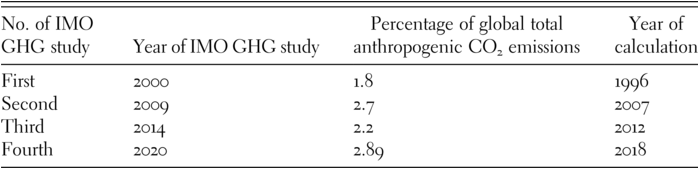
With respect to the latter purpose, four GHG studies were commissioned by the IMO, with reports published from 2000 to 2020 (IMO n.d.-e). At the 61st Session of the SBSTA held in November 2024, the IMO informed about ongoing considerations at the MEPC for commissioning a fifth IMO GHG Study to support evidence-based decision-making (IMO 2024f). Given that the four studies identified CO2 emissions as the most important GHG from shipping in terms of the quantity and quality of global warming potential, the GHG emissions standard is proposed as a CO2 emissions standard (IMO 2001a, para. 3, 2001b, para. 7, 2002, para. 4.21, 2009, 1). These studies indicate an over 62 percent increase in the anthropogenic CO2 emissions contribution of the sector in the past two decades, as shown in Table 5.1.
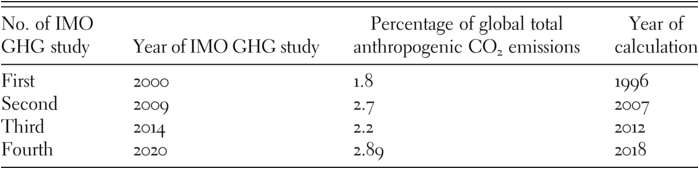
Table 5.1 Long description
The table has four columns for Number of I M O- G H G Study, Year of I M O - G H G Study, Percentage of Global Total Anthropogenic Carbon dioxide Emissions, and Year of Calculation. It has four rows corresponding to the first, second, third, and fourth I M O - G H G studies. Row 1. First; 2000; 1.8; 1996.Row 2. Second; 2009; 2.7; 2007.Row 3. Third; 2014; 2.2; 2012.Row 4. Fourth; 2020; 2.89; 2018.
Subsequent to the call from the global maritime community to consider feasible CO2 reduction strategies (MARPOL COP 1997), the IMO affirmed its prerogative to lead the development of GHG limitation and reduction strategies and mechanisms for international shipping through three measures: (1) technical; (2) operational; and (3) market-based (IMO 2004). The advocacy for market-based measures (MBMs) was based on the view that technical and operational measures had “a limited potential for contributing to reduced emissions from ships” and that there was a need for market pressures to incentivize this goal (IMO 2000, 8). However, the MBMs are contentious and continue to be deliberated for adoption. The relevant legal aspects are discussed in Section 5.4.
5.3.2 Technical and Operational Energy-Efficient Measures for Ships
In the years that followed, MEPC deliberations recognized that emissions reduction in the sector warranted measures to improve the energy efficiency of ships (IMO 2011a). To directly target the goal, the primary IMO action came through the implementation of technical and operational measures. This was partially achieved through the 2011 amendments to Annex VI of MARPOL that implemented the first ever mandatory global energy efficiency standard for an international industry sector (IMO 2011a). However, these regulations were only applicable to new ships,Footnote 12 and there was a requirement to develop the technical and operational energy efficiency of existing ships (IMO 2018d, para. 4.7.2). Besides, the 2018 IMO initial strategy on the reduction of GHG emissions from international shipping (Initial Strategy) outlined the need to reduce CO2 emissions specifically with regard to transport work – that is, the carbon intensity of international shipping (IMO 2018d, para. 4.7.2). This goal called for a change of technical specification of ships or their operational practices or both and, therefore, the need for ship-specific targets (IMO 2020).
Deliberations also revealed the need to provide flexibility to shipowners for deciding the means or measures for carbon intensity reductions of their ships, which could only be possible by mandatory goal-setting rather than enlisting such means and measures (IMO 2018b, paras. 7, 11, 2019d, para. 7.36.16). Therefore, MARPOL Annex VI seeks to reduce GHG emissions from international shipping through mandatory goal-based operational and technical measures (IMO 2021e). The technical measures comprise an Energy Efficiency Design Index (EEDI) and Energy Efficiency Existing Ship Index (EEXI). The operational measures are interconnected and consist of a Ship Energy Efficiency Management Plan (SEEMP), Data Collection System (DCS), and Carbon Intensity Indicator (CII) rating. While the DCS feeds data for the CII ratings of ships, the latter integrates into the SEEMP to continually enhance the operational efficiency of the ships. The scope of application, purpose, and manner of implementation of these measures are tabulated in Table 5.2.

Table 5.2 Long description
The table has five columns for Type of Measure, Name of Measure, Application, Purpose of Measure, and Implementation. It contains two main categories of measures, Technical and Operational, with five specific measures listed in total.Row 1. Type of measure: Technical; Name of measure: E E D I; Application: new ships of 400 gross tonnage and above; Purpose of measure: These indices aim to promote energy-efficient ship design, indicating a minimum energy-efficiency level per capacity mile for different ship types and size segments. Regulations 20, 21. I M O n d g; Implementation: For demonstrating energy efficiency, the E E D I attained in the case of a new ship, or the E E X I attained in the case of an existing ship, is verified against the required E E D I calculated in accordance with the manner provided in MARPOL Annex 6 regulations, 24, 25, I M O n d g.Row 2. Type of measure: Technical; Name of measure: E E X I; Application: existing ships of 400 gross tonnage and above. Purpose of measure: same as E E D I; Implementation:same as E E D I.Row 3. Type of measure: Operational; Name of measure: S E E M P; Application: ships of 400 gross tonnage and above; Purpose of measure: This is a ship-specific mechanism to encourage actions to monitor and improve the ship and fleet energy-efficiency performance and carbon intensity over time. I M O 2022 j, paragraphs 1.2.1, 1.3.1; Implementation: The S E E M P comprises plans for energy-efficiency improvement, fuel oil consumption data collection, and operational carbon intensity, I M O 2022 j, para. 1.3. It is executed by planning, implementation, monitoring, and self-evaluation and improvement. It is determined by the current state of ship energy efficiency and carbon intensity and the expected improvement through best measures I M O 2022 j, paragraphs. 3.6, 4.1.Row 4. Type of measure: Operational; Name of measure: D C S; Application: ships of 5,000 gross tonnage and above; Purpose of measure: This is an annual data collection mechanism of the technical characteristics of the ships; Implementation: DCS includes details of fuel oil consumption and the power output of internal combustion engines. This data is to be transferred to the I M O D C S, with the purposes of data analysis as part of Part 2 of the I M O Roadmap.Row 5. Type of measure: Operational; Name of measure: C I I rating; Application: ships of 5,000 gross tonnage and above; Purpose of measure: This is an annual measure to incentivize most energy-efficient ships; Implementation: The C I I is built on fuel oil consumption from the I M O D C S, I M O n d g. The attained annual operational C I I must be documented and verified against the required annual operational C I I. Based on this, Flag State Administration rates a ship as A major superior, B minor superior, C moderate, D minor inferior, or E inferior performance level. A ship rated D for three consecutive years or rated E is required to develop a “plan of corrective actions,” which is to be included in the revised S E E M P, regulations 28.
a An “existing ship” is a ship that is not a new ship: MARPOL Annex VI, Regulation 2.22.
The implementation of these technical and operational measures is supported by the IMO Roadmap, which takes a three-step approach: (1) data collection of ships’ fuel oil consumption, specifying the fuel oil type and methods used for such data collection; (2) data analysis; and (3) decision on measures to enhance the energy efficiency of international shipping (MARPOL Annex VI, Regulation 22A; see also IMO 2016a, paras. 6.8, 7.7.1, 7.7.4, 7.7.6, 2016b). The third stage aimed for the adoption of the Revised Strategy for the reduction of GHG emissions from ships by the 80th Session of the MEPC in 2023 (IMO 2016b, 2). While this was achieved in principle (IMO 2023l), it has led to practical and interpretational ambiguity, as elaborated in Section 5.4.
In essence, the Revised Strategy is time-conscious and builds on the enlisted implementation of measures already elaborated in the Initial Strategy (IMO 2018d, para. 4). These measures have been specified for implementation in three phases: (1) short term between 2018 and 2023; (2) mid-term between 2023 and 2030; and (3) long term beyond 2030. Short-term measures largely seek to apply operational and technical measures on ships (IMO 2018d, para. 4.1.1). Among them, EEXI, EEDI, SEEMP, and DCS, technical cooperation, and transfer of technology aspects, as discussed above, are already incorporated into MARPOL Annex VI through amendments (IMO 2018d, para. 4.7). The 83rd session of the MEPC agreed on an IMO Net-Zero Framework comprising amendments to the MARPOL Annex VI and integrating an economic mechanism to incentivize JET, which were scheduled for adoption in October 2025 but was adjourned for one year (IMO 2025a).
5.4 Just and Equitable Transition of the International Shipping Sector
The Revised Strategy, like the Initial Strategy, is guided by the principles of implementation enshrined in the IMO conventions and the UNFCCC. The IMO principles of nondiscrimination and NMFT, which mandate equivalent treatment to all ships, are to be balanced against the UNFCCC principle of CBDR-RC, which encourages differential treatment based on considerations of socioeconomic circumstances. The interplay of these principles influences the decisions made for meeting the vision and ambition of the Revised Strategy. While these principles were also included in the Initial Strategy, the principle of CBDR-RC and the utility of its components appear to be strengthened in the Revised Strategy.
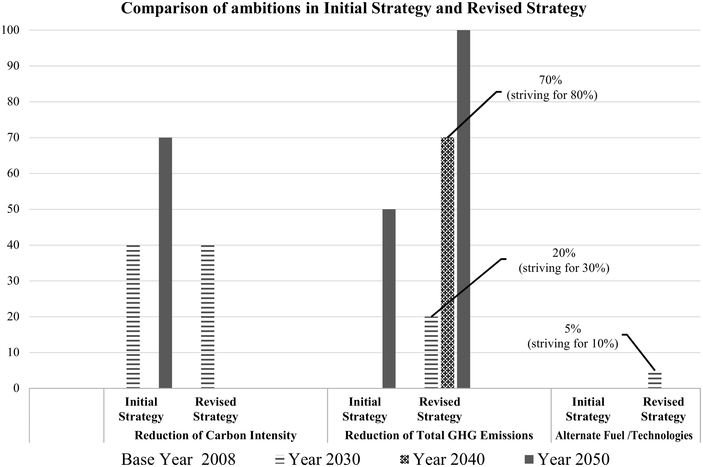
For instance, the Revised Strategy has significantly revised the earlier ambition of reducing 50 percent of the total annual GHG emissions by 2050 to reach net zero by 2050, all while accounting for different national circumstances (IMO 2023l, Annex, para. 3.3.4). Amid support to reach the highest level of GHG emissions from international shipping as soon as possible and phase them out by 2050, deliberations also reveal a preference for alignment with the UNFCCC by using the agreed language of the Glasgow Climate Pact – that is, “aim for achieving net-zero GHG emissions by or around mid-century, taking into account different national circumstances” (IMO 2023f, paras. 15, 16). This culminated in setting two key targets for reducing total annual GHG emissions from international shipping compared to 2008 levels: first, by at least 20 percent, aiming for 30 percent, by 2030; and second, by at least 70 percent, aiming for 80 percent, by 2040 (IMO 2023l, Annex, paras. 3.3.3, 3.4). A comparison of the ambitions of the Initial Strategy and the Revised Strategy is shown in Figure 5.2.
Comparison of ambitions in Initial Strategy and Revised Strategy.
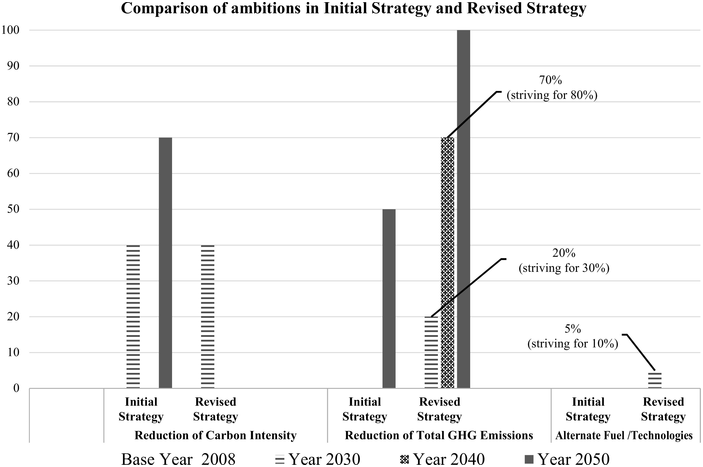
Figure 5.2 Long description
The bar chart gives the following data. The base year is given as 2008. The initial strategy for carbon intensity reduction is 40% by 2030 and 70% by 2050. The initial strategy for total G H G emissions reduction is 50% by 2050. The revised strategy is 20% by 2030 while striving for 30%, 70% by 2040 while striving for 80%, and 100% by 2050. There is no initial strategy for alternate fuel or technologies presented. However, the revised strategy is to target 5% and strive for 10% for the same by 2030.
Further, while both versions of the IMO strategy continue to envision urgent reductions and the phasing-out of GHG emissions from international shipping in this century, the Revised Strategy seeks to reach this vision while promoting JET (IMO 2018d, para. 2). What constitutes JET has not been specifically described or defined in the Revised Strategy. However, its character can be implied to some extent. The Revised Strategy guides that JET should have the impact of “leaving no country behind” (IMO 2023l, Annex, para. 5.3). Further, it asserts that the nature of the mid-term measures should be such that, while they promote and incentivize energy transition, they should also simultaneously contribute to a level-playing field within the sector (IMO 2023l, Annex, para. 4.5). The lack of an explicit definition, however, may be seen as an attempt to offer constructive ambiguity to account for different or broad-ranged circumstances. The travaux préparatoires suggest that the intention is to interpret it as being intrinsically linked to the principle of CBDR-RC (IMO 2023g, paras. 47, 50, 58).
Meanwhile, reference may also be made to the definition adopted by the International Labour Organization (ILO), which plays a critical role in regulating maritime labor concerns. According to the ILO, the term “just transition” means “greening the economy in a way that is as fair and inclusive as possible to everyone concerned, creating decent work opportunities and leaving no one behind” (ILO n.d.). Therefore, it would not be far-fetched to suggest that the possible indicators that contribute to JET for the sector could be derived from the means and factors that influence the IMO’s decisions for addressing GHG emissions in international shipping – that is, matters concerning the IMO’s decision-making procedures and the actors and stakeholders impacted by those decisions.
5.4.1 Procedural Element
Recent literature has identified that MEPC deliberations concerning GHG emissions reduction in shipping are steered by certain highly active State actors, such as Japan, Norway, and the US, while also noting the emergence and increased participation by intergovernmental organizations, such as the European Commission, and nongovernmental organizations, such as the Clean Shipping Coalition, in recent years (Baumann Reference Baumann2023). Moreover, it was also found that the developed countries or regional organizations, such as the European Union, exercise financial influence in promoting participation of the Small Island Developing States (SIDS) (Baumann Reference Baumann2023). Such voluntary initiatives by developed countries beyond the administrative purview of the IMO may be seen as a demonstration of their leadership in fostering inclusive deliberations. However, they also raise concerns about arbitrariness and the misuse of financial incentives in favor of vulnerable or less-capable countries to drive consensus at the IMO, potentially prioritizing the donor’s agendas over genuine benefits.
Therefore, deliberations emphasize the need for procedural fairness for an equitable transition. This entails that representation, maritime mitigation, and the response to climate impacts are equitable while also being just for seafarers, and that disproportionately negative impacts are addressed (IMO 2023f, para. 10.5, 2023g, para. 39). These views seek to ensure a level-playing field and to safeguard the interests of developing countries – in particular, the Least Developed Countries (LDCs) and SIDS, which contribute very little to total global GHG emissions (IMO 2023f, para. 10.5, 2023g, para. 39). This approach also aligns with the suggestion for facilitating a transition that is “environmentally effective, procedurally fair, socially just, globally equitable, and technologically inclusive” (Shaw and De Beukelaer Reference Shaw and De Beukelaer2022). The culmination of these discussions resulted in the call of the Revised Strategy to consider the impacts of GHG reduction measures on the emerging needs of the developing world (IMO 2023l, Annex, para. 3.5.3). Moreover, the IMO’s Strategic Plan for 2024–2029, which was adopted in 2023, also focuses on addressing the needs of the developing world through principles of respect, nondiscrimination, inclusivity, and transparency, with specific regard to capacity development and emerging technologies (IMO 2023j, paras. 4, 21, 25).
Procedural fairness is key to achieving the smooth implementation of measures, as it is a critical tool for inclusivity in the global maritime sector. The maritime community’s appreciation of the need for procedural fairness predates the adoption of the Revised Strategy or the 2024–2029 Strategic Plan. The IMO has attempted to facilitate diverse and equal representation in its GHG meetings through the establishment of a Voluntary Multi-Donor Trust Fund (VMTDF) to support participants from developing countries, particularly SIDS and LDCs (IMO 2023b, 2023c, n.d.-i). Concerns of equity were highlighted on the grounds that LDCs and SIDS were poorly represented, where deliberations reveal that financial support for participation in the decision-making process was integral for sustaining equitable efforts to reach the IMO’s goals toward GHG emissions reduction from international ships (IMO 2018a, para. 1, 2018c, para. 7.7.5, 2019a, para. 6, 2019b, 2019c, para. 2, Annex). Although the VMTDF opened applications in February 2023, only twenty-five of the sixty-five LDCs and SIDS attended the fifteenth Intersessional Working Group on the reduction of GHG emissions from ships, which was instrumental in influencing the finalization and adoption of the Revised Strategy by the 80th Session of the MEPC (IMO 2023c, 2023e, 2023i, para. 7.22).
5.4.2 Human Element
Furthermore, it was also realized that decarbonizing the sector impacts the training and labor conditions of around 2 million seafarers globally, who would require upskilling with respect to the new and alternative fuel technologies (MJTTF 2022). Therefore, for a just and human-centered transition to net zero, the Maritime Just Transition Task Force (MJTTF) was launched at COP 26 in 2021 (IMO n.d.-h). The IMO supports the MJTTF, along with the International Chamber of Shipping, the International Transport Workers’ Federation, the United Nations Global Compact, and the ILO (MJTTF 2022). Marking its first phase in 2022, a position paper of the MJTTF was developed with a ten-point action plan in the context of “mapping a Just Transition for the global maritime workforce” (MJTTF 2022). The paper essentially recommends alignment with global maritime labor standards, championing gender and diversity and prioritizing health and safety onboard ships (MJTTF 2022). The influence of the MJTTF action plan echoes through the Revised Strategy, which – unlike the Initial Strategy – specifically acknowledges the effects on seafarers and other maritime professions (IMO 2023l, Annex, paras. 5.6, 5.11). To meet the ambition of the Revised Strategy while ensuring a just transition for the human element in the maritime sector, it urges the IMO to evaluate its instruments, guidance, and training standards and develop a seafarers’ training and skills program (IMO 2023l, para. 3, Annex, paras. 5.6, 5.11).
5.4.3 Technical Element
The Revised Strategy emphasizes the importance of adopting technologies, fuels, and energy sources with zero or near-zero GHG emissions (IMO 2023l, para. 3, Annex, para. 3.3.3). It aims for these sustainable alternatives to account for a minimum of 5 percent, with a target of 10 percent, of the energy consumed by international shipping by 2030. Presently, 98.8 percent of the global fleet rely on conventional marine fuels,Footnote 13 which are produced from crude oil formed over millions of years from the remains of plants and animals that lived in the seas (UNCTAD 2023, 68). The transition to alternative fuels is still at a nascent stage (IMO 2023h, Annex; UNCTAD 2023, 68). Alternative fuels are nonconventional fuels, which are deemed to serve, at least partly, as a substitute for traditionally used fossil fuels in the energy supply and which have the potential to contribute to decarbonization (IMO 2023h, Annex, para. 1.4.2; BIMCO 2023).
Based on the terminologies used, it also appears that alternative fuels are further categorized as low-carbon fuels, near-zero carbon fuels, and absolute-zero carbon fuels. Since the term “near zero” describes reducing emissions to a level significantly lower than current levels and as close as possible to zero with available technologies, it would be consistent to derive that “low carbon” denotes emissions reductions below the current levels (BIMCO 2023). With respect to alternative low-carbon and zero-carbon fuels, there is no universally applicable and readily available solution today (UNCTAD 2023, 68). Alternative fuels include methanol, ammonia, hydrogen gas, liquified natural gas (LNG), and electrical energy, and it is apparent that the list of alternative fuels is not exhaustive (IMO 2023h, Annex, para. 1.4.2). UN Trade and Development (UNCTAD) reports that, in 2022, only 5.5 percent of the active fleet used alternative fuels, mainly LNG, and, to a lesser extent, battery/hybrid, liquified petroleum gas, and methanol (UNCTAD 2023, 69). The IMO reports that, in 2023, 92.53 percent of the fuels used by ships were conventional fuels comprising heavy fuel oil, light fuel oil, or diesel or gas oil, with increasing usage for alternative fuels (IMO 2024f, para. 17). Reports assume that these small quantities have been delivered mainly via small-scale terminals with truck-to-ship transfers (IMO 2023h, Annex, para. 5.1). The dominant usage of conventional fuels in the international shipping industry is owed to their established supply chains and infrastructure, and to their lower costs (UNCTAD 2023, 68, 72). There is another complexity to the required infrastructure development. It has been evaluated that not all alternative fuels will be able to use existing bunkering infrastructure, with some needing new infrastructure; this suggests that tailored infrastructure will be required based on each fuel’s characteristics (IMO 2023h, Annex, para. 5.1).
Further, while vessel design technologies, such as optimized hull dimensions, had attained maturity for many new vessels, there are challenges, including lack of clarity, concerning the commercial maturity and readiness of various energy efficiency and reduction technologies, such as shore power (IMO 2023h, Annex, para. 4.1). For the uptake of alternative fuels and technologies for international shipping, it is imperative to ensure technological readiness, scalability, and regulatory certainty (UNCTAD 2023, 68, 72). Therefore, IMO measures at mid-term include the uptake of alternative low-carbon and zero-carbon fuels, operational enhancements, continued capacity-building efforts, and feedback mechanisms to address GHG emissions in shipping (IMO 2018d, para. 4.8).
The emphasis on the adoption of alternative technologies, fuels, and energy sources spotlights the need for the environmental effectiveness of this transition, which would require scientific, holistic, and robust development of an international framework to assess life-cycle GHG intensity and the sustainability of alternative low- and zero-emission fuels used by ships (IMO 2023k). Life-cycle analysis of marine fuels seeks to quantify the environmental impacts of a product over its entire life cycle (IMO 2023a, paras. 4, 9). Therefore, the Revised Strategy requires consideration of total GHG emissions produced throughout the entire life cycle of a marine fuel, from its extraction or production, that is, the “well,” to its utility and combustion in a ship’s engines, that is, the “wake” (IMO 2023l, Annex, para. 3.2, 2023k). To this end, the Revised Strategy propagates a goal-based marine fuel standard to reduce the GHG intensity of marine fuels progressively (paras. 4.3, 4.5.1). In this regard, the draft IMO Net-Zero Framework deliberated at the 81st Session of the MEPC considered a GHG marine fuel standard (GFS) as a component in the proposed amendments to MARPOL Annex VI (IMO 2024e, 1).
The GFS has been advocated to address the GHG intensity of energy consumed on ships from “well-to-wake,” providing a predictable transition to low- and zero-emission fuels (IMO 2022b, para. 5, 2022c). This approach benefits both ship operators and fuel producers by providing a predictable timeline for implementation, leading to concrete actions to achieve emissions-reduction goals (IMO 2022c). Although the GFS takes a technology-neutral approach without preferring any specific fuel type, compliance is estimated to increase costs (IMO 2022b, para. 4, 2022c, paras. 23–25). However, the IMO has in the past pioneered a similar fuel standard with the implementation of the global sulfur cap of 0.50 percent m/m in 2020 to promote qualitative fuel standards (MARPOL Annex VI, Regulation 14). To facilitate the same, MARPOL Annex VI also prescribes obligations for ascertaining fuel oil availability and quality (reg. 18). This demonstrates the IMO’s ability to implement global fuel standards effectively and create a level-playing field, which has been a referred guide for the potential application of GFS (IMO 2022c, paras. 23, 24, 25).
5.4.4 Economic Element
It is reiterated that the Revised Strategy’s call for the uptake of alternative low-carbon and zero-carbon fuels can only be supported through demand, which is driven by technological and commercial readiness, scalability, and regulatory certainty (UNCTAD 2023, 68). Therefore, as firming the viability of alternative or low- or zero-carbon fuels continues to be a matter of research and development, which is accompanied by financial implications, it particularly impacts the economic capabilities of the developing world. In addition, the uptake of alternative fuels summons support from adequate infrastructure and technologies, including at ports (IMO 2023l, Annex, para. 4.9.7). In this relation, the legal challenges manifest in creating a just and equitable atmosphere for all States to be well positioned to implement these measures. While the IMO principles of nondiscrimination and NMFT advocate the application of energy-efficient measures for internationally plying ships of all States, there are practical challenges faced by developing States, particularly LDCs and SIDS, due to their differing national circumstances. These practical challenges create a disproportionate or inequitable effect on the developing world in contradiction to the UNFCCC principle of CBDR-RC.
Nevertheless, a 2023 study commissioned by the IMO on the readiness and availability of low- and zero-carbon ship technology and marine fuels found that with clear demand, the increased cost implications for candidate fuels were not a barrier to their uptake for the shipping industry. The study highlighted the prerogative of clear policy actions “to help unlock investment in candidate fuels and their associated infrastructure … needed to ensure the feasibility of this transition” (IMO 2023h, Annex, 26). Importantly, it supported complementary technical and economic measures to ensure the feasibility of the transition (26). The Revised Strategy supports this perspective by aiming to finalize a set of candidate mid-term measures that combine a technical component of a goal-based marine fuel standard discussed above with an economic component involving a maritime GHG emissions pricing mechanism (IMO 2023l, Annex, paras. 4.1.1, 4.5). In addition to the GFS, the draft IMO Net-Zero Framework proposes incorporation of an economic mechanism to incentivize the transition (IMO 2024e).
An economic element in the basket of IMO GHG reduction measures was considered pursuant to broad support over the years, including in the first IMO GHG study in 1997 (IMO 2000, 8). The 2023 IMO study found major gaps for decarbonization by 2050, due to the critical requirement for the full potential of energy efficiency measures and the availability of candidate fuels (IMO 2023h, Annex). Financial ability to unlock investment is key. To address this globally, an economic component was considered as a means to incentivize the reduction of GHG emissions from international shipping through mechanisms of an economic or market-based nature – that is, MBMs. The MBMs are expected to serve as financial incentives, or disincentives, to encourage shipping companies to reduce their carbon footprint. The notion is that assigning a cost to emissions will incentivize the shipping companies to assess whether it is more cost-effective to reduce emissions or to pay for them (IMO 2011b, Annex 1, 11). In essence, the concept resonates with the polluter-pays principle.
Over the years, various proposals have been progressively considered for a levy-based MBM, including a fund and reward system, to reduce or close the price gap between new low- and zero-carbon fuels and conventional fuels (IMO 2021b, 2022f, 2022g, 2022h). For instance, the IMO Maritime Sustainability Fund and Reward was conceptualized to collect funding contributions from ships with actual CO2 emissions above the upper benchmark level and rewarding ships with CO2 emissions below the lower benchmark level. The benchmark levels are set by utilizing the existing DCS and CII mechanisms in MARPOL Annex VI. This mechanism seeks to utilize the collected contributions to finance the capacity-building, mitigate negative impacts in developing countries, and support the acceleration of the research, development, and deployment of low- or zero-carbon marine fuels and technologies, and address issues concerning their accessibility by developing countries (IMO 2022e, 2022f, para. 4).
Further, the Zero Emission Vessels (ZEVs) Incentive Scheme or the “feebate mechanism” builds on incentivizing the early adopters of zero-carbon fuels and effectively deploying ZEVs (IMO 2022e, paras. 4, 6, 7). It proposes the payment of levies by ships using fossil fuels and the receipt of rebates by ships using zero-emission fuels, where the rates are to be determined by the IMO in an inclusive and transparent manner, based on considerations of the estimated costs of and demand for zero-emission fuels (IMO 2022e, paras. 11, 14). The Scheme proposes recycling the generated revenues to incentivize first movers and assist in the equitable transition toward maritime GHG reduction efforts in vulnerable States, in particular SIDS and LDCs (IMO 2022e, para. 18). Another proposal pertains to a universal GHG levy on the bunker or emissions of the entities responsible on the basis of the polluter-pays principle (IMO 2021c, para 19, IMO 2022d, para 3). The generated revenue is proposed for disbursement through separate funds for climate change mitigation and adaptation efforts in vulnerable countries, as well as to subsidize the research, development, and deployment of new technologies and fuels administrated under the IMO mandate (IMO 2021c, para. 20). The proposal of the Emission Cap-and-Trade System (ECTS) suggests the trade of allowances as Ship Emission Units (SEUs) for the GHG emitted during a calendar year (IMO 2021d, para. 32). The number of SEUs is proposed to be limited to the agreed emissions cap, which is gradually reduced toward the IMO’s 2050 ambition (IMO 2021d, para. 33). During the finalization of the Revised Strategy, express opposition was witnessed for the ECTS (IMO 2023f, Annex 3, 14, 26).
Hybrid proposals have been tabled by the European countries to apply the technical measure of GFS with an economic measure characterized as either a levy or a cap-and-trade scheme to incentivize GHG emissions reduction through profitable measures and investments in energy efficiency (IMO 2022a, paras. 12, 17, 2022d). While they suggest the application of a “flag-neutral, transparent, effective, easy to implement, cost-effective” levy that is “enforceable to prevent fraud, in line with the ‘polluter pays’ principle,” they fail to propose the manner for identification of a polluter amid complex international shipping operations (IMO 2022a, para. 12). At the 82nd Session of the MEPC held in 2024, Solomon Islands advocated for the combination of a universal contribution with a GFS as the “most efficient solution, and in the long term, the cheapest.” It is argued that the required revenue for climate mitigation action and for the maritime transition of SIDS and LDCs would be met by imposing a high price on GHG emissions (IMO 2024d, para. 5).
Amid the multiplicity of proposals debated, the agreed IMO Net-Zero Framework incorporates a hybrid MBM combining a global emissions pricing mechanism with a tradable compliance credit system linked to fuel intensity targets (IMO 2025a). Pertinently, achieving JET also pivots on the manner of disbursement of the revenue generated from the proposed MBM. India has submitted that revenue disbursement is a key area for the application of CBDR-RC and the realization of JET in the sector (IMO 2024c, para 9). The proposed amendments to MARPOL Annex VI under this Framework determine that revenue shall be disbursed through the IMO Net-Zero Fund to: (1) reward the use of zero and near-zero emission technologies; (2) JET support activities such as research, development, and deployment of low-emission fuels, technologies, and infrastructure, enabling a just transition for seafarers and the maritime workforce, facilitating information-sharing, technology transfer, capacity-building, training, and technical cooperation, supporting the development and implementation of National Action Plans, and addressing disproportionately negative impacts on States, including on food security; and (3) cover the administration and operational costs of the Fund and its Governing Board (IMO 2025b, Annex, Regulation 41). This inclusion appears to build on proposals included in the IMO’s previously commissioned Comprehensive Impact Assessment (CIA) of these mid-term measures, which marked the following seven categories for revenue disbursement: (1) research, development, and deployment; (2) capacity-building and negative impact mitigation; (3) addressing disproportionately negative impacts as appropriate; (4) reward for eligible fuels in general; (5) GHG mitigation and adaptation; (6) equitable transition; and (7) administration (IMO 2024g, Annex, 35).
The CIA, which assessed the impacts of the measures on shipping fleets and States, also advanced stakeholder analysis. However, its analysis is limited to selected commodities from only ten IMO member States (IMO 2024h). It also highlighted uncertainties for decarbonization pathways and embracing alternative fuels and technologies, with the main reasons being uncertain future fuel prices. From the projections in the CIA, India has interpreted a need for considerable sectoral infrastructure investment alongside green fuel supply chains for ships (IMO 2024c, para. 7). China, Saudi Arabia, and the United Arab Emirates have raised concerns regarding the CIA’s assessment of impact on States on the grounds of misleading conclusions due to a lack of transparency, among other limitations (IMO 2024b).
5.4.5 Obligation of Assistance
ITLOS has implied the need for a level-playing field among nations with varying levels of ability and capacity to implement the IMO GHG reduction measures. It has manifestly found the existence of some elements of the principle of CBDR-RC in the obligation of assistance under Articles 202 and 203 of UNCLOS (ITLOS Advisory Opinion, para. 326). ITLOS has intensified the necessity for IMO decisions to facilitate assistance in favor of the developing world (para. 326). By synonymously using the terms “States with lesser capabilities” as a reference for the developing States and “States that are better placed” for developed States, ITLOS has clarified the purpose of CBDR-RC as being nested in the “obligation of assistance,” which must be executed in acknowledgment of the contemporary inequalities in the capacity of States to meet environmental obligations (para. 326). Moreover, ITLOS has also asserted that the obligation of assistance is of a continuing nature, which is to extend until the developing States are enabled in the long term “to set up their own programmes to counter marine pollution from anthropogenic GHG emissions” (para. 332).
It can be argued that, lacking consensus at present over the terms of the economic measures as part of the IMO GHG reduction measures, the ITLOS Advisory Opinion forms a robust basis for developing maritime nations, particularly SIDS and LDCs, to assert in the upcoming MEPC deliberations that an economic measure must prioritize the “continuous” fulfillment of the obligation of assistance by the developed IMO member States until a level-playing field has been achieved. The fulfillment of this obligation of assistance can only be derived from crystallizing and connecting the purpose of these principles and the impact of each relevant IMO GHG reduction measure (Polepalli Reference Polepalli2024).
The CIA was the first step in realizing the potential impact of the proposed IMO measures. The Revised Strategy calls for an impact assessment of IMO GHG reduction measures on States, with particular attention to the needs of developing countries, in particular LDCs and SIDS (IMO 2023l, Annex, paras. 4.10–4.14). Even prior to the CIA, the Revised Strategy acknowledges specific barriers concerning the development and global availability of zero and near-zero GHG emissions technologies, fuels, and/or energy sources, and associated port infrastructure. It highlights the significance of public–private partnerships, information-sharing, technology transfer, capacity-building activities, and technology cooperation for enabling a smoother transition (IMO 2023l, Annex, para. 5). To this end, the IMO has already initiated various supporting measures. Technical assistance for GHG emissions reduction in the sector has been rolled out through the IMO’s Integrated Technical Cooperation Programme (ITCP) and other externally supported mechanisms, such as the establishment of a GHG Trust Fund (IMO n.d.-f), Global Maritime Technology Cooperation Centres (IMO n.d.-c), and projects run with the assistance of other IMO member States such as Norway, South Korea, and Saudi Arabia.Footnote 14 Appendix 2 of the Revised Strategy provides an overview of these initiatives. The externally supported technical assistance programs are based on voluntary cooperation and initiation among the IMO States.
The IMO’s in-house ITCP, which aims to assist governments that lack the technical knowledge and resources for safe and efficient shipping operations, has had a dedicated program for GHG emissions reductions in the sector (IMO 2023l, Appendix 2). The approved ITCP budget for 2024–25 is £10.781 million (IMO 2024a, 2). The financial distribution from this budget for technical assistance under the ITCP is based on the present regional geographical distribution of countries. To this end, the ITCP is presently divided into five regions: (1) Africa region, which comprises thirty-seven IMO member States; (2) Arab States and the Mediterranean region, which comprises twenty-two IMO member States; (3) Asia and the Pacific region, which comprises twenty-two IMO member States and two IMO associate members; (4) Western Asia and Eastern Europe region, which comprises twenty-three IMO member States; and (5) Latin America and the Caribbean region, which comprises nineteen IMO member States (IMO n.d.-b). It can be observed that there is no uniform criteria for determining these geographic groupings, which invariably results in a disproportionate allocation of resources for the ITCP programs. For instance, the geographic grouping of Asia Pacific, as compared to other geographic groupings, may not be proportionate because the Asia region itself consists of the two most populous countries in the world. This also evidences that the present geographic groupings at the IMO are not based on contemporary circumstances faced by IMO member States and may not align with the principles of CBDR-RC. India had made a written submission raising these concerns at the 129th Session of the IMO Council and advocating for the review and reconsideration of the existing geographic grouping countries in light of significant equitable factors, such as population in the region, per capita income, number of seafarers, coastline and navigable waterways, volume of cargo handled, vulnerabilities, and underrepresentation in the maritime sector (IMO 2023d, para. 12). However, this proposal failed to receive the required support, and for reasons not specified, the forty-member IMO Council decided on behalf of the 176 IMO member States that no such review was “necessary” (IMO 2023m, para. 4(b).3).
5.5 Conclusion
The IMO has assumed the stewardship to navigate the complex task of regulating GHG emissions in the sector. However, its attempts to holistically address this subject do not appear to dive deep beyond the ambit of technical and operational measures. The financial or economic component is integral to driving the goal for net zero in the sector by mid-century, as it is tied to the other elements to be accounted for JET – that is, the procedural, human, and technical elements detailed in Section 5.4. Considering the sector’s complexity discussed in Section 5.2, an examination of the IMO’s work in Section 5.3 and the legal aspects of JET in Section 5.4 reveals an imbalance in procedural aspects and legal focus within the IMO for achieving JET in the sector. The procedural aspects involve facilitation and consideration of the subject for comprehensive and focused decision-making, ensuring equitable representation in IMO decision-making and equitable access to technical assistance for JET. The legal aspects entail realization of the legal principles underpinning the Revised Strategy in the IMO measures for GHG emissions reduction in the sector.
Despite crossing the IMO Roadmap’s Phase III of decision-making and the adoption of the Revised Strategy, the scope and nature of the proposed economic component for the sector remain unclear. The IMO decision-making process is consensus-driven, which is impacted by the divergent perspectives over the alignment of the proposed economic component with JET. Moreover, Section 5.4 surfaces an added complexity stemming from the undefined JET in the Revised Strategy, leading to interpretational ambiguity. It can therefore be argued that aligning the application of an economic component in the sector with JET necessitates a targeted legal examination. However, at present, the agenda of GHG emissions reduction in the sector is exclusively within the ambit of the MEPC, which may lack representatives with legal expertise, unlike the IMO Legal Committee. Including this subject on the Legal Committee’s agenda may help bolster legal clarity on JET. Achieving this requires a procedural reform within the IMO.
Further, Section 5.4 has revealed that perspectives on the economic component vary according to the socioeconomic positions of IMO member States. While the developed IMO member States, such as the European countries, strongly propose levying a price on GHG emissions from ships (IMO 2022a), the SIDS, particularly the Pacific Island States, strongly advocate for the disbursement aspects of the economic component (IMO 2018c, 2024d). Developing IMO member States, such as India, China, the United Arab Emirates, Argentina, and Brazil, focus on alleviating the economic burden emanating from the proposed economic component (IMO 2022f). In this regard, the emergence of coalitions can be observed at the IMO to advocate their policy goals. Further studies can examine the character and role of such coalitions among IMO member States, actors, and stakeholders toward the interpretation and application of JET, particularly its procedural, human, technical, economic, and regulatory elements.
The legal disparities manifest in the inconsistent practical emphasis on the legal principles underpinning the Revised Strategy. While the need for balancing the IMO principles of NMFT and nondiscrimination with the UNFCCC principle of CBDR-RC has been acknowledged, the latter’s realization within the sector remains elusive. Although proposals emphasize the application of the polluter-pays principle, the Revised Strategy and the proposed IMO Net-Zero Framework fail to reflect it. The polluter-pays principle is not just significant for the disbursement of revenue; as proposed in the 76th session of the MEPC (IMO 2021c), it is nonnegotiable for the stage of levying costs for emissions in the sector. Therefore, as the IMO Net-Zero Framework nears its potential adoption, there is an imminent need to examine it through the lens of environmental justice, both in theory and empirically, because the Framework’s design and implementation will have profound implications for how the burdens and benefits of maritime decarbonization are distributed, whose voices are recognized in decision-making, and whether the transition reinforces or redresses existing inequities in the maritime sector.
Further, the ITLOS Advisory Opinion has confirmed that the principle of CBDR-RC entails the obligation of assistance, demanding leadership from the developed countries. However, the draft IMO Net-Zero Framework proposes embedding the economic component with the mandatory provisions of MARPOL Annex VI, relegating the obligation to assist to a voluntary and less significant role, thereby compromising the principle of CBDR-RC. Further, the concerns of unilateral voluntary financial aid to drive consensus at the IMO, as highlighted in Section 5.4, also need to be addressed. Moreover, even the voluntary disbursement of technical assistance funds under the IMO’s ITCP is subject to the disproportionate regional geographic groupings within the IMO, as shown in Section 5.4.5. There is a strong need to bring geographic reforms to realize the principle of CBDR-RC within the IMO. The obligation to steward this goal, including by way of the relevant reforms proposed in this chapter, lies with the developed IMO member States. Such an obligation, as confirmed by ITLOS, shall continue until a level-playing field is achieved.


 Open access