

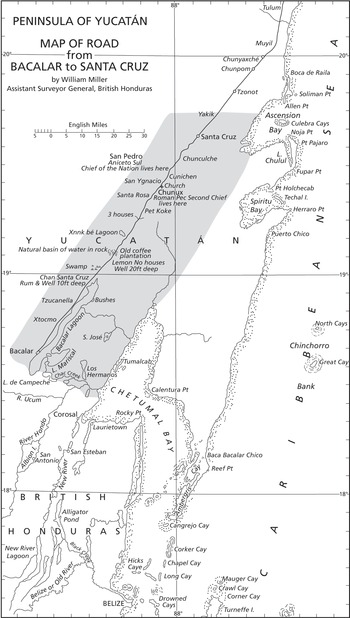
In January 1892, Colonial Secretary of State Lord Knutsford – best known for granting the charter for Cecil Rhodes’s British South Africa Company – received a dispatch from the governor of Belize, Alfred Moloney, describing a meeting with a delegation of the Santa Cruz, a Maya group that was the main protagonist in Mexico’s Caste War. Buried among the great many piles of correspondence that the Colonial Office received from British colonial possessions, this dispatch would have vied dismally for the attention of the Colonial Secretary.Footnote 1 The meeting itself was uneventful and Moloney’s description of it lackluster: “I received him [Santa Cruz chief, José Crescencio Puc] and his suite at Government House when the usual ceremonial formalities and professions of mutual good will were interchanged.” Enclosed with the dispatch were a map showing the location of the Santa Cruz Maya vis-à-vis the colony (see Map I.1) and a photograph of the main attendees of the meeting (see Figure I.1). Yet, on second inspection, the studied banality of the account – itself a product of colonial bureaucratic practice – gives way to a retelling that underlines colonial attempts to allay the disquiet of that encounter.
Map of the location of the Santa Cruz Maya enclosed with Governor Moloney’s dispatch.
Annotated photograph of the meeting between Santa Cruz leaders and Governor Moloney, January 8, 1892, included in Moloney’s dispatch.
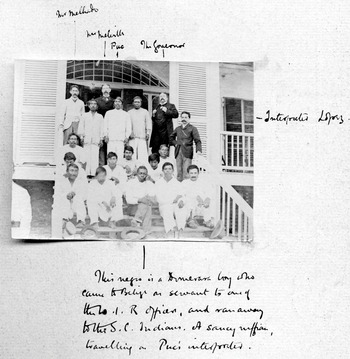
Despite presenting the visit as peaceful and economically motivated by Puc’s desire to collect rents and settle accounts with “those of the Colony with whom they had regular commercial transactions,” Moloney does not fail to note the military nature of the entourage: “Puc … was accompanied by … about forty attendants who although not in the least presenting any such appearance either in bearing, dress or equipment were not-withstanding styled soldiers.” Moloney’s detailed description of the route followed by the Maya contingent to arrive in Belize and his inclusion of a map showing the Santa Cruz positions along the northern border of Belize were surely not meant as simply informative – after all, what difference would it make for the Colonial Office to know how many miles Puc had traveled or the direction in which he had crossed a lagoon? Neither does Moloney’s description of Puc, with his sandal tied together by rope and soiled white trousers, appear to serve any purpose. On the margin of the photograph of the attendees, Moloney points to himself, Carlos Melhado of Cramer and Co., Colonial Secretary Mr. Melville, an interpreter Lopez and a black “demerara boy” who we are told “came to Belize as a servant to one of the W. I. R. [West India Regiment] officers and ran away to the S. C. [Santa Cruz] Indians. A saucy ruffian, travelling as Puc’s interpreter.” What purpose did this annotated photograph serve? In fact, it was precisely through the acts of capturing, categorizing and fixing subjects in time and place – expressed in maps, photographs and, even, notes on the margin – that colonial officials attempted to cognize, contain and control the northern frontier of Belize. At the same time, Moloney’s gift to Puc at the end of the meeting – a musical box, a cornet, two clarinets and a violin – underlines both imperial arrogance and the failure of the British administrator to truly comprehend his Maya counterpart.Footnote 2
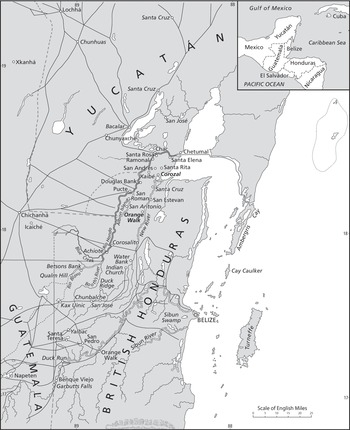
How – asks this book – does Empire operate in frontiers and borderlands during times of conflict? It examines how British officials during the second half of the nineteenth century attempted to understand and impose order on northern Belize, an area that was both a frontier of colonial power and the locus of a disputed border with Mexico (see Map I.2). Their efforts were complicated by the local ramifications of the Caste War (1847–1901), a long-lasting, violent struggle between segments of the indigenous Maya in southeast Mexico and the Mexican state. During the first decade of the war, thousands of refugees – both Maya and Spanish-descended (or Hispanic) – moved into the northern part of the colony, increasing its population tenfold; and, at various points in the conflict, war-related rivalries between pacífico Icaiche Maya and the rebel Santa Cruz Maya over land in the border zone, access to arms and ammunition from colonial merchants, and support from the British government fanned social frictions throughout the area. By 1853, the center of rebel activity in Yucatán shifted to the area of Chan Santa Cruz where a cult of the Speaking Cross, which spoke to the Maya and promised vengeance against the Mexican government, galvanized rebels into action. The Maya to the south and west of Santa Cruz formed an alliance with the Mexican authorities against the rebel Santa Cruz. One of these pacífico groups known as the Chichanhá became a target of hostile Santa Cruz Maya and retreated deeper and deeper south toward the British territory of Belize. A branch of the Chichanhá under the leadership of Luciano Dzuc settled at Icaiche near the Belize border. Belize remained caught in the crossfire between the Icaiche and the Santa Cruz Maya. More generally, the convoluted movements of people and goods, the intensification of race and ethnic mixing, and persistent disputes about the boundary with Mexico gave the frontier a fluidity and nebulousness that constantly challenged easy comprehension and effective control.
Map of the Belize-Yucatán border and surrounding area in the nineteenth century.
Following independence from Spain, Mexico oscillated between liberals and conservatives – later represented by federalist and centralist political parties, respectively. In Yucatán, a further rift between the cities of Mérida and Campeche meant that the postindependence political scene was one of constant turmoil. According to Lean Sweeney, following the separation of Campeche a new kind of politics toward the frontier emerged that was predicated on strong links between state politics and banditry.Footnote 3 Indeed, the fortunes of Campeche and the pacífico Icaiche were often interlinked.Footnote 4 A federalist revolt in 1840 led by a military officer named Santiago Iman proved to be one of the primary triggers of the Caste War. Iman galvanized poor Mayas, arming them and promising them the abolition of the hated obvenciones or church taxes. Iman’s revolt created what Rugeley terms a “welter of expectations” among the Maya and contributed to the spiraling of local politics into the outbreak of the Caste War in 1847.Footnote 5 The feud between Campeche and Mérida, as well as the continuing conflict between centralists and federalists, meant that a united front against eastern Maya rebels was often impossible. Conversely, anxiety over the Caste War often justified aggression between the two factious cities.
An added complication was the dynamics of broader Anglo-Mexican relations in this period. In October 1861, Britain, along with France and Spain, signed the Convention of London with the aim of blockading Mexico to pressure the Juárez government to repay its international debt, which the Mexican president had suspended in July 1861. The British and the Spanish were also incensed over the maltreatment of their citizens in Mexico. Within Mexico, the raging civil war between 1858 and 1861 also prompted conservatives to support the installation of a monarch in Mexico as a means of providing stability. Yet France’s aim in blockading Mexico went beyond simply the question of debt repayment. Rather, as Edward Shawcross writes, “the ambitions of the French emperor, Louis Napoléon Bonaparte, extended far beyond mere debt collection. He planned regime change … in order to establish a state closely tied to French interests, but not ruled from Paris.”Footnote 6 Britain and Spain, realizing the extent of France’s ambitions in Mexico, withdrew from the expedition in 1862. While popular sentiment in Britain supported the new monarchy in Mexico, the new government’s policies to end the Caste War ultimately created tensions with the British government. The imperial commissar Salazar Ilarregui, in his aggressive bid to end British merchants’ supply of arms and ammunitions to the rebel Maya, issued a decree claiming British Honduras as part of Mexican territory. The British minister in Mexico, P. Campbell Scarlett, attempted to negotiate a treaty with Mexico to settle the boundary dispute; and, in October 1866, both countries signed a Treaty of Friendship and Commerce that held out the promise of considering the problem of British Honduras.Footnote 7 However, with the withdrawal of Scarlett from Mexico following the collapse of the Second Empire, the Treaty – which had never been ratified – died a quick death. The death of Maximilian and the restoration of a republic in Mexico created a new spate of Anglo-Mexican tensions. President Benito Juárez canceled all treaties and conventions between Mexico and those countries that had participated in the first stages of intervention in 1861 (i.e. Britain, France and Spain). Although the British Foreign Office was willing to renew relations with Mexico, it stipulated that Mexico should take the initiative.Footnote 8 Yet, as Alfred Tischendorf points out, “when Porfirio Díaz became President of Mexico in April, 1877, British Mexican relations stood exactly where they had at the beginning of the decade.”Footnote 9 The Mexican economy under the Díaz regime became more and more dependent on foreign investment and it was in this backdrop that diplomatic relations between the two countries began to thaw. By 1884, diplomacy between Britain and Mexico was restored – a development that certainly presaged the end of British involvement in the peninsula’s Caste War.
Focusing on the Caste War period, Empire on Edge explores how British colonial officials, keenly attentive to the material interests at stake, attempted, in the context of war, to impose coherence at the frontiers of the empire by deploying a wide variety of tools – from legal prescriptions, policing measures and military interventions to specific ways of using language, categorization, mapping, censuses, surveys and even stamps. It also illuminates how people subjected to these efforts, especially the Hispanics and the various Maya groups, sought to thwart them by building alliances across seemingly firm lines of racial and ethnic division. In the process, this book engages several different bodies of literature: frontiers and borderlands; Belizean and Latin American Studies; and the Caste War historiography.Footnote 10
At the end of the nineteenth century, Belize, with a population of just 30,000, represented less than 0.01 percent of the British Empire; and yet the dispatches and correspondences of colonial administrators in Belize reveal a compelling story of Empire on edge – both spatially and metaphorically, as an expression of imperial anxieties accompanying the project of colonialism in the margins. Along the way, the book raises important questions about the dissonance between colonial and imperial projects, the nature of frontiers and borderlands and the local effects of disputes between bordering countries.
Historical Evolution of Governance in Belize
The necessary protagonists of this book’s story are colonial officials and representatives of the British Crown in Belize. Their power and dominance, however, were not absolute but rather contested at various points in the nineteenth century. One of the foundation myths of Belize is that the British settlement in the Bay of Honduras began with a motley group of pirates and buccaneers who preyed on Spanish galleon ships and vessels transporting logwood to Europe. As logwood, which was used for making dyes that were in high demand in textile industries, became a lucrative commodity and the Treaty of Madrid of 1667 suppressed piracy, this motley crew decided to settle in the Bay of Honduras in what is now the region of Belize.Footnote 11 The first settlers or “Baymen” felled and hauled the trees themselves and, indeed, it is not until 1724 that slavery became clearly intertwined with logwood extraction.Footnote 12 From the very beginning, the region remained a source of tension between Spain and Britain, with the Spanish asserting their sovereignty over the Bay of Honduras and only conceding the right of the English to cut logwood in 1763 by which time the logwood trade had already declined in profitability.Footnote 13 By the end of the eighteenth century, however, the growth of the English luxury furniture industry proved propitious and mahogany became an important export commodity for the settlement. Indeed, by 1789 more than six million feet of mahogany was being exported from the Bay of Honduras.Footnote 14 The extraction of mahogany operated in ways that required more manpower than logwood; and we therefore see a concurrent increase in the number of slaves in the settlement, mostly imported from other British Caribbean colonies such as Jamaica. In 1786, the London Convention extended the area of British timber extraction from the Hondo River in the north to the Sibun in the south. In return, the British were to evacuate from its other settlements in the area such as the Mosquito Coast. This led to a social transformation of the Bay of Honduras settlement, with 537 white and free “coloured” along with 1677 slaves entering the colony.Footnote 15 All but a few of these newcomers became assimilated into the settlement at the lowest rungs and, by the late 1700s, the British settlement had a social structure that was dominated by a small wealthy white elite ruling over a majority black population and a middling free colored, free black and poor white population.Footnote 16
This social structure, once established, together with the demands of the mahogany trade shaped the trajectory of Belize’s internal development and external relations. At first, a minority of wealthy white inhabitants mainly drawn from the old established settlers dominated the mahogany business. This minority was also the main voice of government, being members of the Public Meeting that elected Magistrates who oversaw the settlement’s administration. From 1784, the appointment of a representative of the British Crown, the superintendent, created ambiguity in the location of executive authority and he often proved to be the main check on the power of the Public Meeting and its elected Magistrates.Footnote 17 In the early years, the superintendent’s role was mainly to ensure the proper implementation of the terms of treaties with Spain that defined British rights to logwood extraction.Footnote 18 The authority of superintendents was consolidated over a period of time, with successive holders of the post assuming powers that “came to be accepted by the Colonial Office as inherent in the position of Superintendent.”Footnote 19 Simultaneously, over the first half of the nineteenth century the importance of the Public Meetings declined partly due to the Baymen’s failure to run the colony in the absence of a strong executive.Footnote 20 The 1830s was a period of restructuring, with the abolition of slavery in 1833 followed by the end of the apprenticeship period in 1838, which liberated the African slaves who had been the mainstay of the settler elite. According to Assad Shoman, Belize was already a multi-cultural society by the late 1830s: “Already in early 1838, before the final abolition of slavery, the majority members of the Public Meeting consisted of ‘coloured men.’”Footnote 21 What followed was a decade of tension between the superintendent and the Public Meeting, with the latter losing its legislative powers in 1843 and finally abolishing itself in the early 1850s.Footnote 22 The decline of the Public Meeting reflected the decline of the settler elite and the concomitant rise of British colonial officialdom.
The Legislative Assembly that replaced the Public Meeting included members of the settler elite, but the superintendent exercised considerable power over it. Three of the twenty-one members of the assembly were directly nominated by the superintendent (others were elected by a narrow, landowning franchise and had to be propertied British-born or naturalized subjects). The superintendent could prorogue or dissolve the assembly at any time and determined which bills were to be withheld or presented to the Crown.Footnote 23 By the 1850s, “British Honduras had become a colony all but in name.”Footnote 24 A severe economic depression in the 1850s, as well as the agricultural potential of the settlement unlocked by the influx of Yucatecan immigrants, prompted the settlers to petition through the Legislative Assembly for colonial status in 1861.Footnote 25 With British Honduras formally becoming a colony in 1862, the superintendent now became the lieutenant governor and connected to the Colonial Office through the governor in Jamaica. The increasing cost of defense of the colony in the context of the escalating Caste War, however, created the next constitutional deadlock.
The Legislative Assembly consisted of the great landowners and merchants of Belize. Neither group, however, could agree to raise taxes on their constituents to finance the defense of the colony. In 1870, the Assembly committed “political suicide” by agreeing to dissolve themselves if the British Crown would elevate Belize to the status of a “Crown Colony” and consequently take on the responsibility of the defense of the colony.Footnote 26 As Belize became consolidated as a Crown colony, the Assembly was replaced by a Legislative Council composed of five officials (chief justice, colonial secretary, senior officer commanding the troops, treasurer and attorney general) and four “unofficial” members nominated by the governor. In addition, there was an Executive Council largely comprised of the same members. By 1884, the imperial government was in full control of the colony and the need for supervision from Jamaica was removed. Henceforth, a governor answerable directly to the Colonial Office took charge of the administration of the colony.
Crown colony rule, however, failed to provide the economic stability that the settler elite had hoped for. Coupled with the rule of unpopular governors, by the end of the 1880s this led to widespread disaffection among the elite with Crown colony rule. In April 1890, the unofficial members walked out of the Legislative Council and, in January 1891, Acting Governor Melville, badly miscalculating the situation, appointed four public officers to replace the “unofficials.” This precipitated a constitutional crisis and a public demand for an “unofficial majority” in the Legislative Council. As the Colonial Office faced an outburst of protest against imperial control and the prospect of demand for popular franchise, it ultimately reached a compromise: an unofficial majority would be granted provided there were no further demands for incorporating “the elective principle into the constitution.”Footnote 27
The unofficials, however, did not represent the “people.” Rather, these were members of the landowning/merchant expatriate and Creole elite. The result was that this clique blocked any legislation that could undermine their own economic and political interests. The wide gap between the unofficials and the large masses of the laboring classes came to the fore in a black working-class riot in 1894. Yet it was not just the laboring classes who were disaffected. Members of the Creole middle class who had become sidelined by the white, propertied expatriate elite and metropolitan companies increasingly demanded a greater role in the colony’s decision-making. As we will see in Chapter 6, they would find common cause with colonial officialdom, which had also lost power with the entrenchment of the unofficial majority in the Legislative Council. The dominance of colonial officials and Crown representatives was therefore a fragile and contested phenomenon, particularly in the last decades of the nineteenth century.
At the same time, the actions of the colonial government in Belize remained inextricably tied to economic interests. Thus, consolidation of Belize as a Crown colony owed much to the dominance of metropolitan ownership of land and resources.Footnote 28 The British Honduras Company, which owned more than a million acres of land in the north, for instance, exercised a powerful influence on colonial policies. Of importance also was the increasing divergence between landed and commercial interests, the deadlock between which had resulted in the dissolution of the Legislative Assembly in 1871. Control over labor remained an additional bone of contention. Indeed, the 1894 workers’ riot directly precipitated the Creole middle-class challenge to the power of the unofficial majority, whose self-aggrandizing policies were regarded as the cause of all the troubles. What remain unchanged throughout the nineteenth century, however, was both the colonial officials’ and the various segments of the Belizean elite’s reluctance to extend any form of popular franchise and decision-making to the masses of the population. While Belizean officialdom and the elite remained caught in the administrative somersaulting that characterized the nineteenth century, much of the population of Belize – including most of the Hispanics and Maya in the north – remained economically, politically and socially confined to the margins.
What can the writings and correspondences of these Crown officials and representatives tell us about contestations over imperial projects by people at the peripheries of society – brown, black, indigenous, refugee, laborer, fugitive? Ann Laura Stoler has masterfully shown that what colonial archives convey is “the rough interior ridges of governance and disruptions to the deceptive clarity of its mandates.”Footnote 29 This book argues that the pages of colonial paperwork reveal the tensions, anxiety and even ludicrousness of the colonial project in northern Belize in the Caste War period. Although governors of British colonial possessions had standing instructions to report fully on any important news or event in their colony, these dispatches, upon reaching London, were “minuted” by an efficient group of bureaucrats before they were finally sent to the Colonial Office where the messages were further “trimmed”Footnote 30 before being presented to the secretary of state for the colonies. The minute on Moloney’s dispatch testifies to the layers within the imperial bureaucracy that parodied its own attempts at staging colonial rule: “Mr. Wingfield,”Footnote 31 read the minute, “the annual visit and interview does not vary much in its incidents from year to year. Sir A. Moloney does not report whether Puc embraced him, which he insisted on doing to Mr. Melville last year – a touching spectacle (see their respective heights in the photo).”Footnote 32
The colonial archives of Belize underline the social categories and “enclosures” through which colonial officials and bureaucrats made sense of but also attempted to contain the fluidity of the northern Belize frontier during the latter half of the nineteenth century. The colonial attempt to control the northern frontier, moreover, needs to be examined in the context of the struggle of colonial officialdom itself to maintain its power and dominance in Belizean society.
A Fluid Frontier
Northern Belize was in various senses a fluid frontier. The Rio Hondo acted as a natural fluvial boundary between Mexico and Belize but was a contested and liminal space. Although the river empties itself to the east in the Caribbean Sea, in the west it is bifurcated into two main tributaries. The dispute between Mexico and Belize centered on which of the tributaries could be regarded as the true Rio Hondo. Mexicans claimed that Rio Bravo was the beginning of the Hondo whereas British claimed Blue Creek to be the true boundary.Footnote 33 Additionally boundary disputes between Belize and Guatemala also meant that the western limits of the northern frontier were contested.Footnote 34 The land between the two tributaries of Rio Bravo and Blue Creek became an active zone of contestation not only between Mexico and Belize but also between Belizean loggers, various Maya groups and Hispanics on both sides of the border. Moreover, being a river, the Rio Hondo acted as much as a means of carrying people and goods in and out of the two adjoining countries as a boundary between them. It provided the avenue of escape for fugitives on both sides. Many people on the boundaries saw the river as a convenient means of escaping the local repercussions of the Caste War when violence threatened border towns. Contraband, weapons, ammunition and even seditious writing flowed freely through this fluvial landscape. The Belizean colonial government’s efforts to control this river or use the river as a strategic military base failed time and again both because of the practical difficulties of patrolling the river and due to the imperial government’s parsimony when it came to the British colony. One of the persistent struggles between the Belizean officials and the Colonial Office, for instance, was about paying the expenses of a gunboat on the Hondo. Indeed, official anxieties in Belize often stemmed from the inability to get defensive aid from imperial authorities in London and from the persistent status of the northern frontier as a disputed border.
Yet the frontier was fluid in other ways too. While the movement of people across the Hondo was not a new thing, the Caste War caused the superimposition of a new complexity to the nature and implications of human and material interchanges across the disputed border. Competing Maya groups and Hispanics from varied backgrounds moved south from Yucatán into northern Belize, some to settle down in the northern border towns of the British settlement (later, colony) and others in pursuit of weapons, quick cash and even political support. Complicating the picture were Belizean traders and merchants of different national origins, race and ethnicity who displayed an active interest in business ventures that brought them into close contact with the newcomers from Yucatán. Colonial attempts at comprehending the fluid, multiethnic society that resulted from these movements can be seen through the categories it imposed on the people in the northern border area. At the same time, the ethnic categories – such as “Indian,” “Spaniard,” “white” and “Yucateco” – that the colonial government employed were not referents of ground-level reality but rather means of drawing boundaries around populations that appeared to threaten the imperial vision of Belize as a British colonial nation.
From the beginning of Hispanic migration into Belize at the mid-century, British officials struggled with incorporating this new element into Belizean society. The success of many Yucatecos in establishing themselves in agriculture and business sectors led to a self-congratulatory paternalism among Belizean officials. In 1859, thus, Superintendent Seymour wrote, “Under the shelter of our protection twelve or fifteen thousand Yucatecan now flourish within sight of their ruined native land.”Footnote 35 In 1861, acknowledging the new diversity in population, the census recorded demographic data for various ethnic categories, including Hispanics. According to Cunin and Hoffmann, “while the early 19th-century censuses only took into account the ‘White’ and ‘Black’ populations and their mixtures, the census of 1861 introduced some of the categories that would last … ‘Anglo,’ ‘African,’ ‘Indian,’ ‘Spanish,’ ‘Carib,’ ‘Syrian,’ ‘Chinese,’ ‘Coolie.’”Footnote 36 The census of 1861 also identified the spatial divisions of ethnic categories, revealing a “regional clustering of ethnic groups … a Maya/Mestizo Catholic north.”Footnote 37 However, in the decades following Belize’s consolidation as a Crown colony, we find an erasure of the different ethnic categories from official censuses: “Having established the institutional (colony) and diplomatic (borders) framework, Britain could dedicate itself more directly to the control of its official territory whose geographic limits were recognized. Censuses of the time demonstrate this: in the late 19th century (1871, 1881, 1891) and early 20th century (1911, 1921, 1931), there is no mention of racial/ethnic groups.”Footnote 38 Yet the apparent ethnic neutrality in the new censuses belied the reality of an increasingly (at times, discordant) multiethnic society that emerged in the aftermath of the Caste War. One of the striking aspects about the archival records of late nineteenth-century Belize is the relative silence on the question of race and ethnicity, especially within Belizean society. While documents identify different Maya ethnic groups (such as Icaiche and Santa Cruz) who periodically threatened Belize, the archives are remarkably opaque about race within Belize. Thus, blacks and Hispanics are rarely explicitly mentioned in these documents. Rather, one has to deduce the ethnicity of persons in the documents from other cultural markers such as their family names and places of residence. This apparent absence does not mean that race did not matter in Belizean society. Rather, as Ann Stoler has masterfully illuminated, colonial archives represent “condensed sites of epistemological and political anxiety” that must be read along or against the grain.Footnote 39 Empire on Edge illuminates the centrality of race to the way in which colonial officials understood and attempted to manage the northern frontier. At the same time, the chapters in this book also point to the failure over time of using race as a tool of control. By the end of the nineteenth century, colonial officials would move toward an idiom of loyalty (rather than race) to determine the Britishness of the colony’s subjects.
Scholars of race relations in Latin America have repeatedly emphasized the fluidity of boundaries between different race and ethnic categories. Marisol de la Cadena and David Tavarez, for instance, have demonstrated how people move in and out of categories such as “Indian” and “mestizo” depending on the interests at stake.Footnote 40 Others emphasize cultural markers – such as dress, language and literacy – that served to define one as “Spaniard,” “mestizo” and “Indian” and facilitated movement between the categories. In Yucatán, for instance, Gabbert notes that
Physical features, however, were by no means irrelevant … For the categorization of individuals, however, these were important only in association with other features, such as wealth, dress, occupation, descent and so forth. The hacienda owner who spoke perfect Spanish and wore a fine suit and a gold watch was automatically considered a vecino [non-Indian], regardless of his dark skin and round skull.Footnote 41
In fact, during the Caste War, the rebel “Indians” comprised not just Maya but also poor Hispanics who faced the same economic hardships as their indigenous counterparts. As Gabbert writes, a “considerable number of rebel leaders was, in fact, non-Indian.”Footnote 42 Documents from the Belizean colonial archives show how officials imposed the category of “Indian” on Icaiche or Santa Cruz raiders even if eyewitnesses reported the presence of Hispanics and even blacks in the raiding party.
Scholars such as Raymond Craib, Deborah Poole, Mary Louise Pratt and James Ryan have demonstrated that imposing categories, drawing boundaries, taking photographs and writing travelogues are all tools used by the state to impose order and coherence on an otherwise “fugitive landscape.”Footnote 43 In the case of Belize, Odile Hoffmann has explored the role of maps and censuses in colonial state formation.Footnote 44 The northern frontier of Belize in the context of the Caste War presented a fluid, threatening and constantly shifting space that challenged easy comprehension. Yet there were real material and economic stakes in controlling the people and things that made up this liminal space. The northern border areas were the sources of the timber that was so important to Belizean economy. Moreover, the collapse in the mahogany industry in the mid-nineteenth century, as well as Belize’s declining role as an entrepôt of trade in Central America, necessitated better control over the sugar production in the north as a means of balancing the economy. Added to this were the very real concerns over regulating the Maya, Hispanic and even Chinese laborers who worked in the logging camps and sugar estates. In addition, the weapons and contraband traded in the northern border were an important source of income for Belizean merchants and businessmen.
The colonial paperwork, however, does not just tell us what officials and bureaucrats thought and felt. Rather, we see evidence of people subjected to colonial efforts at control responding in various ways that thwarted the project of imperial control. Indigenous Maya groups flouted colonial prescriptions through illegal trading, raids on border towns, kidnapping and extracting rents for use of disputed lands. Hispanics took advantage of the fluid frontiers by planting sugarcane, setting up distilleries and extracting logwood on both sides of the Hondo and by escaping to the Mexican side at the first sign of troubles in border towns. Neither did all Belizeans feel threatened by the fluid frontier. Some profited, conducting business in the relative freedom from effective governmental oversight that the frontier offered. Mayas and Hispanics also forged alliances across racial and ethnic lines, giving rise to forms of solidarity that challenged the colonial government’s vision of civic harmony. Despite imperial efforts to define Belizean borders, few people on the ground stood to benefit from a closed border. This reality explains the frequent disconnect between the aims of the imperial government and those of the merchant classes in Belize.
Spanning the entire Caste War period (1847–1901), the details in the chapters of this book help to flesh out the contestation over resources, identity and subjecthood that characterized the second half of the nineteenth century in northern Belize. Together, these reveal the preoccupations, vision and methods of colonial officials and bureaucrats in Belize as they tried to govern the fluid frontiers of the colony’s disputed border with Mexico. A close reading of the contents of Belizean colonial archives in the second half of the nineteenth century illustrates how border zones become preeminent sites of imperial anxieties over material, racial, political and ideological control.
A Note on Terminology
I use the term Hispanic in this book to refer to Spanish-descended populations. In contemporary usage, the colonial officials often referred to these groups as “Yucatecos” or, simply, “Spaniards.” The use of the term “Hispanic” serves to remove the historical inaccuracies of the term “Spaniard” while at the same time being a more specific marker of race than “Yucateco.” Terry Rugeley has deployed the term in Rebellion Now and Forever, where he explains:
the people here styled Hispanics most commonly referred to themselves as blanco (white), vecino (non-Indian town resident), or in more poetic moments, gente de razón (people of reason). Hispanics also broke down into various subcategories: criollos, or pure blooded Spaniards born in the Americas; españoles or peninsulares, of purely Iberian origin and birth; and mestizos, a biological mixture of Spaniard and Indian.Footnote 45
Maya groups are signified through the names of places associated with them, such as the Santa Cruz Maya, the Chichanhá Maya, the San Pedro Maya and the Icaiche Maya.
In this book, I use the term Belize to refer to the entire area within the present-day boundaries. In the eighteenth century, the area was called the Settlement in the Bay of Honduras and, from the mid-nineteenth century until 1973, British Honduras. It is important to note that, in the nineteenth century, Belize most often referred to the town by that name.
