





Introduction
While many studies emphasise institutional access, citizenship policies, and residence country integration frameworks, less attention has been paid to the enduring influence of pre-migration political socialisation (Just and Anderson Reference Just and Anderson2012; Morales and Giugni Reference Morales and Giugni2016; Vintila and Martiniello Reference Vintila, Martiniello, Giugni and Grasso2021; Favell Reference Favell2022). Importantly, immigrants do not arrive in the new country as blank slates; rather, they bring with them deeply ingrained political attitudes, norms, and habits shaped by the political culture of their country of origin. This raises a critical question: To what extent does pre-migration political socialisation and the political culture of the country of origin affect electoral participation, even after prolonged exposure to the democratic institutions of the country of residence?
The diversity of migration flows to Europe highlights the complex ways in which pre-migration political socialisation interacts with the process of integration. Immigrants arrive from a multitude of political systems, ranging from post-communist states to authoritarian regimes, creating distinct patterns of political engagement that cannot be adequately explained solely through the lens of residence country policies or socioeconomic characteristics. Recent statistics show that 9% of all EU residents were born outside the EU, with non-EU immigrants comprising approximately 6% of the Union’s total population (Eurostat 2024). Intra-European mobility from countries like Romania and Bulgaria brings immigrants familiar with democratic transitions but often sceptical of institutional trust (Fuchs and Klingemann Reference Fuchs and Klingemann2002; Tatar Reference Tatar2016). Meanwhile, refugees from the Middle East, especially those fleeing the collapse of authoritarian regimes and civil wars, bring with them traumatic experiences that affect their trust in political institutions (Hall and Werner Reference Hall and Werner2022). These divergent political histories and varying experiences across institutions and political cultures in the country of origin, ranging from competitive multiparty systems to single-party regimes, suggest that the political habits immigrants carry with them may persist long after arrival, influencing their engagement in political activities in the residence country.
Against this backdrop, this article aims to examine how various factors, namely pre-migration political socialisation, the timing of arrival (ie whether immigrants spent their formative years in the country of residence), and length of residence, shape electoral participation among immigrants. To capture pre-migration political socialisation, we adopt the concept of the ‘political culture’ of the country of origin, referring either to the respondent’s own country (for foreign-born immigrants) or their parents’ country (for second-generation immigrants). This serves as a proxy for the political norms, values, and attitudes that immigrants are likely to carry with them or inherit through intergenerational transmission.
The central argument of this article is that while residence country characteristics, such as inclusive political institutions, accessible citizenship policies, and civic-friendly environments, are crucial for migrant political integration, they do not fully account for why some migrants remain politically inactive even after decades of residence and citizenship acquisition. Even in countries with favourable conditions for participation, such as Scandinavian democracies, significant portions of the immigrant population abstain from voting (Morad Reference Morad2014; Bergh Christensen and Matland Reference Bergh, Christensen and Matland2020; Aggeborn et al. Reference Aggeborn, Andersson, Dehdari and Lindgren2024). This suggests that political participation is not merely a function of structural opportunities but is also shaped by deeply ingrained pre-migration political socialisation. Immigrants from non-democratic or low-trust political cultures may carry attitudes of disengagement, scepticism toward political institutions, a learned apathy toward electoral participation or fear of interacting with authorities (Pearlman Reference Pearlman2013). These dispositions may persist over time, even in the face of resocialisation in democratic societies of residence, highlighting the long-term impact of pre-migration political contexts on political behaviour. Thus, the political habits and orientations shaped prior to migration can act as enduring barriers to participation, challenging the assumption that time spent in the country of residence and formal inclusion alone foster political engagement.
To examine the role of origin-culture, the epidemiological approach has been increasingly employed in migration studies to isolate cultural effects from institutional contexts (Fernández Reference Fernández, Bisin, Benhabib and Jackson2011; Polavieja Reference Polavieja2015; Schumann et al. Reference Schumann, Bug, Kajikhina, Koschollek, Bartig, Lampert and Santos-Hövener2020). By examining immigrants from diverse origin countries who now share a common residence country institutional setting, this approach allows researchers to identify how inherited cultural norms continue to influence political behaviours independently of current institutional arrangements. The second generation offers a particularly informative case, as parental transmission of cultural values persists, while institutional exposure occurs entirely within the residence country (Finseraas et al. Reference Finseraas, Kotsadam and Polavieja2022).
Taken together, these studies highlight the enduring importance of pre-migration political culture in shaping immigrants’ political engagement in the residence country.
Against this background, this study aims to advance existing research in three ways. First, it brings origin-country political culture to the centre of the analysis of immigrant electoral participation. Second, it jointly considers pre-migration socialisation, timing of arrival, and length of residence across migrant generations. Third, it leverages harmonised cross-national ESS data (rounds 5–11) combined with V-Dem indicators to provide a comparative perspective on citizens of foreign origin across 23 European countries, including 14,216 first-generation, 3,620 1.5-generation, and 5,359 second-generation immigrants.
The article proceeds as follows: we first situate our contribution within the literature on migrant political behaviour and present our specific hypotheses; we then introduce the data and research design, before turning to the empirical analysis and a concluding discussion of the findings and their implications.
Theoretical framework and hypotheses
A broad set of theoretical frameworks has been developed to explain political behaviour, several of which have been applied to migration research to understand how migrants adjust to the political environments of their residence countries and engage in political life.
Socioeconomic status (SES) and resource models
The classical models of political participation, namely the SES and resource models, emphasise that possessing relevant resources is a key precondition for political engagement, with evidence showing that higher levels of education and income are associated with greater likelihood of political participation (Verba and Nie Reference Verba and Nie1972; Brady et al. Reference Brady, Verba and Schlozman1995). Despite its centrality in the literature, several scholars have questioned the ability of SES to account for migrant–native differences in political engagement (Elodie Reference Elodie2022), noting that empirical evidence on SES effects among migrants remains inconsistent. Evidence shows that the impact of socioeconomic characteristics is often weaker among individuals of migrant origin than among natives (Barreto and Muñoz Reference Barreto and Muñoz2003; Cho et al. Reference Cho, Gimpel and Wu2006). Emerging literature in Europe also finds little or no association between parental education and second-generation political interest or turnout in countries such as the UK, Italy, and Germany (Borkowska and Luthra Reference Borkowska and Luthra2024; Guglielmi and Maggini Reference Guglielmi and Maggini2025; Bozhinoska and Spörlein Reference Bozhinoska and Spörlein2025). This, in turn, raises doubts about whether the SES model fully captures the dynamics of political participation among individuals with a migration background. Against this background, we propose the following hypothesis to test whether the effect of SES on electoral participation varies across immigrant and native groups:
H0– (Null Hypothesis): SES has a uniform effect on political participation across all groups, regardless of migration background.
H1– (Migration Background Hypothesis): The relationship between SES and political participation is moderated by migration background: SES indicators are expected to have a stronger effect on participation among natives than immigrants.
Theories of political resocialisation: the role of exposure, resilience, and transferability
A growing body of research suggests that understanding the political participation of immigrants requires considering both the pre-migration political socialisation and exposure to the political context in the residence country. For this purpose, the literature identifies three main theories of political resocialisation, namely resilience, exposure, and transferability, each highlighting distinct yet not mutually exclusive mechanisms through which political learning and adaptation take place.
Resilience argument
As part of the political resocialisation framework, the theory of resilience, adopting a somehow sceptical view of immigrants’ prospects for adaptation, argues that the attitudes and behaviours formed in early life, particularly during adolescence and young adulthood, are deeply ingrained and resistant to change (Schwarzer Reference Schwarzer2011; Grasso et al. Reference Grasso, Farrall, Gray, Hay and Jennings2019). A key point is that most political predispositions are formed during early life, particularly within the ‘impressionable years’ (Sapiro Reference Sapiro1994; Dinas Reference Dinas2010). Impressionable years refer to the life stage when individuals are most receptive to social influences and when various substantial changes in the structure of one’s life, namely identity formation and first-time experiences, occur (Shmulyar Gréen et al. Reference Shmulyar Gréen, Melander and Höjer2021; Verkuyten et al. Reference Verkuyten, Yogeeswaran, Zubielevitch, Lilly, Vanderklei, Osborne and Sibley2024). This perspective suggests that for immigrants – particularly first-generation immigrants or those who migrated after their formative years – political attitudes may be shaped in a context vastly different from that of the residence country. Having been educated and socialised in their country of origin, they may develop enduring political preferences that are different from those of the native-born population.
Studies show that this process is not limited to individual experiences. Through intergenerational transmission, first-generation immigrants transmit political values and norms to their descendants, meaning second-generation immigrants are influenced not only by their residence country’s political system but also by the political experiences of their parents (Neundorf and Smets Reference Neundorf and Smets2017; Borkowska and Luthra Reference Borkowska and Luthra2024; Guglielmi and Maggini Reference Guglielmi and Maggini2025). As Borkowska and Luthra (Reference Borkowska and Luthra2024) highlight, migration ‘disrupts’ the standard processes of political engagement in immigrant families in the UK. This disruption is further compounded by international characteristics, such as the stability of democracy and colonial ties, which shape both immigrant parents’ and their children’s political engagement.
Empirical research on the impact of country-of-origin political culture has produced mixed findings. Some studies suggest that political socialisation in authoritarian contexts may limit immigrants’ engagement in democratic politics after migration. For example, immigrants from democratic countries have been found to be more likely to join political parties in their residence countries than those from autocratic regimes (Lazarova et al. Reference Lazarova, Saalfeld and Seifert2024). Immigrants from non-democratic backgrounds often face difficulties engaging in political life in democratic systems due to limited exposure to party competition, civic engagement, and democratic norms (Bilodeau Reference Bilodeau2008; Pilati and Herman Reference Pilati and Herman2020; Dinesen and Andersen Reference Dinesen and Andersen2022). Consistent with this view, studies report that immigrants from non-democratic or repressive regimes exhibit lower voter turnout (Bueker Reference Bueker2005; Ramakrishnan Reference Ramakrishnan2005), while immigrants in Australia from repressive regimes are less inclined to participate in protest activities (Bilodeau Reference Bilodeau2008). Exposure to authoritarian regimes has also been linked to weaker support for democratic values (Bilodeau et al. Reference Bilodeau, McAllister and Kanji2010) and reduced trust in political institutions (Voicu and Tufiş Reference Voicu and Tufiş2017).
Other research, however, points to migration itself as a potential catalyst for political activation, especially when migrants settle in democratic contexts. Rivera-Salgado (Reference Rivera-Salgado, Foner, Rumbaut and Gold2000) and Østergaard-Nielsen (Reference Østergaard-Nielsen2003) show that immigrants often use the institutional resources and freedoms of the residence society to pursue residence and origin-country political goals and to express political opposition to repressive regimes. Just (Reference Just2019), using the European Social Survey (ESS) data, finds that immigrants from highly authoritarian regimes are more likely to acquire political party attachments in the residence country, as the migration process exposes them to new political freedoms and offers opportunities for political activation that were absent in their countries of origin. Similarly, existing research shows that immigrants from authoritarian backgrounds tend to engage more actively in residence country politics when they are exposed to high levels of political mobilisation upon arrival (White Reference White2017) or when they acquire citizenship in the residence country (Just and Anderson Reference Just and Anderson2012).
Recent work also provides empirical evidence for the mechanisms through which immigrants from authoritarian regimes may become more engaged in democratic contexts. Aksoy et al. (Reference Aksoy, Eichengreen, Litina, Özgüzel and Yu2025), drawing on the ESS and V-Dem data, show that exposure to corruption and low-quality institutions in early adulthood increases immigrants’ trust in residence country political institutions. They argue that immigrants engage in a benchmarking process, evaluating the institutional quality of the residence country relative to the weaker or more corrupt institutions of their origin country. In this framework, institutional conditions in the origin country operate as a formative reference point: when the residence country context compares favourably, immigrants adjust their trust upward. Crucially, Aksoy et al. (Reference Aksoy, Eichengreen, Litina, Özgüzel and Yu2025) also demonstrate that higher institutional trust translates into greater political engagement: immigrants who were more exposed to corruption before migration are more likely to be interested in politics, to have voted in the last election, and to participate in political organisations. This finding supports the idea that experiences under authoritarian rule prior to migration can foster political engagement in democratic residence countries by creating favourable points of comparison, offering a theoretical foundation for understanding reactive mobilisation.
These insights motivate the following hypotheses:
H2– Pre-Migration Political Culture Hypothesis: Pre-migration political culture is expected to have an effect on immigrants’ electoral participation in the residence country, but this effect is anticipated to vary across generations due to processes of political resocialisation. (all immigrants)
H3– Formative Years Hypothesis: Spending one’s formative years (ages 0–13) in the country of residence is expected to increase the likelihood of electoral participation, due to early childhood socialisation within the residence society, in contrast to individuals who arrive after the age of 13. (specific to foreign-born immigrants, first gen & 1.5 gen)
Exposure argument
Another perspective within the resocialisation framework, the exposure argument, offers a more optimistic view of immigrant political adaptation. It posits that political engagement is not static but evolves over time through exposure to new political contexts (White et al. Reference White, Nevitte, Blais, Gidengil and Fournier2008; Voicu and Comşa Reference Voicu and Comşa2014). This perspective suggests that as immigrants spend more time in the residence country, they acquire political knowledge, become familiar with the political system, and gradually form new political preferences that align more closely with those of the residence country. Empirical studies have largely supported the idea that extended periods of residence in the residence country are positively correlated with the increased likelihood of political engagement among immigrants (Ramakrishnan and Espenshade Reference Ramakrishnan and Espenshade2001; Martinovic et al. Reference Martinovic, Van Tubergen and Maas2009; Gonnot and Lo Polito Reference Gonnot and Lo Polito2023). The evidence shows that the longer immigrants live in the residence country, the more likely they are to vote (Finn Reference Finn2020; Bevelander and Hutcheson Reference Bevelander and Hutcheson2022) and participate in political parties (Aleksynska Reference Aleksynska2011). Nevertheless, other studies on immigrants’ political behaviour also question whether the time spent in the country of residence alone sufficiently explains differences in political engagement (White et al. Reference White, Nevitte, Blais, Gidengil and Fournier2008; Bird et al. Reference Bird, Saalfeld and Wüst2011; Lazarova et al. Reference Lazarova, Saalfeld and Seifert2024).
Given this theoretical background, the following hypothesis is formulated:
H4– Length of Stay Hypothesis: The duration of residence in the residence country is expected to influence electoral participation, with longer stays increasing the likelihood of voting due to prolonged exposure to the political system and opportunities for integration. (specific to foreign-born immigrants, first gen & 1.5 gen)
Transferability argument
A third perspective, the theory of transferability, offers a middle-ground view between the exposure and resistance/resilience frameworks. It posits that immigrant political adaptation is shaped not only by contact with new political systems but also by experiences and competencies acquired prior to migration. In this view, political learning developed in the country of origin provides a foundation that can be reinterpreted and applied within the residence country context. Immigrants who were politically engaged or interested before migration are therefore more likely to participate in the politics of their new environment, as they can draw on previously accumulated civic competencies (Black et al. Reference Black, Niemi and Powell1987). Adaptation is thus understood as a process of continuity rather than rupture, although the extent to which such transfer succeeds also depends on the degree of similarity between the political cultures of origin and residence countries.
From the transferability perspective, the extent to which pre-migration political learning can be successfully applied in the residence country context should depend on both the nature of the origin regime and the depth of exposure to the new political environment (length of stay and formative years). This motivates our interaction hypotheses (H5a–H5b).
H5a– Political Culture × Length of Stay Hypothesis: The impact of length of stay on electoral participation is expected to be stronger for immigrants from democratic countries compared to those from non-democratic (as immigrants from less democratic backgrounds may face deeper challenges in re-socialising into democratic norms, making their political adaptation more gradual and less certain). (specific to foreign-born immigrants, first gen & 1.5 gen)
H5b– Political Culture × Formative Years Hypothesis: Immigrants from non-democratic countries who spent their formative years (ages 0–13) in the residence country are expected to demonstrate higher levels of electoral participation than those who arrived later in life. (specific to foreign-born immigrants, first gen & 1.5 gen)
To sum up, starting from a baseline hypothesis about the role of SES (H0/H1), we then address the role of pre-migration political context, specifically the level of democracy in the country of origin (H2). The third and fourth hypotheses (H3 and H4) explore the role of time in shaping immigrant political participation, focusing on both the length of stay in the residence country and whether immigrants spent their formative years there. By considering both dimensions, we aim to disentangle the effects of exposure to residence country political norms and the timing of political socialisation. Finally, our last two hypotheses (H5a and H5b) examine how these time-related effects are conditioned by the political culture of origin, by assessing the interactions between political regime type and both length of stay and formative years. In the following section, we test these expectations using survey data and multivariate models of electoral participation, a key indicator of political incorporation and democratic engagement.
Data sources
The empirical investigation is primarily based on data from the ESS, which includes data from multiple rounds: Round 5 (2010), Round 6 (2012), Round 7 (2014), Round 8 (2016), Round 9 (2018), Round 10 (2020–2022), and Round 11 (2023). As highlighted in the literature, the ESS adheres to rigorous standards, particularly in its questionnaire design, the cross-national equivalence of the instruments used, and the sampling procedures (Jowell et al. Reference Jowell, Roberts, Fitzgerald and Eva2007; Kohler Reference Kohler2007; Reference Kohler, Alber, Fahey and Saraceno2008). The ESS is a high-quality dataset, with a sampling design approximating a simple random sample and a relatively high response rate. It encompasses a wide range of countries and is representative of the general population in these countries. The broad coverage of the ESS makes it particularly valuable for cross-national studies, enabling not only the analysis of cross-country differences but also ensuring that questions are understood consistently by respondents across different languages and cultural contexts. Additionally, the survey provides contextual information about the country in which the respondent resides, allowing the integration of individual-level data with country-level contextual data. Since its inception in 2001, the ESS has become one of the most frequently cited data sources for research on a variety of topics (Malnar Reference Malnar2020).
‘Politics’ is one of the core modules of the ESS, and its questionnaire includes a wide range of political participation items, such as voting in national elections. This aligns closely with the focus of this study, which examines political incorporation. The ESS data are particularly valuable as it contains several key elements discussed in the theoretical framework, such as information on SES variables, political interest, country of birth (for both respondents and their parents), and the year of migration. These variables are critical to understanding electoral behaviour, and the availability of detailed individual-level data on these factors was a priority in the selection of this dataset for our analysis.
While the ESS is representative of the national population in participating countries, it is equally important that it accurately reflects the foreign-born population in the Western countries included in this study. To assess this, the percentage of foreign-born individuals in the ESS sample was calculated and compared with external data from Eurostat, the statistical office of the European Union. A Pearson correlation coefficient of 0.98 indicates a strong match between the foreign-born populations in both datasets, suggesting that the ESS sample closely represents the foreign-born population. It is important to note that the immigrant sample in this study includes both foreign-born respondents and second-generation immigrants – those born in the residence country with foreign-born parents. While it was not possible to directly assess the representativeness of second-generation immigrants in the ESS, the strong correlation between the foreign-born sample in the ESS and external data confirms that the ESS is reliable in representing the foreign-born population in the selected national samples.
In addition to the ESS, this study incorporates macro-level indicators to capture the political context of migrants’ countries of origin using the V-Dem Liberal Democracy Index (v2x_libdem). This index provides a continuous measure of liberal democracy in each country, ranging from 0 (low) to 1 (high). The Liberal Democracy Index has been used in previous research on migrants’ political attitudes and behaviour (Lazarova et al. Reference Lazarova, Saalfeld and Seifert2024; Gülzau et al. Reference Gülzau, Helbling and Morgenstern2025; Quaranta Reference Quaranta2025). It assesses the extent to which liberal democratic principles are realised by integrating several institutional and rights-based dimensions, including electoral democracy, civil liberties, the rule of law, judicial independence, and mechanisms of accountability that constrain executive power (Coppedge Reference Coppedge2023). For this study, we used the V-Dem Liberal Democracy Index scores for the period 2014–2024. To minimise short-term fluctuations and ensure temporal stability, we calculated 10-year average scores for each country, providing a more stable reflection of each country’s political culture.
We acknowledge that V-Dem data are often used to build categorical regime classifications. Following the classificatory approach of Lührmann et al. (Reference Lührmann, Tannenberg and Lindberg2018) and the Regimes of the World (RoW) framework, we derive our dichotomous indicator by applying a threshold to the Liberal Democracy Index: countries with a liberal democracy score ≥ 0.5 are coded as democracies, while those scoring below 0.5 are coded as autocracies. The detailed operationalisation of this variable is presented in Section 4: Measurement of Key Variables.
Measurement of key variables
Our dependent variable, electoral participation, is measured based on respondents’ self-reported voting behaviour in the most recent national election. It is derived from the question: ‘Some people don’t vote nowadays for one reason or another. Did you vote in the last [country] national election in [month/year]?’ Respondents could give the following answers: ‘Yes’; ‘No’; ‘Not eligible to vote’. For the purpose of this analysis, the variable was recoded into a dichotomous format, where respondents who reported voting in the most recent national election were coded as 1 (voted), and those who did not vote were coded as 0 (did not vote). While self-reported voting may be subject to social desirability bias (ie some respondents may overreport participation to conform to perceived norms), it remains a widely used and reliable indicator in survey-based electoral research (Sciarini and Goldberg Reference Sciarini and Goldberg2016).
Central to our analysis are four key independent variables: migratory background; spending formative years in the residence country, which captures early political socialisation in the residence country; length of stay as a measure of cumulative exposure; and the political culture of the country of origin, which captures pre-migration democratic (or authoritarian) cultures.
Migratory background is a key variable, distinguishing between four groups: first-generation immigrants (n = 14,216), who were born abroad and migrated to the residence country after formative years; 1.5-generation immigrants (n = 3,620), who arrived in the residence country during childhood or adolescence and thus spent their formative years there; second-generation immigrants (n = 5,359), who were born in the residence country to two foreign-born parents; and natives (n = 219,202), who were born in the residence country to native-born parents. This classification builds on widely used generational frameworks established in prior research (Rumbaut Reference Rumbaut1997), which divides individuals into different generations, such as 1.5 generation and second generation, based on parental nativity and age at migration. While these classifications reflect the diverse and complex trajectories of immigrant incorporation, they also highlight the nuanced contours of the phenomenon, which may not always be fully captured by standard statistical surveys (Lessard-Phillips Reference Lessard-Phillips2017). To ensure theoretical precision and avoid empirical bias, we apply a stricter operationalisation of second-generation immigrants. This definition excludes those with only one foreign-born parent, such as children of mixed-nationality couples. From a conceptual perspective, individuals with one native-born parent are more likely to be socialised into the dominant political norms of the residence country and tend to exhibit political behaviours more closely aligned with natives. Their inclusion would risk obscuring the unique effects of political socialisation. Empirically, these individuals constitute a substantial portion of the broader second-generation category (over 12,000 out of 17,600 cases), meaning they would disproportionately influence statistical patterns and potentially dilute the distinctiveness of those born to two migrant parents. This refined classification enhances our ability to detect meaningful differences across groups.
Spending formative years in the country of residence is operationalised using respondents’ age at the time of migration. This variable was calculated by subtracting the year of birth from the year of migration, thus capturing the age at which individuals moved to the residence country. Age at migration serves as a proxy for early political socialisation: those who migrate at younger ages are more likely to be socialised into the political norms and institutions of the residence society. We subsequently created a binary variable distinguishing between those who arrived before the age of 13 (often referred to as 1.5-generation immigrants; 3,620 respondents) and those who arrived after the age of 13 (first-generation immigrants; 14,216 respondents). The age 13 threshold was selected because it roughly corresponds to the transition from primary to secondary education in most European school systems, marking a key stage in children’s political learning, where schools play a central role as agents of political socialisation (Hoskins and Janmaat Reference Hoskins and Janmaat2019; Deimel et al. Reference Deimel, Hoskins, Abs, Kuang, Zhu and Kennedy2021). Immigrants who arrive before this stage are more likely to complete primary schooling in the residence country, be exposed to civic education curricula (Campbell Reference Campbell2013; Neundorf et al. Reference Neundorf, Niemi and Smets2016), and socialise with native-born peers during critical developmental years – all of which are central to early political learning.
In addition, the length of stay in the country of residence was derived by subtracting the respondent’s year of arrival from the year of the respective survey round. This calculation was performed separately for each wave of the survey to ensure temporal accuracy. Any resulting negative values were recoded as missing. This variable reflects the number of years an immigrant has resided in the residence country at the time of the interview and is used as a measure of cumulative exposure to the residence society.
To define the political culture of the country of origin, we relied on the V-Dem Liberal Democracy Index and the classification by Lührmann et al. (Reference Lührmann, Tannenberg and Lindberg2018). This index measures the level of democracy within a country, with scores ranging from 0 to 1, where 0 indicates closed autocracies and 1 represents fully liberal democracies, and the scores were derived from the V-Dem-CY-Core-v15 dataset for the period 2014–2024. For first-generation immigrants (ie individuals born outside the residence country), the score of their country of birth is used to capture the political environment they experienced prior to migration. For second-generation immigrants, the political culture is based on the countries of birth of their mother and father – information provided in the ESS dataset. By matching each parent’s country of birth with its respective democracy score, we construct a proxy for the political culture that may have been transmitted intergenerationally. To ensure robustness, we calculated the average V-Dem democracy score for each country across a 10-year period (2014–2024), thereby reducing the influence of short-term political fluctuations.
While it would be ideal to use a time-specific regime measure that matches each migrant’s formative years, data limitations make such an approach difficult to implement consistently. Following Lazarova et al. (Reference Lazarova, Saalfeld and Seifert2024), we therefore adopt a 10-year average of the V-Dem Liberal Democracy Index, which minimises short-term fluctuations and ensures a comparable measure of democracy levels across countries. We acknowledge that this choice may have theoretical implications, especially for first-generation migrants whose formative years pre-date the 2014–2024 reference period, as the political culture measure may not fully capture the context that shaped their early socialisation.
To assess the extent of this potential mismatch, we examined the distribution of year of migration in our sample and found that the vast majority of migrants arrived after 1968. We also inspected V-Dem historical maps (from 1960 onwards) and observed that the colour composition, reflecting liberal democracy scores, changes only gradually over time. Most countries display long-term continuity in their democratic versus autocratic status, which aligns with our final categorisation based on the 10-year average. Taken together, these checks suggest that the 10-year average captures stable and persistent regime characteristics that broadly reflect migrants’ origin-country political environments, even if it does not perfectly measure the exact institutional context experienced during their formative years.
In addition to regime type, our final variable also accounts for the geopolitical area of the individual’s country of birth (for first- and 1.5-generation immigrants) and parents’ countries of birth (for second-generation individuals). The categories based on this approach are as follows:
-
• Western Democracies (0): Countries of birth (for individuals or both parents) with a liberal democracy score of 0.5 or higher, located in Western Europe, North America (United States, Canada), and Oceania (Australia, New Zealand).
-
• Eastern European Democracies (1): Countries of birth (for individuals or both parents) from Eastern Europe with a liberal democracy score of 0.5 or higher.
-
• Non-Western/Eastern European Democracies (2): Countries of birth (for individuals or both parents) located outside Western and Eastern Europe (eg in Latin America, Asia, or Africa) with a liberal democracy score of 0.5 or higher.
-
• Electoral/Closed Autocracies (3): Countries of birth (for individuals or both parents) with a liberal democracy score below 0.5.
The final two residual categories are specific to second-generation individuals with parents originating from different regime types.
-
• Western + Other Democracies (4): The regime has to be democratic for both parents, but one could come from a non-Western area.
-
• Mixed Regimes (5): One parent from a democratic country and one from an autocratic country.
To ensure statistical reliability and interpretability, these categories were merged prior to analysis. Specifically, Mixed Regimes were grouped with Electoral/Closed Autocracies, and Western + Other Democracies with Western Democracies. This choice was both empirically and theoretically justified: small group sizes (eg only 59 second-generation immigrants from ‘Other Western’ countries, as shown in Table A2 in the online Supplementary File) risk unstable estimates, while the merged categories share key institutional features. For robustness checks, we also tested two alternative codings of regime type: one grouping Mixed Regimes and Western + Other Democracies with Western Democracies and another grouping Mixed Regimes with Autocracies while keeping Western + Other Democracies under Western Democracies. The results remained highly consistent across specifications, with only minor variations in coefficients and significance levels, confirming that the findings are robust to alternative classification choices.
Religious affiliation is operationalised based on respondents’ self-reported religious denomination in the ESS. The variable is categorised into four groups: Atheist, Christian, Muslim, and Other. Given the potential overlap between religion and the political culture of the country of origin – particularly since above 90% of Muslim immigrants in the sample originate from autocratic regimes (Table A3, Supplementary File) – religion is not included in the main model to avoid conceptual redundancy and potential confounding. Yet, to assess the robustness of the results, we replicated the main model by replacing the political culture variable with a measure of religious affiliation (the alternative specification is reported in Table A4 of the Supplementary File).
Other control variables considered in this study include demographic characteristics, SES, political interest, and residence country characteristics. Gender is categorised as Male = 0 or Female = 1, which allows for the examination of gender-based differences in political engagement. Age is included as a continuous variable, measured in years. SES variables, namely income and education, are also included, as they are widely recognised as key predictors of political participation. Income is measured subjectively by asking respondents about their household’s economic well-being, with responses ranging from ‘Living comfortably on present income’ to ‘Finding it very difficult on present income’. For analysis, we recategorised Income into three categories: Difficult (respondents who report ‘Finding it very difficult on present income’ or ‘Finding it difficult on present income’), Not difficult (respondents who report ‘Coping on present income’), and Wealthy (respondents who report ‘Living comfortably on present income’). Education is measured according to the International Standard Classification of EducationFootnote 1 , with categories ranging from ‘Less than lower secondary education’ to ‘Tertiary education’. For simplification, we recategorised Education into three levels: Low (less than lower secondary education), Medium (upper secondary education and advanced vocational education), and High (tertiary education, including university degrees or equivalent qualifications).
Lastly, Political interest is included in the analysis as a key predictor of electoral participation. It is measured using a four-point scale, where respondents indicate how interested they are in politics: ‘Very interested’, ‘Quite interested’, ‘Hardly interested’, or ‘Not at all interested’. This variable reflects individuals’ attention to and engagement with political matters, which are widely recognised as important drivers of electoral behaviour.
Analysis
How much does SES really explain? Comparing the role of SES in electoral participation for natives and immigrants (H1)
Before analysing how the origin political culture shapes political participation, we first examined variations in voting behaviour across migrant generations (as shown in Table A1, Supplementary File). Native-born individuals reported the highest voting rate (mean = 0.80), followed by second-generation immigrants (mean = 0.74) and 1.5-generation immigrants (mean = 0.65). First-generation immigrants had the lowest turnout (mean = 0.52). These descriptive patterns suggest a clear generational gradient in political participation, consistent with theories of political socialisation.
We also examined educational attainment across migrant generations. First-generation immigrants were somewhat overrepresented in the low and high ends of the education spectrum, with 29% holding a high degree compared to 22% among natives. Second-generation immigrants showed a lower prevalence of low education (21%) and slightly higher medium-level attainment than their first-generation counterparts, suggesting a generational convergence in educational outcomes. Yet, first-generation immigrants faced significant economic disadvantages. They reported the highest level of financial difficulty (32%) and were least likely to live comfortably (24%). Second-generation immigrants showed signs of upward socioeconomic mobility, with a higher share living comfortably (27%).
In the following, we present an empirical assessment of our hypotheses in a series of analyses estimated using logistic regression models. The table presents a detailed examination of the relationship between SES and political participation for both immigrants and natives. The models progressively introduce interaction terms between migrant background and education, as well as income, to explore whether SES operates as a similar predictor for political participation across these groups. Concerning the goodness-of-fit statistics, model fit improved substantially from the null model (see Table A5 in Appendix) with country fixed effects (AIC = 241185.4, BIC = 241424.2) to the full model including SES, migrant background, and interactions (AIC = 212024.5, BIC = 212479.5), indicating that these variables contribute meaningfully to explaining electoral participation.
Across all models (available in Table A5 in the Supplementary File), first-generation immigrants show the strongest negative association with political participation. These negative coefficients remain statistically significant even after incorporating interactions with education and income. When interactions with education and income are included, the magnitude of the negative coefficients for first-generation immigrants does diminish slightly, indicating that while SES factors have some impact, they cannot entirely overcome the challenges posed by migration status. In other words, first-generation immigrants benefit less from high education and income in terms of turnout, suggesting persistent barriers to full political inclusion even among socioeconomically advantaged immigrants. One likely explanation is that educational qualifications obtained abroad, particularly from non-Western countries, are not always recognised in the residence countries (Lancee and Bol Reference Lancee and Bol2017), limiting the extent to which education translates into resources in the residence country. This aligns with our expectation that other, non-SES factors, such as length of stay and age at migration as well as the political culture of the country of origin, may play a critical role in shaping political incorporation for immigrants.
In comparison, 1.5-generation immigrants (those who migrated before age 13) show negative associations with political participation as well, but these effects are weaker than those of first-generation immigrants. This suggests that earlier migration may alleviate some of the barriers to political participation, but challenges still persist, especially when compared to second-generation immigrants. Second-generation immigrants, who were born in the residence country, show a participation pattern that is more similar to natives, with only a negligible negative impact. This indicates the potential role of early socialisation and acculturation in the residence country, supporting our hypothesis that this group, which either was born in the country or spent their formative years in the residence country attending school, experiences greater political incorporation due to early exposure to the political culture of the residence country. Similarly, for second-generation immigrants, SES factors such as education and income are more predictive of political participation, aligning with the expectations that, as these individuals are born and raised in the residence country, their SES functions similarly to natives.
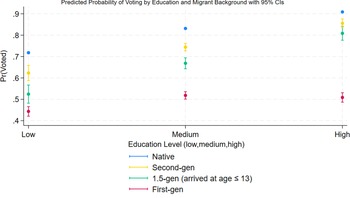
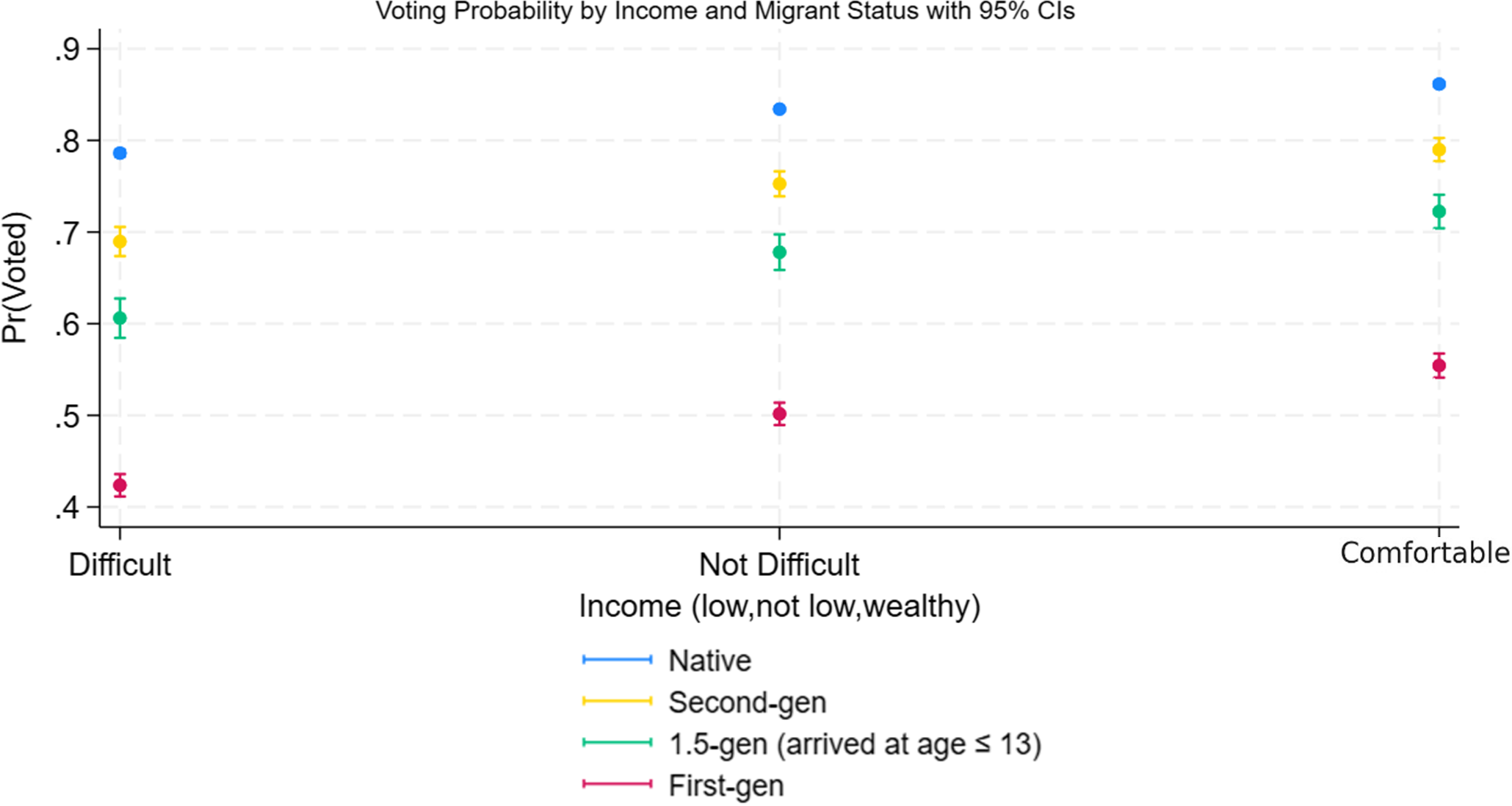
Figures 1 and 2 show that while both education and income are positively associated with voting, their political payoffs vary significantly by migrant generation. Natives and second-generation immigrants exhibit strong and consistent returns to SES, while first-generation immigrants remain at a substantial disadvantage – even when highly educated or economically secure. This supports the argument that structural or institutional barriers, not just individual resources, shape political incorporation. In contrast, second-generation immigrants appear better integrated, with SES functioning more similarly to natives.
Adjusted predictions of voting by migrant background and education.

Adjusted predictions of voting by migrant background and income.

Overall, these findings underscore the complex relationship between SES and political participation, particularly in the context of migration background. As anticipated, these results indicate that higher levels of SES have a smaller contribution in the case of immigrants and cannot fully explain their political participation.
Evaluating the role of political culture (based on respondent or parental country of origin) (H2)
To test our argument that these differences are related to pre-migration cultural factors, H2, we take into account the ‘political culture’ of the country of origin. The findings support H2, indicating that origin-country political culture continues to shape electoral participation, perhaps contrary to the common presumption that democratic origins necessarily foster higher turnout. Once individual-level differences are controlled for in multivariate models, immigrants from non-democratic regimes (including electoral autocracies and mixed regimes) exhibit higher electoral participation than immigrants from democratic origins.
Descriptive statistics (Table A6, Supplementary File) show that immigrants from Western democratic-origin countries exhibit higher raw rates of electoral participation than those from autocratic regimes. Immigrants from democratic origins are, on average, older (mean age 48 vs. 45.2), more politically interested (13.5% very interested vs. 11.7%), better educated (29.4% with high education vs. 25.6%), and more economically secure (32.2% living comfortably vs. 25.1%). These factors are all strongly associated with higher political participation.
Robustness checks confirm that the positive effect of political culture of origin emerges only once individual-level confounders such as age are controlled for. In models excluding age, differences across regime types become statistically negligible, indicating that observed raw participation differences partly reflect age composition across origin groups rather than regime effects per se (Table A8, Supplementary File). Importantly, similar results are obtained when using an alternative operationalisation of political exposure, namely the proportion of life spent in the residence country, reinforcing the robustness of the findings. Once age is accounted for, however, the mobilising effect of autocratic origin becomes evident, supporting a reactive mobilisation mechanism, whereby exposure to democratic residence country institutions activates political engagement among immigrants from authoritarian contexts.
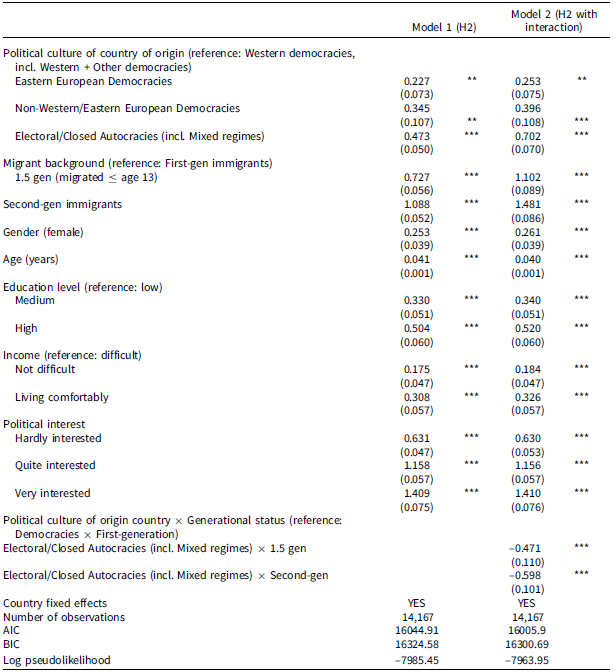
Moreover, the findings also reveal meaningful variation across the different geopolitical areas within the democratic category. As shown in Table 1, migrants from Eastern European democracies (b = 0.227, P < 0.01) and from non-Western democratic countries (b = 0.345, P < 0.01) have significantly higher electoral participation than migrants from Western democracies. Although these effects are smaller than those associated with autocratic origin, these results suggest that political culture effects are not limited to the autocracy–democracy divide but may also reflect broader regional and historical dimensions of democratic development.
Predictors of electoral participation among immigrants with generational status control (all immigrants)

Note: Robust standard errors in parentheses. Significant at *** P < 0.001, ** P < 0.01, * P < 0.05.
Model 2 further explores whether this pattern varies by generational status. The significant interaction terms indicate that the association between political culture of origin and electoral participation is strongest among first-generation immigrants. Specifically, the interaction term for 1.5-generation immigrants is negative and significant (b = –0.471, P < 0.001) and even more so for second-generation immigrants (b = –0.598, P < 0.001). These results suggest that the mobilising effect of autocratic origin on political participation diminishes across generations. Thus, while the results do not support the expectation that second-generation migrants from autocracies would participate less than their peers from democracies, they reveal a clear pattern of generational assimilation, whereby the influence of pre-migration political culture weakens substantially over generations.
Evaluating the role of formative years, length of stay, and pre-migration political culture (H3–H4)
Migrants born outside the residence country (first-gen and 1.5-gen immigrants)
This model investigates the predictors of electoral participation among first-generation and 1.5-generation immigrants – the latter defined as those who migrated to the residence country during their formative years, before the age of 13. We analyse these groups separately from second-generation individuals for both methodological and theoretical reasons. Methodologically, variables such as length of stay and age at arrival vary only for first- and 1.5-generation immigrants. Theoretically, this separation allows us to test specific hypotheses that focus on the role of timing of arrival – whether individuals arrived during their pre-adult years – and the duration of residence in shaping political socialisation and electoral participation (H3–H4).
Three core variables were included to capture key influences on immigrant political participation: whether the immigrant spent his/her formative years in the residence country, the length of stay, and the political regime of the country of origin. While the first two reflect immigrants’ exposure to the residence country environment and their potential for political socialisation, the third captures the political context in which immigrants were born. The analysis tests the influence of early-life socialisation (H3), length of residence (H4), and interaction effects between political culture of origin and these socialisation variables (H5a, H5b).
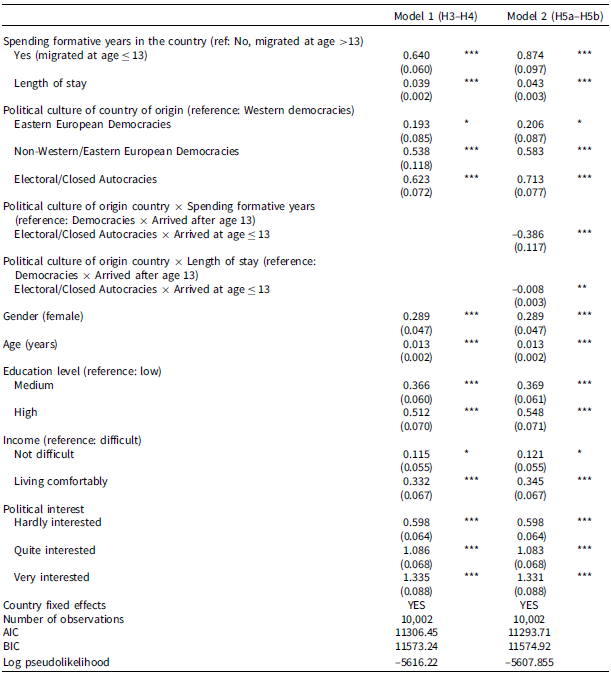
The results are shown in Table 2. In line with H3, the findings in Model 1 show that immigrants who arrived in the residence country before the age of 13 are significantly more likely to vote compared to those who arrived later (β = 0.640, P < 0.001). This effect remains statistically significant and even strengthens in Model 2 after introducing interaction terms (β = 0.874, P < 0.001). These results provide robust support for H3, reinforcing the argument that early childhood socialisation in the residence country fosters stronger political integration.
Predictors of electoral participation among foreign-born immigrants (first- and 1.5-generation)

Note: Robust standard errors in parentheses. Significant at *** P < 0.001, ** P < 0.01, * P < 0.05.
Length of stay in the residence country is another positive and significant predictor of electoral participation across both models (Model 1: β = 0.039; Model 2: β = 0.043; both P < 0.001). This supports H4. It should be noted that to avoid collinearity between early arrival and length of stay, the length of stay variable was group-mean centred within early and later arrivers. This strategy allowed us to see how early and late arrivers differ in their likelihood of voting, assuming they have each stayed in the country for an average amount of time. It also shows how additional years of residence in the country affects voting within each group – early and later arrivers – separately. The findings support the view that early exposure to the residence country promotes political incorporation. In our sample of citizens of foreign origin living in European democracies, the findings support the view that early exposure to the residence country promotes political incorporation, particularly among those who arrive before age 13, while it should not be read as an overarching pattern across all migrant-origin groups or institutional contexts. This finding aligns with integration-based theories of political participation, which emphasise the importance of cumulative exposure to democratic institutions in shaping political engagement.
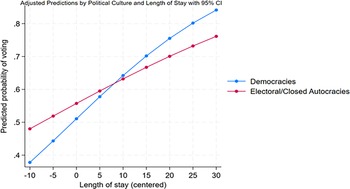
Moreover, the interaction results reveal important heterogeneity, confirming that the impact of pre-migration political culture varies across (re)socialisation pathways, consistent with H2. The interaction between length of stay and pre-migration political culture demonstrates that prolonged residence boosts electoral participation for all immigrants, but the magnitude of this boost varies by regime of origin. The negative and statistically significant interaction term (β = –0.008, P = 0.01) shows that immigrants from autocratic countries experience a smaller participatory gain per additional year of residence compared to those from democratic origins. This supports H5a (Political Culture × Length of Stay) and suggests that political incorporation over time is more challenging for individuals coming from authoritarian rule. As Figure 3 illustrates, both groups benefit from longer residence – immigrants from autocracies start out with a participation advantage at shorter durations of stay, but democratic-origin migrants experience a steeper participatory boost over time. This highlights that while time in the residence country facilitates political incorporation, its effects are conditioned by the pre-migration political socialisation.
Adjusted predictions of voting based on political culture of origin country and length of stay in residence country (centred).

Moreover, the interaction between spending formative years in the residence country and political culture of origin country reveals that the benefits of early exposure to the residence country institutions and norms are not uniform. The coefficient for autocratic-origin immigrants who arrived before age 13 is negative and significant compared to the reference group (democratic-origin immigrants who arrived after age 13) (β = –0.39, P = 0.001).
Figure 4 reveals that migrants from autocratic regimes who arrived after age 13 exhibit a higher predicted probability of voting than their peers from democratic origins at the same age of arrival. This suggests that migrants from autocracies may experience reactive mobilisation upon settlement, as the migration process itself opens political opportunities unavailable in their country of origin. However, the graph also shows that early arrival (before age 13) is associated with higher electoral participation for both groups – yet this participatory boost is markedly larger for migrants from democracies. Migrants from democratic origins who arrived early have the highest predicted probability of voting overall, indicating that early socialisation in the residence country reinforces democratic-origin political dispositions. By contrast, while early arrival still raises participation among autocratic-origin migrants compared to their late-arriving peers, the size of this increase is smaller. This pattern highlights that the benefits of early exposure to residence country institutions are conditional on prior political socialisation: democratic-origin migrants are better positioned to convert early exposure into political engagement, supporting H5b (Political Culture × Formative Years).
Adjusted predictions of voting based on political culture of origin country and spending formative years in the country.

In sum, while both early arrival and longer residence in the residence country positively influence immigrant electoral participation (supporting H3 and H4), their effects are significantly moderated by the political culture of the country of origin. Immigrants who were socialised in democratic contexts benefit more from both early childhood exposure and cumulative residence. In contrast, immigrants from authoritarian regimes gain less from these same integration pathways, consistent with H5a and H5b.
Notably, even among immigrants who arrived before age 13, those from autocratic origins show lower predicted probabilities of voting than their peers from democratic backgrounds. This suggests that early arrival alone is insufficient to overcome the deep-rooted effects of authoritarian political socialisation. These findings underscore the enduring influence of regime type in the country of origin – even when immigrants arrive early enough to undergo schooling and socialisation within the residence country’s democratic environment.
Discussion and conclusion
This study contributes to a growing body of scholarship that challenges linear assimilationist models of political incorporation by highlighting the enduring imprint of pre-migration political socialisation, captured through the political culture of immigrants’ own country of origin for first-generation immigrants, and through their parents’ country of origin for the second generation (Giavazzi et al. Reference Giavazzi, Petkov and Schiantarelli2019; Riniolo and Ortensi Reference Riniolo and Ortensi2021; Lazarova et al. Reference Lazarova, Saalfeld and Seifert2024; Guglielmi and Maggini Reference Guglielmi and Maggini2025). Importantly, the empirical evidence in our analysis speaks to all three components of the political resocialisation framework: resilience, exposure, and transferability. In line with resilience theory, discussed as one of the three strands of political resocialisation theory and highlighting the durability of early-life political learning, our findings indicate that immigrants do not arrive as politically neutral actors but carry with them enduring political orientations formed under distinct regime types.
The findings also reveal that, in line with the exposure and resilience arguments, the length of stay and early arrival to democratic residence country fosters political engagement. Crucially, confirming the enduring relevance of political culture of origin, we find that the effects of length of stay and early arrival on voting are moderated by the political culture of origin: immigrants socialised in democratic regimes benefit more from prolonged exposure and early arrival to the country of residence compared to those from autocratic backgrounds. Our findings therefore support the resocialisation framework, showing that political incorporation reflects both exposure to democratic contexts and the enduring influence of early-life political socialisation. At the same time, our findings challenge a purely path-dependent model of political (dis)engagement. Once compositional factors such as age are accounted for, first-generation immigrants from authoritarian regimes exhibit higher electoral participation than their peers from democratic origins. These findings resonate with earlier research showing that migrants from authoritarian countries of origin are not necessarily less politically active than those from democratic origins (Bilodeau et al. Reference Bilodeau, McAllister and Kanji2010; White Reference White2017; Just Reference Just2019; Bilodeau and Dumouchel Reference Bilodeau and Dumouchel2023).
Although our study differs from Bilodeau and Dumouchel (Reference Bilodeau and Dumouchel2023) – their analysis is situated in the province of Quebec in Canadian context, includes both citizens and permanent residents, and examines both electoral and non-electoral participation, whereas our ESS-based study focuses on self-reported turnout among citizen participants of foreign origin in European democracies – their findings provide an important point of comparison.
Consistent with their findings, our results also suggest that experiences under autocracy do not necessarily suppress political engagement. Importantly, Bilodeau and Dumouchel (Reference Bilodeau and Dumouchel2023: 228) conclude that ‘it is possible that under certain circumstances and/or for certain individuals, pre-migration experiences of autocracy might trigger greater political participation in the host country’ and call for future research to examine this possibility. Our findings speak directly to this point: drawing on a larger, cross-national dataset covering multiple European democracies, we identify evidence of a reactive mobilisation, with migrants socialised under autocratic rule reporting higher turnout in democratic residence countries.
The evidence presented supports the possibility that experiences of autocracy might activate greater political participation in the residence country. Migration to democratic countries may offer new political opportunities previously unavailable in authoritarian settings, allowing some immigrants to overcome prior restrictions and engage with democratic institutions in their residence countries. In this light, following a ‘reference-point’ (or benchmarking) mechanism (Aksoy et al. Reference Aksoy, Eichengreen, Litina, Özgüzel and Yu2025), higher political participation among immigrants from authoritarian contexts may reflect reactive mobilisation rather than an internalisation of undemocratic norms. However, this mobilisation effect appears generationally bounded, diminishing among the second generation, for whom residence country socialisation seems to be a greater driver of political behaviour.
This generational pattern aligns with core expectations of resocialisation theories and the epidemiological approach, suggesting that early-life political orientations are most persistent among first-generation migrants. These orientations are often transmitted to their children, whose political development reflects both parental influence and the context of the residence country (Neundorf and Smets Reference Neundorf and Smets2017; Guglielmi and Maggini Reference Guglielmi and Maggini2025; Bozhinoska and Spörlein Reference Bozhinoska and Spörlein2025). This is consistent with the ‘disruption’ argument, which posits a weakening of political value transmission in migrant families (Borkowska and Luthra Reference Borkowska and Luthra2024).
Moreover, the results also point to variation across democratic-origin categories. These results may gain additional nuance when considering the historical and geopolitical diversity across Western, Eastern European, and non-Western democracies. Many of the Eastern European and non-Western democracies in our sample, including several Latin American cases, are newer or ‘third-wave’ democracies (Huntington Reference Huntington1991; Diamond Reference Diamond1999; Kostadinova and Power Reference Kostadinova and Power2007), whose political institutions have undergone more recent transitions and, in some cases, remain more fragile or volatile compared to long-established Western democracies. According to the ‘reference-point’ (or benchmarking) mechanism (Aksoy et al. Reference Aksoy, Eichengreen, Litina, Özgüzel and Yu2025), individuals assess residence country institutions relative to the institutional quality experienced in their origin country. Migrants from newer or less stable democracies may therefore perceive residence country institutions as comparatively more trustworthy and effective, which could enhance their propensity to vote.
Beyond institutional comparisons, specific pre-migration socialisation experiences likely reinforce these patterns. For the non-Western group, predominantly composed of Latin American migrants, the high turnout may be linked to the legacy of compulsory voting in many of their countries of origin (Bóveda Reference Bóveda2025). Recent scholarship suggests that this ‘normative duty’ to vote is often transferred to the residence country, persisting as a habit even where voting is voluntary (Umpierrez de Reguero and Dandoy Reference Umpierrez de Reguero and Dandoy2022). Conversely, the lower participation of migrants from Western democracies (especially mobile EU citizens) might reflect a ‘taken-for-granted’ attitude toward democratic access or a form of expatriate disengagement. This behaviour can be interpreted through the lens of ‘stealth democracy’ (Hibbing and Theiss-Morse Reference Hibbing and Theiss-Morse2002): individuals socialised in stable democracies often prefer not to be involved in political processes as long as they perceive the system as functioning efficiently and fairly. Unlike migrants from authoritarian backgrounds, for whom voting might be an expressive act of liberty (Bilodeau et al. Reference Bilodeau, McAllister and Kanji2010), Western migrants may adopt an instrumental view, engaging only when dissatisfaction arises, effectively leaving democracy to run in the background. In this respect, our finding of a positive effect of Eastern European origin on turnout in the residence country still warrants closer scrutiny and cannot be readily generalised. The enlargement waves of the European Union, particularly the 2004 and 2007 expansions, not only brought into the EU countries that, while often sharing a socialist or communist past, migrants followed markedly different trajectories of institutional and political transition, but also facilitated a substantial increase in East–West intra-EU mobility. Evidence from studies of specific Eastern European migrant groups’ voting behaviour in both origin and residence countries suggests that migration can foster the acquisition and internalisation of civic and democratic norms (Careja and Emmenegger Reference Careja and Emmenegger2012; Szulecki et al. Reference Szulecki, Bertelli, Erdal, Coșciug, Kussy, Mikiewicz and Tulbure2021). Yet whether this mechanism operates uniformly across diverse Eastern European origin contexts and residence countries remains an open empirical question. More generally, while our results suggest that the origin of migrants’ political socialisation shapes not only whether they vote but also the meaning they attach to the act of voting itself, future research should unpack these mechanisms to clarify why migrants from different democratic contexts vary in their electoral participation in the residence country after migration.
Importantly, these results must be interpreted with caution given the limitation that we do not have information about immigrants’ motivations for migration. Individuals may migrate for a variety of reasons such as economic opportunity, education, family reunification, or political persecution and repression (Simpson Reference Simpson2022). Without direct measures of migration motivation, it remains difficult to disentangle selection effects from broader structural or cultural influences. The ESS data may disproportionately capture the more politically integrated segment of autocracy-origin immigrants, thereby amplifying observed participation levels even after controlling for education, income, political interest, and residence country exposure.
Similarly, another limitation concerns the timing of citizenship acquisition. Although our sample focuses on citizens of foreign origin, the ESS does not provide information on when citizenship was obtained. As a result, we cannot rule out that part of the observed length-of-stay effect may be confounded by differences in the timing of naturalisation, which determines how long individuals have actually been eligible to vote.
Taken together, these findings underscore that political socialisation plays a crucial but complex role in shaping how immigrants adapt to the political environment of their residence countries. The findings call for a more nuanced and dynamic theorisation of immigrant political incorporation – one that integrates the influence of origin-country political cultures, the timing of migration, and intergenerational transmission dynamics. Rather than assuming a linear trajectory of political adaptation, our study underscores how multiple socialisation forces (pre-migration and post-migration) interact across life courses, regimes, and generations. Future research should further unpack how these mechanisms operate across different sending contexts and incorporate information on migration motives and the timing of citizenship acquisition, particularly as contemporary migration flows into European democracies are marked by growing heterogeneity in migrants’ backgrounds and socialisation experiences.
Supplementary material
The supplementary material for this article can be found at https://doi.org/10.1017/S1475676526101248
Data availability statement
The dataset is publicly available on Zenodo at: Mentesoglu Tardivo, Z., & Guglielmi, S. (2025). Political Socialization Before and After Migration: How Origin-Country Political Culture Shapes Immigrant Voting in Europe [Dataset]. Zenodo. https://doi.org/10.5281/zenodo.16541944
Acknowledgements
We thank the anonymous peer reviewers for their valuable comments and suggestions, and Nicola Maggini (University of Bologna) for his helpful advice on the appropriate use of V-Dem indicators.
Funding statement
The open access publication fees for this article were funded by the University of Milan under the CRUI (Conference of Italian University Rectors) and Cambridge University Press Read and Publish Agreement.
Competing interests
The authors declare no conflicts of interest related to this research.
Ethics statement
This study uses secondary data from the European Social Survey and the Varieties of Democracy (V-Dem) project. These data were not collected by the authors and are publicly available. No additional ethical approval was required.


 Open access

