

In March 2024, Carol Martin and I were in Barcelona. We saw an announcement of Robert Wilson’s staging of Mozart’s version of Handel’s Messiah. Because of our flight schedule, we were going to miss it, which made me unhappy because Messiah is one of my all-time favorites. When I emailed Bob my regrets, he invited us to the dress rehearsal. A magnificent performance, musically and visually, formal but not heavy, engaging with both composers. But the highlight was staying after the rehearsal to listen to Wilson giving notes to the company. He spoke quietly, with respect; he listened. One thing he said particularly stuck with us: “When you look at the audience, don’t look at everybody. Pick a person and home in. If you look at everyone you look at no one.”
This focusing was a hallmark of Wilson’s process. He paid attention to each thing happening in a performance: design, music, staging, lighting, movement, costuming. No detail was unattended or accidental, no part of the stage was unconceived. Architect Ludwig Mies van der Rohe famously observed, “God is in the details”—and Wilson was first and foremost an architect of performance. He designed and arranged spaces in relation to time, slowly unfolding detail after detail. Indeed, the preternaturally slow unfolding of his staging was retarded in the noblest sense.
In that regard, Wilson was clear about where his signature style came from. As a teenager who stuttered, his parents took him to Byrd Hoffman, a dancer-teacher, who told Wilson to slow down. He did and his stuttering stopped. Throughout his life, Wilson honored Hoffman, naming his first New York studio the Byrd Hoffman School of Byrds; his Watermill Center is owned and operated by the Byrd Hoffman Water Mill Foundation. Being himself impaired, Wilson was deeply empathic to neurologically other persons, collaborating artistically with them, finding common ground, with Raymond Andrews of Deafman Glance (1970) and Christopher Knowles of Einstein on the Beach (1976). These two productions remain engraved on the tablets of my memory.
Our art intersected as Spalding Gray brought Wilson’s techniques into the Performing Garage at 33 Wooster Street, which was not far from the Byrd Hoffman studio on 147 Spring Street. In fact, the first Wilson piece I experienced—The Life and Times of Sigmund Freud in December 1969 at the Brooklyn Academy of Music—was about two years after I started The Performance Group. After that, I made it my business to go to Wilson’s…what?…theatre works, installations, visual-sonic opuses. At some, I stayed all the way through, at others I went in and out, because Wilson’s work had both autonomy and extent.
In addition to his own auteured pieces, Wilson staged many works of others: Gounod, Albee, Woolf, Stein, Verdi, Goethe, Wilde, Ibsen, Shakespeare, Büchner, Euripides, Homer, and more. I was blown away by his production with NYU Drama Department students of Heiner Müller’s Hamletmachine (1986). Carol and I sat next to the lighting operators in Paris for Wilson’s magnificent Threepenny Opera (2016) because the performance was sold out but Wilson found a place for us. After Wilson first staged this Brecht music drama in 2007 at the Berlin Ensemble, he emailed me, “They [the BE actors] are not opera singers. It was a real challenge to do Threepenny in the house where it was originally done in 1928. It was 38 years since it was last done there” (6 October 2010). Wilson was always up for the challenge.
Wilson’s extraordinary panoply of collaborators matches the diversity of his sources. Not only Andrews and Knowles but also Sheryl Sutton, Philip Glass, John Cage, Tom Waits, Lou Reed, David Byrne, Laurie Anderson, Marina Abramovic´, William S. Burroughs, Susan Sontag, Giorgio Armani, Willem Dafoe, Lady Gaga, Isabelle Huppert, and many more. To my knowledge, no other performing arts creator, anywhere, at any time, had such a scope. And yet, for all this breadth and diversity, Wilson’s oeuvre is unified, unmistakably his own, the realized imagination of a master painter visual musician architect.
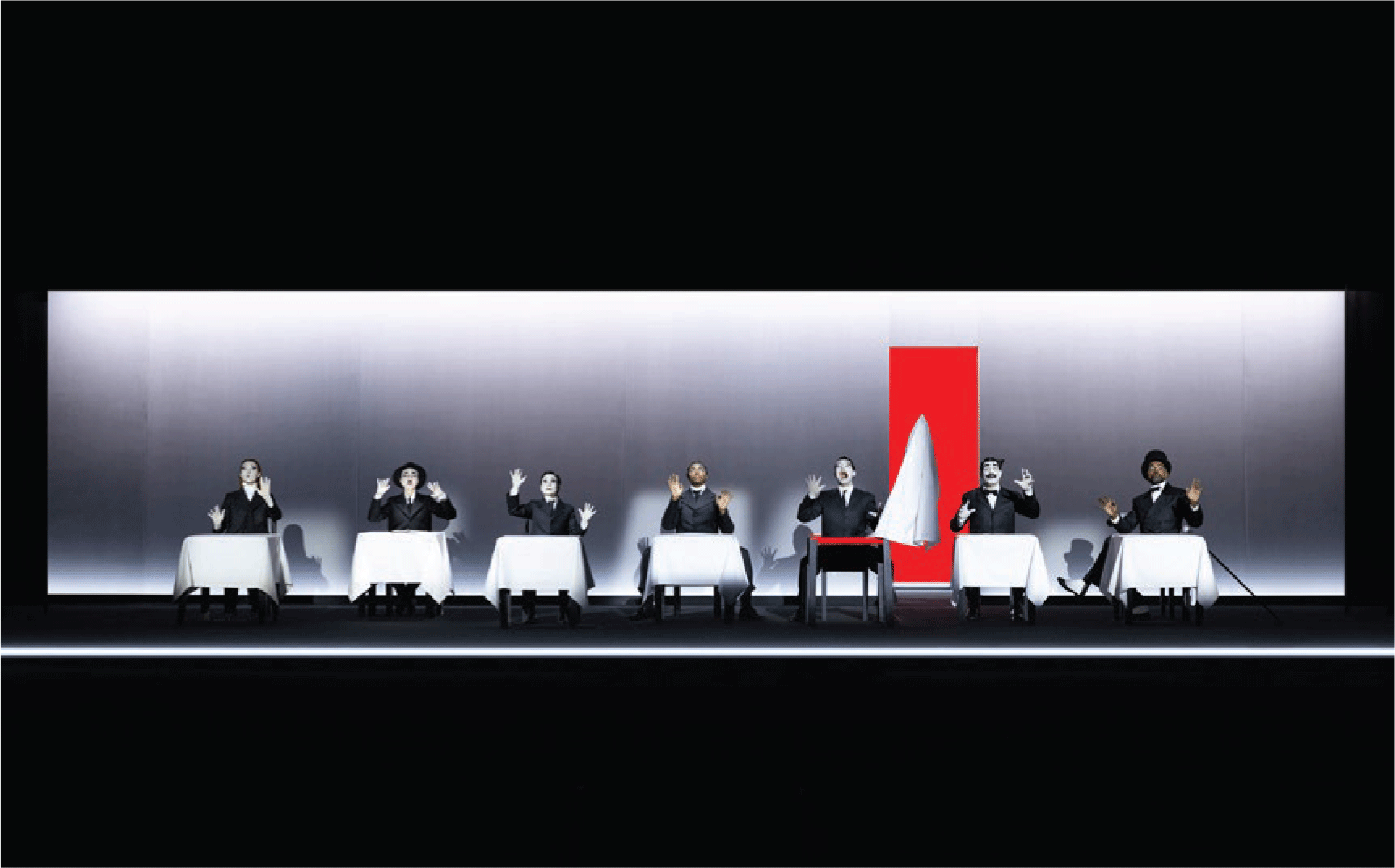
PESSOA—Since I’ve been me. Direction, scenography, and lighting design by Robert Wilson; text by Fernando Pessoa, with Maria de Medeiros, Aline Belibi, Rodrigo Ferreira, Klaus Martini, Sofia Menci, Gianfranco Poddighe, and Janaína Suaudeau. Théâtre de la Ville, Paris, 2024. (Photo by Lucie Jansch)

Wilson staged, wrote, designed, and performed dramas, operas, monologs, dialogs, oratorios, installations, and mixed-media works. He didn’t take on all these roles in each piece, but he often performed more than one artistic task. An avantgarde and traditional artist simultaneously, Bob dressed impeccably, carried himself graciously. Under his quiet formality, actually radiating through it, was a deep compassion, therapy in its original etymological sense: to take care of, to heal. As a way to focus and share his incredible productivity, in 1992 Wilson founded the Watermill Center on eastern Long Island—an interdisciplinary laboratory for the arts and humanities, an incubator, residency, library, art collection, and homebase for Wilson’s global network. The Watermill Center is continuing after Wilson’s passing, a living legacy.
The last email I had from Bob was on 26 February 2025. It was about Mary Said What She Said starring Isabelle Huppert about to have its American premiere on 27 February at NYU’s Skirball Center.
No one can do what she does. It is one of the best of my work. I give her a very strict form and she fills it with her own ideas. She is not afraid to be cold, because she knows she can be hot at the same time. She is not afraid of thinking abstractly. She finds a mystery behind the surface, a mystery we never talk about. Unfortunately I won’t be at the performance to see you and Carol [Martin]. I’m on my way to Paris where I am designing the space for the next Dior collection which opens March 4th.
“I’m on my way,” is Robert Wilson, perfectly.