


1. Introduction
In insurance markets, bonus-malus (BM) systems (BMS) play a pivotal role in adjusting premiums according to the claim history of policyholders by rewarding no-claim periods with premium reductions (bonus) and penalizing claim events with increases (malus). The efficiency and fairness of BMS hinge on its parameters, namely the transition rules and the premium scales.
Transition rules determine the long-run distribution of policyholders across different BM classes (premium levels).
The monotone likelihood ratio property (MLRP) is a critical concept in economics, decision theory, and actuarial science, which plays a central role in analyzing risk and pricing models. This property establishes that the likelihood ratio between two outcomes is monotonic with respect to an underlying variable, such as risk level or claim frequency. In the context of bonus-malus systems (BMSs), proving the MLRP for stationary probabilities allows us to better understand how riskier policyholders are more likely to remain in higher premium categories, while less risky policyholders are more likely to move toward lower premiums.
The MLRP is vital for several reasons: it ensures monotonicity in the relationship between claim frequency and premium levels, and it serves as a foundation for stochastic dominance, making it an essential tool in optimizing premium adjustments. This paper aims to demonstrate that the stationary probabilities in a BMS satisfy the MLRP, a result that contributes both to the theoretical understanding of BMS and its practical implementation in insurance pricing.
In this paper, we model BMS as an ergodic Markov chain. We limit our investigation to the case where only one claim is possible in each period and the transition rule is +1/-d: in case of no claim, the policyholder moves one class upward; and moves d classes downward in case of a claim. We prove that the stationary probabilities of this ergodic Markov chain satisfy the MLRP. This property has has many theoretical and practical consequences. One such consequence, discussed in the last part of the paper, is the monotonicity of the premium scale in a proper BM design problem.
1.1 Literature review and theoretical foundation
A BMS is characterized by several parameters, such as the number of BM classes, the transition rules, and possibly the initial BM class. In traditional BM design, the transition rules, which are determined by the number of claims, are fixed, and the objective is to identify the optimal set of premiums (referred to as the premium scale or relativities) assuming some underlying statistical model and an optimality criterion (or decision model). In early works, the transition rule was based solely on the number of claims; see seminal works by Lemaire, Reference Lemaire1995 later Tremblay, Reference Tremblay1992; Walhin and Paris, Reference Walhin and Paris1992; Coene and Doray, Reference Coene and Doray1996; Kaas et al., Reference Kaas, Goovaerts, Dhaene and Denuit2001, and a more recent study by Heras et al., Reference Heras, Gil, Garca-Pineda and Vilar2004). Later attention shifted to situations in which transition rules are determined by both the number of claims and their severity (see Sammartini, Reference Sammartini1990; Pinquet, Reference Pinquet1997; Frangos and Vrontos, Reference Frangos and Vrontos2001; Tzougas et al., Reference Tzougas, Vrontos and Frangos2014). Recent research indicates that, when transition rules are also involved in the design problem and are determined inside the mathematical model, they are not outside parameters (Tan et al., Reference Tan, Li, Li and Balasooriya2015; Ágoston and Gyetvai, Reference Ágoston and Gyetvai2020; Boucher, Reference Boucher2022). An interesting experience based system – but not BMS – is presented in Martinek and Arató (Reference Martinek and Arató2019).
In an actuarial application, we must set premiums for an entire risk community where there are observable and unobservable risk factors. Observable risk factors can be considered directly, but unobservable risk factors can be taken into account via experience rating, as with BMS. Several studies have investigated cases where premiums (for observable factors) and relativities (for unobservable factors) are determined jointly (see Taylor, Reference Taylor1997; Pitrebois et al., Reference Pitrebois, Denuit and Walhin2003; Tan, Reference Tan2015).
Besides adverse selection, moral hazard is another motivation for BMS. Since the premium is higher in lower (worse) BM classes, the policyholder is incentivized to increase their level of effort. It is somewhat surprising that, although moral hazard is frequently mentioned in BMS-related work, theoretical models in BM literature that concentrate on the issue of moral hazard are not too frequent. One refreshing exception is Vandebroek (Reference Vandebroek1993). While economic (and actuarial) theory tends to neglect joint studies on BMS and moral hazard, there is extensive research on the empirical testing of moral hazard in BMS (see, for example, Abbring et al., Reference Abbring, Heckman, Chiappori and Pinquet2003). A special topic within moral hazard is bonus hunger, which has attracted more attention than the general case itself (see von Lanzenauer, Reference von Lanzenauer1974; Dellaert et al., Reference Dellaert, Frenk, Kouwenhoven and Van Der Laan1990; Holtan, Reference Holtan2001).
MLRP is a statistical concept that illustrates how the likelihood of observing specific data increases monotonically in relation to a parameter of interest, thus enabling comparisons among various distributions (see, for example, Karlin and Rubin, Reference Karlin and Rubin1956; Rukhin et al., Reference Rukhin, Priebe and Healy2009).
In addition to statistics, the MLRP is essential in decision theory, facilitating the ranking of hypotheses according to their likelihoods and ensuring that models correspond with intuitive concepts of risk assessment and behavior. In numerous economic models, the MLRP is a necessary condition to obtain results (see Milgrom, Reference Milgrom1981; Jewitt, Reference Jewitt1991; Mensch, Reference Mensch2021).
From an actuarial perspective Winter (Reference Winter and Dionne1992) is of particular interest. In this work, he derives a Pareto-optimal insurance policy in the presence of moral hazard. This is only achievable if the MLRP is valid for the loss distribution. Moral hazard is a common issue in BMS, and the MLRP can be a useful tool for modeling and analyzing it.
The standard mathematical model for BMS analysis is a discrete-time Markov chain. A unique stationary distribution exists if the Markov chain is irreducible and aperiodic (Kemeny and Snell, Reference Kemeny and Snell1976), which are fair assumptions in the case of a BMS. For a discrete-time Markov chain, the MLRP is merely a sensitivity analysis. This latter field has been the subject of numerous studies (see Schweitzer, Reference Schweitzer1968; Golub and Meyer, Reference Golub and Meyer1986; Funderlic and Meyer, Reference Funderlic and Meyer1986 and Caswell, Reference Caswell2013). Instead, in this paper, we show that the MLRP can be derived from the linear recursions characterizing the stationary distribution.
The remainder of the paper is as follows. In Section 2, we render the necessity foundation for BMS. In Section 3, we introduce linear recursions for stationary probabilities of a BMS. In Lemma 1, we show a key property of this recursion: the order of the linear recursion can be reduced by one, furthermore, in this reduced form all the coefficients are positive. Building on this, we establish our main result in Theorem 1, in which we prove the MLRP for the stationary probabilities of BMS. Section 4 presents an important application of the MLRP (both from a practical and theoretical perspective) in certain BMS design problems, where it ensures that premiums will be monotonic even if this is not explicitly prescribed. This is an obviously desirable property that has not been established to hold in the literature. In this section, we also provide numerical examples to further illustrate the consequences of the MLRP. In Section 5, we summarize our findings.
2. Preliminaries
A BMS with K classes, indexed from 1 to K, is the subject of our investigation. In the BM system, in each year, the participants move u class upward (or get into the top class if they cannot move u classes upward) if they do not have claims and move d classes downward (or get into the bottom class) if they have claims. The probability that a participant has at least a claim in a time period is denoted by q, and we make the standard assumption that the probability of more than one claim during a period is negligible. (Equivalently, further claims do not affect the claimant’s class.)
A common tool for modeling BMS is the ergodic Markov chain. In our case, the +1/-d transition rule ensures the irreducibility and aperiodicity of the Markov chain, so this is not an additional limitation.
The transition matrix $\textbf{T}$
of this Markov chain is made up of entries
$\textbf{T}$
of this Markov chain is made up of entries $t_{ij}$
that indicate the probability that a customer in class i during a period will move to class j in the next period. The transition matrix will be represented by
$t_{ij}$
that indicate the probability that a customer in class i during a period will move to class j in the next period. The transition matrix will be represented by $\textbf{T}(q)$
, highlighting its dependence on the probability of claims.
$\textbf{T}(q)$
, highlighting its dependence on the probability of claims.
The probability that a policyholder belongs to a BM class i during period t is shown by the value ${c}_{ti}(q)$
; the values
${c}_{ti}(q)$
; the values $c_{ti}(q)$
are arranged into a vector
$c_{ti}(q)$
are arranged into a vector $\textbf{c}_t(q)$
. As t tends to infinity,
$\textbf{c}_t(q)$
. As t tends to infinity, $\textbf{c}_t(q)$
tends to a unique stationary distribution
$\textbf{c}_t(q)$
tends to a unique stationary distribution $\textbf{c}(q)$
due to the ergodicity of the Markov chain, which is a solution to the system of equations
$\textbf{c}(q)$
due to the ergodicity of the Markov chain, which is a solution to the system of equations
 \begin{equation} \textbf{c}(q)^\top \textbf{T}(q)=\textbf{c}(q)^\top \ .\end{equation}
In other words, $\textbf{c}(q)$
is the left eigenvector of eigenvalue 1 of matrix
$\textbf{c}(q)$
is the left eigenvector of eigenvalue 1 of matrix $\textbf{T}(q)$
; see Kaas et al. (Reference Kaas, Goovaerts, Dhaene and Denuit2001), Kemeny and Snell (Reference Kemeny and Snell1976), Lemaire (Reference Lemaire1995). The target of our investigation is how
$\textbf{T}(q)$
; see Kaas et al. (Reference Kaas, Goovaerts, Dhaene and Denuit2001), Kemeny and Snell (Reference Kemeny and Snell1976), Lemaire (Reference Lemaire1995). The target of our investigation is how $c_i(q)$
depends on the probability of claims q.
$c_i(q)$
depends on the probability of claims q.
The MLRP is a well-known concept in statistics, frequently appearing in many decision problems as a necessary condition for establishing other key, theoretical properties. Let X be a random variable whose distribution depends on an external parameter q. Assume that X has a probability density function $f(x|q)$
. The MLRP means that the inequality
$f(x|q)$
. The MLRP means that the inequality
 \begin{equation*}\frac{f(x_0|q_1)}{f(x_0|q_0)} \ge \frac{f(x_1|q_1)}{f(x_1|q_0)}\end{equation*}
holds for every $x_0\le x_1$
and
$x_0\le x_1$
and $q_0\le q_1$
.
$q_0\le q_1$
.
If X is a discrete random variable, the MLRP is defined via probabilities (see Rogerson, Reference Rogerson1985 for instance): the inequality
 \begin{equation} \frac{P(x_0|q_1)}{P(x_0|q_0)} \ge \frac{P(x_1|q_1)}{P(x_1|q_0)}\end{equation}
holds for every $x_0\le x_1$
and
$x_0\le x_1$
and $q_0\le q_1$
.
$q_0\le q_1$
.
We can rearrange (2.2) into the following form:
 \begin{equation} \frac{P(x_0|q_1)}{P(x_1|q_1)} \ge \frac{P(x_0|q_0)}{P(x_1|q_0)} \ ,\end{equation}
which can also be read as the monotonicity of the quantity $\frac{P(x_0|q)}{P(x_1|q)}$
as a function of q.
$\frac{P(x_0|q)}{P(x_1|q)}$
as a function of q.
Expression (2.3) is the key for defining and checking MLRP for BMSs: we have to check that the fraction
 \begin{equation} \frac{c_{K-i}(q)}{c_{K-(i+1)}(q)}\end{equation}
is monotone in q (decreasing in our case).
3. Monotone likelihood ratio property in BM systems
In our study, we limit our analysis to the case, where $u=1$
, that is, the policyholder moves one class upward if she/he has no claims. This is the most frequent solution in existing BM systems (“In the classical BMS, the
$u=1$
, that is, the policyholder moves one class upward if she/he has no claims. This is the most frequent solution in existing BM systems (“In the classical BMS, the $-$
1/+h transition rule is common,” Oh et al., Reference Oh, Lee, Park and Ahn2020, p. 143.) From a mathematical point of view, this assumption (along with the obvious
$-$
1/+h transition rule is common,” Oh et al., Reference Oh, Lee, Park and Ahn2020, p. 143.) From a mathematical point of view, this assumption (along with the obvious $0\lt q\lt 1$
) ensures that the Markov chain is ergodic.
$0\lt q\lt 1$
) ensures that the Markov chain is ergodic.
The first equation in the system (2.1) is
 \[c_K=(1-q)c_K+(1-q)c_{K-1},\]
suppressing the argument q of each function $c_i$
for better readability. The next
$c_i$
for better readability. The next $d-1$
equations in the system (2.1) are
$d-1$
equations in the system (2.1) are
 \[c_{K-(i-1)}=(1-q)c_{K-i} \quad (i=2,\dots,d).\]
Compiling these equations, we get
 \begin{equation}c_{K-i}=\frac{q}{(1-q)^i}c_{K} \quad (i=1\dots d).\end{equation}
If $i\gt d$
, then the appropriate equation in the system of Equations (2.1) is
$i\gt d$
, then the appropriate equation in the system of Equations (2.1) is
 \[c_{K-i}=qc_{K-(i-d)}+(1-q)c_{K-(i+1)} \ .\]
Rearranging this, we get
 \begin{equation} c_{K-(i+1)}=\frac{c_{K-i}}{1-q}-\frac{qc_{K-(i-d)}}{1-q} \ .\end{equation}
Let us introduce the notation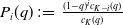 $P_i(q)\,:\!=\,\frac{(1-q)^ic_{K-i}(q)}{c_K(q)}$
. We now see that
$P_i(q)\,:\!=\,\frac{(1-q)^ic_{K-i}(q)}{c_K(q)}$
. We now see that
 \begin{equation} P_0(q)=1, \quad P_{i}(q)=q \;\; (i=1\dots d),\end{equation}
and that the relation (3.2) translates to the following linear recurrence on the functions $P_i$
:
$P_i$
:
 \[\frac{P_{i+1}(q)}{(1-q)^{i+1}}=\frac{P_{i}(q)}{(1-q)(1-q)^{i}}-\frac{qP_{i-d}(q)}{(1-q)(1-q)^{i-d}} \quad (i\gt d),\]
that is,
 \begin{equation} P_{i+1}(q)=P_{i}(q)-q(1-q)^{d}P_{i-d}(q) \quad (i\gt d).\end{equation}
In particular, we can see that each function $P_i$
is a polynomial of degree no greater than i.
$P_i$
is a polynomial of degree no greater than i.
The linear recurrence in (3.4) has order d. In Lemma 1, we show that linear recurrence can be transformed to linear recurrence with degree $d-1$
.
$d-1$
.
Lemma 1. The sequence of polynomials generated by the initial values (3.3) and recurrence (3.4) also satisfies the following linear recurrence relation:
 \begin{equation} P_{i+1}(q)=qP_{i}(q)+q(1-q)P_{i-1}(q)+\dots+q(1-q)^{d-1}P_{i-(d-1)}(q) \quad (i \geq d).\end{equation}
Proof. We shall use induction. The statement holds for $i=d-1$
, since the
$i=d-1$
, since the $P_d$
defined by (3.5) is the same as the
$P_d$
defined by (3.5) is the same as the $P_d$
defined in (3.3):
$P_d$
defined in (3.3):
 \begin{align*}P_d(q)&=qP_{d-1}(q)+q(1-q)P_{d-2}(q)+\dots+q(1-q)^{d-2}P_1(q)+q(1-q)^{d-1}P_0(q)\\&=q\left(q+q(1-q)+\dots q(1-q)^{d-2}\right) + q(1-q)^{d-1}\\&=q.\end{align*}
Now suppose that (3.5) holds for $i=n$
, that is,
$i=n$
, that is,
 \[P_{n+1}(q)=qP_{n}(q)+q(1-q)P_{n-1}(q)+\dots+q(1-q)^{d-1}P_{n-(d-1)}(q).\]
We see that is valid for $i=n+1$
as well:
$i=n+1$
as well:
 \begin{align*}P_{n+2}(q)&=P_{n+1}(q)-q(1-q)^dP_{n+1-d}(q)\\&= qP_{n+1}(q)+(1-q)P_{n+1}(q)-q(1-q)^dP_{n-(d-1)}(q)\\&=qP_{n+1}(q)+(1-q)qP_n(q)+(1-q)q(1-q)P_{n-1}(q)+\dots\\&\qquad +(1-q)q(1-q)^{d-2}P_{n-(d-2)}(q) + (1-q)q(1-q)^{d-1}P_{n-(d-1)}(q)\\&\qquad -q(1-q)^dP_{n-(d-1)}(q)\\&=qP_{n+1}(q)+q(1-q)P_{n}(q)+\dots+q(1-q)^{d-1}P_{n-(d-2)}(q). \end{align*}
Remark 2. The characteristic equation of the linear recurrence (3.4) is
 \[t^{d+1}-t^{d}-q(1-q)^d=0,\]
which can be rearranged as
 \[q(1-q)^d=t^{d}(t-1).\]
From this form it is obvious that $t=1-q$
is a root of the characteristic polynomial. Dividing the characteristic polynomial by
$t=1-q$
is a root of the characteristic polynomial. Dividing the characteristic polynomial by $t-(1-q)$
, we get
$t-(1-q)$
, we get
 \begin{equation} t^d-qt^{d-1}-q(1-q)t^{d-2}-\dots-q(1-q)^{d-1},\end{equation}
which is the characteristic polynomial for recursive relation (3.5).
To prove the MLRP of stationary probabilities, we have to prove that $\frac{c_{K-i}(q)}{c_{K-(i+1)}(q)}$
is monotone decreasing in q. Expressing this in terms of the polynomials
$\frac{c_{K-i}(q)}{c_{K-(i+1)}(q)}$
is monotone decreasing in q. Expressing this in terms of the polynomials $P_i$
, we have to prove that
$P_i$
, we have to prove that
 \begin{equation} \frac{c_{K-i}(q)}{c_{K-(i+1)}(q)}=\frac{\frac{P_i(q)}{(1-q)^i}}{\frac{P_{i+1}(q)}{(1-q)^{i+1}}}=\frac{(1-q)P_i(q)}{P_{i+1}(q)}\end{equation}
is monotone decreasing in q.
Ágoston and Gyetvai (Reference Ágoston and Gyetvai2022) proved that this is true for $d=1$
. In Theorem 1, we prove that it also holds for
$d=1$
. In Theorem 1, we prove that it also holds for $d\ge 2$
.
$d\ge 2$
.
It is well known (and can verified by direct calculation) that if $\frac{a}{b} \lt \frac{c}{d}$
for some positive numbers a, b, c, and d, then we also have
$\frac{a}{b} \lt \frac{c}{d}$
for some positive numbers a, b, c, and d, then we also have
 \begin{equation} \frac{a}{b} \lt\frac{a+c}{b+d} \lt \frac{c}{d}.\end{equation}
To prove Theorem 1, we will need the following generalization of this inequality.
Lemma 3. Suppose that $n\geq 2$
and that the positive numbers
$n\geq 2$
and that the positive numbers $a_1, a_2,\dots,a_n$
and
$a_1, a_2,\dots,a_n$
and $b_1, b_2,\dots,b_n$
satisfy the chain of inequalities
$b_1, b_2,\dots,b_n$
satisfy the chain of inequalities
 \[\frac{a_1}{b_1} \lt \frac{a_2}{b_2} \lt \cdots \lt \frac{a_n}{b_n}.\]
Then they also satisfy the following:
 \[\frac{a_1}{b_1} \lt \frac{a_1+a_2+\dots+a_n}{b_1+b_2+\dots +b_n} \lt \frac{a_n}{b_n}.\]
Proof. Noting that
 \[ \frac{a_1+\dots+a_n}{b_1+\dots+b_n} = \frac{b_1}{B}\frac{a_1}{b_1} + \dots + \frac{b_n}{B}\frac{a_n}{b_n}, \quad \text{where} \quad B = \sum_{i=1}^n b_i, \]
we see that $\frac{a_1+\dots+a_n}{b_1+\dots+b_n}$
is a convex combination of the fractions
$\frac{a_1+\dots+a_n}{b_1+\dots+b_n}$
is a convex combination of the fractions $\frac{a_i}{b_i}\; (i=1,\dots,n)$
; therefore, it must be between the smallest and the largest of these fractions, as claimed.
$\frac{a_i}{b_i}\; (i=1,\dots,n)$
; therefore, it must be between the smallest and the largest of these fractions, as claimed.
We are now ready to prove our main result.
Theorem 4. The MLRP holds for stationary probabilities of a BMS for every $d\ge 2$
.
$d\ge 2$
.
Proof. Based on our earlier observations and notation, we need to show that for every $i\geq 0$
and
$i\geq 0$
and $0\lt q_1 \lt q_2\lt 1$
, we have
$0\lt q_1 \lt q_2\lt 1$
, we have
 \begin{equation}\frac{(1-q_1)P_i(q_1)}{(1-q_2)P_i(q_2)} \gt \frac{P_{i+1}(q_1)}{P_{i+1}(q_2)}.\end{equation}
We will, once again, show this by induction. The inequality (3.9) clearly holds for $i=0,\dots,d$
, since substituting the initial conditions into the inequality (3.3) yields the easily verifiable inequalities
$i=0,\dots,d$
, since substituting the initial conditions into the inequality (3.3) yields the easily verifiable inequalities
 \[\frac{1-q_1}{1-q_2} \gt \frac{q_1}{q_2} \qquad\text{and} \qquad \frac{(1-q_1)q_1}{(1-q_2)q_2} \gt \frac{q_1}{q_2}.\]
Now, for the inductive step, suppose that the inequality (3.9) holds for $i = k-d,k-d+1,\dots,k$
; we need to show that it is true for
$i = k-d,k-d+1,\dots,k$
; we need to show that it is true for $i=k+1$
as well, that is,
$i=k+1$
as well, that is,
 \begin{equation}\frac{(1-q_1)P_{k+1}(q_1)}{(1-q_2)P_{k+1}(q_2)} \gt \frac{P_{k+2}(q_1)}{P_{k+2}(q_2)}.\end{equation}
By our inductive assumption that (3.9) holds for $i\lt k$
, we know that
$i\lt k$
, we know that
 \[\frac{q_1P_k(q_1)}{q_2P_k(q_2)} \lt \frac{q_1(1-q_1)P_{k-1}(q_1)}{q_2(1-q_2)P_{k-1}(q_2)}\lt \cdots \lt \frac{q_1(1-q_1)^{d-1}P_{k-d+1}(q_1)}{q_2(1-q_2)^{d-1}P_{k-d+1}(q_2)}.\]
Now the recurrence relation (3.5) and repeated application of Lemma 2 yield
 \begin{align*}\frac{P_{k+1}(q_1)}{P_{k+1}(q_2)} &= \frac{q_1P_k(q_1)+\dots+q_1(1-q_1)^{d-2}P_{k+2-d}(q_1)+q_1(1-q_1)^{d-1}P_{k+1-d}(q_1)}{q_2P_k(q_2)+\dots+q_2(1-q_2)^{d-2}P_{k+2-d}(q_2)+q_2(1-q_2)^{d-1}P_{k+1-d}(q_2)}\\&\gt \frac{q_1P_k(q_1)+\dots+q_1(1-q_1)^{d-2}P_{k+2-d}(q_1)}{q_2P_k(q_2)+\dots+q_2(1-q_2)^{d-2}P_{k+2-d}(q_2)}.\end{align*}
Rearranging this inequality, we can write
 \begin{multline}\frac{1}{P_{k+1}(q_2)}\left(q_2 P_k(q_2) + \dots + q_2(1-q_2)^{d-2}P_{k+2-d}(q_2)\right) \gt \\ \gt \frac{1}{P_{k+1}(q_1)}\left(q_1 P_k(q_1) + \dots + q_1(1-q_1)^{d-2}P_{k+2-d}(q_1)\right).\end{multline}
Finally, we add (3.11) and the already established inequality $ \frac{q_2}{1-q_2} \gt \frac{q_1}{1-q_1} $
to obtain
$ \frac{q_2}{1-q_2} \gt \frac{q_1}{1-q_1} $
to obtain
 \begin{multline}\frac{q_2}{1-q_2} + \frac{1}{P_{k+1}(q_2)}\left(q_2 P_k(q_2) + \dots + q_2(1-q_2)^{d-2}P_{k+2-d}(q_2)\right) \gt \\ \gt \frac{q_1}{1-q_1} + \frac{1}{P_{k+1}(q_1)}\left(q_1 P_k(q_1) + \dots + q_1(1-q_1)^{d-2}P_{k+2-d}(q_1)\right),\end{multline}
which in turn can be rearranged as
 \[\frac{(1-q_1)P_{k+1}(q_1)}{(1-q_2)P_{k+1}(q_2)} \gt \frac{q_1P_{k+1}(q_1)+q_1(1-q_1)P_{k}(q_1)+\dots+q_1(1-q_1)^{d-1}P_{k+2-d}(q_1)}{q_2P_{k+1}(q_2)+q_2(1-q_2)P_{k}(q_2)+\dots+q_2(1-q_2)^{d-1}P_{k+2-d}(q_2)}.\]
Recalling again the recurrence (3.5), we see that this is exactly the desired inequality (3.10), completing our proof.
Remark 5. The proof also works for the transition rule +1/-1. According to Lemma 1, the recursive relationship is $P_{i+1}(q)=qP_i(q)$
, so the inequality (3.9) takes the following form:
$P_{i+1}(q)=qP_i(q)$
, so the inequality (3.9) takes the following form:
 \[\frac{(1-q_1)P_i(q_1)}{(1-q_2)P_i(q_2)} \gt \frac{q_1P_{i}(q_1)}{q_2P_{i}(q_2)} \ ,\]
which is obviously true if $0\lt q_1\lt q_2\lt 1$
, so we do not need to use induction.
$0\lt q_1\lt q_2\lt 1$
, so we do not need to use induction.
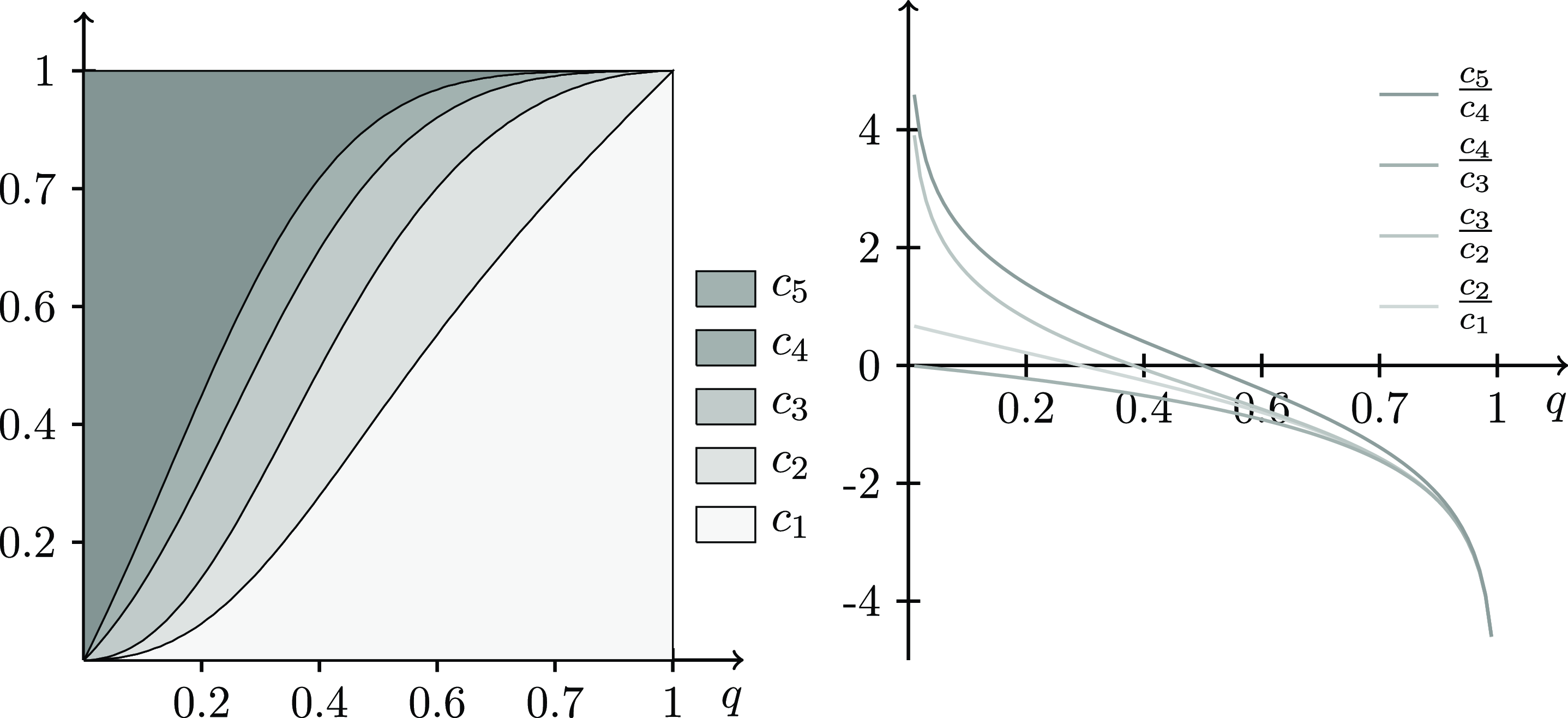
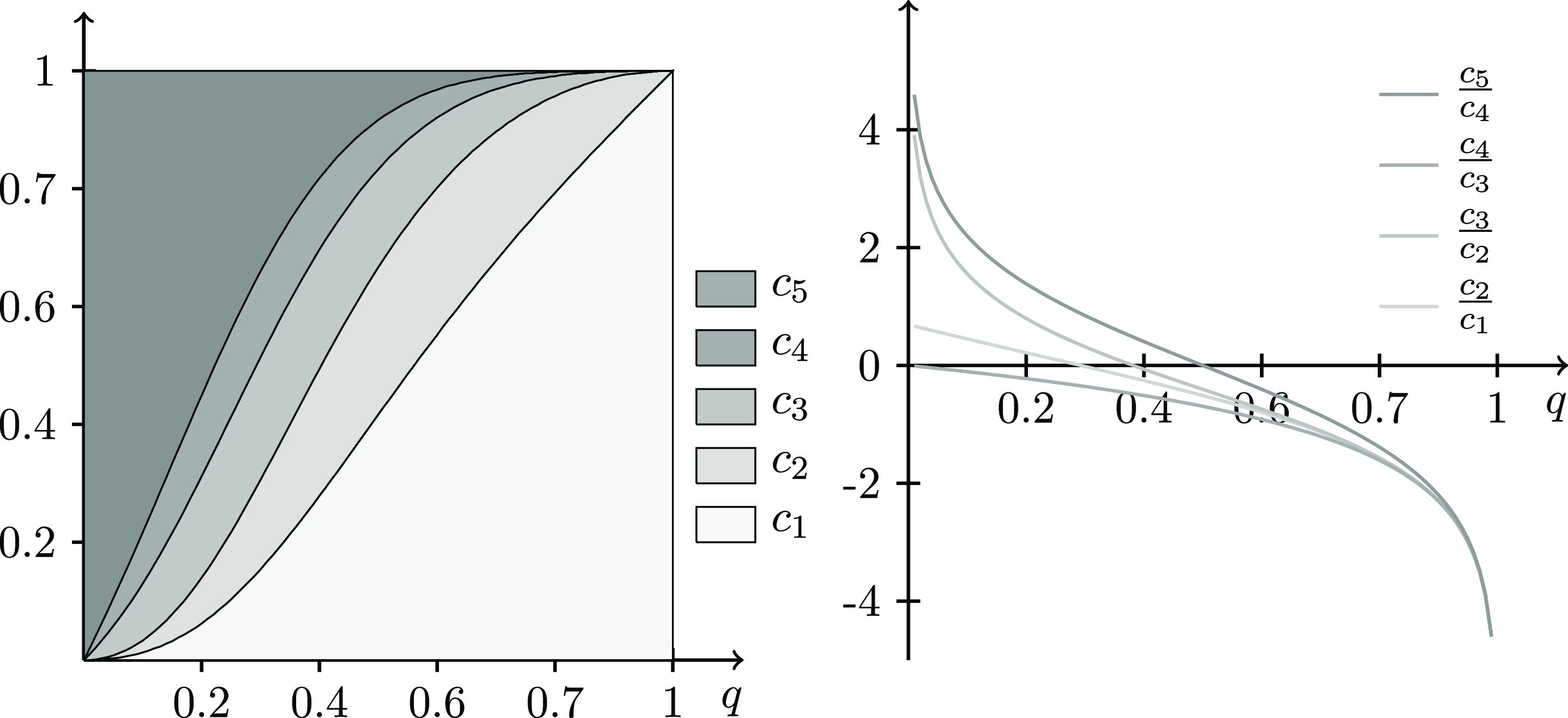
For a visual example, let us consider a BMS with 5 classes and a transition rule +1/-2. Figure 1 shows the stationary probabilities and the log-likelihood ratios.
Stationary probabilities and log likelihood ratios for a five-class BMS with a transition rule +1/-2.
In Example 6, we demonstrate that the MLRP can hold beyond the case examined in Theorem 4. In Example 7, we present a case, where the stationary distribution of the BM classes does not fulfill the MLRP.
Example 6. Let us consider a BMS in which up to two claims can occur in each period, and the number of claims follows a binomial distribution with parameter (2,q). There are 4 BM classes. If there are no claims, the policyholder moves one class upward; in the event of a claim, the policyholder moves down one class for each claim (i.e., two classes for two claims). The transition matrix is as follows
 \[ \left(\begin{array}{c@{\quad}c@{\quad}c@{\quad}c} q^2+2q(1-q) & (1-q)^2 & 0 & 0 \\ q^2+2q(1-q) & 0 & (1-q)^2 & 0 \\ q^2 & 2q(1-q) & 0 & (1-q)^2 \\ 0 & q^2 & 2q(1-q) & (1-q)^2\\\end{array}\right)\]
The stationary probabilities are
 \[\frac{1}{A}\left(\begin{array}{c@{\quad}c} q\left(-3q(1-q)^4-2(1+q)(1-q)^3+(1-q)+1\right) \\ q\left(-2(1-q)^5+(1-q)^3+(1-q)^2\right) \\ q\left((1-q)^5+(1-q)^4\right) \\ (1-q)^6 \end{array}\right) \ ,\]
where
 \begin{align*}A=&\; q\left(-3q(1-q)^4-2(1+q)(1-q)^3+(1-q)+1\right)+\\ &\; q\left(-2(1-q)^5+(1-q)^3+(1-q)^2\right)+q((1-q)^5+(1-q)^4)+(1-q)^6\end{align*}
is the normalizing factor ensuring that the probabilities sum to one.
To verify the MLRP, we must check that all these fractions are decreasing in q:
 \[ \frac{q\left(-2(1-q)^5+(1-q)^3+(1-q)^2\right)}{q\left(-3q(1-q)^4-2(1+q)(1-q)^3+(1-q)+1\right)}\]
 \[ \frac{q\left((1-q)^5+(1-q)^4\right)}{q\left(-2(1-q)^5+(1-q)^3+(1-q)^2\right)}\]
 \[ \frac{(1-q)^6}{q\left((1-q)^5+(1-q)^4\right)}\]
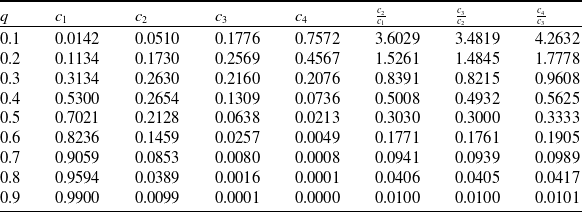
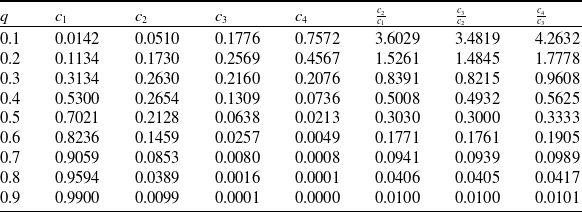
Using algebra, we can directly verify that all of the above expressions are decreasing in q. As a numerical illustration, Table 1 shows the stationary probabilities and the likelihood ratios for a few values of q.
Stationary probability and likelihood ratios for the BMS described in Example 6.
Example 7. Consider a BMS as described in Example 6 except that the claim distribution is special: the probability of no claim is $0.9(1-q)$
, the probability of one claim is q and the probability of two claims is
$0.9(1-q)$
, the probability of one claim is q and the probability of two claims is $0.1(1-q)$
, where parameter q can take values between 0 and 1. The expected claim amount is
$0.1(1-q)$
, where parameter q can take values between 0 and 1. The expected claim amount is $0.2+0.8q$
, which is increases with q. However, it is clear that this underlying distribution does not fulfill the MLRP. The transition matrix is
$0.2+0.8q$
, which is increases with q. However, it is clear that this underlying distribution does not fulfill the MLRP. The transition matrix is
 \[\left(\begin{array}{c@{\quad}c@{\quad}c@{\quad}c@{\quad}c@{\quad}c} 0.1(1-q)+q & 0.9(1-q) & 0 & 0\\ 0.1(1-q)+q & 0 & 0.9(1-q) & 0 \\ 0.1(1-q) & q & 0 & 0.9(1-q) \\ 0 & 0.1(1-q) & q & 0.9(1-q)\\\end{array}\right)\]
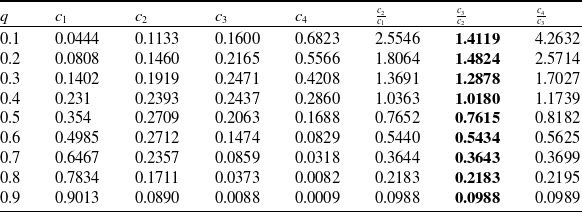
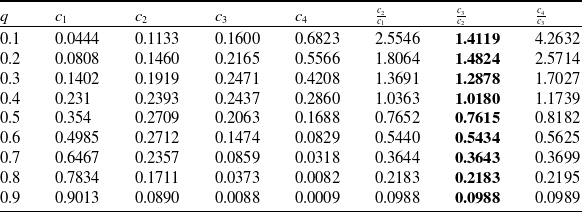
As can be seen in Table 2, the stationary probabilities do not satisfy the MLRP.
Stationary probability and likelihood ratios for the BMS described in Example 2.
4. Application: optimal premiums across risk groups
To demonstrate the usefulness of the MLRP, let us consider the following problem: In a risk community, there are N different groups (type) of insured, each is homogeneous with respect to the probability of a claim (the claim amount is 1 unit). The relative proportions of the groups are denoted by $\phi^n$
(where the superscript n is the group index), that is,
$\phi^n$
(where the superscript n is the group index), that is, $\phi^n\geq 0$
,
$\phi^n\geq 0$
, $\sum_n\phi^n=1$
, and
$\sum_n\phi^n=1$
, and $q^n$
stands for the corresponding probability of a claim in group n. Without loss of generality, we assume that
$q^n$
stands for the corresponding probability of a claim in group n. Without loss of generality, we assume that $q^1 \lt q^2 \lt \dots \lt q^N$
, and we would like to set premiums
$q^1 \lt q^2 \lt \dots \lt q^N$
, and we would like to set premiums $\pi_k$
for each class
$\pi_k$
for each class $k=1,\dots,K$
in such a way that each group pays according to its risk, or at least to get as close to this situation as possible. Formally, this amounts to solving the following nonlinear optimization problem:
$k=1,\dots,K$
in such a way that each group pays according to its risk, or at least to get as close to this situation as possible. Formally, this amounts to solving the following nonlinear optimization problem:
 \begin{align} & \min_\pi\ \mathbb{E}[L(q^n,\pi)] \\[-12pt] \nonumber \end{align}
 \begin{align} \text{s.t.}\;\; & \pi_{k} \le \pi_{k-1} \qquad k=2,\dots,K \\[-12pt] \nonumber \end{align}
 \begin{align} & \pi_k\geq 0 \qquad\quad\;\, k=1,\dots,K \\[6pt] \nonumber \end{align}
with
 \begin{equation} \mathbb{E}[L(q^n,\pi)] =\sum_{k=1}^K\sum_{n=1}^N \phi^n c_k^n L(q^n,\pi_k),\end{equation}
where the decision variables $\pi_k$
represent premiums,
$\pi_k$
represent premiums, $c_k^n$
is the stationary probability that an insured in group n is in the BM class k, and L(x,y) is the loss function that measures the deviation of the premium from the claim probability; usually the quadratic deviation
$c_k^n$
is the stationary probability that an insured in group n is in the BM class k, and L(x,y) is the loss function that measures the deviation of the premium from the claim probability; usually the quadratic deviation $L(x,y)=(x-y)^2$
or the absolute deviation
$L(x,y)=(x-y)^2$
or the absolute deviation $L(x,y)=|x-y|$
. The constraints represent obviously desirable characteristics of the premiums set in our BM system – the question is whether they are necessary to add to the optimization problem. It is clear that the nonnegativity constraints will automatically hold in every optimal solution, for every reasonable loss function, regardless of whether the MLRP is satisfied or not. (For example, it is sufficient that L is monotone in
$L(x,y)=|x-y|$
. The constraints represent obviously desirable characteristics of the premiums set in our BM system – the question is whether they are necessary to add to the optimization problem. It is clear that the nonnegativity constraints will automatically hold in every optimal solution, for every reasonable loss function, regardless of whether the MLRP is satisfied or not. (For example, it is sufficient that L is monotone in $|x-y|$
.) In our next theorem, we argue that for the most commonly used loss functions, if the MLRP holds, then the first set of constraints is also automatically satisfied.
$|x-y|$
.) In our next theorem, we argue that for the most commonly used loss functions, if the MLRP holds, then the first set of constraints is also automatically satisfied.
Theorem 8. Let the loss function L be any function of the form $L(q^n,\pi_k) = \ell(q^n-\pi^k)$
, where
$L(q^n,\pi_k) = \ell(q^n-\pi^k)$
, where $\ell$
is an
$\ell$
is an $\mathbb{R}\to\mathbb{R}$
function with the following properties:
$\mathbb{R}\to\mathbb{R}$
function with the following properties: $\ell$
is convex and it has a unique minimizer at 0. Then the constraint (4.1b) is not binding at the optimal solution of (4.1).
$\ell$
is convex and it has a unique minimizer at 0. Then the constraint (4.1b) is not binding at the optimal solution of (4.1).
Proof. Consider the (unconstrained) optimization problem in which every constraint of (4.1) is relaxed. In this case, the optimal premiums in each BM class k can be determined independently of the other classes. Let $\pi_k^*$
denote an optimal premium for class k (keeping in mind that the minimizer might not be unique, but the minimizers form an interval; the argument below holds for any choice of minimizer
$\pi_k^*$
denote an optimal premium for class k (keeping in mind that the minimizer might not be unique, but the minimizers form an interval; the argument below holds for any choice of minimizer $\pi_k^*$
). As a function of
$\pi_k^*$
). As a function of $\pi_k$
, the objective function (4.2) is a univariate convex function that is subdifferentiable at
$\pi_k$
, the objective function (4.2) is a univariate convex function that is subdifferentiable at $\pi_k^*$
, and from the optimality of
$\pi_k^*$
, and from the optimality of $\pi_k^*$
, its left derivative is nonpositive at this point:
$\pi_k^*$
, its left derivative is nonpositive at this point:
 \begin{equation}\sum_{n=1}^{N} \phi^nc_{k}^n \ell'_-(\pi_k^* - q^n) \leq 0.\end{equation}
Let us search for an index j such that $q^{j} \leq \pi_k^* \lt q^{j+1}$
. Now, by our convexity assumption, each left derivative in the first j terms of (4.3) is nonpositive, while each of the remaining terms is nonnegative:
$q^{j} \leq \pi_k^* \lt q^{j+1}$
. Now, by our convexity assumption, each left derivative in the first j terms of (4.3) is nonpositive, while each of the remaining terms is nonnegative:
 \begin{equation}\sum_{n=1}^{N} \phi^nc_{k}^n \ell'_-(\pi_k^* - q^n) = \sum_{n=1}^{j} \phi^nc_{k}^n \underbrace{\ell'_-(\pi_k^* - q^n)}_{\geq 0} + \sum_{n=j+1}^{N} \phi^nc_{k}^n \underbrace{\ell'_-(\pi_k^* - q^n)}_{\leq 0} \leq 0,\end{equation}
with at least one of the terms being nonzero (otherwise $\ell$
would be constant on an interval containing 0, contradicting our assumption).
$\ell$
would be constant on an interval containing 0, contradicting our assumption).
Introducing the notation $r^n=\frac{c_{k}^n}{c_{k-1}^n}$
, recall that the MLRP implies
$r^n=\frac{c_{k}^n}{c_{k-1}^n}$
, recall that the MLRP implies $r^1 \gt r^2 \gt\dots\gt r^N \gt 0$
. Now the left-hand side of (4.4) can be bounded from below, term-by-term, as
$r^1 \gt r^2 \gt\dots\gt r^N \gt 0$
. Now the left-hand side of (4.4) can be bounded from below, term-by-term, as
 \begin{equation}0\geq\sum_{n=1}^{N} \phi^nc_{k}^n \ell'_-(\pi_k^* - q^n)=\sum_{n=1}^{N} \phi^nc_{k-1}^n r^n \ell'_-(\pi_k^* - q^n) \gt\sum_{n=1}^{N} \phi^nc_{k-1}^n r^j \ell'_-(\pi_k^* - q^n).\end{equation}
Note that the last sum is simply the left derivative of our objective function with respect to $\pi_{k-1}$
at
$\pi_{k-1}$
at $\pi_k^*$
. Because it is strictly negative, the optimal value
$\pi_k^*$
. Because it is strictly negative, the optimal value $\pi_{k-1}^*$
cannot be smaller than
$\pi_{k-1}^*$
cannot be smaller than $\pi_k^*$
. Therefore, at the optimal solutions,
$\pi_k^*$
. Therefore, at the optimal solutions, $\pi_k^*\leq \pi_{k-1}^*$
, as claimed.
$\pi_k^*\leq \pi_{k-1}^*$
, as claimed.
Consider the BMS described in Example 7 and the data in Table 2. For simplicity, let there be two types in equal proportion, with parameter values of 0.1 and 0.2. In this case, the unconstrained model gives the following premium scale for the quadratic loss function and a claim amount 1000: 331.7, 325, 326, and 315.9. We can see that premium scale is not monotonic.
Finally, we would like to draw the attention to the choice of the objective function. Instead of (4.2), the following objective function is often used:
 \begin{equation} \min_\pi \sum_{n=1}^N \phi^n L\left(\sum_{k=1}^K c_k^n q^n,\sum_{k=1}^K c_k^n\pi_k\right)\end{equation}
In (4.6), we aim to minimize the difference between the expected claim amount and the expected premium payment. This sounds reasonable at first but in Example 9 we show that the premium scale is not necessarily monotonic, even if the MLRP is fulfilled for stationary probabilities.
Example 9. Let us consider the BMS described in Example 1. There are two types with equal proportion and with parameter value 0.1 and 0.2; the claim amount is 1000. We minimize (4.6) without the constraints (4.1b). It is not hard to see that the objective function will be zero, and even for a zero objective value we obtain an underdetermined system of equations with infinitely many solutions. For example, the following premium scale is an optimal solution: $136.1$
,
$136.1$
, $1863.4$
, 0, and
$1863.4$
, 0, and $136.1$
. From an actuarial viewpoint, however, this solution is senseless. With additional constraints, we can certainly ensure a monotonic premium scale, but this solution may still be senseless from an actuarial viewpoint, since the lowest premium could be zero. Further constraints would therefore be needed to achieve a reasonable premium scale. This example shows that, although monotonicity of the premium scale can be enforced using additional constraints, this could potentially obscure inherent issues with the model itself.
$136.1$
. From an actuarial viewpoint, however, this solution is senseless. With additional constraints, we can certainly ensure a monotonic premium scale, but this solution may still be senseless from an actuarial viewpoint, since the lowest premium could be zero. Further constraints would therefore be needed to achieve a reasonable premium scale. This example shows that, although monotonicity of the premium scale can be enforced using additional constraints, this could potentially obscure inherent issues with the model itself.
5. Conclusions
We have explored the MLRP within the context of BM systems, establishing its significance in the pricing and risk assessment of insurance policies. Our findings demonstrate that the stationary probabilities of policyholders in a BMS adhere to the MLRP.
We derived the recursive relationships governing the stationary probabilities and using this linear recurrence we proved that stationary probabilities maintain the MLRP under various transition rules, including when multiple downward movements are allowed. Our results extend previous findings, such as those by Ágoston and Gyetvai (Reference Ágoston and Gyetvai2022), to cover more general cases, demonstrating that the MLRP holds even when the number of downward class movements exceeds one.
A practical implication of this result is that the MLRP ensures the monotonicity of premium scale even when this monotonicity is not explicitly prescribed by the system design.
Further research could extend our results in several ways. The transition rules need not be uniform (i.e., claims in different BM classes may result in different downward moves) and certainly more than one claim can occur in each period. It is also interesting what other constraints that are frequently involved in the BM design problem can be shown to be not binding, but hold automatically, under the MLRP assumption.
Acknowledgments
The authors are grateful to the anonymous reviewers for their constructive suggestions on how to simplify some of the proofs and improve the clarity of the presentation.
Funding statement
Dávid Papp: This material is based upon work supported by the National Science Foundation under Grant No. DMS-1847865. This material is based upon work supported by the Air Force Office of Scientific Research under award number FA9550-23-1-0370. Any opinions, findings, and conclusions or recommendations expressed in this material are those of the author(s) and do not necessarily reflect the views of the U.S. Department of Defense. Research was done in part while Dávid Papp was visiting the Corvinus Institute of Advanced Studies, Corvinus University, Budapest, Hungary.
Kolos Csaba Ágoston: The publication of this study was supported by the IDGT MTA National Program (NP2025-IDGT-3/2025).

 Open access

