

Introduction
What elected representatives think about public opinion is a fundamental component of political science theories of representation; politicians’ perceptions are seen as directly impacting the quality and substance of policy responsiveness in democracies (Miller and Stokes Reference Miller and Stokes1963; Stimson et al. Reference Stimson, Mackuen and Erikson1995). Extensive empirical work in various countries using a range of methods has provided strong evidence that politicians rely on their perceptions of public opinion when making decisions (for example, Miller and Stokes Reference Miller and Stokes1963; Converse and Pierce Reference Converse and Pierce1986; Kingdon Reference Kingdon1984, Reference Kingdon1989; Butler and Nickerson Reference Butler and Nickerson2011; Walgrave et al., Reference Walgrave, Soontjens and Sevenans2022; Walgrave, Soroka et al. Reference Walgrave, Soroka, Loewen, Sheafer and Soontjens2022; but see Jones Reference Jones1973). How accurate politicians’ perceptions of public opinion are is therefore of great theoretical interest to scholars of representation and, in recent years, has been the focus of a growing empirical literature (Broockman and Skovron Reference Broockman and Skovron2018; Pereira Reference Pereira2021; Walgrave et al., Reference Walgrave, Jansen, Sevenans, Soontjens, Pilet, Brack, Varone, Helfer, Vliegenthart, van der Meer, Breunig, Bailer, Sheffer and Loewen2023). All things being equal, if politicians have more accurate perceptions of where the public stands on issues, they are more likely to produce policies that are congruent with popular preferences. If their perceptions are inaccurate, policy responsiveness likely decreases.
Older literature has looked into the accuracy of representatives’ perception of public opinion (see, for instance, Sigel and Friesema Reference Sigel and Friesema1965; Hedlund and Friesema Reference Hedlund and Friesema1972; Erikson et al. Reference Erikson, Luttbeg and Holloway1975; Clausen et al. Reference Clausen, Holmberg and deHaven-Smith1983; Dekker and Ester Reference Dekker and Ester1989) and has regained renewed interest in recent years that capitalizes on the availability of large-scale surveys of elected officials (the forerunner was the study by Broockman and Skovron Reference Broockman and Skovron2018; followed amongst others by Pereira Reference Pereira2021; Varone and Helfer, Reference Varone and Helfer2022; Walgrave et al., Reference Walgrave, Jansen, Sevenans, Soontjens, Pilet, Brack, Varone, Helfer, Vliegenthart, van der Meer, Breunig, Bailer, Sheffer and Loewen2023; Walgrave et al., Reference Walgrave, Soontjens and Sevenans2022). This literature largely finds that politicians’ public opinion perceptions are not particularly accurate – certainly no more so than the accuracy exhibited by non-elites – and concludes that politicians can hardly be considered the true public opinion experts they are frequently expected to be. Politicians’ estimates of popular support for specific policy proposals are often erroneous, their estimates are biased in a right-wing direction, and often they even situate the majority on the wrong side of the debate.
Yet, policy responsiveness probably does not depend on all politicians’ perceptual accuracy equally. In fact, it stands to reason that the perceptions of some politicians matter more than those of others. Here, we argue that we should be particularly concerned with the perceptual accuracy of more influential politicians – specifically, those in leadership positions. Leading politicians have more influence on policy decisions than backbenchers do; politicians in the government have a direct impact on the policies in their ministerial portfolio but also, more generally, on all policy decisions taken by the cabinet. In many countries, party leaders are responsible for selecting policy issues on the electoral agenda, negotiating (governmental) coalition agreements, drafting policy solutions, and ensuring party unity during parliamentary votes; parliamentary leaders control the parliamentary agenda and make sure that policy measures are voted (or not). This state of affairs, we argue, should provide an important qualification to the link between perceptual accuracy and representation even if the majority of politicians fail at accurately estimating what the public wants – which extant evidence substantiates – worry that these erroneous perceptions might push policies away from popular preferences could be mitigated insofar as politicians in leadership positions do a better job. If leading politicians had a better nose for public opinion, concerns about low mean perceptual accuracy levels in democracies might be overstated as those elected officials who have the most control over the direction of policymaking do have the necessary capacity to develop responsive policies insofar as they are interested in doing so. Conversely, if the perceptual accuracy of leading politicians is no better (or worse) than that of their backbench colleagues, then the adverse impact of politicians’ perceptual failings on representation and responsiveness may be as strong (or worse) than previously assumed.
This article is, as far as we can tell, the first in the growing body of work on politicians’ perceptual accuracy that directly addresses, theorizes, and empirically tackles leaders’ accuracy and systematically compares it with backbenchers’ performance. To address this question, our research examines the perceptual accuracy of leading politicians and compares it with estimations made by backbenchers. It draws on evidence from four countries: Belgium, Canada, Germany, and Switzerland. We employ a large-scale survey among more than 800 incumbent representatives – including politicians in formal leadership positions such as ministers, party leaders, and caucus leaders – and, in line with the method used in most recent work on the subject, compare these politicians’ estimations of popular support for a range of concrete policies with a direct measurement of popular preferences assessed through citizen surveys. We also directly ask the politicians in our sample to name their in-parliament colleagues who they believe are good at reading public opinion – we assume that these allegedly good raters may act as a kind of ‘subjective’ or informal leaders when it comes to assessing public opinion – and test whether they tend to name leading politicians and whether these perceived good public opinion readers are indeed any better.
Three findings stand out. First, when tested directly, leaders are hardly better at estimating public opinion than regular parliamentarians. Leveraging different indicators of leadership (formal leadership and seniority) and measuring different types of perceptual accuracy (estimating general public opinion and party electorate opinion) in different ways (majority and percentage point inaccuracy), we find no convincing evidence that leaders do a better job in rating public opinion. Leaders make errors as frequently as their common peers, and their perception errors are almost equally large. Second, we supply evidence that politicians themselves do consider politicians in leadership positions as superior readers of public opinion. Third, and in contrast to politicians’ own expectations, as a group, those politicians put forward by their fellow representatives as the best public opinion raters do not perform any better compared to the rest of our sample. In sum, political leaders seem to have no special talent or skill for accurately reading public opinion, nor does such a skill develop over time or through occupying more senior positions.
Leaders’ Special Nose for Public Opinion
While there is substantial individual-level variance in politicians’ perceptual accuracy, and researchers have devoted considerable efforts trying to explain this variance, extant work has not been very successful in laying bare individual-level determinants that explain this variance (for an early, similar complaint, see Clausen et al. Reference Clausen, Holmberg and deHaven-Smith1983). The tendency of politicians to ‘project’, just like any other human being, their own issue stance to others has been the only, but very strong, meaningful individual-level pattern found (Esaiasson and Holmberg Reference Esaiasson and Holmberg1996; Sevenans et al. Reference Sevenans, Walgrave, Jansen, Soontjens, Bailer, Brack, Breunig, Helfer, Loewen, Pilet, Sheffer, Varone and Vliegenthart2023) – although one could argue that this is as much an issue-level as an individual-level factor. But besides that, few factors have been found to exert a significant effect on accuracy. For instance, several scholars have looked into representational role adherence as driving perceptual accuracy but to no avail (for example, Hedlund and Friesema Reference Hedlund and Friesema1972; Erikson et al. Reference Erikson, Luttbeg and Holloway1975; Belchior Reference Belchior2014). The most extensive exploration of the matter to date, dealing with the perceptual accuracy of Belgian politicians, tested for a whole range of individual characteristics, including biographical variables, source use, combination of local and national mandates, and the intensity of reading public opinion, but none was meaningfully predictive of perceptual accuracy (Walgrave et al., Reference Walgrave, Soontjens and Sevenans2022). To be sure, scholars did find a meaningful variation on the issue level, with politicians belonging to parties owning issues holding more accurate perceptions about what the public thinks about their issues (Varone and Helfer, Reference Varone and Helfer2022).
In a new attempt to tackle the unexplained individual-level variance in perceptual accuracy, we focus on a single, but important, characteristic here – leadership. Leaders’ alleged unique sense for public opinion and the idea that this capacity forms one of the reasons for their leadership status in the first place is a theoretical claim political scientists have made for a long time (for example, Merriam Reference Merriam1950; Clausen Reference Clausen1977; Norris and Lovenduski Reference Norris and Lovenduski2004; Belchior Reference Belchior2014). The idea goes as far back as one of the founding fathers of US political science, Charles Merriam, who wrote:
Many political leaders seem to have a high degree of social sensitivity, sensing what goes on around them in the field of political and social power. It was once said of President McKinley, an adroit reader of public opinion, that he had both ears to the ground all the time (…) The leader is likely to feel the weather and know the tides that come and go in human affairs, and to be able to measure the effect of special pleas directed toward representing or influencing these movements and potentialities (Merriam Reference Merriam1950, 40).
In an early theoretical review of the older work on perceptual accuracy, Clausen (Reference Clausen1977, 362–3) writes:
It is widely believed, but less forcefully articulated, that the most durable and effective leaders are those who correctly perceive the attitudes and beliefs of their constituencies. Countless are the references to the leader who succeeds through an accurate assessment of the ‘mood’ of the assembly, the ‘sense’ of the meeting, and the ‘pulse of the nation’, and is reluctant to get too far ahead of public opinion.
The idea that leadership is partly the consequence of an exceptionally high sensitivity for public opinion is reiterated, but not examined empirically, in the perceptual accuracy study of Norris and Lovenduski (Reference Norris and Lovenduski2004).
The broad field of representation is rife with theoretical claims that successful politicians or the parties they lead are able to sense public opinion and, in an anticipative fashion, adapt their position and behaviour accordingly (see, for example, Stimson et al. Reference Stimson, Mackuen and Erikson1995). The large literature showing that, on the macro-level and over time, policies in many countries seem to be responsive to public opinion hinges on the fact that the influential politicians, those who decide about policies, have a good feel for public opinion (for example, Soroka and Wlezien Reference Soroka and Wlezien2009). This capacity to accurately ‘feel’ the mood of the nation makes them avoid positions or policies that go against public opinion, which increases the likelihood that they will retain their leadership status. If this claim is true, then we would expect that, by way of electoral selection, those politicians who have an executive position or who play a leading role in their party are better at gauging public opinion than those who occupy less powerful positions. Indeed, politicians with a weak sense of public opinion, who tend, as a consequence, to make the wrong (unpopular) decisions are expected to be punished electorally and pushed out of their leadership position to be replaced by leaders with a better sense of what the public wants.
Although the macro-level studies did not specify the exact causal mechanism connecting leadership with perceptual accuracy, there are several theoretical reasons why leaders may be better public opinion raters. First, leadership and perceptual accuracy could be driven by the same underlying ‘social’ skill or talent. Second, leaders are on average more experienced politicians than non-leaders, and experience may facilitate a better understanding of the public’s wishes through learning and development of expertise (see also: Clausen et al. Reference Clausen, Holmberg and deHaven-Smith1983; Hafner-Burton et al. Reference Hafner-Burton, Hughes and Victor2013). Third, leaders possess access to staff and to additional personnel and material resources (for example, opinion polls) that may provide them with higher-quality information on public opinion (see also: Walgrave et al., Reference Walgrave, Soontjens and Sevenans2022). And, finally, leaders might be more motivated to form an accurate picture of what their party voters and the general public want. Arguably, their actions are much more visible and, hence, have more electoral consequences for themselves and their party, government members, and party leaders, and parliamentary leaders may be more focused on reading public opinion compared to backbenchers who realize that their personal perceptions and concomitant actions matter less for whether they will be re-elected or not. Importantly, we remain mostly agnostic about the direction of causality of these possible mechanisms linking leadership and perceptual accuracy; individuals could select into leadership roles because they possess high perceptual accuracy or they could develop such skills as a result of reaching these positions, or both.
One could also think about reasons why leaders would be less accurate in their perceptions. First, they might be less motivated to know public opinion since they are in general more electorally safe than backbenchers (see Sheffer and Loewen (Reference Sheffer and Loewen2019), who find that politicians are overconfident about re-election and that this leads to risky behaviour [such as neglecting public opinion], or see more directly, Soontjens and Walgrave, Reference Soontjens and Walgrave2023). Second, and similarly, there is evidence that political leaders score higher with regard to specific personality traits and values that may be connected to over-confidence and over-estimation of their own skills (see, for instance, Nai and Maier Reference Nai and Maier2018; Nai et al. Reference Nai, Coma and Maier2019; Weinberg Reference Weinberg2021). This may produce leaders who are less rather than more accurate in their perceptions of public opinion. Third, their leadership position and busy agenda could insulate them from direct contact with ordinary citizens so that they lose touch with what the people want (see also, Clausen et al. Reference Clausen, Holmberg and deHaven-Smith1983; Walgrave et al., Reference Walgrave, Jansen, Sevenans, Soontjens, Pilet, Brack, Varone, Helfer, Vliegenthart, van der Meer, Breunig, Bailer, Sheffer and Loewen2023). Fourth, leaders are more frequently the target of advocacy groups, which defend sectional interests and this may distort leaders’ perceptions of the public will (Eichenberger et al. Reference Eichenberger, Varone and Helfer2021; Pereira Reference Pereira2021).
We are not in a position to empirically test all these plausible mechanisms leading to leaders increased or decreased ability to rate public opinion. But we will tap into them indirectly by testing different operationalizations of ‘leadership’ and examining their association with perceptual accuracy. As we explain in the next section, we study actual leaders occupying formal top positions (government member, party leader, parliamentary leader), former leaders who once occupied such formal top positions, experienced politicians with a long track record, and ‘subjective’ leaders – that is, those who are considered by their peers as the best public opinion raters. These distinct conceptualizations provide us with some leverage for exploring these identified mechanisms.
Despite the abundance of theoretical work, empirical evidence for the ‘exceptional’ nose for public opinion that leaders are supposed to exhibit is lacking. Studies of perceptual accuracy that survey sitting politicians often have trouble accessing officials in higher office or formal leadership positions in meaningful numbers, preventing a valid analysis. Still, some authors employ measures approximating actual leadership status. Hedlund and Friesema (Reference Hedlund and Friesema1972), for example, examine the electoral success of Iowa state legislators and find that re-elected representatives are somewhat better at gauging public opinion, but differences with those who suffered defeat are small. Broockman and Skovron’s (Reference Broockman and Skovron2018) study of US state legislator candidates points in the same direction; incumbents (who won at least one election) do slightly better than non-incumbent candidates. Length of service has also been used as a proxy for leadership in perceptual accuracy work. Erikson and colleagues (1975, 241) investigate the experience Florida state legislators have and argue that ‘The greater experience of veteran legislators, we thought, would make them superior to relative newcomers as predictors of constituency opinion’ (see Clausen Reference Clausen1977). But they find the exact opposite. Legislative experience has a negative effect on perceptual accuracy. In her study of Portuguese representatives, Belchior (Reference Belchior2014) did not find any effect of experience on perceptual accuracy (see Walgrave et al., Reference Walgrave, Soontjens and Sevenans2022, who found the same in Belgium). Finally, some scholars approach leaders’ perceptual accuracy by focusing on issue variation. They argue that ‘who leads’ in policy decisions depends on who is ‘specialized’ in the issue at hand, and that it is important to know whether politicians are more knowledgeable in areas where they work. But a comprehensive study did not find that issue specialists hold more accurate perceptions compared to non-specialists (Varone and Helfer, Reference Varone and Helfer2022).
In sum, while the theoretical claim that elite status should be associated with an improved, or deteriorated, ability to gauge public opinion has been frequently voiced by scholars, the existing evidence is mixed. A direct comparison of the perceptual accuracy of leading politicians with backbenchers – a comparison that would be directly relevant to the process of representation – is entirely absent from the literature. This is the lacuna this study aims to tackle.
Methods
To examine perceptual accuracy and to test whether leaders are better at it, in-person surveys of sitting politicians were conducted and large-scale online surveys of citizens in four countries were carried out. The entire data collection took place in 2018–2019. Importantly, the sample includes a large number of politicians – eighty-nine – who occupied formal leadership positions at the time of the interview (see below). Politicians from Belgium (both Flanders and Wallonia: for separate analyses, see Supplementary Material 1), Canada, Germany, and Switzerland were recruited. These countries range from hybrid systems like Switzerland with relatively weak parties to parliamentary systems with strong parties – Belgium and Germany (Lijphart Reference Lijphart1999). The four country sample covers variations in electoral systems, with the majoritarian first-past-the-post system of Canada and the other three countries having proportional systems (but with varying district sizes). Switzerland is a special case due to its frequent referendums that arguably give politicians more opportunities to learn about people’s preferences as these preferences are more regularly formally recorded (Pereira Reference Pereira2021). What this country sample can accomplish is maximizing inter-country diversity. In studying very different systems – admittedly, only Western democracies – the aim is to set up a test of the generalizability of our findings beyond the cases we study rather than to search for patterned between-country differences.
In total, 866 survey interviews were conducted, representing a 45 per cent response rate in the legislative chambers we sampled. Although response rates vary considerably between the countries, most studies with politicians report lower response rates (see for example: Deschouwer and Depauw Reference Deschouwer and Depauw2014; Bailer Reference Bailer, Shane, Saalfeld and Strøm2014). Each country’s sample is (small deviations notwithstanding) representative of politicians’ gender, age, seniority, and partisanship in the legislatures they sit in. For full information on the population and sample, we refer to Supplementary Material 1.
The interviewed sample entails a large number of political leaders regardless of operationalization. In all countries we study here, a substantial number of formal political leaders were interviewed. First, among the 866 respondents, 89 politicians (10 per cent) held a top position at the moment of the interview; they were either cabinet ministers (both full and junior, where these roles exist), party leaders, or caucus leaders. Second, if the relationship between leadership and perceptual accuracy was based on talent or learning, it would mean that politicians who previously held top positions should also be considered as leaders. Of the respondents, 132 were regular members of parliament at the time of the interview but had previously held a top position, bringing the share of politicians with experience in a top function to 26 per cent (221 out of 866). Overviews per country and position are provided in Supplementary Material 2. Third, also, the length of tenure of politicians is used; it could be that perceptual accuracy is a matter of learning it on the job. Experience is defined as the years of elected service after the first election (the average politician in the sample had served nine years). Fourth, a measure of ‘subjective’ leadership, in particular when it comes to assessing public opinion, is employed. After the questions about estimating public opinion, the survey contained an additional question prompting respondents to name a politician they consider to be the best at estimating public opinion in their legislature:
Which politician among all politicians in your parliament do you think is particularly good at assessing what the public wants? Can you please write down the name that comes to mind first in the box below?
This question goes beyond official roles and uncovers parts of the ‘hidden face’ of power of an elected representative, which is not directly linked to the formal power position as minister, party leader, or caucus leader (see, for instance, Fischer and Sciarini Reference Fischer and Sciarini2015). In total, 643 politicians (out of 866) provided a specific name of a politician.Footnote 1 These nominations are used to test whether politicians who are perceived to be good estimators by their colleagues (irrespective of whether they are top politicians or not) – and who arguably exert more influence when decisions have to be made – are indeed better at it. The nominations also serve to examine whether politicians think that top politicians have a better feel for reading public opinion than backbenchers do.
Politicians taking the survey were asked to estimate two relevant types of public opinion: the opinions of the general public and those of their own partisan electorate. With regard to a diverse set of eight (or nine, in Switzerland) concrete policy proposals, politicians were first asked to estimate the share of citizens among the general population that supported those policies. The question wording went as follows:
Were we to present [a policy proposal] to a representative sample of [country citizens], what would be your expectation with regard to their answers? What percentage of [country citizens] [do] you think [are] undecided (neutral or no opinion) about this policy proposal? Please give us your best guess by dragging the bar to the correct percentage (answers are given by dragging a slider on a 0–100 per cent scale). And, what percentage of those citizens who have an opinion agrees or totally agrees with this policy proposal? (answering was done on a 0–100 per cent scale).
After this, the set of questions was repeated, now probing politicians’ estimations of the voters of their own party. As an exception, in Switzerland, politicians rated nine rather than eight proposals, and they only rated party electorate opinion, not general public opinion. Full information about how the policy issues in each country were selected is provided in Supplementary Material 3. There, we explain that the issues we selected in each country were relevant and salient and represented real political debates in each of the respective countries.
An online citizen survey was conducted in each country around the same time when fielding the politician survey. Survey companies collected data from at least one thousand (and typically more) respondents in each country. For company details and sample sizes, see Supplementary Material 4. The samples collected are nationally representative for age, gender, and education (mostly by the use of quotas; in Switzerland, a random sample from the population register was drawn).
Citizens were presented with the same set of policy proposals and asked about their own opinions. The data are foremost used to calculate a national, general public opinion per policy proposal. Weights by education, gender, and age are used to correct for residual deviations from the population (despite the quota/random sample). Additionally, the citizen samples are weighed by previous party votes at the last national election.
Perceptual accuracy is assessed in two ways. Our first measure, the number of majority misplacements, is a simple measure that represents whether politicians place their estimation on the correct side of the majority. For example, if a majority of citizens are in favour of a policy proposal, every estimation of 50 per cent or above is classified as correct, while estimates below 50 per cent are incorrect. Calculating how many incorrect estimations of the majority each politician makes results in a metric running from 0–8 incorrect placements. Second, a more detailed inaccuracy score in percentage points is calculated (Sigel and Friesema Reference Sigel and Friesema1965; Erikson et al. Reference Erikson, Luttbeg and Holloway1975; Converse and Pierce Reference Converse and Pierce1986; Esaiasson and Holmberg Reference Esaiasson and Holmberg1996). It grasps the error size of politicians’ estimations of the population share supporting the policy. More concretely, the metric presents the absolute distance (in percentage points) between real public opinion and a politician’s estimation. To get a measure per individual politician, the average error across all eight policies a politician rated is taken. The resulting score, ranging from 0 to 100, is the mean percentage point inaccuracy per politician. These two measures are calculated both for politicians’ estimations of general public opinion and of party electorate opinion. Descriptively we observe a great deal of individual-level variation in perceptual accuracy. A small share of the politicians do not make a single majority misplacement when estimating general public opinion (9 per cent), while others are mistaken (more than) half of the time; that is, for at least four out of eight policies (20 per cent). The most accurate politician has an inaccuracy in percentage points score of 4.93, the average difference between her estimations and actual public opinion numbers is only 5 percentage points; for the least accurate politician, this amounts to 42.7. The numbers for party electorate estimations are very similar. We explore whether leadership can explain these differences.
Results
Politicians in Formal Leadership Positions are not Better Raters
To test whether leading politicians effectively make fewer majority misplacements, we run Poisson regression analyses with the number of misplacements as the dependent variable. To test whether they perform better in their accuracy in percentage points, we use linear regression models. We run two sets of models for leadership: one testing the effect of whether a respondent has experience in formal leadership positions in general (that is, s/he has been/is cabinet minister, party leader, or parliamentary caucus leader previously or at the moment of the interview) (see the main models reported below) and one restricting leadership status to holding a top position at the moment of the interview only (reported in the Supplementary Material only). Our second indicator of leadership is seniority, being the number of years in office since the first parliament election. In all models, we control for gender, age, and membership in a government or opposition party, and include country dummies. A full report of the analysis is found in Supplementary Material 5. We display the predicted valuesFootnote 2 and standard errors from the main models (Supplementary Material Table SM5.1 and SM5.2) in Figs. 1 and 2 below.
No difference in accuracy between leading politicians and backbenchers.
Note: The bars represent predicted values; the lines represent 95 per cent confidence intervals on the predictions.

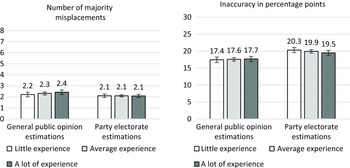
No difference in accuracy between politicians with different levels of experience.
Note: The bars represent predicted values; the lines represent 95 per cent confidence intervals on the predictions. ‘Little experience’ means one year of experience (=mean experience – 1 S.D.); ‘average experience’ means nine years of experience; ‘a lot of experience’ means seventeen years of experience (=mean experience + 1 S.D.).

In essence, politicians with top-level positions and with more political mileage are hardly better at rating public opinion than backbenchers and newcomers. As illustrated in Fig. 1, politicians in both groups make more than two (out of eight) majority misplacements for both general public opinion and party electorate estimations. Their inaccuracy is about 18 percentage points for general public opinion estimations and about 20 percentage points for party electorate estimations. Note that this range of error (±18 percentage points) is very similar to what US scholars observed previously in perceptual accuracy studies (Broockman and Skovron Reference Broockman and Skovron2018; Hertel-Fernandez et al. Reference Hertel-Fernandez, Mildenberger and Stokes2019; Kalla and Porter Reference Kalla and Porter2019). There are hardly any differences between leading politicians and backbenchers, or between those with a lot and little experience.Footnote 3 If anything, leaders and politicians with more seniority are slightly worse at estimating general public opinion than backbenchers (but not significantly so). Only when it comes to party electorate estimations and only when we employ our percentage accuracy measure do we find a negative relationship, suggesting that politicians in leading functions are somewhat more accurate than their fellow backbenchers. The difference is substantively small though (±1 percentage point). Given the absence of a meaningful difference in any of the other indicators, the tentative conclusion we draw from these results is that political leadership and seniority are hardly associated with more accurate public opinion perceptions.
Of course, caution is warranted with the interpretation of null effects. A lack of significance can for instance be the consequence of an underpowered design. Moreover, not finding evidence that political leaders and backbenchers differ significantly from each other is not equal to positively demonstrating that they do not differ from each other and are, in other words, significantly equivalent (Rainey, Reference Rainey2014). We therefore perform several robustness tests with the aim of investigating whether the null effects we found are true null effects. Our study is sufficiently powered; with our sample size,Footnote 4 we have 90 per cent power to detect if political leaders are two percentage points more accurate in their estimations than the average misperception of ±18 percentage points that was found in previous studies (for example, Broockman and Skovron Reference Broockman and Skovron2018; Kalla and Porter Reference Kalla and Porter2019) and that we replicated here.Footnote 5 For differences below 2 percentage points a larger sample would be recommended, but such differences seem small and bear little substantive meaning (for a similar point, see Kalla and Porter Reference Kalla and Porter2019). If we use the 2 percentage point difference benchmark to run an equivalence testFootnote 6 – which tests the equality between means (rather than the difference) – we find that levels of inaccuracy in general public opinion estimates are significantly equivalent, both when we compare leaders with backbenchers and when we compare politicians with a little and a lot of experience. For the majority of misplacements, we cannot perform similar tests since we do not have previous research that we could use as a reference (to determine the standard deviation or a meaningful difference in error size). Yet, the evidence in Figs. 1 and 2 quite obviously shows that there are virtually no differences between leading politicians and backbenchers. So, with the exception of a 1 percentage point difference between leaders and backbenchers on one specific indicator (percentage point inaccuracy only, for party electorate estimates only), we find evidence that leaders do not perform any better at estimating public opinion. This conclusion will be supported when we consider subjective measures of leadership, to which we turn next.
Presumedly good public opinion estimators (subjective leaders) are not better either
Maybe even more so than for the previous analysis focusing on formal leaders, it would be consequential if we found that those politicians who are presumed to be good at estimating public opinion by their colleagues are in fact not particularly good at it. After all, when parties decide on policies and consider whether or not (they think) there is public support for these policies, these presumed public opinion experts, these subjective leaders, are likely consulted and believed most, regardless of whether they formally occupy a top position. For all MPs who participated in our survey, we created a variable counting the number of times an elected representative was nominated by one of their colleagues. Descriptive statistics are in Supplementary Material 6. They show that most of our respondents (77.1 per cent) were never nominated, a limited set of politicians is nominated once (13.6 per cent) or twice (4.6 per cent), and then a few (4.7 per cent) are nominated three times or more, and up to thirty-two times. As a result, a small number of politicians hold a large share of the nominations, suggesting that those few possess the reputation to be an exceptional reader of public opinion.
These highly nominated top-raters do not perform better in our public opinion estimation exercise though. As the predicted values in Fig. 3 show (based on the full models in Supplementary Material 6), presumably outstanding ‘estimators’ are not better than their colleagues at estimating public opinion. The coefficients are negative for general public opinion estimations (indicating that those with more nominations make slightly fewer mistakes), but clearly non-significant. For the other models, we do not even find the expected pattern. Again, the null effect appears to be robust. The results do not change if we alternatively use a dummy indicating whether a representative was nominated at all or not.
No difference in accuracy between politicians with different numbers of good rater nominations.
Note: The bars represent predicted values; the lines represent 95 per cent confidence intervals on the predictions.

Politicians too believe that leaders are better public opinion raters
Finally, our data do allow us to examine the expectation that politicians occupying leadership positions are perceived to be better raters. As we showed earlier, many scholars believe that leaders are better raters – but we also theoretically argued that even the opposite could be the case. Our evidence shows that politicians themselves share the ‘leaders-are-better’ expectation. The results of our question with regard to the nomination of a single politician who excels by her exceptional sense for public opinion are shown in Table 1. They reveal a very clear perception shared by politicians across the aisle and across countries that leading politicians are among the best raters.
Share of leading politicians among politicians perceived as best public opinion estimators

In Belgium-Flanders, for example, no less than 78 per cent of the interviewees put forward the name of a (current or former) minister, party leader, or caucus leader as being the single best public opinion rater they know of. As a benchmark and by way of example, only 22 per cent of all Flemish representatives held such a position at the time of the interviews or in the past, meaning that leaders (past or present) are strongly overrepresented among the nominations. Across countries, the share of nominations of current and past top politicians is 55 per cent. In all countries except Switzerland, an absolute majority of nominations regard a politician with a current or past top position. The Swiss exceptionalism might be related to the weakness of political parties in the Swiss system and to the fact that most elected representatives are still non-professional politicians. In any case, the idea that leading politicians have a special sense of what the people think is widely shared among politicians. But as we showed before, it is not true.
Conclusion
Our findings contradict longstanding claims by students of representation that leading politicians ‘get’ public opinion better. Politicians in formal leadership positions – those who are cabinet ministers or occupy party or caucus leadership positions – are hardly better than their colleagues when estimating public opinion. In-office experience and being perceived by colleagues as a good rater of public opinion are not at all related to perceptual accuracy. As such, our results lay a blow to the expectation that responsiveness will hold through elite politicians’ performance despite the mounting evidence of overall low quality of perceptual accuracy among politicians.
Our findings seem robust. We used various operationalizations of perceptual accuracy (majority misplacements and percentage inaccuracy), looked at the perception of the general public’s preference and that of the own party electorate in four different countries (five systems), and, most importantly, tested different operationalizations of leadership (formal leadership positions, seniority in office, and being perceived by colleagues as a good rater). We find null effects across the board, with only one (substantively small) exception: a 1 percentage point difference in inaccuracy, for one indicator (formal leadership), and one type of estimate (party electorate opinion), and for one operationalization (percentage point inaccuracy) only. The non-significance is not the consequence of a lack of power in our design. Our results suggest that the perceptual accuracy of leading politicians is no better or worse than that of others. Influential politicians with formal authority, with a past career in powerful positions, with a lot of political mileage, or who are widely considered to be amongst the most apt assessors of public opinion do not perform better.
Being able to gauge public opinion is assumed to be an important feature when parties select their leaders but it is clearly not predictive of it, and this raises questions about politicians and party operatives’ decision-making qualities when making these judgements. This is especially apparent when comparing politicians who are explicitly named by peers as good public opinion evaluators (and who are indeed highly likely to occupy leadership positions), and who also turn out to be no better than their colleagues. In practice, then, leadership does not seem to depend on a unique understanding of public opinion that backbenchers lack. Moreover, acquiring this skill does not seem to be something that leaders learn on the job, either. Our key finding that influence does not come with perceptual accuracy adds to the earlier finding (Varone and Helfer, Reference Varone and Helfer2022) that issue specialists – who allegedly also exert more influence on positions and policies within their field of specialization – are not better public opinion raters either.
Our evidence cannot exclude that leaders are actually exceptionally capable with regard to estimating public opinion on some issues or specific population groups. For instance, leaders may be more committed to the central issues they work on and invest cognitive resources in getting to know what the public wants on those issues in particular. Building on evidence that issue specialization is not a significant predictor of perceptual accuracy across the board (Varone and Helfer, Reference Varone and Helfer2022), we decided not to tackle the question, but it could be an avenue for further research. In any case, when analyzing perceptual accuracy as an individual feature that transcends specific issues or population segments as we did in this article, leaders are in no way exceptional.
Of course, leaders may still excel in other types of representational links with the public. It could be, for instance, that leaders are more adequate raters of the priorities that people devote to issues. This ability is also crucial for the quality of democratic representation (see the importance of issue salience congruence: Reher Reference Reher2015; Traber et al., Reference Traber, Hänni, Giger and Breunig2022). Indeed, being inaccurate on non-important policy issues is less consequential for politicians in leadership positions than being inaccurate on an issue that forms a top priority for party voters. Also, it could be that while political leaders may not excel in rating public opinion on specific policy issues, they do have a better feeling for the broader ‘mood of the nation’, or they may be particularly apt at predicting popular backlash against policy measures. But the fact that they are not better at the task that precedes these other types of public opinion estimating does not make it very likely. Furthermore, political leaders are not only responsive to voters’ opinions, but they also influence the formation of citizens’ preferences by persuading and explaining why they adopt a specific policy position (Broockman and Butler Reference Broockman and Butler2015). Top politicians might thus be better at gauging the arguments people have for their position or they may be better at playing into those arguments, persuading citizens. Furthermore, leading politicians appear much more often in the news media than their backbencher colleagues, and as a consequence get more opportunities to affect public opinion. Whether top politicians are indeed better positioned to alter public opinion is beyond the scope of the current study, and we regard it as an important future extension, not least because our findings fail to find support for their capacity to correctly perceive public opinion.
In closing, that influential politicians occupying top positions do not outperform their fellow backbenchers is worrying, as extant work has shown that, as a group, politicians are not very good estimators of what the public wants (Broockman and Skovron Reference Broockman and Skovron2018; Walgrave et al., Reference Walgrave, Jansen, Sevenans, Soontjens, Pilet, Brack, Varone, Helfer, Vliegenthart, van der Meer, Breunig, Bailer, Sheffer and Loewen2023; Walgrave et al., Reference Walgrave, Soontjens and Sevenans2022). Our results suggest that leading politicians’ performance cannot compensate for those collective biases as their own perceptions are as erroneous as those of their colleagues. Even if they vied to be responsive and give the public the policies it wanted or to justify publicly why they adopt a diverging position, their shaky knowledge of what it is that the people want impairs leaders’ ability to be responsive. Identifying where policy responsiveness comes from should therefore be a priority for scholars of representation.
Supplementary material
To view supplementary material for this article, please visit https://doi.org/10.1017/S0007123424000929
Data availability statement
Replication data for this paper can be found at https://doi.org/10.7910/DVN/WL3OXK.
Acknowledgements
We thank the entire POLPOP I team for their efforts in gathering the data this paper draws upon. Many more people than just the authors of this piece have contributed to data-gathering.
Financial support
The data were collected in the framework of the POLPOP I project. POLPOP was a transnational collaboration examining the perceptual accuracy of politicians in five countries, initiated by Stefaan Walgrave. The principal investigators (and funders) per country responsible for data collection were, for Flanders-Belgium, Stefaan Walgrave (FWO, grant G012517N); Wallonia and Brussels-Belgium, Jean-Benoit Pilet and Nathalie Brack (FNRS, grant T.0182.18); Canada, Peter Loewen and Lior Sheffer (supported by a Social Sciences and Humanities Research Council of Canada Insight Grant and by the Dean of the Faculty of Arts and Science at the University of Toronto); Germany, Christian Breunig and Stefanie Bailer (funded by AFF 2018 at the University of Konstanz); Netherlands, Rens Vliegenthart and Toni van der Meer; and Switzerland, Frédéric Varone and Luzia Helfer (SNSF, grant 100017_172559).
Competing interests
None
Ethical standards
The study was conducted in compliance with relevant laws. In Belgium, we first obtained ethical approval from the Ethische Adviescommissie Sociale en Humane Wetenschappen of the University of Antwerp (Flanders, Belgium) on February 10, 2017, and then ethical clearance from the Comission éthique de la Faculté de Philosophie et sciences sociales de l’ULB (Wallonia) in March 2018. In Canada, we obtained ethical approval from the University of Toronto’s Social Sciences, Humanities and Education REB on November 27, 2018. In Switzerland, we obtained ethical approval from the Ethics Commission of the Geneva School of Social Sciences (University of Geneva) on April 16, 2018. In Germany, the Ethics Committee (Institutional Review Board, IRB) of the University of Konstanz judged that approval by the IRB or any regulatory body was not required for this project (but note that the university more generally enforces the proper adherence to ethics guidelines).



 Open access

