


1. Introduction
Design Space Exploration (DSE) has emerged as a central methodology in engineering design, particularly within the framework of set-based design. It enables designers to identify, evaluate, and compare alternative configurations in complex, multi-objective contexts by systematically sampling and analyzing large design spaces (Reference Simpson, Poplinski, Koch and AllenSimpson et al., 2001; Reference Miller, Simpson, Yukish, Bennett, Lego and StumpMiller et al., 2013). Over the past two decades, DSE has evolved from purely computational optimization frameworks to interactive systems that integrate visualization, preference modeling, and user-guided exploration. The Design by Shopping paradigm (Reference BallingBalling, 1999) and subsequent human-in-the-loop approaches (Reference Abi Akle, Yannou and MinelAbi Akle et al., 2019) exemplify this evolution, positioning designers as active participants in trade-off analysis and decision-making. However, most DSE methodologies assume that the design space is predefined and stable. Variables, constraints, and objectives are specified in advance, and designers operate within this structure rather than contributing to its formation. This epistemic limitation raises a central issue: how can exploration be meaningful if the space itself has not been cognitively structured?
This paper seeks to reconceptualize DSE as a co-evolutionary process between the designer and the design space. It argues that exploration does not occur within a fixed environment but through an ongoing process of construction, stabilization, and restructuring. We introduce the concept of transitory cognitive structuring, an under-theorized phase in which the design space becomes operable through cognitive activity. During this phase, designers progressively stabilize an initially ambiguous space by selecting variables, prioritizing criteria, and aligning internal representations with external models.
In the following, we present reviews of classical DSE frameworks, highlighting their methodological evolution and epistemic limitations before examining the cognitive construction of the design space and the conceptual gap in current models. We develop the notion of transitory cognitive structuring as a foundational phase in Section 4. Our proposition of an extended, cognition-centered DSE framework is presented in Section 5 while Section 6 describes its application through a real case study in socio-technical energy system design.
2. Design space exploration frameworks and their limitations
This section reviews the evolution of classical DSE frameworks, examining how different authors conceptualize the DSE process and highlighting the implicit assumptions about the prior existence of a fully formed and stable design space.
-
1. Optimization-centric foundations
Many DSE methodologies originate in the field of algorithmic optimization. These frameworks typically define a design space using formalized variables, constraints, and objectives, followed by the application of optimization techniques to sample and evaluate solutions. For instance, Reference Balasubadra, Shanthi and SrinivasanBalasubadra et al. (2017) propose a hybrid method that integrates evolutionary algorithms with system-level modeling, enabling the generation of Pareto-optimal solutions for application-specific designs. Reference Neubauer, Beichler and HaubeltNeubauer et al. (2020) contribute an exact DSE method based on consistent approximations, aiming to increase reliability in system synthesis. In these approaches, the process is linear and technically driven once the space is mathematically specified, the algorithm explores it. Designers contribute at the beginning (by defining the space) and at the end (by selecting among solutions). The core limitation lies in the assumption that the space itself is stable and complete. There is no room in the model for iterative, designer-driven restructuring of the space during exploration.
-
2. Trade Space Exploration and Design by Shopping
A key family of DSE approaches aims to incorporate designer preferences into the exploration process through interactive trade-off navigation. This is encapsulated in the Design by Shopping paradigm, introduced by Reference BallingBalling (1999) and expanded by Reference Simpson, Carlsen, Congdon, Stump and YukishSimpson et al. (2008), Reference Stump, Simpson, Donndelinger, Lego and YukishStump et al. (2009), and Reference Abi Akle, Yannou and MinelAbi Akle et al. (2019). In this paradigm, the design space is precomputed using simulation or optimization techniques, and the designer “shops” for preferred solutions using visual interfaces. Reference Simpson, Carlsen, Congdon, Stump and YukishSimpson et al. (2008) describe this process in the context of aeronautical design: designers visually explore trade-offs via parallel coordinate plots or scatterplots, selecting preferred configurations in a Pareto front. Reference Stump, Simpson, Donndelinger, Lego and YukishStump et al. (2009) introduce visual steering, which allows users to dynamically refine the sampling of the design space based on areas of interest; effectively creating a feedback loop between visualization and algorithmic sampling. Reference Abi Akle, Yannou and MinelAbi Akle et al. (2019) deepen this model by formalizing two distinct but linked activities: knowledge discovery and informed decision-making. In their model, designers use information visualization to uncover non-obvious relationships among variables and performance outcomes i.e. a phase of cognitive engagement prior to decision. Only then does the designer transition into selecting preferred configurations. This dual-process model acknowledges the epistemic role of visual exploration: the designer does not simply choose; they interpret, learn, and reframe their understanding of the space.
Design space exploration process (Reference Abi Akle, Yannou and MinelAbi Akle et al. 2019)

Figure 1 Long description
The flowchart illustrates the design space exploration process. It starts with the Discovery phase, which involves design points sampling, level of knowledge, data model, and questions. This phase leads to discoveries and insights. The next phase is Narrowing, which involves optimization tools, range constraints, control, and graphs. It reduces the space and marks of performance, leading to a set of optimal solutions. The final phase is Selection, which provides the answer or solution and increases the level of knowledge. The process involves interactors and loops back to the Discovery phase for further refinement.
Nevertheless, even in the Design by Shopping paradigm, the structure of the design space is largely assumed to be fixed in advance. The designers navigate a precomputed space; while they may learn from it and even influence where to look next, they do not participate in redefining its dimensions, constraints, or variables. The space is explorable, but not co-constructable.
-
3. Visual Analytics and Work-Centered Approaches
To better support human sensemaking, some frameworks incorporate data visualization and mining into the DSE loop. Reference Yan, Qiao, Simpson, Li and ZhangYan et al. (2011, Reference Yan, Qiao, Li, Simpson, Stump and Zhang2012) developed the LIVE framework, which presents a model for work-centered visual analytics in DSE. The process involves data preprocessing, multi-dimensional visualization (e.g., parallel coordinates), interactive filtering, and cluster-based analysis. The aim is to empower the designer to identify meaningful patterns, correlations, and anomalies through interaction.
These models prioritize human cognitive engagement during exploration, offering tools to support iterative navigation of a pre-existing solution set. While they enhance interpretability and foster hypothesis-building, they still do not address how the space itself is cognitively structured or restructured.
-
4. Framework Formalization and System-Level Structuring
Some works attempt to generalize the DSE process for specific domains or technologies. Reference Fuchkina, Schneider, Bertel and OsintsevaFuchkina et al. (2018) outline a modular DSE framework that includes components for model generation, parameter management, evaluation, and visualization. Reference Kirov, Passerone and OzhiganovKirov et al. (2015) present a structured DSE process for real-time location systems that integrates simulation loops, model adjustments, and optimization.
These models enhance traceability and repeatability. However, they still rely on a static notion of the design space. The process typically involves: (1) defining the space through formal modeling; (2) exploring it via simulation or heuristics; (3) selecting promising alternatives. Designer cognition is not considered part of the iterative loop : it precedes or follows the process but does not transform it.
Workflow of the design space exploration methodology according to Reference Kirov, Passerone and OzhiganovKirov et al. (2015)

Synthesis
The literature reveals a central conceptual gap: Design Space Exploration unfolds within a space assumed to be already structured. Even in designer-centered approaches, variables and constraints are formalized upstream, and cognitive learning remains implicit and unmodeled. As a result, DSE frames the design space as a territory to navigate rather than a construct progressively formed.
Across existing frameworks, four dimensions clarify this shared assumption. The design space is treated as predefined, whether mathematically complete in optimization-driven models or perceptually navigable in interactive paradigms. Designers act as evaluators or navigators rather than structurers. Adaptive elements concern sampling, visualization, or preference weights, while the dimensional structure of the space remains fixed. Exploration is thus conceived as optimization or preference refinement, not as cognitive constitution of the space itself.
This synthesis shows that the structural definition of the design space systematically precedes exploration. The next section examines how a design space comes into cognitive existence before it can be explored.
3. Epistemic gap: constructing the design space before exploring it
Despite the increasing sophistication of tools enabling designers to explore complex trade spaces, a critical epistemic assumption persists across DSE literature: the design space is given, stable, and complete prior to exploration. This assumption underpins most methodologies, including those claiming to support knowledge discovery (Reference Abi Akle, Yannou and MinelAbi Akle et al., 2019), but it leaves unresolved a fundamental issue: how can meaningful design knowledge emerge in a space that has not been mentally structured?
Several contributions attempt to address this gap. Reference Fuchkina, Schneider, Bertel and OsintsevaFuchkina et al. (2018) propose a modular framework supporting user engagement through visualization and model variation. Similarly, Reference Abi Akle, Yannou and MinelAbi Akle et al. (2019) link knowledge discovery to informed decision-making, emphasizing visual interfaces that foster intuition before choice. These approaches represent a shift from computational toward designer-involved models. However, both assume that the structure of the design space, its variables, relationships, and criteria, is defined before discovery begins. Designers thus navigate a pre-delineated map, where discovery is limited to identifying patterns or preferences within fixed boundaries. The cognitive mechanisms through which the design space initially emerges remain insufficiently theorized, leaving an epistemic blind spot. DSE tools support interaction and refinement, but rarely the upstream cognitive process through which the space is first conceptualized. Consequently, designers are perceived as explorers rather than constructors of the space they explore.
In engineering contexts, the Design Space is described as a multidimensional construct of variables, constraints, and objectives. These elements are not given a priori; they arise from iterative acts of framing, abstraction, and interpretation. In this sense, the design space is not simply modeled but cognitively constructed.
Design cognition research reinforces this view. Reference Cross and DorstCross and Dorst (2001) describe design as a co-evolution of problem and solution spaces, where structure emerges through movement between what is possible and what is desirable. Reference Ball and ChristensenBall and Christensen (2009) show that under uncertainty, designers use analogy and mental simulation to create provisional structures before formalization. These activities assemble the design space itself. Reference VisserVisser (2006) extends this argument by defining sketches and diagrams as cognitive artifacts that externalize and stabilize thought. Reference Bradner, Iorio and DavisBradner et al. (2014) similarly observe that parameters evolve as designers reinterpret or reorganize them, revealing ongoing reframing of the design space. Reference Cash, Hicks and CulleyCash et al. (2013) find that designers continually shift goals and revise performance criteria, demonstrating not only problem-solving but problem-structuring behaviour. Taken together, these studies indicate that knowledge discovery in DSE becomes possible only once a mental structuring of the design space has occurred. This structuring enables designers to focus attention, define relevant variables, and interpret system behaviour as it evolves. The underlying issue, therefore, is understanding how design knowledge can be discovered in a space that has not been cognitively structured. The essential starting point of DSE is not exploration but construction. This act involves:
-
• Identifying candidate variables from an unstructured domain,
-
• Interpreting constraints as meaningful design boundaries,
-
• Establishing relationships between form, function, and context,
-
• Prioritizing objectives based on evolving preferences and external factors,
-
• Choosing representations (sketches, matrices, models) to anchor and test interpretations
These functions are cognitive in nature but are largely unsupported in DSE tools. The result is a methodological blind spot because it provides tools that help designers navigate, but not structure also help to visualize, but not define. In sum, this section argues that the theory of DSE is incomplete without an account of how the design space is cognitively constituted.
4. Transitory cognitive structuring as a foundational phase
Before defining transitory cognitive structuring, it is important to distinguish it from the broader notion of framing. Framing refers to the initial interpretation of a design problem and the delimitation of what is considered relevant. Transitory cognitive structuring, by contrast, occurs once a preliminary frame has been established and concerns the stabilization of a design space that is sufficiently organized to support exploration, simulation, and comparison. While framing defines the problem boundaries, transitory structuring renders the design space operable within a DSE context. We propose to define the Transitory cognitive structuring as a foundational phase in the design space exploration process wherein the designer temporarily stabilizes a problem space that is initially vague, incomplete, or unstable. This phase is not aimed at finalizing the design space but at rendering it cognitively operable i.e. sufficiently structured to allow reasoning, representation, and exploration. It is transitory in that it evolves throughout the process, accommodating new information and reframing.
Reference Woodbury and BurrowWoodbury and Burrow (2006) argue that design spaces are not fixed containers but evolving systems shaped by designer interaction. Recognizing this, transitory structuring becomes necessary to define what variables, constraints, and functions are worth formalizing. In practice, this phase is rarely externalized by current models although it is cognitively indispensable.
This foundational phase relies on a series of intertwined cognitive operations that collectively transform a raw or ill-defined problem into a malleable design space. These operations are not sequential, but iterative and adaptive.
Variable selection and dimensional reduction: Designers use selective attention to identify relevant features among a vast number of possibilities. This includes abstraction and reduction of dimensionality, filtering for parameters that have explanatory or manipulative power (Reference Shen and PilkeyShen & Pilkey, 1990). Reference CrossCross (2004) highlights that expert designers excel at this filtering, quickly identifying salient features based on prior knowledge.
Criteria prioritization: Using implicit or explicit multi-criteria reasoning, designers form provisional hierarchies among evaluation criteria. These early judgments help focus the exploration on meaningful trade-offs and frame the perceived sets of options (Reference Cash, Hicks and CulleyCash et al., 2015).
Parameter calibration: Designers align numerical or symbolic parameters with internal mental models. This involves estimations, analogies, and simulations to ensure that chosen values are coherent with functional goals and context-specific expectations (Reference Bradner, Iorio and DavisBradner et al., 2014; Reference Gueuziec, Gallois and BoulangerGueuziec et al., 2024).
Pattern recognition: Based on perception and prior knowledge, designers detect recurring visual, functional, or structural configurations that offer cognitive shortcuts or hypotheses. Gestalt principles and schema-driven processes enable quick identification of coherent forms (Reference Abramovich and ConnellAbramovich & Connell, 2021).
Causal reasoning and reformulation: Following Reference KlarKlar (1991), designers alternate between statistical, logical, and causal frames to refine problem boundaries and infer new connections. This reformulation is essential for evolving the space beyond initial framings.
Framing under uncertainty: As Reference KleinKlein (2015) and Reference CrossCross (2004) point out, early structuring often relies on intuition and recognition-primed decision-making, especially when information is incomplete or ambiguous.
These operations do not finalize the space; rather, they prepare it to be explored. They create a functional representation of the design space that is open to redefinition, structured enough to allow comparison, manipulation, and learning. Integrating transitory cognitive structuring into DSE theory provides a more realistic and complete account of the design process. It foregrounds the designer not only as a decision-maker but as a constructor of the design space i.e. one who must frame, stabilize, and adapt the space that could be explored.
5. Proposal: a cognitive-centered framework for extended-DSE
Building upon the preceding sections, we propose a conceptual extension of the Design Space Exploration (DSE) paradigm that showcases the cognitive dynamics underlying early and iterative phases of this process. In this view, DSE is no longer conceived as a linear traversal deployed in a predefined space, but as an evolving interaction between three interdependent dimensions: decision, performance, and knowledge. These dimensions constitute distinct and reflexively linked spaces that co-evolve throughout the DSE process.
5.1. A dynamic cognitive process
At the core of this framework is the idea that design operates not only in the parametric space, but rather through the interaction of three cognitive-functional spaces:
-
• The Decision Space represents the set of manipulable variables and design configurations (e.g., PV panel size, battery capacity, governance mechanisms). It reflects the designer’s current set of actionable options.
-
• The Performance Space captures the external system responses resulting from design decisions, typically through simulation, measurement, or prototyping (e.g., energy autonomy, payback period, social acceptance).
-
• The Knowledge Space refers to the internal, evolving mental representations held by the designer: encompassing hypotheses, causal models, evaluative criteria, and semantic framings. This space is implicit, iterative, and central to interpretation.
The Knowledge Space is not an abstract mental entity detached from practice. It becomes observable through design traces such as the reformulation of objectives, the introduction or suppression of variables, the reinterpretation of constraints, or the regrouping of configurations during iterative exploration. These transformations reflect the evolving internal representation of the design space and provide tangible indicators of cognitive structuring in action.
Dynamic cognitive structure of the design space

These three spaces are not independent: they are dynamically linked through three reflexive cognitive loops that underpin how designers engage with complexity:
-
• Perception–Action Loop: Designers test hypotheses by enacting decisions and perceiving outcomes. Adjustments in the decision space (e.g., increasing storage capacity) lead to observable shifts in the performance space (e.g., higher autonomy), which in turn update the designer’s expectations. This loop supports exploratory navigation and feedback learning.
-
• Interpretation–Understanding Loop: Upon observing outcomes, designers engage in meaning-making. They recognize patterns (e.g., diminishing returns on battery size), identify exceptions, and generate insights. This loop operates between performance space and the knowledge space, allowing for deeper comprehension beyond surface-level metrics.
-
• Structuring–Reformulation Loop: When interpretation reveals inconsistency or insufficiency, designers restructure the design space itself. This includes introducing new variables, redefining goals, or reframing problems (e.g., adding “community fit” as a criterion or redefining autonomy from a user-centric perspective). This loop is fundamental to the process of transitory cognitive structuring and reflects the active co-construction of the design space.
Transitory cognitive structuring sits at the center enabling temporary stabilization for exploration.
5.2. Extended-DSE model
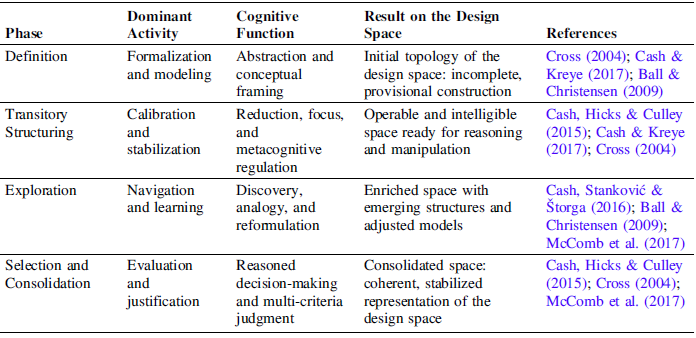
The Extended-DSE model conceptualizes Design Space Exploration as a dynamic and cognitively driven process composed of four iterative phases. Each phase is characterized by a dominant designer activity, a core cognitive function, and a resulting transformation of the design space. The process is not linear but cyclic: as designers learn, interpret, and reformulate, the design space itself evolves in structure and meaning.
-
1. Definition Phase: Formalization and Conceptual Framing
The process begins with the definition phase, during which designers formalize the problem space and articulate initial models or hypotheses. This phase is governed by abstraction and conceptual framing, allowing designers to construct a preliminary topology of the design space. The resulting space is incomplete, defined only by a limited set of parameters and conceptual anchors (incomplete initial design space). As Reference CrossCross (2004) and Reference Cash and KreyeCash and Kreye (2017) note, expertise in design relies heavily on this early framing activity, where problem and solution co-evolve. Cognitive processes of analogical reasoning and mental simulation (Reference Ball and ChristensenBall & Christensen, 2009) enable designers to generate initial representations that structure the forthcoming exploration.
-
2. Transitory Structuring Phase: Calibration and Stabilization
In the transitory structuring phase, the design space becomes operable through calibration and stabilization. Designers refine models, reduce dimensional complexity, and regulate their attention through metacognitive control. This phase transforms the preliminary and abstract topology into an intelligible and manipulable structure that can support reasoning and interaction (operating design space). Reference Cash, Hicks and CulleyCash, Hicks, and Culley (2015) describe this stage as a moment of cognitive alignment between the designer’s internal representations and the externalized design artifacts. Through reduction and focalization, the designer temporarily stabilizes the design space without fixing it permanently, maintaining flexibility for further exploration (Reference CrossCross, 2004; Reference Cash and KreyeCash & Kreye, 2017).
-
3. Exploration Phase: Navigation and Learning
The exploration phase corresponds to active engagement with the design space through simulation, visualization, or experimentation. The dominant cognitive operations involve discovery, analogy, and reformulation. Designers navigate alternative configurations, detect emerging patterns, and generate new insights that refine their understanding of relationships among existing variables (enriched design space). As Reference Cash, Stanković and ŠtorgaCash, Stanković, and Štorga (2016) and Reference Ball and ChristensenBall and Christensen (2009) suggest, this is a learning-intensive stage in which reasoning and perception interact dynamically. Rather than adding new parameters, designers interpret and reorganize the current structure of the space, deepening its meaning and improving its internal coherence. The design space thus evolves epistemically, not structurally.
-
4. Selection and Consolidation Phase: Evaluation and Justification
The final phase, selection and consolidation, involves evaluation and decision-making. Here, designers employ reasoning and multi-criteria judgment to converge toward coherent solutions. This phase consolidates the design space by integrating knowledge gained in previous iterations, leading to a stabilized and coherent representation (consolidated design space). Reference Cash, Hicks and CulleyCash, Hicks, and Culley (2015), Reference CrossCross (2004), and Reference McComb, Cagan and KotovskyMcComb et al. (2017) emphasize that expert designers do not simply choose optimal solutions but actively justify and rationalize their decisions, thereby reinforcing the internal consistency of the design space and ensuring alignment between cognitive understanding and external performance criteria.
Process Summary
Across these four phases, the Extended-DSE model reveals that the design space is not a static container but an evolving cognitive construct. Each phase transforms its structure: from an incomplete conceptual topology to an intelligible working space, then to an enriched and ultimately consolidated representation. This model highlights the iterative co-evolution of cognition and representation as the true engine of Design Space Exploration.
Synthesis of the extended DSE phases

The next section illustrates this framework through a real case based by empirical work on socio-technical innovation in the energy sector (Reference Samir, Lizarralde and Abi AkleSamir et al., 2023a, Reference Samir, Abi Akle and Lizarralde2023b, Reference Samir, Abi Akle, Lizarralde and Hamwi2026).
6. Illustration case: designing a socio-technical energy system
The following example is a stylized case derived from the author’s prior empirical research on photovoltaic self-consumption design (Reference Samir, Lizarralde and Abi AkleSamir et al., 2023a, Reference Samir, Abi Akle and Lizarralde2023b, Reference Samir, Abi Akle, Lizarralde and Hamwi2026). It is presented here illustratively to demonstrate the dynamics of the proposed framework rather than to provide empirical validation. The case serves to make explicit how transitory cognitive structuring unfolds in a socio-technical design context. The case focuses on the early-stage design of a PV self-consumption system intended for rural communities, where both technical performance and social integration are critical.
-
a) Initial Framing and Model Configuration
The design team begins with a technically oriented design space centered on performance parameters such as photovoltaic (PV) panel capacity (in kWp), battery storage size (in kWh), system autonomy ratios, and investment cost. These parameters are manipulated through simulation-based exploration: adjusting PV size alters energy production, modifying storage size affects autonomy and peak shaving, and tuning both impacts the overall self-consumption rate and payback period. The tools in use support model-based simulation and multi-objective optimization, producing trade-offs based on standard performance indicators. At this stage, the design space is formalized as a closed system i.e. variables and objectives are well-defined, and optimization is pursued within fixed boundaries. The knowledge discovery process proceeds through visual feedback and solution comparison.
-
b) First Iteration
Initial simulation outputs are evaluated against stakeholder expectations. While technically optimal configurations are identified, user feedback reveals friction: local actors reject some solutions due to lack of trust, unfamiliar governance mechanisms, or opaque benefit distribution.
This feedback challenges the sufficiency of the existing design space. The rejection of efficient solutions signals a misalignment between what is being optimized and what stakeholders value.
-
c) Transitory Cognitive Structuring in Action
In response, the design team engages in an iterative process of cognitive restructuring:
-
• Redefining objectives: Technical goals (e.g. autonomy, cost) are augmented with qualitative objectives such as “community fit” or “perceived fairness.”
-
• Introducing new variables: Dimensions such as participation level, governance model (centralized vs. cooperative), and local control are integrated.
-
• Clustering by new criteria: Configurations are regrouped according to patterns of social acceptability, not just technical performance.
This process reflects transitory cognitive structuring: the team temporarily stabilizes a revised space that includes socio-technical dimensions. New variables are not simply added; they are cognitively framed and evaluated within a reformulated logic of design performance.
-
d) Iterative Learning Cycles
The design process unfolds through multiple iterative cycles, in which:
-
• Visualization of model outputs leads to interpretation;
-
• Interpretation leads to hypothesis generation (e.g. lack of acceptance is due to governance);
-
• Hypotheses trigger model revision (new variables, new clusters);
-
• Revised models produce new visualizations, prompting further stakeholder reflection.
Each cycle reinforces the importance of the designer’s role in constructing the design space itself to be explored. Rather than merely navigating predefined trade-offs, designers iteratively shape, question, and restructure the space to better align with contextual realities.
-
e) Outcome
The result is a co-constructed design space that is:
-
• Hybrid: integrating technical, economic, and social dimensions
-
• Situated: tailored to the local context and stakeholder dynamics
-
• Navigable: structured enough to support informed exploration
This stylized case highlights how the design space is not a neutral container, but a cognitive and social construct shaped by reflective iteration. Transitory cognitive structuring thus emerges as a foundational enabler of meaningful design exploration in complex socio-technical contexts.
7. Conclusion and implications
This paper proposes a conceptual extension in Design Space Exploration (DSE), challenging the view of the design space as predefined and static. It argues that the space is dynamically shaped through designers’ cognitive activity. The concept of transitory cognitive structuring positions cognition as the mechanism that enables exploration, reframing DSE as a process of space construction and evolution. While classical design cognition theories describe co-evolution and framing at a general level, this paper specifies how these cognitive dynamics operate within computationally mediated Design Space Exploration. Transitory cognitive structuring does not restate co-evolution theory; it formalizes the cognitive mechanisms that render a design space operable in DSE environments. The Extended-DSE model bridges computational and cognitive design research, defining the design space as a dynamic cognitive structure shaped through perception, interpretation, and reformulation. Practically, this perspective implies that DSE tools should support early structuring and reframing, not only visualization and selection. Moreover, training designers in metacognitive framing i.e. the ability to monitor and adapt their cognitive strategies, is essential for developing expertise in exploration. Such capabilities enable designers to construct and manage the evolving logic of the design space more effectively
While this work advances a coherent theoretical refinement reframing, the Extended-DSE model remains primarily conceptual. Its validation requires empirical studies capturing how designers cognitively structure and restructure their design spaces in real contexts and we are currently studying design space structuration for energy systems, additive manufacturing and building design.
A second limitation concerns the operationalization of cognitive mechanisms. Although key processes such as abstraction, calibration, and reformulation have been identified, their interaction with digital interfaces and data visualization remains underexplored. Developing metrics for cognitive structuring, using behavioural and process-analytic methods, would make it possible to trace how cognition drives the evolution of the design space in real time.



 Open access

