

1. Introduction
This article arises at the intersection of three phenomena. First, the continued legacies of imperialism in international law and the effort to understand them in their historical context as productive of transnational and extraterritorial formations with considerable staying power sustained by law.Footnote 1 Second, an epistemological shift to non-state actors and a reconsideration of the division between public and private power in the discipline’s formation and development, particularly as it manifests in new forms of hybrid authority.Footnote 2 This includes the rise of ‘governance without government’, and the recurring tendency of private actors to constitute themselves as public actors suo sponte and outside public delegation.Footnote 3 Third, an increasing call to see cities as not only critical locales, but also emerging actors of international law. Cities are both neglected by and subjected to international law, yet also actors of its transformation.Footnote 4 These three phenomena, against the larger background of the transformation of the public power of states under global neoliberal conditions, pose anew questions about the nature of subjecthood and authority in international law. Although there is a certain specificity to the contemporary conditions wherein such questions are raised, they can also be seen as having much older historical origins that can shed light on continuities and contingencies in the development of international law.
This article, heeding the call to ‘expand the histories of international law’ to include attention to private practices,Footnote 5 looks specifically at the legacy of ‘International Shanghai’ as a particularly striking early example of these phenomena in one of China’s ‘treaty ports’. Unlike Hong Kong, which was ceded to Great Britain and became a colony of the latter, the combination of imperial extraterritoriality and private actors in Shanghai created exceptional conditions for the rise of a sui generis type of transnational authority, one emerging at the interstitial junction of China and Western powers, public and private governance, as well as territorial and extraterritorial rule. As the Shanghai settlement grew, it assumed an increasing degree of autonomy and questions were soon asked about the nature of its authority to regulate both mundane and less mundane matters. Although atypical in some ways, ‘International Shanghai’ provides an opportunity to not only retell the history of international law in China, but to shed light on the present of international law. We suggest that this legacy may have lessons to yield for our understanding of the consolidation of the power not only of city-states but of constellations of public and private power more generally.
After opening for foreign trade in the 1840s, Shanghai gradually emerged as a city where, as part of the imperial encounter, private and public authorities competed with and constituted each other. In the process, it transformed itself from a mere British settlement under conditions of extraterritoriality into a unique cosmopolitan site of great significance for international relations and international law in the first half of twentieth century. This Shanghai ‘success story’ could not be separated from the colonial condition, notably, the extraterritorial system which largely displaced China’s sovereign rights, and the importance, if not primacy, of the business interest that drove the evolution of the Settlement. The trajectory of the International Settlement of Shanghai, we argue, is broadly emblematic of some of today’s most complex and ill-understood international legal developments in that it foretells the complexities of territorialized private power in the shadow imperial governance.
In her ground-breaking work on the International Settlement of Shanghai, Isabella Jackson has described it as the product of a form of ‘transnational colonialism’ by which non-state actors of multiple nationalities co-operated in the colonial government of the Settlement, and the co-operation ‘cut across and transcended national allegiances’.Footnote 6 This detailed analysis of the internal organization and function of the Municipal Council highlights the transnationalism and autonomy of the Settlement and provides a colonial studies lens that de-centres the nation state. Partly drawing from Jackson’s work but adopting a more legal perspective, we study the significant but imperfect autonomy of the Municipal Council by examining the interactions between private power and public authorities. We focus on several cases from archival materials that suggest not a simple primacy of one over another, but constant struggles and compromises. We also try to locate these cases within broader international legal themes in a context where ‘municipal questions which might otherwise have commanded but local interest now challenge the attention of Foreign Offices in remote parts of the world’.Footnote 7 The emergence of ‘International Shanghai’ tells a very sophisticated story of the imbrication of local, national, transnational and international forces, one that strongly challenges a certain traditional vision of the primacy of the public in international law.
In examining the cases we primarily relied on archival materials from the Municipal Council and the British government and local newspaper reports, where the interactions between private actors and imperial authorities can be more clearly identified and traced. We also drew on academic publications of the 1920s when the judicial modernization program of the Republican Government of China and the nationalist demand to abolish extraterritoriality prompted considerable interest in studying the history and governing system of the International Settlement. There are several reasons for our reliance on largely English language materials. First, given that the Chinese authority was largely suspended in the International Settlement and that the Municipal Council only admitted Chinese representatives from 1928, primary sources in Chinese on the governance of the International Settlement were scarce. Second, Chinese academic publications of the 1920s made considerable references to English language materials (including both archival materials and academic publications), which motivated us to exploit those materials referenced directly. Finally, we reconciled our choice of materials with the aim of the article, which is focused on highlighting the interactions between private power and imperial authorities and their formative role for international law. We thus acknowledge that the (in)availability of sources is an indication of the power asymmetry under the broader colonial context.
We begin with an overview of the colonial background and legal characteristics of the International Settlement in Shanghai. As will be seen, at the periphery of Western empires, settlements or concessions in treaty ports in China displayed an intrinsic legal ambiguity which allowed for a certain organic development. Such ambiguity manifested clearly in Shanghai which, as a crucible of different imperial powers, evolved into a cosmopolitan, self-governing municipality. Following this overview, we move to examine specific cases that highlighted the complicated relationship between public and private authority in International Shanghai, focusing on taxation and concerns with law and order. Finally, we examine two attempts to ‘internationalize’ the status of Shanghai via international law in ways that would have made more explicit its free-standing autonomy and its emancipation from the imperial spaces that structured it. Although unsuccessful, these efforts highlight how private power might seek to extricate itself from such constraints by relying on and even reinventing international public authority. We conclude by reflecting on continued processes of constitution of private authority in transnational spaces, both in relation to China and beyond.
2. International Shanghai under the system of extraterritoriality
The encounter between China and Western imperial powers since the mid nineteenth century led to the creation of a considerable variety of territorial arrangements. Concessions established at treaty ports were one of many crucial spaces that facilitated foreign trade and investments in China and the exertion of political influence on Chinese authorities. They were also strategically critical for foreign powers to compete among themselves in the broader contexts of inter-imperialist rivalry in the late nineteenth century. Understanding the general logic of concessions established and operated under the system of extraterritoriality in China and their intrinsic ambiguity (Section 2.1) can help frame our understanding of the International Settlement of Shanghai, which originated and depended on extraterritoriality but went far beyond what extraterritoriality provided (Section 2.2).
2.1 The genesis of treaty ports and their intermediary status
Concessions, generally speaking, refer to a tract of land in those treaty ports designated and delimited by an agreement of lease for the sojourn of foreign residents who carried out trade in China. Following the defeat of the Qing army by the British in the First Opium War (1839–1842), five ports – Guangzhou, Xiamen, Fuzhou, Shanghai, and Ningbo – were opened under the terms of the Treaty of Nanjing. Foreign merchants, initially mostly British but soon followed by the Americans and the French, came to the treaty ports for trade. Simultaneously, consular offices were set up at these cities. The Treaty of Nanjing and its Supplementary Treaty of 1843 provided British merchants with the right of residence and required that the renting of ground and houses be set apart by the local officers in communication with the Consul. However, not a single word on concession was found in the treaties, not to mention its establishment and government.
This vagueness in the initial treaties (which was not resolved in the Treaty of Tianjin of 1858 either), however, did not prevent those on the ground from creating something practical. The first British settlement in Shanghai was established in 1845 under the Land Regulations promulgated by the Chinese Daotai after negotiations with the first British Consul George Balfour. The settlement was on so-called ‘perpetual leases’. This was a legal fiction created to evade the problem with the law of the Qing, which considered lands sold to foreigners as amounting to the loss of imperial property and prohibited such transaction.Footnote 8 The ‘perpetual lease’, in the words of Balfour:
subject only to the Regulations and the payment of an Annual Fixed Rent. The British subject may at pleasure throw up his lease, restoring the land to the Chinese proprietor, who cannot, however, at his pleasure take back or cancel the lease of the land, nor can he interfere in any way whatever with the arrangements for building on the land, interference being restricted to the Chinese authorities, who, of course act only through the Consul. Previously to obtaining possession of the land, the houses situated thereon have necessarily been purchased out and out, according to their local value.Footnote 9
There existed several different forms of leased lands for the sojourn of foreigners. The term concession was often seen used interchangeably with settlement, but strictly speaking, the difference lies in who leased the land. For concessions, the Chinese government expropriated lands from local inhabitants and a lease agreement was concluded with the relevant foreign authorities (also known as the concessionary powers). And the concessionary powers, led by the consuls, would then divide and sublet the land to foreign nationals.Footnote 10 In settlements, properly called, lands were leased not to foreign powers but directly to foreign nationals. Apart from who leased the lands, the diversity of concession is further reflected in terms of their mode of governance. Many concessions were subject to consular authorities, but municipal councils were also established with different levels of power. In most cases, Chinese authority was largely excluded from the concessions, and in those created under ‘perpetual leases’ China’s sovereignty was almost nominal. But there were also those such as in Yueyang (Yochow) where municipal work and the police were under the joint control of the Chinese territorial authorities and the Chinese government was responsible for all expenses.Footnote 11 These different types of statuses suggest the highly heterogenous character of ‘treaty ports’, which was made possible precisely by the open-ended phrasing of the original treaties.
One of the principal early goals of foreign concessions was to segregate the native Chinese and foreigners, and the segregation was deemed important for the government of both the Chinese authorities and foreign consuls.Footnote 12 In Shanghai, the Land Regulations of 1845 designated the area exclusively for Westerners’ sojourn. Chinese nationals were not permitted to hold, purchase or rent land therein.Footnote 13 The only Chinese residents in foreign concessions were those employed by foreigners. The segregation policy was rendered largely useless, however, during the Taiping Rebellion when a large number of native Chinese took refuge in the Settlement, and it was officially terminated by the Land Regulations of 1854. Therefore, except for the initial decade, foreign concessions would become places of remarkable mixity, incorporating various waves of new Western expatriates as well as Chinese. At the same time, settlements and concessions were marked by social and racial stratification, extreme wealth inequality and juxtaposed but parallel realities.Footnote 14
The diversity and complexity of concessions also revealed their intermediary and imperfect character in terms of territorial control. They were obviously short of cession of the colonial sort: China’s sovereignty was not surrendered by leases, and annual land tax was paid by the leasing powers to the Chinese government. This was crucial for the Chinese imperial authorities and reflected a certain ability to at least circumscribe foreign incursions to specific zones. But China’s sovereign rights were no doubt considerably suspended and understood to be so. At any rate, compared with other territorial arrangements (e.g., cession or foreign garrison) which were more clear-cut, their interest stems largely from their intermediary status and how it enabled a hodgepodge of authorities to complement and compete with each other.
The intermediary status of concessions can also be understood as being conditioned by their peripheral status in the Western imperial projects. They tended to be spaces produced not through planning by decision-makers at the centre of Western empires but more by way of interaction and improvisation, as seen in the example of ‘perpetual lease’, by imperial actors present in those peripheries (such as foreign consuls, foreign investors, and entrepreneurs) and their local counterparts (Chinese local authorities, Chinese businessmen, and inhabitants etc.).Footnote 15 Lanning and Couling commented on the evolution of concessions, ‘things that were inconvenient were ignored; while those convenient crystallised in time into customs, and from these passed into the incipient forms of common law’.Footnote 16 Concessions, hence, presented a certain organic dimension, which made possible a reinvention of the division and relationship between public and private powers. At the same time, concessions were, so to speak, not peripheral to the periphery and sometimes not peripheral at all: their location in crucial spaces of encounter is precisely what made them valuable both economically and politically.
2.2 Governance in the International Settlement and the Shanghai Municipal Council
The Land Regulations of 1845 established the British settlement under the control of the British consul. From the beginning, meetings of land-renters were held annually to discuss the upkeep of the settlement, and the Committee of Roads and Jetties, comprised of three merchants, was created in December 1846 to assess revenues and carry out decisions of the land-renter meetings.Footnote 17 The ultimate authority lay in the British Consul who sanctioned the decisions taken by the land-renter meetings and the Committee. The British Consul also adjudicated and punished any breach of the Land Regulations.Footnote 18
Following the establishment of the British settlement in 1845, the Americans and the French also created their respective concessions under consular authorities in 1848 and 1849. The three concessions were brought together under the Land Regulations of 1854 to homogenize the administration of an increasingly diverse and cosmopolitan community (the French dropped out from the arrangement and created their own Conseil d’Administration Municipale de la Concession Française in 1862). The Regulations of 1854 were issued jointly by the British, American, and French consuls without the participation of the Chinese government. The Regulations disbanded the old Committee of Roads and Jetties and created the Shanghai Municipal Council to carry out municipal functions. The Council was to have nine members elected by International Settlement ‘rate payers’. Crucially, even though the Consuls had a role in ensuring elections to the Council, the Council itself was autonomous and accountable only to rate payers themselves. It was even occasionally referred to as the ‘nascent republic of Shanghai’.Footnote 19
It is important to note the timing of the birth of the Municipal Council: it was in the midst of the Taiping Rebellion, a peasants’ revolt that almost destroyed the administrative bureaucracy of the Qing Empire and established an anti-Manchu regime in Nanjing; meanwhile, the foreign community of Shanghai had also been attacked by the Small Sword Society, a Shanghai-origin rebellious organization. Self-defence and self-preservation were major issues for the foreign communities. In addition, civil strife in China created a large influx of refugees in the foreign concessions, which caused additional difficulties for municipal administration. Given such conditions, the scope of authority of the Municipal Council was increasingly wide: it had the power to levy tax, adopt by-laws, administer hospitals and schools, and it created a police force and provided public security. It even regulated opium sales and prostitution.
Strictly speaking, no treaty provisions provided for the establishment and functioning of such self-governing body. The existence and administration of the Municipal Council, however, emerged largely from a homegrown necessity for maintaining public order in the settlement. Over time, the power of the Municipal Council would come to be increasingly in contradiction with the initial idea of consular guardianship when the 1854 Land Regulations was adopted. But this tension with the overseeing public powers was there from the beginning and woven into some of the ambiguities of Shanghai’s mixed governance. In the Autumn of 1854, when fights broke out between the Small Sword Society and the Qing army nearby, then British Consul of Shanghai Rutherford Alcock had asked Admiral Stirling, who was in command of the British squadron, to land and guard the British settlement and to prevent rebels from passing through.Footnote 20 This request was denied by Stirling who deemed that such action would amount to an act of war against China, which would violate the UK’s neutrality. However, he did recognize the right of self-preservation of a municipality and insisted that he would help if the call was from the municipality itself rather than the British Consul.Footnote 21
In other words, the constitution of the foreign settlements into a municipality endowed with all the necessary powers, including the ability to request help from the British navy to defend itself, was implicit from the beginning and could be seen as a way to attenuate the public element in the British presence. Paradoxically, the fact that it emerged from a semi-private actor may have made it more conducive to British imperial interests than had it been a request from one of its own public officials. This necessity was expressed by Alcock at the inaugural meeting of the Municipality on 11 July 1854:
Neither Great Britain, nor the United States, nor France, had undertaken by Treaty to protect their subjects ashore in Chinese territory, nor by Treaty could they, by occupying any portion of that Territory … As a matter of self-preservation, however, the Municipal Council could do these things and the community hardly possessed sufficient power to carry them out, otherwise than by preserving strict neutrality, which gave it every moral right to call in anybody and everybody to help it.Footnote 22
This necessity of creating a municipality with the power of self-preservation was therefore also partly attributed to the limitations of consular authority imposed by international law, including treaties with the Chinese government and the law on the use of force at that time. The private powers of the Shanghai Municipality emerged to bypass some of the limitations of imperial power. The necessity and difficulty of maintaining peace and order in the settlement during the Taiping Rebellion made the consular authorities, in turn, occasionally more sympathetic to the autonomy enjoyed by the Municipal Council in Shanghai.
Higher levels of foreign governments, however, were less understanding. The self-preservation of the International Settlement remained problematic because, by treaty, it was supposed to be China’s responsibility to protect foreigners. And no treaty provision actually provided for the establishment of a self-governing body in foreign concessions. Hence, in an instruction to Alcock in May 1855, the British Foreign Office asked Alcock to inform the Chinese authorities that the British government did not support the ‘Voluntary Association’, i.e., the Shanghai Municipal Council.Footnote 23 This attitude reflected a larger friction between public and private powers. The governments of imperial powers were bound by their treaties with China and needed that legal basis as part of a much broader imperial enterprise. The Municipal Council’s own authority, by comparison, was merely derivative of the Land Regulations of 1854 and had only been expanded for ‘practical administration convenience’.Footnote 24
The different sources of obligation sometimes led to clashes between the Municipal Council and higher overseeing authorities. For example, during the Taiping Rebellion, business thrived in the Settlement. Arms and ammunitions were sold from the Settlement to the rebels; pillaged goods from the city were brought to and sold in the Settlement. As Alcock observed, the so-called neutrality of the Settlement had been ‘daily, openly, and perseveringly violated by isolated acts of individuals’.Footnote 25 The Diplomatic Body in Beijing saw the business in the Shanghai settlements as a source of disturbance for its relationship with China and believed it should be strictly controlled.Footnote 26 In short, consular authorities sought to rein in the Municipal Councils’ aspiration to more autonomy which could occasionally be in tension with governmental agendas.
Tensions between the Municipal Council and the Chinese government were also obvious. As mentioned earlier, the Chinese administration was largely displaced from the Shanghai Settlement. No Chinese citizen was allowed to sit on the Council until 1928. Measures taken by Chinese authorities applicable to Chinese residents in the Settlement needed to be submitted to and agreed by the Municipal Council.Footnote 27 This remained the case even after the drastic increase of the Chinese population there. The hostile attitude of the Municipal Council toward the Chinese government was linked to the desire to preserve the neutrality of the Settlement ‘at any cost’.Footnote 28 This attitude, sometimes shared by the Consuls in Shanghai, was, however, not always shared by the imperial metropolis which often emphasized China’s sovereignty in the foreign concessions.
3. Asserting an autonomous authority in the imperial interstice: Two illustrations
The mixture and imbrication of authorities of different nature and levels often raised difficult questions about the legal status of the Municipal Council and the legality of their power, which was fundamentally related to questions about the nature of the Municipality. In this section, we look in more detail at two highly relevant modalities of exercise of municipal quasi-sovereign power where the difficulty of these questions was laid bare, namely taxation and law and order. Overall, the Municipal Council was more adept at keeping Chinese authorities at bay with the help of the consuls, than it was at securing a genuine autonomy from the treaty powers.
3.1 Taxation
In seeking to assert its sui generis authority, the Municipal Council engaged in a complex exercise of trying to exclude Chinese taxation power altogether whilst asserting its own. As to the former, in July 1862, the Shanghai Daotai approached then British Consul Medhurst for assistance to ascertain the number of Chinese residents for the purpose of Chinese taxation to pay for the cost of the protection of Shanghai.Footnote 29 By that year, the Chinese population in the Settlement had increased to about 500,000. Medhurst refused to recognize the right of taxation and claimed that:
it has been a matter of understanding for years past between the local authorities and this Consulate that the jurisdiction of the former over their own subjects living within these limits shall only be exercised through and with the consent of the British Consul.Footnote 30
The British Minister, Frederick Bruce, however, did not endorse Medhurst’s position, instructing that:
The Taoutae is entitled to levy taxes as he pleases; and as long as he merely seeks to impose taxes on persons resident in the Concession, which are paid by those living in the city and suburb, I see no reason for objecting to it at a time when it is our interest as well as that of the Chinese that the Government shall not be deprived of its resources.Footnote 31
The Municipal Council, however, did not follow Bruce’s instruction, and eventually an arrangement was made by which the Council would collect a higher tax from Chinese residents and pay the balance to the Daotai.Footnote 32
At the same time, the Council strove to and managed to secure its own taxation powers. The Will’s Estate case was brought before the British Supreme Court for China in 1865, three years after the amalgamation of the British and American settlements. The Municipal Council had had difficulties collecting municipal revenues and sued the Wills’ Estate for unpaid dues. The defendant refused to pay its taxes and claimed that the Land Regulations of 1854 were not legally binding upon anyone who refused to submit to them. Hence, the main contention dealt with the legality of the Land Regulations and the powers the Municipal Council derived from them (in this case, the power to collect municipal revenues). Both parties referred to the Order in Council of the British Crown, issued in 1853, which conferred upon the British Consuls the power to make and enforce rules and regulations for the peace, order, and good government of British subjects in China.
According to the defendant, the Land Regulations could not be brought within the words ‘rules and regulations’ in the Order of Council, and they were ‘nothing more than an agreement made by a body of men (which might be made to morrow by any number of individuals assembled for the purpose) to submit themselves to certain rules and orders for their own government’.Footnote 33 In other words, the Municipal Council was a mere private arrangement inter se that could not lay claim to any kind of public authority. As for the powers of the Municipal Council derived from the Land Regulations, such as taxation, the defendant claimed that ‘the sanction of the Minister of the day of course [gave] them greater weight, but not necessarily [made] them binding on those who should come after them’.Footnote 34 To illustrate this, the defendant further posed a few rhetorical questions, asking:
what position the Municipal Council really occupied? Did they consider themselves in the position of our Parliamentary representatives? If so, then [the defendant] admitted their acts were binding on their constituents and the case of the Defendants was at an end, but no one could contend that for a moment … Whence came, then, the power of the Municipal Council to tax? They were not a corporation. They possessed no charter.Footnote 35
The Municipal Council, by contrast, claimed that the Land Regulations were framed precisely under the authority conferred by the Order in Council and were therefore binding on all British subjects in the Settlement. It is revealing to see how the Municipal Council, which in other circumstances would seek to entrench its separateness from imperial authority, relied on public power – in this case to push back against defiant British subjects. It argued that the phrase ‘for peace, order and good government’ was comprehensive enough to justify the Land Regulations, and that ‘if it be assumed that under certain circumstances the Consul has power to make certain regulations, it might easily be shown that the Land Regulations come under the Order’,Footnote 36 hence embedding the Land Regulations under consular authority. The argument may not be that surprising in the proceedings given the Municipal Council’s tactical position in that particular dispute, but it did lead it to admit that the source of its power and the legitimacy of the Land Regulations lied not in the common will of the local land-renters, but in the consular authority under the Crown’s Order.
The case was eventually decided by Chief Justice Edmund Hornby who ruled in favour of the Municipal Council. Not only did he agree with the Municipal Council’s interpretation of the Order in Council of 1853, but he went further:
The words … of the provision for the “peace, good order and government” have a wider significance and confer greater power and authority. They are the words most generally used in the charters granted to the colonies and if we refer to the Charter of the colony of Hongkong we shall find that the source of the authority of the Governor and Legislative Council of that Island springs from the use of the same expressions.Footnote 37
The analogy with Hong Kong Island continued, equating the authority of the British Minister and Consul with that of the British Governor in that colony:
If … these words have authorised the Governor and Legislative Council of Hongkong to frame ordinances embracing within themselves the enactment of laws, the levying of taxes and the provision of a variety of other useful and necessary measures for the peace, good order and government of Her Majesty’s subjects and others within that colony, - by what process of reasoning can we assert that the same words used in the same sense and with the same object are to be limited in their meaning and application when applied to British subjects within the dominions of the Emperor of China? I confess myself at a loss to understand the distinction made.Footnote 38
Hornby, therefore, concluded by upholding the authority of the Municipal Council:
The authority … will still emanate from the Representative of the Crown, and so long as the Committee of Land-renters or the Municipal Council, or by whatever name they may be called, limit … within the sphere of the powers conferred upon them, they have in my opinion a legal status, and are legally constituted body possessing the chief and material, if not all the requisites of self-government.Footnote 39
The paradox of the authority of the Municipal Council and the nature of the ‘body politic’ of the Municipality was evident in Hornby’s quite extensive understanding of consular and ministerial authorities and the analogy with Hong Kong Island. While deciding in favour of the Municipal Council, Hornby’s words ‘if not all’, if pushed harder, begged rather than solved the defendant’s question as to the position of the Municipal Council. Although the judgment upheld the power of the Municipal Council to levy taxes for municipal government, its side effect was the reinforcement of the primacy of public power and the dependency of the Municipality on it. In addition, although as a case against British subjects before the British Supreme Court for China, its focus on the Crown’s Order of Council and the British ministerial and consular authorities was inevitable, it also had the effect of strengthening the national allegiance of the Settlement, which was very much contradictory to its cosmopolitan ambition at that time.
3.2 Law and order
While the initial urgency and necessity of self-preservation re-emerged in times of civil strife in China, the raison d’être of the Shanghai Municipality appeared to evolve quite significantly along familiar imperialist lines. One legacy of the early days of the Municipality after the Taiping Rebellion was that Chinese authorities could not enter settlements to investigate crimes, make arrests, even pass through settlements in uniform and under arms without a permit issued by settlement authorities.Footnote 40 At the same time, the growing influx of Chinese nationals (which at its peak represented 80% of the population of the Settlement) created a problem of law and order. The result was that ‘a condition of affairs arose which called for immediate action if Shanghai was to be able to continue its existence’.Footnote 41 The fundamental principles of the Municipality, as Judge Feetham discussed in his report in 1930 to the Shanghai Municipal Council, was self-government and the rule of law.Footnote 42 Moreover, it seems that the Municipal government also perceived itself as setting a model of western liberal government and the rule of law for China, even though the British diplomats largely deemed the ‘model settlement’ imagery as fake.Footnote 43 Self-defence became gradually understood as encompassing certain Western values that were considered as fundamental to the peace and order of the Settlement as its physical security.
As a result, for example, the municipal government on many occasions refused to enforce orders or warrants by the Daotai, some of which had even been endorsed by the consuls, because these were considered as upsetting the established order of the settlement. A notable example was in 1903. Students formed anti-dynastic groups and held weekly public meetings in the Settlement. In May, a proclamation was issued by the Shanghai Daotai, with the seal of the American Senior Consulate to the municipal police, ordering the arrest and punishment of those who incited sedition and rebellion against the Qing dynasty. The Municipal Council, which controlled the police, refused to post and enforce the proclamation, claiming that, according to established practice, ‘no native resident in the Settlement may be arrested without a warrant in proper form, and that trial at the Mixed Court must precede punishment in all cases’.Footnote 44 In addition, the Municipal Council claimed that the exhibition of the proclamation in the Settlement would ‘produce a general feeling of insecurity and unrest among native residents prejudicial to the good administration of the Settlement’.Footnote 45 This dispute between the Municipal Council and the consular authority was resolved when the Daotai withdrew the proclamation.
A similar but more dramatic incident was the Su Pao case of the same year. The whole proceedings of the case at the Mixed Court in Shanghai dragged on for almost a year with the intervention of various powers. Here, we only pay attention to its beginning. Su Pao was a rebellious newspaper against the Qing government run by Chinese subjects in the Settlement. In June, six Su Pao journalists were arrested by the municipal police and the newspaper closed at the request of the Chinese authorities, the warrant countersigned by the senior consul. The initial agreement was that they would be tried at the Mixed Court and, if found guilty, be punished in the Settlement. However, the Viceroy at Nanjing demanded the journalists be tried and executed there. The Daotai, therefore requested the ‘extradition’ of the journalists from the Settlement to Nanjing. The Municipal Council wrote directly to the Diplomatic Body in Beijing on 22 July, reminding it of the ‘fixed principle of local administration that no native resident is liable to arrest or removal from the Settlement except after trial and offence proved’.Footnote 46 Moreover, it claimed that ‘to hand the defendants over for summary execution without according them an opportunity to prove their innocence would bring lasting disgrace to the Powers concerned in the good government of the Foreign Settlement, and seriously prejudice its future administration’.Footnote 47
This was rejected by the Diplomatic Body which deemed that the issue raised by the Council involved jurisdiction over Chinese natives, and replied, ‘en matière de juridiction le Conseil Municipal n’a droit à aucune ingérence, les questions de cette nature ne relevant que du Corps Consulaire à Shanghai ou du Corps diplomatique quand ce dernier est consulté’.Footnote 48 The Municipal Council reacted in a letter to the American Consul-General that its suggestions raised no questions of jurisdiction, but exclusively referred to the local administration, procedure and legislation of the Foreign Settlement. It stressed that,
the conditions under which [the jurisdiction over the subjects of China] is exercised by the Chinese Government’s representatives within the limits of the Foreign Settlement, the procedure for arrests of residents before trial and their punishment thereafter, are matters intimately affecting the whole system of local administration and the general well-being and security of the community.Footnote 49
Rather than accepting the Municipal Council’s self-serving narrative as the result of a commitment to the rule of law, we may see it as reflecting an increasingly expanded understanding of the ‘peace and order’ and ‘local administration’ of the Settlement, which was inherently connected to the growth of the Shanghai Municipality in terms of both its space, activities and municipal affairs. In addition to refusing to enforce certain orders from the Mixed Court, the Municipal Council asserted its authority in law-and-order issues also by pushing for reforms of the Mixed Court, including financing the construction of the Mixed Court’s gaols, inspecting the conditions of the Mixed Court prisons,Footnote 50 fighting corruption at the Mixed Court (by emphasizing Article IX of the Land Regulation, ‘should the Sub-Prefect be inefficient or notorious he will be denounced and removed from office, another being appointed in his place’Footnote 51), and proposing the revision of the rules and constitution of the Mixed Court.Footnote 52 The Mixed Court also often enforced Municipal ordinances and bylaws.Footnote 53
Despite its influence on the Mixed Court, however, it remains that it was not a court of the international settlement. In fact, before the creation of the Mixed Court, a proposal had been made in 1864 to create a Municipal Police Court in the International Settlement, which would have come under the control of the Municipal Council, to deal with Chinese minor offenders and cases involving foreigners not represented by consuls.Footnote 54 The proposal was supplanted by the proposal by then American Consul, Harry Parkers, to establish a mixed court in the Settlement, with foreign assessors, appointed by relevant consuls, sitting in all cases affecting foreign interests, while leaving the jurisdiction of Chinese authorities untouched. The latter proposal, largely in line with the existing treaties and the system of extraterritoriality,Footnote 55 was agreed by the local Chinese authorities and soon implemented. The Mixed Court was revealing of efforts by public powers to assert jurisdiction over matters within the Settlement, and certainly all matters affecting its order more or less directly.
Overall, the Municipal Council’s domination of law-and-order issues thus remained limited. Besides the Mixed Court, the judicial system in International Shanghai was wedded to as many as 15 distinct imperial powers active in Shanghai with exclusive jurisdiction (and often dedicated courts) over their nationals as per the regime of extraterritoriality. Although these courts may have happened to be located in Shanghai, their jurisdiction often extended to an entire category of nationals in China. Extraterritoriality was also a way in which imperial scrutiny was strengthened over foreign expatriates, and certainly their business in Shanghai. A notable example of this is the United States Court for China, established in the Settlement in 1906, with the purpose of disciplining American nationals (in particular, those running gambling houses and brothels in the Settlement) and corrupt American officials in China and to improve relations with the Chinese.Footnote 56
In addition, action against the Council itself, as part of a sort of proto-administrative law, could be channelled through the Court of Foreign Consuls composed of consuls from all the relevant imperial powers. While this Court was much less active compared to others, it did render a few judgments against the Municipal Council. For example, in the McBain v. the Municipal Council case in 1915, the petitioner challenged the Council’s refusal of their request to install water-closets in certain buildings. The Court of Foreign Consuls upheld the petitioners’ claim and held that the Council’s Building Rule 76 (which was a general prohibition on the use of water-closets) was ultra-vires.Footnote 57 The point is that the Municipal Council’s control of law-and-order issues remained quite limited.
4. Internationalizing autonomy? Free city proposals
In the early 1860s, the Shanghai Municipality had already grown into one of the most important global international trade hubs. The evolution from initially a British settlement to a cosmopolitan city was already felt less than two decades after it opened for trade. While the power of the Municipal Council ascended as the Settlement expanded spatially and became more cosmopolitan (with, henceforth, a huge Chinese population), it existed uneasily between self-government and the control of imperial powers and faced constant difficulties in carrying out municipal functions. This was commented upon by an editorial in the North China Herald, ‘we did not enjoy all the rights and privileges of a colony organized on the orthodox system; and that we were anything but a united community’,Footnote 58 but still, in such an extremely diverse community, ‘our body politic is assuming gigantic proportions. The youth has suddenly grown to manhood, and begins to feel his political strength’.Footnote 59 As a result, attempts were made to further entrench the settlement’s special status through international law.
4.1 The 1862 proposal
As commented by foreign residents there in 1862, ‘we are attaining that maturity in our body politic, which requires an executive body with an efficient head to have complete supervision and control over the affairs of Shanghai’,Footnote 60 and there was ‘a lasting necessity for more extensive and expensive Municipal establishment’.Footnote 61 This lasting necessity was seen in the several revisions of the Land Regulations in 1866, 1881 and 1898 to reorganize the Settlement. The revision was always initiated by the Municipal Council (or its members) who created a special committee to discuss the issue at Municipal meetings. The revised drafts then were sent to the Diplomatic Body for approval, which was obviously not easy to attain as it would require the assent of each foreign minister, who did not necessarily always have the power to agree. A comment made at the opening meeting on the revision of the Land Regulations in 1881, however, indicated the confidence and the entrepreneurial spirit of the community:
if the promulgation of the new code by our Ministers is not based upon some definite law in every case, we may as well go on as we are, and trust to the good sense of our community and of our Councils to help us to scrape along, no doubt with a good deal of friction at times, but still to scrape through.Footnote 62
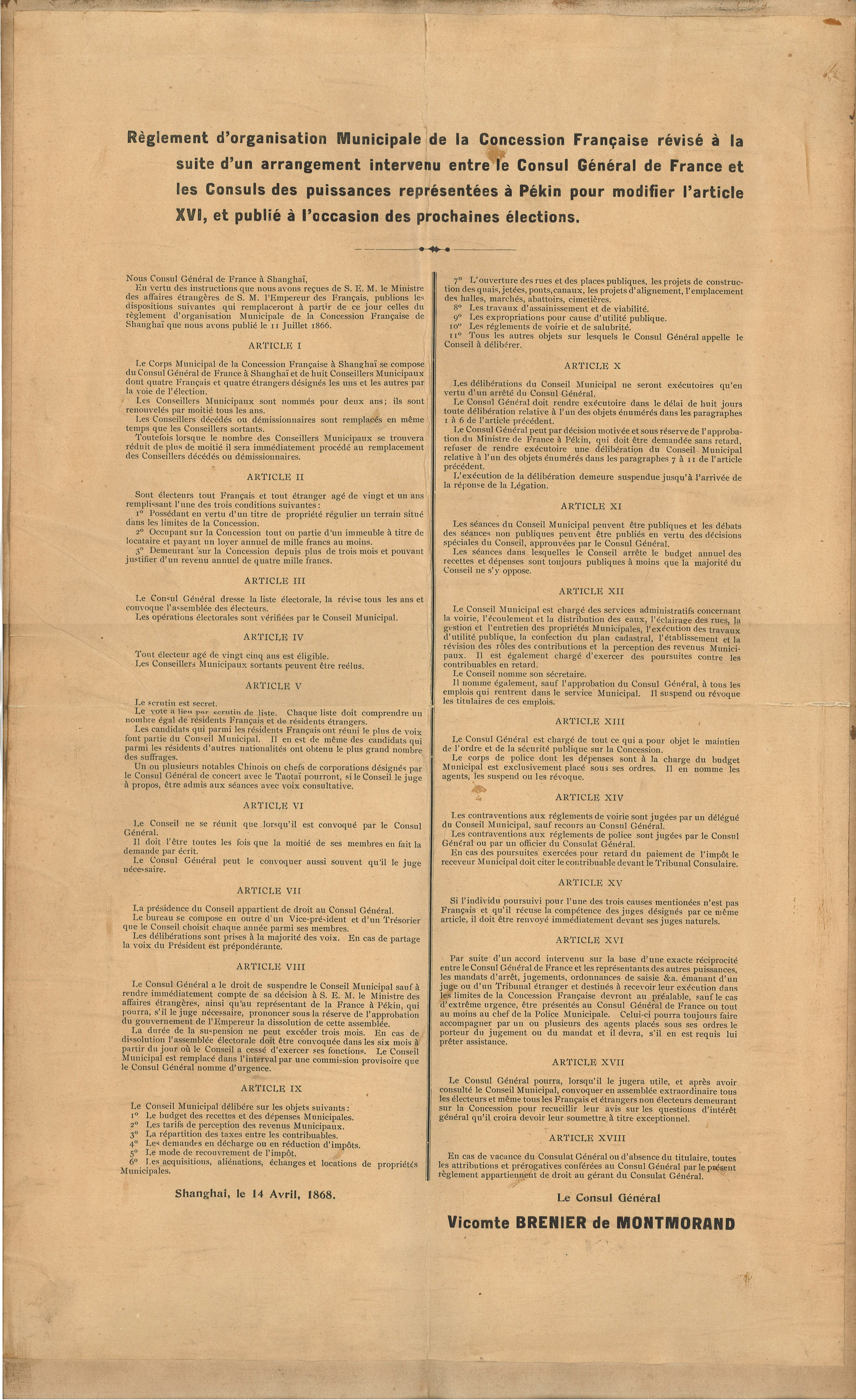
It is precisely this unforeseen autonomy and the lack of clear legal basis, in fact, which created tensions with the overseeing public powers. The self-government of the Municipal Council, for example, was increasingly in contradiction with the initial idea of consular guardianship when the 1854 Land Regulations was promulgated. The consuls often had to remind the Municipal Council to stick to the Land Regulations.Footnote 63 In the French Concession in Shanghai, similar tensions played out between the Council and the Consul-General in 1865 over whether the Council’s authority was independent from the Consul-General and resulted in the dissolution of the former by the latter. The Consul-General then nominated a new Council and, under the instruction of the French Foreign Minister, published the Règlement d’Organisation municipal de la Concession française de Shanghai, which effectively put the Council under the authority of the Consul-General.Footnote 64 All the resolutions decided by the Municipal Council thereafter needed to be approved by him.Footnote 65 Accordingly, the Municipal Council was rendered into a deliberative body and hence significantly less powerful than that of the British-dominated International Settlement.
The evolution of this body politic of the International Settlement was, however, considerably impeded in practice. As the Defence Committee of the Municipal Council lamented, ‘Every year adds to the evidence already existing that our Municipal institutions are imperfect and insufficient. Their authority is questioned constantly, and they are in fact maintained by constant compromises and undignified concessions to individual exactions’.Footnote 66 Meanwhile, the 1860s were also a period that saw several attacks by the Taiping Rebellion against the International Settlement, which made self-defence and political independence the primary concerns of the Municipality. As noted by Morse, the Municipality received no protection from the Chinese government and relied on forces of the imperial powers to preserve its neutrality.Footnote 67
Against this background, the problem of the future government of the Settlement was raised and discussed at the Municipal Council in 1862. The Defence Committee came up with a bold proposal of making Shanghai:
a free city, under the protectorate of the four powers [UK, US, France and Russia, all parties to the 1858 Treaty of Tianjin] whose interests bring them into close connection with this country, but exercising its own government through its own chosen officers, elected under a system of suffrage, that shall give the controlling power to the owners of property – Chinese and Foreign.Footnote 68
The proposed free city would have gone beyond the boundaries of the Settlement, incorporating also ‘its suburbs and the tract of country immediately surrounding’ into one. While relying on the protection of imperial powers, nothing would have impeded the self-government and political independence of the city: ‘a revenue be raised, and an authority exercised, which would ensure order and safety and make this the chief city of the Empire’.Footnote 69
Not surprisingly, the proposal was rejected by the foreign governments. Less than a month after the Defence Committee made it, then British Consul, Medhurst, told the Municipal Council that the land-renters did not have the power to adopt such a plan because the territory belonged to China, who only accorded to the foreign powers an extraterritorial jurisdiction over their own citizens. That sovereignty was not surrendered by China meant that, according to Medhurst, such a project could only be through a grant or charter from the Chinese Emperor, which was quite unlikely.Footnote 70 The reaction of the British Minister, Bruce, was more hostile, describing the scheme as ‘unjustifiable in principle’ and as bringing ‘endless embarrassment and responsibility’.Footnote 71 He started by reminding the community that,
The British concession at Shanghai was neither a transfer nor a lease of the land in question to the British Crown. It is simply an agreement that British subjects should be allowed to acquire land for their personal accommodation within a certain space, in order that they might have the advantage of living together. The land so acquired remains Chinese territory.Footnote 72
He even went as far as to blame the foreign community for inducing troubles within the current municipal government:
the character of the concession has been entirely altered by the acts of the foreigners themselves. Instead of being a foreign Settlement it has become a Chinese city … The security and comfort which were supposed to be derived from isolating the foreign community have been sacrificed, and land has been acquired not for the legitimate purpose of accommodating foreigners, but in order to build on it Chinese houses, which are tenanted by Chinamen at high rates, attracted by the protection our bayonets afford, and by immunity from natural authorities.Footnote 73
The reaction of Bruce was designed to remind the inhabitants of Shanghai of the specifically colonial nature of the whole scheme. The free city was not simply a body politic based on self-government, as the merchants at the Municipal Council considered it, but primarily a colonial project on a Chinese territory whose efforts at governance had been tolerated rather than sanctioned.
In that context, the free city would have controlled a huge Chinese population while displacing the Chinese authorities from their territory and preventing them from controlling Chinese subjects. For the UK government, to endorse a protectorate over the free city would have meant to exercise a protectorate over the Chinese subjects in the Settlement, which was beyond and against the UK’s interests. Bruce put it bluntly,
Great Britain has no interest except in providing a secure place for British trading establishments, and whatever inconveniences may arise from the conversion of the Settlement into a Chinese town, I do not think Her Majesty’s Government will be induced to make a remedy for them by extending its jurisdiction over a larger section of the Chinese population.Footnote 74
According to Bruce, the only case in which the British authority could interfere in a case related to a Chinese subject was when ‘the Chinese is in the employ of a British firm, and where there is reason for believing that the arrest of the Chinese servant is an outrage through him on his employer’. But such interference by the British authority would be ‘in the interests of the British subject, and not the Chinamen which are protected’.Footnote 75 Bruce further stressed that there was ‘no more fertile source of misunderstanding’ than the increase of Chinese subjects in the Settlement, which affected not only Shanghai alone, but the relationship with the whole Chinese Empire. Hence, ‘it is of the utmost importance that we should take no step which cannot be defended upon sound international principle’.Footnote 76 Bruce’s position was endorsed by the rest of the treaty powers.Footnote 77
Thus, the evolution of the Municipality and its Municipal Council, due to either ‘a lasting necessity’ or ‘practical administration convenience’, was subject to at least three kinds of conditions. First, despite the cosmopolitanism of the Municipality, its development needed to be at least not incompatible with the interests of the home countries who offered it protection. And in the present case, the British interests were only ‘trade and pacific relations’ with China.Footnote 78 Second, the treaties with China had to be respected or significantly revised but there was little room in between for changing the fundamental nature of the settlement. In any case, China’s consent had to be obtained, even if superficially, for any projects of the Municipality to proceed. Third, the Municipality was also restrained by the possibility and extent of co-operation among various imperial powers, which was far from being guaranteed. The free city proposal was contradictory to all of these conditions, and hence seemed a wild tale. More often, these conditions were met selectively or with considerable ambiguities, which allowed the Municipality to ‘scrape through’.
4.2 The 1927 proposal
The idea of free city from 1862, though unsuccessful, had always motivated the foreign community in its search for self-government even when the whole structure of extraterritoriality was on the verge of collapse.Footnote 79 In fact, during the second half of the 1920s, at the peak of the Chinese nationalist movement, the conspicuous International Settlement of Shanghai was considered ‘the hard knot at the centre of the problem’Footnote 80 in Sino-foreign relations and had attracted various ideas from both within the SettlementFootnote 81 and international expertsFootnote 82 which sought to maintain its sui generis cosmopolitan character while mitigating the danger posed by Chinese nationalism. The ‘Free City of Shanghai’ put forward in 1927 by Finlayson, a British resident in Shanghai, was a particularly interesting, homegrown proposal which demonstrated the self-imagery of the foreign community. According to Finlayson, Shanghai would be governed by a senate consisting of resident rate payers and land-owners and of a definite number of various nationals. In the Free City, according to this proposal, extraterritoriality would remain, and residents and visitors would be subject to the laws and regulations of the Free City as ‘promulgated and approved by the League of Nations’. The League of Nations, as well as the United States, would then guarantee the neutrality of the Free City in any conflict, and appoint an officer commanding an international militia when neutrality was violated.Footnote 83
The background of this proposal was not entirely dissimilar to that which had arisen 65 years earlier: Chinese society was at the height of nationalism, and the rendition of foreign concessions and the abolition of extraterritoriality were its primary demands. The International Settlement of Shanghai was the main target, especially after the killing by Municipal Police of Chinese protesters on 30 May 1925. In addition, the protection of the International Settlement at that time was largely dependent on British troops, but the Settlement could not take for granted the will of the British government to protect them, as it was clear that ‘troops cannot be kept there indefinitely at the British Government’s expense’.Footnote 84 For one thing, the British government had changed its attitude towards China’s nationalist claims and published the December Memorandum in 1926 and the Treaty Alteration Programme in late January 1927.Footnote 85 The foreign community, especially the British, in Shanghai was urged by the British government to moderate their ‘intransigence towards the Chinese and disregard for their feeling’.Footnote 86 This attempt at internationalizing Shanghai by the foreign settlers illustrates the metaphor of the ‘spoilt children’ who resisted the ‘parental’ guidance of the British government on accommodating Chinese nationalism,Footnote 87 but simultaneously demanded the UK’s military protection when the armies of the Nationalist Government approached Shanghai.Footnote 88
Moreover, the fact that so many different interests in the Settlement coexisted meant that the issue could not be solved by the British government alone. As then British Minister Lampson commented,
It would be hopeless for His Majesty’s Government alone to have a programme only to find when the critical moment came that they had to overcome difficulties not only from the Chinese side but from the side of the other foreign nations concerned.Footnote 89
Therefore, like the first free city proposal, this later one was responsive to the existential precarity of the Settlement of its time. The specificity of this proposal, however, coming as it did in a very different era, was in its reference to the League of Nations. The precedent of the free city of Danzig impressed some foreigners in Shanghai who deemed the League could be of help to solve the perplexing problem that Lampson described as ‘almost insuperable’.Footnote 90 Moreover, the further multilateralization of Shanghai through the league of Nations would not only have been for the purpose of protection but boost Shanghai’s own political status as ‘an active and enterprising cosmopolitan community – in itself already a minor League of Nations second to none in the world’.Footnote 91
Similar to the proposal of 1862, however, this proposal failed. Apart from the issue that the US was not a member of the League of Nations, the analogy between Danzig and Shanghai was deemed by Lampson as more ‘apparent than real’. This was because the problem of Shanghai was not about reconciling the claims of two rival nations but reconciling Chinese sovereignty with the desires of the foreigners living in its midst.Footnote 92 And it was the anti-imperial sentiment already dominant in Chinese society that made such scheme impractical. The British Consul-General, Barton, also saw that ‘while the idea of making Shanghai a ward of the League of Nations is attractive on many grounds, Chinese public opinion would never allow Shanghai to be placed in a position like that of Danzig’ so that the reference to the League of Nations would be regarded by the Chinese as imperialist.Footnote 93 Barton’s view revealed that the Chinese, especially the nationalists, and the foreign community in Shanghai held remarkably different attitudes toward the League of Nations. China’s early demands for treaty alteration under the Versailles-Washington system had produced little consequences,Footnote 94 and the nationalists had depicted the Beijing government who accepted the legitimacy of the Versailles-Washington system as traitorous. Compared to 65 years earlier, when the treaties with China and Chinese sovereignty constrained the power of the Municipality in a more nominal and legalistic fashion, the system of extraterritoriality had been fundamentally shaken by the late 1920s. The free-city proposal had little prospect of success at a time when Chinese nationalism and the weakening of British imperialist hold were forging a new Sino-British relationship.Footnote 95
5. Conclusion
The emergence of ‘International Shanghai’ in the late nineteenth and early twentieth century was a unique and improbable process. It arose in a highly peculiar context marked by a delicate balance between a variety of imperial interests and the host power; a form of territorialized extraterritoriality that did not entirely suppress the sovereignty of China but allowed for significant governance and legal innovations within a particular area; and the dynamism of the private interests of imperial subjects determined to carve out for themselves a degree of autonomy. It is at the junction of those tectonic plates that the Shanghai Municipal Council evolved from a functional organization to one increasingly assuming broad governance powers which was regularly tempted by an even more radical form of emancipation. All the while, however, that private authority had to jostle with the authority of the consuls and of the treaty powers, not to mention of China itself. The fact that Shanghai never achieved the sort of ‘free city’ status that was briefly entertained at times does not make its experiment in a legally pluralistic, intermediary form of self-rule less interesting.
Indeed, from the bullish invocation of terms such as ‘body politic’ or ‘a minor League of Nations’ by the foreign community who perceived and imagined the enterprise of International Shanghai, we can discern the emergence of a sort of transnational constituent power. That power, despite its imperfect publicness and the complex restraints of national allegiance, was articulated by wealthy businessmen from European empires (and soon Japan) at the interstice of multiple imperial powers. In this respect, the history of ‘International Shanghai’ may help expand recent discussions on post-national, cosmopolitan constitutionalism. The latter discussion addresses the current tendency towards the erosion of statehood from both normative and phenomenological perspectives. It has been focused on imagining constituent power as vested beyond the nation state, in the EU, the United Nations or the international community at large.Footnote 96 It has, however, been far less attentive to how constituent authority might emerge from simultaneously local and transnational sites. The experiment of ‘International Shanghai’ shows that concerns addressed by cosmopolitan constitutionalism, have arisen at a very early stage of the development of international law and modern state formation (at least for China).
The quite unique trajectory of Shanghai in China and international law’s history suggests interesting avenues for our understanding of imperialism, private authority and the city. At first glance, the Shanghai episode belongs to the history of imperial practices more than that of international law. It never achieved the sort of formal internationalization that some of its constituents aspired to and could be seen as an oddity in the landscape of international law. Yet international lawyers paid attention at a time when imperialism and international law were joined at the hip, particularly when it came to the complex interaction of trade and the protection of nationals.Footnote 97 As a matter of fact, the practices involved in the making of Shanghai are very telling of an earlier period of international law in which public and private authority were perhaps more evidently embedded.
In a context where major metropolitan centres, spurred by business interests and uncertain political futures, increasingly assert their autonomy (e.g., the London independence movement in the Brexit context, the role of Barcelona in catalysing Catalan independence claims) and sometimes aspire to forge connections directly to international law (e.g., US municipalities ‘signing on’ to climate change agreements), international lawyers would be well to rediscover apparently sui generis forms of private ordering which may have more precedential value than is commonly understood. In the case of Shanghai, this includes the way in which the prototypical imperial city was structured around complex capitalistic and racial lines that made it both dynamic and, in the end, extremely problematic.
The complex imbrication of international law and imperialism at the local level and the way in which governance is realized through interactions of multiple sub-national and supra-national actors has also recently been explored and critiqued by scholars working on development in the localities of the Global South. ‘International Shanghai’ can be seen as a remote but revealing precedent of contemporary international law’s turn to the local – making the local ‘both an object and project of international legal order’.Footnote 98 At the time, the idea of Western tutelage underpinning the making of International Shanghai appeared righteous and self-evident, just as the discourse of development and good governance is often deemed today.
The revival of Shanghai itself in a different form in the last few decades,Footnote 99 the development of Shenzhen, or the distinct but equally telling trajectory of Hong Kong all suggest the significance of urban experimentation in governance and law in China. But they also gesture at the larger significance of cities to reimagine a different international law, one rooted in highly specific metropolitan formations where private transnational forces, national government and local ebullience create conditions for the renegotiation of international legal forms along legally pluralistic lines.

 Open access