





Introduction
If we want to know how issues affect behaviour, we must first find out which issues are salient to individual voters.
(RePass Reference RePass1971: 391)
Which voters prioritise which political issues? Research agrees that issue salience,Footnote 1 i.e. how important an issue is to voters (Wlezien Reference Wlezien2005), affects vote choice by moderating the relationship between issue attitudes and vote choice (Bélanger and Meguid Reference Bélanger and Meguid2008, see Dennison Reference Dennison2019 for an overview). However, there is little research on the determinants of issue salience. We know little about which voters prioritise some political issues over others. This constitutes an important gap in understanding voting behaviour.
One reason why we know little about the determinants of individual-level issue salience is measurement. Most surveys measure issue salience using the ‘most important problem/issue’ question, an open question asking respondents to list which political problem(s) or issue(s) they consider most important. Beyond the critique about its unclear meaning (Wlezien Reference Wlezien2005; Johns Reference Johns2010), this question complicates inference on the determinants of issue salience because we do not learn how important respondents consider non-mentioned issues. While survey research is advancing improved measurements of issue salience (eg Ryan and Ehlinger Reference Ryan and Andrew Ehlinger2023; Cavaillé et al. Reference Cavaillé, Chen and Van der Straeten2024), these are yet to be used to systematically assess issue salience across different policy issues and population groups.
In this research note, we investigate the determinants of issue salience in two steps. Building on the scarce existing research (Boninger et al. Reference Boninger, Krosnick and Berent1995), we identify relevant sociodemographic/socio-economic variables that may influence individual-level issue salience. First, we inductively explore to what extent these variables predict the importance that individuals ascribe to 12 socio-economic and cultural issues across six Western European countries. Second, we use panel data from Germany to test the effects of within-individual changes in relevant variables on issue salience over time. In doing so, rather than measuring issue salience using the ‘most important problem/issue’ question, we analyse a more rarely used measure that enables comparing between respondents who assign low, medium, or high priority across a wide range of issues.
We find that older generations generally prioritise political issues more than younger generations, except on a few issues owned by the left. Further, those with lower living standards prioritise redistribution measures and the environment. The highly educated, in turn, deprioritise immigration, crime, and some redistribution measures, compared to the lower educated. Finally, women and men differ little in their issue prioritisation. With regard to within-individual changes in issue salience over time, we find that changes in income affect socio-economic issue priority, while shifts in left-right ideology affect cultural issue priority. Further, we find that predictors of issue salience often differ from predictors of attitudes. This calls for more research on the determinants of issue salience, using measurements that enable the study of its determinants, and analysing predictors of salience and attitudes separately.
State of the art and theory
The literature on the salience of political issues – i.e. public debate topics of political relevance (Berelson et al. Reference Berelson, Lazarsfeld and MacPhee1954) – distinguishes between salience at the aggregate (national or local) level, for instance sparked by a large-scale event or debate or other contextual factors (Seeberg and Adams Reference Seeberg and Adams2025), party-level salience (Gunderson Reference Gunderson2023, Reference Gunderson2024), and individual-level salience. In this research note, we are concerned with individual-level issue salience. Aggregate-, party-, and individual-level issue salience can be related, as individuals tend to prioritise issues that are salient in the media or at the party level, especially when their preferred party emphasises these issues or certain national conditions increase an issue’s salience (Costello et al. Reference Costello, Toshkov, Bos and Krouwel2021; Jin Reference Jin2024; Seeberg and Adams Reference Seeberg and Adams2025). Still, different individuals within the same context are likely to prioritise an issue differently, with important consequences for their political behaviour. People who prioritise an issue choose to expose themselves to information about the issue, pay more attention to that information, and recall it for longer. They hold stronger opinions on the issue, more likely express their policy preferences on the issue, and are more likely affected by their attitudes towards the issue (Weaver Reference Weaver1991; Miller et al. Reference Miller, Krosnick, Fabrigar, Krosnick, Chiang and Stark2016). Much research finds a moderating effect of issue salience on the relationship between issue attitudes and vote choice (e.g., Fournier et al. Reference Fournier, Blais, Nadeau, Gidengil and Nevitte2003; Dennison and Geddes Reference Dennison and Geddes2019; Hill Reference Hill2022; Otteni and Weisskircher Reference Otteni and Weisskircher2022; Off Reference Off2023), especially when niche parties ‘own’ the salient issue (e.g. Bélanger and Meguid Reference Bélanger and Meguid2008).
Despite the importance of individual-level issue salience for political behaviour, we know little about who prioritises which issues. Research argues that people usually know whether an issue is important to them (Boninger et al. Reference Boninger, Krosnick and Berent1995), which should enable us to meaningfully study this phenomenon. Yet, the determinants of individual-level issue salience remain under-researched (Dennison Reference Dennison2019). A partial exception to this is gender, which is a relatively well-theorised and researched predictor of issue salience (Wängnerud Reference Wängnerud2009; Yildirim Reference Yildirim2022; Cavaillé et al. Reference Cavaillé, Chen and Van der Straeten2024). However, this literature is criticised for its essentialism in assuming women’s interests are based on their seemingly objective gendered experiences. This criticism may be addressed through inductive assessments of gendered issue salience (Yildirim Reference Yildirim2022; Celis et al. Reference Celis, Childs, Kantola and Lena Krook2014). Thus, we inductively explore issue salience by gender and further extend this inductive approach to the assessment of issue salience by other socio-demographic groups. Further, with regard to research on specific policy issues, recent work explores between-individual variation in the salience of immigration (e.g., Hatton Reference Hatton2021; Kustov Reference Kustov2023, Reference Kustov2024). We extend this work to the study of between-individual variation in the salience of other policy issues. To our best knowledge, this is the first study to cross-nationally compare the relationship between several socio-demographic/socio-economic variables and the individual-level salience of several policy issues.
Drivers of individual-level issue salience
To assess the drivers of issue salience, Boninger et al. (Reference Boninger, Krosnick and Berent1995) conducted several studies on mostly convenience samples of US university students and adult residents in Ohio. These are assessed, first, by analysing text answers to open survey questions about why respondents consider certain issues as important; and second, via closed survey items on respondents’ associations with issues they find important. While it is difficult to generalise findings from convenience samples, the authors find that individual-level issue salience is driven by three mechanisms: material self-interest, values, and social group identification.
First, Boninger et al. (Reference Boninger, Krosnick and Berent1995) argue that self-interest drives individuals’ prioritisation of issues that they perceive to affect their rights, privileges, and lifestyle. Similarly, Chong et al. (Reference Chong, Citrin and Conley2001, p. 544) find that ‘people are more likely to recognise their own self-interest, and to act upon it, when their stakes in the policy are clear or when they have been primed to think about the personal costs and benefits of the policy’. Cavaillé et al. (Reference Cavaillé, Chen and Van der Straeten2024) also suggest that material self-interest may affect issue salience, exemplified by an assessment of gender differences in issue priority, but do not test the mechanism. Second, people prioritise issues that align with their values, i.e. their abstract beliefs and ideals about society and how people should behave (Boninger et al. Reference Boninger, Krosnick and Berent1995). Finally, social group identification leads people to prioritise issues of relevance to the group’s rights or privileges and issues that group leaders consider important. While Boninger et al. (Reference Boninger, Krosnick and Berent1995) infer about the mechanisms driving issue salience, research has not systematically tested how these mechanisms translate into differences in issue priority between population groups marked by different socio-demographic/socio-economic variables.
Individual-level issue salience by socio-demographic and socio-economic predictors
In the first empirical part of this research note, we explore how issue salience differs by four socio-demographic variables: education, age, gender, and self-reported living standards. We select these predictors building on Boninger et al.’s (Reference Boninger, Krosnick and Berent1995) identified mechanisms driving issue priority: material self-interest, values, and social group identification. First, material self-interest should be reflected in individuals’ living standards. Specifically, people with lower living standards may be more likely to prioritise socio-economic redistribution measures, given their stronger dependence on such measures. Material self-interest may also be gendered. Women may be more likely to prioritise gender equality and socio-economic redistribution measures and social services that women tend to rely on more strongly than men, e.g. childcare, (maternal), healthcare, and public pensions (Wängnerud Reference Wängnerud2009). Further, material self-interest may drive older generations to prioritise pensions more strongly than younger generations.
Second, regarding Boninger et al.’s (Reference Boninger, Krosnick and Berent1995) identified value mechanism, respondents’ values may most directly influence the relationship between their issue priorities and their education and age. Research agrees that highly educated and younger people tend to hold more progressive sociocultural values than lower educated and older people (Inglehart Reference Inglehart2018; Rekker Reference Rekker2024; Scott Reference Scott2024). According to Boninger et al. (Reference Boninger, Krosnick and Berent1995), these values may lead them to prioritise sociocultural issues more than others, and especially those sociocultural issues traditionally emphasised by progressive parties.
Third, while difficult to disentangle from the self-interest and value mechanisms, social group identification may best be captured by respondents’ gender or age group. Respondents’ gender group identification may affect their prioritisation of gender equality, and their age group identification may affect their prioritisation of, e.g. pensions.
In the second empirical part of this research note, we analyse within-individual changes in issue priority. Here, we focus on Boninger et al.’s (Reference Boninger, Krosnick and Berent1995) self-interest and value mechanisms because we assume social group identification to be stable within the same individual over time. Related to the material self-interest mechanism, we test the effect of within-individual changes in income on issue priority. Similar to the above reasoning on potential effects of self-reported living standards, we expect income changes to affect individuals’ prioritisation of socio-economic redistribution measures. Finally, related to Boninger et al.’s (Reference Boninger, Krosnick and Berent1995) value mechanism, we test the effect of within-individual changes in left-right self-placement on issue salience. While values, i.e. moral beliefs, are arguably more deeply engrained than respondents’ left-right ideology, left-right ideology is related to values and has been shown to predict values (Hatemi et al. Reference Hatemi, Crabtree and Smith2019), as it taps into broader views on egalitarian societal change versus the preservation of inegalitarian social structures (Bobbio Reference Bobbio1996). On this basis, we expect that within-individual changes in left-right ideology may affect individuals’ prioritisation of sociocultural issues in particular.
Overall, while the three mechanisms identified as drivers of issue salience by Boninger et al. (Reference Boninger, Krosnick and Berent1995) relate to the selected sociodemographic variables in different ways, they are difficult to disentangle. We therefore cannot directly test these mechanisms. Instead, our contribution lies in systematically testing the relationships between these socio-economic/socio-demographic variables and different issues’ prioritisation, to better understand who prioritises what.
Data and methods
We use Issue Competition Comparative Project (ICCP) (De Sio et al. Reference De Sio, Emanuele, Maggini, Paparo, Angelucci and D’Alimonte2019) data, collected in 2017–2018 in six Western European countries: Austria, France, Germany, Italy, the Netherlands, and the United Kingdom. To complement the cross-sectional analysis with over-time analysis, we use German Socio-Economic Panel (SOEP) data (Liebig et al. Reference Liebig, Goebel, Kroh, Schröder, Grabka, Schupp and Jürgen2019). Both are relatively rare sources of fine-grained data on individual-level issue prioritisation across a wide range of issues.
Measuring individual-level issue salience
Political behaviour research usually measures individual-level issue salience using the ‘most-important-problem/issue’ question, which complicates research on issue salience determinants. This question asks survey respondents to name one or several problems/issues that they consider most important for the country or themselves. It has mostly been criticised for the unclear meaning of the terms ‘problem’ and ‘issue’ (Wlezien Reference Wlezien2005; Johns Reference Johns2010). Additionally, we argue that this survey question complicates analysing the determinants of issue salience. This is because issues that do not rank among the most important issues are unmentioned, hindering inference on who assigns medium or low importance to an issue. Instead, we present an alternative, rarely used measure of individual-level issue salience that we consider preferable for the analysis of issue salience determinants because it allows comparing who assigns low/middle/high priority for each inquired political issue.
In our cross-sectional analysis, we focus on individuals’ prioritisation of five cultural issues (immigration, gay marriage, gender quotas in politics, environmental protection, and crime)Footnote 2 and seven socio-economic issues (healthcare, inequality reduction, minimum wage, pensions, taxation for social service provision, unemployment, and economic growth).Footnote 3 We choose these 12 issues to maximise thematic coverage while selecting questions providing data for at least two countries. We have measures of both attitudes and salience for seven of these issues (immigration, gay marriage, gender quotas, inequality reduction, minimum wage, pensions, and taxation).Footnote 4 The ICCP classifies the remaining five issues as valence (environment, crime, healthcare, unemployment, and economic growth) and does not collect data on attitudes towards them. For non-valence issues, we compare the socio-demographic/socio-economic determinants of issue salience and attitudes; and for valence issues, we assess the determinants of issue salience only.Footnote 5
In a second step, we analyse German panel data capturing within-individual changes in relevant indicators over time. Here, given data availability, our dependent variables are individuals’ prioritisation of two socioeconomic and three cultural issues: economic development, job security, the environment, crime, and immigration.
To operationalise individual-level salience of the selected issues, we employ a relatively rarely used survey measure. In contrast to the widespread ‘most important problem/issue’ question, this measure provides information on how salient each listed issue is for each respondent, rather than just about the respondents’ top-N most important issues. Thereby, it allows for direct comparisons of salience between different issues and respondents. For our cross-sectional analysis of ICCP data, the following question is repeated for all analysed issues: Do you think that achieving this goal should have a … priority?, to which the possible responses are 1: High, 2: Medium, and 3: Low.Footnote 6 Similarly, the SOEP panel asks for a range of issues: How concerned are you about the following issues?, with response categories ranging from 1: Very to 3: Not at all.Footnote 7 We reverse-coded all variables such that higher values equal higher priority. This measure of issue salience has the disadvantage that respondents can assign the same priority level to all issues, resulting in little variation. In our cross-sectional dataset, we found 5 respondents who assigned the same priority level to all 12 issues. We dropped these cases of response set from our analyses. Hanretty et al. (Reference Hanretty, Lauderdale and Vivyan2020) further argue that respondents are reluctant to assign low priority to issues even when they care little about them. In our analysis, we thus compute a binary variable for issue priority and focus on respondents assigning high (vs. medium or low) priority.Footnote 8
To compare the predictors of issue salience and attitudes, for the ICCP positional issues, we also use respondents’ issue attitudes as dependent variables. These range from ‘1’ to ‘6’, where ‘1’ represents culturally progressive/socio-economic left-wing positions, and ‘6’ represents culturally conservative/socio-economic right-wing positions.
Independent variables
In our cross-sectional analysis of who prioritises which issues, we test the relationships between four sociodemographic/socio-economic variables and issue salience: education, age, gender (binary), and self-reported living standard. Education is coded as binary, where ‘1’ equals ‘tertiary education’ and ‘0’ equals ‘other’. For age, we categorise respondents into groups of people born before 1960 (‘Baby Boomers’), born between 1960 and 1979 (‘Generation X’), and born after 1980 (‘Millennials’ onwards). Self-assessed living standards are measured by a 7-point ordinal variable where ‘1’ equals ‘poor family’ and ‘7’ equals ‘rich family’. To enable coefficient-size comparability across predictors, we rescale the living standards variable to a 0-to-1 scale.
In the German SOEP panel analysis, we use within-individual changes in income (log-transformed to account for its skewed distribution) and left-right ideology as independent variables. These variables are computed by taking the difference between a respondent’s response at t and their response at t-1, computing the within-individual change in a variable based on available survey years: i.e. the experience of an increase, stagnation or decline in income, or ideological self-placement shifts towards the left or right. Given data availability, this analysis is constrained to the years 2005, 2009, 2014, and 2019. Within-individual changes thus capture changes over a 4- to 5-year time period.
Methods
For the cross-sectional analysis, we run mixed-effects logistic regressions of individuals’ issue prioritisation and mixed-effects linear regressions of individuals’ issue attitudes on the above-described predictors. The multi-level model specification accounts for the data structure of individual observations being nested in countries. All models include all four independent variables. Further, we control for political interest (ranging between ‘1’, not at all interested, and ‘4’, very interested), since people with higher political interest may generally prioritise political issues more. We also control for respondents’ assessment of the national economy (better ‘1’, similar ‘2’, or worse ‘3’ than last year), since a perceived worsening national economy may not necessarily directly affect individuals’ socio-economic situation but might still lead them to prioritise socio-economic issues or issues towards which people can redirect economic grievances (such as immigration, e.g., Stockemer and Halikiopoulou Reference Stockemer and Halikiopoulou2023). Because controlling for political interest may introduce post-treatment bias, especially in the models using gender and education as independent variables, we also show bivariate regression results. All models apply robust standard errors and survey weights.
For the subsequent analysis of SOEP data, we run conditional fixed-effects logistic regressions of individuals’ issue prioritisation of two socio-economic and three sociocultural issues.Footnote 9 As independent variables, to leverage the panel structure of our data and appropriately model within-individual change over time (Liker et al. Reference Liker, Augustyniak and Duncan1985), we take the first differences in income (log-transformed) and left-right self-placement. We address potential questions of reverse causality by incorporating a temporal dimension into the model specification: the change in X between t-1 and t temporally precedes Y at the moment t. Relying on available variables in the SOEP dataset, we control for respondents’ age group, tertiary education, political interest, operationalised as per the ICCP models, and year-fixed effects. As Wooldridge tests of serial correlation suggest, we include lagged-dependent variables. We bootstrap robust standard errors.
Who prioritises what?
This section shows bivariate and multivariate regressions of issue priority and attitudes for 12 cultural and socio-economic issues on four selected sociodemographic predictors. First, Figure 1 shows that, generally, healthcare is the most prioritised issue, followed by unemployment, crime, economic growth, and immigration. The least prioritised issues are gender quotas and gay marriage. Next, Figures 2–5 show the relationships between four socio-demographic predictors and the individual-level salience of 12 issues, as well as respondents’ attitudes towards non-valence issues. We run separate models for each of the 12 issues. Thus, each graph shows the results of several models.
General levels of issue priority in the population.

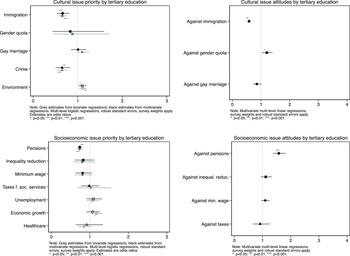
Issue priority and attitudes by education level (tertiary vs. other).
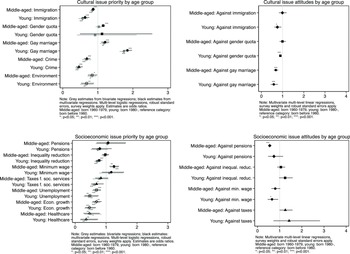
Across Figures 2–5, the different markers illustrate that each estimate stems from a distinct model, where the models differ in their dependent variables.

Issue priority and attitudes by age group.

Women’s (vs. men’s) issue priority and attitudes.

Issue priority and attitudes by self-assessed living standards (0-1, quasi-continuous, higher values equal higher living standards).

Figure 2 shows issue priority and attitudes by education.Footnote 10 People with tertiary education assign less priority to immigration, crime, and pensions, while only prioritising the environment more than people without tertiary education. Regarding respondents’ attitudes, higher education is associated with more progressive attitudes towards immigration, (slightly) more conservative attitudes towards gender quotas, and more economically right-wing attitudes towards pensions. The finding that respondents with tertiary education deprioritise immigration and crime while prioritising the environment may speak to Boninger et al.’s (Reference Boninger, Krosnick and Berent1995) value mechanism, considering that people with higher education generally hold more progressive values (Scott Reference Scott2024). Likewise, their relative deprioritisation of pensions may speak to the self-interest mechanism, as people with higher levels of education tend to be less in need of social security measures. We do not find other differences in issue prioritisation between respondents with and without higher education.
Figure 3 shows issue priority levels and attitudes by age group. It shows that older generations generally prioritise political issues more than younger generations. There are two exceptions: middle-aged and young respondents prioritise gay marriage more than older respondents, and middle-aged respondents prioritise gender quotas and the minimum wage more than older and younger respondents. Regarding their political attitudes, as generally expected (e.g., Inglehart Reference Inglehart2018), younger generations tend to hold (slightly) more culturally progressive and (slightly) more socioeconomically leftist attitudes on pensions and the minimum wage. Older respondents generally assign higher issue priority across several issues and generally hold (slightly) more right-wing attitudes. However, on some issues owned by the left, namely gay marriage, gender quotas and minimum wages, the more left-leaning middle-aged and younger generations assign higher priority than the old generation.
Figure 4 shows women’s (vs. men’s) issue priority and attitudes. Women are more likely to prioritise crime, pensions, and unemployment than men. With regard to their attitudes, in line with previous research (Shorrocks and Grasso Reference Shorrocks and Grasso2020; Langsæther and Knutsen Reference Langsæther and Henrik Knutsen2024), they hold (slightly) more culturally progressive and socioeconomically left-wing attitudes than men, except on inequality reduction. Material self-interest may partly explain these priorities, as women are more likely to experience old-age poverty than men (Ahonen and Kuivalainen Reference Ahonen and Kuivalainen2024) and are more fearful of crime (Reid and Konrad Reference Reid and Konrad2004). Women’s prioritisation of crime, unemployment, and pensions may also reflect higher empathy (Kamas and Preston Reference Kamas and Preston2019). While women are (slightly) more supportive of minimum wages and increased taxation for social services, they do not prioritise these issues more than men. Similarly, women are more progressive than men on cultural issues (especially on gender quotas and gay marriage), but do not significantly prioritise them more than men. Further, while healthcare is often considered an issue of women’s interest (Yildirim Reference Yildirim2022; Mechkova and Edgell Reference Mechkova and Edgell2023), ceiling effects, i.e. the high importance ascribed to healthcare by most respondents (Figure 1), may explain the absence of a significant gender difference in its prioritisation.
Figure 5 shows issue priority and attitudes by self-assessed living standards. Culturally, respondents with higher living standards tend to prioritise crime and deprioritise the environment. Conversely, people with lower living standards prioritise inequality reduction, minimum wages, and unemployment. With regard to attitudes, people with higher living standards are consistently more right-wing on all cultural and socio-economic positional issues but gay marriage. The different prioritisation of crime and the environment by respondents with different living standards may reflect that the economically worse-off hold more left-wing and the better-off hold more right-wing values, and these values affect issue priority. This, however, does not extend to their prioritisation of other cultural issues, including immigration. From an economic viewpoint, our analysis shows that the worse-off prioritise and are more supportive of redistribution measures, which may speak to Boninger et al.’s (Reference Boninger, Krosnick and Berent1995) material self-interest mechanism. In some instances, living standards affect issue attitudes but not issue priority: those with higher living standards are more opposed to immigration, gender quotas, pensions, and taxation, but do not significantly prioritise these issues more than others. In these instances, living standards differently affect issue attitudes and issue priority.
Other noteworthy findings include that individuals’ self-assessed living standards are most consistently related to both their socio-economic issue priorities and attitudes, speaking to its potential consequentiality for political behaviour based on socio-economic issues. Conversely, respondents’ educational level and age are most consistently related to both issue priority and attitudes towards the issue of immigration, with potentially important consequences for political behaviour based on the immigration issue. Younger age is generally related to more left-wing/progressive attitudes but often lower priority. Considering issue priority as a moderator of the relationship between attitudes and political behaviour, the results suggest that younger generations’ more left-wing/progressive attitudes may at times not be reflected in their political behaviour. Further, there are consistent gender differences in attitudes but less so in priority, suggesting that gender differences in attitudes may not directly translate into gender differences in political behaviour. Importantly, this first analysis shows that predictors of issue salience may differ from predictors of issue attitudes. Given the research showing that both importantly affect political behaviour, these results illustrate that both merit being studied in their own right.
Within-individual changes in issue salience over time
Next, we use SOEP data to test the effects of within-individual changes in income (logged) and left-right self-placement on individuals’ issue salience over time.Footnote 11 Figure 6 shows the effects of within-individual changes in income and left-right self-placement on respondents’ prioritisation of two socio-economic and three sociocultural issues: economic development, job security, the environment, crime, and immigration.Footnote 12
Within-individual changes in issue salience over time.
Within-individual changes capture 4- to 5-year time periods. Dependent variables: high prioritisation of each respective issue (binary). Independent variables: changes in income and left-right self-placement. Controlling for the lagged dependent variables, age, education, political interest, and survey year. Only three individuals report changing education levels, distorting effect sizes of education in fixed-effects models (see Table A14 in the Appendix). While effect sizes of the education variable are thus rather meaningless, we still control for education due to its strong correlation with our focal variable, ie income. Fixed-effects and robust standard errors apply. *: p<0.05; **: p<0.01; ***: p<0.001.

The results suggest that increases in income decrease the prioritisation of a socio-economic issue that most directly pertains to individuals who experience income insecurity, namely job security. Conversely, income changes do not affect individuals’ prioritisation of the higher-level and more abstract issue of economic development. Similarly, changes in left-right ideology are reflected in patterns of individual-level issue prioritisation on all selected sociocultural issues. Specifically, the patterns reflect issues traditionally owned by the left and right. As people become more right-wing (and less left-wing), they deprioritise the environment and increasingly prioritise crime and immigration. The results further suggest that income changes do not affect cultural issue priority, and changing left-right ideology does not affect socio-economic issue priority.
Conclusion
Although individual-level issue salience is considered an important predictor of political behaviour, so far, we know little about its individual-level determinants (Dennison Reference Dennison2019). Building on the limited existing research on the drivers of issue salience (Boninger et al. Reference Boninger, Krosnick and Berent1995), to our knowledge, in this research note, we are the first to cross-nationally and longitudinally explore how several socio-demographic variables are associated with the priority that individuals assign to a range of cultural and socio-economic issues.
Our cross-sectional findings include that older generations generally prioritise political issues more than younger generations, except on a few issues owned by the left. Further, those with lower living standards prioritise redistribution measures and the environment. The highly educated, in turn, deprioritise immigration, crime, and some redistribution measures. Finally, women and men differ little in their issue prioritisation. Further, our longitudinal findings on within-individual changes suggest that income changes affect respondents’ prioritisation of socio-economic issues, while changes in left-right ideology affect their prioritisation of cultural issues.
While these findings partly speak to the three mechanisms identified by Boninger et al. (Reference Boninger, Krosnick and Berent1995) as drivers of issue salience, more research is needed to systematically explore the mechanisms explaining these differences in issue priority, i.e. why issue priority differs by socio-economic/socio-demographic factors. Future research may also investigate whether and how the effects of different socio-economic/socio-demographic variables on individuals’ prioritisation of different issues differ by country, given that contextual factors may influence these relationships (Seeberg and Adams Reference Seeberg and Adams2025). Ideally, such comparative efforts should rely on issue priority variables that are measured consistently across several countries.
Methodologically, our analysis illustrates the value of issue-specific, closed survey questions measuring individual-level issue salience, as they enable analysing determinants of issue salience beyond the ‘most important problem/issue’. Further research may explore the sensitivity of our results to other issue-specific measurements of individual-level salience (Cavaillé et al. Reference Cavaillé, Chen and Van der Straeten2024). Finally, our analysis shows that the predictors of issue salience often differ from those of attitudes, which has implications for the study of political behaviour. Since issue salience has been found to moderate the effect of political attitudes on political behaviour, its determinants and drivers merit consideration in their own right. If we do not understand who prioritises which political issues, and why, we cannot fully understand why people engage in certain political behaviour.
Supplementary material
The supplementary material for this article can be found at https://doi.org/10.1017/S1475676525100091
Data availability statement
The original Issue Competition Comparative Project (ICCP) data that support the findings of this study are available at the GESIS repository: https://search.gesis.org/research_data/ZA7499. The data and code used for this project specifically is stored and publicly available in the Harvard dataverse: https://doi.org/10.7910/DVN/ADAEED. The German Socio-Economic Panel (SOEP) data that support the findings of this study are available from SOEP. Restrictions apply to the availability of these data, which were used under license for this study.
Acknowledgements
We wish to thank the four anonymous reviewers, Jacob Gunderson, Bruno Marino, Delia Zollinger, and other participants of the 2024 ECPR Joint Sessions workshop on Cleavage Politics in Western Democracies, the workshop on ‘How Divided is Europe?’ at Goethe-University Frankfurt am Main, and the 2023 SISP Conference, for their very constructive and helpful comments on earlier versions of this manuscript. We further thank Davide Angelucci and Lorenzo De Sio for their helpful suggestions on ICCP data management.
Competing interests
The authors report there are no competing interests to declare.



 Open access

