


Mental illnesses are highly stigmatised conditions. For those with mental illnesses such as schizophrenia, symptoms have a dramatic impact on language, thought, affect, perception and sense of self. 1 Even so, for some, the burden of stigma actually outweighs that of the illness.Reference Hinshaw and Stier 2 Not only do individuals with mental illness experience stigma, but their family members report feeling stigmatised too.Reference Angermeyer, Schulze and Dietrich 3 – Reference Phelan 5 Stigma is a complex, multifaceted process that operates at several levels, including: institutions and structures,Reference Corrigan 6 society (or the public)Reference Corrigan, Kerr and Knudsen 7 and at the level of the individual. Self-stigma, also known as internalised stigma, operates at the level of the individual, and can be conceptualised as ‘a process whereby affected individuals endorse stereotypes […], anticipate social rejection, consider stereotypes to be self-relevant, and believe they are devalued members of society’.Reference Livingston and Boyd 8 Self-stigma has been conceptualised as a counterpoint to constructs such as empowermentReference Shih 9 and self-efficacy.Reference Livingston and Boyd 8 Self-stigma grows from experiences and perceptions of discrimination,Reference Livingston and Boyd 8 and has been postulated to be central to the psychological harm caused by stigma.Reference Livingston and Boyd 8 , Reference Boyd Ritsher and Phelan 10 , Reference Corrigan and Watson 11 Studies show that stigma is experienced,Reference van der Sanden, Bos, Stutterheim, Pryor and Kok 12 perceivedReference van der Sanden, Bos, Stutterheim, Pryor and Kok 13 and internalised by family members of people with mental illness. This phenomenon has been dubbed ‘courtesy stigma’Reference Angermeyer, Schulze and Dietrich 3 or ‘stigma by association’. Research suggests that self-stigma is as damaging for relatives as it is for people with mental illness themselves,Reference Ostman and Kjellin 14 causing psychological distress, suicidal thoughtsReference Ostman and Kjellin 14 and decreased quality of life;Reference van der Sanden, Pryor, Stutterheim, Kok and Bos 15 however, it is postulated to be amenable to change.Reference Shih 9 In order to evaluate the effectiveness of any interventions designed to mitigate self-stigma among relatives of people with mental illness, robust instruments with which to measure it are required.
Whereas the Internalised Stigma Mental Illness scale (ISMI) was developed and validated to measure self/internalised stigma in people with lived experience of mental illness,Reference Ritsher, Otilingam and Grajales 16 no scales have been purpose-built to specifically and comprehensively measure self/internalised stigma among first-degree family members of individuals with mental illness. For example, of the scales that exist for measuring stigma among family members, twoReference Mak and Cheung 17 , Reference Szmukler, Herrman, Colusa, Benson and Bloch 18 were designed for relatives who are providing care for their affected family member (and are therefore not applicable to relatives who are not directly involved with caregiving). Further, one of these instruments includes only a five-item stigma subscale,Reference Szmukler, Herrman, Colusa, Benson and Bloch 18 and the otherReference Mak and Cheung 17 omits a core content area (culpability) that is conceptually important in self/internalised stigma.Reference Link and Phelan 19 An adaptation of the ISMI has been developed for use with parents of individuals with mental illness,Reference Zisman-Ilani, Levy-Frank, Hasson-Ohayon, Kravetz, Mashiach-Eizenberg and Roe 20 and although this has good psychometric properties, it was not developed and purpose-designed for family members, and addresses only one kind of relative – parents. Last, the Devaluation of Consumers and Consumer Families (DCCF) scale has also been used, but this was originally developed to measure family members' perceived social stigma/social stereotype endorsement rather than focusing specifically on self/internalised stigma.Reference Struening, Perlick, Link, Hellman, Herman and Sirey 21 Importantly, it appears that the existing scales that have been used to assess self/internalised stigma among relatives have been founded on the implicit assumption that it is associated with social proximity/caregiving,Reference Ritsher, Otilingam and Grajales 16 , Reference Szmukler, Herrman, Colusa, Benson and Bloch 18 whereas clinical experience and research suggests an important role for biological relatedness in self/internalised stigma.Reference Phelan 5 Tools with which to measure self-stigma in family members of people with mental illness are needed to allow the rigorous assessment of the effectiveness of interventions that may be applied to tackle it. Thus, we aimed to develop and validate a psychometric instrument with which to specifically and comprehensively measure self-stigma among relatives of people with serious mental illness (SMI, specifically, schizophrenia, schizoaffective disorder or bipolar disorder), founding our work on the idea that biological relatedness is important in self-stigma.Reference Phelan 5
Method
Scale development overview
We adopted a structured process that involved both inductive and deductive components that unfolded over several phases. In phase I, we used an inductive group interview-based approach with first-degree family members (biological parents, siblings and children) of people with mental illness to generate a broad array of potential scale items. In phase II we deductively appraised potential scale items in light of the theoretical construction of stigma, to select items for a first draft of a scale. In phase III, we used feedback gathered from cognitive interviews with first-degree relatives of people with mental illness to reduce the number of scale items. Finally, in phase IV, the resulting 30-item scale was validated in a cohort of 195 first-degree relatives of individuals with mental illness.
In all phases, participants were first-degree relatives of people with schizophrenia, schizoaffective disorder or bipolar disorder whom we purposively sampled from family support groups, advocacy agencies and email lists. We confirmed participants' relatives' psychiatric diagnoses using the Family Interview for Genetic Studies, 22 administered via telephone (Table 1). For ecological validity, participants were not excluded if they had a personal history of mental illness, but were asked to consider the influence of a single, specific index family member's diagnosis for activities involved in study participation. The entire study was carried out in accordance with the declaration of Helsinki, and approved by the research ethics board at the University of British Columbia. All participants provided informed consent.
Demographics of participants in phases I, III and IV
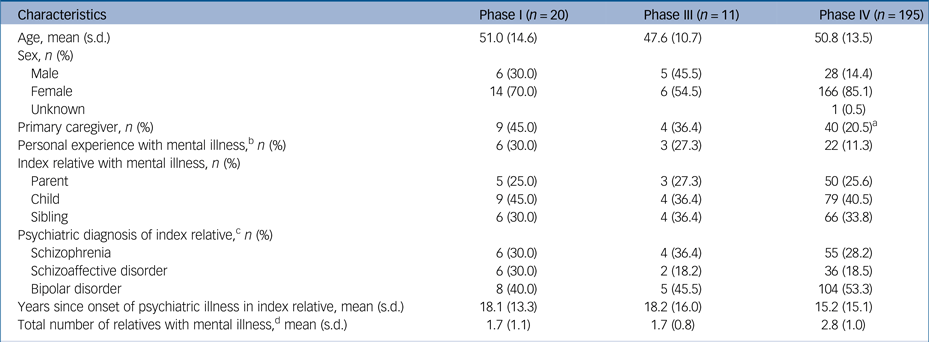
a. Participants who reported living with the index relative with serious mental illness (SMI) at the time of enrolment.
b. Whether the participant had personal experience with mental illness (in phases I and III included all mental illnesses, for example depression, anxiety, phase IV was restricted to SMI), based on self-report.
c. Diagnoses were confirmed using the Family Interview for Genetics Studies (FIGS),22 with the exception of one participant in phase I, in which diagnosis was self-reported.
d. In phase III and IV, when the participants had more than one first-degree relative with a mental illness of interest, we administered the FIGS regarding the individual for whom they had the most knowledge of symptoms and diagnosis to confirm the participant's eligibility – this became their ‘index relative’.
Phase I: item generation (group interviews)
We conducted six group interviews with participants, including three for relatives of people with schizophrenia/schizoaffective disorder (one each for parents, siblings and adult children), and three for relatives of people with bipolar disorder (again, one each for parents, siblings and adult children) (Table 1). Group interviews (each ~2 h in length) were semi-structured in format, with discussion focused on stigma and feelings of self-stigma because of having a family member with a mental illness (See supplementary Appendix 1 for the interview guide; available at https://doi.org/10.1192/bjp.2017.23).
The interviews were audio-recorded, transcribed verbatim and checked for accuracy. Two team members carefully and independently reviewed each transcript to identify quotations that seemed representative of, or particularly meaningful to, the group in which they occurred. An inclusive, consensus-based approach used by the reviewers led to the identification of 130 quotations to be considered for use as potential scale items.
Phase II: item selection (expert input, deductive phase)
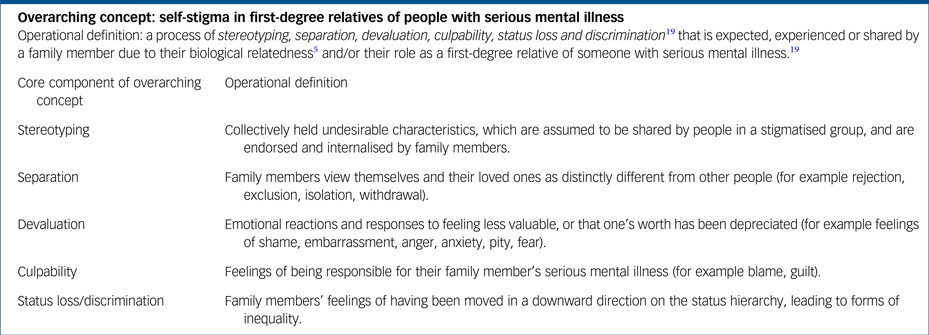
Six members of the team reviewed each of the 130 quotations identified as potential scale items. Each quotation was categorised by group consensus to one of the five core theoretical content areas of self-stigma identified from the literatureReference Link and Phelan 19 (see Table 2). We reached consensus that no additional core content areas were present in the interviews, and that no important topics were missing, and guided by the existing literature, operationalised our concept of self-stigma in relatives of individuals with mental illness and its core components (Table 2). To produce a first draft of a scale, we selected 74 quotations that collectively covered all five core content areas of self-stigma, and ensured that all interview groups were represented. Then, we carefully reframed the 74 quotations such that they could be answered using a Likert scale response (using the following anchors: 1, strongly disagree; 2, disagree; 3, neither agree nor disagree; 4, agree, 5, strongly agree), and modified the wording of items to clarify meaning, and to ensure that some items would be reverse coded, thus generating our first draft of the scale.
Operational definitions of self-stigma and its core components
Phase III: item reduction (cognitive interviews)
We conducted cognitive interviews with 11 first-degree relatives of people with SMI (Table 1) during which participants talked through their process of answering each of the 74 draft scale items and provided feedback on their understandability and pertinence. Interviews were audio-recorded and participants' comments on each item were transcribed. Again, six team members collaboratively reviewed the data from the cognitive interviews and removed or revised those items identified by interviewees as lower priority, problematic or redundant, while ensuring that all of the five core conceptual domains of stigma were still well represented. Through this process, the 74 items were reduced to a scale composed of 30 items that was piloted in the validation phase of the study (see supplementary Appendix 2).
Phase IV: validation
Overview
Since full psychometric validation of scales requires five to ten participants per item,Reference Kass and Tinsely 23 and the draft SSRMI had 30 items, we aimed to recruit approximately 200 participants. Participants were asked to complete a demographic information questionnaire as well as the 30-item SSRMI scale (for scoring and participant instructions, see supplementary Appendix 2), along with four other validated questionnaires to assess construct validity. This set of scales was administered to participants twice to establish test–retest reliability: at baseline (T 1) and 1 month later (T 2).
Psychometric analysis
Data from the validation phase (phase IV) were screened for missing values. Randomly missing values were replaced at the item level using maximum likelihood interpolation for SSRMI at T 1 and T 2. The data were then screened for multivariate outliers.
Tests for normal distribution including Bartlett's test of sphericity and the Kaiser–Meyer–Olkin measure of sampling adequacy were also performed. For establishing internal consistency, Cronbach's alphas for the SSRMI as a whole, and for each of the five individual core conceptual content areas were calculated. Test–retest reliability was calculated for the SSRMI scale as a whole and for each of the content areas.
Exploratory-factor analysis
The T 1 data were used to explore the factor structure of the SSRMI. Factor analyses were completed with scree plot tests, the Kaiser criterion, parallel analysis and Velicer's minimum average partial (MAP) test. Because the nominal structure of the instrument involved five core conceptual content areas, a maximum likelihood extraction set to extract five factors with an oblique rotation (direct oblimin) was then performed. Subsequent tests involving two, three and four factors were also conducted. A final exploratory-factor analysis was conducted to investigate a one-factor structure for the items, based on the results from the scree plot test (see supplementary Fig. 1).
Construct validation
The selection of our external correlates was informed by the psychometric validation of the ISMI.Reference Ritsher, Otilingam and Grajales 16 We selected: the Centre for Epidemiological Studies Depression Scale (CES-D) to measure depressive symptoms,Reference Radloff 24 the DCCFReference Struening, Perlick, Link, Hellman, Herman and Sirey 21 to measure perceived stigma, the Rosenberg Self Esteem Scale (RSE)Reference Rosenberg 25 to measure self-esteem, and a subset of participants also completed a measure of empowerment (Empowerment Scale (ES)).Reference Rogers, Chamberlin, Ellison and Crean 26 We expected the CES-D and DCCF scores to have moderate positive correlations with SSRMI, and the RSE and ES to have moderate negative correlations with SSRMI. Correlations between the SSRMI and the CES-D, RSE, DCCF and ES were calculated.
Developing the ten-item SSRMI
Given that exploratory-factor analysis suggested a single-factor latent structure for the instrument, we also developed a ten-item version of the SSRMI. To ensure breadth of content was retained, we identified two items from each of the five conceptual content areas that best captured the core of each domain, according to group consensus. Each selected item had a significant loading on the single-factor solution to the original 30-item exploratory-factor analysis. Psychometrics analyses were conducted for the ten-item version.
Results
The results of the phase IV validation are presented here. Participant characteristics are described in Table 1. For the 30-item SSRMI, 26% of participants had scores at the midpoint or higher at T 1.
Data preparation
A total of n = 195 participants participated in the validation phase. Two participants' data exceeded the critical value for multivariate outliers and were excluded from the factor analyses, leaving n = 193 for factor analysis. A total of 24 participants did not respond to any SSRMI items at T 2 and were included in analyses involving only T 1 data, but excluded from analyses requiring T 1 data. We used a multiple imputation procedureReference Buuren 27 to replace random missing values (107 at T 1, and 20 at T 2).
Thirty-item scale
Data from the SSRMI were approximately normally distributed. Significant intercorrelations were found between the variables according to Bartlett's test of sphericity (χ 2(435) = 2573.96, P < 0.001) and the Kaiser–Meyer–Olkin measure of sampling adequacy (0.87).
Internal reliability
Cronbach's alpha for the 30-item scale was excellent (α = 0.90). Reliability of the stereotyping (α = 0.62), and status loss and discrimination (α = 0.41) core conceptual content areas were inadequate against the accepted criterion for Cronbach's alpha of 0.70. Reliability of the separation content area (α = 0.76), culpability content area (α = 0.77) and devaluation content area were adequate (α = 0.77).
Test–retest reliability
Strong test–retest reliability over a 1-month period was demonstrated for the 30-item SSRMI as a whole (r = 0.90, P < 0.001), as well as for the core conceptual content areas individually: status loss and discrimination (r = 0.78, P < 0.001), separation (r = 0.81, P < 0.001), stereotyping (r = 0.78, P < 0.001), culpability (r = 0.80, P < 0.001) and devaluation (r = 0.84, P < 0.001).
Relationships with demographic variables
Investigation of groups in the data by ANOVA found that the SSRMI scores were unrelated to family member's diagnosis, sex, relationship to family member with mental illness, or presence/absence of a personal history of SMI (Table 3).
Mean Self-Stigma in Relatives of people with Mental Illness scores for the 30-item and 10-item scales
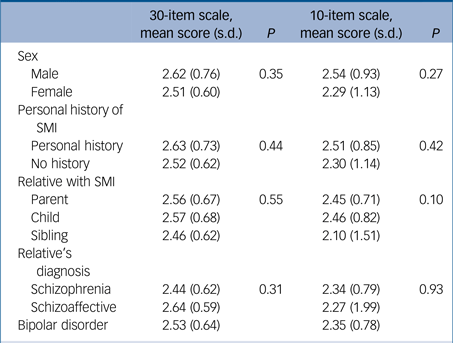
SMI, serious mental illness.
The SSRMI 30-item scale had statistically significant correlations in the expected directions with the CES-D, DCCF, RSE, and ES (Table 4).
Correlations of the Self-Stigma in Relatives of people with Mental Illness (SSRMI) 30-item and 10-item scales with external correlates

Exploratory-factor analysis
The number of factors to be retained for analysis differed across the various methods applied: The scree plot (supplementary Fig. 1) suggested a one-factor solution (explaining 27.5% of the variance), Kaisers criterion suggested seven, parallel analysis suggested four factors and Velicer's MAP test suggested five. The results from maximum-likelihood extraction established that the five components accounted for 44.57% of the total available variance. However, the five components extracted did not align closely with the theoretically derived surface structure of the instrument, and subsequent analyses with two, three and four factors extracted and subject to oblique rotation did not provide any further support for the five subscales. The final exploratory-factor analysis was conducted to investigate the items as having a one-factor structure showed that a single-extracted factor explained 29.57% of the variance, with 26 of the 30 items having significant loadings on this factor. All five subscales were well represented.
Ten-item scale
At T 1, 23% of participants had scores at midpoint or higher on the ten-item SSRMI. Internal reliability of the ten-item short-form SSRMI was very good (α = 0.82), and Cronbach's alpha could not be improved by removing any of the items. Test–retest reliability was also good (r = 0.86, P < 0.001).
Investigation of groups in the data by ANOVA found that the ten-item SSRMI scores were unrelated to sex, relationship to family member with mental illness, family member's diagnosis or presence/absence of a personal history of SMI (Table 3). The ten-item short-form SSRMI had meaningful associations with the CES-D, DCCF, RSE, and ES (Table 4). In sum, the pattern of associations between the 30- and 10-item SSRMI is identical; this confirms the utility of the abbreviated version of the scale.
Discussion
Main findings
We developed a novel, comprehensive measure of internalised stigma among first-degree family members of people diagnosed with SMI. Using a mixed-methods approach, we developed a 30-item measure with excellent internal reliability, and appropriate test–retest reliability, for which we found evidence in support of construct validity. Contrary to expectations, psychometric analyses did not provide support for five subscales in the instrument. Rather, across analyses it seemed appropriate to infer that the new scale is best understood as tapping a single overarching construct. A pragmatic consequence of this conclusion was the possibility of developing a brief version of the instrument – the ten-item SSRMI retained the broad content coverage of the full instrument and demonstrated comparable psychometric features. As the two versions of the scale are comparable in terms of psychometric features, to ease response burden for participants, the 10-item SSRMI may be preferable to the 30-item version in many settings.
We note that analyses of Ritscher et al's ISMI generated a similar pattern of findings to those described here,Reference Ritsher, Otilingam and Grajales 16 with exploratory analyses suggesting that self-stigma because of a personal diagnosis (while theoretically referring to a number of psychosocial processes) is best measured in a single construct and as a single-scale score.
Scores above midpoint on the ISMI have been used to define proportions of studied groups of individuals with mental illness as having ‘high stigma’.Reference Boyd, Adler, Otilingam and Peters 28 Our finding that approximately a quarter of participants scored at or above midpoint on the SSRMI is broadly comparable with proportions of individuals with mental illness who score above midpoint on the ISMI.Reference Boyd, Adler, Otilingam and Peters 28 Although it is not possible to draw direct comparisons between the two sets of data, it does suggest support for the concept that self-stigma is an important issue for family members of people with SMI,Reference Angermeyer, Schulze and Dietrich 3 , Reference Ostman and Kjellin 14 , Reference van der Sanden, Pryor, Stutterheim, Kok and Bos 15 and that there may be a need for the development of interventions (for example psychoeducation,Reference Levy-Frank, Hasson-Ohayon, Kravetz and Roe 29 genetic counsellingReference Austin and Honer 30 , Reference Inglis, Koehn, McGillivray, Stewart and Austin 31 ) designed to reduce self-stigma in this population.Reference Angermeyer, Schulze and Dietrich 3 , Reference Zauszniewski, Bekhet and Suresky 32 , Reference Buizza, Schulze, Bertocchi, Rossi, Ghilardi and Pioli 33
Limitations
Some participants in our study also self-reported a personal history of mental illness, which could potentially be seen as a limitation of our study group. We decided against excluding participants with a personal history of mental illness in the interests of ecological validity, and explicitly instructed participants to focus on their experience as a family member. Our approach was supported by the finding that having a personal diagnosis did not relate to SSRMI scores. Further, our data suggest that perhaps self-stigma as a result of a family member's diagnosis could be different from self-stigma related to a personal diagnosis.
We did not assess the utility of the scale among family members other than first-degree biological relatives, its potential applicability for second-degree and non-biological family members remains to be assessed.
Implications
While other instruments have been used to measure stigma in relatives of people with mental illness,Reference Mak and Cheung 17 , Reference Szmukler, Herrman, Colusa, Benson and Bloch 18 , Reference Zisman-Ilani, Levy-Frank, Hasson-Ohayon, Kravetz, Mashiach-Eizenberg and Roe 20 , Reference Struening, Perlick, Link, Hellman, Herman and Sirey 21 the SSRMI is the first and only self-stigma measure to be developed with direct input from family members to specifically and comprehensively measure self/internalised stigma among first-degree family members of individuals with mental illness. Robust analyses demonstrate that it has strong psychometric properties. The SSRMI has numerous applications in both clinical and research settings to measure self-stigma and to serve as a useful tool to measure the impact of interventions designed to improve outcomes in relatives of people with mental illness.
Funding
The development of the scale was made possible by funding from UBC's Hampton Grant program, and J.A. was supported by the Michael Smith Foundation for Health Research, the Canadian Institutes of Health Research, BC Mental Health and Addictions Services, and the Canada Research Chairs program.
Acknowledgements
The authors would like to thank all participants who participated in each phase of the scale's development, as well as all members of the Translational Psychiatric Genetics Group for their ongoing support.
Supplementary material
Supplementary material is available online at https://doi.org/10.1192/bjp.2017.23.




eLetters
No eLetters have been published for this article.