

I. Introduction: multi-risk analysis and governance
We live in a world of multiple risks.Footnote 1 Consider current efforts to address risks from, for example, accidents, air pollution, AI, chemicals, climate change, disease, disasters, financial crashes, food, terrorism, tsunamis, water, wastes and more. Policies to reduce any one risk may implicate other risks; for example, food safety regulations may involve complex tradeoffs among the risks of foodborne illnesses, chemical exposures, animal suffering, food waste, packaging materials, environmental pollution, food insecurity, and economic burdens. Societies seek, but struggle, to govern multiple simultaneous and interconnected risks.Footnote 2 Some of these risks may be existential, threatening the existence of humanity or all life on Earth.Footnote 3
A recurring problem is the tendency to focus only on one “target risk” or intended outcome at a time, thereby neglecting other risks – narrowly targeting one out of multiple simultaneous stressors, and also neglecting the side effects on other risks from policies to govern the target risk.Footnote 4 In a multi-risk world, policies to reduce a target risk may also affect other risks, both old and new, potentially posing risk–risk tradeoffs.Footnote 5 Multi-risk governance aims to address multiple risks, and both intended and unintended consequences of policy options (including both co-benefits and countervailing risks). Hence multi-risk governance involves analytic methods and institutional capacities to: (i) identify and catalogue the multi-risk effects of each candidate policy option; (ii) evaluate and weigh such multi-risk effects and tradeoffs, in order to select policies that best reduce overall risk; and (iii) develop even better “risk-superior” options that overcome trade-offs by reducing multiple risks in concert.Footnote 6
Importantly, the identification of multi-risk effects (such as countervailing risks) does not necessarily warrant declining to manage the target risk. A countervailing risk increase may be small relative to (and thus justified by) the target risk reduction (plus co-benefits). Even if the countervailing risks are relatively large (in some cases possibly even larger than the target risk reduction), they may warrant selecting or designing a different policy option that still reduces the target risk and also better reduces overall risk.Footnote 7
Governance policy responses to climate change must navigate this multi-risk world. In Part II of this paper, we identify the multi-risk profiles of key climate policy response strategies, including mitigation (reducing greenhouse gas [GHG] emissions and enhancing GHG sinks to prevent climate change),Footnote 8 adaptation (improving resilience to climate impacts), and a third strategy, reflection (cooling the Earth via solar radiation modification (SRM)).Footnote 9 In all three types of response strategies, each specific policy option may also affect other risks, including unintended effects on climate and on non-climate risks. No climate policy is immune to multi-risk interactions, though some policies are better than others at dealing with the multi-risk challenge. In Part III, we examine governance frameworks corresponding to these multiple risks, notably governance frameworks that are uncoordinated, coordinated, and comprehensive. We compare the pros and cons of these three types of governance frameworks in a multi-risk world. We then suggest new governance mechanisms for SRM that can build from uncoordinated toward more coordinated and even comprehensive governance approaches, and can find support from SRM researchers, advocates, and critics. These governance mechanisms include a series of iterative and transparent international assessments, and a transparent international monitoring system for SRM.
II. Multi-risk analysis of climate change policies: mitigation, adaptation and reflection
Climate change is a multi-risk problem. It exhibits multiple simultaneous stressors: multiple greenhouse gases (GHGs) from multiple sectors and sources in multiple countries, contributing to rising global atmospheric concentrations and increasing radiative forcing, with multiple impacts around the world, including on temperature and heat stress, precipitation, flooding, wildfires, glacial melting, sea level rise, vector-borne diseases, agricultural shifts, biodiversity loss and ocean acidification. It interacts with other problems such as stratospheric ozone depletion, air pollution, land use, biodiversity loss, food security and energy access.Footnote 10
The primary policy response to climate risks has been mitigation: reducing emissions of GHGs such as CO2, CH4, N2O and HFCs, and/or enhancing sinks of these gases such as through carbon dioxide removal (CDR) and sequestration. But slow progress on mitigation, and worsening climate impacts, have increased attention to adaptation – improving resilience to climate impacts – and, over time, to a third approach, reflection: strategies to cool the Earth slightly, such as solar radiation modification (SRM).Footnote 11
These three strategies of climate policy – mitigation, adaptation and reflection – might be viewed as alternative substitutes, but they are also potential complements, because they operate in different scales of space and time, on different elements of climate risk (e.g., reducing probability vs. reducing impacts), and some argue that they might all be needed if climate risk becomes extremely acute and no one strategy is sufficient.Footnote 12 Methods of SRM have been understood by scientists since at least the 1960s, but are now receiving increasing attention, as mitigation has been slow and impacts have worsened. “After a long slow start, solar radiation modification (SRM) is seeing a rapid increase in research, attention, involvement of private and public organisations, and controversy.”Footnote 13 Several high-level reports on SRM have been issued in recent years.Footnote 14 SRM methods include stratospheric aerosol injections (SAI) of particles such as sulfates (emulating the observed global cooling effect of major volcanoes); marine cloud brightening (MCB) for regional cooling; and a space-based planetary sunshade system (PSS) positioned on a stable orbit between the Earth and the Sun.
A good working hypothesis is that every climate policy option may have multi-risk effects. Some options may be better overall than others, but no policy is immune to the multi-risk reality.Footnote 15 The specific multi-risk effects depend on the specific policy option, so each policy has a different multi-risk profile or portfolio.
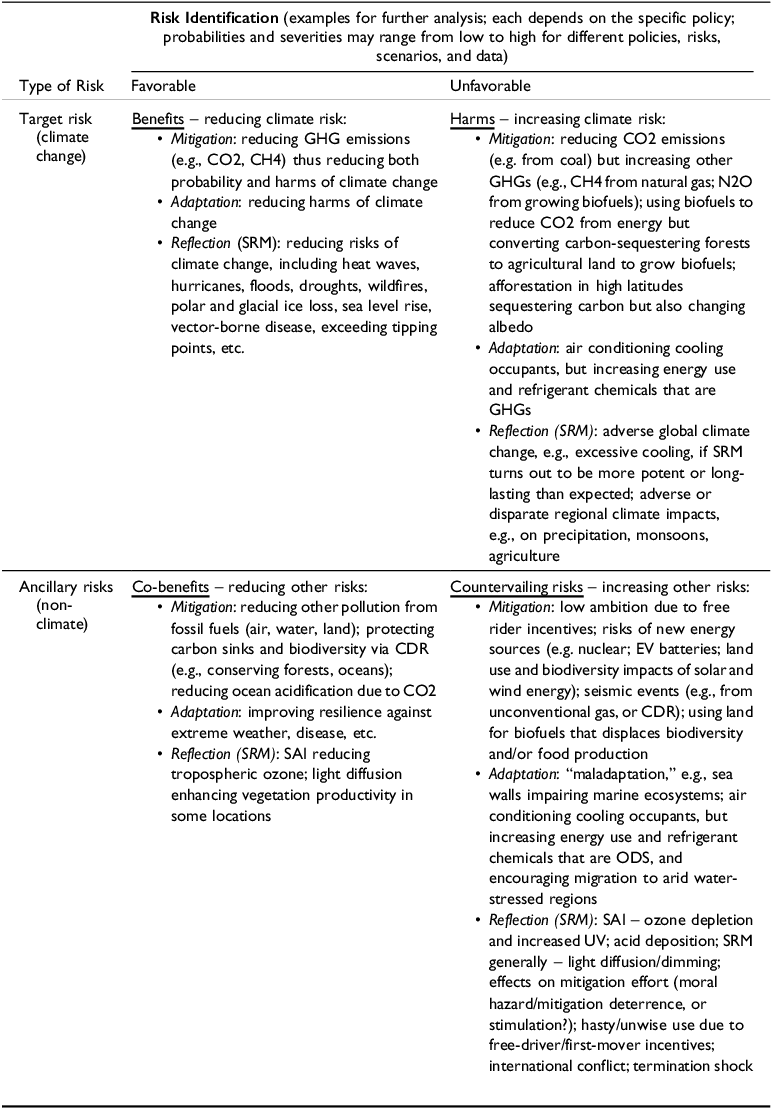
We identify the multi-risk effects of each climate policy strategy – mitigation, adaptation, and reflection – in Table 1. These multi-risk effects include favorable and unfavorable effects on the target risk of climate change, and favorable (co-benefits) and unfavorable (countervailing risks) effects on non-climate risks, as indicated in the four quadrants of Table 1. This process of “risk identification” depicted in Table 1 is intended to help the analyst and policy maker confront the portfolio of multiple risks, beyond just the target risk, associated with each policy option. The lists in Table 1 are not exhaustive; there may be others. The policy options in Table 1 are only described at a very coarse level of generality; risks will vary for more specific policy designs. And the exercise of assembling Table 1 does not yet seek to quantify each risk. Rather it illustrates the key step in multi-risk analysis of: (i) identifying and cataloging the multi-risk effects of each policy option, rather than focusing on the target risk and neglecting or disregarding other effects. This is a key predicate to then (ii) evaluating and weighing the multiple risks, to select or designthe best policy to reduce overall risk, and (iii) seeking even better “risk-superior” policies. Assembling Table 1 also assists in identifying those groups affected by each risk, helping to overcome potential “disregard” or “omitted voice” of affected groups, and fostering more inclusive participation in governance by all affected groups.Footnote 17
Identifying multiple risks affected by climate response optionsFootnote 16

For example, mitigation measures to reduce GHG emissions may reduce climate risk, but may pose a variety of multi-risk effects (depending on the specific policy), such as the co-benefits of reducing conventional air pollution, and the countervailing risks of shifting from one GHG (e.g., CO2) to another (e.g., CH4 or N2O), shifting from one energy source (e.g., coal, oil or gas) to another (e.g., nuclear, hydro, wind or solar), and shifting land uses such as biofuel cultivation and/or forest conservation.Footnote 18
Meanwhile, adaptation measures may also affect multiple risks, such as “maladaptation” that harms other ecological or social systems. For example, sea walls to shield against storm surge may also interfere with marine ecosystems, and air conditioning to cool dwellings may also use energy that increases emissions of GHGs.Footnote 19
As indicated in Table 1, the third strategy, SRM, also poses multi-risk effects. It is not just reversing climate risk; SRM introduces a new climate modification at the same time that GHGs are forcing climate change. Each technique of SRM may reduce climate risk but also pose multiple other risks. Numerous observers have therefore called for risk–risk analysis of SRM.Footnote 20 For example, as indicated in Table 1, SRM may reduce peak temperature impacts and thereby reduce mortality from heat,Footnote 21 and it may benefit warmer countries more than colder countries.Footnote 22 If SRM were deployed and took effect quickly (faster than mitigation), perhaps it could help avoid key tipping points, such as for wildfires, glacial melting and other climate risks.
But as Table 1 also highlights, SRM (specifically SAI) could also pose countervailing risks, including adverse climate changes (globally and regionally), acid deposition, slowed recovery of stratospheric ozone, and light dimming and diffusion with possible effects on photosynthesis. In addition to these biophysical risks, SRM could also pose sociopolitical risks, such as unilateral or non-cooperative use and attendant international conflictFootnote 23 (if countries disagree on the optimal global temperature – or if they just disagree on who is in control), adverse influences on mitigation effort (dubbed mitigation deterrence or moral hazard, if actors relax their mitigation efforts in reliance on SRM – though the research findings are mixed, with many studies finding no effect or even the opposite effect of stimulating added mitigationFootnote 24), and “termination shock” if SRM were started and then stopped while GHG concentrations remained high and the Earth’s climate re-warmed rapidly.Footnote 25 The multi-risk framework helps to identify, evaluate, weigh and compare such multiple risks holistically, to reduce overall risk, and seeks new risk-superior policies that reduce multiple risks in concert.Footnote 26
If the SRM technology were instead a space-based planetary sunshade system (PSS), a kind of parasol placed in a fairly stable orbit around Sun-Earth LaGrange point L1 (about 1% of the distance from the Earth to the Sun, or just under a million miles from Earth),Footnote 27 the climate risk reduction benefits (by reflecting or deflecting a small percentage of energy from the Sun) could in principle be similar to those from SAI (injecting reflective particles into the Earth’s stratosphere). But the PSS would avoid the countervailing risks of putting particles (e.g. sulfates) into the stratosphere, such as acid deposition and ozone depletion.Footnote 28 The countervailing risk of unilateral/non-cooperative deployment could be lower (than for SAI) if the PSS remains much more expensive to deploy than SAI; but PSS technology is being advanced, the cost of space launches has been declining, and the number of spacefaring countries (and corporations) is growing, so the likelihood of some actor developing a PSS may be rising.Footnote 29 The prestige (national or entrepreneurial) from launching the PSS and “winning the (next) space race” could add momentum to unilateral deployment of PSS, compared to SAI. The PSS might thus accentuate the sociopolitical risks of international conflict, if there is a race to capture the scarce orbital location at L1, or if countries disagree on optimal global temperature, or if they disagree on who controls the global thermostat. The risk of termination shock might be different for PSS than for SAI, if deploying an expensive and prestigious PSS would elicit greater political dependency – perhaps a lower probability of termination for PSS than for SAI (though the PSS technology might have glitches), but potentially a greater harm from termination for PSS than for SAI (and more costly and time-consuming to replace or resume PSS than to resume SAI). These multiple risks warrant research.
MCB presents a different multi-risk profile, and uncertainty regarding its mechanisms and impacts is high.Footnote 30 MCB could involve ships spraying sea salt aerosols into the lower atmosphere, resulting in regional or even global cooling, depending on the geographical scale of deployment. In comparison to SAI, the short lifetime of the MCB particles could in principle allow for a more targeted deployment aimed at cooling a particular region, country, or ecosystem.Footnote 31 If MCB were deployed at this scale it might pose lower risks (than would SAI) for mitigation deterrence or termination shock. Yet such localised MCB could have unintended side effects on neighboring countries (with changing precipitation patterns) and also globally via teleconnections. MCB deployed at a scale aiming to cool the globe could bring large negative side effects, depending on the specifics of the deployment strategy.Footnote 32 It thus seems worth investigating both regional and global MCB deployment scenarios. Moreover, analysis is needed of scenarios of multiple simultaneous MCBs, if multiple actors each deployed their own version of MCB, posing the risks of interactions among these multiple MCB interventions, both environmentally and geopolitically.
III. Multi-risk governance of SRM
1. Current governance frameworks
Governance of multi-risk problems entails several functional tasks, including: risk assessments of multiple stressors, including their joint effects; standard-setting and policy design, informed by prospective (ex ante) impact assessments, including of multi-risk effects; implementation and enforcement; monitoring of ongoing outcomes, both intended and unintended; retrospective impact assessments (ex post evaluations), including of multi-risk effects; and adaptive learning and updating. Addressing multiple risks, including unintended consequences, under uncertainty, puts a premium on adaptive learning.Footnote 33 Impact assessments (prospective and retrospective), monitoring, and adaptive updating all need a broad scope in order to assess and address both intended and unintended outcomes.
Actual governance frameworks do not always – or often – undertake all of these tasks. In principle, these tasks could be undertaken by a single institution or by multiple institutions. In a multi-risk world, yet one in which analysts, decision makers and institutions often focus narrowly on a target risk, it is often the case that governance is a patchwork in which key tasks are omitted, important risks are neglected, and affected groups are disregarded – and, where the key tasks are undertaken, each risk is often regulated by a separate treaty, law or regulation, implemented by a separate ministry or agency, within each of many separate national governments. This pattern yields a complex array of multiple institutions applying multiple policies to multiple risks – but not addressing all key tasks, nor all important risks, nor all affected groups, nor accounting for all the important risk–risk interactions, and hence falling short of the best opportunities to reduce overall risk and to engage all affected groups.
The current governance framework for climate change, including the Framework Convention on Climate Change (FCCC),Footnote 34 the Paris Agreement,Footnote 35 other international agreements and multiple national laws, is already a “regime complex” with multiple institutions addressing multiple facets.Footnote 36 Governance of SRM could also take such a multi-institutional approach.Footnote 37 Here we describe the current array of governance of SRM, after which we suggest steps to advance toward better multi-risk governance of SRM.
Along a spectrum of potential multi-risk governance institutions, from highly fragmented to highly cohesive, these multiple institutions could be:
-
(1) uncoordinated, acting independently (and with some gaps in coverage); or
-
(2) coordinated with each other (acting separately but interdependently, in communication and seeking to cover gaps and address multi-risk interactions); or
-
(3) comprehensive, with a single regulator (or oversight body) to orchestrate all the key tasks for the full multi-risk portfolio.
Moving along this spectrum from fragmented uncoordinated, to more coordinated, and toward comprehensive governance frameworks, may improve multi-risk governance, by better addressing the multiple risks and their potential interactions, including the ancillary risks (co-benefits and countervailing risks) of policy measures, thereby improving overall outcomes – but such a move also faces obstacles and raises concerns about centralisation of regulatory power.Footnote 38
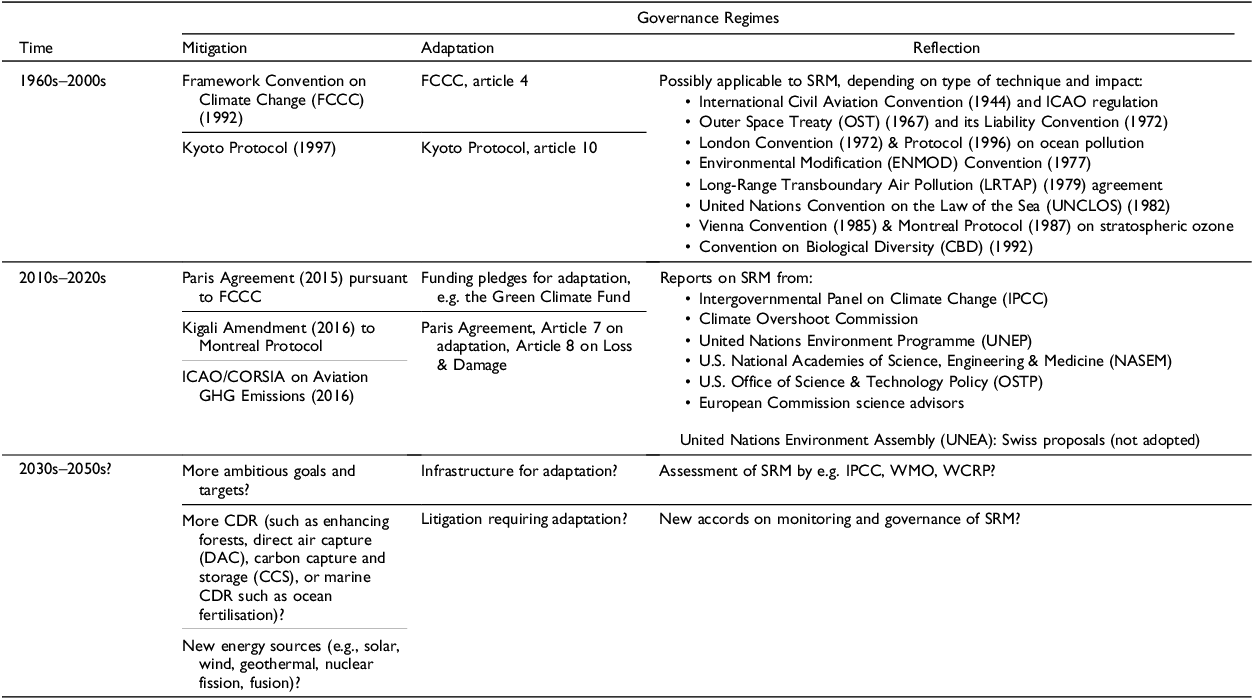
In Table 2, we attempt to describe the current approach to governance of SRM, which is highly fragmented, with scattered authorities for different aspects, and significant gaps.Footnote 40 Although governance has been developed for mitigation, and somewhat for adaptation, there is little or no well-developed or coordinated governance for reflection (SRM). Each ancillary risk of each type of SRM may be addressed (if at all) by a separate treaty or accord “in piecemeal fashion.”Footnote 41 For example, the climate treaties (FCCC and Paris Agreement) say essentially nothing about SRM. FCCC article 4(1)(f) calls for impact assessments of mitigation measures, but the FCCC has no comparable requirement for impact assessments of reflection measures (SRM).Footnote 42 The Paris Agreement adds a temperature-based goal (limiting global warming to 2oC above a preindustrial average), which might implicitly embrace limiting temperatures via SRM, but it has no provisions to assess, employ or govern SRM. The Ozone treaties (the Vienna ConventionFootnote 43 and Montreal ProtocolFootnote 44) may regulate harms to the stratospheric ozone layer due to SAI, and the Long-Range Transboundary Air Pollution treaty (LRTAP)Footnote 45 may address acid deposition from sulfate SAI. The UN Convention on the Law of the Sea (UNCLOS)Footnote 46 and the Convention on Biological Diversity (CBD)Footnote 47 might apply to ocean- and land-based strategies, respectively, for carbon dioxide removal (CDR).Footnote 48 The Environmental Modification (ENMOD) Convention restricts “hostile” and military modifications, and although an actor deploying SRM would presumably deny any hostile animus,Footnote 49 perhaps reckless disregard of harms to others could be construed as “hostile.” For PSS, the Outer Space Treaty (OST)Footnote 50 calls on its parties to avoid “harmful interference” with each other (article IX), and it imposes strict liability on national governments for damages caused on Earth (article VII) (amplified by its 1972 Liability ConventionFootnote 51), though it is unclear if the OST would apply to the induced climate effects of a space-based planetary sunshade system (PSS).Footnote 52
Governance regimes for climate response optionsFootnote 39

In short, there are separate governance regimes for some of the ancillary risks of SRM, but “none of these bodies has a mandate that would include control of SRM, or the capacity to control it effectively.”Footnote 53 In the view of Parson and Keith, “[p]rogress on governance [of SRM] may pose even greater challenges. The range of plausible governance needs for SRM is vast: It might be manageable by adjusting present international law and institutions, or it might require unprecedented new global governance authority.”Footnote 54
Constructing a single comprehensive regulatory regime for the global multi-risk portfolio of SRM has its appeal. A more integratedFootnote 55 and holistic approach to SRM could conceivably embrace the full system scale,Footnote 56 undertaking all of the key functional tasks noted above, with oversight of multiple risks, comprehensive analysis to weigh multi-risk tradeoffs and reduce overall risk, prospective and retrospective impact assessments, and more inclusive participation and voice by those affected.Footnote 57 It could foster ongoing monitoring and adaptive learning and updating on SRM, with a multi-risk scope.Footnote 58
On the other hand, creating such a new comprehensive regime could entail significant cost and time. The political adoption of such a comprehensive regime for SRM might be quite difficult, especially in light of the difficulty of engaging key countries in international agreements on climate mitigation. For example, although the United States (US) joined the FCCC in 1992 and remains a party, the US did not ratify the 1997 Kyoto Protocol (with the Senate voting 95-0 not to do so), and the US signed the 2015 Paris Agreement but then withdrew starting in 2017, rejoined in 2021, and withdrew again in 2025. Several other countries have also been politically ambivalent about the climate mitigation accords, including Canada and Australia; Russia joined the Kyoto Protocol only after a long delay and concessions; and China joined Kyoto without quantitative emissions limitations, and later announced its future emissions targets while rising to be the world’s largest emitter. Moreover, the incentives to be a first-mover on SRMFootnote 59 may make agreement on a governance framework difficult, and its legal authority limited or contested. Still, if they can agree on SRM, perhaps the US and China could cooperate to lead others to join a dual superpower regime on SRM.Footnote 60 As this example augurs, however, concerns about a single comprehensive and centralised regulatory regime include that it could add delays to policy analyses and decision making, could promote concentration of power, and could magnify the errors of policy decisions.Footnote 61
By contrast, a multi-institutional governance framework could rely more on existing institutions, each with specialised expertise in one area of risk. This could entail more narrowly targeted regulation, with policy differences across regulatory institutions (and across countries). These differences could pose inconsistencies across risks, and barriers to trade. But these differences can also enable learning from policy variation.Footnote 62
Fragmentation – especially if not coordinated – can leave gaps in which risks are unregulated, and pose conflicts and risk–risk tradeoffs, without oversight or comprehensive weighing to reduce overall risk. These dysfunctions may increase overall risk, and exacerbate “disregard” and “omitted voice” of underrepresented affected groups, discussed above.Footnote 63 Fragmented and uncoordinated multiple institutions may be a serious mismatch for a systemic multi-risk challenge like SRM, leaving the world vulnerable to the unaddressed risk-risk impacts of an emerging technology with little capacity to assess or manage these risks and to develop adaptive learning and updating.
2. Toward more coordinated and comprehensive multi-risk governance of SRM
Given these constraints and tradeoffs, how can we make progress? A middle way is to start with existing multiple fragmented institutions, and enhance their coordination. The problems of fragmentation can themselves spur uncoordinated policy actors to grope toward coordination, such as in the European response to Covid-19,Footnote 64 and the continuing debate over the four-decades old US “Coordinated Framework” for multi-agency biotechnology policies (with occasional attempts at a new consolidated biotechnology law).Footnote 65 Such a coordinated framework of multi-treaty and multi-agency governance could be attempted for SRM.Footnote 66 If multiple institutions can coordinate to address multi-risk interactions, their specialised expertise and legal authorities can be employed to collaborate on comprehensive analyses and “joined up” policies – more quickly than trying to create a new comprehensive institution, and with fewer concerns about concentrated power or magnifying errors.Footnote 67 Timing is important because key governance tasks are needed before any unilateral (or multilateral) deployment of SRM.Footnote 68 Such coordination may entail a coordinating institution to link other more specialised bodies, at least for information sharing and possibly for collaboration policy making. In the case of SRM – recognising that any suggestions will be imperfect and face critiques – candidates for coordinating roles might include the World Meteorological Organization (WMO) or its affiliates for risk assessment (e.g., the IPCC and the WCRP), the Ozone treaties and the FCCC for risk management of SAI, the OST and FCCC for risk management of PSS, or even the UN Security Council for risk management of geopolitical relations. This tentative menu itself indicates how difficult it may be to find suitable existing coordinating institutions. Creating a new coordinating body – toward a more comprehensive multi-risk oversight regime – has its appeal, as noted above, but would also take time and diplomacy and raise concerns about centralised decision-making.
Failure to coordinate across current institutions, to address regulatory gaps, and to resolve risk–risk tradeoffs may lead to sudden demand for new rules and institutions spurred by a crisis.Footnote 69 But waiting for a crisis to spur new policy, rather than proactively improving coordination and moving toward comprehensive analysis and oversight, poses risks of skewed policies with narrow targets spawning further risk–risk tradeoffs.Footnote 70
The spectrum from uncoordinated multi-institutional, to coordinated multi-institutional, to a single comprehensive institution, leaves open the question of what regulatory policies should be applied by any such institutions. Some of the options advanced in the debate include (a) a ban (or “non-use” stance) on all SRM deployment and research,Footnote 71 (b) a non-deployment stance that allows some research,Footnote 72 (c) a moratorium on deployment (temporary, to be revisited in the future) with affirmative support for research (and mitigation),Footnote 73 (d) ex post liability for attributable harm, or (e) no restrictions. Calls for a moratorium on deployment lead to questions about when, on what criteria, and by whom, decisions could be taken in the future to revise that stance. (Reflecting the difficulty of naming a coordinating institution, when the Climate Overshoot Commission issued its report in September 2023, it did not specify which if any institutions should promote the moratorium and research strategy that it recommended on SRM.)
Before these debates must be resolved, we suggest a near-term opportunity for two significant mechanisms that can help build up from the current fragmented array toward more coordinated (or even comprehensive) multi-risk governance of SRM. These mechanisms could help avoid the downsides of the current uncoordinated and fragmented regime, with regulatory gaps and unaddressed risk–risk interactions, and build toward better governance. These two mechanisms could offer “no regrets” benefits, that is, measures that can gain support from SRM advocates, observers, and critics alike, whether one favors or opposes SRM deployment. And they could be advanced without waiting for unanimous agreement – perhaps by a coalition of key countries. We suggest:
-
1) A series of iterative and transparent international assessments of SRM science, social science and policy.Footnote 74 These assessments could help build toward comprehensive understanding of the multiple risks affected by SRM options, including both climate and non-climate risks, both biophysical and sociopolitical risks, and both favorable and unfavorable impacts (see Table 1). These assessments should include analyses of:
-
○ the multi-risk portfolios
-
○ of an array of SRM techniques and policy options (including SAI with various particle types, MCB, and PSS)
-
○ under a range of scenarios of future climate change, mitigation effort, international relations, and other factors
-
These more multi-risk comprehensive assessments would help overcome disregard of important impacts, inform multi-risk policy decisions to reduce overall risk (including by the multiple governance regimes indicated in Table 2), and identify affected groups whose voices should not be omitted.
-
-
2) A transparent international monitoring system for both unilateral and multilateral SRM activities, to be developed even before broader governance institutions, and to address the lifecycle of potential SRM activities from preparation to deployment to impacts to attribution. This monitoring system (or set of systems) could:
-
○ help identify preparations toward SRM deployment, thereby reducing the risks of unilateral surprise and international conflict;
-
○ help observe and estimate the multi-risk impacts of any SRM deployments (unilateral/non-cooperative or multilateral/cooperative), such as the types of SAI particles used, their atmospheric dynamics and reactions, and their effects on climate and non-climate risks (or the relevant factors for MCB or PSS);
-
○ help enforce any agreements on SRM (such as moratoria, or limitations on types of field testing);
-
○ help advance adaptive learning by assessing experience with intended and unintended (multi-risk) outcomes over time; and
-
○ help attribute (or distinguish) any subsequent adverse events asserted to have been caused by SRM (e.g., extreme weather or shifting precipitation patterns) and inform potential remedies for those harmed.
-
Beyond these two mechanisms, more will be needed to develop coordinated, or even comprehensive, governance frameworks for SRM. Some approach to collective international decision-making about deployment will be needed – whether in a multilateral treaty such as the FCCC or the Vienna Ozone convention (for SAI) or the OST (for a space-based PSS), or a new agreement, or the UN Security Council, or in another way. If not, a unilateral/non-cooperative deployment by one or a few actors may be met by unilateral/non-cooperative sanctions or reprisals by others.
Governance of SRM, and of climate change in general, requires a multi-risk approach. Focusing only on one or a few risks will not make the other risks disappear, and will entail gaps and tradeoffs. A multi-risk approach helps overcome neglect and disregard of important impacts, and of affected groups, enhancing both overall well-being and distributional equity. Monitoring and adaptive learning can help improve policies in light of experience. Yet multi-risk governance can be complex. To make good decisions, we need to identify and catalog the multiple risks affected by climate policy options (including mitigation, adaptation, and reflection [SRM]), estimate and compare these risks in order to reduce overall risk, and seek new risk-superior options. Better information, through assessments and monitoring, will be crucial.
Acknowledgements
The authors appreciate the helpful comments of the anonymous reviewer. The authors acknowledge and thank their co-authors on prior analytic papers, Govindasamy Bala, Ines Camilloni, and Jianhua Xu; for support on these earlier analytic papers, the authors thank the Carnegie Climate Governance Initiative (C2G) and NSF grant #1948154.

 Open access

