





Introduction
Nearly half of premature deaths from the 10 leading causes of mortality worldwide are attributable to personal behaviours (Lopez et al., Reference Lopez, Mathers, Ezzati, Jamison and Murray2006; Alwan et al., Reference Alwan, Galea and Stuckler2011). Collectively, they account for almost three-quarters of all medical care spending (Gruman and Follick, Reference Gruman and Follick1998). Half of all mental health disorders in adulthood start by age 14, but most cases are undetected and untreated (World Health Organization (WHO), 2014). Young adults are emerging as a new and neglected priority in global health (Horton, Reference Horton2012). In 2012, an estimated 1.3 million adolescents died mostly from preventable or treatable causes. Health risk behaviours related to alcohol or tobacco use, lack of physical activity, unprotected sex and/or exposure to violence can impact both current and future health (WHO, 2014).
Primary health care and general practice settings are frequently proposed as the ideal environment for opportunistic and systematic behavioural change interactions. In New Zealand about 80% of the population visit a general practitioner (GP) and about 40% visit a primary health care nurse every year (Ministry of Health, 2008).
There are widespread attempts to address population health by identifying individual health risk factors and risky behaviours. Payment systems and policy mandates require, for example, collection of data to meet Quality and Outcomes Framework criteria in the United Kingdom (NHS Information Centre, 2012), or a targeted percentage of adults having cardiovascular risk assessments in New Zealand (Ministry of Health, 2015). Nurses in chronic care management clinics often follow a consultation structure based on the nurse determining what behaviours the patient needs to change (Jansink et al., Reference Jansink, Braspenning, van der Weijden, Elwyn and Grol2010). There is an (often unspoken) assumption that if practitioners collect data which shows risks, they will act on this data and this action will change patient behaviour and risks. What happens too often is assessment without intervention (Parsons et al., Reference Parsons, Senior, Weidenbohm, Parsons, Jacobs, Jorgensen, Chen, Sheridan, Kilpatrick and Kenealy2013) or intervention with disappointingly small effect (Kenealy et al., Reference Kenealy, Orr-Walker, Cutfield, Robinson and Buetow2011).
Practitioners are often under-prepared to discuss health risk behaviours with patients (Chisholm et al., Reference Chisholm, Hart, Lam and Peters2012). Many practitioners claim lack of time as the main barrier to their changing patient behaviour (Kenealy et al., Reference Kenealy, Docherty, Sheridan and Gao2010; Finlayson et al., Reference Finlayson, Sheridan, Cumming and Fowler2012) rather than recognising barriers internal to themselves (Ogden et al., Reference Ogden, Bavalia, Bull, Frankum, Goldie, Gosslau, Jones, Kumar and Vasant2004). Many practitioners resort to unsolicited advice, despite evidence that this can be unwelcome and that health is often insufficient motivation for change (Rollnick et al., Reference Rollnick, Kinnersley and Stott1993; Emmons and Rollnick, Reference Emmons and Rollnick2001). Dart suggests ‘we become emotionally invested in our patients … [and] believe we know what is best for them’ (Reference Dart2011). Welch et al. (Reference Welch, Rose and Ernst2006) contend that feeling responsible for fixing ‘broken’ patients reinforces the propensity of doctors and nurses to do most of the talking, supported by a belief that patients can change ‘if they really want to’ (McCabe, Reference McCabe2004). This is a short step to making moral judgements about ‘bad’ patients (Hill, Reference Hill2010).
Nurses can make assumptions about their patient’s needs (Docherty, Reference Docherty2013) and their own lifestyle practices may influence any willingness to change patient behaviours. Clinicians who smoke are less likely to raise the issue of smoking with patients (Frank, Reference Frank2004), and many fear that this will lead to conflict with their patients (Sim et al., Reference Sim, Wain and Khong2009). Behaviours discussed are often highly selected and poorly prioritised to the needs of the individual patient. Tobacco smoking, obesity and physical activity are frequently identified in isolation from other high-risk activities, such as gambling, that may be associated with depression and hazardous alcohol use (Goodyear-Smith et al., Reference Goodyear-Smith, Arroll, Kerse, Sullivan, Coupe, Tse, Shepherd, Rossen and Perese2006). Tobacco smoking interventions are much more likely to be discussed in primary health care settings than cannabis, despite three cannabis joints causing as much harm as 20 cigarettes (Aldington et al., Reference Aldington, Harwood, Cox, Weatherall, Beckert, Hansell, Pritchard, Robinson and Beasley2008). Young people admitted to hospital for diabetes have an increased risk of suicide (Roberts et al., Reference Roberts, Goldacre and Neil2004), yet mental health is not a routine part of general practice diabetes care.
Health professionals have long attempted to change patient behaviour without the application of a strong theoretical basis and related training. Smith et al. (Reference Smith, Tang and Nutbeam2006) suggest communication is about informing, influencing and motivating individuals. Elder et al. (Reference Elder, Ayala and Harris1999) refer to informational power and expert power being used to convince patients to change using unsolicited advice while linking any non-conformity to possible severe health outcomes.
Motivational interviewing (MI) is an approach to behavioural counselling that seeks to ‘elicit and strengthen motivation for change’ (Miller, Reference Miller1983). It was first applied to alcohol and later to heroin addictions (Miller, Reference Miller1983) and is considered by some to be the most effective theoretically based intervention. It has been defined as ‘a directive, client-centered counselling style for eliciting behaviour change’ (Rollnick and Miller, Reference Rollnick and Miller1995; Miller and Rollnick, Reference Miller and Rollnick2009). MI continues to form the basis of behavioural change approaches to treatment (Coulter and Collins, Reference Coulter and Collins2011). The Transtheoretical Model of behaviour change was a logical extension of MI developed by Prochaska and DiClemente as a means to understand the process of addiction recovery (Prochaska and DiClemente, Reference Prochaska and DiClemente1983; Prochaska et al., Reference Prochaska, DiClemente and Norcross1992). Other behavioural change variations, mostly based on MI, have been loosely and collectively labelled as brief interventions (BIs), despite a number of differences in the delivery mechanisms and settings in which they were developed. Recent New Zealand BI programmes introduced into primary care include ABC (Ask, Brief Advice, Cessation Support) for smoking cessation (Ministry of Health, 2007) and ABC (Ask, Brief Advice and Counselling) for reducing alcohol consumption (Royal New Zealand College of General Practitioners, 2012). Cognitive Behavioural Therapy (CBT) is a psychotherapeutic approach that aims to alter attitudes and behaviours by replacing inaccurate thoughts (New Zealand Guidelines Group, 2012). Delivering a full CBT programme is beyond the scope of most primary care practitioners. The Flinders ProgramTM (Lawn et al., Reference Lawn, Battersby, Harvey, Pols and Ackland2009) is a semi-structured programme for disease-specific management based on both CBT and MI principles.
Effectiveness of behavioural change interventions can be seen at individual, community and population levels (Michie and West, Reference Michie and West2013), although effects tend to be modest, with significant heterogeneity of effects over both short and long terms (Michie et al., Reference Michie, Johnston, Francis, Hardeman and Eccles2008). Evaluations of effectiveness have been hindered by the absence of a gold standard for measuring health behaviours (Vitolins et al., Reference Vitolins, Rand, Rapp, Ribisl and Sevick2000). Few behavioural change approaches have been tested in real-world longitudinal studies and some trials have been criticised for being clinically unrepresentative (Kaner et al., Reference Kaner, Beyer, Dickinson, Pienaar, Campbell, Schlesinger, Heather, Saunders and Burnand2007). Nil to modest effects have been shown on alcohol consumption (Wutzke et al., Reference Wutzke, Conigrave, Saunders and Hall2002), physical activity (Smith et al., Reference Smith, Merom, Harris and Bauman2002), eating habits (Dunn et al., Reference Dunn, Deroo and Rivara2001), substance abuse, high-risk adolescent behaviours and a variety of chronic diseases (Wagner et al., Reference Wagner, Wickizer, Cheadle, Psaty, Koepsell, Diehr, Curry, Von Korff, Anderman, Beery, Pearson and Perrin2000; Sammut, Reference Sammut2009).
Developing Brief Opportunistic Interactions (BOIs)
The BOI approach was developed from the Tobacco, Alcohol and other Drugs Early Intervention Project (TADS) at the University of Auckland, New Zealand, following involvement in the WHO Collaborative Project on Identification and Treatment of Persons with Harmful Alcohol Consumption in 1996 (Heather, Reference Heather2006). The WHO project sought to develop a scientific basis for screening and BIs in primary care settings and to examine ways of engaging general practices in implementing a BIs approach (McCormick et al., Reference McCormick, Adams, Powell, Bunbury, Paton-Simpson and McAvoy1999). Author B. D. was the TADS Project Manager from 1998 to 2006. The full name of TADS was changed in 2006, to Training and Development Services to reflect the move beyond a focus on tobacco and alcohol.
Starting in 1998, the TADS BIs training was implemented in many areas of New Zealand funded by the New Zealand Ministry of Health. A concurrent programme of evaluation drew on existing literature and used formal and informal qualitative and action research methods. There was constant critical reflection while continuously refining methods and ideas (Whitehead et al., Reference Whitehead, Taket and Smith2003). Notes were taken but conversations were not recorded. Data were collected over 10 years from practitioner workshop participants (6500), consumer feedback (2500 adults and 348 youth), facilitator observation and feedback, and observation in real-world situations (Nemec, Reference Nemec2001). Practitioners came from general practice, school clinics and other primary health care settings. Consumers included people of European, Māori and Pacific ethnicities.
The programme that developed included three key elements: a new language for practitioner–patient interactions, a focus on opportunistic prevention that was not limited to alcohol and tobacco, and a process that enforced patient priority in identifying issues to be addressed. Central to the process is the Personal Assessment Choice Tool (PACT©), a questionnaire which comes in two versions, adult and adolescent (see Appendices). The way it is used is described in the next section. The unique feature is that PACT© responses are not viewed at any stage by practitioners. Questions relate to use of tobacco, alcohol, other drugs, gambling, mild to moderate mental health risks (anxiety and feeling down), anger, violence, physical activity and weight issues. Sexual health is included in the youth version.
The need for a new language was identified by both practitioners and consumers. Pre-training assessments identified that GPs and practice nurses were uncertain how best to approach behavioural change, had lengthy conversations despite feeling time-poor and felt frustrated at poor outcomes (Docherty, Reference Docherty2001). Surveys of adults and young people identified health professionals’ attitudes and behaviour (such as preaching, advice and judgement) as barriers to personal behaviour change. This was consistent with literature suggesting that practitioner word choice could negatively influence patient decisions (Freeman and Sweeney, Reference Freeman and Sweeney2001), and that practitioners could actively avoid or block communication, such as by denial of patients’ concerns, abruptly changing the subject or focussing on the least threatening aspect of a conversation (Webster, Reference Webster1981; Booth et al., Reference Booth, Maguire and Hillier1999). Examples of BOI language are given in Table 1.
Examples of BOI language

BOI=Brief Opportunistic Interaction.
The need for a programme much wider than just tobacco and alcohol was also identified by both practitioners and consumers (Docherty, Reference Docherty2001). Early findings from the TADS programme were that many young people and adults had multiple personal behavioural practices which interlinked. Mild to moderate mental health issues were mostly linked to a current personal behavioural practice such as alcohol, other drugs or gambling rather than a mental illness requiring specialist referral or medication. This led to a broad, opportunistic, preventative approach that allowed all behaviours and mental health risks to be addressed.
It became clear that practitioners did not, perhaps could not, correctly identify patient priority issues. A total of 82 practitioners were shown 339 anonymous PACT© responses, together with the socio-economic status and age of each patient, then asked which behaviours they would choose to start the change process with each patient. The behaviours chosen by health practitioners were not those chosen as the priority starting point by 98% of Adult PACT© patients and 96% of Youth PACT© patients.
That PACT© responses remain private was a strong desire of the participants who helped develop the programme (Parsonage, Reference Parsonage2006; TADS Training Programme, 2006). Participants feared judgement by health professionals particularly for behaviours that are illegal, stigmatised or invite moralising (Brener et al., Reference Brener, Billy and Grady2003). Privacy protects trust in preparation for the second stage of the BOI process where individuals choose their own starting point of change from their PACT© responses. The PACT© questionnaire provides an opportunity for each person to privately gain a snapshot of their current behaviours and mental health risks. Both adult and adolescent participants were clear that they did not want to address any issues immediately as they would feel overwhelmed. They valued the opportunity to think more about any identified behaviours and preferred to use the next opportunistic visit to discuss them.
The final version of the Youth PACT© was tested opportunistically by nurses with 132 students aged 13–14 years across a full range of schools by socio-economic groups, and a wide range of ethnicities, in four geographical areas of New Zealand. They found similar behavioural and mental health risk responses across all school socio-economic groups and student ethnicities. The final version of the Adult PACT© was tested opportunistically in general practice and other settings over four years. Testing covered 216 participants of all ethnicities and a wide range of occupations. The TADS PACT© was acceptable and non-threatening to both adult and youth, across diverse populations by age, ethnicity and income (TADS Training Programme, 2007; Spoth et al., Reference Spoth, Greenberg and Turrisi2008) and in diverse clinical settings (Carroll et al., Reference Carroll, Patterson, Wood, Booth, Rick and Balain2007). GPs said their understanding of person-focussed behavioural change approach improved markedly and their sense of patient engagement in the consultation improved when they changed to BOI language. Practice nurses valued the ‘generic’ conversation capability they could use in all types of consultations, particularly around diabetes and other chronic conditions.
Implementation of this approach through New Zealand primary health care has been constant but slow and partial. Surveys and feedback from course ‘graduates’ point to practice systems and contractual funding arrangements as the main impediments to implementing BOI in general practice. Nurses stated that implementation fidelity was difficult to achieve if others in their workplace were not also trained in the BOI approach, resulting in feelings of isolation, loss of confidence and lack of support. Nurses, in particular, have consistently recommended TADS training as a core requirement for professional development and said it was significantly more relevant than the many disease-specific and repetitive short courses on offer.
The BOI approach and the PACT© in practice
The process unfolds over at least three visits. The first and second are opportunistic when the patient attends for something else. The third is organised for the purpose of making a behaviour change plan. Further short BOI conversations can continue whenever the patient presents to ensure ongoing self-management support. The first stage starts with the PACT© questionnaire, which can be offered to those over 14 years of age in any face-to-face setting where behavioural change discussions occur. The PACT© responses are stored securely and not viewed by practitioners.
The second stage happens at the next opportunistic encounter when the practitioner reminds the patient about the PACT© and asks if they can identify a priority issue or behaviour they may want to address. This is followed by six questions, which help define whether the person is able, ready and willing to make changes (Table 2). The practitioner is trained to suspend the usual practice of ‘needing to know’ or ‘diagnosing’ the ‘problem’. Using non-directive language, the practitioner facilitates the patient through their own decision-making process relating to the behaviour or mental health risk the person has chosen to address, at the same time helping to remove any obstacles to change. More details will emerge and be disclosed as the patient so chooses. At a later visit, the practitioner works with the patient to develop a plan, at which stage the process is similar to other approaches to self-management.
Questions at the second visit
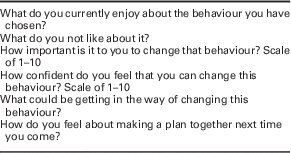
BOI language is more conversational than usual consultation styles we have observed. As it is inherently person focussed, for example, starting a conversation by asking ‘What do you already know about …?’, it has been used successfully within research interviews in three New Zealand projects: the Diabetes Tracking Study (Dowell et al., Reference Dowell, Stubbe, Kenealy, Sheridan, Dew and Macdonald2010), the Very High Intensive Users (Rea et al., Reference Rea, Kenealy, Horwood, Sheridan, Parsons, Wemekamp, Winter, Maingay and Degeling2010) and assisting immunisation co-ordinators to engage with their stakeholders (Docherty, Reference Docherty2006).
Table 3 illustrates BOI in action with a case study. The process in this case is typical, even though the outcome in question is extreme (though not unique). Table 4 summarises the BOI training programme.
An example of a BOI interaction during the TADS Youth PACT© pilot in 2006
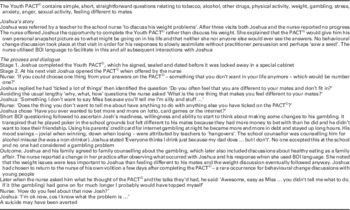
BOI=Brief Opportunistic Interaction; TADS=Tobacco, Alcohol and Other Drugs Services; PACT=Personal Assessment Choice Tool.
Joshua (not his real name) was 14 at the time.
Summary of the three day BOI training programme
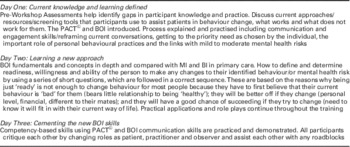
BOI=Brief Opportunistic Interaction; PACT=Personal Assessment Choice Tool; MI=motivational interviewing; BI=brief intervention.
Practice implications and future research
The BOI approach is an opportunistic, time efficient, low cost, preventative, generic approach to facilitate patients in identifying existing or emerging personal behavioural practices, so as to actively choose their beginning, ongoing and end point of behaviour change.
The TADS research and development programme has identified what may be key ingredients missing from other behavioural change approaches. Formal evaluation to assess the TADS programme’s contribution to performance of health practitioners and health outcomes for patients is now required.
Requests for the PACT© to be made available online have been rejected by TADS on the basis that this could allow untrained practitioners to use the tool but continue with their practitioner-driven approach to behaviour change. The PACT© was conceived, developed, refined by patients who entrusted it to use following a competency-based training programme that supports practitioners. Enquiries about use of the tool and appropriate training should be directed to the first author.
Acknowledgement
The authors wish to acknowledge the large number of consumers who influenced the redevelopment of the TADS programme.
Financial Support
We received no funding specific to this work.
Conflicts of Interest
B. D. was paid as Project Manager to deliver and manage the workshops, which led to developing the current TADS programme. During this time she was employed by the University of Auckland through a contract funded by the Ministry of Health. N. S. and T. K. have no conflicts of interest.
Ethical Standards
No ethics approval was sought or required to develop the TADS programme.
Appendix 1: Youth PACT


Appendix 2: Adult PACT


 Open access

