

This Special Issue is all about the stories of children: preschool- and school-age children; bilingual and monolingual children; children developing typically or identified as having a specific language impairment (SLI); and children speaking and experiencing one or more of the following languages: English, Finnish, German, Greek, Hebrew, Italian, Russian, Slovak, Swedish, and Turkish in minority or majority language contexts. The stories are fictional ones, about baby birds and baby goats, a cat and a dog: a cast of characters the reader will come to know well as they read the Introduction (Gagarina, Klop, Tsimpli, & Walters, Reference Gagarina, Klop, Tsimpli and Walters2016) and individual articles. They were collected using a new narrative assessment tool that is common to all the articles within the issue: the Language Impairment Testing in Multilingual Settings—Multilingual Assessment Instrument for Narratives (LITMUS-MAIN; Gagarina et al., Reference Gagarina, Klop, Kunnari, Tantele, Välimaa and Balèiûnienë2012, Reference Gagarina, Klop, Kunnari, Tantele, Välimaa, Balčiūnienė, Armon-Lotem, de Jong and Meir2015), described at some length by its developers in the Introduction to the Special Issue.
Accomplishing the feat of collecting stories from children around the globe using the same protocol is rare, though it has precedent in the developmental and cross-linguistic frog story studies (Berman et al., Reference Berman, Slobin, Aksu-Koç, Bamberg, Dasinger and Marchman1994). In this most recent effort, researchers working in several different countries use the LITMUS-MAIN to further our understanding of children's developing narrative abilities, viewed primarily through the lens of story grammar. The story grammar model has been highly influential in the study of children's narratives, particularly of the fictional genre (but for reviews of alternative approaches to both fictional and personal narratives, see Berman, Reference Berman2009; Nicolopoulou, Reference Nicolopoulou and Bamberg1997; Schick & Melzi, Reference Schick and Melzi2010).
According to the story grammar model (and as elaborated in this issue), stories are organized in accord with mental schemas and include central events that characters respond to by establishing goals and attempting to achieve them. In addition to informing the LITMUS-MAIN, the model has heavily influenced other narrative assessments (e.g., the Edmonton Narrative Norms Instrument; Schneider, Dubé, & Hayward, Reference Schneider, Dubé and Hayward2005) and shaped narrative intervention over the last three decades, as demonstrated in recent meta-analyses (Pesco & Gagné, Reference Pesco and Gagné2015; Petersen, Reference Petersen2011). Given the ubiquitousness of the story grammar model, the reader may well be familiar with it.
What is novel about the LITMUS-MAIN is that the four wordless stories (i.e., picture sets) were carefully designed to be parallel in a number of important ways. This feature is entirely consistent with its intent: to assess children's narrative skills in more than one language (see Introduction to this issue). The parallelism of the stories also allows for pre- and posttesting while avoiding practice effects, and for examining variations in children's storytelling or comprehension as a function of narrative task (e.g., retelling vs. telling stories). Moreover, the LITMUS-MAIN has taken a core construct in story grammar, namely, characters’ engagement in goal-directed behavior, and operationalized it in an interesting way (following Stein & Glenn, Reference Stein and Glenn1979; and Westby, Reference Westby, Catts and Kamhi2005): that is, by using goals as the pivot of a story complexity score. Given its qualities, the tool could be useful in assessing not only bilingual children for whom it was designed but also monolingual children.
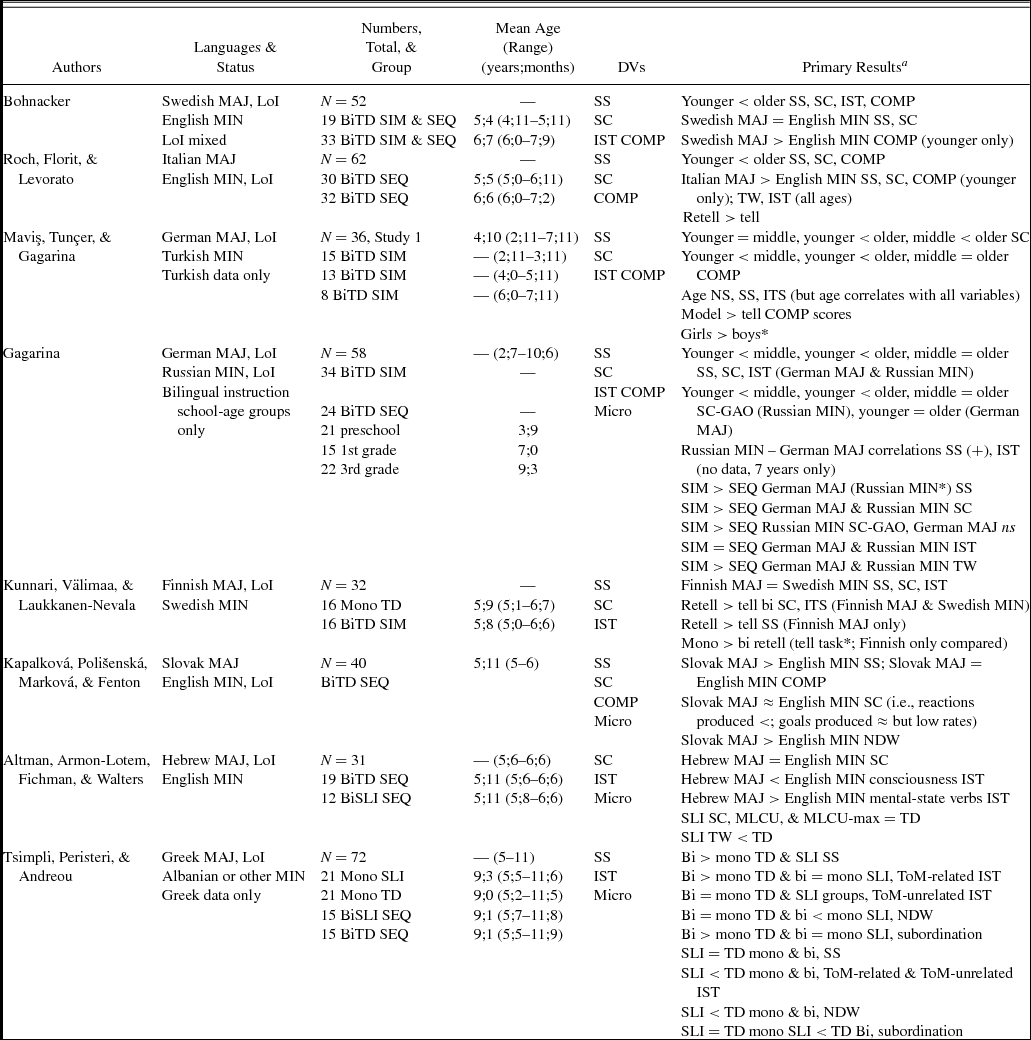
Working from the assumption that children's capacity to understand and tell stories is the product of development in various domains (i.e., linguistic, cognitive, and social), the authors in this issue report findings for story structure, story complexity, and internal state terms of children ages 3 to 9, with most focusing on the period 5 to 7 years. In addition, productivity (e.g., story length), microstructure (i.e., lexical and syntactic features), and other variables (e.g., working memory) were investigated in some studies. The studies are presented in Table 1, including children's ages and the key variables. Some important generalizations that can be drawn from the studies are discussed below.
Study designs, dependent variables (DVs), and primary results ordered by similarity of factors

Note: MAJ, Majority Language; LoI, language of instruction; SS, story structure; SC, story complexity; IST, internal state terms; COMP, comprehension questions; MIN, minority language; SIM, simultaneous bilingual; SEQ, sequential; BiTD, bilingual typically developing; TW, total words; SC-GAO, highest level of SC (goal, attempt, outcome sequence); MonoTD, monolingual TD; NDW, number of different words; MLCU, mean length of C-unit; MLCU-max, longest 3 C-units; MonoSLI, monolingual specific language impairment; ToM, theory of mind.
aFactors vary by study but include age, language, task, gender, bilingualism, and impairment.
*Approaches significance.
A subset of the studies examined developmental changes (see in this issue, Bohnacker, Reference Bohnacker2016; Gagarina, Reference Gagarina2016; Maviş, Tunçer, & Gagarina, Reference Gagarina2016; and Roch, Florit, & Levorato, Reference Roch, Florit and Levorato2016), using cross-sectional designs. Kunnari, Välimaa, and Laukkanen-Nevala (2016) also examined age as a predictor. As shown in the table, when children within a 3- to 6-year-old range were compared to children within a 6- to 8-year-old range, the older children generally had higher scores (see in this issue, Bohnacker, Reference Bohnacker2016; Gagarina, Reference Gagarina2016; and Roch et al., Reference Roch, Florit and Levorato2016; for an exception, see Mavis et al., Reference Maviş and Tunçer2016). When older children were compared (i.e., 7 and 9 years in Gagarina), children performed more similarly. In addition, age was predictive for the use of goals in stories for children in a narrower age range of 5 to 6.5 years (Kunnari et al.). Some studies provided fine-grained analyses at particular ages, showing, for example, that a minority of children produced goals at ages 5 and 6 (see in this issue, Bohnacker, Reference Bohnacker2016; Gagarina, Reference Gagarina2016; and Kapalková, Polišenská, & Marková, Reference Kapalková, Polišenská, Marková and Fenton2016). These findings are consistent with data reported elsewhere for monolingual children of the same age (Stein & Albro, 1997, cited in Nicolopoulou & Richner, Reference Nicolopoulou and Richner2007). Furthermore, while comprehension of goals was good at ages 5–6 years (see in this issue, Bohnacker, Reference Bohnacker2016; and Kapalková et al., Reference Kapalková, Polišenská, Marková and Fenton2016), it was still relatively weak compared to children's understanding of other story grammar elements. In summary, this set of studies shows that the LITMUS-MAIN is sensitive to development in a variety of languages. The instrument detected developmental changes particularly between the ages of 4 and 7. The analyses also revealed variations by age in the integration of goals, a critical feature of storytelling.
A number of bilingual factors impacted the performance of the children in these studies. First, when authors reported differences in performance across languages, children almost always performed better in the majority language (see in this issue, Altman, Armon-Lotem, Fichman, & Walters, Reference Altman, Armon-Lotem, Fichman and Walters2016; Bohnacker, Reference Bohnacker2016; Kapalková et al., Reference Kapalková, Polišenská, Marková and Fenton2016; and Roch et al., Reference Roch, Florit and Levorato2016). This was true for both macro- and microstructural measures, although macrostructure differences disappeared in older children in some studies (see in this issue, Bohnacker, Reference Bohnacker2016; and Roch et al., Reference Roch, Florit and Levorato2016). Second, the majority language advantages were present in studies of sequential bilinguals (see in this issue, Altman et al., Reference Altman, Armon-Lotem, Fichman and Walters2016; Kapalková et al., Reference Kapalková, Polišenská, Marková and Fenton2016; and Roch et al., Reference Roch, Florit and Levorato2016), but not in the single study of simultaneous bilinguals (see in this issue, Kunnari et al., Reference Kunnari, Välimaa and Laukkanen-Nevala2016). This would suggest that the minority language of sequential bilinguals is at risk in the groups studied, a finding consistent with previous studies (e.g., Hammer, Lawrence, & Miccio, Reference Hammer, Lawrence and Miccio2008; Verhoeven, Steenge, van Weerdenburg, & van Balkom, Reference Verhoeven, Steenge, van Weerdenburg and van Balkom2011). Differences between sequential and simultaneous bilinguals were tested directly in only one study (Gagarina, Reference Gagarina2016 [this issue]). This author found that simultaneous bilingual first and third graders in bilingual education programs scored higher on story structure in the majority language and complexity measures in both languages compared to their sequential bilingual counterparts (with the exception of the highest complexity level, goal–attempt–outcome production, in the majority language and internal state terms in both languages). Third, the majority of studies focused upon children who were being (pre)schooled in the majority language (see in this issue, Altman et al., Reference Altman, Armon-Lotem, Fichman and Walters2016; Bohnacker, Reference Bohnacker2016; Kunnari et al., Reference Kunnari, Välimaa and Laukkanen-Nevala2016; Mavis et al., Reference Maviş and Tunçer2016; and Tsimpli et al., Reference Tsimpli, Peristeri and Andreou2016). Two others studied children in minority-language immersion programs (see in this issue, Kapalková et al., Reference Kapalková, Polišenská, Marková and Fenton2016; and Roch et al., Reference Roch, Florit and Levorato2016), and one studied children who were bilingually educated (Gagarina, Reference Gagarina2016). Research in the United States suggests that bilingual education programs lead to better minority language outcomes (e.g., Collier & Thomas, Reference Collier and Thomas2009; Thomas & Collier, Reference Thomas and Collier2012). Direct comparisons of bilingual and monolingual education are not done in the present studies, but one might predict the same is true for these European samples. Fourth, the performance of bilingual and monolingual children was compared in two studies in this issue (Kunnari et al., Reference Kunnari, Välimaa and Laukkanen-Nevala2016; Tsimpli et al., Reference Tsimpli, Peristeri and Andreou2016). Kunnari et al. found group differences favoring monolinguals in the 5-year-olds they studied. In contrast, Tsimpli et al. reported similarities between monolinguals and bilinguals on some variables, and results favoring 9-year-old (on average) bilinguals on others. In both studies, only performance in the majority language was compared, and this was the language of instruction.
The research group's working hypothesis was that story grammar knowledge, particularly as captured by story complexity on the LITMUS-MAIN, would be invariant across a bilingual child's languages. Children performed similarly across languages on complexity measures in some studies (see in this issue, Altman et al., Reference Altman, Armon-Lotem, Fichman and Walters2016; Bohnacker, Reference Bohnacker2016; and Kunnari et al., Reference Kunnari, Välimaa and Laukkanen-Nevala2016), but also on story structure in the latter two studies (Altman et al. did not report the structure score). These findings, along with the advantage for simultaneous bilinguals over sequential bilinguals observed in one study, and higher scores in the majority versus the minority language (observed within sequential bilingualism), require elucidation. Among the possible explanations for these findings are language dominance and proficiency; language exposure (e.g., home and school); and the relatedness of a child's languages (i.e., same or different language “family”). While dominance and proficiency were not investigated in this first ambitious set of studies of the LITMUS-MAIN, we know these to be important factors in the study of bilingualism. Furthermore, research on monolinguals has demonstrated that different linguistic domains (e.g., vocabulary and syntax) differentially predict performance on narrative measures (Heilmann, Miller, Nockerts, & Dunaway, Reference Heilmann, Miller, Nockerts and Dunaway2010); these data could suggest some avenues for future work on bilinguals. In addition, second language exposure, reported descriptively in a few studies in the issue, could be further explored as a predictor of macrostructure. Finally, some authors, notably Gagarina (Reference Gagarina2016), raise the possibility that certain features of macrostructure are less reliant on linguistic proficiency than others, a hypothesis that warrants further direct testing.
The Special Issue also includes two studies examining the narrative abilities of bilingual children with SLI. One of these involved bilingual English–Hebrew speakers (primarily exposed to English at home, but Israeli-born and instructed in Hebrew) with and without SLI (Altman et al., Reference Altman, Armon-Lotem, Fichman and Walters2016). The other study (Tsimpli, Peristeri, & Andreou, Reference Tsimpli, Peristeri and Andreou2016) was of monolingual and bilingual Greek-speaking children with and without SLI. As Table 1 shows, the participants in both studies were nearly 6 on average, but the age range was narrower in Altman et al. (5–6 years compared to 5–12 in Tsimpli et al.).
It is interesting that in Altman et al. (Reference Altman, Armon-Lotem, Fichman and Walters2016 [this issue]), differences in story complexity were not observed between the SLI group and a typically developing group. Tsimpli et al. (Reference Tsimpli, Peristeri and Andreou2016) found, however, that typically developing children outperformed the children with SLI on story structure, in both monolingual and bilingual groups. The discrepancy in findings from the two studies does not appear to be task related, because both studies employed the retell task of the LITMUS-MAIN. The results might be explained by the differences in narrative measures across the two studies (complexity vs. structure; neither study measured both), or the interaction of age with SLI; perhaps as children get older (as they were in Tsimpli et al., Reference Tsimpli, Peristeri and Andreou2016) they lag further behind their peers. However, in Tsimpli et al., within the SLI group, monolingual and bilingual children scored similarly on most variables, in line with data suggesting that bilingualism does not worsen outcomes for children with SLI (Paradis, Reference Paradis2010).
Both of the studies on SLI also examined internal state terms in detail; the results were mixed, favoring the first language for some internal states, and the second language for others (Altman et al., Reference Altman, Armon-Lotem, Fichman and Walters2016), and favoring bilinguals over monolinguals in some instances (Tsimpli et al., Reference Tsimpli, Peristeri and Andreou2016). These findings, in addition to being inherently interesting, show that the LITMUS-MAIN can be used to derive a quite nuanced view of children's narrative skills.
As alluded to earlier, the LITMUS-MAIN is also ideal for examining task effects; these were addressed in this issue by Kapalková et al. (Reference Tsimpli, Peristeri and Andreou2016), Mavis et al. (Reference Maviş and Tunçer2016), and Roch et al. (Reference Maviş and Tunçer2016). The picture that emerged from these data was that bilingual children told stories with more story grammar elements and greater complexity when they retold a story from pictures than when they produced one while looking at pictures alone. These findings are important both for future research and for clinical applications of the LITMUS-MAIN. It would be of particular interest to compare how storytelling on the LITMUS-MAIN (apparently more difficult based on the data reported in the present set of studies) fares in comparison to retell tasks at distinguishing SLI from typical performance.
The reader is invited to delve into this set of studies on bilingual narratives assessed with the LITMUS-MAIN and the authors’ own reflections on their data. In addition to providing rich data on narrative production and comprehension across a variety of language pairs, the authors remind us how very many children are bilingual and how pressing a matter it is to reflect this reality in theory and practice. The LITMUS-MAIN is a significant step in this direction, as was the international collaboration required to bring the instrument, the research, and this Special Issue to fruition.