


Introduction
Infant mortality, estimated as the death of an infant before his or her first birthday, is a demographic indicator that is directly related to the socioeconomic and health status of a population (Aksan and Chakraborty, Reference Aksan and Chakraborty2014; Liczbińska, Reference Liczbińska2009; Scott and Duncan, Reference Scott and Duncan2000). Before the demographic transition, the number of children not reaching their first birthday was well above 200 per 1,000 in most European countries (Pozzi and Ramiro, Reference Pozzi and Ramiro2015; Dalla-Zuanna et al., Reference Dalla-Zuanna, Minello and Piccione2017). Large differences in infant mortality between developed (3 per 1,000 live births) and least developed (70 per 1,000) countries still prevail today, albeit on a smaller scale (UNICEF Data, 2024). Assessing the pattern of mortality and the influence of biological and environmental factors on child survival in historical populations is of great interest to demographers, epidemiologists, anthropologists and historians. All of these researchers bring complementary insights to understanding the patterns, causes and effects of mortality in different periods and populations. However, the lack of extensive datasets spanning long periods, especially for the years preceding the demographic transition, hinders a comprehensive view of the evolution of the pattern of infant mortality (Corsini and Viazzo, Reference Corsini and Viazzo1997; Dalla-Zuanna and Rossi, Reference Dalla-Zuanna and Rossi2010; Volk and Atkinson, Reference Volk and Atkinson2013).
Endogenous causes of infant mortality are more common during the first month of life and are related mainly to biological factors (i.e. congenital malformations), but also to conditions during the pregnancy and childbirth (Nenko et al., Reference Nenko, Hayward, Simons and Lummaa2018; Rychtaríková, Reference Rychtaríková, Smelsen and Baltes2001; Scott and Duncan, Reference Scott and Duncan2000). From the first weeks of life onward, environmental causes (cultural, socioeconomic, sanitary, and health-related factors) begin to play a major role (Muñoz-Tudurí and García-Moro, Reference Muñoz-Tudurí and García-Moro2008; Pozzi and Ramiro, Reference Pozzi and Ramiro2015; Scott and Duncan, Reference Scott and Duncan2000). The nutritional status of the mother during pregnancy and breastfeeding is of crucial importance for infant growth and development. Moreover, poor hygienic and sanitary conditions at delivery may also compromise the survival of the newborn (Aksan and Chakraborty, Reference Aksan and Chakraborty2014; Nenko et al., Reference Nenko, Hayward, Simons and Lummaa2018; Scott and Duncan, Reference Scott and Duncan2000; Volk and Atkinson, Reference Volk and Atkinson2013). An early childbearing age, especially during adolescence, is associated with an increased risk of experiencing pre-term delivery due to immature pelvic architecture and even death during childbirth. Gillespie et al. (Reference Gillespie, Russell and Lummaa2013) observed an increased first-child mortality in younger mothers in a pre-industrial Finnish population.
The sex of the newborn can also affect survival during the first year of life, with girls being more likely to survive than boys (Beise and Voland, Reference Beise and Voland2002; Bengtsson and Dribe, Reference Bengtsson and Dribe2010; Bruckner et al., Reference Bruckner, Helle, Bolund and Lummaa2014; Kruger and Nesse, Reference Kruger and Nesse2006; Scott et al., Reference Scott, Kendall, Gomez, Howie, Zaman, Ceesay, D’Alessandro and Jasseh2017). Being born to a first-time mother is associated with higher mortality in pre-industrial societies (Gillespie et al., Reference Gillespie, Russell and Lummaa2008, Reference Gillespie, Russell and Lummaa2013; Scott and Duncan, Reference Scott and Duncan2000) and, in addition, a short inter-birth interval could also compromise infant survival (Scott and Duncan, Reference Scott and Duncan2000). The comprehensive work of Tymicki (Reference Tymicki2009), who performed a longitudinal reconstruction of church records in a Polish parish between the eighteenth and twentieth centuries, concluded that sex, short inter-birth intervals, birth rank, birth cohort, and the absence of parents and/or grandparents were strongly related to infant mortality.
Regarding the complex interplay between endogenous and exogenous causes of infant mortality, Oris et al. (Reference Oris, Derosas, Breschi, Bengtsson, Campbell and Lee2004) emphasize that in historical populations, high infant mortality rates (IMR) were often the result of the combined effects of these factors. For example, poor living conditions and inadequate medical care exacerbated the vulnerability of infants with congenital issues, leading to higher mortality rates. Pozzi and Ramiro (Reference Pozzi and Ramiro2015) further observed that, although endogenous factors create the conditions for an infant’s vulnerability, the exogenous factors precipitate the actual mortality events.
A previous study evaluated the influence of biological and cultural factors in several life history traits through the analysis of multigenerational information based on parish records in a historical population from Hallstatt (Austria) (Gavrus-Ion et al., Reference Gavrus-Ion, Sjøvold, Hernández, González-José, Martínez-Abadías, Esteban Torné and Esparza2021). Hallstatt is one of the oldest settlements in Austria that remained isolated until the last third of the 19th century, when the town was connected with neighboring villages with the construction of a road and a railway (1875–1877). Before, access to the town was only achieved through mountain trails or by crossing the homonymous lake that surrounds the eastern side of the village. The geographical isolation of this population limited its economic resources almost exclusively to salt mining. The population size ranged around 1,500–2,000 inhabitants during the 18th and 19th centuries. At the end of the 18th century, birth and mortality rates were rather high and similar (around 25–35‰). At the beginning of the 19th century, the mortality rate began to decline, while the birth rate remained high. During the 20th century, birth and death rates were similar but substantially lower (10–12‰) (Gavrus-Ion et al., Reference Gavrus-Ion, Sjøvold, Hernández, González-José, Martínez-Abadías, Esteban Torné and Esparza2021; Kurz, Reference Kurz2002).
Starting in the second half of the 18th century, Catholic and Protestant faiths coexisted in Hallstatt. As was common in other parts of Austria at that time, particularly in the Salzburg region, there was a high rate of illegitimate births, which increased in the 19th century (Dalla-Zuanna and Rossi, Reference Dalla-Zuanna and Rossi2010). In Hallstatt, this can be explained in part by the restrictions on weddings introduced by the salt mine authorities, restricting the ‘marriage permits’ to only those men who met certain economic requirements. Several mortality crises battered the population over the three centuries examined. A previous study revealed that both religious groups had fewer children and a shorter reproductive span than other European populations (Gavrus-Ion et al., Reference Gavrus-Ion, Sjøvold, Hernández, González-José, Martínez-Abadías, Esteban Torné and Esparza2021). However, Protestants lived longer and had a longer reproductive span than Catholics, suggesting that religion played an important role in the fertility pattern of this population.
Based on the above observations, the main aim of this paper is to analyse the pattern of infant mortality in Hallstatt from the 17th to the beginning of the 20th century. For this purpose, neonatal (early neonatal and late-neonatal) and post-neonatal infant mortality will be explored separately. The influence of family factors on infant mortality will also be assessed, adding to the family variables the possible effect of mortality crises, religion and legitimacy.
Materials and methods
Data records, variables, and limitations of the database
The database used in this study has been extracted from a previous large database built from ecclesiastic sources recording baptisms (births), marriages and burials (deaths) celebrated in the Catholic and Protestant parishes of Hallstatt. This database included Catholic (18,134 individuals covering a time span from 1507 to 1906) and Protestant records (4,176 individuals spanning from 1733 to 1908). From 1781 to 1848, Protestants were allowed to celebrate baptisms, marriages, and funerals, but their congregation had to register at both the Catholic and Protestant parishes. After this date, both churches maintained their own separate records. Although the ecclesiastic records span over three different centuries, all records were homogeneous regarding the following information:
- Baptisms: date of birth (day, month, year), home address (place of birth), first and last name of the newborn, sex, first and last name of the father, first and last name of the mother (if they were married the last name was the same, although the maiden name of the mother was also included). When both parents were not married but the father recognized the baby, the surnames were different. In this case, the baby was recorded as illegitimate with known father. If the father’s name was missing, the baby was recorded as illegitimate not recognized.
- Marriages: date of marriage, wife’s maiden name, husband’s name, parents’ names, wife’s address, husband’s address, wife’s date of birth, husband’s date of birth, and age at marriage of both spouses.
- Burials: date of death, address, first and last name (in the case of women also maiden name), sex, date of birth. Some records also included the cause of death in Latin (especially in the most recent records) or in its common name.
The information collected in the three types of records made it possible to link each individual to his or her parents, and through that, to estimate several family-related variables. Although the original database was larger, a sample was selected that included only those individuals whose date of death, date of marriage, or offspring information (baptisms) was available. This sample consisted of 9,086 people born between 1603 and 1908, and it is the one used in this study (Supplementary Figure 1).
The variables considered are (1) the survival of the parents in the first year of life of the index child. The difference between the father’s/mother’s age when their child was born and their own age at death made it possible to determine the survival of the parents during the first year of the child’s life, (2) the number of siblings in the family, (3) the birth order of the index child (parity), (4) the birth interval between the index child and the previous sibling, and (5) whether the previous sibling was alive when the index child was born. Baptism and marriage certificates also provided information about the religion of the parents and the legitimacy of the infant. The variables included in the analyses are detailed in Supplementary Material Table 1.
Mortality crises in the Hallstatt population were identified from deaths collected in the original database following the Del Panta and Livi-Bacci method (Del Panta and Livi-Bacci, Reference Del Panta and Livi-Bacci1977). Mortality crises, already identified in Gavrus-Ion et al. (Reference Gavrus-Ion, Sjøvold, Hernández, González-José, Martínez-Abadías, Esteban Torné and Esparza2021) and, for the region as a whole, by Kurz (Reference Kurz2002) were classified into three types based on historical evidence: famines, epidemics, and crises of unknown etiology. The number and type of mortality crises have been added to Figures 1 to 3 in the results section.
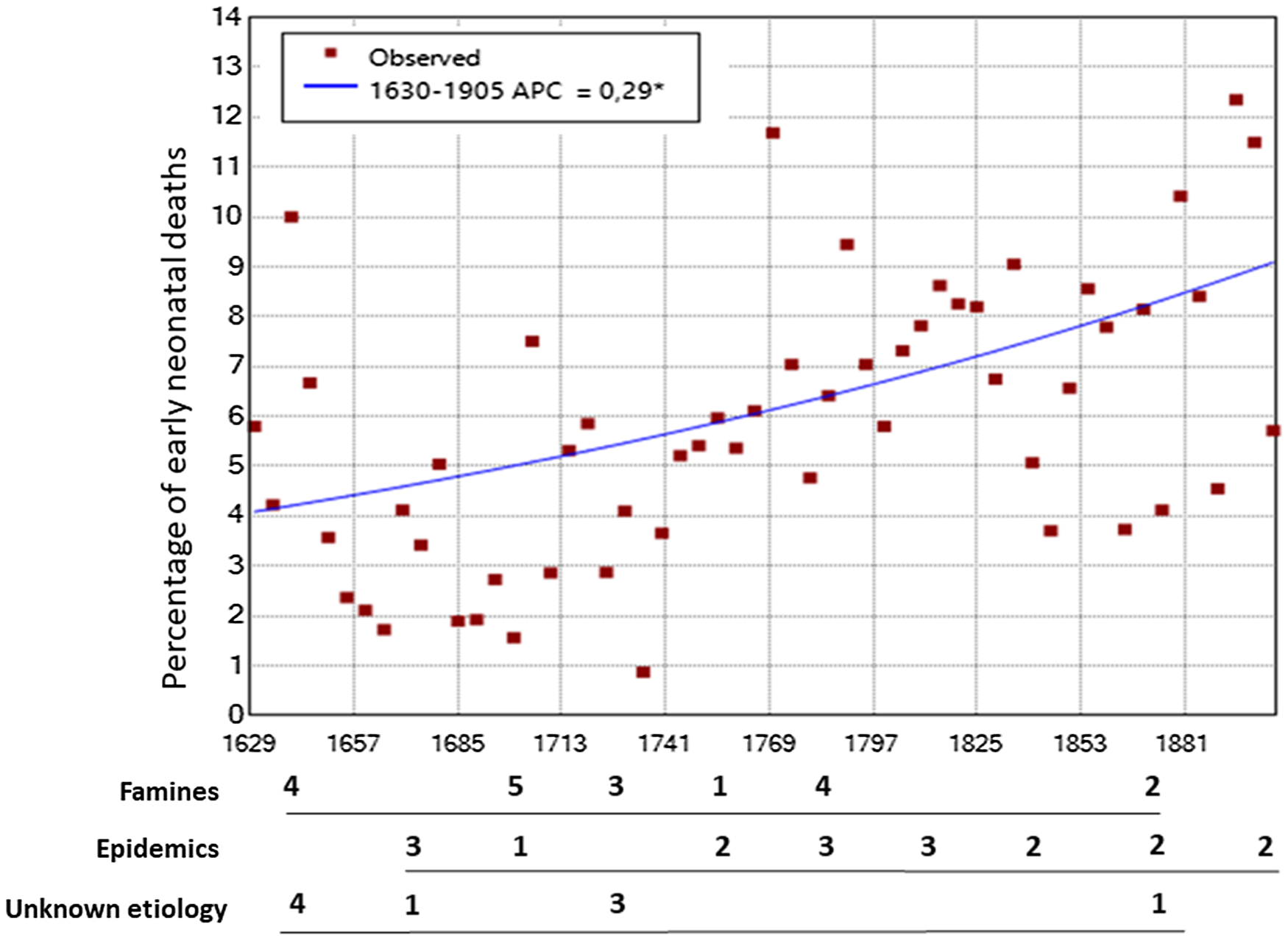
Patterns of Early Neonatal Deaths in Hallstatt (1630–1905). Dots Represent Observations, Continuous Line Represents the Annual Percent Change (APC). No Joinpoints are Observed. Below the Figure, and for Illustrative Purposes, the Number and Types of Mortality Crises for the Entire Population of Hallstatt During the Studied Years are Indicated.
The reconstruction of the database, based on ecclesiastical records, has some limitations that should be considered in subsequent analyses. First, some individuals were excluded from the study when it was not possible to register their death or any vital event that would ensure that they had reached adulthood. Additionally, individuals who emigrated or moved out of Hallstatt were not included. Second, the age of death was calculated as the difference between the date of death included on the burial certificate and the date of baptism, which could lead to slight deviations of the actual age of death if there were any delays in baptism following birth or burial after death. When recording this information, it was verified that, at most, the date of death and the date of burial were two days apart. Finally, it should be noted that, for cultural and religious reasons, in the centuries studied some stillbirths may have been recorded as deaths on the first day of life in order to baptize the baby. This may increase the number of perinatal deaths. Consequently, this work uses the term early neonatal mortality, rather than perinatal mortality, to describe infant mortality during the first week of life. Given the mentioned limitations, the sample in this study does not represent the population at risk; therefore, IMR were not calculated. While baptismal records are useful, they may not accurately reflect the total number of births. Consequently, calculating the percentage contributions of early neonatal, late neonatal, and post-neonatal mortality could introduce inaccuracies in IMR calculations.
Statistical analyses
Analysis of infant mortality over time
The analysis of infant deaths has been performed in three age groups:
-
1) Early neonatal (deaths of infants from days 0 to 6 of life, D0-D6)
-
2) Late neonatal (deaths of infants from days 7 to 27 of life, D7-D27)
-
3) Post-neonatal (deaths of infants from days 28 to 364 of life, D28-D364)
To study the pattern of infant deaths over time, the number of deaths was collected over the total number of births registered each year in the database. The data were then grouped into consecutive 5-year periods beginning in 1630 and ending in 1905. Data for years prior to 1630 were not consecutive, so they were added to the first period (1630), data from 1905 to 1908 were added to 1905. Grouping the data into 5-year periods ensured an adequate sample size (125–250 births in each period) to estimate proportions with a maximum error of 5% and a 95% confidence interval. The number of deaths and births aggregated in 5-year periods was analysed using a joinpoint regression model developed in the software from the Surveillance Research Program of the National Cancer Institute, version 4.9.1.0 (Kim et al., Reference Kim, Fay, Feuer and Midthune2000). The software allows for testing whether a change in a trend is statistically significant by estimating the regression coefficients (intercepts and slopes) and the changes of the slopes. P-values for the slope changes were calculated using a t-test based on asymptotic normality. The software also calculates the annual percent change (APC) for each segment. Standard errors were calculated from the data assuming first-order autocorrelation using the weighted Bayesian Information Criterion.
Analysis of risk of death
To determine the influence of the variables on infant survival, a Cox proportional hazard (PH) model was applied. The Cox PH Model was calculated separately for early neonatal (D0-D6) and late neonatal and post-neonatal categories (D7-D364). Late neonatal and post-neonatal mortality were pooled because they showed a similar pattern of mortality over time compared to the early neonatal pattern. Analyses were performed in three time periods, considering the breakpoints detected in the joinpoint regression analysis. These periods were also chosen to reflect when the Protestant religion is recorded in the sample: (1) From 1630 to 1739, including only Catholic families, (2) from 1740 to 1829, and (3) from 1830 to 1905, periods 2 and 3 included both Catholic and Protestant families. Missing cases were not considered for calculations. Only those variables showing a Wald test p-value of < 0.10 in the univariate analyses were included in the multivariate analyses. The proportionality of hazard ratios was evaluated with the Schoenfeld test. Cox PH analyses were performed using the survival and the survminer R packages (Therneau and Grambsch, Reference Therneau and Grambsch2000). Forest plots of multivariate results were drawn with the R package ggplot2 (Wickham, Reference Wickham2016).
Results
Trends in infant mortality in Hallstatt
The entire period included 2,598 deaths of infants not achieving the first year of life out of 9,086 births recorded (28.6%). Of these, 900 deaths were neonatal (9.9%) that were distributed in 509 early neonatal deaths (5.6%) and 391 late neonatal deaths (4.3%). There were 1,698 post-neonatal deaths out of the total number of births (18.7%).
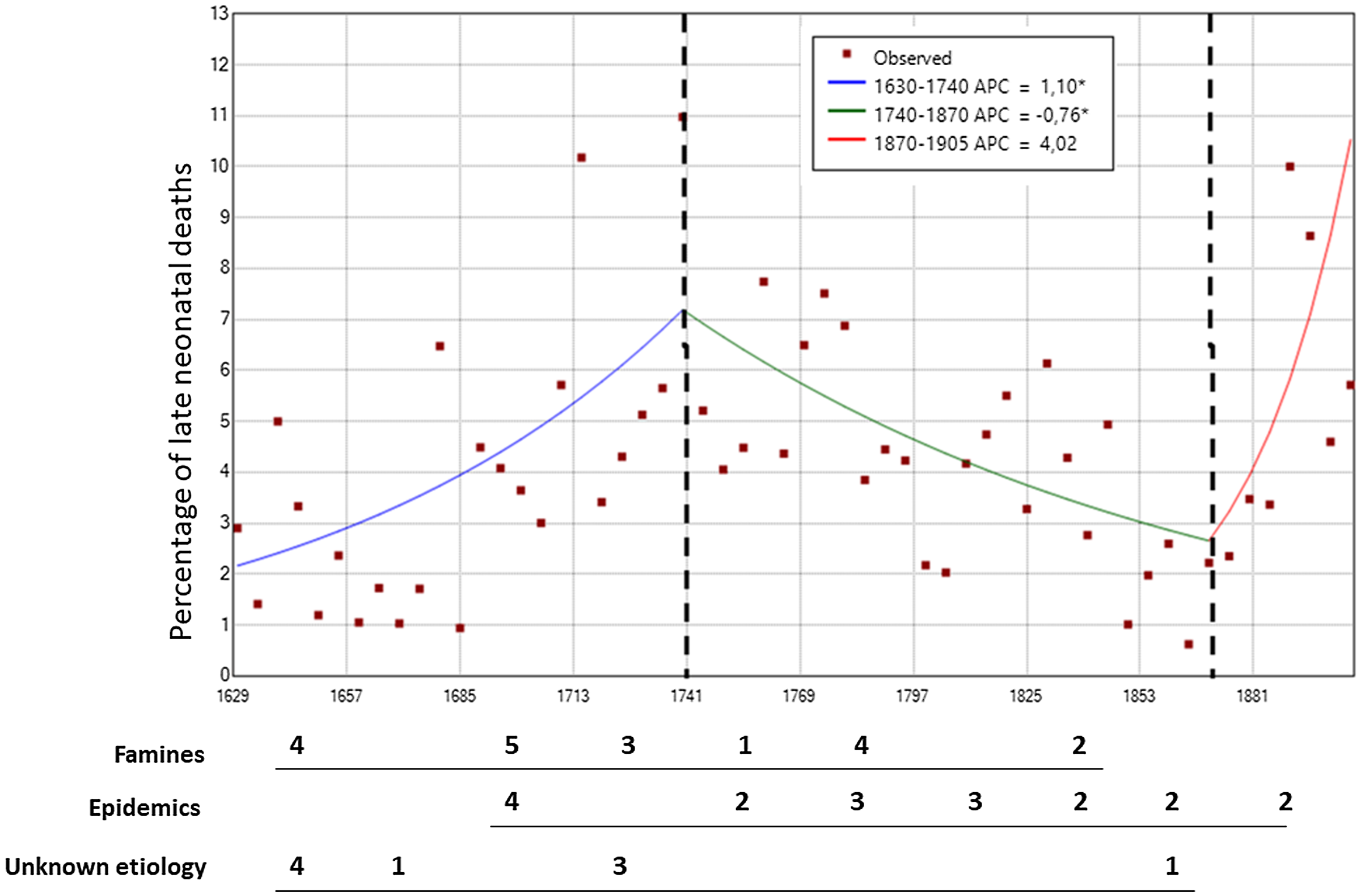
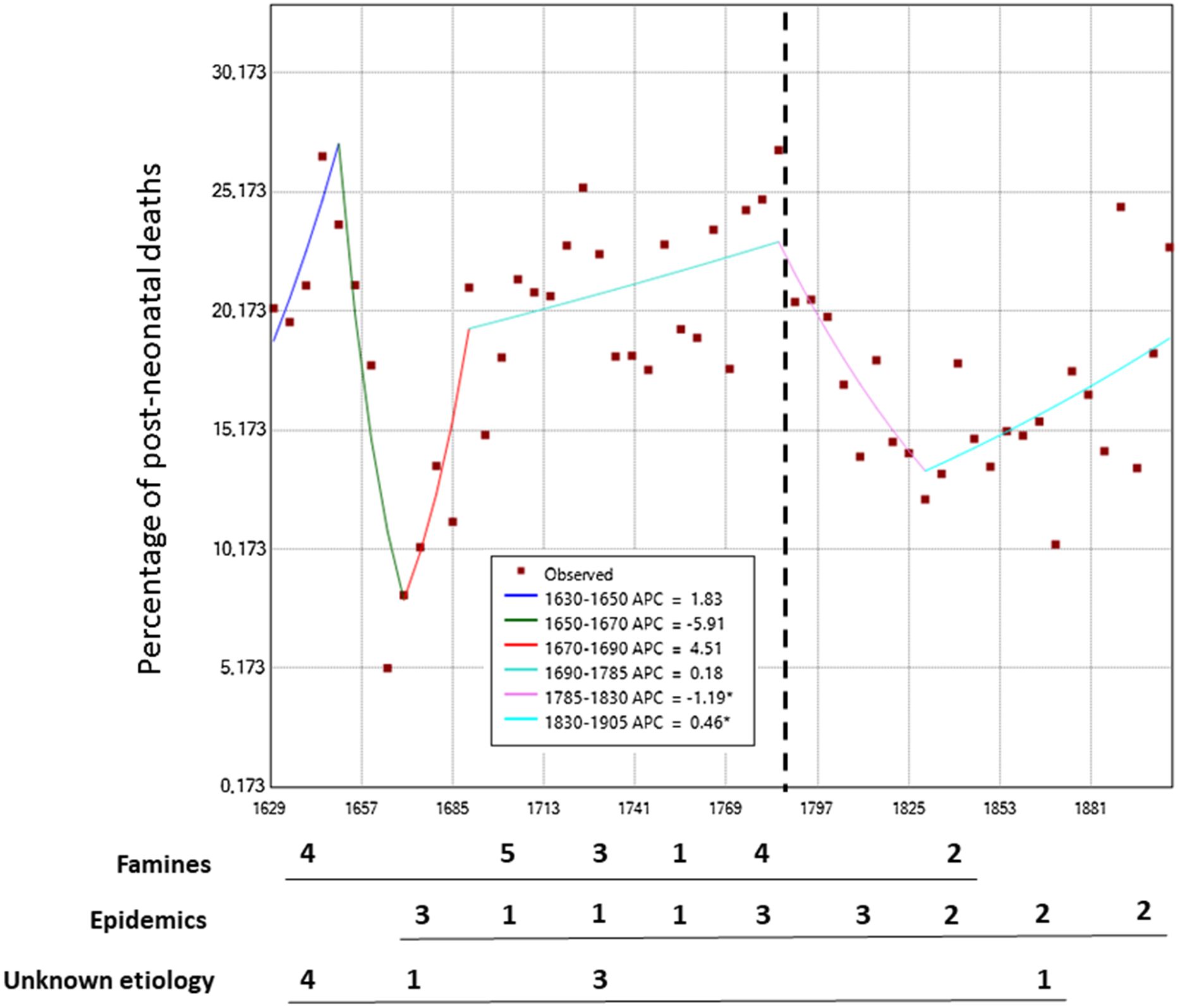
While early neonatal mortality showed a gradual and steady increase over the three centuries, with a positive APC of 0.29 (95% CI 0.2 – 0.4) (Figure 1), late neonatal (Figure 2), and post-neonatal mortality (Figure 3) trends were characterized by several break points (Supplementary Material table 2). Late neonatal mortality increased from 1630 to 1740 (APC 1.1, 95% CI 0.5 –1.7) and then decreased from 1740 to 1870 (APC -0.8, 95% CI −1.2 to -0.4) (Figure 2). From 1870 to 1905, the trend increased again, although it was not statistically significant. Post-neonatal mortality was characterized by 5 breakpoints, among which only those from 1785–1830 (APC -1.2, 95% CI −1.9 – −0.4) to 1830–1905 (APC 0.5, 95% CI 0.5 – 0.8) were statistically significant (Figure 3).
Patterns of Late Neonatal Deaths in Hallstatt (1630–1905). Dots Represent Observations, Continuous line Represents the Annual Percent Change (APC). Dotted Vertical Lines Indicates the 2 Significant Joinpoints Selected by the Model. Below the Figure, and for Illustrative Purposes, the Number and Types of Mortality Crises for the Entire Population of Hallstatt During the Studied Years are Indicated.
Patterns of Post-Neonatal Deaths in Hallstatt (1630–1905). Dots Represent Observations, Continuous Line Represents the Annual Percent Change (APC). Dotted Vertical Lines Indicates the 2 (over a total of 5) Significant Joinpoints Selected by the Model. Below the Figure, and for Illustrative Purposes, the Number and Types of Mortality Crises for the Entire Population of Hallstatt during the Studied Years are Indicated.
It is interesting to pay attention to the distribution of early neonatal deaths, as in some cases stillbirths may have been classified as deaths during the first day of life in order to baptize the baby. The distribution of early neonatal deaths was compared between religions and between time periods (Supplementary Material table 3). No significant differences were detected between Catholics and Protestants. However, the distribution of early neonatal deaths in 1630–1739 showed statistically significant differences compared to the other time periods. Deaths during the first day of life accounted for over 53% of all early neonatal deaths in 1630–1739, while they increased to 71% in 1740–1829 and 80% in 1830–1905.
Cox proportional hazard model
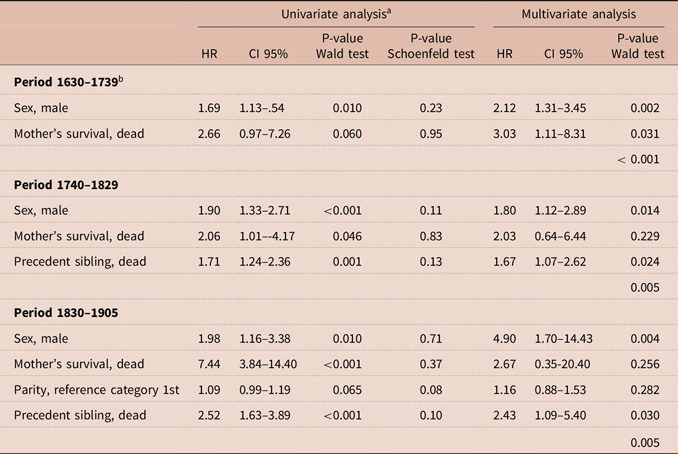
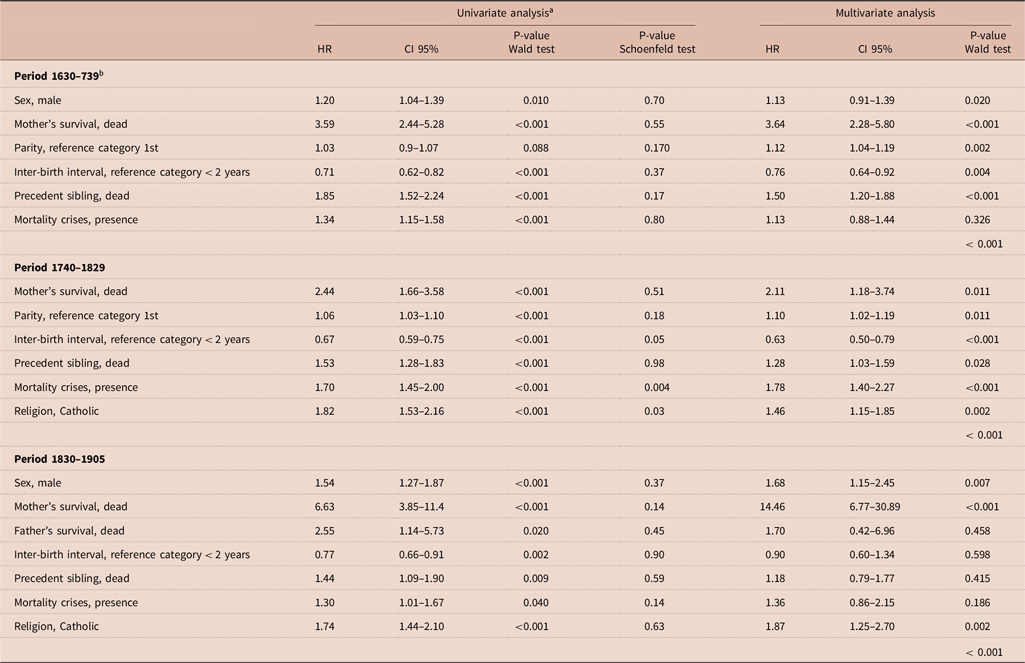
The characteristics of the whole sample are summarized by infant vital status in Table 1. Results of the univariate analyses are reported in Supplementary Material table 4. Except for religion and mortality crises in the period of 1740–1829, all variables were in line with the proportionality of hazard ratios evaluated by the Schoenfeld test. The univariate analyses revealed the most influential variables in infant survival. For early neonatal mortality (Table 2), sex was the only variable showing statistical significance in all time periods, with boys showing higher mortality risk than girls. Both the death of the mother and the death of the previous sibling were statistically significant risk factors in 1740–1829 and 1830–1905. For late neonatal and post-neonatal cases (Table 3), the death of the mother, a short inter-birth interval, the death of the precedent sibling, the presence of mortality crises, and belonging to a Catholic family were statistically significant risk factors in all periods. With few differences between the three periods studied, around 60% and 70% of the infants who died before reaching one month of life also had a mother who died during the same time. A similar distribution was observed for deaths occurring between 1 month and 1 year of life (Supplementary Material table 5).
Characteristics of the Entire Sample by Child’s Vital Status. Percentages are Provided Within each Variable for the Categories Dead and Alive
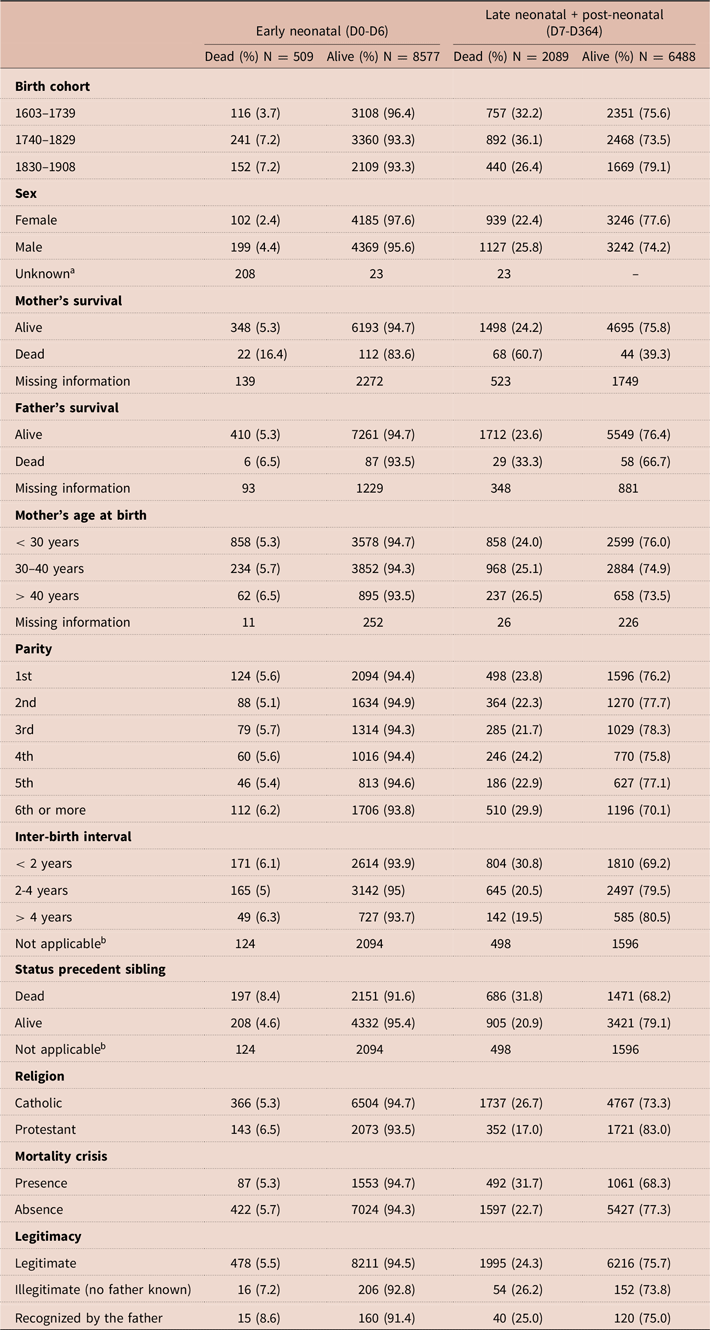
N, sample size.
a They died shortly after delivery and the sex was not recorded.
b Individuals who are the first children of the family
Variables Influencing Early Neonatal Survival (Cox PH Model) by Time Periods. Only Variables with a Wald Test P-value < 0.10 in the Univariate Analysis are Included in this Table and Considered in the Multivariate Analysis
CI 95%, confidence interval; HR, hazard ratio.
a Results from all variables in the univariate analysis are indicated in Supplementary Table 3.
b In this period, religion has not been considered since there were only Catholic records.
Variables Influencing Late Neonatal and Post-Neonatal Infant Survival (Cox PH Model) by Time Periods. Only Variables with a Wald Test P-value < 0.10 in the Univariate Analysis are Included in this Table and Considered in the Multivariate Analysis
CI 95%, confidence interval; HR, hazard ratio; CI 95%, confidence interval; HR, hazard ratio.
a Results from all variables in the univariate analysis are indicated in Supplementary Table 3.
b In this period, religion has not been considered since there were only Catholic records.
To evaluate the combined influence of the variables on infant mortality, they were included in a multivariate model. Results for early neonatal and late neonatal/post-neonatal analyses are indicated in Tables 2 and 3, respectively. For early neonatal cases, being a boy increased the risk of dying in all periods. The death of the previous sibling also increased the risk, but only after 1740. For late and post-neonatal cases, the mother’s death was the only variable showing a statistically significant risk at all periods. Sex, higher parities, short inter-birth intervals, and the presence of mortality crises were statistically significant risk factors, but not in all periods. Being born into a Catholic family was also a risk factor.
Discussion
For the three centuries analysed, infant deaths in Hallstatt records were 28.6%, which is a relatively high value among the already high rates of traditional agricultural populations (Corsini and Viazzo, Reference Corsini and Viazzo1997; Volk and Atkinson, Reference Volk and Atkinson2013). Worldwide, the average infant mortality estimated among 43 historical groups was 26.9% (Volk and Atkinson, Reference Volk and Atkinson2013). In European populations from 1600 to 1900, the value ranged between 17% in England in 1650–1700 to 38% in Germany in 1692–1899. The results from the Hallstatt population fit into the range of mortality rates shown by historical European populations. This study has an added interest compared to similar works, since in Hallstatt Catholic and Protestant parishes coexisted, cases of illegitimate children were recorded, and they faced several mortality crises during the period analysed.
The first objective was to assess the pattern of infant mortality over 3 centuries, and to test whether it differed between age categories. With due caution, as the number of deaths is not particularly high when working with a population of the size of Hallstatt and over three centuries, it is important to underline that the mortality pattern was clearly different when early neonatal deaths were separated from those occurring in the following months of life. Early neonatal mortality reached an overall value of 5.6%. The mortality pattern showed a clear and steady increase over the entire period of 1630–1905 (Figure 1). It cannot be excluded, however, that early neonatal mortality values contain some cases of stillbirths recorded as live births to be baptized. In Hallstatt, mortality during the first day of life ranged from 1.9% in 1630–1739 to 4.8% in the other two studied periods. The proportion of deaths on the first day of life relative to total early neonatal deaths increased from 53% in 1630–1739 to 80% in 1830–1905. These values are comparable to those described by Woods (Reference Woods2009) in the British population. Both Catholics and Protestants baptized their infants within a few days of birth and showed a similar pattern regarding the rise in early neonatal deaths. This increase may be attributed to the overall rise in infant mortality in Hallstatt, with more deaths occurring on the first day of life, or to an increase in the registration of stillbirths as live births. In a rural parish in Italy, the proportion of baptisms within the first two days of life increased from 1750 to 1850, coinciding with a rise in mortality within the first month of life compared to earlier periods (Minello et al., Reference Minello, Dalla-Zuanna and Alfani2017).
Late neonatal mortality showed a value of 4.3%, revealing two statistically significant breakpoints, at 1630–1740 and 1740–1870 (Figure 2). Late neonatal mortality increased until 1740, then declined for more than 100 years. However, the last third of the 19th century showed an abrupt increase in mortality. Post-neonatal mortality, with a global value of 18.7%, was the one that showed the widest range of variation (5% to 25%; Figure 3). Interestingly, late neonatal mortality showed a more similar pattern to post-neonatal mortality than early neonatal mortality. While early neonatal mortality depends on intrauterine conditions and the birth process itself, with a high endogenous component, late neonatal mortality may be influenced by other factors more closely related to the environment (Pozzi and Ramiro, Reference Pozzi and Ramiro2015; Oris et al., Reference Oris, Derosas, Breschi, Bengtsson, Campbell and Lee2004). The common trend observed in Hallstatt, regardless of the age category studied, pointed to an increase in mortality as the 20th century approached. In Italy, in the Veneto region and, to a lesser extent, in the north of the country, infant mortality increased considerably from 1770 to 1830 (Derosas, Reference Derosas2009). Dalla Zuanna and Rosina (Reference Dalla-Zuanna and Rossi2011) suggested that from 1700 onwards, deteriorating living standards led to widespread malnutrition among mothers, who consequently gave birth to underweight, and much more fragile infants. Other authors argued for an increase in infant mortality related to the winter months (Rossi and Tesolat, Reference Rossi and Tesolat2006). In England and Sweden, mortality in early childhood increased in urban and rural populations, at least until 1860–1870, because of a rise of scarlet fever (Davenport, Reference Davenport2021). Unfortunately, the exact causes of death in Hallstatt are not available in the original database, but mortality crises that affected the adult population undoubtedly affected infant mortality. The effect of mortality crises will be addressed later.
The most consistent risk mortality factors identified in the Hallstatt population for the three time periods analyzed were, first, being a boy, particularly in early neonatal cases; and second, the death of the mother during the first year of life. Other family factors increased the risk of dying, but only in certain periods. For late neonatal and post-neonatal mortality, it is interesting to underline the effect of the death of the previous sibling, short time interval between births, higher parities, and mortality crises, especially before 1830. Belonging to a Catholic family became a significant risk factor, and finally, being born out of wedlock had no impact on infant survival at any age category or period.
Being a boy increased the risk of early neonatal death between two- and three-fold. For late neonatal and post-neonatal deaths, boys had a risk of approximately 1.5, except in the 1740–1829 group, where sex had no associated risk. Different studies observed sex differences in survival up to the first year of life. This effect has been explained by the impact of sex hormones on the immune system, which can lead to a greater vulnerability among boys (Bengtsson and Dribe, Reference Bengtsson and Dribe2010; Bruckner et al. Reference Bruckner, Helle, Bolund and Lummaa2014; Kruger and Nesse, Reference Kruger and Nesse2006; Reher and González-Quiñones, Reference Reher and González-Quiñones2003).
As expected, the mother’s survival exerted a great influence on infants’ survival. In Hallstatt, the risk ranged from values around 2.5 up to 6-7 in 1830–1905. Among 60–70% of the mothers died in the same period as they infant did. In Poland, the death of the mother conferred a risk of 1.4 in the 18th century, and 1.7 in the 19th century (Tymicki, Reference Tymicki2009). In Spain, in the study of Reher and González-Quiñones (Reference Reher and González-Quiñones2003), the mortality for children with deceased mothers had a risk between 1.5 and 3.2, and this value was even higher when her death was close to the time of birth. A recent study conducted in rural Spain from 1750 to 1959 also highlighted the crucial historical role of mothers, especially during the early years of children’s lives when they are most vulnerable to disease and nutritional issues. The findings indicate that mothers were particularly vital before weaning, with mortality rates for motherless children being up to 4 times higher than for those with living mothers. Maternal loss results in reduced childcare and no breastfeeding. Breastfeeding is confirmed as essential for child survival. After weaning, children could survive on solid food, but this also exposed them to risks from spoiled food and untreated water (Marco-Gracia et al. Reference Marco-Gracia, Rommelspacher and Jang2024). During the first months of life, breast milk is vital nutrition for infants and a lack thereof compromises their health and survival (Reher and González-Quiñones, Reference Reher and González-Quiñones2003). Maternal care is also of the utmost importance in guaranteeing infants’ survival. Scott and Duncan (Reference Scott and Duncan2000) found that differences in exogenous infant mortality between pre-industrial English social classes were related to the duration of breastfeeding. In Bavaria (Knodel Reference Knodel1970), breastfeeding practices showed distinct regional patterns and were more frequent in mothers before 1850. Infants were three times more likely to survive when they were breastfed. In Nordic countries (Edvinsson et al., Reference Edvinsson, Garðarsdóttir and Thorvaldsen2008), feeding practices also showed a decisive role in periods of high levels of infant mortality. Unfortunately, no information is available on breastfeeding practices in Hallstatt. However, given the region’s isolation and limited economic resources, it is plausible that mothers breastfed their infants as much as possible.
Other variables that play an important role in infant mortality include inter-birth intervals shorter than 2 years and the death of the preceding sibling. A short inter-birth interval often necessitates stopping lactation to feed the next child, which directly affects the first infant’s survival. It can also create competition between siblings for resources or maternal care (Cinnirella et al., Reference Cinnirella, Klemp and Weisdorf2017; Scott and Duncan, Reference Scott and Duncan2000; Volk and Atkinson, Reference Volk and Atkinson2013). The mother’s nutritional status, crucial for mobilizing energy to support lactation, is of utmost importance (Butte and King, Reference Butte and King2005). A short inter-birth interval, with mothers transitioning from lactating the previous child to the new one, could exhaust the mothers, thereby jeopardizing the survival of the index child.
One would expect that the death of the previous sibling would shorten birth intervals and prevent competition for resources, conferring some sort of advantage to the ’replacement’ baby. In Hallstatt, this was apparently not the case. Short inter-birth intervals and the death of the previous sibling negatively influenced the survival of the index child in late neonatal and post-neonatal cases. The fact that the death of the previous sibling is also a risk factor in early neonatal cases may reflect the effect of some congenital anomalies or intrauterine conditions in a context of very harsh living conditions, the same ones that potentially explain the high values of infant mortality in Hallstatt.
The presence of mortality crises at birth affected infant survival in Hallstatt only starting from the first week of life. The mortality crises detected in Hallstatt were of low-to-moderate intensity (Gavrus-Ion et al., Reference Gavrus-Ion, Sjøvold, Hernández, González-José, Martínez-Abadías, Esteban Torné and Esparza2021; Kurz, Reference Kurz2002). Over the entire study period, there were identified 19 famine crises, 18 epidemic crises, and 9 crises of unknown cause. Specifically, from 1630 to 1739, there were 12 famine crises, 4 epidemic crises, and 8 of unknown etiology. Between 1740 and 1829, 5 famine crises and 8 epidemic crises were observed. Lastly, from 1830 to 1905, there were 2 famine crises, 6 epidemic crises, and 1 crisis of unknown etiology. For illustrative purposes, the number and types of mortality crises in Hallstatt have been added to Figures 1 to 3. However, mortality crises only posed a risk factor for infant mortality from the second week of life onwards. These crises significantly influenced late neonatal and post-neonatal mortality across the three studied periods. Interestingly, the period from 1740 to 1829, which experienced the highest number of epidemic crises, is the only one that maintained the statistical significance of mortality crises in the multivariate analysis (see Table 3). Famines and epidemics undoubtedly impacted maternal survival, which in turn plays a crucial role in offspring survival. However, the direct impact of crises on infant survival cannot be ruled out. Unfortunately, specific causes of death are not available, which could provide valuable insights. This research, extending the study period to include mortality throughout a longer span of childhood, may offer more evidence on the role of mortality crises.
Religion also played an important role in late neonatal and post-neonatal mortality, since belonging to a Catholic family entailed a mortality risk that was 1.7-1.8 times higher when compared to being from a Protestant one. From a prosaic perspective, the differences between religions often imply differences at the socioeconomic, health, and hygiene levels. These results suggest that Protestants may have enjoyed better living conditions. A previous study found that Protestants lived longer and had a more successful fertility pattern than Catholics (Gavrus-Ion et al., Reference Gavrus-Ion, Sjøvold, Hernández, González-José, Martínez-Abadías, Esteban Torné and Esparza2021). A study conducted by McQuillan (Reference McQuillan1999) on Alsace from 1750 to 1870, also revealed that Catholic and Lutheran populations experienced distinct demographic regimes. Catholics had restricted marriages, high marital fertility, and elevated infant and child mortality rates. In contrast, Lutherans married earlier, had lower marital fertility, and lower infant and child mortality rates. The period also brought marriage restrictions to both religions, and particularly for 19th-century Lutheran couples, more premarital conceptions and births. While infant mortality in Lutherans remained high, it was lower than among Catholics. In the Netherlands, Catholicism was also associated with higher values of infant mortality in the last half of the 19th century (Wolleswinkel-van den Bosch et al., Reference Wolleswinkel-van den Bosch, van Poppel, Looman and Mackenbach2000). The differences were related with episodes of diarrheal disease and less adherence to breastfeeding among Catholic women. It has been suggested that the strong adherence to folk medicine and, subsequently, less acceptance of then-modern hygienic measures among Catholics may have contributed to religion-based differences in infant mortality (Brown and Guinnane, Reference Bown and Guinnane2002; Wolleswinkel-van den Bosch et al., Reference Wolleswinkel-van den Bosch, van Poppel, Looman and Mackenbach2000). Derosas (Reference Derosas2003) found that, in 19th century Venice (Italy), infant mortality levels in Jewish communities were considerably lower than the ones observed in neighbour Catholic communities. However, infant mortality patterns between both groups were similar. The author pointed to cultural differences reflecting a certain child neglect, and hence, Catholic infant over mortality compared to childcare in Jewish communities. In Ireland, during the first decades of the 20th century, infant and child mortality showed differences among religious groups. Catholic children had the highest mortality rates, while Jewish children had the lowest. Among Protestants, the Church of Ireland had higher mortality rates than Presbyterians. After controlling for socioeconomic factors differences among Protestant groups were less pronounced, Catholics were still at a disadvantage, and Jewish families were more favored (Pozzi et al., Reference Pozzi, Scalone, Raftakio and Kennedy2024).
Interestingly, illegitimacy did not show any disadvantage or higher risk of infant mortality. The rate of illegitimate children in Hallstatt, as in the region of Salzburg, was high for the values of the time (Dalla Zuanna and Rossi, Reference Dalla-Zuanna and Rossi2010), but children out of wedlock were widely accepted into families and likely received a similar levels of care as legitimate children (Gavrus-Ion et al., 2020; Kurz, Reference Kurz2002). This was not the case in other regions. During the second half of the 19th century, in Bavaria, as well as in Sweden and Denmark, infants born out of wedlock had higher mortality (Brown and Guinnane, 2002; Edvinsson et al., Reference Edvinsson, Garðarsdóttir and Thorvaldsen2008). The fate of illegitimate children can largely depend on the help and acceptance of close relatives. In Sweden, illegitimate infants who lived in the same parish as their grandparents had the same chances of surviving than legitimate children (Edvinsson et al., Reference Edvinsson, Garðarsdóttir and Thorvaldsen2008).
Conclusions
The results underline the need to assess early neonatal mortality independently in studies of infant mortality in historical populations, since they can hide different mortality patterns as compared to late neonatal and post-neonatal mortality. In Hallstatt, early neonatal mortality did not show any substantial improvement from 1630 to 1905. Boys were more likely to die throughout the period studied. Late neonatal and post-neonatal mortality declined between the mid-18th and mid-19th centuries but increased as the 20th century approached. Harsh living conditions, as well as several epidemics, may explain this increase. The mother’s survival, sex, the death of the previous sibling, and being born in a Catholic family increased the risk of death in the first year of life.
Supplementary material
The supplementary material for this article can be found at https://doi.org/10.1017/S0021932025000239
Funding statement
The authors declare that no funds, grants, or other support was received. The author ME belong to the Research Group in Learning Environments and Resources (EMA)-2021SGR01067 and the authors MEE and NMA to the Research Group in Genes, Environment and Phenotypes Complex_Fen_GxExD 2021SGR00706.
Competing interests
The authors have no conflicts of interest to declare.
Ethical standard
The authors assert that all procedures contributing to this work comply with the ethical standards of the relevant national and institutional committees on human experimentation and with the Helsinki Declaration of 1975, as revised in 2008.


 Open access

