

Messy Messy Messy
madison moore, Rebecca Schneider, Beckett Warzer
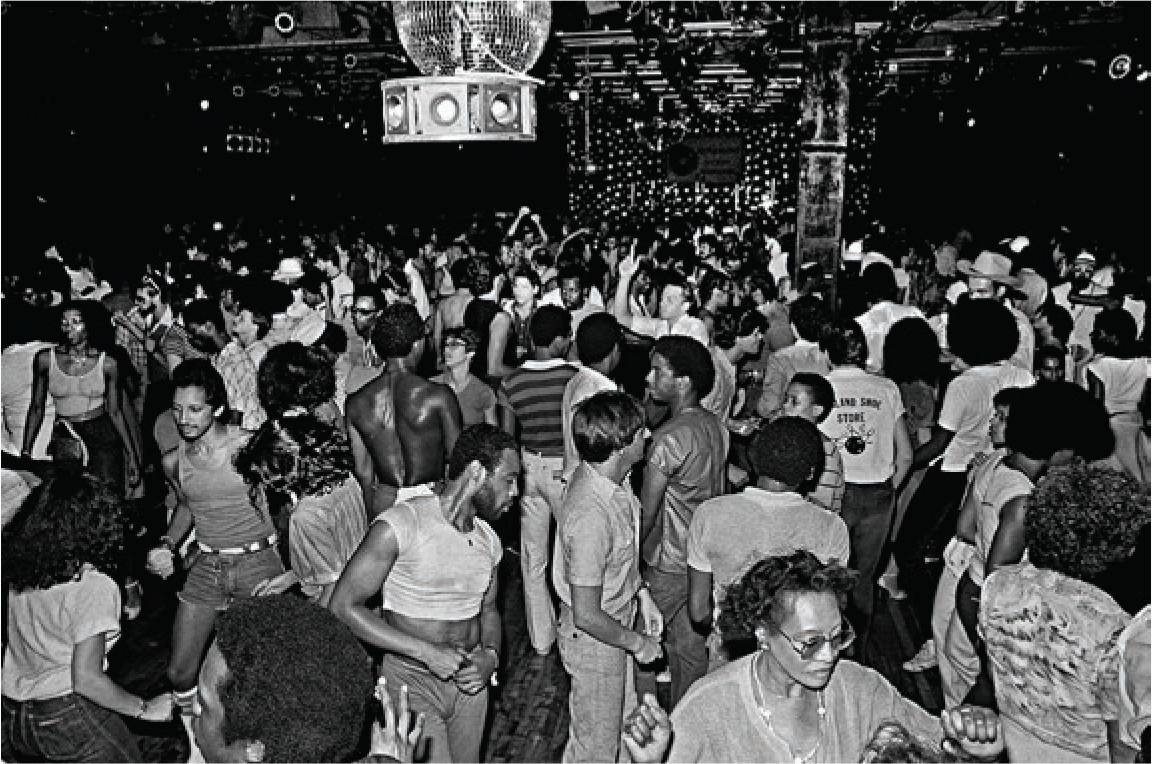
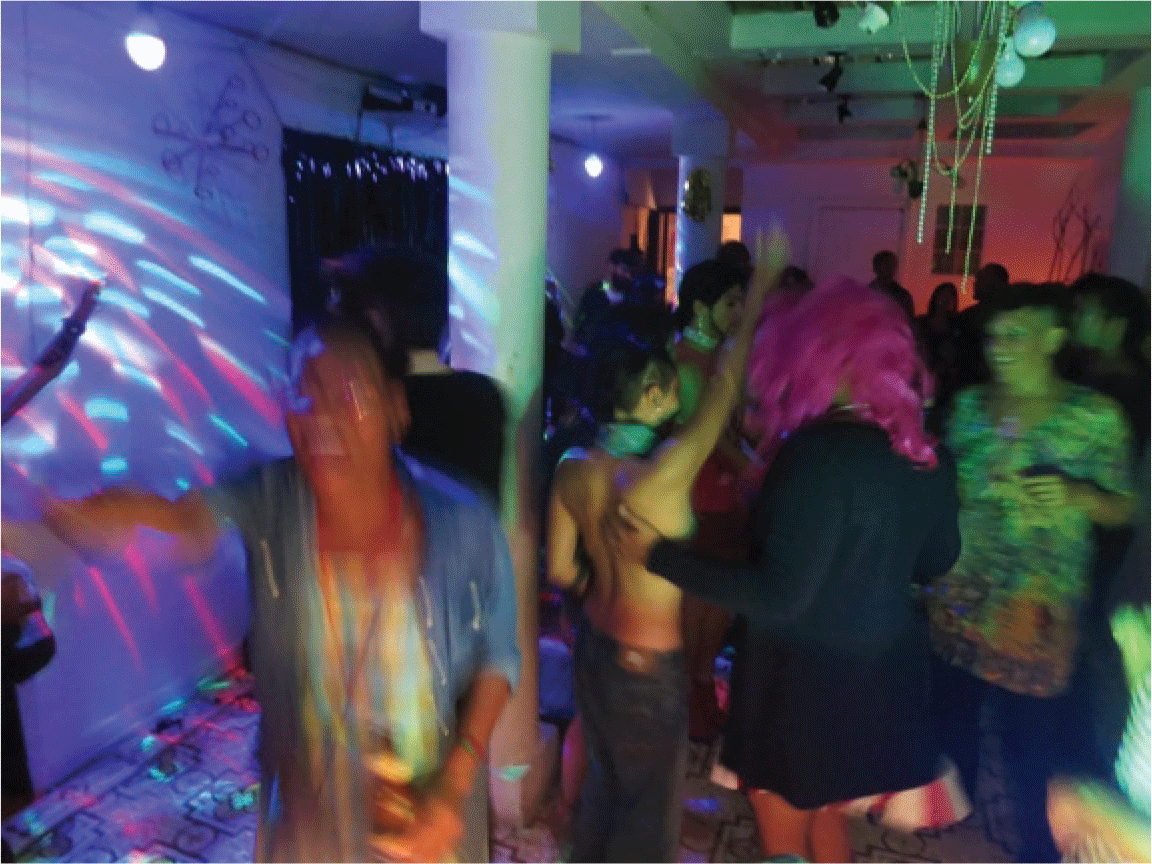
We begin this special issue of TDR, “Queer Nightlife: A Collection of Moves, Sounds, and Other Sensations,” from the middle of a messy, hot, crowded dance floor. You’re working it and twirling in front of a speaker tower (of six) that’s taller than you, the beats are pumping. It’s all so messy. Crushed cans, drink cups, soggy napkins, and straws are strewn all over the floor, the ground a pool of sweat, glitter, perspiration, and other residues. A queer archive of a different kind. You haven’t thought about the time, your phone, your text messages, or your email in hours.
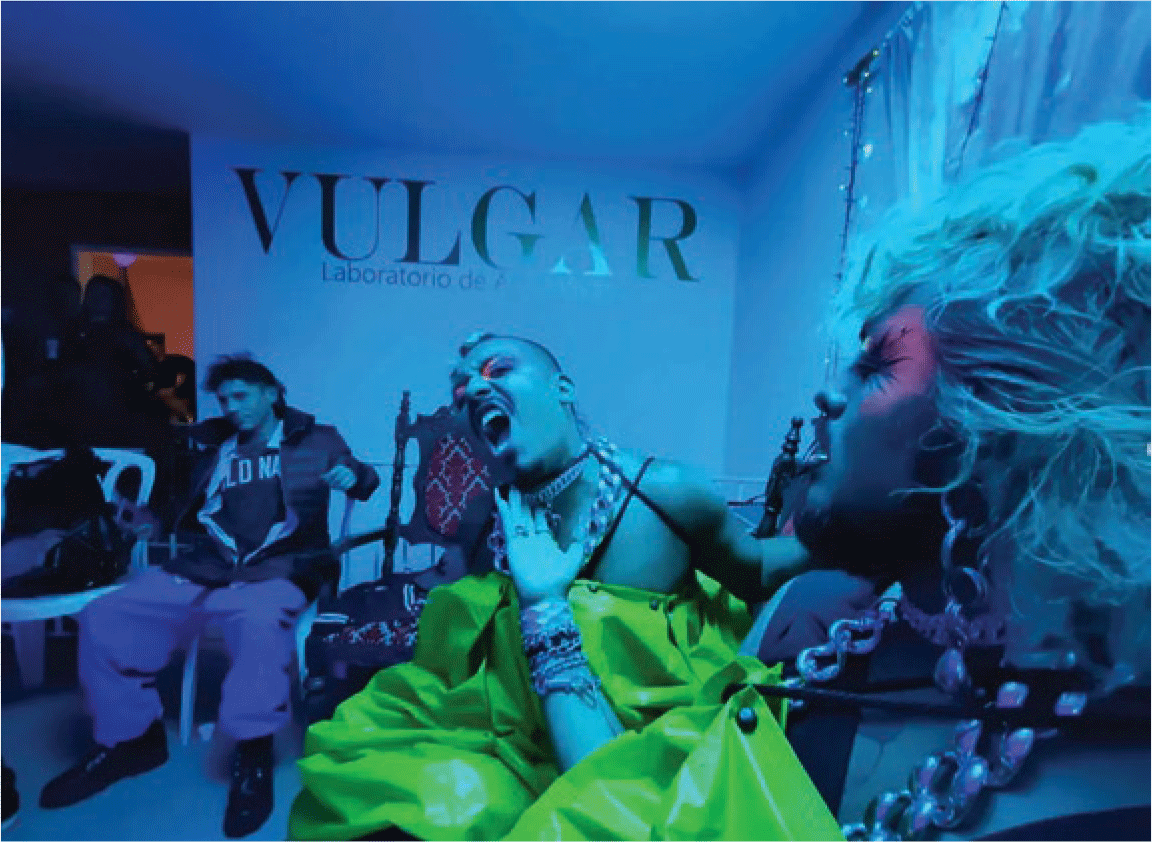
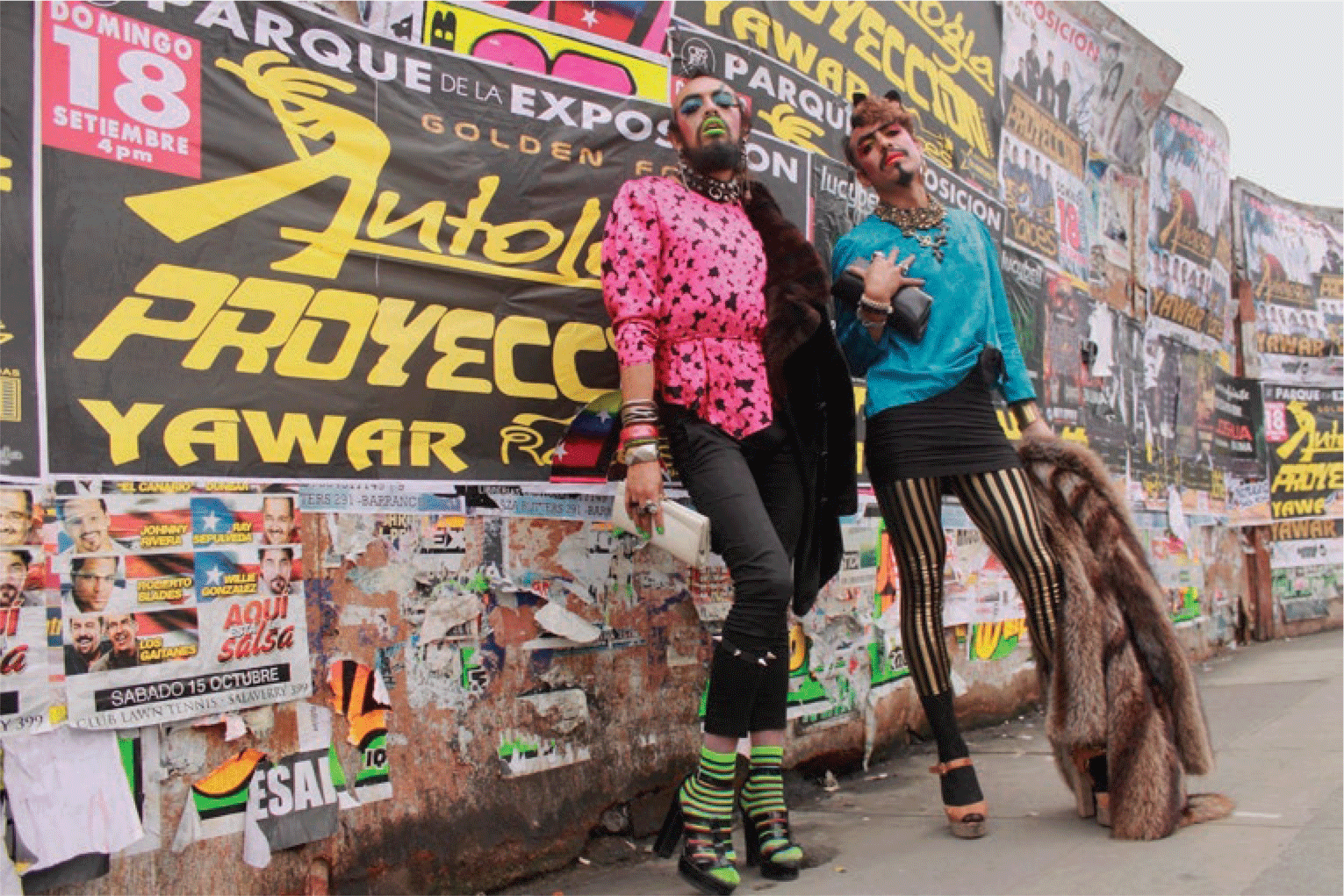
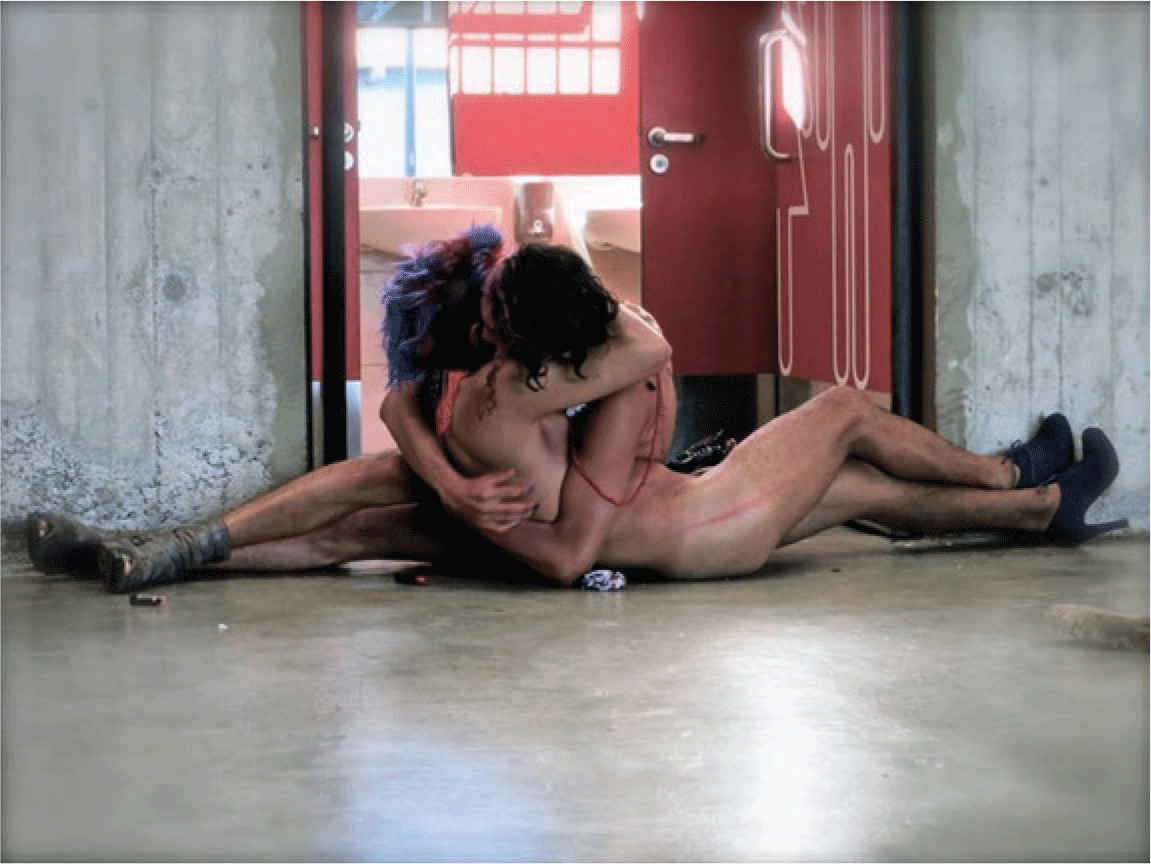
As editors of this special issue, we wanted to start “from the floor.” This is a way to center and foreground the many kinds of queer feelings, impossibilities, experiments, gestures, sensations, and other practices that take shape on the dancefloor. The short pieces gathered below offer snapshots of moments that speak from, to, and even with the nightlife space in the cracks and slippery interstices among dancing queer bodies, moving in and through what madison moore has called, in the introduction to this issue, “analog intimacies.” Instead of neatly offering each author as a standalone contribution, one after another, separate, ours is a crowded dancefloor. Dancefloors always platform the collective and the collaborative—a call and response among you, the dancers, the groove, and whatever comes next. Just as the DJ blends together track after track over a long night (or daytime) set, here too you will experience the dancefloor as a collective site of energy. In fact, we took inspiration for this dossier from another dossier, borrowing the move and jumping the beat from a fabulous special issue of Gay and Lesbian Quarterly (GLQ), edited by Mel Y. Chen and Dana Luciano in 2016, titled “Dossier: Theorizing Queer Inhumanisms.” So call and response and call it is! This right here is a deep dig, a long, extended club mix of voices, perspectives, feelings, attitudes, and sensations that bleed or leak or otherwise hum into and out of each other across time, space, and generations. What kinds of dancefloor sensations will emerge for you as you dance with us?
Berghain
Juana María Rodríguez
Berghain had been trying to get me to pay attention but I had left her on read the first time I went to Berlin. Somehow in my mind, I swore that I hated techno, and the idea of sweaty German gym bunnies did not entice. But the second time I visited the city by the Spree, I decided to leave my sonic and somatic comfort zones behind and open myself to the embodied possibilities of a foreign adventure.
Lucky for me, I had been invited to the home of an über-rich gay German art collector and his glamorous Eurasian husband, and over an exquisite meal they offered me a primer on this iconic Berlin institution. It helped of course that in their expansive dining room they had a miniature rendition of the former multistoried postwar power plant encased in glass, I’ve never been to Berghain (2016), by German conceptual artist Philip Topolovac. The piece reproduces the club’s iconic edifice in cork in the reductive style of 18th-century Italian artisans who would carve replicas of sacred places that few of the faithful ever got to visit. As we talked, these quintessential Berlin insiders shared insights about this most famous of all nightclubs. They began by addressing my anxieties about the role of the bouncer, which in the US (and elsewhere) is mostly about enforcing racist and classist exclusions. My hosts reframed the job of the bouncer as one of curation: they are there to curate a Scene. They added that they themselves, along with many other people, including Lady Gaga herself and most deliciously Elon Musk, had once been denied entry—hearing the dreaded “Not tonight” from the burly doormen. My hosts also shared that the bouncers, rather than worship at the altar of youth, generally respect the experience of age and those who demonstrate an enduring commitment to the possibilities of the night. Nevertheless, their effortless German eliteness made me a bit wary of trusting their insights too deeply.
The next day, over a much more casual meal, a brown club kid, a new lover and one of the many newer immigrants to Berlin, similarly spent time persuading me why I needed to put my prejudices aside and try my luck at the door to the craven techno experience that Berghain exemplified. But they added something else that helped steel my resolve. They reminded me that Black queers and the Black music scene from Detroit were instrumental in shaping the techno scene in Berlin. Later
I would learn that in fact Mac Folkes, a Black American living in Berlin when the wall came down, was the person who had schooled the Germans on how to “do the door” at Berghain. They reminded me that the bouncer, there or anywhere, doesn’t get to determine your worth or the worthiness of your outfit and to just act like I belonged, because I did. I was ready.
The next day, after hours of daylight blurring into night, of anxious waiting in a line full of measured camaraderie performed across the queer patois of languages, the bouncer assessed our human offering…and said Willkommen.
Once you are past the bouncer at Berghain, it all begins, quickly and in blurry German, because you are inside and your heart is racing with the thrill of possibility. You and your possessions are searched—and as I open wide, I flash back to La Escuelita, NYC, 1989, and the ritual pat down by the fly Dominican bouncers that curated that scene. But I am in Berlin now and everything is unfamiliar and new; the vibe is dark and stern—in all the ways that I am not. The details of money and wristbands move you along the queue with the chosen others, your phone is snatched, covered in stickers and handed back, limp and foreign. Inside, the bass that had been calling you from the door is right there, waiting to grab you, as your eyes dart across the anteroom to the gates of decadence. But first you must peel off any extraneous layers of the outside world and deposit them with the coat check who will stare at you blankly and hand you a ticket. You carry only the barest essentials: vape, glasses, a battery pack, money, and drugs.
The brown club kid who convinced you to go is now your RaveMate, PlayMate, NativeInformant and you happily bottom to their club-going wisdom. The next stop is the bathroom. You will make another queue to access a stall to consume the MDMA that you have brought along, a full dose now, and a half dose hours later. My RaveMate is responsible for dispensing all the intoxicants and for timed hydration. As you wait for a stall to open, you see groups of partygoers…four, six, eight…stumble out as a door pushes open, arms and legs covered in black mesh and tattoos, and disentangle themselves to stand upright. It is easy to recognize the partygoers who have just arrived and the ones who have been there all night. You will return to this space over and over again over the course of the night, refilling your water bottle, queueing to pee. The space provides a small respite as you ready yourself to go back out onto the dancefloor, into the oozing mass of flesh pulsing in unison. There are no mirrors anywhere and this is a small mercy for which you will be forever grateful.
The space of the place is its own story; it is a dark cavernous maze of steel and concrete. Metal stairways traverse the vertical expanse where impossibly high ceilings contrast with tight intricate hallways. Along its industrial interiors tiny pockets of rainbow-colored light stream in to land on sundry mounds of flesh pressed together. We go up up up to the Panorama Bar to face the DJ, directing the scene in her own tranced rapture. Once on the dancefloor, the room is alive and throbbing with color and sound as we all submit to the pounding rhythms that have overtaken the space, making the very walls hum in submission.
Now I have a body pressed behind me, and soon into me, fingers worming their way to fuck me to the syncopated sound that has me reverberating in the heat of the beat. Their hand wraps around to steady me, as they thrust in time to the DJ’s commanding presence. My eyes stare into an elsewhere that is everywhere, fused with the sparkled bits of light beaming down, engulfed in the heat of the other bodies writhing in their own ravished bliss. I let go and the waters rush out of me, gushing down my thighs and onto the floor to mix with the spilled drinks and droplets of sweat that fly off the other partygoers. Throughout the night, the dancing becomes the fucking, on the dancefloor, in cold metal cubbies, against the walls that keep us protected from an outside. This is the real ecstasy, the space of abandon where desire breathes free.
Pride Weekend 2024 (Raving after Raving)
McKenzie Wark
Ran into Élan d’Orphium on the Manhattan-bound M train in Brooklyn.Footnote 1 She was in a show I did in Madrid for the Spanish edition of Raving (Wark Reference Wark and López Seoane2024). She and other local trans people read from it in Spanish, and I did a little in English (Wark Reference Wark2023a), over some laid-back beats on vinyl from DJ Lanoche.Footnote 2 A delightful surprise to see Élan. She had just arrived that morning. Soon enough we’re exchanging DMs on Insta to meet up. It’s the Thursday before Pride weekend and I want to make sure she has options for celebrating it the way we do in my transsexual circles.
We meet up that night at Bossa Nova Civic Club, which, despite the name, is famous for techno. It’s a low-key local bar to many of us in Bushwick, Brooklyn, but every up-and-coming DJ has played it and many who book bigger shows come through just for the atmosphere. We’re early—before there’s a cover charge. Just sitting and chatting at the bar. There’s a conversation we need to have about Madrid, but the situation isn’t ripe for it.
Maybe later. Élan pulls up her Insta to show me this lovely performance she did in an art context of herself dancing—exotic style—with a horse tail made of optical fiber.
“I’m trying to bring the energy of the club into the art and performance space,” she says. “It’s hard, but the creative energy is in nightlife these days and I think the interesting stuff is about translating that.”Footnote 3
Eva Loveless programmed the night at Bossa and booked Soso Tharpa, up from DC.Footnote 4 After a heroic bump of K the whole set seems to bark and bleep with sonic hallucinations. I can’t tell what’s in the mix and what’s just people talking, or the fire engines that yowl down the street outside from time to time. How is one to write about this side of the “Dionysian”? Nietzsche excluded the “barbarian” side of the Dionysian from Birth of Tragedy ([1872] 1994). Didn’t fit with the racist, heterosexual union of dream and intoxication. Well honey, we’re all about the “barbarian.” We’re its afterbirth.
Élan and I dance together for a while, which I don’t usually do but it’s fun throwing moves to each other. What I take to be a cis man joins us who’s a fabulous dancer. He might be interested in Élan, so I detach myself after a while. He really is great. I heard that later he was spinning on his head b-boy style. You never know what’ll happen at Bossa.
Out on the street I introduce Élan to V and some other local trans and adjacents. “It was fun dancing with you and that guy,” Élan says to me. “I like dancing with hot people. You’re hot.”
I give her a look. She’s sharing her flirtatious side as an act of friendship, and I appreciate that. It’s a language of trans-femme intimacy.
“I’m hot for my age,” I concede.
“No, you’re hot.”
“I think being hot in the real world rather than on the ’Gram is just a matter of being in your body. To be in the flesh in the flesh.”
Someone who recognizes me as the author of Raving politely interrupts to introduce themselves. It happens a lot, at least around here. I’m “Brooklyn famous,” as Torrey Peters once described it (2021:88). Although truth be told I’ve been clocked as the author of Raving on the streets of Milan and in the ice cream bar at Berghain.
In Raving I tried to acknowledge the rich library of books at the intersection of queer nightlife, techno, and raves. Others have added to that library since.Footnote 5 And now there are other books that include firsthand accounts of the Brooklyn scene.Footnote 6 There’s resistance to writing about the rave scene in the rave scene, but also a feeling that we need it. The morning after we’re often left with mysteries. What the fuck just happened? The writing can help us feel less alone with the weirdness.
My girlfriend Jenny is working out of town for Pride weekend, so I have a spare ticket to the Pride edition of Flanger, one of my favorite queer-flavored raves. It is to run from 11pm Friday night until 5pm Saturday, so I figure I’ll get at least two rounds in with a disco nap in between. I’m not usually early to raves. I like to wait until what in Raving I called the punishers and coworkers have gone home. The punishers feel like for them to have a good time it needs to be at your expense. The coworkers are looking for someone to give them a leisure experience. Harmless, usually, but they don’t bring anything to the party. A good rave centers people with gifts.
Élan has a little trouble getting in, as she doesn’t know much about it.
“They asked me if I knew what DJs are playing.”
“I’m sorry, I should have prepped you for that.”
“You’d think as a trans woman they would just let me in.”
“The problem with that is you’re unclockable.”
We get drinks. Beer for her; mate for me. I don’t drink alcohol anymore. Leaves room for better drugs in my life.
The crowd is spaced out. We easily weave to the front. Lolsnake is throwing down some interplanetary techno.Footnote 7 I get the ketamine out and start measuring a bump by the light from the CDJs. This alarms Élan. I’ll have to explain later that in New York clubs one should always do drugs in the toilet stalls, but at the raves it’s bad manners to tie up the toilets with drugs and kiki. Better to do them anywhere else.
Flanger dancefloor thickens. Élan seems like she can handle herself so I leave her dancing to go hang with whoever I can find that I know. I always talk to the medic and the door people. Topics include pets, visas, rent, tea about various scene personalities. I decide it’s time to head home for a bit. It’s a 15-minute walk. Bushwick is noisy and getting expensive but it’s a real pleasure to just walk home from the rave.
Back after a longer nap than I’d expected. Sweat from the first round has dissolved my wrist stamp but people know me at this party so no drama. I slept on Ron Like Hell, which I regret.Footnote 8 Boris is just starting his set. Boris has his fans. I feel like he goes over better in a bigger room. Lots of build and release, lots of club bangers.Footnote 9
Taking a break, I run into F outside having a cig.
“Not into Boris?”
“The theory I came up with dancing to him just now is that from the way people DJ you can tell how they like to fuck.”
When F looks at me I glance away, as F and I have, as it happens, fucked.
“Not enough winding textures for you. Not digressive enough. Not dogged by incompleteness.” I have to concede I’ve been read.
I head back in for Clarisa Kimskii, a Flanger resident DJ and regular closer. Clarisa always takes us home.Footnote 10
Saturday night into Sunday morning is to be another rave, thrown by S, a well-known local promoter. The problem is that S has asked me not to write about this party and I honor that. This is not a scene that needs or wants tourists. There’s already a problem with what in Raving I called style extraction. Whatever art, fashion, music, performance is now, whatever the life of the city is now, at its center is—paradoxically enough—the kind of nightlife that’s marginal, that’s a little hard to find. Urban industries from fashion to real estate thrive on extracting these living situations—where we go to get free—to package them and sell them as product. It’s inevitable and I won’t judge friends who grab that bag, but there’s no reason to accelerate it.
So let me just describe a little about the art of throwing a New York queer rave in honor of S and his talents. The first thing is finding a venue. We often end up in the same spaces. Usually warehouses and former industrial facilities. Some of these will eventually be redeveloped into condos or shopping malls. Recent losses include The Muse, a former circus school, and Chernobyl, a former vehicle repair shop. We called it Chernobyl because the site was mildly radioactive as it had once been a thorium storage facility.
A good rave promoter is always on the lookout for a new venue. It needs to be far enough away from residential buildings to be safe from noise complaints, but near enough to the subway so people can get there. A careful promoter might also take note of which police precinct it is in. It will ideally have space for not only a dancefloor, maybe two, but also some chill-out spaces, a darkroom for gay men to fuck, and maybe even a flinta darkroom in which everyone but cis men might want to fuck. It is best if it’s not too much of a fire hazard.
Layout, light, and fog are to me underappreciated aspects of a good New York warehouse rave. It’s a constructed situation, and as such it shapes a possible range of action for the ravers who come through.Footnote 11 There’s the flow of bodies through space to consider. Lowering the level of visibility heightens the other senses. Light and fog can create emotional textures as well as sensory ones. Then there’s the range of activities to consider. Ravers might want to dance, flirt, fuck, cruise, kiki, turn looks, gawk, pool into ecstatic emotional puddles, nap, smoke a cigarette…and other collective configurations not yet discovered.
After the venue, the next most important thing is the work crew. There will be people on construction, sounds, lights, bar, door, security, medics, and several other tasks. There may even be a designer to plan the use of the space and people to fabricate some partitions or light rigs. It will all have to be assembled, using components held in storage or rented. It might take days to build and days to strike. There may be disasters, such as flooding, or maybe the whole thing is called off because the landlord gets nervous and cancels.
Then—the lineup. With luck the DJs will understand their timeslot and form part of the larger arc of the night. The resident DJs will have to pull their followers, and there will be special guests. A promoter might have a signature style for their communications. Unter, an iconic New York rave that had a nearly 10-year run (2014–2023) was famous for its poster designs, promotional copy, and party themes.Footnote 12 This information might go out to email lists, public or private Insta accounts, Discords, and so forth. A well-curated mailing list is key.
There will be a guest list, of course. I had list for Unter for a while, but the list got too big, and my name was purged. Some people will be known to the door and have free access. Trans women get in free—sometimes. It’s a policy meant for the dolls, a special kind of trans woman, not necessarily for other kinds, or for me. The dolls are the sacred beings of the night. The dolls-in-free principle butts up against another: that the decision of the door is final and not to be questioned.
There’s a delicate balance between giving the rave away to the people who really need it, who make it work; and the paying customers who, among other things, are paying to consume the free labor of the people who get in free. Tickets are usually priced by staggered releases, starting at maybe $45 for first release, $55 for second, and $70 at the door. There’s a lot of bitching about these prices. But where else can you get 8 to 14 hours–worth of anything for that kind of money?
The best ravers are those who know that we’re here to create something together, and so even if we bought tickets, we still bring gifts. Since I don’t do looks and I’m not a very good dancer, my gift is to never cause any drama or discourse and to just dance for a long time. I can weave myself into the dancers around me. On a good night, at least. If those around me will do the same.
Not to be that bitch, but I do bring something else, at least to some people on the scene. I wouldn’t say with a straight face that I’m iconic, as that word doesn’t belong to me, and I’ve not earned it. That’s a word from Black queer nightlife, particularly ballroom. It’s earned in ballroom, both on and off the runway (see Tucker Reference Tucker2022). I’m not that, but I am recognizable. There aren’t many older trans women around, let alone who try to write with affection, seriousness, and a light touch, and not about the scene, but for it. I wrote Raving as a love letter to ravers.
When doing interviews and talks for the book I kept being asked if the rave was utopia, or resistance or transcendence or subversion or therapeutic, or the underground or the carnivalesque, or the Dionysian, even. Maybe none of that language helps anymore. A rave is a situation. It’s the best one-word tag I have. My gift to the rave is language—even if what I write is in International Disco Latin. Hito Steyerl:
It is a queer Latin made by splashing mutant versions of gender across assumed nouns. It’s a language that takes into account its digital dispersion, its composition and artifice […] a language that is not policed by formerly imperial, newly global corporations, nor by national statistics—a language that takes on and confronts issues of circulation, labor, and privilege […] a language that is not a luxury commodity nor a national birthright, but a gift, a theft, an excess or waste. (Steyerl Reference Steyerl2013)
At a good rave, the situation lends itself to various pathways towards getting free. This will be different for different people. I’m hanging with Q and this other girl, let’s call her L. Both L and I have been in Q’s life for a minute but never met before. We’re on a ratty old legless sofa in a chill-out room, lit in a warm pink glow. I share my ketamine with both of them, ignoring the fourth trans woman who has joined us, whom none of us know. I chat with this fourth one a bit, but I’m more interested in Q and L. For the three of us to just be together for a moment seems to be the most interesting thing to make of the situation.
Q shares her ket with L and me (but not the random fourth girl). Some indefinable bracket of time passes. L gets out her baggie. I know that if I hit that I will be as legless as this old sofa. I decide it doesn’t matter. I’ll be stuck here for a while and that’s okay. It’s a possibility open within the situation. On that one bump too many, sound, light, and sensation warp into an alien perceptual field. Skating the thin ice of the symbolic. That crackling sound of the real. Time slitherings.
Q gets up and wanders off, as she does. Amazed she can walk. Her tolerance is far higher than mine. I lean into L and we talk, in that halting way you do when kundled. L is showing me the tattoo that runs the length of her thigh, both beauties. We’re trying to figure out what’s happening with the two men nearby on another sofa. Are they fucking or is it a back massage? We talk about sexual attraction. L was straight when attempting manhood, attracted to women; and is straight now as a woman, attracted to men, mostly. “Many such cases,” I say, using a conventional internet phrase. It’s a conversation both intimate and occasionally contentless. Making sense is optional.
We decide it would be a good idea to be outside for a bit. I’m orbiting the rim of the k-hole and could fall in at any time. Maybe L is too. She gets up, helps me up, leads the way. I follow with a hand on her shoulder to steady me. It’s daylight outside. There’s a hundred ravers crammed in this little yard, sweat sheening on black clothing. We find Q, who as usual wandered off in search of encounters. My rave encounters are mostly on the dancefloor while hers explore a lot of other contours of the situation. But then, I’m monogamous and she is not.
Talking, sort of, with other raver friends. We’ll discover later in the Discord chat that we were all on different drugs. I’m coming back into possession of my sense of balance, so I go back for one more round of dancing. It’s a morning of local DJs and I want to share in the moods they’re bringing. They know how we feel: the anger, rage, despair, hopelessness, self-harm, but they also know we’re horny, gleeful, joyful, proud, hot, bursting with life, love, energy. They’re mixing emotions as much as beats. I need to share in some of that with this curated selection of New York’s finest freaks, faggots, queers, gays, transsexuals, and the adjacents who love us and whom we admit into the sanctuary of our lives.
After that, heading home again. I meet some other trans girl on the way to the subway. We’ve seen each other around for years but never talked before. She is going straight to the airport. Off to a wedding in Tennessee. I’m off home for another disco nap. The day is not done.
Élan didn’t come to that rave as she wanted to go to the Reclaim Pride march. But she did come to T4T LUV NRG at Knockdown Center.Footnote 13 It’s an annual celebration. Eris Drew and Octo Octa spin house music back-to-back for the whole afternoon. I’m a techno girl, but Eris and Maya make an excellent case for house. I wrote a story about the two of them, based on a weekend in which they opened their home in New Hampshire to me (Wark Reference Wark2023b). Of course for this one I can get list.
They play together, live together, love together—hence T4T, trans for trans. I have a tattoo on my wrist that says T3T. I got it at a party in Genoa, thrown by the Rome-based outfit Merende, where I performed some of Raving.Footnote 14 For me T3T is like T4T but take it down a notch. I’m here for other transsexuals, for our art, culture, social life, mutual aid, but not the discourse, the drama, the cancelations. I didn’t go to Bodyhack, the more trans-centric Pride event this weekend.Footnote 15 I like it when transsexuality is a flavor among others. I like it when our presence is ordinary. Where we are neither despised nor expected to be fabulous.
It’s a mixed crowd at T4T. It’s not like we all get along. It’s more that antagonism is diffused into the negotiation of sharing and moving through the space. Some cis gay man, tall and probably twice my weight, just bodies me and Élan out of the way on the dancefloor. I could be annoyed. Or just take it as part of what such bodies are. He’s beautiful. Phone out. He asks me for the names of this party and venue so he can get his friends to come. I think about making up a fake answer but don’t.
To Élan, I make the international sign for “need a drink?” She nods, and we’re wending out from the thick to find the bar. Drinks in hand, we find a corner to sit. Dancing together at T4T has made this the right moment.
“I’m sorry about Roberta.” Roberta Marrero was in the show for Raving in Madrid where I met Élan (Léon Reference Léon2024). Roberta died by suicide not long ago. Élan and I are holding each other’s hands. “I have friends who knew her much better than I did,” Élan says, and she shares some of what she was told of the details of Roberta’s passing. I won’t share those, as they don’t belong to you, or to me. I’ll just say they set my heart at rest. Some of us choose to leave this life, calmly and deliberately. Every transsexual who welcomes death indicts this whole cursed world.
Nothing sacred, nothing free, nothing joyful, nothing safe, can exist without us. And I don’t just mean transsexuals. Something like that goes for all the freaks and monsters and demons and other others. Exclude us from the world and call it yours alone and it will die. Sorry (not sorry). Sometimes, at the rave, there’s a fragment of what could be.
Traces of Ketamine: The Rhythm of Queer Nightlife
Rory Fewer
Take ketamine with me. Burn, tingle, drip. The world folds into itself until it barely resembles anything at all. Measured not in seconds, minutes, or hours but in shimmers, flutters, and glitters. Every gesture slow and heavy like a pendulum, erratically swaying side to side, back and forth—up, down, and all around.Footnote 16
The first time I did k was at a rave on Cheung Chau. I had disappeared for five minutehours (or whatever its equivalent in flutterglitters might be), feeling the wet grass squelch under my moonboots as gravity loosened its pull. Traversing the soundscape, I thought. My friends called me, their voices dipping in and out of my range of perception, transmitted from a distant space station.
“We’re behind the moon,” they said.
Behind the moon? How absurd, I thought, gazing upward. Now how was I to get behind the moon?
I relaxed into an unfathomability, barely tethered to the ground:
I forgot how to talk how to walk and speak and I am toward flying into the air raving (Goetz [Reference Goetz1998] 2020:19)

Turns out the rave had a big blow-up moon sitting right under the moon moon. I know, right? One rotating and one stationary: two moons, immiscible in their rhythms—which is also absurd!


Rhythm, Eleni Ikoniadou writes, is inextricable from the production of subjectivity insofar as it is understood as “the organizer of time and movement” (2014:12). If the subject, including the telos of its temporal constitution, is differentially accessed by the queer, then what alternative lifeways might a substance like ketamine offer by distorting one’s relationship to time? Ikoniadou suggests another way of conceptualizing rhythm, not as the measurement of duration, but rather as “belonging to the gap […] a middle force that occupies the distance between events,” as primarily affective rather than subjective (13). For all our writing on the death of the subject, it is perhaps in this gap, in the still void of the k-hole, where such possibilities emerge most convincingly.


My friend A expertly places the k in a sandwich to grind it: plate, bill, k, bill, credit card. His linework, though, is always a bit too condensed, arranged like the tightest rungs of a ladder you’ve ever seen, stretching up and through the stratosphere. Whether you get one or two lines is all part of the fun. Then A says, “The k is strong, guys…” These would become the defining words of the weekend (when is the k not strong?), muttered as we slipped off the edge of the earth and drifted into the stars. Am I just spacing out or…
We crowd into the club’s bathroom to do a few bumps, careful not to trigger the automatic hand dryer. Imagine all of our k blown away! A takes a seat on one of the sofas outside and closes his eyes to ride the high. He says he can picture all of us sitting on the edge of a dinner plate, slowly rotating in the middle of the ocean. On the brink of slipping off into the confounding ocean, with no beach in sight.
As José Esteban Muñoz writes, “We know time through the field of the affective, and affect is tightly bound to temporality” (2009:187). In the queer time of ketamine, there is not only no future but also no past. No thesis or intention, nothing to develop let alone recapitulate. The time of ketamine is nonanticipatory and unguided; it has no objective in mind and therefore positions itself not toward or against but beside (see Sedgwick Reference Sedgwick2003:8). A way of living through the affective field of the surface, of making sense after we hit the limits of thought. While an invitation to stand outside of straight time, the time of ketamine is not so much a temporality of the “then and there” than it is one of the “here and now.” An amnesiac form of ongoing exposition that shifts with each…
The queer time of ketamine searches far and wide for a referent that never materializes. Words, let alone a precise idea of what one would even say, do not form…Where was I, again? Stringing together a bunch of half-baked ideas, bouncing all the while as the hands freeze and the clock melts. Time becomes divided into: warm to the touch, fuzzy, blue and swirling, pops, someone mistaken for someone else, that which someone once said was time-sensitive, makes me wanna dance, mouth opens but no word forms, a sticky spot on the floor, they squeeze by politely, et cetera. A Chinese encyclopedia “breaking up all the ordered surfaces and all the planes with which we are accustomed to tame the wild profusion of existing things” (Foucault [Reference Foucault1966] 2001:xvi). This encyclopedia, however, is also one that deletes as it adds to itself. A present that moves without repetition; a scattering of dots that fail to chart a line, however odd its shape might be. It is what Deleuze and Guattari describe as a nonpulsed time, “a deterritorialized rhythmic block that has abandoned points, coordinates, and measure, like a drunken boat that melds with the line or draws a plane of consistency” ([1980] 1987:296). If the rationally constituted subject already betrays its own myopia, “knowing” ketamine is to embrace that which lies forgotten in the blind spots of subjectivity. The blank, the gap, the cavity as a mode of thought.

One night M brought out a new device that would become a fixture of our nights out in Hong Kong: a small, plastic bullet designed to measure out bumps of k. Fashioned with a tiny hole at the top, one only needed to invert the bullet, twist the base once to disperse the k, and inhale. Simple, right? The bullet, however, never worked precisely, and instead incited a weekly game of roulette. One bump, two bumps, three bumps, k-hole. Like Beethoven’s broken metronome, the bullet turns on itself to undermine its very purpose of measurement—beating at odd intervals, unmaking time, feeling rhythm where no repetition exists.
The rhythm of ketamine is nonvibratory, uncoded, nonmetrical. It relies not on the periodic repetition of space-time but rather “changes direction,” operating not “in a homogeneous space-time, but by heterogeneous blocks” (Deleuze and Guattari [1980] 1987:313). Up, down, and all around. McKenzie Wark similarly writes of ketamine time as “amplified to the moment where it splits from duration and takes the body into a sideways time, without memory or expectations, without history or desire” (2023:30). In its besideness, it strives for nothing much at all. “K-time,” she explains, is an imminent time not of duration but rather time “folded into duration” (30).
D says that all is still after you descend into the k-hole. Back in Singapore, they nicknamed him the “Vacuum Cleaner” after his loud and insatiable nostrils. He sits next to me, seemingly unconscious, as the whirs and buzzes of the club continue as usual. I hold his hand. Muffled and cushioned, sounds float around in the dark of this ketamine time. They don’t travel through space-time per se, as Stefan Helmreich reminds us, but rather are rendered audible as they “become present at reception” (2015:229). D finally comes to. He tells me about his descent into stillness, how his mind moves fast while the outer world slinks in slow motion, how sound becomes one’s primary relation to the world. Most of all though, he doesn’t recall much. As Deleuze and Guattari write, “The musician is in the best position to say: ‘I hate the faculty of memory, I hate memories.’ And that is because he or she affirms the power of becoming” ([1980] 1987:296–97).


I can’t remember exactly why but All Saints’ “Pure Shores” (2000) became our k song for a while. Slow and elastic, its main riff and harmonizations float in and out of time—astroswirl, lunardrone, spaghettification. We’d all dance in the soft light of O’s living room, receiving a sluggish assemblage of ghostly interpellations:

It’s the end of the night and D is sipping a box of chocolate milk. He swears the sugar brings down the high. Techniques of reintegration. The lines are gone and the plate licked clean. Time begins to lurch forward again. In one’s inevitably incomplete recollection of what this time feels like, a few affective traces linger to remind us of their possibility: the burn of a line, the flash of a light, the trickle of sweat. We hang on to these fragments, crystalline in structure and ground into ever-smaller particles. Little specks of dust that carry the immensity of nothingness. Traces that remind us of the quiet and the still. Memories of what it feels like to forget.
Vacant. Pointless. Blank.
Raving in the Undergrowth
Alice Zhao
TIME: 3:30am on the 4th of July 2024.
Hour: Sometime in the pitch-black middle of the night; my exhaustion has not kicked in yet and it feels like there is more to unfold before I head home.
LOCATION (always given in coordinates): xx°xx’xx”N xx°xx’xx”W, a picnic ground located along a camping trail in San Gabriel Valley, a predominantly Asian American region on the outskirts of Los Angeles.
Place: The former ground of Japanese internment camps, now a recreational nature preserve closed to the public at night.
WEATHER: Just below 70 degrees. The crispy breeze of a SoCal summer night has finally kicked in to breach the engulfing heat.
Atmosphere: I am feeling the thrill of subversion and a sense of rage and emptiness, which is perhaps gestured to by CRYSTALLMESS’s track “Just Because It’s a Funeral Doesn’t Mean We Can’t Rave.”
SOUNDS: Fireworks popping off in the distance, and cars speeding down the highway.
Noises: A promiscuous blend of the sounds of the flowing stream, house and techno beats, and the distinct chatter from a collaborative tarot reading.
EVENT: an unofficial gathering featuring a lineup of DJs and vendors.
Event: Raving in the undergrowth. The underground party culture of Los Angeles inherits the ’90s Latinx tradition of organizing renegades—guerilla parties that pop up in abandoned or unused spaces (Lhooq Reference Lhooq2022)—to rebel against the city’s increasing police surveillance. Undergrowth, which refers to a plethora of shrubs, low bushes, insects, fungi, and other small matter elemental to the germination of a forest, metaphorically limns the lives of those who are marginalized, surplus, anonymous, unmarked, and otherwise socially dead.
This July 4th; my friend and I organized the first renegade under the name of our party crew, Undergrowth. After persistently feeling left out of dominant queer nightlife spaces, we felt called to experiment with scripting alternative modes of gathering. By organizing, we hoped to find our way back to the ephemeral moments when we had felt the potential to inhabit our bodies differently, usually during nights spent dancing to harsh frequencies, along with other misfits, at renegades that took place at abandoned industrial sites.
Who Served the Cuntry?
Under this headline on our flyer for our renegade are subtitles that read, “Futch of July” and “10pm till late.” Any priestess of the party scene would know to text the number on the flyer and expect the exact location to be sent out just a few hours before the party. We printed our flyer on custom sheets of glossy gunmetal mirror paper, just to drop a hint of the sticky, provocative, and open-ended undertones of the occasion—an invitation to enter the queer alchemy in the undergrowth.
Days before the renegade, A and I drove around in Southern California’s scorching heat to scout out discrete spots. We let Google Maps point us to open grounds along trails of parks and forests, then took these hikes in real time to ensure their feasibility for holding a PA system and a crowd. We timed our hikes and drew blueprints of ways to set up in these spaces. As it approached sunset on the day of the 4th, we hit send on a link to a Google Doc with instructions on how to access the spot. The information shared were coordinates, suggested places to park, a wiggly line denoting the path to the function, followed by a reminder to follow the noise.
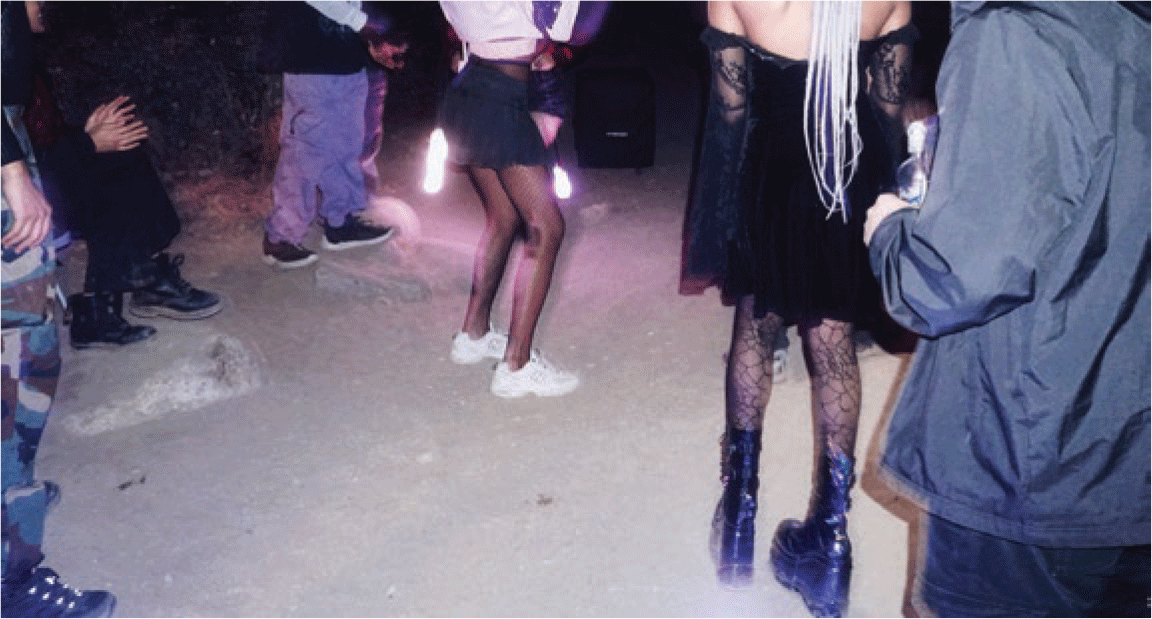
Raving in the Undergrowth. Somewhere on the edge of San Gabriel Valley, 5 July 2024. (Photo by Alice Zhao)

I have always felt an orientation towards fungible matter in the undergrowth. Even as I’ve been labeled a legal alien, first-generation migrant, model minority, parachute child, international student, Asian/American, babygirl, whore, diva, freak, and the repository of all things my “young female Asian body” pins me down to here and over there, I continue to shapeshift at the periphery of social legibility.
Over the years, I have come to know of my queerness as neither exclusively nor straightforwardly about homosexual attraction, but also about the ways I sense and desire beyond my physical body. I am infinitely drawn to the libidinal possibilities generated by mechanical hackings, archived among heavily stacked PC music (electronic music made on personal computers with auto-tuned vocals and sonic distortions that harkens back to 2000s internet culture), Yeule’s cyborgian presence, storefronts of aggressively shiny and cheaply manufactured dollar store decor, the acrylic needle nails Evicshen crafted for her turntable performance, and looks upcycled from torn and worn-out garments. I am fascinated with the way (night)life happens through trespassing into overlooked corners in the undergrowth. I hold memories of stepping into warehouse raves packed with Amazon boxes, dancing under the bridge to views of cargo trains speeding by, and squatting Chinese laundromats for punk shows. These underground parties I went to were thresholds into worlds outside what was foreclosed to me as a queer, femme, Asian, noncitizen by the fear of being followed at night, the one AAPI heritage program added at museums, the photos taken of me on public transit without permission, and the anxiety in my mother’s tone when we indefinitely waited through Covid, visa delays, and exorbitant travel expenses to reunite during our five years apart.
I remember attending my first ever renegade and feeling distinctly called forth by its hardcore PC music. Perhaps I could attribute this affinity to my conflation with highly productive machines during my upbringing in Asia and my subsequent Techno-Orientalist becoming upon migrating to the States (Rivera Reference Rivera2022). Standing close to the wall of speakers, I lost mastery of my psychic coherence to the shattering vibrations of 180 bpm techno that suspended me in space. I let the wavelike texture of the sound crash over me, as I felt the edges of my skin gradually dissolve to the mechanical repetitions of drumbeats. Amidst these rhythmic alterations, I moved with the tunes in coterminous motions of contraction and release. Surrounded by the undergrowth, I felt my body becoming undisciplined in its curious mutations among an emergent assemblage of matter created by the energetic pull of heavy-hitting techno beats.
Inhaling the air of the deep forest on July 4th, I exhaled in tandem with foliage and dust that carries obsolete sedimentations of the history of the San Gabriel Valley. The natural fog had just appeared, as if co-conspiring to shield us from surveillance. The sky began to lighten and my arms were numb as I pushed the generator down the pebble trail back to our car, lifting it over the closed gate before sliding the handcart underneath. Adrift, nomadic, I felt a sudden sense of comfort on my hikes back and forth along the trail. Trudging back to collect more equipment, with my body on the brink of collapse, I caught sight of the neon pink light we put up earlier, glowing in the forest mist. That visceral image unlocked a palimpsest of memories from the past—the glimpses I exchange with strangers under deafening speakers at that forest rave, the sight of SoCal high schoolers in cybergoth attire gabber dancing inside a freeway pass, the night I was surrounded by butoh dancers in club kids costumes who improvised to Fashion LaBeija’s set. I drifted down this portal to an otherwise world.
Dancing with Memories: Friday Night at Arena and other Nightlife Stories of Senses and Pleasures
Eddy Francisco Alvarez Jr.
Arena was such a site of cultural production. And it was so big! And it lasted for so many years, it was a huge space, and I think that needs to be captured, the memories, the resistance, the celebration, um, the sissyness, the faggotry that happened there, it was such a beautiful place and there was so much community and love and connections were made.
—Sergio Morales (Reference Morales2019)
It matters not just where the party is, what music is played or who has been allowed in, but how we dance with each other, how we let each other dance.
—Kareem Khubchandani (Reference Khubchandani2020)
Emboldened by our divinity, fat queers have the freedom to play, resist, and fuck with colonial, raced, classed, and gendered norms that tell us to shrink, to be small, and to be quiet, to not draw attention to ourselves.
—Caleb Luna (Reference Luna, Adeyemi, Khubchandani and Ramón2021)
As I write these words I dance with memories, and sensations of my youth and of recent adulthood, of dancefloors that shaped who I am today, of the visibility-invisibility dichotomy of nightlife, of theories and writings of nightlife scholars who have made sense of the feelings and indescribable sensations and memories many of us have of the spaces, old and new, that taught us about being queer and fabulous, about the collective affect, of how bodies on the dancefloor create momentary utopias and make histories (sometimes as we make out). Sweat. Euphoria. Drips. Saliva. Kisses. Tongues, hands waving, heads spinning, mouths bobbing, spit, sweat, cum. In the bathroom. On the dancefloor. On the patio. In the parking lot. In the alley. I think of 1990s Mexican pop star and telenovela actress Thalía’s tetralogy of songs: “Sudor,” “Sangre,” “Saliva,” “Lagrimas.” Songs I danced to in my youth that spoke to bodily fluids, their memory lingering still. I dance with the words of Caleb Luna and Karen Jaime and Kareem Khubchandani. And with madison moore, with his techno beats in the background as I share my nightlife stories and my own memories, early 1990s to the aughts, of Arena Nightclub, of Escándalo, of Tempo, of Club L, and Moonshadow in North Hollywood. Inspired by moore’s 2023 Night Fever, the nightlife reading series at USC NAVEL, an arts venue in Downtown LA, I use poetry and Gloria Anzaldúa’s concept of auto-historia-teoria, theorizing through one’s own life story, to bring to life the archive of memories of Arena and other nightclubs—substance use, pleasure, kinship, and public space (in Keating Reference Keating2022).
The sensorial archive of Arena lives in my—in our—bodies: we can hear it, smell it, see it, we can even still touch it. From the beats of House music thumping through the walls of the old ice factory-turned-nightclub to the clacking of heels and the laughter of crowds, Arena, a nightclub in Los Angeles that opened in 1991, was a haven for queer Latinx and other youth of color, a refuge and site of experimentation and belonging for young people who outside the walls of the club were dealing with the effects of the AIDS epidemic, anti-immigrant sentiment, racial unrest, and gang violence in the city (Alvarez Reference Alvarez2022). Separated by a parking lot from its sister club the iconic Circus, which was launched years prior because of the lack of welcoming spaces for queer people of color in LA, Arena was open to all ages on Friday nights and was like that secret place only we knew about until its popularity exploded. By the early to mid-2000s it felt like straight people had changed what we once had. In early 2001 TigerHeat began with Thursday nights for 18 and over and was more poppy and electronic than Arena. Regardless of the changes over the years and its closing in 2016, Arena continues to be emblematic of queer Latinx nightlife and youth culture in the ’90s and aughts.
Khubchandani’s quote above evokes memories of Ader, a stylish fashion-forward fabulous and eccentric Lebanese Muslim guy I dated in college. We met in French class and did a flirtatious dance one day after class when we walked together to the student union. He kept chatting me up and asked me to be his tutor. We had lots of fun together including going out dancing. One of the clubs we went to was Escándalo, a gay Latinx club on Wednesday nights in West Hollywood at Axis, formerly Studio One and The Factory. After Arena, Escándalo, which was an 18-and-over club, was the hottest place to be. I have memories of Ader taking up lots of space on the dancefloor, and at the time, feeling both embarrassed by his confidence and inspired that he was so carefree with his moves and his body. At the time I couldn’t see it but in retrospect he taught me about being brave, and bold, and about the gestural possibilities of the dancefloor. I can still see him vogueing across the dancefloor, not necessarily with the best moves or rhythm, but radiating fierceness. Revisiting my memories of Arena, as I reflect on the importance of nightlife as part of jotería (queer Chicanx or Latinx) pedagogies, also makes me think about the lessons I learned at Plaza in the early 2000s, where I first went as part of a Latin American theatre class to learn about drag as performance. Our professor, who tragically is now a MAGA-espousing Trump lover, had interviewed and written about one of Plaza’s artists and hosts, Gabby, an immigrant trans woman from El Salvador who became an icon there. Plaza was, and still is, like going to a Mexican or Latinx family party, a quinceañera—the flashy outfits, the sequins, the tias, the cumbias, and the norteñas, even the fights after the party.
“The Lines at Arena” (early 1990s)
Indescribably Arena
Riding in the flatbed of my friend Andre’s truck, a carload of us traveled from the San Fernando Valley to Hollywood. The anticipation of making it to the club made manageable the wind in our faces, the cold of the night, the uncomfortable metal underneath our outfits. Sometimes those days feel like a dream. Arena was an indescribable space. To this day, when I present on this topic, people are mesmerized by the idea of an all-ages club—that teenagers were out and about at that time. Where were their parents, wasn’t it dangerous? Many of us drove there and some of us got rides if we didn’t have a license yet. Arena closed at 4am, and after the night was over the bus stop at Santa Monica and Las Palmas was crowded. Catching perhaps one of the first morning buses, the clubbers shared space with señoras heading to work downtown or across the city in west LA. I remember thinking, thank God I don’t have to take the bus here, because I always had a ride. As Juan and Sergio, two of the narrators in my oral history project, “Finding Sequins in the Rubble,” on jotería memories, sounds, spaces, and archives in Los Angeles reminded me, rideshare back then was meeting someone and getting their landline number so you could connect with them to ride to Arena on Friday. These were the days before Uber or Lyft and before social media. I remember thinking how die-hard it was to take the bus there but I was die-hard too. On some nights, I remember, before going to the Arena with friends, starting the party at someone’s house, pregaming with house music or Madonna or a combination of the playlist of the early to mid-1990s. After getting high and drinking together, Arena was the main attraction during a night that lasted all weekend and into Monday morning when we were finally sobering up.
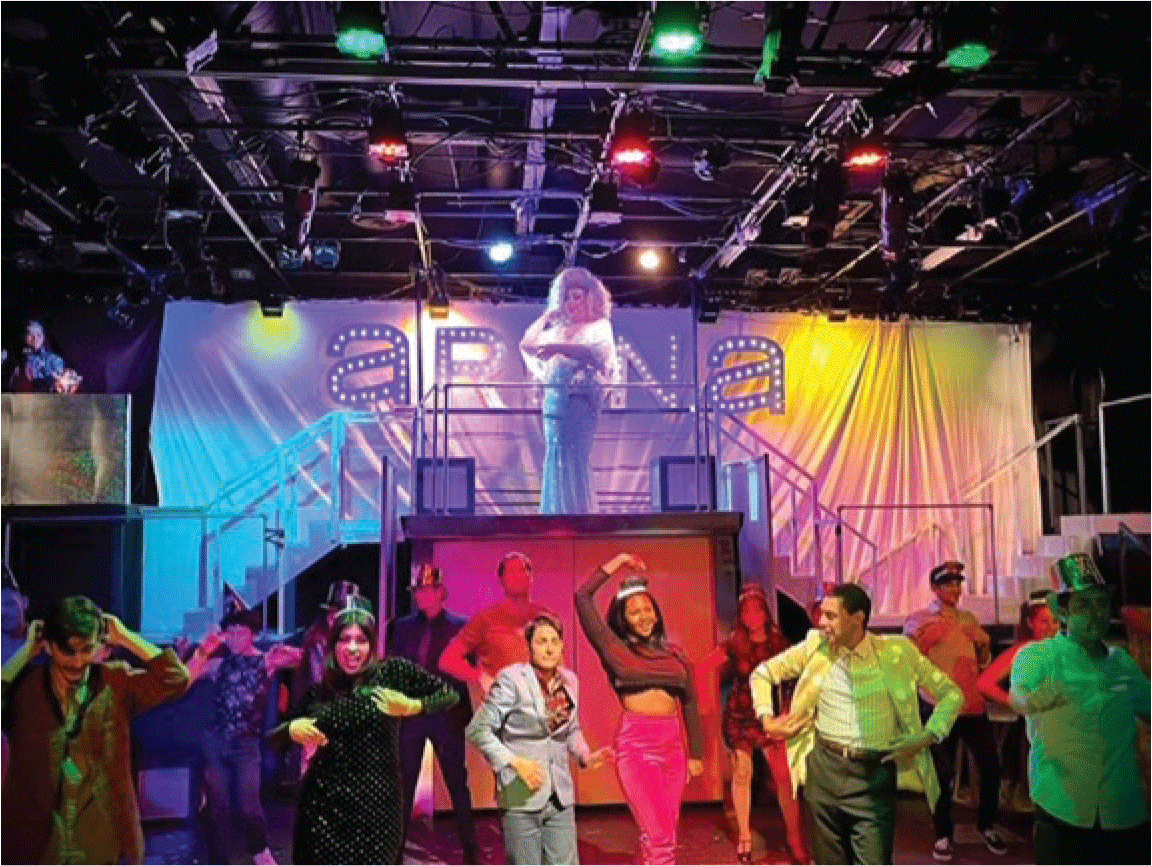
For many queer Latinx youth as well as nonqueer, Arena is part of their memories of Los Angeles of the ’90s. We can’t think about Arena without thinking about house music, the fashion, the tea parties, Pedro Zamora on the TV show Real World, racial injustice on our streets after the Rodney King beating trial verdict in 1992, Prop 187. If you were in the know you knew icons of Arena like Miss Martin, Stacey Hollywood, Barbarella, and the Fabulous Wonder Twins, who became infamous on talk shows like the Jerry Springer Show and the Geraldo Rivera Show. Arena itself is iconic of the 1990s. Its memory and sounds and styles were immortalized in the 2023 musical production Arena: A House Music-al written by Abel Alvarado, who also came of age at Arena.
Scene from Arena: A House Music-al, 2021, Los Angeles. (Photo courtesy of Abel Alvarado)

Sequined Worlds: Inspired by a Critical Karaoke to Gloria Trevi’s “Todos Me Miran”
I first heard “Todos Me Miran” by Mexican pop diva Gloria Trevi at Long Beach Pride in 2008. The singer, famous for her rebellious hit “Pelo Suelto,” had been released from prison four years earlier. “Todos Me Miran” was her first single from the album La Trayectoria (2006). I immediately thought, this is a gay anthem if I’ve ever heard one. Onstage in a blue metallic leotard, short black feathered skirt, and her signature wild hair, Trevi thanked the queers who had always been loyal to her. It takes guts to be strong like you, se necesitan huevos, she said. I was immediately inspired by the song and have been using it as an inspiration for my writing and my life ever since. And I was right. It became a club anthem. It is about breaking from the chains of heteropatriarchal domination, transphobia, toxic masculinity, and other forces that keep us subjugated (Alvarez Jr. 2016). It is about being seen and respected as we want to be seen and about the journey to fabulousness.
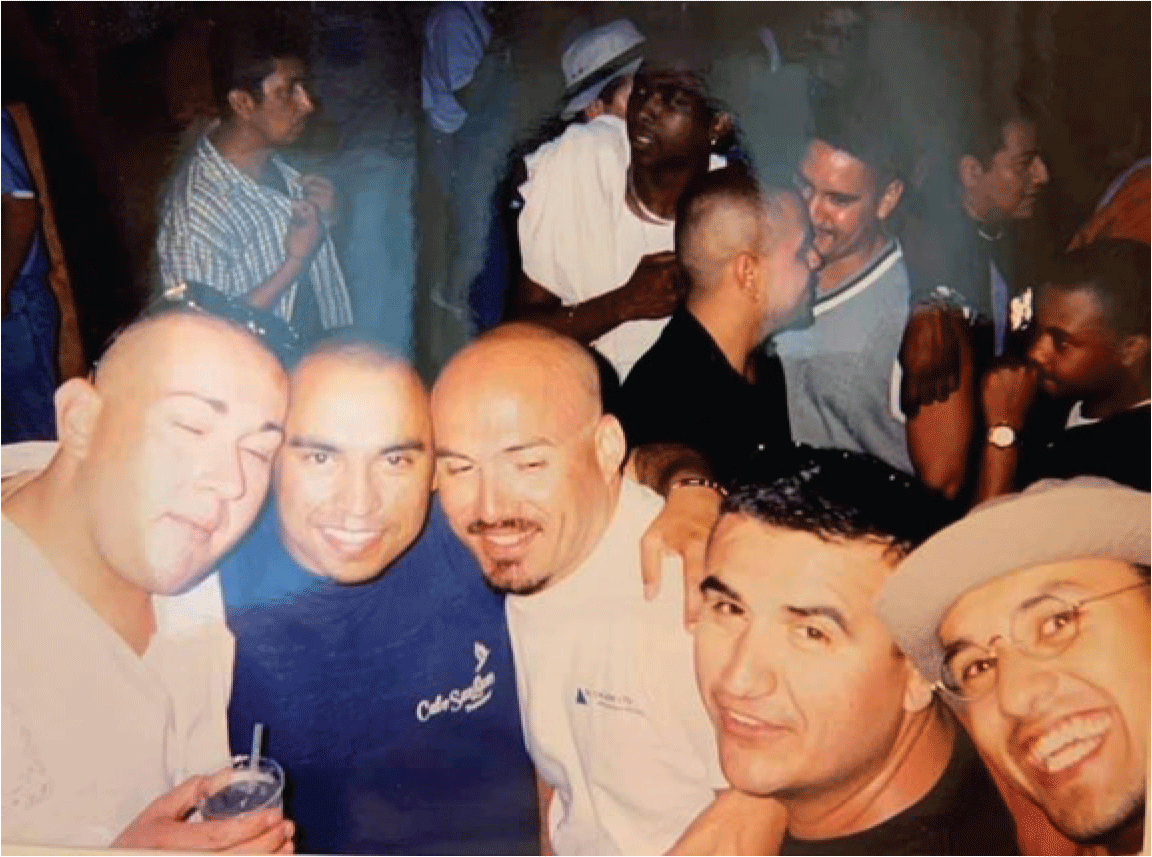
Abel Alvarado with friends at Arena, 1998 or 1999. (Photo courtesy of Abel Alvarado)

The sequined night bore sequined worlds, the ones I created for myself when I first dyed my hair in middle school or started plucking my eyebrows in high school, lip-synched to Madonna’s “Material Girl” in my friend’s sequined drill team uniform, when at 16 we’d walk into Arena nightclub and the beats of DJ Irene and the club kids’ outfits and the thumping of the walls became as intoxicating and adventurous as the drugs we’d taken earlier.
What is your sequined world? What sequined moments and worlds do you remember, make, envision, and desire? I think of Juan Gabriel’s flamboyant outfits, my Cuban grandma’s style, memories of love and kinship, chosen family and otherwise. Mundos de lentejuelas son de deseo, comunidad, amor, de las veces que te sentiste vista, consentida, bienvenida—the moments of belonging and connection.
Sequined worlds are memories of 20-something gay boy crushes on hair-slicked-back butch lesbians at Plaza in the early 2000s, impeccable performers in sequined gowns, feathers, and red lips while we guzzled cubetas of Coronas, while the best version of Paquita La Del Barrio performs on the stage, singing “tres veces te engañé,” while the crowded sweaty dancefloor becomes the place where you feel free, free like you never have before. At least not that you can remember.
My sequined world is now when I enter the bar in that harness and jockstrap, take those clothes off at coat check, my ass bare in public like it’s never been, every scar, pimple, stretch mark, and imperfection visible for the guys behind me to see. And I feel fabulous!
Sequined worlds are of fabulousness, “something embodied and queer—an aesthetic—one rooted in certain kinds of creative agency” in the words of madison moore (Reference moore2018). Underneath fabulousness is a story of resilience, a story still unfolding. To be visible, to be seen, can be scary and dangerous but it can also be liberating and world changing. Let the personal and collective revolution continue one sequin and one song at a time. ¡Que viva la jotería!
Long before I read any article or book on nightlife, Arena educated me on the pleasures and joys of the dancefloor, about the ways the music can create temporary bonds among strangers, how in the beats and thumps and collective stomping and clapping of the crowd one can feel a sense of belonging, a safety, which even if temporary, can shelter us from the harshness outside of the club. Arena showed me what loving myself as a queer kid felt like. When I walked past the coat check and the bathrooms onto the main dance floor, and the music entered my body, I was beautiful and fabulous. Arena taught me that nightlife is its own ecology, with its own rituals, protocols, aesthetics, languages, and value systems. How I understand nightlife now has changed, of course. But the lessons Arena taught me about joy and experimentation and gender fluidity stay with me always, helping me know that there are multiple worlds in the here and now, and that sometimes we must create them. The lessons of Arena and of nightlife, of the beats of DJ Irene, the bravery of the drag queens and club kids, taught me to appreciate fabulousness, the care queer people of color take with their aesthetics, their daily performances of self, their daily ways of making poetry out of grief and loss, of finding sequins in the rubble.
More than 30 years after I first stood in line to get into Arena, the memory of the euphoria and joy of being there lives in my body. Not many places have replicated that feeling, but being part of and helping to build an academic, scholarly, and artistic community like jotería studies comes close. “Jotería” is more than just an identity marker that means queer Chicanx or Latinx. Jotería is an intellectual, epistemological, and pedagogical framework, an aesthetic, an ethos, and a communitarian consciousness. As Anita Tijerina Revilla and José Manuel Santillana Blanco write in their 2014 essay in the now foundational dossier of jotería studies in Aztlan: A Journal of Chicano Studies, jotería consciousness, among many things, is “rooted in fun, laughter and radical queer love” (174). In his introductory essay to the dossier, “Jotería Studies, or the Political Is Personal,” Michael Hames-García describes his first physical queer encounters “in the bathroom of the entrance of Disneyland” and then his first kiss four years later at a college party with a young Palestinian man (2014:136). He traces his immersion into jotería studies with these very personal anecdotes and then moves on to the classes he took and texts he read that shaped his jotería epistemologies. In many ways my introduction to jotería studies, before we had a name for it, was at Arena. My jotería consciousness was nurtured by the aesthetics, affect, and embodied knowledge I gained when I went to school on Friday nights at Arena.
Precarious Systems
Kristy Li Puma
The Beauty of the Precarious
This past summer, while I was setting up my DJ equipment at a local queer bar, a younger DJ friend looked around the tangled web of cables and gear in the cramped booth. Amidst the faint stickiness of spilled drinks, they spotted a battered plastic electronic sound card with its frayed wire tail—an old $19 companion from my early club days. “What’s this?” they inquired, toying with it in their hands curiously. I explained its role as a backup tool, a lifeline if our main sound equipment failed, allowing us to keep the party music going by hooking this device up to two phones, some home-adapted cables, and a mixer. My friend looked back and forth from the gleaming newish DJ equipment I had arranged in the booth to the cheap, falling-apart device, and cackled, “Kristy, that’s so chuscoooo”—a Peruvian slang, translating roughly to “bootleg” or “janky.” We laughed and I reflected on the 15 years of messy party tech the tattered gadget represented, agreeing, “but we gotta remember there’s beauty in the precarious.”
Precarious systems are intentional, everyday moves made by people at the margins who are crafting their own creative solutions while living within larger systems of state-produced precarity. I call them “precarious” because they are low-budget and makeshift in character, with the potential to fall apart, but also the flexibility to work magic in the right hands. In queer of color spaces, using such “makeshift” or “DIY” tech reveals more than simple resourcefulness; it reflects a nimble form of creative, tactical, and expressive power for people at the margins who may lack full access to technology, social spaces, or a sense of public safety. I am thinking especially of femme, working-class, trans, immigrant, weirdo, gig-working, and young people within wider queer of color communities. “Precarious systems” have the power to, for example, contest growing neoliberalist forces channeling themselves into queer nightlife cultures where the most polished, expensive gear setups can become synonymous with legitimacy. Many of us as DJs, performers, organizers have turned to objects like handmade cables, trash retooled to evade surveillance and extend pleasure, and improvised record player perches, in order to cultivate the party spaces we desire. And while precarious systems do serve as important workarounds for barriers to accessing expensive professional gear, they are worth exploring as more than just compensatory. Such practices reveal vital collective knowledges about how technology can foster affective connections, how amplified music shapes collective spaces, and how collaborative creative processes can modify or even transform participants’ sense of possibility.Footnote 17 These group uses of makeshift tech offer crucial examples of the ingenuity of queer communities of color, especially in the face of larger systems of repressive state power such as anti-Black policing, gentrification, and displacement; immigration profiling and raids; and the uneven criminalization of drug use, sex work, and gender identity along racialized lines. Over time, the scrappy material culture and technology these communities use to produce their own queer nightlife spaces represent larger intergenerational lineages of praxis.
A focus on precarious systems leads to questions like: What comes through the mess of our shared hands reaching under the hood to jury-rig the special sparkle and sound of a particular night? Precarious systems twirl open unexpected possibilities of access and agency as we build alternative subcultural worlds.
Welcome to DC
So let’s take a trip to explore these ephemeral but enduring traditions…to Washington, DC—a place seldom noted for its vibrant underground queer nightlife cultures.Footnote 18 The mainstream US imagination often confines the capital city to its status as the national hub of formal politics and state surveillance agencies. But outside its federal white-collar downtown enclave the city breathes a whole different life—and here people just say “DC.” The local, real DC has long been home to shimmering and sustaining queer worlds led by Black and Latinx communities.Footnote 19 DC communities have led the way on major LGBTQ+ “firsts” nationally. In the 1880s, formerly enslaved Washingtonian William Dorsey Swann famously threw popular, unpermitted drag balls at his home, performing at great risk (and with great splendor) as the first self-proclaimed “queen of drag” in US history (Joseph Reference Joseph2020). A century of queer underground arts scenes later, DC locals organized the first Black Pride (in 1991) and Latinx Pride (in 2007) celebrations in the US, generating early grassroots traditions of boldly and colorfully uniting activist and nightlife spirits in public (Beemyn Reference Beemyn2015; Gutiérrez Reference Gutiérrez, Quesada, Gomez and Vidal-Ortiz2015).
By carefully considering these alternative worlds, and the cast of everyday characters who have formed them, we can learn from the innovative technologies and makeshift material culture used to craft them. This helps to understand how, while living amidst conditions of structurally produced precarity, DC’s queer Black and Latinx communities have employed provisional technological practices, often at “amateur” levels of traditional expertise, to generate life-giving sites of personal and collective expression, gathering, connection, belonging, and joy. Here I share one autobiographical snapshot from that massive legacy.
La Cultura del Recursero
My own DJ origin story was, as my whole life has been, a transnational affair steeped in hybridity and remix. Raised between the DC metro area and Lima, Peru, I learned to DJ while throwing parties in both places. Living in Lima during the late 2000s, my artist friends and I started organizing till-dawn dance nights, playing a patchwork of alt electronic and Andean musical sounds that echoed the “South American neon” aesthetics circulating through our clothes, haircuts, and artwork. Tucked along a seedy street in Lima’s once-grand downtown, our venue was a ’70s-era discoteca featuring a vintage lit-up dancefloor from its disco glory days, the worn glass-tiled surface still glowing with rainbow light. Through coorganizing those parties, I learned to concretize lo recursero, which translates as “resourcefulness,” and in the mainstream Peruvian spirit means “do creative things with what you’ve got,” often involving expanding the purpose and extending the lifespan of everyday objects. My Limeña friends playfully brought this ethic to bear at every stage of our process—hand-soldering cables to connect portable CD players and bootleg iPods; softening harsh venue lights with a wide magenta T-shirt to create a more welcoming makeout corner; creating our digital party flyers using the most available, if rudimentary, Windows graphics editor (Paint)—and fully enjoying the unpolished results. My creative approach was indelibly shaped by this sensibility, and it showed when I moved back to DC the next year, as my babe friends and I began organizing queer genre-jumping house parties that felt like expressions of our own unruly youth.
For that crew of friends, finding comfortable places to go out dancing was not always easy. Even with DC’s abundant LGBTQ+ nightlife offerings (the ones we knew about, of course), we often craved more accessible and flexible spaces to freely express ourselves and our own weirdness. Higher-end gay bars or strip clubs required door covers and drink minimums that often exceeded our budgets. ID checks and some security protocols meant underage and undocumented friends might have to stay home, splitting up our group for the night. Dress codes demanded the conformity of clothes we did not own or want to wear. And then many parties were just clearly crafted for a particular audience that our group fell outside of; sometimes we were a little too oddball, too out of bounds, or of too many mismatched identities. As fellow budding DJ and party girl Marsha put it, “a lot of these spots weren’t even fancy, but I’d feel weird walking in because I’d think, ‘I’m not who they’re meant for.’ ” Footnote 20 We wanted something of our own so we turned to hosting word-of-mouth dance spaces, in our homes, our way.
Daisy Chains and Our Messy Interconnectivity
It’s 2008 and you walk into the Palace, an early 20th-century rowhouse tucked in the Columbia Heights neighborhood. Our party starts in 10 hours and it’s time to set up. The brown wall-to-wall carpet is worn into visible pathways, soft foot-traffic trails marking the daily choreographies of the eight housemates living together under this shared roof. Up the stairs to the right, Marsha and Diamond share a sunny bedroom filled with political stickers and art knickknacks, as well as stacks of cassettes, minidiscs, CDs, and old computer gear. Media-media-media. Like many DC group houses, the Palace is full: many things come in, few leave.Footnote 21 This genuine abundance belies the scarcity that brings about this common local living arrangement: DC has raced through the blueprint of gentrification, so affordable housing is exceedingly rare.Footnote 22 Group houses of unrelated housemates are part of the city’s long tradition of resource-sharing. And we are about to do some sharing tonight!
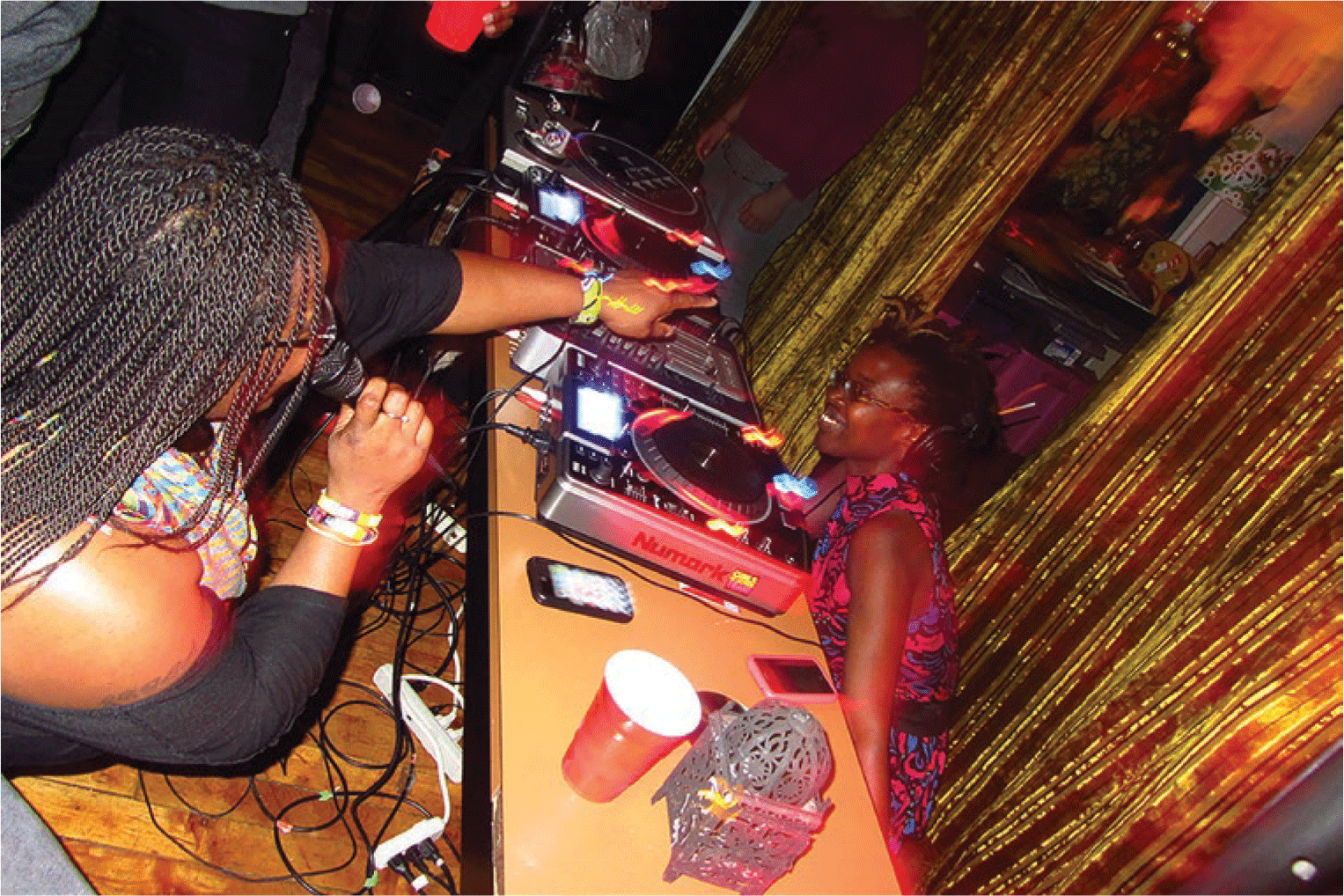
Two DJ friends making magic at an art studio/house party. Edging the dance floor on the ground is the ubiquitous daisy chain. Washington, DC. (Photo by Kristy Li Puma)

Downstairs by the home’s front door, we begin setting up the DJ booth in a cleared-out bay window cove, where the couches are usually sprawled. The wiring situation is tenuous: there’s o-n-e working outlet available nearby. (The others in the room have been left in disrepair for years by the landlord.) We run an orange extension cord from this singular outlet, snaking it under the DJ table and joining it with a white plastic power strip—the six-socket kind that you can get at any hardware store. The power strip quickly fills up with plugs from the also-abundant variety of sound gear we are using, a patchwork of second-hand, borrowed, and collectively purchased equipment—turntables, speakers, CD players, a mixer. Another plastic power strip gets plugged into the last socket of the previous one to keep making room for more plugs. Then another power strip joins the series. Such links of interconnected power strips are often called “daisy chains.”
By the time Sofia, our DJ-decor connoisseur, insists that we need a red mood light, we’re on our fourth power strip in the daisy chain series; our fingers press the prongs of two vintage lamps into the sockets…crimson dollar-store bulbs glow to life.
Inevitably, as we situate all the party elements, the cords tangle, extend, and pull at each other, threatening to come undone. Sometimes the whole chain gets drawn taut as the cords get stretched out to their maximum reach and the whole daisy chain lifts off the carpet, suspended in a knot below our DJ table. “Daisy chains” is a sweet name and they sound harmless (like flower crowns), but we are also keenly aware that in electrical terms they’re a hazard, one overload away from total party outage, one overheating fray away from fire.
Tonight, we are overloading the circuitry for a special occasion, but this hazard is present in houses across the neighborhood on many other nights, and not by choice. Daisy chains are an everyday configuration of making do for tenants across the city in homes where indifferent and often exploitative landlords regularly impose such risk upon their tenants. As renters look to plug in irons, need light to do homework, seek power to juice up a phone on 3%, or draw heat from a space heater…a hair dryer in the home goes on, and the flickering lights remind you that it might be a choice between running the hair dryer or the microwave. On the daily, residents must deal with electrical system overloads and outages resulting from the mere practice of living within unnecessarily ramshackle housing infrastructures; sometimes perilous uses of power strips are part of extending limited electric capacity. Landlords’ failure to provide updated wiring, pest control, or proper insulation—and the state’s failure to enforce housing codes needed for warmth, sustenance, and survival—represents an uneven city-wide risk arrangement in which the health and safety of rent-paying tenants on this side of town are not deemed worthy of the investment.
Our party setup is happening within these everyday makeshift micro-infrastructural neighborhood practices and also inside the routine risk calculations queer people at the margins already navigate. From just leaving the house to get food to going on a date, daily life can involve exposure to violence from random people on sidewalks, in bathrooms, at grocery stores; to targeted policing, massive health-system failure, and ongoing exclusion from social spaces and employment. For underground partygoers, risk and pleasure are entangled together, situated amidst the contradictions of which Marlon Bailey reminds us (2016). Here, the daisy chains and cord convolutions in our house parties mark the risk we take on for ourselves as well as party guests, should our rickety wood rowhouse venue spark aflame. Additional exposures in the equation—police visits to the house over noise complaints, landlord fines for hosting unpermitted events, damage to housemates’ belongings, and of course, the party getting shut down—felt worth it in our calculus for creating our own space for pleasure, joy, and expression even if it was just for the night. Looking back, this feels like a contrast with the profit-driven risks imposed by corporate cultural events where the organizers are neither present nor exposed to the consequences.Footnote 23 Even if we couldn’t fully guarantee safety, we were all stepping into the party for the kind of liberatory feelings that can only be found on the dancefloor.
It’s 5am. In what feels like a warp of suspended time, we’ve lived a party. The equipment is humming along, still working even if a little hot, a little crunchier sounding. A few hours ago there was a moment when the music stopped, but it’s unclear if it was an overload or if a DJ, attempting to unplug some lights, had knocked out a link in the daisy-chained power strips. At the party’s fullest point, we were all on that worn brown carpet. There was strutting and dancing and experimental gestures. The metallic tones of the tech setups and our silver adornments—chunky hoops, studded chokers—reflected off each other. In the swirl of it all we came undone. By nearly dawn, the final guests who’d been smoldering on the dancefloor have left. We’ve made it through the night. Our choices to risk a precarious party setup have paid off, at least for tonight. Together, we created a tiny signal-interruption within a larger system-wide broadcast that usually registers us only as deviant, or perhaps just as nothing. In these shabby Palace walls, we feel like we’ve created a mini-world for our friends, and their friends, and new friends, and as the party fades our bodies start to relish the behind-the-scenes collaboration through which this living room alternative world manifested. Perhaps for a few hours we’ve even tried out different ways of living, connecting, and expressing ourselves as outrageously and tenderly as we want.
The Sustaining Magic of the Tangle
Daisy chains and cable tangles are not just technical vehicles for queer of color pleasure but evidence of the sensibilities developed through practice. In adapted or noncommercial queer spaces, precarious cable and equipment setups are ubiquitous, and it seems apt: some of the magic in queer spaces is in the tangle. From my vantage point as a DJ, I’ve been lucky to witness how the tangle manifests in the twirling bodies of dancers, lovers, loners, and friends who appear for a night; in their fake fur, footwear, home-fashioned leather harnesses, a range of sapphic raver fits; in the collapsing, exploding, and twisting contours of time that we can achieve through amplified dance music; and in the throng of cables and tech devices curled and contorted around the sound system, literally used to make the night happen, turning silence into a space to come together. Using common household items and scrappy tech configurations to retrofit venues like restaurants, artist studios, straight bars, even churches into a queer club space for the night is a worldmaking legacy tactic rooted in the kinds of house party setups so many of us have created, and in the collective will to creatively build a public place to congregate by any means we can. The pleasure is in the tangle, the connections, the links and series we create together.
Queer Underground as Strategic Method
Nick Bazzano

The underground is not a given. It exists as neither fact nor fait accompli. The underground does not occur at a specific time we can always access, nor in a discrete place we can always visit. Especially in the context of queer nightlife, we cannot simply point at what we want and buy a ticket to the underground, as the underground—much like queerness itself—is never simply indexical. Neither actuating nor proliferating what could be described as dominant or majoritarian economies of (chrono-)(hetero-)normativity, the performative force of the queer underground circulates by shirking both material and commodity form so as to always-already be prepared to leverage its own strategic ephemerality in service of activating what could be called counternormative alter-accomplishment, or (a) life-(lived-)otherwise. We—as scholars, producers, enjoyers, and acolytes of queer nightlife—should hold no transcendental methodological entitlements as to how we go about accessing, disclosing, describing, defining, representing, or remediating the amorphous, anomalous queer underground. Instead, we must persistently work toward understanding and affirming the queer underground itself as strategic method, one that continuously retools its own precarious impossibility into radical acts and sonic-affective ripples of potential. For these reasons and many more, the underground is not, never was, and never will be guaranteed.
The queer underground is a method, a gesture, an orientation, a style; a minor and “major” mode of relationality, navigation, cocreation, and collective comportment; a performative act done, undone, and redone only in its own continual and communal doing, undoing, and redoing. Less imperative and more subjunctive in both mood and materiality, the queer underground gains its meaning, power, texture, and significance only through constantly and continuously tarrying with and creatively reembodying both the context and the feeling of its own situational (im-)possibility. Existing radically outside while simultaneously nested “deep, deep inside” the stultifying, totalizing infrastructures of nonconsensually dominant modes of both historical and contemporary existence, the queer underground is a topological function that performatively modulates the spatiotemporal parameters of existence itself, even and especially when that’s for one night only. Operating on the substrates of context, situation, and mutual precarity lived in the singular-plural, the queer underground opens onto and artfully activates a throbbing horizon, an unapologetically sensate and sensual realm of potential always-already immanent to collective queer life lived under the weight of the historical present, under the sign of someone else’s mode of production.
For these reasons and many more, the underground is not, never was, and never will be guaranteed. And, it bears repeating: we—as scholars, producers, enjoyers, and acolytes of queer nightlife—must always learn, unlearn, and relearn how to simultaneously elaborate and protect the queer underground. Among many others, an unconventional and relatively unpracticed method for doing so is less a descriptive, imperative, or constative act; and more a strategic rhetorical, polemical, and performative deployment of the subjunctive mood. We must always ask (and it’s best to ask first): what if we were to prioritize taking and making the time and space to continually recalibrate our theoretical understanding of the queer underground itself by affirming it as a vital, living methodology, as our much-cherished, deeply invaluable queer “(un-[der])grounding” function? As our list of both literal and figurative places to go and go out inevitably continues to diminish, if we want to collectively maintain our strategic option to topologically fold ourselves out of the violences and banalities of normative gridlock—especially at a time when we quite literally can’t go anywhere else but deeper in—we must make space for conversations that relentlessly interrogate the methodological machinery of the queer underground function.
This function is neither a tautologically immortal deus ex machina, nor a nostalgic, politically myopic thought exercise in open-format cockeyed club optimism. Instead, invoking the queer underground should always foreground its ecstatically mobilizing yet critically endangered status as a collective endeavor in survival, style, precarity, and potential. And sometimes, both thinking and writing about the queer underground might elect to take the form of having strategically theoretical and theoretically performative conversations about the queer dancefloor, and sometimes these conversations stay on the queer dancefloor itself. Hopefully, this further morphs the act of writing about queer nightlife into a polyvocal proliferation of laughs, kikis, hot takes, and quietly loud whispers-through-earplugs uttered in service of not only protecting but perpetually (un-[der])grounding our lived experience of the queer underground, positing it as the literal field of potential that constitutes queer nightlife’s collective shape of desire in the first place.
La Madrugada
Tavia Nyong’o
“They sleep. We grind.”
—Erykah Badu (Reference Badu2013)
In Spain in my 20s, I learned the name of a beautiful time and place: la madrugada. To get there, you took a long afternoon siesta, met friends for drinks and pinchos as the sun set, perhaps ate a proper meal (or just scarfed down a ghastly bocadillo de jamón con mantequilla) around 8 or 9 prior to hitting the clubs before they got too crowded at midnight. In a time before cell phones or the internet, you stuck together or were lost to the night. I often went out alone, since I was never really alone in a crowd of fellow dancers, and there were always new friends I could connect with on the dancefloor (with whom I could perhaps explore a little further reaches of friendship in a dark room nearby). By 4 or 5am, you landed in la madrugada—time to head for afters or churros or just general chicanery wandering the streets as the sun rose. That the Spanish had a name for this time of day between midnight and dawn made it real.
Hey, it was summer and I was 24. What else was I supposed to be doing with my nights?
But beyond youthful indulgence, la madrugada named something larger about nightlife itself: it was a temporal commons. This was time that didn’t belong to work or family or even biological needs like sleep. It wasn’t claimed by church bells or office hours. Instead it belonged to the dancers, the insomniacs, the queer kids sneaking out, the sex workers finishing late shifts, and all the bodies seeking communion in music and touch. In those hours, I began to understand nightlife not only as leisure, but as an improvised choreography of freedom.
La madrugada, of course, was also the crucible of la movida madrileña, the countercultural surge of nightlife, art, and queer expression that unfurled after Generalissimo Franco’s death. In Pedro Almodóvar’s novella Patty Diphusa (1991)—which I read in Spanish that summer—the eponymous porn star alter ego drifts through Madrid’s nocturnal subcultures—drug-tinged parties, sexual adventures, and underground scenes—never sleeping and always telling stories that skim the line between erotic survival and satirical confession. On screen there was his Pepi, Luci, Bom y otras chicas del montón (1980), a film that captures the same after-hours delirium: punk bands thrash through basement gigs, lesbians and drag queens spill into bars at 3am. The film lingers on the messy, exuberant collisions that defined Madrid at night. Both works show la madrugada as more than a stretch of time; it is a portal where performance becomes truth—and when a newly liberated Madrid found its voice in the cry of the night.
If la madrugada were the hours of freedom, they were also the hours of duende, that deep, ineffable force the poet Federico García Lorca described as the “mysterious power that everyone feels but no philosopher explains,” a power especially alive in flamenco, music, dance, and spoken poetry—art forms that demand the living body to embody their emotion and risk. Duende, in Lorca’s formulation, wasn’t born of technique or graceful “angelic” inspiration, but of struggle, blood, and a confrontation with mortality—“it climbs up inside you, from the soles of the feet” ([1933] 1955). The stamp of those feet was African.
As the night deepens and a flamenco room heats up—bodies pressed close, voices rasping over guitars—the duende erupts through a charged intimacy, a stretching of limits, and a dislodging of the ordinary that invites something primal and communal. The room then becomes a crucible where grief, desire, and defiance can combust. This is also African; a diaspora of refusal of what “humanity” has refused us.
Lorca and Almodóvar bookend Spain’s confrontation with fascism. Lorca’s life and death frame the terror of its rise: executed by Falangist forces in 1936, his poetry became a symbol of what fascism sought to silence—queer, Andalusian, avantgarde, popular all at once. Almodóvar, by contrast, emerged as a filmmaker in the aftermath of Franco’s long dictatorship, when la movida exploded into view. His films turned nightlife into allegory: the delirious parties, queer entanglements, and camp provocations were not only cultural excess, but a deliberate undoing of decades of authoritarian repression. Where Lorca’s duende was cut short by violence, Almodóvar’s cinema posited its potential return, especially in later films like Bad Education (2004) that perfected a traumatophilic gaze upon national history.
In my 20s, before the Euro, I understood only fragments of this past, but enough to make of it an elective affinity. Lorca’s poetry drew me to Spain as much as Almodóvar’s films did, and both led me to la madrugada. Langston Hughes prepared me for Spain, and his poems were some of the earliest and most durable performance theoretics I read. Hughes translated Lorca’s Romancero gitano (Gypsy Ballads) and Bodas de sangre (Blood Wedding) into English and admired the emotional force of duende—seeing in it a kinship with the blues. In both traditions, art born of pain summons the soul to witness.
To stay awake through la madrugada is thus to seek the spirit in the deep, to inhabit the space where duende thrives. In this sense, nightlife becomes a historical record that is not kept in books or state repositories but inscribed in bodies moving together through time. Robert Reid-Pharr’s Archives of Flesh: African America, Spain, and Post-Humanist Critique (2016) traces how Black diasporic history is preserved in and through such embodied practices, particularly in relation to Spain and the afterlives of its empire. His argument that the flesh itself can serve as a resistant mode of memory justifies my recourse here: la madrugada is precisely such an embodied archive, one that dissolves before dawn yet leaves its trace in muscle memory, in rumor and gossip, in chant and song. To think of nightlife this way is to recognize it as both fragile and resilient, an ephemeral commons whose meaning is carried through dance steps into the exhausted joy of stumbling in daylight. It is there, in those unrecorded hours, that another history of freedom lives on.
Traveling the Space Ways: Time Out…On the Dance Floor at the Paradise GarageFootnote 24
Jennifer DeVere Brody
You went there to dance, and we didn’t dance like the regular people who were dancing in discos. I used to get dressed up to go to a disco, I’d do the Hustle for a couple hours till 4 o’clock in the morning, then I’d say, “Oh shit, lemme go to the Garage.” I had my bag with me and go to the Garage and change into my sweatpants and my sneakers.
—Willie Dancer (in Rymer Reference Rymer2018)
Spaces of intense liberation such as the Paradise Garage do not summon spirituality by some inherent connection to ecstatic African dance and its migration to the United States. Rather, they call to bodily possibility precisely their relation to sexual energy and the erotics of contact.
—Ricardo Montez (Reference Montez2020:105)
Paradise Garage logo by Janet Halverson. (Courtesy of Katherine Small Gallery)

My fragments and diffractions here were inspired by my time out…on the 5,000-square-foot dancefloor at the Paradise Garage in New York, just west of SoHo, in the 1980s. The Garage, as we called it, was populated predominantly by Black and Brown queer folks. Owned by Michael Brody (no relation as far as I know), it came to epitomize everything that a dance club could be: it was a singular invention to create a club for dancing as the ultimate form of queer-of-color sociality. The built environment deployed technological innovations to transform the space from functional facility (it was an actual garage in the 1920s) into a space to facilitate fantasy, fabulosity, friendship, fierceness, and queer futurity.
The Garage supported the bodies within its walls with a specially designed sprung floor (like those in professional dance studios); a massive, multidirectional, state-of-the-art sound system that blew you away and made your body quiver; an elevated (in both senses of the term) DJ booth with three turntables; and, by the time I got there, an outdoor rooftop that gave the body a chance to breathe in the early morning light. These innovations represent concrete ways that the Paradise Garage became a place and a space for (un)doing things with, by, and for queer nightlife.
Following the dance moves of fellow travelers and devotees of queer nightlife (think José Esteban Muñoz [Reference Muñoz2009], Kemi Adeyemi [2021], Gayatri Gopinath [Reference Gopinath2018], Ramón Rivera-Servera [2013], E. Patrick Johnson [Reference Johnson2003], Kareem Khubchandani [Reference Khubchandani2020], madison moore [Reference moore2018], Jafari S. Allen [Reference Allen2022], and Marlon Bailey [Reference Bailey2013], to name only a select few), I look at embodied practice as a way of thinking or knowing the pleasures and perils of queer nightlife. I sample, mix, and dig through shards of evidence—sonic, danced, seen, heard, smelled, and felt—as a mode of remembering how bodies of life came together in ecstatic communal performance to create temporary spaces of queer, colored collectivity.
Travelling the space ways, in time out on the dance floor, on the rooftop, in the beat, we were, then and now, a “body of life,” to quote the title of Elizabeth Alexander’s poem (1996).
“Showing Out (Get Fresh at the Weekend)”
—Mel and Kim, dance track (1986)
The Garage I think I remember was the sine qua non of feeling our heartbeats in unity. Dancing, then and there, together, became our “condition of exchange, at once emphatic and indeterminate” (Coleman and DeFrantz Reference Coleman and DeFrantz2019:67). It was where we experienced epiphanic moments of cohesion, “spots of time” that were time outs for psychic and bodily transference and transformation (Wordsworth Reference Wordsworth1850:line 208). The shared sound and sweat bound us together and turned us out in every sense of the phrase. For the decade the Paradise Garage lived at 84 King Street between Hudson and Varick, it served as the locus for talented DJs who reigned from a booth above the dancefloor (even if he—it was always he—came down to hear the sound on the ground). The club was lit: this downtown dance mecca, the Paradise Garage (1977–1987)—yes, it has birth and death dates as it was alive, a place to live, it had a heartbeat—remains indelible for a generation of folks who were able to experience the space. Its after-effects and images are like the shadows sewn onto a Peter Pan in the queer 19th-century stage play: they inevitably come loose, but with the help of another, can be restitched.
The Ramp - Paradise Garage. Waiting in line on the ramp leading to the main floor of Paradise Garage, 18 July 1986, 84 King Street, NYC. (Photo by Paul McKee)

As a living entity subject to death, the Garage’s ending was anticipated. Indeed, the closing came slowly over an extended summer, with the full knowledge that its deed was expiring but not knowing that it would be the victim of yet another deadly real estate “development.” Like the many people who built and sustained the space—proprietor and patrons alike—the club lived out its time in the era of HIV and AIDS activism. Embodied memories of the garage remain: 14,000 people came to pay their respects on the final weekend. We remember the refrain from the last song played on that Monday afternoon, 26 September 1987—“Make it Last Forever.”
My journey to the Garage began in 1983 when I was a 17-year-old high school senior in the neighboring state of Connecticut. In the days before social media, one had to be led to the Garage by friends, by word of mouth, by listening to WBLS. It was, after all, a members-only, after-hours spot that was a licensed “juice bar” that did not serve liquor. I was too young to enter the long runway that led to the club at 82 King Street when I first heard about the place from a local DJ who mixed a show for the college radio station I listened to every week. Like Willie quoted in the epigraph, I loved to, no I lived to dance. I began dreaming of going to the Garage. Eventually, I befriended that DJ (who did an extended version of Karyn White’s “The Way You Love Me”) and he took me to the Garage after I turned 18 during my first year of college, in the spring of 1984. I took the train from the Hudson River Valley to downtown. I must have crashed with friends—either in midtown or on Varick Street.
The experience was ecstasy at the first entrance and ascent from the long corridor up a ramp to the dancefloor. Even before entering the bass could be heard outside on the street, beckoning. I remember the slow-moving line to enter the club. It was marked by a multicolored oval-shaped neon logo hanging high above the long entryway. Paying the steep $15 entry fee granted access to the everything that awaited inside on the dancefloor.
The logo featured the muscled arm of a profiled male figure. The neon sign designed by Janet Halverson above the doubled plexiglass ticket window featured pink curly hair, a bright purple tambourine, a palm tree in electric green, and the name of the club in script. They stamped your hand, maybe with the logo. With my stamp, I felt I had become an initiate—a member of the club. There is no mistaking that I remain forever stamped by the experience.
Interlude: Clothing Option
Unlike most other clubs in the city at the time, the Garage was an anything goes place when it came to clothing. There is no doubt that when I went there I was wearing black. Maybe leggings and an oversize white T-shirt clipped up on the side with safety pins as I was moving out of my punk stage, or perhaps the Fiorucci skirt made of synthetic black fur and maybe a gifted Dead Kennedys slashed top that I adorned with garage sale silver metal necklaces (which I still wear) and an armful of black plastic bracelets like the ones Madonna made chic on the cover of her eponymous album of 1983. Both outfits were completed with the most important part of everyone’s Garage-ready attire: the footwear. I likely wore my coveted black patent leather wrestling boots that tied up my ankle, purchased in London. (I never wore Doc Martens since I associated them with white racists who, in my experience, used the shoes as weapons against people of color since the boots were reinforced with a steel toe.) I wore out those black patent leather high-tops; when I finally got rid of them, the patent leather was cracked.
BREAK: Last Night a DJ Saved My Life
Never one for late nights, I learned early on to take a disco nap before going to the Garage, which, because it didn’t sell alcohol, could stay open after bar hours (which ended at midnight)—well into the morning (Pareles Reference Pareles2000). I needed to rest to be able to dance all night, not that the beats and the rests between dance sessions would not sustain you, but since I didn’t do ecstasy, uppers, or poppers, or any other drugs popular in the 1980s, and the only thing at the club was punch, which I was told was spiked, you had to prepare.
Paradise Garage by Bill Bernstein, 1979. (billbernsteinfineart.com)

In the club, the dancefloor was vast: it could hold thousands of people crushed together but I never remember anyone stepping on anyone else’s toes. There were a few platforms dotted among the dancefloor where jaw-droppingly beautiful movers performed. In the dark, grainy photos and videos that exist from the Garage (we know from Krista Thompson’s study, Shine, that such experiences can never be captured with visual technologies) a disco ball is visible. As Jafari Allen reminds us
The disco ball is not made of a single mirror, but numerous tiny mirrors. Each reflects and refracts light at different angles, showing different colors of the spectrum—seemingly in a different time too, shifting on the walls, on the floors, on the face of dancers at different points in space and depending on where you stand. (Allen Reference Allen2022:1)
During the dance, we reflected and refracted one another’s joy through our movements, shifting differences…
The club had a stage for live performances that hosted luminary performers: Grace Jones, Sylvester, Patti LaBelle, Chaka Khan, Diana Ross, Gloria Gaynor, Evelyn “Champagne” King, Gwen Guthrie, Natalie Cole, Whitney Houston, Madonna…and on and on. But the true stars were the clientele, the clubbers, the dancers. The rooftop oasis (meant to resemble the wilds of the infamous Fire Island where Brody owned a house) opened in 1984. The lavender sunrise over the industrial concrete rooftops, which were dotted with air conditioners and abandoned water towers, provided an eerie urban vista that was unrivaled in the City. You could feel the beats below your feet but the only thing you really heard was calming quiet. It was as if time had stopped.
In the late 1980s—concomitant with the AIDS epidemic—the owner of the Garage, like the brilliant DJ Larry Levan he hired, died of complications from AIDS. Levan was 38 when he succumbed to the ravages of AIDS in 1992.
During his brief but consequential life, Levan was the engine driving the rapture at the Garage. His ability to play the changes on that extraordinary, perfectly calibrated sound system that was “developed, designed, and installed by Richard Long & Associates [and] had amazing treble and a powerful low-end that was tuned twice a week to optimize the sound paired with a clever sound treatment that prevented reverberations and unwanted echo” (Beta Reference Beta2016). Levan’s performance helped to make the Garage the ideal model for dance clubs across the globe. The sound seems to extend beyond its time and space: it is present and future—traveling the spaceways… You can listen to a sample of a Levan mix; one from 1979 BBC sound archive includes a voice-over documentary (BBC 1979). Of course, to hear the music is to isolate this most essential element—the soundtrack—and that alone cannot revive the experience of being there, together. Nor could the Paradise Garage Tribute Party held uptown at Lincoln Center in June 2022. I did not attend that party and wonder about its effects and affects—did the displaced reenactment conjure the collective feeling?
Like so many others who have written about the club’s “world-making” potential (Buckland Reference Buckland2002), that phenomenal feeling of collectivity made a gritty concrete garage into a celebratory congregation. It made me feel real…love.
Heart Beat, you make me feel so weak, moving all around, from my head down to the ground.
—Taana Gardner, “Heartbeat” (1981) Larry Levan Extended Remix
My last night at the Paradise Garage I traveled from Philadelphia where I had just entered the graduate program in English and American Literature at the University of Pennsylvania. I was 21 and I went to the Garage just a few weeks after my grandmother’s funeral in Memphis, TN. I had had all four of my wisdom teeth removed over the summer and I had to attend the intimate service at the funeral parlor (it was just across the street from the famed Lorraine Motel where MLK was shot and killed) with a bruised and swollen jaw. Granny’s friend Grace warbled a version of the gospel hymn, “His Eye Is on the Sparrow.” The hymn was famously sung by both Ethel Waters and Mahalia Jackson. I imagine them as queer divas who in their day may have loved a space like the Garage, along with Josephine Baker, whose dancing body was the basis for Alexander Calder’s sculptural invention—the mobile. In the endlessly fraught mobile circulations that cut across time and emanate from spaces like the Paradise Garage, we can stitch together connections among all these figures. Indeed, the incomparable Grace Jones seemed to reference La Baker when she wore silver wire conical breast cups and a matching triangular thong—as her only “clothing” when (or is it while) Keith Haring painted her brilliant brown skin with his white lines of paint at the Paradise Garage. This event was documented by Yale University’s African American studies scholar, Robert Farris Thompson.
Thompson’s piece recalls the occasion on which he was invited to photograph Haring painting Jones at the Paradise Garage; […] In his account of that event, Thompson […] argued that Haring owed some of his most expressive dancing outlines to close observation of the African-Americans performing at the Garage. (Montez Reference Montez2020:104)
The conundrum of this statement is the drumline for this entry.Footnote 25
In an article about the infamous and erroneously named “Last Night,” a massive days-long party that lasted from Saturday night (which was officially gay night when things were divided that way)—all the way to Monday afternoon. Judy Weinstein, a record executive who also booked some of the aforementioned performers, said, “The closing of the Paradise Garage marks the end of the last musical democracy” (in Peaslee Reference Peaslee1987:37).
One of the last nights that the Garage was open, in September 1987, Levan played “Heartbeat”—a song that, at 100 bpm, is now one of the legendary queer dance tracks that requires the body to slow its movements as if stilling time…Levan was the maestro of ceremony in the spiritual sense of the term. As I recall, he played and replayed the song on an absurdly long loop—at least one-half hour. Sometimes he would stop the music altogether. The opening of the track as developed by Larry is slow…; an odd number—either 5 or 9 “heartbeats” open the track, which in its 12” extended version includes rap, a drum line, and a hook, and in some versions an overlay of a melodic guitar worthy of a Santana solo. Throughout, the heart of the song, that heartbeat, never stops. I remember being on the floor and after about 10 minutes, the music faded and just the beats played: the entire community of dancers slowed, recognized one another, took in the moment, heartbeat to heartbeat, and then, just as magically, the drum line returned, the song began to build, and that was one way that the ecstatic electric relations were produced by Levan’s rock steady hand.
Then…the base line began…building. Bump. Bump. Bump. Bump.
Forever after, if ever there is a good mix (of music and people) on the dancefloor, we witness a revival—with muscle memory born of time out on the dance floor at places from the Paradise Garage, Traxx in DC, The Fridge in London, the Warehouse in Chicago where Frankie Knuckles played, and Les Bain Douches in Paris. The club is the place where we are found…
Skipping the Line
Ariel Osterweis
As a queer, mixed-race, accidental academic who finished college and grad school after 15 years of dancing professionally in New York and abroad, I can only think of a few moments when I felt seen, that I could identify with the contents of a book or a television show. The first TV show that spoke to me, since there definitely weren’t any shows about half-Koreans, was Ab Fab. You may recall Absolutely Fabulous’s champagne-drinking, fashion show–attending Edina Monsoon and her partner in crime, Patsy Stone? Well, imagine Edina as a globe-trotting Korean woman dressed in black Yohji Yamamoto, and there you have my MOTHER. Suno was her name.
You may also remember Edina’s nerdy daughter Saffron who does charity work in Uganda and is likely an anthro major. Indeed, I was Saffy to my mother’s Edina. Along with reading madison moore’s book, Fabulous (2018), or the affinity I felt reading Anne Anlin Cheng’s work on racial melancholia (2001), watching Ab Fab was one of the only times I felt so close to the content of scholarship or popular culture. The hyperbolic was my familiar. My mother truly manifested a point that moore raises in the book, which is that fabulousness lives dangerously close to pain (2018:vii). Without getting into the weeds of my mother’s Korean war trauma, or her growing up Korean in Japan, or being a frustrated avantgarde fashionista in the provincial Patagonia fleece–loving village of San Francisco, California, I share all this with you to give you a little context for an especially formative club night in my development as a conflicted yet resilient human being.
Now imagine Edina, Patsy, and Saffron, but Asian. My mom Suno is Korean Edina, my godmother Katherine is Chinese Patsy, and I am mixed-kid, Saffy. I am 16 and have been dragged to Paris by my mom and Katherine as a distraction from my parents’ divorce-in-process. Naturally, after dining at the best sushi bar in Paris, my mom takes me to the club. Which club? I have no idea. But as we approach the club, we see a line. I’m sure you’ve already ascertained that my mom was not the type to wait in a line. Well, the line for this basement club goes down a long staircase. As we are peering down the staircase to see what could be in store, my mom suddenly and unexpectedly—and to my great horror—falls down the stairs! Is she injured?! Is she dead?! (After all, she had an affection for trying to die.) I run down the stairs wailing, “Oh my god, Mom, are you OK?!” Without skipping a beat, she glares at me and says, “Oh please, this is how you get into a club. Now, get inside and DANCE.”
The imperative—her command—to dance was serious. She meant it. She did not purposely fall down the stairs of this Parisian club for me not to dance. Meanwhile, it was still a bit early, and the dancefloor was empty. What was I to do? Keep in mind, at the time I was a teenaged dance student who had been training seriously at San Francisco Ballet since the age of four, and one thing I can tell you about that training is that we were not being trained to let loose. I was a bunhead with a stick up her ass and didn’t know my way around a club dancefloor yet. Nevertheless, as a perfectionist and a performer with just the right degree of “fuck you” attitude, there was no way I wasn’t going to dance. So it was from that moment onward that I began to embrace what the club could offer—the ability to simultaneously shine under a spotlight and hide in the shadows of the beat, to be exposed but go completely internal, all cloaked in a blanket of relentless sound—sound that was louder than my mother’s demanding, judgmental voice, louder than my insecurity, and louder than the gatekeepers of classical ballet telling me what was or wasn’t real dance.
So, fast-forward a few years to New York City.
By this point I had moved away to train at the Ailey School full-time, where I was offered a full scholarship at the school just after Alvin Ailey’s death from AIDS. I was training to be a contemporary dancer and emulated Alvin Ailey American Dance Theater company member Desmond Richardson (in fact I wrote a book on Richardson and virtuosity, published by Oxford in 2024).
At Ailey I was taking daily classes in ballet, Martha Graham technique, and Lester Horton technique, and would rehearse and perform in the evenings. Interestingly, we had no classes in improvisation or choreography. We were training to be dancers with a capital D. It’s not that we were dissuaded from improvising or choreographing, but it was understood that we would learn such skills by being in the rehearsal process with choreographers who were brought in to set pieces on us as students. Those choreographers included Bill T. Jones, Dwight Rhoden, and others. I would later go on to dance with Richardson and Rhoden’s company, Complexions Contemporary Ballet. Out of necessity, their initial choreographic experiments occurred in hotel rooms while on tour with Ailey. But another important site of experimentation and improvisation was the club!
Many of us who met at the Ailey School and the Ailey company (AAADT) would go down to Tribeca every Sunday to the club Vinyl for the 3 to 11pm event, Body & Soul. If club Shelter would go on to be a mecca for straight house dancers, Body & Soul was for everyone, especially gay Black and Latino men, and lots of dancers of all kinds. Some folks were there as an after party to the after party, having done drugs all Saturday night, and some of us were there just to dance; hate to say it, as corny as it seems, but music was our drug! We would shop on 8th Street for platforms or sneakers, and on Broadway near Canal for baggy clubbing pants and tank tops from Urban Outfitters and Canal Jeans. Some even made it to Patricia Field’s for cunty little bandage dresses. Body & Soul became our weekly improv jam, and we would find a groove with the deep house music and its uplifting lyrics of overcoming, as deep house embraced black soul and spirituality. The three Body & Soul DJs were Danny Krivit, Joe Claussell, and Francois K.
I was talking to moore, scholar Eddy Francisco Alvarez Jr., New Orleans DJ Brett LaBauve, and my house dancer friend Cricket about BPMs and speed, and as it turns out, house music is often faster than hip hop but slower than techno. Interestingly enough, though, it was movement experiments within the deep house setting, as I have written elsewhere (2013, 2024), that influenced a certain strand of contemporary American concert dance in the 1990s and the aughts and actually led to a speeding up of black concert dance. The quintessential example of this weaving together of deep house culture and ballet and modern dance is found in Dwight Rhoden’s choreography for Complexions and his muse, Richardson. And so we come to find that the relative slowness of deep house beats creates enough space for concert dancers to improvise elaborately enough to insert a sense of speed into contemporary concert choreography. In addition to ballet and modern dance, Rhoden’s choreography includes influences from popping and locking, the hustle, and voguing. Of course, all these Africanist elements go overlooked by critics from, say, the New York Times, who refer to the ensuing aesthetic as “frenzied.” No need to get into this now, but at one point in the aughts, slowness as a choreographic ethos and an academic angle into Europeanist dance was all the fetishized rage as that which stood against the capitalist imperative to move fast. But, especially in black party dance and concert dance, speed is its own kind of protest and, in the right spaces, allows us to create subcultures as a group and explore individuality within. Ultimately, speed changes dance, defines virtuosity, then time moves on and new velocities—whether speeding up or slowing down—redefine the demands on newer generations of dancers. At the time, Body & Soul felt like a subculture, this beautiful Sunday utopia. But now, after the passing of time, house culture has entered the academy. At CalArts, for example, I teach a graduate course on queer of color nightlife every other fall called Clubbing. And there are a handful of nightlife scholars and courses being developed across the globe within various disciplines in the arts and humanities.
Performing Epilogue
I’d been digesting my mother’s death, the ebbs and flows of mourning, mostly through writing. But then they asked, “Do you have a performance in you?” I would have replied “no” if it hadn’t been a diasporic Korean arts organization in LA (GYOPO) that asked me this question. When we are writing, we are always writing other things at the same time, and that speed we encounter in so much dance is not what defines the writing process, one that is often interrupted, grueling, static, and ever unfinished. The academy, for all its institutional bureaucracy, is more forgiving than show business in its timelines when it comes to publication due dates. Unlike a performance in a theatre, a book or journal article is often received in its own time. There is no ticket sale or performance date. Perhaps this is due to academic writing’s distance from the theatre and detachment from capitalist gain and monetary temporality, or perhaps it is where we find the academy’s heart, its sense of compassion for the scholar’s slog through writing’s revisitations and revisions. The practitioner in me was attracted to this provocation as a way to challenge my current vehicle of expression beyond writing, to partake in a short turnaround time, and to commit to a set performance date. Furthermore, my identity hasn’t been caught up in performance-making as of late, so the invitation to make a piece felt like a chance to experiment, to play…with death. I had recently met the composer and sound designer Will Johnson (completing a PhD at Brown University), who is similarly interested in the “sub,” the deep sonic vibrations of nightlife culture. As a musician-scholar with a background in singing and composition, and research interest in black sound and histories of the subwoofer, Johnson was perfectly situated to collaborate on this piece as a sound designer. I asked my mother’s friends and family to send me voicemail recordings of any memory they may have had with her. Messages ranged in topic from fashion and food to psychological trauma and cultural exploration. Educated at Sophia University, UC Berkeley, and Stanford University and fluent in five languages, Suno was a complex woman who had made friendships all over the globe. I consider the piece that ensued a work in progress, and it has been called Sunocide S(e)oul Mix (excerpt). Suno was portrayed by experimental opera singer Sharon Chohi Kim, and contemporary dancer Liessa Son portrayed me. In addition to Kim’s operatic wailing, murmuring, whispers, and tones, the soundscape included excerpts from the cacophony of voices riffing on Suno memories, as well as songs that defined my childhood under Suno’s aura and teenage years at the club with her. Johnson and I sampled in songs from my teen years—songs I would have played on my Walkman and blasted through my headphones as well as songs that Mom and I would have heard together (but so differently)…from Cyndi Lauper’s “Girls Just Want to Have Fun” on a hotel dance floor to “Everybody Everybody” in a Parisian club, fresh off a fall, after skipping the line. If writing my way through grief and the complexities of mourning a hot-and-cold mother offer an opportunity to make sense of some of the sociocultural dynamics of generationally transferred melancholic fabulousness, sharing the same experiences through live performance brings us back to the evocative, to sensing the timbre, the BPMs, and kinesthetics of a moment, sweat on skin, bass in bones.
The Making/Meaning of Style
Julian Kevon Kamilah Glover
In her 2020 hit song “Whole Lotta Money,” rapper BIA proudly asserts that she wears fine jewelry “just to go to the bodega.” Despite the fact that the coronavirus (Covid) pandemic was still in full swing when the song was released, people found ingenious reasons to get outside and ways to rendezvous with each other, thus making an otherwise routine activity something extraordinary. BIA’s song provides a chance to consider the transformative potential of approaching every opportunity as one in which to curate a look—no matter how mundane the occasion. Given my upbringing in a deeply conservative Pentecostal Midwestern family, style has always been one of the few ways I can genuinely express myself and thus, I have taken every chance to turn a look. In fact, the words of fashion icon André Leon Talley undergird my beliefs about style in that “it is a moral code to dress well” (in Novak Reference Novak2017). With some examples from my wardrobe, you’ll see that my style is anchored by the belief that gender fungibility (in Hortense Spillers’s conception [1987]) provides an opportunity to constantly remake oneself, as does transmutation or shapeshifting, such that my style reflects a perpetual state of embodied transformation.
My transformations conjure a new self-understanding that favors capaciousness in lieu of stability by providing a method through which I am able to embrace my embodied complexities and contradictions rather than eschew, minimize, or eliminate them. Embracing contradictions, in my case, takes many forms including wearing dresses and skirts without succumbing to pressure to tuck; appreciating my voice as femme despite its deep resonance; and mixing clothing imbued with strong normatively masculine and/or feminine connotations, such as wearing baseball caps with minidresses/skirts or bodysuits with oversized/baggy jeans. Such an embrace precipitated the revelation that many character traits I’d been taught were evidence of my weaknesses were actually my superpowers. This shift in consciousness empowers me to get up, get dressed, and express myself on a daily basis, whether I’m heading to the nightclub, to teach, to the bodega, or all three. While it is sometimes nice to receive recognition, I do not rely on it, nor approval or adoration of others. My approach to aesthetics presents an outward reflection of an altogether personal journey that others simply witness.
Backwoods Barbie. (https://vimeo.com/1166479738?fl=ip&fe=ec; screenshot by Kamilah Glover)

Style Examples
Backwoods Barbie: In this example, I mix Western wear with lingerie and various masculine and feminine signifiers of gender to create a unique look that refuses the influence of binary gender in the curation of one’s style. For example, pairing a trucker hat with oversized hoop earrings demonstrates how I intentionally mix hegemonic gender signifiers to conjure a new meaning that embraces contradiction rather than seeking to minimize or eliminate it.
Behind the Scenes: Curation is a fine-tuned practice of getting dressed during which I engage in a specific process that includes laying out each piece of clothing, hats/scarves, jewelry, handbag, and lipstick on a bed in the second bedroom of my apartment that also operates as a styling studio. Every piece (excluding outerwear, which is usually hung up on a door) is laid out where it would approximately sit on my body so that I can get a sense of how everything will flow together.
Goddess Energy: This look is my take on what is widely considered a staple piece of clothing in anyone’s wardrobe: the Little Black Dress. This dress sits on my body in such a beautiful way and reveals my careful attention to proportion and silhouette—two aspects of fashion that remain of utmost importance to me whenever I get dressed.
Honky Tonk Esmerelda: This look alchemizes Western wear with the energy, spirit, and silhouette (specifically the skirt, pashmina, and ankle jewelry) of Esmeralda (The Hunchback of Notre Dame), one of my favorite Disney characters. I curated this look for a monthly event called Honky Tonk Karaoke at one of my favorite local bars, the Fuzzy Cactus.
Olfactory Cunt. (Image by Kamilah Glover)

Howdy: This look features a structured denim maxi shirt dress with a high center split, a white cowboy hat with bronzed medallions, tan suede heeled mule booties, and a burgundy suede tote bag. I wore this look to attend a rodeo themed event at another favorite local bar, Fallout, that was hosted by Dyke Hang RVA, an organization created to provide pop up social spaces for lesbian, bisexual, and queer women that is also inclusive of transfeminine, transmasculine, and nonbinary people.
Lumber Jane: In an effort to avoid taking myself too seriously, I approach style in a playful manner as reflected in the Lumber Jane energy this look exudes. I curated this look to go to a club with the knowledge that I would likely do a lot of dancing, which, given my dance style (vogueing), meant I needed to wear something that would minimally restrict my movement.
Olfactory Cunt: Fragrances are one of the most important parts of curating a look, given their ability to tell a story in ways that engage an often overlooked yet critically important sense: smell. I curate my collection of scents according to the energy that each look exudes. My fragrance collection also reflects what some might consider opposites—that is, a wide range of notes including patchouli, amber, musk, oud, jasmine sambac, frangipani, magnolia, cherry, marshmallow, neroli, and saffron.
The Devil You Know. (https://vimeo.com/1166480813?fl=ip&fe=ec; screenshot by Kamilah Glover)

The Living Flame. (https://vimeo.com/1166480841?fl=ip&fe=ec; screenshot by Kamilah Glover)

Pain and Pleasure: This look highlights the emphasis I place on silhouette as I wear shiny hot pants, a bodysuit with intricate cutouts, a trucker hat, a cropped sleeveless moto shirt, a cropped hoodie, and a snakeskin trenchcoat. The title for this example comes from the fact that I’m wearing an open-toe stiletto with a 5.5” heel that causes me both immense pleasure and pain.
The Devil You Know: Many of my style influences emerge from the cartoons and animations that I loved as a child. Regardless of the show, I was always attracted to the villains (HIM from Powerpuff Girls, Frieza and Majin Buu from Dragonball Z, and Poison Ivy, the Joker, and Harley Quinn from Batman) whose style and panache I found much cooler than any hero. The hat I’m wearing in The Devil You Know references anime and the jewelry I wear underscores how it functions as both armor and adornment.
The Living Flame: For this I wear an ombre dress featuring flames created by shades of orange and brown, a matching silk headscarf, oversized square (orange) Havana print sunglasses, and square-toe metallic heeled boots. In my video of this look I reference a saying by Little Richard—an iconic performer and one of the chief architects of the rock ‘n’ roll musical genre—who would scream these words from the balcony of theatres at the beginning of his set. The complexities of Little Richard’s story deeply resonate with me given his creative prodigiousness in tandem with a deeply conflicting religious upbringing that haunted him throughout his life. Nevertheless, Richard never missed an opportunity to show the world how brightly his light shined…and, with style, I aim to do the same!
celebrACCIÓN
por PachaQueer—La CoCa & La MoTa
Cuando pensamos sobre la vida nocturna cuir, nos invade una galaxia de emociones, recuerdos, hermanxs, amantes, locuras y utopías disidentes que hace más de una década son parte de nosotras y de nuestro caminar.
El pretexto fue juntarnos para celebrar y travestirnos. Así abrimos por primera vez la sala de nuestra casa localizada en los Andes, en latitudes que la colonización llamó Quito en Ecuador. Cansadas de espacios homonormativos, donde el clasismo atravesado por el racismo y la transfobia expulsaba nuestras existencias por no habitar lo “políticamente correcto”, la “estética hegemónica” o “capacidad adquisitiva” para pertenecer a esa aristocracia que al final de la noche resulta ser una falacia.
El 4 de mayo del 2013 se abrieron las catacumbas de PachaQueer [espacio libre de arte]. La primera noche de performance, placer y subversión se llamó -Performática-. Entre dragas, cuerpas raras, rituales profanos, brebajes, amigxs y una que otra existencia curiosa y ganosa de salirse de la norma celebramos el -Nacimiento de Lilith-: una performance que bautizaba a unx artista que no quería usar peluca pero si maquillarse; danzar con técnica pero sin escenario. Abrazamos y fuimos testigxs de la Cruz y Ficción de una diosa travesti que quería sentirse amada luego de ser desterrada de un régimen donde no encajaba, donde nos obligan a nacer heterosexuales. En su ritual de sanación que hoy en día la academia lo llamaría performance se liberó de esas ataduras sociomentales y desde sus entrañas gritaba: “mírenme! soy igual a todxs.”
Cruz y Ficción, Quito, Ecuador, May 2013. (Photo Eduardo Fajardo; courtesy of PachaQueer)

Pronto PachaQueer se volvió mito urbano en la ciudad. Se decía que al abrir la ducha del tercer baño de la primera casa que albergó a la pacha salían brebajes psicotrópicos; que las monstra shots de colores tornasol eran interminables; que los cuartos oscuros eran indomables; que los icónicos cereales de colores que compartimos en cada fiesta en verdad eran caca de pony. Han pasado 13 años desde la primera fiesta entre rumores y excesos, nos seguimos preguntando… si en la disidencia o en la humanidad en general “todxs somos iguales.” Ejercitar la memoria y el autorreconocimiento hace imposible negar que esas noches en nuestra guarida de mierda, donde el amanecer no impidió continuar con la celebración fueron, son y seguirán siendo huellas inmortales como nuestras re-existencias.
Una de tantas fiesta en PachaQueer, 2015. (Photo by PachaQueer)

En esta travesía, PachaQueer ha visto nacer, surgir, mercantilizar y morir múltiples iniciativas contraculturales, disidentes, domésticas y clandestinas. Algunas, nos atrevemos a decir, fueron incubadas en nuestra casa en alguna noche de performance y celebración.
Para nosotras, la fiesta siempre ha sido y será un acto político de rebeldía, emancipación, juntansa y creación. Activar trincheras domésticas donde las etiquetas sociales no nos representan. Donde -mi cuerpa es libre y soberana- (como dice nuestra primera canción). Donde la autogestión, la -tesão- o placer politizado (tercera canción) y la ternura radical nos sostienen como prácticas de intercambios y cuidados colectivos; abortando esa idea patriarcal del “espacio seguro”; ya que ese imaginario de seguridad proviene del Estado y el control social para nosotras no existe!. Lo que existe es una legítima disidencia construida desde la afectividad y el conflicto que ha mantenido la esencia de nuestra celebración protegida.
Pero también; es absurdo romantizar la disidencia. Sabemos que no todo es felicidad. En los últimos años, probablemente al igual que en otros territorios donde la globalización y el neoliberalismo nos acechan constantemente, la vida nocturna cuir/queer, antes irreverente y contestataria, ha sido cooptada por el poder, muchas veces no desde los cisgenerismos sino desde las propias disidencias. El auge de la cultura ballroom y su apropiación desde privilegios blanco mestizos; la comercialización de sexualidades subversivas bajo etiquetas de “liberación sexual”; el uso y desuso de identidades no normativas como estética/tendencia de consumo han vaciado de contenido político a la fiesta despolitizando y vendiendo al mejor postor lo clandestino y a los brazos del capitalismo “rosa” la disidencia.
De cualquier manera, desde esta constelación disidente y transfronteriza a la que llamamos PachaQueer siempre encontraremos un punto de escape a la emancipación. Desde cualquier trinchera transdisciplinaria la estrategia kamikaze será invocada; como la primera vez que presentamos una Cabaret, era la primera vez que nuestros tacones retumban otras territorias; entre las fétidas calles del puerto de Valparaíso en el 2015 nuestras cuerpas monstras fueron parte del tributo de amor eterno a Hija de Perra “La Patrona de la Disidencia” a un año de su muerte. Irina La Loca, amante absoluta de esa diosa, presentó una noche llena de risas, lágrimas, placer y harta asquerosidad. Desde ese momento esa escena cabaretera surgió como una denuncia bulliciosa, una propuesta, política y afectiva que habita la noche como territoria de disputa y celebrACCIÓN. Entendiendo a la cabaret no como una práctica artística cerrada ni como un espectáculo de consumo, sino como un ritual escénico disidente, un espacio donde la cuerpa se vuelve archivo vivo, memoria encarnada y herramienta de desobediencia.
La Monstra Cabaret nace del cruce entre lo cuir, lo paupérrimo, lo andino, lo abyecto y lo nocturno. En escena conviven el humor y la herida, el exceso y la precariedad, la fiesta y el duelo. Hay travestismo, performance, hechizos, música, palabra hablada, improvisación y delirio; pero sobre todo hay presencia política: cuerpas que históricamente fueron/fuimos expulsadas de la nefasta sociedad, de la escena pública o del arte mainstream y que ahora en un flash de luces y lentejuelas reaparecen brillando, gritando, riéndose, seduciendo y conspirando. Sin responder al espectáculo ni a la nostalgia europea de la tradicional puesta en escena. Nosotras somos un cabaret bastardo, transfeminista y cuir: un dispositivo escénico donde la burla, el fracaso y el deseo se transforman en herramientas de desmontaje político. Que no entretienen; solo incomodan, convocan, desarman jerarquías, se ríen del poder y erotizan la disidencia. La cabaret ha sido para nosotras una pedagogía nocturna, una forma de archivo vivo y una tecnología de supervivencia colectiva, una estrategia comunitaria que convoca jaurías, crea linajes improbables y ensambla refugio. No hay distancia entre escena y público; no hay virtuosismo como mandato; hay cuerpas expuestas, vulnerables y furiosas conspirando en tiempo real, donde la noche no es escenario, es una forma de vida, un espacio de supervivencia y una plataforma de imaginación política dentro de las realidades cuir.
De la muestra de performance Noche de Fantasia Travesti, Colombia 2024. (Photo by Alaska Vulgar; courtesy of PachaQueer)

En otros reinos de la gran disidencia, eventos nocturnos donde la gente ha muerto y lxs asistentes (también disidentes) exigen que continúe la fiesta nos hace reflexionar con urgencia si realmente ¿todxs somos iguales? Para nosotras el único pretexto fue siempre celebrar. Celebrar que estamos vivxs a pesar de estar en una lucha constante por ser reconocidas; que nuestras cuerpas son deseadas y la vez cuidadas, que después de bailar habrá comida y muchos relatos que contar, que en nuestra casa no existe autoridad, solo la intensión de transformar.
El quiebre del “todxs somos iguales” se hizo explícito en el 2014 tras la primera muestra de arte disidente “Ven Para Mearte,” una exposición de “obras de desecho” creadas por artistas no convencionales, por fuera de los márgenes institucionales, que reivindicaba lo abyecto como un acto político de reconocimiento dentro del arte y la sociedad. Mientras tanto, en Quito se desarrollaba la Quinta Conferencia de Paradigmas Queer, “Trastocar,” un encuentro académico sobre sexualidad, género e identidades diversas, abordadas por expertxs en la “teoría queer”; irónicamente no fuimos convocadas oficialmente, pese a ser el único espacio de arte cuir de la ciudad en aquel entonces. Sin embargo, nos invitaron “convenientemente” a clausurar su encuentro en La PachaQueer
Nuestra casa se convirtió en laboratorio social. Académicxs, activistas y gestores culturales arribaron con hambre de irreverencia, listxs para extraer micropolíticas disidentes y convertirlas en papers, obras interseccionales o proyectos vanguardistas, sin redistribución ni reconocimiento. El rumor urbano de que nuestras fiestas eran una vorágine de arte y contracultura nos puso en la mira de su extractivismo. En esos días el Ecuador estaba a poco de elegir nuevos gobernantes y la ley seca como disposición estatal impedía no beber ni organizar reuniones sociales ese fin de semana. Lxs asistentes anhelaban exquisitos cócteles clandestinos para embriagar sus deseos de disidencia, opulentos bocaditos para saciar su hambre de poder y canciones de moda para blanquear toda el borramiento social e institucional que surgió con tanta charla magistral. No hubo copas, ni platos, mucho menos servilismo. Hubo pambamesa, hojas de plátano, choclos, mote y avena sin alcohol. En medio de la oscuridad una performance empezó a incomodar: cucharas de palo empezaron a sonar y un grito colectivo: las disidencias somos colectividad, el deseo de acumular nunca será parte de nuestra ancestralidad; el imperio del capital no nos va a domesticar. Desde ese momento lo queer en nuestra travesía se dejó de promulgar.
De la fotoperformance divxs sudacxs, Peru 2016. (Photo by Max Lira; courtesy of PachaQueer)

PachaQueer es una trinchera de re-acción y creación; donde el consumismo es enemigo letal. El servilismo tampoco estaba invitado a celebrar; no somos un club, ni una marca, ni una fiesta temática. Somos una comunidad nocturna autogestiva, un espacio de encuentro y de-formación donde la incomodidad y la rabia, la colectividad y la autonomía, el intercambio y la celebración también construyen afectos. Las noches de día y los días de noche son nuestro archivo, nuestra escuela y nuestra trinchera.
Si todas las personas queer, cuir, kuy o como les guste…fuésemos iguales, comeríamos de la misma palma, bailaríamos encerradas compartiendo la misma cerveza o celebraríamos alrededor de una hoguera cual perras sedientas de venganza. Pero no lo somos. Por eso seguimos celebrando desde la diferencia, el conflicto y la memoria, porque la vida nocturna desde nuestras realidades divergentes va más allá de una canción de moda o de un “outfit genderless”, porque lo que importa es sentirnos cuidadxs. Es confiar que si unx amigx necesita recolectar fondos para su padre que está enfermo activamos el patio de nuestra casa, hacemos comida y bailamos con un parlante de computadora. Porque la cantidad de gente es irrelevante cuando los afectos son invaluables. Cualquier obstáculo social será una razón más para celebrar.
Si reconociéramos que ser queer, no te exime de ser violento; que por ser trans-feminista no dejas de ser clasista; que lo migrante no te quita lo fascista; que lo afro no oculta tu transfobia; que las fiestas disidentes también son espacios despolitizados donde los excesos también te ponen en riesgo o que la vanguardia de abrir un cupo trans en un ballroom para cuerpas que no pueden pagar te hace entrar por la puerta de atrás y no disfrutar de la parafernalia de una alfombra roja al caminar, el acto político de celebrar con glamour y decadencia desde las cloacas de la PachaQueer seguiría siendo el detonando para conspirar.
Ahora, luego de 13 años que nosotras La CoCa y La MoTa, brujas andinas terroristas del género, devotas y travestis del infierno, creadoras de la PachaQueer, hemos sido testigas de ver cómo la disidencia se ha vuelto una oportunidad de lucrar y sostener los CIS-temas de opresión, porque al capital y sus engranajes de productividad no le conviene que dejemos de gastar, desde la rabia, el taconeo subversivo y la colectividad nuestras fiestas tejerán puntos de fuga y encuentro donde la celebrACCIÓN construirá comunidad.
De la fotoperformance Tremendo Brillo, Chile 2015. (Photo by Gina Ferrada Torres; courtesy of PachaQueer)

Ellxs no dejarán de ser disidentes y de ocupar lugares de privilegios sin conciencia de clase; ellxs no dejarán de hacer sus fiestas opulentas promoviendo la liberación sexual sin politizar; ellxs seguirán siendo parte del extenso universo de las disidencias al igual que nosotras y muchas otrxs; la única diferencia es que la PachaQueer donde sea que este será clandestina; porque somos galaxia lejana y cercana dentro de ese mágico cosmos de irreverencia donde somos y seguiremos siendo mito urbano que promueve la emancipación de los pensamientos y la liberaciones de las cuerpas. Siendo autogestivas y autofestivas.
Con amor subversivo y toda nuestra furia monstra
Hasta que la memoria se convierta en venganza y la vaca no se olvide que fue ternera.
celebrA(C)TION
by PachaQueer—La CoCa & La MoTa translated by Yayo Meza
When we think of queer nightlife, we are invaded by a galaxy of emotions, memories, siblings, lovers, insanities, and dissident utopias that have been a part of us and of our journey for over a decade.
The excuse for getting together was to celebrate and travestirnos. That’s why we opened the living room of our home in the Andes for the first time, in the latitudes that colonization named Quito in Ecuador. We were tired of homonormative spaces, where classism and its intersection with racism and transphobia expunged our very existence for not acceding to the “politically correct,” the “hegemonic aesthetic,” or the “purchasing power” needed to belong to an aristocracy that, by the end of the night, turns out to be a fallacy.
On 4 May 2013, the catacombs of PachaQueer (espacio libre de arte) were opened. That first night of performance, pleasure, and subversion was called Performática. Among drag queens, peculiar cuerpas (femme bodies), profane rituals, drinks, friends, and a few curious individuals eager to break from the norm, we celebrated the Nacimiento de Lilith (Birth of Lilith): a performance that christened an artist who did not want to wear a wig but did want to wear makeup, who danced with skill but without a stage. We embraced and witnessed the Cruz y Ficción (Cross and Fiction) of a travesti goddess who wanted to feel loved after being banished from a regime where she did not fit in, where we are all forced to be born heterosexual. In her healing ritual, which academia today would call a performance, she freed herself from those psychosocial restraints and, from her guts, shouted: “Mirenme! soy igual a todxs” (Look at me! I am the same as everyone else).
Soon, PachaQueer became one of the city’s urban myths. It was said that upon turning on the shower on the third floor of the first house where Pacha was hosted, psychotropic liquid would emerge; that the iridescent-colored monstra shots were interminable; that the dark rooms were indomitable; that the iconic colored cereals we shared at every party were actually pony poop. Now, in 2026, 13 years of rumor and excess have passed since the first party, and we keep asking ourselves if in the realms of dissidence or in humanity in general todxs somos iguales. Exercising memory and self-recognition makes it impossible to deny that those nights in our shitty den, where dawn did not impede upon the continuation of our celebration, were, are, and continue to be immortal footprints that allow for the renewal of our existences.
Throughout the journey, PachaQueer has seen the birth, growth, commercialization, and death of multiple countercultural, dissident, domestic, and clandestine initiatives. Some, we dare say, were incubated in our home on some night of performance and celebration.
For us, the party has always been and always will be a political act of rebellion, emancipation, unity, and creation—the activation of domestic trenches where society’s labels do not represent us. Where mi cuerpa es libre y soberana (like our first released song says). Where self-management, tesão or politicized pleasure (our third single), and radical tenderness sustain us as practices of reciprocal exchange and collective care; aborting that patriarchal idea of a “safe space” since this kind of imagined safety comes from the State, and social protection for us does not exist! What does exist is a legitimate dissidence built from affectivity and conflict that has kept the essence of our celebration protected.
But it is also absurd to romanticize dissidence. We know that not everything is happiness. In the past few years, probably as in other territories where globalization and neoliberalism constantly surveil us, cuir/queer nightlife, once irreverent and rebellious, has been coopted by power, and in many instances not by cisgenderisms but by dissidences themselves. The boom of ballroom culture and its appropriation by privileged white mestizos; the commercialization of subversive sexualities under the label of “sexual liberation”; the use and disuse of nonnormative identities as an aesthetic and consumer trend have together emptied the party of political context, depoliticizing and selling off the clandestine to the highest bidder and dissidence to the arms of “pink” capitalism.
In any case, from this dissident and transborder constellation we call PachaQueer, we will always find a point of escape towards emancipation. From transdisciplinary trenches the kamikaze strategy will be invoked; like the first time we performed a cabaret, the first time our heels echoed other territories; in the foul-smelling streets of Valparaíso’s port in 2015 our cuerpas monstras were part of a tribute of eternal love to Hija de Perra, La Patrona de la Disidencia (The Patroness of Dissidence) one year after her death. Irina La Loca, an absolute lover of The Patroness, put on a night full of laughter, tears, pleasure, and plentiful disgust. From that moment on, our cabaret scene surged like a vibrant protest, a political and affective offering that inhabits the night as a territory of dispute and celebrA(C)TION, understanding the cabaret not as a closed artistic practice or as a spectacle to be consumed, but as a dissident onstage ritual, a space where the cuerpa becomes living archive, embodied memory, and a tool of disobedience.
Monstra Cabaret was born out of the crossroads of the queer, the poor, the Andean, the abject, and the nocturnal. Humor and the wound, excess and precarity, party and pain all coexist together onstage. There is travestismo, performance, magic, music, spoken word, improvisation, and delirium; but above all there is political presence: cuerpas who have historically been expelled from a nefarious society, from the public scene, or from mainstream art and who now reappear in a flash of lights and sequins, shining, shouting, laughing, seducing, and conspiring. All without answering to the spectacle or to the European nostalgia for traditional staging. We are a bastard, transfeminist, and queer cabaret: a theatrical apparatus where mockery, failure, and desire are transformed into tools for political dismantling. We do not entertain; we unsettle, we summon, we deconstruct hierarchies, we make fun of power, and we eroticize dissent. For us, the cabaret represents a pedagogy of the night, a form of living archive, and a technology of collective survival, a community strategy that convenes packs of hounds, creates improbable lineages, and assembles refuge. There is no distance between stage and audience; there is no mandate for virtuosity; there are exposed, vulnerable, and furious cuerpas, conspiring in real time, where night is not a stage but a way of life, a space of survival, and a platform for political imagination within queer realities.
In other realms of the great dissidence, nightlife events where people died while other attendants (also dissidents) demanded that the party continue make us reflect with a sense of urgency if, truly, todxs somos iguales. For us, the only motive was always to celebrate. Celebrate that we are alive despite being in a constant struggle to be recognized; that our cuerpas are desired and cared for at the same time, that after the dancing there will be food and an abundance of stories to tell, that in our home there is no authority, only the intention to transform.
The rupture in “todxs somos iguales” was made explicit in 2014 following the first showing of the dissident art exhibition Ven Para Mearte (Come Here So I Can Piss on You), a display of junk art created by unconventional artists outside institutional boundaries that reclaimed the abject as a political act of recognition within art and society. Meanwhile, the fifth Queering Paradigms International Conference, Trastocar—an encounter of academics concerning sexuality, gender, and diverse identities convened by experts in “queer theory”—was taking place in Quito. Ironically, we were not officially summoned despite being the only space for queer art in the city at that time. However, they “conveniently” asked us to close out their encounter in La PachaQueer.
Our home became a social laboratory. Academics, activists, and cultural managers arrived with irreverent hunger, ready to extract dissidents’ micropolitics and convert them into papers, intersectional works, or avantgarde projects, without redistribution or recognition. The urban rumor that our parties were a vortex of art and counterculture placed us in the crosshairs of their extractivism. Back in those days, Ecuador was close to choosing new leaders and therefore a weekend-long alcohol ban prevented planning social gatherings. The attendees craved exquisite clandestine cocktails to intoxicate their desire for dissidence, opulent bites to satiate their hunger for power, and fashionable songs to whiten the social and institutional erasure that arose from all that magisterial talk. There were no cups or plates, let alone servers. There was pambamesa, hojas de plátano, choclos, mote, and nonalcoholic avena. Amid the darkness, a performance began to unsettle: wooden spoons began to clatter and a collective shout: “las disidencias somos colectividad, el deseo de acumular nunca será parte de nuestra ancestralidad; el imperio del capital no nos va a domesticar.” (The dissidents are a collective, the desire to accumulate will never be part of our ancestry; the empire of capital will not domesticate us.) From that moment on, the queerness of our collective’s journey stopped being proclaimed.
PachaQueer is a trench of reaction and creation, where consumerism is a lethal enemy. Servility is also not invited to the celebration; we are not a club, or a brand, or a party theme. We are a self-managed nightlife community, a space of encounter and deformation where discomfort and rage, collectivity and autonomy, exchange and celebration produce affect. The night of day and the day of night are our archive, our school, our trenches.
If all queer, cuir, kuy, or however you like, people were the same, we would eat from the same palm, dance in private while sharing the same beer, or celebrate around a bonfire like perras thirsty for revenge. But we aren’t. Which is why we continue celebrating based on our own differences, conflicts, and memories, because nightlife grown from our many divergent realities matters more than a fashionable song or a genderless outfit; what matters is to feel cared for. It is trusting that if a friend needs to collect funds for their sick father, then we activate the patio of our house, make food, and dance to music coming out of a computer speaker. Because the quantity of people is irrelevant when the affects are invaluable. Any social obstacle just gives us another reason to celebrate.
If we recognize that to be queer does not exempt you from being violent; that being transfeminist does not make you any less classist; that the migrant does not rid you of your fascism; that Blackness does not hide your transphobia; that dissident parties can also be depoliticized spaces where excess puts you at risk; or that the avantgarde ball with a trans quota for cuerpas who cannot afford the ticket fee makes you enter through the back door and not enjoy the trappings of walking down a red carpet, the political act of celebrating with glamour and decadence from the sewers of PachaQueer will continue being a trigger for conspiracy.
Now, after 13 years that we, La Coca and La MoTa, Andean witches and gender terrorists, devotees and travestis from hell, founders of PachaQueer, have been witnesses of dissidence being turned into an opportunity to profit from and sustain CIS-tems of oppression, because it is not convenient for capital and its mechanisms of productivity for us to stop spending, our parties will emerge from rage, from the subversive heel-clack, and from collectivity to weave together sites of leakage and encounter where celebrA(C)TION builds community.
Those who participate in the co-optation of queer nightlife will not stop being dissidents while occupying privileged spaces without class consciousness; they will not stop throwing their opulent parties that promote sexual liberation without politicization; they will continue being part of the vast universe of dissidence alongside us and many others. The only difference is that PachaQueer, wherever it may find itself, will be clandestine; because we are a distant and nearby galaxy within that magical cosmos of irreverence where we are and will continue to be an urban myth that promotes the emancipation of thoughts and the liberation of cuerpas. Where we will be self-managing and self-reveling.
With fugitive love and all our monstra fury, until our memory becomes revenge and the cow does not forget it was a calf.