

Introduction
Since 1959 (de Fourestier, Reference de Fourestier2002) the IMA-CNMNC (International Mineralogical Associations – Commission of New Minerals, Nomenclature and Classification) have presided over the validation of new minerals and the suitability of any proposed names. However, it was not until the 1970s that there was an appetite for having type specimens inextricably linked to the species name allowing for subsequent acquisition or refinement of fundamental data (Embrey and Hey, Reference Embrey and Hey1970; Dunn and Mandarino, Reference Dunn and Mandarino1987).
Although type specimens as a concept had been present in mineralogy since the early 1900s (Rumsey et al., Reference Rumsey, Missen and Mills2021) their formalisation came later. As a result many species lack a clear or formally recognised type specimen (Dunn, Reference Dunn1990). For well-established species known since antiquity it will never be possible to trace the type specimen, nor would it be a sensible use of resources as the fundamental properties of these minerals are so well-studied that universal recognition has evolved. However, older rarely studied species benefit significantly from type specimens being traced or assigned allowing for data refinement and assessment of their categorisation. Particularly desirous of type specimen investigation are the minerals that the IMA-CNMNC has codified ‘Q’ for questionable (Burke, Reference Burke2006) because the information available has not yet allowed for unambiguous speciation.
The rare bismuth tellurate mineral montanite [Bi2(TeO6)·nH2O (0<n≤⅔)] was one such ‘Q’ designated mineral species (Pasero, Reference Pasero2021). It occurs as brownish orange–yellow surface coatings on tetradymite. Like many alteration products it is poorly crystalline and intergrown with other materials, giving it a heterogenous multicoloured appearance, no doubt contributing to it remaining questionable for so long.
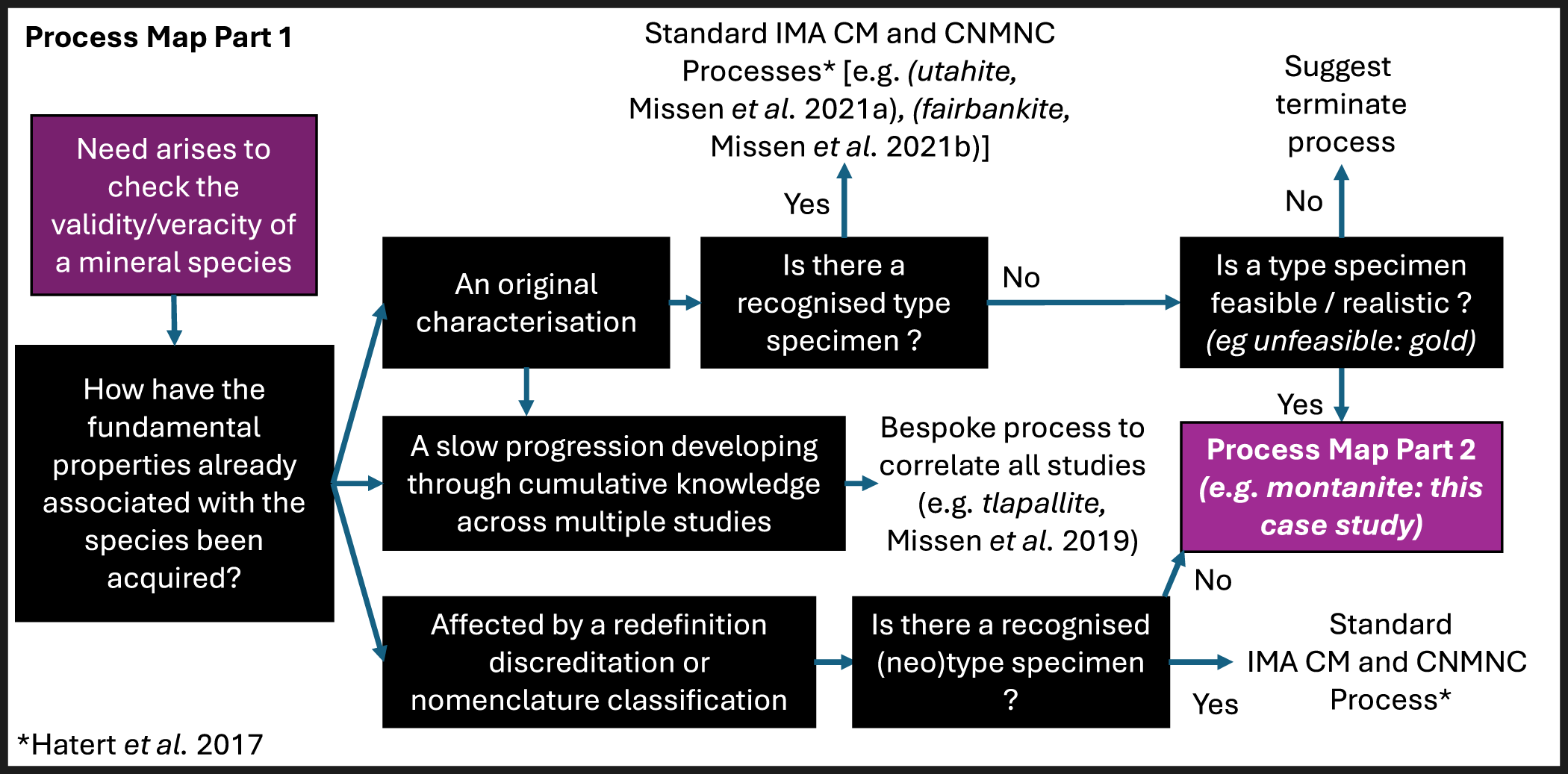
As part of a study investigating the mobility of tellurium, reassessment of species relating to the alteration of tellurides was undertaken (Missen et al., Reference Missen, Ram, Mills, Etschmann, Reith, Shuster, Smith and Brugger2020). Montanite was identified as needing a significant reassessment. IMA-CNMNC guidelines required the identification of the original montanite type specimen(s), or the justified designation of surrogate neotypes that might be used instead. Unfortunately, no unambiguous type specimen(s) were recorded. The decision-making behind the initial stages of the re-assessment or re-discovery of a type specimen is given in Fig. 1.
The decision-making behind the initial stages of the re-assessment or re-discovery of a type specimen. References: Hatert et al. (Reference Hatert, Pasero, Mills and Halenius2017); Missen et al. (Reference Missen, Kampf, Mills, Housley, Spratt, Welch, Coolbaugh, Marty, Chorazewicz and Ferraris2019, Reference Missen, Mills, Rumsey, Back, Di Cecco, Birch and Spratt2021a, Reference Missen, Rumsey, Mills, Weil, Najorka, Spratt and Kolitsch2021b).
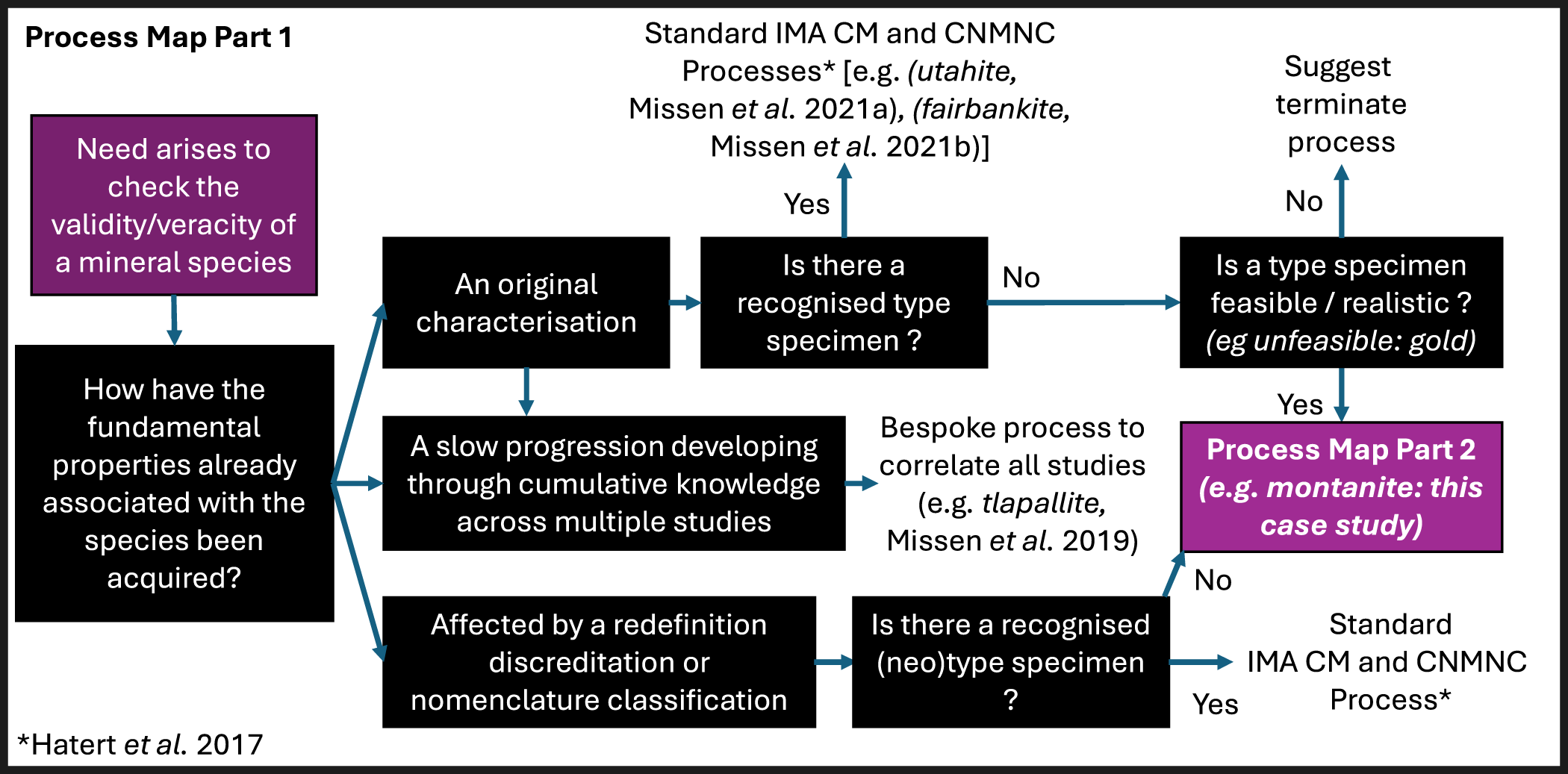
Figure 1 Long description
The flowchart begins with 'Need arises to check the validity/veracity of a mineral species.' It connects to 'How have the fundamental properties already associated with the species been acquired?' leading to 'An original characterisation.' From here, it asks 'Is there a recognised type specimen?' If yes, it follows 'Standard IMA CM and CNMNC Processes' with examples like 'utahite, Missen et al. 2021a, fairbankite, Missen et al. 2021b.' If no, it asks 'Is a type specimen feasible/realistic?' with an example 'gold.' If no, it suggests 'terminate process.' If yes, it leads to 'Process Map Part 2 (e.g. montanite: this case study).' Returning to 'An original characterisation,' it connects to 'A slow progression developing through cumulative knowledge across multiple studies.' This leads to 'Bespoke process to correlate all studies' with an example 'tapalpite, Missen et al. 2019.' It then asks 'Affected by a redefinition discretisation or nomenclature classification.' If yes, it asks 'Is there a recognised (neotype) specimen?' If yes, it follows 'Standard IMA CM and CNMNC Process.'.
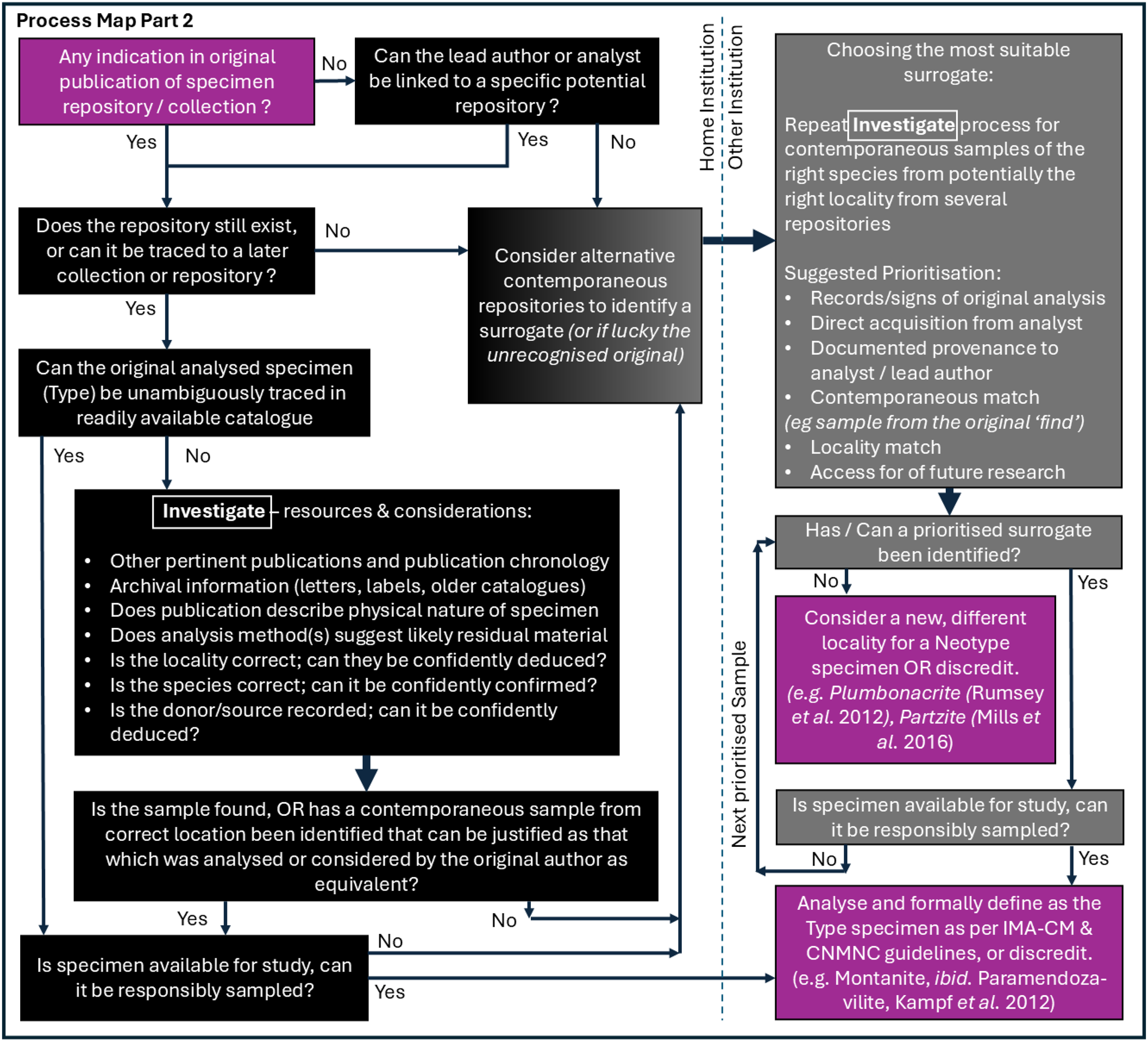
The following is a case study detailing the historical information gathering and decision-making processes outlined by Dunn (Reference Dunn1990) that is often absent from published studies that reassess mineral species. These can be as extensive and time consuming as the scientific analyses. It is of note that several resources not listed by Dunn (Reference Dunn1990), such as letters, archives and specimen labels, were important during this study and should be added to the resources considered for reassessments, redefinitions and discreditations. Our suggested idealised process-map for undertaking these studies is presented in Fig. 2. It should be noted that this is an idealised workflow. With complex situations such as montanite, several parts of the process end up being concurrent and iterative, with specimens and resources getting revisited after new information is discovered.
An idealised detailed approach to the decision-making and investigative processes for determining the type specimens, or best surrogates for type specimens in situations of historical re-assessments, re-definitions or discreditations of mineral species. References: Kampf et al. (Reference Kampf, Mills, Rumsey, Dini, Birch, Spratt, Pluth, Steele, Jenkins and Pinch2012); Rumsey et al. (Reference Rumsey, Siidra, Krivovichev, Spratt, Stanley and Turner2012); Mills et al. (Reference Mills, Christy, Rumsey and Spratt2016).
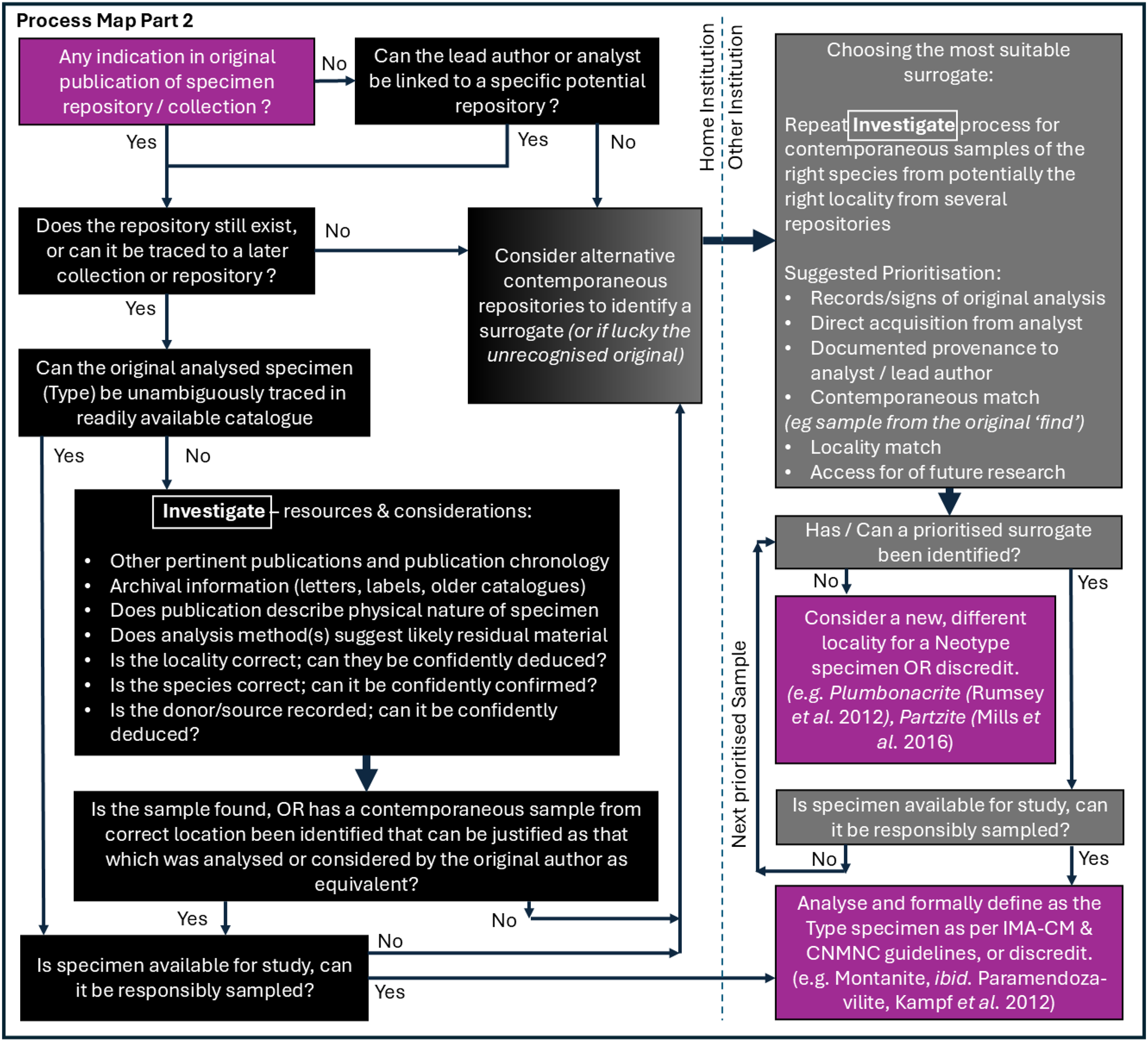
Figure 2 Long description
The infographic flowchart outlines the process for determining type specimens or surrogates in historical reassessments of mineral species. It begins with the question: 'Any indication in original publication of specimen repository/collection?' If yes, it asks: 'Can the lead author or analyst be linked to a specific potential repository?' If no, it suggests considering alternative repositories to identify a surrogate or the unrecognised original. The next section checks: 'Does the repository still exist, or can it be traced to a later collection or repository?' If yes, it asks: 'Can the original analysed specimen (Type) be unambiguously traced in readily available catalogue?' If yes, it proceeds to 'Investigate - resources & considerations,' which includes checking publications, archives and specimen labels. It asks: 'Is the sample found, OR has a contemporaneous sample from correct location been identified that can be just as that which was analysed or described by the original author as equivalent?' If yes, it asks: 'Is specimen available for study, can it be responsibly sampled?' If no, it suggests 'Choosing the most suitable surrogate,' with steps for repeating investigations, prioritising original analysis and considering new identifiers. The final section is 'Analyse and formally define as the type specimen as per IMA-CM & CNMNC guidelines, or discredit.' The flowchart uses arrows to indicate decision points and pathways, with branching Yes/No outcomes guiding the process. Side panels run parallel to the main path, detailing surrogate-selection pathways and repeat investigation loops.
Historical setting
Starting the search for an unrecorded, historic type specimen begins with the earliest publication of the name and any other published information about its discovery prior to naming (Dunn, Reference Dunn1990). Montanite is important as the earliest described natural tellurium oxysalt, first named in print by Frederick August Genth in 1868 (Genth, Reference Genth1868). Genth was a prolific correspondent (Myers and Zerfoss, Reference Myers and Zerfoss1946) particularly with James Dwight Dana. Because of the Genth–Dana correspondence, the first publication of the name montanite was nearly that in the 5th edition of Dana’s A System of Mineralogy (Dana, Reference Dana1868) rather than a stand-alone scientific article.
The 5th edition of Dana’s System, lists montanite in the main section as a “private contribution” from Genth, dated “Jan 19th 1868”. Dana’s excitement at being able to include Genth’s new mineral is recorded in a letter preserved at the archives of Pennsylvania State University (PSU) which reads in part, “I was delighted to have a real tellurate to add to the book – it has already taken its place” (Dana to Genth, Jan 25th 1868, PSU Archive 392). The letters additionally record that Dana’s System was produced in sections, with those completed being sent to the printers while others were being edited. So, although montanite had already “taken its place” in January, it took time for the completed book to be produced which allowed for the formal scientific communication of montanite in the American Journal of Science and Arts in March (Genth, Reference Genth1868). This confuses the chronology of the earliest reference, as Dana’s listing bears the earlier date but was published later.
Although named in 1868, Genth’s article indicates he discovered the material as early as 1850 (Genth, Reference Genth1868), having previously reported it unnamed as an oxidative alteration product of tetradymite (Genth, Reference Genth1853). In this earlier publication, Genth described the material from “a few specimens” as “a combination of tellurous acid with teroxyd of bismuth” from a locality “about 5 miles west of Washington Mine” in Davidson County, North Carolina, USA. Genth was well positioned to investigate the mineralogy of this area having been briefly appointed the superintendent of Washington mine during 1849–1850 in between stints at his analytical laboratory in Philadelphia before becoming affiliated with the University of Pennsylvania in 1872 (Barker, Reference Barker1901).
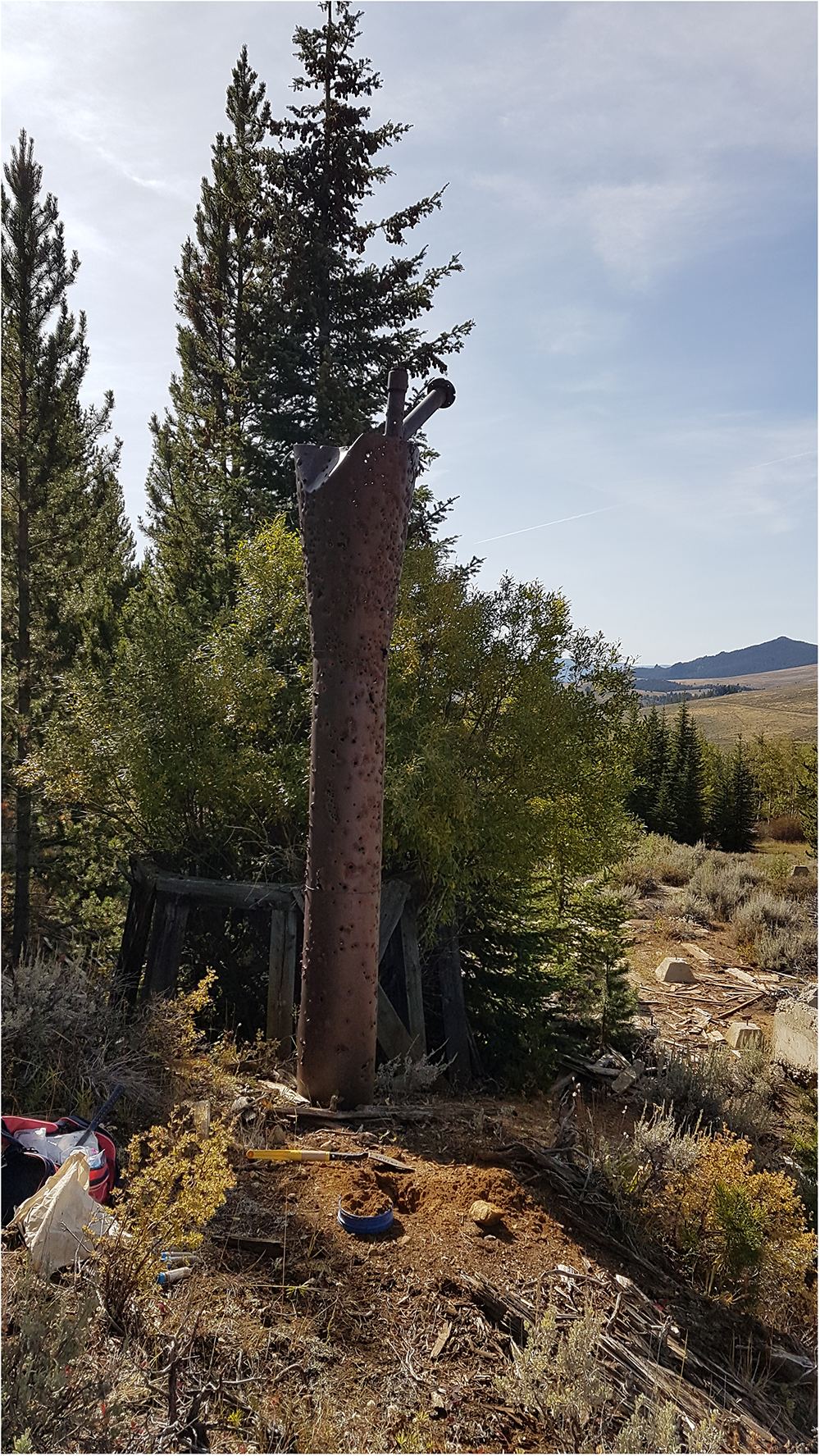
Genth’s 1868 description primarily focuses on samples passed to him in December 1867 from a Mr. Kleinschmidt but significantly these were sourced from a different locality: Highland, Montana Territory (Fig. 3). Genth specifically documents the Montana material is, in his opinion, the same as that from North Carolina and reports analytical data from both localities.
A photo of some of the abandoned processing works at Highland, Montana, USA. Fieldwork at this location for Missen et al. (Reference Missen, Mills, Rumsey, Weil, Artner, Spratt and Najorka2022) uncovered a small amount of montanite in the tailings pile.
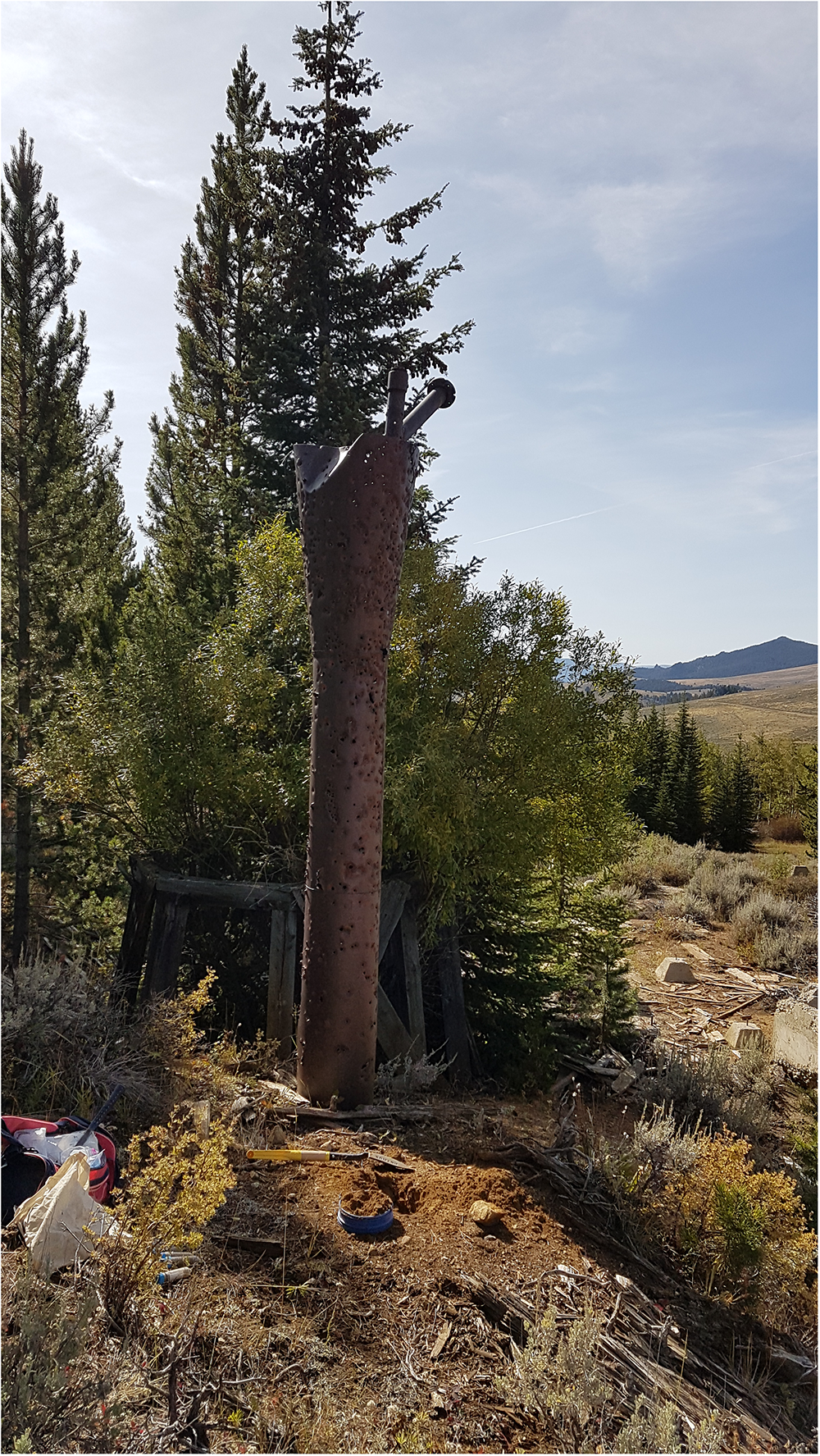
Figure 3 Long description
A tall, rusted metal structure is positioned vertically among trees and tailing piles in a rural post-mining landscape. The structure appears cylindrical and is surrounded by various types of vegetation, including pine trees and shrubs. In the background, there are rolling hills and open fields. The ground around the structure is covered with dry grass and scattered rock debris. The sky is clear with a few clouds visible.
This data must have been communicated to Dana in two parts, the first part furnished the main entry for montanite with analyses only from Montana samples. While the second part provided data relating to the North Carolina samples and the 1868 publication for a supplementary section in Dana’s System which captured mineralogical developments during the compilation of the work.
The Dana listings and Genth’s publication suggest the Montana samples increased Genth’s confidence that the material was a new mineral species, inspiring him to revisit the North Carolina samples. This resulted in an uncertainty in the H2O content between the earlier main listing and the later supplementary inclusion.
The drawn-out gestation period, the publication of analyses from both occurrences and the impact on interpretation of H2O content specifically based on analyses of North Carolina samples indicates that material from both localities contributed to Genth’s essential understanding of montanite (Genth, Reference Genth1868). As such, the two localities constitute what would now be considered co-type localities (Dunn and Mandarino, Reference Dunn and Mandarino1987). Had the inclusion of the North Carolina samples not affected Genth’s interpretation of the chemistry, it could be argued that although samples from two localities are represented, the addition of the North Carolina samples was for illuminative purposes only. This point has not been previously noted in type specimen and locality compilations, preferring only to list the Montana locality, suggesting incorrectly that it was the discovery locality. The reason for using Montana (the chronological second locality) as the eponym is not recorded, but it is likely that it is this naming decision which accounts for the historical and scientific importance of the Davidson County, North Carolina occurrence being unrecognised.
Davidson County, North Carolina
The occurrence of what would become montanite, from Davidson County, North Carolina is reported alongside minor gold (Genth, Reference Genth1853). This region was the site of the first United States gold discovery in 1799 and saw eluvial, alluvial and placer-type gold mining on an artisanal scale in the early nineteenth century until around 1825 when mines started working gold-bearing lodes (Hines and Smith, Reference Hines and Smith2002). Unfortunately, despite this rich history the exact co-type locality of montanite has not yet been identified. Neither the 1853, or 1868 Genth publications give a name, nor is the occurrence referenced as a ‘mine’, potentially suggesting a small unnamed prospect or embargoed information.
The 1853 article coincided with Dana’s previous 4th edition of A System of Mineralogy (Dana, Reference Dana1854). In this edition’s tetradymite listing, the oxidative alteration product that is later to become montanite is noted, citing the 1853 article and repeating the specific occurrence west of Washington Mine. The archives at PSU reveal Genth was reviewing Dana’s 4th Edition for errors and Dana asks him to provide lists of the species known from the localities he has visited. Genth’s response is not retained, but it must have furnished parts of Dana’s additional appendix-like section, ‘Catalogue of American Localities of Minerals’ which lists under Davidson County, “five miles from Washington Mine, on Faust’s Farm, gold, tetradymite, oxyd of bismuth and tellurium [are found]”.
An identical entry occurs in the same American localities section in Dana’s 5th edition (Dana, Reference Dana1868), which seemingly wasn’t updated, retaining the “oxyd” description rather than using the new name montanite. Despite a search of readily available resources, including online search engines no further references to Faust’s farm have been identified in the mineralogical, geological or mining-based literature.
After both the initial discovery and the important samples from Montana, a new Genth publication (Kerr, Reference Kerr1875) lists two localities in North Carolina for montanite, neither of which obviously correlate to the locality west of Washington Mine. These are “David Beck’s Mine” in Davidson County and “Captain Mills’s Mine” in Burke County. The correlation problem is solved by investigating the same publication but viewing the localities listed for tetradymite. Here David Beck’s mine is listed again, but located as “5 miles west of Silver Hill”. This unequivocally correlates David Beck’s mine to the Dana listing of Faust’s farm because Washington mine was renamed Silver Hill mine in 1854 (Kaas, Reference Kaas2009).
By the 6th edition of Dana’s A System of Mineralogy (Dana, Reference Dana1892), the American localities section has been updated listing David Beck’s mine as a locality for tetradymite and montanite, and Genth is recognised as the main contributor of North Carolina entries.
Geological survey work in the region (Emmons, Reference Emmons1856), notes the “plantation of David Beck”, in the vicinity of the Washington mine, but locates it to the east. This raises a possibility that Washington mine was 5 miles west of David Beck’s mine rather than vice-versa, which would place it in the middle of what would eventually become the Cid mining district (Pogue Jr., Reference Pogue1910). However, it seems unlikely that Genth, familiar with the area, would propagate such a mistake in several publications for over 30 years, suggesting that David Beck’s plantation was a large area.
Readily available records and online sources (Pardee and Park, Reference Pardee and Park1948; Ralph et al. Reference Ralph, Von Bargen, Martynov, Zhang, Que, Prabhu, Morrison, Li, Chen and Ma2025) record few mineral producing localities west of Washington/Silver Hill mine and none 5 miles distant. This distance would place the locality somewhere between the modern towns of Feezor and Ravenwood, perhaps on the banks of Swearing Creek or one of its tributaries prior to the damming of the Yadkin River and the creation of High Rock Lake in 1927. Intriguingly, Genth noted the samples were “found near the surface” (Genth, Reference Genth1853), and correspondingly the samples identified herein are fragmentary, rich in iron-ochres and largely devoid of rock-bearing matrix. This suggests they were not mined from a consolidated lode or vein. Additionally, a proprietor-based farm-locality description initially omitting the word ‘mine’ suggests a small artisanal endeavour. Perhaps an eluvial, near surface expression of a weathered minor lode or placer-like alluvial deposit of no notoriety or significant output. Such workings were commonplace in the district from 1799 to 1868 (Pogue Jr., Reference Pogue1910; Hines and Smith, Reference Hines and Smith2002, Reference Hines and Smith2006).
Highland, Montana occurrences
After the discovery of placer gold in the Highland District in 1866 (Winchell, Reference Winchell1914), there were at least 29 individually named mines recorded in the district just two years later (Browne, Reference Browne1868). The eponymous Highland City quickly became a significant boom town until its demise in the mid 1870’s. Genth’s publications (Genth, Reference Genth1874) record that the first montanite material from this area was passed to him by Mr. Kleinschmidt of Helena, Montana Territory as early as 1867. This was J.L. Kleinschmidt, a mining engineer with interests across the wider Montana region. Unfortunately, Genth only uses the non-specific term “Highland” so it is unclear if he is referencing the district, the town, the gulch (valley) or a specific mine.
Specific locality information is often lacking just after discovery and broader geographically referenced locations are often recorded even when a specific mine might be traceable. A contemporaneous reference (Anon., Reference Anon1867) implies that Highland Gulch refers holistically to the myriad of placer workings along tributaries and a 5-mile stretch of what is now Fish Creek. This perhaps suggests that Genth (Reference Genth1868) didn’t have more specific detail and a myriad of placer workings would still correlate with his description “found in placer gold at Highland, Montana”.
A potential specific source location is the Ballarat mine within the Highland district. The samples J.L. Kleinschmidt passed to Genth were sourced from a Professor Swallow (Genth, Reference Genth1868). Professor Swallow was an investor in the “Ballarat” mine (Meredith, Reference Meredith1868) and a publication by J.L. Kleinschmidt mentions that the “Balarat” was the most important of the mines in the area (Kleinschmidt, Reference Kleinschmidt1869). Unfortunately, although Kleinschmidt mentions the material soon to become montanite as “partly converted into telluric acid bismuth oxide” [quote translated from German], there is no evidence to link it to the Ballarat mine, only the coincidence of his interests.
Several years later in 1874, Genth reports montanite and a sulphurous variety of tetradymite from the specific location “Uncle Sam’s Lode in Highland District”. Although tempting to speculate this is a more specific locality for the earlier montanite occurrence, this seems unlikely as Genth notes the montanite here was “not in a state of sufficient purity for analysis” (Genth, Reference Genth1874). However, these samples must have been found soon after the first occurrence as some had already passed to the mineralogical and geological collections cabinet formed by the US General Land Office by 1870 (Anon., 1870, Smithsonian Institution Archives, Accession 84–178).
Unsurprisingly, there are many locations across the United States that have been named ‘Uncle Sam’, including several in Montana. This causes well-intentioned specimen misattributions in museum collections and care must be taken in interpretation. For this project location synonymy was assumed between samples labelled Uncle Sam Lode, Uncle Sam and Uncle Sam Mine only if also located to Highland Montana on the original source label.
Local mining historians were contacted for information relating to both Highland and Davidson Counties. Unfortunately, time limitations put more intricate geographical investigation beyond the scope of this project as it is not strictly necessary for the identification of type specimens in this case.
Type specimens
As type specimen concepts were absent at the time of Genth’s publication it’s unsurprising there is no detail on sample preservation. However, multiple chemical analyses and some physical observations are reported which can be used to infer what form of material might remain that would now be considered equivalent, or nearest to the original specimens studied by Genth. The nature of chemical analysis at the time would have destroyed any subsamples used, so extant type specimens could only be those that garnered physical properties alongside any remaining parent or residual material from that which was chemically analysed.
The obvious repository for remnants of analysed material is the mineral collection, laboratory or institution connected to the original author(s). A pamphlet (Canfield, Reference Canfield1923) records that Genth formed two mineral collections, one went to the University of Pennsylvania (now PSU), while the other was offered for sale in 1923. The contents and whereabouts of the second collection have never been identified, so any analysed samples it might contain are presumed lost. But the former is still preserved at PSU (Myers and Zerfoss, Reference Myers and Zerfoss1946) with a catalogue (Genth, Reference Genth1892) documenting around 5000 samples.
This collection contains one montanite sample, numbered 808.1, from “Davidson County”. Due to the lack of other reported montanite localities in Davidson County the sample is assumed to be from David Beck’s mine. There are no other montanite samples in Genth’s collection, only tetradymites are listed from “Highland Gulch” (31.2) and “Uncle Sams Mine” (31.10 & 31.11), both of which could contain montanite, especially that from Uncle Sam’s mine which are heavily oxidised, matching Genth’s description of the occurrence. However, as these specimens were not catalogued by Genth as montanite, it is reasonable to assume they do not constitute remnants of analysed montanite.
Unfortunately, the single montanite in the Genth collection was not available for subsampling in 2021 at the time of the tellurium project (Missen et al., Reference Missen, Mills, Rumsey, Weil, Artner, Spratt and Najorka2022) due to a lack of policy at PSU specifically balancing preservation and destructive analysis on this important historical collection.
In the archives at the Natural History Museum (NHM) in London, letters indicate that Genth was open to disseminating samples to collectors and institutions. Between the montanite discovery in 1850 and Genth’s death in 1893 there was ample time for samples sourced from him to spread across the globe. Museum catalogues often document samples of new species acquired from the discoverer, collector or lead author and this is generally considered potential evidence of type status, however, care must be taken when assessing these specimens. Recent research (Kampf et al., Reference Kampf, Mills, Rumsey, Dini, Birch, Spratt, Pluth, Steele, Jenkins and Pinch2012) has highlighted an instance where although assumed to be a type specimen, subsequent analysis of a sample showed it to be a different material, indicating it could have never been analysed and was selected on visual grounds, in this case incorrectly.
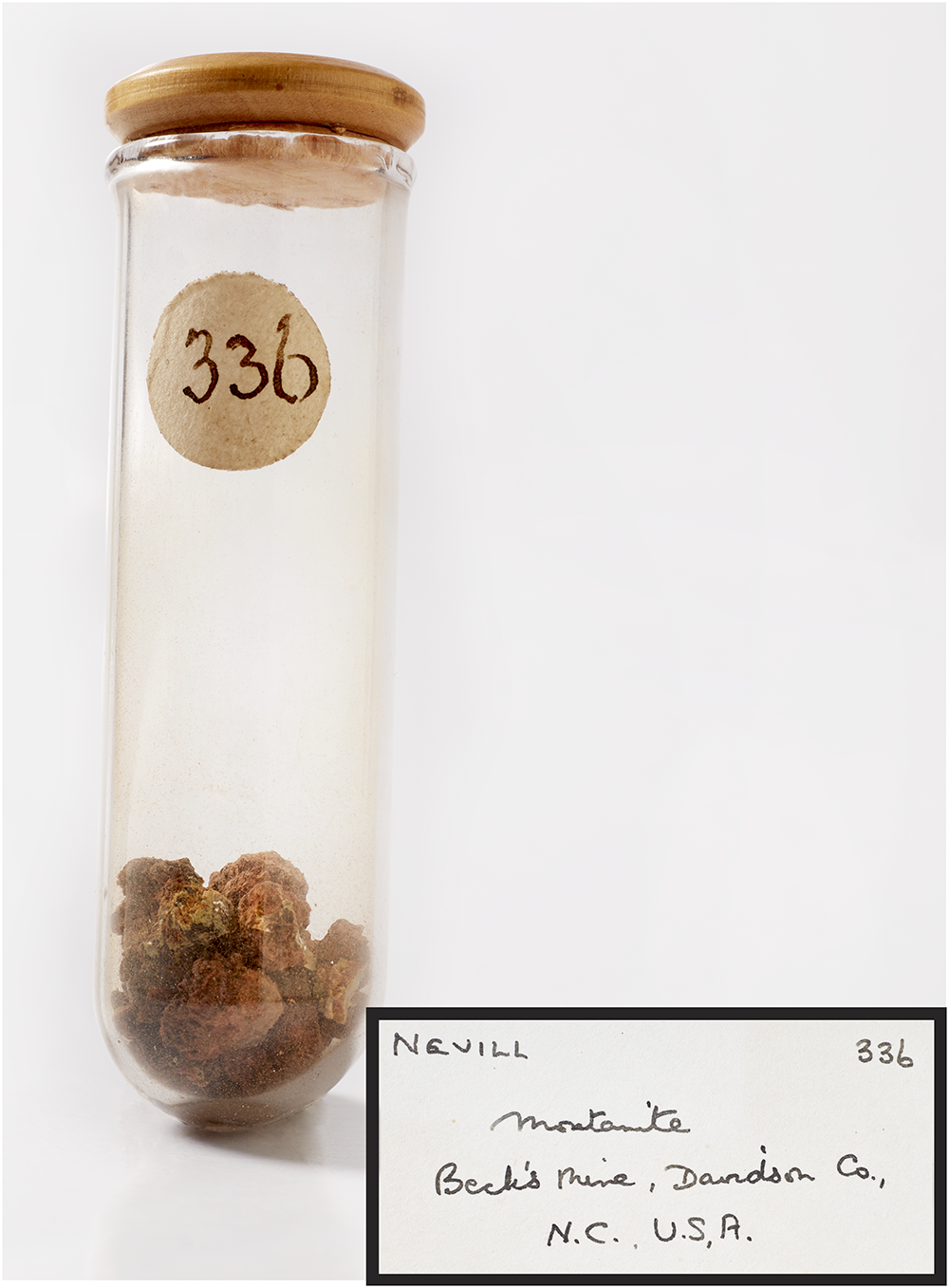
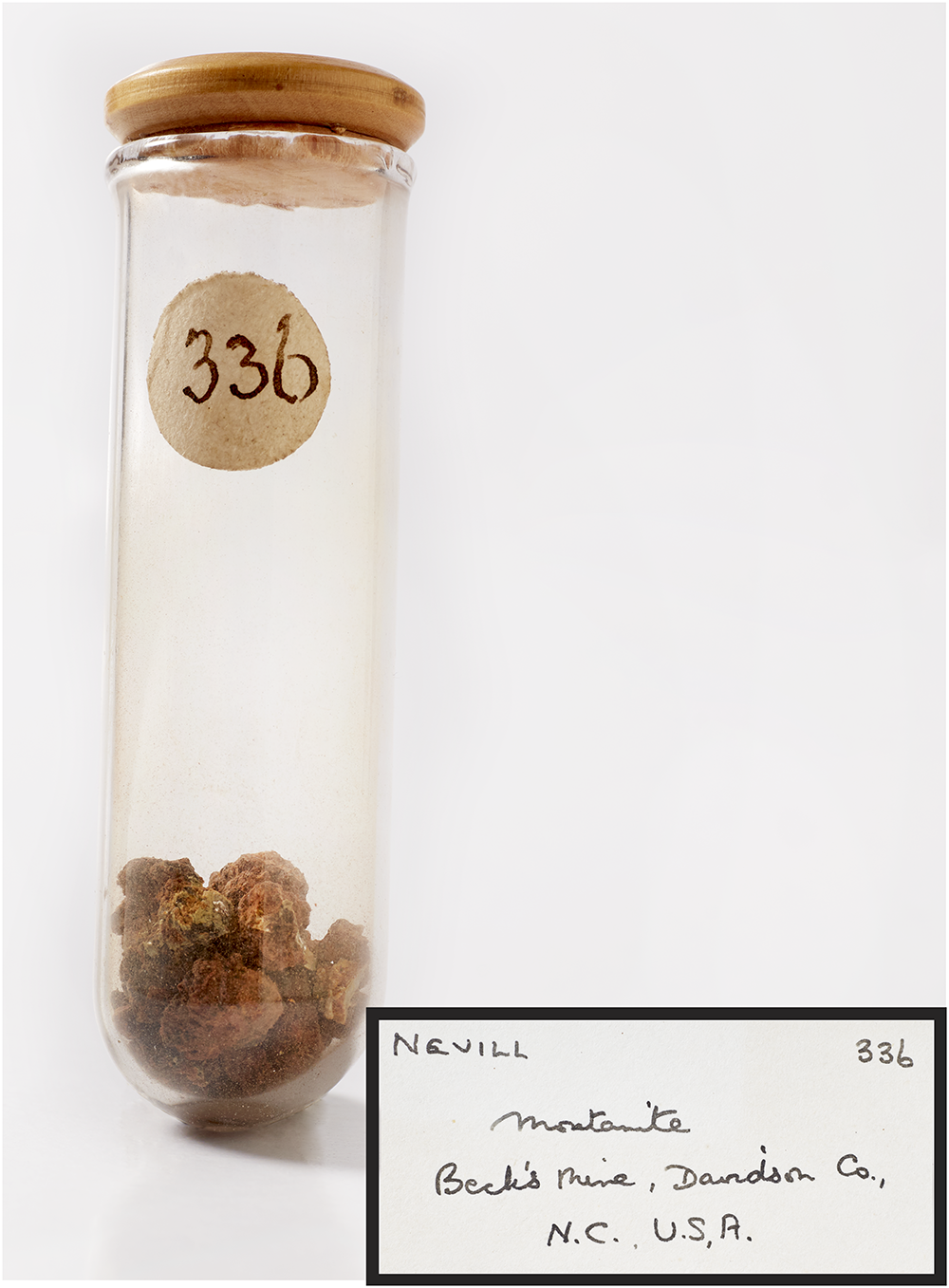
Contacting all plausible museum recipients about other historic montanite samples that could be carefully studied in this way is unrealistic, however a small number of key institutions were either contacted or their online databases searched. Nineteen historic montanite samples were identified, but only one other was documented from North Carolina. This sample (BM 1985,Nev336) (Fig. 4) at the NHM in London is recorded from the specific locality of “Beck’s Mine” and is presumably synonymous with David Beck’s mine. Also preserved at the same institution are montanite samples from “Uncle Sam’s Lode” (BM 1985,Nev337) (Fig. 5) and “Highland” (BM 85116) (Fig. 6) with the latter sample directly linked to Genth. Consequently, in lieu of being able to study the samples at PSU, this unique situation preserved at the NHM, London with seemingly well-provenanced montanite specimens from all three relevant localities was selected for identification and assessment.
BM 1985,Nev336, montanite from [David] ‘Beck’s mine’, North Carolina. From the Nevill collection at the NHM, London. © Trustees of the Natural History Museum, London.
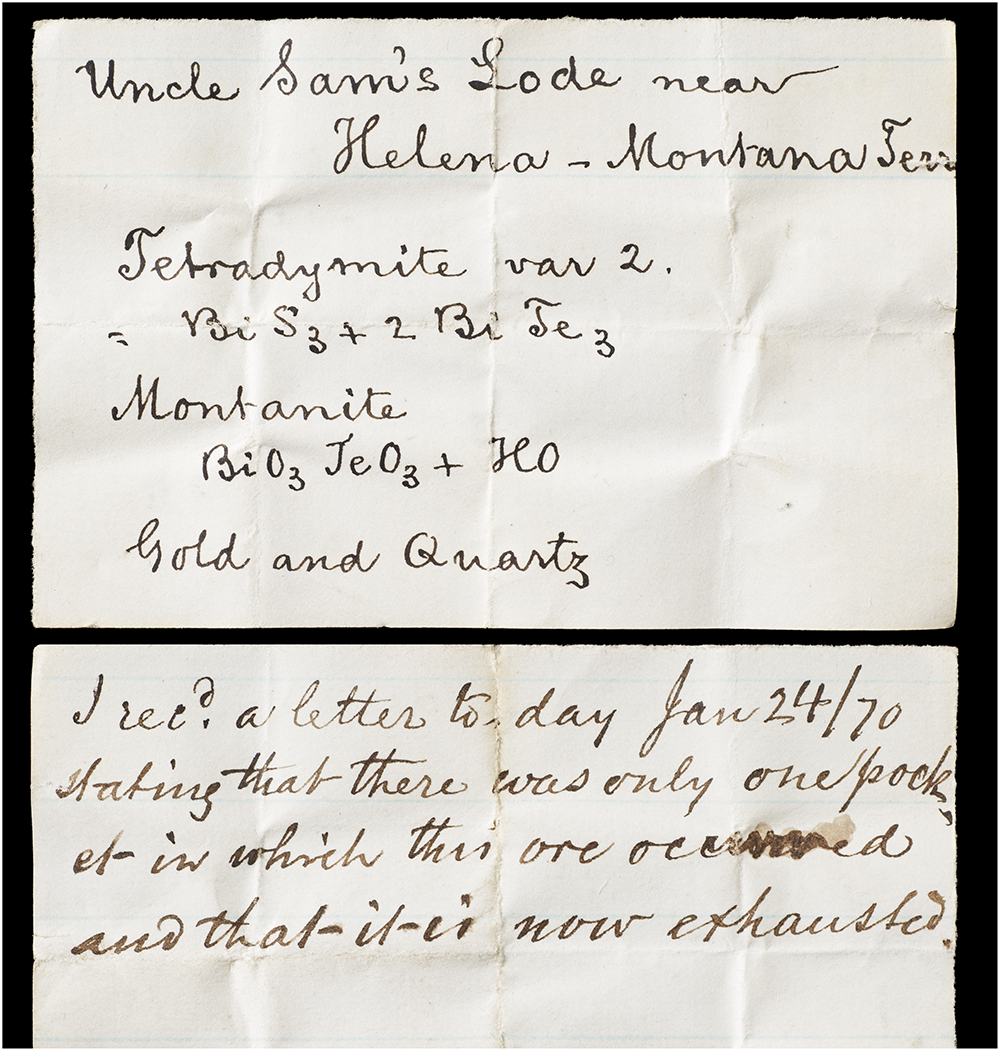
Specimen label of BM 1985,Nev337 documenting specific information about ‘Uncle Sam’s Lode’, thought to be in the hand of W. Nevill. © Trustees of the Natural History Museum, London.
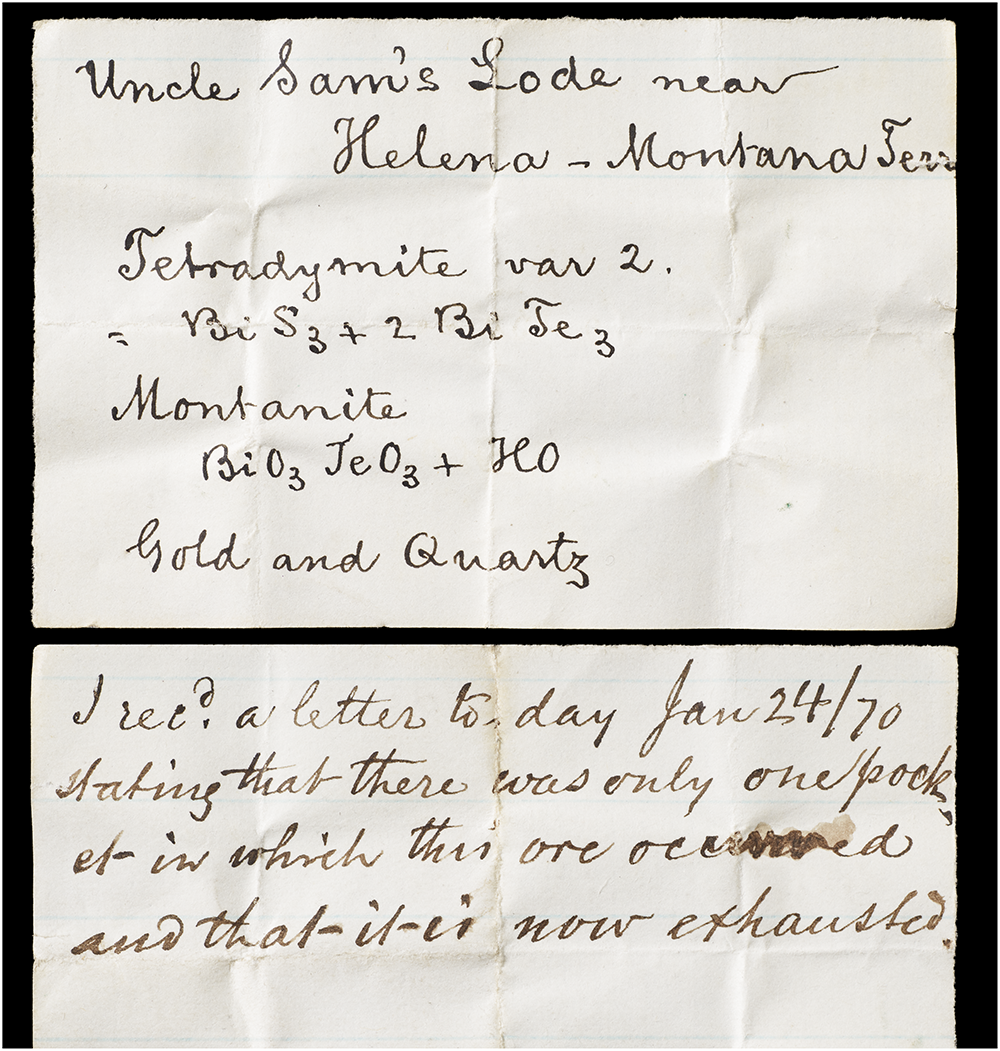
Figure 5 Long description
The label says “Uncle Sam's Lode near Helena - Montana Terr. Tetradymite var 2. Bi S subscript 3 plus 2 Bi Te subscript 3 Montanite Bi O subscript 3 TeO subscript 3 plus KO Gold and Quartz” The second label says “I rec'd a letter to day Jan 24/70 stating that there was only one pocket in which this ore occurred and that it is now exhausted.”
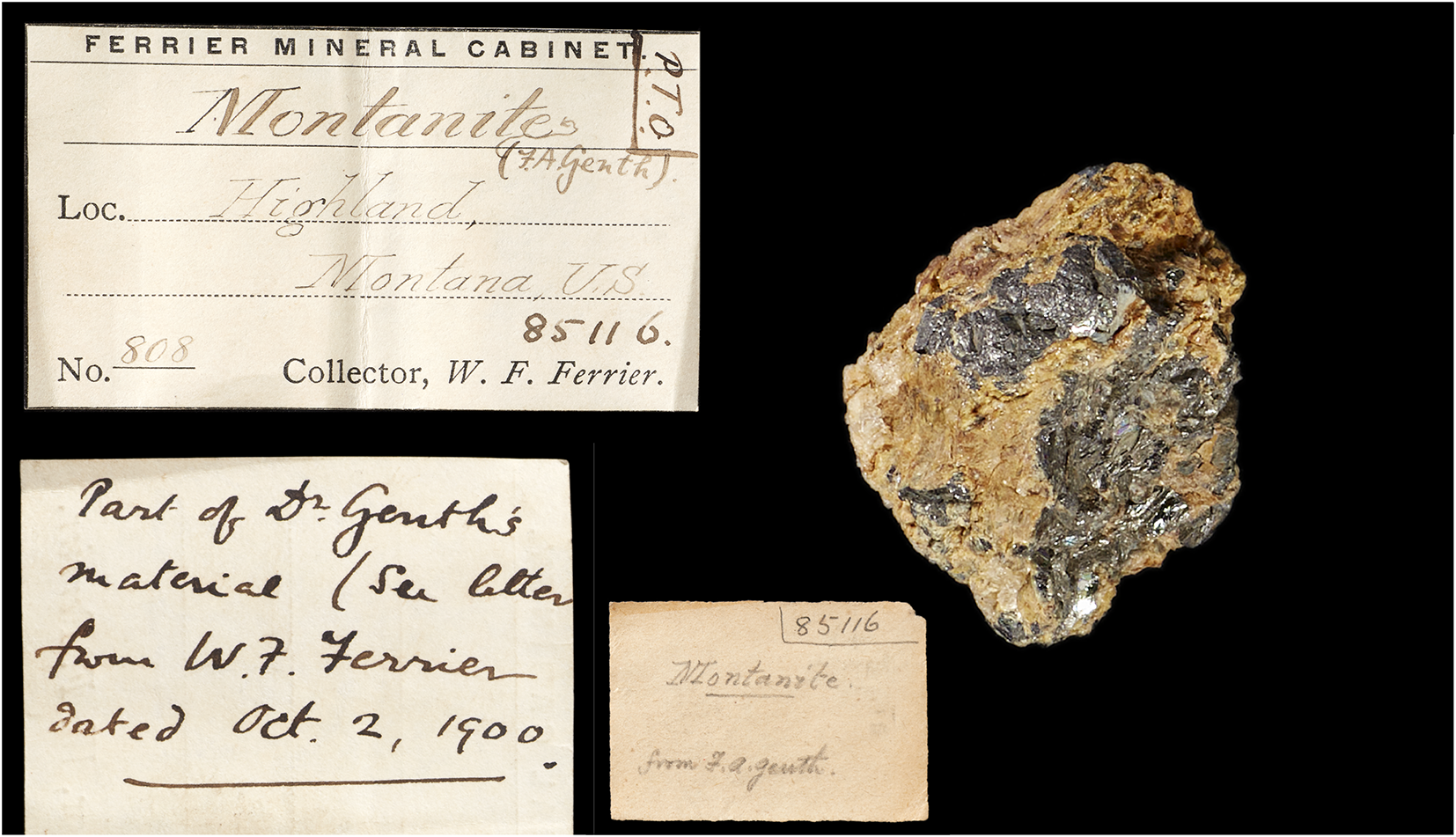
BM 85116, c.10 mm (size-increased relative to labels), montanite from ‘Highland, Montana’. A fragment supplied to Canadian mineralogist, Colonel Ferrier in exchange with Genth in 1891, subsequently exchanged to the NHM in 1900. Alongside original labels of Genth (in pencil) and Ferrier. [Note: Ferrier number 808, is the same as that in Genth’s catalogue (808.1). This is not co-incidence, nor evidence for this being a part of the same sample, it is a reflection of the use of Dana’s system for organising mineral collections as montanite is species number 808 in Dana’s 6th System of Mineralogy (1892)]. © Trustees of the Natural History Museum, London.
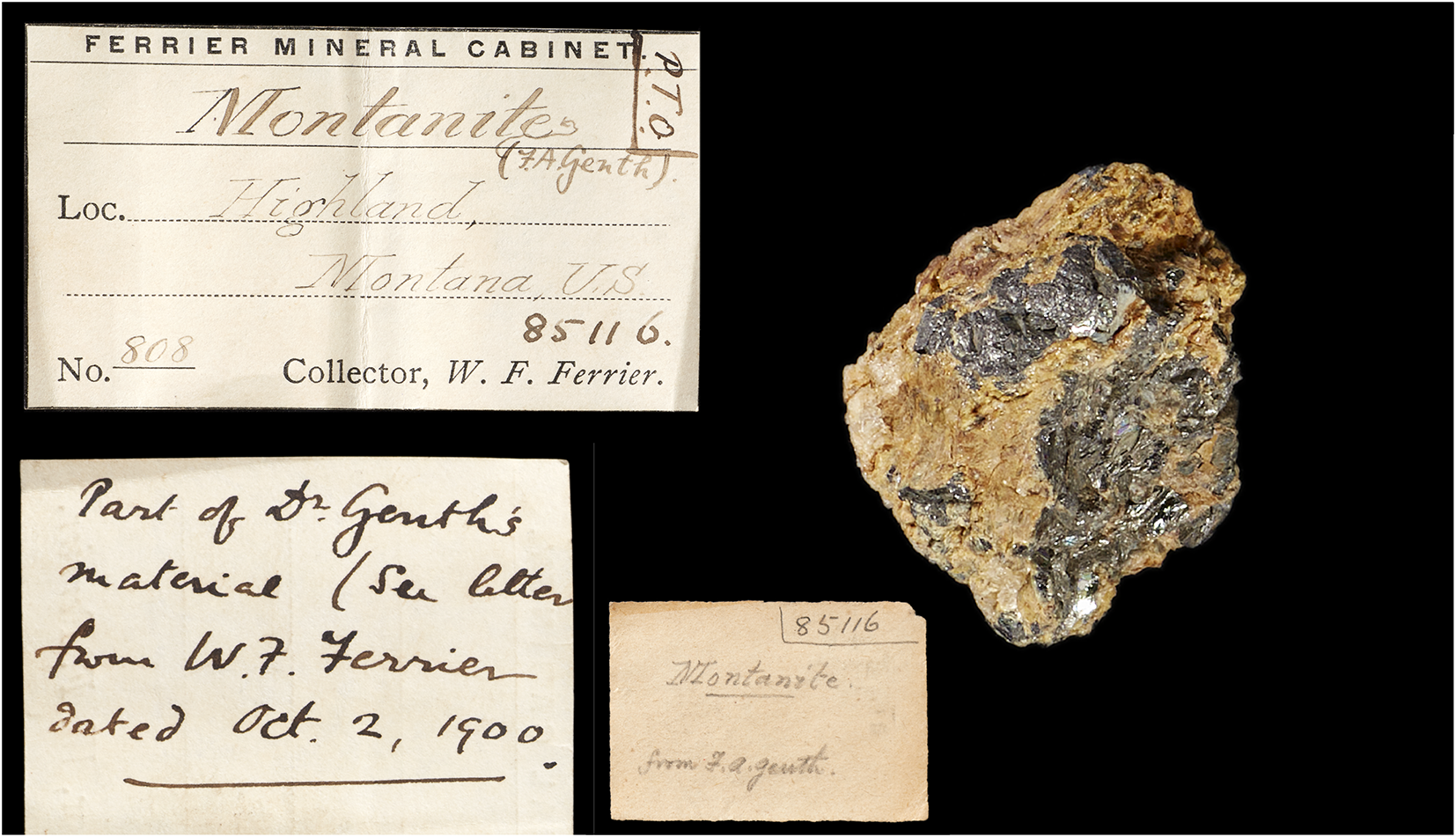
Figure 6 Long description
The image shows a montanite mineral sample alongside three labels. The first label, titled 'Ferrier Mineral Cabinet,' details the location as 'Highland, Montana, US,' with the number '808' and collector 'W. F. Ferrier.' The second label notes 'Part of Dr. Genth's material (see letter from W. F. Ferrier dated Oct. 2, 1900).' The third label reads '85116 Montanite from F.A. Genth.' The mineral sample is rough and textured, with visible crystalline structures.
BM 85116 was acquired by the NHM in an exchange with Colonel W.G. Ferrier, a Canadian geologist and contemporary of Genth. The sample is a 1 cm fragment of tetradymite with yellowish-orange glassy alteration coating and occurring within foliated oxidising tetradymite. On acquisition, a note in the catalogue documented it as “A portion of Dr. Genth’s original material, on which the species [montanite] was based”. The use of ‘portion’ and ‘on which’ suggests the fragment has a better chance than most of genuinely being a small residual piece of Genth’s analysed material. A pencil-written label preserved with the sample retains Genth’s handwriting.
Preserved correspondence (Ferrier to Genth December 13th, 24th 1890, January 17th, 1891, PSU archives 392) suggests Ferrier was looking to exchange samples with Genth for the purpose of comparing Genth’s rare mineral discoveries with samples in his possession. Ferrier is particularly keen to emphasise that samples must be “authentic”, which is underlined in his letter and presumably means being identical in both chemical and physical characteristics to that which Genth described. Although Genth’s responses are not preserved it can be inferred from Ferrier’s correspondence that Genth was not keen on sending whole samples, preferring instead to send fragments, which Ferrier received in 1891. Although it will probably never be conclusively established, this Highland sample is a reasonable candidate for a fragment of Genth’s analysed material.
Samples BM 1985,Nev336 and Nev337 were acquired by NHM, London in 1985 when the collections of the Geological Museum were merged into it. The Geological Museum acquired the Henry Ludlam collection in 1881, whose collection had absorbed that of William Nevill (1808–1874). Nevill was well known as a meteorite collector (Anon., Reference Anon1877) but he also had a large mineral collection and an interest in the preservation of rare mineral species. His collection catalogue was published in 1872 (Nevill, Reference Nevill1872) providing data on both montanite specimens. There is no known link between Nevill and Genth, no letters from Nevill at PSU, and no references indicating from whom Nevill obtained his montanite samples.
The listing in Nevill’s catalogue of the specific “Beck’s Mine” locality is surprising as the name is otherwise strictly limited to documents linked to Genth. This sample is physically different to the NHM samples from Highland and Uncle Sam’s lode and consists of small fragments in a vial (Fig. 4). Small grains of primary tetradymite are coated and partially altered to yellow-green montanite encrusted in thick coatings of brown to black iron oxy-hydroxides. This is visually identical in form and character to the Davidson County material in the Genth collection at PSU.
Although not a candidate for surrogate type material, contextual information is provided with Uncle Sam’s Lode sample BM 1985,Nev337, the label states “I recd. a letter today Jan 24/70 [January 24th, 1870] stating that there was only one pocket in which this ore occurred and that it is now exhausted” (Fig. 5). The date, 11 months before the published work by Genth on tetradymite from Uncle Sam’s mine and only 2 months after the first mention of the Uncle Sam locality in a publication (Anon., 1870) suggests Nevill’s sample came from someone well-connected to the montanite situation. Unfortunately, the referenced letter has not been preserved.
The excellent combined historical provenance of this suite from the original co-type localities alongside the opportunity to study all three samples at the same institution highlighted them as perfect candidates for the scientific study. As a result of the successful study (Missen et al. Reference Missen, Mills, Rumsey, Weil, Artner, Spratt and Najorka2022) it was proposed to use BM 85116 and BM 1985,Nev336 as surrogate ‘neotype’ specimens even though they were poorly crystalline (IMA-CNMNC proposal 22-A). This is unlike the more common situation of choosing specimens from a different neotype locality with properties more suited for analysis and was suggested so that historical continuity could be maintained.
Since the scientific study was completed, the Genth Collections at PSU have now been made available for analysis.
Conclusions
The detailed historical investigation ultimately allowed for the establishment of the two neotype samples which unlocked the validation of montanite (Missen et al., Reference Missen, Mills, Rumsey, Weil, Artner, Spratt and Najorka2022) as nature’s first recognised (albeit questioned) tellurium oxysalt.
Respectful assessment of historical precedence revealed that montanite from the original localities could be considered a discrete mineral species rather than an impure mixture (e.g. Mills et al., Reference Mills, Christy, Rumsey and Spratt2016). All three NHM samples showed commonality in their powder X-ray diffraction patterns despite their different localities validating Genth’s ability to recognise their equivalence. The patterns also matched three montanite references on the International Centre for Diffraction Data (ICDD) database from occurrences in Slovakia (Sejkora et al., Reference Sejkora, Litochleb, Černý and Ozdín2004), the Ural Mountains and a sample listed as Highland Mine, USA (Pokrovskii and Yunikov, Reference Pokrovskii and Yunikov1967).
With montanite revalidated and BM 85116 and BM 1985,Nev336 as the recognised neotype samples the two samples must be assessed in unison during future research on the nature of montanite. Although approved formally as neotypes, this term is generally recognised for single specimens from a different locality that provide better data than an original type material. In this instance, the neotype samples preserve historic context and are from two different localities, providing continuity with the original description even though they are unlikely to have provided better data. A reconsideration of the use of the term neotype in this situation along with a general overhaul of other type specimen terminologies would be beneficial (Rumsey et al., Reference Rumsey, Missen and Mills2021).
The workflow behind determining the historic specimens relevant to a study is often omitted from scientific papers. This can have the effect of the process being overlooked in studies where consideration of specimens is critical, particularly nomenclature. This example of a complicated and interesting case is presented so other researchers are reminded that historical investigation, type specimens, collections and reasoned decision-making are all parts of the scientific method that lay the groundwork for future study and influence collections policies.
Acknowledgements
MSR acknowledges Kathryn Rooke at the NHM for sourcing letters from Colonel Ferrier, Laura Spess and Alex Bainbridge at Pennsylvania State University Libraries for accessing Genth’s letters, Julianne Snider, Peter Heaney, Chris Widga, Patti Wood Finkel and R. Allen Kimel at the Department of Geosciences at Pennsylvania State University for images and information on the Genth mineral collection. All authors acknowledge the time of the reviewers and editors for helpful comments and suggestions.
Funding statement
OPM acknowledges support from the project “Building Capacity in Regional Australia to Enhance Australia’s Economy through Research, Training, and Environmentally Sustainable Production of Critical Metals”, a Regional Research Collaboration (RRC) initiative funded by the Australian Government Department of Education. Part of the work was funded by The Ian Potter Foundation grant “tracking tellurium” to SJM while working at Museums Victoria, Melbourne, Australia.
Competing interests
The authors declare none.