

Obsidian, a volcanic glass used by the ancient Maya for manufacturing utilitarian cutting implements such as blades and flakes, occurs naturally in Mesoamerica only in the volcanic highlands. Each obsidian source is chemically distinct, and many sources can be distinguished based on instrumental attributions and optical criteria. For this reason obsidian has been extremely useful for studying interregional and even long-distance exchange, including the Tehuantepec trans-isthmian exchange. With a large database of geological source samples and many years of studies, laboratories such as the University of Missouri Research Reactor (MURR) have established an outstanding record of success in obsidian provenance research (e.g., Glascock Reference Glascock2002; Glascock et al. Reference Glascock, Braswell, Cobean and Shackley1998). The identification of the sources of artifacts has usually been accomplished through neutron activation analysis (NAA), X-ray fluorescence (XRF), and other technologies, such as inductively coupled plasma mass spectrometry (ICP-MS). Although NAA and ICP-MS are more accurate than XRF in detecting elements in very small and thin pieces of obsidian artifacts, both technologies incur relatively high per sample costs, are potentially destructive, and require the export of artifacts for analysis (Feinman et al. Reference Feinman, Nicholas and Golitko2013). Moreover, small sample sizes and inappropriate sampling methods often impede efforts to study obsidian distribution patterns (Drennan et al. Reference Drennan, Fitzgibbons and Dehn1990:180). Recently, Moholy-Nagy and coauthors (Reference Moholy-Nagy, Meierhoff, Golitko and Kestle2013) used portable X-ray fluorescence (pXRF) to source a large sample of 2,235 obsidian artifacts from Tikal, Guatemala. Although their total sample of instrumental attributions is much larger than any previous study conducted in the Maya area, it represents much less than 4 percent of the total number of obsidian artifacts recorded from the site by the University of Pennsylvania and other archaeological projects and does not constitute a representative sample of what was brought to Tikal (Moholy-Nagy et al. Reference Moholy-Nagy, Meierhoff, Golitko and Kestle2013:74). It is my contention that we should and can study broader issues of prehistoric Maya economy, such as production, consumption, and exchange, by analyzing a large representative sample of obsidian artifacts from a diachronic perspective.
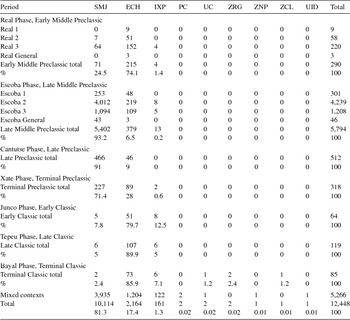
I discuss the results of diachronic analyses of an entire collection of 12,448 obsidian artifacts from Ceibal in order to shed light on changing long-term patterns in the Preclassic and Classic Maya interregional and long-distance exchange system (Figure 1). Sources of all obsidian artifacts from Ceibal were identified by a combination of pXRF of a large sample of 5,375 obsidian artifacts and visual examination of the remaining 7,073 artifacts (Figure 2; Tables 1 and 2; Supplemental Table 1).
Map of Mesoamerica, showing the locations of Ceibal, other sites, and obsidian sources mentioned in the text.

Obsidian artifacts from an unmixed Escoba 2 phase of the late Middle Preclassic midden deposit associated with an elite residence at Ceibal.

XRF Source Assignments of Obsidian Artifacts by Period from Ceibal, Guatemala.

SMJ = San Martín Jilotepeque; ECH = El Chayal; IXP = Ixtepeque; PC = Pachuca; UC = Ucareo; ZRG = Zaragoza; ZNP = Zinapécuaro; ZCL = Zacualtipán; UID = Unidentified source.
Visual and XRF Source Assignments of Obsidian Artifacts by Period from Ceibal, Guatemala.
There is a particularly conspicuous lacuna in empirical studies dealing with obsidian production and exchange during the Middle Preclassic period (1000–350 B.C.) in the Maya Lowlands. This was a critical period, during which many characteristics of social complexity became institutionalized. One principal reason for this gap in our knowledge is that early remains lie under thick layers of later constructions, with the result that large areas of the Middle Preclassic levels at most lowland Maya sites are inaccessible to excavators. Since 2005, however, the members of the Ceibal-Petexbatun Archaeological Project have uncovered evidence of substantial construction activity in the early stages of human settlement at Ceibal. This was accomplished through deep vertical and extensive horizontal excavations and tunnels into Middle Preclassic contexts, focusing considerable attention on the origins and development of Maya civilization (Inomata et al. Reference Inomata, Triadan, Aoyama, Castillo and Yonenobu2013, Reference Inomata, MacLellan, Triadan, Burham, Aoyama, Nasu, Munson, Pinzón and Yonenobu2015). Our excavations recovered a total of 6,084 obsidian artifacts from unmixed Middle Preclassic contexts. This is the largest sample and earliest recovered to date from the Maya Lowlands.
Obsidian Samples
The lowland Maya city of Ceibal is the largest of all Pasión drainage sites, both in extent and in the total construction volume of its major public structures (Willey Reference Willey1990). Extensive stratified excavations of the Ceibal-Petexbatun Archaeological Project have been carried out since 2005 in different parts of Ceibal, including two major groups of structures: Group A and Group D, as well as the nearby minor center of Caobal and other peripheral residential group locations. Obsidian artifacts were recovered throughout the city of Ceibal in archaeological contexts ranging from house mounds in the periphery to elite residences, burials, and dedicatory caches in the epicenter. The Ceibal-Petexbatun Archaeological Project has collected significantly more obsidian artifacts (Table 2) than the Ceibal Project of Harvard University (N = 1,331), primarily because we screened excavated soil through 1/4-inch mesh, unlike earlier field methodologies (Willey Reference Willey1978).
In this study, I focus on diachronic changes of obsidian artifacts. For this reason, chronological control is of particular importance. Based on stratigraphic excavations, detailed ceramic analysis, and more than 150 radiocarbon dates, Takeshi Inomata refined the ceramic chronology of Ceibal (Inomata et al. Reference Inomata, MacLellan, Triadan, Burham, Aoyama, Nasu, Munson, Pinzón and Yonenobu2015; Figure 3). All discussion of absolute chronology in this article is framed in terms of calibrated radiocarbon dates. To ensure temporal control, I eliminated obsidian artifacts that seemed to represent mixed time periods. Because no artifacts were recovered from unmixed Postclassic contexts, I do not discuss that time period. A total of 7,182 artifacts were recovered from temporally secure contexts pertaining to the Middle Preclassic through the Terminal Classic periods (1000 B.C.–A.D. 950). These serve as the basis for the diachronic discussions presented below. Temporally mixed samples were nevertheless considered only for the study of spatial distribution patterns of rare artifacts such as exhausted polyhedral cores and Mexican obsidian artifacts. Notably, the Ceibal-Petexbatun Archaeological Project has collected 6,914 obsidian artifacts from unmixed Preclassic contexts alone. The majority of Preclassic artifacts, 6,084 out of the 6,914, are from the Middle Preclassic. Many obsidian artifacts from later periods came from construction fills and were found mixed with earlier materials. Thus, considerably fewer obsidian artifacts dating to the Late Preclassic through Classic periods could be assigned to a single ceramic complex.
Methodology and Results
pXRF
I identified sources of obsidian artifacts by combining the pXRF analysis of a large sample of 5,375 obsidian artifacts and visual examination of the remaining 7,073 artifacts. The total sample of instrumental attributions is the largest such database published to date for any single site in the Maya area. A selected 43.2 percent sample (N = 5,375) was analyzed using an Olympus Innov-X Delta Premium DP-6000-CC handheld X-ray fluorescence analyzer. This flagship instrument combines a large-area, high-performance silicon drift detector (SDD), powerful 4W X-ray rhodium anode tube, and 200µA current (max) plus optimized beam settings, providing faster measurements with accuracy than previous instruments. Prior to artifact analysis, I analyzed obsidian source samples taken from San Martín Jilotepeque, El Chayal, and Ixtepeque in highland Guatemala as well as Pachuca in highland Mexico using pXRF analysis. The obsidian calibration uses a set of very well characterized obsidian source samples in the MURR with data from previous NAA, XRF, and ICP measurements (Glascock and Ferguson Reference Glascock and Ferguson2012). The instrument was set to “geochem” mode. All samples were counted for one minute to measure the minor and trace elements present. The elements measured include K, Ti, Mn, Fe, Rb, Sr, Y, Zr, Nb, Al, and Si. The pXRF analysis was nondestructive. After data collection, element concentration data were tabulated in parts per million employing Microsoft Office Excel. By using bivariate plots to compare the artifact compositional data with data for sources in Guatemala and Mexico and for direct comparison of measured values, it was possible to determine sources for all of the artifacts except one (Table 1; Figures 4 and 5). I used a set of freely available statistical routines described in Gauss, originally formulated by Hector Neff and developed at MURR (http://archaeometry.missouri.edu/datasets/GAUSS_Download.html), to generate bivariate plots with confidence ellipses. Attributed sources discussed in the present study are not a representative sample of what was brought to Ceibal. Obsidian samples were not randomly selected for XRF analysis. Instead, all visually distinct obsidian artifacts were sampled, as were all pieces thought to be from a source other than San Martín Jilotepeque, which was the most common obsidian in the late Middle Preclassic, Late Preclassic, and Terminal Preclassic samples. This informed, nonrandom sampling strategy intentionally skewed the pXRF results toward high percentages of El Chayal and Ixtepeque obsidian; the point was to identify them all. Moreover, a greater proportion of rare artifacts, such as exhausted polyhedral cores and bifacial points, were intentionally selected for XRF analysis. Visual analysis was conducted to correct the sampling bias introduced by the informed, non-random sampling strategy of the pXRF analysis.
Ceramic chronologies of Ceibal and other regions of the Maya Lowlands (courtesy of Takeshi Inomata).

Bivariate plot of zirconium and rubidium comparing 90 percent confidence ellipses for obsidian sources with Terminal Preclassic obsidian artifacts from Ceibal measured by pXRF.

Bivariate plot of strontium and zirconium comparing 90 percent confidence ellipses for obsidian sources with Classic obsidian artifacts from Ceibal measured by pXRF.

Visual Analysis
The accuracy of my visual analysis has been confirmed by a blind test of 100 obsidian artifacts from the La Entrada region of Honduras using NAA developed by Michael D. Glascock at the MURR. The results of the blind test indicated a 98 percent accuracy rate (Aoyama Reference Aoyama1999:29). More importantly, independent scholars have demonstrated that, at least for certain collections of Maya obsidian artifacts that include the three major obsidian sources in highland Guatemala (El Chayal, San Martín Jilotepeque, and Ixtepeque), visual sourcing is both reproducible and accurate (Braswell et al. Reference Braswell, Clark, Aoyama, McKillop and Glascock2000). Nevertheless, visual analysis is not perfect science. I experienced some difficulty in determining the sources of certain obsidian artifacts from Ceibal. For example, the visual characteristics of some El Chayal obsidian with dusty inclusions are quite similar to San Martín Jilotepeque. Therefore, I first submitted a range of optically distinct artifacts to the pXRF for more secure definitive identification and thereafter used them as a comparative reference collection of known sources for further visual analysis. The reference collection also included geological specimens exhibiting the full range of optical variability of the precolumbian obsidian sources in Mexico, Guatemala, and Honduras. Future visual analysis will be complemented by petrographic analysis, because the presence and distribution of several compositions of microcrystals are responsible for the color and translucence of the obsidian (e.g., Pastrana Reference Pastrana1987).
The combination of pXRF and visual analysis enabled source attribution of all obsidian artifacts at a high level of accuracy, precision, and reliability. Random samples have been demonstrated to sometimes underrepresent variation within heterogeneous populations, especially when there are limited numbers of atypical items, as is the case for Mexican obsidian artifacts (see Braswell Reference Braswell, Hruby, Braswell and Mazariegos2011:123). Prior to the pXRF, I visually identified all eight Mexican obsidian artifacts from Ceibal; pXRF was not helpful in identifying any more. These extremely scarce artifacts are easily missed in any random sample. Nevertheless, I was not able to identify the sources of two of the eight artifacts through visual analysis alone. I was not familiar with two geological sources (Zacualtipán and Zinapécuaro), and artifacts from these sources could only be assigned through instrumental attribution. The bottom line is that visual analysis of large, statistically meaningful samples or, if possible, entire collections, allows a well-trained lithic analyst to study exchange networks more comprehensively than does chemical source analysis of small samples selected by inappropriate—including purely random—sampling methods. Daniel Pierce (Reference Pierce2015) has recently demonstrated the utility of visual sourcing, even in an area of great variability such as West Mexico, where no fewer than 26 obsidian sources have been identified.
Results
Prehistoric political economies were a mix of many different resource mobilization strategies that crosscut the production, service, and distribution sectors (Hirth Reference Hirth1996). I reconstructed the precolumbian interregional and long-distance obsidian exchange system of Ceibal using a combination of pXRF, visual analysis, and technological analysis (see Aoyama Reference Aoyama1999, Reference Aoyama2009a). This allowed me to identify the sources of imported raw material and finished products (Table 3; Supplemental Tables 2–7). The ancient inhabitants of Ceibal imported obsidian from at least eight geological sources: San Martín Jilotepeque (81.3 percent; N = 10,114), El Chayal (17.3 percent; N = 2,164), and Ixtepeque (1.3 percent; N = 161) in highland Guatemala; Pachuca (N = 2) and Zacualtipán (N = 1) in the highland Mexican state of Hidalgo; Zaragoza, Puebla (N = 2); and Ucareo (N = 2) and Zinapécuaro (N = 1), Michoacán (Figure 1; Table 2). This study provides a diachronic look at shifting obsidian procurement patterns, including interregional obsidian exchange from the Maya highlands to the lowlands and long-distance or trans-isthmian obsidian exchange from the Mexican highlands (Figure 6). El Chayal was the principal source of obsidian during the early Middle Preclassic and Classic periods, and San Martín Jilotepeque was heavily used in the late Middle Preclassic, Late Preclassic, and Terminal Preclassic periods. A small number of finished obsidian artifacts from highland Mexico were imported to Ceibal during the Classic period. In what follows, I present data related to the procurement and production of obsidian artifacts over time.
Obsidian Sources by Technological Type of Obsidian Artifacts from Ceibal, Early Middle Preclassic Period.

Frequencies of obsidian sources over time from Ceibal. SMJ = San Martín Jilotepeque; ECH = El Chayal; IXP = Ixtepeque; PC = Pachuca; UC = Ucareo; ZRG = Zaragoza; ZNP = Zinapécuaro; ZCL = Zacualtipán; EMPC = early Middle Preclassic; LMPC = late Middle Preclassic; LPC = Late Preclassic; TPC = Terminal Preclassic; EC = Early Classic; LC = Late Classic; TC = Terminal Classic.

Real Phase, Early Middle Preclassic Period
The diachronic changes in obsidian procurement and production are summarized in Figure 7, which compares the percentage of pressure blades in obsidian artifacts with the percentage of artifacts containing remnant cortex over time in Ceibal. Very few obsidian artifacts dated to the early Middle Preclassic pre-Mamom phase have been uncovered in the Maya Lowlands. A total of 290 obsidian artifacts were recovered from unmixed early Middle Preclassic pre-Mamom Real/Xe phase (1000–700 B.C.) contexts. Pressure blades account for 39.3 percent (N = 114) of the total assemblage (Table 3). Although a previous model suggested that highland Guatemalan obsidian exchange commenced with major supplies from the San Martín Jilotepeque source during the Middle Preclassic period (e.g., Nelson Reference Nelson1985; Rice et al. Reference Rice, Michel, Asaro and Stross1985), the emerging picture is more complex. The present study clearly indicates that El Chayal was the principal source for Ceibal during the early Middle Preclassic Real phase (Table 2; Figure 6). By way of comparison, nearly all the obsidian from the Early Preclassic through the Early Postclassic period came to Copán, Honduras, from Ixtepeque (Aoyama Reference Aoyama2001:348). Thus, long-time differences in procurement patterns (east vs. west of the Maya Lowlands) already existed in Pre-Mamom times.
Diachronic change in the percentage of pressure blades in all obsidian artifacts comparing the percentage of artifacts containing remnant cortex over time in Ceibal. EMPC = early Middle Preclassic; LMPC = late Middle Preclassic; LPC = Late Preclassic; TPC = Terminal Preclassic; EC = Early Classic; LC = Late Classic; TC = Terminal Classic.

The Real phase, which has three subphases, was a critical period of sociopolitical development at Ceibal. At the beginning of the Real 1 phase (1000–850 B.C.), a formal ceremonial center with a public plaza was founded at Ceibal (Inomata et al. Reference Inomata, Triadan, Aoyama, Castillo and Yonenobu2013:467). The plaza was delimited by a square structure (Structure Ajaw) to the west and a long platform (Structure Xa'an) to the east, which constitutes the earliest known example of a so-called E-Group assemblage in the Maya Lowlands. In spite of our extensive stratified excavations, only nine obsidian artifacts were recovered from the Real 1 layers (Table 3). Obsidian is quite rare in human occupation layers dating to this time period. All artifacts were manufactured from El Chayal obsidian. During the Real 1 phase, El Chayal obsidian was imported to Ceibal in the form of nodules for the production of percussion flakes. This observation is based on the presence of flake cores and flakes, the high percentage of cortex found on El Chayal obsidian artifacts (22.2 percent; N = 2), and the absence of blades. Primary flakes have a remnant cortex on more than 50 percent of the dorsal surfaces, while secondary flakes show less than 50 percent. Tertiary flakes are those showing no remnant cortex. Similarly, Awe and Healy (Reference Awe and Healy1994) report 28 obsidian flakes and note the absence of obsidian blades at Cahal Pech, Belize, during the first half of the early Middle Preclassic period (1000–850 B.C.). Small quantities of prismatic blades made from Ixtepeque obsidian were imported to Copán as finished products, while Ixtepeque obsidian was imported mainly as nodules for the production of percussion flakes during the first half of the early Middle Preclassic Gordon phase (1000–850 B.C.; Aoyama Reference Aoyama1999:Table 2).
During the Early and Middle Preclassic period, the expedient flake technology also predominated in other regions of Mesoamerica, including the Basin of Mexico (Boksenbaum et al. Reference Boksenbaum, Tolstoy, Harbottle, Jerome and Neivens1987), the Oaxaca Valley (Parry Reference Parry1987), San Lorenzo (Coe and Diehl Reference Coe and Diehl1980), the central depression and Pacific coast of Chiapas (Clark and Lee Reference Clark, Lee and Hirth1984), and the Pacific coast of Guatemala (Aoyama Reference Aoyama2004; Jackson and Love Reference Jackson and Love1991). El Chayal obsidian was transported over greater distances and in larger quantities than either San Martín Jilotepeque or Ixtepeque obsidian during the Early Preclassic period (e.g., Cobean et al. Reference Cobean, Coe, Parry, Turekian and Kharkar1971; Golitko and Feinman Reference Golitko and Feinman2015; Pires-Ferreira Reference Pires-Ferreira1975; Zeitlin Reference Zeitlin1982). While Guadalupe Victoria, Puebla, was the primary source of obsidian for the inhabitants of San Lorenzo, El Chayal was the most common source of Guatemalan obsidian at San Lorenzo between the Ojochi phase (1800–1600 B.C.) and the Palangana phase (800–400 B.C.; Cobean et al. Reference Cobean, Coe, Parry, Turekian and Kharkar1971, Reference Cobean, Vogt, Glascock and Stocker1991; Hirth et al. Reference Hirth, Cyphers, Cobean, León and Glascock2013). In the central depression of Chiapas, the inhabitants imported obsidian spalls for the production of percussion flakes from several sources, such as San Martín Jilotepeque, El Chayal, and Tajumulco during the Early Preclassic period (Clark and Lee Reference Clark, Lee, Lowe and Pye2007). Prismatic blades of El Chayal obsidian were imported in finished form at most sites in the Pacific Chiapas and Guatemala regions during the Middle Preclassic period, although expedient flake production persisted after the introduction of prismatic blades (Rosenswig Reference Rosenswig2010). As in Ceibal during the Real phase, El Chayal was the most common source for obsidian at the Pacific coast center of La Blanca during the Conchas phase (1000–600 B.C.; Jackson and Love Reference Jackson and Love1991). In sum, the inhabitants of Ceibal and those of neighboring centers in the Tehuantepec Isthmian region, which included the central depression of Chiapas, the Pacific Chiapas and Guatemala regions, and the southern Gulf Coast, shared the expedient flake technology and participated in the El Chayal obsidian exchange networks during the Real 1 phase.
During the Real 2 phase (850–775 B.C.), the Ceibal E-Group assemblage grew to be the earliest known plaza-pyramid complex in the Maya Lowlands (Inomata et al. Reference Inomata, Triadan, Aoyama, Castillo and Yonenobu2013:468). There is no clear evidence of local blade production due to the lack of exhausted polyhedral cores or other manufacturing debris (Table 3). Obsidian blades may have been imported in finished form to Ceibal during the Real 2 phase. Nevertheless, many hundreds of pressure blades can be made from a polyhedral core. Given the number of obsidian artifacts related to core-blade production, including a small percussion blade as well as initial and later series pressure blades, pressure blades may have been manufactured locally during this phase. On the basis of the low percentage of pressure blades (31 percent; N = 18), which include initial pressure and later series pressure blades (prismatic blades) and the high percentage of percussion flakes (67.2 percent; N = 39) and cortex in the obsidian artifacts (20.7 percent; N = 12), it can be hypothesized that expedient flake production persisted after the introduction of pressure blades. Of the recovered obsidian artifacts from the Real 2 layers (N = 58), El Chayal was the dominant source of obsidian (87.9 percent; N = 51), with minor quantities of obsidian from San Martín Jilotepeque (12.1 percent; N = 7).
In the Real 3 phase (775–700 B.C.) there is unambiguous evidence of local production of pressure blades. The importation of large polyhedral cores of El Chayal and San Martín Jilotepeque obsidian to Ceibal and the local production of pressure blades began after the rise of political complexity at Ceibal. Therefore, we cannot say that blade specialization caused that development. Of the 220 obsidian artifacts dated to the Real 3 phase, El Chayal (69.1 percent, N = 152) continued to be the most common source, followed by San Martín Jilotepeque (29.1 percent, N = 64); for the first time, Ixtepeque obsidian appears in the Ceibal obsidian sample (1.8 percent, N = 4). The presence of exhausted polyhedral cores and artifacts related to the percussion stage of core-blade production, such as small percussion and crested blades, suggest that large polyhedral cores of El Chayal obsidian were imported to Ceibal and that pressure blades were manufactured locally during the Real 3 phase (Table 3). From Real 3 times onward, blade makers in Ceibal created crested ridges to remove crested blades. A portion of the El Chayal obsidian was imported to Ceibal in the form of nodules for the production of percussion flakes. This conclusion is based on the presence of flake cores, the high percentage of cortex found on El Chayal obsidian artifacts (22.4 percent; N = 34), and a relatively low percentage of pressure blades (41.4 percent; N = 63) made from El Chayal obsidian.
Although no exhausted polyhedral cores of San Martín Jilotepeque obsidian were recovered from Real 3 phase levels, artifacts related to the percussion stage of core-blade production were collected. These include small percussion blades, a crested blade, a platform rejuvenation flake, and a flake from a polyhedral core made of San Martín Jilotepeque obsidian. Together, these indicate the local production of pressure blades. Moreover, it is likely that a portion of the San Martín Jilotepeque obsidian was imported to Ceibal in the form of nodules, based on the relatively high percentage of percussion flakes (43.8 percent; N = 28) and the high percentage of cortex found on San Martín Jilotepeque obsidian artifacts (18.8 percent; N = 12).
In sum, the obsidian artifacts from Real 3 phase Ceibal present the earliest known unambiguous evidence of local production of prismatic blades made from both sources of obsidian (El Chayal and San Martín Jilotepeque) in the Maya Lowlands. Ceibal society appears to have attained at least the minimal level of sociopolitical complexity necessary for the procurement of large polyhedral cores of obsidian and the local production of pressure blades. In contrast, from the inception of its importation to K'axob, Belize, during the early part of the Middle Preclassic period (800–600 B.C.), obsidian arrived as finished prismatic blades (McAnany Reference McAnany2004:308). At Tikal, Guatemala, Moholy-Nagy (Reference Moholy-Nagy2003:Tables 3.24 and 3.29) identified three obsidian prismatic blades and two small flakes that dated to the early Middle Preclassic Eb phase (800–600 B.C.), although there is no clear evidence of local blade production.
Late Middle Preclassic, Late Preclassic, and Terminal Preclassic Periods
Pyramid building and refurbishing continued, and the local population increased steadily during the late Middle Preclassic Escoba phase (700–350 B.C.) at Ceibal (Inomata et al. Reference Inomata, MacLellan, Triadan, Burham, Aoyama, Nasu, Munson, Pinzón and Yonenobu2015:4269; Willey Reference Willey1990:239). Our extensive stratified excavations in unmixed late Middle Preclassic deposits yielded the largest sample of obsidian artifacts (N = 5,794) at Ceibal of any time period of human occupation. The percentage of obsidian artifacts (29.9 percent) among all chipped stone artifacts (N = 19,397) during the late Middle Preclassic period increased substantially from the early Middle Preclassic period (2.9 percent; 290/10,047). Thus, there is a significant increase in the relative quantity of obsidian imported at this time. San Martín Jilotepeque (93.2 percent; N = 5,402) accounted for most of the obsidian brought to Ceibal, while minor quantities were procured from El Chayal (6.5 percent; N = 379) and Ixtepeque (0.2 percent; N = 13). One possible interpretation for this drastic change in obsidian exchange is provided by Geoffrey Braswell (Reference Braswell, Garraty and Stark2010:133). During the second half of the Middle Preclassic period, a bounded network system emerged at the Preclassic center of Kaminaljuyú near El Chayal, resulting in a concomitant decrease in the circulation of the El Chayal obsidian in the Maya Lowlands. In contrast, due to the simpler open network system of the Preclassic eastern Kaqchikel region, where San Martín Jilotepeque is located, obsidian from this source could circulate throughout the Maya area.
As in the Real 3 phase, obsidian was imported in the form of large polyhedral cores that were modified into percussion and pressure blades during the late Middle Preclassic period. This interpretation is based on the presence of exhausted polyhedral cores and artifacts related to the percussion stage of core-blade production. The latter include macroblades, small percussion blades, crested blades, and a wide variety of core rejuvenation flakes (Supplemental Table 2). Exhausted polyhedral cores from San Martín Jilotepeque and El Chayal that were recovered from late Middle Preclassic unmixed contexts indicate local production of pressure blades. Exhausted polyhedral cores from Ixtepeque from late Middle Preclassic secondary contexts mixed with earlier materials also indicate local blade production. The relatively high percentage of cortex (16.9 percent; N = 978) found on the obsidian artifacts dating to the late Middle Preclassic, a comparatively low percentage of pressure blades (40 percent; N = 2,319), and abundant flake cores all suggest that obsidian nodules also were brought to the site for the production of percussion flakes (Figure 7).
The relative frequency of obsidian to all chipped-stone artifacts is significantly greater in central Ceibal than at the nearby minor center of Caobal and other peripheral sites, suggesting that the inhabitants of the epicenter of Ceibal had greater access to obsidian imports than did the peripheral areas (Aoyama and Munson Reference Aoyama and Munson2012). In contrast to the high percentage of cortex found on obsidian artifacts from Ceibal, virtually no obsidian artifacts at Caobal have cortex for any time in the precolumbian sequence. It is possible that Ceibal elites distributed finished blades, as well as already trimmed and partially reduced polyhedral cores, outside of the site center during the Preclassic and Classic periods.
During the Late Preclassic period (350–75 B.C.) Ceibal became a city, reaching its first peak population of about 10,000 people (Willey Reference Willey1990:241). Due to the Maya penchant for building directly on top of earlier structures, fewer obsidian artifacts from unmixed Late Preclassic deposits were found in Ceibal compared to the late Middle Preclassic deposits (Supplemental Table 3). San Martín Jilotepeque continued to be the most common source for obsidian (91 percent; N = 466), followed by El Chayal (9 percent; N = 46). No Ixtepeque obsidian artifacts were found from unmixed Late Preclassic contexts, and only four were recovered from secondary contexts.
In comparison to the late Middle Preclassic period, pressure blades account for a greater percentage of all obsidian artifacts during the Late Preclassic period (62.7 percent; N = 321). Given this higher percentage as well as the lower frequency of cortex (9.6 percent; N = 49), it appears that obsidian was imported to Ceibal mainly as large polyhedral cores (Figure 7). A small portion of the obsidian was brought to the site in the form of nodules, based on the presence of flake cores and numerous flakes.
The relative frequency of pressure blades (63.5 percent; N = 202) during the Terminal Preclassic period (75 B.C.–A.D. 200) increased slightly from the Late Preclassic period. The presence of exhausted polyhedral cores and percussion blades, such as small percussion blades and crested blades, suggests that large polyhedral cores were imported to Ceibal during the Terminal Preclassic period (Supplemental Table 4). Moreover, a flake core and the relatively high percentage of cortex found on obsidian artifacts (11 percent; N = 35) imply that a portion of the obsidian was imported to Ceibal in the form of nodules in the Terminal Preclassic period. The primary source of obsidian was San Martín Jilotepeque (71.4 percent; N = 227), followed by El Chayal obsidian (28 percent; N = 89). Minor quantities of obsidian were brought from Ixtepeque (0.6 percent; N = 2).
Classic Period (A.D. 200–950)
The ruler K'an Mo’ Bahlam (ca. A.D. 415) is mentioned in a retrospective text on the Late Classic Hieroglyphic Stairway of Ceibal, but Ceibal was occupied in only a very minor way during the latter part of the Early Classic period (A.D. 450–600; Inomata Reference Inomata, Vega and Lowe2012; Sabloff Reference Sabloff1975). Unmixed Early Classic (A.D. 200–600) deposits in Ceibal contained only 64 obsidian artifacts, supporting the conclusion that population declined during this time. As shown in Figure 6 and Supplemental Table 5, during the Early Classic period, El Chayal once more became the major source of obsidian artifacts in Ceibal (79.7 percent; N = 51), followed by Ixtepeque (12.5 percent; N = 8). Only a small amount of obsidian was from San Martín Jilotepeque (7.8 percent; N = 5). In fact, San Martín Jilotepeque obsidian appears in significantly lower quantities in all contexts dating to the Classic period than in Preclassic deposits. In contrast, greater quantities of Ixtepeque obsidian were imported to Ceibal throughout the Classic period than in Preclassic times.
Previous studies have demonstrated the predominance of El Chayal obsidian in many other parts of the Maya Lowlands during the Classic period (e.g., Braswell Reference Braswell, Hruby, Braswell and Mazariegos2011; Brown et al. Reference Brown, Dreiss and Hughes2004; Healy et al. Reference Healy, McKillop and Walsh1984; Moholy-Nagy et al. Reference Moholy-Nagy, Meierhoff, Golitko and Kestle2013; Nelson Reference Nelson1985; Rice et al. Reference Rice, Michel, Asaro and Stross1985). One of the reasons for the dramatic increase in the exchange of El Chayal obsidian may have to do with the decline of the Kaminaljuyú polity around A.D. 150 (Inomata et al. Reference Inomata, Ortiz, Arroyo and Robinson2014:401). I argue that the bounded network system of the Preclassic Kaminaljuyú broke down, resulting in a concomitant open network system that made it possible for obsidian from El Chayal to be circulated throughout the Maya Lowlands. In fact, from the Xate 2 phase (A.D. 50–125) to the Xate 3 phase (A.D. 125–200) of Terminal Preclassic Ceibal, El Chayal increased from one quarter (43/179) to nearly half (46 percent; 28/61) of the sample, while the percentage of San Martín Jilotepeque decreased from three quarters (134/179) to half (33/61). Moreover, Braswell (Reference Braswell, Garraty and Stark2010:133) argues that very simple hierarchical settlement and extended distribution systems persisted in the eastern Kaqchikel highland until the beginning of the Early Classic period. These political changes near two major obsidian sources in the Maya highlands during the Preclassic to Classic transition must have greatly affected the circulation of the obsidian in the Maya Lowlands.
Based on the considerably lower percentage of cortex found on obsidian artifacts from Early Classic contexts (1.6 percent; N = 1) compared to the Terminal Preclassic period (11 percent; N = 35), it can be concluded that obsidian was imported primarily in the form of more prepared polyhedral cores that were transformed into pressure blades at Ceibal. This inference is also supported by the significantly greater percentage of pressure blades (92.2 percent; N = 59) in Early Classic than in the Terminal Preclassic deposits (63.5 percent; N = 202). This pattern, in which El Chayal obsidian was imported in the form of more highly prepared polyhedral cores throughout the Classic period is also evident at the neighboring site of Aguateca (Aoyama Reference Aoyama and Laporte2009a) and many other Petén sites (e.g., Aoyama and Laporte Reference Aoyama and Laporte2009). Macroblades and crested blades, which were related to the percussion stage of core-blade production, are notably absent from the Classic contexts of Ceibal, as are small percussion blades (Supplemental Tables 5–7). Moreover, virtually no obsidian artifacts have cortex (Figure 7). As in earlier periods, pressure blades were the most common form of obsidian artifact. Microwear and contextual analyses indicate that pressure blades made of highland Guatemalan obsidian were mainly valued as utilitarian goods. Both elites and commoners used them for a wide variety of craft production and domestic tasks.
Mexican Obsidian Artifacts in Ceibal
A small number of finished artifacts (primarily prismatic blades, but also small quantities of bifacial points) from highland Mexico were imported to Ceibal during the Classic period. Their restricted spatial distribution indicates that Mexican obsidian tools may have been designated as elite goods. These artifacts are concentrated in two major groups of structures in the central part of Ceibal, Groups A and D, which consist of public structures and plazas covering an area of about 1 km2. In contrast, Mexican obsidian is completely absent in peripheral areas. The use or display of such small quantities of long-distance exchange goods appears to have been primarily of social and symbolic rather than economic importance. They may have arrived at Ceibal as elite gifts (e.g., Spence Reference Spence1996).
A medial fragment of a bifacial point made of green obsidian from the Pachuca, Hidalgo, source was found in an Early Classic secondary deposit in Structure A-2, a large platform. So far, this is the only green obsidian bifacial point found at Ceibal. A proximal segment of a prismatic blade made of Pachuca obsidian was found in the E-Group of Group A and a fragment of a bifacial point made of Zinapécuaro, Michoacán, obsidian was recovered from the massive A-24 platform. These two artifacts date to the Late Classic period. The paucity of Mexican obsidian—even in the central groups of Ceibal—during the Early and Late Classic periods may be related to the reduced population of this period and the subordinate nature of the elites residing at the site during those centuries.
A total of five Mexican obsidian artifacts were recovered from Terminal Classic contexts. Four artifacts are from Group D: (1) a proximal segment of a prismatic blade from the East Plaza made of obsidian from Zaragoza, Puebla; (2) a fragment of a bifacial point from the West Plaza, also made of Zaragoza obsidian; (3) a medial segment of a prismatic blade made of Zacualtipán, Hidalgo, obsidian; and (4) a medial segment of a prismatic blade made of Ucareo, Michoacán, obsidian. Another medial segment of a prismatic blade made of Ucareo obsidian was excavated in the E-Group plaza of Group A. The notable absence of green obsidian artifacts and the overall scarcity of Mexican obsidian artifacts at Terminal Classic Ceibal indicate that elites may not have participated in developing long-distance obsidian exchange networks during the tenth century (e.g., Braswell Reference Braswell, Garraty and Stark2010:137). The presence of Mexican obsidian is a sensitive chronological indicator for the Early Classic, Terminal Classic, and Early Postclassic periods in the nearby Punta de Chimino in the Petexbatun region, the southeast and central-western Petén region (Aoyama Reference Aoyama2006, Reference Aoyama, Inomata, Triadan, Ponciano and Aoyama2009b; Aoyama and Laporte Reference Aoyama and Laporte2009), western Honduras, and especially the northern Maya Lowlands (Aoyama Reference Aoyama2001; Braswell Reference Braswell, Smith and Berdan2003).
Obsidian Exchange and the Fall of the Ceibal Dynasty
Compared to the open network system centered on Classic El Chayal, there was a very sharp delineation of exchange covers 60 km northeast of Copan in the La Entrada region. This region had access to polyhedral cores of Ixtepeque obsidian. Sites in the northern extremity of the La Entrada region, by contrast, received most of their obsidian from the San Luis source, 30 km to the east in Honduras (Aoyama Reference Aoyama1999:143). This sharp decrease in Ixtepeque obsidian suggests a bounded network system in the Classic Copán state. After the demise of centralized authority in Copán during the ninth century, the bounded network system of the Classic Copán state broke down and the Ixtepeque obsidian exchange sphere began to expand, particularly along the Caribbean coast. For example, Ixtepeque obsidian was more prevalent than El Chayal at Wild Cane Cay, Belize, during the Postclassic period (McKillop Reference McKillop1996).
The notable presence of Mexican obsidian artifacts at Chichén Itzá, Uxmal, and other sites in northern Maya Lowlands (Braswell Reference Braswell, Garraty and Stark2010:137), as well as smaller coastal sites (McKillop Reference McKillop1996:57), implies that their distribution became more widespread and decentralized during the tenth century. Although Ixtepeque was still the most commonly used obsidian source, even the inhabitants of a small village in Copán imported finished prismatic blades from Pachuca and Ucareo sources during the Early Postclassic Ejar phase (A.D. 950–1050; Aoyama Reference Aoyama2001:356). The inhabitants of the Terminal Classic city of Ceibal did not. Moreover, all proximal segments of prismatic blades made of El Chayal obsidian from Terminal Classic Ceibal have scratched platforms, but none of them have pecked-and-ground platforms, which became common after about AD 900 (see Braswell Reference Braswell, Hruby, Braswell and Mazariegos2011:126). In summary, the prevalence of El Chayal obsidian rather than Ixtepeque obsidian, and the scarcity of Mexican obsidian artifacts at Terminal Classic Ceibal, imply that the fall of the Ceibal dynasty may have occurred shortly after A.D. 889, the last date recorded on Ceibal stone monuments.
Summary and Conclusions
The results of the present study suggest that El Chayal obsidian was heavily used during the early Middle Preclassic period and that San Martín Jilotepeque was the principal source of obsidian in the late Middle Preclassic, Late Preclassic, and Terminal Preclassic periods. El Chayal once again became the major source for Ceibal during the Classic period. The dramatic decrease in use of El Chayal obsidian during the late Middle Preclassic period, at Ceibal and in many other part of the Maya Lowlands, may have to do with the emergence of a bounded network system at Kaminaljuyú during the late Middle Preclassic. This system broke down during the Terminal Preclassic collapse, resulting in a striking increase in El Chayal during the Early Classic period.
The interregional exchange of large polyhedral cores of obsidian from the Maya highlands, and the local production of pressure blades, began after the rise of political complexity at Ceibal, which occurred by the early Middle Preclassic Real 3 phase. Early leaders of Ceibal may have sponsored the procurement of large polyhedral cores of obsidian along with local production of fine blades on behalf of their community as a means of consolidating and legitimizing their own political authority. The Ceibal data present the earliest known evidence for the local production of pressure blades made from each source of obsidian (El Chayal and San Martín Jilotepeque).
The procurement of large polyhedral cores of obsidian from the Maya highlands increased from the Real 3 phase to the Terminal Preclassic period. Obsidian was also imported to Ceibal in the form of nodules for the production of percussion flakes during the Preclassic period. In contrast, material was imported mainly in the form of more prepared polyhedral cores, which were transformed into pressure blades at Ceibal, throughout the Classic period. Ceibal elites may have distributed finished blades and semi-exhausted polyhedral cores of highland Guatemalan obsidian outside of the site center throughout the Preclassic and Classic periods. Long-distance exchange of very small quantities of finished obsidian artifacts from highland Mexico was primarily of social and symbolic rather than economic importance. In conclusion, interregional exchange of obsidian from the Maya highlands was of great economic significance to the inhabitants of the community, and was more crucial to the development of lowland Maya civilization than was long-distance exchange with Mexico.
Acknowledgments
Funding for my research in Guatemala (2005–2017) has been provided by the Ministry of Education, Culture, Sports, Science, and Technology–Japan (Grants-in-Aid for Scientific Research No. 21101001, No. 21101003, No. 26101001, and No. 26101003) and the Japan Society for the Promotion of Science (Grants-in-Aid for Scientific Research No. 17401024, No. 21402008, and No. 26300025). Michael D. Glascock kindly provided me with the database for all obsidian source samples in Guatemala, Honduras, and Mexico analyzed by pXRF at the University of Missouri Research Reactor. Mark Golitko kindly offered me the database for the Tikal obsidian artifacts analyzed by pXRF at the Field Museum of Natural History. Hattula Moholy-Nagy, Hector Neff, and Geoffrey Braswell helped me with solid advice in order for me to start to analyze Ceibal obsidian artifacts by pXRF. This paper benefited considerably from thoughtful suggestions of three anonymous reviewers. I thank other members of the Ceibal-Petexbatun Archaeological Project, particularly Takeshi Inomata, Daniela Triadan, Ottó Roman, Víctor Castillo, Juan Manuel Palomo, Flory Pinzón, and Estela Pinto, for their guidance and support during the lithic analysis. Joyce Cunningham kindly helped me to edit the manuscript. I also thank Geoffrey Braswell and Sowparnika Balaswaminathan for their outstanding editorial work. My wife, Vilma Aoyama, helped me with the Spanish abstract. Any errors remain entirely my responsibility.
Data Availability Statement
Data on the weight of obsidian artifacts by period and data on the obsidian sources by technological type of obsidian artifacts from the late Middle Preclassic period to the Terminal Classic period used in this study are published online in Supplemental Tables 1–7.
Supplemental Materials
Supplemental materials are linked to the online version of this paper, which is accessible via the SAA member login at https://doi.org/10.1017/laq.2017.2. These include the following tables:
Supplemental Table 1. Weight (g) of obsidian artifacts by visual and XRF source assignments by period from Ceibal, Guatemala.
Supplemental Table 2. Obsidian sources by technological type of obsidian artifacts from Ceibal, Late Middle Preclassic period.
Supplemental Table 3. Obsidian sources by technological type of obsidian artifacts from Ceibal, Late Preclassic period.
Supplemental Table 4. Obsidian sources by technological type of obsidian artifacts from Ceibal, Terminal Preclassic period.
Supplemental Table 5. Obsidian sources by technological type of obsidian artifacts from Ceibal, Early Classic period.
Supplemental Table 6. Obsidian sources by technological type of obsidian artifacts from Ceibal, Late Classic period.
Supplemental Table 7. Obsidian sources by technological type of obsidian artifacts from Ceibal, Terminal Classic period.



